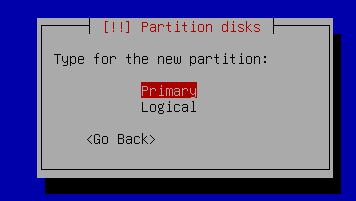
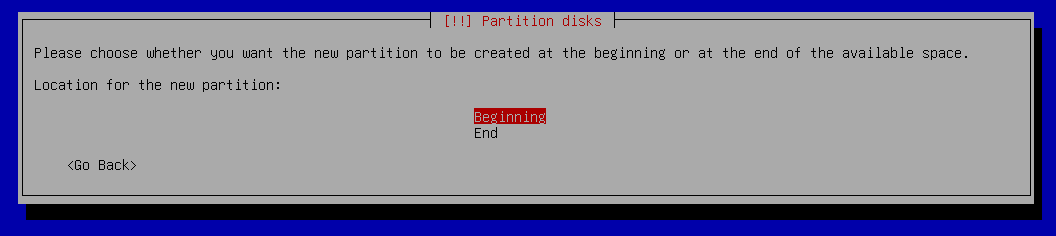
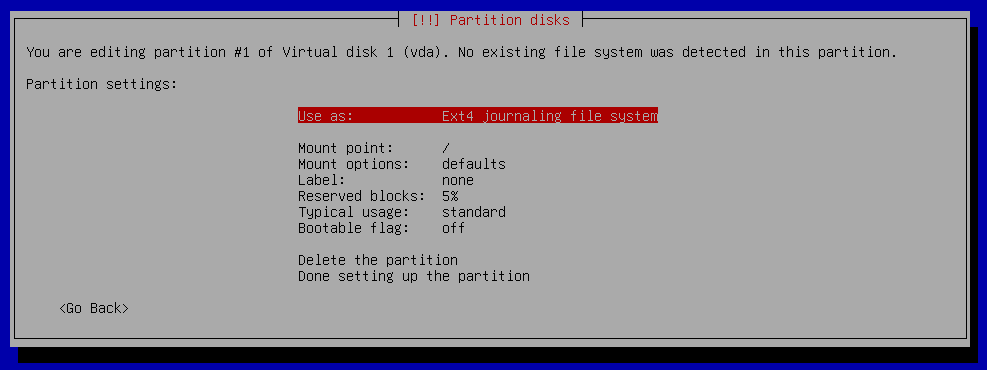
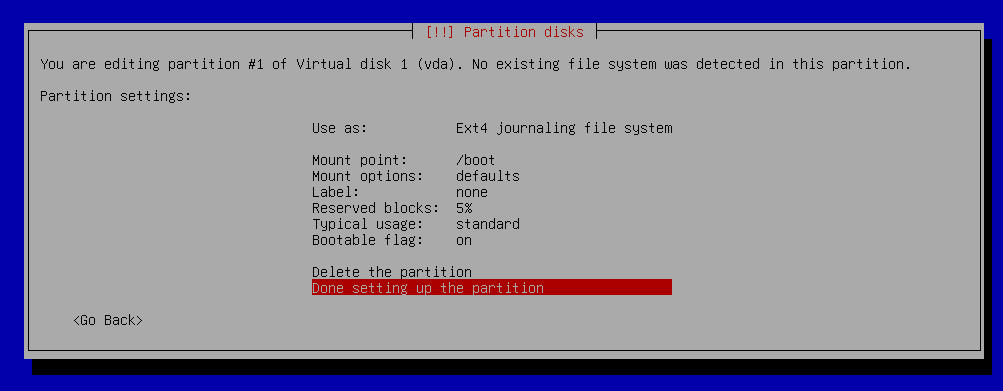
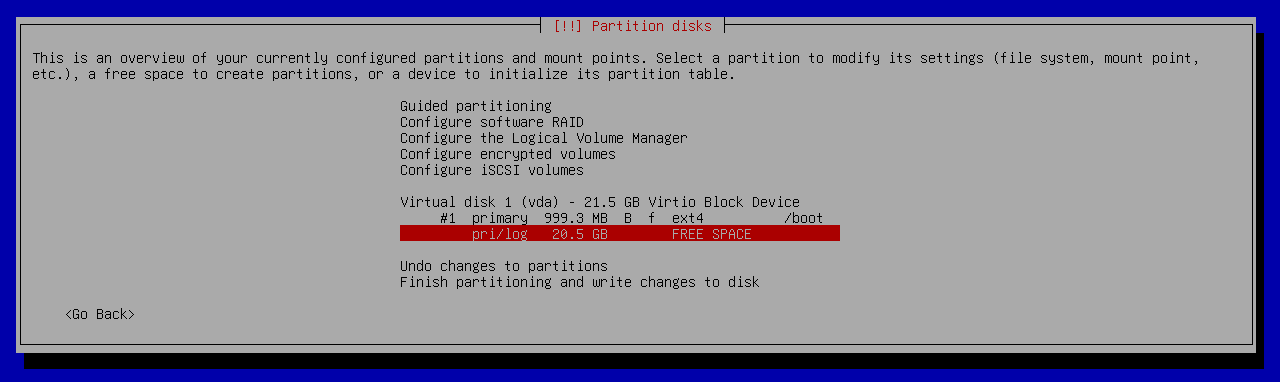
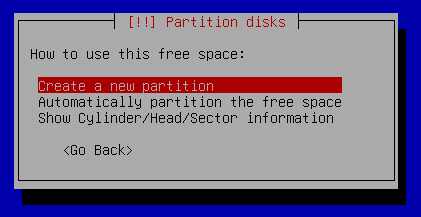
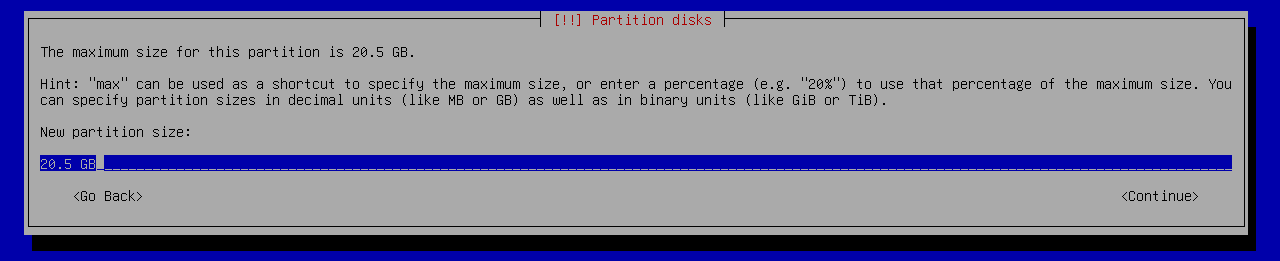
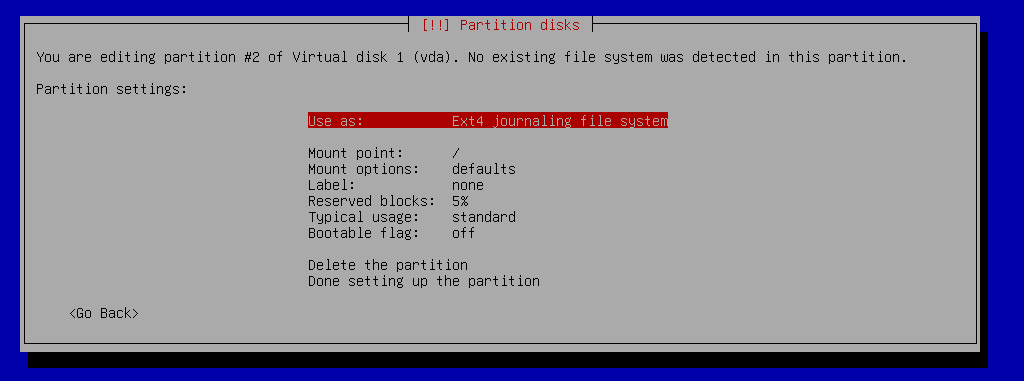
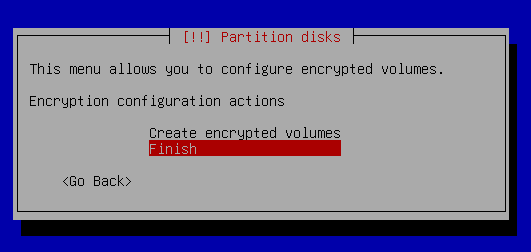
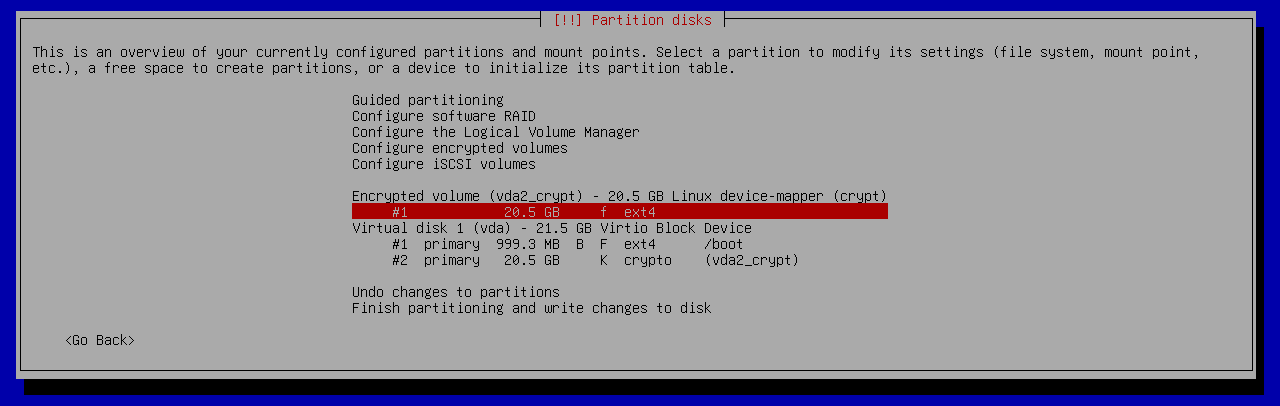
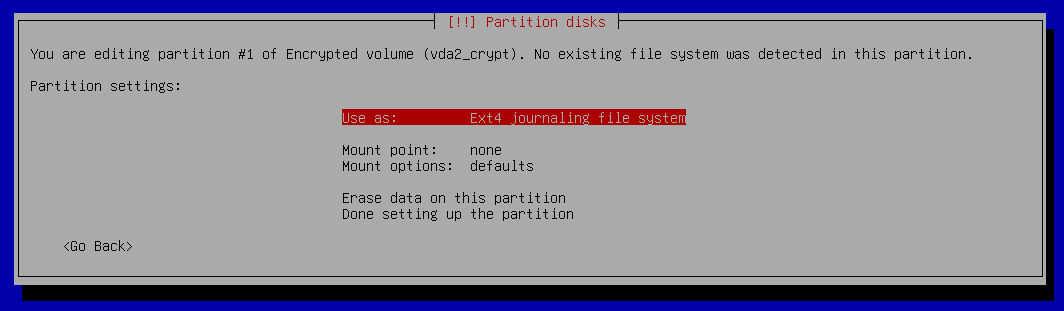
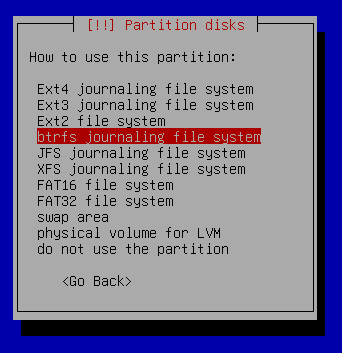
A couple of weeks ago there was an article on the Freexian blog about Using
JavaScript in Debusine without depending on
JavaScript. It
describes how JavaScript is used in the Debusine Django app, namely for
progressive enhancement rather than core functionality .
This is an approach I also follow when implementing web interfaces and I think
developments in web technologies and standardization in recent years have made
this a lot easier.
One of the examples described in the post, the Bootstrap toast messages, was
something that I implemented myself recently, in a similar but slightly
different way.
In the main app I develop for my day job we also use the Bootstrap
framework. I have also used it for different
personal projects (for example the GSOC project I did for Debian in 2018, was
also a Django app that used
Bootstrap).
Bootstrap is still primarily a CSS framework, but it also comes with a
JavaScript library for some functionality. Previous versions of Bootstrap
depended on jQuery, but since version 5 of Bootstrap, you don t need jQuery
anymore. In my experience, two of the more commonly used JavaScript utilities
of Bootstrap are modals
(also called lightbox or popup, they are elements that are displayed above
the main content of a website) and
toasts (also called
alerts, they are little notification windows that often disappear after a
timeout). The thing is, Bootstrap 5 was released in 2021 and a lot has happened
since then regarding web technologies. I believe that both these UI components
can nowadays be implemented using standard HTML5 elements.
An eye opening talk I watched was Stop using JS for
that from last years JSConf(!).
In this talk the speaker argues that the Rule of least
power is one of the core
principles of web development, which means we should use HTML over CSS and CSS
over JavaScript. And the speaker also presents some CSS rules and HTML elements
that added recently and that help to make that happen, one of them being the
dialog
element:
The <dialog> HTML element represents a modal or non-modal dialog box or other
interactive component, such as a dismissible alert, inspector, or subwindow.
The Dialog element at MDN
The baseline for this element is widely available :
This feature is well established and works across many devices and browser
versions. It s been available across browsers since March 2022.
The Dialog element at MDN
This means there is an HTML element that does what a modal Bootstrap does!
Once I had watched that talk I removed all my Bootstrap modals and replaced
them with HTML <dialog> elements (JavaScript is still needed to .show() and
.close() the elements, though, but those are two methods instead of a full
library). This meant not only that I replaced code that depended on an external
library, I m now also a lot more flexible regarding the styling of the
elements.
When I started implementing notifications for our app, my first approach was to
use Bootstrap toasts, similar to how it is implemented in Debusine. But looking
at the amount of HTML code I had to write for a simple toast message, I thought
that it might be possible to also implement toasts with the <dialog> element.
I mean, basically it is the same, only the styling is a bit different. So what
I did was that I added a #snackbar area to the DOM of the app. This would be
the container for the toast messages. All the toast messages are simply
<dialog> elements with the open attribute, which means that they are
visible right away when the page loads.
<divid="snackbar">
% for message in messages %
<dialogclass="mytoast alert alert- message.tags "role="alert"open>
message
</dialog>
% endfor %
</div>
This looks a lot simpler than the Bootstrap toasts would have.
To make the <dialog> elements a little bit more fancy, I added some CSS to make
them fade in and out:
(If one would want to use the same HTML code for both script and noscript users,
then the CSS should probably adapted: it fades away and if there is no
JavaScript to close the element, it stays visible after the animation is over.
A solution would for example be to use a close button and for noscript users
simply let it stay visible - this is also what happens with the noscript
messages in Debusine).
So there are many new elements in HTML and a lot of new features of CSS. It
makes sense to sometimes ask ourselves if instead of the solutions we know (or
what a web search / some AI shows us as the most common solution) there might
be some newer solution that was not there when the first choice was
created. Using standardized solutions instead of custom libraries makes the
software more maintainable. In web development I also prefer standardized
elements over a third party library because they have usually better
accessibility and UX.
In How Functional Programming Shaped (and Twisted) Frontend
Development
the author writes:
Consider the humble modal dialog. The web has <dialog>, a native element with
built-in functionality: it manages focus trapping, handles Escape key
dismissal, provides a backdrop, controls scroll-locking on the body, and
integrates with the accessibility tree. It exists in the DOM but remains
hidden until opened. No JavaScript mounting required.
[ ]
you ve trained developers to not even look for native solutions. The platform
becomes invisible. When someone asks how do I build a modal? , the answer is
install a library or here s my custom hook, never use <dialog>.
Ahmad Alfy
A side project I have been working on a little since last winter and
which explores extending duckdb with

mlpack is now public at the duckdb-mlpack
repo.
duckdb is an excellent small (as
in runs as a self-contained binary ) database engine with both a focus
on analytical payloads (OLAP rather than OLTP) and an impressive number
of already bolted-on extensions (for example for cloud data access)
delivered as a single-build C++ executable (or of course as a library
used from other front-ends). mlpack is
an excellent C++ library containing many/most machine learning
algorithms, also built in a self-contained manner (or library) making it
possible to build compact yet powerful binaries, or to embed (as opposed
to other ML framework accessed from powerful but not lightweight
run-times such as Python or R). The compact build aspect as well as the
common build tools (C++, cmake) make these two a natural candidate for
combining them. Moreover, duckdb is a
champion of data access, management and control and the complementary
machine learning insights and predictions offered by mlpack are fully complementary and hence
fit this rather well.
duckdb also has a very robust and
active extension system. To use it, one starts from a template
repository and its use this template button, runs a script and can
then start experimenting. I have now grouped my initial start and test
functions into a separate repository duckdb-example-extension
to keep the duckdb-mlpack
one focused on the extend to mlpack aspect.
duckdb-mlpack
is right an MVP , i.e. a minimally viable product (or demo). It just
runs the adaboost classifier but does so on any dataset
fitting the rectangular setup with columns of features (real valued)
and a final column (integer valued) of labels. I had hope to use two
select queries for both features and then labels but it
turns a table function (returning a table of data from a query) can
only run one select *. So the basic demo, also on the repo
README is now to run the following script (where the
SELECT * FROM mlpack_adaboost((SELECT * FROM D)); is the
key invocation of the added functionality):
#!/bin/bashcat<<EOFbuild/release/duckdbSET autoinstall_known_extensions=1;SET autoload_known_extensions=1; # for httpfsCREATE TEMP TABLE Xd AS SELECT * FROM read_csv("https://mlpack.org/datasets/iris.csv");CREATE TEMP TABLE X AS SELECT row_number() OVER () AS id, * FROM Xd;CREATE TEMP TABLE Yd AS SELECT * FROM read_csv("https://mlpack.org/datasets/iris_labels.csv");CREATE TEMP TABLE Y AS SELECT row_number() OVER () AS id, CAST(column0 AS double) as label FROM Yd;CREATE TEMP TABLE D AS SELECT * FROM X INNER JOIN Y ON X.id = Y.id;ALTER TABLE D DROP id;ALTER TABLE D DROP id_1;CREATE TEMP TABLE A AS SELECT * FROM mlpack_adaboost((SELECT * FROM D));SELECT COUNT(*) as n, predicted FROM A GROUP BY predicted;EOF
(Note that this requires the httpfs extension. So when
you build from a freshly created extension repository you may be ahead
of the most recent release of duckdb by a few commits. It
is easy to check out the most recent release tag (or maybe the one you
are running for your local duckdb binary) to take advantage
of the extensions you likely already have for that version. So here, and
in the middle of October 2025, I picked v1.4.1 as I run
duckdb version 1.4.1 on my box.)
There are many other neat duckdb
extensions. The core ones are regrouped here
while a list of community extensions is here
and here.
For this (still more minimal) extension, I added a few TODO items to
the README.md:
More examples of model fitting and prediction
Maybe set up model serialization into table to predict on new
data
Ideally: Work out how to SELECT from multiple tabels,
or else maybe SELECT into temp. tables and pass temp. table
names into routine
Maybe add mlpack as a git submodule
Please reach out if you are interested in working on any of this.
Tobias Frost
did 5.0h (out of 0.0h assigned and 8.0h from previous period), thus carrying over 3.0h to the next month.
Utkarsh Gupta
did 16.5h (out of 14.25h assigned and 6.75h from previous period), thus carrying over 4.5h to the next month.
Evolution of the situation
In September, we released 38 DLAs.
Notable security updates:
modsecurity-apache prepared by Adrian Bunk, fixes a cross-site scripting vulnerability
cups, prepared by Thorsten Alteholz, fixes authentication bypass and denial of service vulnerabilities
jetty9, prepared by Adrian Bunk, fixes the MadeYouReset vulnerability (a recent, well-known denial of service vulnerability)
python-django, prepared by Chris Lamb, fixes a SQL injection vulnerability
firefox-esr and thunderbird, prepared by Emilio Pozuelo Monfort, were updated from the 128.x ESR series to the 140.x ESR series, fixing a number of vulnerabilities as well
Notable non-security updates:
wireless-regdb prepared by Ben Hutchings, updates information reflecting changes to radio regulations in many countries
There was one package update contributed by a Debian Developer outside of the LTS Team: an update of node-tar-fs, prepared by Xavier Guimard (a member of the Node packaging team).
Finally, LTS Team members also contributed updates of the following packages:
libxslt (to stable and oldstable), prepared by Guilhem Moulin, to address a regression introduced in a previous security update
libphp-adodb (to stable and oldstable), prepared by Abhijith PA
cups (to stable and oldstable), prepared by Thorsten Alteholz
u-boot (to oldstable), prepared by Daniel Leidert and Jochen Sprickerhof
libcommongs-lang3-java (to stable and oldstable), prepared by Daniel Leidert
python-internetarchive (to oldstable), prepared by Daniel Leidert
One other notable contribution by a member of the LTS Team is that Sylvain Beucler proposed a fix upstream for CVE-2025-2760 in gimp2. Upstream no longer supports gimp2, but it is still present in Debian LTS, and so proposing this fix upstream is of benefit to other distros which may still be supporting the older gimp2 packages.
Thanks to our sponsors
Sponsors that joined recently are in bold.
Debian LTS
This was my hundred-thirty-fifth month that I did some work for the Debian LTS initiative, started by Raphael Hertzog at Freexian. During my allocated time I uploaded or worked on:
[DLA 4168-2] openafs regression update to fix an incomplete patch in the previous upload.
[DSA 5998-1] cups security update to fix two CVEs related to a authentication bypass and a denial of service.
[DLA 4298-1] cups security update to fix two CVEs related to a authentication bypass and a denial of service.
[DLA 4304-1] cjson security update to fix one CVE related to an out-of-bounds memory access.
[DLA 4307-1] jq security update to fix one CVE related to a heap buffer overflow.
[DLA 4308-1] corosync security update to fix one CVE related to a stack-based buffer overflow.
An upload of spim was not needed, as the corresponding CVE could be marked as ignored.
I also started to work on an open-vm-tools and attended the monthly LTS/ELTS meeting.
Debian ELTS
This month was the eighty-sixth ELTS month. During my allocated time I uploaded or worked on:
[ELA-1512-1] cups security update to fix two CVEs in Buster and Stretch, related to a authentication bypass and a denial of service.
[ELA-1520-1] jq security update to fix one CVE in Buster and Stretch, related to a heap buffer overflow.
[ELA-1524-1] corosync security update to fix one CVE in Buster and Stretch, related to a stack-based buffer overflow.
[ELA-1527-1] mplayer security update to fix ten CVEs in Stretch, distributed all over the code.
The CVEs for open-vm-tools could be marked as not-affeceted as the corresponding plugin was not yet available. I also attended the monthly LTS/ELTS meeting.
Debian Printing
This month I uploaded a new upstream version or a bugfix version of:
misc
The main topic of this month has been gcc15 and cmake4, so my upload rate was extra high. This month I uploaded a new upstream version or a bugfix version of:
I wonder what MBF will happen next, I guess the /var/lock-issue will be a good candidate.
On my fight against outdated RFPs, I closed 30 of them in September. Meanwhile only 3397 are still open, so don t hesitate to help closing one or another.
FTP master
This month I accepted 294 and rejected 28 packages. The overall number of packages that got accepted was 294.
In December 2024, I went on a trip through four countries - Singapore, Malaysia, Brunei, and Vietnam - with my friend Badri. This post covers our experiences in Singapore.
I took an IndiGo flight from Delhi to Singapore, with a layover in Chennai. At the Chennai airport, I was joined by Badri. We had an early morning flight from Chennai that would land in Singapore in the afternoon. Within 48 hours of our scheduled arrival in Singapore, we submitted an arrival card online. At immigration, we simply needed to scan our passports at the gates, which opened automatically to let us through, and then give our address to an official nearby. The process was quick and smooth, but it unfortunately meant that we didn t get our passports stamped by Singapore.
Before I left the airport, I wanted to visit the nature-themed park with a fountain I saw in pictures online. It is called Jewel Changi, and it took quite some walking to get there. After reaching the park, we saw a fountain that could be seen from all the levels. We roamed around for a couple of hours, then proceeded to the airport metro station to get to our hotel.
A shot of Jewel Changi. Photo by Ravi Dwivedi. Released under the CC-BY-SA 4.0.
There were four ATMs on the way to the metro station, but none of them provided us with any cash. This was the first country (outside India, of course!) where my card didn t work at ATMs.
To use the metro, one can tap the EZ-Link card or bank cards at the AFC gates to get in. You cannot buy tickets using cash. Before boarding the metro, I used my credit card to get Badri an EZ-Link card from a vending machine. It was 10 Singapore dollars ( 630) - 5 for the card, and 5 for the balance. I had planned to use my Visa credit card to pay for my own fare. I was relieved to see that my card worked, and I passed through the AFC gates.
We had booked our stay at a hostel named Campbell s Inn, which was the cheapest we could find in Singapore. It was 1500 per night for dorm beds. The hostel was located in Little India. While Little India has an eponymous metro station, the one closest to our hostel was Rochor.
On the way to the hostel, we found out that our booking had been canceled.
We had booked from the Hostelworld website, opting to pay the deposit in advance and to pay the balance amount in person upon reaching. However, Hostelworld still tried to charge Badri s card again before our arrival. When the unauthorized charge failed, they sent an automatic message saying we tried to charge and to contact them soon to avoid cancellation, which we couldn t do as we were in the plane.
Despite this, we went to the hostel to check the status of our booking.
The trip from the airport to Rochor required a couple of transfers. It was 2 Singapore dollars (approx. 130) and took approximately an hour.
Upon reaching the hostel, we were informed that our booking had indeed been canceled, and were not given any reason for the cancelation. Furthermore, no beds were available at the hostel for us to book on the spot.
We decided to roam around and look for accommodation at other hostels in the area. Soon, we found a hostel by the name of Snooze Inn, which had two beds available. It was 36 Singapore dollars per person (around 2300) for a dormitory bed. Snooze Inn advertised supporting RuPay cards and UPI. Some other places in that area did the same. We paid using my card. We checked in and slept for a couple of hours after taking a shower.
By the time we woke up, it was dark. We met Praveen s friend Sabeel to get my FLX1 phone. We also went to Mustafa Center nearby to exchange Indian rupees for Singapore dollars. Mustafa Center also had a shopping center with shops selling electronic items and souvenirs, among other things. When we were dropping off Sabeel at a bus stop, we discovered that the bus stops in Singapore had a digital board mentioning the bus routes for the stop and the number of minutes each bus was going to take.
In addition to an organized bus system, Singapore had good pedestrian infrastructure. There were traffic lights and zebra crossings for pedestrians to cross the roads. Unlike in Indian cities, rules were being followed. Cars would stop for pedestrians at unmanaged zebra crossings; pedestrians would in turn wait for their crossing signal to turn green before attempting to walk across. Therefore, walking in Singapore was easy.
Traffic rules were taken so seriously in Singapore I (as a pedestrian) was afraid of unintentionally breaking them, which could get me in trouble, as breaking rules is dealt with heavy fines in the country. For example, crossing roads without using a marked crossing (while being within 50 meters of it) - also known as jaywalking - is an offence in Singapore.
Moreover, the streets were litter-free, and cleanliness seemed like an obsession.
After exploring Mustafa Center, we went to a nearby 7-Eleven to top up Badri s EZ-Link card. He gave 20 Singapore dollars for the recharge, which credited the card by 19.40 Singapore dollars (0.6 dollars being the recharge fee).
When I was planning this trip, I discovered that the World Chess Championship match was being held in Singapore. I seized the opportunity and bought a ticket in advance. The next day - the 5th of December - I went to watch the 9th game between Gukesh Dommaraju of India and Ding Liren of China. The venue was a hotel on Sentosa Island, and the ticket was 70 Singapore dollars, which was around 4000 at the time.
We checked out from our hostel in the morning, as we were planning to stay with Badri s aunt that night. We had breakfast at a place in Little India. Then we took a couple of buses, followed by a walk to Sentosa Island. Paying the fare for the buses was similar to the metro - I tapped my credit card in the bus, while Badri tapped his EZ-Link card. We also had to tap it while getting off.
If you are tapping your credit card to use public transport in Singapore, keep in mind that the total amount of all the trips taken on a day is deducted at the end. This makes it hard to determine the cost of individual trips. For example, I could take a bus and get off after tapping my card, but I would have no way to determine how much this journey cost.
When you tap in, the maximum fare amount gets deducted. When you tap out, the balance amount gets refunded (if it s a shorter journey than the maximum fare one). So, there is incentive for passengers not to get off without tapping out. Going by your card statement, it looks like all that happens virtually, and only one statement comes in at the end. Maybe this combining only happens for international cards.
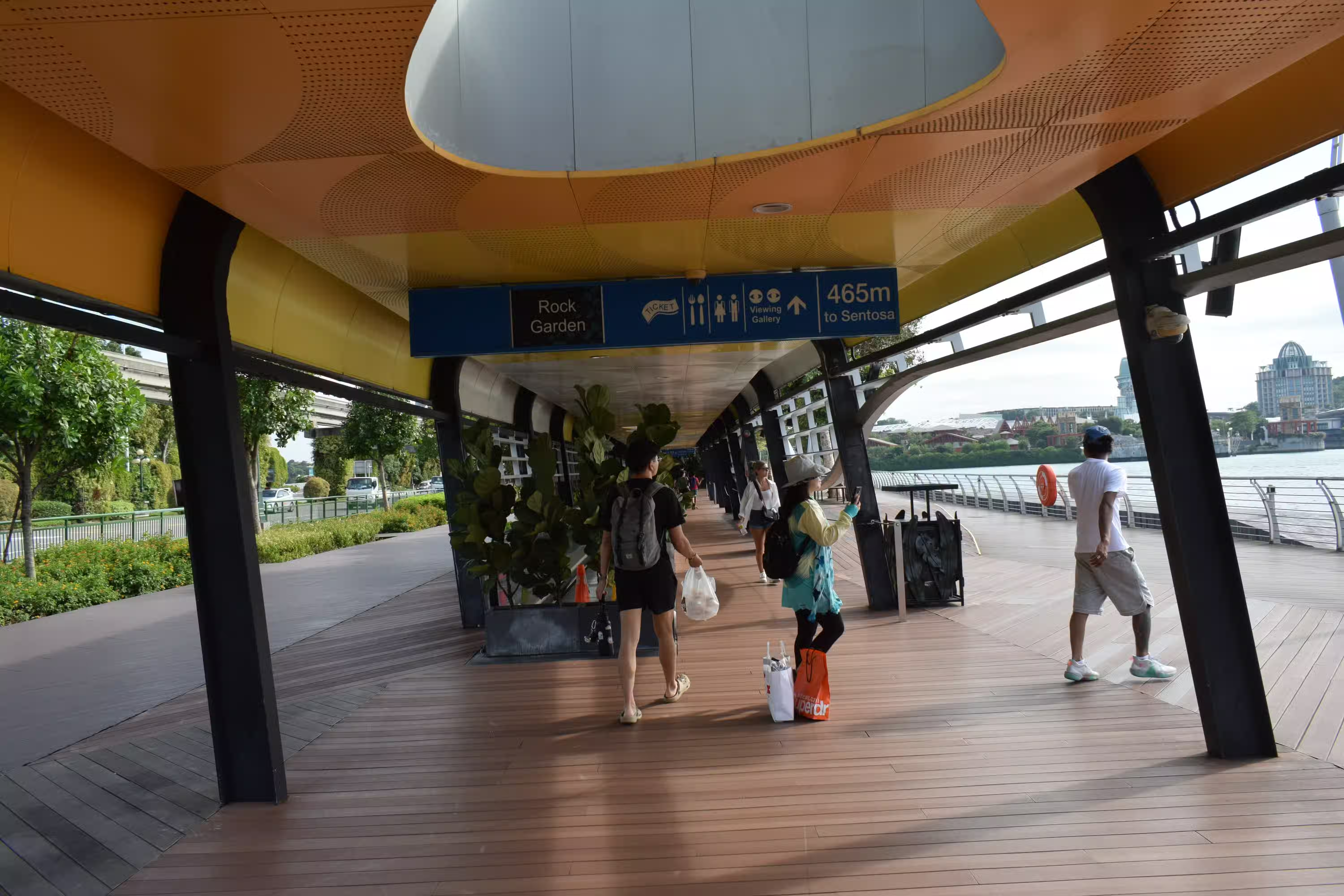
We got off the bus a kilometer away from Sentosa Island and walked the rest of the way. We went on the Sentosa Boardwalk, which is itself a tourist attraction. I was using Organic Maps to navigate to the hotel Resorts World Sentosa, but Organic Maps route led us through an amusement park. I tried asking the locals (people working in shops) for directions, but it was a Chinese-speaking region, and they didn t understand English. Fortunately, we managed to find a local who helped us with the directions.
A shot of Sentosa Boardwalk. Photo by Ravi Dwivedi. Released under the CC-BY-SA 4.0.
Following the directions, we somehow ended up having to walk on a road which did not have pedestrian paths. Singapore is a country with strict laws, so we did not want to walk on that road. Avoiding that road led us to the Michael Hotel. There was a person standing at the entrance, and I asked him for directions to Resorts World Sentosa. The person told me that the bus (which was standing at the entrance) would drop me there! The bus was a free service for getting to Resorts World Sentosa. Here I parted ways with Badri, who went to his aunt s place.
I got to the Resorts Sentosa and showed my ticket to get in. There were two zones inside - the first was a room with a glass wall separating the audience and the players. This was the room to watch the game physically, and resembled a zoo or an aquarium. :) The room was also a silent room, which means talking or making noise was prohibited. Audiences were only allowed to have mobile phones for the first 30 minutes of the game - since I arrived late, I could not bring my phone inside that room.
The other zone was outside this room. It had a big TV on which the game was being broadcast along with commentary by David Howell and Jovanka Houska - the official FIDE commentators for the event. If you don t already know, FIDE is the authoritative international chess body.
I spent most of the time outside that silent room, giving me an opportunity to socialize. A lot of people were from Singapore. I saw there were many Indians there as well. Moreover, I had a good time with Vasudevan, a journalist from Tamil Nadu who was covering the match. He also asked questions to Gukesh during the post-match conference. His questions were in Tamil to lift Gukesh s spirits, as Gukesh is a Tamil speaker.
Tea and coffee were free for the audience. I also bought a T-shirt from their stall as a souvenir.
After the game, I took a shuttle bus from Resorts World Sentosa to a metro station, then travelled to Pasir Ris by metro, where Badri was staying with his aunt. I thought of getting something to eat, but could not find any caf s or restaurants while I was walking from the Pasir Ris metro station to my destination, and was positively starving when I got there.
Badri s aunt s place was an apartment in a gated community. On the gate was a security guard who asked me the address of the apartment. Upon entering, there were many buildings. To enter the building, you need to dial the number of the apartment you want to go to and speak to them. I had seen that in the TV show Seinfeld, where Jerry s friends used to dial Jerry to get into his building.
I was afraid they might not have anything to eat because I told them I was planning to get something on the way. This was fortunately not the case, and I was relieved to not have to sleep with an empty stomach.
Badri s uncle gave us an idea of how safe Singapore is. He said that even if you forget your laptop in a public space, you can go back the next day to find it right there in the same spot. I also learned that owning cars was discouraged in Singapore - the government imposes a high registration fee on them, while also making public transport easy to use and affordable. I also found out that 7-Eleven was not that popular among residents in Singapore, unlike in Malaysia or Thailand.
The next day was our third and final day in Singapore. We had a bus in the evening to Johor Bahru in Malaysia. We got up early, had breakfast, and checked out from Badri s aunt s home. A store by the name of Cat Socrates was our first stop for the day, as Badri wanted to buy some stationery. The plan was to take the metro, followed by the bus. So we got to Pasir Ris metro station. Next to the metro station was a mall. In the mall, Badri found an ATM where our cards worked, and we got some Singapore dollars.
It was noon when we reached the stationery shop mentioned above. We had to walk a kilometer from the place where the bus dropped us. It was a hot, sunny day in Singapore, so walking was not comfortable. We had to go through residential areas in Singapore. We saw some non-touristy parts of Singapore.
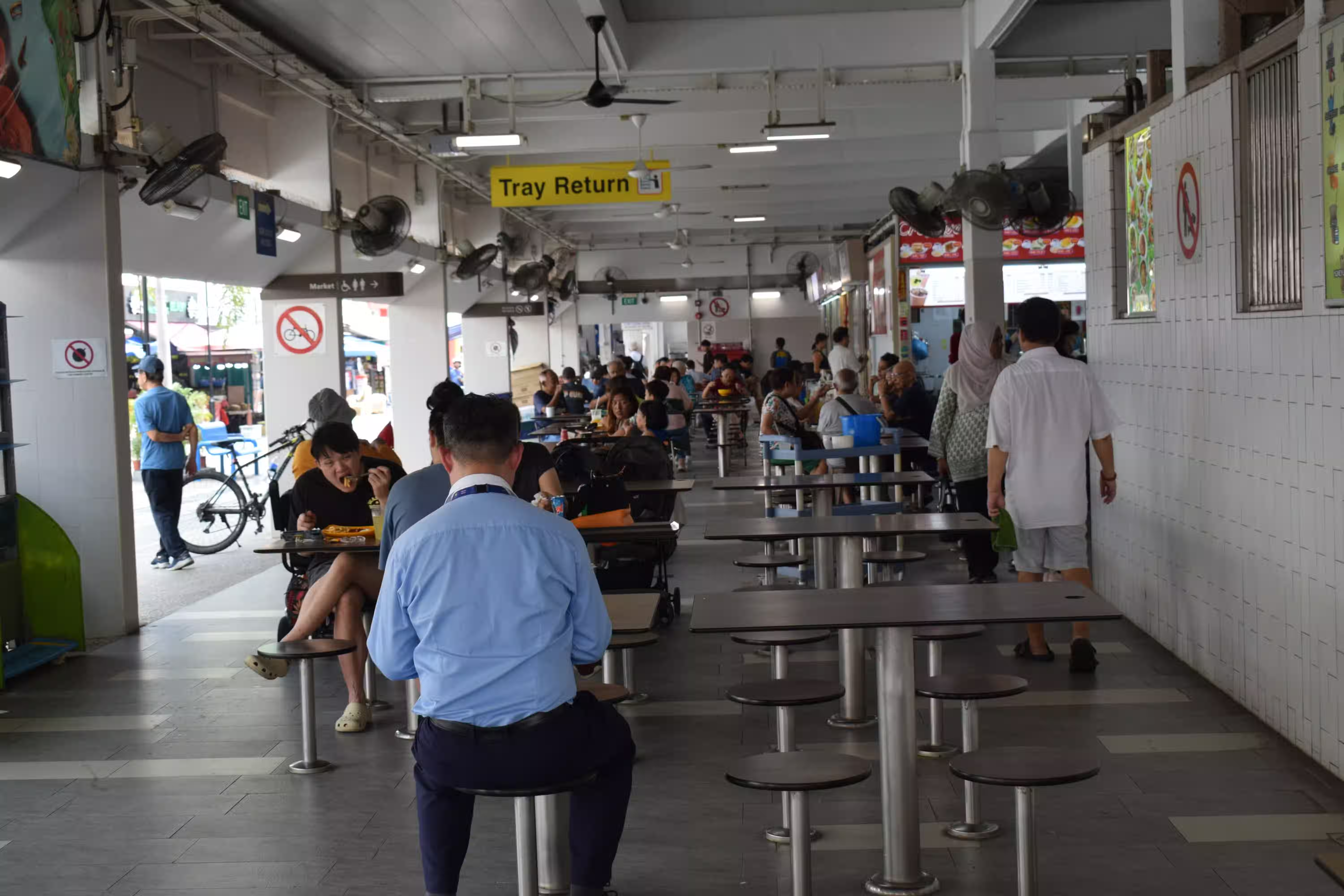
After we were done with the stationery shop, we went to a hawker center to get lunch. Hawker centers are unique to Singapore. They have a lot of shops that sell local food at cheap prices. It is similar to a food court. However, unlike the food courts in malls, hawker centers are open-air and can get quite hot.
This is the hawker center we went to. Photo by Ravi Dwivedi. Released under the CC-BY-SA 4.0.
To have something, you just need to buy it from one of the shops and find a table. After you are done, you need to put your tray in the tray-collecting spots. I had a kaya toast with chai, since there weren t many vegetarian options. I also bought a persimmon from a nearby fruit vendor. On the other hand, Badri sampled some local non-vegetarian dishes.
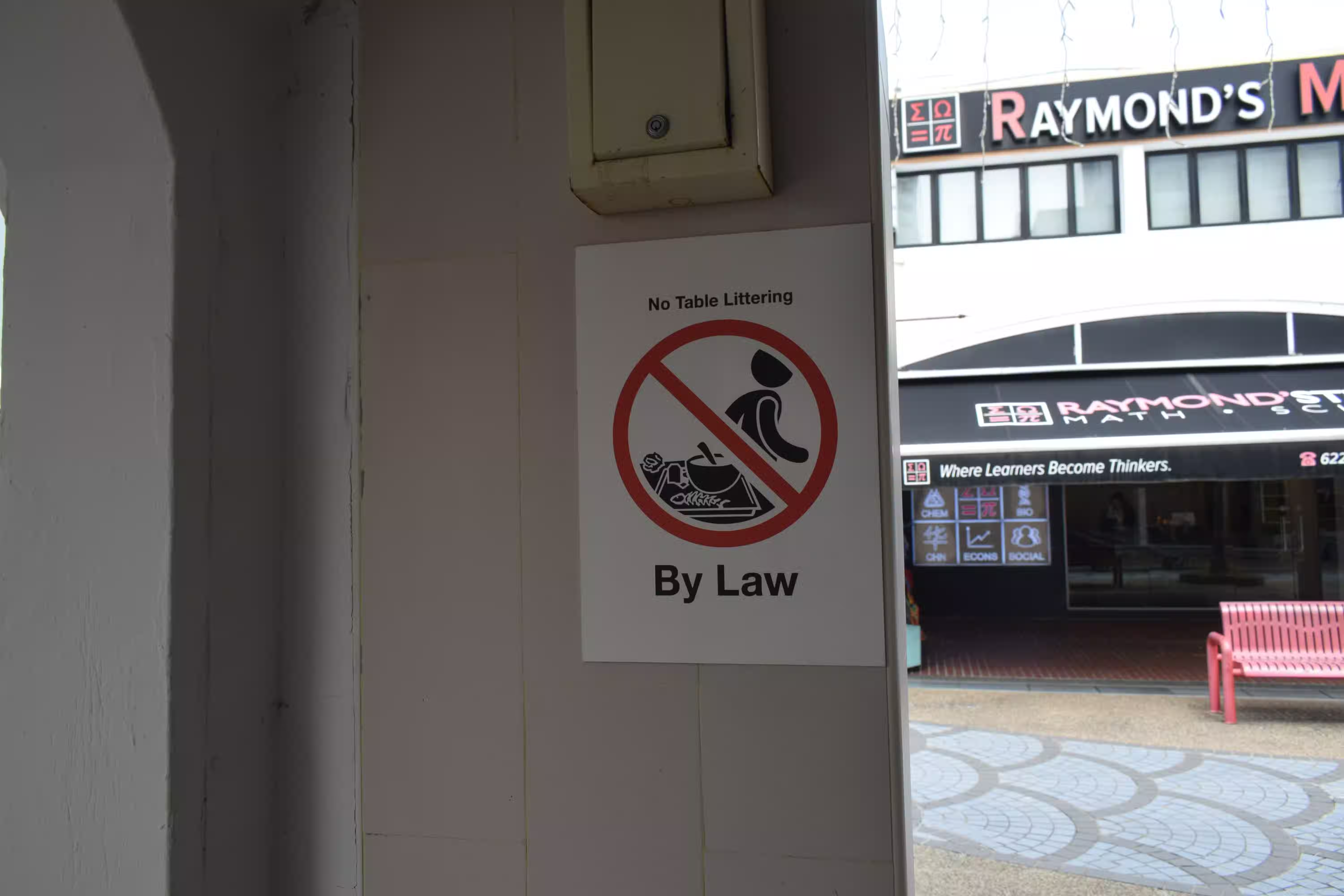
Table littering at the hawker center was prohibited by law. Photo by Ravi Dwivedi. Released under the CC-BY-SA 4.0.
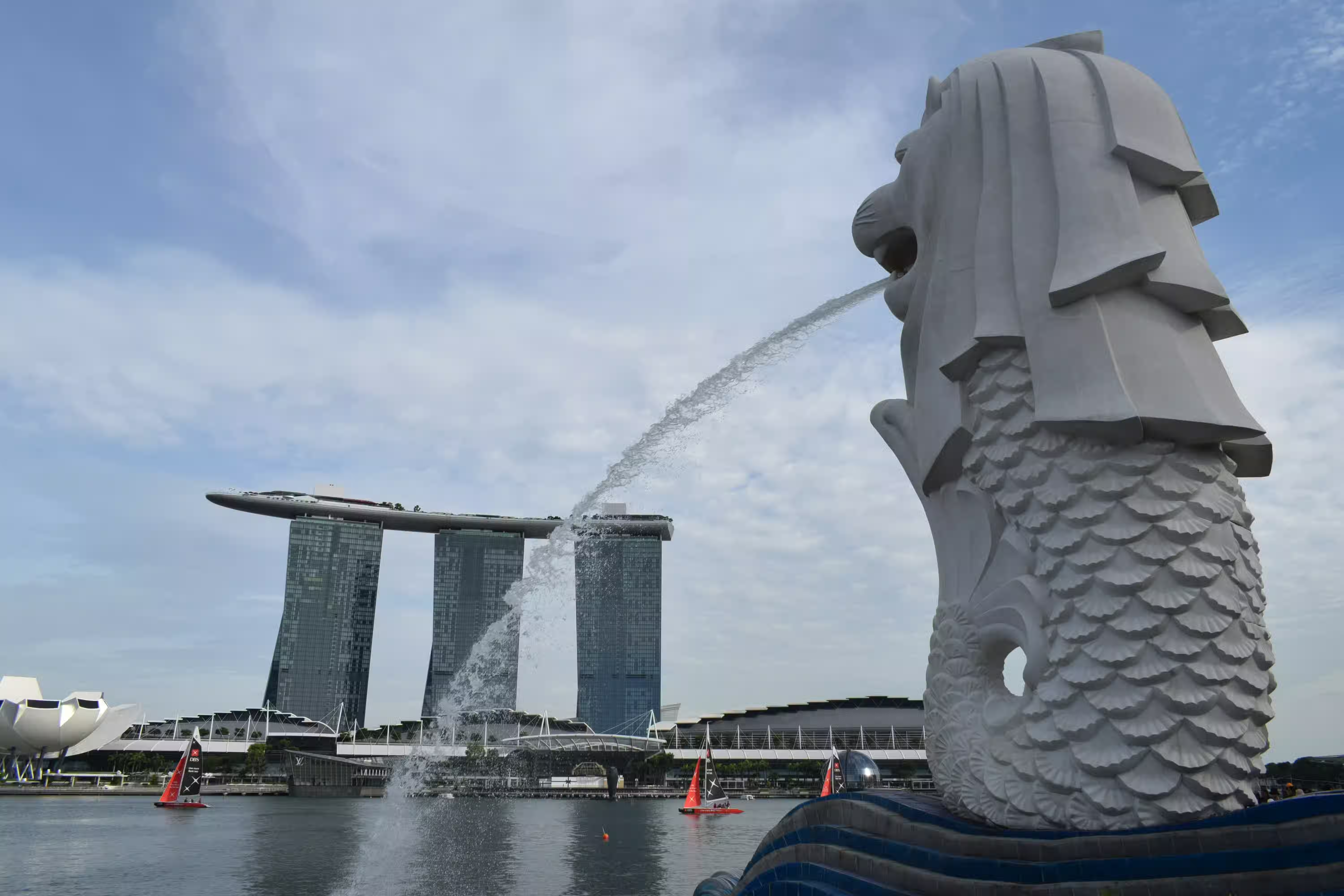
Next, we took a metro to Raffles Place, as we wanted to visit Merlion, the icon of Singapore. It is a statue having the head of a lion and the body of a fish. While getting through the AFC gates, my card was declined. Therefore, I had to buy an EZ-Link card, which I had been avoiding because the card itself costs 5 Singapore dollars.
From the Raffles Place metro station, we walked to Merlion. The place also gave a nice view of Marina Bay Sands. It was filled with tourists clicking pictures, and we also did the same.
Merlion from behind, giving a good view of Marina Bay Sands. Photo by Ravi Dwivedi. Released under the CC-BY-SA 4.0.
After this, we went to the bus stop to catch our bus to the border city of Johor Bahru, Malaysia. The bus was more than an hour late, and we worried that we had missed the bus. I asked an Indian woman at the stop who also planned to take the same bus, and she told us that the bus was late. Finally, our bus arrived, and we set off for Johor Bahru.
Before I finish, let me give you an idea of my expenditure. Singapore is an expensive country, and I realized that expenses could go up pretty quickly. Overall, my stay in Singapore for 3 days and 2 nights was approx. 5500 rupees. That too, when we stayed one night at Badri s aunt s place (so we didn t have to pay for accomodation for one of the nights) and didn t have to pay for a couple of meals. This amount doesn t include the ticket for the chess game, but includes the costs of getting there. If you are in Singapore, it is likely you will pay a visit to Sentosa Island anyway.
Stay tuned for our experiences in Malaysia!
Credits: Thanks to Dione, Sahil, Badri and Contrapunctus for reviewing the draft. Thanks to Bhe for spotting a duplicate sentence.
Many people that were once enthusiast Twitter users have dropped as a
direct or indirect effect of its ownership change and the following policy
changes. Given Twitter X is getting each time more irrelevant, it is
less interesting and enciting for more and more people But also, its
current core users (mostly, hate-apologists of the right-wing mindset that
finds conspiration theories everywhere) are becoming more commonplace, and
by sheer probability (if not for algorithmic bias), every time it becomes
more likely a given piece of content will be linked to what their authors
would classify as crap.
So, there has been in effect an X exodus. This has been reported in media
outlets as important as Reuters, or The
Guardianresearch
institutes such as
Berkeley,
even media that no matter how hard you push cannot be identified as the
radical left Mr. Trump is so happy to blame for everything, such as
Forbes
Today I read a short note in a magazine I very much enjoy, Communications
of the ACM, where SIGDOC (the ACM s Special Interest
Group on Design of Communication) is officially closing their X
account. The reasoning is crystal clear. They have the mission to create
and study User Experience (UX) implementations and report on it, focused
on making communication clearer and more human centered . That is no
longer, for many reasons, a goal that can be furthered by the means of an X
account.
(BTW, and How many people are actually angry that Mr. Musk took the X11
old logo and made it his? I am sure it is now protected under too many
layers of legalese, even though I am aware of it since at least 30 years
ago )
Introduction and some stats
We announced tag2upload s open beta in mid-July. That was in the middle of the the freeze for trixie, so usage was fairly light until the forky floodgates opened.
Since then the service has successfully performed 637 uploads, of which 420 were in the last 32 days. That s an average of about 13 per day. For comparison, during the first half of September up to today there have been 2475 uploads to unstable. That s about 176/day.
So, tag2upload is already handling around 7.5% of uploads. This is very gratifying for a service which is advertised as still being in beta!
Sean and I are very pleased both with the uptake, and with the way the system has been performing.
Recent UI/UX improvements
During this open beta period we have been hard at work. We have made many improvements to the user experience.
Current git-debpush in forky, or trixie-backports, is much better at detecting various problems ahead of time.
When uploads do fail on the service the emailed error reports are now more informative. For example, anomalies involving orig tarballs, which by definition can t be detected locally (since one point of tag2upload is not to have tarballs locally) now generally result in failure reports containing a diffstat, and instructions for a local repro.
Why we are still in beta
There are a few outstanding work items that we currently want to complete before we declare the end of the beta.
Retrying on Salsa-side failures
The biggest of these is that the service should be able to retry when Salsa fails. Sadly, Salsa isn t wholly reliable, and right now if it breaks when the service is trying to handle your tag, your upload can fail.
We think most of these failures could be avoided. Implementing retries is a fairly substantial task, but doesn t pose any fundamental difficulties. We re working on this right now.
Other notable ongoing work
We want to support pristine-tar, so that pristine-tar users can do a new upstream release. Andrea Pappacoda is working on that with us. See #1106071. (Note that we would generally recommend against use of pristine-tar within Debian. But we want to support it.)
We have been having conversations with Debusine folks about what integration between tag2upload and Debusine would look like. We re making some progress there, but a lot is still up in the air.
We are considering how best to provide tag2upload pre-checks as part of Salsa CI. There are several problems detected by the tag2upload service that could be detected by Salsa CI too, but which can t be detected by git-debpush.
Common problems
We ve been monitoring the service and until very recently we have investigated every service-side failure, to understand the root causes. This has given us insight into the kinds of things our users want, and the kinds of packaging and git practices that are common. We ve been able to improve the system s handling of various anomalies and also improved the documentation.
Right now our failure rate is still rather high, at around 7%. Partly this is because people are trying out the system on packages that haven t ever seen git tooling with such a level of rigour.
There are two classes of problem that are responsible for the vast majority of the failures that we re still seeing:
Reuse of version numbers, and attempts to re-tag
tag2upload, like git (and like dgit), hates it when you reuse a version number, or try to pretend that a (perhaps busted) release never happened.
git tags aren t namespaced, and tend to spread about promiscuously. So replacing a signed git tag, with a different tag of the same name, is a bad idea. More generally, reusing the same version number for a different (signed!) package is poor practice. Likewise, it s usually a bad idea to remove changelog entries for versions which were actually released, just because they were later deemed improper.
We understand that many Debian contributors have gotten used to this kind of thing. Indeed, tools like dcut encourage it. It does allow you to make things neat-looking, even if you ve made mistakes - but really it does so by covering up those mistakes!
The bottom line is that tag2upload can t support such history-rewriting. If you discover a mistake after you ve signed the tag, please just burn the version number and add a new changelog stanza.
One bonus of tag2upload s approach is that it will discover if you are accidentally overwriting an NMU, and report that as an error.
Discrepancies between git and orig tarballs
tag2upload promises that the source package that it generates corresponds precisely to the git tree you tag and sign.
Orig tarballs make this complicated. They aren t present on your laptop when you git-debpush. When you re not uploading a new upstream version, the tag2upload service reuses existing orig tarballs from the archive. If your git and the archive s orig don t agree, the tag2upload service will report an error, rather than upload a package with contents that differ from your git tag.
With the most common Debian workflows, everything is fine:
If you base everything on upstream git, and make your orig tarballs with git archive (or git deborig), your orig tarballs are the same as the git, by construction. We recommend usually ignoring upstream tarballs: most upstreams work in git, and their tarballs can contain weirdness that we don t want. (At worst, the tarball can contain an attack that isn t visible in git, as with xz!)
Alternatively, if you use gbp import-orig, the differences (including an attack like Jia Tan s) are imported into git for you. Then, once again, your git and the orig tarball will correspond.
But there are other workflows where this correspondence may not hold. Those workflows are hazardous, because the thing you re probably working with locally for your routine development is the git view. Then, when you upload, your work is transplanted onto the orig tarball, which might be quite different - so what you upload isn t what you ve been working on!
This situation is detected by tag2upload, precisely because tag2upload checks that it s keeping its promise: the source package is identical to the git view. (dgit push makes the same promise.)
Get involved
Of course the easiest way to get involved is to start using tag2upload.
We would love to have more contributors. There are some easy tasks to get started with, in bugs we ve tagged newcomer mostly UX improvements such as detecting certain problems earlier, in git-debpush.
More substantially, we are looking for help with sbuild: we d like it to be able to work directly from git, rather than needing to build source packages: #868527.
In my post yesterday, ARM is great, ARM is terrible (and so is RISC-V), I described my desire to find ARM hardware with AES instructions to support full-disk encryption, and the poor state of the OS ecosystem around the newer ARM boards.
I was anticipating buying either a newer ARM SBC or an x86 mini PC of some sort.
More-efficient AES alternatives
Always one to think, what if I didn t have to actually buy something , I decided to research whether it was possible to use encryption algorithms that are more performant on the Raspberry Pi 4 I already have.
The answer was yes. From cryptsetup benchmark:
root@mccoy:~# cryptsetup benchmark --cipher=xchacha12,aes-adiantum-plain64
# Tests are approximate using memory only (no storage IO).
# Algorithm Key Encryption Decryption
xchacha12,aes-adiantum 256b 159.7 MiB/s 160.0 MiB/s
xchacha20,aes-adiantum 256b 116.7 MiB/s 169.1 MiB/s
aes-xts 256b 52.5 MiB/s 52.6 MiB/s
With best-case reads from my SD card at 45MB/s (with dd if=/dev/mmcblk0 of=/dev/null bs=1048576 status=progress), either of the ChaCha-based algorithms will be fast enough. Great, I thought. Now I can just solve this problem without spending a dollar.
But not so fast.
Serial terminals vs. serial consoles
My primary use case for this device is to drive my actual old DEC vt510 terminal. I have long been able to do that by running a getty for my FTDI-based USB-to-serial converter on /dev/ttyUSB0. This gets me a login prompt, and I can do whatever I need from there.
This does not get me a serial console, however. The serial console would show kernel messages and could be used to interact with the pre-multiuser stages of the system that is, everything before the loging prompt. You can use it to access an emergency shell for repair, etc.
Although I have long booted that kernel with console=tty0 console=ttyUSB0,57600, the serial console has never worked but I d never bothered investigating because the text terminal was sufficient.
You might be seeing where this is going: to have root on an encrypted LUKS volume, you have to enter the decryption password in the pre-multiuser environment (which happens to be on the initramfs).
So I started looking. First, I extracted the initrd with cpio and noticed that the ftdi_sio and usbserial modules weren t present. Added them to /etc/initramfs-tools/modules and rebooted; no better.
So I found the kernel s serial console guide, which explicitly notes To use a serial port as console you need to compile the support into your kernel . Well, I have no desire to custom-build a kernel on a Raspberry Pi with MicroSD storage every time a new kernel comes out.
I thought well I don t stricly need the kernel to know about the console on /dev/ttyUSB0 for this; I just need the password prompt which comes from userspace to know about it.
So I looked at the initramfs code, and wouldn t you know it, it uses /dev/console. Looking at /proc/consoles on that system, indeed it doesn t show ttyUSB0. So even though it is possible to load the USB serial driver in the initramfs, there is no way to make the initramfs use it, because it only uses whatever the kernel recognizes as a console, and the kernel won t recognize this. So there is no way to use a USB-to-serial adapter to enter a password for an encrypted root filesystem.
Drat.
The on-board UARTs?
I can hear you know: The Pi already has on-board serial support! Why not use that?
Ah yes, the reason I don t want to use that is because it is difficult to use that, particularly if you want to have RTS/CTS hardware flow control (or DTR/DSR on these old terminals, but that s another story, and I built a custom cable to map it to RTS/CTS anyhow).
Since you asked, I ll take you down this unpleasant path.
The GPIO typically has only 2 pins for serial communication: 8 and 10, for TX and RX, respectively.
But dive in and you get into a confusing maze of UARTs. The mini UART , the one we are mostly familiar with on the Pi, does not support hardware flow control. The PL011 does. So the natural question is: how do we switch to the PL011, and what pins does it use? Great questions, and the answer is undocumented, at least for the Pi 4.
According to that page, for the Pi 4, the primary UART is UART1, UART1 is the mini UART, the secondary UART is not normally present on the GPIO connector and might be used by Bluetooth anyway, and there is no documented pin for RTS/CTS anyhow. (Let alone some of the other lines modems use) There are supposed to be /dev/ttyAMA* devices, but I don t have those. There s an enable_uart kernel parameter, which does things like stop the mini UART from changing baud rates every time the VPU changes clock frequency (I am not making this up!), but doesn t seem to control the PL011 UART selection. This page has a program to do it, and map some GPIO pins to RTS/CTS, in theory.
Even if you get all that working, you still have the problem that the Pi UARTs (all of them of every type) is 3.3V and RS-232 is 5V, so unless you get a converter, you will fry your Pi the moment you connect it to something useful. So, you re probably looking at some soldering and such just to build a cable that will work with an iffy stack.
So, I could probably make it work given enough time, but I don t have that time to spare working with weird Pi serial problems, so I have always used USB converters when I need serial from a Pi.
Conclusion
I bought a fanless x86 micro PC with a N100 chip and all the ports I might want: a couple of DB-9 serial ports, some Ethernet ports, HDMI and VGA ports, and built-in wifi. Done.
Preparing for setup.py install deprecation, by Colin Watson
setuptools upstream will be removing the setup.py install command
on 31 October. While this may not trickle down immediately into Debian, it does
mean that in the near future nearly all Python packages will have to use
pybuild-plugin-pyproject (though they don t necessarily have to use
pyproject.toml; this is just a question of how the packaging runs the build
system). Some of the Python team talked about this a bit at DebConf, and Colin
volunteered to write up some notes
on cases where this isn t straightforward. This page will likely grow as the
team works on this problem.
Salsa CI, by Santiago Ruano Rinc n
Santiago fixed some pending issues in the MR that moves the pipeline to sbuild+unshare,
and after several months, Santiago was able to mark the MR as ready. Part of the
recent fixes include handling external repositories,
honoring the RELEASE autodetection from d/changelog
(thanks to Ahmed Siam for spotting the main reason of the issue), and fixing a
regression about the apt resolver for *-backports releases.
Santiago is currently waiting for a final review and approval from other members
of the Salsa CI team, and being able to merge it. Thanks to all the folks who
have helped testing the changes or provided feedback so far. If you want to test
the current MR, you need to include the following pipeline definition in your
project s CI config file:
As a reminder, this MR will make the Salsa CI pipeline build the packages more
similar to how it s built by the Debian official builders. This will also save
some resources, since the default pipeline will have one stage less (the
provisioning) stage, and will make it possible for more projects to be built on
salsa.debian.org (including large projects and
those from the OCaml ecosystem), etc. See the different issues being fixed in
the MR description.
Debian 13 trixie release, by Emilio Pozuelo Monfort
On August 9th, Debian 13 trixie was released, building on two years worth of
updates and bug fixes from hundreds of developers. Emilio helped coordinate the
release, communicating with several teams involved in the process.
DebConf 26 Site Visit, by Stefano Rivera
Stefano visited Santa Fe, Argentina, the site for DebConf 26
next year. The aim of the visit was to help build a local team and see the
conference venue first-hand. Stefano and Nattie represented the DebConf
Committee. The local team organized Debian meetups in Buenos Aires and Santa Fe,
where Stefano presented a talk
on Debian and DebConf. Venues were scouted
and the team met with the university management and local authorities.
Miscellaneous contributions
Rapha l updated tracker.debian.org after the
trixie release to add the new forky release in the set of monitored
distributions.
He also reviewed and deployed the work of Scott Talbert
showing open merge requests from salsa in the action needed panel.
Rapha l reviewed some DEP-3 changes
to modernize the embedded examples in light of the broad git adoption.
Rapha l configured new workflows
on debusine.debian.net to upload to trixie and
trixie-security, and officially announced the service
on debian-devel-announce, inviting Debian developers to try the service for
their next upload to unstable.
Carles created a merge request
for django-compressor upstream to fix an error when concurrent node processing
happened. This will allow removing a workaround
added in openstack-dashboard and avoid the same bug in other projects that use
django-compressor.
Carles prepared a system to detect packages that Recommends packages which
don t exist in unstable. Processed (either reported
or ignored due to mis-detected problems or temporary problems) 16% of the
reports. Will continue next month.
Carles got familiar and gave feedback for the freedict-wikdict package.
Planned contributions with the maintainer to improve the package.
Helmut responded to queries related to /usr-move.
Helmut adapted crossqa.d.n to the release of
trixie .
Helmut diagnosed sufficient failures in rebootstrap
to make it work with gcc-15.
Faidon discovered that the Multi-Arch hinter would emit confusing hints about
:any annotations. Helmut identified the root cause to be the handling of
virtual packages and fixed it.
Colin upgraded about 70 Python packages to new upstream versions, which is
around 10% of the backlog; this included a complicated Pydantic upgrade in
collaboration with the Rust team.
Colin fixed
a bug in debbugs that caused incoming emails to bugs.debian.org with certain
header contents to go missing.
Thorsten uploaded sane-airscan, which was already in experimental, to unstable.
Thorsten created a script to automate the upload of new upstream versions of
foomatic-db. The database contains information about printers and regularly gets
an update. Now it is possible to keep the package more up to date in Debian.
Stefano prepared updates to almost all of his packages that had new versions
waiting to upload to unstable. (beautifulsoup4, hatch-vcs, mkdocs-macros-plugin,
pypy3, python-authlib, python-cffi, python-mitogen, python-pip, python-pipx,
python-progress, python-truststore, python-virtualenv, re2, snowball, soupsieve).
Stefano uploaded two new python3.13 point releases to unstable.
Stefano updated distro-info-data in stable releases, to document the trixie
release and expected EoL dates.
Stefano did some debian.social sysadmin work (keeping up quotas with growing
databases and filesystems).
Stefano supported the Debian treasurers in processing some of the DebConf 25
reimbursements.
Lucas uploaded ruby3.4 to experimental. It was already approved by FTP masters.
Lucas uploaded ruby-defaults to experimental to add support for ruby3.4. It
will allow us to start triggering test rebuilds and catch any FTBFS with ruby3.4.
Lucas did some administrative work for Google Summer of Code (GSoC) and
replied to some queries from mentors and students.
Anupa helped to organize release parties for Debian 13 and Debian Day events.
Anupa did the live coverage for the Debian 13 release and prepared the Bits
post for the release announcement and 32nd Debian Day as part of the Debian
Publicity team.
Anupa attended a Debian Day event
organized by FOSS club SSET as a speaker.
Tobias Frost
did 4.0h (out of 0.0h assigned and 12.0h from previous period), thus carrying over 8.0h to the next month.
Utkarsh Gupta
did 16.0h (out of 22.75h assigned), thus carrying over 6.75h to the next month.
Evolution of the situation
In August, we released 27 DLAs.
The month of August marked the release of Debian 13 (codename trixie ). This is worth noting because it brought with it the return of the customary fast development pace of Debian unstable, which included several contributions from LTS Team members. More on that below.
Of the many security updates which were published (and a few non-security updates as well), some notable ones are highlighted here.
Notable security updates:
gnutls28 prepared by Adrian Bunk, fixes several potential denial of service vulnerabilities
apache2, prepared by Bastien Roucari s, fixes several vulnerabilities including a potential denial of service and SSL/TLS-related access control
mbedtls (original update, regression update) prepared by Andrej Shadura, fixes several potential denial of service and information disclosure vulnerabilities
openjdk-17, prepared by Emilio Pozuelo Monfort, fixes several vulnerabilities which could result in denial of service, information disclosure or weakened TLS connections
Notable non-security updates:
distro-info-data, prepared by Stefano Rivera, adds information concerning future Debian and Ubuntu releases
ca-certificates-java, prepared by Bastien Roucari s, fixes some bugs which could disrupt future updates
The LTS Team continues to welcome the collaboration of maintainers from across the Debian community. The contributions of maintainers from outside the LTS Team include: postgresql-13 (Christoph Berg), sope (Jordi Mallach), thunderbird (Carsten Schoenert), and iperf3 (Roberto Lumbreras).
Finally, LTS Team members also contributed updates of the following packages:
redis (to stable), prepared by Chris Lamb
firebird3.0 (to oldstable and stable), prepared by Adrian Bunk
node-tmp (to oldstable, stable, and unstable), prepared by Adrian Bunk
openjpeg2 (to oldstable, stable, and unstable), prepared by Adrian Bunk
apache2 (to oldstable), prepared by Bastien Roucari s
unbound (to oldstable), prepared by Guilhem Moulin
luajit (to oldstable), prepared by Guilhem Moulin
golang-github-gin-contrib-cors (to oldstable and stable), prepared by Thorsten Alteholz
libcoap3 (to stable), prepared by Thorsten Alteholz
libcommons-lang-java and libcommons-lang3-java (both to unstable), prepared by Daniel Leidert
python-flask-cors (to oldstable), prepared by Daniel Leidert
The LTS Team would especially like to thank our many longtime friends and sponsors for their support and collaboration.
Thanks to our sponsors
Sponsors that joined recently are in bold.
Release 0.2.9 of our RcppSMC package arrived at
CRAN today. RcppSMC
provides Rcpp-based bindings to R for the Sequential Monte Carlo
Template Classes (SMCTC) by Adam
Johansen described in his JSS article. Sequential
Monte Carlo is also referred to as Particle Filter
in some contexts. The package now also features the Google Summer of Code
work by Leah South
in 2017, and by Ilya Zarubin in
2021.
This release is again entirely internal. It updates the code for the
just-released RcppArmadillo
15.0.2-1, in particular opts into Armadillo 15.0.2. And it makes one
small tweak to the continuous integration setup switching to the
r-ci action.
The release is summarized below.
Changes in RcppSMC
version 0.2.9 (2025-09-09)
Adjust to RcppArmadillo 15.0.* by
setting ARMA_USE_CURRENT and updating two expressions from
deprecated code
Rely on r-ci GitHub Action which includes the bootstrap
step
I m something of a filesystem geek, I guess. I first wrote about ZFS on Linux 14 years ago, and even before I used ZFS, I had used ext2/3/4, jfs, reiserfs, xfs, and no doubt some others.
I ve also used btrfs. I last posted about it in 2014, when I noted it has some advantages over ZFS, but also some drawbacks, including a lot of kernel panics.
Since that comparison, ZFS has gained trim support and btrfs has stabilized. The btrfs status page gives you an accurate idea of what is good to use on btrfs.
Background: Moving towards ZFS and btrfs
I have been trying to move everything away from ext4 and onto either ZFS or btrfs. There are generally several reasons for that:
The checksums for every block help detect potential silent data corruption
Instant snapshots make consistent backups of live systems a lot easier, and without the hassle and wasted space of LVM snapshots
Transparent compression and dedup can save a lot of space in storage-constrained environments
For any machine with at least 32GB of RAM (plus my backup server, which has only 8GB), I run ZFS. While it lacks some of the flexibility of btrfs, it has polish. zfs list -o space shows a useful space accounting. zvols can be behind VMs. With my project simplesnap, I can easily send hourly backups with ZFS, and I choose to send them over NNCP in most cases.
I have a few VMs in the cloud (running Debian, of course) that I use to host things like this blog, my website, my gopher site, the quux NNCP public relay, and various other things.
In these environments, storage space can be expensive. For that matter, so can RAM. ZFS is RAM-hungry, so that rules out ZFS. I ve been running btrfs in those environments for a few years now, and it s worked out well. I do async dedup, lzo or zstd compression depending on the needs, and the occasional balance and defrag.
Filesystems on the Raspberry Pi
I run Debian trixie on all my Raspberry Pis; not Raspbian or Raspberry Pi OS for a number of reasons. My 8-yr-old uses a Raspberry Pi 400 as her primary computer and loves it! She doesn t do web browsing, but plays Tuxpaint, some old DOS games like Math Blaster via dosbox, and uses Thunderbird for a locked-down email account.
But it was SLOW. Just really, glacially, slow, especially for Thunderbird.
My first step to address that was to get a faster MicroSD card to hold the OS. That was a dramatic improvement. It s still slow, but a lot faster.
Then, I thought, maybe I could use btrfs with LZO compression to reduce the amount of I/O and speed things up further? Analysis showed things were mostly slow due to I/O, not CPU, constraints.
The conversion
Rather than use the btrfs in-place conversion from ext4, I opted to dar it up (like tar), run mkfs.btrfs on the SD card, then unpack the archive back onto it. Easy enough, right?
Well, not so fast. The MicroSD card is 128GB, and the entire filesystem is 6.2GB. But after unpacking 100MB onto it, I got an out of space error.
btrfs has this notion of block groups. By default, each block group is dedicated to either data or metadata. btrfs fi df and btrfs fi usage will show you details about the block groups.
btrfs allocates block groups greedily (the ssd_spread mount option I use may have exacerbated this). What happened was it allocated almost the entire drive to data block groups, trying to spread the data across it. It so happened that dar archived some larger files first (maybe /boot), so btrfs was allocating data and metadata blockgroups assuming few large files. But then it started unpacking one of the directories in /usr with lots of small files (maybe /usr/share/locale). It quickly filled up the metadata block group, and since the entire SD card had been allocated to different block groups, I got ENOSPC.
Deleting a few files and running btrfs balance resolved it; now it allocated 1GB to metadata, which was plenty. I re-ran the dar extract and now everything was fine. See more details on btrfs balance and block groups.
This was the only btrfs problem I encountered.
Benchmarks
I timed two things prior to switching to btrfs: how long it takes to boot (measured from the moment I turn on the power until the moment the XFCE login box is displayed), and how long it takes to start Thunderbird.
After switching to btrfs with LZO compression, somewhat to my surprise, both measures were exactly the same!
Why might this be?
It turns out that SD cards are understood to be pathologically bad with random read performance. Boot and Thunderbird both are likely doing a lot of small random reads, not large streaming reads. Therefore, it may be that even though I have reduced the total I/O needed, the impact is unsubstantial because the real bottleneck is the seeks across the disk.
Still, I gain the better backup support and silent data corruption prevention, so I kept btrfs.
SSD mount options and MicroSD endurance
btrfs has several mount options specifically relevant to SSDs. Aside from the obvious trim support, they are ssd and ssd_spread. The documentation on this is vague and my attempts to learn more about it found a lot of information that was outdated or unsubstantiated folklore.
Some reports suggest that older SSDs will benefit from ssd_spread, but that it may have no effect or even a harmful effect on newer ones, and can at times cause fragmentation or write amplification. I could find nothing to back this up, though. And it seems particularly difficult to figure out what kind of wear leveling SSD firmware does. MicroSD firmware is likely to be on the less-advanced side, but still, I have no idea what it might do. In any case, with btrfs not updating blocks in-place, it should be better than ext4 in the most naive case (no wear leveling at all) but may have somewhat more write traffic for the pathological worst case (frequent updates of small portions of large files).
One anecdotal report I read and can t find anymore, somehow was from a person that had set up a sort of torture test for SD cards, with reports that ext4 lasted a few weeks or months before the MicroSDs failed, while btrfs lasted years.
If you are looking for a MicroSD card, by the way, The Great MicroSD Card Survey is a nice place to start.
For longevity: I mount all my filesystems with noatime already, so I continue to recommend that. You can also consider limiting the log size in /etc/systemd/journald.conf, running daily fstrim (which may be more successful than live trims in all filesystems).
Conclusion
I ve been pretty pleased with btrfs. The concerns I have today relate to block groups and maintenance (periodic balance and maybe a periodic defrag). I m not sure I d be ready to say put btrfs on the computer you send to someone that isn t Linux-savvy because the chances of running into issues are higher than with ext4. Still, for people that have some tech savvy, btrfs can improve reliability and performance in other ways.
Debian LTS
This was my hundred-thirty-fourth month that I did some work for the Debian LTS initiative, started by Raphael Hertzog at Freexian. During my allocated time I uploaded or worked on:
[DLA 4272-1] aide security update of two CVEs where a local attacker can take advantage of these
flaws to hide the addition or removal of a file from the the report,
tamper with the log output, or cause aide to crash during report
printing or database listing.
[DLA 4284-1] udisks2 security update to fix one CVE related to a possible local privilege escalation.
[DLA 4285-1] golang-github-gin-contrib-cors security update to fix one CVE related to circumvention of restrictions.
[#1112054] trixie-pu of golang-github-gin-contrib-cors, prepared and uploaded
[#1112335] trixie-pu of libcoap3, prepared and uploaded
[#1112053] bookworm-pu of golang-github-gin-contrib-cors, prepared and uploaded
I also continued my work on suricata and could backport all patches. Now I have to do some tests with the package. I also started to work on an openafs regression and attended the monthly LTS/ELTS meeting.
Debian ELTS
This month was the eighty-fifth ELTS month. During my allocated time I uploaded or worked on:
[ELA-1499-1] aide security update to fix one embargoed CVE in Stretch, related to a crash. The other CVE mentioned above was not affecting Stretch.
[ELA-1508-1] udisks2 security update to fix one embargoed CVE in Stretch and Buster.
I could also mark the CVEs of libcoap as not-affected.
I also attended the monthly LTS/ELTS meeting.Of course like for LTS, As suricata had been requested for Stretch as well now, I didn t not finish my work here.
Debian Printing
This month I uploaded a new upstream version or a bugfix version of:
On my fight against outdated RFPs, I closed 31 of them in August.
FTP master
Yeah, Trixie has been released, the tired bones need to be awaken again :-). This month I accepted 203 and rejected 18 packages. The overall number of packages that got accepted was 243.
Welcome to the August 2025 report from the Reproducible Builds project!
Welcome to the latest report from the Reproducible Builds project for August 2025. These monthly reports outline what we ve been up to over the past month, and highlight items of news from elsewhere in the increasingly-important area of software supply-chain security. If you are interested in contributing to the Reproducible Builds project, please see the Contribute page on our website.
In this report:
Reproducible Builds Summit 2025
Please join us at the upcoming Reproducible Builds Summit, set to take place from October 28th 30th 2025 in Vienna, Austria!**
We are thrilled to host the eighth edition of this exciting event, following the success of previous summits in various iconic locations around the world, including Venice, Marrakesh, Paris, Berlin, Hamburg and Athens. Our summits are a unique gathering that brings together attendees from diverse projects, united by a shared vision of advancing the Reproducible Builds effort.
During this enriching event, participants will have the opportunity to engage in discussions, establish connections and exchange ideas to drive progress in this vital field. Our aim is to create an inclusive space that fosters collaboration, innovation and problem-solving.
If you re interesting in joining us this year, please make sure to read the event page which has more details about the event and location. Registration is open until 20th September 2025, and we are very much looking forward to seeing many readers of these reports there!
Reproducible Builds and live-bootstrap at WHY2025
WHY2025 (What Hackers Yearn) is a nonprofit outdoors hacker camp that takes place in Geestmerambacht in the Netherlands (approximately 40km north of Amsterdam). The event is organised for and by volunteers from the worldwide hacker community, and knowledge sharing, technological advancement, experimentation, connecting with your hacker peers, forging friendships and hacking are at the core of this event .
At this year s event, Frans Faase gave a talk on live-bootstrap, an attempt to provide a reproducible, automatic, complete end-to-end bootstrap from a minimal number of binary seeds to a supported fully functioning operating system .
Frans talk is available to watch on video and his slides are available as well.
DALEQ Explainable Equivalence for Java Bytecode
Jens Dietrich of the Victoria University of Wellington, New Zealand and Behnaz Hassanshahi of Oracle Labs, Australia published an article this month entitled DALEQ Explainable Equivalence for Java Bytecode which explores the options and difficulties when Java binaries are not identical despite being from the same sources, and what avenues are available for proving equivalence despite the lack of bitwise correlation:
[Java] binaries are often not bitwise identical; however, in most cases, the differences can be attributed to variations in the build environment, and the binaries can still be considered equivalent. Establishing such equivalence, however, is a labor-intensive and error-prone process.
Jens and Behnaz therefore propose a tool called DALEQ, which:
disassembles Java byte code into a relational database, and can normalise this database by applying Datalog rules. Those databases can then be used to infer equivalence between two classes. Notably, equivalence statements are accompanied with Datalog proofs recording the normalisation process. We demonstrate the impact of DALEQ in an industrial context through a large-scale evaluation involving 2,714 pairs of jars, comprising 265,690 class pairs. In this evaluation, DALEQ is compared to two existing bytecode transformation tools. Our findings reveal a significant reduction in the manual effort required to assess non-bitwise equivalent artifacts, which would otherwise demand intensive human inspection. Furthermore, the results show that DALEQ outperforms existing tools by identifying more artifacts rebuilt from the same code as equivalent, even when no behavioral differences are present.
Reproducibility regression identifies issue with AppArmor security policies
Tails developer intrigeri has tracked and followed a reproducibility regression in the generation of AppArmor policy caches, and has identified an issue with the 4.1.0 version of AppArmor.
Although initially tracked on the Tails issue tracker, intrigeri filed an issue on the upstream bug tracker. AppArmor developer John Johansen replied, confirming that they can reproduce the issue and went to work on a draft patch. Through this, John revealed that it was caused by an actual underlying security bug in AppArmor that is to say, it resulted in permissions not (always) matching what the policy intends and, crucially, not merely a cache reproducibility issue.
Work on the fix is ongoing at time of writing.
Rust toolchain fixes
Rust Clippy is a linting tool for the Rust programming language. It provides a collection of lints (rules) designed to identify common mistakes, stylistic issues, potential performance problems and unidiomatic code patterns in Rust projects. This month, however, Sosth ne Gu don filed a new issue in the GitHub requesting a new check that would lint against non deterministic operations in proc-macros, such as iterating over a HashMap .
Dropping support for the armhf architecture. From July 2015, Vagrant Cascadian has been hosting a zoo of approximately 35 armhf systems which were used for building Debian packages for that architecture.
Holger Levsen also uploaded strip-nondeterminism, our program that improves reproducibility by stripping out non-deterministic information such as timestamps or other elements introduced during packaging. This new version, 1.14.2-1, adds some metadata to aid the deputy tool. ( #1111947)
Lastly, Bernhard M. Wiedemann posted another openSUSEmonthly update for their work there.
diffoscopediffoscope is our in-depth and content-aware diff utility that can locate and diagnose reproducibility issues. This month, Chris Lamb made the following changes, including preparing and uploading versions, 303, 304 and 305 to Debian:
Improvements:
Use sed(1) backreferences when generating debian/tests/control to avoid duplicating ourselves. []
Move from a mono-utils dependency to versioned mono-devel mono-utils dependency, taking care to maintain the [!riscv64] architecture restriction. []
Use sed over awk to avoid mangling dependency lines containing = (equals) symbols such as version restrictions. []
Bug fixes:
Fix a test after the upload of systemd-ukify version 258~rc3. []
Ensure that Java class files are named .class on the filesystem before passing them to javap(1). []
Do not run jsondiff on files over 100KiB as the algorithm runs in O(n^2) time. []
Don t check for PyPDF version 3 specifically; check for >= 3. []
Misc:
Update copyright years. [][]
In addition, Martin Joerg fixed an issue with the HTML presenter to avoid crash when page limit is None [] and Zbigniew J drzejewski-Szmek fixed compatibility with RPM 6 []. Lastly, John Sirois fixed a missing requests dependency in the trydiffoscope tool. []
Website updates
Once again, there were a number of improvements made to our website this month including:
Chris Lamb:
Write and publish a news entry for the upcoming summit. []
Add some assets used at FOSSY, such as the badges and the paper handouts. []
Reproducibility testing framework
The Reproducible Builds project operates a comprehensive testing framework running primarily at tests.reproducible-builds.org in order to check packages and other artifacts for reproducibility. In August, however, a number of changes were made by Holger Levsen, including:
Ignore that the megacli RAID controller requires packages from Debian bookworm. []
In addition,
James Addison migrated away from deprecated toplevel deb822 Python module in favour of debian.deb822 in the bin/reproducible_scheduler.py script [] and removed a note on reproduce.debian.net note after the release of Debian trixie [].
Jochen Sprickerhof made a huge number of improvements to the reproduce.debian.net statistics calculation [][][][][][] as well as to the reproduce.debian.net service more generally [][][][][][][][].
Mattia Rizzolo performed a lot of work migrating scripts to SQLAlchemy version 2.0 [][][][][][] in addition to making some changes to the way openSUSE reproducibility tests are handled internally. []
Lastly, Roland Clobus updated the Debian Live packages after the release of Debian trixie. [][]
Upstream patches
The Reproducible Builds project detects, dissects and attempts to fix as many currently-unreproducible packages as possible. We endeavour to send all of our patches upstream where appropriate. This month, we wrote a large number of such patches, including:
Finally, if you are interested in contributing to the Reproducible Builds project, please visit our Contribute page on our website. However, you can get in touch with us via:
There are times when an email based workflow gets really difficult. One of those times is when discussing projects related to spam and malware detection.
noahm@debian.org
host stravinsky.debian.org [2001:41b8:202:deb::311:108]
SMTP error from remote mail server after end of data:
550-malware detected: Sanesecurity.Phishing.Fake.30934.1.UNOFFICIAL:
550 message rejected
submit@bugs.debian.org
host stravinsky.debian.org [2001:41b8:202:deb::311:108]
SMTP error from remote mail server after end of data:
550-malware detected: Sanesecurity.Phishing.Fake.30934.1.UNOFFICIAL:
550 message rejected
This was, in fact, a false positive. And now, because reportbug doesn t record outgoing messages locally, I need to retype the whole thing.
(NB. this is not a complaint about the policies deployed on the Debian mail servers; they d be negligent if they didn t implement such policies on today s internet.)
For my birthday I was gifted copies of Eno's last two albums, Luminal and
Lateral, both of which are collaborations with Beatie Wolfe.
Let's start with the art. I love this semi-minimalist, bold style, and how the
LP itself (in their coloured, bio-vinyl variants) feels like it's part of the
artwork. I like the way the artist credits mirror each other: Wolfe, Eno for
Luminal; Eno, Wolfe for Lateral.
My first "bio vinyl" LP was the Cure's last one, last year. Ahead of it arriving
I planned to blog about it, but when it came arrived it turned out I had nothing
interesting to say. In terms of how it feels, or sounds, it's basically the same
as the traditional vinyl formulation.
The attraction of bio-vinyl to well-known environmentalists like Eno (and I
guess, the Cure) is the reduced environmental impact due to changing out the
petroleum and other ingredients with recycled used cooking oil.
You can read more about bio-vinyl if you wish.
I try not to be too cynical about things like this; my immediate response is
to assume some kind of green-washing PR campaign (I'm
currently reading Consumed by Saabira
Chaudhuri, an excellent book that is not sadly only fuelling my cynicism) but
I know Eno in particular takes this stuff seriously and has likely done more
than a surface-level evaluation. So perhaps every little helps.
On to the music. The first few cuts I heard from the albums earlier in the year
didn't inspire me much. Possibly I heard something from Luminal, the vocal
album; and I'm generally more drawn to Eno's ambient work. (Lateral is
ambient instrumental). I was not otherwise familiar with Beatie Wolfe. On
returning to the albums months later, I found them more compelling. Luminal
reminds me a little of Apollo: Atmospheres and Soundtracks. Lateral worked
well as space music for phd-correction sessions.
The pair recently announced a third album, Liminal, to arrive in October, and
totally throw off the symmetry of the first two. Two of its tracks are available
to stream now in the usual places.
Motivation
On the 8th of August 2025 (a day before the Debian Trixie release), I was upgrading my personal laptop from Debian Bookworm to Trixie. It was a major update. However, the update didn t go smoothly, and I ran into some errors. From the Debian support IRC channel, I got to know that it would be best if I removed the texlive packages.
However, it was not so easy to just remove texlive with a simple apt remove command. I had to remove the texlive packages from /usr/bin. Then I ran into other errors. Hours after I started the upgrade, I realized I preferred having my system as it was before, as I had to travel to Noida the next day. Needless to say, I wanted to go to sleep rather than fix my broken system. Only if I had a way to go back to my system before I started upgrading, it would have saved a lot of trouble for me. I ended up installing Trixie from scratch.
It turns out that there was a way to recover to the state before the upgrade - using Timeshift to roll back the system to a state (in our example, it is the state before the upgrade process started) in the past. However, it needs the Btrfs filesystem with appropriate subvolumes, not provided by Debian installer in their guided partitioning menu.
I have set it up after a few weeks of the above-mentioned incident. Let me demonstrate how it works.
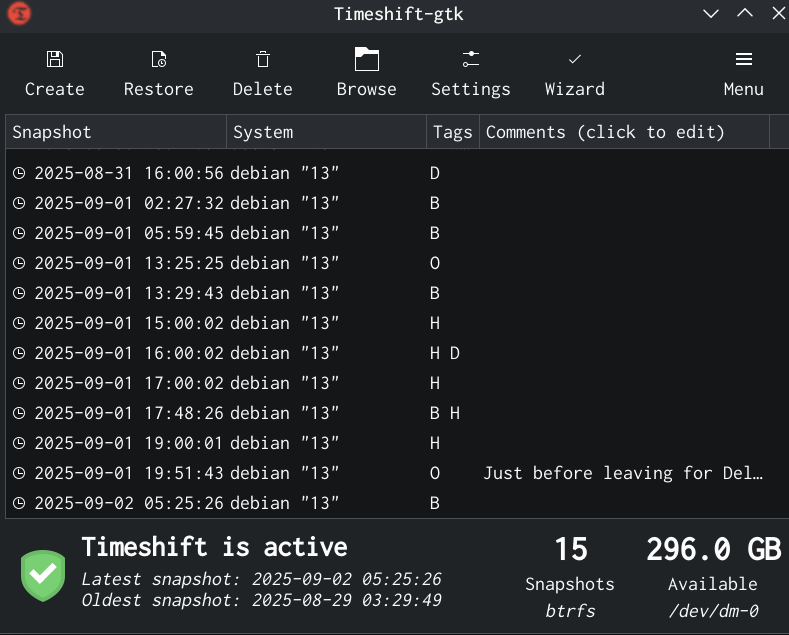
Check the screenshot above. It shows a list of snapshots made by Timeshift. Some of them were made by me manually. Others were made by Timeshift automatically as per the routine - I have set up hourly backups and weekly backups etc.
In the above-mentioned major update, I could have just taken a snapshot using Timeshift before performing the upgrade and could have rolled back to that snapshot when I found that I cannot spend more time on fixing my installation errors. Then I could just perform the upgrade later.
Installation
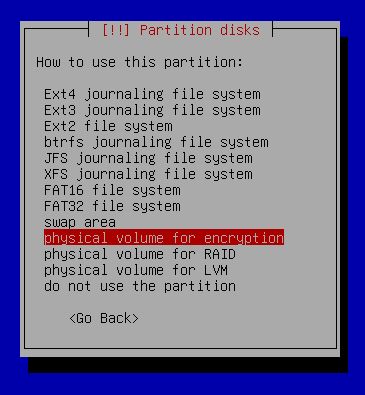
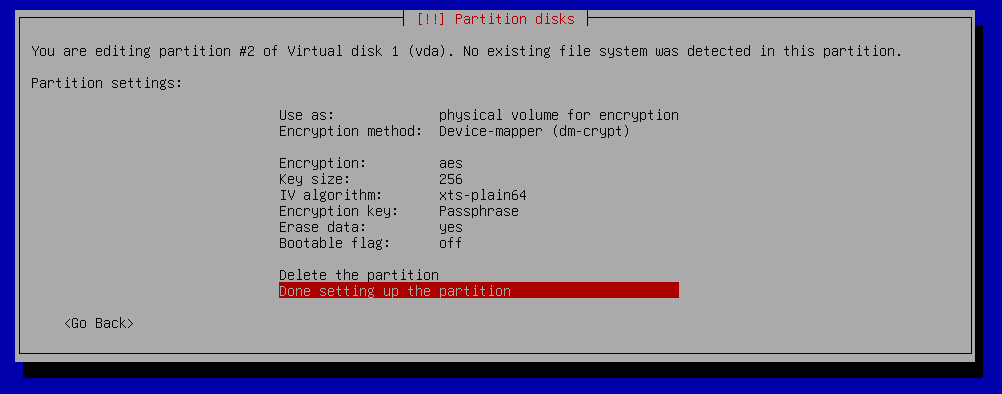
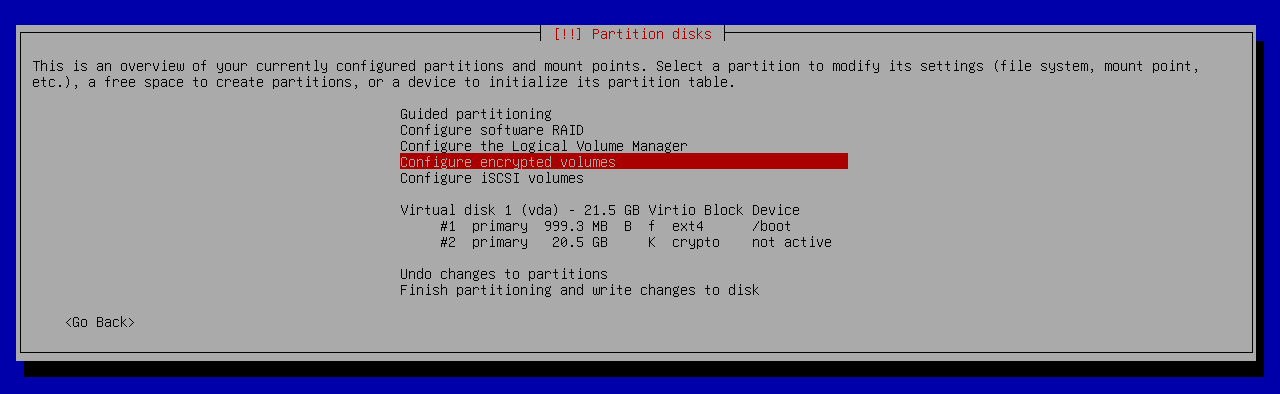
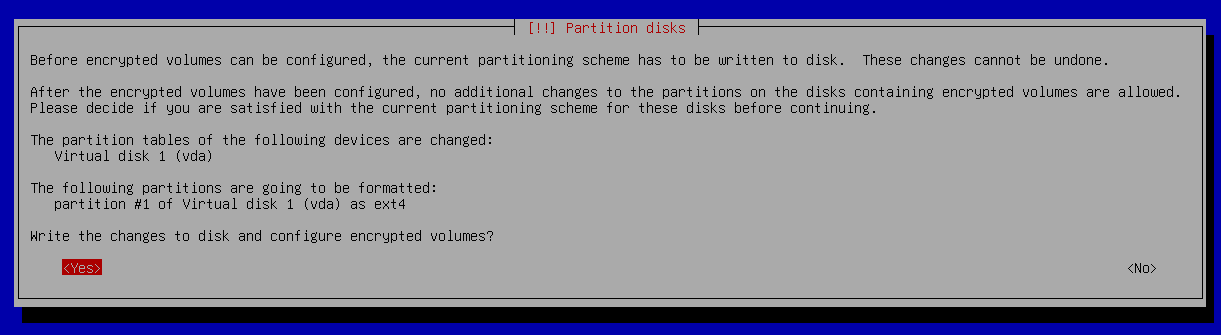
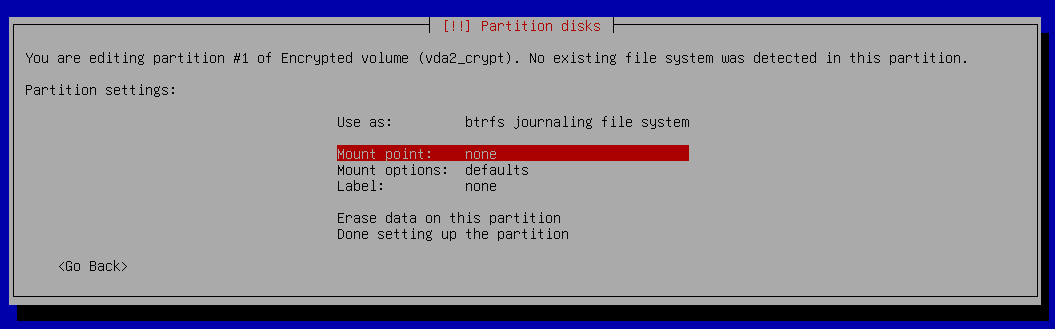
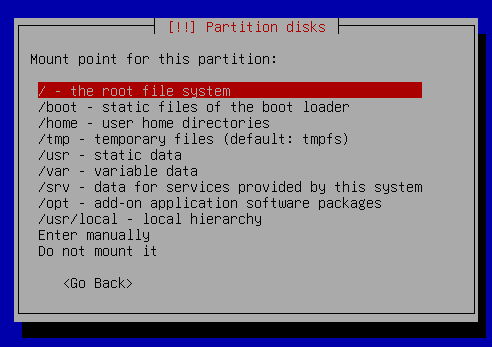
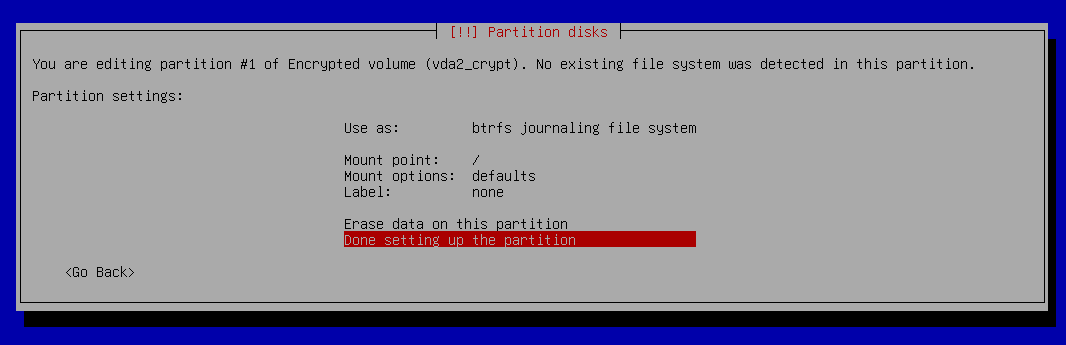
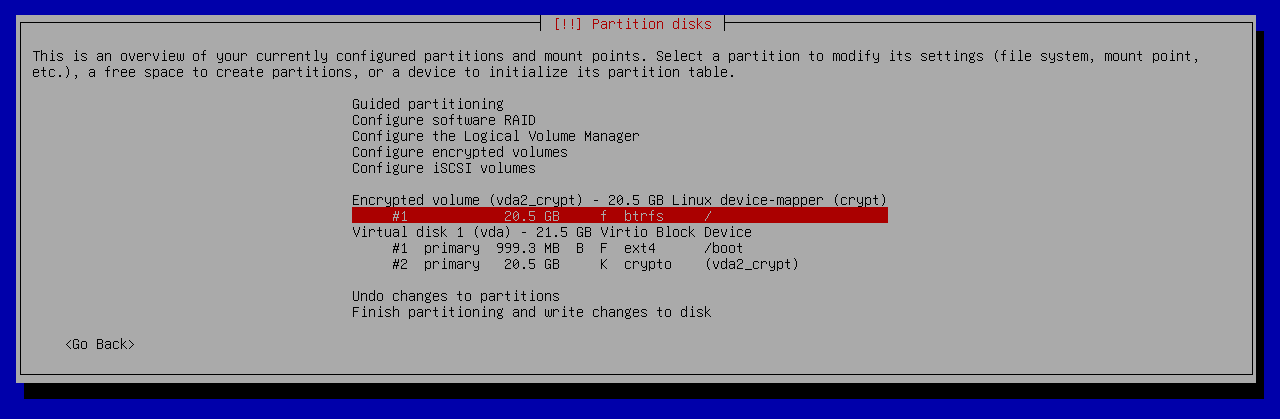
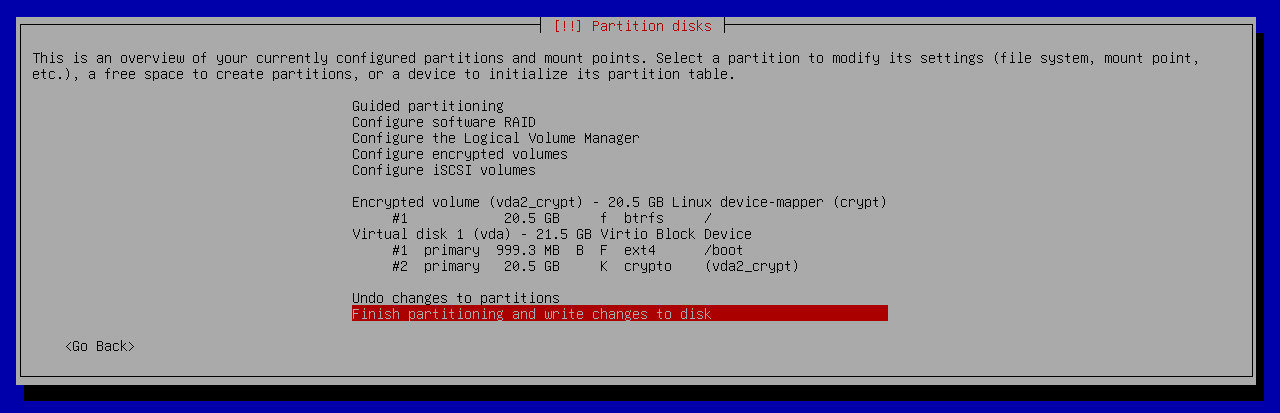
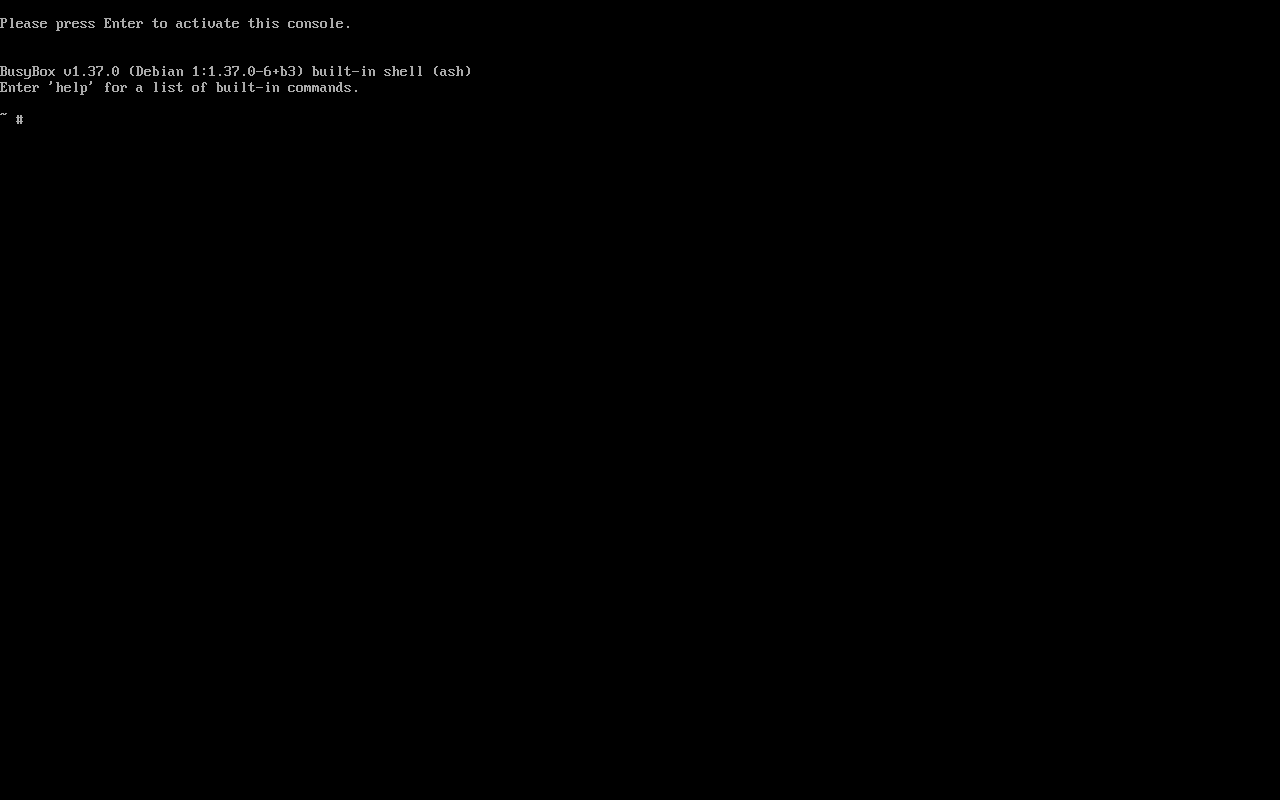
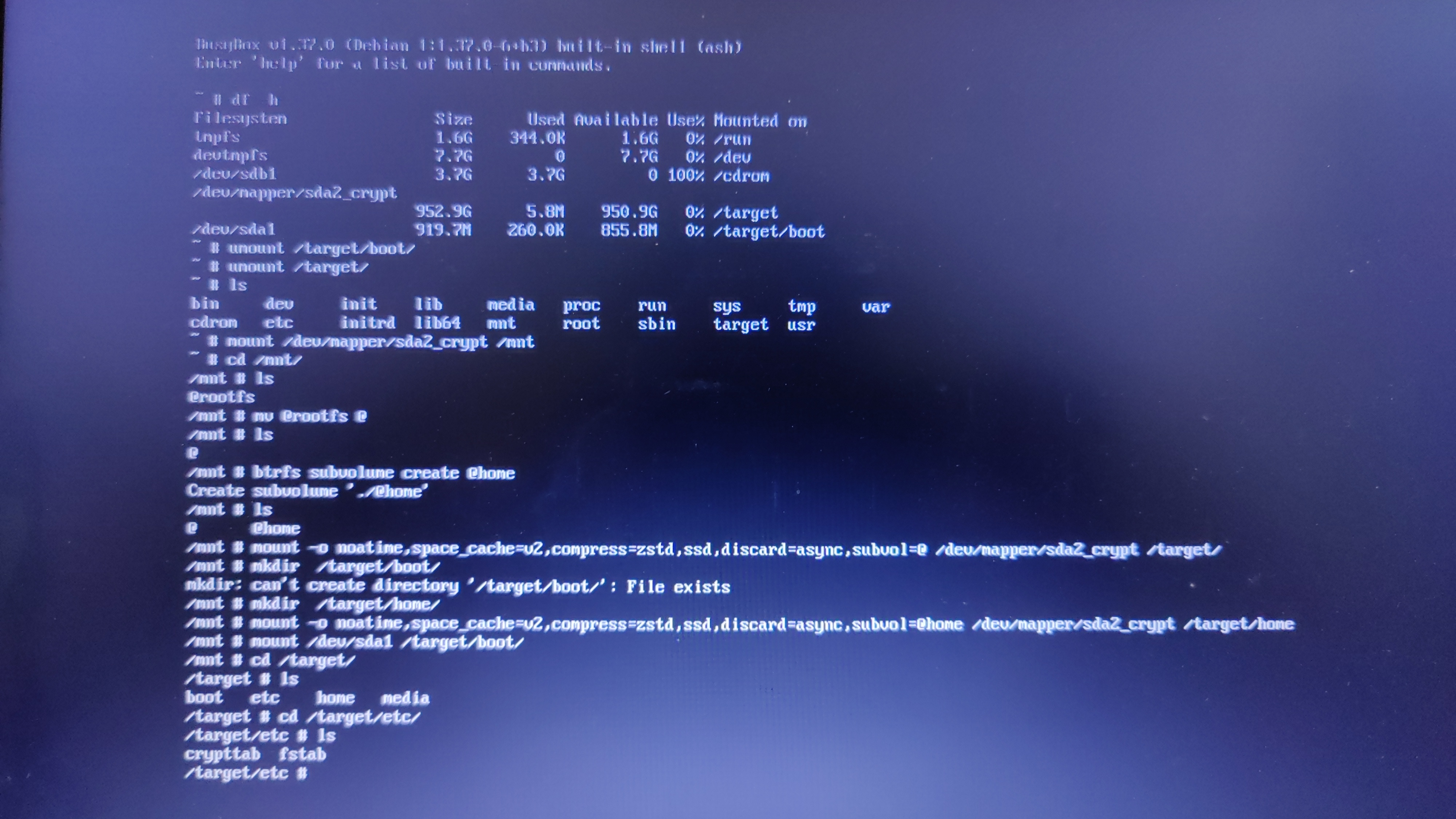
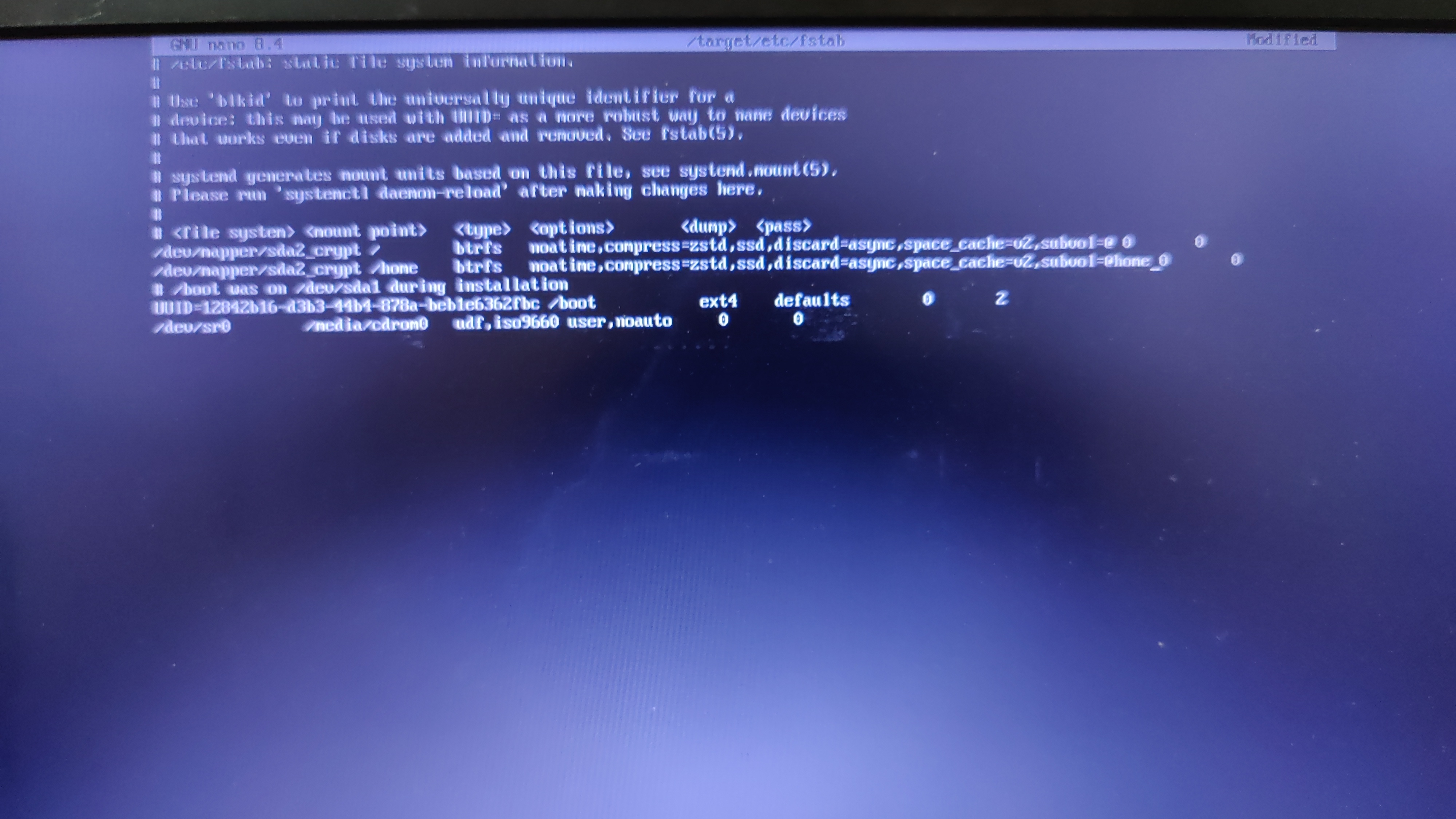
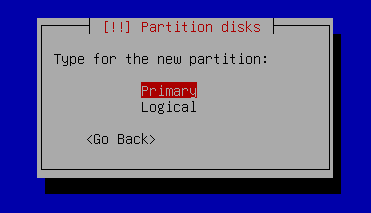
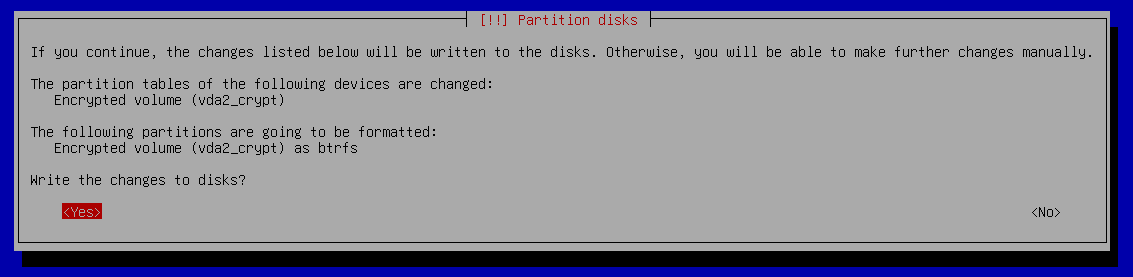
In this tutorial, I will cover how I installed Debian with Btrfs and disk encryption, along with creating subvolumes @ for root and @home for /home so that I can use Timeshift to create snapshots. These snapshots are kept on the same disk where Debian is installed, and the use-case is to roll back to a working system in case I mess up something or to recover an accidentally deleted file.
I went through countless tutorials on the Internet, but I didn t find a single tutorial covering both the disk encryption and the above-mentioned subvolumes (on Debian). Debian doesn t create the desired subvolumes by default, therefore the process requires some manual steps, which beginners may not be comfortable performing. Beginners can try distros such as Fedora and Linux Mint, as their installation includes Btrfs with the required subvolumes.
Furthermore, it is pertinent to note that I used Debian Trixie s DVD iso on a real laptop (not a virtual machine) for my installation. Debian Trixie is the codename for the current stable version of Debian. Then I took screenshots in a virtual machine by repeating the process. Moreover, a couple of screenshots are from the installation I did on the real laptop.
Let s start the tutorial by booting up the Debian installer.
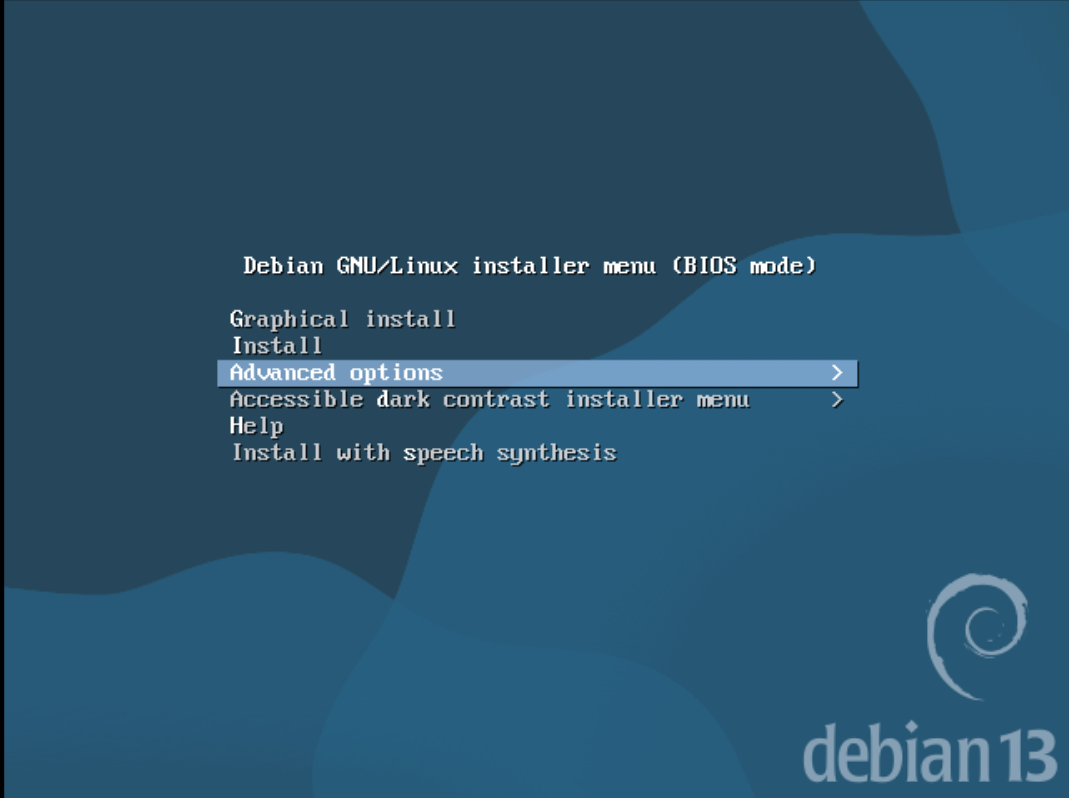
The above screenshot shows the first screen we see on the installer. Since we want to choose Expert Install, we select Advanced Options in the screenshot above.
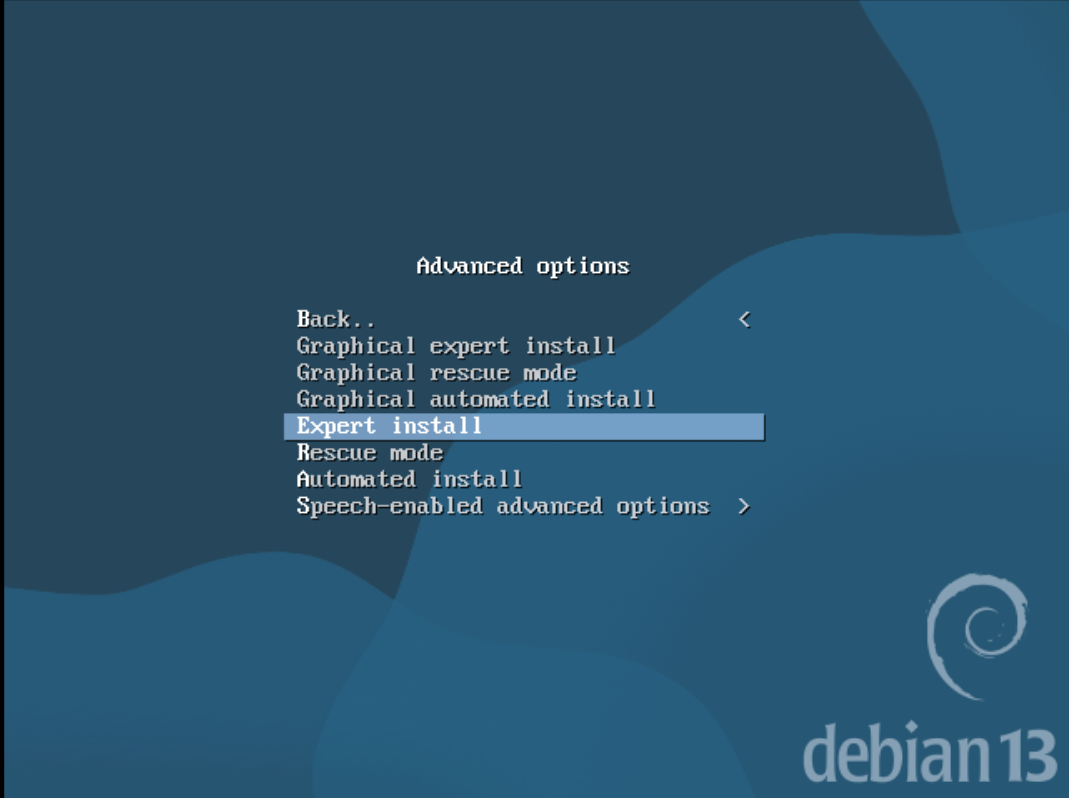
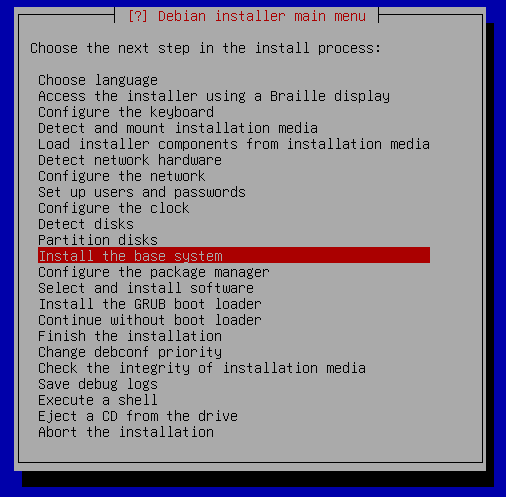
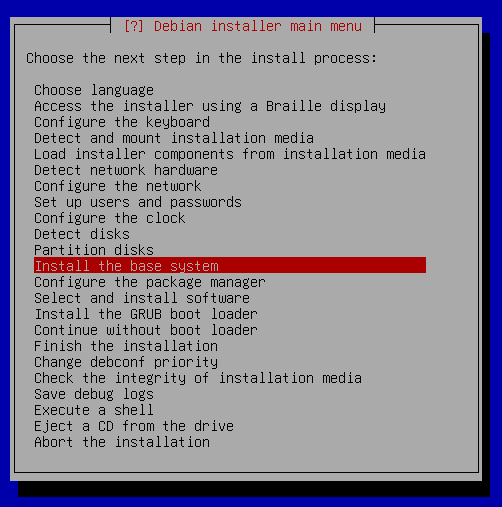
Let s select the Expert Install option in the above screenshot. It is because we want to create subvolumes after the installer is done with the partition, and only then proceed to installing the base system. Non-expert install modes proceed directly to installing the system right after creating partitions without pausing for us to create the subvolumes.
After selecting the Expert Install option, you will get the screen above. I will skip to partitioning from here and leave the intermediate steps such as choosing language, region, connecting to Wi-Fi, etc. For your reference, I did create the root user.
Let s jump right to the partitioning step. Select the Partition disks option from the menu as shown above.
Choose Manual.
Select your disk where you would like to install Debian.
Select Yes when asked for creating a new partition.
I chose the msdos option as I am not using UEFI. If you are using UEFI, then you need to choose the gpt option. Also, your steps will (slightly) differ from mine if you are using UEFI. In that case, you can watch this video by the YouTube channel EF Linux in which he creates an EFI partition. As he doesn t cover disk encryption, you can continue reading this post after following the steps corresponding to EFI.
Select the free space option as shown above.
Choose Create a new partition.
I chose the partition size to be 1 GB.
Choose Primary.
Choose Beginning.
Now, I got to this screen.
I changed mount point to /boot and turned on the bootable flag and then selected Done setting up the partition.
Now select free space.
Choose the Create a new partition option.
I made the partition size equal to the remaining space on my disk. I do not intend to create a swap partition, so I do not need more space.
Select Primary.
Select the Use as option to change its value.
Select physical volume for encryption.
Select Done setting up the partition.
Now select Configure encrypted volumes.
Select Yes.
Select Finish.
Selecting Yes will take a lot of time to erase the data. Therefore, I would say if you have hours for this step (in case your SSD is like 1 TB), then I would recommend selecting Yes. Otherwise, you could select No and compromise on the quality of encryption.
After this, you will be asked to enter a passphrase for disk encryption and confirm it. Please do so. I forgot to take the screenshot for that step.
Now select that encrypted volume as shown in the screenshot above.
Here we will change a couple of options which will be shown in the next screenshot.
In the Use as menu, select btrfs journaling file system.
Now, click on the mount point option.
Change it to / - the root file system.
Select Done setting up the partition.
This is a preview of the paritioning after performing the above-mentioned steps.
If everything is okay, proceed with the Finish partitioning and write changes to disk option.
The installer is reminding us to create a swap partition. I proceeded without it as I planned to add swap after the installation.
If everything looks fine, choose yes for writing the changes to disks.
Now we are done with partitioning and we are shown the screen in the screenshot above. If we had not selected the Expert Install option, the installer would have proceeded to install the base system without asking us.
However, we want to create subvolumes before proceeding to install the base system. This is the reason we chose Expert Install.
Now press Ctrl + F2.
You will see the screen as in the above screenshot. It says Please press Enter to activate this console. So, let s press Enter.
After pressing Enter, we see the above screen.
The screenshot above shows the steps I performed in the console. I followed the already mentioned video by EF Linux for this part and adapted it to my situation (he doesn t encrypt the disk in his tutorial).
First we run df -h to have a look at how our disk is partitioned. In my case, the output was:
df -h shows us that /dev/mapper/sda2_crypt and /dev/sda1 are mounted on /target and /target/boot respectively.
Let s unmount them. For that, we run:
# umount /target
# umount /target/boot
Next, let s mount our root filesystem to /mnt.
# mount /dev/mapper/sda2_crypt /mnt
Let s go into the /mnt directory.
# cd /mnt
Upon listing the contents of this directory, we get:
/mnt # ls
@rootfs
Debian installer has created a subvolume @rootfs automatically. However, we need the subvolumes to be @ and @home. Therefore, let s rename the @rootfs subvolume to @.
/mnt # mv @rootfs @
Listing the contents of the directory again, we get:
/mnt # ls
@
We only one subvolume right now. Therefore, let us go ahead and create another subvolume @home.
If we perform ls now, we will see there are two subvolumes:
/mnt # ls
@ @home
Let us mount /dev/mapper/sda2_crypt to /target
/mnt # mount -o noatime,space_cache=v2,compress=zstd,ssd,discard=async,subvol=@ /dev/mapper/sda2_crypt /target/
Now we need to create a directory for /home.
/mnt # mkdir /target/home/
Now we mount the /home directory with subvol=@home option.
/mnt # mount -o noatime,space_cache=v2,compress=zstd,ssd,discard=async,subvol=@home /dev/mapper/sda2_crypt /target/home/
Now mount /dev/sda1 to /target/boot.
/mnt # mount /dev/sda1 /target/boot/
Now we need to add these options to the fstab file, which is located at /target/etc/fstab. Unfortunately, vim is not installed in this console. The only way to edit is Nano.
nano /target/etc/fstab
Edit your fstab file to look similar to the one in the screenshot above. I am pasting the fstab file contents below for easy reference.
# /etc/fstab: static file system information.
#
# Use 'blkid' to print the universally unique identifier for a
# device; this may be used with UUID= as a more robust way to name devices
# that works even if disks are added and removed. See fstab(5).
#
# systemd generates mount units based on this file, see systemd.mount(5).
# Please run 'systemctl daemon-reload' after making changes here.
#
# <file system> <mount point> <type> <options> <dump> <pass>
/dev/mapper/sda2_crypt / btrfs noatime,compress=zstd,ssd,discard=async,space_cache=v2,subvol=@ 0 0
/dev/mapper/sda2_crypt /home btrfs noatime,compress=zstd,ssd,discard=async,space_cache=v2,subvol=@home 0 0
# /boot was on /dev/sda1 during installation
UUID=12842b16-d3b3-44b4-878a-beb1e6362fbc /boot ext4 defaults 0 2
/dev/sr0 /media/cdrom0 udf,iso9660 user,noauto 0 0
Please double check the fstab file before saving it. In Nano, you can press Ctrl+O followed by pressing Enter to save the file. Then press Ctrl+X to quit Nano. Now, preview the fstab file by running
cat /target/etc/fstab
and verify that the entries are correct, otherwise you will booted to an unusable and broken system after the installation is complete.
Next, press Ctrl + Alt + F1 to go back to the installer.
Proceed to Install the base system.
Screenshot of Debian installer installing the base system.

I chose the default option here - linux-image-amd64.
After this, the installer will ask you a few more questions. For desktop environment, I chose KDE Plasma. You can choose the desktop environment as per your liking. I will not cover the rest of the installation process and assume that you were able to install from here.
Post installation
Let s jump to our freshly installed Debian system. Since I created a root user, I added the user ravi to the suoders file (/etc/sudoers) so that ravi can run commands with sudo. Follow this if you would like to do the same.
Now we set up zram as swap. First, install zram-tools.
sudo apt install zram-tools
Now edit the file /etc/default/zramswap and make sure to have the following lines are uncommented:
ALGO=lz4
PERCENT=50
Now, run
sudo systemctl restart zramswap
If you run lsblk now, you should see the below-mentioned entry in the output:
zram0 253:0 0 7.8G 0 disk [SWAP]
This shows us that zram has been activated as swap.
Now we install timeshift, which can be done by running
sudo apt install timeshift
After the installation is complete, run Timeshift and schedule snapshots as you please. We are done now. Hope the tutorial was helpful.
See you in the next post and let me know if you have any suggestions and questions on this tutorial.
When a Debian cloud VM boots, it typically runs cloud-init at various points in the boot process. Each invocation can perform certain operations based on the host s static configuration passed by the user, typically either through a well known link-local network service or an attached iso9660 drive image. Some of the cloud-init steps execute before the network comes up, and others at a couple of different points after the network is up.
I recently encountered an unexpected issue when configuring a dualstack (uses both IPv6 and legacy IPv4 networking) VM to use a custom apt server accessible only via IPv6. VM provisioning failed because it was unable to access the server in question, yet when I logged in to investigate, it was able to access the server without any problem. The boot had apparently gone smoothly right up until cloud-init s Package Update Upgrade Install module called apt-get update, which failed and broke subsequent provisioning steps. The errors reported by apt-get indicated that there was no route to the service in question, which more accurately probably meant that there was not yet a route to the service. But there was shortly after, when I investigated.
This was surprising because the apt-get invocations occur in a cloud-init sequence that s explicitly ordered after the network is configured according to systemd-networkd-wait-online. Investigation eventually led to similar issues encountered in other environments reported in Debian bug #1111791, systemd: network-online.target reached before IPv6 address is ready . The issue described in that bug is identical to mine, but the bug is tagged wontfix. The behavior is considered correct.
Why the default behavior is the correct one
While it s a bit counterintuitive, the systemd-networkd behavior is correct, and it s also not something we d want to override in the cloud images. Without explicit configuration, systemd can t accurately infer the intended network configuration of a given system. If a system is IPv6-only, systemd-networkd-wait-online will introduce unexpected delays in the boot process if it waits for IPv4, and vice-versa. If it assumes dualstack, things are even worse because it would block for a long time (approximately two minutes) in any single stack network before failing, leaving the host in degraded state. So the most reasonable default behavior is to block until any protocol is configured.
For these same reasons, we can t change the systemd-networkd-wait-online configuration in our cloud images. All of the cloud environments we support offer both single stack and dual stack networking, so we preserve systemd s default behavior.
What s causing problems here is that IPv6 takes significantly longer to configure due to its more complex router solicitation + router advertisement + DHCPv6 setup process. So in this particular case, where I ve got a dualstack VM that needs to access a v6-only apt server during the provisioning process, I need to find some mechanism to override systemd s default behavior and wait for IPv6 connectivity specifically.
What won t work
Cloud-init offers the ability to write out arbitrary files during provisioning. So writing a drop-in for systemd-networkd-wait-online.service is trivial. Unfortunately, this doesn t give us everything we actually need. We still need to invoke systemctl daemon-reload to get systemd to actually apply the changes after we ve written them, and of course we need to do that before the service actually runs. Cloud-init provides a bootcmd module that lets us run shell commands very early in the boot process , but it runs too early: it runs before we ve written out our configuration files. Similarly, it provides a runcmd module, but scripts there are towards the end of the boot process, far too late to be useful.
Instead of using the bootcmd facility, to simply reload systemd s config, it seemed possible that we could both write the config and trigger the reload, similar to the following:
But even that runs too late, as we can see in the logs that systemd-networkd-wait-online.service has completed before bootcmd is executed:
root@sid-tmp2:~# journalctl --no-pager -l -u systemd-networkd-wait-online.service
Aug 29 17:02:12 sid-tmp2 systemd[1]: Starting systemd-networkd-wait-online.service - Wait for Network to be Configured...
Aug 29 17:02:13 sid-tmp2 systemd[1]: Finished systemd-networkd-wait-online.service - Wait for Network to be Configured
.
root@sid-tmp2:~# grep -F 'config-bootcmd ran' /var/log/cloud-init.log
2025-08-29 17:02:14,766 - handlers.py[DEBUG]: finish: init-network/config-bootcmd: SUCCESS: config-bootcmd ran successfully and took 0.467 seconds
At this point, it s looking like there are few options left!
What eventually worked
I ended up identifying two solutions to the issue, both of which involve getting some other component of the provisioning process to run systemd-networkd-wait-online.
Solution 1
The first involves getting apt-get itself to wait for IPv6 configuration. The apt.conf configuration interface allows the definition of an APT::Update::Pre-Invoke hook that s executed just before apt s update operation. By writing the following to a file in /etc/apt/apt.conf.d/, we re able to ensure that we have IPv6 connectivity before apt-get tries accessing the network. This cloud-config snippet accomplishes that:
This is safe to leave in place after provisioning, because the delay will be negligible once IPv6 connectivity is established. It s only during address configuration that it ll block for a noticeable amount of time, but that s what we want.
This solution isn t entirely correct, though, because it s only apt-get that s actually affected by it. Other service that start after the system is ostensibly online might only see IPv4 connectivity when they start. This seems acceptable at the moment, though.
Solution 2
The second solution is to simply invoke systemd-networkd-wait-online directly from a cloud-init bootcmd. Similar to the first solution, it s not exactly correct because the host has already reached network-online.target, but it does block enough of cloud-init that package installation happens only after it completes. The cloud-config snippet for this is
In either case, we still want to write out a snippet to configure systemd-networkd-wait-online to wait for IPv6 connectivity for future reboots. Even though cloud-init won t necessarily run in those cases, and many cloud VMs never reboot at all, it does complete the solution. Additionally, it solves the problem for any derivative images that may be created based on the running VM s state. (At least if we can be certain that instances of those derivative images will never run in an IPv4-only network!)
How to properly solve it
One possible improvement would be for cloud-init to support a configuration key allowing the admin to specify the required protocols. Based on the presence of this key, cloud-init could reconfigure systemd-networkd-wait-online.service accordingly. Alternatively it could set the appropriate RequiredFamilyForOnline= value in the generated .network file. cloud-init supports multiple network configuration backends, so each of those would need to be updated. If using the systemd-networkd configuration renderer, this should be straightforward, but Debian uses the netplan renderer, so that tool might also need to be taught to pass such a configuration along to systemd-networkd.
Posted on August 28, 2025
Tags: madeof:atoms, craft:sewing, FreeSoftWear
A bit more than a year ago, I had been thinking about making myself a
cartridge pleated skirt. For a number of reasons, one of which is the
historybounding potential, I ve been thinking pre-crinoline, so
somewhere around the 1840s, and that s a completely new era for me,
which means: new underwear.
Also, the 1840s are pre-sewing machine, and I was already in a position
where I had more chances to handsew than to machine sew, so I decided to
embrace the slowness and sew 100% by hand, not even using the machine
for straight seams.

If I remember correctly, I started with the corded petticoat, looking
around the internet for instructions, and then designing my own based on
the practicality of using modern wide fabric from my stash (and
specifically some DITTE from costumers favourite source of dirty cheap
cotton IKEA).
Around the same time I had also acquired a sashiko kit, and I used the
Japanese technique for sewing running stitches pushing the needle with a
thimble that covers the base of the middle finger, and I can confirm
that for this kind of things it s great!
I ve since worn the petticoat a few times for casual / historyBounding /
folkwearBounding reasons, during the summer, and I can confirm it s
comfortable to use; I guess that during the winter it could be nice to
add a flannel layer below it.
Then I proceeded with the base layers: I had been browsing through

The workwoman's guide and that provided plenty of examples, and I
selected the basic ankle-length drawers from page 53 and the alternative
shift on page 47.
As for fabric, I had (and still have) a significant lack of underwear
linen in my stash, but I had plenty of cotton voile that I had not used
in a while: not very historically accurate for plain underwear, but
quite suitable for a wearable mockup.
Working with a 1830s source had an interesting aspect: other of the
usual, mildly annoying, imperial units, it also used a lot a few
obsolete units, especially nails, that my qalc, my usual calculator and
converter, doesn t support.
Not a big deal, because GNU units came to the rescue, and that one
knows a lot of obscure and niche units, and it s quite easy to add those
that are missing1
Working on this project also made me freshly aware of something I had
already noticed: converting instructions for machine sewing garments
into instructions for hand sewing them is usually straightforward, but
the reverse is not always true.
Starting from machine stitching, you can usually convert straight
stitches into backstitches (or running backstitches), zigzag and
overlocking into overcasting and get good results. In some cases you may
want to use specialist hand stitches that don t really have a machine
equivalent, such as buttonhole stitches instead of simply overcasting
the buttonhole, but that s it.
Starting from hand stitching, instead, there are a number of techniques
that could be converted to machine stitching, but involve a lot of
visible topstitching that wasn t there in the original instructions, or
at times are almost impossible to do by machine, if they involve
whipstitching together finished panels on seams that are subject to
strong tension.
Anyway, halfway through working with the petticoat I cut both the
petticoat and the drawers at the same time, for efficiency in fabric
use, and then started sewing the drawers.
The book only provided measurements for one size (moderate), and my
fabric was a bit too narrow to make them that size (not that I have any
idea what hip circumference a person of moderate size was supposed to
have), so the result is just wide enough to be comfortably worn, but I
think that when I ll make another pair I ll try to make them a bit
wider. On the other hand they are a bit too long, but I think that I ll
fix it by adding a tuck or two. Not a big deal, anyway.

The shift gave me a bit more issues: I used the recommended gusset size,
and ended up with a shift that was way too wide at the top, so I had to
take a box pleat in the center front and back, which changed the look
and wear of the garment. I have adjusted the instructions to make
gussets wider, and in the future I ll make another shift following
those.
Even with the pleat, the narrow shoulder straps are set quite far to the
sides, and they tend to droop, and I suspect that this is to be expected
from the way this garment is made. The fact that there are buttonholes
on the shoulder straps to attach to the corset straps and prevent the
issue is probably a hint that this behaviour was to be expected.
I ve also updated the instructions so that they shoulder straps are a
bit wider, to look more like the ones in the drawing from the book.
Making a corset suitable for the time period is something that I will
probably do, but not in the immediate future, but even just wearing the
shift under a later midbust corset with no shoulder strap helps.
I m also not sure what the point of the bosom gores is, as they don t
really give more room to the bust where it s needed, but to the high
bust where it s counterproductive. I also couldn t find images of
original examples made from this pattern to see if they were actually
used, so in my next make I may just skip them.

On the other hand, I m really happy with how cute the short sleeves
look, and if2 I ll ever make the other cut of shift from the same
book, with the front flaps, I ll definitely use these pleated sleeves
rather than the straight ones that were also used at the time.
As usual, all of the patterns have been published on my website under a
Free license: