Raphaël Hertzog: People behind Debian: Christian Perrier, translation coordinator

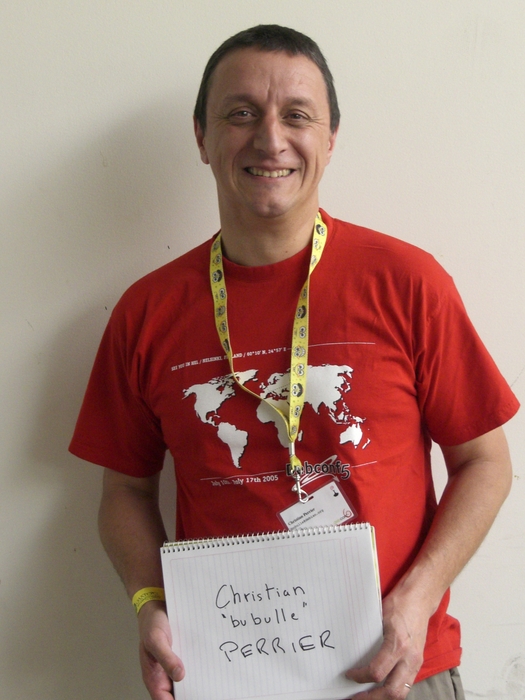 Christian is a figure of Debian, not only because of the tremendous coordination work that he does within the translation project, but also because he s very involved at the social level. He s probably in the top 5 of the persons who attended most often the Debian conference.
Christian is a friend (thanks for hosting me so many times when I come to Paris for Debian related events) and I m glad that he accepted to be interviewed. He likes to speak and that shows in the length of his answers
 but you ll be traveling the world while reading him.
My questions are in bold, the rest is by Christian.
Who are you?
I am a French citizen (which is easy to guess unless you correct my
usual mistakes in what follows). I m immensely proud of being married
for nearly 26 years with Elizabeth (who deserves a statue from Debian
for being so patient with my passion and my dedication to the
project).
I m also the proud father of 3 wonderful kids , aged 19 to
23.
I work as team manager in the Networks and Computers Division of Onera
the French Aerospace lab , a public research institute about
Aeronautics, Space and Defense. My team provides computer management
services for research divisions of Onera, with a specific focus put on
individual computing.
I entered the world of free software as one of the very first users of
Linux in France. Back in the early 1990 s, I happened (though the BBS
users communities) to be a friend of several early adopters of Linux
and/or BSD386/FreeBSD/NetBSD in France. More specifically, I
discovered Linux thanks with my friend Ren Cougnenc (all my free
software talks are dedicated to Ren , who passed away in 1996).
You re not a programmer, not even a packager. How did you come
to Debian?
I m definitely not a programmer and I never studied computing (I
graduated in Materials Science and worked in that area for a few years
after my PhD).
However, my daily work always involved computing (I redesigned the
creep testing laboratory and its acquisition system all by myself
during my thesis research work). An my hobbies often involved
playing with home computers, always trying to learn about something
new.
So, first learning about a new operating system then trying to
figure out how to become involved in its development was quite a
logical choice.
Debian is my distro of choice since it exists. I used Slackware on work
machines for a while, but my home server, kheops,
first ran Debian 1.1 when I stopped running a BBS on an MS-DOS machine
to host a news server. That was back in October 1996.
I then happened to be a user, and more specifically a user of
genealogy software, also participating very actively in Usenet from
this home computer and server, that was running this Debian thing.
So, progressively, I joined mailing lists and, being a passionate
person, I tried to figure out how I could bring my own little
contribution to all this.
This is why I became a packager (yes, I am one!) by taking over the
geneweb package, which I was using to publish my genealogy
research. I applied as DD in January 2001, then got my account in July
2001. My first upload to the Debian archive occurred on August 22nd
2001: that was of course geneweb, which I still maintain.
Quite quickly, I became involved in the work on French localization. I
have always been a strong supporter of localized software (I even
translated a few BBS software back in the early 90 s) as one of the
way to bring the power and richness of free software to more users.
Localization work lead me to work on the early version of Debian
Installer, during those 2003-2005 years where the development of D-I
was an incredibly motivating and challenging task, lead by Joey Hess
and his inspiring ideas.
From user to contributor to leader, I suddenly discovered, around
2004, that I became the coordinator of D-I i18n (internationalization)
without even noticing
You re the main translation coordinator in Debian. What plans
and goals have you set for Debian Wheezy?
As always: paint the world in red.
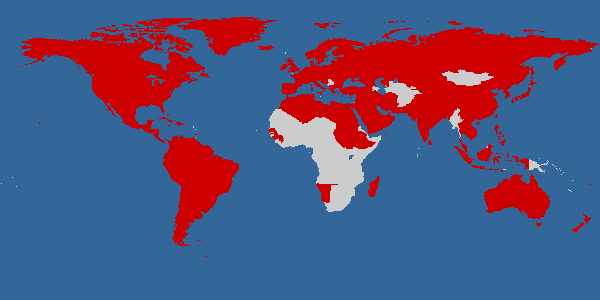 Indeed, this is my goal for years. I would like our favorite distro to
be able to be used by anyone in the world, whether she speaks
English, Northern Sami, Wolof, Uyghur or Secwepemcts n.
As a matter of symbol, I use the installer for this. My stance is that
one should be able to even install Debian in one s own language. So,
for about 7 years, I use D-I as a way to attract new localization
contributors.
This progress is represented on
this
page where the world
is gradually painted in red as long as the installer supports more
languages release after release. The map above tries to illustrate
this by painting in red countries when the most spoken language in the
country is supported in Debian Installer.
However, that map does not give enough reward to many great efforts
made to support very different kind of languages. Not only various
national languages, but also very different ones: all regional
languages of Spain, many of the most spoken languages in India,
minority languages such as Uyghur for which an effort is starting,
Northern Sami because it is taught in a few schools in Norway, etc.,
etc.
Still, the map gives a good idea of what I would like to see better
supported: languages from Africa, several languages in Central
Asia. And, as a very very personal goal, I m eagerly waiting for
support of Tibetan in Debian Installer, the same way we support its
sister language, Dzongkha from Bhutan.
For this to happen, we have to make contribution to localization as
easy as possible. The very distributed nature of Debian development
makes this a challenge, as material to translate (D-I components,
debconf screens, native packages, packages descriptions, website,
documentation) is very widely spread.
A goal, for years, is to set a centralized place where
translators could work easily without even knowing about SVN/GIT/BZR
or having to report bugs to send their work. The point, however, would
be to have this without making compromises on translation quality. So,
with peer review, use of thesaurus and translation memory and all such
techniques.
Tools for this exist: we, for instance, worked with the developers of
Pootle to help making it able to cope with the huge amount of material
in Debian (think about packages descriptions translations). However, as
of now, the glue between such tools and the raw material (that often
lies in packages) didn t come.
So, currently, translation work in Debian requires a great knowledge
of how things are organized, where is the material, how it can be
possible to make contribution reach packages, etc.
And, as I m technically unable to fulfill the goal of building the
infrastructure, I m fulfilling that role of spreading out the
knowledge. This is how I can define my coordinator role.
Ubuntu uses a web-based tool to make it easy to contribute
translations directly in Launchpad. At some point you asked Canonical to
make it free software. Launchpad has been freed in the mean time. Have you
(re)considered using it?
Why not? After all, it more or less fills in the needs I just
described. I still don t really figure out how we could have all
Debian material gathered in Rosetta/Launchpad .and also how Debian
packagers could easily get localized material back from the framework
without changing their development processes.
I have always tried to stay neutral wrt Ubuntu. As many people now in
Debian, I feel like we have reached a good way to achieve our mutual
development. When it comes at localization work, the early days where
the everything in Rosetta and translates who wants stanza did a lot
of harm to several upstream localization projects is, I think, way
over.
Many people who currently contribute to D-I localization were indeed
sent to me by Ubuntu contributors .and by localizing D-I, apt,
debconf, package descriptions, etc., they re doing translation work
for Ubuntu as well as for Debian.
Let s say I m a Debian user and I want to help translate Debian
in my language. I can spend 1 hour per week on this activity. What should
I do to start?
Several language teams use Debian mailing lists to coordinate their
work. If you re lucky enough to be a speaker of one of these
languages, try joining debian-l10n-<yourlanguage>
and follow what s happening there. Don t try to immediately jump in some
translation work. First, participate to peer reviews: comment on
others translations. Learn about the team s processes, jargon and
habits.
Then, progressively, start working on a few translations: you may want
to start with translations of debconf templates: they are short, often
easy to do. That s perfect if you have few time.
If no language team exists for your language, try joining debian-i18n
and ask about existing effort for your language. I may be able to
point you to individuals working on Debian translations (very often
along with other free software translation efforts). If I am not, then
you have just been named coordinator for your language I may
even ask you if you want to work on translating the Debian Installer.
What s the biggest problem of Debian?
We have no problems, we only have solutions
We are maybe facing a growth problem for a few years. Despite the
increased welcoming aspects of our processes (Debian Maintainers),
Debian is having hard times in growing. The overall number of active
contributors is probably stagnating for quite a while. I m still
amazed, however, to see how we can cope with that and still be able to
release over the years. So, after all, this is maybe not a
problem
Many people would point communication problems here. I don t. I
think that communication inside the Debian project is working fairly
well now. Our famous flame wars do of course still happen from time
to time, but what large free software project doesn t have flame wars?
In many areas, we indeed improved communication very significantly. I
want to take as an example the way the release of squeeze has been
managed. I think that the release team did, even more this time, a
very significant and visible effort to communicate with the entire
project. And the release of squeeze has been a great success in that
matter.
So, there s nearly nothing that frustrates me in Debian. Even when a
random developer breaks my beloved 100% completeness of French
translations, I m not frustrated for more than 2 minutes.
You re known in the Debian community as the organizer of the
Cheese & Wine Party during DebConf. Can you tell us what this is
about?
 This is an interesting story about how things build themselves in
Debian.
It all started in July 2005, before DebConf 5 in Helsinki. Denis
Barbier, Nicolas Fran ois and myself agreed to bring at Debconf a few
pieces of French cheese as well as 1 or 2 bottles of French wine and
share them with some friends. Thus, we settled an informal meeting in
the French room where we invited some fellows: from memory, Benjamin
Mako Hill, Hannah Wallach, Matt Zimmermann and Moray Allan. All of
us fond of smelly cheese, great wine plus some extra p t
home-made by Denis in Toulouse.
It finally happened that, by word of mouth, a few dozens of other
people slowly joined in that French room and turned the whole thing
into an improvized party that more or less lasted for the entire
night.
The tradition was later firmly settled in 2006, first in Debconf 6 in
Mexico where I challenged the French DDs to bring as many great cheese
as possible, then during the Debian i18n meeting in Extremadura (Sept
2006) where we reached the highest amount of cheese per participant
ever. I think that the Creofonte building in Casar de C ceres hasn t
fully recovered from it and is still smelling cheese 5 years after.
This party later became a real tradition for DebConf, growing over
and over each year. I see it as a wonderful way to illustrate the
diversity we have in Debian, as well as the mutual enrichment we
always felt during DebConfs.
My only regret about it is that it became so big over the years that
organizing it is always a challenge and I more and more feel pressure
to make it successful. However, over the years, I always found
incredible help by DebConf participants (including my own son, last
year a moment of sharing which we will both remember for years, i think).
And, really, in 2010, standing up on a chair, shouting (because the
microphone wasn t working) to thank everybody, was the most emotional
moment I had at Debconf 10.
Is there someone in Debian that you admire for their
contributions?
So many people. So, just like it happens in many awards ceremonies, I
will be very verbose to thank people, sorry in advance for this.
The name that comes first is Joey Hess. Joey is someone who has a
unique way to perceive what improvements are good for Debian and a
very precise and meticulous way to design these improvements. Think
about debconf. It is designed for so long now and still reaching its
very specific goal. So well designed that it is the entire basis for
Joey s other achievement: designing D-I. Moreover, I not only admire
Joey for his technical work, but also for his interaction with
others. He is not he loudest person around, he doesn t have to .just
giving his point in discussion and, guess what? Most of the time, he s
right.
Someone I would like to name here, also, is Colin Watson. Colin is
also someone I worked with for years (the D-I effect, again ) and,
here again, the very clever way he works on technical improvements as
well as his very friendly way to interact with others just make it.
And, how about you, Rapha l? I m really admirative of the way you
work on promoting technical work on Debian. Your natural ability to
explain things (as good in English as it is in French) and your
motivation to share your knowledge are a great benefit for the
project. Not to mention the technical achievements you made with
Guillem on dpkg of course!
Another person I d like to name here is Steve Langasek. We both
maintain samba packages for years and collaboration with him has
always been a pleasure. Just like Colin, Steve is IMHO a model to
follow when it comes at people who work for Canonical while continuing
their involvment in Debian. And, indeed, Steve is so patient with my
mistakes and stupid questions in samba packaging that he deserves a
statue.
We re now reaching the end of the year where Stefano Zacchiroli was
the Debian Project Leader. And, no offense intended to people who were
DPL before him (all of them being people I consider to be friends of
mine), I think he did the best term ever. Zack is wonderful in sharing
his enthusiasm about Debian and has a unique way to do it. Up to the
very end of his term, he has always been working on various aspects of
the project and my only hope is that he ll run again (however, I would
very well understand that he wants to go back to his hacking
activities!). Hat off, Zack!I again have several other people to name in this Bubulle hall of
Fame : Don Armstrong, for his constant work on improving Debian BTS,
Margarita Manterola as one of the best successes of Debian Women (and
the most geeky honeymoon ever), Denis Barbier and Nicolas Fran ois
because i18n need really skilled people, Cyril Brulebois and Julien
Cristau who kept X.org packaging alive in lenny and squeeze, Otavio
Salvador who never gave up on D-I even when we were so few to care
about it.
I would like to make a special mention for Frans Pop. His loss in 2010
has been a shock for many of us, and particularly me. Frans and I had
a similar history in Debian, both mostly working on so-called non
technical duties. Frans has been the best release manager for D-I (no
offense intended, at all, to Joey or Otavio .I know that both of
them share this feeling with me). His very high involvment in his work
and the very meticulous way he was doing it lead to great achievements
in the installer. The Installation Guide work was also a model and
indeed a great example of non technical work that requires as many
skills as more classical technical work. So, and even though he was
sometimes so picky and, I have to admit, annoying, that explains why
I m still feeling sad and, in some way, guilty about Frans loss.
One of my goals for wheezy is indeed to complete some things Frans
left unachieved. I just found one in bug #564441: I will make this
work reach the archive, benefit our users and I know that Frans would
have liked that.
Thank you to Christian for the time spent answering my questions. I hope you enjoyed reading his answers as I did. Subscribe to my newsletter to get my monthly summary of the Debian/Ubuntu news and to not miss further interviews. You can also follow along on Identi.ca, Twitter and Facebook.
7 comments Liked this article? Click here. My blog is Flattr-enabled.

 A couple of months ago, Debian project membership


 But, since I m not a magician yet, I d stick to more realistic plans:


 Last week I was on my first Ubuntu Developer Summit (UDS-N), I wanted to attended this summit for couple of reasons:
1. Developer, I m part of Debian Java, working on Eclipse IDE, and as you re developing Debian, you re automatically developing Ubuntu, no?
 2.
 I
 NYC
I spent couple of days here with my cousins and friends, as always NYC never fails to surprise me, and I ll always stop by even if it s only for couple of days
 I wanted to meet up with couple of Debian people as well, but unfortunately my schedule was too tight so


 Hotel where everything was held was
 15 minutes later after I checked in, I was at a bar talking to


 There was a lot of places where you could go to enjoy yourself. Good people at Canonical even offered me free ticket to Disney World, there was a lot of destinations to visit and transpiration was also organized by Canonical. Unfortunately I missed the notorious UDS party on Friday because I had to head home early, but possibly I ll make it next year
 Even though, hotel was that great and to be honest you didn t have to leave to look for party.


 This is definitely something everyone should see during his life, one moment you re laughing like a lunatic, while other moment you re just having goose bumps from the performance itself. Amazing stuff.


