Search Results: "Petter Reinholdtsen"

7 April 2016

Petter Reinholdtsen: One in two hundred Debian users using ZFS on Linux?

Just for fun I had a look at the popcon number of ZFS related packages in Debian, and was quite surprised with what I found. I use ZFS myself at home, but did not really expect many others to do so. But I might be wrong. According to the popcon results for spl-linux, there are 1019 Debian installations, or 0.53% of the population, with the package installed. As far as I know the only use of the spl-linux package is as a support library for ZFS on Linux, so I use it here as proxy for measuring the number of ZFS installation on Linux in Debian. In the kFreeBSD variant of Debian the ZFS feature is already available, and there the popcon results for zfsutils show 1625 Debian installations or 0.84% of the population. So I guess I am not alone in using ZFS on Debian. But even though the Debian project leader Lucas Nussbaum announced in April 2015 that the legal obstacles blocking ZFS on Debian were cleared, the package is still not in Debian. The package is again in the NEW queue. Several uploads have been rejected so far because the debian/copyright file was incomplete or wrong, but there is no reason to give up. The current status can be seen on the team status page, and the source code is available on Alioth. As I want ZFS to be included in next version of Debian to make sure my home server can function in the future using only official Debian packages, and the current blocker is to get the debian/copyright file accepted by the FTP masters in Debian, I decided a while back to try to help out the team. This was the background for my blog post about creating, updating and checking debian/copyright semi-automatically, and I used the techniques I explored there to try to find any errors in the copyright file. It is not very easy to check every one of the around 2000 files in the source package, but I hope we this time got it right. If you want to help out, check out the git source and try to find missing entries in the debian/copyright file.

2 April 2016

Petter Reinholdtsen: syslog-trusted-timestamp - chain of trusted timestamps for your syslog

Two years ago, I had a look at trusted timestamping options available, and among other things noted a still open bug in the tsget script included in openssl that made it harder than necessary to use openssl as a trusted timestamping client. A few days ago I was told the Norwegian government office DIFI is close to releasing their own trusted timestamp service, and in the process I was happy to learn about a replacement for the tsget script using only curl:
openssl ts -query -data "/etc/shells" -cert -sha256 -no_nonce \
    curl -s -H "Content-Type: application/timestamp-query" \
         --data-binary "@-" http://zeitstempel.dfn.de > etc-shells.tsr
openssl ts -reply -text -in etc-shells.tsr
This produces a binary timestamp file (etc-shells.tsr) which can be used to verify that the content of the file /etc/shell with the calculated sha256 hash existed at the point in time when the request was made. The last command extract the content of the etc-shells.tsr in human readable form. The idea behind such timestamp is to be able to prove using cryptography that the content of a file have not changed since the file was stamped. To verify that the file on disk match the public key signature in the timestamp file, run the following commands. It make sure you have the required certificate for the trusted timestamp service available and use it to compare the file content with the timestamp. In production, one should of course use a better method to verify the service certificate.
wget -O ca-cert.txt https://pki.pca.dfn.de/global-services-ca/pub/cacert/chain.txt
openssl ts -verify -data /etc/shells -in etc-shells.tsr -CAfile ca-cert.txt -text
Wikipedia have a lot more information about trusted Timestamping and linked timestamping, and there are several trusted timestamping services around, both as commercial services and as free and public services. Among the latter is the zeitstempel.dfn.de service mentioned above and freetsa.org service linked to from the wikipedia web site. I believe the DIFI service should show up on https://tsa.difi.no, but it is not available to the public at the moment. I hope this will change when it is into production. The RFC 3161 trusted timestamping protocol standard is even implemented in LibreOffice, Microsoft Office and Adobe Acrobat, making it possible to verify when a document was created. I would find it useful to be able to use such trusted timestamp service to make it possible to verify that my stored syslog files have not been tampered with. This is not a new idea. I found one example implemented on the Endian network appliances where the configuration of such feature was described in 2012. But I could not find any free implementation of such feature when I searched, so I decided to try to build a prototype named syslog-trusted-timestamp. My idea is to generate a timestamp of the old log files after they are rotated, and store the timestamp in the new log file just after rotation. This will form a chain that would make it possible to see if any old log files are tampered with. But syslog is bad at handling kilobytes of binary data, so I decided to base64 encode the timestamp and add an ID and line sequence numbers to the base64 data to make it possible to reassemble the timestamp file again. To use it, simply run it like this:
syslog-trusted-timestamp /path/to/list-of-log-files
This will send a timestamp from one or more timestamp services (not yet decided nor implemented) for each listed file to the syslog using logger(1). To verify the timestamp, the same program is used with the --verify option:
syslog-trusted-timestamp --verify /path/to/log-file /path/to/log-with-timestamp
The verification step is not yet well designed. The current implementation depend on the file path being unique and unchanging, and this is not a solid assumption. It also uses process number as timestamp ID, and this is bound to create ID collisions. I hope to have time to come up with a better way to handle timestamp IDs and verification later. Please check out the prototype for syslog-trusted-timestamp on github and send suggestions and improvement, or let me know if there already exist a similar system for timestamping logs already to allow me to join forces with others with the same interest. As usual, if you use Bitcoin and want to show your support of my activities, please send Bitcoin donations to my address 15oWEoG9dUPovwmUL9KWAnYRtNJEkP1u1b.

23 March 2016

Petter Reinholdtsen: Full battery stats collector is now available in Debian

Since this morning, the battery-stats package in Debian include an extended collector that will collect the complete battery history for later processing and graphing. The original collector store the battery level as percentage of last full level, while the new collector also record battery vendor, model, serial number, design full level, last full level and current battery level. This make it possible to predict the lifetime of the battery as well as visualise the energy flow when the battery is charging or discharging. The new tools are available in /usr/share/battery-stats/ in the version 0.5.1 package in unstable. Get the new battery level graph and lifetime prediction by running:
/usr/share/battery-stats/battery-stats-graph /var/log/battery-stats.csv
Or select the 'Battery Level Graph' from your application menu. The flow in/out of the battery can be seen by running (no menu entry yet):
/usr/share/battery-stats/battery-stats-graph-flow
I'm not quite happy with the way the data is visualised, at least when there are few data points. The graphs look a bit better with a few years of data. A while back one important feature I use in the battery stats collector broke in Debian. The scripts in /usr/lib/pm-utils/power.d/ were no longer executed. I suspect it happened when Jessie started using systemd, but I do not know. The issue is reported as bug #818649 against pm-utils. I managed to work around it by adding an udev rule to call the collector script every time the power connector is connected and disconnected. With this fix in place it was finally time to make a new release of the package, and get it into Debian. If you are interested in how your laptop battery is doing, please check out the battery-stats in Debian unstable, or rebuild it on Jessie to get it working on Debian stable. :) The upstream source is available from github. As always, patches are very welcome.

21 March 2016

Lunar: Reproducible builds: week 47 in Stretch cycle

What happened in the reproducible builds effort between March 13th and March 19th 2016:

Toolchain fixes
  • Petter Reinholdtsen uploaded naturaldocs/1.51-1.1 which makes the output reproducible. Original patch by Chris Lamb.
  • Damyan Ivanov uploaded libpdf-api2-perl/2.025-2 which will make internal font ID reproducible.
  • Christian Hofstaedtler uploaded ruby2.3/2.3.0-5 which sets gzip embedded mtime field to fixed value for rdoc-generated compressed javascript data.

Packages fixed The following packages have become reproducible due to changes in their build dependencies: diction, doublecmd, ruby-hiredis, vdr-plugin-epgsearch. The following packages became reproducible after getting fixed: Some uploads fixed some reproducibility issues, but not all of them: Patches submitted which have not made their way to the archive yet:
  • #818128 on nethack by Reiner Herrmann: implement support for SOURCE_DATE_EPOCH, set LC_ALL to C, and ensure deterministic build order when running parallel builds.
  • #818111 on debian-keyring by Satyam Zode: fix the order of files in md5sums.
  • #818067 on ncurses by Niels Thykier: strip trailing whitespaces introduced when using dash as system shell.
  • #818230 on aircrack-ng by Reiner Herrmann: build assembly code as a separate .o file.
  • #818419 on mutt by Daniel Shahaf: use C locale when listing files to be put in README.Patches.
  • #818430 on ruby-coveralls by Dhole: ensure UTC is used as the timezone when generating the documentation.
  • #818686 on littlewizard by Reiner Herrmann: use the C locale in the script for iterating over the files.
  • #818704 on strigi by Reiner Herrmann: sort keys when traversing hashes in makecode.pl.

Package reviews 44 reviews have been removed, 40 added and 5 updated in the previous week. Chris Lamb has reported 16 FTBFS.

19 March 2016

Petter Reinholdtsen: UsingQR - "Electronic" paper invoices using JSON and QR codes

Back in 2013 I proposed a way to make paper and PDF invoices easier to process electronically by adding a QR code with the key information about the invoice. I suggested using vCard field definition, to get some standard format for name and address, but any format would work. I did not do anything about the proposal, but hoped someone one day would make something like it. It would make it possible to efficiently send machine readable invoices directly between seller and buyer. This was the background when I came across a proposal and specification from the web based accounting and invoicing supplier Visma in Sweden called UsingQR. Their PDF invoices contain a QR code with the key information of the invoice in JSON format. This is the typical content of a QR code following the UsingQR specification (based on a real world example, some numbers replaced to get a more bogus entry). I've reformatted the JSON to make it easier to read. Normally this is all on one long line:
 
 "vh":500.00,
 "vm":0,
 "vl":0,
 "uqr":1,
 "tp":1,
 "nme":"Din Leverand r",
 "cc":"NO",
 "cid":"997912345 MVA",
 "iref":"12300001",
 "idt":"20151022",
 "ddt":"20151105",
 "due":2500.0000,
 "cur":"NOK",
 "pt":"BBAN",
 "acc":"17202612345",
 "bc":"BIENNOK1",
 "adr":"0313 OSLO"
 
The interpretation of the fields can be found in the format specification (revision 2 from june 2014). The format seem to have most of the information needed to handle accounting and payment of invoices, at least the fields I have needed so far here in Norway. Unfortunately, the site and document do not mention anything about the patent, trademark and copyright status of the format and the specification. Because of this, I asked the people behind it back in November to clarify. Ann-Christine Savlid (ann-christine.savlid (at) visma.com) replied that Visma had not applied for patent or trademark protection for this format, and that there were no copyright based usage limitations for the format. I urged her to make sure this was explicitly written on the web pages and in the specification, but unfortunately this has not happened yet. So I guess if there is submarine patents, hidden trademarks or a will to sue for copyright infringements, those starting to use the UsingQR format might be at risk, but if this happen there is some legal defense in the fact that the people behind the format claimed it was safe to do so. At least with patents, there is always a chance of getting sued... I also asked if they planned to maintain the format in an independent standard organization to give others more confidence that they would participate in the standardization process on equal terms with Visma, but they had no immediate plans for this. Their plan was to work with banks to try to get more users of the format, and evaluate the way forward if the format proved to be popular. I hope they conclude that using an open standard organisation like IETF is the correct place to maintain such specification. Update 2016-03-20: Via Twitter I became aware of some comments about this blog post that had several useful links and references to similar systems. In the Czech republic, the Czech Banking Association standard #26, with short name SPAYD, uses QR codes with payment information. More information is available from the Wikipedia page on Short Payment Descriptor. And in Germany, there is a system named BezahlCode, (specification v1.8 2013-12-05 available as PDF), which uses QR codes with URL-like formatting using "bank:" as the URI schema/protocol to provide the payment information. There is also the ZUGFeRD file format that perhaps could be transfered using QR codes, but I am not sure if it is done already. Last, in Bolivia there are reports that tax information since november 2014 need to be printed in QR format on invoices. I have not been able to track down a specification for this format, because of my limited language skill sets.

15 March 2016

Petter Reinholdtsen: Making battery measurements a little easier in Debian

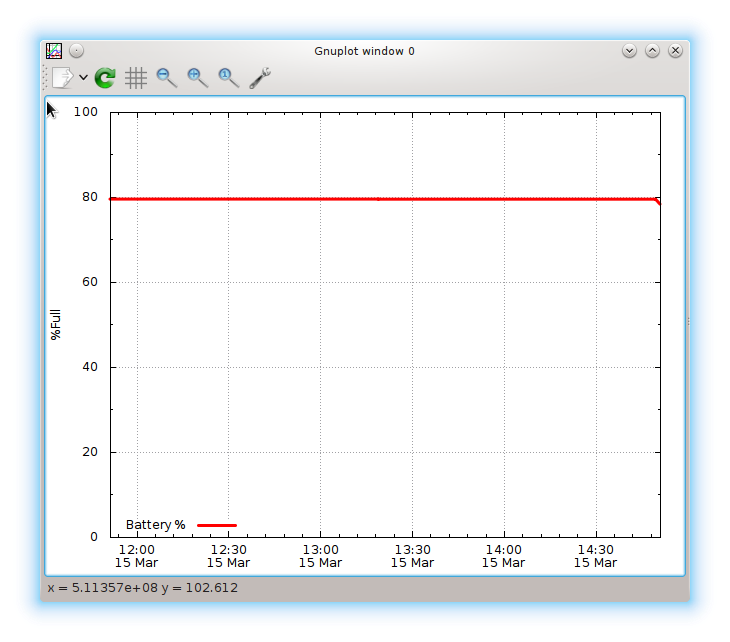
Back in September, I blogged about the system I wrote to collect statistics about my laptop battery, and how it showed the decay and death of this battery (now replaced). I created a simple deb package to handle the collection and graphing, but did not want to upload it to Debian as there were already a battery-stats package in Debian that should do the same thing, and I did not see a point of uploading a competing package when battery-stats could be fixed instead. I reported a few bugs about its non-function, and hoped someone would step in and fix it. But no-one did. I got tired of waiting a few days ago, and took matters in my own hands. The end result is that I am now the new upstream developer of battery stats (available from github) and part of the team maintaining battery-stats in Debian, and the package in Debian unstable is finally able to collect battery status using the /sys/class/power_supply/ information provided by the Linux kernel. If you install the battery-stats package from unstable now, you will be able to get a graph of the current battery fill level, to get some idea about the status of the battery. The source package build and work just fine in Debian testing and stable (and probably oldstable too, but I have not tested). The default graph you get for that system look like this:

My plans for the future is to merge my old scripts into the battery-stats package, as my old scripts collected a lot more details about the battery. The scripts are merged into the upstream battery-stats git repository already, but I am not convinced they work yet, as I changed a lot of paths along the way. Will have to test a bit more before I make a new release. I will also consider changing the file format slightly, as I suspect the way I combine several values into one field might make it impossible to know the type of the value when using it for processing and graphing. If you would like I would like to keep an close eye on your laptop battery, check out the battery-stats package in Debian and on github. I would love some help to improve the system further.
21 February 2016

Lunar: Reproducible builds: week 43 in Stretch cycle

What happened in the reproducible builds effort between February 14th and February 20th 2016:

Toolchain fixes Yaroslav Halchenko uploaded cython/0.23.4+git4-g7eed8d8-1 which makes its output deterministic. Original patch by Chris Lamb. Didier Raboud uploaded pyppd/1.0.2-3 to experimental which now serialize PPD deterministically. Lunar submitted two patches for lcms to add a way for clients to set the creation date/time in profile headers and initialize all bytes when writing named colors.

Packages fixed The following packages have become reproducible due to changes in their build dependencies: dbconfig-common, dctrl-tools, dvdwizard, ekg2, expeyes, galternatives, gpodder, icewm, latex-mk, libiio, lives, navit, po4a, tasksel, tilda, vdr-plugin-infosatepg, xaos. The following packages became reproducible after getting fixed: Some uploads fixed some reproducibility issues, but not all of them: Unknown status:
  • tomcat7/7.0.68-1 by Emmanuel Bourg (test suite fails in test environment).
Patches submitted which have not made their way to the archive yet:
  • #814840 on tor by Petter Reinholdtsen: use the UTC timezone when calling asciidoc.
  • #815082 on arachne-pnr by Dhole: use the C locale to format the changelog date.
  • #815192 on manpages-de by Reiner Herrmann: tell grep to always treat the input as text so that it works with non-UTF-8 locales.
  • #815193 on razorqt by Reiner Herrmann: tell grep to always treat the input as text so that it works with non-UTF-8 locales.
  • #815250 on jacal by Reiner Herrmann: use the C locale to format the build date.
  • #815252 on colord by Lunar: remove extra timestamps when generating CMF and spectra and implement support for SOURCE_DATE_EPOCH.

reproducible.debian.net Two new package sets have been added: freedombox and freedombox_build-depends. (h01ger)

diffoscope development diffoscope version 49 was released on February 17th. It continues to improve handling of debug symbols for ELF files. Their content will now be compared separately to make them more readable. The search for matching debug packages is more efficient by looking only for .deb files in the same parent directory. Alongside more bug fixes, support for ICC profiles has been added, and libarchive is now also used to read metadata for ar archives.

strip-nondeterminism development Reiner Herrmann added support to normalize Gettext .mo files.

Package reviews 170 reviews have been removed, 172 added and 54 updated in the previous week. 34 new FTBFS bugs have been opened by Chris Lamb, h01ger and Reiner Herrmann. New issues added this week: lxqt_translate_desktop_binary_file_matched_under_certain_locales, timestamps_in_manpages_generated_by_autogen. Improvements to the prebuilder script: avoid ccache, skip disorderfs hook if device nodes cannot be created, compatibility with grsec trusted path execution (Reiner Herrmann), code cleanup (Esa Peuha).

Misc. Steven Chamberlain highlighted reproducibility problems due to differences in how Linux and FreeBSD handle permissions for symlinks. Some possible ways forward have been discussed on the reproducible-builds mailing list. Bernhard M. Wiedemann reported on some reproducibility tests made on OpenSuse mentioning the growing support for SOURCE_DATE_EPOCH. If you are eligible for Outreachy or Google Summer of Code, consider spending the summer working on reproducible builds!

19 February 2016

Petter Reinholdtsen: Creating, updating and checking debian/copyright semi-automatically

Making packages for Debian requires quite a lot of attention to details. And one of the details is the content of the debian/copyright file, which should list all relevant licenses used by the code in the package in question, preferably in machine readable DEP5 format. For large packages with lots of contributors it is hard to write and update this file manually, and if you get some detail wrong, the package is normally rejected by the ftpmasters. So getting it right the first time around get the package into Debian faster, and save both you and the ftpmasters some work.. Today, while trying to figure out what was wrong with the zfsonlinux copyright file, I decided to spend some time on figuring out the options for doing this job automatically, or at least semi-automatically. Lucikly, there are at least two tools available for generating the file based on the code in the source package, debmake and cme. I'm not sure which one of them came first, but both seem to be able to create a sensible draft file. As far as I can tell, none of them can be trusted to get the result just right, so the content need to be polished a bit before the file is OK to upload. I found the debmake option in a blog posts from 2014. To generate using debmake, use the -cc option:
debmake -cc > debian/copyright
Note there are some problems with python and non-ASCII names, so this might not be the best option. The cme option is based on a config parsing library, and I found this approach in a blog post from 2015. To generate using cme, use the 'update dpkg-copyright' option:
cme update dpkg-copyright
This will create or update debian/copyright. The cme tool seem to handle UTF-8 names better than debmake. When the copyright file is created, I would also like some help to check if the file is correct. For this I found two good options, debmake -k and license-reconcile. The former seem to focus on license types and file matching, and is able to detect ineffective blocks in the copyright file. The latter reports missing copyright holders and years, but was confused by inconsistent license names (like CDDL vs. CDDL-1.0). I suspect it is good to use both and fix all issues reported by them before uploading. But I do not know if the tools and the ftpmasters agree on what is important to fix in a copyright file, so the package might still be rejected. The devscripts tool licensecheck deserve mentioning. It will read through the source and try to find all copyright statements. It is not comparing the result to the content of debian/copyright, but can be useful when verifying the content of the copyright file. Are you aware of better tools in Debian to create and update debian/copyright file. Please let me know, or blog about it on planet.debian.org. As usual, if you use Bitcoin and want to show your support of my activities, please send Bitcoin donations to my address 15oWEoG9dUPovwmUL9KWAnYRtNJEkP1u1b. Update 2016-02-20: I got a tip from Mike Gabriel on how to use licensecheck and cdbs to create a draft copyright file
licensecheck --copyright -r  find * -type f    \
  /usr/lib/cdbs/licensecheck2dep5 > debian/copyright.auto
He mentioned that he normally check the generated file into the version control system to make it easier to discover license and copyright changes in the upstream source. I will try to do the same with my packages in the future. Update 2016-02-21: The cme author recommended against using -quiet for new users, so I removed it from the proposed command line.

14 February 2016

Lunar: Reproducible builds: week 42 in Stretch cycle

What happened in the reproducible builds effort between February 7th and February 13th 2016:

Toolchain fixes
  • James McCoy uploaded devscripts/2.16.1 which makes dcmd supports .buildinfo files. Original patch by josch.
  • Lisandro Dami n Nicanor P rez Meyer uploaded qt4-x11/4:4.8.7+dfsg-6 which make files created by qch reproducible by using a fixed date instead of the current time. Original patch by Dhole.
Norbert Preining rejected the patch submitted by Reiner Herrmann to make the CreationDate not appear in comments of DVI / PS files produced by TeX. He also mentioned that some timestamps can be replaced by using the -output-comment option and that the next version of pdftex will have patches inspired by reproducible build to mitigate the effects (see SOURCE_DATE_EPOCH patches) .

Packages fixed The following packages have become reproducible due to changes in their build dependencies: abntex, apt-dpkg-ref, arduino, c++-annotations, cfi, chaksem, clif, cppreference-doc, dejagnu, derivations, ecasound, fdutils, gnash, gnu-standards, gnuift, gsequencer, gss, gstreamer0.10, gstreamer1.0, harden-doc, haskell98-report, iproute2, java-policy, libbluray, libmodbus, lizardfs, mclibs, moon-buggy, nurpawiki, php-sasl, shishi, stealth, xmltex, xsom. The following packages became reproducible after getting fixed: Some uploads fixed some reproducibility issues, but not all of them: Patches submitted which have not made their way to the archive yet:
  • #813944 on cvm by Reiner Herrmann: remove gzip headers, fix permissions of some directories and the order of the md5sums.
  • #814019 on latexdiff by Reiner Herrmann: remove the current build date from documentation.
  • #814214 on rocksdb by Chris Lamb: add support for SOURCE_DATE_EPOCH.

reproducible.debian.net A new armhf build node has been added (thanks to Vagrant Cascadian) and integrated into the Jenkins setup for 4 new armhf builder jobs. (h01ger) All packages for Debian testing (Stretch) have been tested on armhf in just 42 days. It took 114 days to get the same point for unstable back when the armhf test infrastructure was much smaller. Package sets have been enabled for testing on armhf. (h01ger) Packages producing architecture-independent ( Arch:all ) binary packages together with architecture dependent packages targeted for specific architectures will now only be tested on matching architectures. (Steven Chamberlain, h01ger) As the Jenkins setup is now made of 252 different jobs, the overview has been split into 11 different smalller views. (h01ger)

Package reviews 222 reviews have been removed, 110 added and 50 updated in the previous week. 35 FTBFS reports were made by Chris Lamb, Danny Edel, and Niko Tyni.

Misc. The recordings of Ludovic Court s' talk at FOSDEM 16 about reproducible builds and GNU Guix is now available. One can also have a look at slides from Fabian Keil's talk about ElecrtroBSD and Baptiste Daroussin's talk about FreeBSD packages.

8 February 2016

Lunar: Reproducible builds: week 41 in Stretch cycle

What happened in the reproducible builds effort this week:

Toolchain fixes After remarks from Guillem Jover, Lunar updated his patch adding generation of .buildinfo files in dpkg.

Packages fixed The following packages have become reproducible due to changes in their build dependencies: dracut, ent, gdcm, guilt, lazarus, magit, matita, resource-agents, rurple-ng, shadow, shorewall-doc, udiskie. The following packages became reproducible after getting fixed:
  • disque/1.0~rc1-5 by Chris Lamb, noticed by Reiner Herrmann.
  • dlm/4.0.4-2 by Ferenc W gner.
  • drbd-utils/8.9.6-1 by Apollon Oikonomopoulos.
  • java-common/0.54 by by Emmanuel Bourg.
  • libjibx1.2-java/1.2.6-1 by Emmanuel Bourg.
  • libzstd/0.4.7-1 by Kevin Murray.
  • python-releases/1.0.0-1 by Jan Dittberner.
  • redis/2:3.0.7-2 by Chris Lamb, noticed by Reiner Herrmann.
  • tetex-brev/4.22.github.20140417-3 by Petter Reinholdtsen.
Some uploads fixed some reproducibility issues, but not all of them:
  • anarchism/14.0-4 by Holger Levsen.
  • hhvm/3.11.1+dfsg-1 by Faidon Liambotis.
  • netty/1:4.0.34-1 by Emmanuel Bourg.
Patches submitted which have not made their way to the archive yet:
  • #813309 on lapack by Reiner Herrmann: removes the test log and sorts the files packed into the static library locale-independently.
  • #813345 on elastix by akira: suggest to use the $datetime placeholder in Doxygen footer.
  • #813892 on dietlibc by Reiner Herrmann: remove gzip headers, sort md5sums file, and sort object files linked in static libraries.
  • #813912 on git by Reiner Herrmann: remove timestamps from documentation generated with asciidoc, remove gzip headers, and sort md5sums and tclIndex files.

reproducible.debian.net For the first time, we've reached more than 20,000 packages with reproducible builds for sid on amd64 with our current test framework. Vagrant Cascadian has set up another test system for armhf. Enabling four more builder jobs to be added to Jenkins. (h01ger)

Package reviews 233 reviews have been removed, 111 added and 86 updated in the previous week. 36 new FTBFS bugs were reported by Chris Lamb and Alastair McKinstry. New issue: timestamps_in_manpages_generated_by_yat2m. The description for the blacklisted_on_jenkins issue has been improved. Some packages are also now tagged with blacklisted_on_jenkins_armhf_only.

Misc. Steven Chamberlain gave an update on the status of FreeBSD and variants after the BSD devroom at FOSDEM 16. He also discussed how jails can be used for easier and faster reproducibility tests. The video for h01ger's talk in the main track of FOSDEM 16 about the reproducible ecosystem is now available.

4 February 2016

Petter Reinholdtsen: Using appstream in Debian to locate packages with firmware and mime type support

The appstream system is taking shape in Debian, and one provided feature is a very convenient way to tell you which package to install to make a given firmware file available when the kernel is looking for it. This can be done using apt-file too, but that is for someone else to blog about. :) Here is a small recipe to find the package with a given firmware file, in this example I am looking for ctfw-3.2.3.0.bin, randomly picked from the set of firmware announced using appstream in Debian unstable. In general you would be looking for the firmware requested by the kernel during kernel module loading. To find the package providing the example file, do like this:
% apt install appstream
[...]
% apt update
[...]
% appstreamcli what-provides firmware:runtime ctfw-3.2.3.0.bin   \
  awk '/Package:/  print $2 '
firmware-qlogic
%
See the appstream wiki page to learn how to embed the package metadata in a way appstream can use. This same approach can be used to find any package supporting a given MIME type. This is very useful when you get a file you do not know how to handle. First find the mime type using file --mime-type, and next look up the package providing support for it. Lets say you got an SVG file. Its MIME type is image/svg+xml, and you can find all packages handling this type like this:
% apt install appstream
[...]
% apt update
[...]
% appstreamcli what-provides mimetype image/svg+xml   \
  awk '/Package:/  print $2 '
bkchem
phototonic
inkscape
shutter
tetzle
geeqie
xia
pinta
gthumb
karbon
comix
mirage
viewnior
postr
ristretto
kolourpaint4
eog
eom
gimagereader
midori
%
I believe the MIME types are fetched from the desktop file for packages providing appstream metadata.

24 January 2016

Lunar: Reproducible builds: week 39 in Stretch cycle

What happened in the reproducible builds effort between January 17th and January 23rd:

Toolchain fixes James McCoy uploaded subversion/1.9.3-2 which removes -Wdate-time from CPPFLAGS passed to swig enabling several packages to build again. The switch made in binutils/2.25-6 to use deterministic archives by default had the unfortunate effect of breaking a seldom used feature of make. Manoj Srivastava asked on debian-devel the best way to communicate the changes to Debian users. Lunar quickly came up with a patch that displays a warning when Make encounters deterministic archives. Manoj made it available in make/4.1-2 together with a NEWS file advertising the change. Following Guillem Jover's comment on the latest patch to make mtimes of packaged files deterministic, Daniel Kahn Gillmor updated and extended the patch adding the --clamp-mtime option to GNU Tar. Mattia Rizzolo updated texlive-bin in the reproducible experimental repository.

Packages fixed The following packages became reproducible after getting fixed: Some uploads fixed some reproducibility issues, but not all of them: Patches submitted which have not made their way to the archive yet:

reproducible.debian.net Transition from reproducible.debian.net to the more general tests.reproducible-builds.org has started. More visual changes are coming. (h01ger) A plan on how to run tests for F-Droid has been worked out. (hc, mvdan, h01ger) A first step has been made by adding a Jenkins job to setup an F-Droid build environment. (h01ger)

diffoscope development diffoscope 46 has been released on January 19th, followed-up by version 47 made available on January 23rd. Try it online at try.diffoscope.org! The biggest visible change is the improvement to ELF file handling. Comparisons are now done section by section, using the most appropriate tool and options to get meaningful results, thanks to Dhole's work and Mike Hommey's suggestions. Also suggested by Mike, symbols for IP-relative ops are now filtered out to remove clutter. Understanding differences in ELF files belonging to Debian packages should also be much easier as diffoscope will now try to extract debug information from the matching dbgsym package. This means objdump disassembler should output line numbers for packages built with recent debhelper as long as the associated debug package is in the same directory. As diff tends to consume huge amount of memory on large inputs, diffoscope has a limit in place to prevent crashes. diffoscope used to display a difference every time the limit was hit. Because this was confusing in case there were actually no differences, a hash is now internally computed to only report a difference when one exists. Files in archives and other container members are now compared in the original order. This should not matter in most case but overall give more predictable results. Debian .buildinfo files are now supported. Amongst other minor fixes and improvements, diffoscope will now properly compare symlinks in directories. Thanks Tuomas Tynkkynen for reporting the problem.

Package reviews 70 reviews have been removed, 125 added and 33 updated in the previous week, gcc-5 amongst others. 25 FTBFS issues have been filled by Chris Lamb, Daniel Stender, Martin Michlmayr.

Misc. The 16th FOSDEM will happen in Brussels, Belgium on January 30-31st. Several talks will be about reproducible builds: h01ger about the general ecosystem, Fabian Keil about the security oriented ElectroBSD, Baptiste Daroussin about FreeBSD packages, Ludovic Court s about Guix.

Petter Reinholdtsen: Creepy, visualise geotagged social media information - nice free software

Most people seem not to realise that every time they walk around with the computerised radio beacon known as a mobile phone their position is tracked by the phone company and often stored for a long time (like every time a SMS is received or sent). And if their computerised radio beacon is capable of running programs (often called mobile apps) downloaded from the Internet, these programs are often also capable of tracking their location (if the app requested access during installation). And when these programs send out information to central collection points, the location is often included, unless extra care is taken to not send the location. The provided information is used by several entities, for good and bad (what is good and bad, depend on your point of view). What is certain, is that the private sphere and the right to free movement is challenged and perhaps even eradicated for those announcing their location this way, when they share their whereabouts with private and public entities.

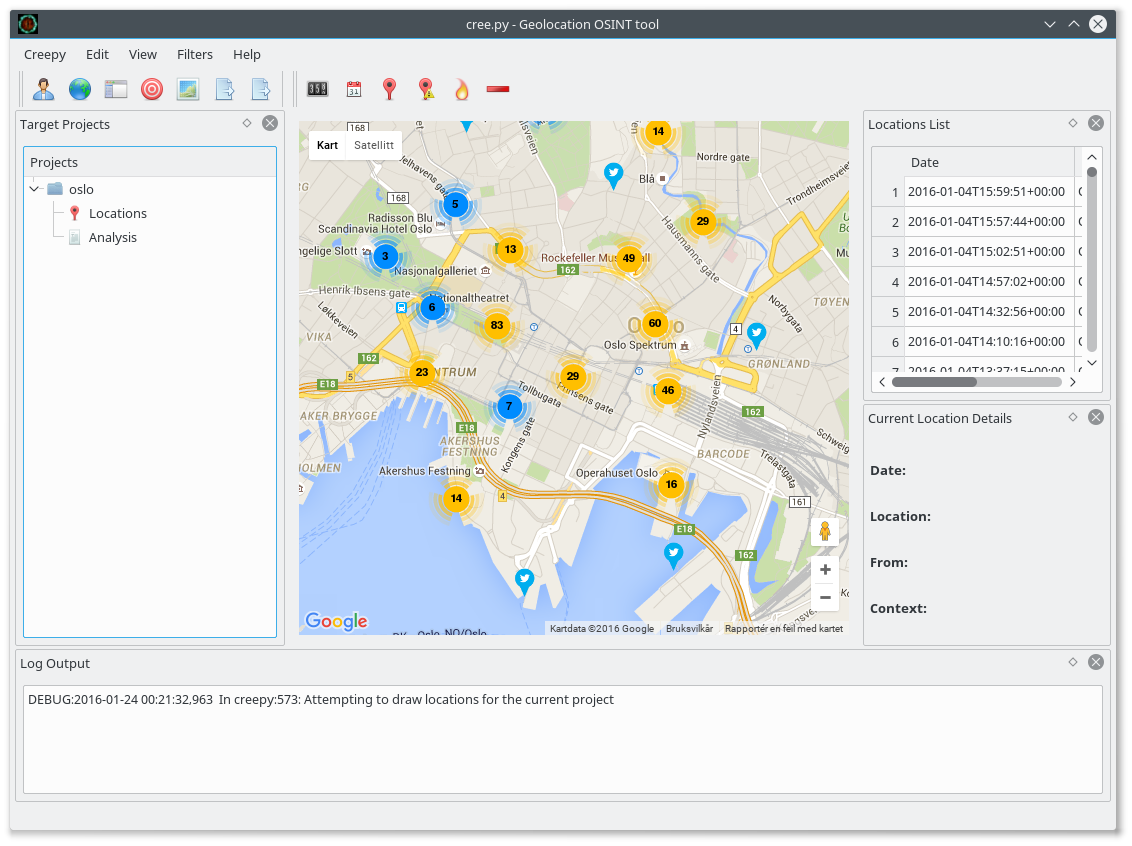
The phone company logs provide a register of locations to check out when one want to figure out what the tracked person was doing. It is unavailable for most of us, but provided to selected government officials, company staff, those illegally buying information from unfaithful servants and crackers stealing the information. But the public information can be collected and analysed, and a free software tool to do so is called Creepy or Cree.py. I discovered it when I read an article about Creepy in the Norwegian newspaper Aftenposten i November 2014, and decided to check if it was available in Debian. The python program was in Debian, but the version in Debian was completely broken and practically unmaintained. I uploaded a new version which did not work quite right, but did not have time to fix it then. This Christmas I decided to finally try to get Creepy operational in Debian. Now a fixed version is available in Debian unstable and testing, and almost all Debian specific patches are now included upstream. The Creepy program visualises geolocation information fetched from Twitter, Instagram, Flickr and Google+, and allow one to get a complete picture of every social media message posted recently in a given area, or track the movement of a given individual across all these services. Earlier it was possible to use the search API of at least some of these services without identifying oneself, but these days it is impossible. This mean that to use Creepy, you need to configure it to log in as yourself on these services, and provide information to them about your search interests. This should be taken into account when using Creepy, as it will also share information about yourself with the services. The picture above show the twitter messages sent from (or at least geotagged with a position from) the city centre of Oslo, the capital of Norway. One useful way to use Creepy is to first look at information tagged with an area of interest, and next look at all the information provided by one or more individuals who was in the area. I tested it by checking out which celebrity provide their location in twitter messages by checkout out who sent twitter messages near a Norwegian TV station, and next could track their position over time, making it possible to locate their home and work place, among other things. A similar technique have been used to locate Russian soldiers in Ukraine, and it is both a powerful tool to discover lying governments, and a useful tool to help people understand the value of the private information they provide to the public. The package is not trivial to backport to Debian Stable/Jessie, as it depend on several python modules currently missing in Jessie (at least python-instagram, python-flickrapi and python-requests-toolbelt). (I have uploaded the image to screenshots.debian.net and licensed it under the same terms as the Creepy program in Debian.)

17 January 2016

Lunar: Reproducible builds: week 38 in Stretch cycle

What happened in the reproducible builds effort between January 10th and January 16th:

Toolchain fixes Benjamin Drung uploaded mozilla-devscripts/0.43 which sorts the file list in preferences files. Original patch by Reiner Herrmann. Lunar submitted an updated patch series to make timestamps in packages created by dpkg deterministic. To ensure that the mtimes in data.tar are reproducible, with the patches, dpkg-deb uses the --clamp-mtime option added in tar/1.28-1 when available. An updated package has been uploaded to the experimental repository. This removed the need for a modified debhelper as all required changes for reproducibility have been merged or are now covered by dpkg.

Packages fixed The following packages have become reproducible due to changes in their build dependencies: angband-doc, bible-kjv, cgoban, gnugo, pachi, wmpuzzle, wmweather, wmwork, xfaces, xnecview, xscavenger, xtrlock, virt-top. The following packages became reproducible after getting fixed: Some uploads fixed some reproducibility issues, but not all of them: Untested changes:

reproducible.debian.net Once again, Vagrant Cascadian is providing another armhf build system, allowing to run 6 more armhf builder jobs, right there. (h01ger) Stop requiring a modified debhelper and adapt to the latest dpkg experimental version by providing a predetermined identifier for the .buildinfo filename. (Mattia Rizzolo, h01ger) New X.509 certificates were set up for jenkins.debian.net and reproducible.debian.net using Let's Encrypt!. Thanks to GlobalSign for providing certificates for the last year free of charge. (h01ger)

Package reviews 131 reviews have been removed, 85 added and 32 updated in the previous week. FTBFS issues filled: 29. Thanks to Chris Lamb, Mattia Rizzolo, and Niko Tyni. New issue identified: timestamps_in_manpages_added_by_golang_cobra.

Misc. Most of the minutes from the meetings held in Athens in December 2015 are now available to the public.

14 January 2016

Petter Reinholdtsen: Always download Debian packages using Tor - the simple recipe

During his DebConf15 keynote, Jacob Appelbaum observed that those listening on the Internet lines would have good reason to believe a computer have a given security hole if it download a security fix from a Debian mirror. This is a good reason to always use encrypted connections to the Debian mirror, to make sure those listening do not know which IP address to attack. In August, Richard Hartmann observed that encryption was not enough, when it was possible to interfere download size to security patches or the fact that download took place shortly after a security fix was released, and proposed to always use Tor to download packages from the Debian mirror. He was not the first to propose this, as the apt-transport-tor package by Tim Retout already existed to make it easy to convince apt to use Tor, but I was not aware of that package when I read the blog post from Richard. Richard discussed the idea with Peter Palfrader, one of the Debian sysadmins, and he set up a Tor hidden service on one of the central Debian mirrors using the address vwakviie2ienjx6t.onion, thus making it possible to download packages directly between two tor nodes, making sure the network traffic always were encrypted. Here is a short recipe for enabling this on your machine, by installing apt-transport-tor and replacing http and https urls with tor+http and tor+https, and using the hidden service instead of the official Debian mirror site. I recommend installing etckeeper before you start to have a history of the changes done in /etc/.
apt install apt-transport-tor
sed -i 's% http://ftp.debian.org/%tor+http://vwakviie2ienjx6t.onion/%' /etc/apt/sources.list
sed -i 's% http% tor+http%' /etc/apt/sources.list
If you have more sources listed in /etc/apt/sources.list.d/, run the sed commands for these too. The sed command is assuming your are using the ftp.debian.org Debian mirror. Adjust the command (or just edit the file manually) to match your mirror. This work in Debian Jessie and later. Note that tools like apt-file only recently started using the apt transport system, and do not work with these tor+http URLs. For apt-file you need the version currently in experimental, which need a recent apt version currently only in unstable. So if you need a working apt-file, this is not for you. Another advantage from this change is that your machine will start using Tor regularly and at fairly random intervals (every time you update the package lists or upgrade or install a new package), thus masking other Tor traffic done from the same machine. Using Tor will become normal for the machine in question. On Freedombox, APT is set up by default to use apt-transport-tor when Tor is enabled. It would be great if it was the default on any Debian system.

23 December 2015

Petter Reinholdtsen: OpenALPR, find car license plates in video streams - nice free software

When I was a kid, we used to collect "car numbers", as we used to call the car license plate numbers in those days. I would write the numbers down in my little book and compare notes with the other kids to see how many region codes we had seen and if we had seen some exotic or special region codes and numbers. It was a fun game to pass time, as we kids have plenty of it. A few days I came across the OpenALPR project, a free software project to automatically discover and report license plates in images and video streams, and provide the "car numbers" in a machine readable format. I've been looking for such system for a while now, because I believe it is a bad idea that the automatic number plate recognition tool only is available in the hands of the powerful, and want it to be available also for the powerless to even the score when it comes to surveillance and sousveillance. I discovered the developer wanted to get the tool into Debian, and as I too wanted it to be in Debian, I volunteered to help him get it into shape to get the package uploaded into the Debian archive. Today we finally managed to get the package into shape and uploaded it into Debian, where it currently waits in the NEW queue for review by the Debian ftpmasters. I guess you are wondering why on earth such tool would be useful for the common folks, ie those not running a large government surveillance system? Well, I plan to put it in a computer on my bike and in my car, tracking the cars nearby and allowing me to be notified when number plates on my watch list are discovered. Another use case was suggested by a friend of mine, who wanted to set it up at his home to open the car port automatically when it discovered the plate on his car. When I mentioned it perhaps was a bit foolhardy to allow anyone capable of placing his license plate number of a piece of cardboard to open his car port, men replied that it was always unlocked anyway. I guess for such use case it make sense. I am sure there are other use cases too, for those with imagination and a vision. If you want to build your own version of the Debian package, check out the upstream git source and symlink ./distros/debian to ./debian/ before running "debuild" to build the source. Or wait a bit until the package show up in unstable.

20 December 2015

Petter Reinholdtsen: Using appstream with isenkram to install hardware related packages in Debian

Around three years ago, I created the isenkram system to get a more practical solution in Debian for handing hardware related packages. A GUI system in the isenkram package will present a pop-up dialog when some hardware dongle supported by relevant packages in Debian is inserted into the machine. The same lookup mechanism to detect packages is available as command line tools in the isenkram-cli package. In addition to mapping hardware, it will also map kernel firmware files to packages and make it easy to install needed firmware packages automatically. The key for this system to work is a good way to map hardware to packages, in other words, allow packages to announce what hardware they will work with. I started by providing data files in the isenkram source, and adding code to download the latest version of these data files at run time, to ensure every user had the most up to date mapping available. I also added support for storing the mapping in the Packages file in the apt repositories, but did not push this approach because while I was trying to figure out how to best store hardware/package mappings, the appstream system was announced. I got in touch and suggested to add the hardware mapping into that data set to be able to use appstream as a data source, and this was accepted at least for the Debian version of appstream. A few days ago using appstream in Debian for this became possible, and today I uploaded a new version 0.20 of isenkram adding support for appstream as a data source for mapping hardware to packages. The only package so far using appstream to announce its hardware support is my pymissile package. I got help from Matthias Klumpp with figuring out how do add the required metadata in pymissile. I added a file debian/pymissile.metainfo.xml with this content:
<?xml version="1.0" encoding="UTF-8"?>
<component>
  <id>pymissile</id>
  <metadata_license>MIT</metadata_license>
  <name>pymissile</name>
  <summary>Control original Striker USB Missile Launcher</summary>
  <description>
    <p>
      Pymissile provides a curses interface to control an original
      Marks and Spencer / Striker USB Missile Launcher, as well as a
      motion control script to allow a webcamera to control the
      launcher.
    </p>
  </description>
  <provides>
    <modalias>usb:v1130p0202d*</modalias>
  </provides>
</component>
The key for isenkram is the component/provides/modalias value, which is a glob style match rule for hardware specific strings (modalias strings) provided by the Linux kernel. In this case, it will map to all USB devices with vendor code 1130 and product code 0202. Note, it is important that the license of all the metadata files are compatible to have permissions to aggregate them into archive wide appstream files. Matthias suggested to use MIT or BSD licenses for these files. A challenge is figuring out a good id for the data, as it is supposed to be globally unique and shared across distributions (in other words, best to coordinate with upstream what to use). But it can be changed later or, so we went with the package name as upstream for this project is dormant. To get the metadata file installed in the correct location for the mirror update scripts to pick it up and include its content the appstream data source, the file must be installed in the binary package under /usr/share/appdata/. I did this by adding the following line to debian/pymissile.install:
debian/pymissile.metainfo.xml usr/share/appdata
With that in place, the command line tool isenkram-lookup will list all packages useful on the current computer automatically, and the GUI pop-up handler will propose to install the package not already installed if a hardware dongle is inserted into the machine in question. Details of the modalias field in appstream is available from the DEP-11 proposal. To locate the modalias values of all hardware present in a machine, try running this command on the command line:
cat $(find /sys/devices/ grep modalias)
To learn more about the isenkram system, please check out my blog posts tagged isenkram.

30 November 2015

Petter Reinholdtsen: The GNU General Public License is not magic pixie dust

A blog post from my fellow Debian developer Paul Wise titled "The GPL is not magic pixie dust" explain the importance of making sure the GPL is enforced. I quote the blog post from Paul in full here with his permission:
Become a Software Freedom Conservancy Supporter!
The GPL is not magic pixie dust. It does not work by itself.
The first step is to choose a copyleft license for your code.
The next step is, when someone fails to follow that copyleft license, it must be enforced
and its a simple fact of our modern society that such type of work
is incredibly expensive to do and incredibly difficult to do.
-- Bradley Kuhn, in FaiF episode 0x57 As the Debian Website used to imply, public domain and permissively licensed software can lead to the production of more proprietary software as people discover useful software, extend it and or incorporate it into their hardware or software products. Copyleft licenses such as the GNU GPL were created to close off this avenue to the production of proprietary software but such licenses are not enough. With the ongoing adoption of Free Software by individuals and groups, inevitably the community's expectations of license compliance are violated, usually out of ignorance of the way Free Software works, but not always. As Karen and Bradley explained in FaiF episode 0x57, copyleft is nothing if no-one is willing and able to stand up in court to protect it. The reality of today's world is that legal representation is expensive, difficult and time consuming. With gpl-violations.org in hiatus until some time in 2016, the Software Freedom Conservancy (a tax-exempt charity) is the major defender of the Linux project, Debian and other groups against GPL violations. In March the SFC supported a lawsuit by Christoph Hellwig against VMware for refusing to comply with the GPL in relation to their use of parts of the Linux kernel. Since then two of their sponsors pulled corporate funding and conferences blocked or cancelled their talks. As a result they have decided to rely less on corporate funding and more on the broad community of individuals who support Free Software and copyleft. So the SFC has launched a campaign to create a community of folks who stand up for copyleft and the GPL by supporting their work on promoting and supporting copyleft and Free Software. If you support Free Software, like what the SFC do, agree with their compliance principles, are happy about their successes in 2015, work on a project that is an SFC member and or just want to stand up for copyleft, please join Christopher Allan Webber, Carol Smith, Jono Bacon, myself and others in becoming a supporter. For the next week your donation will be matched by an anonymous donor. Please also consider asking your employer to match your donation or become a sponsor of SFC. Don't forget to spread the word about your support for SFC via email, your blog and or social media accounts.
I agree with Paul on this topic and just signed up as a Supporter of Software Freedom Conservancy myself. Perhaps you should be a supporter too?

17 November 2015

Petter Reinholdtsen: PGP key transition statement for key EE4E02F9

I've needed a new OpenPGP key for a while, but have not had time to set it up properly. I wanted to generate it offline and have it available on a OpenPGP smart card for daily use, and learning how to do it and finding time to sit down with an offline machine almost took forever. But finally I've been able to complete the process, and have now moved from my old GPG key to a new GPG key. See the full transition statement, signed with both my old and new key for the details. This is my new key:
pub   3936R/111D6B29EE4E02F9 2015-11-03 [expires: 2019-11-14]
      Key fingerprint = 3AC7 B2E3 ACA5 DF87 78F1  D827 111D 6B29 EE4E 02F9
uid                  Petter Reinholdtsen <pere@hungry.com>
uid                  Petter Reinholdtsen <pere@debian.org>
sub   4096R/87BAFB0E 2015-11-03 [expires: 2019-11-02]
sub   4096R/F91E6DE9 2015-11-03 [expires: 2019-11-02]
sub   4096R/A0439BAB 2015-11-03 [expires: 2019-11-02]
The key can be downloaded from the OpenPGP key servers, signed by my old key. If you signed my old key (DB4CCC4B2A30D729), I'd very much appreciate a signature on my new key, details and instructions in the transition statement. I m happy to reciprocate if you have a similarly signed transition statement to present.

3 November 2015

Petter Reinholdtsen: Is Pentagon deciding the Norwegian negotiating position on Internet governance?

In Norway, all government offices are required by law to keep a list of every document or letter arriving and leaving their offices. Internal notes should also be documented. The document list (called a mail journal - "postjournal" in Norwegian) is public information and thanks to the Norwegian Freedom of Information Act (Offentleglova) the mail journal is available for everyone. Most offices even publish the mail journal on their web pages, as PDFs or tables in web pages. The state-level offices even have a shared web based search service (called Offentlig Elektronisk Postjournal - OEP) to make it possible to search the entries in the list. Not all journal entries show up on OEP, and the search service is hard to use, but OEP does make it easier to find at least some interesting journal entries . In 2012 I came across a document in the mail journal for the Norwegian Ministry of Transport and Communications on OEP that piqued my interest. The title of the document was "Internet Governance and how it affects national security" (Norwegian: "Internet Governance og p virkning p nasjonal sikkerhet"). The document date was 2012-05-22, and it was said to be sent from the "Permanent Mission of Norway to the United Nations". I asked for a copy, but my request was rejected with a reference to a legal clause said to authorize them to reject it (offentleglova 20, letter c) and an explanation that the document was exempt because of foreign policy interests as it contained information related to the Norwegian negotiating position, negotiating strategies or similar. I was told the information in the document related to the ongoing negotiation in the International Telecommunications Union (ITU). The explanation made sense to me in early January 2013, as a ITU conference in Dubay discussing Internet Governance (World Conference on International Telecommunications - WCIT-12) had just ended, reportedly in chaos when USA walked out of the negotiations and 25 countries including Norway refused to sign the new treaty. It seemed reasonable to believe talks were still going on a few weeks later. Norway was represented at the ITU meeting by two authorities, the Norwegian Communications Authority and the Ministry of Transport and Communications. This might be the reason the letter was sent to the ministry. As I was unable to find the document in the mail journal of any Norwegian UN mission, I asked the ministry who had sent the document to the ministry, and was told that it was the Deputy Permanent Representative with the Permanent Mission of Norway in Geneva. Three years later, I was still curious about the content of that document, and again asked for a copy, believing the negotiation was over now. This time I asked both the Ministry of Transport and Communications as the receiver and asked the Permanent Mission of Norway in Geneva as the sender for a copy, to see if they both agreed that it should be withheld from the public. The ministry upheld its rejection quoting the same law reference as before, while the permanent mission rejected it quoting a different clause (offentleglova 20 letter b), claiming that they were required to keep the content of the document from the public because it contained information given to Norway with the expressed or implied expectation that the information should not be made public. I asked the permanent mission for an explanation, and was told that the document contained an account from a meeting held in the Pentagon for a limited group of NATO nations where the organiser of the meeting did not intend the content of the meeting to be publicly known. They explained that giving me a copy might cause Norway to not get access to similar information in the future and thus hurt the future foreign interests of Norway. They also explained that the Permanent Mission of Norway in Geneva was not the author of the document, they only got a copy of it, and because of this had not listed it in their mail journal. Armed with this knowledge I asked the Ministry to reconsider and asked who was the author of the document, now realising that it was not same as the "sender" according to Ministry of Transport and Communications. The ministry upheld its rejection but told me the name of the author of the document. According to a government report the author was with the Permanent Mission of Norway in New York a bit more than a year later (2014-09-22), so I guessed that might be the office responsible for writing and sending the report initially and asked them for a copy but I was obviously wrong as I was told that the document was unknown to them and that the author did not work there when the document was written. Next, I asked the Permanent Mission of Norway in Geneva and the Foreign Ministry to reconsider and at least tell me who sent the document to Deputy Permanent Representative with the Permanent Mission of Norway in Geneva. The Foreign Ministry also upheld its rejection, but told me that the person sending the document to Permanent Mission of Norway in Geneva was the defence attach with the Norwegian Embassy in Washington. I do not know if this is the same person as the author of the document. If I understand the situation correctly, someone capable of inviting selected NATO nations to a meeting in Pentagon organised a meeting where someone representing the Norwegian defence attach in Washington attended, and the account from this meeting is interpreted by the Ministry of Transport and Communications to expose Norways negotiating position, negotiating strategies and similar regarding the ITU negotiations on Internet Governance. It is truly amazing what can be derived from mere meta-data. I wonder which NATO countries besides Norway attended this meeting? And what exactly was said and done at the meeting? Anyone know?

Next.

Previous.