Search Results: "Paul Tagliamonte"

19 December 2012

Paul Tagliamonte: The most horrifying thing i've done -- or: hy

Hang tight folks, this is a trippy one: As many have noted in my most recent post, I ve taken a shine to lisps hosted in Python. While clojure-py is badass, it s not fit for using from python. I hit some problems in the way it handles atomic variable access (well atomic , it s actually not ;) ), so I ve decided to give it a shot myself. That s right. I wrote a Lisp. A very basic, unmacroed lisp, but a lisp. So, let s take a look a trivial hy file pair The first file (really_lisp.hy), is as follows:
; vim: tabstop=2 expandtab shiftwidth=2 softtabstop=2 filetype=lisp
; Copyright (c) Paul Tagliamonte, in sofar as any of this is at all
;  copyrightable.
(def hello "World!")
(def square (fn [arg]
  (* arg arg)))
(def factorial (fn [n]
  (if (<= n 1)
   1
   (* n (factorial (- n 1))))))
(def fib (fn [n]
  (if (< n 2)
    n
    (+ (fib (- n 1)) (fib (- n 2))))))
And, the example Python script example.py is as follows:
import hy.lang.importer
import really_lisp
print really_lisp.hello
# "World!"
print really_lisp.square(4)
# 16
print really_lisp.factorial(10)
# 3628800
print [really_lisp.fib(x) for x in range(1, 20)]
# [1, 1, 2, 3, 5, 8, 13, 21, 34, 55, 89, 144,
#        233, 377, 610, 987, 1597, 2584, 4181]
Please note two awesome things firstly, we re importing a non-python script into a Python module. Awesome. Secondly, we re able to access symbols natively, as well as functions. Let s also demonstrate the other way (just hython this time):
; vim: tabstop=2 expandtab shiftwidth=2 softtabstop=2 filetype=lisp
; Copyright (c) Paul Tagliamonte, in sofar as any of this is at all
;  copyrightable.
(puts "Hello, World!")
; "Hello, World!"
(import ["os"
         "sys"])
(puts (os.path.abspath "."))
; "/home/tag/tmp"
(puts sys.argv)
; ['/home/tag/.virtualenvs/hy/bin/hython', 'test.hy']
(sys.stdout.write "Fuggn' test\n")
; "Fuggn' test"
Naturally, not to be outdone, I decided to amp it up. Django in Lisp While insane, the big stuff looks like this: I ve replaced urls.py with urls.hy:
; vim: tabstop=2 expandtab shiftwidth=2 softtabstop=2 filetype=lisp
(import ["django.conf.urls"])
(def urlpatterns (django.conf.urls.patterns ""
  (django.conf.urls.url "^$" "djlisp.hellisp.views.home")
))
And, views.py with views.hy:
; vim: tabstop=2 expandtab shiftwidth=2 softtabstop=2 filetype=lisp
(import ["django.shortcuts"])
(def home (fn [request]
  (django.shortcuts.render_to_response "home.html"  )))
And lastly, the settings.hy file. I m not going to paste it because it s huge. But, it works!

14 December 2012

Paul Tagliamonte: Scripting Python in Clojure

Yeah, wait, what? No, really! I took a look through clojure-py, and found out something pretty rad. In order to get clojurepy scripts to load other clojurepy, it had to shim out and add a new importer for clojure scripts. What this really means, is that you can import Clojure from Python, which is pretty sweet. I abused the internals here, and added it to dput-ng as a quick hack. Basically, I just had to import clojure.main, and let the main function set up the sys shim. I would set it up in dput, but I d have to import that module anyway. Remember, when doing this, the namespace ((ns ...)) needs to match the filename. So, I present the first Clojure hook for dput-ng:
; Copyright (c) Paul R. Tagliamonte <paultag@debian.org>, 2012, under the
; terms of dput-ng itsself.
(ns clojtest
  (:require dput.core
            dput.exceptions))
(defn log [x]  ; for debug output
  (.debug dput.core/logger x))
(defn dput-checker [changes profile interface]
  (cond (>= (-> changes (.get "maintainer") (.find "arno@debian.org")) 0)
    (throw (dput.exceptions/HookException. "Maintainer's Arno. Aborting upload"))
  :else
    (log "Nah, it's not arno, we're good")))
This, of course, checks if the maintainer is Arno, and throws a fit if it is. Gist is over on gist.github. After, Algernon added his own checker, which throws a fit if you have a package in the B-Ds that you aught to not use (such as dpatch)
; Copyright (c) Gergely Nagy <algernon@debian.org>, 2012, under the
; terms of dput-ng itself.
(ns bd-blacklist
  (:require dput.core
            dput.exceptions
            dput.dsc))
(defn prune-build-deps
  "Prune a string representation of the build-depends so that only a
  list of packages remain."
  [bd-string]
  (map #(first (-> % (.strip) (.split " "))) (.. bd-string (split ","))))
(defn has-blacklisted?
  "Given a dsc file and a blacklist, check if any of the
  build-depencencies are in that list. Throws an error if there are
  matches."
  [dsc-file blacklist]
  (let [dsc (dput.dsc/parse_dsc_file dsc-file)
        build-deps (prune-build-deps (.. dsc (get "build-depends")))]
    (if-let [bad-bd (some blacklist build-deps)]
      (throw (dput.exceptions/HookException. (str "Blacklisted build-dependency found: " bad-bd)))
      (-> dput.core/logger (.trace "Build-Dependencies do not have anything on the blacklist")))))
(defn blacklist-checker
  "Checks whether the dsc has blacklisted build-dependencies, ignores
  the check when no dsc is to be found."
  [changes profile interface]
  (if-let [dsc-file (.. changes (get_dsc))]
    (has-blacklisted? dsc-file (set (get profile "bd-blacklist")))
    (-> dput.core/logger (.trace "No .dsc found, build-dependencies cannot be checked"))))
You can check that out in the git tree Hacks welcome!

7 December 2012

Paul Tagliamonte: converting kml to csv (for consumption of google latitude)

Google Latitude history dumps come in KML, and KML isn t super compatible with existing GIS tools. I wrote a quick snippit to output CSV from a KML dump on google latitude.
from lxml import etree
import sys
root = etree.fromstring(open(sys.argv[1], 'r').read())
track = root.xpath("//*[local-name()='Track']")[0]
coord = None
when = None
print "time,lat,lon"
for node in track.iter():
    name = node.xpath("local-name()")
    if name == 'coord':
        lon, lat, z = node.xpath("text()")[0].split()
        coord =  
            "lat": lat,
            "lon": lon,
            "zee": z
         
    elif name == 'when':
        when = node.xpath("text()")[0]
    if coord and when:
        print "%s,%s,%s" % (
            when,
            coord['lat'],
            coord['lon']
        )
        coord, when = None, None
P.S. namespaces in lxml is nasty.

28 November 2012

Paul Tagliamonte: debuild.me update

It s working! (ish) Here are some snapshots (and fully automated as much as I could) This comprises a lot of work, so I m fairly proud of it. Feel free to browse over at debuild.me. Patches & feedback welcome!

22 November 2012

Paul Tagliamonte: update on dput-ng & debuild.me

I ve been working (although; slowly) on dput-ng. I need to finish dirt (a tool to modify the config files, sorta like how git works at times), but it s otherwise mostly in the state it will be in upon our upload to unstable. good-intentioned co-maintainers and contributors are welcome. Code s in collab-maint, be sure to run big changes through us over in #torabora on irc.oftc.net. I ve also spent some time on debuild.me, and I ve written out most of the krufty bits, more changes to come. If anyone has ARM hardware suggestions, I m open to them, but I m thinking (from some debian-arm advice) that it d be best to wait for the v8 goodies to drop. Godspeed!

16 November 2012

Paul Tagliamonte: pathfinding debian's social connections

As a followup to my toy over at debtree, I ve taken some suggestions from my buddy Arno and found some time in the hotel during a visit for work up to Canada with the Open North folks hacking on open13. The hack is called debfriends (I need to purge personal details from the source tree before I can push it to VCS, since it uses the nm.d.o dump. Sorry, I should have been better about that.) I ve posted a cute front-end on my staging machine to play with over at graph.lucifer.pault.ag There s also an API, but it has all the data in the NM dump exposed. If you re a DD who will treat this data right, I can add a key (it s not secure, like, at all). I m going to publish the source ASAP so that others can stand up an instance if they d like. It s a cute toy, though! In the tradition of using nhandler for my examples, here s an example path from pabs to Nathan: pabs > nhandler Also, we re a shockingly well connected bunch. Well done :) Feel free to play with it!

11 November 2012

Nathan Handler: Debian Developer

Today, I officially got approved by the Debian Account Managers as a Debian Developer (still waiting on keyring-maint and DSA). Over the years, I have seen many people complain about the New Member Process. The most common complaint was with regards to the (usually) long amount of time the process can take to complete. I am writing this blog post to provide one more perspective on this process. Hopefully, it will prove useful to people considering starting the New Member Process. The most difficult part about the New Member Process for me had to do with getting my GPG key signed by Debian Developers. I have not been able to attend any large conferences, which are great places to get your key signed. I also have not been able to meet up with the few Debian Developers living in/around Chicago. As a result, I was forced to patiently wait to start the NM process. This waiting period lasted a couple of years. It wasn't until this October, at the [Association for Computing Machinery at Urbana-Champaign's Reflections Projections Conference], that this changed. Stefano Zacchiroli was present to give a talk about Debian. Asheesh Laroia was also present to lead an OpenHatch Workshop about contributing to open source projects. Both of these Developers were more than willing to sign my key when I asked. If you look at my key, you will see that these signatures were made on October 7 and October 9, 2012. With the signatures out of the way, the next step in the process was to actually apply. Since I did not already have an account in the system, I had to send an email to the Front Desk and have them enter my information into the system. Details on this step, along with a sample email are available here. Once I was in the system, the next step was to get some Debian Developers to serve as my advocates. Advocates should be Debian Developers you have worked closely with, and usually include your sponsor(s). If these people believe you are ready to become a Debian Developer, they write a message describing the work you have been doing with them and why they feel you are ready. Paul Tagliamonte had helped review and sponsor a number of my uploads. I had been working with him for a number of years, and he really helped encourage and help me to reach this milestone. He served as my first advocate. Gregor Herrmann is responsible for getting me started in contributing to Debian. When I first tried to get involved, I had a hard time finding sponsors for my uploads and bugs to work on. Eventually, I discovered the Debian Perl Group. This team collectively maintains most of the Perl modules that are included in the Debian repositories. Gregor and the other Debian Developers on the team were really good about reviewing and sponsoring uploads in a very timely manner. This allowed me to learn quickly and make a number of contributions to Debian. He served as my second advocate. With my advocations taken care of, the next step in the process was for the Front Desk to assign me an Application Manager and for the Application Manager to accept the appointment. Thijs Kinkhorst was appointed as my Application Manager. He also agreed to take on this task. For those of you who might not know, the Application Manager is in charge of asking the applicant questions, collecting information, and ultimately making a recommendation to the Debian Account Managers about whether or not they should accept the applicant as a Developer. They can go about this in a variety of ways, but most choose to utilize a set of template questions that are adjusted slightly on a per-applicant basis. Remember that period of waiting to get my GPG key signed? I had used that time to go through and prepare answers to most of the template questions. This served two purposes. First, it allowed me to prove to myself that I had the knowledge to become a Debian Developer. Second, it helped to greatly speed up the New Member process once I actually applied. There were some questions that were added/removed/modified, but by answering the template questions befrehoand, I had become quite familiar with documents such as the Debian Policy and the Debian Developer's Rerference. These documents are the basis for almost all questions that are asked. After several rounds of questions, testing my knowledge of Debian's philosophy and procedures as well as my technical knowledge and skills, some of my uploads were reviewed. This is a pretty standard step. Be prepared to explain any changes you made (or chose not to make) in your uploads. If you have any outstanding bugs or issues with your packages, you might also be asked to resolve them. Eventually, once your Application Manager has collected enough information to ensure you are capable of becoming a Debian Developer, they will send their recommendation and a brief biography about you to the debian-newmaint mailing list and forward all information and emails from you to the Debian Account Managers (after the Front Desk checks and confirms that all of the important information is present). The Debian Account Managers have the actual authority to approve new Debian Developers. They will review all information sent to them and reach their own decision. If they approve your application, they will submit requests for your GPG key to be added to the Debian Keyring and for an account to be created for you in the Debian systems. At this point, the New Member process is complete. For me, it took exactly 1 month from the time I officially applied to become a Debian Developer until the time of my application being approved by the Debian Account Managers. Hopefully, it will not be long until my GPG key is added to the keyring and my account is created. I feel the entire process went by very quickly and was pain-free. Hopefully, this blog post will help to encourage more people to apply to become Debian Developers.

Nathan Handler: Introducing nmbot

While going through the NM Process, I spent a lot of time on https://nm.debian.org. At the bottom of the page, there is a TODO list of some new features they would like to implement. One item on the list jumped out at me as something I was capable of completing: IRC bot to update stats in the #debian-newmaint channel topic. I immediately reached out to Enrico Zini who was very supportive of the idea. He also explained how he wanted to expand on that idea and have the bot send updates to the channel whenever the progress of an applicant changes. Thanks to Paul Tagliamonte, I was able to get my hands on a copy of the nm.debian.org database (with private information replaced with dummy data). This allowed me to create some code to parse the database and create counts for the number of people waiting in the various queues. I also created a list of events that occurred in the last n days. Enrico then took this code and modified it to integrate it into the website. You can specify the number of days to show events for, and even have the information produced in JSON format. This information is generated upon requesting the page, so it is always up-to-date. It took a couple of rounds of revisions to ensure that the website was exposing all of the necessary information in the JSON export. At this stage, I converted the code to be an IRC bot. Based on prior experience, I decided to implement this as an irssi5 script. The bot is currently running as nmbot in #debian-newmaint on OFTC. Every minute, it fetches the JSON statistics to see if any new events have occurred. If they have, it updates the topic and sends announcements as necessary. While the bot is running, there are still a few more things on its TODO list. First, we need to move it to a stable and permanent home. Running it off of my personal laptop is fine for testing, but it is not a long term solution. Luckily, Joerg Jaspert (Ganneff) has graciously offerred to host the bot. He also made the suggestion of converting the bot to a Supybot plugin so that it could be integrated into the existing ftpmaster bot (dak). The bot's code is currently pretty simple, so I do not expect too much difficulty in converting it to Python/supybot. One last item on the list is something that Enrico is working on implementing. He is going to have the website generate static versions of the JSON output whenever an applicant's progress changes. The bot could then fetch this file, which would reduce the number of times the site needs to generate the JSON. The code for the bot is available in a public git repository, and feedback/suggestions are always appreciated.

8 November 2012

Paul Tagliamonte: an update on debuild.me

Between working on dput-ng, I ve been working more on debuild.me s infrastructure for the last month or so (slowly). In the end, this should support some pretty exotic setups, including a mixed AWS node farm (which scales with the package load) and physical nodes (for stuff like ARM, etc), AWS only, or real host only. I need to finish up a lot, but this shot looks like it s going to be a lot more viable. After I get back from a trip, I ll be working on this more. Soon. Soon.

31 October 2012

Paul Tagliamonte: dput-ng -- the next generation of your friendly upload tool

Hello, World! Arno and I have been in the middle of a 3 week long quest to rewrite dput. We feature tons of improvements over the old dput, such as: Support for even core features are treated as plugins, so derivative distributions should be able to add features without maintaining a patch against dput (current situation). In addition, I ve implemented some show-ey post-upload hooks, such as a Twitter plugin. Here s how it s defined:
import twitter
import json
import os
def tweet(changes, profile, interface):
    tweet = "I've just uploaded %s/%s to %s's %s suite #debian" % (
        changes['Source'],
        changes['Version'],
        profile['name'],
        changes['Distribution']
    )
    if len(tweet) > 140:
        tweet = tweet[:140]
    obj = json.load(open(os.path.expanduser("~/.twitter.json"), 'r'))
    t = twitter.Api(
        consumer_key=obj['consumer_key'],
        consumer_secret=obj['consumer_secret'],
        access_token_key=obj['oath_token'],
        access_token_secret=obj['oath_secret']
    )
    t.PostUpdates(tweet)
This file is placed in ~/.dput.d/scripts, as tweet.py, and the plugin def file is placed in ~/.dput.d/processors (since it s a post-upload processor), which looks like:
 
    "name": "Tweet after an upload.",
    "path": "tweet.tweet"
 
I know this sounds confusing, but it s actually quite nice. Check out the plugin in action Feedback, and contributors more then welcome! Documentation is at dput.rtfd.org. It s all a bit pre-beta at the moment, but the authors are using it for all their uploads, and should be stable for users who don t mind a bit of breakage. We ve filed the ITP, and updates on it & and upload will follow shortly. We re just weeding out some final major issues. Should be stable enough for general use in the next 30 days or so.

27 October 2012

Paul Tagliamonte: point checks for packages

I ve spent some time thinking about how to properly audit packages for common mistakes. As part of this problem is how to store the issues found. All the tools I care about have different output formats, and I hate the idea of writing so many adapters for all the tools into some sort of common format. Has anyone come across this issue before? Anyone working on something similar?

19 October 2012

Paul Tagliamonte: GSoC: Mentor's Summit

I ll be attending Google Summer of Code s Mentor s Summit this weekend. I leave tomorrow for Mountain View if anyone else will be there, be sure to let me know! Looking forward to as great of an event as last year!

11 October 2012

Paul Tagliamonte: Stuff that's bothering me about Ubuntu right now

As many of you know, I love Ubuntu. I ve given years of my life for Ubuntu. I ve served as much as anyone s expected to, and long upheld the ideology and technical motivations behind Ubuntu as second to none. Until recently. Now, with advertisements in the default DE (and don t tell me they re not, when I search for term and get The Terminator on DVD, it s a ad if you care so much about whatever binding to search applications, why not disable ads by default, and let super-s do your shopping ), and now, begging for a handout when people Download Ubuntu without an option to donate to Debian, which composes over 70% of the Desktop, I get upset. I feel cheated, and I m not even involved on a day-to-day anymore. I m ashamed of what s going on now, and I hope we find a better way to serve our users.

1 October 2012

Paul Tagliamonte: OLF 2012 BSP

Hello, World! At OLF, mgilbert and I planned to have a Debian BSP sessionlet. We sadly forgot to find a way to announce this, so we just sort of hacked off in a corner for a few hours. The following is a digest of our activity. bugs 685958, 685959 and 675220 were closed (they re currently working through the DELAYED queue) by Markus Koschany (hey, thanks!) with NMUs. I happily sponsed their upload (RFS bugs 688122, 688126 and 688124) Mike triaged 646981, 689118, 687378, 643628, 658252 and 688229, and I processed 688668, 605732, 598776 and 611170.

29 September 2012

Paul Tagliamonte: OLF (Ohio LinuxFest) 2012

Heyya, World! I ve just got to OLF, and I m looking forward to another weekend packed full of great talks, awesome friends and late-night hacking. At some point on Saturday, I ll try to organize a Debian BSP with anyone else who s interested. If you re here, feel free to email me / say hi!

19 September 2012

Paul Tagliamonte: deb-docshot

I ve spent the last few hours working on a tool to take snapshots of all the html files in a .deb using phantomjs. It works great, but renders text all funny on my machine. I ve got two builds going with slight tweaks to check for the issue, but some advice before I file a bug would be helpful. (or see the full size image) This will hopefully be integrated into debuild.me, or debexpo.

14 September 2012

Paul Tagliamonte: atlantic, monomoy and the eventual debuild.me

Two bits here - debuild.me I ve started working on a site to host my build stuff, and i ve called it debuild.me None of it s active, and I m going to be slowly using it more as it becomes more, well, implemented. atlantic, etc I ve been working (mostly quietly) on a cut down buildd, to test packages I intend to sponsor over a couple of different conditions. I m going to run deep source checks, build the package a few different ways, check the basics (lintian, piuparts, etc) and lots of other stuff I might think is a good idea while doing it. At it s core, it doens t use buildd nodes like the archive, rather, it uses aws. When I dput a package, it spins up at least one AWS instance, based on an AMI I set up (and update frequently), and builds on that. This means yes! No queues! :) It also means I need careful oversight of the nodes, and pay attention to not running up a big bill. It should also be noted, this is not for uploading a built package to the archive, this is for testing packages before uploading them to the archive. Ideas / patches welcome

3 September 2012

Paul Tagliamonte: tmperamental - check for wild /tmp calls

tmperamental found either on git.d.o, or github is a library to be LD_PRELOAD-ed, and help check for use of hardcoded /tmp. The idea is to get TMPDIR and friends, and preload tmperamental, which will call non-zero exit when an app does stuff in /tmp. It s a big hack, so if you feel like making it even better, send in patches :)

31 August 2012

Paul Tagliamonte: A bit more on DPU

DPU, as I ve mentioned casually, is a testing framework for Debian tools. I ll expand a bit more about what DPU does, what it s going to be used for, and how it can help you (yes, you!) create tools to work with Debian packages. Firstly, DPU is a test framework. It s sole purpose is only to run tests, and give each test a pass / fail grade. The test syntax will be as declarative and simple as one can keep such things, and tries to do the right thing(tm). It s not currently stable, but it s getting there. DPU aims to replace Lintian s test suite, and clean up the tests to make them a bit more declarative, and less hackish. At it s core, DPU uses a templating system (using Jinja2) to render out a policy-perfect Debian source directory, including (if needed) any number of fake Upstream files, such as Hello World! in Shell (for arch:all), in C (for arch:any), and so forth. DPU tests mangle (slightly) the files before a run simple stuff like removing a manpage, or adding a file where it shouldn t be. After the builder builds the package (with any of the global or test-local builders), any number of checkers (again, global or local) are run, and output compared. This is the part that s currently undergoing work, but the basics are alive, and an example test directory is on my github. Everything s in Python, and new contributors are welcome!

24 August 2012

Jonathan Carter: Wheezy Theme Updates


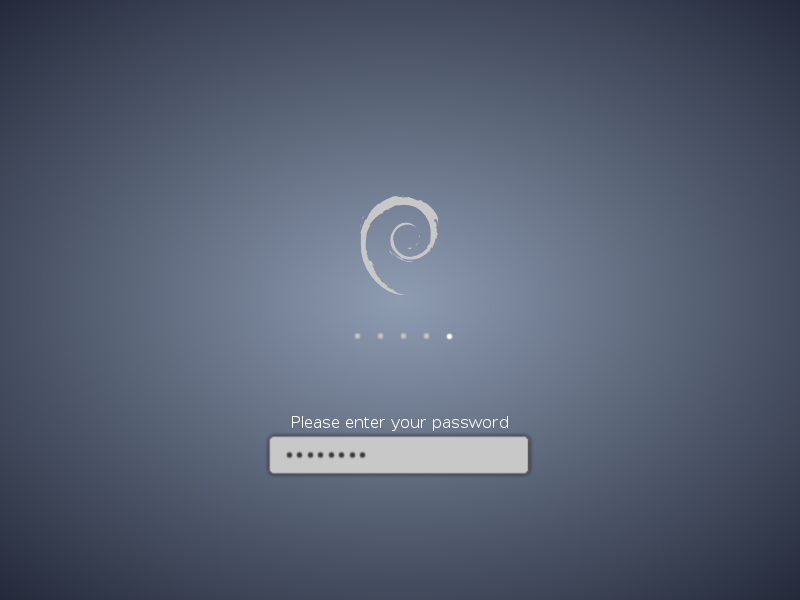
Joy Theme When the Joy theme was picked as the chosen theme for Debian 7.0 (Wheezy), I wanted to do what I could to get as much of it in the archive as possible before the freeze that occurred in June. I ve been working with Paul Tagliamonte and Vagrant Cascadian and I m glad that it resulted in some nice things! The Joy theme is modest and beautiful and I think Debian 7.0 is going to be one of the best looking Debian releases so far. Joy Plymouth Theme Plymouth is the part that provides the boot splash. It also takes care of a few other things, like showing prompts and progress indicators for filesystem checks, password prompts for encrypted devices and more so that the splash doesn t need to exit to show those. It s very scriptable, The installers for the Genesi Efika range of devices even use it for it s front-end. I needed to start with a Plymouth theme where I knew the prompts for all the things that happen during boot was at least more or less implemented, so I started off with one that I know works well, the Edubuntu one. So, fun fact: Debian 7.0 s Plymouth theme is actually based on the Edubuntu one. I had to play with the colours a bit to get it right, Edubuntu has a light background so I had to invert contrast for things like the input box, but I think it came out nicely. Splashy isn t in the archives anymore and it s not widely used anymore, so I cleaned it up from the desktop-base package so that there s less clutter shipped with it. Joy LTSP/LDM Theme This screenshot actually looks a bit uglier than it should because I took it on a VM that doesn t have 24bit colour, but we re looking into what we can do to make it look better on 16bit colour as well. During Debconf in Nigaragua, Vagrant and I worked on getting the LDM theme in shape. I have already done what I thought was most of the work by the time Debconf started, but it turns out there was a lot more to it to do it properly. We managed to get rid of the gtk2-engines-murrine dependency, which in itself is quite tiny, but it s a bit backwards in that it depends on the whole rest of the murrine-themes which brings in too much. We took the time to get the dependencies/recommends/etc right and to make it the default theme in Debian without messing it up for any Debian derivatives. It all came together and now when you install LTSP on Debian, you get the Joy theme by default! I m really glad about that because I didn t get the Spacefun LDM theme done in time for the Squeeze release. Enjoy!

Next.

Previous.