Search Results: "Jordi Mallach"

19 April 2006

Jordi Mallach: Siemens-BenQ mobile and Catalan support

While Catalan in the computer industry slowly advances, thanks to volunteer efforts and Free Software, it's difficult to see any sign of improvement in other areas of the technology world. Mobile phones are not an exception. In Catalunya, many people own a Siemens, Alcatel or Sagem mobile phone because they are the only companies that include Catalan as an option for their terminals. When I first got my mobile phone one and a half years ago, I chose an Alcatel, and while the phone was more or less ok, and Catalan was present in the interface, it lacked some Catalan characters like , , or in the input system. The battery wasn't that good, and it was a bit slow at times, but in general I was happy. Three weeks ago, I decided to switch to Telef nica's mobile phone provider, Movistar, because Vodafone has no network coverage in my mother's town, Vall de Almonacid, where I spend many weekends and vacations, and I was getting tired of my mobile turning into a plastic brick when I went there. I hoped the switch would be painless. As people talked positively about Siemens, I went for one of their free Siemens offerings: the Siemens AP75. Ugh, fellow Catalans: DON'T DO IT. So, it seems Siemens has sold or merged their mobile division with BenQ. The girl in the shop said one of the cool new features was better battery lifetime. This terminal was advertised as having Bluetooth, Infrared and other goodies. As soon as I got it (and couldn't give it back), I found out the extensive language list in BenQ mobile phones doesn't include Catalan anymore. Actually, it just offers Spanish and English. Had I known this, I would have quickly got a Nokia, which I believe are the best phones out there. But I'm silly enough not to pick the best just to support some practices, in the same way I won't but nVidia unless they do something about their drivers. Anyway, ignoring the lack of Catalan fact, the mobile was supossed to be quite good, or so I thought, until I tried to transfer my contacts list via Bluetooth. My mobile phone wasn't able to find other devices at all, and the interface doesn't list IrDA at all. What's the story? Yesterday I had the opportunity to go to the Movistar shop, and I was told a tale about the mobile phone having those features built in, but they are deactivated by the telco. This is pretty difficult to believe, and googling around, I haven't seen any proof about the AP75 having any Bluetooth support for anything other than voice transmission (ie, for use with headphones, etc). It plain sucks. So, dear Catalan readers, if you're getting new phones, avoid these BenQ-Siemens idiots, as they don't have a clue about Catalan. Either choose Alcatel, Sagem, or one of the older real Siemens mobiles. Softcatal has a Catalan mobile phones Wiki page with detailed information of the current situation. I'll have to update it to warn about current Siemens practices. In a happy future, Nokia will hopefully support Catalan and things will be a lot easier.
Jordi Mallach: Siemens-BenQ mobile and Catalan support

While Catalan in the computer industry slowly advances, thanks to volunteer efforts and Free Software, it's difficult to see any sign of improvement in other areas of the technology world. Mobile phones are not an exception. In Catalunya, many people own a Siemens, Alcatel or Sagem mobile phone because they are the only companies that include Catalan as an option for their terminals. When I first got my mobile phone one and a half years ago, I chose an Alcatel, and while the phone was more or less ok, and Catalan was present in the interface, it lacked some Catalan characters like , , or in the input system. The battery wasn't that good, and it was a bit slow at times, but in general I was happy. Three weeks ago, I decided to switch to Telef nica's mobile phone provider, Movistar, because Vodafone has no network coverage in my mother's town, Vall de Almonacid, where I spend many weekends and vacations, and I was getting tired of my mobile turning into a plastic brick when I went there. I hoped the switch would be painless. As people talked positively about Siemens, I went for one of their free Siemens offerings: the Siemens AP75. Ugh, fellow Catalans: DON'T DO IT. So, it seems Siemens has sold or merged their mobile division with BenQ. The girl in the shop said one of the cool new features was better battery lifetime. This terminal was advertised as having Bluetooth, Infrared and other goodies. As soon as I got it (and couldn't give it back), I found out the extensive language list in BenQ mobile phones doesn't include Catalan anymore. Actually, it just offers Spanish and English. Had I known this, I would have quickly got a Nokia, which I believe are the best phones out there. But I'm silly enough not to pick the best just to support some practices, in the same way I won't but nVidia unless they do something about their drivers. Anyway, ignoring the lack of Catalan fact, the mobile was supossed to be quite good, or so I thought, until I tried to transfer my contacts list via Bluetooth. My mobile phone wasn't able to find other devices at all, and the interface doesn't list IrDA at all. What's the story? Yesterday I had the opportunity to go to the Movistar shop, and I was told a tale about the mobile phone having those features built in, but they are deactivated by the telco. This is pretty difficult to believe, and googling around, I haven't seen any proof about the AP75 having any Bluetooth support for anything other than voice transmission (ie, for use with headphones, etc). It plain sucks. So, dear Catalan readers, if you're getting new phones, avoid these BenQ-Siemens idiots, as they don't have a clue about Catalan. Either choose Alcatel, Sagem, or one of the older real Siemens mobiles. Softcatal has a Catalan mobile phones Wiki page with detailed information of the current situation. I'll have to update it to warn about current Siemens practices. In a happy future, Nokia will hopefully support Catalan and things will be a lot easier.
14 April 2006

Jordi Mallach: 75 years of the Spanish dream

Recently Spain remembered the 65th anniversary of our tragic Civil War, an episode which broke the state in two halves which still today haven't been glued together at all. The origin of that nightmare is the dream of many Spanish people of the early 20th Century. In the morning of the 14th of April, 1931, the Second Spanish Republic was proclaimed in Madrid, after two days before, a majority of republican and leftist parties won the local elections; many people celebrated throughout the Spanish territory, and the tricolour flag was shown in many town hall buildings. With the king in exile after these quick happenings, Spain was again a Republic, as decided by the election results. The Republic brought many social measures to Spain: women suffrage, eight-hour day and many other labour related improvements. The nobility titles were abolished, and those properties were confiscated by the government. And this was just the provisional government. All of this is regarded like a big social and cultural revolution, which was just starting. Not everyone was happy about this, of course. The newly approved Constitution of December 9 gave the government power to confiscate many of the Church's properties, and limit their great power in political matters. Soon, the episcopacy came with a strategy to defeat the Republic in any possible way. The Royalists were also not happy. There were a series of revolts in the South, and an attempt of coup d'etat by General Sanjurjo. These attacks were repealed; the Republic was still strong. In 1933, the Anarchists started to be seriously unhappy about the moderate path the government was leading and started striking, which led to violent repression by the Government. The General elections of November brought a victory of the right and extreme-right, and many social and anti-church measures were repealed. Riots and strikes spread throughout the territory. The Martial Law proclaimed by the right wing government resulted in thousands beings imprisoned. Things went even worse when three ministers of the fascist CEDA entered the Republican Government. A big worker uprise started the 1st of October in Asturies, and Catalunya proclaimed the Catalan Republic. The revolts were supressed by General Franco, who would be well known in the world just a few years later. Thousands were killed and injuried during the few weeks of revolt, and the Socialist Party was dissolved, leaving the Spanish Courts with barely no left representation. The next years saw a very unstable government from the right due to internal disputes within the parties that formed it. New elections were called in 1936, and the left united under the Popular Front, which won by a slight margin; Manuel Aza a was the new president. The right, the church and the army continued to undermine the Republic in any possible way. In an attempt to make the military heads more loyal to the established government, the fascist Falange Espa ola was dissolved. The 2nd Spanish Republic received a massive blow on the 17th of July, 1936 when Franco and other generals attempted a new coup d'etat in the Northern African territories. The Republic started to die as people started fighting the coup back, and the Spanish Civil War started throughout the territory. With the aid of Fascist Germany and Italy, Franco managed to seize control of more and more areas of Spain during the nearly three years of war, and the Government of the Republic had to move a number of times, to Val ncia and Barcelona. In January 1939, most of Spain was in Franco's hands, and Catalunya soon fell. Two months later, the fascist troops entered Madrid, and hours later, Val ncia surrended. Still today, people talk about dos Espa as , the victorious and the defeated. Still today, the is much difficulty in having official recognition for the thousands who died while defending what a majority of people had voted for in a democratic way. Still today, one of the major political parties in Spain refuses to acknowledge what the forty years of Franco meant for the disidents, for the exiled, and for the dead. They are the legacy of Franco. Today Spain celebrates the 75th anniversary of our Second Republic, with many events in many cities, which will be ongoing for a few weeks. Izquierda Republicana has a good list of events.

1 April 2006

Jordi Mallach: GNOME 2.14 visits unstable

And after a long and boring week and a half of ordered Development Platform uploads, today the first few Desktop packages have started to hit unstable. I expect that the entire 2.14 release will be ready for your apt-get'ing in just a few days more. Of course, that doesn't include Ekiga, as their dependencies seem to be in a debian-legal trap... The most exciting bit of this round of uploads is the participation of at least 3 new Debian GNOME maintainers, including... new people looking after the evolution packages!

30 March 2006

Jordi Mallach: Evolution and the new GLib in Debian testing

Last night, glib 2.8 and pango 1.12 entered testing, as a first step on the GNOME 2.14 quest. The bad news is that the fixed evolution & friends were not ready to go in as well, so now many etch users will be wondering why their evolution doesn't start up, or doesn't show any mail. Until we manage to get a fixed evolution in testing, and it looks like it won't be trivial to get this done in the immediate future, Erich's recipe comes handy again:
My personal hero of the day is Gustavo Franco, for this email to debian-devel. He writes how to get your Gnome/Pango/Glib applications that don't work since yesterday's upgrade like evolution (#358071) working again:
$ G_SLICE=always-malloc evolution
And you should be able to read your email again.
Just FYI, and in case you missed it. :)

28 March 2006

Jordi Mallach: Ubuntu's Langpacks system, a solution for the OLPC project

Jim Gettys wrote about a problem regarding localisation that the OLPC project will face in the future. The One Laptop Per Child project aims to provide the famous $100 laptop to children in the developing world. They are Free Software based, and as most GNU/Linux distributions, the bundled software will be available in a number of languages. For now, it'll only be ten or so, but as OLPC grows, the number will skyrocket... just think about the number of languages spoken only in Africa. The $100 laptops don't have a hard drive. Instead, they have a 1 gigabyte of compact flash memory, which is enough to run the software, but it can't store that much extra data. The most common way of internationalising and localising Free Software is to use GNU gettext, which provides an easy to handle text file format for translations, with a series of sentences and labels that the translators need to fill in in their language. The applications ship these translations in .mo files, which are the same .PO files, in compiled binary format the gettext enabled programs can read. Each application installs one .mo file per language it is translated into. When the apps are big enough, these files can amount to several megabytes per application, which is a problem for embedded systems or projects like OLPC. Ubuntu has been trying a different approach to the distribution of translations. Instead of packaging all the translation files with the applications .deb packages, they are stripped off from the packages, and provided by language packs. Language packs offer the translations for all the applications and libraries of the main component of Ubuntu. This includes GNOME, KDE and many other popular applications. When you install Ubuntu, you select the main language of the interface, and the installer program will download the appropriate language pack, plus a selection of useful localisation-related packages like dictionaries, translated manuals, etc. These language packs are generated periodically by Rosetta, a web-based translation portal which is sponsored by Canonical, Ubuntu's and Launchpad.net's parent company. Rosetta offers a very easy to use translation infrastructure, and Ubuntu users can start translating the applications they are running with just two clicks on the application's interface. With Rosetta lowering the barrier for people wanting to translate Free Software, Ubuntu can have, and is now having, lots of people improving the translations of not only the next version of the software, which is what translation groups have traditionally worked on, but also the version you are running at that same moment. There is no need to wait for the next version of Ubuntu to see your translations complete. Help your team translate whatever is missing, and wait for the next language pack update. Voil ! If the OLPC project adopted the language pack scheme and Rosetta, they could install a raw OLPC laptop without translations, and only install the language packs that are needed in the target country or area. The langpacks are currently split into GNOME, KDE and the rest , but any derivative could fine-grain the components they wish to include. Furthermore, the system helps improving the localisation of the system after the laptops have been deployed. Just stick a USB drive to the laptop, and use your usual package manager to install the updated language packs contained in it. Or just use the Internet if it's available. In environments where network access is completely impossible, making the availability of updated packs from a remote server a no-op, as well as online translation in the Rosetta server, other solutions could come in place. Generating langpacks from a set of local PO files should be pretty easy.

24 March 2006

Jordi Mallach: jdub's Cheerios fantasy

20:52 < fusibou> if jdub gets excited over edge flipping and window matching,
                 he's got a low threshold
20:52 < fusibou> XGL would probably send him into fatal seizures

20 March 2006

Jordi Mallach: GNOME 2.14 for Debian

The observant eyes will have noticed a few interesting uploads hitting unstable or incoming in the last few days. GNOME 2.14 is being uploaded to unstable in small chunks, in an attempt to let the buildd's do the compiling in a given order, so things can get sorted out in all architectures at the same time. The libraries will take a few days to get in, and once most of them are in place, you can expect more mass uploads of end-user applications of the GNOME 2.14 suite. As this time no big or complicated dependencies were introduced in the release, and there are no soname changes involved, it was easier to avoid the previous, and sometimes annoying experimental uploads.

19 March 2006

Jordi Mallach: London

I'm miraculously on my way back from London, after spending a week with daf, mvo and two guests, abel and thep, from Hong Kong and Thailand, working on improving some l10n aspects of the upcoming Ubuntu release, dapper. The most visible result of the stuff that we've been doing is that if all goes well, users of the Chinese, Japanese, Thai, Bengali, Lao or Korean languages will get their required input methods, fonts and dictionaries Just Working as soon as their drives spit their dapper install CDs. We've learned quite a bit about the state of many of the Asian languages in the Free Software world today. Daf and I can certainly tell when an app renders Bengali or Thai correctly and when it doesn't, after closely comparing how different browsers do the job on various websites and font test pages. We've learned more than we probably like about fontconfig, and thanks to mvo, there is now a mechanism to get custom fonts.conf snippets depending on the default language of the system set by language-selector, so users get the right fonts installed and used by default. Thep's and Abel's help to get this straight is invaluable. On Friday, daf and I went to the ExCel Novotel where the Launchpad team is having a sprint, in order to lend a hand with the dapper translation import that is going on right now, but for a series of reasons we ended up working on l10n sprint stuff. At least I got to see the team again, and specially kiko, who greeted me with a "Qu pasa, hijo de puta!" The real life side of this sprint has been less exciting than on other occasions, as due to being few in number and being quite tired, we haven't gone out of Earl's Court area until today. Still, our exploring around the hotel has yield some nice discoveries. On Sunday, mvo and I were looking for a place to have dinner, and stumbled uppon the Troubadour a place which can either be a pub, a restaurant, a social club or a theatre, depending on your mood. The food was excellent, and the staff was really friendly. I found a Dictionary of Slang in one of the book shelves, and learned a few funny phrases. Other days we've been to good Italian, Indian or Chinese restaurants, but we couldn't resist to go back to Trobadour again. On our last night, Mark took us to a place in the South Kesington area, with again was very good. Abel left just after dinner as his flight was at 5AM from Stansted, and we hope he made it OK to the Netherlands, as at 00:30 or so he phoned us and seemed to be pretty lost somewhere. mvo left early in the morning, so daf, thep and I went to visit some bits of the city. My plane was at 16:45GMT, and we calculated that I should be leaving the K&K at 15:00 to be well on track for my flight. We went to Monument to see the tower, went up and enjoyed both the great views over London and the Thames river, as well as the really cold wind which made me swear once again about the %*@!# lack of Spring in the UK. It was getting quite late for me, so we went to China Town for lunch. Despite the restaurant people being really quick, I only managed to leave the place at 14:50, but given my travel plan was pretty conservative, I was supposed to be safe still. Daf left me at the tube station entrance, and there I started my way too stressful journey back to Val ncia. If on our way to London Carlos and were quite close to find our flight closed, this time, I think I hit the limits. I really don't know how daf and I arrived to the conclusion that leaving Earl's Court at 15:20 was acceptable to get in Heathrow on time. I ran up and down the tube stations, grabbed by luggage, and rushed back to the station, but I had just missed a train to Heathrow and that made me lose some precious 10 minutes. As stations passed by, it became clearer that we had fucked up somewhere when deciding at what time I needed to leave. At 15:35 I was still in the Hammersmith station, with half of the Picadilly line ahead before arriving to the aiport. I sent a message to daf, so he started to get prepared about me staying to sleep somewhere in London. As soon as the train's doors opened, a number of people rushed out. Someone ahead of me fell when climbing the automatic staircase and I somehow managed to jump over him, with luggage and all. After a run that seemed like half an hour, I arrived at the Iberia desk and, panting, I could only articulate "Tarde para Val ncia?". The guy at the counter looked at me, and with a "this can't be true" expression in his face, he picked up a phone and asked "Is it already closed? [...] Can you open it for one more piece of luggage? Thanks." In the meanwhile, I had been busy removing a 500 ml yoghourt from my bag, fearing having all my clothes smelling like strawberry back in Val ncia. The guy handed me a boarding pass, and gave me instructions about the "Iberia Room" near my gate. I asked him what that was about, and he says "oh, of course, you're in Business Class". For a second, I was reminded of stargirl's tricks to get free upgrades when flying, and immediately I was reminded that I was still in a hurry, and I should rush to my gate. And so I did, forgetting to thank the guy for being so kind. I left my yoghourt there though, so at least he could get some food if he was hungry. The long line before the security check was exasperating, and when I finally went past it, I had to run all over terminal two to my gate, where everyone appeared to be waiting just for me. The doors closed as soon as I entered the aircraft, and I sat in the first row, got a free newspaper and a free meal. I couldn't believe my luck. As I write this, we've gone over the Pyrenees, which are not as snowy as a month ago, but they still look beautiful from up here. I'm glad to be back in Val ncia.

16 March 2006

Jordi Mallach: GNOME 2.14, tamb en catal

GNOME 2.14 was successfully released last night, and the release churning caught me in my hotel room in London, while preparing to go to bed. Knowing that the release notes were done in Catalan, but not uploaded, I decided to work on that for a while and ended up going to bed later than I would have wished. Congratulations to everyone involved in making 2.14 happen, it's exciting to watch GNOME maturing release after release. As for the Catalan credits, again, I haven't been able to help much with GNOME 2.14 translations other than guidance and some tiny bit of coordination on our list. Thankfully, Josep, Xavi, Gil and Jordi, and not forgetting our new contributors like Maria, are always ready to carry most of the burden of the release. Again, this GNOME release is completely translated to our language, and I think we can highlight the polish of the translations, thanks to the ongoing review process. Rock on, GNOME!

12 March 2006

Ross Burton: Sound Juicer "Let's Go Back, Let's Go Way On Way Back When" 2.14.0

Sound Juicer "Let's Go Back, Let's Go Way On Way Back When" 2.14.0 is out. Tarballs are available on burtonini.com, or from the GNOME FTP servers. Bug fixes: Translators: Ankit Patel (gu), Clytie Siddall (vi), Daniel Nylander (sv), Duarte Loreto (pt), Elian Myftiu (sq), Francesco Marletta (it), Francisco Javier F. Serrador (es), Funda Wang (zh_CN), Gabor Kelemen (hu), Gnome PL Team (pl), Hendrik Richter (de), Ignacio Casal Quinteiro (gl), Ilkka Tuohela (fi), J r my Le Floc'h (br), Jordi Mallach (ca), Kjartan Maraas (nb, no), Lasse Bang Mikkelsen (da), Leonid Kanter (ru), Maxim V. Dziumanenko (uk), Mugurel Tudor (ro), Petr Tome (cs), Priit Laes (et), Rajesh Ranjan (hi), Raphael Higino (pt_BR), Rhys Jones (cy), Rostislav "zbrox" Raykov (bg), Satoru SATOH (ja), Tino Meinen (nl), ygimantas Beru ka (lt).

Jordi Mallach: My non-vote for the GDFDL position statement

[ 1 ] Choice 1: GFDL-licensed works are unsuitable for main in all cases
[ 2 ] Choice 2: GFDL-licensed works without unmodifiable sections are free
[ 4 ] Choice 3: GFDL-licensed works are compatible with the DFSG [needs 3:1]
[ 3 ] Choice 4: Further discussion
And vote.debian.org's reaction:
A message that you sent could not be delivered to one or more of its
recipients. This is a permanent error. The following address(es) failed:
  pipe to  echo vote is over; false
      generated by gr_gfdl@vote.debian.org
      "echo" command not found for address_pipe transport
But I... I... only had two weeks to cast my vote! *sigh*, I suck.

11 March 2006

Jordi Mallach: Quant a Ubuntutu

Embarrasing enough, Ubuntu has shipped a Catalan translation for the very prominent About Ubuntu GNOME Panel menu entry which read Quant a Ubuntutu . It s been there for so long that irazuzta and I really considered not fixing it at all for hysterical raisins . Anyway, seb128 now has a patch to correct this at long last in Ubuntu s gnome-panel. He promised to include it in monday's 2.14.0 upload seb: DON T FORGET! In the meanwhile, Jordi Irazuzta and I just finished setting up the Ubuntu Catalan Translators team, with the mailing of some detailed instructions on how we want to get work done in the team. It's been months of planning and designing a workflow to make a Ubuntu translation team and the openness that Rosetta offers to all the members of a team fit in Softcatal s high standards for the quality of the translations made by the organisation. As soon as people start mailing back and get subscribed to the team s mailing list, they'll get tasks assigned and we'll get the team kickstarted, with lots of work to be done before the Dapper release. The key for this team s success is that we educate our volunteers to contribute their Ubuntu translations to the upstream projects or relevant Catalan teams, and that this is somehow coordinated. The experience will be quite good for me to identify some of the social problems with Rosetta, as many times people ask if their translations for Ubuntu will appear in other distributions as well. The team is led, for now, by Jordi Irazuzta, lo noi de l'Ebre, and me. If you're a Catalan Ubuntu user and want to lend a hand, you're more than welcome to join the mailing list to help, and become a Ubuntaire!

9 March 2006

Martin Michlmayr: FOSDEM 2006

FOSDEM is one of the events I really enjoy. Unfortunately, I couldn't attend last year because I was at a conference in China. However, this year I was back, and the event was bigger than ever. There's so much going on that it's really hard to keep up. There are a number of people I'd really like to have talked to more but there just wasn't time in those two days which were fully packed. It was nice to meet a number of people again, though, in particular the usual suspects, including Michi Banck (aka Hurd illusionist, "it supports two wireless cards now"), Guillem Jover (Spanish mafia boss living in exile), and Jordi Mallach ("World Domination for Catalan^WValencian"). I also hung around the Spanish free software research people with whom I'm going to spend a few months soon. Crazy Spaniards... I've no idea how I'm going to survive there. Oh, and Neal Walfield, who still stinks, and who thinks I have a British accent now (which he thinks is a bad thing while I took it as a compliment). Regarding new people, I had the great pleasure to meet and talk to Lennert Buytenhek. I talked to him on IRC a bit recently because he's involved in the big-endian ARM port and I've been hacking on the ARM based NSLU2 device. Lennert is quite frustrated because joining Debian is so hard. As it turns out, there's currently a six month wait to be assigned an Application Manager. I haven't really followed NM recently, but when I acted as Front Desk I tried to keep it less than approximately six weeks. Unfortunately, a great number of AMs resigned in the last few months and years, and it has been quite hard to find good new people as AMs. Lennert is the kind of person we really want to have in Debian since he's extremely kind, smart and productive. Given that the current situation seems really bad I decided to act as Application Manager again, but I only intend to do that temporarily. I'm sure I forgot lots of other things. But the summary is that it was a great weekend, with way too much stuff going on at the same time. And while I wish I could have devoted more time to my research, I gained some important insights and did one interview which was really informative.

4 March 2006

Jordi Mallach: Buying a computer mouse

I've had the same mouse for probably 5 years, and I'm very happy with the result. Unfortunately, the batteries don't make good contact with the pins anymore and sometimes it takes ten minutes of delicate work to get it going again. So today, I went to buy a mouse, and surprise, surprise, I had forgotten how much it sucks to be a left-handed when purchasing certain objects. At the computer store, there were about 25 different mouse models, most of them featuring extra buttons, ergononic shape and other cool stuff. I was ready to buy something for even more than 20 if it was worth it, but due to the non-simmetrical shape of most of them, again I could only go for the cheapest models. I took a Creative optical mouse, and downgraded from a cordless mouse with 5 buttons + a wheel to a plain simple 3-button + wheel. At least it's USB... all the low end mice are still PS2. When I was looking for a laptop, one of the requirements was that the touchpad wasn't slightly displaced to the left. So right-handed-ish... I know there are shops with stuff for left-handed. Once, my mother bought me a pair of nail scissors designed for left-handed people. All that kind of stuff is generally very expensive and anecdotic, though. I wonder if we'll ever see laws that will force manufacturers to provide inverted items on demand. I want one of those cool mice.

Jordi Mallach: Catalan orthotypography

Ivan never has enough, and has gone ways further on his Escriu b quest. Following up on my previous post on the X.Org Catalan changes, he has posted a list of characters that he still misses in our layout, in order to type really correct, orthotypograpically-wise, Catalan. Ivan, the king of nitpickers. :) Toni also posted a mini-HOWTO on how to get your geminated l's look a lucinants .

Michael Banck: 3 Mar 2006

FOSDEM 2006 This year, the days before FOSDEM were the stressful ones, as I got to organize accomodation. Initially, we wanted to have similar appartments as last year, but by the time I was less busy at uni to actually look into it, most of them were already booked, so we had to put up with a youth hostel instead. The positive sides of this were the much lower expenses and a location in the city centre, making us actually look at Bruxelles a bit in detail this time. "Us" were the Hurd people, including Martin "earliest Hurd adopter present" Michlmayr. I got to FOSDEM by car again, picking up Marcus Brinkmann, Neal Walfield and Olaf Buddenhagen on the way in Cologne. Finding the youth hostel seemed to be pretty hard as we just had a street address and a map without street names, but we managed to find it pretty quickly to my great surprise (driving around in Bruxelles usually ended up being a complete disaster over the last years). After a strange encounter with a Guillem Jover lookalike in front of the hostel, we met the other guys (Thomas Schwinge, Marco Gerards, Stefan Siegl and Ognyan Kulev) and had a discussion about Neal's and Marcus' plan to move to a persistent system. After dinner, I met the other Debian people in the Roi d'Espagne and hat some longer chats with Jeroen van Wolffelaar, Rob Bradford, Martin Michlmayr and Jordi Mallach, who I finally met for the first time and who did not cop out of FOSDEM this year as usual... The pub is getting more and more crowded each year, all the hackers barely fit even though they opened the balustrade this time as well. It was great to see everybody again and have a few beers. Martin and I then managed to find the way back to the hostel by foot. We had no developer room, and no talks in the Debian room either, so FOSDEM was a pretty relaxed event this year. I met some more familiar faces like Noel Koethe and Andreas Mueller and listened to a couple of talks, most notably Richard Stallman's and Jeff Waugh's keynotes and Hanna Wallach's talk about FLOSSPOLS. Stefan Siegl also managed to get GNU Mach working for both my 3Com PCMCIA NIC and my Orinoco PCMCIA WLAN card, confirming his title as Hurd "hacker of the month". On Saturday evening, we (at this time, Guillem Jover, Gianluca Guida, Bas Wijnen and Jeroen Dekkers had joined) had dinner with the french Hurd guys (Manuel Menal, Marc Dequenes, Richard Braun, Arnaud Fontaine and others) in an italian restaurant. At 10:40 PM, the waiter told us in a rather unfriendly tone that they would close at 11 and presented us with the bill, along with handing out the menu again so that we could look up our share. By the time the bill arrived the french part of the table (at 10:55 PM), the guys were pretty surprised by this whole business and complained loudly that they did not have a dessert yet and insistent on having one. After some more minutes of discussion, the waiter gave in and served their desserts, after which each of them paid his share with his carte bleue. I believe we left the restaurant around 11:30. On Sunday evening, we had dinner again (the french guys had left Bruxelles already) and then drove back to Germany after having desserts and coffee in a bar. We left Bruxelles at around midnight and arrived in Duesseldorf at 2:30 PM, so we were glad that Neal offered us to stay at his place. We had breakfast the next morning with him and Isabel and then I proceeded to drive back to Frankfurt in the early afternoon. FOSDEM rocked, as usual. After being with the Debian crowd for the first three years or so, and mostly sticking with the Hurd crowd last year, I think I managed a pretty good balance between the two this year. This will not have been my last FOSDEM.

2 March 2006

Jordi Mallach: L MIDDLE DOT in X.Org

English (Queen's English) is the only real language.
After this required short announcement by our main sponsor, Daniel Stone, lets go ahead and explain something of interest to the many Catalan X.Org users out there. Ivan and I have been looking at the issues that block a GNU/Linux user from using the compound geminate L, , instead of the more usual L L spelling. The and characters are unfortunately not included in ISO-8859-1, so fonts were the first big problem we faced. When modern X desktops started using True Type fonts by default, the de-facto free font in most distributions became Bitstream Vera as soon as they were licensed under a Free Software license back in 2003. Bitstream did not include the Unicode glyphs U+013F and U+0140, but some time after, chatting with daf, I learned he was working on Olwen, a Vera extension which would add proper Welsh coverage. He promptly added the Catalan glyphs, but Olwen never got widely exposed in distributions. Luckily, things are changing lately. Due to the lack of bugfixes or new releases of Vera, the list of Vera derivatives like Olwen started growing. The DejaVu project is building a font family, based on Vera, which merged many of these smaller purpose Vera derivatives, including Olwen. DejaVu, is, as far as I know, slowly replacing Bitstream Vera as the standard free, high quality true type font in free desktops. With the font blocker easily solvable now, the next problem was making the input easy. Some terminals, such as GNOME's or rxvt, allow you to insert Unicode typing a Unicode code point. The Spanish layouts don't provide a shortcut for it though, and if you try to do Level3-Shift+l, you'll get a Polish character, , that is of no use in neither Catalan, Spanish, Galician, Basque or other languages in the Spanish state. We wanted to replace that with , but when we had a look at it last Saturday night during our stay in Bruxelles, we couldn't find what the name for Unicode's U+0140/U+013F was in XKB-speak. So, as I said, on Sunday I went looking for Daniel and Keith to see if we would be clued up. The solution is easy: there is no name mapping, but you can use Unicode in 0x100XXXX notation directly in your X config file to make it work. He tried in his laptop, and why not, generated a patch for X.Org 7.0's xkeyboard-config. Daniel can't be that good, so he forced me to spread lies about the English language in this blog entry if we wanted the patch committed. :) Support for X.Org 6.8 and 6.9 isn't planned, unless you bribe your X maintainer to add a tiny patch. This has been implemented as an "es" keyboard extension (named cat ) because other systems don't have that feature in the Spanish layout, and X.Org wants to remain compatible with the rest. We'll have to add a
        Option          "XkbVariant"     "cat"
option to our keyboard section in xorg.conf. If you're not using X.Org 7.0, you might want to try:
xmodmap -e "keycode 46 = l L U140 U13f U140 U13f"
but I don't know if that'll work in all systems. To test in your keyboard, that'll probably be AltGr+l or AltGR+L . What we need to do now is to add support for the character in more fonts, alternative spellings for words using the ela geminada (ie, col labora and co labora ) in dictionaries, wordlists..., and of course, teach users about the avalability of this, and promote its usage.

Jordi Mallach: FOSDEM 2006

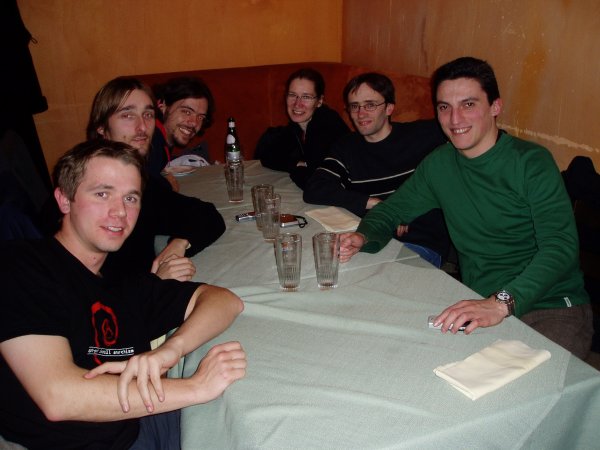
I'm so glad I finally decided to attend FOSDEM this year, as last weekend in Bruxelles was so cool it reminded me of the unforgettable week in Helsinki for DebConf 5 last summer. I travelled early on Friday with Ivan Vilata, the dude who dragged me into the Catalan translations world, and about 12:30 we were finding our way through Bruxelles airport. We had barely no problems getting to Ra l's place in Boulevard Louis Schmidt, thanks to the detailed HOWTO he provided a few days before. We dropped our bags in his appartment and went out with him and Virginia after a well deserved mini-nap. On our way to the Grand' Place, where we'd hook up with the Softcatal crowd and the rest of FOSDEM people, we stopped in A la Morte Subite, where we Ivan and I started our personal training on Belgian beers. The Roy d'Espagne is an excellent name for a place where to meet our friends from Catalunya. I didn't know that was a formal meeting point that kickstarts FOSDEM, so I was really impressed when I got to the second floor and found the place was packed with Free Software people, many of them I already knew in person. Reaching Softcatala's table near the window took about 15 minutes, and after saying hi to most people, we decided we could use a quieter place to have dinner, and then go back.


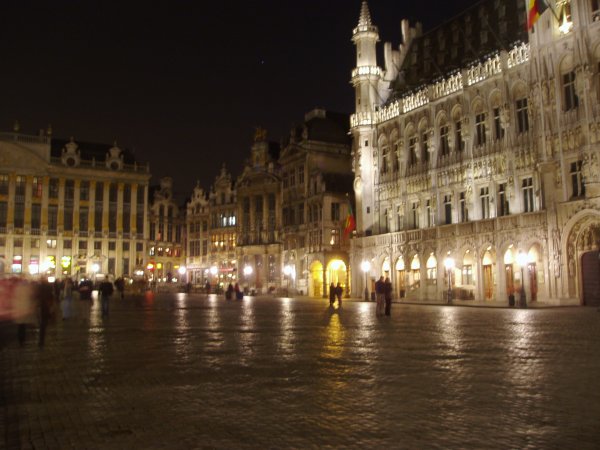
The Grand' Place was bombed by seb128 in 1695 Ra l and Virginia, our official guides during the weekend, chose a Vietnamese restaurant in the Stock Exchange area they frequent, and for little money we got an enormous meal. Back at the Roy d'Espagne, I tried to say hello to most Debian people I saw around, while at the same time I tried to be with my hosts and the Catalan people. A while after, I spotted tbm and azeem downstairs, who I finally met. I talked to Michael for a long while, and at some point we left as we didn't want to miss the last tram. Ivan, luckily, only snores rarely, so we slept for a while, and then took the tram to the Universit Libre du Bruxelles. The main room was already packed for RMS's keynote, which was pretty good. After that, we went to several talks here and there, while I kept meeting some people around the place. Ivan and I left when the show ended and we met with Virginia and Ra l at the centre. This time, we hooked up with Xevi and Jes s Corrius from Softcatal , as Toni Hermoso had abandoned us for a cheap dinner with the Mozilla.org people. We were taken to a packed bar/restaurant (don't remember the name right now), which had a few interesting features: they wouldn't sell any Coca-Cola, would not accept credit cards in protest for the high fees Visa charges on small businesses, and something I wouldn't expect to see in 2006, their chart of prices hadn't been rounded up when they switched to the Euro. So some plate would be 9.72, others 12.43, etc. After dinner we had a few beers at the Th atre de Toone, located in some tiny alley in the centre and being pretty tired, we went back home at 23:30 or so. Sunday was a busy days, due to the number of interesting Debian and GNOME talks going on. I'd highlight liw's talk on Piuparts, Enrico's on debtags and fjp's on Debian Installer in the Debian room, and kris' on the future of GTK+. There was also a cool demo of Novell's XGL. During a dead slot, I approached Little Daniel and keithp to see if he could point me at some mapping between UTF-8 and XKB symbol names. But Daniel was cool enough to solve a problem a lot simpler than expected. :) jdub's closing talk was just fantastic, and telling him "See you in Vilanova, we left the University, for our last dinner around Bruxelles.


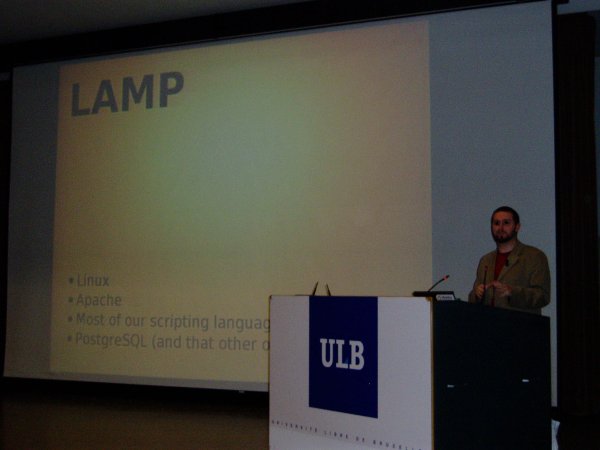
jdub clues the audience about some basic acronyms We managed to rescue madduck from the Debian UK beer trap and went to an Italian for dinner, this time with Josep and Mia, from Softcatal , making a nice mix of German, Valencian/Catalan, and Swedish at our table.


Mia, Josep, Ra l, Ivan, Martin and Jordi after pizza Ra l took us around the city centre and told us about the underground river, the remaining city wall's tower, and the church that leaned against it. That night's beer lesson happened in the "2000 beer bar". We all had a 7 Trappist Westvleteren Bleu 8, apparently "the best beer of the world". It was pretty good, actually. Our weekend in Bruxelles was about to end. After not that much sleep, Ivan and I took a tram and a bus to the Airport, arriving in Val ncia around 10AM, and after seeing the best view of the Pyrenees ever, which were absolutely covered with snow, as well as many other places in the Pa s Valenci and Teruel due to massive snows during the two days we were out. FOSDEM is probably a "can't miss" yearly event now. Thanks to all the organisers for their hard work to make it happen. You rock.

1 March 2006

Jordi Mallach: He's Welcome in Pakistan

I would have thought that three years after the start of the war, Iraq would be yet another forgotten war, as it tends to happen when murder, bombings, famine and corruption become the routine in some country or area. It's been nearly three years since the holy coalition made up of United States and the UK, with a selected group of allies which included the Spain of our beloved Aznar, invaded the country to save the poor iraqi people from the fierce Sadam. After a few months of hard fight against the bloody dictator, Iraq would finally be able to live in peace and Democracy, and the world would understand the goodness behind the reasoning that made the superpowers start the second war in Iraq, against the opinion of the UN security council and an overwhelming majority of the people in the planet. Today, after years of bloodbaths in different parts of Iraq, we're witnessing the start of a civil war. I hope the mass media stop talking about "the terrorists" now, because what's been going on for the last week is random people against random people. It makes me sick to think how bad the near future looks in Iraq. All of this happened in the name of freedom, or so they said. And then, it was in the name of the War on Terror , because Iraq was infested with terrorists (they never told us how they planned to stop that from happening). In the meanwhile, little they talk about the most wanted man on earth, uncle Osama. Today's edition of EL PAIS includes a translation of an article by Ahmed Rashid in The Washington Post's edition of February 26, apropos of George Bush's visit to Pakistan and Afghanistan this week. He's Welcome In Pakistan is surely worth a read; I'm sure Miguel will enjoy.

Next.

Previous.