Search Results: "Colin Watson"

8 October 2011

Steve Langasek: Free as in flickers

Ubuntu has had an explicit goal for several cycles now to achieve flicker-free booting: smooth graphical boot all the way through from bootloader to the desktop, with no messy modeswitches or cuts between text and graphics mode on the console. This is no small task, to be sure; even getting flicker-free transitions between plymouth and X for the KMS-capable video cards was a handful for 10.04 LTS. So I was suitably impressed when in the course of testing for the upcoming Ubuntu 11.10 release I found that on a laptop with the nouveau driver, we had achieved 100% flicker-free boot all the way from grub to X. And then I was astonished to find the grub-kernel transition was flicker-free when using the binary nvidia driver too! This is in large part thanks to Colin Watson's work upstream implementing VBE support in GRUB2, and Andy Whitcroft's adding proper support for a vesafb fallback when no KMS video driver is found. The architecture of how this all hangs together is now documented in the Ubuntu wiki. The irony is that, while nouveau gives a perfect flicker-free boot, and the nvidia binary drivers give a boot with just one modeswitch, both of my Intel systems show two modeswitches on boot - one between grub and the kernel, another between the kernel and X. Something to work on cleaning up next month, I think...

6 October 2011

Colin Watson: Top ideas on Ubuntu Brainstorm (August 2011)

The Ubuntu Technical Board conducts a regular review of the most popular Ubuntu Brainstorm ideas (previous reviews conducted by Matt Zimmerman and Martin Pitt). This time it was my turn. Apologies for the late arrival of this review. Contact lens in the Unity Dash (#27584) Unity supports Lenses, which provide a consistent way for users to quickly search for information via the Dash. Current lenses include Applications, Files, and Music, but a number of people have asked for contacts to be accessible using the same interface. While Canonical's DX team isn't currently working on this for Ubuntu 11.10 or 12.04, we'd love somebody who's interested in this to get involved. Allison Randal explains how to get started, including some skeleton example code and several useful links. Displaying Ubuntu version information (#27460) Several people have asked for it to be more obvious what Ubuntu version they're running, as well as other general information about their system. John Lea, user experience architect on the Unity team, responds that in Ubuntu 11.10 the new LightDM greeter shows the Ubuntu version number, making that basic information very easily visible. For more detail, System Settings -> System Info provides a simple summary. Volume adjustments for headphone use (#27275) People often find that they need to adjust their sound volume when plugging in or removing headphones. It seems as though the computer ought to be able to remember this kind of thing and do it automatically; after all, a major goal of Ubuntu is to make the desktop Just Work. David Henningson, a member of Canonical's OEM Services group and an Ubuntu audio developer, responds on his blog with a summary of how PulseAudio jack detection has improved matters in Ubuntu 11.10, and what's left to do:
The good news: in the upcoming Ubuntu Oneiric (11.10), this is actually working. The bad news: it isn't working for everyone.
Making it easier to find software to handle a file (#28148) Ubuntu is not always as helpful as it could be when you don't have the right software installed to handle a particular file. Michael Vogt, one of the developers of the Ubuntu Software Center, responded to this. It seems that most of the pieces to make this work nicely are in place, but there are a few more bits of glue required:
Thanks a lot for this suggestion. I like the idea and it's something that software-center itself supports now. In the coming version 5.0 we will offer to "sort by top-rated" (based on the ratings&reviews data). It's also possible to search for an application based on its mime data. To search for a mime-type, you can enter "mime:text/html" or "mime:audio/ogg" into the search field. What is needed however is better integration into the file manager nautilus. I will make sure this gets attention at the next developer meeting and filed bug #860536 about it. In nautilus, there is now a button called "Find applications online" available as an option when opening an unknown file or when the user selects "open with...other application" in the context menu. But that will not use the data from software-center.
Show pop-up alert on low battery (#28037) Some users have reported on Brainstorm that they are not alerted frequently enough when their laptop's battery is low, as they clearly ought to be. This is an odd one, because there are already several power alert levels and this has been working well for us for some time. Nevertheless, enough people have voted for this idea that there must be something behind it, perhaps a bug that only affects certain systems. Martin Pitt, technical lead of the Ubuntu desktop team, has responded directly to the Brainstorm idea with a description of the current system and how to file a bug when it does not work as intended.

4 October 2011

Andreas Barth: Building a mipsel porter box and buildd

As grub is now working on the loongson 2e boxes as well (thanks to phcoder and Colin Watson), it is time to move the buildds running at my home to a data center (previously we couldn't remote manage the kernels / boot flags without VGA console, which means no data center usage). Also one of the boxes could be converted to a porter machine, so that we could get an mipsel porter box again. The machines are delivered only with 256M of ram, which is a bit too less for usage. Thanks to Zugschlus (Marc Haber) I got 1g ram for both machines going to Vienna (one buildd, one porter box), and thanks to Robert Grimm a 160g harddisk to replace the build-in 40g in the porter box (the buildd can cope with 40g fine). The additional ram modules and hard disk are visible on the following picture.
eysler.debian.org is now DSAed, online and building packages (including autosigning). I will shutdown monteverdi.ayous.org which is still at my place in the next days, reinstall the system and send it to Darmstadt as another buildd for data center hosting there. After that happens all mipsel buildds are DSAed as it should be, and are running in a data center and not via some DSL line. (In case you're looking for hardware at your place, there are a couple of loongson 2f-systems available to buy. 2f is the successor cpu of 2e. Some 2f systems get delivered with Debian installed on it, see e.g. http://www.aliexpress.com/product-gs/290632002-Yeeloong-8101-Laptop-10-inch-Debian-EU-Adaptor-version--wholesalers.html. However, for buildd usage, the 2e are fine as well, and we got them sponsored some time ago.)

2 October 2011

Gregor Herrmann: RC bugs 2011/39

another weekly report about RC bugs I've fixed, this time mostly by applying patches from ubuntu:

25 September 2011

Gregor Herrmann: RC bugs 2011/38

quick overview over my RC bug activities during the last week: random notes:

16 September 2011

Raphaël Hertzog: How to triage bugs in the Debian bug tracking system

Triaging bugs is one of the easiest way to start contributing to Debian. I ll teach you the basics in this article. 1. Prerequisites All interactions with the Debian Bug Tracking System (BTS) happen through email so you need to have an email account with an address that you re willing to make public. All the mail that you send to the BTS will be archived and publicly available through its web-interface. This also means that you should have some spam filters in place because it will inevitably be harvested by spammers. :-( To ensure that this email address is consistently used by the various tools that we re going to use, it s a good idea to put this email address in the DEBEMAIL environment variable. You can also specify your full name in DEBFULLNAME (in case you don t want to use the name associated with your Unix account). You usually do this by modifying ~/.bashrc (if you use bash as login shell):
export DEBEMAIL="hertzog@debian.org"
export DEBFULLNAME="Rapha l Hertzog"
You should also install the devscripts package, it provides the bts command that we re going to use. 2. Find a package or a team with too many bugs You can literally pick any popular software that s in Debian, they almost always get more bug reports than the maintainers can handle. Instead of picking a package, you can also select a packaging team and concentrate your efforts on the set of packages managed by the team. In any case, it s important to receive the bug traffic for the packages that you re going to work on. If you went for a specific package, you should subscribe to the package via the Package Tracking System (there s a subscribe box on the bottom left corner once you selected the source package of interest). If you decided to help a team, there s usually a dedicated mailing list receiving all bug traffic. You can browse a list of packages with the most bugs if you have troubles finding a package to work on. A stack of bug reports to triage 3. Triage bugs! Bug triaging is all about making sure that bugs are correctly classified so that when a developer looks at the bug list, he can quickly find bugs with all the information required to be able to fix them! 3.1 Adding information to bug Adding supplementary information is easily done just by sending a mail to XXXX@bugs.debian.org (replace XXXX with the bug number). But often you want to reply to a message in the bug history, in that case bts --mbox show XXXX is for you. It will grab the corresponding mailbox and open a mailer (mutt by default) on it. Now you can directly reply in your favorite mailer. 3.2 Classifying bugs The Debian BTS uses tags (click the link and read the doc!) to classify bugs. bts tag XXXX + foo will add the foo tag (replace the + with a to remove a tag). If you want to explain why you re adding a tag, you should instead reply in the bug log as explained above, put control@bugs.debian.org in Bcc (Blind Carbon Copy) and start the body of your message with your tag command:
tag XXXX + foo
thanks
But what tag should you add? When a bug is submitted, you should try to reproduce the bug. If you can reproduce it, then tag the bug confirmed (example in #641710). If you can t, you should request more information (ex: a sample document triggering the bug, a configuration file, the output of some relevant command, etc.) until you can reproduce it or conclude that it was a user mistake. When you request supplementary information due to this, you should tag the bug unreproducible moreinfo (example in #526774). moreinfo should be later dropped when the requested information are provided, and unreproducible should be dropped if those information were enough to actually help reproduce the bug (example in #526774). During that initial evaluation, it s also worth differentiating packaging bugs (which are specific to Debian) from upstream bugs (which are relevant also for non-Debian users). The latter should be tagged upstream (and forwarded upstream if the bug is reproducible or contains enough information for the upstream developers, example in #635112). If you saw a (viable) patch in the bug log, the bug should be tagged patch . This is usually done by the patch submitter but sometimes it s forgotten (example in #632460). Take care though to not reinstate the patch tag if it was initially set but then dropped by the package maintainer after a review of the patch. If the title of the bug report is not descriptive enough, you can change it with a retitle XXXX new-title command (example in #170850). You can also change the severity of the bug report depending on the impact of the problem (with a command severity XXXX new-severity , what a surprise!). Request for new features are wishlist , most documentation problems are minor . On the other side of the scale, you can use important for bugs that are very annoying but that should not block a release. serious , grave and critical are used for release critical bugs, check the official definitions of the severities (examples in 502738 or #506498). 3.3 Closing non-bugs and bugs that are already fixed If your analysis of the bug report is that it s not really a bug but a user mistake, then you should close it by sending a mail to XXXX-done@bugs.debian.org with some explanations of the user s mistake so that he can get past his problem (example in #592853). If the problem was a real bug, but one that is apparently already fixed, you should try to quickly find the version that fixed the bug. If you can t find it in the changelog (there s a link to it in the PTS, or you can use /usr/share/doc/package/changelog.Debian.gz), you ll make the safe assumption that the upstream version you re currently using is the first one where this is fixed. Then you send a mail to XXXX-done@bugs.debian.org but you start your mail with Version: version-that-fixed-the-bug and continue with a small explanation of why you believe the bug to be fixed by this version (example in #122948). 3.4 Reassigning misfiled bug reports Bug reports are not always filed against the proper package. Users file bugs against applications where they experience the bugs, but the real bug might be in an underlying library or application. When that happens, you should use the reassign XXXX correct-package version command to get it filed against the correct package. The version parameter is optional but should be provided if possible, it should be the oldest version that we know to have the problem (example in #626232). 3.5 Forwarding bugs Forwarding bugs means opening bug reports in the upstream bug tracker for issues that have been reported in Debian but that applies to the upstream (unmodified) source code. Be sure to include all the relevant information and a link to the corresponding Debian bug. Depending on the upstream bug tracker, you might have to open an account to be able to file new bug reports. On the Debian side, you must record that a bug has been forwarded with bts forwarded XXXX upstream-bug-url . upstream-bug-url is the URL corresponding to the upstream bug report you created (ex: http://projects.ciarang.com/p/feed2omb/issues/21/ recorded in #609345 ). If the upstream authors fix the bug you reported, you can tag the Debian bug with fixed-upstream so that it s easier to find bugs to close when the next upstream release comes out (example in #637275). 3.6 Updating version information The Debian BTS uses version tracking to know which package versions are affected by a given bug. It s particularly important to have correct version information for release critical bugs since it might affect the migration of packages to testing. You can learn more on this topic here: http://wiki.debian.org/HowtoUseBTS. 4. More advice Colin Watson wrote a constructive rant explaining some mistakes that bug triagers are often doing. While it refers mainly to Ubuntu s launchpad, the advice apply equally as well to Debian. Check it out to become a better bug triager! Note that you can refer to this article with this shorter URL: http://raphaelhertzog.com/go/bugtriaging/

Do you want to read more tutorials like this one? Click here to subscribe to my free newsletter, you can opt to receive future articles by email.

One comment Liked this article? Click here. My blog is Flattr-enabled.

21 July 2011

Raphaël Hertzog: People behind Debian: Martin Michlmayr, former Debian Project Leader

Martin Michlmayr is a Debian developer since 2000 and I share quite a few things with him, starting with his age and involvement in the quality assurance team. He managed to be elected Debian Project Leader in 2003 and 2004. He s no longer as active as he used to be but his input is always very valuable and he continues to do very interesting things in particular concerning the support of NAS devices. Read on for the details. Raphael: Who are you? Martin: I m Martin Michlmayr. I m 32, originally from Austria, and currently living in the UK. I ve contributed to various free software projects over the years but Debian is without doubt the one I m most passionate about. I joined Debian in 2000 when I was a student. I worked on Debian more or less full time for a few years while I was pretending to study. Later I started a PhD to do research about quality and management aspects of volunteer free software projects. I investigated the release process in several free software projects, in particular looking at time-based releases. After finishing my PhD in 2007, I joined Hewlett-Packard. I m part of HP s Open Source Program Office and work on various free software and open source activities, both internally and within the community. Raphael: How did you start contributing to Debian? Martin: I first used Debian in the days of 0.93R6, some time around the end of 1995. The 0.93R6 release was still based on a.out but I needed an ELF-based system for some application, so I moved to Slackware. I then quickly moved to Red Hat Linux where I stayed for several years. I rediscovered Debian in 2000 and quickly decided to join the project. I cannot recall how I rediscovered Debian but when I did, it was clear to me that Debian was the ideal project for me: I could identify with its philosophy, I liked the volunteer nature of the project, and I found the size and diversity of Debian interesting since a large project offers a lot of different challenges and opportunities. I remember how many new things there were to learn and back then the documentation and other resources for new contributors were nowhere as good as they are today. My application manager, Julian Gilbey, was a great help he was incredibly friendly and passionate about Debian. I also remember meeting up with Peter Palfrader (weasel) for key signing when we were both in the New Maintainer queue. I was incredibly lucky with my New Maintainer process and soon became an official Debian Developer. Because there was a shortage of application managers, my first major contribution in Debian was to become an application manager myself and help other people join the project. Debian is a large project with a long history and a rich culture, so new contributors should expect that it will take some time to become familiar with everything. Fortunately, there are many resources, such as documentation and the debian-mentors list, for new contributors. Another great way to become familiar with the way things are done in Debian is to subscribe to various Debian mailing lists and ideally to read some mailing list archives. It s also a great idea to attend the Debian Conference or other conferences since meeting people in real life is a great way to integrate. I remember attending Debian Conference 1 in Bordeaux where I gave my first public talk. Finally, new contributors should find an area where they can make a unique contribution. Most people in Debian maintain packages but there are so many other ways to contribute. For example, most of my contributions were not technical but were about coordination and other organizational activities. Raphael: What s your biggest achievement within Debian? Martin: I m particularly proud of a number of achievements: Raphael: Speaking about NAS devices: what exactly are you doing on this topic and how can people help? Martin: There are plenty of instructions on the Internet to install Linux distributions on NAS or various embedded devices by connecting a serial console and then typing in hundreds of commands. What I found is that such instructions significantly limit the user base because they are way too complicated for most users. There are just too many steps that can go wrong. So instead, in Debian, we provide a solution that just works: usually, you download a firmware image for your NAS device from Debian and when you upgrade you get the Debian installer. You connect to the installer via SSH and perform a normal installation. The installer knows about the device and will prepare everything for you automatically for example, it knows if the device has requirements for the partition layout and it will install the kernel where the device expects to find it; unfortunately, NAS devices are not like PCs, so the requirements are different for almost every device and therefore you need special code to support a new device. Finally, there are detailed installation guides and we provide help on our mailing lists. There are a number of technical areas for improvement. The installation could be made even easier, and it would be nice to support new platforms and devices. A bigger problem is that while we ve implemented a great solution for NAS devices, we haven t really extended this work to support other classes of devices. For example, tablets and mobile phones are getting incredibly popular and we don t have a compelling solution for such devices, mostly because of the lack of an appropriate GUI. Raphael: What are your plans for Debian Wheezy? Martin: I ve recently been asked by Stefano Zacchiroli, our current Debian Project Leader, to coordinate the care-taking of Debian finances. Debian, as a volunteer project, relies on donations and in-kind gifts (e.g. hardware) to maintain its infrastructure and to support various development efforts, such as funding sprints and other developer gatherings. Debian s money and other assets are held by affiliate organizations around the world. My responsibility will be to keep track of money and other assets (e.g. hardware and trademarks), work with the DPL to establish procedures related to the use of Debian s assets, and make sure that the procedures are followed. Finally, we want to publish public statements so our donors know how we use their donations to further improve Debian. I just started working on this and this will be my main activity in Debian in the coming months. Raphael: Speaking of money, I plan to run a fundraising to get the Debian book I wrote with Roland Mas translated (cf. http://debian-handbook.info). Is this something Debian should support? Martin: First of all, I should make it clear that I don t decide how Debian spends its money. This is up to the DPL to decide together with the project at a whole. I ll just make sure that procedures are followed and expenses tracked and reported properly. Having said that, in my opinion, it s unlikely that Debian as a project will fund this effort. It would be inconsistent with the position of the project not to fund work directly (only some related expenses, such as travel costs to allow Debian teams to organize face-to-face meetings). Whether Debian should support the fundraising effort by helping to promote it is another question and that s probably not as clear cut. It looks like a worthwhile effort, but on the other hand it would be unfair for authors of other Debian books for Debian to put its weight behind one and there are many other efforts that are worth promoting if you promote one, where do you stop? So while it sounds worthwhile, it s probably better for Debian to stay out of it. But somehow related to this, I sometimes worry about the fact that there are so few paid opportunities around Debian. If you contribute to the Linux kernel for a while, you have an excellent chance to get hired by someone and to work on the kernel full time. The kernel may be an extreme example but there are a lot of projects that have more paid opportunities than Debian, e.g. Mono, GNOME, OpenOffice/LibreOffice and KDE. Obviously, there are some Debian Developers who can spend some time on Debian as part of their job. I know that some Canonical employees contribute to Debian, that support companies like credativ improve Debian as part of their work, and that system administrators fix bugs or package new software as they deploy Debian. But I think this is a minority of contributors and even they don t work full time on Debian. Instead what I see is that a lot of people leave university, get a job and then no longer have time for Debian or people start a family and no longer have time. I can take myself as an example since I don t have nearly as much time as I did in the past when I was a student. I guess there are different ways to deal with this problem one would be to create more paid opportunities around Debian outside the project, another one might be to make it easier for new volunteers to join the project. I don t have the answers to these questions but it s something I wonder about, and I also wonder whether pure volunteer projects can still keep up with projects with a lot of full time contributors. Raphael: What motivates you to continue to contribute year after year? Martin: Debian is a great project with a great mission, goals and people. I contribute to make Debian a better solution and to promote the free software philosophy. Finally, the community around Debian provides a lot of motivation. It s amazing how much I ve learned about other cultures because of my involvement in Debian and how many friends I ve made over the years all around the world. Raphael: Do you have wishes for Debian Wheezy? Martin: Not really. I m pretty happy with the way things are going at the moment. We have made a lot of organizational changes in the last few years from which the project has greatly benefited. I m particularly pleased about the plans to adopt a time-based freeze. Raphael: Is there someone in Debian that you admire for their contributions? Martin: There are many people I admire greatly. I d like to mention Joey Hess because he s a great example to follow. He doesn t get involved in politics, is easy to work with and does great technical work. In fact, he has made not one but several contributions that have completely changed Debian (debconf, debhelper, and debian-installer). Furthermore, Debian has a lot of contributors who have done great work over the years but who are not very vocal about it. People like Colin Watson or Peter Palfrader. Debian has many unique contributors and the list of people I admire is much longer than the few people I just mentioned.
Thank you to Martin for the time spent answering my questions. I hope you enjoyed reading his answers as I did. He raised some interesting questions. Subscribe to my newsletter to get my monthly summary of the Debian/Ubuntu news and to not miss further interviews. You can also follow along on Identi.ca, Twitter and Facebook.

No comment Liked this article? Click here. My blog is Flattr-enabled.

17 June 2011

Timo Jyrinki: Ubuntu 10.04 and 3G modems usb-modeswitch or not?

I'm writing a blog entry instead of just replying to myself on a mailing list, since this subject might be interesting to a largish portion of the community. Most people assume things just magically work out by themselves and then after a release wonder why it wasn't so.

So, I raised a question on ubuntu-devel-discuss mailing list about whether usb-modeswitch should be included in the default Ubuntu 10.04 LTS installation instead of it only being in the universe repository. Reason was simply that firstly, I've read some general wonderings from the community about why it isn't already so. Secondly, without it my 3G modem (Huawei E1552) was first not functional, but right after installing usb-modeswitch package Network Manager worked smoothly with it.

Since I didn't get much discussion going on besides some statements that it doesn't work for everybody and even has caused extra problems for some others (in 9.10), I asked for a small round of comments on the subject on IRC. The channels are logged so I believe I can quote those a bit.

Colin Watson said among else:
"surely we just want the kernel to DTRT [do the right thing] by default ... this is the upstream trend ... it already DTRT for quite a few devices"
"I'd be very concerned about advertising that it's the Way to get things to work, and thus undermining getting things fixed in the kernel"
"I agree that usb-modeswitch is often a way to get otherwise non-working hardware to work ... I'm just not very convinced it's a real properly supportable option"
"but I'm just another user from this point of view, albeit one who ended up in quite a few discussions with various appropriate upstreams last time round :)"
Later on Paul Sladen continued a bit, among else:
"usb-modeswitch is a very long-winded way of sending a single usb-mass-storage command to the device's first profile"
"grep -hr MessageContent usb_modeswitch.d/ sort -n uniq -c sort -rn shows the level of duplication in the configuration files"
"...I do like that it is done in userspace though, as so easy to disable if you wanted something else".
Meanwhile I also IM:d a bit with Antti Kaijanm ki from whom I probably originally coined the idea of following whether usb-modeswitch is integrated into Ubuntu or not. He mainly said that he doubts the feasibility of updating kernel's USB storage quirks in a stable release, compared to having stable release upgrades about the usb-modeswitch-data udev rules. He also proposed discussing maintainability and usability by distros with the Debian maintainer and upstream, although it sounds like Colin might have had some talks already.

So there we are now. Apparently at this point it is hoped that as many quirks as possible are inserted in the kernel, see for example drivers/usb/storage/unusual_devs.h in the kernel. But if you have concerns about if 10.04 LTS will be kept up-to-date regarding 3G modems and want to somehow participate in bringing usb-modeswitch into Ubuntu default installation or simply discuss how to handle the kernel SRUs properly, it's time to stand up and do something.

Should there perhaps be a process with which the usb-modeswitch developers would get the information they are gathering more easily to the upstream kernel _and_ (older) distribution kernels? Is this simply a case of being easier to address an issue with a "hackish" approach, or is the usb-modeswitch actually the right way to go?

Note that I'm no expert in this area, I simply become interested in various subject from time to time :)

-Timo, going to figure out a kernel quirk for his 3G modem

8 June 2011

Matt Zimmerman: DEX finishes first batch of derivative patches for Debian

It s been a few months since Zack and I announced the DEX project, which aims to improve the Debian ecosystem by working jointly with derivative distributions. Our first milestone The goal of our first project, nicknamed ancient-patches, was to clear out an old batch of a few hundred Ubuntu patches whose status was unclear. We couldn t tell which ones had been merged into Debian, which were waiting in the BTS, and which had yet to be submitted to Debian. All of them were several years old. I m pleased to announce that this project is now complete. Thanks to help from David Paleino, Colin Watson, Nathan Handler and Steve Langasek, we were able to clear over 95% of the patches in a matter of days. These were the easy ones: patches which were obsolete, or had already been applied. We discussed the remainder, and resolved all of the patches whose status was still unclear. This left the harder ones: patches stalled in the BTS, and patches where there was no consensus about what to do with them. One of the stalled patches was merged into Debian via an NMU, eliminating the delta between Debian and Ubuntu. Another had been submitted to Debian by a third party, but was no longer shipping in Ubuntu, so we considered it obsolete for purposes of this project. This has left only two patches out of the original list of 277. Both of them are filed in the BTS and have been discussed with the relevant maintainer team. One of them is expected to be obsoleted when a new upstream version is packaged, which implements similar functionality. The other is being discussed with the upstream developers, but there is no conclusion yet about whether it can be merged upstream or in Debian. Conclusions Although we weren t quite able to clear the whole list, we still consider the project to be a success because: What s next In the most recent DEX update on debian-derivatives, I highlighted a few important events for DEX: We re looking forward to seeing DEX develop further. If you d like to get involved, come and join us on the debian-derivatives mailing list or IRC (#debian-derivatives on freenodeOFTC). Matt Zimmerman and Stefano Zacchiroli

9 April 2011

Colin Watson: man-db 2.6.0

I've released man-db 2.6.0 (announcement, NEWS, ChangeLog), and uploaded it to Debian unstable. Ubuntu is rapidly approaching beta freeze so I'm not going to try to cram this into 11.04; it'll be in 11.10.

7 April 2011

Raphaël Hertzog: People behind Debian: Adam D. Barratt, release manager

Adam D. Barratt is a Debian developer since 2008, in just a few years he got heavily involved to the point of being now Release manager , a high responsibility role within the community. He worked hard with the other members of the release team to make Squeeze happen. You could expect the release managers to have some rest after a big release, but it s not really the case. With the long freeze, loads of transitions have accumulated and they are now busy to get all those updated packages in the new testing (wheezy). Despite this Adam took some time to answer my questions. He shares with us his impression on the Squeeze release, his opinion on time-based freezes (regular/predictable freeze) and much more. Read on. My questions are in bold, the rest is by Adam. Who are you? I m a 31 year old software developer and part-time sysadmin for a software and IT services company based in the south of England. I have no children, no pets and a long-suffering partner who puts up with me spending far too much time tinkering with things and people making fun of her Macbook during Debconf. As well as being on the release team, I m a member of the maintainer teams for devscripts and lintian. Can you describe your journey in Debian and in the release team? I was introduced to Debian as part of an infrastructure upgrade at work, moving from a set of Red Hat and Solaris-based systems. As part of that, we submitted some bugs for issues we found during the upgrade and for small patches we included in some software to add extra functionality we wanted. From that starting point I became more interested in Debian in general and began following some of the mailing lists and IRC channels. When Julian Gilbey asked for help with the maintenance of devscripts, I submitted some patches for some of the outstanding bug reports and was invited to join the team which was being created to handle maintenance for the package. One of the then Release Managers was also on the team and asked if I d be interested in working on a couple of updates they wanted to the scripts which generate the proposed-updates overview pages. I added the new functionality which was merged in to the live scripts and a little while later I was invited to join the team, shortly before Debconf 9. As most readers will be aware, we unfortunately reached a point during last year where we didn t have anyone filling the Release Manager role. During that period, I became more active in handling transitions and requests for updates to stable and as time went on more people started to suggest that I should put myself forward for the position, or refer to me as already being RM. I procrastinated over the decision for some time but after discussions during Debconf 10 I came round to the idea that we should have the RM role filled again and agreed to take it on, together with Neil. The rest, as they say How much time do you usually spend working for the release team ? I ve been trying to work out how to usefully answer this question. My initial answer was approximately two hours each day , but the longer I thought about it the more I started debating exactly what I should include under the umbrella of release work; after some to-and-fro I ve decided to stick with my initial answer. During periods when Debian is frozen and particularly in the lead up to the release that time commitment increases significantly, particularly over weekends. I m reliably informed that at that point the correct answer to the question is too much time . :-) What s your own retrospective of the Squeeze release? What went well and what needs to be improved? Overall, I believe the release went well and that we should all be proud of the Squeeze release. The parts of the release cycle which highlighted the need for improvement all share, imo, a single root cause communication, particularly around freeze-related plans. We worked hard during the freeze itself to improve our communication with the rest of the project and want to continue in that vein during the Wheezy cycle. One thing that I personally found quite difficult at times before the freeze was keeping track of the transitions which were still waiting for a place in the queue; it s also something that we could improve on at this early stage of the Wheezy cycle. In order to help us keep a clear overview of requests for transitions, stable updates and binNMUs, it would be helpful if they could be filed as appropriately user-tagged bugs. This not only allows us to easily get an overview of the status of requests from the BTS but also aids transparency by allowing anyone else to do so; as a useful additional feature, it means that we can use the BTS s blocking functionality to indicate reasons why a request cannot be fulfilled right now. Are you in favor of time based freeze? I think there s merit in having a time frame that we can work towards in order to achieve the goals which we set ourselves for the release, as individual maintainers, maintenance teams and a project. I do have concerns that even with such a time frame in place there will still be uploads made very close to the proposed freeze point and transitions which may be unfinished, for example because of an unforeseen entanglement with or reliance on the transition of another package. One thing I m interested in is how exact and specific that time frame should be and the balance between predictability and being able to achieve everything we want for a great release; this is something we can cover in the debate on this subject which I know many people have strong opinions about. What are your plans for Debian Wheezy? The Wheezy to-do list I started before the final Squeeze release begins multiarch, multiarch, multiarch . It looks like we re finally going to get that achieved during this release cycle, thanks to a great deal of hard work from various people. I m also interested in seeing the C.UTF-8 locale standardised throughout Debian and continuing to work on our tools and processes to make tracking of transitions and stable updates simpler (or at least appearing to be so :-) and more transparent. With my package maintenance hats on, I d like to help ensure that both devscripts and lintian are able to keep pace with changes in the development landscape in Debian (e.g. more useful package diffing for source format v3 packages) and continue to be tools that are an integral part of package development in Debian. Some people (including me) would like a rolling distribution constantly usable by end-users. Do you think that the release process currently geared towards producing stable can be accommodated to support this? I m not yet convinced that the concept of a rolling, constantly usable distribution can be easily integrated in to the workflow that exists around preparing stable releases in Debian. The testing distribution was created as, and continues to be used as, a tool to enable the release team to create the next stable release that it happens to be something that people can use every day for much of the time is mostly a happy side-effect of the fact that we don t gratuitously break it, but is by no means guaranteed to be the case early in the release cycle or during large, disruptive, transitions. It s been suggested that testing and rolling could be basically the same for most of the cycle, with rolling then continuing to be updated when testing is frozen. This would essentially mean an extra suite which is only used for a few months every couple of years or so, which is one of the things that testing was intended to avoid (i.e. the old frozen suite) and seems like a lot of overhead to introduce in order to reduce disruption to some users during the freeze. The early part of the release cycle also tends to include a number of larger transitions which often require packages to either be removed from testing or broken as part of migrating the transition, if they are not able to be successfully updated in time. What s the biggest problem of Debian? The thing that I ve been noticing myself becoming frustrated by recently is a tendency to debate the minor details of proposals, rather than concentrating on getting the key points right to begin with. Clearly for some projects such as multiarch the details may be as important as the big picture, but in most cases the people working on a development should be allowed to look after the smaller details themselves. That s not meant to imply that feedback from other parts of the project should not be welcomed, simply that if we consider Debian to be a do-ocracy then we need to permit people the freedom to do . Is there someone in Debian that you admire for their contributions? All previous release managers, for making the job look much easier than it seems when you re in the hot seat . :-) Outside of the release team, Joey Hess for his contributions to various parts of the Debian development environment over the years, such as debhelper and debian-installer, and Colin Watson for his enviable willingness to tackle a wide variety of different projects within Debian.
Thank you to Adam for the time spent answering my questions. I hope you enjoyed reading his answers as I did. Subscribe to my newsletter to get my monthly summary of the Debian/Ubuntu news and to not miss further interviews. You can also follow along on Identi.ca, Twitter and Facebook.

No comment Liked this article? Click here. My blog is Flattr-enabled.

16 March 2011

Matt Zimmerman: DEX: Debian and its derivatives, getting things done together

Since I resumed active status in Debian, I ve been thinking about how to bridge the gap between Debian and its derivatives*. I ve spoken at length with Zack, the attendees of the Derivatives BoF at DebConf 10, and the fine folks at the Derivatives Front Desk about the technical and social issues affecting derivative projects, and could probably write a very thorough series of blog posts on the subject. Instead, Zack and I decided to try doing something about it: we have begun a project to test out a new approach to the problem. Introducing DEX DEX is all about action: merging patches, fixing bugs, crunching data, whatever is necessary to get changes from derivatives into Debian proper. DEX doesn t try to change the way any existing project works, but adds a fast path for getting code from one place to another. DEX is a joint task force where developers from Debian and its derivatives work together on this common goal. As a pilot project, we ve established an Ubuntu DEX Team focused on merging code from Ubuntu into Debian. With members from both projects, we hope to be able to resolve blockage anywhere in the pipeline. Whatever needs to get done in order to merge an Ubuntu patch, someone in the Ubuntu DEX team will know what to do. If we get good results with Ubuntu, we hope that other derivatives will follow. With thanks to David Paleino, we re excited that the Utnubu project is merging into DEX as it aligns well with their goals. I m very grateful to have Colin Watson and James Westby signed up to contribute as well. Our first project is simple: turn this list green. This is an archive of quite old patches from Ubuntu, most of which have probably been merged already or made obsolete, but they pre-date any kind of tracking system so they need to be verified. Once that s done, we ll move on to a new project with a new todo list. If you want to see Debian benefit from technical work done in derivatives, DEX is a chance for you to act together to make it happen. If you work on a derivative and want to carry a smaller delta, come and join us. I m sure we ll learn a lot from this experience. * There are many instances of great cooperation between Debian and derivative distributions, including joint package maintenance teams, and some derivatives are even part of the Debian project. Nonetheless, there are areas were most people I ve spoken to agree that we need to do better. This is what I ve referred to as the gap .

15 March 2011

Colin Watson: Wubi bug 693671

I spent most of last week working on Ubuntu bug 693671 ("wubi install will not boot - phase 2 stops with: Try (hd0,0): NTFS5"), which was quite a challenge to debug since it involved digging into parts of the Wubi boot process I'd never really touched before. Since I don't think much of this is very well-documented, I'd like to spend a bit of time explaining what was involved, in the hope that it will help other developers in the future. Wubi is a system for installing Ubuntu into a file in a Windows filesystem, so that it doesn't require separate partitions and can be uninstalled like any other Windows application. The purpose of this is to make it easy for Windows users to try out Ubuntu without the need to worry about repartitioning, before they commit to a full installation. Wubi started out as an external project, and initially patched the installer on the fly to do all the rather unconventional things it needed to do; we integrated it into Ubuntu 8.04 LTS, which involved turning these patches into proper installer facilities that could be accessed using preseeding, so that Wubi only needs to handle the Windows user interface and other Windows-specific tasks. Anyone familiar with a GNU/Linux system's boot process will immediately see that this isn't as simple as it sounds. Of course, ntfs-3g is a pretty solid piece of software so we can handle the Windows filesystem without too much trouble, and loopback mounts are well-understood so we can just have the initramfs loop-mount the root filesystem. Where are you going to get the kernel and initramfs from, though? Well, we used to copy them out to the NTFS filesystem so that GRUB could read them, but this was overly complicated and error-prone. When we switched to GRUB 2, we could instead use its built-in loopback facilities, and we were able to simplify this. So all was more or less well, except for the elephant in the room. How are you going to load GRUB? In a Wubi installation, NTLDR (or BOOTMGR in Windows Vista and newer) still owns the boot process. Ubuntu is added as a boot menu option using BCDEdit. You might then think that you can just have the Windows boot loader chain-load GRUB. Unfortunately, NTLDR only loads 16 sectors - 8192 bytes - from disk. GRUB won't fit in that: the smallest core.img you can generate at the moment is over 18 kilobytes. Thus, you need something that is small enough to be loaded by NTLDR, but that is intelligent enough to understand NTFS to the point where it can find a particular file in the root directory of a filesystem, load boot loader code from it, and jump to that. The answer for this was GRUB4DOS. Most of GRUB4DOS is based on GRUB Legacy, which is not of much interest to us any more, but it includes an assembly-language program called GRLDR that supports doing this very thing for FAT, NTFS, and ext2. In Wubi, we build GRLDR as wubildr.mbr, and build a specially-configured GRUB core image as wubildr. Now, the messages shown in the bug report suggested a failure either within GRLDR or very early in GRUB. The first thing I did was to remember that GRLDR has been integrated into the grub-extras ntldr-img module suitable for use with GRUB 2, so I tried building wubildr.mbr from that; no change, but this gave me a modern baseline to work on. OK; now to try QEMU (you can use tricks like qemu -hda /dev/sda if you're very careful not to do anything that might involve writing to the host filesystem from within the guest, such as recursively booting your host OS ... [update: Tollef Fog Heen and Zygmunt Krynicki both point out that you can use the -snapshot option to make this safer]). No go; it hung somewhere in the middle of NTLDR. Still, I could at least insert debug statements, copy the built wubildr.mbr over to my test machine, and reboot for each test, although it would be slow and tedious. Couldn't I? Well, yes, I mostly could, but that 8192-byte limit came back to bite me, along with an internal 2048-byte limit that GRLDR allocates for its NTFS bootstrap code. There were only a few spare bytes. Something like this would more or less fit, to print a single mark character at various points so that I could see how far it was getting:
	pushal
	xorw	%bx, %bx	/* video page 0 */
	movw	$0x0e4d, %ax	/* print 'M' */
	int	$0x10
	popal
In a few places, if I removed some code I didn't need on my test machine (say, CHS compatibility), I could even fit in cheap and nasty code to print a single register in hex (as long as you didn't mind 'A' to 'F' actually being ':' to '?' in ASCII; and note that this is real-mode code, so the loop counter is %cx not %ecx):
	/* print %edx in dumbed-down hex */
	pushal
	xorw	%bx, %bx
	movb	$0xe, %ah
	movw	$8, %cx
1:
	roll	$4, %edx
	movb	%dl, %al
	andb	$0xf, %al
	int	$0x10
	loop	1b
	popal
After a considerable amount of work tracking down problems by bisection like this, I also observed that GRLDR's NTFS code bears quite a bit of resemblance in its logical flow to GRUB 2's NTFS module, and indeed the same person wrote much of both. Since I knew that the latter worked, I could use it to relieve my brain of trying to understand assembly code logic directly, and could compare the two to look for discrepancies. I did find a few of these, and corrected a simple one. Testing at this point suggested that the boot process was getting as far as GRUB but still wasn't printing anything. I removed some Ubuntu patches which quieten down GRUB's startup: still nothing - so I switched my attentions to grub-core/kern/i386/pc/startup.S, which contains the first code executed from GRUB's core image. Code before the first call to real_to_prot (which switches the processor into protected mode) succeeded, while code after that point failed. Even more mysteriously, code added to real_to_prot before the actual switch to protected mode failed too. Now I was clearly getting somewhere interesting, but what was going on? What I really wanted was to be able to single-step, or at least see what was at the memory location it was supposed to be jumping to. Around this point I was venting on IRC, and somebody asked if it was reproducible in QEMU. Although I'd tried that already, I went back and tried again. Ubuntu's qemu is actually built from qemu-kvm, and if I used qemu -no-kvm then it worked much better. Excellent! Now I could use GDB:
(gdb) target remote   qemu -gdb stdio -no-kvm -hda /dev/sda
This let me run until the point when NTLDR was about to hand over control, then interrupt and set a breakpoint at 0x8200 (the entry point of startup.S). This revealed that the address that should have been real_to_prot was in fact garbage. I set a breakpoint at 0x7c00 (GRLDR's entry point) and stepped all the way through to ensure it was doing the right thing. In the process it was helpful to know that GDB and QEMU don't handle real mode very well between them. Useful tricks here were: Single-stepping showed that GRLDR was loading the entirety of wubildr correctly and jumping to it. The first instruction it jumped to wasn't in startup.S, though, and then I remembered that we prefix the core image with grub-core/boot/i386/pc/lnxboot.S. Stepping through this required a clear head since it copies itself around and changes segment registers a few times. The interesting part was at real_code_2, where it copies a sector of the kernel to the target load address, and then checks a known offset to find out whether the "kernel" is in fact GRUB rather than a Linux kernel. I checked that offset by hand, and there was the smoking gun. GRUB recently acquired Reed-Solomon error correction on its core image, to allow it to recover from other software writing over sectors in the boot track. This moved the magic number lnxboot.S was checking somewhat further into the core image, after the first sector. lnxboot.S couldn't find it because it hadn't copied it yet! A bit of adjustment and all was well again. The lesson for me from all of this has been to try hard to get an interactive debugger working. Really hard. It's worth quite a bit of up-front effort if it saves you from killing neurons stepping through pages of code by hand. I think the real-mode debugging tricks I picked up should be useful for working on GRUB in the future.

14 March 2011

Colin Watson: Wubi bug 693671

I spent most of last week working on Ubuntu bug 693671 ("wubi install will not boot - phase 2 stops with: Try (hd0,0): NTFS5"), which was quite a challenge to debug since it involved digging into parts of the Wubi boot process I'd never really touched before. Since I don't think much of this is very well-documented, I'd like to spend a bit of time explaining what was involved, in the hope that it will help other developers in the future. Wubi is a system for installing Ubuntu into a file in a Windows filesystem, so that it doesn't require separate partitions and can be uninstalled like any other Windows application. The purpose of this is to make it easy for Windows users to try out Ubuntu without the need to worry about repartitioning, before they commit to a full installation. Wubi started out as an external project, and initially patched the installer on the fly to do all the rather unconventional things it needed to do; we integrated it into Ubuntu 8.04 LTS, which involved turning these patches into proper installer facilities that could be accessed using preseeding, so that Wubi only needs to handle the Windows user interface and other Windows-specific tasks. Anyone familiar with a GNU/Linux system's boot process will immediately see that this isn't as simple as it sounds. Of course, ntfs-3g is a pretty solid piece of software so we can handle the Windows filesystem without too much trouble, and loopback mounts are well-understood so we can just have the initramfs loop-mount the root filesystem. Where are you going to get the kernel and initramfs from, though? Well, we used to copy them out to the NTFS filesystem so that GRUB could read them, but this was overly complicated and error-prone. When we switched to GRUB 2, we could instead use its built-in loopback facilities, and we were able to simplify this. So all was more or less well, except for the elephant in the room. How are you going to load GRUB? In a Wubi installation, NTLDR (or BOOTMGR in Windows Vista and newer) still owns the boot process. Ubuntu is added as a boot menu option using BCDEdit. You might then think that you can just have the Windows boot loader chain-load GRUB. Unfortunately, NTLDR only loads 16 sectors - 8192 bytes - from disk. GRUB won't fit in that: the smallest core.img you can generate at the moment is over 18 kilobytes. Thus, you need something that is small enough to be loaded by NTLDR, but that is intelligent enough to understand NTFS to the point where it can find a particular file in the root directory of a filesystem, load boot loader code from it, and jump to that. The answer for this was GRUB4DOS. Most of GRUB4DOS is based on GRUB Legacy, which is not of much interest to us any more, but it includes an assembly-language program called GRLDR that supports doing this very thing for FAT, NTFS, and ext2. In Wubi, we build GRLDR as wubildr.mbr, and build a specially-configured GRUB core image as wubildr. Now, the messages shown in the bug report suggested a failure either within GRLDR or very early in GRUB. The first thing I did was to remember that GRLDR has been integrated into the grub-extras ntldr-img module suitable for use with GRUB 2, so I tried building wubildr.mbr from that; no change, but this gave me a modern baseline to work on. OK; now to try QEMU (you can use tricks like qemu -hda /dev/sda if you're very careful not to do anything that might involve writing to the host filesystem from within the guest, such as recursively booting your host OS ...). No go; it hung somewhere in the middle of NTLDR. Still, I could at least insert debug statements, copy the built wubildr.mbr over to my test machine, and reboot for each test, although it would be slow and tedious. Couldn't I? Well, yes, I mostly could, but that 8192-byte limit came back to bite me, along with an internal 2048-byte limit that GRLDR allocates for its NTFS bootstrap code. There were only a few spare bytes. Something like this would more or less fit, to print a single mark character at various points so that I could see how far it was getting:
	pushal
	xorw	%bx, %bx	/* video page 0 */
	movw	$0x0e4d, %ax	/* print 'M' */
	int	$0x10
	popal
In a few places, if I removed some code I didn't need on my test machine (say, CHS compatibility), I could even fit in cheap and nasty code to print a single register in hex (as long as you didn't mind 'A' to 'F' actually being ':' to '?' in ASCII; and note that this is real-mode code, so the loop counter is %cx not %ecx):
	/* print %edx in dumbed-down hex */
	pushal
	xorw	%bx, %bx
	movb	$0xe, %ah
	movw	$8, %cx
1:
	roll	$4, %edx
	movb	%dl, %al
	andb	$0xf, %al
	int	$0x10
	loop	1b
	popal
After a considerable amount of work tracking down problems by bisection like this, I also observed that GRLDR's NTFS code bears quite a bit of resemblance in its logical flow to GRUB 2's NTFS module, and indeed the same person wrote much of both. Since I knew that the latter worked, I could use it to relieve my brain of trying to understand assembly code logic directly, and could compare the two to look for discrepancies. I did find a few of these, and corrected a simple one. Testing at this point suggested that the boot process was getting as far as GRUB but still wasn't printing anything. I removed some Ubuntu patches which quieten down GRUB's startup: still nothing - so I switched my attentions to grub-core/kern/i386/pc/startup.S, which contains the first code executed from GRUB's core image. Code before the first call to real_to_prot (which switches the processor into protected mode) succeeded, while code after that point failed. Even more mysteriously, code added to real_to_prot before the actual switch to protected mode failed too. Now I was clearly getting somewhere interesting, but what was going on? What I really wanted was to be able to single-step, or at least see what was at the memory location it was supposed to be jumping to. Around this point I was venting on IRC, and somebody asked if it was reproducible in QEMU. Although I'd tried that already, I went back and tried again. Ubuntu's qemu is actually built from qemu-kvm, and if I used qemu -no-kvm then it worked much better. Excellent! Now I could use GDB:
(gdb) target remote   qemu -gdb stdio -no-kvm -hda /dev/sda
This let me run until the point when NTLDR was about to hand over control, then interrupt and set a breakpoint at 0x8200 (the entry point of startup.S). This revealed that the address that should have been real_to_prot was in fact garbage. I set a breakpoint at 0x7c00 (GRLDR's entry point) and stepped all the way through to ensure it was doing the right thing. In the process it was helpful to know that GDB and QEMU don't handle real mode very well between them. Useful tricks here were: Single-stepping showed that GRLDR was loading the entirety of wubildr correctly and jumping to it. The first instruction it jumped to wasn't in startup.S, though, and then I remembered that we prefix the core image with grub-core/boot/i386/pc/lnxboot.S. Stepping through this required a clear head since it copies itself around and changes segment registers a few times. The interesting part was at real_code_2, where it copies a sector of the kernel to the target load address, and then checks a known offset to find out whether the "kernel" is in fact GRUB rather than a Linux kernel. I checked that offset by hand, and there was the smoking gun. GRUB recently acquired Reed-Solomon error correction on its core image, to allow it to recover from other software writing over sectors in the boot track. This moved the magic number lnxboot.S was checking somewhat further into the core image, after the first sector. lnxboot.S couldn't find it because it hadn't copied it yet! A bit of adjustment and all was well again. The lesson for me from all of this has been to try hard to get an interactive debugger working. Really hard. It's worth quite a bit of up-front effort if it saves you from killing neurons stepping through pages of code by hand. I think the real-mode debugging tricks I picked up should be useful for working on GRUB in the future.

3 March 2011

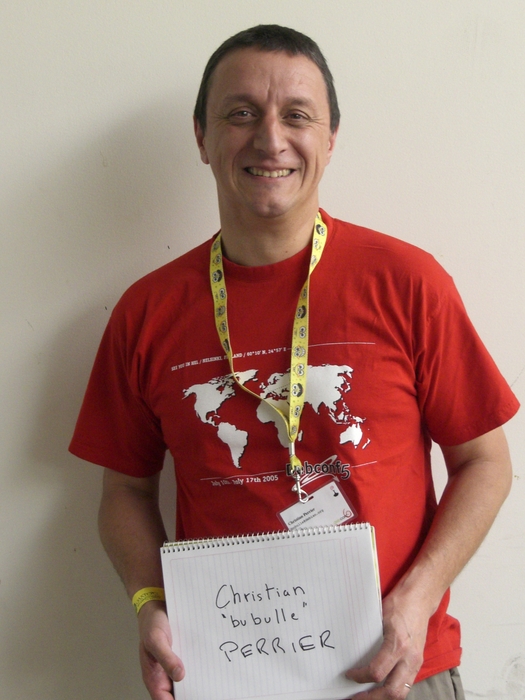
Raphaël Hertzog: People behind Debian: Christian Perrier, translation coordinator

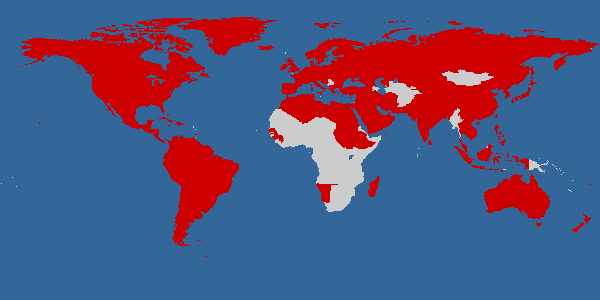
Christian is a figure of Debian, not only because of the tremendous coordination work that he does within the translation project, but also because he s very involved at the social level. He s probably in the top 5 of the persons who attended most often the Debian conference. Christian is a friend (thanks for hosting me so many times when I come to Paris for Debian related events) and I m glad that he accepted to be interviewed. He likes to speak and that shows in the length of his answers :-) but you ll be traveling the world while reading him. My questions are in bold, the rest is by Christian. Who are you? I am a French citizen (which is easy to guess unless you correct my usual mistakes in what follows). I m immensely proud of being married for nearly 26 years with Elizabeth (who deserves a statue from Debian for being so patient with my passion and my dedication to the project). I m also the proud father of 3 wonderful kids , aged 19 to 23. I work as team manager in the Networks and Computers Division of Onera the French Aerospace lab , a public research institute about Aeronautics, Space and Defense. My team provides computer management services for research divisions of Onera, with a specific focus put on individual computing. I entered the world of free software as one of the very first users of Linux in France. Back in the early 1990 s, I happened (though the BBS users communities) to be a friend of several early adopters of Linux and/or BSD386/FreeBSD/NetBSD in France. More specifically, I discovered Linux thanks with my friend Ren Cougnenc (all my free software talks are dedicated to Ren , who passed away in 1996). You re not a programmer, not even a packager. How did you come to Debian? I m definitely not a programmer and I never studied computing (I graduated in Materials Science and worked in that area for a few years after my PhD). However, my daily work always involved computing (I redesigned the creep testing laboratory and its acquisition system all by myself during my thesis research work). An my hobbies often involved playing with home computers, always trying to learn about something new. So, first learning about a new operating system then trying to figure out how to become involved in its development was quite a logical choice. Debian is my distro of choice since it exists. I used Slackware on work machines for a while, but my home server, kheops, first ran Debian 1.1 when I stopped running a BBS on an MS-DOS machine to host a news server. That was back in October 1996. I then happened to be a user, and more specifically a user of genealogy software, also participating very actively in Usenet from this home computer and server, that was running this Debian thing. So, progressively, I joined mailing lists and, being a passionate person, I tried to figure out how I could bring my own little contribution to all this. This is why I became a packager (yes, I am one!) by taking over the geneweb package, which I was using to publish my genealogy research. I applied as DD in January 2001, then got my account in July 2001. My first upload to the Debian archive occurred on August 22nd 2001: that was of course geneweb, which I still maintain. Quite quickly, I became involved in the work on French localization. I have always been a strong supporter of localized software (I even translated a few BBS software back in the early 90 s) as one of the way to bring the power and richness of free software to more users. Localization work lead me to work on the early version of Debian Installer, during those 2003-2005 years where the development of D-I was an incredibly motivating and challenging task, lead by Joey Hess and his inspiring ideas. From user to contributor to leader, I suddenly discovered, around 2004, that I became the coordinator of D-I i18n (internationalization) without even noticing :-) You re the main translation coordinator in Debian. What plans and goals have you set for Debian Wheezy? As always: paint the world in red. Indeed, this is my goal for years. I would like our favorite distro to be able to be used by anyone in the world, whether she speaks English, Northern Sami, Wolof, Uyghur or Secwepemcts n. As a matter of symbol, I use the installer for this. My stance is that one should be able to even install Debian in one s own language. So, for about 7 years, I use D-I as a way to attract new localization contributors. This progress is represented on this page where the world is gradually painted in red as long as the installer supports more languages release after release. The map above tries to illustrate this by painting in red countries when the most spoken language in the country is supported in Debian Installer. However, that map does not give enough reward to many great efforts made to support very different kind of languages. Not only various national languages, but also very different ones: all regional languages of Spain, many of the most spoken languages in India, minority languages such as Uyghur for which an effort is starting, Northern Sami because it is taught in a few schools in Norway, etc., etc. Still, the map gives a good idea of what I would like to see better supported: languages from Africa, several languages in Central Asia. And, as a very very personal goal, I m eagerly waiting for support of Tibetan in Debian Installer, the same way we support its sister language, Dzongkha from Bhutan. For this to happen, we have to make contribution to localization as easy as possible. The very distributed nature of Debian development makes this a challenge, as material to translate (D-I components, debconf screens, native packages, packages descriptions, website, documentation) is very widely spread. A goal, for years, is to set a centralized place where translators could work easily without even knowing about SVN/GIT/BZR or having to report bugs to send their work. The point, however, would be to have this without making compromises on translation quality. So, with peer review, use of thesaurus and translation memory and all such techniques. Tools for this exist: we, for instance, worked with the developers of Pootle to help making it able to cope with the huge amount of material in Debian (think about packages descriptions translations). However, as of now, the glue between such tools and the raw material (that often lies in packages) didn t come. So, currently, translation work in Debian requires a great knowledge of how things are organized, where is the material, how it can be possible to make contribution reach packages, etc. And, as I m technically unable to fulfill the goal of building the infrastructure, I m fulfilling that role of spreading out the knowledge. This is how I can define my coordinator role. Ubuntu uses a web-based tool to make it easy to contribute translations directly in Launchpad. At some point you asked Canonical to make it free software. Launchpad has been freed in the mean time. Have you (re)considered using it? Why not? After all, it more or less fills in the needs I just described. I still don t really figure out how we could have all Debian material gathered in Rosetta/Launchpad .and also how Debian packagers could easily get localized material back from the framework without changing their development processes. I have always tried to stay neutral wrt Ubuntu. As many people now in Debian, I feel like we have reached a good way to achieve our mutual development. When it comes at localization work, the early days where the everything in Rosetta and translates who wants stanza did a lot of harm to several upstream localization projects is, I think, way over. Many people who currently contribute to D-I localization were indeed sent to me by Ubuntu contributors .and by localizing D-I, apt, debconf, package descriptions, etc., they re doing translation work for Ubuntu as well as for Debian. Let s say I m a Debian user and I want to help translate Debian in my language. I can spend 1 hour per week on this activity. What should I do to start? Several language teams use Debian mailing lists to coordinate their work. If you re lucky enough to be a speaker of one of these languages, try joining debian-l10n-<yourlanguage> and follow what s happening there. Don t try to immediately jump in some translation work. First, participate to peer reviews: comment on others translations. Learn about the team s processes, jargon and habits. Then, progressively, start working on a few translations: you may want to start with translations of debconf templates: they are short, often easy to do. That s perfect if you have few time. If no language team exists for your language, try joining debian-i18n and ask about existing effort for your language. I may be able to point you to individuals working on Debian translations (very often along with other free software translation efforts). If I am not, then you have just been named coordinator for your language :-) I may even ask you if you want to work on translating the Debian Installer. What s the biggest problem of Debian? We have no problems, we only have solutions :-) We are maybe facing a growth problem for a few years. Despite the increased welcoming aspects of our processes (Debian Maintainers), Debian is having hard times in growing. The overall number of active contributors is probably stagnating for quite a while. I m still amazed, however, to see how we can cope with that and still be able to release over the years. So, after all, this is maybe not a problem :-) Many people would point communication problems here. I don t. I think that communication inside the Debian project is working fairly well now. Our famous flame wars do of course still happen from time to time, but what large free software project doesn t have flame wars? In many areas, we indeed improved communication very significantly. I want to take as an example the way the release of squeeze has been managed. I think that the release team did, even more this time, a very significant and visible effort to communicate with the entire project. And the release of squeeze has been a great success in that matter. So, there s nearly nothing that frustrates me in Debian. Even when a random developer breaks my beloved 100% completeness of French translations, I m not frustrated for more than 2 minutes. You re known in the Debian community as the organizer of the Cheese & Wine Party during DebConf. Can you tell us what this is about? This is an interesting story about how things build themselves in Debian. It all started in July 2005, before DebConf 5 in Helsinki. Denis Barbier, Nicolas Fran ois and myself agreed to bring at Debconf a few pieces of French cheese as well as 1 or 2 bottles of French wine and share them with some friends. Thus, we settled an informal meeting in the French room where we invited some fellows: from memory, Benjamin Mako Hill, Hannah Wallach, Matt Zimmermann and Moray Allan. All of us fond of smelly cheese, great wine plus some extra p t home-made by Denis in Toulouse. It finally happened that, by word of mouth, a few dozens of other people slowly joined in that French room and turned the whole thing into an improvized party that more or less lasted for the entire night. The tradition was later firmly settled in 2006, first in Debconf 6 in Mexico where I challenged the French DDs to bring as many great cheese as possible, then during the Debian i18n meeting in Extremadura (Sept 2006) where we reached the highest amount of cheese per participant ever. I think that the Creofonte building in Casar de C ceres hasn t fully recovered from it and is still smelling cheese 5 years after. This party later became a real tradition for DebConf, growing over and over each year. I see it as a wonderful way to illustrate the diversity we have in Debian, as well as the mutual enrichment we always felt during DebConfs. My only regret about it is that it became so big over the years that organizing it is always a challenge and I more and more feel pressure to make it successful. However, over the years, I always found incredible help by DebConf participants (including my own son, last year a moment of sharing which we will both remember for years, i think). And, really, in 2010, standing up on a chair, shouting (because the microphone wasn t working) to thank everybody, was the most emotional moment I had at Debconf 10. Is there someone in Debian that you admire for their contributions? So many people. So, just like it happens in many awards ceremonies, I will be very verbose to thank people, sorry in advance for this. The name that comes first is Joey Hess. Joey is someone who has a unique way to perceive what improvements are good for Debian and a very precise and meticulous way to design these improvements. Think about debconf. It is designed for so long now and still reaching its very specific goal. So well designed that it is the entire basis for Joey s other achievement: designing D-I. Moreover, I not only admire Joey for his technical work, but also for his interaction with others. He is not he loudest person around, he doesn t have to .just giving his point in discussion and, guess what? Most of the time, he s right. Someone I would like to name here, also, is Colin Watson. Colin is also someone I worked with for years (the D-I effect, again ) and, here again, the very clever way he works on technical improvements as well as his very friendly way to interact with others just make it. And, how about you, Rapha l? :-) I m really admirative of the way you work on promoting technical work on Debian. Your natural ability to explain things (as good in English as it is in French) and your motivation to share your knowledge are a great benefit for the project. Not to mention the technical achievements you made with Guillem on dpkg of course! Another person I d like to name here is Steve Langasek. We both maintain samba packages for years and collaboration with him has always been a pleasure. Just like Colin, Steve is IMHO a model to follow when it comes at people who work for Canonical while continuing their involvment in Debian. And, indeed, Steve is so patient with my mistakes and stupid questions in samba packaging that he deserves a statue. We re now reaching the end of the year where Stefano Zacchiroli was the Debian Project Leader. And, no offense intended to people who were DPL before him (all of them being people I consider to be friends of mine), I think he did the best term ever. Zack is wonderful in sharing his enthusiasm about Debian and has a unique way to do it. Up to the very end of his term, he has always been working on various aspects of the project and my only hope is that he ll run again (however, I would very well understand that he wants to go back to his hacking activities!). Hat off, Zack!I again have several other people to name in this Bubulle hall of Fame : Don Armstrong, for his constant work on improving Debian BTS, Margarita Manterola as one of the best successes of Debian Women (and the most geeky honeymoon ever), Denis Barbier and Nicolas Fran ois because i18n need really skilled people, Cyril Brulebois and Julien Cristau who kept X.org packaging alive in lenny and squeeze, Otavio Salvador who never gave up on D-I even when we were so few to care about it. I would like to make a special mention for Frans Pop. His loss in 2010 has been a shock for many of us, and particularly me. Frans and I had a similar history in Debian, both mostly working on so-called non technical duties. Frans has been the best release manager for D-I (no offense intended, at all, to Joey or Otavio .I know that both of them share this feeling with me). His very high involvment in his work and the very meticulous way he was doing it lead to great achievements in the installer. The Installation Guide work was also a model and indeed a great example of non technical work that requires as many skills as more classical technical work. So, and even though he was sometimes so picky and, I have to admit, annoying, that explains why I m still feeling sad and, in some way, guilty about Frans loss. One of my goals for wheezy is indeed to complete some things Frans left unachieved. I just found one in bug #564441: I will make this work reach the archive, benefit our users and I know that Frans would have liked that.
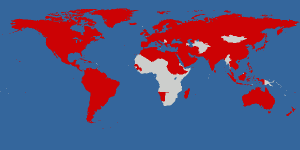

Thank you to Christian for the time spent answering my questions. I hope you enjoyed reading his answers as I did. Subscribe to my newsletter to get my monthly summary of the Debian/Ubuntu news and to not miss further interviews. You can also follow along on Identi.ca, Twitter and Facebook.

7 comments Liked this article? Click here. My blog is Flattr-enabled.

17 February 2011

Rapha&#235;l Hertzog: People behind Debian: Maximilian Attems, member of the kernel team

Maximilian, along with the other members of the Debian kernel team, has the overwhelming job of maintaining the Linux kernel in Debian. It s one of the largest package and certainly one where dealing with bug reports is really difficult as most of them are hardware-specific, and thus difficult to reproduce. He s very enthusiastic and energetic, and does not fear criticizing when something doesn t please him. You ll see. My questions are in bold, the rest is by Maximilian. Who are you? My name is Maximilian Attems. I am a theoretical physicist in my last year of PhD at the Technical University of Vienna. My main research area is the early phase of a Quark-Gluon Plasma as produced in heavy ion collisions at the LHC at CERN. I am developing simulations that take weeks on the Vienna Scientific Cluster (in the TOP 500 list). The rest of the lab is much less fancy and boils down to straight intel boxes without any binary blobs or external drivers (although lately we add radeon graphics for decent free 3D). Mathematica and Maple are the rare exceptions to the many dev tools of Debian (LaTeX, editors, git, IDE s, Open MPI, ..) found at the institute, as those are unfortunately yet unmatched in Free Software for symbolic computations. The lab mostly runs a combination of Debian stable (testing starting from freeze) for desktops and oldstable/stable for servers. Debian is in use for more than 10 years. So people in the institute know some ups and downs of the project. Newcomers like my room neighbors are always surprised how functional a free Debian Desktop is. :) What s your biggest achievement within Debian? Building lots and lots of kernels together with an growing uptake of the officially released linux images. I joined the Debian kernel team shortly after Herbert Xu departed. I had been upstream Maintainer of the linux-2.6 janitor project for almost a year brewing hundreds of small cleanups with quilt in a tree named kjt for early linux-2.6. In Debian we had lots of fun in sorting out the troubles that the long 2.5 freeze had imposed: Meaning we were sitting on a huge diverging monolithic semi-good patchset. It was great fun to prepare 2.6.8 for Sarge with a huge team enthusiastic in shipping something real close to mainline (You have to imagine that back then you had no stable or longterm release nor any useful free tools like git. This involved passing patches around, hand editing them and seeing what the result does.) From the Sarge install reports a common pattern emerged that the current Debian early userspace was causing lots of boot failures. This motivated me to develop an alternative using the new upstream initramfs features. So I got involved in early userspace. Thanks to large and active development team initramfs-tools got a nice ecosystem. It still tries to be as generic and flexible as possible and thus gains many nice features. Also H. Peter Anvin (hpa) gave me the official co-maintenance of klibc. klibc saw uptake and good patches from Google in the last 2 years. I am proud that the early userspace is working out fairly well these days, meaning you can shuffle discs around and see your box boot. Later on we focused on 2.6.18 for Etch, which turned out to a be good release and picked up by several other distributions. Only very much later we would see such a sync again. With 2.6.26 for Lenny we got somehow unlucky as we just missed the new longterm release by one release. We also pushed for another update very late (during freeze) in the release cycle, which turned out to semi-work as too much things depend on linux-2.6. For Squeeze 2.6.32 got picked thanks to discussions at Portland Linux Plumbers and it turned out to be a good release picked up by many distributions and external patchsets. The long-term support is going very well. Greg KH is doing a great job in collecting various needed fixes for it. Somehow we had hoped that the Squeeze freeze would start sooner and that the freeze duration would be shorter, since we were ready for a release starting from the actual freeze on. The only real big bastard on the cool 2.6.32 sync is Red Hat. Red Hat Enterprise 6.0 is shipping the linux-2.6 2.6.32 in obfuscated form. They released their linux-2.6 as one big tarball clashing with the spirit of the GPL. One can only mildly guess from the changelog which patches get applied. This is in sharp contrast to any previous Red Hat release and has not yet generated the sharp and snide comments in press it deserves. Red Hat should really step back and not make such stupid management moves. Next to them even the semi-maintained Oracle Unbreakable 2.6.32 branch looks better: It is git fetchable. What are your plans and those of the kernel team for Debian Wheezy? Since 2.6.32 many of the used patches landed upstream or are on the way (speakup, Kbuild Debian specific targets, ..). The proper vfs based unionfs is something we d be looking forward. We haven t yet picked the next upstream release we will base Wheezy on, so currently we can happily jump to the most recent ones. There are plans for better interaction with Debian Installer thanks to generating our udebs properly in linux-2.6 source itself. Also we are looking forward to using git as tool of maintenance. We d hope that this will also allow for even better cross distribution collaboration. Concerning early userspace I plan to release an initramfs-tools with more generic userspace for the default case and finally also a klibc only for embedded or tuning cases. What do you like most in Debian? For one thing I do like the 2 year release cycle. It is not too long to have completely outdated software and on the other hand it gives enough time to really see huge progress from release to release. Also at my institute the software is is recent enough without too much admin overhead. For servers the three years support are a bit short, but on the manageable side. I do enjoy a lot the testing distribution. For my personal use it is very stable and thus I mainly run testing on my desktop and work boxes. (Occasionally mixing in things from sid for unbreaking transition or newer security fixes). Debian is independent and not a commercial entity. I think this is its main force and even more important these days. I enjoy using the Debian platform a lot at work thus in return this motivates me to contribute to Debian itself. I also like the fact that we strive for technical correctness. Is there some recurrent problem that hinders the progress of Debian? The New Maintainer process is a strange way to discourage people to contribute to Debian. It is particularly bureaucratic and a huge waste of time both for the applicant and his manager. It should be completely thrown overboard. One needs a more scalable approach for trust and credibility that also enhances the technical knowledge for coding and packaging of the applicant. NM is currently set in stone as any outside critics is automatically rejected. Young and energetic people are crucial for Debian and the long-term viability of the project, this is the reason why I d consider the New Maintainer process as Debian s biggest problem. Note from Rapha l Hertzog: I must say I do not share this point of view on the New Maintainer process, I have witnessed lots of improvements lately thanks to the addition of the Debian Maintainer status, and to the fact that a good history of contribution can easily subsume the annoying Tasks & Skills questionnaire. Another thing I miss is professional graphics input both for the desktop theme and the website. I know that effort has been done there lately and it is good to see movement there, but the end result is still lacking. Another trouble of Debian is its marketing capabilities. It should learn to better sell itself. It is the distribution users want to run and use not the rebranded copies of itself with lock-in sugar . Debian is about choice and it offers plenty of it: it is a great default Desktop. Linus Torvalds doesn t find Debian (and/or Ubuntu) a good platform to hack on the kernel. Do you know why and what can we do about this? The Fedora linux-2.6 receives contributions from several Red Hat employed upstream sub-Maintainers. Thus it typically carries huge patches which are not yet upstream. As a consequence eventual userland troubles get revealed quite quickly and are often seen there first. The cutting edge nature of Fedora rawhide is appealing for many developers. The usual Debian package division of library development files and the library itself is traditionally an entry barrier for dev on Debian. Debian got pretty easily usable these days, although we could and should again improve a lot more in this sector. Personally I think that Linus hasn t tried Debian for years. I have the feeling that the implication of the Debian Kernel team in LKML has been on the rise. Is that true and how do you explain this? Ben Hutchings is the Nr.1 contributor for 2.6.33. He also is top listed as author of patches on stable 2.6.32. Debian is not listed as organization as many send their linux-2.6 patches from their corporate or personal email address and thus it won t be attributed to Debian. There is currently no means to see how many patches get forwarded for the stable tree, but I certainly forwarded more then fifty patches. I was very happy when Greg KH personally thanked me in the 2.6.32.12 release. In the Squeeze kernel, the firmwares have been stripped and moved into separate packages in the non-free section. What should a user do to ensure his system keeps working? There is a debconf warning on linux-2.6 installation. It is quite clear that the free linux-2.6 can t depend on the firmware of the non-free archive (also there is no strict dependency there technically). On the terminal you d also see warnings by update-initramfs on the initramfs generation for drivers included in the initramfs. The debconf warning lists the filename(s) of the missing firmware(s). One can then apt-cache search for the firmware package name and install it via the non-free repository. The check runs against the current loaded modules. The match is not 100% accurate for special cases as the one where the device might be handled well by this driver without firmware, but is accurate enough to warrant the warning. The set of virtualization technologies that the official Debian kernel supports seems to change regularly. Which of the currently available options would you recommend to users who want to build on something that will last? KVM has been a smooth ride from day zero. It almost got included instantly upstream. The uptake it has is great as it sees both dev from Intel and AMD. Together with libvirt it s management is easy. Also the performance of virtio is very good. The linux containers are the thing we are looking forward for enhanced chroots in the Wheezy schedule. They are also manageable by libvirt. Xen being the bad outside boy has an incredible shrinking patchset, thus is fair to expect to see it for Wheezy and beyond. For many it may come a bit late, but for old hardware without relevant CPU it is there. Many tend to overstate the importance of the virtualization tech. I d be much more looking forward to the better Desktop support in newer linux-2.6. The Desktop is important for linux and something that is in heavy use. The much better graphics support of the radeon and nouveau drivers: The performance optimizations thanks to dcache scalability work and the neat automatic task-grouping for the CPU scheduler are very promising features for the usability of the linux desktop. Another nice to have feature is the online defrag of ext4 and its faster mkfs. Even cooler would be better scalability in ext4 (This side seems to have seen not enough effort lately). Is there someone in Debian that you admire for their contributions? Hans Peter Anvin and Ted Tso are a huge source of deep linux-2.6 knowledge and personal wisdom. I do enjoy all sorts of interactions with them. Christoph Hellwig with Matthew Wilcox and also William Irwin for setting up the Debian kernel Team. Several Debian leaders including the previous and the current one for their engagement, which very often happens behind the scene. The Debian Gnome Team work is great, also the interactions have always been always easy and a pleasure. Martin Michlmayr and previously Thiemo Seufer do an incredible job in porting Debian on funny and interesting ARM and MIPS boxes. Debian has a lot of upcoming potential on this area. I m looking forward to other young enthusiastic people in that area. Colin Watson is bridging Debian and Ubuntu, which is an immense task. Michael Prokop bases on Debian an excellent recovery boot CD: http://www.grml.org. I d be happy if any Debian Developer would work as carefully coding and working.
Thank you to Maximilian for the time spent answering my questions. I hope you enjoyed reading his answers as I did. Subscribe to my newsletter to get my monthly summary of the Debian/Ubuntu news and to not miss further interviews. You can also follow along on Identi.ca, Twitter and Facebook.

One comment Liked this article? Click here. My blog is Flattr-enabled.

28 January 2011

Axel Beckert: Cool new feature in OpenSSH 5.7: scp between two remote hosts

Just a few days after OpenSSH 5.7 was released upstream, our (Debian s as well as Ubuntu s) tireless OpenSSH and GRUB maintainer Colin Watson uploaded a first package of OpenSSH 5.7 to Ubuntu Natty and to Debian Experimental. Besides the obvious new thing, the implementation of Elliptic Curve Cryptography which promises better speed and shorter keys while staying at the same level of security, one other item of his changelog entry stuck out and caught my attention: That s something I always wondered why it didn t just work . While it still doesn t seem to detect such a situation by default, it s now at least possible to copy stuff from on remote box to another without ugly port forwarding and tunneling hacks. Further cool stuff in the changelog: Colin++

11 December 2010

Colin Watson: libpipeline 1.1.0 released

I've released libpipeline 1.1.0, and uploaded it to Debian unstable. The changes are mostly just to add a few occasionally useful interfaces: The shared library actually ends up being a few kilobytes smaller on Debian than 1.0.0, probably because I tweaked the set of Gnulib modules I'm using.

10 December 2010

Matt Zimmerman: Ubuntu Brainstorm Top 10 for December 2010

As I mentioned recently, the Ubuntu Technical Board is reviewing the most popular topics in Ubuntu Brainstorm and coordinating official responses on behalf of the project. This means that the most popular topics on Ubuntu Brainstorm receive expert answers from the people working in these areas. This is the first batch, and we plan to repeat this process each quarter. We ll use feedback and experiences from this run to improve it for next time, so let us know what you think. Power management (idea #24782) Laptops are now outselling desktops globally, and laptop owners want to get the most out of their expensive and heavy batteries. So it s no surprise that people are wondering about improved power management in Ubuntu. This is a complex topic which spans the Linux software stack, and certainly isn t an issue which will be solved in the foreseeable future, but we see a lot of good work being done in this area. To tell us about it, Amit Kucheria, Ubuntu kernel developer and leader of the Linaro working group on Power Management, contributed a great writeup on this topic, with technical analysis, tips and recommendations, and a look at what s coming next.
I am going to attempt to summarize the various use profiles and what Ubuntu does (or can do) to prolong battery life in those profiles. Power management, when done right, should not require the user to make several (difficult) choices. It should just work providing a good balance of performance and battery life.
IP address conflicts (idea #25648) IP addressing is a subject that most people should never have to think about. When something isn t working, and two computers end up with the same IP address, it can be hard to tell what s wrong. I was personally surprised to find this one near the top of the list on Ubuntu Brainstorm, since it seems unlikely to be a very common problem. Nonetheless, it was voted up, and we re listening. There is a tool called ipwatchd which is already available in the package repository, and was created specifically to address this problem. This seems like a further indication that this problem may be more widespread than I might assume. The idea has already been marked as implemented in Brainstorm based on the existence of this package, but that doesn t help people who have never heard of ipwatchd, much less found and installed it. What do you think? Have you ever run into this problem? Would it have helped you if your computer had told you what was wrong, or would it have only confused you further? Is it worth considering this for inclusion in the default install? Post your comments in Brainstorm. Selecting the only available username to login (idea #6974) Although Linux is designed as a multi-user operating system, most Ubuntu systems are only used by one person. In that light, it seems a bit redundant to ask the user to identify themselves every time they login, by clicking on their username. Why not just preselect it? Indeed, this would be relatively simple to implement, but the real question is whether it is the right choice for users. Martin Pitt of the Ubuntu Desktop Team notes that consistency is an important factor in ease of use, and asks for further feedback.
So in summary, we favored consistency and predictablility over the extra effort to press Enter once. This hasn t been a very strong opinion or decision, though, and the desktop team would be happy to revise it.
Icon for .deb packages (idea #25197) Building on the invaluable efforts of Debian developers, we work hard to make sure that people can get all of the software they need from Ubuntu repositories through Software Center and APT, where they are authenticated and secure. However, in practice, it is occasionally necessary for users to work with .deb files directly. Brainstorm idea 25197 suggests that the icon used to represent .deb packages in the file manager is not ideal, and can be confusing. Matthew Paul Thomas of the Canonical Design Team responds with encouragement for deb-thumbnailer, which makes the icon both more distinctive and more informative. He has opened bug 685851 to track progress on getting it packaged and into the main repository.
I have reviewed the proposed solutions with Michael Vogt, our packaging expert. Solution #1 is straightforward, but we particularly like solutions #5 and #10, using a thumbnailer to show the application icon from inside each package.
Keeping the time accurate over the Internet by default (idea #25301) It s important for an Internet connected computer to know the correct time of day, which is why Ubuntu has included automatic Internet time synchronization with NTP since the very first release (4.10 warty ). So some of us were a little surprised to see this as one of the most popular ideas on Ubuntu Brainstorm. Colin Watson of the Ubuntu Technical Board investigated and discovered a case where this wasn t working correctly. It s now fixed for Ubuntu 11.04, and Colin has sent the patches upstream to Debian and GNOME.
My first reaction was hey, that s odd I thought we already did that? . We install the ntpdate package by default (although it s deprecated upstream in favour of other tools, but that shouldn t be important here). ntpdate is run from /etc/network/if-up.d/ntpdate, in other words every time you connect to a network, which should be acceptably frequent for most people, so it really ought to Just Work by default. But this is one of the top ten problems where users have gone to the trouble of proposing solutions on Brainstorm, so it couldn t be that simple. What was going on?
More detail in GNOME system monitor (idea #25887) Under System, Preferences, System Monitor, you can find a tool to peek under the hood at the Linux processes which power every Ubuntu system. Power users, hungry for more detail on their systems inner workings, voted to suggest that more detail be made available through this interface. Robert Ancell of the Ubuntu Desktop Team answered their call by offering to mentor a volunteer to develop a patch, and someone has already stepped up with a first draft. Help the user understand when closing a window does not close the app (idea #25801) When the user clicks the close button, most applications obediently exit. A few, though, will just hide, and continue running, because they assume that s what the user actually wants, and it can be hard to tell which has happened. Ivanka Majic, Creative Strategy Lead at Canonical, shares her perspective on this issue, with a pointer to work in progress to resolve it.
This is more than a good idea, it s an important gap in the usability of most of the desktop operating systems in widespread use today.
Ubuntu Software Centre Removal of Configuration Files (idea #24963) One feature of the Debian packaging system used in Ubuntu is that it draws a distinction between removing a package and purging it. Purging should remove all traces of the package, such that installing and then immediately purging a package should return the system to the same state. Removing will leave certain files behind, including system configuration files and sometimes runtime data. This subtle distinction is useful to system administrators, but only serves to confuse most end users, so it s not exposed by Software Center: it just defaults to removing packages. This proposal in Ubuntu Brainstorm suggests that Software Center should purge packages by default instead. Michael Vogt of the Ubuntu Foundations Team explains the reasoning behind this default, and offers an alternative suggestion based on his experience with the package management system.
This is not a easy problem and we need to carefully balance the needs to keep the UI simple with the needs to keep the system from accumulating cruft.
Ubuntu One file sync progress (idea #25417) Ubuntu One file synchronization works behind the scenes, uploading and downloading as needed to replicate your data to multiple computers. It does most of its work silently, and it can be hard to tell what it is doing or when it will be finished. John Lenton, engineering manager for the Ubuntu One Desktop+ team, posts on the AskUbuntu Q&A site with tools and tips which work today, and their plans to address this issue comprehensively in the future. Multimedia performance (idea #24878) With a cornucopia of multimedia content available online today, it s important that users be able to access it quickly and easily. Poor performance in the audio, video and graphics subsystems can spoil the experience, if resource-hungry multimedia applications can t keep up with the flow of data. Allison Randal, Ubuntu Technical Architect, answers with an analysis of the problem and the proposed solutions, an overview of current activity in this area, and pointers for getting involved.
The fundamental concern is a classic one for large systems: changes in one part of the system affect the performance of another part of the system. It s modestly difficult to measure the performance effects of local changes, but exponentially more difficult to measure the network effects of changes across the system.

6 December 2010

Colin Watson: NTP synchronisation problems

The Ubuntu Technical Board is currently conducting a review of the top ten Brainstorm issues users have raised about Ubuntu, and Matt asked me to investigate and respond to Idea #25301: Keeping the time accurate over the Internet by default. My first reaction was "hey, that's odd - I thought we already did that?". We install the ntpdate package by default (although it's deprecated upstream in favour of other tools, but that shouldn't be important here). ntpdate is run from /etc/network/if-up.d/ntpdate, in other words every time you connect to a network, which should be acceptably frequent for most people, so it really ought to Just Work by default. But this is one of the top ten problems where users have gone to the trouble of proposing solutions on Brainstorm, so it couldn't be that simple. What was going on? I brought up a clean virtual machine with a development version of Natty (the current Ubuntu development version, which will eventually become 11.04), and had a look in its logs: it was indeed synchronising its time from ntp.ubuntu.com, and I didn't think anything in that area had changed recently. On the other hand, I had occasionally noticed that my own laptop wasn't always synchronising its time quite right, but I'd put it down to local weirdness as my network isn't always very stable. Maybe this wasn't so local after all? So, I started tracing through the scripts to figure out what was going on. It turned out that I had an empty /etc/ntp.conf file on my laptop. The /usr/sbin/ntpdate-debian script assumed that that meant I had a full NTP server installed (I don't), and fetched the list of servers from it; since the file was empty, it ended up synchronising time from no servers, that is, not synchronising at all. I removed the file and all was well. That left the question of where that file came from. It didn't seem to be owned by any package; I was pretty sure I hadn't created it by hand either. I had a look through some bug reports, and soon found ntpdate 1:4.2.2.p4+dfsg-1ubuntu2 has a flawed configuration file. It turns out that time-admin (System -> Administration -> Time and Date) creates an empty /etc/ntp.conf file if you press the reload button (tooltip: "Synchronise now"), as part of an attempt to update NTP configuration. Aha! Once I knew where the problems were, it was easy to fix them. I've uploaded the following changes, which will be in the 11.04 release: I've also sent these changes to Debian and GNOME as appropriate. There are still a few problems. The "Synchronise now" button doesn't work quite right in general (bug #90524), and if your network doesn't allow time synchronisation from ntp.ubuntu.com then you'll have to change the value of NTPSERVERS in /etc/default/ntpdate. Furthermore, the time-admin interface is confusing and makes it seem as though the default is not to synchronise the time automatically; this interface is being redesigned at the moment, which should be a good opportunity to make it less confusing, and I will contact the designers to mention this problem. On the whole, though, I think that many fewer people should have this kind of problem in Ubuntu 11.04. It's always possible that I missed some other problem that breaks automatic time synchronisation for people. Please do file a bug report if it still doesn't work for you in 11.04, or contact me directly (cjwatson at ubuntu.com).

Next.

Previous.