Reproducible Builds (diffoscope): diffoscope 255 released
255. This version includes the following changes:
[ Vekhir ]
* Add/fix compatibility for Python progressbar 2.5 & 3.0 etc.
[ Chris Lamb ]
* Update copyright years.
255. This version includes the following changes:
[ Vekhir ]
* Add/fix compatibility for Python progressbar 2.5 & 3.0 etc.
[ Chris Lamb ]
* Update copyright years.
IEEE Software recently announced that a paper that I co-authored with Dr. Stefano Zacchiroli has recently been awarded their Best Paper award:

Although it is possible to increase confidence in Free and Open Source Software (FOSS) by reviewing its source code, trusting code is not the same as trusting its executable counterparts. These are typically built and distributed by third-party vendors with severe security consequences if their supply chains are compromised. In this paper, we present reproducible builds, an approach that can determine whether generated binaries correspond with their original source code. We first define the problem and then provide insight into the challenges of making real-world software build in a "reproducible" manner that is, when every build generates bit-for-bit identical results. Through the experience of the Reproducible Builds project making the Debian Linux distribution reproducible, we also describe the affinity between reproducibility and quality assurance (QA).According to Google Scholar, the paper has accumulated almost 40 citations since publication. The full text of the paper can be found in PDF format.
254. This version includes the following changes:
[ Chris Lamb ]
* Reflow some code according to black.
[ Seth Michael Larson ]
* Add support for comparing the 'eXtensible ARchive' (.XAR/.PKG) file format.
[ Vagrant Cascadian ]
* Add external tool on GNU Guix for 7z.
Apparently I got an honour from OpenUK.
There are a bunch of people I know on that list. Chris Lamb and Mark Brown
are familiar names from Debian. Colin King and
Jonathan Riddell are people I know from past work in
Ubuntu. I ve admired David MacIver s work on
Hypothesis and Richard Hughes work on
firmware updates from afar. And there are a bunch of
other excellent projects represented there:
OpenStreetMap,
Textualize, and my alma mater of
Cambridge to name but a few.
My friend Stuart Langridge
wrote about
being on a similar list a few years ago, and I can t do much better than to
echo it: in particular he wrote about the way the open source development
community is often at best unwelcoming to people who don t look like Stuart
and I do. I can t tell a whole lot about demographic distribution just by
looking at a list of names, but while these honours still seem to be skewed
somewhat male, I m fairly sure they re doing a lot better in terms of gender
balance than my home project of Debian is, for one. I hope this is a sign
of improvement for the future, and I ll do what I can to pay it forward.
Like each month, have a look at the work funded by Freexian s Debian LTS offering.
Welcome to the December 2023 report from the Reproducible Builds project! In these reports we outline the most important things that we have been up to over the past month. As a rather rapid recap, whilst anyone may inspect the source code of free software for malicious flaws, almost all software is distributed to end users as pre-compiled binaries (more).
In February 2022, we announced in these reports that a paper written by Chris Lamb and Stefano Zacchiroli was now available in the March/April 2022 issue of IEEE Software. Titled Reproducible Builds: Increasing the Integrity of Software Supply Chains (PDF).
This month, however, IEEE Software announced that this paper has won their Best Paper award for 2022.
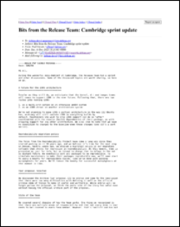
In a post summarising the activities of the Debian Release Team at a recent in-person Debian event in Cambridge, UK, Paul Gevers announced a change to the way packages are migrated into the staging area for the next stable Debian release based on its reproducibility status:
The folks from the Reproducibility Project have come a long way since they started working on it 10 years ago, and we believe it s time for the next step in Debian. Several weeks ago, we enabled a migration policy in our migration software that checks for regression in reproducibility. At this moment, that is presented as just for info, but we intend to change that to delays in the not so distant future. We eventually want all packages to be reproducible. To stimulate maintainers to make their packages reproducible now, we ll soon start to apply a bounty [speedup] for reproducible builds, like we ve done with passing autopkgtests for years. We ll reduce the bounty for successful autopkgtests at that moment in time.
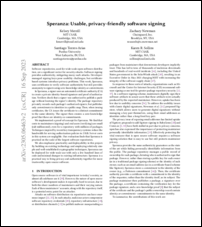
Kelsey Merrill, Karen Sollins, Santiago Torres-Arias and Zachary Newman have developed a new system called Speranza, which is aimed at reassuring software consumers that the product they are getting has not been tampered with and is coming directly from a source they trust. A write-up on TechXplore.com goes into some more details:
What we have done, explains Sollins, is to develop, prove correct, and demonstrate the viability of an approach that allows the [software] maintainers to remain anonymous. Preserving anonymity is obviously important, given that almost everyone software developers included value their confidentiality. This new approach, Sollins adds, simultaneously allows [software] users to have confidence that the maintainers are, in fact, legitimate maintainers and, furthermore, that the code being downloaded is, in fact, the correct code of that maintainer. [ ]The corresponding paper is published on the arXiv preprint server in various formats, and the announcement has also been covered in MIT News.
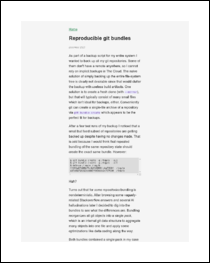
Paul Baecher published an interesting blog post on Reproducible git bundles. For those who are not familiar with them, Git bundles are used for the offline transfer of Git objects without an active server sitting on the other side of a network connection. Anyway, Paul wrote about writing a backup system for his entire system, but:
I noticed that a small but fixed subset of [Git] repositories are getting backed up despite having no changes made. That is odd because I would think that repeated bundling of the same repository state should create the exact same bundle. However [it] turns out that for some, repositories bundling is nondeterministic.Paul goes on to to describe his solution, which involves forcing git to be single threaded makes the output deterministic . The article was also discussed on Hacker News.
libxlst now deterministic
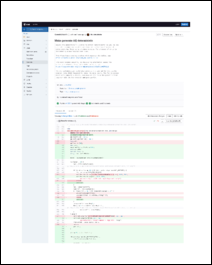
libxslt is the XSLT C library developed for the GNOME project, where XSLT itself is an XML language to define transformations for XML files. This month, it was revealed that the result of the generate-id() XSLT function is now deterministic across multiple transformations, fixing many issues with reproducible builds. As the Git commit by Nick Wellnhofer describes:
Rework the generate-id() function to return deterministic values. We use
a simple incrementing counter and store ids in the 'psvi' member of
nodes which was freed up by previous commits. The presence of an id is
indicated by a new "source node" flag.
This fixes long-standing problems with reproducible builds, see
https://bugzilla.gnome.org/show_bug.cgi?id=751621
This also hardens security, as the old implementation leaked the
difference between a heap and a global pointer, see
https://bugs.chromium.org/p/chromium/issues/detail?id=1356211
The old implementation could also generate the same id for dynamically
created nodes which happened to reuse the same memory. Ids for namespace
nodes were completely broken. They now use the id of the parent element
together with the hex-encoded namespace prefix.
There were made a number of improvements to our website, including Chris Lamb fixing the generate-draft script to not blow up if the input files have been corrupted today or even in the past [ ], Holger Levsen updated the Hamburg 2023 summit to add a link to farewell post [ ] & to add a picture of a Post-It note. [ ], and Pol Dellaiera updated the paragraph about tar and the --clamp-mtime flag [ ].
On our mailing list this month, Bernhard M. Wiedemann posted an interesting summary on some of the reasons why packages are still not reproducible in 2023.
diffoscope is our in-depth and content-aware diff utility that can locate and diagnose reproducibility issues. This month, Chris Lamb made a number of changes, including processing objdump symbol comment filter inputs as Python byte (and not str) instances [ ] and Vagrant Cascadian extended diffoscope support for GNU Guix [ ] and updated the version in that distribution to version 253 [ ].
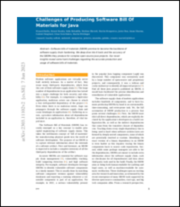
Musard Balliu, Benoit Baudry, Sofia Bobadilla, Mathias Ekstedt, Martin Monperrus, Javier Ron, Aman Sharma, Gabriel Skoglund, C sar Soto-Valero and Martin Wittlinger (!) of the KTH Royal Institute of Technology in Sweden, have published an article in which they:
deep-dive into 6 tools and the accuracy of the SBOMs they produce for complex open-source Java projects. Our novel insights reveal some hard challenges regarding the accurate production and usage of software bills of materials.The paper is available on arXiv.
As mentioned in previous reports, the Reproducible Builds team within Debian has been organising a series of online and offline sprints in order to clear the huge backlog of reproducible builds patches submitted by performing so-called NMUs (Non-Maintainer Uploads).
During December, Vagrant Cascadian performed a number of such uploads, including:
crack [ ] (#1021521 & #1021522)dustmite [ ] (#1020878 & #1020879)edid-decode [ ] (#1020877)gentoo [ ] (#1024284)haskell98-report [ ] (#1024007)infinipath-psm [ ] (#990862)lcm [ ] (#1024286)libapache-mod-evasive [ ] (#1020800)libccrtp [ ] (#860470)libinput [ ] (#995809)lirc [ ] (#979019, #979023 & #979024)mm-common [ ] (#977177)mpl-sphinx-theme [ ] (#1005826)psi [ ] (#1017473)python-parse-type [ ] (#1002671)ruby-tioga [ ] (#1005727)ucspi-proxy [ ] (#1024125)ypserv [ ] (#983138).buildinfo files in Debian trixie, specifically lorene (0.0.0~cvs20161116+dfsg-1.1), maria (1.3.5-4.2) and ruby-rinku (1.7.3-2.1).
The Reproducible Builds project operates a comprehensive testing framework (available at tests.reproducible-builds.org) in order to check packages and other artifacts for reproducibility. In December, a number of changes were made by Holger Levsen:
create-meta-pkgs tool. [ ][ ]python3-setuptools and swig packages, which are now needed to build OpenWrt. [ ]pkg-config needed to build Coreboot artifacts. [ ]fakeroot tool is implicitly required but not automatically installed. [ ]vmlinuz file. [ ]freebsd-jenkins.debian.net has been updated to FreeBSD 14.0. [ ]apr (hostname issue)dune (parallelism)epy (time-based .pyc issue)fpc (Year 2038)gap (date)gh (FTBFS in 2024)kubernetes (fixed random build path)libgda (date)libguestfs (tar)metamail (date)mpi-selector (date)neovim (randomness in Lua)nml (time-based .pyc)pommed (parallelism)procmail (benchmarking)pysnmp (FTBFS in 2038)python-efl (drop Sphinx doctrees)python-pyface (time)python-pytest-salt-factories (time-based .pyc issue)python-quimb (fails to build on single-CPU systems)python-rdflib (random)python-yarl (random path)qt6-webengine (parallelism issue in documentation)texlive (Gzip modification time issue)waf (time-based .pyc)warewulf (CPIO modification time and inode issue)xemacs (toolchain hostname)python-aiostream.openpyxl.python-multipletau.wxmplot.stunnel4.qttools-opensource-src.#reproducible-builds on irc.oftc.net.
rb-general@lists.reproducible-builds.org
This post should have marked the beginning of my yearly roundups of the favourite books and movies I read and watched in 2023.
However, due to coming down with a nasty bout of flu recently and other sundry commitments, I wasn't able to undertake writing the necessary four or five blog posts In lieu of this, however, I will simply present my (unordered and unadorned) highlights for now. Do get in touch if this (or any of my previous posts) have spurred you into picking something up yourself
Books
Peter Watts: Blindsight (2006)
Reymer Banham: Los Angeles: The Architecture of Four Ecologies (2006)
Joanne McNeil: Lurking: How a Person Became a User (2020)
J. L. Carr: A Month in the Country (1980)
Hilary Mantel: A Memoir of My Former Self: A Life in Writing (2023)
Adam Higginbotham: Midnight in Chernobyl (2019)
Tony Judt: Postwar: A History of Europe Since 1945 (2005)
Tony Judt: Reappraisals: Reflections on the Forgotten Twentieth Century (2008)
Peter Apps: Show Me the Bodies: How We Let Grenfell Happen (2021)
Joan Didion: Slouching Towards Bethlehem (1968)
Erik Larson: The Devil in the White City (2003)
Films Recent releases
Like each month, have a look at the work funded by Freexian s Debian LTS offering.
Some notable fixes which were made in LTS during the month of November include the gnutls28 cryptographic library and the freerdp2 Remote Desktop Protocol client/server implementation. The gnutls28 update was prepared by LTS contributor Markus Koschany and dealt with a timing attack which could be used to compromise a cryptographic system, while the freerdp2 update was prepared by LTS contributor Tobias Frost and is the result of work spanning 3 months to deal with dozens of vulnerabilities.
In addition to the many ordinary LTS tasks which were completed (CVE triage, patch backports, package updates, etc), there were several contributions by LTS contributors for the benefit of Debian stable and old-stable releases, as well as for the benefit of upstream projects. LTS contributor Abhijith PA uploaded an update of the puma package to unstable in order to fix a vulnerability in that package while LTS contributor Thosten Alteholz sponsored an upload to unstable of libde265 and himself made corresponding uploads of libde265 to Debian stable and old-stable. LTS contributor Bastien Roucari s developed patches for vulnerabilities in zbar and audiofile which were then provided to the respective upstream projects. Updates to packages in Debian stable were made by Markus Koschany to deal with security vulnerabilities and by Chris Lamb to deal with some non-security bugs.
As always, the LTS strives to provide high quality updates to packages under the direct purview of the LTS team while also rendering assistance to maintainers, the stable security team, and upstream developers whenever practical.
Welcome to the November 2023 report from the Reproducible Builds project! In these reports we outline the most important things that we have been up to over the past month. As a rather rapid recap, whilst anyone may inspect the source code of free software for malicious flaws, almost all software is distributed to end users as pre-compiled binaries (more).
amd64, arm64, armhf, i386, ppc64el, riscv64 and s390 for Debian trixie, unstable and experimental, this is only around 500GB ie. less than 1%. Although the new service not yet ready for usage, it has already provided a promising outlook in this regard. More information is available on https://rebuilder-snapshot.debian.net and we hope that this service becomes usable in the coming weeks.
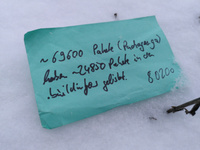
The adjacent picture shows a sticky note authored by Jan-Benedict Glaw at the summit in Hamburg, confirming Holger Levsen s theory that rebuilding all Debian packages needs a very small subset of packages, the text states that 69,200 packages (in Debian sid) list 24,850 packages in their .buildinfo files, in 8,0200 variations. This little piece of paper was the beginning of rebuilder-snapshot and is a direct outcome of the summit!
The Reproducible Builds team would like to thank our event sponsors who include Mullvad VPN, openSUSE, Debian, Software Freedom Conservancy, Allotropia and Aspiration Tech.
On November 4th, Vagrant Cascadian presented Beyond Trusting FOSS at SeaGL in Seattle, WA in the United States. Founded in 2013, SeaGL is a free, grassroots technical summit dedicated to spreading awareness and knowledge about free source software, hardware and culture. The summary of Vagrant s talk mentions that it will:
[ ] introduce the concepts of Reproducible Builds, including best practices for developing and releasing software, the tools available to help diagnose issues, and touch on progress towards solving decades-old deeply pervasive fundamental security issues Learn how to verify and demonstrate trust, rather than simply hoping everything is OK!Germane to the contents of the talk, the slides for Vagrant s talk can be built reproducibly, resulting in a PDF with a SHA1 of
cfde2f8a0b7e6ec9b85377eeac0661d728b70f34 when built on Debian bookworm and c21fab273232c550ce822c4b0d9988e6c49aa2c3 on Debian sid at the time of writing.
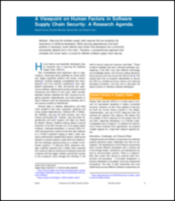
Marcel Fourn , Dominik Wermke, Sascha Fahl and Yasemin Acar have published an article in a Special Issue of the IEEE s Security & Privacy magazine. Entitled A Viewpoint on Human Factors in Software Supply Chain Security: A Research Agenda, the paper justifies the need for reproducible builds to reach developers and end-users specifically, and furthermore points out some under-researched topics that we have seen mentioned in interviews. An author pre-print of the article is available in PDF form.
[ ] today I hold in my hands the first two bit-identical LibreOffice rpm packages. And this is the success I wanted to share with you all today [and] it makes me feel as if we can solve anything.
esp32c3 microcontroller firmware reproducible with Rust, repro-env and Arch Linux:
I chose theesp32c3[board] because it has good Rust support from theesp-rsproject, and you can get a dev board for about 6-8 . To document my build environment I usedrepro-envtogether with Arch Linux because its archive is very reliable and contains all the different Rust development tools I needed.
dump command and hopes that someone may be able to help.
Bernhard M. Wiedemann has created a wiki page outlining an proposal to create a general-purpose Linux distribution which consists of 100% bit-reproducible packages albeit minus the embedded signature within RPM files. It would be based on openSUSE Tumbleweed or, if available, its Slowroll-variant.
In addition, Bernhard posted another monthly update for his work elsewhere in openSUSE.
As recently reported in the most recent Debian Developer News, Paul Gevers has integrated a package s reproducibility status into the way Debian migrates packages into the next stable release. For the amd64, arm64, i386 and armhf architectures, data is collected from the Reproducible Builds testing framework is collected by this migration software even though, at the time of writing, it neither causes nor migration bonuses nor blocks migration. Indeed, the information only results are visible on Britney s excuses as well as on individual packages pages on tracker.debian.org.
.buildinfo files
Back in 2017, Steve Langasek filed a bug against Ubuntu s Launchpad code hosting platform to report that .changes files (artifacts of building Ubuntu and Debian packages) reference .buildinfo files that aren t actually exposed by Launchpad itself. This was causing issues when attempting to process .changes files with tools such as Lintian. However, it was noticed last month that, in early August of this year, Simon Quigley had resolved this issue, and .buildinfo files are now available from the Launchpad system.
Firstly, the widely-deployed PHPUnit framework for the PHP programming language have recently released version 10.5.0, which introduces the inclusion of a composer.lock file, ensuring total reproducibility of the shipped binary file. Further details and the discussion that went into their particular implementation can be found on the associated GitHub pull request.
In addition, the presentation Leveraging Nix in the PHP ecosystem has been given in late October at the PHP International Conference in Munich by Pol Dellaiera. While the video replay is not yet available, the (reproducible) presentation slides and speaker notes are available.
diffoscope is our in-depth and content-aware diff utility that can locate and diagnose reproducibility issues. This month, Chris Lamb made a number of changes, including:
7z. [ ]RequiredToolNotFound import. [ ]252 to Debian unstable. [ ]
A huge number of notes were added to our website that were taken at our recent Reproducible Builds Summit held between October 31st and November 2nd in Hamburg, Germany. In particular, a big thanks to Arnout Engelen, Bernhard M. Wiedemann, Daan De Meyer, Evangelos Ribeiro Tzaras, Holger Levsen and Orhun Parmaks z.
In addition to this, a number of other changes were made, including:
SOURCE_DATE_EPOCH and CMake [ ], added iomart (ne Bytemark) and DigitalOcean to our sponsors page [ ] and dropped an unnecessary link on some horizontal navigation buttons [ ].
amber-cli (date-related issue)bin86 (FTBFS-2038)buildah (timestamp)colord (CPU)google-noto-fonts (file modification issue)grub2 (directory-related metadata)guile-fibers (parallelism issue)guile-newt (parallelism issue)gutenprint (embedded date/hostname)hub (random build path)ipxe (nondeterministic behavoiour)joker / jokerkopete (undefined behaviour)kraft (embedde hostname)libcamera (signature)libguestfs (embeds build host file)llvm (toolchain/Rust-related issue)nfdump (date-related issue)ovmf (unknown cause)quazip (missing fonts)rdflib (nondeterminstic behaviour)rpm (toolchain)tigervnc (embedded an RSA signature)whatsie (date-related issue)xen (time-related issue)policycoreutils (sort-related issue)python-ansible-pygments.bidict.meson.radsecproxy.taffybar.php-doc.pelican.maildir-utils.openmrac-data.vectorscan.
The Reproducible Builds project operates a comprehensive testing framework (available at tests.reproducible-builds.org) in order to check packages and other artifacts for reproducibility. In October, a number of changes were made by Holger Levsen:
Priority: important in a new package set. [ ][ ]pool_buildinfos script to be re-run for a specific year. [ ]osuosl4 node [ ][ ] along with lynxis [ ].amd64 Ionos builders from 48 GiB to 64 GiB; thanks IONOS! [ ]arm64 architecture workers from 24 to 16 in order to improve stability [ ], reduce the workers for amd64 from 32 to 28 and, for i386, reduce from 12 down to 8 [ ].cache_dir size setting to 16 GiB. [ ]systemd-oomd as it unfortunately kills sshd [ ]debootstrap from backports when commisioning nodes. [ ]live_build_debian_stretch_gnome, debsums-tests_buster and debsums-tests_buster jobs to the zombie list. [ ][ ]jekyll build with the --watch argument when building the Reproducible Builds website. [ ]rc.local s Bash syntax so it can actually run [ ], commenting away some file cleanup code that is (potentially) deleting too much [ ] and fixing the html_brekages page for Debian package builds [ ]. Finally, diagnosed and submitted a patch to add a AddEncoding gzip .gz line to the tests.reproducible-builds.org Apache configuration so that Gzip files aren t re-compressed as Gzip which some clients can t deal with (as well as being a waste of time). [ ]
#reproducible-builds on irc.oftc.net.
rb-general@lists.reproducible-builds.org
Like each month, have a look at the work funded by Freexian s Debian LTS offering.
Welcome to the October 2023 report from the Reproducible Builds project. In these reports we outline the most important things that we have been up to over the past month. As a quick recap, whilst anyone may inspect the source code of free software for malicious flaws, almost all software is distributed to end users as pre-compiled binaries.
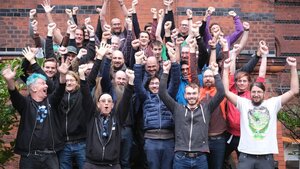
Between October 31st and November 2nd, we held our seventh Reproducible Builds Summit in Hamburg, Germany!
Our summits are a unique gathering that brings together attendees from diverse projects, united by a shared vision of advancing the Reproducible Builds effort, and this instance was no different.
During this enriching event, participants had the opportunity to engage in discussions, establish connections and exchange ideas to drive progress in this vital field. A number of concrete outcomes from the summit will documented in the report for November 2023 and elsewhere.
Amazingly the agenda and all notes from all sessions are already online.
The Reproducible Builds team would like to thank our event sponsors who include Mullvad VPN, openSUSE, Debian, Software Freedom Conservancy, Allotropia and Aspiration Tech.
Russ Cox posted a fascinating article on his blog prompted by the fortieth anniversary of Ken Thompson s award-winning paper, Reflections on Trusting Trust:
[ ] In March 2023, Ken gave the closing keynote [and] during the Q&A session, someone jokingly asked about the Turing award lecture, specifically can you tell us right now whether you have a backdoor into every copy of gcc and Linux still today?Although Ken reveals (or at least claims!) that he has no such backdoor, he does admit that he has the actual code which Russ requests and subsequently dissects in great but accessible detail.
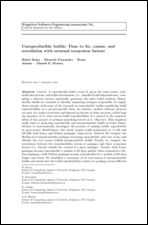
Rahul Bajaj, Eduardo Fernandes, Bram Adams and Ahmed E. Hassan from the Maintenance, Construction and Intelligence of Software (MCIS) laboratory within the School of Computing, Queen s University in Ontario, Canada have published a paper on the Time to fix, causes and correlation with external ecosystem factors of unreproducible builds.
The authors compare various response times within the Debian and Arch Linux distributions including, for example:
Arch Linux packages become reproducible a median of 30 days quicker when compared to Debian packages, while Debian packages remain reproducible for a median of 68 days longer once fixed.A full PDF of their paper is available online, as are many other interesting papers on MCIS publication page.
On the NixOS Discourse instance, Arnout Engelen (raboof) announced that NixOS have created an independent, bit-for-bit identical rebuilding of the nixos-minimal image that is used to install NixOS. In their post, Arnout details what exactly can be reproduced, and even includes some of the history of this endeavour:
You may remember a 2021 announcement that the minimal ISO was 100% reproducible. While back then we successfully tested that all packages that were needed to build the ISO were individually reproducible, actually rebuilding the ISO still introduced differences. This was due to some remaining problems in the hydra cache and the way the ISO was created. By the time we fixed those, regressions had popped up (notably an upstream problem in Python 3.10), and it isn t until this week that we were back to having everything reproducible and being able to validate the complete chain.Congratulations to NixOS team for reaching this important milestone! Discussion about this announcement can be found underneath the post itself, as well as on Hacker News.
Seth Larson published a blog post investigating the reproducibility of the CPython source tarballs. Using diffoscope, reprotest and other tools, Seth documents his work that led to a pull request to make these files reproducible which was merged by ukasz Langa.
arm64 hardware from Codethink
Long-time sponsor of the project, Codethink, have generously replaced our old Moonshot-Slides , which they have generously hosted since 2016 with new KVM-based arm64 hardware. Holger Levsen integrated these new nodes to the Reproducible Builds continuous integration framework.
ext4 filesystem images. [ ]
distro-info is a Debian-oriented tool that can provide information about Debian (and Ubuntu) distributions such as their codenames (eg. bookworm) and so on. This month, Benjamin Drung uploaded a new version of distro-info that added support for the SOURCE_DATE_EPOCH environment variable in order to close bug #1034422. In addition, 8 reviews of packages were added, 74 were updated and 56 were removed this month, all adding to our knowledge about identified issues.
Bernhard M. Wiedemann published another monthly report about reproducibility within openSUSE.
edje_cc (race condition)elasticsearch (build failure)erlang-retest (embedded .zip timestamp)fdo-client (embeds private keys)fftw3 (random ordering)gsoap (date issue)gutenprint (date)hub/golang (embeds random build path)Hyprland (filesystem issue)kitty (sort-related issue, .tar file embeds modification time)libpinyin (ASLR)maildir-utils (date embedded in copyright)mame (order-related issue)mingw32-binutils & mingw64-binutils (date)MooseX (date from perl-MooseX-App)occt (sorting issue)openblas (embeds CPU count)OpenRGB (corruption-related issue)python-numpy (random file names)python-pandas (FTBFS)python-quantities (date)python3-pyside2 (order)qemu (date and Sphinx issue)qpid (sorting problem)rakudo (filesystem ordering issue)SLOF (date-related issue)spack (CPU counting issue)xemacs-packages (date-related issue)file -i returns text/plain, fallback to comparing as a text file. This was originally filed as Debian bug #1053668) by Niels Thykier. [ ] This was then uploaded to Debian (and elsewhere) as version 251.
The Reproducible Builds project operates a comprehensive testing framework (available at tests.reproducible-builds.org) in order to check packages and other artifacts for reproducibility. In October, a number of changes were made by Holger Levsen:
#debian-reproducible-changes IRC channel. [ ][ ][ ]systemd-oomd on all Debian bookworm nodes (re. Debian bug #1052257). [ ]schroots. [ ]arm64 machines from Codethink. [ ][ ][ ][ ][ ][ ]#reproducible-builds on irc.oftc.net.
rb-general@lists.reproducible-builds.org
Welcome to the September 2023 report from the Reproducible Builds project
In these reports, we outline the most important things that we have been up to over the past month. As a quick recap, whilst anyone may inspect the source code of free software for malicious flaws, almost all software is distributed to end users as pre-compiled binaries.
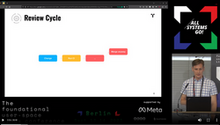
Andreas Herrmann gave a talk at All Systems Go 2023 titled Fast, correct, reproducible builds with Nix and Bazel . Quoting from the talk description:
You will be introduced to Google s open source build system Bazel, and will learn how it provides fast builds, how correctness and reproducibility is relevant, and how Bazel tries to ensure correctness. But, we will also see where Bazel falls short in ensuring correctness and reproducibility. You will [also] learn about the purely functional package manager Nix and how it approaches correctness and build isolation. And we will see where Bazel has an advantage over Nix when it comes to providing fast feedback during development.Andreas also shows how you can get the best of both worlds and combine Nix and Bazel, too. A video of the talk is available.
diffoscope is our in-depth and content-aware diff utility that can locate and diagnose reproducibility issues. This month, Chris Lamb fixed compatibility with file(1) version 5.45 [ ] and updated some documentation [ ]. In addition, Vagrant Cascadian extended support for GNU Guix [ ][ ] and updated the version in that distribution as well. [ ].
Yet another reminder that our upcoming Reproducible Builds Summit is set to take place from October 31st November 2nd 2023 in Hamburg, Germany.
If you haven t been before, our summits are a unique gathering that brings together attendees from diverse projects, united by a shared vision of advancing the Reproducible Builds effort. During this enriching event, participants will have the opportunity to engage in discussions, establish connections and exchange ideas to drive progress in this vital field.
If you re interested in joining us this year, please make sure to read the event page, the news item, or the invitation email that Mattia Rizzolo sent out recently, all of which have more details about the event and location.
We are also still looking for sponsors to support the event, so please reach out to the organising team if you are able to help. Also note that PackagingCon 2023 is taking place in Berlin just before our summit.
BUILDSPEC.md file. [ ] And Fay Stegerman fixed the builds failing because of a YAML syntax error.
In Debian, this month:
.dsc file modulo the GPG signature . This month, however, Russ Allbery closed the bug due to concerns about the viability of source reproducibility.
September saw F-Droid add ten new reproducible apps, and one existing app switched to reproducible builds. In addition, two reproducible apps were archived and one was disabled for a current total of 199 apps published with Reproducible Builds and using the upstream developer s signature. [ ] In addition, an extensive blog post was posted on f-droid.org titled Reproducible builds, signing keys, and binary repos .
linuxsampler (benchmarking issue)antlr3 (date)rpm (embeds too many build details)seamonkey (date)conky (date and ordering-related issue)lsp-plugins-shared (date/copyright year issue)build-comparehelix (ASLR-related non-determinism)intel-graphics-compiler (ASLR)sphinxcontrib-mermaid.mkdocs-material.apophenia.lapackpp.blaspp.mysql-connector-java, java-21-openjdk, apache-ivy, maven-assembly-plugin, eclipse, antlr3, groovy18, hbci4java, ini4j, hppc, checkstyle, glassfish-jaxb, tycho, xmvn, mockito, languagetool, json-lib, jnr-unixsocket, jnr-ffi, jnr-enxio, jboss-jaxrs-2.0-api, istack-commons, rxtx-java, glassfish-jaxb, glassfish-hk2, findbugs, docker-client-java, maven, xmvn-connector-ivy, xmlstreambuffer, checkstyle, cglib, bean-validation-api, aws-sdk-java, javapackages-tools, ant, scala, osgi-service-log, jmdns, xml-security, super-csv, osgi-service-jdbc, msv, junit5, jsr-311, jersey, itextpdf, httpcomponents-asyncclient, ed25519-java, jnacl, javaparser, picocli, freemarker, extra166y, javaparser, xstream, woodstox-core, uom-lib, unit-api, uncommons-maths, tycho, treelayout, tiger-types, super-csv, stax-ex, stax2-api, sqlite-jdbc, reflectasm, prometheus-simpleclient-java, powermock, paranamer, opennlp, netty3, mybatis, morfologik-stemming, minlog, maven-archetype, mariadb-java-client, logback, kryo, jsonp, jopt-simple, jnr-posix, jnr-constants, jnr-a64asm, jfreechart, jffi, jetty-schemas, jetty-minimal, jeromq, jctools, jcsp, jboss-websocket-1.0-api, jboss-marshalling, jboss-logmanager, jboss-logging, javaewah, jatl, janino, jackson-modules-base, jackson-jaxrs-providers, jackson-datatypes-collections, jackson-dataformat-xml, jackson-dataformats-text, jackson-dataformats-binary, indriya, google-gson, glassfish-websocket-api, glassfish-transaction-api, glassfish-jsp, glassfish-jax-rs-api, glassfish-hk2, glassfish-fastinfoset, felix-scr, felix-gogo-shell, felix-gogo-command, disruptor, apache-commons-ognl, apache-commons-math, apache-commons-csv, antlr4, jettison, sisu, maven
The Reproducible Builds project operates a comprehensive testing framework (available at tests.reproducible-builds.org) in order to check packages and other artifacts for reproducibility. In August, a number of changes were made by Holger Levsen:
armhf and i386 builds due to Debian bug #1052257. [ ][ ][ ][ ]ionice priority. [ ]dinstall again. [ ]schroot running the tested suite. [ ][ ]diffoscope --version (as suggested by Fay Stegerman on our mailing list) [ ], worked on an openQA credential issue [ ] and also made some changes to the machine-readable reproducible metadata, reproducible-tracker.json [ ]. Lastly, Roland Clobus added instructions for manual configuration of the openQA secrets [ ].
#reproducible-builds on irc.oftc.net.
rb-general@lists.reproducible-builds.org
Like each month, have a look at the work funded by Freexian s Debian LTS offering.
Welcome to the August 2023 report from the Reproducible Builds project!
In these reports we outline the most important things that we have been up to over the past month. As a quick recap, whilst anyone may inspect the source code of free software for malicious flaws, almost all software is distributed to end users as pre-compiled binaries.
The motivation behind the reproducible builds effort is to ensure no flaws have been introduced during this compilation process by promising identical results are always generated from a given source, thus allowing multiple third-parties to come to a consensus on whether a build was compromised. If you are interested in contributing to the project, please visit our Contribute page on our website.
serde_derive macro as a precompiled binary. As Ax Sharma writes:
The move has generated a fair amount of push back among developers who worry about its future legal and technical implications, along with a potential for supply chain attacks, should the maintainer account publishing these binaries be compromised.After intensive discussions, use of the precompiled binary was phased out.
On August 4th, Holger Levsen gave a talk at BornHack 2023 on the Danish island of Funen titled Reproducible Builds, the first ten years which promised to contain:
[ ] an overview about reproducible builds, the past, the presence and the future. How it started with a small [meeting] at DebConf13 (and before), how it grew from being a Debian effort to something many projects work on together, until in 2021 it was mentioned in an executive order of the president of the United States. (HTML slides)Holger repeated the talk later in the month at Chaos Communication Camp 2023 in Zehdenick, Germany: A video of the talk is available online, as are the HTML slides.
Just another reminder that our upcoming Reproducible Builds Summit is set to take place from October 31st November 2nd 2023 in Hamburg, Germany.
Our summits are a unique gathering that brings together attendees from diverse projects, united by a shared vision of advancing the Reproducible Builds effort. During this enriching event, participants will have the opportunity to engage in discussions, establish connections and exchange ideas to drive progress in this vital field.
If you re interested in joining us this year, please make sure to read the event page, the news item, or the invitation email that Mattia Rizzolo sent out, which have more details about the event and location.
We are also still looking for sponsors to support the event, so do reach out to the organizing team if you are able to help. (Also of note that PackagingCon 2023 is taking place in Berlin just before our summit, and their schedule has just been published.)
Vagrant Cascadian was interviewed on the SustainOSS podcast on reproducible builds:
Vagrant walks us through his role in the project where the aim is to ensure identical results in software builds across various machines and times, enhancing software security and creating a seamless developer experience. Discover how this mission, supported by the Software Freedom Conservancy and a broad community, is changing the face of Linux distros, Arch Linux, openSUSE, and F-Droid. They also explore the challenges of managing random elements in software, and Vagrant s vision to make reproducible builds a standard best practice that will ideally become automatic for users. Vagrant shares his work in progress and their commitment to the last mile problem.The episode is available to listen (or download) from the Sustain podcast website. As it happens, the episode was recorded at FOSSY 2023, and the video of Vagrant s talk from this conference (Breaking the Chains of Trusting Trust is now available on Archive.org:
It was also announced that Vagrant Cascadian will be presenting at the Open Source Firmware Conference in October on the topic of Reproducible Builds All The Way Down.
hello-traditional package from Debian. The entire thread can be viewed from the archive page, as can Vagrant Cascadian s reply.
In diffoscope development this month, versions 247, 248 and 249 were uploaded to Debian unstable by Chris Lamb, who also added documentation for the new specialize_as method and expanding the documentation of the existing specialize as well [ ]. In addition, Fay Stegerman added specialize_as and used it to optimise .smali comparisons when decompiling Android .apk files [ ], Felix Yan and Mattia Rizzolo corrected some typos in code comments [ , ], Greg Chabala merged the RUN commands into single layer in the package s Dockerfile [ ] thus greatly reducing the final image size. Lastly, Roland Clobus updated tool descriptions to mark that the xb-tool has moved package within Debian [ ].
In Debian, 28 reviews of Debian packages were added, 14 were updated and 13 were removed this month adding to our knowledge about identified issues. A number of issue types were added, including Chris Lamb adding a new timestamp_in_documentation_using_sphinx_zzzeeksphinx_theme toolchain issue.
In August, F-Droid added 25 new reproducible apps and saw 2 existing apps switch to reproducible builds, making 191 apps in total that are published with Reproducible Builds and using the upstream developer s signature. [ ]
Bernhard M. Wiedemann published another monthly report about reproducibility within openSUSE.
arimo (modification time in build results)apptainer (random Go build identifier)arrow (fails to build on single-CPU machines)camlp (parallelism-related issue)developer (Go ordering-related issue)elementary-xfce-icon-theme (font-related problem)gegl (parallelism issue)grommunio (filesystem ordering issue)grpc (drop nondetermistic log)guile-parted (parallelism-related issue)icinga (hostname-based issue)liquid-dsp (CPU-oriented problem)memcached (package fails to build far in the future)openmpi5/openpmix (date/copyright year issue)openmpi5 (date/copyright year issue)orthanc-ohif+orthanc-volview (ordering related issue plus timestamp in a Gzip)perl-Net-DNS (package fails to build far in the future)postgis (parallelism issue)python-scipy (uses an arbitrary build path)python-trustme (package fails to build far in the future)qtbase/qmake/goldendict-ng (timestamp-related issue)qtox (date-related issue)ring (filesytem ordering related issue)scipy (1 & 2) (drop arbtirary build path and filesytem-ordering issue)snimpy (1 & 3) (fails to build on single-CPU machines as well far in the future)tango-icon-theme (font-related issue)
The Reproducible Builds project operates a comprehensive testing framework (available at tests.reproducible-builds.org) in order to check packages and other artifacts for reproducibility. In August, a number of changes were made by Holger Levsen:
reproducible-tracker.json data file. [ ]pbuilder.tgz for Debian unstable due to #1050784. [ ][ ]usrmerge. [ ][ ]armhf nodes (wbq0 and jtx1a) as down; investigation is needed. [ ]buildd.debian.org. [ ][ ]
#reproducible-builds on irc.oftc.net.
rb-general@lists.reproducible-builds.org
250. This version includes the following changes:
[ Chris Lamb ]
* Fix compatibility with file 5.45. (Closes: reproducible-builds/diffoscope#351)
[ Vagrant Cascadian ]
* Add external tool references for GNU Guix (for html2text and ttx).
249. This version includes the following changes:
[ FC Stegerman ]
* Add specialize_as() method, and use it to speed up .smali comparison in
APKs. (Closes: reproducible-builds/diffoscope!108)
[ Chris Lamb ]
* Add documentation for the new specialize_as, and expand the documentation
of specialize too. (Re: reproducible-builds/diffoscope!108)
* Update copyright years.
[ Felix Yan ]
* Correct typos in diffoscope/presenters/utils.py.
Like each month, have a look at the work funded by Freexian s Debian LTS offering.
Welcome to the July 2023 report from the Reproducible Builds project. In our reports, we try to outline the most important things that we have been up to over the past month. As ever, if you are interested in contributing to the project, please visit the Contribute page on our website.

Marcel Fourn et al. presented at the IEEE Symposium on Security and Privacy in San Francisco, CA on The Importance and Challenges of Reproducible Builds for Software Supply Chain Security.
As summarised in last month s report, the abstract of their paper begins:
The 2020 Solarwinds attack was a tipping point that caused a heightened awareness about the security of the software supply chain and in particular the large amount of trust placed in build systems. Reproducible Builds (R-Bs) provide a strong foundation to build defenses for arbitrary attacks against build systems by ensuring that given the same source code, build environment, and build instructions, bitwise-identical artifacts are created. (PDF)

Chris Lamb published an interview with Simon Butler, associate senior lecturer in the School of Informatics at the University of Sk vde, on the business adoption of Reproducible Builds.
(This is actually the seventh instalment in a series featuring the projects, companies and individuals who support our project. We started this series by featuring the Civil Infrastructure Platform project, and followed this up with a post about the Ford Foundation as well as recent ones about ARDC, the Google Open Source Security Team (GOSST), Bootstrappable Builds, the F-Droid project and David A. Wheeler.)

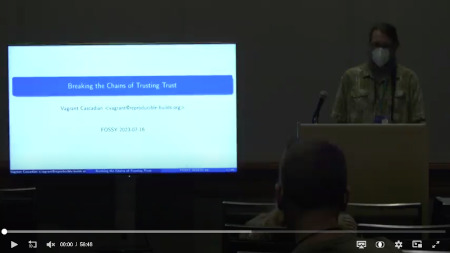
Vagrant Cascadian presented Breaking the Chains of Trusting Trust at FOSSY 2023.
I have identified 16 root causes for unreproducible builds in my empirical study, which I have linked to the corresponding documentation. The initial MR right now contains information about 10 root causes. For each root cause, I have provided a definition, a notable instance, and a workaround. However, I have only found workarounds for 5 out of the 10 root causes listed in this merge request. In the upcoming commits, I plan to add an additional 6 root causes. I kindly request you review the text for any necessary refinements, modifications, or corrections. Additionally, I would appreciate the help with documentation for the solutions/workarounds for the remaining root causes: Archive Metadata, Build ID, File System Ordering, File Permissions, and Snippet Encoding. Your input on the identified root causes for unreproducible builds would be greatly appreciated. [ ]

Just a reminder that our upcoming Reproducible Builds Summit is set to take place from October 31st November 2nd 2023 in Hamburg, Germany.
Our summits are a unique gathering that brings together attendees from diverse projects, united by a shared vision of advancing the Reproducible Builds effort. During this enriching event, participants will have the opportunity to engage in discussions, establish connections and exchange ideas to drive progress in this vital field.
If you re interested in joining us this year, please make sure to read the event page which has more details about the event and location.
There was more progress towards making the Go programming language ecosystem reproducible this month, including:
while packaginggovulncheckfor Arch Linux I noticed a checksum mismatch for a tar file I downloaded fromgo.googlesource.com. I used diffoscope to compare the.tarfile I downloaded with the.tarfile the build server downloaded, and noticed the timestamps are different.
In Debian, 20 reviews of Debian packages were added, 25 were updated and 25 were removed this month adding to our knowledge about identified issues. A number of issue types were updated, including marking ffile_prefix_map_passed_to_clang being fixed since Debian bullseye [ ] and adding a Debian bug tracker reference for the nondeterminism_added_by_pyqt5_pyrcc5 issue [ ].
In addition, Roland Clobus posted another detailed update of the status of reproducible Debian ISO images on our mailing list. In particular, Roland helpfully summarised that live images are looking good, and the number of (passing) automated tests is growing .
F-Droid added 20 new reproducible apps in July, making 165 apps in total that are published with Reproducible Builds and using the upstream developer s signature. [ ]
util.inspect.object_description
attempts to sort collections, but this can fail. The change handles the failure case by using string-based object descriptions as a
fallback deterministic sort ordering, as well as adding recursive object-description calls for list and tuple datatypes. As a result,
documentation generated by Sphinx will be more likely to be automatically reproducible.
Lastly in news, kpcyrd posted to our mailing list announcing a new repro-env tool:
My initial interest in reproducible builds was how do I distribute pre-compiled binaries on GitHub without people raising security concerns about them . I ve cycled back to this original problem about 5 years later and built a tool that is meant to address this. [ ]
django-graphql-jwt (fails to build in 2038)doxygen (filesystem ordering issue)git-interactive-rebase-tool (date-related issue)obs-buildprocmeter (parallelism race condition)promupython-cx_Freeze (version update for year 2038 fix)python-zope.deprecationpython310 (ASLR-related issue)python-control (fails to build-j4)python-DateTime (fails to build in 2038)python-pyface (date/time-related issue)python-quantities (date/time-related issue)python-scipy (date/time-related issue)rpmlintstarship (filesystem ordering issue)Telethonxindy (fails to build in 2036)yt (filesystem ordering issue)python-bpython, python-flup, python-mysqlclient, python-waitress, python-WebOb, python-WebTest, python-zope.event, python-zope.hookable & python-zope.i18nmessageiddotenv-cli.unity-java.ruby-babosa (forwarded upstream).guidata (forwarded upstream).SOURCE_DATE_EPOCH, a three-and-a-half year effort started by Bernhard M. Wiedemann in January 2020, taken over by John Neffenger in March 2021, integrated upstream in June 2023, and available starting with JavaFX 21 on September 19, 2023.
In diffoscope development this month, versions 244, 245 and 246 were uploaded to Debian unstable by Chris Lamb, who also made the following changes:

libarchive-5. [ ]test_dex::test_javap_14_differences test requires the procyon tool. [ ]assert_diff in the .ico and .jpeg tests. [ ]XFAIL due to Debian bugs #1040941 & #1040916. [ ]
The Reproducible Builds project operates a comprehensive testing framework (available at tests.reproducible-builds.org) in order to check packages and other artifacts for reproducibility. In July, a number of changes were made by Holger Levsen:

create_meta_pkg_sets job into two (for Debian unstable and Debian testing) to half the job runtime to approximately 90 minutes. [ ][ ]postgresql_autodoc is back in Debian bookworm. [ ]kfreebsd-related tests now that it s officially dead. [ ]dpkg-db-backup [ ] and munin-node services [ ].#reproducible-builds on irc.oftc.net.

rb-general@lists.reproducible-builds.org
247. This version includes the following changes:
[ Chris Lamb ]
* Fix compataibility with file(1) version 5.45.
* Use assert_diff in test_uimage and test_cpio.
[ Roland Clobus ]
* xb-tool has moved in Debian bookworm.
Next.