
Search Results: "tar"

14 January 2008

Roland Mas: GForge security patch, and a new feed

First, and most important: while researching a functional bug for a client, I found a rather important security problem in GForge. All versions (starting from 3.1) are vulnerable to an SQL injection problem due to missing input sanitisation. Debian packages have already been fixed and released, and the patches have been committed to the upstream Subversion repository, so non-Debian users are encouraged to grab the patches from there. For instance, the patches for the 4.5.* branch can be obtained from the ViewVC page. For reference, the CVE ID for this problem is CVE-2008-0173. Secondly, there's a new "gforge" tag on this blog, to filter posts that relate to GForge. I mainly created it in response to the existence of a feed aggregator focusing on forges and variants, but you can also subscribe to it directly if you only want to hear about Gforge and not about my other Free Software activities. I'll also use it to announce security patches like this one.

13 January 2008

Eddy Petrișor: blowing things out of proportion

First I want to say shame on you for plain out laying. I had the laptop in service once, not twice. That was for the battery. The HDD is fine and I never had hardware issues with it. Now I am writing from that laptop, is that proof good enough for you?

Now I understand how rumors start.

What I don't understand what would motivate anyone to do this?

Oh, and you're welcome for the free advertising.

Andrew Pollock: [debian] Adding domain-search (option 119) support to DHCP

I've been a bit behind with the ISC DHCP v3 package of late. I've had a package of 3.1.0 for a few months, but I'm becoming more and more reluctant to make uploads of this package without giving it some rudimentary testing. Real life has been demanding of late, so I haven't had a chance to do that testing. Nothing's gone wrong with the package to date, I just feel negligent not giving it some basic testing before throwing it out there. So I chucked a spare QFE card in my workstation brutus, put unstable on the second hard drive, installed Debian unstable on the spare 10G partition of Sarah's old PowerBook, and lashed the two together with a bit of CAT-5, and voila, instant DHCP client/server testbed. So now that I'd verified that version 3.1.0 wasn't blatantly broken, I could have a fiddle with the new support for option 119 (domain-search) that has people at work very excited. I spent a bit of time off on a wild goose chase trying to figure out how to configure the DHCP server for this new option before I realised it was as simple as option domain-search "foo bar baz"; and then made the necessary tweaks to dhclient-script. I'm figuring that since one of the blokes who wrote the RFC works at Apple, and since Leopard supports option 119, the way they're doing it in Leopard must be approximately correct, so I've altered the behaviour of the DHCP client accordingly. All of this assumes you're not using resolvconf. Prior to 3.1.0, if you had the domain-name option set, the /etc/resolv.conf created by dhclient-script would set the search directive to the domain name. With 3.1.0, I've decided to make this set the domain option instead. The resolver behaviour remains the same, as best as I can determine. With 3.1.0, if the domain-search option is set, then the search directive is set to this. If the domain-name option is set, this is prepended to the list of domains in the domain-search option. This is consistent with what MacOS X 10.5 (Leopard) does. I'm not sure what Windows does (nor what version started honouring the domain-search DHCP option)), and since it doesn't have an /etc/resolv.conf equivalent, it's a bit hard to test. I'm going to hazard a guess and hope that since the other bloke who wrote the RFC works for Microsoft, that maybe, just maybe, Windows and MacOS X at least behave the same way. Currently, if resolvconf is in use, you get the old behaviour whereby the search directive is populated with the contents of the domain-name option, and the domain-search option is ignored completely. I've filed #460609 with a patch to fix this. Interestingly, resolvconf itself internally collapses the domain and search directives into the search directive of the /etc/resolv.conf it generates, so I can't quite get the same /etc/resolv.conf generated as would be generated without resolvconf being used. No big deal, the behaviour should be the same. The domain directive is largely unnecessary as I understand it. I have unearthed what I consider to be a bug with the domain-search option handling code in the client. It seems to be largely benign, apart from causing the client to emit some errors when it's obtaining a lease that contains the domain-search option, and possibly not splitting the domains in the domain-search option correctly. There's also another (I think unrelated) warning that gets emitted as well. I'm waiting to hear back from upstream about both. I'm not going to package the recently released 4.0 DHCP until I've figured out a transition plan to go from the old DHCP v2 packages to the v3 ones.

Ross Burton: Sound Juicer "Now There's Emptiness In My Bed" 2.21.2

Sound Juicer "Now There's Emptiness In My Bed" 2.21.2 is available now. Tarballs are available on burtonini.com, or from the GNOME FTP servers. Again, the response from the gnome-love and GHOP tasks has been great, and there is a lot new in this release.

Gregor Herrmann: felicidad

after neglecting her for over four months I took "felicidad" (my western guitar) out of her case tonight. at the beginning of today's date she was quite "desafinado" but after a few minutes of tuning we started to have a nice session.

& it's amazing that my fingers (although they have lost the thick skin on the fingertips) still remember more or less what to do with the strings.

Matthew Garrett

Neil:

The vast majority of your criticisms are unfounded. Nvidia contribute code to the open driver for their network hardware (see the commits) - you don't mention what version of Debian you're actually running, but if it's etch then it's hardly surprising that new hardware isn't supported terribly well. Try a more recent kernel. It's not clear what you expect HP to have done here - used older hardware to make sure Debian worked?

"the graphics don't work with standard Debian kernels and the standard Debian 'nv' driver" - this seems fairer. No 7000-series IDs have been added to the nv driver for some time, and 7150 is clearly missing. Naughty nvidia. No biscuit. But, again, hard to see what you wanted HP to do here - you bought a machine with an nvidia graphics chipset, and you're surprised that the open support is poor?

"I'll still need some firmware for the bcm43xx wireless card - and it is that firmware that made my previously ultra-reliable iBook into a flaky, power hungry psycho-beast." - no. Given that the firmware runs fine on non-Linux platforms, it's pretty clear that it's the (entirely open) driver that's at fault. Which is hardly surprising, given that it's had to be reverse engineered due to Broadcom providing no specifications whatsoever, but blaming vendors for using proprietary firmware is a bit much. Do you have the source for your CPU microcode? Your BIOS? The firmware that's in flash on your other wireless cards? Your hard drive? As a community, we haven't been sending a strong message to vendors that we want open firmware. Acting shocked that they then don't provide it is alarmingly unreasonable.

"GNOME doesn't yet work because of the proprietary crap" - the only proprietary crap you need is the graphics driver, and it's unlikely (though possible) that it's breaking GNOME. Perhaps you have another bug?

"I didn't think companies were still producing crap of this pitiful standard - HP: you stink" - this might at some level be linked to the fact that you paid 500 pounds, and as a result you got something made from cheap parts. That's not HP's fault. Their consumer hardware isn't designed to work with Linux. It's hardware that's designed to be as cheap and shiny as possible in order to appeal to home users who are then going to use it to download films and porn and animated mouse cursors in order to ensure that all their private data get sent to Russia. If it's supported by Linux then that's a happy coincidence. If not, then who cares?

Never mind. It's likely that your laptop is one of the machines that has some debugging hardware on io port 0x80, and as a result Linux's use of that as a delay port (despite the hardware's acpi tables claiming it as a motherboard resource) is likely to cause the machine to deadlock randomly if you do things like try to read the hardware clock or nvram. That's likely to cause you more problems than HP's use of Nvidia graphics.

Neil Williams: Partially rescued from NVidia horrors by Mepis but still v.v.v.v.unhappy with HP.

What a disaster!
HP and NVidia making laptops unusable
I've been considering a new laptop for weeks - mainly to get more RAM, more space but without adding to the actual size of the machine (or weight). I know, I should have taken more time over the selection, I should have found out more about the hardware, etc.etc.
I've ended up with an HP Pavilion dv6000 (dv6615ea) for the 2Gb RAM, 15inch screen, 250Gb hard drive to replace my ageing iBook 12inch with 128Mb RAM and 30Gb hard drive - all for barely an inch extra depth and very similar weight (and it was cheaper than the original price of the iBook). I thought I'd made a good choice. Yes, it was "NVidia Graphics" according to the sticker and yes, I could have spent more time (and money) finding a pre-installed lappy but I was hasty. (Much the same way as you should never go food shopping whilst hungry). I've managed with NVidia graphics before without using the horrid proprietary rubbish and I was prepared to put up with less-than-perfect graphics (I never use 3D anyway) because the free driver is at least stable with the graphics that I actually need.
What I wasn't expecting was that the dv6615ea has a lot more NVidia stuff than just the graphics card - including the network card! This really trashes a normal install because eth0 simply does not exist. OK, I can work around that for a while but there's more - the graphics don't work with standard Debian kernels and the standard Debian 'nv' driver. Ubuntu managed some graphics with the restricted NV support but only in VESA-safe-mode. Next stop was Mepis.
Don't buy a HP Pavilion dv6000 (dv6615ea)!
Just to see if the graphics would work at all, I tried it. Aha - the non-free changes to the Mepis kernel solved both problems so at least I now have a working ethernet card and a working graphics card. That at least allows me to finish the rest of the setup to find a better way of getting the graphics to work without the non-free kernel.
I'm not happy though - I'm annoyed with myself that I got suckered into a non-free-only lappy. I'm annoyed with NVidia for being stupid about Linux support. I'm annoyed that this new lappy is just going to end up MORE unstable than my existing one because of all the proprietary crap. (I'll still need some firmware for the bcm43xx wireless card - and it is that firmware that made my previously ultra-reliable iBook into a flaky, power hungry psycho-beast.)
Currently, I'm still migrating this horrid little piece of rubbish from Mepis to Ubuntu (Hardy from Breezy) then from Hardy to Debian unstable.
GNOME doesn't yet work because of the proprietary crap but the Mepis GNOME packages are also v.old so I'm hoping that a genuine Sid installation of GNOME can actually start up but I suspect that the Mepis patches are KDE-specific and I hate KDE.
I've just wasted 500 and that's why I'm really annoyed.
I've wasted a day and a half too, making things worse.
I'm probably going to have to leave this new lappy behind and take my existing iBook to Fosdem in a few weeks and that makes me even more annoyed. Even worse, this is an amd64 machine but I'm stuck with a 32bit installation because of the proprietary crap. I doubt I'll be able to trust any packages built on this laptop - or even be able to report bugs from this machine without first replicating the bug on a genuine Debian box. There is just SO much proprietary pollution in this piece of crap. I didn't think companies were still producing crap of this pitiful standard - HP: you stink.
I'm not a happy bunny. Not even slightly.

On a lighter note - it just goes to show how I've been isolated from all this stuff until now. My other machines are fine and have no need for any non-free stuff. Nice that I don't have to deal with this every day but such a shock to the system when I'm confronted with such horrors.

Biella Coleman: On Losing a Mother, on Losing Memories

For the last four years, I have left my life and home to return to my mother’s far more precarious and fragile life in Puerto Rico. I do so to visit. But I also do so to give her caretaker, Milagro, a much needed break. I returned on December 18th and found my mother nearly in the same state as she was in October. Far worse than a year ago, but she still struck me as my mother, if nothing else because she knew I was her daughter. Over the course of a week, all of that changed. After a series of howling fits, by the end of my first week there, she no longer knew she was my mother. While I knew this would eventually happen, I was still caught off guard. You see, prior to my arrival, and since my last visit in late October, she asked me on the phone, and my sister and Milagro in PR, *nearly everyday,* when I was coming back. So even though she asked when her daughter, who she knew lived and worked in the city of New York, was coming back over and over again for 8 weeks, this seemingly hard-wired thought quickly vaporized thanks to what is a disease of the brain, but what strikes experientially as a cruel disease of the soul and personality. So while 2007 was overall a pretty good year, it is also the year when in certain respects my mother died, at least for me in so far she has morphed into someone remarkably different from the person I once knew. Now she only remembers small scraps of her life. She knows she is from Russia, she knows that she lives in the Casa de Vera (which she thinks is her bed), she knows she loves the dog, she knows that she had parents (and she would like to return to them but does not know where they are), she knows she has a good friend who is a painter (I think she had a massive crush on him if she still remembers him and not me ;-) but otherwise, everything is so twisted, so jumbled or so gone, it is beyond stunning. She certainly knew I was around and helping for she got upset when she knew I was leaving, often bursting in tears, asking me to take her to New York. But she just knew me as Gabriella from Nueva York who brought her novio bueno to PR and not as anyone else. It is certainly not easy to see this, to experience it day in and out but it is what it is and there is no running from it. Logistically it is also beyond hard to take care of my mom. To get her to eat, to calm down after one of her morning fits (she always, always, always had a raging fit in the morning, the afternoon and evenings being far more calm periods), to convince her to wear her dentures (which is the only remedy to stop her from spitting all over the place), to dress her, to deal with her in the middle of the night, often twice, are all extraordinarily challenging. Very quickly, your waking hours fill up with seemingly endless tasks and this I guess is, in some respects, a hidden blessing; there is just a lot less time to ruminate over how all of this, frankly, sucks. It is only later, late at night, early in the morning, or on the plane ride home where the darkness of her life would set deeply into my own. It may be obvious why this state and experience is tough but there are two parts that I find particularly rough. If my mother’s state is one of near total chaos and entropy, there is one thing that is utterly clear. She knows she is suffering and she wants out. On particularly bad days, she would mutter or sometimes yell loudly that she wants to die and would ask for the medicine that would accomplish this. She would even sometimes call me mala for not giving her this medicine. It is certainly not the case that everyone with Alzheimers goes through what my mother does. Apparently, some experience the illness quietly and peacefully. This is so not the case for my mother, who lived a particularly hard yet vibrant life. Donning a difficult personality, she lived lived as fully as she could and it is clear that as life leaves her, she would rather not be around to experience what is a cruel exorcism of self. Thankfully, she is not constantly or not even mostly in a suicidal state. I think she at times forgets how lousy she feels and rather enjoys the rather limited life she has. And at this point, I just hope that she continues to have calm or even happy moments. The second surprise concerns my own memories. My mother has had this rare form of Alzheimers, Posterior Cortical Atrophy, for at least 6, possible 7 years now, though we only received the official diagnosis 2003, which is the year when when I first started to write the occasional post about my experiences with her. In 2003 and 2004, she was pretty functionally in tact and it has only been the last 2.5 years when the persistent decline has set in, whittling her capacities and memories to what seems to be a bare minimum. But because her presence and reality is nothing short of totally enveloping and drowning, I am starting to lose my own memory of my mother prior to her illness. If Alzheimers robs people of their memories, I have come to realize, that if you are not careful, it is a thief that can also rob your own memories. I think it is for this reason that I have become so attached to my mother’s stuff her furniture, her paintings some of which I have taken back with me. They are material vehicles that transport me back to the past when my mother was in a different state and place. Now it is clear that if the challenge is to deal with the emotional toll this illness causes, it as much summoning the will and performing the labor to retain and recall my older memories of her.

Wouter Verhelst: Network booting

Those who keep track, will know that I started writing support for NBD in debian-installer last weekend. But that's not what this post is about. I've been setting up a laptop for my brother. He talked about "something about as fast as our parents' computer", which is a 600Mhz PIII. After looking a while on ebay, I found a Dell Latitude L400, a 12" 700Mhz PIII-based laptop, for a fairly low price, which seems to fit that description, so I placed a bid. Only to figure out later that I should've read the description a slight bit more, because this was an incomplete machine: no RAM, no power adapter, no battery, no hard disk, which was being sold "for parts". Darn. Got me some fitting RAM and a power adapter on replacedirect (which is a shop I can really recommend, BTW -- new batteries for almost all conceivable laptop models, including those that have been out of production for years), put the RAM in, connected the power adapter, and crossed my fingers. Luckily the machine appears to work; it's not that they took it apart because it had broken down, or some such. I also still have a 2" hard disk to put in the machine, but apparently Dell has this conversion thing that I need to put between the disk and the rest of the machine, and that's missing; I guess I'll have to be a bit creative there. So, for the time being, I configured the machine to enable PXE booting, and set something up on the network to boot from. Since the installer support to install to the network is not (yet ;-) finished, I needed to do some stuff manually, however. After making sure I could boot the machine (long live debootstrap), I set out to install additional packages. After downloading and installing a number of packages, however, the machine suddenly died. Unfortunately rebooting didn't fix anything; the machine would die somewhat halfway through the boot. Since it was quite, eh, "early" in the morning by then, I left it at that and went to bed. Today, I easily figured out what the problem was: network-manager expects to take the network down, and then to run some scripts... which obviously breaks just about everything. I guess that if I want to make partman-nbd work, I'll have to do some work there, too...

12 January 2008

Filip Van Raemdonck: Big G having issues

Something awry on Gmail this evening... I've been having status messages — you know, the yellow/orangish overlay on top of the page that usually shows when an action has finished — telling me that "the system encountered a problem" for a few hours now while reading my email, intermittently.
Now all of a sudden, I'm dropped in the "old version" of the Gmail interface and there's no longer a choice at the top for the current UI, you know, the one with the funky coloured labels and such; which disappearance leads me to believe that it's not just a client side issue. I'm simply curious now how long it'll take them to fix things.

*Update* As I finished this post and went back to navigating through Gmail, the new UI is back. That didn't take them long...
*Second update* ... but the service also wasn't fixed, I almost immediately started getting error status messages again. And now I'm back into the "old" UI. As I'll be off for bed soon, I probably won't find out how long it'll take. Not that I'm that interested.

Adeodato Sim : Ikiwiki for, cough, debian.org?

(Disclaimer: I’ve decided to blog this mainly to get it off my mind. I’m not claiming it’s viable or appropriate, nor that the tool would be up to the job, or anything else. Heck, I’m not even involved with debian-www at all, but don’t we all love to share happy ideas.) The other day, when trying to think of a possible Summer of Code project to undertake this year, I thought that working on migrating (by making a parallel copy, see below) www.debian.org and wiki.debian.org to be ikiwiki-powered could be one, and see how it goes. Me, I think that having www.debian.org use a markup language, and have wiki.debian.org (or www.debian.org/wiki) live in a real VCS (us being Debian people, after all) would be two big pluses. The www instance would be only editable via the repository, either by the current group or DD-wide, and would have stuff like htmlscrubber disabled. And the wiki would be another setup/instance, with the normal setup for an ikiwiki wiki setup, backed up by a real e.g. Subversion repository open to all DDs, and possibly contributors at request. I believe that would be very very cool. Plus web edits as usual. This could also be used as a fresh start, and maybe as an opportunity to accomplish the long-awaited re-design of the site: if this job is done by making a live paralell copy, able to update itself from the current webml repository, and MoinMoin as well, it would give an interesting playground for experimenting, and could be adopted later on, when it’s truly polished, if ever.

Jacobo Tarrío Barreiro: ETOOCLEVER

msgid "Unable to cw::util::transcode package display format after \"%ls\""
WTF. That’s not even proper English. How am I supposed to translate it? No, really. My mind boggles. I’m going out for a walk in the beautiful Dublin weather.

David Welton: New Hecl Release

After four or so months, it's time for another Hecl "checkpoint". Those who are seriously interested really ought to be getting Hecl from subversion, however, it's a good idea to tie up the loose ends every now and then, and put something that's easy to fetch for the casual user. https://sourceforge.net/project/showfiles.php?group_id=122383 This release contains a number of interesting things:

11 January 2008

Joey Hess: my first terabyte

I bought one of the new terabyte drives, to double the storage space on my home network. I put it in a Thecus, so I have a terabyte of storage in a computer about the size of my first computer's floppy disk drive.

Felipe Augusto van de Wiel: 11 Jan 2008

Bits from the Debian i18n meeting (Extremadura 2007)
From December 12th to December 15th, Junta de Extremadura hosted another one of the Debian Meetings; five i18n guys shared ideas, food, buses and fun with the Debian KDE maintainers. We would like to thank Extremadura for hosting us during the Hispalinux Meeting 2007, the event was held at Universad de Derecho (Law University) in Caceres, Spain.

These are the minutes, results and notes from our work, it is a brief description but hopefully complete of what we have done and what is still missing/pending.

Thanks to Cesar (cek) we had the chance to work on churro (i18n.debian.net) locally; the server is still running a 2.4 kernel because of some "tick" problems with 2.6 series, the last one tried was 2.6.21 and we should try newer ones, in order to support upgrades and not get stuck with 2.4, we hope Cesar will find time to test new Debian kernels.

First, let me introduce everybody to the services, robots and resources being hosted by i18n.d.n:

  • MoinMoin wiki for local and simple reference documentation, it contains all the links to the below resources. (http://i18n.debian.net/wiki/)
  • Pootle experimental server
  • dl10n scripts, aka dl10n robots (codename Lion), these scripts are responsible for the status of pseudo URLs used by some translation teams, by the Project Smith and by the NMU Priority List for i18n NMU Campaign
  • Synchronization of the i18n material used by the Debian website to generate translation statistics about PO and PO-debconf
  • Generation of Compendium PO files per-language
  • Different types of statistics
  • Other non user-visible services like a full source mirror for stable, testing, unstable and experimental, used by the scripts and robots.
  • DDTP, Debian Descriptions Translation Project
  • DDTSS, The Debian Distributed Translation Server Satellite, a web front-end for DDTP, now integrated to DDTP to use the Database back-end instead of the e-mail interface.


And, at some point, we found important to state clear the acronyms and names used in related DDTP projects/tools:
  • DDTS, Debian Description Translation Server, this is the main "back-end" used in DDTP, it tends to be the interface between translator tools (present and future ones) and the database;
  • ddt.cgi is a CGI interface that is able to provide info for specific packages or translations, including diffs, related packages and active/inactive descriptions.
  • DDTC which is the old (and still functional) command line client for DDTP.


We took the chance to organize a few things on churro, old accounts were cleaned out and removed, we moved from /org to /srv and got more GBs of space to the "playground". Old files were also removed and some are schedule to deletion on early 2008. With the reallocation of /org we also find some more space to /home and /var, we reorganize some of the links on the web space (specially to remove services from people's accounts), and we changed the mirror script to also synchronize the Packages and Contents files.

Grisu and Martijn worked mainly on DDTP and DDTSS integration. DDTSS now provides statistics for stable, testing and unstable, we are also working with Debian Med to provide support and infrastructure to a specific audience, like packages related to Medicine. The conversion to talk directly with DDTP/DDTS database also provided:

  • Fetching new translations is almost instantaneous and marks translation as requested (avoiding duplicated works via the e-mail interface).
  • After sufficient reviews occurred, the upload is instant
  • Committed DDTS / DDTSS / DDTP website generation into SVN
    • Added READMEs for the above directories


DDTSS now announces the user using authentication because of its integration with the Database backend used by DDTP. Quick trivia: DDTP is now a compound of 25 languages occupying 18 GBytes.

A few days before the meeting we had the offer to use "AUTOBYHAND" to upload a package with the Translation-* files. The package is now called 'ddtp-translations' and we worked during the meeting to create scripts to build the package and to test it on the archive side. This approach allow Debian i18n Team to upload new translations and remove old ones (or inactive ones) without bother FTP Master Team. Special thanks to Anthony Town, he has been working with us to prove tips, fixes and info on how to produce the package and the scripts. The code is available in the debian-l10n SVN under pkg-ddtp-translations:
http://svn.debian.org/viewsvn/debian-l10n/pkg-ddtp-translations

In our case, "BYHAND" processing consists of a simple tarball of the main,contrib,non-free /i18n/Translation-*, we decide to work on a set of scripts to make it easier to create new packages (ddtp-translations) in a consistent way and keeping debian/changelog up-to-date. We also made some suggestions to the script what will run on the archive side to check the tarball structure, base on the examples of debian-maintainers and debtags (tags-override).

One of our initial targets for the meeting with regards to Pootle and Debian was to try big PO files per language, fortunately, Nicolas and Friedel were able to increase Pootle performance enough to get a few languages from DDTP loaded in Pootle. Using the upstream Pootle-diet branch, which uses a database back-end for the generation of statistics, the time to browse the DDTP POs of a language (~20.000 files) went down to a dozen of seconds.

Speaking about Pootle, Friedel gave us a good picture of what is coming next in terms of Pootle's development. There are improvements planned in the areas of permissions and rights delegation, as well as file management (for projects and templates). Improved management of terminology projects is also planned.

Improvements in the QA capabilities of the translate toolkit and Pootle are planned to help with the "false positives" of the pofilter checks. Better reuse of existing translations will become possible by using better translation memory techniques. There is also work planned on formats and converters involving, for example, XLIFF, TMX, TRADOS and WordFast.

Another pending task for quite a while was the CVS migration to SVN, it is now done, with a new layout. Commits to the CVS were disabled and every single script or resource depending on CVS should be changed to use SVN. For now, we are publishing (via HTTP) the status files generated by the pseudo-urls robots until we can fix the scripts to re-enable the commit of the files. You can find them here: http://i18n.debian.net/debian-l10n/status/

We are pretty happy with the changes and results of the work during those days, but we still have some items pending on our TODO list:

  • More advertisement and usage information about PO Compendiums
    There are two use cases are identified:
    • Filling new PO files.
    • QA work to find inconsistent translations.
    Maybe Eddy would love to do that? :-)
  • Extend the duration of the statistics history. (Nekral)
  • Debian packages of the services running on churro
    • DDTP (Grisu)
    • DDTSS (Martijn)
    • dl10n (Nekral)
  • DDTP: add some scripts to handle packages with version in the description (e.g. kernel and kernel modules) (Martijn)
  • DDTP: Standard generation of the translation tarballs (faw)
  • DDTP: document the bracketed stats on the main page (faw)
  • DDTC: should be updated to match the current features. Documentation to ease integration with procmail. (Nekral - low priority)
  • Implement mail service for translation teams with their own robots (e.g. Dutch) (faw)
  • Collect data from http://www.debian.org/devel/website/stats/ (Nekral)
  • http://www.debian.org/intl/l10n/po/,
    http://www.debian.org/intl/l10n/po-debconf/
    are built based on the churro material. It would make more sense to build these statistics on churro (Nekral)
    • We could "fork" the page and add some fancy new features on these pages (Nekral)
    • Add information from the coordination page to indicate that a translation is ongoing. (Nekral)
  • Pootle: missing review indication. Hard with PO back-end. (Friedel)


There are a couple more reports to be sent but they are more focused on i18n specific questions, tools and plans for 2008. So, probably those will be sent only to debian-i18n mail list. If you are interested, please, stay tuned. :-)
Posted on d-d-a: http://lists.debian.org/debian-devel-announce/2008/01/msg00002.html
And a big thanks to Nicolas François (aka nekral), he helped me a lot making notes, preparing the text and reviewing it; and was patient enough to wait for the report while I was solving some personal problems.

Anthony Towns: LCA Sponsors

An article by Sam Varghese appeared on ITwire today, entitled linux.conf.au: What is Novell doing here?:
A GNU/Linux system does not normally load modules that are not released under an approved licence. So why should Australia’s national Linux conference take on board a sponsor who engages in practices that are at odds with the community? What am I talking about? A company which should not be in the picture has poked its nose in as a sponsor. Novell, which indicated the level of its commitment to FOSS by signing a deal with Microsoft in November 2006, will be one of the supporting sponsors for the conference.
Novell was also a minor sponsor of the 2007 conference, and Sam wrote an article in January expressing similar thoughts, which included this quote from Bruce Perens:
“I’d rather they hadn’t accepted a Novell sponsorship. It wasn’t very clueful of them, given Novell’s recent collaboration with Microsoft in spreading fear and doubt about Linux and software patents,” Perens said.
Ultimately, I think that’s a mistaken view. Linux.conf.au is what it is thanks to the contributions of four groups:
the organisers
who create the conference, get a venue, organise a schedule of events, help the speakers and attendees to get there, and generally make it easy for everyone to just get immersed in cool Linux stuff
the speakers
who provide the core of the schedule, the reason for attendees to go, and a core depth of awesome technical knowledge and ideas
the attendees
who fill in the organisational/content gaps that the organisers and speakers miss, who make for fascinating corridor and dinner conversations, who make side events like the miniconfs, the hackfest or open day interesting, and who pay the rego fees that lets the conference happen
the sponsors
who provide a chunk of money to fill out the conference budget letting us commit to venues and events earlier (when we might otherwise have to wait to see how many people come), and let us do extra things that registration fees alone wouldn’t cover
Obviously sometimes you have to exclude people from participating, but that’s mostly only if they’re actually causing trouble for the event. For sponsors, that pretty much means trying to interfere in the conference itself, or not paying on time. Otherwise, if you’re contributing to the conference, and not causing problems, you certainly should be recognised for that, as far as I can see. For me, the same thing would apply if Microsoft was offering to sponsor the conference – if they’re willing to contribute, and not cause problems, I’m all for it. If they happen to not be doing anything constructive in Linux-space anywhere else, well, it seems perfectly fine to me to start contributing by helping make linux.conf.au awesome. In Microsoft’s case that would be hard, because all the people going “oh my gosh, Microsoft, Linux! Wolves, sheeps! Hell, snow!” along with possible mixed messages from Microsoft and our long-term major sponsors HP and IBM about the future of Linux and whatnot could really distract us from all the cool technical stuff the conference is fundamentally about. I don’t think there’s anything Microsoft could offer to justify that much disruption, but having more of the world’s software companies involved in free software would probably be worth a bit of hassle, if the disruption could be minimised. Ultimately, I guess my disagreement comes down to these couple of comments from Sam’s article:
Asked whether it was right that Novell should be allowed to be a sponsor for a conference such as this - which, in my view, is a privilege - […] […] Novell, obviously, is hoping that, as public memory is woefully short, it will be able to wriggle its way back into the community. Providing such leeway is, in my opinion, a big mistake.
In my opinion, the ability to contribute to open source isn’t a privelege, it’s something that should be open to everyone, including people who’ve made mistakes in the past: and that’s precisely what the “free” in free software is all about. OTOH, if you want to see who’s been participating most in the Linux world lately, you’re much better off looking at the list of speakers than sponsors. Novell (or at least SuSE) folks giving talks in the main conference this year seem to include John Johansen and Nick Piggin. Interestingly, the count of HP folks seems a bit low this year, with only two that I can see, which leaves them not only merely equalling Novell/SuSE, but beaten by both Intel and Catalyst. Tsk! I guess we’ll have to wait and see if that changes when we can see the list of attendees’ companies in the booklet this year…

10 January 2008

Robert Collins: 11 Jan 2008

thank you lazyweb; A number of folk have written to me pointing out Netem. One in particular, Yusuf Goolamabbas even provided a set of wrapper scripts for Netem that I'm going to be digging into next week. Netem is built around various lower level tools like tc, which is good (tc is what I was using year ago). I'm hopeful it will be really easy to use, and will blog something when I've used it in anger :)

Christine Spang: MIT Athena: Not Dead Yet

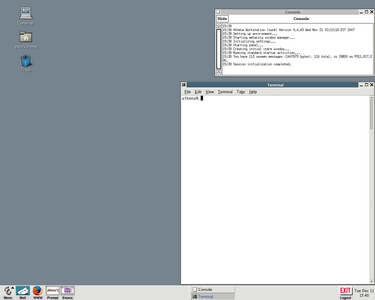
(Disclaimer: I work for MIT Information Services & Technology blah blah blah I am a student blah blah these are only my words and do not represent the opinion(s) of my employer.) Way back in the day in 1983, MIT started something it called Project Athena, which had the goal of investigating how computers could be used to enhance education at MIT. This project became the origin of such pieces of software as the X Window System and Kerberos, as well as a campus-wide network of workstations all running similar software. In 1991, Project Athena ended, but the Athena system continued on, taken over by MIT Information Systems. It’s 2008, and Athena still exists at MIT—walk into a computing cluster, and chances are all the machines will be running Athena software. (Unless that particular cluster has been taken over be Athena’s evil sibling, often referenced as “WinAthena”, which often seems to be maintained by no one, and whose existence is sometimes denied by those who maintain and support Real Athena. Not many machines have suffered this agonizing fate, luckily.) Unfortunately, as the years have progressed recently, fewer and fewer resources have been put into the development of Athena. In many ways it is no longer on the cutting edge of things as it has been in the past, though it is certainly still useful. Some students these days, however, even think of Athena as only “their MIT email” or maybe use it occasionally to print something in a cluster on the way to class. I’ve seen people grow frustrated and storm out of a cluster due to things like instructions for using a flash drive that involve more steps than just plugging it in. While on the one hand it’s easy to laugh at people for a lack of patience or being open to a computing system that is not either Windows or Mac and perhaps a bit more complicated on the surface, on the other hand, some of these things really should just work by now, and on other UNIX-based systems they do—but Athena has lagged behind. When you log into an Athena workstation for the first time, you are confronted with what looks like this: Clean MIT Athena login That’s GNOME 2.8, and it looks kind of like the GNOME 2.8 default but uglier. When you look under the hood, there are pieces of the system that obviously originated in a time where nothing better existed and so something new had to be created—the “xlogin” login system doesn’t support PAM, and the login path involves a hairy maze of scripts that perform various tasks. Under the hood, the base OS is currently RHEL 4 or Solaris 10. I still can’t remember what the right options are to feed RPM whenever I need some information that I think I should be able to get from it. These things were once necessary but today just look crufty. Some people have tossed around the idea that everyone has a laptop these days and thus clusters are uselessly expensive, but it’s been met with a lot of resistance. I’m all for progress, but I use clusters all the time! They’re one thing that makes it an easy choice for me to have a really portable laptop, because when I really need computing power or screen space on campus away from my room, there is always a cluster nearby. They’re also nice isolated places that can be associated with “work mode”, which is good for productivity. Beyond all this, Athena provides a common platform that all technical classes can depend on, from providing standard and specialized academic software to standing as a baseline of “make sure your code works on this before handing it in because that is how it will be graded”. At any rate, things are finally happening on this front. Athena can’t stay RHEL 4 forever—while AFS allows non-system software to be easily updated for all machines without requiring any OS release, hardware moves on and compatibility is lost, and the rest of the world is coming up with new awesome things that Athena machines are missing out on. A student group that I am vaguely involved with, SIPB, took the early initiative with this and created DebAthena, which takes stock Debian and Ubuntu and allows it to closely resemble an Athena environment. We even run a campus Linux dialup using the packages. (I won’t claim to have done much work on DebAthena myself because, well, I didn’t.) Amazingly, the Athena release team has decided to work with the SIPB on the next release of Athena. So, what I really just wasted over 600 words prepping for is to say that Athena 10 will be based on Ubuntu. This is only relatively new news, but I am lame about finishing blog posts. There are a variety of reasons why Ubuntu was chosen over Debian. Some of them are lame and some of them are not. Even so, I am excited about this prospect—and it should be possible to peripherally support Debian in such a way that was not possible with Athena 9.4. I really like Athena. Even coming to MIT with a background in Linux there has been a steep learning curve, though, and I think that things could be better. Lots of people here have their first encounter with a ‘nix system in the form of Athena, and we should strive to make that experience as good as possible. I’m kind of skeptical on the expected release date of this upcoming summer, but as long as it happens soon it will be a big step forward. In some ways it’s kind of sad that I’m excited about a big part of a research institution catching up with others—but inertia is a strong force, and dealing with thousands of workstations is no trivial task. I kind of long for the exciting days of creating new big pieces of free software like X. I bet I imagine those days as being better than they actually were.
9 January 2008

Cameron Dale: DebTorrent 0.1.5: Now With Status Updates

It's been a while, but a new update to DebTorrent is available in unstable. There is also a new version of the helper apt-transport-debtorrent (0.2.0) to go with it, which was mostly the cause of the long delay (due to a pending apt transition to testing). It is now highly recommended to install both, read below for new reasons why. One of the previous problems with debtorrent was the incorrect status updates displayed by apt, due to it not being aware of pieces of large files that have already downloaded. Using these new versions together will help to improve the update status messages shown during a download. Now, apt-get update will display a status at the bottom that will look something like:
DebTorrent: 837MiB left at 319 KiB/s (46m03s)
You may not be able to see it all if there are multiple updates to different mirrors under way. In aptitude, the status will appear on a line by itself at the bottom of the list of downloaded files. The status line will update about once per second, and should give a good indication of how much time is really left. The other (incorrect) status information presented by apt/aptitude will still be there but you can ignore it. I've only tested apt and aptitude, so I'm not sure how (or if) synaptic, adept or gnome-apt will display these messages, though they are general apt status messages, usually used for displaying the status while logging into an FTP server. This should also fix another problem that debtorrent can have with downloading large files (usually on slower connections). Since apt can't see the download happening for a long time, the connection would sometimes time out. With these status updates the connection is constantly active, so the timeouts shouldn't be a problem when downloading large packages (although they may still occur when doing an apt-get update, as there are no status updates during that process). I did implement a better solution, as suggested by Micha Politowski on the wiki. This solution uses the creation of sparse files to let apt know how much of a file has actually been downloaded. However, apt doesn't understand how a single process can download multiple files in prarallel, so it only follows the last file that was started, and complains when a file finishes that was not the last one that started. I've disabled that for now while I see if it's possible to modify apt to work better in this situation. Here are the changes for debtorrent: And for apt-transport-debtorrent:

Robert Collins: 10 Jan 2008

Dear lazyweb, In bzr development we are now working primarily on network performance. One of the key things about being sure we have improved things is automated, repeatable benchmarks. And for that to be useful in networking environments we need to control latency and bandwidth and packet loss. I know this isn't a new problem, but it was about 5 years ago that I last did this sort of thing. What are the best tools today (for linux :)). Ideally I'd be able to bring up a bunch of local addresses like 127.0.1.1 or 127.0.0.2, with different properties - such that traffic from 127.0.0.1 to 127.0.0.2 will simulate being uploaded over adsl, and 127.0.0.2 to 127.0.0.1 will simulate being downloaded over adsl.

Next.

Previous.


