Search Results: "ag"

7 September 2012

Russ Allbery: Web and Debian slides

In writing a note to someone today, I realized that I had never put up on my web site the slides for my presentation to the 2011 AFS and Kerberos Best Practices workshop. Those are now available from my Kerberos notes page. Entitled "The Murky Tangle of Web Authentication," they're about what we've done recently with our site-wide web authentication system. Both of the major efforts discussed there (multifactor and proactive user account abuse detection) are deployed in production, although the latter is only deployed in a fairly light-weight and minimal way pending further time to refine and improve it. The multifactor support in WebAuth has been available since version 4.0.0, but it currently relies on a user information service, which right now you have to write. I want to polish and release ours as open source, but it's going to require some dedicated hours that I've not yet been able to find. Similarly, I hope to release as open source the proactive account abuse detection system, but there haven't been enough hours yet. I also noticed that my 2010 Debconf slides on using Debian in the enterprise weren't up on my web site (although they've been available from the Debconf site), so those have been added to my Debian notes page.

Dirk Eddelbuettel: RcppArmadillo 0.3.4.0

A new major released of Armadillo came out earlier today. I prepared the corresponding RcppArmadillo package 0.3.4.0 which also arrived on CRAN earlier today. This released contains a few performance improvements, the beginnings of support of sparse matrices and more, see below. We also post the NEWS entry for the beta release which was prepared, but not uploaded to CRAN to minimise the upload frequency there. On the RcppArmadillo side, two enhancements were made for the fastLm() function for faster linear model fits.
Changes in RcppArmadillo version 0.3.4.0 (2012-09-06)
  • Upgraded to Armadillo release 3.4.0 (Ku De Ta)
    • added economical QR decomposition: qr_econ()
    • added .each_col() & .each_row() for vector operations repeated on each column or row
    • added preliminary support for sparse matrices, contributed by Ryan Curtin et al. (Georgia Institute of Technology)
    • faster singular value decomposition via divide-and-conquer algorithm
    • faster .randn()
  • NEWS file converted to Rd format
Changes in RcppArmadillo version 0.3.3.91 (2012-08-30)
  • Upgraded to Armadillo release 3.3.91
    • faster singular value decomposition via "divide and conquer" algorithm
    • added economical QR decomposition: qr_econ()
    • added .each_col() & .each_row() for vector operations repeated on each column or row
    • added preliminary support for sparse matrices, contributed by Ryan Curtin, James Cline and Matthew Amidon (Georgia Institute of Technology)
  • Corrected summary method to deal with the no intercept case when using a formula; also display residual summary() statistics
  • Expanded unit tests for fastLm
Courtesy of CRANberries, there is also a diffstat report for 0.3.4.0 relative to 0.3.2.4 As always, more detailed information is on the RcppArmadillo page. Questions, comments etc should go to the rcpp-devel mailing list off the R-Forge page.

6 September 2012

Joey Hess: UPS farce

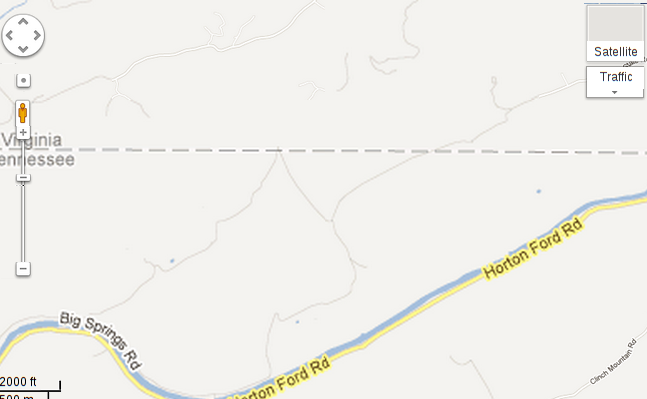
This is not the kind of place I live, though I don't mind a visit. Errol looking out over Salsalito and the Bay I'm not bothered by a more rural life, I thrive on peace and quiet, and am not bothered by needing to haul my water, split firewood, or spend an hour just mowing my driveway. I bought a GPS the other day, and it doesn't know where my driveway is..
or where the road leading to my driveway is..
or even about the highway leading to that road!
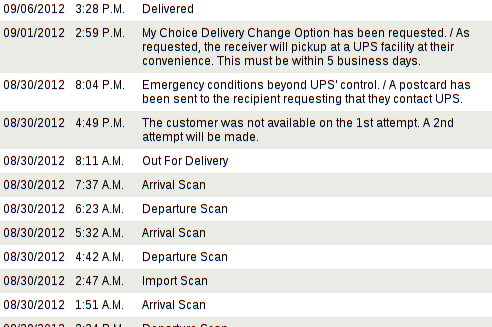
not many roads on this map.. The only thing that really bothers me about living here off the map is that I'm in the middle of a food desert too. The nearest semi-decent grocery store and produce market are 40 minutes away. There's one restaurant worth eating at, and while a very congenial place to eat rustic food while watching the river flow by, it serves almost no vegetables. Adding to the problem, my fridge is a rather expensive propane model, which is about half a normal size, and has no freezer. Managing a healthy meal plan is a constant struggle, though I do have time to cook, at least, thanks to not having the kind of commute that is typical around here. Well, the food desert was my only real problem. Now I can add to that the UPS emergency. A week ago, a package left Shenzen China for here. It quickly passed through Anchorage Alaska, and with a few days had arrived an hour and a half from here. Getting it here has taken the whole rest of the week.
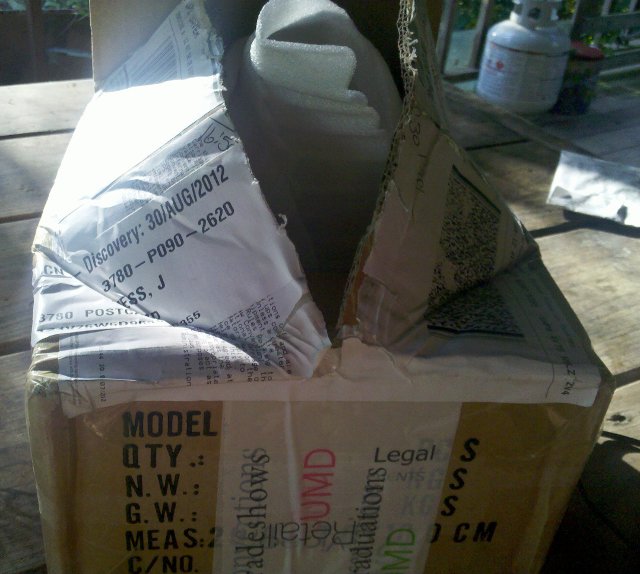
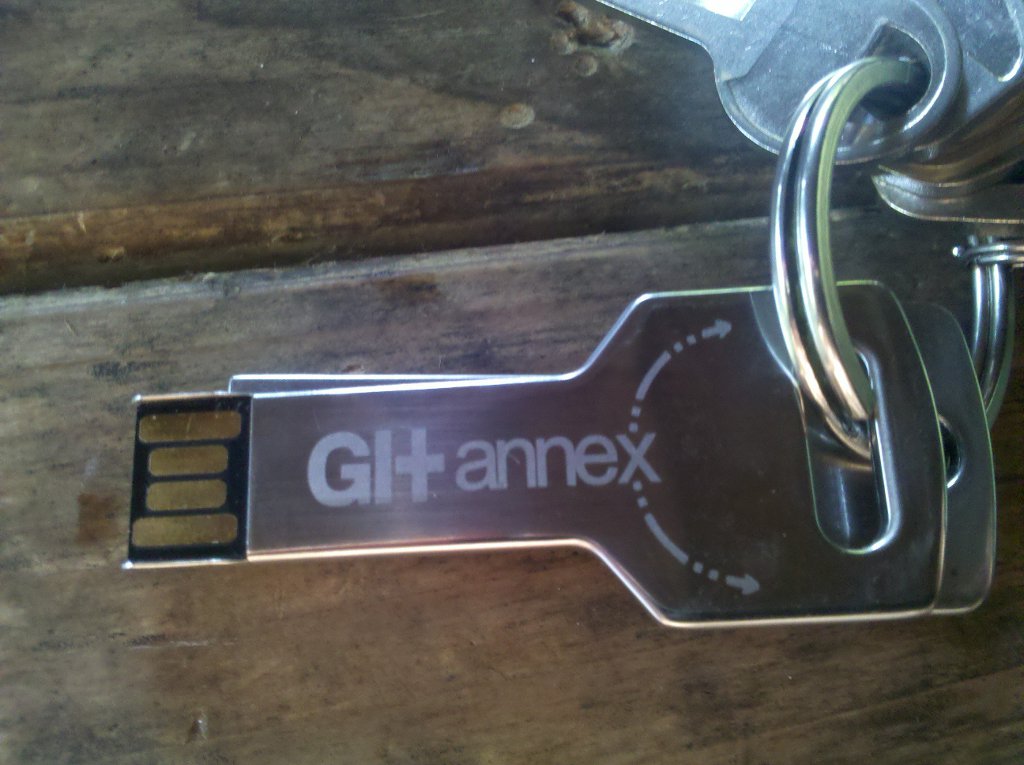
I only knew UPS attempted delivery because a neighbor told me. Seems they took one look at my driveway and turned around. They never tried again, and they didn't bother to leave a note on the mailbox, or anything. Now, the US postal service is happy to drive up this driveway; they drive a sensible 4x4 around here. I think DHL and Fedex have been here too. (Contrary to John Goerzen's experiences) My compact car is not bothered by my driveway either... But UPS's brand involves large brown trucks, even where inappropriate, and damage to them from such things as low-hanging branches apparently comes out of the driver's paycheck. And while normally UPS leaves small things in my mailbox, or with a neighbor, this was an important package from China, and it needed a signature. But really, a post card? "emergency"?! So, I bought the GPS to find UPS, because my package was in an industrial park in some town I've never been to. And on Tuesday I was within an hour of there and swung by. And it was closed. UPS's website had not mentioned this; other businesses are open the day after Memorial day. That turned out to be a really annoying day all around. When I got home, after a night away, I found my fridge's fire had blown out, and nearly all my food was only fit for the dog. Today I went out to try again (and buy groceries). When I reached the UPS depot.. it was closed! Until 3 pm. At this point I felt this story was reaching full-on farce. After cooling my heels in a library for three hours, I was finally able to open the most over-packed package I've probably ever seen. My kickstarter reward sample looks good.. I'll be ordering a lot more, but not to this address. As a coda to the UPS farce, arriving home today I checked my mailbox, and found the UPS postcard had finally arrived. It included mention of the 3 pm opening time, and noted that I had until tomorrow before they'd return my package to China. The coda to the coda is that on my way home from this second annoying day delivered courtesy of UPS, I stumbled on a restaurant overlooking a waterfall, just outside the town where I get my groceries. It serves food that satisfies both my Cajun and healthy cravings. Now I just need a larger fridge..

5 September 2012

Jonathan Carter: Shello


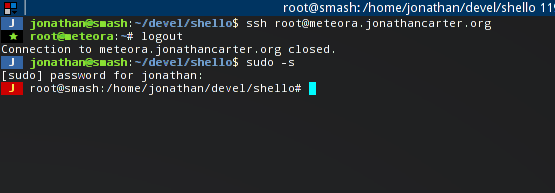
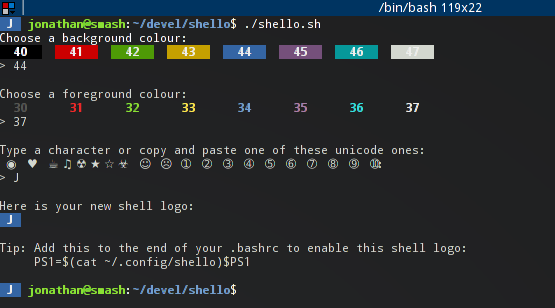
If there s one thing that I ve had missing in my life for way too long, it s hacking on small silly stupid amusing little things. When I was young I used to write dozens of little pointless programs a week and forget about them, only to found them a few months later and be incredibly amused by them. This afternoon I noticed that one of my machines didn t have my default .bashrc loaded, which colourises (or colorizes for Americans or colourizes for Canadians) my shell so that I know on which machine I am so that I don t accidentally do something silly like reboot the wrong host. One problem I ve had with this is that there are limited colours available that makes sense to use for a shell prompt. Right as I was thinking this, I was looking at my Byobu screen sessions and thinking Hmm! I like those logos, maybe I could use them in my shell! . So in just a few minutes I had a little script to help you configure those for your shell. Here is a screenshot of the shell logos in action. On my laptop I use a red background when I have a root shell: This is what the shello script looks like that sets it up: I might get bored by seeing it soon and get rid of it, but at least I had a little fun with it. If you d like to try it out, then you can get the script right here: https://github.com/highvoltage/shello It doesn t do anything like validating input yet, I d also like to add something that creates some kind of a checksum of your hostname and choose a unicode character based on that. Maybe I ll finish it up this weekend, or maybe I ll have new things to write about!

Raphaël Hertzog: My Debian Activities in August 2012

This is my monthly summary of my Debian related activities. If you re among the people who made a donation to support my work (88.41 , thanks everybody!), then you can learn how I spent your money. Otherwise it s just an interesting status update on my various projects. This month has again been a short one since I have mostly been in vacation during the last 2 weeks. Dpkg Things are relatively quiet during the freeze. I only took care of fixing 3 bugs: a regression of 3.0 (quilt) (#683547), a segfault of dpkg-query -W -f (commit) and a bad auto-completion for French users (#685863). Testing the upgrade to wheezy We got several reports of wheezy upgrade that failed because dpkg ran the trigger while the dependencies of the package with pending triggers are not satisfied. Unfortunately fixing this in dpkg is not without problems (see #671711 for details) so Guillem decided to defer this fix for Jessie. My suggestion of an intermediary solution has fallen in limbo. Instead we now have to find solutions for each case where this can fail (example of failure: 680626). Another way to avoid those errors is to ensure that triggers are run as late as possible. We can improve this in multiple ways. The first way is to modify most triggers so that they use the interest-noawait directive. In that case, the packages activating the trigger will be immediately marked as configured (instead of triggers-awaited ) and the trigger will thus not need to be run as part of further dependency solving logic. But as of today, there s no package using this new feature yet despite a nudge on debian-devel-announce. :-( The second way is to modify APT to use dpkg no-triggers, and to let the trigger processing for the end (with a last dpkg configure -a call). I requested this early in the wheezy timeframe but for various reasons, the APT maintainers did not act on it. I pinged them again in #626599 but it s now too late for wheezy. I find this a bit sad because I have been using those options for the entire wheezy cycle and it worked fine for me (and I used them for a dist-upgrade on my wife s laptop too). It would have been good to have all this in place for wheezy so that we don t have to suffer from the same problems during the jessie upgrade, but unless someone steps up to steer those changes, it seems unlikely to happen. Instead, we re back to finding klumsy work-arounds in individual packages. Packaging I prepared security updates for python-django (1.4.1 for unstable,
1.2.3-3+squeeze3 for stable). I packaged a new upstream version for cpputest (3.2-1). I reviewed ledgersmb 1.3.21-1 prepared by Robert James Clay and asked him to prepare another version with further fixes. I released nautilus-dropbox 1.4.0-2 with supplementary changes of my own to support https_proxy and to display better diagnostic information when the download fails. With the help of Paul van der Vlis and Michael Ziegler, we did what was required to be able to migrate python-django-registration 0.8 to Wheezy even though it s a new upstream version with backwards incompatible changes. Thanks to Adam D. Barratt who unblocked the package, we now have the right version in Wheezy despite the fact that I missed the freeze deadline. Debian France Julien Cristau reminded the board of Debian France that we have to elect officers (President, Secretary, Treasurer) as the current officers have withdrawn. I was somewhat afraid that nobody would take over so I pinged each member to try to get new volunteers. We now have volunteers (me, Julien Danjou and Sylvestre Ledru) and we re waiting until Julien finds some time to run the election. Misc With the help of DSA, I setup antispam rules for the owner@packages.qa.debian.org alias because I was getting tired by the amount of spam. In the process, they asked me to write a wiki page for dsa.debian.org to document everything so that they can refer to it for future queries. I did it but it looks like that they did not apply my patch yet. I also tested an upstream patch for gnome-keyring (see bugzilla #681081) that reintroduces the support of forgetting GPG passphrases after a specified amount of time. Thanks See you next month for a new summary of my activities.

No comment Liked this article? Click here. My blog is Flattr-enabled.

Tanguy Ortolo: Datalove USB drives to reform European copyright

La Quadrature du Net is a European advocacy group that has been created to defend our rights and freedoms on the Internet against the continuous political threats driven by major corporations, such as the recent ACTA. After the recent citizen victories against these monsters, it is time to take the initiative and advocate for a reform of the copyright system which has become inappropriate with the omnipresence of copy-based systems.A USB stick, etched with a heart smiley <3 To this end, la Quadrature will give each Member of the European Parliament a customized USB drive, preloaded with a set of elements for a copyright reform, and with an anthology of free cultural works. To fund that campaign, la Quadrature is asking for everyone's help, by the means of an Ulule campaign (Ulule is a crowd-funding platform similar to Kickstarter). This initiative is noteworthy by at least two aspects: If, like me, you are tired of the continuous attacks from the major corporations of mass entertainment, in addition to not helping them by buying their crap, you can now participate in this first counter-attack. This will probably not end the war, so I hope there will be more offensive actions from the citizen group!

Matthew Garrett: UEFI Secure boot in Fedora: status update

There's been good progress in Fedora's implementation of UEFI Secure Boot, so time for a quick update.
Boot process signingThe infrastructure for signing the bootloader binaries is now implemented. pesign is in the archive and being used to sign shim, grub2 and the kernel. At the moment they're all being signed by test keys, and the private key is actually in the pesign package. This is, obviously, not intended for production use - it's just to ensure that we can build correctly signed images. We've proof-of-concepted signing via cryptographic hardware and will shortly be deploying new build systems dedicated to building the signed binaries. These won't be general access systems and will have a lightly modified mock configuration to ensure that the crypto hardware is available to the build chroots, but otherwise there's nothing special about them.

As far as signing with the Microsoft keys goes, we're in the final round of legal review of the appropriate agreements and will be migrating to a version of shim signed with their key in the near future.
Kernel modificationsThere's two main sets of patches for the kernel. The first is to automatically enable the locking down of various bits of functionality when secure boot is enabled, in order to prevent users (including root) from being able to modify the kernel at runtime. They've just been posted upstream and haven't been dreadfully received, though we'll probably be changing the name of the capability. The main thing that users will notice is that any X drivers that still need direct hardware access (which, on secure boot systems, should be zero - we've implemented native kernel drivers for all the hardware we expect to see there) will fail to work, as will setpci. The plan is for kexec to require that kernel images be signed, but that's requiring rather more reworking of kexec than expected so for now kexec will just be disabled.

The other lump of kernel functionality is the support for module signatures. That had been somewhat blocked based on a lack of consensus between patch authors and upstream, but an agreement got hammered out at Kernel Summit last week and so we should see progress there shortly. Right now we're still looking at modules being signed with a throwaway key, but the plan is still for keys in db (and MOK, if using the Suse approach) to be imported into the kernel keyring and used. That's dependent upon that code being written in time, though. It's definitely still a goal for F18.
Key managementWe're planning on using Suse's approach of permitting local key management at the shim level, and I spent some time discussing this with Vojtech last week. In combination with the above, this should provide a workable mechanism for permitting the end-user to install module signing keys.
General UEFI support improvementsWe've added support to grub to use the kernel's built-in UEFI setup functionality, although there's still some discussion with upstream to ensure that it's implemented in an acceptable way. This approach also makes it easy for us to obtain PCI ROMs via UEFI, which improves radeon support on a bunch of Macs. Finally, we've been hammering on some remaining UEFI bugs and are definitely at the point where the machines that don't work are surprising and the ones that do are the tedious expectation. This is far better than any previous release.
DocumentationStill has to be written, and that's probably where much of the my next month is going.
SummaryFedora 18 is still on track to have full UEFI Secure Boot support out of the box, and the Beta should be fully signed although perhaps still with our test keys.

For those of you who get sent to surprisingly expensive conferences, I'll be discussing some of this as part of a presentation on improving Linux support for UEFI at the Intel Developer Forum in San Francisco next Tuesday morning. Feel free to say hi if you're in the area.

comment count unavailable comments

Russ Allbery: Reacting to excitement

I've been slowly noticing, over a number of years now, a place where I don't react to other people the way that I want to. I've been stumbling over defensive reactions that I didn't realize I had. These are a few rules of thumb that I'm formulating for myself to try to improve that, and I thought it might help to write them down. And maybe they'll be meaningful for someone else.
  1. Things people are excited about are probably exciting. If I don't find them exciting, that's probably because I don't know enough about them to understand why they're exciting. Or perhaps I have a different mindset, and therefore the exciting parts don't connect with me. Both of those are okay! There are way more things to learn about than I will ever possibly have time to learn, and I don't have to get excited about everything other people are excited about. But, equally, just because I'm not excited doesn't mean that the thing is not exciting.
  2. My misplaced sense of obligation should not be someone else's buzzkill. This requires a bit of unpacking, since I only intermittantly realize that I'm doing this. But (partly for cultural reasons, partly due to natural inclinations) I've always felt a strong sense of obligation to "keep up" with things. To know a lot about a lot of topics. And one of the things I've realized is that my brain occasionally twists an interest in knowing lots about the world into a sense of obligation to "stay current" and know something about everything important, at least within my vague field of expertise. And usually that part of my brain has a very expansive notion of field of expertise; all of software development, for example, which is, when I pull it out into the light, ridiculously broad. This then sparks one of the standard failure modes of human cognition. I have an unrealistic expectation of myself. I fail to meet that expectation. This makes me feel guilty and stressed. At that point, my brain starts trying to find targets for me to displace negative feelings onto, and that generally ends up being the next person who is excited about something new that I don't know anything about but feel like I should. This is all very interesting psychologically, in the abstract. However, the concrete result is that I sometimes get all snarky and negative about something that someone else is excited about because it happens to be the moment I hit overload, or because I didn't want to hear about another thing that I feel like I should know more about. And that, in turn, can be either confrontational or discouraging to someone who is legitimately excited (and may rarely get the chance to be excited). And that's not the person I want to be.
  3. It's okay not to have an opinion. Seriously, it's okay. The world is full of stuff, far more stuff than any one person can know anything about. It's okay not to go read about everything people say is exciting. It's okay not to know about something new. It's okay to focus on the things I'm already doing. Really. What's not okay is to make up an opinion about something I know nothing about just so that I can feel better about myself by having an opinion. Particularly since that opinion formed under those circumstances tends to be negative, despite the fact that I have no actual basis for having any opinion at all. I need to practice just quietly not having an opinion. No one else needs to know about my lack of opinion.
  4. Before bristling at imposition, be sure someone is actually imposing. I frequently leap to the conclusion that, when someone raises a topic, they want me to do something about it. It's a gut emotional reaction, I think in part because the emotional part of my brain likes to make everything about me. Intellectually, if I can engage that part of my brain, it's often obvious that it's not about me, or that they're not asking me to do anything. Often, when someone brings something up, they just want to tell someone else about it, or make me aware of it. If I've listened to, or read, all the sentences and understood then, then congratulations! I've done everything that I needed to do and was expected to do and need not feel any further obligation. Even if something further needs to be done, it doesn't necessarily need to be done by me. I'm very protective of my time and available resources because I almost always feel overwhelmed by all the things that I want to work on. This does not entitle me to snap at random people who are being excited around me on the grounds that they're trying to put more obligations on me. They're probably not. If it becomes clear that they really want me to do something I don't have time to do, I can politely decline, but if I just shut up and listen for longer, usually that's not the case at all.
(Please note that this is not prompted by any current discussion happening anywhere, and paticularly not by anything in Debian. Insofar as it was prompted by anything, it was by a throwaway comment in an unrelated private discussion. It's just something that gelled enough to write down while I was walking home from work.)

4 September 2012

Gunnar Wolf: Electronic voting in Panama: Slower, more expensive, more uncertainty... Goodbye!

Panama just underwent a nasty e-voting exercise: Electronic-mediated elections were held for the committee of the PRD party. It sounds simple - Even trivial! There were only 4100 authorized voters, it was geographically trivial (all set inside a stadium)... But it blew up in smoke. I won't reiterate all what happened, I'll rather direct you to our project's (the e-voting observatorium) page: News regarding Panama (for those coming from the future, search starting at 2012-08-27 and yes, it's all in Spanish, but there are free-as-in-beer translation services. Many e-vote proponents/sellers/pushers were very eagerly waiting for this election to brag about one more success... So much that they could not just ignore it, and started rationalizing it away. Anyway, while feeding the observatorium, I came across this opinion-article in the Voto Digital website, which makes quite a bit of pro-e-voting noise. I replied to it, and I think my analysis is worth sharing also with you:
So, lets make some simple numbers, rounding the numbers: The PRD vote in Panama was done for a universe of 4100 voters. It took 10 hours (instead of the planned 4), so 410 people were processed every hour. There were 40 voting (electronic) booths, so each processed 10 people per hour. This means, each person spent 6 minutes by the booth. A manual vote in this fashion is highly parallelizable: Each of the voters can be given ballots with anticipation, or many of them cna be allowed in to be given the ballots in situ (depending on the electoral scheme employed). The contention time is the time it takes to each voter to get near the booth and deposit his ballot (either folded or in an envelope) - And it will very rarely be more than a couple of seconds. So, given that using electronic booths parallelism cannot grow (there is a fixed number of machines) and the queues grew wildly, with traditional voting it would have surely fitted in the expected four hours (they were expected, also, based on their past experiences). As for counting, that's the slowest part of manual voting, it's also highly parallelizable: If each of the 40 booths has slightly over 100 ballots, the party personnel can easily count them in under 30 minutes. Capture and aggregation for the 40 partial results would take an extra 10 minutes, even being generous. Manual voting would have saved them around five hours, without demanding additional resources (and being thus much more economical than having to buy 40 specific-purpose computers). And as an additional advantage, the physical and tangible vote proofs would remain, in case they were ever again needed.

Jon Dowland: Pretty Eight Machine

P8M CD and stickers P8M CD and stickers
Back in June or thereabouts I learned about a project to re-create Nine Inch Nails' first album "Pretty Hate Machine" as a chiptune cover/tribute project. This project is called Pretty Eight Machine. The artist InversePhase was kind enough to send me a copy of the CD as a random prize draw, so I thought I would write a few words about it. I don't know a great deal about the world of chiptunes, besides having heard a variety of "chiptune" covers of various well-known songs, some good, some bad. the backing track to this video, a cover of Tears for Fears' "Mad World", is, in my opinion, good. The front cover for P8M lovingly reflects the recent reworking of the classic PHM cover by Rob Sheridan, for the source album's recent deluxe reissue. There's a great in-depth interview with Rob about the process of reviving that cover at sleevage. That little homage is a good indication of the amount of effort and attention to detail that has gone into this project. One interesting thing about this project is that each track has been composed for a particular vintage chipset, such as the Commodore 64 in the case of the opening track "Head like I/O". InversePhase is very faithful to the original chips here, not just using their tones as part of a modern composition but constraining himself with the actual chipset limitations: for example, the number of voices that can be playing at once. (By contrast, that Tears for Fears chiptune above is the non-authentic type of chiptune). InversePhase tracks Trent's vocal lines as an instrument, so all of the notes that are heard in the original are present on this remake. It would be interesting to hear an "instrumental" mix of these tracks, and perhaps mix isolated vocal tracks from the originals on top My favourite track is probably "Kinda I Want To". I actually really like the original track, in particular the extended breakdown, where a synth noise gradually breaks down and disintegrates bar after bar. It suffered terribly from dated lyrics compared to other PHM tracks, but InversePhase's cover is saved that embarrassment. This particular track (apparently) makes use of a VCR6, a Konami chipset apparently used to supplement the hardware in the Famicom/NES. Yes, back then games came on cartidges that could supply bits of their own hardware if required. Those were the days! And yes InversePhase, you've successfully made the NES sound "dirty": and the synth breakdown sounds great. Any fan of the original album or anyone with an interest in what kind of noises vintage sound synthesis chipsets could produce are thoroughly recommended to give this album a try. You can preview all of the tracks and read per-track information on the bandcamp page.

Thomas Koch: leaving facebook

I've never really used facebook so it's not too hard for me to delete my account there. The only thing that's a pity is that I found (or others found me) many people that I once met and which I'd love to meet again once. So I'll go through my facebook contacts list and will try to copy all contact data especially the email adresses and plan to write emails to everybody every quarter or half a year about happenings in our lifes. I'd be glad to receive such emails from others too! They'll surely be read more carefully then my facebook timeline!
This gets me to another point: I still don't have a satisfying free (as in freedom) solution to manage my contacts across devices and available on my web server. The same for image galleries. So I can understand how convenient facebook for many people is. Still facebook is evil and it's an important and ongoing project to provide a better alternative.

It'll be harder for me to leave Twitter. This one comes next. If people would just switch to the free and privacy aware alternative identi.ca...

And then I've to finally provide a better alternative for my family to share baby pictures then Google Plus... Leaving Xing and Linkedin also doesn't worry me, I just have to collect the addresses of my important contacts there. Not so pressing is to leave Couchsurfing for bewelcome.org.

So if you want to hear news from me just pass by www.koch.ro from time to time or put my blogs feed into your feed reader. I'll also keep my identi.ca account.

update: One tiny example of facebooks evilness is, that they don't show me your real email address (anymore). They only show me an @facebook address. So if I don't know your real email address from any other source, I would not be able to send you messages without sending it over facebooks servers. I read that you can change the email address shown back to your real email address somewhere in the options.

Gunnar Wolf: To CURP or not to CURP

To CURP or not to CURP
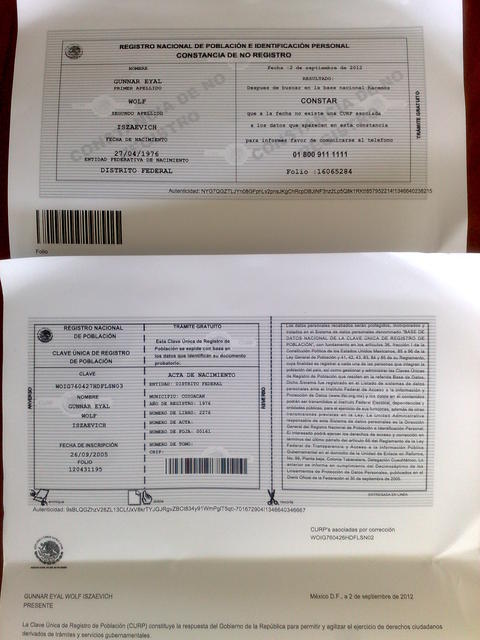
CURP: Clave nica del Registro Poblacional, or Unique Population Registry Code. This is a (hopefully) unique, 18 character long, string identifying each Mexican - I won't get into the technicalities, but serve yourselves. By following such a convoluted scheme, the authorities should have ensured a biunivocal relation between each person and their CURP number. Well, at some point, due to a bureaucratical mishap completely outside my hands (my patron registered me with the wrong birth date, as you can see in the page at the bottom), I got two CURPs - And the procedure to fix it was far from trivial. Last Sunday, I entered the Consulta CURP system to print a copy of the official document. Much to my surprise... It answered that I was not registered! A couple of minutes later, I tried again, and succeeded. But I could not refrain from printing my Certificate of non-registration. I guess their system follows a strong-but-stupid scheme such as:
  1. begin
  2. db = connect_to_database
  3. curp = find_curp_for_person(query)
  4. generate_document(curp)
  5. rescue
  6. generate_non_reg_certificate(query)
So, right, if a user submits a query during the system maintenance window (after all, it was Sunday after 23:00), the system will fail to connect to the database (or whatever), raise an exception, trap it, and... Well, you no longer exist, thanks for playing!

Tollef Fog Heen: Driving Jenkins using YAML and a bit of python

We recently switched from Buildbot to Jenkins at work, for building Varnish on various platforms. Buildbot worked-ish, but was a bit fiddly to get going on some platforms such as Mac OS and Solaris. Where buildbot has a daemon on each node that is responsible for contacting the central host, Jenkins uses SSH as the transport and centrally manages retries if a host goes down or is rebooted. All in all, we are pretty happy with Jenkins, except for one thing: The job configurations are a bunch of XML files and the way you are supposed to configure this is through a web interface. That doesn't scale particularly well when you want to build many very similar jobs. We want to build multiple branches, some which are not public and we want to build on many slaves. The latter we could partially solve with matrix builds, except that will fail the entire build if a single slave fails with an error that works on retry. As the number of slaves increases, such failures become more common. To solve this, I hacked together a crude tool that takes a yaml file and writes the XML files. It's not anywhere near as well structured and pretty as liw's jenkinstool, but it is quite good at translating the YAML into a bunch of XML files. I don't know if it's useful for anybody else, there is no documentation and so on, but if you want to take a look, it's on github. Feedback is most welcome, as usual. Patches even more so.

Pietro Abate: Package Managers Comparison - take 2

On year ago, we (the mancoosi team) published a comparison study regarding the state of the art of dependency solving in debian. As few noticed, the data presented had few glitches that I promised to fix. So we've repeated our tests using exactly the same data we used one year ago, but now using the latest available versions of all package managers as available in debian unstable. During the last year, three out of four solver that we evaluated release a major upgrade so I expected many improvements in performances and accuracy. Mpm, our test-bench for new technologies, changed quite a bit under the wood as a consequence of the evolution of apt-cudf and the recent work done in apt-get to integrate external cudf dependency solvers. Overall the results of our study are not changed. All solvers but mpm, that is based on aspcud, are not scalable as the number of packages (and alternatives) grows. It seems that Smart is the solver that does not give up, incurring in a timeout (fixed at 60 seconds) most of the time. Aptitude is the solver that tried to give you a solution, doesn't matter what and as result providing solutions that do not satisfy the user request for one reason or the other. Apt-get does surprisingly well, but it gives up pretty often showing the incomplete nature of it's internal solver. Cupt sometimes timeout, sometimes gives up, but when it is able to provide an answer it is usually optimal and it is very fast ... Mpm consistently finds an optimal solution, but sometimes it takes really a long time to do it. Since mpm is written in python and not optimized for speed this is not a big problem for us. The technology used by mpm is now integrated in apt-get and I hope this will alleviate this problem. All the details of our study can be found one the Mancoosi Website as usual with a lot of details. For example here you can find the results when mixing four major releases : sarge-etch-lenny-squeeze. Comments are more then welcome.

3 September 2012

Rog rio Brito: Trying out AdSense

I have been having quite costly experiments with (embeded) hardware in the last few weeks/months. To cover at least part of the expenses, I am trying out to use Google's AdSense with my blog. I plan on blogging more frequently with the results of the experiments, but it will take me a few days, as I want to offer people only the "meat" of what I actually did, pointing out some pitfalls that made me waste a lot of time. Anyway, back to AdSense, one interesting thing about trying it is that I applied to be part of the program for 3 or 4 times late in August and, due to unspecified reasons, my application was rejected for "not complying with their policies". I read the policies from left to side, from up and down and nowhere I saw anything that my blog infringed. This morning, I tried once again and I'm now in a sort of "probation period" for AdSense, which is progress I think. So far, I only put one advertisement at the top of my pages, but I am curious to know how "targeted" those ads would be to a blog that has articles that were written more than a decade ago, with posts in at least two languages. I guess that this is a weaker version of what Rapha l Hertzog is trying to do with his funding campaigns, except that I only expect to cover the costs of my hardware (even if I am skeptical that I will actually manage to reach that point of self-sufficiency).

Gunnar Wolf: WikiLovesMonuments wants *you* (and me!)

What, haven't you heard about the WikiLovesMonuments photo contest around cultural heritage? Copying from its web page,
Wiki Loves Monuments is an international photo contest around cultural heritage monuments in September. Starting from the Netherlands in 2010 and organized on a European level in 2011, we go global in 2012!
I heard about this initiative in Iv n Mart nez's Wikimedia talk at COSIT 2012, held last week in Coatzacoalcos, Veracruz (I intend to write a bit more regarding COSIT later on). I loved the idea, and intend to participate Not because I take great pictures (I don't, and I usually take them using my aging phone, which gives decent results but nothing beyond that), but because I love to move by bike in the city, and it's one of the best ways to roll in front of some of them. But more on me later Back to the topic! WikiLovesMonuments aims to improve on Wikimedia's (the organization behind Wikipedia and several other Free Culture reference projects) coverage of important landmarks all over the world. To do so, they are offering a trip to attend WikiMania 2013 in Hong Kong to the first place winner, and other "photography-related" prizes to the other winners. So, back to me: My motivation to enter the contest is to help Wikimedia. I know my shots won't be top-notch (although they will be the best I can do). I enjoy biking in my city, and often go not too far from many of the listed monuments. I am amazed at the number of monuments still pending in my area (of course, it's not by mistake this is called "La ciudad de los palacios", The city of the palaces) Surely some of the readers of this post will have (or will find easy to take) some photos to add. Of course, I'll try to focus on the missing monuments, but if you are a good photographer, you might want to submit a better version for a monument that's already there. So, some pointers, from what's closest to what's farthest from me: At least for Mexico, the listings are taken from the National Institute for Anthropology and History (INAH)'s Public registry of archaeological zones and monuments. So, I cannot wait to start my biking session today to get some good end-of-summer evening sun and get some pictures taken! :-D

Martin Pitt: PyGObject 3.3.91 released

I just released PyGObject 3.3.91, for GNOME 3.5.91. The big new feature in this release (thanks to the release team for granting an exception) is Simon Feltman s new Signal helper class, which makes defining custom signals a whole lot simpler and more obvious. In the past, you had to do
 class C(GObject.GObject):
    __gsignals__ =  
        'my_signal': (GObject.SIGNAL_RUN_FIRST, GObject.TYPE_NONE,
                      (GObject.TYPE_INT,))
     
    def do_my_signal(self, arg):
        print("my_signal called with %i" % arg)
whereas now this looks like
class C(GObject.GObject):
    @GObject.Signal(arg_types=(int,))
    def my_signal(self, arg):
        print("my_signal called with %i" % arg)
or even more elegantly when using Python 3 and its new type annotations:
class C(GObject.GObject):
    @GObject.Signal
    def my_signal(self, arg:int):
        print("my_signal called with %i" % arg)
Check out the updated example and docstring for other ways how to use it. Overrides can now be in a directory different from the one that pygobject installs itself into. These overrides need to put this into their __init__.py at the top:
from pkgutil import extend_path
__path__ = extend_path(__path__, __name__)
and put themselves somewhere into the default PYTHONPATH. This should make it a lot easier for library packages to ship their own overrides for Python. This new version also comes with a couple of new overrides and bug fixes. See the detailled list of changes below. Thanks to all contributors!

Paul Tagliamonte: tmperamental - check for wild /tmp calls

tmperamental found either on git.d.o, or github is a library to be LD_PRELOAD-ed, and help check for use of hardcoded /tmp. The idea is to get TMPDIR and friends, and preload tmperamental, which will call non-zero exit when an app does stuff in /tmp. It s a big hack, so if you feel like making it even better, send in patches :)

Lars Wirzenius: New format to replace tar: some notes

During lunch the other day, I discussed the shortcomings of the tar file format with friend and co-worker Daniel. The tar file format has a lot of legacy by now, and it's not quite up to date with the latest developments in file systems, such as extended attributes. This makes tar badly suited for things such as backups and other situations where precise reproduction of the input data matters. There are several variants of the tar file format, and various more or less standard extensions to it. GNU tar, for example, added support for pathnames longer than 100 bytes many years ago, and it is now commonly supported. Other problems in the tar file format: This led us to discuss the possibility of a new file format. We had a bit of fun exploring the solution space for a while. However, almost all use of tar these days is for distributing sets of files, where the filename and basic set of file permissions is enough. In other words, for things such as source code, tar is just fine. The archives are small enough, and the other limitations are rarely a problem, but the pain of switching to a new format would be great. Thus, with some reluctance, we concluded that a new format would be a waste of time. But I thought I'd write this up anyway, in case one of my readers wants to start working on this.

Philipp Kern: IPv6 support in debian-installer

I tried to continue netcfg's journey to support IPv6 in debian-installer. Matt Palmer wrote a large patch set many moons ago (kudos!) and Colin Watson polished it and included it into Ubuntu. The reason for it not being merged into Debian first was ifupdown. Version 0.7 finally supports IPv6 and only entered Debian unstable by the end of May. Due to a bunch of changes to netcfg, one reason being a Summer of Code project on it, I had to forward-port those 50 patches and add two bug fixes on top. Hence it's possible that I introduced some breakage, even if the result works well for me (apart from one DHCPv6 oddity that cannot be seen from within KVM). The tree can be found in the people/pkern/ipv6 branch. I was unable to check if Ubuntu has introduced any additional patches on top of the old patch set, as I'm not used enough to bzr.

This mini.iso (detached signature) netinst image contains a debian-installer current as of today and two additional patched udebs: netcfg with the aforementioned IPv6 patch set and busybox with ping6 enabled. I'd appreciate if you could go and test it in one (or more) of the following environments: IPv4-only (DHCPv4 / static), wireless (IPv4 / IPv6 as desired, there has been some refactoring), stateless IPv6 autoconfiguration (it even supports RDNSS and DNSSL), stateless IPv6 autoconfiguration with stateless DHCPv6, and stateful DHCPv6. It will try to configure dual stack if possible. Please note that many Debian mirrors are not yet IPv6-enabled. Even prominent ftp.CC.debian.org hosts like ftp.de.debian.org still do not support it. So you'll have to pick one carefully if you want to try IPv6-only installation. (Which worked for me!)

If you have any feedback for me, please leave it here as a comment or mail me at pkern@d.o. Thanks!

Next.

Previous.