Search Results: "uli"

18 September 2008

Julien Danjou: awesome 3 released

I just released the final version of awesome 3. I'm very happy to see all this work (6 months, over 1K patchset) and time spent on this piece of code being wide used and much appreciated. This last months were amazing and very exciting. Thanks everyone for using it or contributing to it. You rock (too). Let's go for awesome 3.1 now

Julien Danjou: blah mail

Following my first idea of a blah script for irssi, I've wrote the same thing in Python for filtering some mail. IMHO, it's better than killfile.
  1 #!/usr/bin/python 
  2  
  3 import email, sys, re 
  4  
  5 def blaahw(match): 
  6     w = match.group(0) 
  7     l = len(w) 
  8     if l == 1: 
  9         return "o" 
 10     elif l == 2: 
 11         return "he" 
 12     elif l == 3: 
 13         return "lol" 
 14     a = "a" * (l - 3) 
 15     return re.sub("\w+", "bl%sh" % a, w) 
 16  
 17 def blaah(text): 
 18     rc = re.compile('\w+') 
 19     return rc.sub(blaahw, text) 
 20  
 21 mail = email.message_from_file(sys.stdin) 
 22  
 23 mail.replace_header("Subject", blaah(mail["Subject"])) 
 24  
 25 def blaah_payload(pl): 
 26     if type(pl) == list: 
 27         for i in range(len(pl)): 
 28             if pl[i].get_content_type() == "text/plain": 
 29                 pl[i].set_payload(blaah(pl[i].get_payload())) 
 30         return pl 
 31     elif type(pl) == str: 
 32         return blaah(pl) 
 33  
 34 mail.set_payload(blaah_payload(mail.get_payload())) 
 35 print(mail) 
Then can use a procmail rule like:
:0 fw
* ^From: asshole <asshole@asshole.com>
  $HOME/bin/blahmail.py
EDIT: I've updated it to a more robust version which support multipart messages.

17 September 2008

Julien Danjou: xcb-util 0.3.0 released

I just released XCB util and announced on XCB xorg-announce lists at Freedesktop. This version has seen some of the modules totally rewritten, like ICCCM, event, reply or property. It also has a lot more documentation than previous, so I've set up doxygen documentation online. It was the last step before releasing awesome 3 final hm hm.

16 September 2008

Biella Coleman: Playing for social good

When I was in Montreal in August, I got to spend some time with Simon Law, one of the first Free Software/Debian developers I met in full flesh and blood back in 2002. In August he was a bit worn but there was a definite sparkle in his eye. He was working at a new company doing some interesting development but he could not reveal just what had been up to. Just recently he clued me into what he was spending his night, days, and dreams working on. I have to admit, I am at once intrigued, puzzled, and surprised by this new reality based game, which won’t fully come out until 2009 but they are accepting beta testers. As you can read here, Akoha it is a social reality game which uses real world, mobile, and web technologies to engage people in game, play, and do-good type activities. As many others have written about, games are not just about play but they are economically lucrative enterprises. But economies are not only built around finances, money, and gold but can be moral economies based on reputation and also doing good. Akoha is thus directing the energies of fun and play in a combined digital and non-digital environment to build up just this playful moral economy. I look forward to seeing its path develop once it is finally released. If you are still confused as to what Akoha is, this video will shed some additional light on this social experiment.

13 September 2008

Julien Blache: Testers needed for mt-daapd in experimental

I’ve just taken over the maintenance of mt-daapd and gave the package and code the thorough cleanup it so badly needed. I’ve fixed everything that was reported againt mt-daapd and a bit more. No miracles though, the code is still not great and there still hasn’t been an official upstream release in … years? It works for me as well as it did before, so hopefully I’ve fixed bugs and did not introduce new ones in the process. Now that’s up to you, mt-daapd users, to tell me :-) Go grab mt-daapd 0.9~r1696.dfsg-1 in experimental and enjoy.

11 September 2008

Martin F. Krafft: Host naming theme

Init Seven, my favourite Swiss ISP, has offered to collocate one of my machines in their racks with native IPv6-connectivity. I am now searching for a name for this new host. A recent discussion has made me curious about how many people can deduce my host naming theme from the set of names of currently operational machines under the madduck.net domain:
albatross, bell, brick, cigar, cirrus, clegg, diamond, echo, embryo, eugene, fishbowl, gerald, gnome, lapse, lust, mother, pict, pig, piper, pulse, seamus, sheep, time, vera, wall.
If you know what ties this list together, please help me christen the new machine! Update: the responses have been overwhelming, 183 people have written in so far, and 149 of them knew what s going on (though some admitted to cheating with a search engine). Thanks to everyone! In addition to the common theme, which most guessed correctly, I have a few other restrictions, mainly that the words have to be singular names or nouns, and that they have to feel right . Here are the suggestions I ve received which passed my filters, in decreasing order of frequency:
emily, lucifer, fletcher, lunatic, arnold, flesh, gig, bike, moon, brain, hand, balloon, hope, alan, marmelade, wing, heart, summer, thunder, sam, tropez, sky, stethoscope, khyber, lotus, jugband, cymbaline, remergence, dawn, hell, desert, worm, eclipse, dog, sysyphus, julia, scarecrow, sun, overdrive, vizier, matilda, eiderdown, babe, pillow, funkydung, atom, fore, shout, breast, domine, swan, charade, grantchester, money.
Curiously, I forgot about worm and wing, which are in use, so those are out. Some of them are not candidates because I d mistype them all the time ( stethoscope , cymbaline , sysyphus , remergence , scarecrow , eiderdown , marmelade , grantchester ). Some just don t seem right ( tropez , shout , overdrive , flesh , breast , sky , jugband , eclipse , lucifer , money ) Some are not appropriate as hostname for computers ( brain , heart , damage , hell , lunatic , babe ). Those who suggested machine were referred to my SMTP servers greeting banner. I have to scratch fletcher and desert because of their source. I have to do the same to thunder , unfortunately. And I ought to retire pulse , although not really. Noone suggested grimble and crumble . As there are so many, and so many more, I am changing my rule to significant, enigmatic, and memorable singular nouns and names , which brings us down to:
arnold, gig, bike, moon, alan, khyber, lotus, julia, sun, vizier, matilda, atom, domine, swan, charade, grimble, crumble.
Given that list, I think I will be launching gig, khyber, lotus, charade, vizier, domine, and/or swan in the near future. Or if it s a pair, it ll be grimble and crumble. Thanks all, this was fun. PS: you may use the same naming scheme for your hosts, but you take full responsibility in case you and I ever have to fuse networks in any way. NP: Riverside: Out of Myself

10 September 2008

Julien Danjou: Working on

I've been quite busy last weeks, between real life and awesome stuff. awesome 3.0 final release is getting closer. No more release candidate version should be expected since there's only 9 small patches into master from rc6. Final release should be out real soon now, before the end of the month. Also, the next branch already contains already nice stuff for the upcoming 3.1 version. I've done some grunt work on XCB also, pushing other patches and fixing padding stuff in XML protocol description. This was very boring, but well, had to be done, so I did it. That's all for now. Stay tuned.

5 September 2008

Gunnar Wolf: Awesome!

For about eight years, I was a very happy WindowMaker user. It was very lightweight, aesthetically pleasing, and I had interiorized its behaviour and keybindings so much, I didn't feel I'd ever switch away. I periodically tried (forced myself even!) to use any of the other, more en vogue environments... Experimented using Gnome for a week, KDE for a week, XFCE for a week (so I would have enough time to learn their ways)... And always came back to my good, well-known wmaker.
In 2006, when we held DebConf6 in Mexico, I saw how other people worked with ion3. I fell immediately in love with it. Not because it is prettier, snappier or has nicer widgets than other window managers - but because it is enormously more usable. Quoting Tuomo Valkonen, the ion3 author,
Ion is not perfect and certainly not for everyone, but neither is any user interface. Usability is subjective.
Using a keyboard-oriented, tiling window manager represented -for the first time in 20 years (I had my first contact with a Macintosh in 1986)- a radical user interface change. For my way of working, I just don't need a desktop, I don't need having a background space or overlapping windows. What I need is a way to functionally organize the windows I have open at any given time, quickly switch between them (and not depending on the mouse, please!), maximizing screen space and all that. ion3 was godsent.
Now, in 2007 there was (yet another) huge flamefest. Valkonen basically does not want distributors distributing any version of ion3 that's not the latest, and introducing changes not approved by him - He basically demands ion to be non-free. So, it was moved to the non-free section of Debian where only Womble decided to keep giving it support. And, of course, by September 2007 Julien Danjou announced he had written another window manager: Awesome.
My main motivation for switching away from ion3 is that... I don't want to use non-free software. But I was very comfortable with ion3. It was only after I saw many other people using Awesome at DebConf8 I decided to bite the bullet and switch. It looked at least as comfortable as ion3.
But... Well, I cannot come up with better phrasing than what Joey said when he switched to Awesome, almost exactly a month ago. When changing between the mainstream window managers, the differences are mostly cosmetic. But with these really different window managers... I cannot but reproduce Joey's words:
I wish I had a good analogy to explain to my nontechnical readers what changing to a new window manager is about.
One way to think about it is that it's like driving a car down the road, and suddenly swapping the steering wheel and brakes out for a tiller and gear shifter. And having to downshift for braking until you learn that the brakes moved to the turn indicator lever. By trial and error.
But that's really only part of it. Another way to look at it is adopting a new philosophy. Or, in some cases a cult. (In some cases, with crazy cult leaders.) Whether they use Windows or a Mac, or Linux, most computer users are members of a big established religion, with some implicit assumptions, like "thy windows shall be overlapping, like papers on the desktop, and thou shalt move them with thy mouse".
So, changing to a new window manager is a process of being dumped into a different environment, where nothing works like you've come to expect, and trying to construct a mental model that you can use to make sense of it. But it's also a process of modifying that environment to behave the way you like.
And when done whole-heartedly, this doesn't just mean trying to make it like the environment you were used to before. It means trying to absorb the underlying philosopy of the window manager, and think up new ways of doing things, inspired by that philosopy, and modify the environment to allow doing those things.
So ideally, "I switched to a new window manager" doesn't mean "my screen has some different widgets on it now". It means "I'm looking at the screen with new eyes."
So, what's so different?
Besides learning some new keybindings (expected, of course), Awesome has several suggested layouts to help you organize your workflow, usually (although not always) consisting of a main area and a side area, tiled side by side (or one above the other, or several stranger ways). This sounds rigid, but it is incredibly comfortable - and I've only been an Awesome user for three days!
But what sets Awesome apart from basically anything else is the concept of tags. Whey you see an Awesome session, you recognize something similar to the very well known workspaces concept we have had in any Unix-like environment for many years, right? Well, but they are not workspaces. They are tags. What is the difference?
When I work with workspace, each of my windows can be in a different workspace. So in one, I'll have my mail-related stuff. In another one, I might be browsing. In another one, I have my development things, and I might be following some logfiles in yet another one.
Awesome allows you to use tags for categorization in much a more flexible way.
For example: I am mostly a web-oriented developer. I usually need four things when developing a system: A browser, Emacs, the log for my development server, and a console where I can peek and poke at my objects and interactions. Of course, cramming them all into the same screen makes no sense - It would be better to follow the good ol' desktop metaphore, and just switch the focus and raise the window, right?
In Awesome, I can have them all set to the maximum screen size - _and_ use the most common combinations as well. Each of the windows can be tagged to more than one workspace (and yes, this is immensely more flexible than the always visible hint on traditional WMs).
To begin with, I'll give each major process a tag to itself, to work full-screen. Emacs is on tag 1, my browser on tag 2. The log and the console share a terminal (i.e. via screen or terminator).
This console by itself is not too useful, so I'll set it to tag 4, and we will go back to it later.
So if I'm building a view or following online documentation, I will add tag 3 to both Emacs and the browser.
I'm also setting tag 4 to the browser - That allows me to use it next to my terminal, following the results of my website-clicking.
And, of course, tag 5 will be set to Emacs and to the console, so I can quickly check any quick API-related question that does not need the documentation or look at a newly written method.
By the way, have you noticed CapsLock is the most stupid key invented, ever? Ok, I gave a good use to it: It's called Mod4. Imagine it is just an extra Ctrl, Alt or Meta key.
So, Mod4-1 gives me Emacs. Mod4-2 gives me the browser. Mod4-3 gives Emacs+browser, Mod4-4 gives browser+console, and Mod4-5 gives Emacs+console. And, of course, the handy Mod4-0 gives me all of my open windows tiled side by side.
Even this is a pattern of being a newbie, I know - I could keep 4 and 5 free, and just tag several simultaneous tags to be active. How? Switch to tag 1 exclusively (Mod4-1), and activate tag2 as well (Ctrl-Mod4-2). There, I have Emacs and browser side by side. Want to get the console instead of the browser? Simple. Ctrl-Mod4-2 (toggle off tag 2), Ctrl-Mod4-3 (toggle on tag 3).
Anyway - As you can see, I am excited at finding a very new and nice tool to help me work better. Today I was playing a bit with the Awesome widgets, but that's something to be talked about later.
In Debian, we are at a crossing point: Awesome is just reaching ion3's popularity. And I'm adding my two main machines' votes to Awesome.
This is Awesome. Quoting (yes, one last quote) the official Awesome site, This gonna be LEGEN... wait for it... DARY!.

4 September 2008

John Goerzen: Political Thoughts

It may come as no surprise to some of you that I actually enjoy -- yes, enjoy -- watching political conventions. I've spent some time watching them over the past two weeks.

McCain has yet to speak tonight as I write this, but I've got to get out a few comments.

First of all, both parties of course were attacking the presidential candidate of the other. But did you notice a key difference? The Democrats attacked McCain on policy, while the McCain people attacked Obama on biography. VP nominee Palin even went so far as to mock Obama's work 20 years ago as a community organizer. I think that is incredibly telling. It seems to me to indicate that the Republicans know that their policies aren't working, and are grasping at straws to find something else. There is plenty in McCain's biography that the Democrats could go after -- his involvement in one of the worst scandals in the Senate, for instance -- but they aren't.

What about the other difference? Hope vs. fear. Obama's speech last week was truly inspiring. I don't think I've ever been inspired by a politician before. Make no mistake about it, he set the bar for himself incredibly high. I don't think anybody since Kennedy has done that. Obama realizes that there are things we must do as a country, and he also emphasized that the "ask not what your country can do for you" theme. Watching Giulianni and Palin was an exercise in fear-mongering. It's a constant stream of "9/11 MUSLIM OIL SHORTAGE TERRORISM NUCLEAR BIN LADEN IRAN GAS PRICES RED ALERT PANIC PANIC PANIC MEXICANS 9/11 9/11 9/11 SCARY WAR WAR WAR." It's as if they have discovered M-x spook RET in Emacs.

The Democrats, on the other hand, are talking about reducing health care costs, making sure everyone is covered, ending war, making the economy better for working-class people. It's an interesting disconnect that Obama highlighted well: McCain has said that the American economy has done well over the past 8 years. And indeed, by some "traditional" measures, such as productivity or GDP, it has. But the vast majority of Americans are not better off today than they were 8 years ago. Obama argues that the way McCain measures economic success is way off; our economy is not doing well if the vast majority of regular Americans are not doing well.

Also telling was how both candidates promised to reach across party lines (Bush promised that too). One actually is working to do it. Take abortion, for example. Obama said that he doesn't agree with the pro-lifers, but surely everyone can agree that providing better funding and support for alternatives to abortion such that it becomes incredibly rare is a good thing. Where's McCain looking for common ground? And then, of course, we have Palin wanting her family to be off limits -- but only when it's convenient to her.

I've voted in the past, but usually as a vote against someone rather than a vote for someone. This year, I'll make a single vote and do both.

30 August 2008

Russell Coker: Improving Blog Latency to Benefit Readers

I just read an interesting post about latency and how it affects web sites [1]. The post has some good ideas but unfortunately mixed information on some esoteric technologies such as infiniband that are not generally applicable with material that is of wide use (such as ping times). The post starts by describing the latency requirements of Amazon and stock broking companies. It’s obvious that stock brokers have a great desire to reduce latency, it’s also not surprising that Google and Amazon analyse the statistics of their operations and make changes to increase their results by a few percent. But it seems to be a widely held belief that personal web sites are exempt from such requirements. The purpose of creating content on a web site is to have people read it, if you can get an increase in traffic of a few percent by having a faster site and if those readers refer others then it seems likely to have the potential to significantly improve the result. Note that an increase in readership through a better experience is likely to be exponential, and an exponential increase of a few percent a year will eventually add up (an increase of 4% a year will double the traffic in 18 years). I have been considering hosting my blog somewhere else for a while. My blog is currently doing about 3G of traffic a month which averages out to just over 1KB/s, peaks will of course be a lot greater than that and the 512Kb/s of the Internet connection would probably be a limit even if it wasn’t for the other sites onn the same link. The link in question is being used for serving about 8G of web data per month and there is some mail server use which also takes bandwidth. So performance is often unpleasantly slow. For a small site such as mine the most relevant issues seem to be based around available bandwidth, swap space use (or the lack therof), disk IO (for when things don’t fit in cache) and available CPU power exceeding the requirements. For hosting in Australia (as I do right now) bandwidth is a problem. Internet connectivity is not cheap in any way and bandwidth is always limited. Also the latency of connections from Australia to other parts of the world often is not as good as desired (especially if using cheap hosting as I currently do). According to Webalizer only 3.14% of the people who access my blog are from Australia, they will get better access to my site if hosted in Australia, and maybe the 0.15% of people who access my blog from New Zealand will also benefit from the locality of sites hosted in Australia. But the 37% of readers who are described as “US Commercial” (presumably .com) and the 6% described as “United States” (presumably .us) will benefit from US hosting, as will most of the 30% who are described as “Network” (.net I guess). For getting good network bandwidth it seems that the best option is to choose what seems to be the best ISP in the US that I can afford, where determining what is “best” is largely based on rumour. One of the comments on my post about virtual servers and swap space [2] suggested just not using swap and referenced the Amazon EC2 (Elastic Computing) cloud service and the Gandi.net hosting (which is in limited beta and not generally available). The Amazon EC2 clound service [3] has a minimum offering of 1.7G of RAM, 1EC2 Compute Unit (equivalent to a 1.0-1.2GHz 2007 Opteron or 2007 Xeon processor), 160G of “instance storage” (local disk for an instance) running 32bit software. Currently my server is using 12% of a Celeron 2.4GHz CPU on average (which includes a mail server with lots of anti-spam measures, Venus, and other things). Running just the web sites on 1EC2 Compute Unit should use significantly less than 25% of a 1.0GHz Opteron. I’m currently using 400M of RAM for my DomU (although the MySQL server is in a different DomU). 1.7G of RAM for my web sites is heaps even when including a MySQL server. Currently a MySQL dump of my blog is just under 10M of data, with 1.7G of RAM the database should stay entirely in RAM which will avoid the disk IO issues. I could probably use about 1/3 of that much RAM and still not swap. The cost of EC2 is $US0.10 per hour of uptime (for a small server), so that’s $US74.40 per month. The cost for data transfer is 17 cents a GIG for sending and 10 cents a gig for receiving (bulk discounts are available for multiple terabytes per month). I am not going to pay $74 per month to host my blog. But sharing that cost with other people might be a viable option. An EC2 instance provides up to 5 “Elastic IP addresses” (public addresses that can be mapped to instances) which are free when they are being used (there is a cost of one cent per hour for unused addresses - not a problem for me as I want 24*7 uptime). So it should be relatively easy to divide the costs of an EC2 instance among five people by accounting for data transfer per IP address. Hosting five web sites that use the same software (MySQL and Apache for example) should reduce memory use and allow more effective caching. A small server on EC2 costs about five times more than one of the cheap DomU systems that I have previously investigated [4] but provides ten times the RAM. While the RAM is impressive, I have to wonder about CPU scheduling and disk IO performance. I guess I can avoid disk IO on the critical paths by relying on caching and not doing synchronous writes to log files. That just leaves CPU scheduling as a potential area where it could fall down. Here is an interesting post describing how to use EC2 [5]. Another thing to consider is changing blog software. I currently use Wordpress which is more CPU intensive than some other options (due to being written in PHP), is slightly memory hungry (PHP and MySQL), and doesn’t have the best security history. It seems that an ideal blog design would use a language such as Java or PHP for comments and use static pages for the main article (with the comments in a frame or loaded by JavaScript). Then the main article would load quickly and comments (which probably aren’t read by most users) would get loaded later.

29 August 2008

Aigars Mahinovs: 24th September as a day against software patents - Debian support?

According to the Slashdot article and the StopSoftwarePatents.org website itself and on Digg, the anti-software-patent activists are attempting a world-wide event on the 24th of September as a world-wide day against software patents. USA has them via a weird court ruling, Japan has them as well (not sure why), there have been efforts to force software patents on EU, India, Australia and many other countries either by Microsoft lobbies or even via US trade treaty pressure. While lobbying by local Microsoft branches and their pet companies can be countered locally, like I and many others did in EU a couple years ago (mostly thanks to FFII), trade negotiations are very secretive affairs and it is very hard to lobby there directly. The public needs to be aware of the issue, otherwise the politicians will not be aware of its importance to their voters. Software patents are a threat to free software as it circumvents the power of GPL and other copyright licenses if enough money is thrown at the lawyers. If a software patent is generic enough, it can easily stop development of a whole class of free software applications on a whim of the patent holder. And there are plenty of granted software patents with a very broad scope (progress bar, anyone?). I am aware that to get Debian support for such an initiative, a GR is needed, but how about a personal word of support from the DPL or support from the SPI? It is in direct area of interest for SPI - software patents create an ever present threat of legal action against any and all software in Debian (in USA and Japan, at least) and, as the legal umbrella of Debian in the USA, SPI would be a prime target. What do others think about this?

26 August 2008

Russell Coker: Killing Servers with Virtualisation and Swap

The Problem: A problem with virtual machines is the fact that one rogue DomU can destroy the performance of all the others by inappropriate resource use. CPU scheduling is designed to allow reasonable sharing of computational resources, it is unfortunately not well documented, the XenSource wiki currently doesn’t document the “credit” scheduler which is used in Debian/Etch and CentOS 5 [1]. One interesting fact is that CPU scheduling in Xen can have a significant effect on IO performance as demonstrated in the paper by Ludmila Cherkasova, Diwaker Gupta and Amin Vahdat [2]. But they only showed a factor of two performance difference (which while bad is not THAT bad). A more significant problem is managing virtual memory, when there is excessive paging performance can drop by a factor of 100 and even the most basic tasks become impossible. The design of Xen is that every DomU is allocated some physical RAM and has it’s own swap space. I have previously written about my experiments to optimise swap usage on Xen systems by using a tmpfs in the Dom0 [3]. The aim was to have every Xen DomU swap data out to a tmpfs so that if one DomU was paging heavily and the other DomUs were not paging then the paging might take place in the Dom0’s RAM and not hit disk. The experiments were not particularly successful but I would be interested in seeing further research in this area as there might be some potential to do some good. I have previously written about the issues related to swap space sizing on Linux [4]. My conclusion is that following the “twice RAM” myth will lead to systems becoming unusable due to excessive swapping in situations where they might otherwise be usable if the kernel killed some processes instead (naturally there are exceptions to my general rule due to different application memory use patterns - but I think that my general rule is a lot better than the “twice RAM” one). One thing that I didn’t consider at the time is the implications of this problem for Xen servers. If you have 10 physical machines and one starts paging excessively then you have one machine to reboot. If you have 10 Xen DomUs on a single host and one starts paging heavily then you end up with one machine that is unusable due to thrashing and nine machines that deliver very poor disk read performance - which might make them unusable too. Read performance can particularly suffer in a situation when one process or VM is writing heavily to disk due to the way that the disk queuing works, it’s not uncommon for an application to read dozens or hundreds of blocks from disk to satisfy a single trivial request from a user, if each of these block read requests has to wait for a large amount of data to be written out from the write-back cache then performance will suck badly (I have seen this in experiments on single disks and on Linux software RAID - but have not had the opportunity to do good tests on a hardware RAID array). Currently for Xen DomUs I am allocating swap spaces no larger than 512M, as anything larger than that is likely to cause excessive performance loss to the rest of the server if it is actually used. A Solution for Similar Problems: A well known optimisation technique of desktop systems is to use a separate disk for swap, in desktop machines people often use the old disk as swap after buying a new larger disk for main storage. The benefit of this is that swap use will not interfere with other disk use, for example the disk reads needed to run the “ps” and “kill” programs won’t be blocked by the memory hog that you want to kill. I believe that similar techniques can be applied to Xen servers and give even greater benefits. When a desktop machine starts paging excessively the user will eventually take a coffee break and let the machine recover, but when an Internet server such as a web server starts paging excessively the requests keep coming in and the number of active processes increases so it seems likely that using a different device for the swap will allow some processes to satisfy requests by reading data from disk while some other processes are waiting to be paged in. Applying it to Xen Servers: The first thing that needs to be considered for such a design is the importance of reliable swap. When it comes to low-end servers there is ongoing discussion about the relative merits of RAID-0 and RAID-1 for swap. The benefit of RAID-0 is performance (at least in perception - I can imagine some OS swapping algorithms that could potentially give better performance on RAID-1 and I am not aware of any research in this area). The benefit of RAID-1 is reliability. Now there are two issues in regard to reliability, one is continuity of service (EG being able to hot-swap a failed disk while the server is running), and the other is the absence of data loss. For some systems it may be acceptable to have a process SEGV (which I presume is the result if a page-in request fails) due to a dead disk (reserving the data loss protection of RAID for files). One issue related to this is the ability to regain control of a server after a problem. For example if the host OS of a machine had non-RAID swap then a disk failure could prevent a page-in of data related to sshd or some similar process and thus make it impossible to recover the machine without hardware access. But if the swap for a virtual machine was on a non-RAID disk and the host had RAID for it’s swap then the sysadmin could login to the host and reboot the DomU after creating a new swap space on a working disk. Now if you have a server with 8 or 12 disks (both of which seem to be reasonably common capacities of modern 2RU servers) and if you decide that RAID is not required for the swap space of DomUs then it would be possible to assign single disks for swap spaces for groups of virtual machines. So if one client had several virtual machines they could have them share the same single disk for the swap, so a thrashing server would only affect the performance of other VMs from the same client. One possible configuration would be a 12 disk server that has a four disk RAID-5 array for main storage and 8 single disks for swap. 8 CPU cores is common for a modern 2RU server, so it would be possible to lock 8 groups of DomUs so that they share CPUs and swap spaces. Another possibility would be to have four groups of DomUs where each group had a RAID-1 array for swap and two CPU cores. I am not sure of the aggregate performance impact of such a configuration, I suspect that a group of single disks would give better performance for swap than a single RAID array and that RAID-1 would outperform RAID-5. For a single DomU it seems most likely that using part of a large RAID array for swap space would give better performance. But the benefit in partitioning the server seems clear. An architecture where each DomU had it’s own dedicated disk for a swap space is something that I would consider a significant benefit if renting a Xen DomU. I would rather have the risk of down-time (which should be short with hot-swap disks and hardware monitoring) in the rare case of a disk failure than have bad performance regularly in the common situation of someone else’s DomU being overloaded. Failing that, having a separate RAID array for swap would be a significant benefit. If every process that isn’t being paged out could deliver full performance while one DomU was thrashing then it would be a significant benefit over the situation where any DomU can thrash and kill the file access performance of all other DomUs. A single RAID-1 array should handle all the swap space requirements for a small or medium size Xen server One thing that I have not tested is the operation of LVM when one disk goes bad. In the case of a disk with bad sectors it’s possible to move the LVs that are not affected to other disks and to remove the LV that was affected and re-create it after removing the bad disk. The case of a disk that is totally dead (IE the PV header can’t be read or written) might cause some additional complications.

23 August 2008

Russell Coker: Play Machine Downtime

From the 13th to the 14th of August my Play Machine [1] was offline. There was a power failure for a few seconds and the machine didn’t boot correctly. As I had a lot of work to do I left it offline for a day before fixing it. The reason it didn’t boot was that due to an issue with the GRUB package it was trying to boot a non-Xen kernel with Xen, this would cause the Xen Dom0 load to abort and it would then reboot after 5 seconds - and automatically repeat the process. The problem is that update-grub in Lenny will generate boot entries for Xen kernels to boot without Xen and for non-Xen kernels to boot with Xen. Two days ago someone launched a DOS attack on my Play Machine and I’ve only just put it back online. I’ve changed the ulimit settings a bit, that won’t make DOS attacks impossible, just force the attacker to use a little bit more effort.

20 August 2008

Adam Rosi-Kessel: Walter Michalik and the Roslindale Community Center

I’ve had little time in the four years I’ve lived in Roslindale to get involved in community volunteer efforts. My wife Rachele, however, has devoted several years to efforts such as the Roslindale Community Center, Roslindale Village Main Streets, and Roslindale Clean and Green. She has served as chair of both RCC and one of the RVMS committees. Over the past few months, I’ve been disappointed to see the RCC board endure repeated senseless attacks by a perhaps overzealous community member, Walter Michalik, who has effectively paralyzed the organization. I have nothing personal against this guy, but I thought I could do my part here by publishing an example of an email he broadcast to the committee, which I think is embarrassing enough on its own merits to need no editorializing from me, except to say any email that starts with “just so you won’t be surprised when the IRS launches its investigation” can be neither productive nor taken seriously. The context is a response to an announcement sent out pursuant to the Community Centers By-Laws scheduling a special meeting to discuss the recent upheaval on the Council. There’s no reason this should not be in the public record:
Rachele Just so you won’t be surprised when the IRS launches its investigation, be advised that YOU DO NOT HAVE THE AUTHORITY TO CALL FOR A SPECIAL MEETING. The By Laws do not allow the President/Chair to call for a Special meeting - that right is reserved for the MEMBERS to have a power over a hostile or non-performing President/Chair. It was created by a Membership wary of annimosity within its ranks in order to protect itself from falling into a useless dysfunctional body. That’s why our By Laws require the majority of the membership request it through the Chair and not the other way around. So you screwed that up too. Your continuous violation of rules and laws have proven beyond a doubt that this current Roslindale Community Center Council has violated the trust behind its IRS-designated not-for-profit status. The failures are on so many significant levels over 6 months it is readily apparent that the Roslindale Community is better served without a Community Center Council. There is no longer any excuse to allow the residents of Roslindale to be denied the services they deserve that you and the officers have no idea how to deliver. Because that’s what you are supposed to do - serve the residents of Roslindale and not preseide over a self-serving board. You’ve taken us from dysfunctional to non-functional over the past 60 days. You and your officers have already driven away our Archdale partners and now the merger is off. Congratulations. You got what you wanted. You and the officers have withheld information from the Members of the Council imposing gag orders along the way and in more than one instance spreading lies within this community. There are so very many lapses on your part and the rest of the officers that it is very apparent that the Roslindale Community Center exists IN SPITE OF the Roslindale Community Center Council - not because of it. It would be far better indeed, if the Center were run without the Council. What have you done in 6 months? All you do is avoid the work of leadership. Please, just gracefully step aside and let a real leader emerge - or dissolve the Council and let the Center run itself under BCYF before the IRS makes that happen. Of course this is my stated opinion. You can choose not to belive it. You can huddle with a group of self-serving officers and invent excuses or change the agenda away from the message and continue with your ad hominem attacks against the messenger. I’m thick-skinned. Feelings aren’t important to me - services to residents are important to me. While I have, in fact, enjoyed the confidences of others within this community and their true displesure with this Council, I will produce that to the appropriate authorities as I see fit along with the Bill of Particulars I have produced with documentation for all charges. As a founder of the Roslindale Community Center Council I can no longer support you or the officers as any legitimate authority in this community.
Technorati Tags: , ,

John Goerzen: From Dell, a Uniquely Terrible Experience

Ah, Dell. Seeming inventors of the tech support pit of bureaucratic indifferences, inventors of the flamingo pink Inspiron, perpetrators of fraud in New York...

I have, for over a year now, been on a crusade trying to get them to stop sending me their Dell Home and Home Office catalog to my mailbox. It has been a bundle of fun, let me tell you.

They have a nice-sounding privacy policy. It says you can opt out of all their mailings by filling out a form online. Yeah, good luck with that. First of all, there are different forms for different departments at Dell. I've filled out them all, multiple times. They do nothing whatsoever. Perhaps they use them as lists of known-good addresses to send new advertisements to, rather than lists of people to remove. Oh well.

Now, unfortunately I feel compelled to bore you with the saga so far, involving telephone hang-ups, broken privacy policies, and the like. But there is a silver lining at the end, in which I submitted a request to the postal service asking them to block Dell from sending me any more mail, and it appears that they are very likely to violate Federal Law any day now.

I have called them about it. Dealt with the old "let me transfer you to the correct department" then hang up on me ploy. Spoken to people that have promised up and down that I'll be off their list in 30-60 days. It's always 30-60 days, isn't it? Very convenient that I can't tell for 2 months whether or not they've processed my request.

I've tried their online chat. One of my attempts went like this:

Session Started with Agent (Sneha Ranga)

Agent (Sneha Ranga): "Due to circumstances that have affected Dell Communications I am temporarily unable to pull up any information. The down time is temporary. We apologize for the inconvenience, as we value your time as a customer. Please contact us back after an hour."

Session Ended


Ah Dell, only you could reach such a pinnacle of customer service. /kicking someone out of a chat room before they have a chance to say a word.

Finally, last fall, I blogged about the situation (that's the link above). Debbie from Dell red the post and emailed me. Great, I thought. She asked for my address information and catalog information and sent me a removal confirmation:


From: Debbie@Dell.com
Date: Thu, 18 Oct 2007 13:08:18 -0500
To: jgoerzen@complete.org
Subject: RE: Dell mailing list

Thank you, Mr. Goerzen, your request to have the below address
information removed from our marketing lists has been received:

[ my address here ]

We will process your request promptly. However, it may take several
weeks for some changes to take effect. If you are still receiving
catalogs after thirty (30) days feel free to email me. Sorry for any
inconvenience you may have experienced.

Thank you,
Debbie


So that was October. In December, I replied to that message, saying: "I received another mailing today, and it's been nearly 2 months since your initial message. If there's anything further you can do, I'd appreciate it." Debbie said, "I am very sorry Mr. Goerzen, I will resubmit your request." Guess how successful that was.

So in February, I manage to figure out a way to send in a support ticket without having a Dell system serial number. I wrote:

I keep getting your Dell Home and Home Office catalog. I have tried for months to get off your mailing list. I have called in, talked to people in multiple departments, who have promised to remove me from the list. I have contacted you online. NOTHING IS HELPING. This has gone on for MONTHS.

PLEASE NEVER SEND ME MAIL AGAIN, EVER, AND DO NOT RENT OR SHARE MY NAME.

My address is above.

The code on the mailing I received is: [ snipped ]


The form letter I got back said:

If you are currently receiving our catalog or mailings and would like to be removed, please visit the following web page and select the appropriate link under the "Opt-out of direct mail, phone or fax communications" heading: http://www.dell.com/OptOut


I replied, saying that form didn't work. Guess what I got back?

Thank you for signing up for Dell Email Subscriptions. Please save this email for your records.


Yes, that's right. Asking them to take me off their postal mailing lists got them to PUT ME ON their email lists. ARGH.

So they eventually manage to correctly take me off the email list, and of course promise to do the same with the postal list. This back in February.

I contacted them again in March and July, only to have a similar stupidity-laced run-in with clueless form-answer-laden Dell support reps. Each one claimed to have now, finally, and permanently removed me from the list. It never happened, and none of them lifted a finger to find out way, and no amount of begging could make them.

So, here's the good part.

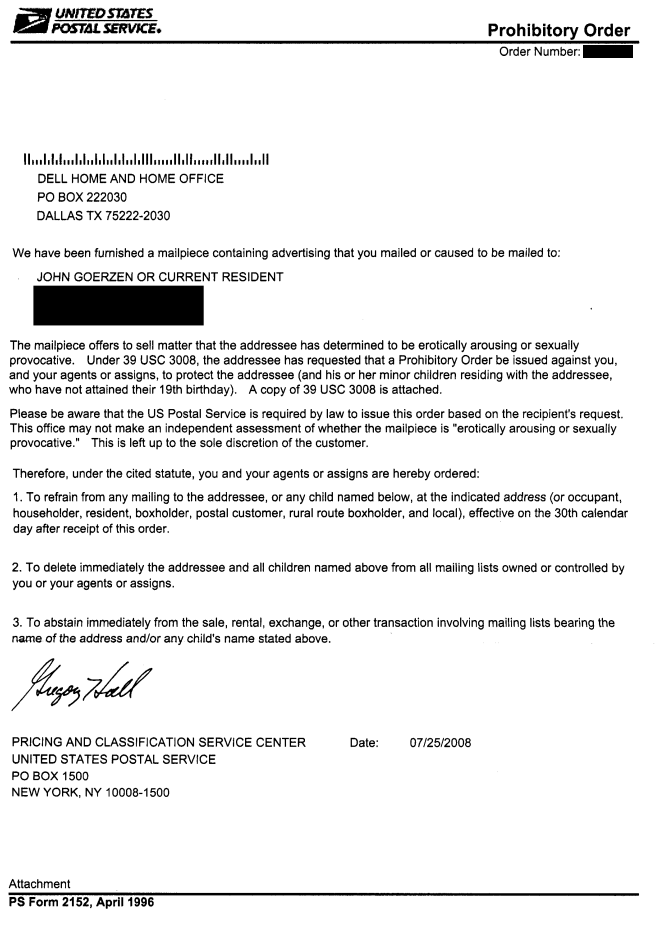
Junkbusters has spent years educating people on how to get rid of unwanted mail, and documents getting a prohibitory order against the sender. It was originally designed for people that didn't want to receive obscene advertising mailings, but thanks to the happy fact that one non-adult-mailer challenged a prohibitory order all the way to the Supreme Court, you can now get prohibitory order against anyone. Yes, even Dell. (The supreme court's ruling even gave an example: you can prohibit a clothing catalog if you want.)

And last month, that's exactly what I did. The USPS sent me back a copy of the letter they sent to Dell, as well as a second page with instructions on reporting violations. Here's the letter they sent to Dell:

dell-usps

Somehow I get a chuckle over some Dell mail clerk trying to figure out how an 11-pound laptop is sexually provocative.

From August 25 on, it is a federal offense for Dell to send me another Home and Home Office catalog. This is a branch of criminal law, not civil law. That is, it's the maybe-go-to-jail branch of law.

How disappointed I was to receive yet another catalog from them today. If only they had waited 5 more days, I could have turned them in now.

Oh well. There's always next month's catalog. Let's just hope the clerk that received the USPS letter removed my name with a better system than everyone else at Dell uses, eh?

18 August 2008

Julien Danjou: Unexpected VARMon new release

This has been 4 years since I released a new upstream release of VARMon, the DAC960 administration tool. There was a bug first discovered in #401236. It has been fixed in Debian with an ugly fix, which did not work finally for a long time. Recently #491505 got opened too, which was the same as the previous one. But this time I got access to hardware, thanks to Christoph! And I finally fixed the bug. I've even be able to test the fixes I wrote years ago for all of the compilation warnings. That's a shame that the problem was caused by dead code from the previous upstream, and that I did not realize that sooner. Kids, do not let dead debug code in your program at home. So I've finally been able to release a new 1.2.1 version which maybe the last release for the next decade! ;-)

15 August 2008

Stefano Zacchiroli: edos-builddebcheck

Statically detecting FTBFS with edos-builddebcheck Here at DebConf8, after my talk about Mancoosi, I got in touch with several people interested in the QA implication of the EDOS/Mancoosi tools. Me and Ralf have for example been contacted by Ubuntu people which are setting up theirs equivalent of http://edos.debian.net. A guy working on a mirroring tool made an interesting hack using edos-debcheck: out of a mirror with broken dependencies he can mirrors a subset of packages which do not suffer of the same problem. But now to the more interesting development, following a bug report by Atomo and discussions with Lucas (the RC-bug-filing-master), me and Ralf implemented edos-builddebcheck. You can invoke it on a pair of Packages/Sources package list, and it will check whether some packages will FTBFS due to unsatisfiable dependencies. The results on Lenny main/amd64 as of today are, ... erm ..., scary : 49 packages will FTBFS. The RC-bug-filing-master and Ralf are working on filing them, "don't worry". You can find edos-builddebcheck in the edos-debcheck package, starting from version 1.0-7 (in incoming at the time of writing). Update yes, ATM edos-builddebcheck does not know anything about P-A-S packages, so there are some false positive. Still, 33 source packages are proper hits.

14 August 2008

Pablo Lorenzzoni: Finally! We won a battle!

Although far from winning the war against Azeredo s bill, we finally won a battle. Chamber-of-Deputies IT Committee approved the request [pt-BR] for a public hearing [pt-BR]. Although a small step forward, all people involved with entities and NGOs interested in blocking this bill will have a chance to speak their minds. This comes in a very special timing. A pool was published early this week [pt-BR] run by Vox Populi revealing that more than a half of the Brazilian voters distrust e-voting and about 20% think it s possible to spy on their choices. This is a election year in Brazil, and all this setting can end up helping our case. More than 106-thousand already signed the petition and I think with all those signatures adding to this setting this is going to be a very interesting hearing. At least people supporting this bill will have to stand up and say they are for it And who knows what damage this can cause to them in a election year. Some public hearings are broadcast through Internet. I ll let you know if this one will be.

Julien Danjou: Documentation usefulness

I had this books since 2 years under my screens to raise them at work. Never though of opening them, I just realized what they are some days ago. xlib-prog-man.jpg That's probably why I became awesome without even knowing it. The truth is out there.

Julien Danjou: My developement process

Some people wonder how I develop and manage various features and their requests for awesome. thinking

Next.

Previous.
