Search Results: "tim"

11 April 2024

Russell Coker: ML Training License

Last year a Debian Developer blogged about writing Haskell code to give a bad result for LLMs that were trained on it. I forgot who wrote the post and I d appreciate the URL if anyone has it. I respect such technical work to enforce one s legal rights when they aren t respected by corporations, but I have a different approach. As an aside the Fosdem lecture Fortify AI against regulation, litigation and lobotomies is interesting on this topic [1], it s what inspired me to write about this. For what I write I am at this time happy to allow it to be used as part of a large training data set (consider this blog post a licence grant that applies until such time as I edit this post to change it). But only if aggregated with so much other data that my content is only a tiny portion of the data set by any metric. So I don t want someone to make a programming LLM that has my code as the only C code or a political data set that has my blog posts as the only left-wing content. If someone wants to train an LLM on only my content to make a Russell-simulator then I don t license my work for that purpose but also as it s small enough that anyone with a bit of skill could do it on a weekend I can t stop it. I would be really interested in seeing the results if someone from the FOSS community wanted to make a Russell-simulator and would probably issue them a license for such work if asked. If my work comprises more than 0.1% of the content in a particular measure (theme, programming language, political position, etc) in a training data set then I don t permit that without prior discussion. Finally if someone wants to make a FOSS training data set to be used for FOSS LLM systems (maybe under the AGPL or some similar license) then I ll allow my writing to be used as part of that.

Wouter Verhelst: OpenSC and the Belgian eID

Getting the Belgian eID to work on Linux systems should be fairly easy, although some people do struggle with it. For that reason, there is a lot of third-party documentation out there in the form of blog posts, wiki pages, and other kinds of things. Unfortunately, some of this documentation is simply wrong. Written by people who played around with things until it kind of worked, sometimes you get a situation where something that used to work in the past (but wasn't really necessary) now stopped working, but it's still added to a number of locations as though it were the gospel. And then people follow these instructions and now things don't work anymore. One of these revolves around OpenSC. OpenSC is an open source smartcard library that has support for a pretty large number of smartcards, amongst which the Belgian eID. It provides a PKCS#11 module as well as a number of supporting tools. For those not in the know, PKCS#11 is a standardized C API for offloading cryptographic operations. It is an API that can be used when talking to a hardware cryptographic module, in order to make that module perform some actions, and it is especially popular in the open source world, with support in NSS, amongst others. This library is written and maintained by mozilla, and is a low-level cryptographic library that is used by Firefox (on all platforms it supports) as well as by Google Chrome and other browsers based on that (but only on Linux, and as I understand it, only for linking with smartcards; their BoringSSL library is used for other things). The official eID software that we ship through eid.belgium.be, also known as "BeID", provides a PKCS#11 module for the Belgian eID, as well as a number of support tools to make interacting with the card easier, such as the "eID viewer", which provides the ability to read data from the card, and validate their signatures. While the very first public version of this eID PKCS#11 module was originally based on OpenSC, it has since been reimplemented as a PKCS#11 module in its own right, with no lineage to OpenSC whatsoever anymore. About five years ago, the Belgian eID card was renewed. At the time, a new physical appearance was the most obvious difference with the old card, but there were also some technical, on-chip, differences that are not so apparent. The most important one here, although it is not the only one, is the fact that newer eID cards now use a NIST P-384 elliptic curve-based private keys, rather than the RSA-based ones that were used in the past. This change required some changes to any PKCS#11 module that supports the eID; both the BeID one, as well as the OpenSC card-belpic driver that is written in support of the Belgian eID. Obviously, the required changes were implemented for the BeID module; however, the OpenSC card-belpic driver was not updated. While I did do some preliminary work on the required changes, I was unable to get it to work, and eventually other things took up my time so I never finished the implementation. If someone would like to finish the work that I started, the preliminal patch that I wrote could be a good start -- but like I said, it doesn't yet work. Also, you'll probably be interested in the official documentation of the eID card. Unfortunately, in the mean time someone added the Applet 1.8 ATR to the card-belpic.c file, without also implementing the required changes to the driver so that the PKCS#11 driver actually supports the eID card. The result of this is that if you have OpenSC installed in NSS for either Firefox or any Chromium-based browser, and it gets picked up before the BeID PKCS#11 module, then NSS will stop looking and pass all crypto operations to the OpenSC PKCS#11 module rather than to the official eID PKCS#11 module, and things will not work at all, causing a lot of confusion. I have therefore taken the following two steps:
  1. The official eID packages now conflict with the OpenSC PKCS#11 module. Specifically only the PKCS#11 module, not the rest of OpenSC, so you can theoretically still use its tools. This means that once we release this new version of the eID software, when you do an upgrade and you have OpenSC installed, it will remove the PKCS#11 module and anything that depends on it. This is normal and expected.
  2. I have filed a pull request against OpenSC that removes the Applet 1.8 ATR from the driver, so that OpenSC will stop claiming that it supports the 1.8 applet.
When the pull request is accepted, we will update the official eID software to make the conflict versioned, so that as soon as it works again you will again be able to install the OpenSC and BeID packages at the same time. In the mean time, if you have the OpenSC PKCS#11 module installed on your system, and your eID authentication does not work, try removing it.

9 April 2024

Matthew Palmer: How I Tripped Over the Debian Weak Keys Vulnerability

Those of you who haven t been in IT for far, far too long might not know that next month will be the 16th(!) anniversary of the disclosure of what was, at the time, a fairly earth-shattering revelation: that for about 18 months, the Debian OpenSSL package was generating entirely predictable private keys. The recent xz-stential threat (thanks to @nixCraft for making me aware of that one), has got me thinking about my own serendipitous interaction with a major vulnerability. Given that the statute of limitations has (probably) run out, I thought I d share it as a tale of how huh, that s weird can be a powerful threat-hunting tool but only if you ve got the time to keep pulling at the thread.

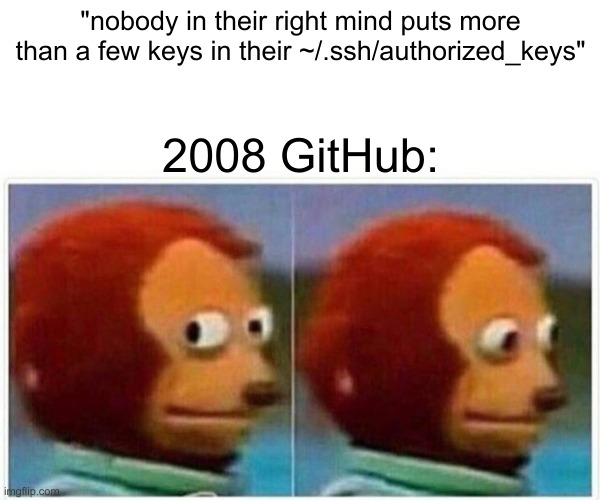
Prelude to an Adventure Our story begins back in March 2008. I was working at Engine Yard (EY), a now largely-forgotten Rails-focused hosting company, which pioneered several advances in Rails application deployment. Probably EY s greatest claim to lasting fame is that they helped launch a little code hosting platform you might have heard of, by providing them free infrastructure when they were little more than a glimmer in the Internet s eye. I am, of course, talking about everyone s favourite Microsoft product: GitHub. Since GitHub was in the right place, at the right time, with a compelling product offering, they quickly started to gain traction, and grow their userbase. With growth comes challenges, amongst them the one we re focusing on today: SSH login times. Then, as now, GitHub provided SSH access to the git repos they hosted, by SSHing to git@github.com with publickey authentication. They were using the standard way that everyone manages SSH keys: the ~/.ssh/authorized_keys file, and that became a problem as the number of keys started to grow. The way that SSH uses this file is that, when a user connects and asks for publickey authentication, SSH opens the ~/.ssh/authorized_keys file and scans all of the keys listed in it, looking for a key which matches the key that the user presented. This linear search is normally not a huge problem, because nobody in their right mind puts more than a few keys in their ~/.ssh/authorized_keys, right?
2008-era GitHub giving monkey puppet side-eye to the idea that nobody stores many keys in an authorized_keys file
Of course, as a popular, rapidly-growing service, GitHub was gaining users at a fair clip, to the point that the one big file that stored all the SSH keys was starting to visibly impact SSH login times. This problem was also not going to get any better by itself. Something Had To Be Done. EY management was keen on making sure GitHub ran well, and so despite it not really being a hosting problem, they were willing to help fix this problem. For some reason, the late, great, Ezra Zygmuntowitz pointed GitHub in my direction, and let me take the time to really get into the problem with the GitHub team. After examining a variety of different possible solutions, we came to the conclusion that the least-worst option was to patch OpenSSH to lookup keys in a MySQL database, indexed on the key fingerprint. We didn t take this decision on a whim it wasn t a case of yeah, sure, let s just hack around with OpenSSH, what could possibly go wrong? . We knew it was potentially catastrophic if things went sideways, so you can imagine how much worse the other options available were. Ensuring that this wouldn t compromise security was a lot of the effort that went into the change. In the end, though, we rolled it out in early April, and lo! SSH logins were fast, and we were pretty sure we wouldn t have to worry about this problem for a long time to come. Normally, you d think patching OpenSSH to make mass SSH logins super fast would be a good story on its own. But no, this is just the opening scene.

Chekov s Gun Makes its Appearance Fast forward a little under a month, to the first few days of May 2008. I get a message from one of the GitHub team, saying that somehow users were able to access other users repos over SSH. Naturally, as we d recently rolled out the OpenSSH patch, which touched this very thing, the code I d written was suspect number one, so I was called in to help.
The lineup scene from the movie The Usual Suspects They're called The Usual Suspects for a reason, but sometimes, it really is Keyser S ze
Eventually, after more than a little debugging, we discovered that, somehow, there were two users with keys that had the same key fingerprint. This absolutely shouldn t happen it s a bit like winning the lottery twice in a row1 unless the users had somehow shared their keys with each other, of course. Still, it was worth investigating, just in case it was a web application bug, so the GitHub team reached out to the users impacted, to try and figure out what was going on. The users professed no knowledge of each other, neither admitted to publicising their key, and couldn t offer any explanation as to how the other person could possibly have gotten their key. Then things went from weird to what the ? . Because another pair of users showed up, sharing a key fingerprint but it was a different shared key fingerprint. The odds now have gone from winning the lottery multiple times in a row to as close to this literally cannot happen as makes no difference.
Milhouse from The Simpsons says that We're Through The Looking Glass Here, People
Once we were really, really confident that the OpenSSH patch wasn t the cause of the problem, my involvement in the problem basically ended. I wasn t a GitHub employee, and EY had plenty of other customers who needed my help, so I wasn t able to stay deeply involved in the on-going investigation of The Mystery of the Duplicate Keys. However, the GitHub team did keep talking to the users involved, and managed to determine the only apparent common factor was that all the users claimed to be using Debian or Ubuntu systems, which was where their SSH keys would have been generated. That was as far as the investigation had really gotten, when along came May 13, 2008.

Chekov s Gun Goes Off With the publication of DSA-1571-1, everything suddenly became clear. Through a well-meaning but ultimately disasterous cleanup of OpenSSL s randomness generation code, the Debian maintainer had inadvertently reduced the number of possible keys that could be generated by a given user from bazillions to a little over 32,000. With so many people signing up to GitHub some of them no doubt following best practice and freshly generating a separate key it s unsurprising that some collisions occurred. You can imagine the sense of oooooooh, so that s what s going on! that rippled out once the issue was understood. I was mostly glad that we had conclusive evidence that my OpenSSH patch wasn t at fault, little knowing how much more contact I was to have with Debian weak keys in the future, running a huge store of known-compromised keys and using them to find misbehaving Certificate Authorities, amongst other things.

Lessons Learned While I ve not found a description of exactly when and how Luciano Bello discovered the vulnerability that became CVE-2008-0166, I presume he first came across it some time before it was disclosed likely before GitHub tripped over it. The stable Debian release that included the vulnerable code had been released a year earlier, so there was plenty of time for Luciano to have discovered key collisions and go hmm, I wonder what s going on here? , then keep digging until the solution presented itself. The thought hmm, that s odd , followed by intense investigation, leading to the discovery of a major flaw is also what ultimately brought down the recent XZ backdoor. The critical part of that sequence is the ability to do that intense investigation, though. When I reflect on my brush with the Debian weak keys vulnerability, what sticks out to me is the fact that I didn t do the deep investigation. I wonder if Luciano hadn t found it, how long it might have been before it was found. The GitHub team would have continued investigating, presumably, and perhaps they (or I) would have eventually dug deep enough to find it. But we were all super busy myself, working support tickets at EY, and GitHub feverishly building features and fighting the fires in their rapidly-growing service. As it was, Luciano was able to take the time to dig in and find out what was happening, but just like the XZ backdoor, I feel like we, as an industry, got a bit lucky that someone with the skills, time, and energy was on hand at the right time to make a huge difference. It s a luxury to be able to take the time to really dig into a problem, and it s a luxury that most of us rarely have. Perhaps an understated takeaway is that somehow we all need to wrestle back some time to follow our hunches and really dig into the things that make us go hmm .

Support My Hunches If you d like to help me be able to do intense investigations of mysterious software phenomena, you can shout me a refreshing beverage on ko-fi.
  1. the odds are actually probably more like winning the lottery about twenty times in a row. The numbers involved are staggeringly huge, so it s easiest to just approximate it as really, really unlikely .

7 April 2024

Thorsten Alteholz: My Debian Activities in March 2024

FTP master This month I accepted 147 and rejected 12 packages. The overall number of packages that got accepted was 151.

If you file an RM bug, please do check whether there are reverse dependencies as well and file RM bugs for them. It is annoying and time-consuming when I have to do the moreinfo dance. Debian LTS This was my hundred-seventeenth month that I did some work for the Debian LTS initiative, started by Raphael Hertzog at Freexian. During my allocated time I uploaded: I also continued to work on qtbase-opensource-src and last but not least did a week of FD. Debian ELTS This month was the sixty-eighth ELTS month. During my allocated time I uploaded: I also continued on an update for qtbase-opensource-src in Stretch (and LTS and other releases as well) and did a week of FD. Debian Printing This month I uploaded new upstream or bugfix versions of: This work is generously funded by Freexian! Debian Astro This month I uploaded a new upstream or bugfix version of: Debian IoT This month I uploaded new upstream or bugfix versions of: Debian Mobcom This month I uploaded a new upstream or bugfix version of: misc This month I uploaded new upstream or bugfix versions of:

6 April 2024

John Goerzen: Facebook is Censoring Stories about Climate Change and Illegal Raid in Marion, Kansas

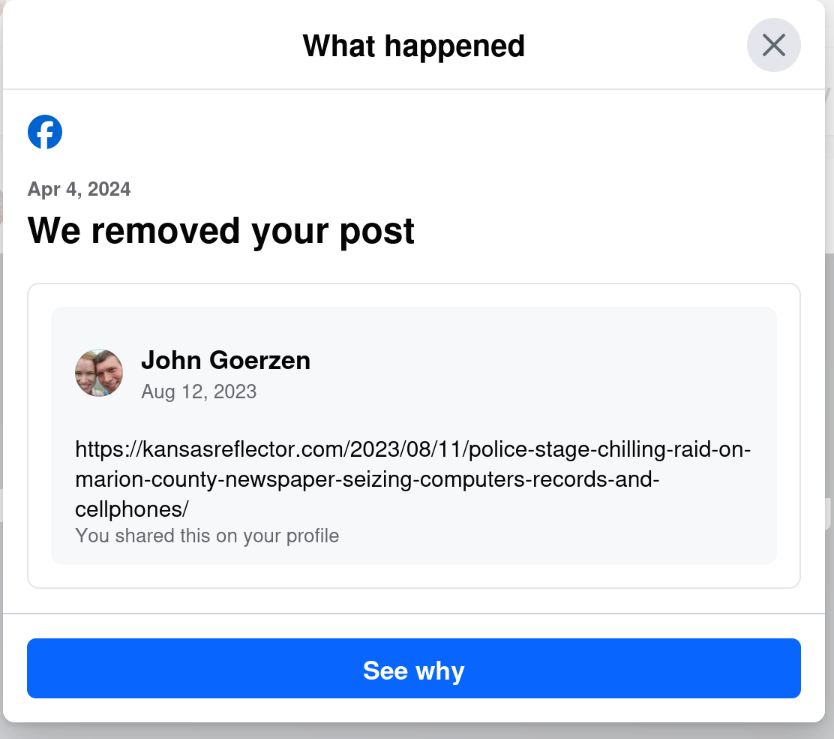
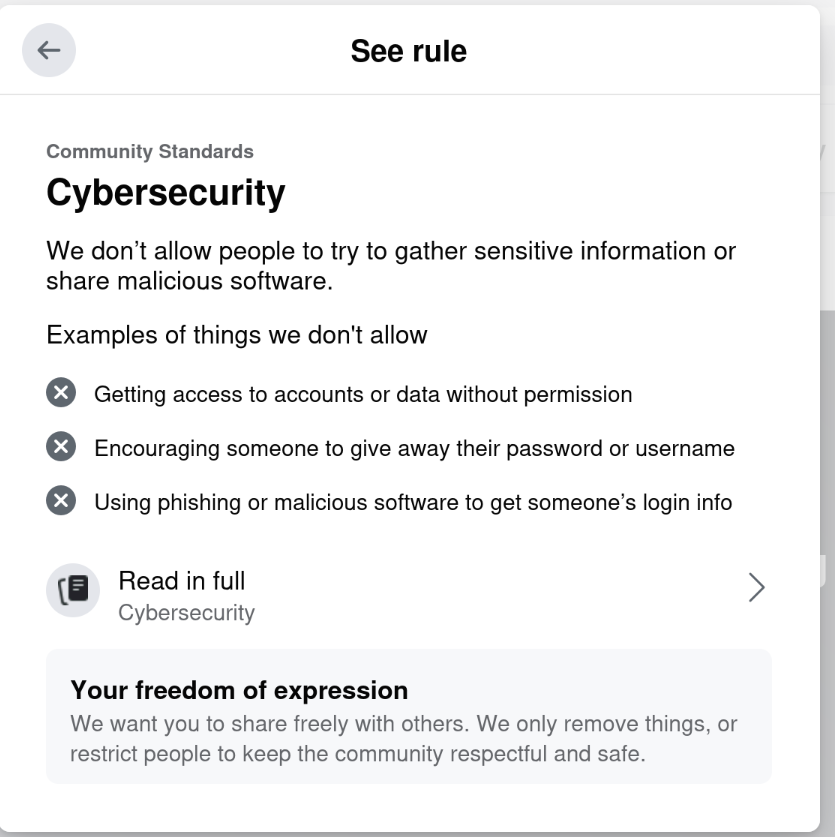
It is, sadly, not entirely surprising that Facebook is censoring articles critical of Meta. The Kansas Reflector published an artical about Meta censoring environmental articles about climate change deeming them too controversial . Facebook then censored the article about Facebook censorship, and then after an independent site published a copy of the climate change article, Facebook censored it too. The CNN story says Facebook apologized and said it was a mistake and was fixing it. Color me skeptical, because today I saw this: Yes, that s right: today, April 6, I get a notification that they removed a post from August 12. The notification was dated April 4, but only showed up for me today. I wonder why my post from August 12 was fine for nearly 8 months, and then all of a sudden, when the same website runs an article critical of Facebook, my 8-month-old post is a problem. Hmm. Riiiiiight. Cybersecurity. This isn t even the first time they ve done this to me. On September 11, 2021, they removed my post about the social network Mastodon (click that link for screenshot). A post that, incidentally, had been made 10 months prior to being removed. While they ultimately reversed themselves, I subsequently wrote Facebook s Blocking Decisions Are Deliberate Including Their Censorship of Mastodon. That this same pattern has played out a second time again with something that is a very slight challenege to Facebook seems to validate my conclusion. Facebook lets all sort of hateful garbage infest their site, but anything about climate change or their own censorship gets removed, and this pattern persists for years. There s a reason I prefer Mastodon these days. You can find me there as @jgoerzen@floss.social. So. I ve written this blog post. And then I m going to post it to Facebook. Let s see if they try to censor me for a third time. Bring it, Facebook.

5 April 2024

Paul Wise: FLOSS Activities March 2024

Focus This month I didn't have any particular focus. I just worked on issues in my info bubble.

Changes

Issues

Administration
  • Debian wiki: approve accounts

Communication
  • Respond to queries from Debian users and contributors on the mailing lists and IRC

Sponsors The SWH work was sponsored. All other work was done on a volunteer basis.

Dirk Eddelbuettel: RcppArmadillo 0.12.8.2.0 on CRAN: Upstream Fix

armadillo image Armadillo is a powerful and expressive C++ template library for linear algebra and scientific computing. It aims towards a good balance between speed and ease of use, has a syntax deliberately close to Matlab, and is useful for algorithm development directly in C++, or quick conversion of research code into production environments. RcppArmadillo integrates this library with the R environment and language and is widely used by (currently) 1136 other packages on CRAN, downloaded 33.5 million times (per the partial logs from the cloud mirrors of CRAN), and the CSDA paper (preprint / vignette) by Conrad and myself has been cited 578 times according to Google Scholar. This release brings a new upstream bugfix release Armadillo 12.8.2 prepared by Conrad two days ago. It took the usual day to noodle over 1100+ reverse dependencies and ensure two failures were independent of the upgrade (i.e., no change to worse in CRAN parlance). It took CRAN another because we hit a random network outage for (spurious) NOTE on a remote URL, and were then caught in the shrapnel from another large package ecosystem update spuriously pointing some build failures that were due to a missing rebuild to us. All good, as human intervention comes to the rescue. The set of changes since the last CRAN release follows.

Changes in RcppArmadillo version 0.12.8.2.0 (2024-04-02)
  • Upgraded to Armadillo release 12.8.2 (Cortisol Injector)
    • Workaround for FFTW3 header clash
    • Workaround in testing framework for issue under macOS
    • Minor cleanups to reduce code bloat
    • Improved documentation

Courtesy of my CRANberries, there is a diffstat report relative to previous release. More detailed information is on the RcppArmadillo page. Questions, comments etc should go to the rcpp-devel mailing list off the Rcpp R-Forge page. If you like this or other open-source work I do, you can sponsor me at GitHub.

This post by Dirk Eddelbuettel originated on his Thinking inside the box blog. Please report excessive re-aggregation in third-party for-profit settings.

Bits from Debian: apt install dpl-candidate: Andreas Tille

The Debian Project Developers will shortly vote for a new Debian Project Leader known as the DPL. The Project Leader is the official representative of The Debian Project tasked with managing the overall project, its vision, direction, and finances. The DPL is also responsible for the selection of Delegates, defining areas of responsibility within the project, the coordination of Developers, and making decisions required for the project. Our outgoing and present DPL Jonathan Carter served 4 terms, from 2020 through 2024. Jonathan shared his last Bits from the DPL post to Debian recently and his hopes for the future of Debian. Recently, we sat with the two present candidates for the DPL position asking questions to find out who they really are in a series of interviews about their platforms, visions for Debian, lives, and even their favorite text editors. The interviews were conducted by disaster2life (Yashraj Moghe) and made available from video and audio transcriptions: Voting for the position starts on April 6, 2024. Editors' note: This is our official return to Debian interviews, readers should stay tuned for more upcoming interviews with Developers and other important figures in Debian as part of our "Meet your Debian Developer" series. We used the following tools and services: Turboscribe.ai for the transcription from the audio and video files, IRC: Oftc.net for communication, Jitsi meet for interviews, and Open Broadcaster Software (OBS) for editing and video. While we encountered many technical difficulties in the return to this process, we are still able and proud to present the transcripts of the interviews edited only in a few areas for readability. 2024 Debian Project Leader Candidate: Andrea Tille Andreas' Interview Who are you? Tell us a little about yourself. [Andreas]:
How am I? Well, I'm, as I wrote in my platform, I'm a proud grandfather doing a lot of free software stuff, doing a lot of sports, have some goals in mind which I like to do and hopefully for the best of Debian.
And How are you today? [Andreas]:
How I'm doing today? Well, actually I have some headaches but it's fine for the interview. So, usually I feel very good. Spring was coming here and today it's raining and I plan to do a bicycle tour tomorrow and hope that I do not get really sick but yeah, for the interview it's fine.
What do you do in Debian? Could you mention your story here? [Andreas]:
Yeah, well, I started with Debian kind of an accident because I wanted to have some package salvaged which is called WordNet. It's a monolingual dictionary and I did not really plan to do more than maybe 10 packages or so. I had some kind of training with xTeddy which is totally unimportant, a cute teddy you can put on your desktop. So, and then well, more or less I thought how can I make Debian attractive for my employer which is a medical institute and so on. It could make sense to package bioinformatics and medicine software and it somehow evolved in a direction I did neither expect it nor wanted to do, that I'm currently the most busy uploader in Debian, created several teams around it. DebianMate is very well known from me. I created the Blends team to create teams and techniques around what we are doing which was Debian TIS, Debian Edu, Debian Science and so on and I also created the packaging team for R, for the statistics package R which is technically based and not topic based. All these blends are covering a certain topic and R is just needed by lots of these blends. So, yeah, and to cope with all this I have written a script which is routing an update to manage all these uploads more or less automatically. So, I think I had one day where I uploaded 21 new packages but it's just automatically generated, right? So, it's on one day more than I ever planned to do.
What is the first thing you think of when you think of Debian? Editors' note: The question was misunderstood as the worst thing you think of when you think of Debian [Andreas]:
The worst thing I think about Debian, it's complicated. I think today on Debian board I was asked about the technical progress I want to make and in my opinion we need to standardize things inside Debian. For instance, bringing all the packages to salsa, follow some common standards, some common workflow which is extremely helpful. As I said, if I'm that productive with my own packages we can adopt this in general, at least in most cases I think. I made a lot of good experience by the support of well-formed teams. Well-formed teams are those teams where people support each other, help each other. For instance, how to say, I'm a physicist by profession so I'm not an IT expert. I can tell apart what works and what not but I'm not an expert in those packages. I do and the amount of packages is so high that I do not even understand all the techniques they are covering like Go, Rust and something like this. And I also don't speak Java and I had a problem once in the middle of the night and I've sent the email to the list and was a Java problem and I woke up in the morning and it was solved. This is what I call a team. I don't call a team some common repository that is used by random people for different packages also but it's working together, don't hesitate to solve other people's problems and permit people to get active. This is what I call a team and this is also something I observed in, it's hard to give a percentage, in a lot of other teams but we have other people who do not even understand the concept of the team. Why is working together make some advantage and this is also a tough thing. I [would] like to tackle in my term if I get elected to form solid teams using the common workflow. This is one thing. The other thing is that we have a lot of good people in our infrastructure like FTP masters, DSA and so on. I have the feeling they have a lot of work and are working more or less on their limits, and I like to talk to them [to ask] what kind of change we could do to move that limits or move their personal health to the better side.
The DPL term lasts for a year, What would you do during that you couldn't do now? [Andreas]:
Yeah, well this is basically what I said are my main issues. I need to admit I have no really clear imagination what kind of tasks will come to me as a DPL because all these financial issues and law issues possible and issues [that] people who are not really friendly to Debian might create. I'm afraid these things might occupy a lot of time and I can't say much about this because I simply don't know.
What are three key terms about you and your candidacy? [Andreas]:
As I said, I like to work on standards, I d like to make Debian try [to get it right so] that people don't get overworked, this third key point is be inviting to newcomers, to everybody who wants to come. Yeah, I also mentioned in my term this diversity issue, geographical and from gender point of view. This may be the three points I consider most important.
Preferred text editor? [Andreas]:
Yeah, my preferred one? Ah, well, I have no preferred text editor. I'm using the Midnight Commander very frequently which has an internal editor which is convenient for small text. For other things, I usually use VI but I also use Emacs from time to time. So, no, I have not preferred text editor. Whatever works nicely for me.
What is the importance of the community in the Debian Project? How would like to see it evolving over the next few years? [Andreas]:
Yeah, I think the community is extremely important. So, I was on a lot of DebConfs. I think it's not really 20 but 17 or 18 DebCons and I really enjoyed these events every year because I met so many friends and met so many interesting people that it's really enriching my life and those who I never met in person but have read interesting things and yeah, Debian community makes really a part of my life.
And how do you think it should evolve specifically? [Andreas]:
Yeah, for instance, last year in Kochi, it became even clearer to me that the geographical diversity is a really strong point. Just discussing with some women from India who is afraid about not coming next year to Busan because there's a problem with Shanghai and so on. I'm not really sure how we can solve this but I think this is a problem at least I wish to tackle and yeah, this is an interesting point, the geographical diversity and I'm running the so-called mentoring of the month. This is a small project to attract newcomers for the Debian Med team which has the focus on medical packages and I learned that we had always men applying for this and so I said, okay, I dropped the constraint of medical packages. Any topic is fine, I teach you packaging but it must be someone who does not consider himself a man. I got only two applicants, no, actually, I got one applicant and one response which was kind of strange if I'm hunting for women or so. I did not understand but I got one response and interestingly, it was for me one of the least expected counters. It was from Iran and I met a very nice woman, very open, very skilled and gifted and did a good job or have even lose contact today and maybe we need more actively approach groups that are underrepresented. I don't know if what's a good means which I did but at least I tried and so I try to think about these kind of things.
What part of Debian has made you smile? What part of the project has kept you going all through the years? [Andreas]:
Well, the card game which is called Mao on the DebConf made me smile all the time. I admit I joined only two or three times even if I really love this kind of games but I was occupied by other stuff so this made me really smile. I also think the first online DebConf in 2020 made me smile because we had this kind of short video sequences and I tried to make a funny video sequence about every DebConf I attended before. This is really funny moments but yeah, it's not only smile but yeah. One thing maybe it's totally unconnected to Debian but I learned personally something in Debian that we have a do-ocracy and you can do things which you think that are right if not going in between someone else, right? So respect everybody else but otherwise you can do so. And in 2020 I also started to take trees which are growing widely in my garden and plant them into the woods because in our woods a lot of trees are dying and so I just do something because I can. I have the resource to do something, take the small tree and bring it into the woods because it does not harm anybody. I asked the forester if it is okay, yes, yes, okay. So everybody can do so but I think the idea to do something like this came also because of the free software idea. You have the resources, you have the computer, you can do something and you do something productive, right? And when thinking about this I think it was also my Debian work. Meanwhile I have planted more than 3,000 trees so it's not a small number but yeah, I enjoy this.
What part of Debian would you have some criticisms for? [Andreas]:
Yeah, it's basically the same as I said before. We need more standards to work together. I do not want to repeat this but this is what I think, yeah.
What field in Free Software generally do you think requires the most work to be put into it? What do you think is Debian's part in the field? [Andreas]:
It's also in general, the thing is the fact that I'm maintaining packages which are usually as modern software is maintained in Git, which is fine but we have some software which is at Sourceport, we have software laying around somewhere, we have software where Debian somehow became Upstream because nobody is caring anymore and free software is very different in several things, ways and well, I in principle like freedom of choice which is the basic of all our work. Sometimes this freedom goes in the way of productivity because everybody is free to re-implement. You asked me for the most favorite editor. In principle one really good working editor would be great to have and would work and we have maybe 500 in Debian or so, I don't know. I could imagine if people would concentrate and say five instead of 500 editors, we could get more productive, right? But I know this will not happen, right? But I think this is one thing which goes in the way of making things smooth and productive and we could have more manpower to replace one person who's [having] children, doing some other stuff and can't continue working on something and maybe this is a problem I will not solve, definitely not, but which I see.
What do you think is Debian's part in the field? [Andreas]:
Yeah, well, okay, we can bring together different Upstreams, so we are building some packages and have some general overview about similar things and can say, oh, you are doing this and some other person is doing more or less the same, do you want to join each other or so, but this is kind of a channel we have to our Upstreams which is probably not very successful. It starts with code copies of some libraries which are changed a little bit, which is fine license-wise, but not so helpful for different things and so I've tried to convince those Upstreams to forward their patches to the original one, but for this and I think we could do some kind of, yeah, [find] someone who brings Upstream together or to make them stop their forking stuff, but it costs a lot of energy and we probably don't have this and it's also not realistic that we can really help with this problem.
Do you have any questions for me? [Andreas]:
I enjoyed the interview, I enjoyed seeing you again after half a year or so. Yeah, actually I've seen you in the eating room or cheese and wine party or so, I do not remember we had to really talk together, but yeah, people around, yeah, for sure. Yeah.

Bits from Debian: apt install dpl-candidate: Sruthi Chandran

The Debian Project Developers will shortly vote for a new Debian Project Leader known as the DPL. The DPL is the official representative of representative of The Debian Project tasked with managing the overall project, its vision, direction, and finances. The DPL is also responsible for the selection of Delegates, defining areas of responsibility within the project, the coordination of Developers, and making decisions required for the project. Our outgoing and present DPL Jonathan Carter served 4 terms, from 2020 through 2024. Jonathan shared his last Bits from the DPL post to Debian recently and his hopes for the future of Debian. Recently, we sat with the two present candidates for the DPL position asking questions to find out who they really are in a series of interviews about their platforms, visions for Debian, lives, and even their favorite text editors. The interviews were conducted by disaster2life (Yashraj Moghe) and made available from video and audio transcriptions: Voting for the position starts on April 6, 2024. Editors' note: This is our official return to Debian interviews, readers should stay tuned for more upcoming interviews with Developers and other important figures in Debian as part of our "Meet your Debian Developer" series. We used the following tools and services: Turboscribe.ai for the transcription from the audio and video files, IRC: Oftc.net for communication, Jitsi meet for interviews, and Open Broadcaster Software (OBS) for editing and video. While we encountered many technical difficulties in the return to this process, we are still able and proud to present the transcripts of the interviews edited only in a few areas for readability. 2024 Debian Project Leader Candidate: Sruthi Chandran Sruthi's interview Hi Sruthi, so for the first question, who are you and could you tell us a little bit about yourself? [Sruthi]:
I usually talk about me whenever I am talking about answering the question who am I, I usually say like I am a librarian turned free software enthusiast and a Debian Developer. So I had no technical background and I learned, I was introduced to free software through my husband and then I learned Debian packaging, and eventually I became a Debian Developer. So I always give my example to people who say I am not technically inclined, I don't have technical background so I can't contribute to free software. So yeah, that's what I refer to myself.
For the next question, could you tell me what do you do in Debian, and could you mention your story up until here today? [Sruthi]:
Okay, so let me start from my initial days in Debian. I started contributing to Debian, my first contribution was a Tibetan font. We went to a Tibetan place and they were saying they didn't have a font in Linux. So that's how I started contributing. Then I moved on to Ruby packages, then I have some JavaScript and Go packages, all dependencies of GitLab. So I was involved with maintaining GitLab for some time, now I'm not very active there. But yeah, so GitLab was the main package I was contributing to since I contributed since 2016 to maybe like 2020 or something. Later I have come [over to] packaging. Now I am part of some of the teams, delegated teams, like community team and outreach team, as well as the Debconf committee. And the biggest, I think, my activity in Debian, I would say is organizing Debconf 2023. So it was a great experience and yeah, so that's my story in Debian.
So what are three key terms about you and your candidacy? [Sruthi]:
Okay, let me first think about it. For candidacy, I can start with diversity is one point I started expressing from the first time I contested for DPL. But to be honest, that's the main point I want to bring.
[Yashraj]:
So for diversity, if you could break down your thoughts on diversity and make them, [about] your three points including diversity.
[Sruthi]:
So in addition to, eventually when starting it was just diversity. Now I have like a bit more ideas, like community, like I want to be a leader for the Debian community. More than, I don't know, maybe people may not agree, but I would say I want to be a leader of Debian community rather than a Debian operating system. I connect to community more and third point I would say.
The term of a DPL lasts for an year. So what do you think during, what would you try to do during that, that you can't do from your position now? [Sruthi]:
Okay. So I, like, I am very happy with the structure of Debian and how things work in Debian. Like you can do almost a lot of things, like almost all things without being a DPL. Whatever change you want to bring about or whatever you want to do, you can do without being a DPL. Anyone, like every DD has the same rights. Only things I feel [the] DPL has hold on are mainly the budget or the funding part, which like, that's where they do the decision making part. And then comes like, and one advantage of DPL driving some idea is that somehow people tend to listen to that with more, like, tend to give more attention to what DPL is saying rather than a normal DD. So I wanted to, like, I have answered some of the questions on how to, how I plan to do the financial budgeting part, how I want to handle, like, and the other thing is using the extra attention that I get as a DPL, I would like to obviously start with the diversity aspect in Debian. And yeah, like, I, what I want to do is not, like, be a leader and say, like, take Debian to one direction where I want to go, but I would rather take suggestions and inputs from the whole community and go about with that. So yes, that's what I would say.
And taking a less serious question now, what is your preferred text editor? [Sruthi]:
Vim.
[Yashraj]:
Vim, wholeheartedly team Vim?
[Sruthi]:
Yes.
[Yashraj]:
Great. Well, this was made in Vim, all the text for this.
[Sruthi]:
So, like, since you mentioned extra data, I'll give my example, like, it's just a fun note, when I started contributing to Debian, as I mentioned, I didn't have any knowledge about free software, like Debian, and I was not used to even using Linux. So, and I didn't have experience with these text editors. So, when I started contributing, I used to do the editing part using gedit. So, that's how I started. Eventually, I moved to Nano, and once I reached Vim, I didn't move on.
Team Vim. Next question. What, what do you think is the importance of the Debian project in the world today? And where would you like to see it in 10 years, like 10 years into the future? [Sruthi]:
Okay. So, Debian, as we all know, is referred to as the universal operating system without, like, it is said for a reason. We have hundreds and hundreds of operating systems, like Linux, distributions based on Debian. So, I believe Debian, like even now, Debian has good influence on the, at least on the Linux or Linux ecosystem. So, what we implement in Debian has, like, is going to affect quite a lot of, like, a very good percentage of people using Linux. So, yes. So, I think Debian is one of the leading Linux distributions. And I think in 10 years, we should be able to reach a position, like, where we are not, like, even now, like, even these many years after having Linux, we face a lot of problems in newer and newer hardware coming up and installing on them is a big problem. Like, firmwares and all those things are getting more and more complicated. Like, it should be getting simpler, but it's getting more and more complicated. So, I, one thing I would imagine, like, I don't know if we will ever reach there, but I would imagine that eventually with the Debian, we should be able to have some, at least a few of the hardware developers or hardware producers have Debian pre-installed and those kind of things. Like, not, like, become, I'm not saying it's all, it's also available right now. What I'm saying is that it becomes prominent enough to be opted as, like, default distro.
What part of Debian has made you And what part of the project has kept you going all through these years? [Sruthi]:
Okay. So, I started to contribute in 2016, and I was part of the team doing GitLab packaging, and we did have a lot of training workshops and those kind of things within India. And I was, like, I had interacted with some of the Indian DDs, but I never got, like, even through chat or mail. I didn't have a lot of interaction with the rest of the world, DDs. And the 2019 Debconf changed my whole perspective about Debian. Before that, I wasn't, like, even, I was interested in free software. I was doing the technical stuff and all. But after DebConf, my whole idea has been, like, my focus changed to the community. Debian community is a very welcoming, very interesting community to be with. And so, I believe that, like, 2019 DebConf was a for me. And that kept, from 2019, my focus has been to how to support, like, how, I moved to the community part of Debian from there. Then in 2020 I became part of the community team, and, like, I started being part of other teams. So, these, I would say, the Debian community is the one, like, aspect of Debian that keeps me whole, keeps me held on to the Debian ecosystem as a whole.
Continuing to speak about Debian, what do you think, what is the first thing that comes to your mind when you think of Debian, like, the word, the community, what's the first thing? [Sruthi]:
I think I may sound like a broken record or something.
[Yashraj]:
No, no.
[Sruthi]:
Again, I would say the Debian community, like, it's the people who makes Debian, that makes Debian special. Like, apart from that, if I say, I would say I'm very, like, one part of Debian that makes me very happy is the, how the governing system of Debian works, the Debian constitution and all those things, like, it's a very unique thing for Debian. And, and it's like, when people say you can't work without a proper, like, establishment or even somebody deciding everything for you, it's difficult. When people say, like, we have been, Debian has been proving it for quite a long time now, that it's possible. So, so that's one thing I believe, like, that's one unique point. And I am very proud about that.
What areas do you think Debian is failing in, how can it (that standing) be improved? [Sruthi]:
So, I think where Debian is failing now is getting new people into Debian. Like, I don't remember, like, exactly the answer. But I remember hearing someone mention, like, the average age of a Debian Developer is, like, above 40 or 45 or something, like, exact age, I don't remember. But it's like, Debian is getting old. Like, the people in Debian are getting old and we are not getting enough of new people into Debian. And that's very important to have people, like, new people coming up. Otherwise, eventually, like, after a few years, nobody, like, we won't have enough people to take the project forward. So, yeah, I believe that is where we need to work on. We are doing some efforts, like, being part of GSOC or outreachy and having maybe other events, like, local events. Like, we used to have a lot of Debian packaging workshops in India. And those kind of, I think, in Brazil and all, they all have, like, local communities are doing. But we are not very successful in retaining the people who maybe come and try out things. But we are not very good at retaining the people, like, retaining people who come. So, we need to work on those things. Right now, I don't have a solid answer for that. But one thing, like, I was thinking about is, like, having a Debian specific outreach project, wherein the focus will be about the Debian, like, starting will be more on, like, usually what happens in GSOC and outreach is that people come, have the, do the contributions, and they go back. Like, they don't have that connection with the Debian, like, Debian community or Debian project. So, what I envision with these, the Debian outreach, the Debian specific outreach is that we have some part of the internship, like, even before starting the internship, we have some sessions and, like, with the people in Debian having, like, getting them introduced to the Debian philosophy and Debian community and Debian, how Debian works. And those things, we focus on that. And then we move on to the technical internship parts. So, I believe this could do some good in having, like, when you have people you can connect to, you tend to stay back in a project mode. When you feel something more than, like, right now, we have so many technical stuff to do, like, the choice for a college student is endless. So, if they want, if they stay back for something, like, maybe for Debian, I would say, we need to have them connected to the Debian project before we go into technical parts. Like, technical parts, like, there are other things as well, where they can go and do the technical part, but, like, they can come here, like, yeah. So, that's what I was saying. Focused outreach projects is one thing. That's just one. That's not enough. We need more of, like, more ideas to have more new people come up. And I'm very happy with, like, the DebConf thing. We tend to get more and more people from the places where we have a DebConf. Brazil is an example. After the Debconf, they have quite a good improvement on Debian contributors. And I think in India also, it did give a good result. Like, we have more people contributing and staying back and those things. So, yeah. So, these were the things I would say, like, we can do to improve.
For the final question, what field in free software do you, what field in free software generally do you think requires the most work to be put into it? What do you think is Debian's part in that field? [Sruthi]:
Okay. Like, right now, what comes to my mind is the free software licenses parts. Like, we have a lot of free software licenses, and there are non-free software licenses. But currently, I feel free software is having a big problem in enforcing these licenses. Like, there are, there may be big corporations or like some people who take up the whole, the code and may not follow the whole, for example, the GPL licenses. Like, we don't know how much of those, how much of the free softwares are used in the bigger things. Yeah, I agree. There are a lot of corporations who are afraid to touch free software. But there would be good amount of free software, free work that converts into property, things violating the free software licenses and those things. And we do not have the kind of like, we have SFLC, SFC, etc. But still, we do not have the ability to go behind and trace and implement the licenses. So, enforce those licenses and bring people who are violating the licenses forward and those kind of things is challenging because one thing is it takes time, like, and most importantly, money is required for the legal stuff. And not always people who like people who make small software, or maybe big, but they may not have the kind of time and money to have these things enforced. So, that's a big challenge free software is facing, especially in our current scenario. I feel we are having those, like, we need to find ways how we can get it sorted. I don't have an answer right now what to do. But this is a challenge I felt like and Debian's part in that. Yeah, as I said, I don't have a solution for that. But the Debian, so DFSG and Debian sticking on to the free software licenses is a good support, I think.
So, that was the final question, Do you have anything else you want to mention for anyone watching this? [Sruthi]:
Not really, like, I am happy, like, I think I was able to answer the questions. And yeah, I would say who is watching. I won't say like, I'm the best DPL candidate, you can't have a better one or something. I stand for a reason. And if you believe in that, or the Debian community and Debian diversity, and those kinds of things, if you believe it, I hope you would be interested, like, you would want to vote for me. That's it. Like, I'm not, I'll make it very clear. I'm not doing a technical leadership part here. So, those, I can't convince people who want technical leadership to vote for me. But I would say people who connect with me, I hope they vote for me.

Emanuele Rocca: PGP keys on Yubikey, with a side of Mutt

Here are my notes about copying PGP keys to external hardware devices such as Yubikeys. Let me begin by saying that the gpg tools are pretty bad at this.
MAKE A COUPLE OF BACKUPS OF ~/.gnupg/ TO DIFFERENT ENCRYPTED USB STICKS BEFORE YOU START. GPG WILL MESS UP YOUR KEYS. SERIOUSLY.
For example, would you believe me if I said that saving changes results in the removal of your private key? Well check this out.
Now that you have multiple safe, offline backups of your keys, here are my notes.
apt install yubikey-manager scdaemon
Plug the Yubikey in, see if it s recognized properly:
ykman list
gpg --card-status
Change the default PIN (123456) and Admin PIN (12345678):
gpg --card-edit
gpg/card> admin
gpg/card> passwd
Look at the openpgp information and change the maximum number of retries, if you like. I have seen this failing a couple of times, unplugging the Yubikey and putting it back in worked.
ykman openpgp info
ykman openpgp access set-retries 7 7 7
Copy your keys. MAKE A BACKUP OF ~/.gnupg/ BEFORE YOU DO THIS.
gpg --edit-key $KEY_ID
gpg> keytocard # follow the prompts to copy the first key
Now choose the next key and copy that one too. Repeat till all subkeys are copied.
gpg> key 1
gpg> keytocard
Typing gpg --card-status you should be able to see all your keys on the Yubikey now.

Using the key on another machine
How do you use your PGP keys on the Yubikey on other systems?
Go to another system, if it does have a ~/.gnupg directory already move it somewhere else.
apt install scdaemon
Import your public key:
gpg -k
gpg --keyserver pgp.mit.edu --recv-keys $KEY_ID
Check the fingerprint and if it is indeed your key say you trust it:
gpg --edit-key $KEY_ID
> trust
> 5
> y
> save
Now try gpg --card-status and gpg --list-secret-keys, you should be able to see your keys. Try signing something, it should work.
gpg --output /tmp/x.out --sign /etc/motd
gpg --verify /tmp/x.out

Using the Yubikey with Mutt
If you re using mutt with IMAP, there is a very simple trick to safely store your password on disk. Create an encrypted file with your IMAP password:
echo SUPERSECRET   gpg --encrypt > ~/.mutt_password.gpg
Add the following to ~/.muttrc:
set imap_pass= gpg --decrypt ~/.mutt_password.gpg 
With the above, mutt now prompts you to insert the Yubikey and type your PIN in order to connect to the IMAP server.

4 April 2024

John Goerzen: The xz Issue Isn t About Open Source

You ve probably heard of the recent backdoor in xz. There have been a lot of takes on this, most of them boiling down to some version of:
The problem here is with Open Source Software.
I want to say not only is that view so myopic that it pushes towards the incorrect, but also it blinds us to more serious problems. Now, I don t pretend that there are no problems in the FLOSS community. There have been various pieces written about what this issue says about the FLOSS community (usually without actionable solutions). I m not here to say those pieces are wrong. Just that there s a bigger picture. So with this xz issue, it may well be a state actor (aka spy ) that added this malicious code to xz. We also know that proprietary software and systems can be vulnerable. For instance, a Twitter whistleblower revealed that Twitter employed Indian and Chinese spies, some knowingly. A recent report pointed to security lapses at Microsoft, including preventable lapses in security. According to the Wikipedia article on the SolarWinds attack, it was facilitated by various kinds of carelessness, including passwords being posted to Github and weak default passwords. They directly distributed malware-infested updates, encouraged customers to disable anti-malware tools when installing SolarWinds products, and so forth. It would be naive indeed to assume that there aren t black hat actors among the legions of programmers employed by companies that outsource work to low-cost countries some of which have challenges with bribery. So, given all this, we can t really say the problem is Open Source. Maybe it s more broad:
The problem here is with software.
Maybe that inches us closer, but is it really accurate? We have all heard of Boeing s recent issues, which seem to have some element of root causes in corporate carelessness, cost-cutting, and outsourcing. That sounds rather similar to the SolarWinds issue, doesn t it?
Well then, the problem is capitalism.
Maybe it has a role to play, but isn t it a little too easy to just say capitalism and throw up our hands helplessly, just as some do with FLOSS as at the start of this article? After all, capitalism also brought us plenty of products of very high quality over the years. When we can point to successful, non-careless products and I own some of them (for instance, my Framework laptop). We clearly haven t reached the root cause yet. And besides, what would you replace it with? All the major alternatives that have been tried have even stronger downsides. Maybe you replace it with better regulated capitalism , but that s still capitalism.
Then the problem must be with consumers.
As this argument would go, it s consumers buying patterns that drive problems. Buyers individual and corporate seek flashy features and low cost, prizing those over quality and security. No doubt this is true in a lot of cases. Maybe greed or status-conscious societies foster it: Temu promises people to shop like a billionaire , and unloads on them cheap junk, which all but guarantees that shipments from Temu containing products made with forced labor are entering the United States on a regular basis . But consumers are also people, and some fraction of them are quite capable of writing fantastic software, and in fact, do so. So what we need is some way to seize control. Some way to do what is right, despite the pressures of consumers or corporations. Ah yes, dear reader, you have been slogging through all these paragraphs and now realize I have been leading you to this:
Then the solution is Open Source.
Indeed. Faults and all, FLOSS is the most successful movement I know where people are bringing us back to the commons: working and volunteering for the common good, unleashing a thousand creative variants on a theme, iterating in every direction imaginable. We have FLOSS being vital parts of everything from $30 Raspberry Pis to space missions. It is bringing education and communication to impoverished parts of the world. It lets everyone write and release software. And, unlike the SolarWinds and Twitter issues, it exposes both clever solutions and security flaws to the world. If an authentication process in Windows got slower, we would all shrug and mutter Microsoft under our breath. Because, really, what else can we do? We have no agency with Windows. If an authentication process in Linux gets slower, anybody that s interested anybody at all can dive in and ask why and trace it down to root causes. Some look at this and say FLOSS is responsible for this mess. I look at it and say, this would be so much worse if it wasn t FLOSS and experience backs me up on this. FLOSS doesn t prevent security issues itself. What it does do is give capabilities to us all. The ability to investigate. Ability to fix. Yes, even the ability to break and its cousin, the power to learn. And, most rewarding, the ability to contribute.

3 April 2024

Guido G nther: Free Software Activities March 2024

A short status update of what happened on my side last month. I spent quiet a bit of time reviewing new, code (thanks!) as well as maintenance to keep things going but we also have some improvements: Phosh Phoc phosh-mobile-settings phosh-osk-stub gmobile Livi squeekboard GNOME calls Libsoup If you want to support my work see donations.

Joey Hess: reflections on distrusting xz

Was the ssh backdoor the only goal that "Jia Tan" was pursuing with their multi-year operation against xz? I doubt it, and if not, then every fix so far has been incomplete, because everything is still running code written by that entity. If we assume that they had a multilayered plan, that their every action was calculated and malicious, then we have to think about the full threat surface of using xz. This quickly gets into nightmare scenarios of the "trusting trust" variety. What if xz contains a hidden buffer overflow or other vulnerability, that can be exploited by the xz file it's decompressing? This would let the attacker target other packages, as needed. Let's say they want to target gcc. Well, gcc contains a lot of documentation, which includes png images. So they spend a while getting accepted as a documentation contributor on that project, and get added to it a png file that is specially constructed, it has additional binary data appended that exploits the buffer overflow. And instructs xz to modify the source code that comes later when decompressing gcc.tar.xz. More likely, they wouldn't bother with an actual trusting trust attack on gcc, which would be a lot of work to get right. One problem with the ssh backdoor is that well, not all servers on the internet run ssh. (Or systemd.) So webservers seem a likely target of this kind of second stage attack. Apache's docs include png files, nginx does not, but there's always scope to add improved documentation to a project. When would such a vulnerability have been introduced? In February, "Jia Tan" wrote a new decoder for xz. This added 1000+ lines of new C code across several commits. So much code and in just the right place to insert something like this. And why take on such a significant project just two months before inserting the ssh backdoor? "Jia Tan" was already fully accepted as maintainer, and doing lots of other work, it doesn't seem to me that they needed to start this rewrite as part of their cover. They were working closely with xz's author Lasse Collin in this, by indications exchanging patches offlist as they developed it. So Lasse Collin's commits in this time period are also worth scrutiny, because they could have been influenced by "Jia Tan". One that caught my eye comes immediately afterwards: "prepares the code for alternative C versions and inline assembly" Multiple versions and assembly mean even more places to hide such a security hole. I stress that I have not found such a security hole, I'm only considering what the worst case possibilities are. I think we need to fully consider them in order to decide how to fully wrap up this mess. Whether such stealthy security holes have been introduced into xz by "Jia Tan" or not, there are definitely indications that the ssh backdoor was not the end of what they had planned. For one thing, the "test file" based system they introduced was extensible. They could have been planning to add more test files later, that backdoored xz in further ways. And then there's the matter of the disabling of the Landlock sandbox. This was not necessary for the ssh backdoor, because the sandbox is only used by the xz command, not by liblzma. So why did they potentially tip their hand by adding that rogue "." that disables the sandbox? A sandbox would not prevent the kind of attack I discuss above, where xz is just modifying code that it decompresses. Disabling the sandbox suggests that they were going to make xz run arbitrary code, that perhaps wrote to files it shouldn't be touching, to install a backdoor in the system. Both deb and rpm use xz compression, and with the sandbox disabled, whether they link with liblzma or run the xz command, a backdoored xz can write to any file on the system while dpkg or rpm is running and noone is likely to notice, because that's the kind of thing a package manager does. My impression is that all of this was well planned and they were in it for the long haul. They had no reason to stop with backdooring ssh, except for the risk of additional exposure. But they decided to take that risk, with the sandbox disabling. So they planned to do more, and every commit by "Jia Tan", and really every commit that they could have influenced needs to be distrusted. This is why I've suggested to Debian that they revert to an earlier version of xz. That would be my advice to anyone distributing xz. I do have a xz-unscathed fork which I've carefully constructed to avoid all "Jia Tan" involved commits. It feels good to not need to worry about dpkg and tar. I only plan to maintain this fork minimally, eg security fixes. Hopefully Lasse Collin will consider these possibilities and address them in his response to the attack.

Arnaud Rebillout: Firefox: Moving from the Debian package to the Flatpak app (long-term?)

First, thanks to Samuel Henrique for giving notice of recent Firefox CVEs in Debian testing/unstable. At the time I didn't want to upgrade my system (Debian Sid) due to the ongoing t64 transition transition, so I decided I could install the Firefox Flatpak app instead, and why not stick to it long-term? This blog post details all the steps, if ever others want to go the same road. Flatpak Installation Disclaimer: this section is hardly anything more than a copy/paste of the official documentation, and with time it will get outdated, so you'd better follow the official doc. First thing first, let's install Flatpak:
$ sudo apt update
$ sudo apt install flatpak
Then the next step is to add the Flathub remote repository, from where we'll get our Flatpak applications:
$ flatpak remote-add --if-not-exists flathub https://dl.flathub.org/repo/flathub.flatpakrepo
And that's all there is to it! Now come the optional steps. For GNOME and KDE users, you might want to install a plugin for the software manager specific to your desktop, so that it can support and manage Flatpak apps:
$ which -s gnome-software  && sudo apt install gnome-software-plugin-flatpak
$ which -s plasma-discover && sudo apt install plasma-discover-backend-flatpak
And here's an additional check you can do, as it's something that did bite me in the past: missing xdg-portal-* packages, that are required for Flatpak applications to communicate with the desktop environment. Just to be sure, you can check the output of apt search '^xdg-desktop-portal' to see what's available, and compare with the output of dpkg -l grep xdg-desktop-portal. As you can see, if you're a GNOME or KDE user, there's a portal backend for you, and it should be installed. For reference, this is what I have on my GNOME desktop at the moment:
$ dpkg -l   grep xdg-desktop-portal   awk ' print $2 '
xdg-desktop-portal
xdg-desktop-portal-gnome
xdg-desktop-portal-gtk
Install the Firefox Flatpak app This is trivial, but still, there's a question I've always asked myself: should I install applications system-wide (aka. flatpak --system, the default) or per-user (aka. flatpak --user)? Turns out, this questions is answered in the Flatpak documentation:
Flatpak commands are run system-wide by default. If you are installing applications for day-to-day usage, it is recommended to stick with this default behavior.
Armed with this new knowledge, let's install the Firefox app:
$ flatpak install flathub org.mozilla.firefox
And that's about it! We can give it a go already:
$ flatpak run org.mozilla.firefox
Data migration At this point, running Firefox via Flatpak gives me an "empty" Firefox. That's not what I want, instead I want my usual Firefox, with a gazillion of tabs already opened, a few extensions, bookmarks and so on. As it turns out, Mozilla provides a brief doc for data migration, and it's as simple as moving Firefox data directory around! To clarify, we'll be copying data: Make sure that all Firefox instances are closed, then proceed:
# BEWARE! Below I'm erasing data!
$ rm -fr ~/.var/app/org.mozilla.firefox/.mozilla/firefox/
$ cp -a ~/.mozilla/firefox/ ~/.var/app/org.mozilla.firefox/.mozilla/
To avoid confusing myself, it's also a good idea to rename the local data directory:
$ mv ~/.mozilla/firefox ~/.mozilla/firefox.old.$(date --iso-8601=date)
At this point, flatpak run org.mozilla.firefox takes me to my "usual" everyday Firefox, with all its tabs opened, pinned, bookmarked, etc. More integration? After following all the steps above, I must say that I'm 99% happy. So far, everything works as before, I didn't hit any issue, and I don't even notice that Firefox is running via Flatpak, it's completely transparent. So where's the 1% of unhappiness? The Run a Command dialog from GNOME, the one that shows up via the keyboard shortcut <Alt+F2>. This is how I start my GUI applications, and I usually run two Firefox instances in parallel (one for work, one for personal), using the firefox -p <profile> command. Given that I ran apt purge firefox before (to avoid confusing myself with two installations of Firefox), now the right (and only) way to start Firefox from a command-line is to type flatpak run org.mozilla.firefox -p <profile>. Typing that every time is way too cumbersome, so I need something quicker. Seems like the most straightforward is to create a wrapper script:
$ cat /usr/local/bin/firefox 
#!/bin/sh
exec flatpak run org.mozilla.firefox "$@"
And now I can just hit <Alt+F2> and type firefox -p <profile> to start Firefox with the profile I want, just as before. Neat! Looking forward: system updates I usually update my system manually every now and then, via the well-known pair of commands:
$ sudo apt update
$ sudo apt full-upgrade
The downside of introducing Flatpak, ie. introducing another package manager, is that I'll need to learn new commands to update the software that comes via this channel. Fortunately, there's really not much to learn. From flatpak-update(1):
flatpak update [OPTION...] [REF...] Updates applications and runtimes. [...] If no REF is given, everything is updated, as well as appstream info for all remotes.
Could it be that simple? Apparently yes, the Flatpak equivalent of the two apt commands above is just:
$ flatpak update
Going forward, my options are:
  1. Teach myself to run flatpak update additionally to apt update, manually, everytime I update my system.
  2. Go crazy: let something automatically update my Flatpak apps, in my back and without my consent.
I'm actually tempted to go for option 2 here, and I wonder if GNOME Software will do that for me, provided that I installed gnome-software-plugin-flatpak, and that I checked Software Updates -> Automatic in the Settings (which I did). However, I didn't find any documentation regarding what this setting really does, so I can't say if it will only download updates, or if it will also install it. I'd be happy if it automatically installs new version of Flatpak apps, but at the same time I'd be very unhappy if it automatically upgrades my Debian system... So we'll see. Enough for today, hope this blog post was useful!

2 April 2024

Bits from Debian: Bits from the DPL

Dear Debianites This morning I decided to just start writing Bits from DPL and send whatever I have by 18:00 local time. Here it is, barely proof read, along with all it's warts and grammar mistakes! It's slightly long and doesn't contain any critical information, so if you're not in the mood, don't feel compelled to read it! Get ready for a new DPL! Soon, the voting period will start to elect our next DPL, and my time as DPL will come to an end. Reading the questions posted to the new candidates on debian-vote, it takes quite a bit of restraint to not answer all of them myself, I think I can see how that aspect contributed to me being reeled in to running for DPL! In total I've done so 5 times (the first time I ran, Sam was elected!). Good luck to both Andreas and Sruthi, our current DPL candidates! I've already started working on preparing handover, and there's multiple request from teams that have came in recently that will have to wait for the new term, so I hope they're both ready to hit the ground running! Things that I wish could have gone better Communication Recently, I saw a t-shirt that read:
Adulthood is saying, 'But after this week things will slow down a bit' over and over until you die.
I can relate! With every task, crisis or deadline that appears, I think that once this is over, I'll have some more breathing space to get back to non-urgent, but important tasks. "Bits from the DPL" was something I really wanted to get right this last term, and clearly failed spectacularly. I have two long Bits from the DPL drafts that I never finished, I tend to have prioritised problems of the day over communication. With all the hindsight I have, I'm not sure which is better to prioritise, I do rate communication and transparency very highly and this is really the top thing that I wish I could've done better over the last four years. On that note, thanks to people who provided me with some kind words when I've mentioned this to them before. They pointed out that there are many other ways to communicate and be in touch with the community, and they mentioned that they thought that I did a good job with that. Since I'm still on communication, I think we can all learn to be more effective at it, since it's really so important for the project. Every time I publicly spoke about us spending more money, we got more donations. People out there really like to see how we invest funds in to Debian, instead of just making it heap up. DSA just spent a nice chunk on money on hardware, but we don't have very good visibility on it. It's one thing having it on a public line item in SPI's reporting, but it would be much more exciting if DSA could provide a write-up on all the cool hardware they're buying and what impact it would have on developers, and post it somewhere prominent like debian-devel-announce, Planet Debian or Bits from Debian (from the publicity team). I don't want to single out DSA there, it's difficult and affects many other teams. The Salsa CI team also spent a lot of resources (time and money wise) to extend testing on AMD GPUs and other AMD hardware. It's fantastic and interesting work, and really more people within the project and in the outside world should know about it! I'm not going to push my agendas to the next DPL, but I hope that they continue to encourage people to write about their work, and hopefully at some point we'll build enough excitement in doing so that it becomes a more normal part of our daily work. Founding Debian as a standalone entity This was my number one goal for the project this last term, which was a carried over item from my previous terms. I'm tempted to write everything out here, including the problem statement and our current predicaments, what kind of ground work needs to happen, likely constitutional changes that need to happen, and the nature of the GR that would be needed to make such a thing happen, but if I start with that, I might not finish this mail. In short, I 100% believe that this is still a very high ranking issue for Debian, and perhaps after my term I'd be in a better position to spend more time on this (hmm, is this an instance of "The grass is always better on the other side", or "Next week will go better until I die?"). Anyway, I'm willing to work with any future DPL on this, and perhaps it can in itself be a delegation tasked to properly explore all the options, and write up a report for the project that can lead to a GR. Overall, I'd rather have us take another few years and do this properly, rather than rush into something that is again difficult to change afterwards. So while I very much wish this could've been achieved in the last term, I can't say that I have any regrets here either. My terms in a nutshell COVID-19 and Debian 11 era My first term in 2020 started just as the COVID-19 pandemic became known to spread globally. It was a tough year for everyone, and Debian wasn't immune against its effects either. Many of our contributors got sick, some have lost loved ones (my father passed away in March 2020 just after I became DPL), some have lost their jobs (or other earners in their household have) and the effects of social distancing took a mental and even physical health toll on many. In Debian, we tend to do really well when we get together in person to solve problems, and when DebConf20 got cancelled in person, we understood that that was necessary, but it was still more bad news in a year we had too much of it already. I can't remember if there was ever any kind of formal choice or discussion about this at any time, but the DebConf video team just kind of organically and spontaneously became the orga team for an online DebConf, and that lead to our first ever completely online DebConf. This was great on so many levels. We got to see each other's faces again, even though it was on screen. We had some teams talk to each other face to face for the first time in years, even though it was just on a Jitsi call. It had a lasting cultural change in Debian, some teams still have video meetings now, where they didn't do that before, and I think it's a good supplement to our other methods of communication. We also had a few online Mini-DebConfs that was fun, but DebConf21 was also online, and by then we all developed an online conference fatigue, and while it was another good online event overall, it did start to feel a bit like a zombieconf and after that, we had some really nice events from the Brazillians, but no big global online community events again. In my opinion online MiniDebConfs can be a great way to develop our community and we should spend some further energy into this, but hey! This isn't a platform so let me back out of talking about the future as I see it... Despite all the adversity that we faced together, the Debian 11 release ended up being quite good. It happened about a month or so later than what we ideally would've liked, but it was a solid release nonetheless. It turns out that for quite a few people, staying inside for a few months to focus on Debian bugs was quite productive, and Debian 11 ended up being a very polished release. During this time period we also had to deal with a previous Debian Developer that was expelled for his poor behaviour in Debian, who continued to harass members of the Debian project and in other free software communities after his expulsion. This ended up being quite a lot of work since we had to take legal action to protect our community, and eventually also get the police involved. I'm not going to give him the satisfaction by spending too much time talking about him, but you can read our official statement regarding Daniel Pocock here: https://www.debian.org/News/2021/20211117 In late 2021 and early 2022 we also discussed our general resolution process, and had two consequent votes to address some issues that have affected past votes: In my first term I addressed our delegations that were a bit behind, by the end of my last term all delegation requests are up to date. There's still some work to do, but I'm feeling good that I get to hand this over to the next DPL in a very decent state. Delegation updates can be very deceiving, sometimes a delegation is completely re-written and it was just 1 or 2 hours of work. Other times, a delegation updated can contain one line that has changed or a change in one team member that was the result of days worth of discussion and hashing out differences. I also received quite a few requests either to host a service, or to pay a third-party directly for hosting. This was quite an admin nightmare, it either meant we had to manually do monthly reimbursements to someone, or have our TOs create accounts/agreements at the multiple providers that people use. So, after talking to a few people about this, we founded the DebianNet team (we could've admittedly chosen a better name, but that can happen later on) for providing hosting at two different hosting providers that we have agreement with so that people who host things under debian.net have an easy way to host it, and then at the same time Debian also has more control if a site maintainer goes MIA. More info: https://wiki.debian.org/Teams/DebianNet You might notice some Openstack mentioned there, we had some intention to set up a Debian cloud for hosting these things, that could also be used for other additional Debiany things like archive rebuilds, but these have so far fallen through. We still consider it a good idea and hopefully it will work out some other time (if you're a large company who can sponsor few racks and servers, please get in touch!) DebConf22 and Debian 12 era DebConf22 was the first time we returned to an in-person DebConf. It was a bit smaller than our usual DebConf - understandably so, considering that there were still COVID risks and people who were at high risk or who had family with high risk factors did the sensible thing and stayed home. After watching many MiniDebConfs online, I also attended my first ever MiniDebConf in Hamburg. It still feels odd typing that, it feels like I should've been at one before, but my location makes attending them difficult (on a side-note, a few of us are working on bootstrapping a South African Debian community and hopefully we can pull off MiniDebConf in South Africa later this year). While I was at the MiniDebConf, I gave a talk where I covered the evolution of firmware, from the simple e-proms that you'd find in old printers to the complicated firmware in modern GPUs that basically contain complete operating systems- complete with drivers for the device their running on. I also showed my shiny new laptop, and explained that it's impossible to install that laptop without non-free firmware (you'd get a black display on d-i or Debian live). Also that you couldn't even use an accessibility mode with audio since even that depends on non-free firmware these days. Steve, from the image building team, has said for a while that we need to do a GR to vote for this, and after more discussion at DebConf, I kept nudging him to propose the GR, and we ended up voting in favour of it. I do believe that someone out there should be campaigning for more free firmware (unfortunately in Debian we just don't have the resources for this), but, I'm glad that we have the firmware included. In the end, the choice comes down to whether we still want Debian to be installable on mainstream bare-metal hardware. At this point, I'd like to give a special thanks to the ftpmasters, image building team and the installer team who worked really hard to get the changes done that were needed in order to make this happen for Debian 12, and for being really proactive for remaining niggles that was solved by the time Debian 12.1 was released. The included firmware contributed to Debian 12 being a huge success, but it wasn't the only factor. I had a list of personal peeves, and as the hard freeze hit, I lost hope that these would be fixed and made peace with the fact that Debian 12 would release with those bugs. I'm glad that lots of people proved me wrong and also proved that it's never to late to fix bugs, everything on my list got eliminated by the time final freeze hit, which was great! We usually aim to have a release ready about 2 years after the previous release, sometimes there are complications during a freeze and it can take a bit longer. But due to the excellent co-ordination of the release team and heavy lifting from many DDs, the Debian 12 release happened 21 months and 3 weeks after the Debian 11 release. I hope the work from the release team continues to pay off so that we can achieve their goals of having shorter and less painful freezes in the future! Even though many things were going well, the ongoing usr-merge effort highlighted some social problems within our processes. I started typing out the whole history of usrmerge here, but it's going to be too long for the purpose of this mail. Important questions that did come out of this is, should core Debian packages be team maintained? And also about how far the CTTE should really be able to override a maintainer. We had lots of discussion about this at DebConf22, but didn't make much concrete progress. I think that at some point we'll probably have a GR about package maintenance. Also, thank you to Guillem who very patiently explained a few things to me (after probably having have to done so many times to others before already) and to Helmut who have done the same during the MiniDebConf in Hamburg. I think all the technical and social issues here are fixable, it will just take some time and patience and I have lots of confidence in everyone involved. UsrMerge wiki page: https://wiki.debian.org/UsrMerge DebConf 23 and Debian 13 era DebConf23 took place in Kochi, India. At the end of my Bits from the DPL talk there, someone asked me what the most difficult thing I had to do was during my terms as DPL. I answered that nothing particular stood out, and even the most difficult tasks ended up being rewarding to work on. Little did I know that my most difficult period of being DPL was just about to follow. During the day trip, one of our contributors, Abraham Raji, passed away in a tragic accident. There's really not anything anyone could've done to predict or stop it, but it was devastating to many of us, especially the people closest to him. Quite a number of DebConf attendees went to his funeral, wearing the DebConf t-shirts he designed as a tribute. It still haunts me when I saw his mother scream "He was my everything! He was my everything!", this was by a large margin the hardest day I've ever had in Debian, and I really wasn't ok for even a few weeks after that and I think the hurt will be with many of us for some time to come. So, a plea again to everyone, please take care of yourself! There's probably more people that love you than you realise. A special thanks to the DebConf23 team, who did a really good job despite all the uphills they faced (and there were many!). As DPL, I think that planning for a DebConf is near to impossible, all you can do is show up and just jump into things. I planned to work with Enrico to finish up something that will hopefully save future DPLs some time, and that is a web-based DD certificate creator instead of having the DPL do so manually using LaTeX. It already mostly works, you can see the work so far by visiting https://nm.debian.org/person/ACCOUNTNAME/certificate/ and replacing ACCOUNTNAME with your Debian account name, and if you're a DD, you should see your certificate. It still needs a few minor changes and a DPL signature, but at this point I think that will be finished up when the new DPL start. Thanks to Enrico for working on this! Since my first term, I've been trying to find ways to improve all our accounting/finance issues. Tracking what we spend on things, and getting an annual overview is hard, especially over 3 trusted organisations. The reimbursement process can also be really tedious, especially when you have to provide files in a certain order and combine them into a PDF. So, at DebConf22 we had a meeting along with the treasurer team and Stefano Rivera who said that it might be possible for him to work on a new system as part of his Freexian work. It worked out, and Freexian funded the development of the system since then, and after DebConf23 we handled the reimbursements for the conference via the new reimbursements site: https://reimbursements.debian.net/ It's still early days, but over time it should be linked to all our TOs and we'll use the same category codes across the board. So, overall, our reimbursement process becomes a lot simpler, and also we'll be able to get information like how much money we've spent on any category in any period. It will also help us to track how much money we have available or how much we spend on recurring costs. Right now that needs manual polling from our TOs. So I'm really glad that this is a big long-standing problem in the project that is being fixed. For Debian 13, we're waving goodbye to the KFreeBSD and mipsel ports. But we're also gaining riscv64 and loongarch64 as release architectures! I have 3 different RISC-V based machines on my desk here that I haven't had much time to work with yet, you can expect some blog posts about them soon after my DPL term ends! As Debian is a unix-like system, we're affected by the Year 2038 problem, where systems that uses 32 bit time in seconds since 1970 run out of available time and will wrap back to 1970 or have other undefined behaviour. A detailed wiki page explains how this works in Debian, and currently we're going through a rather large transition to make this possible. I believe this is the right time for Debian to be addressing this, we're still a bit more than a year away for the Debian 13 release, and this provides enough time to test the implementation before 2038 rolls along. Of course, big complicated transitions with dependency loops that causes chaos for everyone would still be too easy, so this past weekend (which is a holiday period in most of the west due to Easter weekend) has been filled with dealing with an upstream bug in xz-utils, where a backdoor was placed in this key piece of software. An Ars Technica covers it quite well, so I won't go into all the details here. I mention it because I want to give yet another special thanks to everyone involved in dealing with this on the Debian side. Everyone involved, from the ftpmasters to security team and others involved were super calm and professional and made quick, high quality decisions. This also lead to the archive being frozen on Saturday, this is the first time I've seen this happen since I've been a DD, but I'm sure next week will go better! Looking forward It's really been an honour for me to serve as DPL. It might well be my biggest achievement in my life. Previous DPLs range from prominent software engineers to game developers, or people who have done things like complete Iron Man, run other huge open source projects and are part of big consortiums. Ian Jackson even authored dpkg and is now working on the very interesting tag2upload service! I'm a relative nobody, just someone who grew up as a poor kid in South Africa, who just really cares about Debian a lot. And, above all, I'm really thankful that I didn't do anything major to screw up Debian for good. Not unlike learning how to use Debian, and also becoming a Debian Developer, I've learned a lot from this and it's been a really valuable growth experience for me. I know I can't possible give all the thanks to everyone who deserves it, so here's a big big thanks to everyone who have worked so hard and who have put in many, many hours to making Debian better, I consider you all heroes! -Jonathan

1 April 2024

Colin Watson: Free software activity in March 2024

My Debian contributions this month were all sponsored by Freexian.

Simon Josefsson: Towards reproducible minimal source code tarballs? On *-src.tar.gz

While the work to analyze the xz backdoor is in progress, several ideas have been suggested to improve the software supply chain ecosystem. Some of those ideas are good, some of the ideas are at best irrelevant and harmless, and some suggestions are plain bad. I d like to attempt to formalize two ideas, which have been discussed before, but the context in which they can be appreciated have not been as clear as it is today.
  1. Reproducible tarballs. The idea is that published source tarballs should be possible to reproduce independently somehow, and that this should be continuously tested and verified preferrably as part of the upstream project continuous integration system (e.g., GitHub action or GitLab pipeline). While nominally this looks easy to achieve, there are some complex matters in this, for example: what timestamps to use for files in the tarball? I ve brought up this aspect before.
  2. Minimal source tarballs without generated vendor files. Most GNU Autoconf/Automake-based tarballs pre-generated files which are important for bootstrapping on exotic systems that does not have the required dependencies. For the bootstrapping story to succeed, this approach is important to support. However it has become clear that this practice raise significant costs and risks. Most modern GNU/Linux distributions have all the required dependencies and actually prefers to re-build everything from source code. These pre-generated extra files introduce uncertainty to that process.
My strawman proposal to improve things is to define new tarball format *-src.tar.gz with at least the following properties:
  1. The tarball should allow users to build the project, which is the entire purpose of all this. This means that at least all source code for the project has to be included.
  2. The tarballs should be signed, for example with PGP or minisign.
  3. The tarball should be possible to reproduce bit-by-bit by a third party using upstream s version controlled sources and a pointer to which revision was used (e.g., git tag or git commit).
  4. The tarball should not require an Internet connection to download things.
    • Corollary: every external dependency either has to be explicitly documented as such (e.g., gcc and GnuTLS), or included in the tarball.
    • Observation: This means including all *.po gettext translations which are normally downloaded when building from version controlled sources.
  5. The tarball should contain everything required to build the project from source using as much externally released versioned tooling as possible. This is the minimal property lacking today.
    • Corollary: This means including a vendored copy of OpenSSL or libz is not acceptable: link to them as external projects.
    • Open question: How about non-released external tooling such as gnulib or autoconf archive macros? This is a bit more delicate: most distributions either just package one current version of gnulib or autoconf archive, not previous versions. While this could change, and distributions could package the gnulib git repository (up to some current version) and the autoconf archive git repository and packages were set up to extract the version they need (gnulib s ./bootstrap already supports this via the gnulib-refdir parameter), this is not normally in place.
    • Suggested Corollary: The tarball should contain content from git submodule s such as gnulib and the necessary Autoconf archive M4 macros required by the project.
  6. Similar to how the GNU project specify the ./configure interface we need a documented interface for how to bootstrap the project. I suggest to use the already well established idiom of running ./bootstrap to set up the package to later be able to be built via ./configure. Of course, some projects are not using the autotool ./configure interface and will not follow this aspect either, but like most build systems that compete with autotools have instructions on how to build the project, they should document similar interfaces for bootstrapping the source tarball to allow building.
If tarballs that achieve the above goals were available from popular upstream projects, distributions could more easily use them instead of current tarballs that include pre-generated content. The advantage would be that the build process is not tainted by unnecessary files. We need to develop tools for maintainers to create these tarballs, similar to make dist that generate today s foo-1.2.3.tar.gz files. I think one common argument against this approach will be: Why bother with all that, and just use git-archive outputs? Or avoid the entire tarball approach and move directly towards version controlled check outs and referring to upstream releases as git URL and commit tag or id. One problem with this is that SHA-1 is broken, so placing trust in a SHA-1 identifier is simply not secure. Another counter-argument is that this optimize for packagers benefits at the cost of upstream maintainers: most upstream maintainers do not want to store gettext *.po translations in their source code repository. A compromise between the needs of maintainers and packagers is useful, so this *-src.tar.gz tarball approach is the indirection we need to solve that. Update: In my experiment with source-only tarballs for Libntlm I actually did use git-archive output. What do you think?

Arturo Borrero Gonz lez: Kubecon and CloudNativeCon 2024 Europe summary

Kubecon EU 2024 Paris logo This blog post shares my thoughts on attending Kubecon and CloudNativeCon 2024 Europe in Paris. It was my third time at this conference, and it felt bigger than last year s in Amsterdam. Apparently it had an impact on public transport. I missed part of the opening keynote because of the extremely busy rush hour tram in Paris. On Artificial Intelligence, Machine Learning and GPUs Talks about AI, ML, and GPUs were everywhere this year. While it wasn t my main interest, I did learn about GPU resource sharing and power usage on Kubernetes. There were also ideas about offering Models-as-a-Service, which could be cool for Wikimedia Toolforge in the future. See also: On security, policy and authentication This was probably the main interest for me in the event, given Wikimedia Toolforge was about to migrate away from Pod Security Policy, and we were currently evaluating different alternatives. In contrast to my previous attendances to Kubecon, where there were three policy agents with presence in the program schedule, Kyverno, Kubewarden and OpenPolicyAgent (OPA), this time only OPA had the most relevant sessions. One surprising bit I got from one of the OPA sessions was that it could work to authorize linux PAM sessions. Could this be useful for Wikimedia Toolforge? OPA talk I attended several sessions related to authentication topics. I discovered the keycloak software, which looks very promising. I also attended an Oauth2 session which I had a hard time following, because I clearly missed some additional knowledge about how Oauth2 works internally. I also attended a couple of sessions that ended up being a vendor sales talk. See also: On container image builds, harbor registry, etc This topic was also of interest to me because, again, it is a core part of Wikimedia Toolforge. I attended a couple of sessions regarding container image builds, including topics like general best practices, image minimization, and buildpacks. I learned about kpack, which at first sight felt like a nice simplification of how the Toolforge build service was implemented. I also attended a session by the Harbor project maintainers where they shared some valuable information on things happening soon or in the future , for example: On networking I attended a couple of sessions regarding networking. One session in particular I paid special attention to, ragarding on network policies. They discussed new semantics being added to the Kubernetes API. The different layers of abstractions being added to the API, the different hook points, and override layers clearly resembled (to me at least) the network packet filtering stack of the linux kernel (netfilter), but without the 20 (plus) years of experience building the right semantics and user interfaces. Network talk I very recently missed some semantics for limiting the number of open connections per namespace, see Phabricator T356164: [toolforge] several tools get periods of connection refused (104) when connecting to wikis This functionality should be available in the lower level tools, I mean Netfilter. I may submit a proposal upstream at some point, so they consider adding this to the Kubernetes API. Final notes In general, I believe I learned many things, and perhaps even more importantly I re-learned some stuff I had forgotten because of lack of daily exposure. I m really happy that the cloud native way of thinking was reinforced in me, which I still need because most of my muscle memory to approach systems architecture and engineering is from the old pre-cloud days. That being said, I felt less engaged with the content of the conference schedule compared to last year. I don t know if the schedule itself was less interesting, or that I m losing interest? Finally, not an official track in the conference, but we met a bunch of folks from Wikimedia Deutschland. We had a really nice time talking about how wikibase.cloud uses Kubernetes, whether they could run in Wikimedia Cloud Services, and why structured data is so nice. Group photo
29 March 2024

Rapha&#235;l Hertzog: Freexian is looking to expand its team with more Debian contributors

It s been a while that I haven t posted anything on my blog, the truth is that Freexian has been doing very well in the last years and that I have a hard time to allocate time to write articles or even to contribute to my usual Debian projects the exception being debusine since that s part of the Freexian work (have a look at our most recent announce!).
That being said, given Freexian s growth and in the hope to reduce my workload, we are looking to extend our team with Debian members of more varied backgrounds and skills, so they can help us in areas like sales / marketing / project management. Have a look at our announce on debian-jobs@lists.debian.org.
As a mission-oriented company, we are looking to work with persons already involved in Debian (or persons who were waiting the right opportunity to get involved). All our collaborators can spend 20% of their paid work time on the Debian projects they care about.

Ravi Dwivedi: A visit to the Taj Mahal

Note: The currency used in this post is Indian Rupees, which was around 83 INR for 1 US Dollar as that time. I and my friend Badri visited the Taj Mahal this month. Taj Mahal is one of the main tourist destinations in India and does not need an introduction, I guess. It is in Agra, in the state of Uttar Pradesh, 188 km from Delhi by train. So, I am writing a post documenting useful information for people who are planning to visit Taj Mahal. Feel free to ask me questions about visiting the Taj Mahal.
Our retiring room at the Old Delhi Railway Station.
We had booked a train from Delhi to Agra. The name of the train was Taj Express, and its scheduled departure time from Hazrat Nizamuddin station in Delhi is 07:08 hours in the morning, and its arrival time at Agra Cantt station is 09:45. So, we booked a retiring room at the Old Delhi railway station for the previous night. This retiring room was hard to find. We woke up at 05:00 in the morning and took the metro to Hazrat Nizamuddin station. We barely reached the station in time, but anyway, the train was not yet at the station; it was late. We reached Agra at 10:30 and checked into our retiring room, took rest and went out for Taj Mahal at 13:00 in the afternoon. Taj Mahal s outer gate is 5 km away from the Agra Cantt station. As we were going out of the railway station, we were chased by an autorickshaw driver who offered to go to Taj Mahal for 150 INR for both of us. I asked him to bring it down to 60 INR, and after some back and forth, he agreed to drop us off at Taj Mahal for 80 INR. But I said we won t pay anything above 60 INR. He agreed with that amount but said that he would need to fill up with more passengers. When we saw that he wasn t making any effort in bringing more passengers, we walked away. As soon as we got out of the railway station complex, an autorickshaw driver came to us and offered to drop us off at Taj Mahal for 20 INR if we are sharing with other passengers and 100 INR if we reserve the auto for us. We agreed to go with 20 INR per person, but he started the autorickshaw as soon as we hopped in. I thought that the third person in the auto was another passenger sharing a ride with us, but later we got to know he was with the driver. Upon reaching the outer gate of Taj Mahal, I gave him 40 INR (for both of us), and he asked to instead give 100 INR as he said we reserved the auto, even though I clearly stated before taking the auto that we wanted to share the auto, not reserve it. I think this was a scam. We walked away, and he didn t insist further. Taj Mahal entrance was like 500 m from the outer gate. We went there and bought offline tickets just outside the West gate. For Indians, the ticket for going inside the Taj Mahal complex is 50 INR, and a visit to the mausoleum costs 200 INR extra.
Security outside the Taj Mahal complex.

This red colored building is entrance to where you can see the Taj Mahal.

Taj Mahal.
Shoe covers for going inside the mausoleum.

Taj Mahal from side angle.
We came out of the Taj Mahal complex at 18:00 and stopped for some tea and snacks. I also bought a fridge magnet for 30 INR. Then we walked back towards Agra Cantt station, as we had a train for Jaipur at midnight. We were hoping to find a restaurant along the way, but we didn t find any that we found interesting, so we just ate at the railway station. During the return trip, we noticed there was a bus stand near the station, which we didn t know about. It turns out you can catch a bus to Taj Mahal from there. You can click here to check out the location of that bus stand on OpenStreetMap.

Expenses These were our expenses per person Retiring room at Delhi Railway Station for 12 hours 131 Train ticket from Delhi to Agra (Taj Express) 110 Retiring room at Agra Cantt station for 12 hours 450 Auto-rickshaw to Taj Mahal 20 Taj Mahal ticket (including going inside the mausoleum): 250 Food 350

Important information for visitors
  • Taj Mahal is closed on Friday.
  • There are plenty of free-of-cost drinking water taps inside the Taj Mahal complex.
  • Ticket price for Indians is 50, for foreigners and NRIs it is 1100, and for people from SAARC/BIMSTEC is 540. 200 extra for the mausoleum for everyone.
  • A visit inside the mausoleum requires covering your shoes or removing them. Shoe covers costs 10 per person inside the complex, but are probably involved free of charge in foreigner tickets. We could not find a place to keep our shoes, but some people managed to enter barefoot, indicating there must be some place to keep your shoes.
  • Mobile phones and cameras are allowed inside the Taj Mahal, but not eatables.
  • We went there on March 10th, and the weather was pleasant. So, we recommend going around that time.
  • Regarding the timings, I found this written near the ticket counter: Taj Mahal opens 30 minutes before sunrise and closes 30 minutes before sunset during normal operating days, so the timings are vague. But we came out of the complex at 18:00 hours. I would interpret that to mean the Taj Mahal is open from 07:00 to 18:00, and the ticket counter closes at around 17:00. During the winter, the timings might differ.
  • The cheapest way to reach Taj Mahal is by bus, and the bus stop is here
Bye for now. See you in the next post :)

Next.

Previous.