Search Results: "tb"

23 October 2017

Russ Allbery: Review: Algorithms to Live By

Review: Algorithms to Live By, by Brian Christian & Tom Griffiths
Publisher: Henry Holt and Company
Copyright: April 2016
ISBN: 1-62779-037-3
Format: Kindle
Pages: 255
Another read for the work book club. This was my favorite to date, apart from the books I recommended myself. One of the foundations of computer science as a field of study is research into algorithms: how do we solve problems efficiently using computer programs? This is a largely mathematical field, but it's often less about ideal or theoretical solutions and more about making the most efficient use of limited resources and arriving at an adequate, if not perfect, answer. Many of these problems are either day-to-day human problems or are closely related to them; after all, the purpose of computer science is to solve practical problems with computers. The question asked by Algorithms to Live By is "can we reverse this?": can we learn lessons from computer science's approach to problems that would help us make day-to-day decisions? There's a lot of interesting material in the eleven chapters of this book, but there's also an amusing theme: humans are already very good at this. Many chapters start with an examination of algorithms and mathematical analysis of problems, dive into a discussion of how we can use those results to make better decisions, then talk about studies of the decisions humans actually make... and discover that humans are already applying ad hoc versions of the best algorithms we've come up with, given the constraints of typical life situations. It tends to undermine the stated goal of the book. Thankfully, it in no way undermines interesting discussion of general classes of problems, how computer science has tackled them, and what we've learned about the mathematical and technical shapes of those problems. There's a bit less self-help utility here than I think the authors had intended, but lots of food for thought. (That said, it's worth considering whether this congruence is less because humans are already good at this and more because our algorithms are designed from human intuition. Maybe our best algorithms just reflect human thinking. In some cases we've checked our solutions against mathematical ideals, but in other cases they're still just our best guesses to date.) This is the sort of a book where a chapter listing is an important part of the review. The areas of algorithms discussed here are optimal stopping, explore/exploit decisions (when to go with the best thing you've found and when to look for something better), sorting, caching, scheduling, Bayes's rule (and prediction in general), overfitting when building models, relaxation (solving an easier problem than your actual problem), randomized algorithms, a collection of networking algorithms, and finally game theory. Each of these has useful insights and thought-provoking discussion of how these sometimes-theoretical concepts map surprisingly well onto daily problems. The book concludes with a discussion of "computational kindness": an encouragement to reduce the required computation and complexity penalty for both yourself and the people you interact with. If you have a computer science background (as I do), many of these will be familiar concepts, and you might be dubious that a popularization would tell you much that's new. Give this book a shot, though; the analogies are less stretched than you might fear, and the authors are both careful and smart about how they apply these principles. This book passes with flying colors a key sanity check: the chapters on topics that I know well or have thought about a lot make few or no obvious errors and say useful and important things. For example, the scheduling chapter, which unsurprisingly is about time management, surpasses more than half of the time management literature by jumping straight to the heart of most time management problems: if you're going to do everything on a list, it rarely matters the order in which you do it, so the hardest scheduling problems are about deciding what not to do rather than deciding order. The point in the book where the authors won my heart completely was in the chapter on Bayes's rule. Much of the chapter is about Bayesian priors, and how one's knowledge of past events is a vital part of analysis of future probabilities. The authors then discuss the (in)famous marshmallow experiment, in which children are given one marshmallow and told that if they refrain from eating it until the researcher returns, they'll get two marshmallows. Refraining from eating the marshmallow (delayed gratification, in the psychological literature) was found to be associated with better life outcomes years down the road. This experiment has been used and abused for years for all sorts of propaganda about how trading immediate pleasure for future gains leads to a successful life, and how failure in life is because of inability to delay gratification. More evil analyses have (of course) tied that capability to ethnicity, with predictably racist results. I have kind of a thing about the marshmallow experiment. It's a topic that reliably sends me off into angry rants. Algorithms to Live By is the only book I have ever read to mention the marshmallow experiment and then apply the analysis that I find far more convincing. This is not a test of innate capability in the children; it's a test of their Bayesian priors. When does it make perfect sense to eat the marshmallow immediately instead of waiting for a reward? When their past experience tells them that adults are unreliable, can't be trusted, disappear for unpredictable lengths of time, and lie. And, even better, the authors supported this analysis with both a follow-up study I hadn't heard of before and with the observation that some children would wait for some time and then "give in." This makes perfect sense if they were subconsciously using a Bayesian model with poor priors. This is a great book. It may try a bit too hard in places (applicability of the math of optimal stopping to everyday life is more contingent and strained than I think the authors want to admit), and some of this will be familiar if you've studied algorithms. But the writing is clear, succinct, and very well-edited. No part of the book outlives its welcome; the discussion moves right along. If you find yourself going "I know all this already," you'll still probably encounter a new concept or neat explanation in a few more pages. And sometimes the authors make connections that never would have occurred to me but feel right in retrospect, such as relating exponential backoff in networking protocols to choosing punishments in the criminal justice system. Or the realization that our modern communication world is not constantly connected, it's constantly buffered, and many of us are suffering from the characteristic signs of buffer bloat. I don't think you have to be a CS major, or know much about math, to read this book. There is a lot of mathematical details in the end notes if you want to dive in, but the main text is almost always readable and clear, at least so far as I could tell (as someone who was a CS major and has taken a lot of math, so a grain of salt may be indicated). And it still has a lot to offer even if you've studied algorithms for years. The more I read of this book, the more I liked it. Definitely recommended if you like reading this sort of analysis of life. Rating: 9 out of 10

22 October 2017

Hideki Yamane: openSUSE.Asia Summit 2017 in Tokyo

This weekend large typhoon is approaching to Japan, however, I went to UEC (The University of Electro-Communications, ) to give a talk in openSUSE.Asia Summit 2017 in Tokyo.

"... hey, wait. openSUSE? Are you using openSUSE?"

Honestly no, I'm not. My talk was "openSUSE tools on Debian" - the only one session about Debian in that conference :)

Photo by Youngbin Han (Ubuntu Korea Loco), thanks!


We Debian distribute some tools from openSUSE - OBS (Open Build Service), Snapper and I'm now working on openQA. So, it is a good chance to contact to upstream (=openSUSE) people, and I got some hints from them, thanks!


openSUSE tools on Debian from Hideki Yamane

Michael Stapelberg: Which VCS do Debian s Go package upstreams use?

In the pkg-go team, we are currently discussing which workflows we should standardize on. One of the considerations is what goes into the upstream Git branch of our repositories: should it track the upstream Git repository, or should it contain orig tarball imports? Now, tracking the upstream Git repository only works if upstream actually uses Git. The go tool, which is widely used within the Go community for managing Go packages, supports Git, Mercurial, Bazaar and Subversion. But which of these are actually used in practice? Let s find out! Option 1: If you have the sources lists of all suites locally anyway
/usr/lib/apt/apt-helper cat-file \
  $(apt-get indextargets --format '$(FILENAME)' 'ShortDesc: Sources' 'Origin: Debian') \
    sed -n 's,Go-Import-Path: ,,gp' \
    sort -u
Option 2: If you prefer to use a relational database over textfiles This is the harder option, but also the more complete one. First, we ll need the Go package import paths of all Go packages which are in Debian. We can get them from the ProjectB database, Debian s main PostgreSQL database containing all of the state about the Debian archive. Unfortunately, only Debian Developers have SSH access to a mirror of ProjectB at the moment. I contacted DSA to ask about providing public ProjectB access.
  ssh mirror.ftp-master.debian.org "echo \"SELECT value FROM source_metadata \
  LEFT JOIN metadata_keys ON (source_metadata.key_id = metadata_keys.key_id) \
  WHERE metadata_keys.key = 'Go-Import-Path' GROUP BY value\"   \
    psql -A -t service=projectb" > go_import_path.txt
I uploaded a copy of resulting go_import_path.txt, if you re curious. Now, let s come up with a little bit of Go to print the VCS responsible for each specified Go import path:
go get -u golang.org/x/tools/go/vcs
cat >vcs4.go <<'EOT'
package main
import (
	"fmt"
	"log"
	"os"
	"sync"
	"golang.org/x/tools/go/vcs"
)
func main()  
	var wg sync.WaitGroup
	for _, arg := range os.Args[1:]  
		wg.Add(1)
		go func(arg string)  
			defer wg.Done()
			rr, err := vcs.RepoRootForImportPath(arg, false)
			if err != nil  
				log.Println(err)
				return
			 
			fmt.Println(rr.VCS.Name)
		 (arg)
	 
	wg.Wait()
 
EOT
Lastly, run it in combination with uniq(1) to discover
go run vcs4.go $(tr '\n' ' ' < go_import_path.txt)   sort   uniq -c
    760 Git
      1 Mercurial

19 October 2017

Daniel Pocock: FOSDEM 2018 Real-Time Communications Call for Participation

FOSDEM is one of the world's premier meetings of free software developers, with over five thousand people attending each year. FOSDEM 2018 takes place 3-4 February 2018 in Brussels, Belgium. This email contains information about:
  • Real-Time communications dev-room and lounge,
  • speaking opportunities,
  • volunteering in the dev-room and lounge,
  • related events around FOSDEM, including the XMPP summit,
  • social events (the legendary FOSDEM Beer Night and Saturday night dinners provide endless networking opportunities),
  • the Planet aggregation sites for RTC blogs
Call for participation - Real Time Communications (RTC) The Real-Time dev-room and Real-Time lounge is about all things involving real-time communication, including: XMPP, SIP, WebRTC, telephony, mobile VoIP, codecs, peer-to-peer, privacy and encryption. The dev-room is a successor to the previous XMPP and telephony dev-rooms. We are looking for speakers for the dev-room and volunteers and participants for the tables in the Real-Time lounge. The dev-room is only on Sunday, 4 February 2018. The lounge will be present for both days. To discuss the dev-room and lounge, please join the FSFE-sponsored Free RTC mailing list. To be kept aware of major developments in Free RTC, without being on the discussion list, please join the Free-RTC Announce list. Speaking opportunities Note: if you used FOSDEM Pentabarf before, please use the same account/username Real-Time Communications dev-room: deadline 23:59 UTC on 30 November. Please use the Pentabarf system to submit a talk proposal for the dev-room. On the "General" tab, please look for the "Track" option and choose "Real Time Communications devroom". Link to talk submission. Other dev-rooms and lightning talks: some speakers may find their topic is in the scope of more than one dev-room. It is encouraged to apply to more than one dev-room and also consider proposing a lightning talk, but please be kind enough to tell us if you do this by filling out the notes in the form. You can find the full list of dev-rooms on this page and apply for a lightning talk at https://fosdem.org/submit Main track: the deadline for main track presentations is 23:59 UTC 3 November. Leading developers in the Real-Time Communications field are encouraged to consider submitting a presentation to the main track. First-time speaking? FOSDEM dev-rooms are a welcoming environment for people who have never given a talk before. Please feel free to contact the dev-room administrators personally if you would like to ask any questions about it. Submission guidelines The Pentabarf system will ask for many of the essential details. Please remember to re-use your account from previous years if you have one. In the "Submission notes", please tell us about:
  • the purpose of your talk
  • any other talk applications (dev-rooms, lightning talks, main track)
  • availability constraints and special needs
You can use HTML and links in your bio, abstract and description. If you maintain a blog, please consider providing us with the URL of a feed with posts tagged for your RTC-related work. We will be looking for relevance to the conference and dev-room themes, presentations aimed at developers of free and open source software about RTC-related topics. Please feel free to suggest a duration between 20 minutes and 55 minutes but note that the final decision on talk durations will be made by the dev-room administrators based on the received proposals. As the two previous dev-rooms have been combined into one, we may decide to give shorter slots than in previous years so that more speakers can participate. Please note FOSDEM aims to record and live-stream all talks. The CC-BY license is used. Volunteers needed To make the dev-room and lounge run successfully, we are looking for volunteers:
  • FOSDEM provides video recording equipment and live streaming, volunteers are needed to assist in this
  • organizing one or more restaurant bookings (dependending upon number of participants) for the evening of Saturday, 4 February
  • participation in the Real-Time lounge
  • helping attract sponsorship funds for the dev-room to pay for the Saturday night dinner and any other expenses
  • circulating this Call for Participation (text version) to other mailing lists
Related events - XMPP and RTC summits The XMPP Standards Foundation (XSF) has traditionally held a summit in the days before FOSDEM. There is discussion about a similar summit taking place on 2 February 2018. XMPP Summit web site - please join the mailing list for details. Social events and dinners The traditional FOSDEM beer night occurs on Friday, 2 February. On Saturday night, there are usually dinners associated with each of the dev-rooms. Most restaurants in Brussels are not so large so these dinners have space constraints and reservations are essential. Please subscribe to the Free-RTC mailing list for further details about the Saturday night dinner options and how you can register for a seat. Spread the word and discuss If you know of any mailing lists where this CfP would be relevant, please forward this email (text version). If this dev-room excites you, please blog or microblog about it, especially if you are submitting a talk. If you regularly blog about RTC topics, please send details about your blog to the planet site administrators:
Planet site Admin contact
All projects Free-RTC Planet (http://planet.freertc.org) contact planet@freertc.org
XMPP Planet Jabber (http://planet.jabber.org) contact ralphm@ik.nu
SIP Planet SIP (http://planet.sip5060.net) contact planet@sip5060.net
SIP (Espa ol) Planet SIP-es (http://planet.sip5060.net/es/) contact planet@sip5060.net
Please also link to the Planet sites from your own blog or web site as this helps everybody in the free real-time communications community. Contact For any private queries, contact us directly using the address fosdem-rtc-admin@freertc.org and for any other queries please ask on the Free-RTC mailing list. The dev-room administration team:

17 October 2017

Reproducible builds folks: Reproducible Builds: Weekly report #129

Here's what happened in the Reproducible Builds effort between Sunday October 8 and Saturday October 14 2017: Upcoming events Reproducible work in other projects Pierre Pronchery reported that that he has built the foundations for doing more reproducibility work in NetBSD. Packages fixed Upstream bugs and patches: Reproducibility non-maintainer uploads in Debian: QA fixes in Debian: Reviews of unreproducible packages 6 package reviews have been added, 30 have been updated and 37 have been removed in this week, adding to our knowledge about identified issues. Weekly QA work During our reproducibility testing, FTBFS bugs have been detected and reported by: diffoscope development reprotest development Version 0.7.3 was uploaded to unstable by Ximin Luo. It included contributions already covered by posts of the previous weeks, as well as new ones: Misc. This week's edition was written by Ximin Luo, Chris Lamb and Holger Levsen & reviewed by a bunch of Reproducible Builds folks on IRC & the mailing lists.

Norbert Preining: Japanese TeX User Meeting 2017

Last saturday the Japanese TeX User Meeting took place in Fujisawa, Kanagawa. For those who have been at the TUG 2013 in Tokyo you will remember that the Japanese TeX community is quite big and vibrant. On Saturday about 50 users and developers gathered for a set of talks on a variety of topics. The first talk was by Keiichiro Shikano ( ) on using Markup text to generate (La)TeX and HTML. He presented a variety of markup formats, including his own tool xml2tex. The second talk was my Masamichi Hosoda ( ) on reducing the size of PDF files using PDFmark extraction. As a contributor to many projects including Texinfo and LilyPond, Masamichi Hosoda tells us horror stories about multiple font embedding in the manual of LilyPond, the permanent need for adaption to newer Ghostscript versions, and the very recent development in Ghostscript prohibiting the merge of font definitions in PDF files. Next up was Yusuke Terada ( ) on grading exams using TeX. Working through hundreds and hundreds of exams and do the grading is something many of us are used to and I think nobody really enjoys it. Yusuke Terada has combined various tools, including scans, pdf merging using pdfpages, to generate gradable PDF which were then checked on an iPad. On the way he did hit some limits in dvipdfmx on the number of images, but this was obviously only a small bump on the road. Now if that could be automatized as a nice application, it would be a big hit I guess! The forth talk was by Satoshi Yamashita ( ) on the preparation of slides using KETpic. KETpic is a long running project by Setsuo Takato ( ) for the generation of graphics, in particular using Cinderella. KETpic and KETcindy integrates with lots of algebraic and statistical programs (R, Maxima, SciLab, ) and has a long history of development. Currently there are activities to incorporate it into TeX Live. The fifth talk was by Takuto Asakura ( ) on programming TeX using expl3, the main building block of the LaTeX3 project and already adopted by many TeX developers. Takuto Asakura came to fame on this years TUG/BachoTeX 2017 when he won the W. J. Martin Prize for his presentation Implementing bioinformatics algorithms in TeX. I think we can expect great new developments from Takuto! The last talk was by myself on fmtutil and updmap, two of the main management programs in any TeX installation, presenting the changes introduced over the last year, including the most recent release of TeX Live. Details have been posted on my blog, and a lengthy article in TUGboat 38:2, 2017 is available on this topic, too. After the conference about half of the participants joined a social dinner in a nearby Izakaya, followed by a after-dinner beer tasting at a local craft beer place. Thanks to Tatsuyoshi Hamada for the organization. As usual, the Japanese TeX User Meetings are a great opportunity to discuss new features and make new friends. I am always grateful to be part of this very nice community! I am looking forward to the next year s meeting.

Antoine Beaupr : A comparison of cryptographic keycards

An earlier article showed that private key storage is an important problem to solve in any cryptographic system and established keycards as a good way to store private key material offline. But which keycard should we use? This article examines the form factor, openness, and performance of four keycards to try to help readers choose the one that will fit their needs. I have personally been using a YubiKey NEO, since a 2015 announcement on GitHub promoting two-factor authentication. I was also able to hook up my SSH authentication key into the YubiKey's 2048 bit RSA slot. It seemed natural to move the other subkeys onto the keycard, provided that performance was sufficient. The mail client that I use, (Notmuch), blocks when decrypting messages, which could be a serious problems on large email threads from encrypted mailing lists. So I built a test harness and got access to some more keycards: I bought a FST-01 from its creator, Yutaka Niibe, at the last DebConf and Nitrokey donated a Nitrokey Pro. I also bought a YubiKey 4 when I got the NEO. There are of course other keycards out there, but those are the ones I could get my hands on. You'll notice none of those keycards have a physical keypad to enter passwords, so they are all vulnerable to keyloggers that could extract the key's PIN. Keep in mind, however, that even with the PIN, an attacker could only ask the keycard to decrypt or sign material but not extract the key that is protected by the card's firmware.

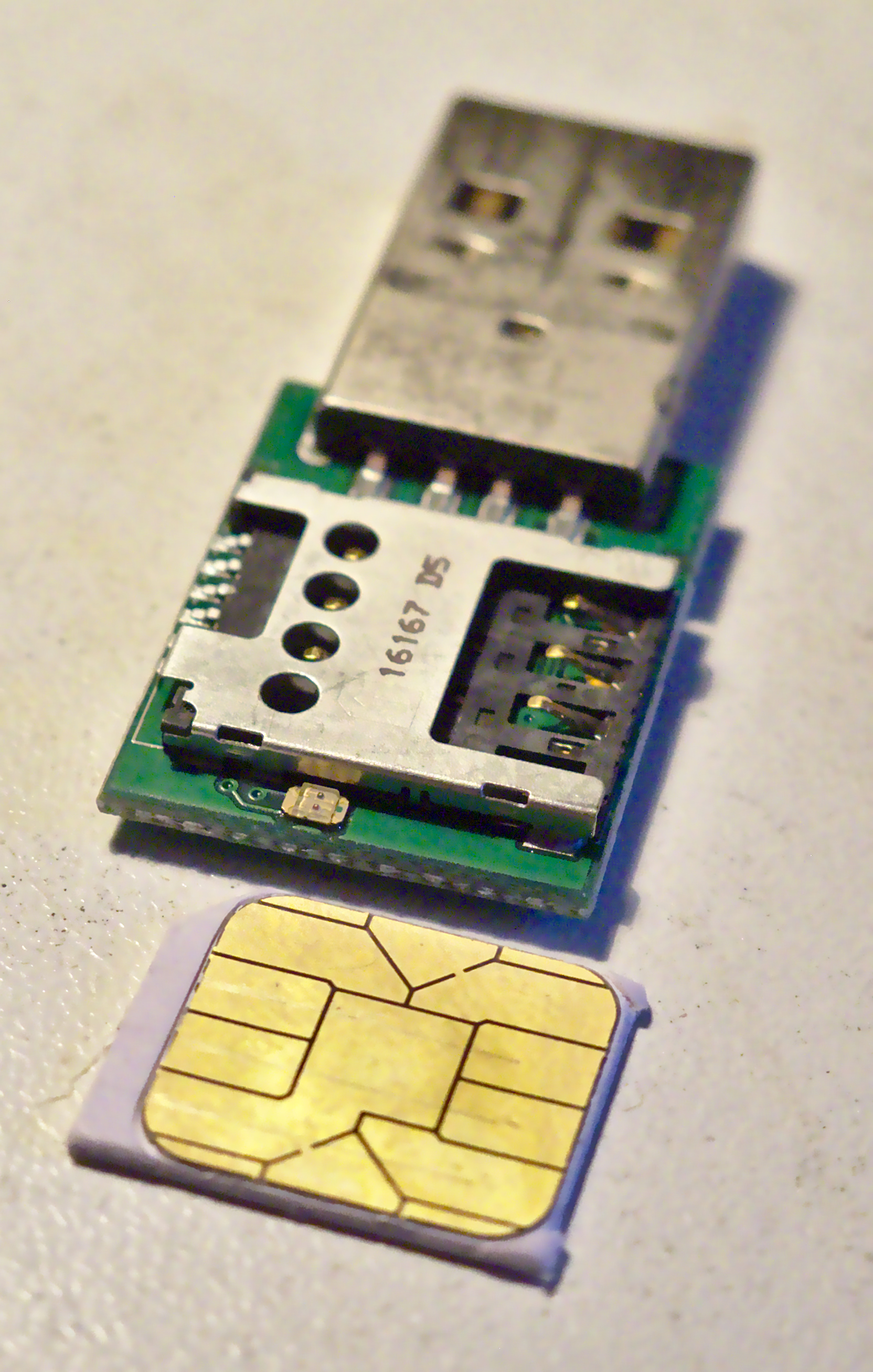
Form factor The Nitrokey Pro, YubiKey NEO (worn out), YubiKey 4, and FST-01 The four keycards have similar form factors: they all connect to a standard USB port, although both YubiKey keycards have a capacitive button by which the user triggers two-factor authentication and the YubiKey 4 can also require a button press to confirm private key use. The YubiKeys feel sturdier than the other two. The NEO has withstood two years of punishment in my pockets along with the rest of my "real" keyring and there is only minimal wear on the keycard in the picture. It's also thinner so it fits well on the keyring. The FST-01 stands out from the other two with its minimal design. Out of the box, the FST-01 comes without a case, so the circuitry is exposed. This is deliberate: one of its goals is to be as transparent as possible, both in terms of software and hardware design and you definitely get that feeling at the physical level. Unfortunately, that does mean it feels more brittle than other models: I wouldn't carry it in my pocket all the time, although there is a case that may protect the key a little better, but it does not provide an easy way to hook it into a keyring. In the group picture above, the FST-01 is the pink plastic thing, which is a rubbery casing I received along with the device when I got it. Notice how the USB connectors of the YubiKeys differ from the other two: while the FST-01 and the Nitrokey have standard USB connectors, the YubiKey has only a "half-connector", which is what makes it thinner than the other two. The "Nano" form factor takes this even further and almost disappears in the USB port. Unfortunately, this arrangement means the YubiKey NEO often comes loose and falls out of the USB port, especially when connected to a laptop. On my workstation, however, it usually stays put even with my whole keyring hanging off of it. I suspect this adds more strain to the host's USB port but that's a tradeoff I've lived with without any noticeable wear so far. Finally, the NEO has this peculiar feature of supporting NFC for certain operations, as LWN previously covered, but I haven't used that feature yet. The Nitrokey Pro looks like a normal USB key, in contrast with the other two devices. It does feel a little brittle when compared with the YubiKey, although only time will tell how much of a beating it can take. It has a small ring in the case so it is possible to carry it directly on your keyring, but I would be worried the cap would come off eventually. Nitrokey devices are also two times thicker than the Yubico models which makes them less convenient to carry around on keyrings.

Open and closed designs The FST-01 is as open as hardware comes, down to the PCB design available as KiCad files in this Git repository. The software running on the card is the Gnuk firmware that implements the OpenPGP card protocol, but you can also get it with firmware implementing a true random number generator (TRNG) called NeuG (pronounced "noisy"); the device is programmable through a standard Serial Wire Debug (SWD) port. The Nitrokey Start model also runs the Gnuk firmware. However, the Nitrokey website announces only ECC and RSA 2048-bit support for the Start, while the FST-01 also supports RSA-4096. Nitrokey's founder Jan Suhr, in a private email, explained that this is because "Gnuk doesn't support RSA-3072 or larger at a reasonable speed". Its devices (the Pro, Start, and HSM models) use a similar chip to the FST-01: the STM32F103 microcontroller. Nitrokey Pro with STM32F103TBU6 MCU Nitrokey also publishes its hardware designs, on GitHub, which shows the Pro is basically a fork of the FST-01, according to the ChangeLog. I opened the case to confirm it was using the STM MCU, something I should warn you against; I broke one of the pins holding it together when opening it so now it's even more fragile. But at least, I was able to confirm it was built using the STM32F103TBU6 MCU, like the FST-01. Nitrokey back side But this is where the comparison ends: on the back side, we find a SIM card reader that holds the OpenPGP card that, in turn, holds the private key material and does the cryptographic operations. So, in effect, the Nitrokey Pro is really a evolution of the original OpenPGP card readers. Nitrokey confirmed the OpenPGP card featured in the Pro is the same as the one shipped by the Free Software Foundation Europe (FSFE): the BasicCard built by ZeitControl. Those cards, however, are covered by NDAs and the firmware is only partially open source. This makes the Nitrokey Pro less open than the FST-01, but that's an inevitable tradeoff when choosing a design based on the OpenPGP cards, which Suhr described to me as "pretty proprietary". There are other keycards out there, however, for example the SLJ52GDL150-150k smartcard suggested by Debian developer Yves-Alexis Perez, which he prefers as it is certified by French and German authorities. In that blog post, he also said he was experimenting with the GPL-licensed OpenPGP applet implemented by the French ANSSI. But the YubiKey devices are even further away in the closed-design direction. Both the hardware designs and firmware are proprietary. The YubiKey NEO, for example, cannot be upgraded at all, even though it is based on an open firmware. According to Yubico's FAQ, this is due to "best security practices": "There is a 'no upgrade' policy for our devices since nothing, including malware, can write to the firmware." I find this decision questionable in a context where security updates are often more important than trying to design a bulletproof design, which may simply be impossible. And the YubiKey NEO did suffer from critical security issue that allowed attackers to bypass the PIN protection on the card, which raises the question of the actual protection of the private key material on those cards. According to Niibe, "some OpenPGP cards store the private key unencrypted. It is a common attitude for many smartcard implementations", which was confirmed by Suhr: "the private key is protected by hardware mechanisms which prevent its extraction and misuse". He is referring to the use of tamper resistance. After that security issue, there was no other option for YubiKey NEO users than to get a new keycard (for free, thankfully) from Yubico, which also meant discarding the private key material on the key. For OpenPGP keys, this may mean having to bootstrap the web of trust from scratch if the keycard was responsible for the main certification key. But at least the NEO is running free software based on the OpenPGP card applet and the source is still available on GitHub. The YubiKey 4, on the other hand, is now closed source, which was controversial when the new model was announced last year. It led the main Linux Foundation system administrator, Konstantin Ryabitsev, to withdraw his endorsement of Yubico products. In response, Yubico argued that this approach was essential to the security of its devices, which are now based on "a secure chip, which has built-in countermeasures to mitigate a long list of attacks". In particular, it claims that:
A commercial-grade AVR or ARM controller is unfit to be used in a security product. In most cases, these controllers are easy to attack, from breaking in via a debug/JTAG/TAP port to probing memory contents. Various forms of fault injection and side-channel analysis are possible, sometimes allowing for a complete key recovery in a shockingly short period of time.
While I understand those concerns, they eventually come down to the trust you have in an organization. Not only do we have to trust Yubico, but also hardware manufacturers and designs they have chosen. Every step in the hidden supply chain is then trusted to make correct technical decisions and not introduce any backdoors. History, unfortunately, is not on Yubico's side: Snowden revealed the example of RSA security accepting what renowned cryptographer Bruce Schneier described as a "bribe" from the NSA to weaken its ECC implementation, by using the presumably backdoored Dual_EC_DRBG algorithm. What makes Yubico or its suppliers so different from RSA Security? Remember that RSA Security used to be an adamant opponent to the degradation of encryption standards, campaigning against the Clipper chip in the first crypto wars. Even if we trust the Yubico supply chain, how can we trust a closed design using what basically amounts to security through obscurity? Publicly auditable designs are an important tradition in cryptography, and that principle shouldn't stop when software is frozen into silicon. In fact, a critical vulnerability called ROCA disclosed recently affects closed "smartcards" like the YubiKey 4 and allows full private key recovery from the public key if the key was generated on a vulnerable keycard. When speaking with Ars Technica, the researchers outlined the importance of open designs and questioned the reliability of certification:
Our work highlights the dangers of keeping the design secret and the implementation closed-source, even if both are thoroughly analyzed and certified by experts. The lack of public information causes a delay in the discovery of flaws (and hinders the process of checking for them), thereby increasing the number of already deployed and affected devices at the time of detection.
This issue with open hardware designs seems to be recurring topic of conversation on the Gnuk mailing list. For example, there was a discussion in September 2017 regarding possible hardware vulnerabilities in the STM MCU that would allow extraction of encrypted key material from the key. Niibe referred to a talk presented at the WOOT 17 workshop, where Johannes Obermaier and Stefan Tatschner, from the Fraunhofer Institute, demonstrated attacks against the STMF0 family MCUs. It is still unclear if those attacks also apply to the older STMF1 design used in the FST-01, however. Furthermore, extracted private key material is still protected by user passphrase, but the Gnuk uses a weak key derivation function, so brute-forcing attacks may be possible. Fortunately, there is work in progress to make GnuPG hash the passphrase before sending it to the keycard, which should make such attacks harder if not completely pointless. When asked about the Yubico claims in a private email, Niibe did recognize that "it is true that there are more weak points in general purpose implementations than special implementations". During the last DebConf in Montreal, Niibe explained:
If you don't trust me, you should not buy from me. Source code availability is only a single factor: someone can maliciously replace the firmware to enable advanced attacks.
Niibe recommends to "build the firmware yourself", also saying the design of the FST-01 uses normal hardware that "everyone can replicate". Those advantages are hard to deny for a cryptographic system: using more generic components makes it harder for hostile parties to mount targeted attacks. A counter-argument here is that it can be difficult for a regular user to audit such designs, let alone physically build the device from scratch but, in a mailing list discussion, Debian developer Ian Jackson explained that:
You don't need to be able to validate it personally. The thing spooks most hate is discovery. Backdooring supposedly-free hardware is harder (more costly) because it comes with greater risk of discovery. To put it concretely: if they backdoor all of them, someone (not necessarily you) might notice. (Backdooring only yours involves messing with the shipping arrangements and so on, and supposes that you specifically are of interest.)
Since that, as far as we know, the STM microcontrollers are not backdoored, I would tend to favor those devices instead of proprietary ones, as such a backdoor would be more easily detectable than in a closed design. Even though physical attacks may be possible against those microcontrollers, in the end, if an attacker has physical access to a keycard, I consider the key compromised, even if it has the best chip on the market. In our email exchange, Niibe argued that "when a token is lost, it is better to revoke keys, even if the token is considered secure enough". So like any other device, physical compromise of tokens may mean compromise of the key and should trigger key-revocation procedures.

Algorithms and performance To establish reliable performance results, I wrote a benchmark program naively called crypto-bench that could produce comparable results between the different keys. The program takes each algorithm/keycard combination and runs 1000 decryptions of a 16-byte file (one AES-128 block) using GnuPG, after priming it to get the password cached. I assume the overhead of GnuPG calls to be negligible, as it should be the same across all tokens, so comparisons are possible. AES encryption is constant across all tests as it is always performed on the host and fast enough to be irrelevant in the tests. I used the following:
  • Intel(R) Core(TM) i3-6100U CPU @ 2.30GHz running Debian 9 ("stretch"/stable amd64), using GnuPG 2.1.18-6 (from the stable Debian package)
  • Nitrokey Pro 0.8 (latest firmware)
  • FST-01, running Gnuk version 1.2.5 (latest firmware)
  • YubiKey NEO OpenPGP applet 1.0.10 (not upgradable)
  • YubiKey 4 4.2.6 (not upgradable)
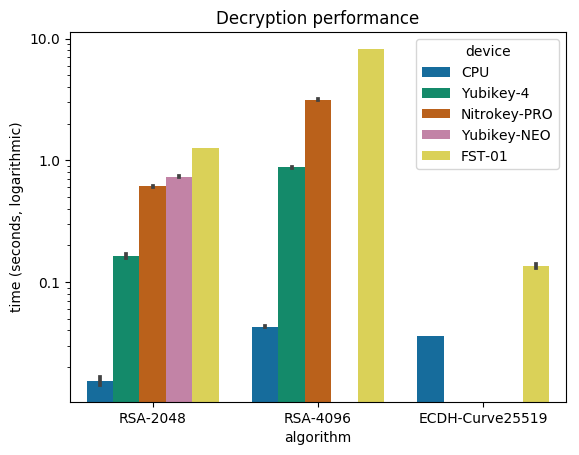
I ran crypto-bench for each keycard, which resulted in the following:
Algorithm Device Mean time (s)
ECDH-Curve25519 CPU 0.036
FST-01 0.135
RSA-2048 CPU 0.016
YubiKey-4 0.162
Nitrokey-Pro 0.610
YubiKey-NEO 0.736
FST-01 1.265
RSA-4096 CPU 0.043
YubiKey-4 0.875
Nitrokey-Pro 3.150
FST-01 8.218
Decryption graph There we see the performance of the four keycards I tested, compared with the same operations done without a keycard: the "CPU" device. That provides the baseline time of GnuPG decrypting the file. The first obvious observation is that using a keycard is slower: in the best scenario (FST-01 + ECC) we see a four-fold slowdown, but in the worst case (also FST-01, but RSA-4096), we see a catastrophic 200-fold slowdown. When I presented the results on the Gnuk mailing list, GnuPG developer Werner Koch confirmed those "numbers are as expected":
With a crypto chip RSA is much faster. By design the Gnuk can't be as fast - it is just a simple MCU. However, using Curve25519 Gnuk is really fast.
And yes, the FST-01 is really fast at doing ECC, but it's also the only keycard that handles ECC in my tests; the Nitrokey Start and Nitrokey HSM should support it as well, but I haven't been able to test those devices. Also note that the YubiKey NEO doesn't support RSA-4096 at all, so we can only compare RSA-2048 across keycards. We should note, however, that ECC is slower than RSA on the CPU, which suggests the Gnuk ECC implementation used by the FST-01 is exceptionally fast. In discussions about improving the performance of the FST-01, Niibe estimated the user tolerance threshold to be "2 seconds decryption time". In a new design using the STM32L432 microcontroller, Aurelien Jarno was able to bring the numbers for RSA-2048 decryption from 1.27s down to 0.65s, and for RSA-4096, from 8.22s down to 3.87s seconds. RSA-4096 is still beyond the two-second threshold, but at least it brings the FST-01 close to the YubiKey NEO and Nitrokey Pro performance levels. We should also underline the superior performance of the YubiKey 4: whatever that thing is doing, it's doing it faster than anyone else. It does RSA-4096 faster than the FST-01 does RSA-2048, and almost as fast as the Nitrokey Pro does RSA-2048. We should also note that the Nitrokey Pro also fails to cross the two-second threshold for RSA-4096 decryption. For me, the FST-01's stellar performance with ECC outshines the other devices. Maybe it says more about the efficiency of the algorithm than the FST-01 or Gnuk's design, but it's definitely an interesting avenue for people who want to deploy those modern algorithms. So, in terms of performance, it is clear that both the YubiKey 4 and the FST-01 take the prize in their own areas (RSA and ECC, respectively).

Conclusion In the above presentation, I have evaluated four cryptographic keycards for use with various OpenPGP operations. What the results show is that the only efficient way of storing a 4096-bit encryption key on a keycard would be to use the YubiKey 4. Unfortunately, I do not feel we should put our trust in such closed designs so I would argue you should either stick with 2048-bit encryption subkeys or keep the keys on disk. Considering that losing such a key would be catastrophic, this might be a good approach anyway. You should also consider switching to ECC encryption: even though it may not be supported everywhere, GnuPG supports having multiple encryption subkeys on a keyring: if one algorithm is unsupported (e.g. GnuPG 1.4 doesn't support ECC), it will fall back to a supported algorithm (e.g. RSA). Do not forget your previously encrypted material doesn't magically re-encrypt itself using your new encryption subkey, however. For authentication and signing keys, speed is not such an issue, so I would warmly recommend either the Nitrokey Pro or Start, or the FST-01, depending on whether you want to start experimenting with ECC algorithms. Availability also seems to be an issue for the FST-01. While you can generally get the device when you meet Niibe in person for a few bucks (I bought mine for around \$30 Canadian), the Seeed online shop says the device is out of stock at the time of this writing, even though Jonathan McDowell said that may be inaccurate in a debian-project discussion. Nevertheless, this issue may make the Nitrokey devices more attractive. When deciding on using the Pro or Start, Suhr offered the following advice:
In practice smart card security has been proven to work well (at least if you use a decent smart card). Therefore the Nitrokey Pro should be used for high security cases. If you don't trust the smart card or if Nitrokey Start is just sufficient for you, you can choose that one. This is why we offer both models.
So far, I have created a signing subkey and moved that and my authentication key to the YubiKey NEO, because it's a device I physically trust to keep itself together in my pockets and I was already using it. It has served me well so far, especially with its extra features like U2F and HOTP support, which I use frequently. Those features are also available on the Nitrokey Pro, so that may be an alternative if I lose the YubiKey. I will probably move my main certification key to the FST-01 and a LUKS-encrypted USB disk, to keep that certification key offline but backed up on two different devices. As for the encryption key, I'll wait for keycard performance to improve, or simply switch my whole keyring to ECC and use the FST-01 or Nitrokey Start for that purpose.
[The author would like to thank Nitrokey for providing hardware for testing.] This article first appeared in the Linux Weekly News.

13 October 2017

Alex Muntada: My Free Software Activities in Jul-Sep 2017

If you read Planet Debian often, you ve probably noticed a trend of Free Software activity reports at the beginning of the month. First, those reports seemed a bit unamusing and lengthy, but since I take the time to read them I ve learnt a lot of things, and now I m amazed at the amount of work that people are doing for Free Software. Indeed, I knew already that many people are doing lots of work. But reading those reports gives you an actual view of how much it is. Then, I decided that I should do the same and write some kind of report since I became a Debian Developer in July. I think it s a nice way to share your work with others and maybe inspire them as it happened to me. So I asked some of the people that have been inspiring me how do they do it. I mean, I was curious to know how they keep track of the work they do and how long it takes to write their reports. It seems that it takes quite some time, it s mostly manual work and usually starts by the end of the month, reviewing their contributions in mailing lists, bug trackers, e-mail folders, etc. Here I am now, writing my first report about my Free Software activities since July and until September 2017. I hope you like it: Happy hacking!

10 October 2017

Reproducible builds folks: Reproducible Builds: Weekly report #128

Here's what happened in the Reproducible Builds effort between Sunday October 1 and Saturday October 7 2017: Media coverage Documentation updates Packages reviewed and fixed, and bugs filed Reviews of unreproducible packages 32 package reviews have been added, 46 have been updated and 62 have been removed in this week, adding to our knowledge about identified issues. Weekly QA work During our reproducibility testing, FTBFS bugs have been detected and reported by: diffoscope development strip-nondeterminism development Rob Browning noticed that strip-nondeterminism was causing serious performance regressions in the Clojure programming language within Debian. After some discussion, Chris Lamb also posted a query to debian-devel in case there were any other programming languages that might be suffering from the same problem. reprotest development Versions 0.7.1 and 0.7.2 were uploaded to unstable by Ximin Luo: It included contributions already covered by posts of the previous weeks, as well as new ones from: tests.reproducible-builds.org Misc. This week's edition was written by Bernhard M. Wiedemann, Chris Lamb, Holger Levsen, Mattia Rizzolo & reviewed by a bunch of Reproducible Builds folks on IRC & the mailing lists.

9 October 2017

Markus Koschany: My Free Software Activities in September 2017

Welcome to gambaru.de. Here is my monthly report that covers what I have been doing for Debian. If you re interested in Java, Games and LTS topics, this might be interesting for you. Debian Games Debian Java Debian LTS This was my nineteenth month as a paid contributor and I have been paid to work 15,75 hours on Debian LTS, a project started by Rapha l Hertzog. In that time I did the following: Misc QA upload Thanks for reading and see you next time.

Gunnar Wolf: Achievement unlocked - Made with Creative Commons translated to Spanish! (Thanks, @xattack!)

I am very, very, very happy to report this And I cannot believe we have achieved this so fast: Back in June, I announced I'd start working on the translation of the Made with Creative Commons book into Spanish. Over the following few weeks, I worked out the most viable infrastructure, gathered input and commitments for help from a couple of friends, submitted my project for inclusion in the Hosted Weblate translations site (and got it approved!) Then, we quietly and slowly started working. Then, as it usually happens in late August, early September... The rush of the semester caught me in full, and I left this translation project for later For the next semester, perhaps... Today, I received a mail that surprised me. That stunned me. 99% of translated strings! Of course, it does not look as neat as "100%" would, but there are several strings not to be translated. So, yay for collaborative work! Oh, and FWIW Thanks to everybody who helped. And really, really, really, hats off to Luis Enrique Amaya, a friend whom I see way less than I should. A LIDSOL graduate, and a nice guy all around. Why to him specially? Well... This has several wrinkles to iron out, but, by number of translated lines: ...Need I say more? Luis, I hope you enjoyed reading the book :-] There is still a lot of work to do, and I'm asking the rest of the team some days so I can get my act together. From the mail I just sent, I need to:
  1. Review the Pandoc conversion process, to get the strings formatted again into a book; I had got this working somewhere in the process, but last I checked it broke. I expect this not to be too much of a hurdle, and it will help all other translations.
  2. Start the editorial process at my Institute. Once the book builds, I'll have to start again the stylistic correction process so the Institute agrees to print it out under its seal. This time, we have the hurdle that our correctors will probably hate us due to part of the work being done before we had actually agreed on some important Spanish language issues... which are different between Mexico, Argentina and Costa Rica (where translators are from). Anyway This sets the mood for a great start of the week. Yay!
AttachmentSize
Screenshot from 2017-10-08 20-55-30.png103.1 KB

3 October 2017

Reproducible builds folks: Reproducible Builds: Weekly report #127

Here's what happened in the Reproducible Builds effort between Sunday September 24 and Saturday September 30 2017: Development and fixes in key packages Kai Harries did an initial packaging of the Nix package manager for Debian. You can track his progress in #877019. Uploads in Debian: Packages reviewed and fixed, and bugs filed Patches sent upstream: Reproducible bugs (with patches) filed in Debian: QA bugs filed in Debian: Reviews of unreproducible packages 103 package reviews have been added, 153 have been updated and 78 have been removed in this week, adding to our knowledge about identified issues. Weekly QA work During our reproducibility testing, FTBFS bugs have been detected and reported by: diffoscope development Mattia Rizzolo uploaded version 87 to stretch-backports. strip-nondeterminism development reprotest development tests.reproducible-builds.org reproducible-website development Misc. This week's edition was written by Ximin Luo, Bernhard M. Wiedemann, Holger Levsen and Chris Lamb & reviewed by a bunch of Reproducible Builds folks on IRC & the mailing lists.

Christoph Egger: Another Xor (CSAW 2017)

A short while ago, FAUST participated in this year's CSAW qualification and -- as usual -- I was working on the Crypto challenges again. The first puzzle I worked on was called "Another Xor" -- and, while there are quite some write ups already our solution was somewhat different (maybe even the intended solution given how nice things worked out) and certainly interesting. The challenge provides a cipher-text. It's essentially a stream cipher with key repeated to generate the key stream. The plain-text was plain + key + checksum.
p = this is a plaintextThis is the keyfa5d46a2a2dcdeb83e0241ee2c0437f7
k = This is the keyThis is the keyThis is the keyThis is the keyThis i
Key length Our first step was figuring out the key length. Let's assume for now the key was This is the key. Notice that the key is also part of the plain-text and we know something about its location -- it ends at 32 characters from the back. If we only take a look at the encrypted key it should have the following structure:
p' = This is the key
k' = he keyThis is t
The thing to notice here is that every character in the Key appears both in the plain-text and key stream sequence. And the cipher-text is the XOR ( ) of both. Therefore XOR over the cipher-text sequence encrypting the key should equal 0 ( (p') (k') = 0). So remove the last 32 characters and find all suffixes that result in a XOR of 0. Fortunately there is exactly one such suffix (there could be multiple) and therefore we know the key size: 67. To put it in code, this basically is the function we implemented for this:
def calculate(ciphertextcandidate):
    accumulator = 0
    for char in ciphertextcandidate:
        accumulator = accumulator ^ char
Which, for the matching plain-text and key-stream fragments is equal (due to the XOR encryption) to
def calculate(plainfragment, keyfragment):
    accumulator = 0
    for i in range(len(plainfragment):
        accumulator = accumulator ^ (plainfragment[i] ^ keyfragment[i])
Now XOR lets us nicely reorder this to
def calculate(plainfragment, keyfragment):
    accumulator = 0
    for i in range(len(plainfragment):
        accumulator = accumulator ^ (plainfragment[i] ^
                                     keyfragment[(i + 6) % len(plainfragment)])
And, as plainfragment[i] and keyfragment[(i + 6) % len(plainfragment)] are equal for the plain-text range encoding the key this becomes
def calculate(plainfragment, keyfragment):
    accumulator = 0
    for i in range(len(plainfragment):
        accumulator = accumulator ^ 0
Or simply 0 if the guess of the cipher-text range is correct. Key recovery Now the nice thing to notice is that the length of the key (67) is a prime (and 38, the plain-text length, is a generator). As a result, we only need to guess one byte of the key: Assume you know one byte of the key (and the position). Now you can use that one byte of the key to decrypt the next byte of the key (using the area where the key is part of the plain-text). Due to the primeness of the key length this allows recovery of the full key. Finally you can either print all 256 options and look for the one that looks reasonable or you can verify the md5sum which will give you the one valid solution, flag sti11_us3_da_x0r_for_my_s3cratz . Code

cipher = b"'L\x10\x12\x1a\x01\x00I[P-U\x1cU\x7f\x0b\x083X]\x1b'\x03\x0bR(\x04\r7SI\n\x1c\x02T\x15\x05\x15%EQ\x18\x00\x19\x11SJ\x00RV\n\x14YO\x0b\x1eI\n\x01\x0cE\x14A\x1e\x07\x00\x14aZ\x18\x1b\x02R\x1bX\x03\x05\x17\x00\x02\x07K\n\x1aLAM\x1f\x1d\x17\x1d\x00\x15\x1b\x1d\x0fH\x0eI\x1e\x02I\x01\x0c\x15\x00P\x11\\PXPCB\x03B\x13TBL\x11PC\x0b^\tM\x14IW\x08\rDD%FC"
def keycover(guess):
    key = dict()
    pos = 38
    key[38] = guess
    for i in range(67):
        newpos = (pos % 67) + 38
        key[newpos] = xor(cipher[pos:], key[pos])
        pos = newpos
    try:
        return b''.join([ key[i] for i in range(38, 105, 1) ])
    except:
        return b'test'
for guess in range(256):
    keycand = keycover(bytes([guess]))
    plaincand = xor(cipher, repeat(keycand, len(cipher)))
    if md5(plaincand[:-32]).hexdigest().encode() == plaincand[-32:]:
        print(keycand, plaincand)

2 October 2017

James McCoy: Monthly FLOSS activity - 2017/09 edition

Debian devscripts Before deciding to take an indefinite hiatus from devscripts, I prepared one more upload merging various contributed patches and a bit of last minute cleanup. I also setup integration with Travis CI to hopefully catch issues sooner than "while preparing an upload", as was typically the case before. Anyone with push access to the Debian/devscripts GitHub repo can take advantage of this to test out changes, or keep the development branches up to date. In the process, I was able to make some improvements to travis.debian.net, namely support for DEB_BUILD_PROFILES and using a separate, minimal docker image for running autopkgtests. unibilium neovim Oddly, the mips64el builds were in BD-Uninstallable state, even though luajit's buildd status showed it was built. Looking further, I noticed the libluajit-5.1 ,-dev binary packages didn't have the mips64el architecture enabled, so I asked for it to be enabled. msgpack-c There were a few packages left which would FTBFS if I uploaded msgpack-c 2.x to unstable. All of the bug reports had either trivial work arounds (i.e., forcing use of the v1 C++ API) or trivial patches. However, I didn't want to continue waiting for the packages to get fixed since I knew other people had expressed interest in the new msgpack-c. Trying to avoid making other packages insta-buggy, I NMUed autobahn-cpp with the v1 work around. That didn't go over well, partly because I didn't send a finalized "Hey, I'd like to get this done and here's my plan to NMU" email. Based on that feedback, I decided to bump the remaining bugs to "serious" instead of NMUing and upload msgpack-c. Thanks to Jonas Smedegaard for quickly integrating my proposed fix for libdata-messagepack-perl. Hopefully, upstream has some time to review the PR soon. vim subversion

neovim

1 October 2017

Paul Wise: FLOSS Activities September 2017

Changes

Issues

Review

Administration
  • icns: merged patches
  • Debian: help guest user with access, investigate/escalate broken network, restart broken stunnels, investigate static.d.o storage, investigate weird RAID mails, ask hoster to investigate power issue,
  • Debian mentors: lintian/security updates & reboot
  • Debian wiki: merged & deployed patch, redirect DDTSS translator, redirect user support requests, whitelist email addresses, update email for accounts with bouncing email,
  • Debian derivatives census: merged/deployed patches
  • Debian PTS: debugged cron mails, deployed changes, reran scripts, fixed configuration file
  • Openmoko: debug reboot issue, debug load issues

Communication

Sponsors The samba bug was sponsored by my employer. All other work was done on a volunteer basis.

30 September 2017

Chris Lamb: Free software activities in September 2017

Here is my monthly update covering what I have been doing in the free software world in September 2017 (previous month):
Reproducible builds

Whilst anyone can inspect the source code of free software for malicious flaws, most software is distributed pre-compiled to end users. The motivation behind the Reproducible Builds effort is to allow verification that no flaws have been introduced either maliciously or accidentally during this compilation process by promising identical results are always generated from a given source, thus allowing multiple third-parties to come to a consensus on whether a build was compromised. I have generously been awarded a grant from the Core Infrastructure Initiative to fund my work in this area. This month I:
  • Published a short blog post about how to determine which packages on your system are reproducible. [...]
  • Submitted a pull request for Numpy to make the generated config.py files reproducible. [...]
  • Provided a patch to GTK upstream to ensure the immodules.cache files are reproducible. [...]
  • Within Debian:
    • Updated isdebianreproducibleyet.com, moving it to HTTPS, adding cachebusting as well as keeping the number up-to-date.
    • Submitted the following patches to fix reproducibility-related toolchain issues:
      • gdk-pixbuf: Make the output of gdk-pixbuf-query-loaders reproducible. (#875704)
      • texlive-bin: Make PDF IDs reproducible. (#874102)
    • Submitted a patch to fix a reproducibility issue in doit.
  • Categorised a large number of packages and issues in the Reproducible Builds "notes" repository.
  • Chaired our monthly IRC meeting. [...]
  • Worked on publishing our weekly reports. (#123, #124, #125, #126 & #127)


I also made the following changes to our tooling:
reproducible-check

reproducible-check is our script to determine which packages actually installed on your system are reproducible or not.

  • Handle multi-architecture systems correctly. (#875887)
  • Use the "restricted" data file to mask transient issues. (#875861)
  • Expire the cache file after one day and base the local cache filename on the remote name. [...] [...]
I also blogged about this utility. [...]
diffoscope

diffoscope is our in-depth and content-aware diff utility that can locate and diagnose reproducibility issues.

  • Filed an issue attempting to identify the causes behind an increased number of timeouts visible in our CI infrastructure, including running a number of benchmarks of recent versions. (#875324)
  • New features:
    • Add "binwalking" support to analyse concatenated CPIO archives such as initramfs images. (#820631).
    • Print a message if we are reading data from standard input. [...]
  • Bug fixes:
    • Loosen matching of file(1)'s output to ensure we correctly also match TTF files under file version 5.32. [...]
    • Correct references to path_apparent_size in comparators.utils.file and self.buf in diffoscope.diff. [...] [...]
  • Testing:
    • Make failing some critical flake8 tests result in a failed build. [...]
    • Check we identify all CPIO fixtures. [...]
  • Misc:
    • No need for try-assert-except block in setup.py. [...]
    • Compare types with identity not equality. [...] [...]
    • Use logging.py's lazy argument interpolation. [...]
    • Remove unused imports. [...]
    • Numerous PEP8, flake8, whitespace, other cosmetic tidy-ups.

strip-nondeterminism

strip-nondeterminism is our tool to remove specific non-deterministic results from a completed build.

  • Log which handler processed a file. (#876140). [...]

disorderfs

disorderfs is our FUSE-based filesystem that deliberately introduces non-determinism into directory system calls in order to flush out reproducibility issues.


Debian My activities as the current Debian Project Leader are covered in my monthly "Bits from the DPL" email to the debian-devel-announce mailing list.
Lintian I made a large number of changes to Lintian, the static analysis tool for Debian packages. It reports on various errors, omissions and general quality-assurance issues to maintainers: I also blogged specifically about the Lintian 2.5.54 release.

Patches contributed
  • debconf: Please add a context manager to debconf.py. (#877096)
  • nm.debian.org: Add pronouns to ALL_STATUS_DESC. (#875128)
  • user-setup: Please drop set_special_users hack added for "the convenience of heavy testers". (#875909)
  • postgresql-common: Please update README.Debian for PostgreSQL 10. (#876438)
  • django-sitetree: Should not mask test failures. (#877321)
  • charmtimetracker:
    • Missing binary dependency on libqt5sql5-sqlite. (#873918)
    • Please drop "Cross-Platform" from package description. (#873917)
I also submitted 5 patches for packages with incorrect calls to find(1) in debian/rules against hamster-applet, libkml, pyferret, python-gssapi & roundcube.

Debian LTS

This month I have been paid to work 15 hours on Debian Long Term Support (LTS). In that time I did the following:
  • "Frontdesk" duties, triaging CVEs, etc.
  • Documented an example usage of autopkgtests to test security changes.
  • Issued DLA 1084-1 and DLA 1085-1 for libidn and libidn2-0 to fix an integer overflow vulnerabilities in Punycode handling.
  • Issued DLA 1091-1 for unrar-free to prevent a directory traversal vulnerability from a specially-crafted .rar archive. This update introduces an regression test.
  • Issued DLA 1092-1 for libarchive to prevent malicious .xar archives causing a denial of service via a heap-based buffer over-read.
  • Issued DLA 1096-1 for wordpress-shibboleth, correcting an cross-site scripting vulnerability in the Shibboleth identity provider module.

Uploads
  • python-django:
    • 1.11.5-1 New upstream security release. (#874415)
    • 1.11.5-2 Apply upstream patch to fix QuerySet.defer() with "super" and "subclass" fields. (#876816)
    • 2.0~alpha1-2 New upstream alpha release of Django 2.0, dropping support for Python 2.x.
  • redis:
    • 4.0.2-1 New upstream release.
    • 4.0.2-2 Update 0004-redis-check-rdb autopkgtest test to ensure that the redis.rdb file exists before testing against it.
    • 4.0.2-2~bpo9+1 Upload to stretch-backports.
  • aptfs (0.11.0-1) New upstream release, moving away from using /var/lib/apt/lists internals. Thanks to Julian Andres Klode for a helpful bug report. (#874765)
  • lintian (2.5.53, 2.5.54) New upstream releases. (Documented in more detail above.)
  • bfs (1.1.2-1) New upstream release.
  • docbook-to-man (1:2.0.0-39) Tighten autopkgtests and enable testing via travis.debian.net.
  • python-daiquiri (1.3.0-1) New upstream release.

I also made the following non-maintainer uploads (NMUs):

Debian bugs filed
  • clipit: Please choose a sensible startup default in "live" mode. (#875903)
  • git-buildpackage: Please add a --reset option to gbp pull. (#875852)
  • bluez: Please default Device "friendly name" to hostname without domain. (#874094)
  • bugs.debian.org: Please explicitly link to packages,tracker .debian.org. (#876746)
  • Requests for packaging:
    • selfspy log everything you do on the computer. (#873955)
    • shoogle use the Google API from the shell. (#873916)

FTP Team

As a Debian FTP assistant I ACCEPTed 86 packages: bgw-replstatus, build-essential, caja-admin, caja-rename, calamares, cdiff, cockpit, colorized-logs, comptext, comptty, copyq, django-allauth, django-paintstore, django-q, django-test-without-migrations, docker-runc, emacs-db, emacs-uuid, esxml, fast5, flake8-docstrings, gcc-6-doc, gcc-7-doc, gcc-8, golang-github-go-logfmt-logfmt, golang-github-google-go-cmp, golang-github-nightlyone-lockfile, golang-github-oklog-ulid, golang-pault-go-macchanger, h2o, inhomog, ip4r, ldc, libayatana-appindicator, libbson-perl, libencoding-fixlatin-perl, libfile-monitor-lite-perl, libhtml-restrict-perl, libmojo-rabbitmq-client-perl, libmoosex-types-laxnum-perl, libparse-mime-perl, libplack-test-agent-perl, libpod-projectdocs-perl, libregexp-pattern-license-perl, libstring-trim-perl, libtext-simpletable-autowidth-perl, libvirt, linux, mac-fdisk, myspell-sq, node-coveralls, node-module-deps, nov-el, owncloud-client, pantomime-clojure, pg-dirtyread, pgfincore, pgpool2, pgsql-asn1oid, phpliteadmin, powerlevel9k, pyjokes, python-evdev, python-oslo.db, python-pygal, python-wsaccel, python3.7, r-cran-bindrcpp, r-cran-dotcall64, r-cran-glue, r-cran-gtable, r-cran-pkgconfig, r-cran-rlang, r-cran-spatstat.utils, resolvconf-admin, retro-gtk, ring-ssl-clojure, robot-detection, rpy2-2.8, ruby-hocon, sass-stylesheets-compass, selinux-dbus, selinux-python, statsmodels, webkit2-sharp & weston. I additionally filed 4 RC bugs against packages that had incomplete debian/copyright files against: comptext, comptext, ldc & python-oslo.concurrency.

Iain R. Learmonth: Breaking RSS Change in Hugo

My website and blog are managed by the static site generator Hugo. I ve found this to be a stable and flexible system, but at the last upgrade a breaking change has occurred that broken the syndication of my blog on various planets. At first I thought perhaps with my increased posting rate the planets were truncating my posts but this was not the case. The problem was in Hugo pull request #3129 where for some reason they have changed the RSS feed to contain only a lead instead of the full article. I ve seen other content management systems offer a similar option but at least they point out that it s truncated and offer a read more link. Here it just looks like I m publishing truncated unfinished really short posts. If you take a look at the post above, you ll see that the change is in an embedded template and it took a little reading the docs to work out how to revert the change. The steps are actually not that difficult, but it s still annoying that the change occurred. In a Hugo site, you will have a layouts directory that will contain your overrides from your theme. Create a new file in the path layouts/_default/rss.xml (you may need to create the _default directory) with the following content:
<rss version="2.0" xmlns:atom="http://www.w3.org/2005/Atom">
  <channel>
    <title>  if eq  .Title  .Site.Title   .Site.Title   else   with .Title  .  on   end   .Site.Title   end  </title>
    <link>  .Permalink  </link>
    <description>Recent content   if ne  .Title  .Site.Title   with .Title  in  .    end   end  on   .Site.Title  </description>
    <generator>Hugo -- gohugo.io</generator>  with .Site.LanguageCode  
    <language> . </language> end  with .Site.Author.email  
    <managingEditor> .  with $.Site.Author.name   ( . ) end </managingEditor> end  with .Site.Author.email  
    <webMaster> .  with $.Site.Author.name   ( . ) end </webMaster> end  with .Site.Copyright  
    <copyright> . </copyright> end  if not .Date.IsZero  
    <lastBuildDate>  .Date.Format "Mon, 02 Jan 2006 15:04:05 -0700"   safeHTML  </lastBuildDate>  end  
      with .OutputFormats.Get "RSS"  
          printf "<atom:link href=%q rel=\"self\" type=%q />" .Permalink .MediaType   safeHTML  
      end  
      range .Data.Pages  
    <item>
      <title>  .Title  </title>
      <link>  .Permalink  </link>
      <pubDate>  .Date.Format "Mon, 02 Jan 2006 15:04:05 -0700"   safeHTML  </pubDate>
        with .Site.Author.email  <author> .  with $.Site.Author.name   ( . ) end </author> end 
      <guid>  .Permalink  </guid>
      <description>  .Content   html  </description>
    </item>
      end  
  </channel>
</rss>
If you like my new Hugo theme, please let me know and I ll bump tidying it up and publishing it further up my todo list.

28 September 2017

Russell Coker: Process Monitoring

Since forking the Mon project to etbemon [1] I ve been spending a lot of time working on the monitor scripts. Actually monitoring something is usually quite easy, deciding what to monitor tends to be the hard part. The process monitoring script ps.monitor is the one I m about to redesign. Here are some of my ideas for monitoring processes. Please comment if you have any suggestions for how do do things better. For people who don t use mon, the monitor scripts return 0 if everything is OK and 1 if there s a problem along with using stdout to display an error message. While I m not aware of anyone hooking mon scripts into a different monitoring system that s going to be easy to do. One thing I plan to work on in the future is interoperability between mon and other systems such as Nagios. Basic Monitoring
ps.monitor tor:1-1 master:1-2 auditd:1-1 cron:1-5 rsyslogd:1-1 dbus-daemon:1- sshd:1- watchdog:1-2
I m currently planning some sort of rewrite of the process monitoring script. The current functionality is to have a list of process names on the command line with minimum and maximum numbers for the instances of the process in question. The above is a sample of the configuration of the monitor. There are some limitations to this, the master process in this instance refers to the main process of Postfix, but other daemons use the same process name (it s one of those names that s wrong because it s so obvious). One obvious solution to this is to give the option of specifying the full path so that /usr/lib/postfix/sbin/master can be differentiated from all the other programs named master. The next issue is processes that may run on behalf of multiple users. With sshd there is a single process to accept new connections running as root and a process running under the UID of each logged in user. So the number of sshd processes running as root will be one greater than the number of root login sessions. This means that if a sysadmin logs in directly as root via ssh (which is controversial and not the topic of this post merely something that people do which I have to support) and the master process then crashes (or the sysadmin stops it either accidentally or deliberately) there won t be an alert about the missing process. Of course the correct thing to do is to have a monitor talk to port 22 and look for the string SSH-2.0-OpenSSH_ . Sometimes there are multiple instances of a daemon running under different UIDs that need to be monitored separately. So obviously we need the ability to monitor processes by UID. In many cases process monitoring can be replaced by monitoring of service ports. So if something is listening on port 25 then it probably means that the Postfix master process is running regardless of what other master processes there are. But for my use I find it handy to have multiple monitors, if I get a Jabber message about being unable to send mail to a server immediately followed by a Jabber message from that server saying that master isn t running I don t need to fully wake up to know where the problem is. SE Linux One feature that I want is monitoring SE Linux contexts of processes in the same way as monitoring UIDs. While I m not interested in writing tests for other security systems I would be happy to include code that other people write. So whatever I do I want to make it flexible enough to work with multiple security systems. Transient Processes Most daemons have a second process of the same name running during the startup process. This means if you monitor for exactly 1 instance of a process you may get an alert about 2 processes running when logrotate or something similar restarts the daemon. Also you may get an alert about 0 instances if the check happens to run at exactly the wrong time during the restart. My current way of dealing with this on my servers is to not alert until the second failure event with the alertafter 2 directive. The failure_interval directive allows specifying the time between checks when the monitor is in a failed state, setting that to a low value means that waiting for a second failure result doesn t delay the notification much. To deal with this I ve been thinking of making the ps.monitor script automatically check again after a specified delay. I think that solving the problem with a single parameter to the monitor script is better than using 2 configuration directives to mon to work around it. CPU Use Mon currently has a loadavg.monitor script that to check the load average. But that won t catch the case of a single process using too much CPU time but not enough to raise the system load average. Also it won t catch the case of a CPU hungry process going quiet (EG when the SETI at Home server goes down) while another process goes into an infinite loop. One way of addressing this would be to have the ps.monitor script have yet another configuration option to monitor CPU use, but this might get confusing. Another option would be to have a separate script that alerts on any process that uses more than a specified percentage of CPU time over it s lifetime or over the last few seconds unless it s in a whitelist of processes and users who are exempt from such checks. Probably every regular user would be exempt from such checks because you never know when they will run a file compression program. Also there is a short list of daemons that are excluded (like BOINC) and system processes (like gzip which is run from several cron jobs). Monitoring for Exclusion A common programming mistake is to call setuid() before setgid() which means that the program doesn t have permission to call setgid(). If return codes aren t checked (and people who make such rookie mistakes tend not to check return codes) then the process keeps elevated permissions. Checking for processes running as GID 0 but not UID 0 would be handy. As an aside a quick examination of a Debian/Testing workstation didn t show any obvious way that a process with GID 0 could gain elevated privileges, but that could change with one chmod 770 command. On a SE Linux system there should be only one process running with the domain init_t. Currently that doesn t happen in Stretch systems running daemons such as mysqld and tor due to policy not matching the recent functionality of systemd as requested by daemon service files. Such issues will keep occurring so we need automated tests for them. Automated tests for configuration errors that might impact system security is a bigger issue, I ll probably write a separate blog post about it.

Russ Allbery: Review: The Seventh Bride

Review: The Seventh Bride, by T. Kingfisher
Publisher: 47North
Copyright: 2015
ISBN: 1-5039-4975-3
Format: Kindle
Pages: 225
There are two editions of this book, although only one currently for sale. This review is of the second edition, released in November of 2015. T. Kingfisher is a pen name for Ursula Vernon when she's writing for adults. Rhea is a miller's daughter. She's fifteen, obedient, wary of swans, respectful to her parents, and engaged to Lord Crevan. The last was a recent and entirely unexpected development. It's not that she didn't expect to get married eventually, since of course that's what one does. And it's not that Lord Crevan was a stranger, since that's often how it went with marriage for people like her. But she wasn't expecting to get married now, and it was not at all clear why Lord Crevan would want to marry her in particular. Also, something felt not right about the entire thing. And it didn't start feeling any better when she finally met Lord Crevan for the first time, some days after the proposal to her parents. The decidedly non-romantic hand kissing didn't help, nor did the smug smile. But it's not like she had any choice. The miller's daughter doesn't say no to a lord and a friend of the viscount. The miller's family certainly doesn't say no when they're having trouble paying the bills, the viscount owns the mill, and they could be turned out of their livelihood at a whim. They still can't say no when Lord Crevan orders Rhea to come to his house in the middle of the night down a road that quite certainly doesn't exist during the day, even though that's very much not the sort of thing that is normally done. Particularly before the marriage. Friends of the viscount who are also sorcerers can get away with quite a lot. But Lord Crevan will discover that there's still a limit to how far he can order Rhea around, and practical-minded miller's daughters can make a lot of unexpected friends even in dire circumstances. The Seventh Bride is another entry in T. Kingfisher's series of retold fairy tales, although the fairy tale in question is less clear than with The Raven and the Reindeer. Kirkus says it's a retelling of Bluebeard, but I still don't quite see that in the story. I think one could argue equally easily that it's an original story. Nonetheless, it is a fairy tale: it has that fairy tale mix of magical danger and practical morality, and it's about courage and friendships and their consequences. It also has a hedgehog. This is an T. Kingfisher story, so it's packed full of bits of marvelous phrasing that I want to read over and over again. It has wonderful characters, the hedgehog among them, and it has, at its heart, a sort of foundational decency and stubborn goodness that's deeply satisfying for the reader. The Seventh Bride is a lot closer to horror than the other T. Kingfisher books I've read, but it never fell into my dislike of the horror genre, despite a few gruesome bits. I think that's because neither Rhea nor the narrator treat the horrific aspects as representative of the true shape of the world. Rhea instead confronts them with a stubborn determination and an attempt to make the best of each moment, and with a practical self-awareness that I loved reading about.
The problem with crying in the woods, by the side of a white road that leads somewhere terrible, is that the reason for crying isn't inside your head. You have a perfectly legitimate and pressing reason for crying, and it will still be there in five minutes, except that your throat will be raw and your eyes will itch and absolutely nothing else will have changed.
Lord Crevan, when Rhea finally reaches him, toys with her by giving her progressively more horrible puzzle tasks, threatening her with the promised marriage if she fails at any of them. The way this part of the book finally resolves is one of the best moments I've read in any book. Kingfisher captures an aspect of moral decisions, and a way in which evil doesn't work the way that evil people expect it to work, that I can't remember seeing an author capture this well. There are a lot of things here for Rhea to untangle: the nature of Crevan's power, her unexpected allies in his manor, why he proposed marriage to her, and of course how to escape his power. The plot works, but I don't think it was the best part of the book, and it tends to happen to Rhea rather than being driven by her. But I have rarely read a book quite this confident of its moral center, or quite as justified in that confidence. I am definitely reading everything Vernon has published under the T. Kingfisher name, and quite possibly most of her children's books as well. Recommended, particularly if you liked the excerpt above. There's an entire book full of paragraphs like that waiting for you. Rating: 8 out of 10

27 September 2017

Enrico Zini: Qt cross-architecture development in Debian

Use case: use Debian Stable as an environment to run amd64 development machines to develop Qt applications for Raspberry Pi or other smallish armhf devices. Qt Creator is used as Integrated Development Environment, and it supports cross-compiling, running the built source on the target system, and remote debugging. Debian Stable (vanilla or Raspbian) runs on both the host and the target systems, so libraries can be kept in sync, and both systems have access to a vast amount of libraries, with security support. On top of that, armhf libraries can be installed with multiarch also in the host machine, so cross-builders have access to the exact same libraries as the target system. This sounds like a dream system. But. We're not quite there yet. cross-compile attempts I tried cross compiling a few packages:
$ sudo debootstrap stretch cross
$ echo "strech_cross"   sudo tee cross/etc/debian_chroot
$ sudo systemd-nspawn -D cross
# dpkg --add-architecture armhf
# echo "deb-src http://deb.debian.org/debian stretch main" >> /etc/apt/sources.list
# apt update
# apt install --no-install-recommends build-essential crossbuild-essential-armhf
Some packages work:
# apt source bc
# cd bc-1.06.95/
# apt-get build-dep -a armhf .
# dpkg-buildpackage -aarmhf -j2 -b
 
dh_auto_configure -- --prefix=/usr --with-readline
        ./configure --build=x86_64-linux-gnu --prefix=/usr --includedir=\$ prefix /include --mandir=\$ prefix /share/man --infodir=\$ prefix /share/info --sysconfdir=/etc --localstatedir=/var --disable-silent-rules --libdir=\$ prefix /lib/arm-linux-gnueabihf --libexecdir=\$ prefix /lib/arm-linux-gnueabihf --disable-maintainer-mode --disable-dependency-tracking --host=arm-linux-gnueabihf --prefix=/usr --with-readline
 
dpkg-deb: building package 'dc-dbgsym' in '../dc-dbgsym_1.06.95-9_armhf.deb'.
dpkg-deb: building package 'bc-dbgsym' in '../bc-dbgsym_1.06.95-9_armhf.deb'.
dpkg-deb: building package 'dc' in '../dc_1.06.95-9_armhf.deb'.
dpkg-deb: building package 'bc' in '../bc_1.06.95-9_armhf.deb'.
 dpkg-genbuildinfo --build=binary
 dpkg-genchanges --build=binary >../bc_1.06.95-9_armhf.changes
dpkg-genchanges: info: binary-only upload (no source code included)
 dpkg-source --after-build bc-1.06.95
dpkg-buildpackage: info: binary-only upload (no source included)
With qmake based Qt packages, qmake is not configured for cross-building, probably because it is not currently supported:
# apt source pumpa
# cd pumpa-0.9.3/
# apt-get build-dep -a armhf .
# dpkg-buildpackage -aarmhf -j2 -b
 
        qmake -makefile -nocache "QMAKE_CFLAGS_RELEASE=-g -O2 -fdebug-prefix-map=/root/pumpa-0.9.3=.
          -fstack-protector-strong -Wformat -Werror=format-security -Wdate-time -D_FORTIFY_SOURCE=2"
          "QMAKE_CFLAGS_DEBUG=-g -O2 -fdebug-prefix-map=/root/pumpa-0.9.3=. -fstack-protector-strong
          -Wformat -Werror=format-security -Wdate-time -D_FORTIFY_SOURCE=2"
          "QMAKE_CXXFLAGS_RELEASE=-g -O2 -fdebug-prefix-map=/root/pumpa-0.9.3=. -fstack-protector-strong
          -Wformat -Werror=format-security -Wdate-time -D_FORTIFY_SOURCE=2"
          "QMAKE_CXXFLAGS_DEBUG=-g -O2 -fdebug-prefix-map=/root/pumpa-0.9.3=. -fstack-protector-strong
          -Wformat -Werror=format-security -Wdate-time -D_FORTIFY_SOURCE=2"
          "QMAKE_LFLAGS_RELEASE=-Wl,-z,relro -Wl,-z,now"
          "QMAKE_LFLAGS_DEBUG=-Wl,-z,relro -Wl,-z,now" QMAKE_STRIP=: PREFIX=/usr
qmake: could not exec '/usr/lib/x86_64-linux-gnu/qt5/bin/qmake': No such file or directory
 
debian/rules:19: recipe for target 'build' failed
make: *** [build] Error 2
dpkg-buildpackage: error: debian/rules build gave error exit status 2
With cmake based Qt packages it goes a little better in that it finds the cross compiler, pkg-config and some multiarch paths, but then it tries to run armhf moc, which fails:
# apt source caneda
# cd caneda-0.3.0/
# apt-get build-dep -a armhf .
# dpkg-buildpackage -aarmhf -j2 -b
 
        cmake .. -DCMAKE_INSTALL_PREFIX=/usr -DCMAKE_VERBOSE_MAKEFILE=ON -DCMAKE_BUILD_TYPE=None
          -DCMAKE_INSTALL_SYSCONFDIR=/etc -DCMAKE_INSTALL_LOCALSTATEDIR=/var -DCMAKE_SYSTEM_NAME=Linux
          -DCMAKE_SYSTEM_PROCESSOR=arm -DCMAKE_C_COMPILER=arm-linux-gnueabihf-gcc
          -DCMAKE_CXX_COMPILER=arm-linux-gnueabihf-g\+\+
          -DPKG_CONFIG_EXECUTABLE=/usr/bin/arm-linux-gnueabihf-pkg-config
          -DCMAKE_INSTALL_LIBDIR=lib/arm-linux-gnueabihf
 
CMake Error at /usr/lib/arm-linux-gnueabihf/cmake/Qt5Core/Qt5CoreConfig.cmake:27 (message):
  The imported target "Qt5::Core" references the file
     "/usr/lib/arm-linux-gnueabihf/qt5/bin/moc"
  but this file does not exist.  Possible reasons include:
  * The file was deleted, renamed, or moved to another location.
  * An install or uninstall procedure did not complete successfully.
  * The installation package was faulty and contained
     "/usr/lib/arm-linux-gnueabihf/cmake/Qt5Core/Qt5CoreConfigExtras.cmake"
  but not all the files it references.
Note: Although I improvised a chroot to be able to fool around with it, I would use pbuilder or sbuild to do the actual builds. Helmut suggests pbuilder --host-arch or sbuild --host. Doing it the non-Debian way This guide in the meantime explains how to set up a cross-compiling Qt toolchain in a rather dirty way, by recompiling Qt pointing it at pieces of the Qt deployed on the Raspberry Pi. Following that guide, replacing the CROSS_COMPILE value with /usr/bin/arm-linux-gnueabihf- gave me a working qtbase, for which it is easy to create a Kit for Qt Creator that works, and supports linking applications with Debian development packages that do not use Qt. However, at that point I need to recompile all dependencies that use Qt myself, and I quickly got stuck at that monster of QtWebEngine, whose sources embed the whole of Chromium. Having a Qt based development environment in which I need to become the maintainer for the whole Qt toolchain is not a product I can offer to a customer. Cross compiling qmake based packages on stretch is not currently supported, so at the moment I had to suggest to postpone all plans for total world domination for at least two years. Cross-building Debian In the meantime, Helmut Grohne has been putting a lot of effort into making Debian packages cross-buildable:
helmut> enrico: yes, cross building is painful. we have ~26000 source packages. of those, ~13000 build arch-dep packages. of those, ~6000 have cross-satisfiable build-depends. of those, I tried cross building ~2300. of those 1300 cross built. so we are at about 10% working. helmut> enrico: plus there are some 607 source packages affected by some 326 bugs with patches. helmut> enrico: gogo nmu them helmut> enrico: I've filed some 1000 bugs (most of them with patches) now. around 600 are fixed :)
He is doing it mostly alone, and I would like people not to be alone when they do a lot of work in Debian, so Join Helmut in the effort of making Debian cross-buildable! Build any Debian package for any device right from the comfort of your own work computer! Have a single development environment seamlessly spanning architecture boundaries, with the power of all that there is in Debian! Join Helmut in the effort of making Debian cross-buildable! Apply here, or join #debian-bootstrap on OFTC! Cross-building Qt in Debian mitya57 summarised the situation on the KDE team side:
mitya57> we have cross-building stuff on our TODO list, but it will likely require a lot of time and neither Lisandro nor I have it currently. mitya57> see https://gobby.debian.org/export/Teams/KDE/qt-cross for a summary of what needs to be done. mitya57> Any help or patches are always welcome :))
qemu-user-static Helmut also suggested to use qemu-user-static to make the host system able to run binaries compiled for the target system, so that even if a non-cross-compiling Qt build tries to run moc and friends in their target architecture version, they would transparently succeed. At that point, it would just be a matter of replacing compiler paths to point to the native cross-compiling gcc, and the build would not be slowed down by much. Fixing bug #781226 would help in making it possible to configure a multiarch version of qmake as the qmake used for cross compiling. I have not had a chance of trying to cross-build in this way yet. In the meantime... Having qtcreator able to work on an amd64 devel machine and deploy/test/debug remotely on an arm target machine, where both machine run debian stable and have libraries in sync, would be a great thing to have even though packages do not cross-build yet. Helmut summarised the situation on IRC:
svuorela and others repeat that Qt upstream is not compatible with Debian's multiarch thinking, in that Qt upstream insists on having one toolchain for each pair of architectures, whereas the Debian way tends to be to make packages generic and split stuff such that it can be mixed and matched. An example being that you need to run qmake (thus you need qmake for the build architecture), but qmake also embeds the relevant paths and you need to query it for them (so you need qmake for the host architecture) Either you run it through qemu, or you have a particular cross qmake for your build/host pair, or you fix qt upstream to stop this madness
Building qmake in Debian for each host-target pair, even just limited to released architectures, would mean building Qt 100 times, and that's not going to scale. I wonder:

Next.

Previous.