Search Results: "reg"

9 March 2022

Jonathan Dowland: Broken webcam aspect ratio

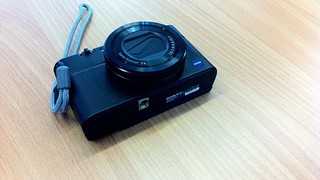
picture of my Sony RX100-III camera Sony RX100-III, relegated to a webcam
Sometimes I have remote meetings with Google Meet. Unlike the other video-conferencing services that I use (Bluejeans, Zoom), my video was stretched out of proportion under Google Meet with Firefox. I haven't found out why this was happening, but I did figure out a work-around. Thanks to Daniel Silverstone, Rob Kendrick, Gregor Herrmann and Ben Allen for pointing me in the right direction! Hardware The lovely Sony RX-100 mk3 that I bought in 2015 has spent most of its life languishing unused. During the Pandemic, once I was working from home all the time, I decided to press-gang it into service as a better-quality webcam. Newer models of this camera the mark 4 onwards have support for a USB mode called "PC Remote", which effectively makes them into webcams. Unfortunately my mark 3 does not support this, but it does have HDMI out, so I picked up a cheap "HDMI to USB Video Capture Card" from eBay. Video modes
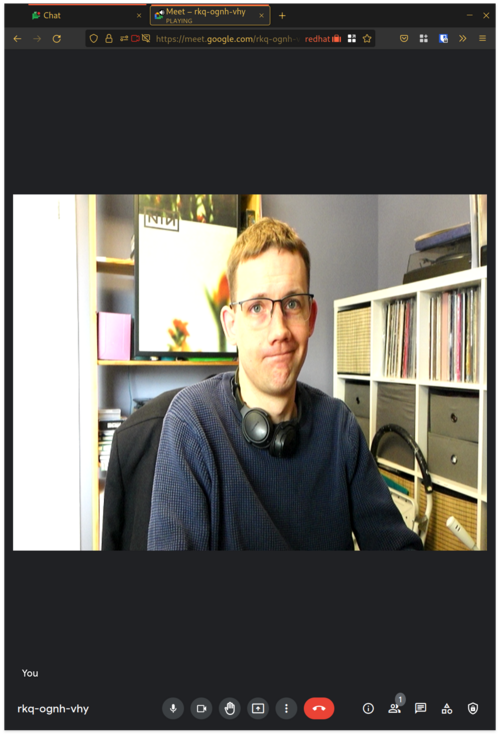
Before: wrong aspect ratio Before: wrong aspect ratio
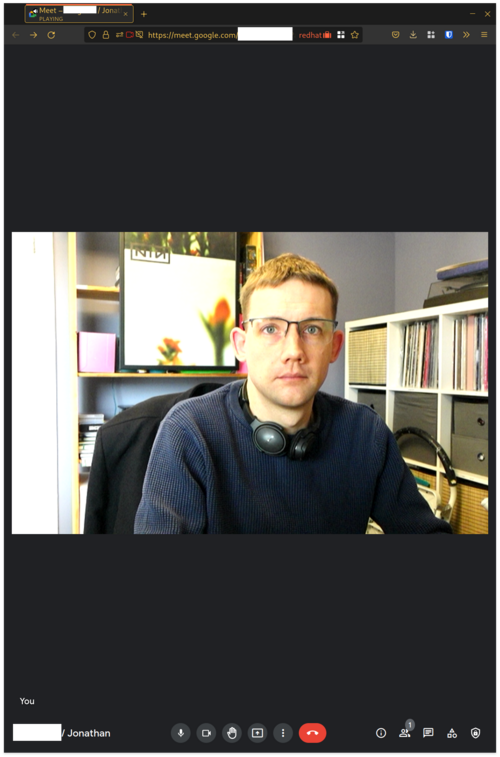
This device offers a selection of different video modes over a webcam interface. I used qv4l2 to explore the different modes. It became clear that the camera was outputting a signal at 16:9, but the modes on offer from the dongle were for a range of different aspect ratios. The picture for these other ratios was not letter or pillar-boxed, but stretched to fit. I also noticed that the modes which had the correct aspect ratio were at very low framerates: 1920x1080@5fps, 1360x768@8fps, 1280x720@10fps. It felt to me that I would look unnatural at such a low framerate. The most promising mode was close to the right ratio, 720x480 and 30 fps. Software
After: corrected aspect ratio After: corrected aspect ratio
My initial solution is to use the v4l2loopback kernel module, which provides a virtual loop-back webcam interface. I can write video data to it from one process, and read it back from another. Loading it as follows:
modprobe v4l2loopback exclusive_caps=1
The option exclusive_caps configures the module into a mode where it initially presents a write-only interface, but once a process has opened a file handle, it then switches to read-only for subsequent processes. Assuming there are no other camera devices connected at the time of loading the module, it will create /dev/video0.1 I experimented briefly with OBS Studio, the very versatile and feature-full streaming tool, which confirmed that I could use filters on the source video to fix the aspect ratio, and emit the result to the virtual device. I don't otherwise use OBS, though, so I achieve the same result using ffmpeg:
fmpeg -s 720x480 -i /dev/video1 -r 30 -f v4l2 -vcodec rawvideo \
    -pix_fmt yuyv422 -s 720x405 /dev/video0
The source options are to select the source video mode I want. The codec and pixel formats are to match what is being emitted (I determined that using ffprobe on the camera device). The resizing is triggered by supplying a different size to the -s parameter. I think that is equivalent to explicitly selecting a "scale" filter, and there might be other filters that could be used instead (to add pillar boxes for example). This worked just as well. In Google Meet, I select the Virtual Camera, and Google Meet is presented with only one video mode, in the correct aspect ratio, and no configurable options for it, so it can't misbehave. Future I'm planning to automate the loading (and unloading) of the module and starting the ffmpeg process in response to the real camera device being plugged or unplugged, using systemd events and services. (I don't leave the camera plugged in all the time due to some bad USB behaviour I've experienced if I do so.) If I get that working, I will write a follow-up.

  1. you can request a specific device name/number with another module option.

Dirk Eddelbuettel: RcppRedis 0.2.0: Major Updates

A new major release of RcppRedis arrived on CRAN today. RcppRedis is one of several packages connecting R to the fabulous Redis in-memory datastructure store (and much more). RcppRedis does not pretend to be feature complete, but it may do some things faster than the other interfaces, and also offers an optional coupling with MessagePack binary (de)serialization via RcppMsgPack. The package has carried production loads for several years now. This release integrates support for pub/sub, a popular messaging pattern in which one or more clients can subscribe to one or more channels . Whenever a client instances publishes, the Redis server immediately updates all clients listening on the given channel. This pattern is fairly common to transmit data to listeners. A there is a bit more to explain about this, I also added a brand-new vignette describing pub/sub with RcppRedis, along with another introductory vignette about Redis itself. We blogged about this exciting new feature and its particular use for market monitoring in R4 #36 recently too. The pub/sub feature was available in package rredis by Bryan Lewis and has now been ported over by Bryan in a truly elegant yet compact implementation. We placed the code for the pub/sub examples, both for a single symbol (SP 500) as well as for a set of (futures) symbols, into a new examples/ subdirectory. Other changes in this release are the removal of the build-dependency on Boost (or, rather, my BH package), an update to the included hiredis library (used if no system-wide version is found), and an updated to the UCRT build for R. That last one is a bit of a sore spot and nobody at CRAN deemed it necessary to tell me they were waiting for me to make this change; communication with the CRAN team can still be challenging (and I am being generous here). Anyway, the package is now on CRAN so all is well now, at long last. The detailed changes list follows.

Changes in version 0.2.0 (2022-03-08)
  • Two simple C++11 features remove needs for BH and lexical_cast() (Dirk in #45 addressing #44).
  • Redis pub/sub is now supported (Dirk in #43, Bryan in #46).
  • Bryan Lewis is now a coauthor.
  • Added pub/sub examples for single and multiple Globex symbols.
  • The included hiredis sources have been updated to release 1.0.2.
  • Two vignettes have been added to introduce Redis and to described a live market-monitoring application included in directory pubsub/.
  • The UCRT build was updated per a suggestion by Tomas.

Courtesy of CRANberries, there is also a diffstat report for this release. More information is on the RcppRedis page. If you like this or other open-source work I do, you can now sponsor me at GitHub.

This post by Dirk Eddelbuettel originated on his Thinking inside the box blog. Please report excessive re-aggregation in third-party for-profit settings.

6 March 2022

Dirk Eddelbuettel: nanotime 0.3.6 on CRAN: Updates

Leonardo and I are pleased to another update to our nanotime package bringing it to version 0.3.6 which landed on CRAN earlier today. nanotime relies on the RcppCCTZ package (as well as the RcppDate package for additional C++ operations) and offers efficient high(er) resolution time parsing and formatting up to nanosecond resolution, and the bit64 package for the actual integer64 arithmetic. Initially implemented using the S3 system, it has benefitted greatly from a rigorous refactoring by Leonardo who not only rejigged nanotime internals in S4 but also added new S4 types for periods, intervals and durations. This release corrects subsetting with %in% operator, integrates it better fit in the mixed S3/S4 setup, fixes a negative period parse, and updates class comparisons to rely on inherits(). The NEWS snippet has the full more details.

Changes in version 0.3.6 (2022-03-06)
  • Fix incorrect subsetting with operator %in% (Leonardo in #100 fixing #99).
  • Fix incorrect parsing for negative nanoperiod (Leonardo in #100 fixing #96).
  • Test for class via inherits() (Dirk).

Thanks to my CRANberries there is also a diff to the previous version. More details and examples are at the nanotime page; code, issue tickets etc at the GitHub repository and all documentation is provided at the nanotime documentation site. If you like this or other open-source work I do, you can now sponsor me at GitHub.

This post by Dirk Eddelbuettel originated on his Thinking inside the box blog. Please report excessive re-aggregation in third-party for-profit settings.

5 March 2022

Reproducible Builds: Reproducible Builds in February 2022

Welcome to the February 2022 report from the Reproducible Builds project. In these reports, we try to round-up the important things we and others have been up to over the past month. As ever, if you are interested in contributing to the project, please visit our Contribute page on our website.
Jiawen Xiong, Yong Shi, Boyuan Chen, Filipe R. Cogo and Zhen Ming Jiang have published a new paper titled Towards Build Verifiability for Java-based Systems (PDF). The abstract of the paper contains the following:
Various efforts towards build verifiability have been made to C/C++-based systems, yet the techniques for Java-based systems are not systematic and are often specific to a particular build tool (eg. Maven). In this study, we present a systematic approach towards build verifiability on Java-based systems.

GitBOM is a flexible scheme to track the source code used to generate build artifacts via Git-like unique identifiers. Although the project has been active for a while, the community around GitBOM has now started running weekly community meetings.
The paper Chris Lamb and Stefano Zacchiroli is now available in the March/April 2022 issue of IEEE Software. Titled Reproducible Builds: Increasing the Integrity of Software Supply Chains (PDF), the abstract of the paper contains the following:
We first define the problem, and then provide insight into the challenges of making real-world software build in a reproducible manner-this is, when every build generates bit-for-bit identical results. Through the experience of the Reproducible Builds project making the Debian Linux distribution reproducible, we also describe the affinity between reproducibility and quality assurance (QA).

In openSUSE, Bernhard M. Wiedemann posted his monthly reproducible builds status report.
On our mailing list this month, Thomas Schmitt started a thread around the SOURCE_DATE_EPOCH specification related to formats that cannot help embedding potentially timezone-specific timestamp. (Full thread index.)
The Yocto Project is pleased to report that it s core metadata (OpenEmbedded-Core) is now reproducible for all recipes (100% coverage) after issues with newer languages such as Golang were resolved. This was announced in their recent Year in Review publication. It is of particular interest for security updates so that systems can have specific components updated but reducing the risk of other unintended changes and making the sections of the system changing very clear for audit. The project is now also making heavy use of equivalence of build output to determine whether further items in builds need to be rebuilt or whether cached previously built items can be used. As mentioned in the article above, there are now public servers sharing this equivalence information. Reproducibility is key in making this possible and effective to reduce build times/costs/resource usage.

diffoscope diffoscope is our in-depth and content-aware diff utility. Not only can it locate and diagnose reproducibility issues, it can provide human-readable diffs from many kinds of binary formats. This month, Chris Lamb prepared and uploaded versions 203, 204, 205 and 206 to Debian unstable, as well as made the following changes to the code itself:
  • Bug fixes:
    • Fix a file(1)-related regression where Debian .changes files that contained non-ASCII text were not identified as such, therefore resulting in seemingly arbitrary packages not actually comparing the nested files themselves. The non-ASCII parts were typically in the Maintainer or in the changelog text. [ ][ ]
    • Fix a regression when comparing directories against non-directories. [ ][ ]
    • If we fail to scan using binwalk, return False from BinwalkFile.recognizes. [ ]
    • If we fail to import binwalk, don t report that we are missing the Python rpm module! [ ]
  • Testsuite improvements:
    • Add a test for recent file(1) issue regarding .changes files. [ ]
    • Use our assert_diff utility where we can within the test_directory.py set of tests. [ ]
    • Don t run our binwalk-related tests as root or fakeroot. The latest version of binwalk has some new security protection against this. [ ]
  • Codebase improvements:
    • Drop the _PATH suffix from module-level globals that are not paths. [ ]
    • Tidy some control flow in Difference._reverse_self. [ ]
    • Don t print a warning to the console regarding NT_GNU_BUILD_ID changes. [ ]
In addition, Mattia Rizzolo updated the Debian packaging to ensure that diffoscope and diffoscope-minimal packages have the same version. [ ]

Website updates There were quite a few changes to the Reproducible Builds website and documentation this month as well, including:
  • Chris Lamb:
    • Considerably rework the Who is involved? page. [ ][ ]
    • Move the contributors.sh Bash/shell script into a Python script. [ ][ ][ ]
  • Daniel Shahaf:
    • Try a different Markdown footnote content syntax to work around a rendering issue. [ ][ ][ ]
  • Holger Levsen:
    • Make a huge number of changes to the Who is involved? page, including pre-populating a large number of contributors who cannot be identified from the metadata of the website itself. [ ][ ][ ][ ][ ]
    • Improve linking to sponsors in sidebar navigation. [ ]
    • drop sponsors paragraph as the navigation is clearer now. [ ]
    • Add Mullvad VPN as a bronze-level sponsor . [ ][ ]
  • Vagrant Cascadian:

Upstream patches The Reproducible Builds project attempts to fix as many currently-unreproducible packages as possible. February s patches included the following:

Testing framework The Reproducible Builds project runs a significant testing framework at tests.reproducible-builds.org, to check packages and other artifacts for reproducibility. This month, the following changes were made:
  • Daniel Golle:
    • Update the OpenWrt configuration to not depend on the host LLVM, adding lines to the .config seed to build LLVM for eBPF from source. [ ]
    • Preserve more OpenWrt-related build artifacts. [ ]
  • Holger Levsen:
  • Temporary use a different Git tree when building OpenWrt as our tests had been broken since September 2020. This was reverted after the patch in question was accepted by Paul Spooren into the canonical openwrt.git repository the next day.
    • Various improvements to debugging OpenWrt reproducibility. [ ][ ][ ][ ][ ]
    • Ignore useradd warnings when building packages. [ ]
    • Update the script to powercycle armhf architecture nodes to add a hint to where nodes named virt-*. [ ]
    • Update the node health check to also fix failed logrotate and man-db services. [ ]
  • Mattia Rizzolo:
    • Update the website job after contributors.sh script was rewritten in Python. [ ]
    • Make sure to set the DIFFOSCOPE environment variable when available. [ ]
  • Vagrant Cascadian:
    • Various updates to the diffoscope timeouts. [ ][ ][ ]
Node maintenance was also performed by Holger Levsen [ ] and Vagrant Cascadian [ ].

Finally If you are interested in contributing to the Reproducible Builds project, please visit our Contribute page on our website. However, you can get in touch with us via:

4 March 2022

Reproducible Builds (diffoscope): diffoscope 207 released

The diffoscope maintainers are pleased to announce the release of diffoscope version 207. This version includes the following changes:
* Fix a gnarly regression when comparing directories against non-directories.
  (Closes: reproducible-builds/diffoscope#292)
* Use our assert_diff utility where we can within test_directory.py
You find out more by visiting the project homepage.

2 March 2022

Antoine Beaupr : procmail considered harmful

TL;DR: procmail is a security liability and has been abandoned upstream for the last two decades. If you are still using it, you should probably drop everything and at least remove its SUID flag. There are plenty of alternatives to chose from, and conversion is a one-time, acceptable trade-off.

Procmail is unmaintained procmail is unmaintained. The "Final release", according to Wikipedia, dates back to September 10, 2001 (3.22). That release was shipped in Debian since then, all the way back from Debian 3.0 "woody", twenty years ago. Debian also ships 25 uploads on top of this, with 3.22-21 shipping the "3.23pre" release that has been rumored since at least the November 2001, according to debian/changelog at least:
procmail (3.22-1) unstable; urgency=low
  * New upstream release, which uses the  standard' format for Maildir
    filenames and retries on name collision. It also contains some
    bug fixes from the 3.23pre snapshot dated 2001-09-13.
  * Removed  sendmail' from the Recommends field, since we already
    have  exim' (the default Debian MTA) and  mail-transport-agent'.
  * Removed suidmanager support. Conflicts: suidmanager (<< 0.50).
  * Added support for DEB_BUILD_OPTIONS in the source package.
  * README.Maildir: Do not use locking on the example recipe,
    since it's wrong to do so in this case.
 -- Santiago Vila <sanvila@debian.org>  Wed, 21 Nov 2001 09:40:20 +0100
All Debian suites from buster onwards ship the 3.22-26 release, although the maintainer just pushed a 3.22-27 release to fix a seven year old null pointer dereference, after this article was drafted. Procmail is also shipped in all major distributions: Fedora and its derivatives, Debian derivatives, Gentoo, Arch, FreeBSD, OpenBSD. We all seem to be ignoring this problem. The upstream website (http://procmail.org/) has been down since about 2015, according to Debian bug #805864, with no change since. In effect, every distribution is currently maintaining its fork of this dead program. Note that, after filing a bug to keep Debian from shipping procmail in a stable release again, I was told that the Debian maintainer is apparently in contact with the upstream. And, surprise! they still plan to release that fabled 3.23 release, which has been now in "pre-release" for all those twenty years. In fact, it turns out that 3.23 is considered released already, and that the procmail author actually pushed a 3.24 release, codenamed "Two decades of fixes". That amounts to 25 commits since 3.23pre some of which address serious security issues, but none of which address fundamental issues with the code base.

Procmail is insecure By default, procmail is installed SUID root:mail in Debian. There's no debconf or pre-seed setting that can change this. There has been two bug reports against the Debian to make this configurable (298058, 264011), but both were closed to say that, basically, you should use dpkg-statoverride to change the permissions on the binary. So if anything, you should immediately run this command on any host that you have procmail installed on:
dpkg-statoverride --update --add root root 0755 /usr/bin/procmail
Note that this might break email delivery. It might also not work at all, thanks to usrmerge. Not sure. Yes, everything is on fire. This is fine. In my opinion, even assuming we keep procmail in Debian, that default should be reversed. It should be up to people installing procmail to assign it those dangerous permissions, after careful consideration of the risk involved. The last maintainer of procmail explicitly advised us (in that null pointer dereference bug) and other projects (e.g. OpenBSD, in [2]) to stop shipping it, back in 2014. Quote:
Executive summary: delete the procmail port; the code is not safe and should not be used as a basis for any further work.
I just read some of the code again this morning, after the original author claimed that procmail was active again. It's still littered with bizarre macros like:
#define bit_set(name,which,value) \
  (value?(name[bit_index(which)] =bit_mask(which)):\
  (name[bit_index(which)]&=~bit_mask(which)))
... from regexp.c, line 66 (yes, that's a custom regex engine). Or this one:
#define jj  (aleps.au.sopc)
It uses insecure functions like strcpy extensively. malloc() is thrown around gotos like it's 1984 all over again. (To be fair, it has been feeling like 1984 a lot lately, but that's another matter entirely.) That null pointer deref bug? It's fixed upstream now, in this commit merged a few hours ago, which I presume might be in response to my request to remove procmail from Debian. So while that's nice, this is the just tip of the iceberg. I speculate that one could easily find an exploitable crash in procmail if only by running it through a fuzzer. But I don't need to speculate: procmail had, for years, serious security issues that could possibly lead to root privilege escalation, remotely exploitable if procmail is (as it's designed to do) exposed to the network. Maybe I'm overreacting. Maybe the procmail author will go through the code base and do a proper rewrite. But I don't think that's what is in the cards right now. What I expect will happen next is that people will start fuzzing procmail, throw an uncountable number of bug reports at it which will get fixed in a trickle while never fixing the underlying, serious design flaws behind procmail.

Procmail has better alternatives The reason this is so frustrating is that there are plenty of modern alternatives to procmail which do not suffer from those problems. Alternatives to procmail(1) itself are typically part of mail servers. For example, Dovecot has its own LDA which implements the standard Sieve language (RFC 5228). (Interestingly, Sieve was published as RFC 3028 in 2001, before procmail was formally abandoned.) Courier also has "maildrop" which has its own filtering mechanism, and there is fdm (2007) which is a fetchmail and procmail replacement. Update: there's also mailprocessing, which is not an LDA, but processing an existing folder. It was, however, specifically designed to replace complex Procmail rules. But procmail, of course, doesn't just ship procmail; that would just be too easy. It ships mailstat(1) which we could probably ignore because it only parses procmail log files. But more importantly, it also ships:
  • lockfile(1) - conditional semaphore-file creator
  • formail(1) - mail (re)formatter
lockfile(1) already has a somewhat acceptable replacement in the form of flock(1), part of util-linux (which is Essential, so installed on any normal Debian system). It might not be a direct drop-in replacement, but it should be close enough. formail(1) is similar: the courier maildrop package ships reformail(1) which is, presumably, a rewrite of formail. It's unclear if it's a drop-in replacement, but it should probably possible to port uses of formail to it easily.
Update: the maildrop package ships a SUID root binary (two, even). So if you want only reformail(1), you might want to disable that with:
dpkg-statoverride --update --add root root 0755 /usr/bin/lockmail.maildrop 
dpkg-statoverride --update --add root root 0755 /usr/bin/maildrop
It would be perhaps better to have reformail(1) as a separate package, see bug 1006903 for that discussion.
The real challenge is, of course, migrating those old .procmailrc recipes to Sieve (basically). I added a few examples in the appendix below. You might notice the Sieve examples are easier to read, which is a nice added bonus.

Conclusion There is really, absolutely, no reason to keep procmail in Debian, nor should it be used anywhere at this point. It's a great part of our computing history. May it be kept forever in our museums and historical archives, but not in Debian, and certainly not in actual release. It's just a bomb waiting to go off. It is irresponsible for distributions to keep shipping obsolete and insecure software like this for unsuspecting users. Note that I am grateful to the author, I really am: I used procmail for decades and it served me well. But now, it's time to move, not bring it back from the dead.

Appendix

Previous work It's really weird to have to write this blog post. Back in 2016, I rebuilt my mail setup at home and, to my horror, discovered that procmail had been abandoned for 15 years at that point, thanks to that LWN article from 2010. I would have thought that I was the only weirdo still running procmail after all those years and felt kind of embarrassed to only "now" switch to the more modern (and, honestly, awesome) Sieve language. But no. Since then, Debian shipped three major releases (stretch, buster, and bullseye), all with the same vulnerable procmail release. Then, in early 2022, I found that, at work, we actually had procmail installed everywhere, possibly because userdir-ldap was using it for lockfile until 2019. I sent a patch to fix that and scrambled to remove get rid of procmail everywhere. That took about a day. But many other sites are now in that situation, possibly not imagining they have this glaring security hole in their infrastructure.

Procmail to Sieve recipes I'll collect a few Sieve equivalents to procmail recipes here. If you have any additions, do contact me. All Sieve examples below assume you drop the file in ~/.dovecot.sieve.

deliver mail to "plus" extension folder Say you want to deliver user+foo@example.com to the folder foo. You might write something like this in procmail:
MAILDIR=$HOME/Maildir/
DEFAULT=$MAILDIR
LOGFILE=$HOME/.procmail.log
VERBOSE=off
EXTENSION=$1            # Need to rename it - ?? does not like $1 nor 1
:0
* EXTENSION ?? [a-zA-Z0-9]+
        .$EXTENSION/
That, in sieve language, would be:
require ["variables", "envelope", "fileinto", "subaddress"];
########################################################################
# wildcard +extension
# https://doc.dovecot.org/configuration_manual/sieve/examples/#plus-addressed-mail-filtering
if envelope :matches :detail "to" "*"  
  # Save name in $ name  in all lowercase
  set :lower "name" "$ 1 ";
  fileinto "$ name ";
  stop;
 

Subject into folder This would file all mails with a Subject: line having FreshPorts in it into the freshports folder, and mails from alternc.org mailing lists into the alternc folder:
:0
## mailing list freshports
* ^Subject.*FreshPorts.*
.freshports/
:0
## mailing list alternc
* ^List-Post.*mailto:.*@alternc.org.*
.alternc/
Equivalent Sieve:
if header :contains "subject" "FreshPorts"  
    fileinto "freshports";
  elsif header :contains "List-Id" "alternc.org"  
    fileinto "alternc";
 

Mail sent to root to a reports folder This double rule:
:0
* ^Subject: Cron
* ^From: .*root@
.rapports/
Would look something like this in Sieve:
if header :comparator "i;octet" :contains "Subject" "Cron"  
  if header :regex :comparator "i;octet"  "From" ".*root@"  
        fileinto "rapports";
   
 
Note that this is what the automated converted does (below). It's not very readable, but it works.

Bulk email I didn't have an equivalent of this in procmail, but that's something I did in Sieve:
if header :contains "Precedence" "bulk"  
    fileinto "bulk";
 

Any mailing list This is another rule I didn't have in procmail but I found handy and easy to do in Sieve:
if exists "List-Id"  
    fileinto "lists";
 

This or that I wouldn't remember how to do this in procmail either, but that's an easy one in Sieve:
if anyof (header :contains "from" "example.com",
           header :contains ["to", "cc"] "anarcat@example.com")  
    fileinto "example";
 
You can even pile up a bunch of options together to have one big rule with multiple patterns:
if anyof (exists "X-Cron-Env",
          header :contains ["subject"] ["security run output",
                                        "monthly run output",
                                        "daily run output",
                                        "weekly run output",
                                        "Debian Package Updates",
                                        "Debian package update",
                                        "daily mail stats",
                                        "Anacron job",
                                        "nagios",
                                        "changes report",
                                        "run output",
                                        "[Systraq]",
                                        "Undelivered mail",
                                        "Postfix SMTP server: errors from",
                                        "backupninja",
                                        "DenyHosts report",
                                        "Debian security status",
                                        "apt-listchanges"
                                        ],
           header :contains "Auto-Submitted" "auto-generated",
           envelope :contains "from" ["nagios@",
                                      "logcheck@",
                                      "root@"])
     
    fileinto "rapports";
 

Automated script There is a procmail2sieve.pl script floating around, and mentioned in the dovecot documentation. It didn't work very well for me: I could use it for small things, but I mostly wrote the sieve file from scratch.

Progressive migration Enrico Zini has progressively migrated his procmail setup to Sieve using a clever way: he hooked procmail inside sieve so that he could deliver to the Dovecot LDA and progressively migrate rules one by one, without having a "flag day". See this explanatory blog post for the details, which also shows how to configure Dovecot as an LMTP server with Postfix.

Other examples The Dovecot sieve examples are numerous and also quite useful. At the time of writing, they include virus scanning and spam filtering, vacation auto-replies, includes, archival, and flags.

Harmful considered harmful I am aware that the "considered harmful" title has a long and controversial history, being considered harmful in itself (by some people who are obviously not afraid of contradictions). I have nevertheless deliberately chosen that title, partly to make sure this article gets maximum visibility, but more specifically because I do not have doubts at this moment that procmail is, clearly, a bad idea at this moment in history.

Developing story I must also add that, incredibly, this story has changed while writing it. This article is derived from this bug I filed in Debian to, quite frankly, kick procmail out of Debian. But filing the bug had the interesting effect of pushing the upstream into action: as mentioned above, they have apparently made a new release and merged a bunch of patches in a new git repository. This doesn't change much of the above, at this moment. If anything significant comes out of this effort, I will try to update this article to reflect the situation. I am actually happy to retract the claims in this article if it turns out that procmail is a stellar example of defensive programming and survives fuzzing attacks. But at this moment, I'm pretty confident that will not happen, at least not in scope of the next Debian release cycle.

1 March 2022

Paul Wise: FLOSS Activities February 2022

Focus This month I didn't have any particular focus. I just worked on issues in my info bubble.

Changes

Issues

Review

Administration
  • Debian BTS: fix usertags for some users, unarchive/reopen/triage bugs for reintroduced packages: horae dh-haskell shutter logging-tree openstreetmap-carto gnome-commander
  • Debian servers: restore wiki data from backup, restarted bacula director for TLS cert update
  • Debian wiki: restore wiki account from backup, approve accounts

Communication
  • Respond to queries from Debian users and contributors on the mailing lists and IRC

Sponsors The purple-discord, gensim, DiskANN, SPTAG, wsproto work was sponsored by my employer. All other work was done on a volunteer basis.

25 February 2022

Dirk Eddelbuettel: It was twenty years ago today

that I made my first upload to CRAN as demonstrated by the very bottom of the ChangeLog file of the RQuantLib package:
2002-02-25  Dirk Eddelbuettel  <edd@debian.org>
    * Initial 0.1.0 release
And quite a few more uploads followed since. (Also see the earlier twenty years ago post about my initial contributions to the Debian R package I had by then adopted too.) If you like this or other open-source work I do, you can now sponsor me at GitHub.

This post by Dirk Eddelbuettel originated on his Thinking inside the box blog. Please report excessive re-aggregation in third-party for-profit settings.

Dirk Eddelbuettel: Rcpp now used by 2500 CRAN packages!

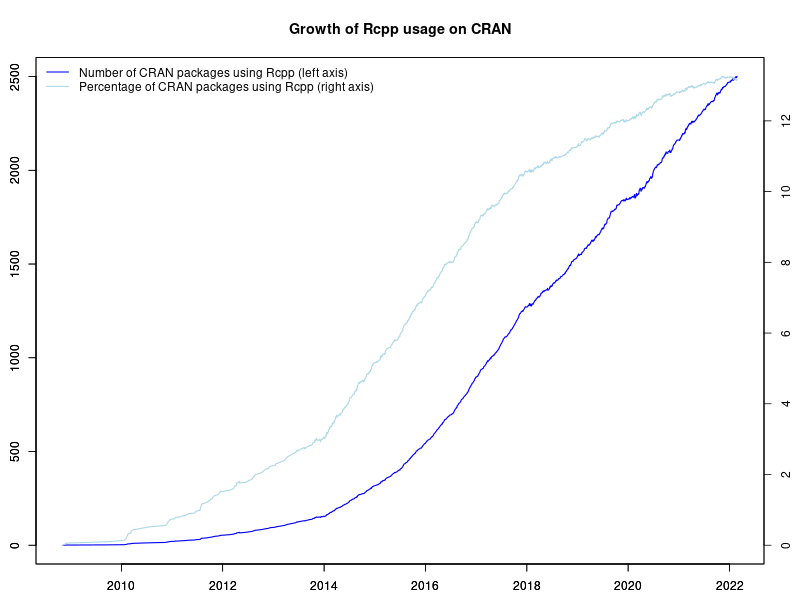
2500 Rcpp packages As of this morning, Rcpp stands at 2501 reverse-dependencies on CRAN. The graph on the left depicts the growth of Rcpp usage (as measured by Depends, Imports and LinkingTo, but excluding Suggests) over time. Rcpp was first released in November 2008. It probably cleared 50 packages around three years later in December 2011, 100 packages in January 2013, 200 packages in April 2014, and 300 packages in November 2014. It passed 400 packages in June 2015 (when I tweeted about it), 500 packages in late October 2015, 600 packages in March 2016, 700 packages in July 2016, 800 packages in October 2016, 900 packages early January 2017, 1000 packages in April 2017, 1250 packages in November 2017, 1500 packages in November 2018, 1750 packages in August 2019, 2000 packages in July 2020, and 2250 package in March of last year. The chart extends to the very beginning via manually compiled data from CRANberries and checked with crandb. The next part uses manually saved entries. The core (and by far largest) part of the data set was generated semi-automatically via a short script appending updates to a small file-based backend. A (manually curated) list of packages using Rcpp is available too. Also displayed in the graph is the relative proportion of CRAN packages using Rcpp. The four per-cent hurdle was cleared just before useR! 2014 where I showed a similar graph (as two distinct graphs) in my invited talk. We passed five percent in December of 2014, six percent July of 2015, seven percent just before Christmas 2015, eight percent in the summer of 2016, nine percent mid-December 2016, cracked ten percent in the summer of 2017, eleven percent in 2018 and passed 12.5 percent or one in every eight CRAN packages dependens on Rcpp along with the 2000 packages mark. Truly stunning. As before, there is more detail in the chart: how CRAN seems to be pushing back more and removing more aggressively (which my CRANberries tracks but not in as much detail as it could), how the growth of Rcpp seems to be slowing somewhat outright and even more so as a proportion of CRAN as one would expect a growth curve to. The Rcpp team continues to aim for keeping Rcpp as performant and reliable as it has been (and see e.g. here for some more details). A really big shoutout and Thank You! to all users and contributors of Rcpp for help, suggestions, bug reports, documentation or, of course, code. If you like this or other open-source work I do, you can now sponsor me at GitHub. For the first year, GitHub will match your contributions.

This post by Dirk Eddelbuettel originated on his Thinking inside the box blog. Please report excessive re-aggregation in third-party for-profit settings.

Reproducible Builds (diffoscope): diffoscope 206 released

The diffoscope maintainers are pleased to announce the release of diffoscope version 206. This version includes the following changes:
* Also allow "Unicode text, UTF-8 text" as well as "UTF-8 Unicode text" to
  match for .buildinfo files too.
* Add a test for recent file(1) issue regarding .changes files.
  (Re: reproducible-builds/diffoscope#291)
* Drop "_PATH" suffix from some module-level globals that are not paths.
You find out more by visiting the project homepage.

24 February 2022

Dirk Eddelbuettel: #36: pub/sub for live market monitoring with R and Redis

Welcome to the 36th post of the really randomly reverberating R, or R4 for short, write-ups. Today s post is about using Redis, and especially RcppRedis, for live or (near) real-time monitoring with R. market monitor There is an saying that you can take the boy out of the valley, but you cannot the valley out of the boy so for those of us who spent a decade or two in finance and on trading floors, having some market price information available becomes second nature. And/or sometimes it is just good fun to program this. A good while back Josh posted a gist on a simple-yet-robust while loop. It (very cleverly) uses his quantmod package to access the SP500 in real-time . (I use quotes here because at the end of retail broadband one is not at the same market action as someone co-located in a New Jersey data center. It is however not delayed: as an index, it is not immediately tradeable as a stock, etf, or derivative may be all of which are only disseminated as delayed price information, usually by ten minutes.) I quite enjoyed the gist and used it and started tinkering with it. For example, it collects data but only saves (i.e. persists ) it after market close. If for whatever reason one needs to restart recent history is gone. In any event, I used his code and generalized it a little and published this about a year ago as function intradayMarketMonitor() in my dang package. (See this blog post announcing it.) The chart of the left shows this in action, the chart is a snapshot from a couple of days ago when the vignettes (more on them below) were written. As lovely as intradayMarketMonitor() is, it also limits itself to market hours. And sometimes you want to see, say, how the market opens on Sunday (futures usually restart at 17h Chicago time), or how news dissipates during the night, or where markets are pre-open, or . So I both wanted to complement this with futures, and also cache it locally so that, say, one machine might collect data and one (or several others) can visualize. For such tasks, Redis is unparalleled. (Yet I also always felt Redis could do with another, simple, short and sweet introduction stressing the key features of i) being multi-lingual: write in one language, consume in another and ii) loose coupling: no linking as one talks to Redis via standard tcp/ip networking. So I wrote a new intro vignette that is now in RcppRedis. I hope this comes in handy. Comments welcome!) Our RcppRedis package had long been used for such tasks, and it was easy to set it up. Standard use is to loop, fetch some data, push it to Redis, sleep, and start over. Clients do the same: fetch most recent data, plot or report it, sleep, start over. That works, but it has a dual delay as the client sleeping may miss the data update! The standard answer to this is called publish/pubscribe, or pub/sub. Libraries such as 0mq or zeromq specialise in this. But it turns out Redis already has it. I had some initial difficulty adding it to RcppRedis so for a trial I tested the marvellous rredis package by Bryan and simply instantiated two Redis clients. Now the data getter simply publishes a new data point in a given channel, by convention named after the security it tracks. Clients register with the Redis server which does all the actual work of keeping track of who listens to what. The clients now simply listen (which is a blocking operation) and as soon as data comes in receive it. market monitor This is quite mesmerizing when you just run two command-line clients (in a byobu session, say). As sone as the data is written (as shown on console log) it is consumed. No measruable overhead. Just lovely. Bryan and I then talked a litte as he may or may not retire rredis. Having implemented the pub/sub logic for both sides once, he took a good hard look at RcppRedis and just like that added it there. With some really clever wrinkles for (optional) per-symbol callback as closure attached to the instance. Truly amazeballs And once we had it in there, generalizing from publishing or subscribing to just one symbol easily generalizes to having one listener collect and publish for multiple symbols, and having one or more clients subscribe and listen one, more or even all symbol. All with ease thanks tp Redis. The second chart, also from a few days ago, shows four symbols for four (front-contract) futures for Bitcoin, Crude Oil, SP500, and Gold. As all this can get a little technical, I wrote a second vignette for RcppRedis on just this: market monitoring. Give this a read, if interested, feedback on this one is most welcome too! But all the code you need is included in the package just run a local Redis instance. Before closing, one sour note. I uploaded all this in a new and much improved updated RcppRedis 0.2.0 to CRAN on March 13 ten days ago. Not only is it still not there , but CRAN in their most delightful way also refuses to answer any emails of mine. Just lovely. The package exhibited just one compiler warning: a C++ compiler objected to the (embedded) C library hiredis (included as a fallback) for using a C language construct. Yes. A C++ compiler complaining about C. It s a non-issue. Yet it s been ten days and we still have nothing. So irritating and demotivating. Anyway, you can get the package off its GitHub repo. If you like this or other open-source work I do, you can sponsor me at GitHub.

This post by Dirk Eddelbuettel originated on his Thinking inside the box blog. Please report excessive re-aggregation in third-party for-profit settings.

23 February 2022

Ian Jackson: Rooting an Eos Fairphone 4

Last week I received (finally) my Fairphone 4, supplied with a de-googled operating system, which I had ordered from the E Foundation s shop in December. (I m am very hard on hardware and my venerable Fairphone 2 is really on its last legs.) I expect to have full control over the software on any computing device I own which is as complicated, capable, and therefore, hazardous, as a mobile phone. Unfortunately the Eos image (they prefer to spell it /e/ os , srsly!) doesn t come with a way to get root without taking fairly serious measures including unlocking the bootloader. Unlocking the bootloader wouldn t be desirable for me but I can t live without root. So. I started with these helpful instructions: https://forum.xda-developers.com/t/fairphone-4-root.4376421/ I found the whole process a bit of a trial, and I thought I would write down what I did. But, it s not straightforward, at least for someone like me who only has a dim understanding of all this Android stuff. Unfortunately, due to the number of missteps and restarts, what I actually did is not really a sensible procedure. So here is a retcon of a process I think will work: Unlock the bootloader The E Foundation provide instructions for unlocking the bootloader on a stock FP4, here https://doc.e.foundation/devices/FP4/install and they seem applicable to the Murena phone supplied with Eos pre-installed, too. NB tht unlocking the bootloader wipes the phone. So we do it first. So:
  1. Power on the phone, with no SIM installed
  2. You get a welcome screen.
  3. Skip all things on startup including wifi
  4. Go to the very end of the settings, tap a gazillion times on the phone s version until you re a developer
  5. In the developer settings, allow usb debugging
  6. In the developer settings, allow oem bootloader unlocking
  7. Connect a computer via a USB cable, say yes on phone to USB debugging
  8. adb reboot bootloader
  9. The phone will reboot into a texty kind of screen, the bootloader
  10. fastboot flashing unlock
  11. The phone will reboot, back to the welcome screen
  12. Repeat steps 3-9 (maybe not all are necessary)
  13. fastboot flashing unlock_critical
  14. The phone will reboot, back to the welcome screen
Note that although you are running fastboot, you must run this command with the phone in bootloader mode, not fastboot (aka fastbootd ) mode. If you run fastboot flashing unlcok from fastboot you just get a don t know what you re talking about . I found conflicting instructions on what kind of Vulcan nerve pinches could be used to get into which boot modes, and had poor experiences with those. adb reboot bootloader always worked reliably for me. Some docs say to run fastboot oem unlock; I used flashing. Maybe this depends on the Android tools version. Initial privacy prep and OTA update We want to update the supplied phone OS. The build mine shipped with is too buggy to run Magisk, the application we are going to use to root the phone. (With the pre-installed phone OS, Magisk crashes at the patch boot image step.) But I didn t want to let the phone talk to Google, even for the push notifications registration.
  1. From the welcome screen, skip all things except location, date, time. Notably, do not set up wifi
  2. In settings, microg section
    1. turn off cloud messaging
    2. turn off google safetynet
    3. turn off google registration (NB you must do this after the other two, because their sliders become dysfunctional after you turn google registration off)
    4. turn off both location modules
  3. In settings, location section, turn off allowed location for browser and magic earth
  4. Now go into settings and enable wifi, giving it your wifi details
  5. Tell the phone to update its operating system. This is a big download.
Install Magisk, the root manager (As a starting point I used these instructions https://www.xda-developers.com/how-to-install-magisk/ and a lot of random forum posts.) You will need the official boot.img. Bizarrely there doesn t seem to be a way to obtain this from the phone. Instead, you must download it. You can find it by starting at https://doc.e.foundation/devices/FP4/install which links to https://images.ecloud.global/stable/FP4/. At the time of writing, the most recent version, whose version number seemed to correspond to the OS update I installed above, was IMG-e-0.21-r-20220123158735-stable-FP4.zip.
  1. Download the giant zipfile to your computer
  2. Unzip it to extract boot.img
  3. Copy the file to your phone s storage . Eg, via adb: with the phone booted into the main operating system, using USB debugging, adb push boot.img /storage/self/primary/Download.
  4. On the phone, open the browser, and enter https://f-droid.org. Click on the link to install f-droid. You will need to enable installing apps from the browser (follow the provided flow to the settings, change the setting, and then use Back, and you can do the install). If you wish, you can download the f-droid apk separately on a computer, and verify it with pgp.
  5. Using f-droid, install Magisk. You will need to enable installing apps from f-droid. (I installed Magisk from f-droid because 1. I was going to trust f-droid anyway 2. it has a shorter URL than Magisk s.)
  6. Open the Magisk app. Tell Magisk to install (Magisk, not the app). There will be only one option: patch boot file. Tell it to patch the boot.img file from before.
  7. Transfer the magisk_patched-THING.img back to your computer (eg via adb pull).
  8. adb reboot bootloader
  9. fastboot boot magisk_patched-THING.img (again, NB, from bootloader mode, not from fastboot mode)
  10. In Magisk you ll see it shows as installed. But it s not really; you ve just booted from an image with it. Ask to install Magisk with Direct install .
After you have done all this, I believe that each time you do an over-the-air OS update, you must, between installing the update and rebooting the phone, ask Magisk to Install to inactive slot (after OTA) . Presumably if you forget you must do the fastboot boot dance again. After all this, I was able to use tsu in Termux. There s a strange behaviour with the root prompt you get apropos Termux s request for root; I found that it definitely worked if Termux wasn t the foreground app You have to leave the bootloader unlocked. Howwever, as I understand it, the phone s encryption will still prevent an attacker from hoovering the data out of your phone. The bootloader lock is to prevent someone tricking you into entering the decryption passkey into a trojaned device. Other things to change There are probably other things to change. I have not yet transferred my Signal account from my old phone. It is possible that Signal will require me to re-enable the google push notifications, but I hope that having disabled them in microg it will be happy to use its own system, as it does on my old phone.

comment count unavailable comments

Jonathan McDowell: Upgrading my home internet; a story of yak shaving

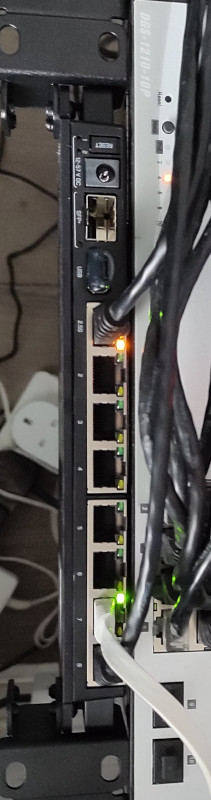
RB5009 This has ended up longer than I expected. I ll write up posts about some of the individual steps with some more details at some point, but this is an overview of the yak shaving I engaged in. The TL;DR is:
The desire for a faster connection When I migrated my home connection to FTTP I kept the same 80M/20M profile I d had on FTTC. I didn t have a pressing need for faster, and I saved money because I was no longer paying for the phone line portion. I wanted more, but at the time I think the only option was for a 160M/30M profile instead and I didn t need it and it wasn t enough better to convince me. Time passed and BT rolled out their GigE (really 900M) download option. And again, I didn t need it, but I wanted it. My provider, Aquiss, initially didn t offer this (I think they had up to 330M download options available by this point). So I stayed on 80M/20M. And the only time I really wanted it to be faster was when pushing off-site backups to rsync.net. Of course, we ve had the pandemic, and that s involved 2 adults working from home with plenty of video calls throughout the day. The 80M/20M connection has proved rock solid for this, so again, I didn t feel an upgrade was justified. We got a 4K capable TV last year and while the bandwidth usage for 4K streaming is noticeably higher, again the connection can handle it no problem. At some point last year I noticed Aquiss had added speed options all the way to 900M down. At the end of the year I accepted a new role, which is fully remote, so I had a bit of an acceptance about the fact that I wasn t going back into an office any time soon. The combination (and the desire for the increased upload speed) finally allowed me to justify the upgrade to myself.

Testing the current setup for bottlenecks The first thing to do was see whether my internal network could cope with an upgrade. I m mostly running Cat6 GigE so I wasn t worried about that side of things. However I m using an RB3011 as my core router, and while it has some coprocessors for routing acceleration they re not supported under mainline Linux (and unlikely to be any time soon). So I had to benchmark what it was capable of routing. I run a handful of VLANs within my home network, with stateful firewalling between them, so I felt that would be a good approximation of the maximum speed to the outside world I might be able to get if I had the external connection upgraded. I went for the easy approach and fired up iPerf3 on 2 hosts, both connected via ethernet but on separate networks, so routed through the RB3011. That resulted in slightly more than a 300Mb/s throughput. Ok. I confirmed that I could get 900Mb/s+ on 2 hosts both on the same network, just to be sure there wasn t some other issue I was missing. Nope, so unsurprisingly the router was the bottleneck. So. To upgrade my internet speed I need to upgrade my router. I could just buy something off the shelf, but I like being able to run Debian (or OpenWRT) on the router rather than some horrible vendor firmware. Lucky MikroTik launched the RB5009 towards the end of last year. RouterOS is probably more than capable, but what really interested me was the fact it s an ARM64 platform based on an Armada 7040, which is pretty well supported in mainline kernels already. There s a 10G connection from the internal switch to the CPU, as well as a 2.5Gb/s ethernet port and a 10G SFP+ cage. All good stuff. I ordered one just before the New Year. Thankfully the OpenWRT folk had done all of the hard work on getting a mainline kernel booting on the device; Sergey Sergeev and Robert Marko in particular fighting RouterBoot and producing a suitable device tree file to get everything up and running. I ended up soldering a serial console connection up to aid debugging, and lightly patching Rob s u-boot to fix the incorrect RAM size reported by RouterBoot. A few kernel tweaks were necessary to make the networking entirely happy and at that point it was time to think about actually doing a replacement.

Upgrading to Debian 11 (bullseye) My RB3011 is currently running Debian 10 (buster); an upgrade has been on my todo list, but with the impending replacement I decided I d hold off and create a new Debian 11 (bullseye) image for the RB5009. Additionally, I don t actually run off the internal NAND in the RB3011; I have a USB flash drive for the rootfs and just the kernel booting off internal NAND. Originally this was for ease of testing, then a combination of needing to figure out a good read-only root solution and a small enough image to fit in the 120M available. For the upgrade I decided to finally look at these pieces. I ve ended up with a script that will build me a squashfs image, and the initial rootfs takes care of mounting this and then a tmpfs as an overlay fs. That means I can easily see what pieces are being written to. The RB5009 has a total of 1G NAND so I m not as space constrained, but the squashfs ends up under 50M. I ve added some additional pieces to allow me to pre-populate the overlay fs with updates rather than always needing to rebuild the squashfs image. With that done I decided to try it out on the RB3011; I tweaked the build script to be able to build for armhf (the RB3011) or arm64 (the RB5009) and to deal with some slight differences in configuration between the two (e.g. interface naming). The idea here was to ensure I d got all the appropriate configuration sorted for the RB5009, in the known-good existing environment. Everything is still on a USB stick at this stage and the new device has an armhf busybox root meaning it can be used on either device, and the init script detects the architecture to select the appropriate squashfs to mount.

A problem with ESP8266 home automation devices Everything seemed to work fine - a few niggles with the watchdog, which is overly sensitive on the RB3011, but I got those sorted (and the build script updated) and the device came up and successfully did the PPPoE dance to bring up external connectivity. And then I noticed that my home automation devices were having problems connecting to the mosquitto MQTT server. It turned out it was only the ESP8266 based devices that were failing, and examining the serial debug output on one of my test devices revealed it was hitting an out of memory issue (displaying E:M 280) when establishing the TLS MQTT connection. I rolled back to the Debian 10 image and set about creating a test environment to look at the ESP8266 issues. My first action was to try and reduce my RAM footprint to try and ensure there was enough spare to establish the connection. I moved a few functions that were still sitting in IRAM into flash. I cleaned up a couple of buffers that are on the stack to be more correctly sized. I tried my new image, and I didn t get the memory issue. Instead I progressed a bit further and got a watchdog reset. Doh! It was obviously something related to the TLS connection, but I couldn t easily see what the difference was; the same x509 cert was in use, it looked like the initial handshake was the same (and trying with openssl s_client looked pretty similar too). I set about instrumenting the ancient Mbed TLS used in the Espressif SDK and discovered that whatever had changed between buster + bullseye meant the EPS8266 was now trying a TLS-DHE-RSA-WITH-AES-256-CBC-SHA256 handshake instead of a TLS-RSA-WITH-AES-256-CBC-SHA256 handshake and that was causing enough extra CPU usage that it couldn t complete in time and the watchdog kicked in. So I commented out MBEDTLS_KEY_EXCHANGE_DHE_RSA_ENABLED in the config_esp.h for mbedtls and rebuilt things. Hacky, but I ll go back to trying to improve this generally at some point.

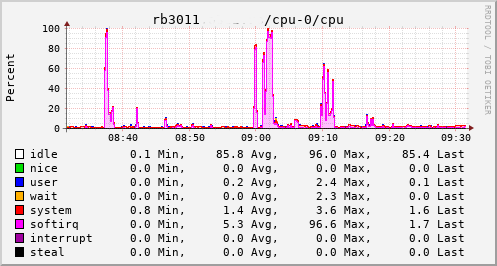
A detour into interrupt load Now, my testing of the RB3011 image is generally done at weekends, when I have enough time to tear down and rebuild the connection rather than doing it in the evening and having limited time to get things working again in time for work in the morning. So at the point I had an image ready to go I pulled the trigger on the line upgrade. I went with the 500M/75M option rather than the full 900M - I suspect I d have difficulty actually getting that most of the time and 75M of upload bandwidth seems fairly substantial for now. It only took a couple of days from the order to the point the line was regraded (which involved no real downtime - just a reconnection in the night). Of course this happened just after the weekend I d discovered the ESP8266 issue. collectd CPU usage for RB3011 This provided an opportunity to see just what the RB3011 could actually manage. In the configuration I had it turned out to be not much more than the 80Mb/s speeds I had previously seen. The upload jumped from a solid 20Mb/s to 75Mb/s, so I knew the regrade had actually happened. Looking at CPU utilisation clearly showed the problem; softirqs were using almost 100% of a CPU core. Now, the way the hardware is setup on the RB3011 is that there are two separate 5 port switches, each connected back to the CPU via a separate GigE interface. For various reasons I had everything on a single switch, which meant that all traffic was boomeranging in and out of the same CPU interface. The IPQ8064 has dual cores, so I thought I d try moving the external connection to the other switch. That puts it on its own GigE CPU interface, which then allows binding the interrupts to a different CPU core. That helps; throughput to the outside world hits 140Mb/s+. Still a long way from the expected max, but proof we just need more grunt.
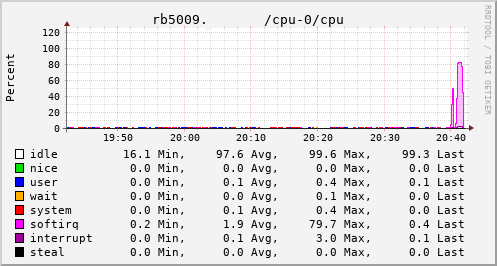
Success collectd CPU usage for RB5009 Which brings us to this past weekend, when, having worked out all the other bits, I tried the squashfs root image again on the RB3011. Success! The home automation bits connected to it, the link to the outside world came up, everything seemed happy. So I double checked my bootloader bits on the RB5009, brought it down to the comms room and plugged it in instead. And, modulo my failing to update the nftables config to allow it to do forwarding, it all came up ok. Some testing with iperf3 internally got a nice 912Mb/s sustained between subnets, and some less scientific testing with wget + speedtest-cli saw speeds of over 460Mb/s to the outside world. Time from ordering the router until it was in service? Just under 8 weeks

Russ Allbery: Review: Elder Race

Review: Elder Race, by Adrian Tchaikovsky
Publisher: Tordotcom
Copyright: November 2021
ISBN: 1-250-76871-3
Format: Kindle
Pages: 199
(It's a shame that a lot of people will be reading this novella on a black-and-white ebook reader, since the Emmanuel Shiu cover is absolutely spectacular. There's a larger image without the words at the bottom of that article.) When reports arrive at the court about demons deep in the forest that are taking over animals and humans and bending them to their will, the queen doesn't care. It's probably some unknown animal, and regardless, the forest kingdom is a rival anyway. Lynesse Fourth Daughter disagrees vehemently, but she has no power at court. Even apart from her lack of seniority, her love of stories and daring and adventures is a source of endless frustration to her mother. That is why this novella opens with her climbing the mountain path to the Tower of Nyrgoth Elder, the last of the ancient wizards, to seek his help. Nyr Illim Tevitch is an anthropologist second class of Earth's Explorer Corps, part of the second wave of Earth's outward expansion through the galaxy. In the first wave, colonies were seeded on habitable planets, only to be left stranded when Earth's civilization collapsed in an ecological crisis. Nyr was a member of a team of four, sent to make careful and limited contact with one of those lost colonies as part of Earth's second flourishing with more advanced technology. When the team lost contact with Earth, the other three went back while Nyr stayed to keep their field observations going. It's now 291 years of intermittent suspended animation later. Nyr's colleagues never came back, and there have been no messages from Earth. Elder Race is a Prime Directive anthropology story, a subgenre so long-standing that it has its own conventions and variations. Variations of the theme have been written by everyone from Eleanor Arnason to Iain M. Banks (linking to the book I have in mind is arguably a spoiler). Per the dedication, Tchaikovsky's take is based on Gene Wolfe's story "Trip, Trap," which I have not read but whose plot looks very similar. To that story structure, Tchaikovsky brings two major twists. First, Nyr is cut off from his advanced civilization, and has considerable reason to believe that civilization no longer exists. Do noninterference rules still have any meaning if Nyr is stranded and the civilization that made the rules is gone? Second, Nyr has already broken those rules rather spectacularly. More than a hundred years previously, he had ridden with Astresse Regent, a warrior queen and Lynesse's ancestor, to defeat a local warlord who had found control codes for abandoned advanced machinery and was using it as weaponry. In the process, he fell in love and made a rash promise to come to the aid of any of her descendants if he were needed. Lynesse has come to collect on the promise. Elder Race is told in alternating chapters between Nyr and Lynesse's viewpoints: first person for Nyr and tight third person for Lynesse. The core of the story is this doubled perspective, one from a young woman who wants to live in a fantasy novel and one from a deeply depressed anthropologist torn between wanting human contact, wanting to follow the rules of his profession, and wanting to explain to Lynesse that he is not a wizard. Nyr talks himself into helping with another misuse of advanced technology using the same logic he used a hundred years earlier: he's protecting Lynesse's pre-industrial society from interference rather than causing it. But the demons Lynesse wants him to fight are something entirely unexpected. This parallel understanding is a great story structure. What worked less for me was Tchaikovsky's reliance on linguistic barriers to prevent shared understanding. Whenever Nyr tries to explain something, Lynesse hears it in terms of magic and high fantasy, and often exactly backwards from how Nyr intended it. This is where my suspension of disbelief failed me, even though I normally don't have suspension of disbelief problems in SF stories. I was unable to map Lynesse's misunderstandings to any realistic linguistic model. Lynesse's language is highly complex (a realistic development within an isolated population), and Nyr complains about his inability to speak it properly given it's blizzard of complex modifiers. This is entirely believable. What is far less believable is that Lynesse perceives him as fluent in her language, but often saying the precise opposite of what he's trying to say. One chapter in the middle of the book gives Nyr's intended story side-by-side with Lynesse's understanding. This is a brilliant way to show the divide, but I found the translation errors unbelievable. If Nyr is failing that profoundly to communicate his meaning, he should be making more egregious sentence-level errors, occasionally saying something bizarre or entirely nonsensical, referring to a person as an animal or a baby, or otherwise not fluently telling a coherent story that's fundamentally different than the one he thinks he's telling. If you can put that aside, though, this is a fun story. Nyr has serious anxiety and depression made worse by his isolation, and copes by using an implanted device called a Dissociative Cognition System that lets him temporarily turn off his emotions at the cost of letting them snowball. He has a wealth of other augments and implants, including horns, which Lynesse sees as evidence that he's a different species of magical being and which he sees as occasionally irritating field equipment with annoying visual menus. The key to writing a story like this is for both perspectives to be correct given their own assumptions, and to offer insight that the other perspective is missing. I thought the linguistic part of that was unsuccessful, but the rest of it works. One of the best parts of novellas is that they don't wear out their welcome. This is a fun spin on well-trodden ground that tells a complete story in under 200 pages. I wish the ending had been a bit more satisfying and the linguistics had been more believable, but I enjoyed the time I spent in this world. Content warning for some body horror. Rating: 7 out of 10

22 February 2022

Russ Allbery: Review: Children of Earth and Sky

Review: Children of Earth and Sky, by Guy Gavriel Kay
Publisher: New American Library
Copyright: 2016
ISBN: 0-698-18327-4
Format: Kindle
Pages: 572
Nine hundred years have passed since the events of Lord of Emperors. Twenty-five years ago, Sarantium, queen of cities, fell to the Osmanlis, who have renamed it Asharias in honor of their Asherite faith. The repercussions are still echoing through the western world, as the Osmanlis attempt each spring to push farther west and the forces of Rodolfo, Holy Emperor in Obravic and defender of the Jaddite faith, hold them back. Seressa and Dubrava are city-state republics built on the sea trade. Seressa is the larger and most renown, money-lenders to Rodolfo and notorious for their focus on business and profit, including willingness to trade with the Osmanlis. Dubrava has a more tenuous position: smaller, reliant on trade and other assistance from Seressa, but also holding a more-favored trading position with Asharias. Both are harassed by piracy from Senjan, a fiercely Jaddite raiding city north up the coast from Dubrava and renown for its bravery against the Asherites. The Senjani are bad for business. Seressa would love to wipe them out, but they have the favor of the Holy Emperor. They settled for attempting to starve the city with a blockade. As Children of Earth and Sky opens, Seressa is sending out new spies. One is a woman named Leonora Valeri, who will present herself as the wife of a doctor that Seressa is sending to Dubrava. She is neither his wife nor Seressani, but this assignment gets her out of the convent to which her noble father exiled her after an unapproved love affair. The other new spy is the young artist Pero Villani, a minor painter whose only notable work was destroyed by the woman who commissioned it for being too revealing. Pero's destination is farther east: Grand Khalif Gur u the Destroyer, the man whose forces took Sarantium, wants to be painted in the western style. Pero will do so, and observe all he can, and if the opportunity arises to do more than that, well, so much the better. Pero and Leonora are traveling on a ship owned by Marin Djivo, the younger son of a wealthy Dubravan merchant family, when their ship is captured by Senjani raiders. Among the raiders is Danica Gradek, the archer who broke the Seressani blockade of Senjan. This sort of piracy, while tense, should be an economic transaction: some theft, some bargaining, some ransom, and everyone goes on their way. That is not what happens. Moments later, two men lie dead, and Danica's life has become entangled with Dubravan merchants and Seressani spies. Children of Earth and Sky is in some sense a sequel to the Sarantine Mosaic, and knowing the events of that series adds some emotional depth and significant moments to this story, but you can easily read it as a stand-alone novel. (That said, I recommend the Sarantine Mosaic regardless.) As with nearly all of Kay's work, it's historical fiction with the names changed (less this time than in most of this books) and a bit of magic added. The setting is the middle of the 15th century. Seressa is, of course, Venice. The Osmanlis are the Ottoman Turks, and Asharias is Istanbul, the captured Constantinople. Rodolfo is a Habsburg Holy Roman Emperor, holding court in an amalgam of northern cities that (per the afterward) is primarily Prague. Dubrava, which is central to much of this book, is Dubrovnik in Croatia. As usual with Kay's novels, you don't need to know this to enjoy the story, but it may spark some fun secondary reading. The touch of magic is present in several places, but comes primarily from Danica, whose grandfather resides as a voice in her head. He is the last of her family that she is in contact with. Her father and older brother were killed by Osmanli raiders, and her younger brother taken as a slave to be raised as a djanni warrior in the khalif's infantry. (Djannis are akin to Mamluks in our world.) Damaz, as he is now known, is the remaining major viewpoint character I've not mentioned. There are a couple of key events in the book that have magic at the center, generally involving Danica or Damaz, but most of the story is straight historical fiction (albeit with significant divergences from our world). I'd talked myself out of starting this novel several times before I finally picked it up. Like most of Kay's, it's a long book, and I wasn't sure if I was in the mood for epic narration and a huge cast. And indeed, I found it slow at the start. Once the story got underway, though, I was as enthralled as always. There is a bit of sag in the middle of the book, in part because Kay didn't follow up on some relationships that I wish were more central to the plot and in part because he overdoes the narrative weight in one scene, but the ending is exceptional. Guy Gavriel Kay is the master of a specific type of omniscient tight third person narration, one in which the reader sees what a character is thinking but also gets narrative commentary, foreshadowing, and emotional emphasis apart from the character's thoughts. It can feel heavy-handed; if something is important, Kay tells you, explicitly and sometimes repetitively, and the foreshadowing frequently can be described as portentous. But in return, Kay gets fine control of pacing and emphasis. The narrative commentary functions like a soundtrack in a movie. It tells you when to pay close attention and when you can relax, what moments are important, where to slow down, when to brace yourself, and when you can speed up. That in turn requires trust; if you're not in the mood for the author to dictate your reading pace to the degree Kay is attempting, it can be irritating. If you are in the mood, though, it makes his novels easy to relax into. The narrator will ensure that you don't miss anything important, and it's an effective way to build tension. Kay also strikes just the right balance between showing multiple perspectives on a single moment and spending too much time retelling the same story. He will often switch viewpoint characters in the middle of a scene, but he avoids the trap of replaying the scene and thus losing the reader's interest. There is instead just a moment of doubled perspective or retrospective commentary, just enough information for the reader to extrapolate the other character's experience backwards, and then the story moves on. Kay has an excellent feel for when I badly wanted to see another character's perspective on something that just happened. Some of Kay's novels revolve around a specific event or person. Children of Earth and Sky is not one of those. It's a braided novel following five main characters, each with their own story. Some of those stories converge; some of them touch for a while and then diverge again. About three-quarters of the way through, I wasn't sure how Kay would manage a satisfying conclusion for the numerous separate threads that didn't feel rushed, but I need not have worried. The ending had very little of the shape that I had expected, focused more on the small than the large (although there are some world-changing events here), but it was an absolute delight, with some beautiful moments of happiness that took the rest of the novel to set up. This is not the sort of novel with a clear theme, but insofar as it has one, it's a story about how much of the future shape and events of the world are unknowable. All we can control is our own choices, and we may never know their impact. Each individual must decide who they want to be and attempt to live their life in accordance with that decision, hopefully with some grace towards others in the world. The novel does, alas, still have some of Kay's standard weaknesses. There is (at last!) an important female friendship, and I had great hopes for a second one, but sadly it lasted only a scant handful of pages. Men interact with each other and with women; women interact almost exclusively with men. Kay does slightly less awarding of women to male characters than in some previous books (although it still happens), but this world is still weirdly obsessed with handing women to men for sex as a hospitality gesture. None of this is too belabored or central to the story, or I would be complaining more, but as soon as one sees how regressive the gender roles typically are in a Kay novel, it's hard to unsee. And, as always for Kay, the sex in this book is weirdly off-putting to me. I think this goes hand in hand with Kay's ability to write some of the best conversations in fantasy. Kay's characters spar and thrust with every line and read nuance into small details of wording. Frequently, the turn of the story rests on the outcome of a careful conversation. This is great reading; it's the part of Kay's writing I enjoy the most. But I'm not sure he knows how to turn it off between characters who love and trust each other. The characters never fully relax; sex feels like another move in ongoing chess games, which in turn makes it feel weirdly transactional or manipulative instead of open-hearted and intimate. It doesn't help that Kay appears to believe that arousal is a far more irresistible force for men than I do. Those problems did get in the way of my enjoyment occasionally, but I didn't think they ruined the book. The rest of the story is too good. Danica in particular is a wonderful character: thoughtful, brave, determined, and deeply honest with herself in that way that is typical of the best of Kay's characters. I wanted to read the book where Danica's and Leonora's stories stayed more entwined; alas, that's not the story Kay was writing. But I am in awe at Kay's ability to write characters who feel thoughtful and insightful even when working at cross purposes, in a world that mostly avoids simple villains, with a plot that never hinges on someone doing something stupid. I love reading about these people. Their triumphs, when they finally come, are deeply satisfying. Children of Earth and Sky is probably not in the top echelon of Kay's works with the Sarantine Mosaic and Under Heaven, but it's close. If you like his other writing, you will like this as well. Highly recommended. Rating: 9 out of 10

19 February 2022

Shirish Agarwal: The King of Torts John Grisham

John Grisham The King of Torts Lots of things have been happening and I have been unable to be on top of things. There are so many things that happen and keep on happening and a lot of it is just not in control. For those who are watching Brexit, India is going through the same/similar phenomena just without Brexit. I would not like to delve much into Indian happenings as there is no sweet story to tell. Mum is in hospital (diabetic foot) so a lot of time to read books. So I have been making use of the time and at the same time learning or making connections from what I know of the history of the world which goes on enriching what I read all the time. For e.g. in this book, opens up with people who are on Crack. Now while the book is set in 2003, it is still relevant today for a lot of things. There have been rumors and whatnot that the President of the United States, Ronald Reagan supplied a lot of cocaine to black folks in the early 1980s. While that has never been proved, it has been proved somewhat that the CIA and even people in the state department were part of providing crack cocaine to African Americans (as they refer to blacks) in those days. Whether this was because of black power rising or non-profits like ACLU or other organizations is beyond me. I had also read that the GOP (Republicans/Grand Old Party) in the 1970s itself when computers became fast and could do a lot of processing, came to know if education would be as it is, then soon they would no voters. hence they decided to defund education in America, the end result being massive education loans to prospective students and perhaps partly the reason why China produces more than enough STEM graduates than the total number of Americans who become graduates. It is a shame nonetheless, that education in the U.S. is never top  . This is somewhat from a Republican perspective. That is also the reason they are much anti-science.

Tort Cases India doesn t have either class-action suits or tort cases. But before we go headlong, this is what tort means. The book however is not about general tort cases but medical tort cases. The idea is that medical companies often produce medicines claiming they solve x or y issues but more often than not they take short-cuts to get approval from FDA and other regulators. And sooner or later those medicines can and do have harmful effects on the body, sometimes resulting in death. One of the more interesting articles that I read and probably also shared is the work done by Mr. Rob Bilott. While it is a typical David and Goliath story once you read the book, you realize that there are and were many difficulties in Mr. Rob s path that are never fully appreciated or even worked out. The biggest issue is the 8 years that he paid out of his own pocket to get the hundreds and thousands of people tested. How many of us would do that? And this is before proving causation of any disease, illness or anything to a particular environment, pollution etc. is hard even then and even now. Whatever money the victims receive afterward and whatever went to Mr. Rob Bilott would never compensate for the stress faced by him. And lawyers have to be careful, if they ask too little, they are not hurting the company and there is no change in its behavior. If they ask too much, the company can declare Chapter 11, bankruptcy so they have to keep the balance. There is also a lot of greed shown by the tort lawyer and while at the end he does tell about a company s nefarious activities that he suspects he could share his opinion only after giving up his law career. There is and was talk of tort-reform in the book but as can be seen if you reform tort there is just no way to punish such companies but that is in the U.S. There is also some observations that I have shared over the years, for e.g. Europe bans far more drugs than the U.S. does. A major part of it is perhaps due to the fact that Europe has 26/27 independent medical regulators and one country bans medicine for one or the other reason, the rest of Europe also bans the same. In the U.S. it is only the FDA. I have read they have had both funding and staffing issues for years and this is from before the pandemic. The Indian regulators are much worse. One could follow Priyanka Pulla s articles in Mint and others where she has shared how the regulator is corrupt and lazy and a combo of both. And all of this is besides how doctors are corrupted in India by marketing executives of pharma companies. That would be a whole article in itself. In short, when you read this book, there are so many thoughts that come alive when you are reading the book. The sad part is the book doesn t offer any solutions at all. John Grisham s books are usually legal thrillers and courtroom exchanges, this one though is and was very different. This one sadly doesn t take one to any conclusion apart from the fact that we live in an imperfect world and there don t seem to be any solutions. This was even shared by Rep. Katie Porter in her pinned tweet. The Abbvie s of the world will continue to take common people like you and me for a ride.

Reproducible Builds (diffoscope): diffoscope 205 released

The diffoscope maintainers are pleased to announce the release of diffoscope version 205. This version includes the following changes:
* Fix a file(1)-related regression where .changes files that contained
  non-ASCII text were not identified as being .changes files, resulting in
  seemingly arbitrary packages on tests.reproducible-builds.org and elswhere
  not comparing the package at all. The non-ASCII parts could have been in
  the Maintainer or in the upload changelog, so we were effectively
  penalising anyone outside of the Anglosphere.
  (Closes: reproducible-builds/diffoscope#291)
* Don't print a warning to the console regarding NT_GNU_BUILD_ID changes in
  ELF binaries.
You find out more by visiting the project homepage.

18 February 2022

Dirk Eddelbuettel: RcppSimdJson 0.1.7 on CRAN: Maintenance

The RcppSimdJson package was updated to release 0.1.7 today. CRAN had sent a note overnight that it triggered LENGTH_1 error (where boolean comparisons happen with longer vectors). That may be debatable in the two cases flagged if one looks at the commit but life being too short to debate this so we just fixed it. The email came in at 04:50h-ish when I was sound asleep, but four hours later the fixed version was on CRAN thanks to the automated processing: RcppSimdJson wraps the fantastic and genuinely impressive simdjson library by Daniel Lemire and collaborators. Via very clever algorithmic engineering to obtain largely branch-free code, coupled with modern C++ and newer compiler instructions, it results in parsing gigabytes of JSON parsed per second which is quite mindboggling. The best-case performance is faster than CPU speed as use of parallel SIMD instructions and careful branch avoidance can lead to less than one cpu cycle per byte parsed; see the video of the talk by Daniel Lemire at QCon (also voted best talk). The very short NEWS entry for this release follows.

Changes in version 0.1.7 (2022-02-18)
  • Two URLs were updated in 'README.md', and Travis artifacts and badges have been removed (Dirk).
  • One unit test file was updated to not trigger a 'LENGTH_1' warning (Dirk closing #76).

Courtesy of my CRANberries, there is also a diffstat report for this release. For questions, suggestions, or issues please use the issue tracker at the GitHub repo. If you like this or other open-source work I do, you can now sponsor me at GitHub.

This post by Dirk Eddelbuettel originated on his Thinking inside the box blog. Please report excessive re-aggregation in third-party for-profit settings.

Colin Watson: Launchpad now supports SSH Ed25519 keys and RSA SHA-2 signatures

As of 2022-02-16, Launchpad supports a couple of features on its SSH endpoints (git.launchpad.net, bazaar.launchpad.net, ppa.launchpad.net, and upload.ubuntu.com) that it previously didn t: Ed25519 public keys (a well-regarded format, supported by OpenSSH since 6.5 in 2014) and signatures with existing RSA public keys using SHA-2 rather than SHA-1 (supported by OpenSSH since 7.2 in 2016). I m hesitant to call these features new , since they ve been around for a long time elsewhere, and people might quite reasonably ask why it s taken us so long. The problem has always been that Launchpad can t really use a normal SSH server such as OpenSSH because it needs features that aren t practical to implement that way, such as virtual filesystems and dynamic user key authorization against the Launchpad database. Instead, we use Twisted Conch, which is a very extensible Python SSH implementation that has generally served us well. The downside is that, because it s an independent implementation and one that occupies a relatively small niche, it often lags behind in terms of newer protocol features. Catching up to this point has been something we ve been working on for around five years, although it s taken a painfully long time for a variety of reasons which I thought some people might find interesting to go into, at least people who have the patience for details of the SSH protocol. Many of the delays were my own responsibility, although realistically we probably couldn t have added Ed25519 support before OpenSSL/cryptography work that landed in 2019. Phew! Thanks to everyone who works on Twisted, cryptography, and OpenSSL - it s been really useful to be able to build on solid lower-level cryptographic primitives - and to those who helped with code review.

16 February 2022

Robert McQueen: Forward the Foundation

Earlier this week, Neil McGovern announced that he is due to be stepping down as the Executive Director as the GNOME Foundation later this year. As the President of the board and Neil s effective manager together with the Executive Committee, I wanted to take a moment to reflect on his achievements in the past 5 years and explain a little about what the next steps would be. Since joining in 2017, Neil has overseen a productive period of growth and maturity for the Foundation, increasing our influence both within the GNOME project and the wider Free and Open Source Software community. Here s a few highlights of what he s achieved together with the Foundation team and the community: Recognizing and appreciating the amazing progress that GNOME has made with Neil s support, the search for a new Executive Director provides the opportunity for the Foundation board to set the agenda and next high-level goals we d like to achieve together with our new Executive Director. In terms of the desktop, applications, technology, design and development processes, whilst there are always improvements to be made, the board s general feeling is that thanks to the work of our amazing community of contributors, GNOME is doing very well in terms of what we produce and publish. Recent desktop releases have looked great, highly polished and well-received, and the application ecosystem is growing and improving through new developers and applications bringing great energy at the moment. From here, our largest opportunity in terms of growing the community and our user base is being able to articulate the benefits of what we ve produced to a wider public audience, and deliver impact which allows us to secure and grow new and sustainable sources of funding. For individuals, we are able to offer an exceedingly high quality desktop experience and a broad range of powerful applications which are affordable to all, backed by a nonprofit which can be trusted to look after your data, digital security and your best interests as an individual. From the perspective of being a public charity in the US, we also have the opportunity to establish programs that draw upon our community, technology and products to deliver impact such as developing employable skills, incubating new Open Source contributors, learning to program and more. For our next Executive Director, we will be looking for an individual with existing experience in that nonprofit landscape, ideally with prior experience establishing and raising funds for programs that deliver impact through technology, and appreciation for the values that bring people to Free, Open Source and other Open Culture organizations. Working closely with the existing members, contributors, volunteers and whole GNOME community, and managing our relationships with the Advisory Board and other key partners, we hope to find a candidate that can build public awareness and help people learn about, use and benefit from what GNOME has built over the past two decades. Neil has agreed to stay in his position for a 6 month transition period, during which he will support the board in our search for a new Executive Director and support a smooth hand-over. Over the coming weeks we will publish the job description for the new ED, and establish a search committee who will be responsible for sourcing and interviewing candidates to make a recommendation to the board for Neil s successor a hard act to follow! I m confident the community will join me and the board in personally thanking Neil for his 5 years of dedicated service in support of GNOME and the Foundation. Should you have any queries regarding the process, or offers of assistance in the coming hiring process, please don t hesitate to join the discussion or reach out directly to the board.

Next.

Previous.