| Series: | Finder Chronicles #4 |
| Publisher: | DAW |
| Copyright: | May 2024 |
| ISBN: | 0-7564-1888-7 |
| Format: | Kindle |
| Pages: | 378 |
Version 0.0.21 of RcppSpdlog arrived
on CRAN today and has been
uploaded to Debian. RcppSpdlog
bundles spdlog, a
wonderful header-only C++ logging library with all the bells and
whistles you would want that was written by Gabi Melman, and also includes fmt by Victor Zverovich. You can learn
more at the nice package
documention site.
This release updates the code to the version 1.15.2 of spdlog which was released
this weekend as well.
The NEWS entry for this release follows.
Courtesy of my CRANberries, there is also a diffstat report. More detailed information is on the RcppSpdlog page, or the package documention site.Changes in RcppSpdlog version 0.0.21 (2025-03-30)
- Upgraded to upstream release spdlog 1.15.2 (including fmt 11.1.4)
This post by Dirk Eddelbuettel originated on his Thinking inside the box blog. If you like this or other open-source work I do, you can sponsor me at GitHub.
A new release 0.1.8 of RcppZiggurat
is now on the CRAN network for
R, following up on the 0.1.7
release last week which was the first release in four and a half
years.
The RcppZiggurat
package updates the code for the Ziggurat
generator by Marsaglia and
others which provides very fast draws from a Normal (or Exponential)
distribution. The package provides a simple C++ wrapper class for the
generator improving on the very basic macros, and permits comparison
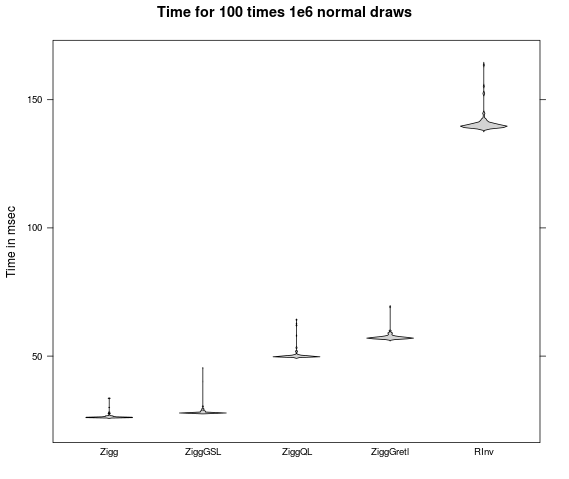
among several existing Ziggurat implementations. This can be seen in the
figure where Ziggurat from this package dominates accessing the
implementations from the GSL, QuantLib and Gretl all of which are still
way faster than the default Normal generator in R (which is of course of
higher code complexity).
This release switches the vignette to the standard trick of premaking
it as a pdf and including it in a short Sweave document that imports it
via pdfpages; this minimizes build-time dependencies on
other TeXLive components. It also incorporates a change contributed by
Tomas to rely on the system build of the GSL on Windows as well if
Rtools 42 or later is found. No other changes.
The NEWS file entry below lists all changes.
Courtesy of my CRANberries, there is a diffstat report relative to previous release. More detailed information is on the Rcppziggurat page or the GitHub repository.Changes in version 0.1.8 (2025-03-30)
- The vignette is now premade and rendered as Rnw via pdfpage to minimize the need for TeXLive package at build / install time (Dirk)
- Windows builds now use the GNU GSL when Rtools is 42 or later (Tomas Kalibera in #25)
This post by Dirk Eddelbuettel originated on his Thinking inside the box blog. If you like this or other open-source work I do, you can sponsor me at GitHub.
:wq for today.
| Series: | Ambit's Run #1 |
| Publisher: | Tor |
| Copyright: | 2024 |
| ISBN: | 1-250-87126-3 |
| Format: | Kindle |
| Pages: | 407 |
A second maintenance release of our still young-ish package tinythemes arrived
on CRAN today. tinythemes
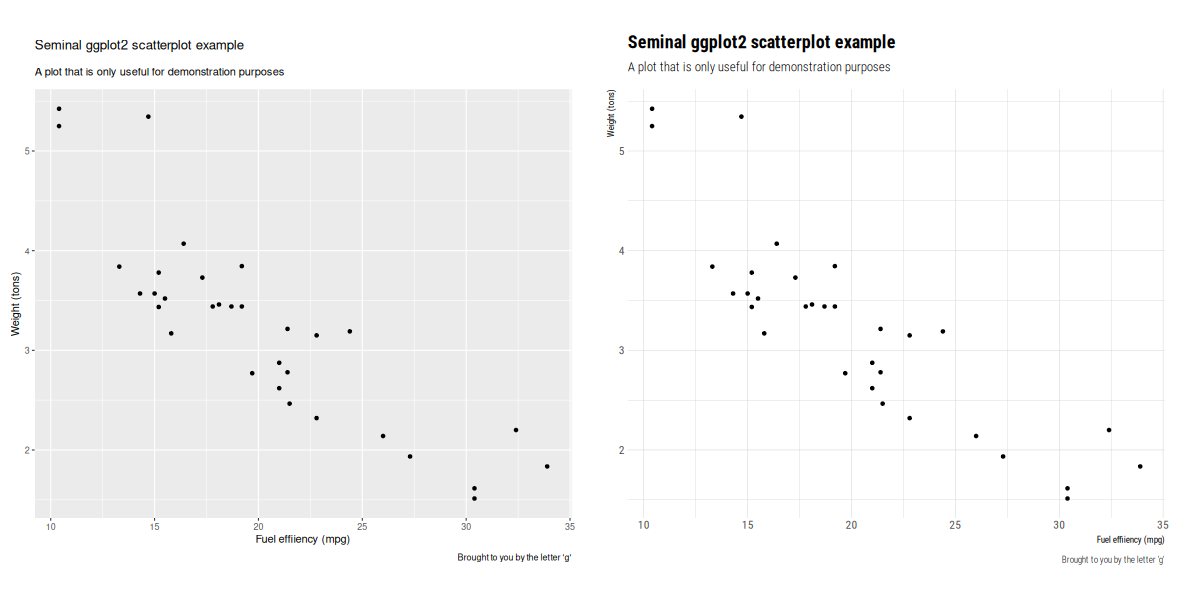
provides the theme_ipsum_rc() function from hrbrthemes by Bob Rudis in a zero (added) dependency way. A
simple example is (also available as a demo inside the package)
contrasts the default style (on the left) with the one added by this
package (on the right):
This version responds solely to things CRAN now nags about. As these are
all package quality improvement we generally oblige happily (and
generally fix in the respective package repo when we notice). I am
currently on a quest to get most/all of my nags down so new releases are
sometimes the way to go even when not under a deadline gun (as with
other releases this week).
The full set of changes since the last release (a little over a year
ago) follows.
Courtesy of my CRANberries, there is a diffstat report relative to previous release. More detailed information is on the repo where comments and suggestions are welcome.Changes in tinythemes version 0.0.3 (2025-03-29)
- Updated a badge URL in README.md
- Updated manual pages with proper anchor links
- Rewrote one example without pipe to not require minimum R version
This post by Dirk Eddelbuettel originated on his Thinking inside the box blog. If you like this or other open-source work I do, you can sponsor me at GitHub.
libtheora 1.2.0 (2025 March 29)As usual, if you use Bitcoin and want to show your support of my activities, please send Bitcoin donations to my address 15oWEoG9dUPovwmUL9KWAnYRtNJEkP1u1b.
- Bumped minor SONAME versions as oc_comment_unpack() implementation changed.
- Added example wrapper script encoder_example_ffmpeg (#1601 #2336).
- Improve comment handling on platforms where malloc(0) return NULL (#2304).
- Added pragma in example code to quiet clang op precedenca warnings.
- Adjusted encoder_example help text.
- Adjusted README, CHANGES, pkg-config and spec files to better reflect current release (#2331 #2328).
- Corrected english typos in source and build system.
- Switched http links to https in doc and comments where relevant. Did not touch RFC drafts.
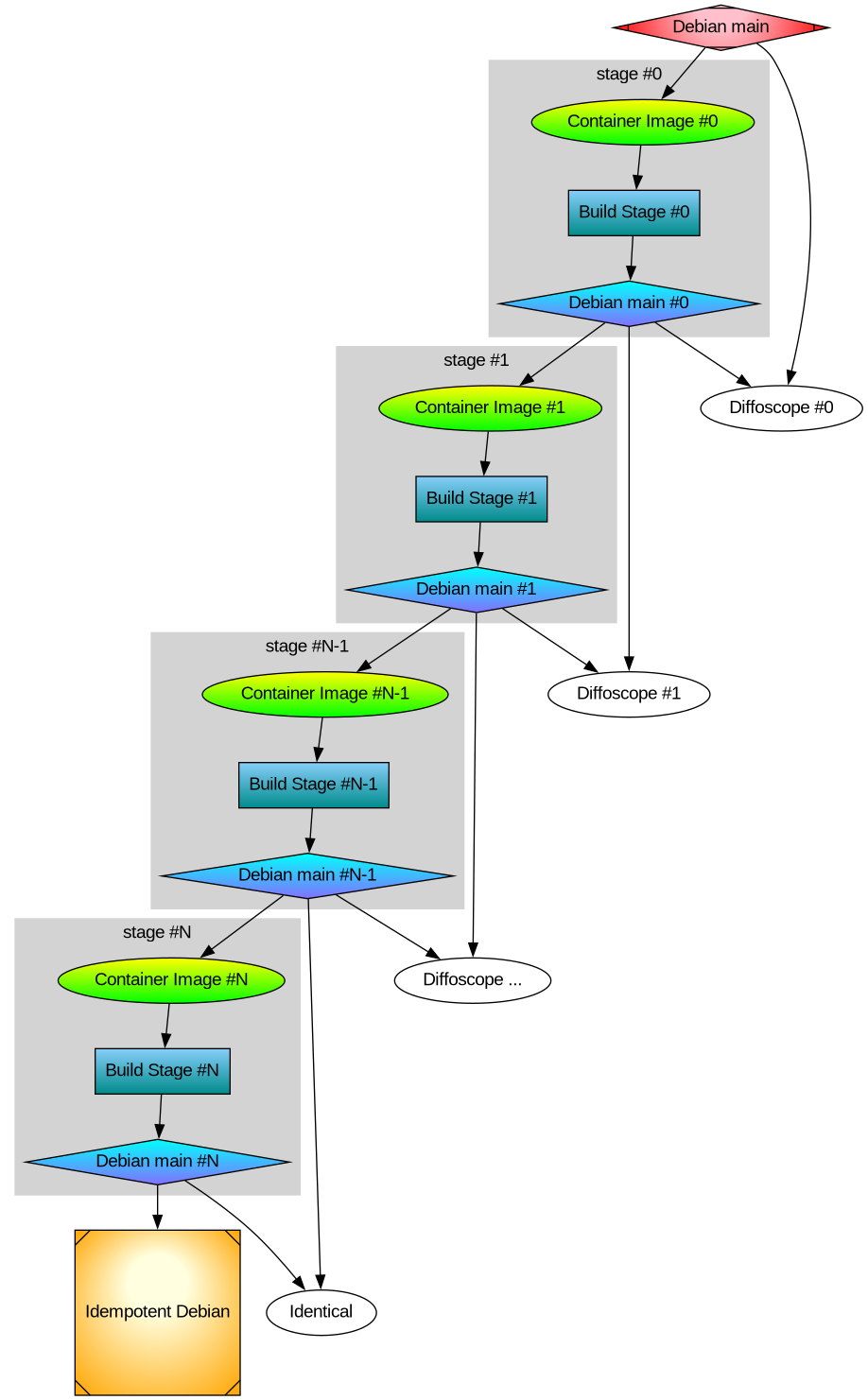
292. This version includes the following changes:
[ Ivan Trubach ]
* Ignore st_size entry for directories to avoid spurious diffs as this value
is essentially filesystem dependent.
[ Chris Lamb ]
* Update copyright years.
293. This version includes the following changes:
[ Chris Lamb ]
* Correct import masking issue.
A language empowering everyone to build reliable and efficient software.Surprisingly, this motto is not mere marketing puff. For Rustaceans, it is a key goal which strongly influences day-to-day decisions (big and small). Empowering everyone is a key aspect of this, which aligns with my own personal values. In the Rust community, we care about empowerment. We are trying to help liberate our users. And we want to empower everyone because everyone is entitled to technological autonomy. (For a programming language, empowering individuals means empowering their communities, of course.) This is all very airy-fairy, but it has concrete consequences: Attitude to the programmer s mistakes In Rust we consider it a key part of our job to help the programmer avoid mistakes; to limit the consequences of mistakes; and to guide programmers in useful directions. If you write a bug in your Rust program, Rust doesn t blame you. Rust asks how could the compiler have spotted that bug . This is in sharp contrast to C (and C++). C nowadays is an insanely hostile programming environment. A C compiler relentlessly scours your program for any place where you may have violated C s almost incomprehensible rules, so that it can compile your apparently-correct program into a buggy executable. And then the bug is considered your fault. These aren t just attitudes implicitly embodied in the software. They are concrete opinions expressed by compiler authors, and also by language proponents. In other words: Rust sees programmers writing bugs as a systemic problem, which must be addressed by improvements to the environment and the system. The toxic parts of the C and C++ community see bugs as moral failings by individual programmers. Sound familiar? The ideology of the hardcore programmer Programming has long suffered from the myth of the rockstar . Silicon Valley techbro culture loves this notion. In reality, though, modern information systems are far too complicated for a single person. Developing systems is a team sport. Nontechnical, and technical-adjacent, skills are vital: clear but friendly communication; obtaining and incorporating the insights of every member of your team; willingness to be challenged. Community building. Collaboration. Governance. The hardcore C community embraces the rockstar myth: they imagine that a few super-programmers (or super-reviewers) are able to spot bugs, just by being so brilliant. Of course this doesn t actually work at all, as we can see from the atrocious bugfest that is the Linux kernel. These rockstars want us to believe that there is a steep hierarchy in programmming; that they are at the top of this hierarchy; and that being nice isn t important. Sound familiar? Memory safety as a power struggle Much of the modern crisis of software reliability arises from memory-unsafe programming languages, mostly C and C++. Addressing this is a big job, requiring many changes. This threatens powerful interests; notably, corporations who want to keep shipping junk. (See also, conniptions over the EU Product Liability Directive.) The harms of this serious problem mostly fall on society at large, but the convenience of carrying on as before benefits existing powerful interests. Sound familiar? Memory safety via Rust as a power struggle Addressing this problem via Rust is a direct threat to the power of established C programmers such as gatekeepers in the Linux kernel. Supplanting C means they will have to learn new things, and jostle for status against better Rustaceans, or be replaced. More broadly, Rust shows that it is practical to write fast, reliable, software, and that this does not need (mythical) rockstars . So established C programmer experts are existing vested interests, whose power is undermined by (this approach to) tackling this serious problem. Sound familiar? Notes This is not a RIIR manifesto I m not saying we should rewrite all the world s C in Rust. We should not try to do that. Rust is often a good choice for new code, or when a rewrite or substantial overhaul is needed anyway. But we re going to need other techniques to deal with all of our existing C. CHERI is a very promising approach. Sandboxing, emulation and automatic translation are other possibilities. The problem is a big one and we need a toolkit, not a magic bullet. But as for Linux: it is a scandal that substantial new drivers and subsystems are still being written in C. We could have been using Rust for new code throughout Linux years ago, and avoided very many bugs. Those bugs are doing real harm. This is not OK. Disclosure I first learned C from K&R I in 1989. I spent the first three decades of my life as a working programmer writing lots and lots of C. I ve written C++ too. I used to consider myself an expert C programmer, but nowadays my C is a bit rusty and out of date. Why is my C rusty? Because I found Rust, and immediately liked and adopted it (despite its many faults). I like Rust because I care that the software I write actually works: I care that my code doesn t do harm in the world. On the meaning of woke The original meaning of woke is something much more specific, to do with racism. For the avoidance of doubt, I don t think Rust is particularly antiracist. I m using woke (like Rust s opponents are) in the much broader, and now much more prevalent, culture wars sense. Pithy conclusion If you re a senior developer who knows only C/C++, doesn t want their authority challenged, and doesn t want to have to learn how to write better software, you should hate Rust. Also you should be fired.
Armadillo is a powerful
and expressive C++ template library for linear algebra and scientific
computing. It aims towards a good balance between speed and ease of use,
has a syntax deliberately close to Matlab, and is useful for algorithm
development directly in C++, or quick conversion of research code into
production environments. RcppArmadillo
integrates this library with the R environment and language and is
widely used by (currently) 1236 other packages on CRAN, downloaded 39 million times
(per the partial logs from the cloud mirrors of CRAN), and the CSDA paper (preprint
/ vignette) by Conrad and myself has been cited 620 times according
to Google Scholar.
This release brings a small upstream bug fix to the two
FFTW3-interfacing functions, something not likely to hit many CRAN packages.
The changes since the last and fairly recent CRAN release are summarised
below.
Courtesy of my CRANberries, there is a diffstat report relative to previous release. More detailed information is on the RcppArmadillo page. Questions, comments etc should go to the rcpp-devel mailing list off the Rcpp R-Forge page.Changes in RcppArmadillo version 14.4.1-1 (2025-03-27)
- Upgraded to Armadillo release 14.4.1 (Filtered Espresso)
- Fix for
fft()andifft()when using FFTW3 in multi-threaded contexts (such as OpenMP)
This post by Dirk Eddelbuettel originated on his Thinking inside the box blog. If you like this or other open-source work I do, you can sponsor me at GitHub.
A new version 0.1.5 of the tint package
arrived at CRAN today.
tint provides a style not unlike Tufte for use in html
and pdf documents created from markdown. The github repo shows
several examples in its README, more as usual in the package
documentation.
This is the first release in one and a half years and contains only
routine maintenance. As CRAN
now bags about missing anchors in the common \code \link
use, I added these today. Otherwise the usual mix of updates to
continuous integration, to badges and URLs and other small packaging
details but nothing user-facing.
Courtesy of my CRANberries, there is a diffstat report relative to previous release. More information is on the tint page. For questions or comments use the issue tracker off the GitHub repo.Changes in tint version 0.1.5 (2025-03-27)
- Standard package maintenance for continuous integration, URL updates, and packaging conventions
- Correct two minor nags in the Rd file
This post by Dirk Eddelbuettel originated on his Thinking inside the box blog. If you like this or other open-source work I do, you can sponsor me at GitHub.
Like each month, have a look at the work funded by Freexian s Debian LTS offering.
We are pleased to announce that Viridien
has committed to sponsor DebConf25 as a
Platinum Sponsor.
Viridien is an advanced technology, digital
and Earth data company that pushes the boundaries of science for a more
prosperous and sustainable future.
Viridien has been using Debian-based systems to power most of its HPC
infrastructure and its cloud platform since 2009 and currently employs two
active Debian Project Members.
As a Platinum Sponsor, Viridien is contributing to the Debian annual
Developers' conference, directly supporting the progress of Debian and Free
Software. Viridien contributes to strengthen the community that collaborates
on the Debian project from all around the world throughout all of the year.
Thank you very much, Viridien, for your support of DebConf25!
Become a sponsor too!
DebConf25 will take place from 14 to 20
July 2025 in Brest, France, and will be preceded by DebCamp, from 7 to 13
July 2025.
DebConf25 is accepting sponsors! Interested companies and organizations may
contact the DebConf team through
sponsors@debconf.org, and visit the DebConf25
website at
https://debconf25.debconf.org/sponsors /become-a-sponsor/.
A new minor release 0.2.5 of our RcppRedis
package arrived on CRAN today.
RcppRedis
is one of several packages connecting R to the fabulous Redis in-memory datastructure store (and
much more). RcppRedis
does not pretend to be feature complete, but it may do some things
faster than the other interfaces, and also offers an optional coupling
with MessagePack binary
(de)serialization via RcppMsgPack. The
package has been deployed in production as a risk / monitoring tool on
a trading floor for several years. It also supports pub/sub
dissemination of streaming market data as per this
earlier example.
Given the changes around Redis, it is
worth stressing that the package works just as well with valkey and uses only hiredis which remains proper
open source.
This update is again somewhat mechanical as a few maintenance things
bubbled up in since the last release in the summer of 2023. As with
other packages, continuous integration was updated a few times as were
URLs and badges, and we update the use of our RApiSerialize.
And, just as we did today and yesterday with littler,
RQuantLib
and RDieHarder,
this addresses a nag from CRAN
about implicit bash dependency in configure.ac
(which we fixed in January as for the other packages but are under
deadline now). Last but not least the newly-added extension of
forbidden symbols in static libraries revealed that yes indeed I had
forgotten to set -DNDEBUG when building the embedded hiredis in fallback mode and
I now also converted its four uses of sprintf to
snprintf so we are clean there too.
The detailed changes list follows.
Courtesy of my CRANberries, there is also a diffstat report for this this release. More information is on the RcppRedis page and at the repository and its issue tracker.Changes in version 0.2.5 (2025-03-26)
- The continuous integration setup was updated several times
- Badges and URLs in README.md have been updated
- An updated interface from RApiSerialize is now used, and a versioned dependency on version 0.1.4 or later has been added
- The DESCRIPTION file now uses Authors@R
- Two possible bashisms have been converted in
configure.ac- The (fallback if needed) build of
libhiredis.anow sets-DNDEBUG, four uses ofsprintfconverted tosnprintf
This post by Dirk Eddelbuettel originated on his Thinking inside the box blog. If you like this or other open-source work I do, you can sponsor me at GitHub.
An new version 0.2.7 of the random-number generator tester RDieHarder
(based on the DieHarder
suite developed / maintained by Robert Brown with contributions by David
Bauer and myself along with other contributors) is now on CRAN.
This release contains only internal maintenance changes: continuous
integration was updated as was a badge URL, and a bashism issue in
configure.ac was addressed (months ago) but as CRAN now sends NOTEs it triggered
this update (just like littler
and RQuantLib
yesterday).
Thanks to CRANberries, you
can also look at the most recent diff
to the previous release.
If you like this or other open-source work I do, you can now sponsor me at
GitHub.
This post by Dirk Eddelbuettel originated on his Thinking inside the box blog. Please report excessive re-aggregation in third-party for-profit settings.
Next.