Search Results: "eric"

11 April 2011

Cyril Brulebois: Debian XSF News #10

This is the tenth Debian XSF News issue. It is basically meant to be a follow-up to DXN#9.
  1. I completed the addition of the Sinhala language, and also dealt with big changes on the xkb-data (a.k.a. xkeyboard-config) side, as explained by Sergey Udaltsov. Protocol:
    • [KiBi] x11proto-core: the upload to experimental was a bit overcautious, so upload again unstable.
    Data: Library:
    • [KiBi] libx11: new upstream release, adding support for Sinhala unstable.
  2. The Graphical Installer started receiving improved portability. There were a few patches floating around adding udebs for generic drivers for non-Linux architectures. I cleaned them up a bit (especially on the vesa side, getting rid of libdrm entirely), got them test-built on a kfreebsd-amd64 box, while Samuel Thibault was doing the same on a hurd-i386 box. I raised the topic on debian-boot@, debian-bsd@, and debian-hurd@, mentioning the remaining steps. Drivers (all accepted by ftpmasters after a tiny trip to the NEW queue):
  3. Here are some other packages which got updated. Applications: Library:
    • [Chris,Julien,KiBi] mesa 7.10.1: long-awaited upload, finally checked, built, and uploaded experimental.
  4. Finally, let s mention migration to testing (from now on I ll use testing instead of wheezy so that it s clear it s about week after week migrations to the testing distribution, rather than our final plans for the next stable release). After a while, and thanks to some hand-holding from our nice release managers (hi, Adam!), linux-2.6, libdrm, mesa, xorg-server, and several dozen drivers migrated to testing. Yay!
  5. As a consequence, some other packages got updated shortly after the successful britney run (because they were prepared right before, just in case). Libraries:
    • [KiBi] libdrm: replace 2.4.23 with 2.4.24 (which was in experimental previously) unstable.
    • [KiBi] mesa: new stable release, 7.10.2 supersedes both 7.10 in unstable and 7.10.1 in experimental (see above) unstable.
    • [KiBi] pixman: new development snapshot, 0.21.6 comes from experimental and supersedes 0.21.4 unstable.
    Drivers:

9 April 2011

Axel Beckert: Finding packages for deinstallation on the commandline with aptitude

Although I often don t agree with Erich (especially if GNOME is involved ;-), he recently posted something on Planet Debian which I found very helpful. I also own a netbook where disk space is sacre. It s an ASUS EeePC 701 with just 4GB disk space. And it runs Debian Sid, so dependencies change often, leaving packages installed which formerly had hard dependencies on, but are now left with just recommendations pointing to it. Quite a few times I asked myself if it s possible to find those packages and if so, how to do it. Well, I don t have to ask myself that anymore, since Erich recently posted the appropriate filter patterns for my favourite package manager aptitude for this task in his posting Finding packages for deinstallation . Thanks, Erich! Since those filters aren t very easy to remember, I d like to extend the usefulness of his posting towards the commandline. I for myself added the following aliases to my shell setup:
alias aptitude-just-recommended='aptitude -o "Aptitude::Pkg-Display-Limit=!?reverse-depends(~i) ~M !?essential"'
alias aptitude-also-via-dependency='aptitude -o "Aptitude::Pkg-Display-Limit=~i !~M ?reverse-depends(~i) !?essential"'
As youam suggested on IRC, I also added the filter !?essential since we won t touch essential packages when cleaning up the list of installed packages anyway. Hope this helps further.

Olly Betts: Xapian GSoC Applications for 2011

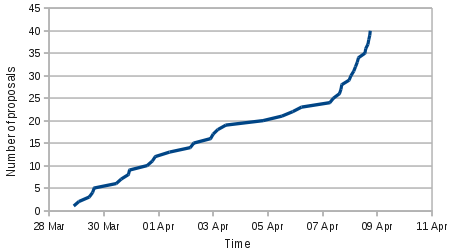
Student applications for GSoC closed a few hours ago. This is Xapian's first year as a mentoring organisation (though I've been involved in previous years with SWIG and Debian) and we've been blown away by the response from students. If you'd have asked me when we'd got accepted, I'd have guessed we might get 20 applications and feel we'd done well, but counting up now we have 42. Ignoring two which were withdrawn (one duplicate, one a spam which surprisingly got withdrawn when I politely suggested such applications weren't useful), here is a graph of applications against time: Graph of student applications to Xapian in GSoC 2011 If you're an admin or a mentor, you can produce a similar graph for your own org(s) - just download this OpenDocument spreadsheet and follow the instructions inside. Now the task of selection starts in earnest. I've gone through and marked the seven spam proposals as ineligible (that's one line proposals, proposals with no connection at all to Xapian, and proposals which are just a title and/or paste from our ideas list with a generic biography). That leaves 33, but not all are really in the running, before our student applicants start to despair! I don't have a good picture yet, but it looks like there are something like 10-15 we'll be seriously considering.

3 April 2011

Cyril Brulebois: Debian XSF News #8

This is the eighth Debian XSF News issue. For a change, I m going to use a numbered list, which should help telling people which item to look for when pointing to a given URL. Feel free to let me know if that seems like a nice idea or whether that hurts readability. Also, it was prepared several days ago already, so I m publishing it (with the needed bits of polishing it still needed) without mentioning what happened in the last few days (see you in the next DXN issue!).
  1. Let s start with a few common bugs reported over the past few weeks:
    • The server can crash due to some X Font Server (XFS) issue as reported upstream in FDO#31501 or in Debian as #616578. The easy fix is to get rid of FontPath in xorg.conf, or to remove the xfs package. It s deprecated anyway.
    • Xdm used to crash when started from init, but not afterwards (#617208). Not exactly fun to reproduce, but with the help of a VM, bisecting libxt to find the guilty commit was quite easy. After a quick upload with this commit reverted, a real fix was pushed upstream; a new upstream was released, packaged, and uploaded right after that.
    • We ve had several reports of flickering screens, which are actually due to upowerd s polling every 30 seconds: #613745.
    • Many bug reports were filed due to a regression on the kernel side for the 6.0.1 squeeze point release, leading to cursor issues with Intel graphics: #618665.
  2. Receiving several similar reports reminded me of the CurrentProblemsInUnstable page on the wiki, which is long unmaintained (and that s why I m not linking to it). I m not exactly sure what to do at this point, but I think having a similar page on http://pkg-xorg.alioth.debian.org/, linked from the how to report bugs page would make sense. Common issues as well as their solutions or workarounds for stable should probably go to the FAQ instead.
  3. As explained in DXN#7, we re waiting for the kernel to migrate to wheezy. The 2.6.38 upstream release was quickly pushed to unstable, which is great news, even if it s not really ready yet (since it s still failing to build on armel and mips).
  4. I ve been using markdown for our documentation, basically since it looked sufficient for our needs, and since I ve been using it to blog for years now, but it had some limitations. I ve been hearing a lot of nice things about asciidoc for a while (hi, Corsac!), so I gave it a quick shot. Being quite happy with it, I converted our documentation to asciidoc, which at the bare minimum buys us a nice CSS (at least nicer than the one I wrote ), and with automatic table of contents if we ask for it, which should help navigating to the appropriate place. A few drawbacks:
    • The syntax (or the parser s behaviour) changed a lot since lenny s version, so updating the online documentation broke badly. Thanks to the nice Alioth admins, the version from lenny-backports was quickly installed and the website should look fine.
    • The automatic table of contents is generated through JavaScript, which doesn t play nicely with wkhtmltopdf (WebKit-based HTML to PDF converter), since the table of contents gets pixelated in the generated PDF documents. We could use a2x to generate documents through the DocBook way, but that means dealing with XSL stylesheets as far as I can tell; that looks time-consuming and a rather low-priority task. But of course, contributions are welcome.
  5. When I fixed missing XSecurity (#599657) for squeeze, I didn t notice the 1.9 packages were forked right before that, so were affected too. I fixed it in sid since then (and in git for experimental). I noticed that when Ian reported a crash with large timeouts in xauth calls, which I couldn t reproduce since untrusted cookies without XSecurity don t trigger this issue. I reported that upstream as FDO#35066, which got marked as a duplicate of (currently restricted) FDO#27134. My patch is currently still waiting for a review.
  6. Let s mention upcoming updates, prepared in git, but not uploaded yet:
    • mesa 7.10.1, prepared by Chris (RAOF); will probably be uploaded to experimental, unless 7.10 migrates to testing first, in which case that update will target unstable.
    • Intel driver: Lintian s been complaining about the .so symlinks for a while, and I finally gave it a quick look. It seems one is supposed to put e.g. libI810XvMC.so.1 in /etc/X11/XvMCConfig to use that library, so the symlinks are indeed not needed at all, and I removed them.
    • Tias Guns and Timo Aaltonen introduced xinput-calibrator in a git repository; that s a generic touchscreen calibration tool.
  7. Here come the updated packages, with uploader between square brackets (JVdG = Julien Viard de Galbert, Sean = Sean Finney). For the next issue, I ll try to link to the relevant entries in the Package Tracking System.
    • [KiBi] libxt: to unstable, as mentioned above, with a hot fix, then with a real fix.
    • [KiBi] synaptics input driver: to unstable and experimental, fixing the FTBFS on GNU/kFreeBSD.
    • [KiBi] xterm: new upstream, to unstable.
    • [KiBi] libdrm: new upstream, to experimental. A few patches to hide private symbols were sent upstream, but I ve seen no reactions yet (and that apparently happened in the past already).
    • [KiBi] xorg-server 1.9.5rc1 then 1.9.5, to unstable.
    • [KiBi] xutils-dev to unstable: the bootstrap issue goes away, thanks to Steve s report.
    • [KiBi] libxp to unstable, nothing fancy, that s libxp
    • [KiBi] keyboard input driver: mostly documentation update, to unstable and experimental.
    • [KiBi] mouse input driver: fixes BSD issues, to unstable and experimental.
    • [KiBi] intel video driver: to experimental, but the debian-unstable branch can be used to build the driver against unstable s server.
    • [KiBi] xfixes: protocol to unstable, and library to experimental (just in case); this brings support for pointer barriers.
    • [JVdG] openchrome video driver: Julien introduced a debugging package, and got rid of the (old!) via transitional package. He also performed his first upload as a Debian Maintainer. Yay!
    • [KiBi] siliconmotion video driver: to unstable.
    • [KiBi] pixman: new upstream release candidate, to experimental
    • [Sean] last but not least: many compiz packages to experimental.

31 March 2011

Josselin Mouette: News@11: Mozilla gives the finger to embedders

There have been a lot of web browsers embedding the Gecko engine, especially through the gtkmozembed library (it was not really a proper library but let s call it like that). I remember being a happy user of galeon, which went on as epiphany, but there were also all these small applications that just need a good HTML renderer in one of their widgets, like yelp, or several Python applications using python-gtkmozembed. Anyone having had to deal with these applications, especially the most complex ones, could tell you a few things: So, today, it is official: Mozilla is dropping gtkmozembed from their codebase. I don t think this will come as a surprise to anyone. You can t develop a new version of a behemoth, monolithic application every 3 months while still caring about the interfaces underneath. Embedded applications have been migrating to webkit over the recent years, and those that don t do it really soon will die. The interesting part of the announcement is not here. It can be found hidden in a bug report: a stable and versioned libmozjs will just never happen. What does it mean? First of all, it means that Debian and Ubuntu will have to go on maintaining their own versioning of libmozjs so that it can be linked to in a decent way by applications using the SpiderMonkey JS engine. It also means that this version will have to be bumped more often. But it also puts into question the whole future of SpiderMonkey as a separate library. With a shortened release cycle, the Mozilla developers will be tempted to add more specific interfaces to SpiderMonkey, reducing its genericity in favor of its use in Firefox itself. This will produce less and less useful libmozjs versions, until we reach the point when they ll make the same announcement as above, with s/gtkmozembed/libmozjs/. This is especially relevant in the context of the GNOME Shell, which is at the core of the GNOME 3 experience. The developers deliberately chose to avoid using JavaScriptCore (the JS library inside webkit) through the Seed engine, and used GJS instead, that relies on libmozjs. In my opinion this was done for frivolous reasons (being able to use more language extensions); and not only this put the GNOME developers in an awkward situation where 2 JS interpreters compete in the same desktop, but now it puts a risk on a technology which is at the core of the desktop. One of the reasons for the limited adoption of JSCore is that it lies currently in the same library as Webkit, which is a huge dependency. I ve been very glad to learn that Gustavo is considering the idea of splitting it. We need to provide an escape route for applications using libmozjs, and it looks like more than a decent one. I hope that GNOME Shell follows it sooner than later.

Pau Garcia i Quiles: A wish a day 7: make emerge a generic package manager for Windows

A while ago I said Koen from Emweb made an interesting proposal at FOSDEM about emerge, the KDE Windows build tool. Yesterday, Jaros aw Staniek and I reaffirmed our commitment to emerge . Today, I d like to go a bit further: let s bring more developers to emerge by opening it up to other projects. Keep reading! What is emerge, why is it important and what was Koen s proposal? Fact: Microsoft Windows is very different to Unix in regards to development. On Unix platforms -that includes Linux and Mac OS X-, software is usually installed to /usr: applications in /usr/bin and /usr/sbin, libraries in /usr/lib, headers in /usr/include, common resources in /usr/share, etc. Also, dependency management is usually something you can count on: when you install kdelibs5-dev in Ubuntu, it will automatically install libqt4-dev, kdelibs5-data, libfreetype (runtime), etc That makes setting up a development environment a very easy task: look for shared libraries, header files, etc in the common places and you will probably find them. On Windows there is nothing like that. When you want to compile an application, you need to provide (build and install) all its dependencies, and you need to tell Visual Studio where to find everything. Even CMake usually needs some help in the form of a hint for CMAKE_PREFIX_PATH. As you may imagine, building KDE, which has more than 200 third party dependencies and tens of modules (and with the move + split to git, many more) becomes an almost insurmountable task. Emerge to the rescue: inspired by Gentoo s emerge, Ralf Habacker, Christian Ehrlicher, Patrick Spendrin and others (yours faithfully included) developed a tool which downloads the source, configures, builds, installs and packages KDE and its dependencies. It makes a world of difference when building KDE. Actually, it makes building KDE on Windows possible. Once more: thank you very much guys, impressive tool. There are two well-differentiated parts in emerge, the engine and the recipes . The engine takes care of downloading the sources (tarballs, checkouts from Subversion and git clones, etc) , configuring and building for the usual build systems (QMake, CMake, NMake makefiles, etc), installing, bundling packages together and much more. All that for four compilers (MSVC2008, MSVC2010, MinGW32 and MinGW-W64). It s the equivalent to Gentoo s emerge, Debian s dpkg + debhelper/cdbs or Homebrew and MacPorts for Macintosh. The recipes are the package-specific instructions a particular piece of software needs to build: what s the name of the tarball? URL to download from? What versions are available? What build system to use to configure and build? Does it need any Windows-specific patch? They are written in Python using some helper modules emerge provides (the debhelper-like part I mentioned above). Currently, there are about 70 recipes in emerge, organized in our portage tree (bear in mind the names are taken from Gentoo but the internals of the tool are completely different). With those 70 recipes, we are able to build most KDE modules. Problem is to provide all the optional features, we are missing probably 200 to 250 more recipes. Given that KDE on Windows is quite short on developers, we have to decide: either we fix bugs and improve the integration of KDE on Windows, or we keep track of the dependencies. I won t lie: for KDE on Windows, I d rather focus on development than on packaging. Given that writing and maintaining recipes does not strictly require programming skills (although they help :-) ), during my talk at FOSDEM I kept asking people to join the KDE on Windows team as packagers, even if you know little to nothing about software development. If you think about it, that s what we have in Linux distributions: there are hundreds (thousands?) of packagers in Debian, Fedora, openSuse, etc which take care of the recipes to build software developed by someone else ( upstream , in the parlance). What we have in KDE on Windows, where we are the KDE packagers, the KDE developers (upstream) and the emerge developers, is actually an anomaly. Then Koen took the microphone and said: why don t you open emerge to other projects? And I there I realized he was damn right We have developed an awesome tool to download, configure, build, package and install third party software on Windows, to manage dependencies, to update, etc. For four compilers, no less. The engine of emerge is not really tied to KDE. We already have a lot of recipes for software which is not KDE specific: openssl, Qt, bzip2, libpng, mysql, etc. I see no actual reason to disallow Gnome, GStreamer, OpenSceneGraph, LibreOffice and many others in (assuming someone wants to take care of them, of course no, do not look at me! I don t have time!). Currently, the only barrier preventing those recipes in is emerge is developed in the KDE repository and you need a KDE developer account to commit your recipes. That s about it. There is also a perception problem: if emerge is developed in KDE, it s because it s a KDE-thingy, right? . Well, no. One way to avoid that would be to graduate emerge from KDE and make it an independent project, one in which the current developers have accounts, and new developers get an emerge project account instead of a KDE account to commit recipes. Please note graduating does not mean expelling , firing or anything peyorative. It does not mean that emerge developers (engine and recipes) are worse than KDE developers, or less KDE developers than our god David Faure: in KDE, we consider Debian, Fedora, openSuse, etc KDE packagers as equals, they are also KDE developers and many of them are in the KDE eV (funny thing is I am not). My wish for today: think of one application or library you d like to see in Windows and become its maintainer in emerge for Windows. For now, let s do this in the kde-windows mailing list and if this idea succeeds, then we ll talk about graduating. You could also try to add support for a new compiler (OpenWatcom, Intel C++, etc) but that s a lot more more and it s not a priority now. PS: Yes, I know about CoApp, Microsoft s similar effort, with some magic involved. I ve been watching and trying it since day 1. I m really interested. It s just not there yet and I do not have spare time to help Garrett (hey Microsoft, hire me and I ll have all the time in the world! :-) )

Russell Coker: Links March 2011

Cory Doctorow wrote an interesting article for The Guardian about Harper-Collins attempts to make self-destructing books [1]. They claim that a traditional book falls apart after being read 26 times (a claim that Cory disputes based on personal experience working at libraries) and want ebooks to be deleted after being borrowed so often. Really the copy-right fascists are jumping the shark here.Socialogical Images has an interesting archive of adverts for supposed treatments for autism, obsessive-compulsive disorder, asperger syndrome, and attention deficit and hyperactivity disorder [2]. The New York University Child Study Center conducted the campaign of fake ransom notes to describe a psychological difference as something that kidnaps a child. The possibility that parents should to some extent learn to adapt to their child s nature rather than fixing them with medication is something that most people can t seem to understand.William Cronon has written an interesting analysis of the way Conservative , lobby groups work [3]. They are more organised than I expected.The Reid Report has a good summary of some of the corporat issues related to the Japanese nuclear melt-down [4], apparently the company that runs the reactors decided to delay using sea-water in the hope that their investment could be salvaged and thus put everyone at increased risk. I think that this proves that reactors shouldn t be privately owned.Ian Lowe wrote a good summary of the reasons why Australia should not be using nuclear power when we believed that the Fukushima disaster was over [5]. But it turns out that the Fukushima problems were worse than we thought and the melt-down is getting worse.Christopher Smart wrote a good analysis of Microsoft s latest attempt to extort money from Linux users where they assert patent claims over Android [6]. He points out that .NET/Mono is a risk to Linux.Major Keary wrote a positive review of Snip Burn Solder Shred which is a book about Seriously geeky stuff to make with your kids [7]. Sounds like a fun book.The internal network of RSA has been cracked in some way that apparently weakens the security of SecureID, Bruce Schneier s blog comments section has an interesting discussion of the possibilities [8]. I expect that it s a fairly bad attack, if the attack was minor then surely the RSA people would have told us all the details.Hans Rosling gave an interesting TED talk about The Magic Washing Machine [9]. He describes how his family benefited when his mother first got a washing machine and how this resulted in better education as his mother had more time to get library books for her children. It seems that deploying more electric washing machines should be a priority for improving education and food supplies in third-world countries.Paul Root Wolpe gave an interesting and disturbing TED talk about bio-engineering [10]. He catalogues the various engineered animals and talks about the potential for future developments.Ron Rosenbaum wrote an interesting and insightful article for Slate about Maj. Harold Hering who s military career ended after he asked how to determine whether a nuclear launch order is lawful, legitimate, and comes from a sane president [11]. The question never received a good answer, this is a good reason for moving towards nuclear disarmament and for Americans to vote for the sanest and most intelligent candidate in the presidential elections.Eythor Bender gave an inspiring TED talk about human exoskeletons [12]. He had live demonstrations on stage of a soldier using an exo-skeleton to carry a heavy backpack and a woman who suffered a severe spinal-cord injury walking after being in a wheel-chair for 19 years.

26 March 2011

Dirk Eddelbuettel: Branford Marsalis and Terence Blanchard

Wonderful jazz concert at CSO yesterday in classic double-header plus intermission format. First up was Branford Marsalis (ss,ts) with his quartet featuring Joey Calderazzo (p), Eric Revis (b) and Justin Faulkner (dr) and they simply blew the roof off the place. Best set I heard in a while: dynamic, joyful, playful, modern, whathaveyou. Really really nice. The second set was the Terence Blanchard (tp) quintet featuring Brice Winston (ts), Fabian Almazan (p), Joe Sanders (b) and Kendrick Scott (dr) who also played a nice set, but as far as I am concerned did not gel as a much as the spectacular first set. Great evening.

21 March 2011

Lars Wirzenius: Obnam version 0.15 and 0.15.1, and btree/larch 0.19

I've just made a couple of software releases: This is the first release of Obnam this year. Below is a summary of the changes. My apt repository has binary packages for amd64, i386, and armel. I've started mentoring someone to help me maintain the Debian packages, and hope to start uploading Obnam and its dependencies to Debian within a few weeks. Obnam is still in ALPHA, but the only missing thing for moving to BETA is encryption support. There's a bunch of bugs that need to be fixed, but I'm not going to block the BETA on them. I'd be very interested to hear any feedback on this version. Bugs fixed: Improvements and other changes:

16 March 2011

Daniel Kahn Gillmor: CryptLib and the OpenSSL License

I spent part of today looking at packaging Peter Gutmann's CryptLib for debian. My conclusion: it may not be worth my time. One of the main reasons i wanted to package it for debian is because i would like to see more OpenPGP-compliant free software available to debian users and developers, particularly if the code is GPL-compatible. Cryptlib makes it quite clear that it intends to be GPL-compatible:

cryptlib is distributed under a dual license that allows free, open-source use under a GPL-compatible license and closed-source use under a standard commercial license.
However, a significant portion of the cryptlib codebase (particularly within the bn/ and crypt/ directories) appears to derive directly from OpenSSL, and it retains Eric Young's copyright and licensing. This licensing retains the so-called "advertising clause" that is generally acknowledged to be deliberately incompatible with the GPL. (A common counterargument for this incompatibility is that OpenSSL should be considered a "System Library" for GPL'ed tools that link against it; whether or not you believe this for tools linked against OpenSSL, this counterargument clearly does not hold for a project that embeds and ships OpenSSL code directly, as CryptLib does) This does not mean that CryptLib is not free software (it is!), nor does it mean that you cannot link it against GPL'ed code (you can!). However, you probably can't distribute the results of linking CryptLib against any GPL'ed code, because the GPL is incompatible with the OpenSSL license. The un-distributability of derived GPL-covered works makes the CryptLib package much less appealing to me, since i want to be able to write distributable code that links against useful libraries, and many of the libaries i care about happen to be under the GPL. I also note that Peter Gutmann and CryptLib Security Software (apparently some sort of company set up to distribute CryptLib) may be in violation of Eric Young's License, which states:
 * 3. All advertising materials mentioning features or use of this software
 *    must display the following acknowledgement:
 *    "This product includes cryptographic software written by
 *     Eric Young (eay@cryptsoft.com)"
 *    The word 'cryptographic' can be left out if the rouines from the library
 *    being used are not cryptographic related :-).
A Google search for Eric Young's name on cryptlib.com yields no hits. I do find his name on page 340 of the Cryptlib manual, but that hardly seems like it covers "All advertising materials mentioning features or use of this software". I suppose it's also possible that CryptLib has negotiated an alternate license with Eric Young that I simply don't know about. In summary: i think CryptLib could go into debian, but its incorporation of OpenSSL-licensed code makes it less useful than i was hoping it would be. I have a few other concerns about the package after looking it over in more detail. I suspect these are fixable one way or another, but i haven't sorted them out yet. I'm not sure i'll spend the time to do so based on the licensing issues i sorted out above. But in case anyone feels inspired, the other concerns i see are:
embedded code copies
In addition to embedded (and slightly-modified) copies of bn/ and crypt/ from OpenSSL, CryptLib contains an embedded copy of zlib. Debian has good reasons for wanting to avoid embedded code copies. I've got it CryptLib building against the system copy of zlib, but the bits copied from OpenSSL seem to be more heavily patched, which might complicate relying on the system version.
executable stack
lintian reports shlib-with-executable-stack for the library after it is built. I don't fully understand what this means or how to fix it, but i suspect it derives from the following set of object files that also have an executable stack:
0 dkg@pip:~/src/cryptlib/cryptlib$ for foo in $(find . -iname '*.o'); do
>  if ! readelf -S "$foo"   grep -q .note.GNU-stack ; then
>   echo "$foo"
>  fi
> done
./shared-obj/desenc.o
./shared-obj/rc5enc.o
./shared-obj/md5asm.o
./shared-obj/castenc.o
./shared-obj/bfenc.o
./shared-obj/rmdasm.o
./shared-obj/sha1asm.o
./shared-obj/bn_asm.o
./shared-obj/rc4enc.o
0 dkg@pip:~/src/cryptlib/cryptlib$ 
They probably all need to be fixed, unless there's a good reason for them to be that way (in which case they need to be documented).
non-PIC code
lintian reports shlib-with-non-pic-code on the library after it is built. I don't fully understand what this means, or how to resolve it cleanly, but i imagine this is just a question of sorting out the details.
Anyone interested in using my packaging attempts as a jumping off point can start with:
git clone git://lair.fifthhorseman.net/~dkg/cryptlib
Oh, and please correct me about anything in this post; I'd be especially happy to hear that my analysis of the licensing issues above is wrong :) Tags: cryptlib, gpl, licensing, openssl

14 March 2011

Erich Schubert: GNOME3 in Debian experimental - python and dconf

As GNOME3 slowly enters Debian experimental, things become a bit ... experimental.
The file manager can be set to still draw icons on the desktop, but that doesn't entirely work yet (it will also open folders as desktop then...)
One machine had lost the keyboard settings. I could not set the fonts I wanted...
There is a tool called dconf-editor that will allow you to manually tweak some settings such as the fonts. But it doesn't seem to have support for value lists yet - and the keyboard mappings setting is a string list.
So here's sample python code to modify such a value:
from gi.repository import Gio
s = Gio.Settings.new("org.gnome.libgnomekbd.keyboard")
s.set_strv("layouts", ["de"])
Update: you could also install the optional libglib2.0-bin and use the gsettings command.

Erich Schubert: What is really happening at Fukushima?

As far as I can tell, neither the Japanese government, nor the operating companies tell the truth.
Here's my take of the story:
  • The tsunami not only destroyed the generators, but the complete cooling systems.
  • Thus, the cores will overheat and melt, they have no way to prevent this, they can only try to keep the damage as low as possible.
  • The cooling water turned into gas and disassociated into hydrogen and oxygen. Unfortunately, this is highly explosive. So the best they can do is to try to get the gas out of the core containment, and let is explode outside where it does not cause too much radioactive pollusion (are core explosion would be really bad). This already happened at reactors 1 and 3, and will happen at reactor 2 the next one or two days.
  • They use the sea water to slow down the core meltdown and keep the core containment stable. They probably do this by flooding the second containment, where there it no direct radioactive materials.
So essentially, I don't see much of a risk of a nuclear explosion, and I expect the radioactive pollution to be quite low, mostly via indirect radiation from the coolant in the outer containment. The reactor however is trashed and full of highly radioactive waste, that will require constant cooling for the next few years.
However, I'm really concerned that apparently, the government and the companies involed lied to us. This is happening a lot when it comes to nuclear power, they barely are truthful about what is happening.
Nuclear power is only safe as long it is operated by altruistic and responsible people. Once you bring free market, politics and money in, it is a dangerous toy that should not be toyed with by humans.

Erich Schubert: Google Circles rumor

The media are spreading a rumor about a social networking platform by Google, called Circles.
So far, these things have been debunked.
I do not believe that Google could succeed with a "Facebook clone". The market is already taken, Facebook is too big and had successfully been taking away international markets from local clones. For example in Germany, the other social networks used to be a lot bigger, but Facebook overtook them in just a few months, and the people I know pretty much quit the other networks then.
And I assume Google is aware that unless they have a strong strategy, the network would go the Wave-Buzz route.
At least here in Germany, people are surprisingly concerned by the amount of data Google might have on them, while at the same time they give it to Facebook for free. This is probably due to the media attention received with StreetView. It's not fair, but that's life.
However, "social network" is a broad term. Just think of what people actually use facebook for:
  • Games (often even not with their social circle!)
  • Microblogging
  • Photo sharing
  • Email
  • Automatic address book
Now, if you look closely at this list, Google pretty much has all of these, if we ignore the browser games (and they are all over the internet by now, Facebook and without!), then there is just one key ingredient missing for Google: the address book thing.
I believe this "Google circles" thing will largely by a "smart address book" that helps people managing their social contacts in a social network style. And obviously, this can be integrated in various products such as Mail, Picasa, Buzz, ...
If Google manages to launch a "contact manager" that makes it really easy for people to manage their social circles, this can be quite a killer. Facebook has "lists" but they are awful to use. It likes to "hide" friends to reduce the amount of information it throws at you. But it doesn't really organize it for you, for example by social circles or topics. These days for example Facebook could split the news feed into "Japan" and "everything else" I guess.

Raphaël Hertzog: Missing firmware in Debian? Learn how to deal with the problem

You know it already, since Debian 6.0 non-free firmware are no longer provided by a standard Debian installation. This will cause some troubles to users who need them. I m thus going to do a small overview on the topic and teach you what you need to know to deal with the problem. What are firmware and how are they used? From the user s point of view, a firmware is just some data that is needed by some piece of hardware in order to function properly. The driver for that hardware typically loads the firmware on the device as part of its initialization. In the Linux kernel, the drivers are all using a standardized interface (request_firmware) to retrieve the firmware before sending it to the device. Thanks to this standardization, it s possible to either embed the firmware in the kernel or to have it request the firmware from user-space when needed. Debian (like most distributions) has selected the latter option. Thus when the kernel needs a firmware, it sends out a request to user-space. udev is getting the request with the name of the firmware, and in its default configuration (see /lib/udev/rules.d/80-drivers.rules) it executes /lib/udev/firmware.agent in response. Where are firmware stored? firmware.agent is a simple shell script that tries to locate a firmware before sending it back to the kernel through a sysfs entry. It looks into the following directories: Firmware provided by packages are thus usually in /lib/firmware and you can use /usr/local/lib/firmware for manually installed firmware. How do I know whether I need a firmware? First of, you can notice messages from the kernel telling you that it tried to load a firmware but it failed. They look like this:

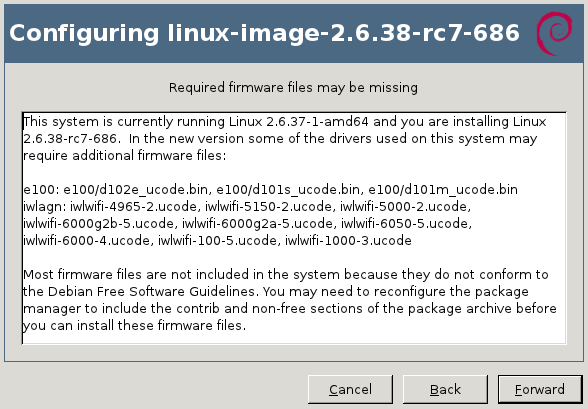
e100: eth0: e100_request_firmware: Failed to load firmware "e100/d101m_ucode.bin": -2
But you might be informed sooner. When you install a new version of the Linux kernel with the official Debian packages, the post-installation script will go through all loaded modules (those listed by lsmod) and it will verify whether this module as provided by the newly installed kernel might require firmware files. This information can be retrieved with modinfo:
$ modinfo -F firmware /lib/modules/2.6.32-5-amd64/kernel/drivers/net/e100.ko
e100/d102e_ucode.bin
e100/d101s_ucode.bin
e100/d101m_ucode.bin
If one (or more) of those firmware is (are) not yet available on the system, you will get a warning message similar to this one:
update-initramfs will also generate a similar warning on the terminal:
update-initramfs: Generating /boot/initrd.img-2.6.32-5-amd64
W: Possible missing firmware /lib/firmware/e100/d102e_ucode.bin for module e100
W: Possible missing firmware /lib/firmware/e100/d101s_ucode.bin for module e100
W: Possible missing firmware /lib/firmware/e100/d101m_ucode.bin for module e100
The Debian installer also detects when you have hardware that might require a missing firmware file. You have the option to supply the missing files on a USB stick (either directly or through the corresponding package). How do I find and install the missing firmware? Now that you have the name of the firmware file that you want, it s relatively easy to identify the package that provides the required file. You can use apt-cache search <filename> because the firmware packages embed the list of firmware files in their description. You can also use apt-file (provided by the package of the same name) or the web interface at packages.debian.org.
$ apt-cache search d101m_ucode.bin
firmware-linux-nonfree - Binary firmware for various drivers in the Linux kernel
$ apt-file search d101m_ucode.bin
firmware-linux-nonfree: /lib/firmware/e100/d101m_ucode.bin
If the above commands return nothing, you probably need to enable the non-free repository in your /etc/apt/sources.list (you can also enable it within synaptic). And you also want to run sudo apt-file update to have the latest information. Now you can install the right package, in the example above it was firmware-linux-nonfree. How do I install all firmware just to be sure I don t miss any? There s no meta-package depending on all firmware packages so there s no easy answer to this question. Furthermore not all firmware packages respect the naming convention firmware-* (there s for example zd1211-firmware). So your best bet is to look up all the packages with a generic search like this one:
$ apt-file --package-only search /lib/firmware/
atmel-firmware
[...]
And then install them all. Are there DVD or CD images with non-free firmware? Yes. Debian provides an unofficial netinst image for i386/amd64/powerpc with the non-free firmware, you can find it here: http://cdimage.debian.org/cdimage/unofficial/non-free/cd-including-firmware/. I provide complete DVD sets with firmware, and Multi-Arch CD/DVD with firmware, it s over there in my DVD shop: http://raphaelhertzog.com/go/debian-cd/ (i386/amd64 only) When using those installation discs, the Debian-installer will be able to find the required firmware immediately. There s no need for you to provide them on a USB stick. Other questions? I think I covered the most important things you have to know about firmware on Debian. But should you still have a question, feel free to share it in the comments so that I can improve this article.
Click here to subscribe to my free newsletter and get my monthly analysis on what s going on in Debian and Ubuntu. Or just follow along via the RSS feed, Identi.ca, Twitter or Facebook.

6 comments Liked this article? Click here. My blog is Flattr-enabled.

12 March 2011

Joey Hess: JEST results

Four months ago I opted out of daylight savings time. How did it work out? Tomorrow I will be in sync with everyone else. That might take some getting used to. I plan to keep my timezone setting, and will be doing this again next winter.

11 March 2011

Pietro Abate: On equivalent debian versions

For one of our experiments, we ended up analyzing all versions mentioned in a Debian Packages file if mentioned in a constraint or in a version field of a package. It seems that there are a lot of DDs that like to use strange 'formatting' when writing down a versioned constraint. This is might be not a choice done directly by the debian maintainer, but just a consequence of a particular version schema from upstream. The debian policy is rigorous with relation to the algorithm to compare version .
 The strings are compared from left to right.
 First the initial part of each string consisting entirely of non-digit characters is determined. These two parts 
 (one of    which may be empty) are compared lexically. If a difference is found it is returned. The lexical 
 comparison is a comparison of ASCII values modified so that all the letters sort earlier than all the non-letters 
 and so that a tilde sorts before anything, even the end of a part. For example, the following parts are in sorted 
 order from earliest to latest: ~~, ~~a, ~, the empty part, a.[34]
 Then the initial part of the remainder of each string which consists entirely of digit characters is determined. 
 The numerical values of these two parts are compared, and any difference found is returned as the result of 
 the comparison. For these purposes an empty string (which can only occur at the end of one or both version 
 strings being compared) counts as zero.
 These two steps (comparing and removing initial non-digit strings and initial digit strings) are repeated until a
 difference is found or both strings are exhausted.
I think the important part is about the numerical comparison The numerical values of these two parts are compared, and any difference found is returned as the result of the comparison . Our tool finds a number of examples of equivalent versions : For example version '0.00001-1' is from package libbenchmark-progressbar-perl. I don't know why so many equivalent way of writing a version string are used. Probably they appear in completely unrelated packages I'm pretty sure no harm is intended :) However, to avoid confusion, it might be a good idea to settle on a non-normative canonical representation of versions. Like no '0' in front of dots and hyphen... Maybe we could add a warning in lintian ? If somebody is interested I can generate a full report that associates each version to a package name.

3 March 2011

Thorsten Glaser: (Free)BSD vs. Linux

Warning: this is a rant against BSD (specifically FreeBSD , but don t let me get started on DragonFly, who think it s wise to drop all shells except ash from the base system and rely on pkgsrc yay let s compile a dozen packages just to get a shell with tab completion, not to mention boxen with no network access for the task although others seem to go into that direction too ; you know, there s BSD, and then there s FreeBSD ) don t like, don t read. If you want to change something in the BSD world, you gotta fork your own BSD no other way around the thickheads. Ok, back then, I ran into a particularily thick one, but others tend to not be much better. Users share the thickness. If you want to change something in the GNU/Linux world, just make a package, have someone upload it, prod (or pay, Hanno got a Radler) people to do it, or just upload it yourself. At the BSD booth at FOSDEM, despite me bringing the Windows Mobile 6 Professional devive, strictly for Geocaching mind you, Macintosh boxen had a share of more than 50% I didn t manage to tip the scale. At the Debian booth, almost everyone had a I want to buy a new laptop some day, but it just keeps on working and doesn t break pre-Lenovo IBM laptop. No hyping of Google either. (Last year s CLT saw BSD people advocating pro-Schily the guy with the broken encoding in his name shockingly.) Honestly, tcsh, FreeBSD people? Sorry. While I agree that there is merit on having the same script and interactive shell, as someone has pointed out (copy-paste examples into the command line), there s those zsh users who use mksh or GNU bash for scripting. Or just POSIX shell. And that s with an interactive shell which can be used for scripting. On the other hand, the C shell (both csh and tcsh) cannot. And what s with pretending the accent gravis is non-combining, called backtick (such a thing does not exist); and advocating it? Sorry, if your csh/tcsh doesn t handle the POSIX $( ) you should just drop it. (By the way, there is a convention that example command lines are prefixed with % for csh and $ for sh (or # but we write $ sudo instead, these days). Use it. Or leave it. If you have examples that substitute another process output, be specific.) It s funny to see how one person tries to defuse my arguments against csh by telling me it s just an interactive shell , while the other argues that people copy-paste between them, to which that was my response. Read the thread! And please, get your facts right. I would prefer that the standard shell be at least Bourne-compatible. You don t want Bourne ( ^ instead of for pipes), you want POSIX. That GNU bash is called the Bourne-Again Shell in one of their usual semi-bad puns doesn t help the global perception of such things any. Also, the root shell and /bin/sh are disjunct. (Plus, why change the root shell, use sudo(8), plain and simple.) ObNote: in jupp (should I package that for Debian, btw? rather upload, packages are ready ) the key is used as pr fix for Ctrl-X ( X) or to directly enter numerical (decimal, octal, sedecimal/hexadecadic) ASCII, 8-bit or Unicode codepoints. Yay!

And even the FSF has seen the light; for a few releases already, GCC uses ' ' instead of ' for quoting in messages, even without locales. Great job there! (LC_MESSAGES=en_GB.UTF-8 usually works, too, though.) ObDisclaimer: I have an (yes, Google ) Alert on the word mksh , so I know when it s being discussed. This obviously includes certain fora. Also, I m a shell implementer and bound to know a certain amount of details. Plus, mksh s build script runs with pretty much any Bourne/POSIX/Z Shell which has functions and not too many bugs. I wrote it. Go figure. No lowly trolling. FWIW, mksh(1) has the cat(1) builtin both because Android has no cat(1), and as speed hack. Almost all other shells have worse speed hacks, like a printf(1) builtin. And recently, builtins have become direct-callable, so this actually reduces the overall system footprint. (Its inclusion also provides for some other possibilities, internally.) And as two final side notes, if you haven t seen this: determine which shell we are run under (CVS) and I still offer a prompt conversion service (send me any GNU bash or oksh $PS1 and I ll send that to you in mksh(1) syntax optionally with adjustments/improvements, like cwd uses only up to 1/3 of screen width).

28 February 2011

Matthew Garrett: Further adventures in mobile Linux

I picked up a couple of cheap Linux devices at the weekend. First of all, a $99 Android tablet from CVS, made by Craig. It's a generic RK2818 device and of course it's lacking any kind of GPL offer in the documentation. As far as I know the only company that's released any Rockchip source so far has been Archos, and even then they haven't released the tools you need to actually build an image - they seem to be floating around the internet anyway. But it's straightforward to get it to run the Android market, and it runs Shortyz quite well, so fit for purpose from my point of view. I am, obviously, attempting to contact Craig to find out how they're going to satisfy their obligations but haven't got past their bizarre text-to-speech based support menu system that dumps you to answerphone after 5 minutes of being on hold. Next attempt will involve pressing more buttons.

The other one was a Sharper Image Literati e-reader, $49 from Macy's (on clearance, obviously). This one's interesting by virtue of not being an Android device. Instead it's got a fairly recognisable Busybox-based Linux environment that's even got udev and dbus running. It brings up a framebuffer and just dumps a QTE-based reader (from Kobo) onto it. Other than being woefully underpowered and slow, it actually seems very competent. There seem to be several versions of the hardware - the one I got has an ARM SoC from SiRF on it. SiRF make GPS chipsets, and it turns out that their Atlas 5 platform is actually intended for Linux-based GPS units. The embedded world always seems to find a way. What surprised me more is that it's probably the most polished looking Linux I've bought for under $300. No bizarre kernel spew. echo mem >/sys/power/state works. Standard backlight interface.

Oh, and no source. Obviously. But an interesting device regardless.

(comment count unavailable Comments Comment on this)

Jonathan McDowell: Notes on moving to America

I've been out here for 6 months now. At the point in time I was coming out I was pointed at Andrew Pollock's On bootstrapping oneself in the US. I figure some extra data may be useful for anyone considering the same. I moved from the UK rather than Australia. Banking I sorted out my US banking long before I ever moved here; in fact I kicked the process off shortly after I accepted the move offer. Matthew had recommended the HSBC approach, so I did that. This meant when I arrived I had a credit card, debit card and check book. They also allow me to do really easy online transfers between my US and UK accounts. Mobile phone My mobile phone was something else that was dealt with before the move. I bought a Simple Mobile SIM off eBay. I thought I'd end up moving to a contract once I had a credit record here, but actually the $60/month unlimited tariff seems to be fairly reasonable. Their customer service leaves a lot to be desired, but I've sadly come to expect that from phone companies. I've got a Google Voice account which is the number I've been giving out, so it's easily for me to switch providers (or redirect things to a VOIP setup for when I'm back in the UK, but I've got a writeup to do for that at a later point in time). Finding somewhere to live One of my concerns was that it would be hard to find somewhere to live at short notice without any credit history or SSN. This turned out to be ill founded. Both of the managed apartment complexes I looked at were ok with the fact I'd just moved to the country and seemed used to such a setup. The place I went with is privately leased and was a bit more wary, but after a conversation with my US manager (who'd managed me even when I was in the UK) it was fine. Social Security Number AKA existing as an entity as far as the US is concern. I was told to wait at least 10 working days after entry before even applying for this, or I wouldn't be in the system and it could cause delays. I did so and the card turned up within about a week (I had been told up to 2 weeks). Which was good, because work were having problems figuring out how to pay me without one. You do seem to need the SSN for everything. The only times I can remember needing my National Insurance number in the UK is for new jobs and my E111 application. Driving licence I haven't ended up buying a car here; I pretty much don't need one most of the time and I've signed up to ZipCar for easy short term rentals - they're happy to take a UK licence for sign up. However I figured getting a licence here was a good idea in case I did decide to get a car, and even just for ID (I kept having to point people at the DOB on my UK licence - everywhere here seems to card). Applying for a licence ideally relies an SSN, so I did so a few days after I'd got that. I did the car + motorbike written tests and got my learner's permit. I applied for the car theory test the same day, but the first available slot was about 6 weeks later. During this period I did the CMSP basic RiderCourse, which meant that when I passed the car test I was also fully entitled to ride a motorbike here. Other useful notes As I live in the Bay Area I got myself a ClipperCard - it's like Oyster except without the clever discounts. Works on more agencies though and helps avoid having to sort out change. For broadband I went with Sonic.net - I'm in their ADSL2 coverage area so I'm getting a reasonable 17Mb/s connection. The other options were AT&T ADSL (slower) or Comcast cable (evil). I've had zero problems with Sonic; It Just Works. Also I sort of ended up with a trial run thanks to DebConf10 being in New York. Due to the way timings worked out this took place only a few weeks before my move to SF was scheduled. My banking and phone were already in place by this point, so it allowed me to check both were working ok. They were, and I didn't really expect them not to be, but it was a nice safety net to have for the move proper. Overall the main issue I had was that a lot of things were dependant on other things; get the SSN, get a learner's permit, apply for the practical test, wait for the licence to actually turn up etc. It probably took over 3 months for everything to actually happen and come through in the post. I can tell when I actually started to exist in the system because Capital One being junk mailing me about whether I want a credit card with them...

Russell Coker: Links February 2011

Australia s Department of Finance has mandated that the MS-Office document format should be the standard document format for all agencies [1]. Paul Wayper notes the fact that MS doesn t plan to support it s own standards and suggests ODF, also known as ISO/IEC standard 26300:2006. [2].Psychology Today has an interesting blog post by Marnia Robinson about scientific reasons for avoiding porn addiction [3]. Her post links to a number of other posts on the topic on Psychology Today.Psychology Today has an interesting post by Noam Shpancer titled What Doesn t Kill You Makes You Weaker [4]. It seems to me that the belief to the contrary is due to people rationalising bad things that happened to them, it s not all bad as it made me stronger .Psychology Today has an interesting article by Noam Shpancer about the soldier as hero myth [5]. He argues that soldiers are really just employees, the risk to American soldiers in war zones really isn t that great and that they are just pawns to the military-industrial complex.Anders Ynnerman gave an interesting TED talk about visualising medical data which includes many startling 3D pictures of humans and animals that are being scanned [6]. He describes how this is useful in forensic analysis by the police and in better understanding biological processes.Margarita Manterola gave an interesting Debconf talk titled Making Debian Rule, again , she has some interesting ideas for improving Debian [7]. She is most focussed on social problems and the questions and comments had some interesting ideas. The Center for Non-Violent Communication [8] was mentioned in the questions, apparently their success includes teaching better communication skills to violent criminals, so it seems that they can help with some big problems.Benjamin Mako Hill wrote an interesting article about the ratio of writers to readers on Wikipedia [9]. While he makes some good points I m wondering about the measure of an editor , there have been few months where I have made 5 edits, so I guess I m just a reader. I probably should take more care in logging in when I make changes though, I ve made more than a few small changes from random systems (client sites, Internet cafes, etc) without bothering to login. This would mess up the stats a bit.The Reid Report has an interesting article about Bush being limited in his international travel due to the fact that he has admitted being a war criminal [10].Understanding Prejudice is an interesting article that summarises a lot of psychological research [11]. It gives many ideas for anyone who wants to reduce prejudice.Robin Harris wrote an interesting ZD Net article about vibrations and the impact on disk performance [12]. Apparently it s very common to be able to get more performance from drive arrays if you dampen vibration, previously I believed that unless you had extreme vibration to cause catastrophic problems then nothing would go wrong. But it seems that even smaller amounts of vibration can cause a 30% performance loss or worse! There is work in progress on vibration-damping racks.In a story published in The Australian about the NSW ambulance service being shut down due to a virus, Professor Caelli cites SE Linux as an example of a technology to make computers more virus resistant [13]. Professor Caelli also states that there should be a legal requirement to have backup systems for computers that have such grave consequences if they crash.Sinclair Community College is offering a new class Fundamentals of Linux Security , it includes SE Linux [14].Slate has an interesting article about Pickpockets [15]. Apparently they are becoming extinct in the US as law enforcement has prevented the Fagins from training younger people, and it s only in Eastern Europe that the skills base remains.

Next.

Previous.