Search Results: "edd"

20 February 2016

Mark Brown: Expedient ABIs

The biggest change we ve seen in the Linux kernel for ARM over the past few years has been the transition to providing descriptions of the hardware in systems via device tree. This splits out the description of the devices in the system that can t be automatically enumerated from the kernel into a separate binary instead of being part of the kernel binary. Currently for most systems that are actively used upstream the device tree source code is kept in the kernel but the goal is to allow people to use device trees that are distributed separately to the kernel, especially device trees that are shipped as part of the board firmware. This is something that other platforms have done for a long time, PowerPC Macs and Sun SPARC systems use device tree as the mechanism for describing the hardware to the operating system. One consequence of this desire to allow the kernel and device tree to be shipped separately is that the device tree becomes an ABI. This is a really big change for people working in the embedded and consumer electronics areas where ARM has been most widely deployed, it means that any descriptions of the hardware need to be something that can stand the test of time. Anything we release is something we have to expect to carry code for indefinitely. When everything was done as part of the kernel binary we could easily do something that doesn t quite represent the hardware with the intention of replacing it later, now it is much harder to do that. An example of this is the SAW in Qualcomm SoCs. This is a block in the SoC which provides control of some regulators used for the CPU cores in the PMIC in very low power states and also allows the CPU to control the regulator with fast memory mapped registers rather than the slower buses used to control the PMIC. Unfortunately it doesn t fully replace direct access to the PMIC, it supports a subset of the control we need for the PMIC but not all of it. We could represent the SAW as an independent regulator but from a system integration point of view it is functioning as an extra control interface for the external PMIC and if we want to use the extra functionality that is only available via direct access to the PMIC we need to consider that and represent the SAW as an extension of it. If we don t need that extra PMIC functionality at the current time this means we need to do some extra work to make sure we describe the PMIC before we can use the SAW even if we have no intention to use anything other than the SAW. Now, few if any people are actually using the device tree as an ABI at present so those working on enabling platforms often forget about the requirement and find it an obstacle to getting things done they have pressure to get things done, they don t have quite the same pressure to make sure that attention is paid to device tree compatibility so it can easily get forgotten. Over time this may change, especially if people start to take advantage of the device tree as an ABI that become more and more important, but for now if we want to enable that in the future it s something we have to actively think about and work on, accepting that this means we won t always be able to do the most expedient thing.

17 February 2016

Antoine Beaupr : My free software activities, february 2016

Debian Long Term Support (LTS) This is my third month working on Debian LTS, started by Raphael Hertzog at Freexian. This month was my first month working on the frontdesk duty and did a good bunch of triage. I also performed one upload and reviewed a few security issues.

Frontdesk duties I spent some time trying to get familiar with the frontdesk duty. I still need to document a bit of what I learned, which did involve asking around for parts of the process. The following issues were triaged:
  • roundcube in squeeze was happily not vulnerable to CVE-2015-8794 and CVE-2015-8793, as the code affected was not present. roundcube is also not shipped with jessie but the backport is vulnerable
  • the php-openid vulnerability was actually just a code sample, a bug report comment clarified all of CVE-2016-2049
  • ffmpeg issues were closed, as it is not supported in squeeze
  • libxml2 was marked as needing work (CVE-2016-2073)
  • asterisk was triaged for all distros before i found out it is also unsupported in squeeze (CVEs coming up, AST-2016-001, AST-2016-001, AST-2016-001)
  • libebml and libmatroska were marked as unsupported, although an upload of debian-security-support will be necessary to complete that work (bug #814557 filed)

Uploads and reviews I only ended up doing one upload, of the chrony package (CVE-2016-1567), thanks to the maintainer which provided the patch. I tried my best trying to sort through the issues with tiff (CVE-2015-8668 and CVE-2015-7554), which didn't have obvious fixes available. OpenSUSE seem to have patches, but it is really hard to find them through their issue trackers, which were timing out on me. Hopefully someone else can pick that one up. I also tried and failed to reproduce the cpio issue (CVE-2016-2037), which, at the time, didn't have a patch for a fix. This ended up being solved and Santiago took up the upload. I finally spent some time trying to untangle the mess that is libraw, or more precisely, all the packages that embed dcraw code instead of linking against libraw. Now I really feel even more strongly for the Debian policy section 4.13 which states that Debian packages should not ship with copies of other packages code. It made it really hard to figure out which packages were vulnerable, especially because it was hard to figure out which versions of libraw/dcraw were actually vulnerable to the bug, but also just plain figure out which packages were copying code from libraw. I wish I had found out about secure-testing/data/embedded-code-copies earlier... Still, it was interesting to get familiar with codesearch.debian.net to try to find copies of the vulnerable code, which was not working so well. Kudos to darktable 2.0 for getting rid of their embedded copy of libraw, by the way - it made it completely not vulnerable to the issue, the versions in stretch and sid not having the code at all and older versions having non-vulnerable copies of the code.

Issues with VMs again I still had problems running a squeeze VM - not wanting to use virtualbox because of the overhead, I got lost for a bit trying to use libvirt and KVM. A bunch of issues crept up: using virt-manager would just fail on startup with an error saying interface mtu value is improper, which is a very unhelpful error message (what is a proper value??) - and, for the record, the MTU on eth0 and wlan0 is the fairly standard 1500, while lo is at 65536 bytes, nothing unusual there as far as I know. Then the next problem was actually running a VM - I still somewhat expected to be able to boot off a chroot, something I should definitely forget about it seems like (boot loader missing? not sure). I ended up calling virt-install with the live ISO image I was previously using:
virt-install --virt-type kvm --name squeeze-amd64 --memory 512 --cdrom ~/iso/Debian/cdimage.debian.org_mirror_cdimage_archive_6.0.10_live_amd64_iso_hybrid_debian_live_6.0.10_amd64_gnome_desktop.iso --disk size=4 --os-variant debiansqueeze
At least now I have an installed squeeze VM, something I didn't get to do in Virtualbox (mostly because I didn't want to wait through the install, because it was so slow). Finally, I still have trouble getting a commandline console on the VM: somehow, running virtsh console squeeze-amd64 doesn't give me a login terminal, and worse, it actually freezes the terminal that I can actually get on virt-viewer squeeze-amd64, which definitely sounds like a bug. I documented a bit more of that setup in the Debian wiki KVM page so hopefully this will be useful for others.

Other free software work I continued my work on improving timetracking with ledger in my ledger-timetracking git repository, which now got a place on the new plaintextaccounting.org website, which acts as a portal for ledger-like software projects and documentation.

Darktable 2.0 I had the pleasure of trying the new Darktable 2.0 release, which only recently entered Debian. I built a backport for jessie, which works beautifully: much faster thumbnail rendering, no dropping of history when switching views... The new features are great, but I also appreciate how they are being very conservative in their approach. Darktable is great software: I may have trouble approaching the results other are having with lightroom and snapseed, but those are proprietary software that I can't use anyways. I also suspect that I just don't have enough of a clue of what I'm doing to get the results I need in Darktable. Maybe with hand-holding, one day, I will surpass the results I get with the JPEGs from my Canon camera. Until then, I turned off RAW exports in my camera to try and control the explosion of disk use I saw since I got that camera:
41M     2004
363M    2005
937M    2006
2,2G    2007
894M    2008
800M    2009
1,8G    2010
1,4G    2011
9,8G    2012
31G     2013
26G     2014
9,8G    2015
The drop in 2015 is mostly due to me taking less pictures in the last year, for some reason...

Markdown mode hacks I ended up writing some elisp for the markdown mode. It seems I am always writing links like [text](link) which seems more natural at first, but then the formatting looks messier, as paragraph wrapping is all off because of the long URLs. So I always ended up converting those links, which was a painful series of keystrokes. So I made a macro, and while I'm a it, why not rewrite it as a lisp function. Twice. Then I was told by the markdown-mode.el developers that they had already fixed that (in the 2.1 version, not in Debian jessie) and that the C-c C-a r key binding actually recognized existing links and conveniently converted them. I documented my adventures in bug #94, but it seems I wrote this code for nothing else than re-learning Emacs lisp, which was actually quite fun.

More emacs hacking Another thing I always wasted time doing by and is "rename file and buffer". Often, you visit a file but it's named wrong. My most common case is a .txt file that i rename to .mdwn. I would then have to do:
M-x rename-file <ret> newfile
M-x rename-buffer <ret> newfile
C-x C-s <ret> newfile
Really annoying. Turns out that set-visited-file-name actually does most of the job, but doesn't actually rename the file, which is really silly. So I wrote this small function instead:
(defun rename-file-and-buffer (newfname)
  "combine rename-file and rename-buffer
set-visited-file-name does most of the job, but unfortunately
doesn't actually rename the file. rename-file does that, but
doesn't rename the buffer. rename-buffer only renames the buffer,
which is pretty pointless.
only operates on current buffer because set-visited-file-name
also does so and we don't bother doing excursions around.
"
  (interactive "GRename file and bufer: ")
  (let ((oldfname (buffer-file-name)))
    (set-visited-file-name newfname nil t)
    (rename-file oldfname newfname)
    )
  )
Not bound to any key, really trivial, but doing this without that function is really non-trivial, especially since set-visited-file-name needs special arguments to not mark the file as modified.

IRC packages updates I updated the Sopel IRC bot package to the latest release, 6.3.0. They have finally switched to Requests, but apart from that, no change was necessary. I am glad to finally see SNI support working everywhere in the bot! I also update the Charydbis IRC server package to the latest 3.5.0 stable release. This release is great news, as I was able to remove 5 of the 7 patches I was dragging along the Debian package. The previous Charybdis stable release was over 3 years old, as 3.4.2 was released in (December) 2012! I spend a good chunk of time making the package reproducible. I filed a bug upstream and eventually made a patch to make it possible to hardcode a build timestamp, which seems to have been the only detectable change in the reproducible build infrastructure. Charybdis had been FTBS for a while in sid now, and the upload should fix that as well. Unfortunately, Charybdis still doesn't build with hardening flags - but hopefully a future update of the package should fix that. It is probably because CFLAGS are not passed around properly. There's really interesting stuff going on in the IRC world. Even though IRC is one of the oldest protocols still in operation (1988, even before the Web, but after SMTP and the even more venerable FTP), it is still being actively developed, with a working group drafting multiple extensions to the IRCv3 protocol defined in RFC 1459. For example, IRCv3.3 includes a Strict Transport Security extension, which tries to ensure users use encrypted channels as much as possible, through warnings and STARTTLS support. Charybdis goes even further by proposing a reversal of the +S ("secure channel" flag) where all channels are secure by default, and you need to deliberately mark a channel as insecure with the +U flag if you actually want to allow users on an clear-text connection to join the channel. A transition mechanism is also proposed.

Miscellaneous bug reports En vrac... I fell face-first in this amazing game that is endless-sky. I made a small pull request on the documentation, a bug report and a feature request. I forwarded a bug report, originally filed against monkeysign, to the pyqrencode maintainers. I filed a usability bug against tails-installer, which just entered Debian, mostly usability issues. I discovered the fim image viewer, which re-entered Debian recently. It seemed perfect to adjust my photos-import workflow, so I added it to my script, to be able to review photos prior to importing them into Darktable and git-annex.

7 February 2016

Ben Armstrong: Bluff Trail icy dawn: Winter 2016

Before the rest of the family was up, I took a brief excursion to explore the first kilometre of the Bluff Trail and check out conditions. I turned at the ridge, satisfied I had seen enough to give an idea of what it s like out there, and then walked back the four kilometres home on the BLT Trail. I saw three joggers and their three dogs just before I exited the Bluff Trail on the way back, and later, two young men on the BLT with day packs approaching. The parking lot had gained two more cars for a total of three as I headed home. Exercising appropriate caution and judgement, the first loop is beautiful and rewarding, and I m not alone in feeling the draw of its delights this crisp morning. Click the first photo below to start the slideshow.
Click to start the slideshowClick to start the slideshow
At the parking lot, some ice, but passable with caution Trail head: a few mm of sleet Many footprints since last snowfall Thin ice encrusts the bog The boardwalk offers some loose traction Mental note: buy crampons More thin bog ice Bubbles captured in the bog ice Shelves hang above receding water First challenging boulder ascent Rewarding view at the crest Time to turn back here Flowing runnels alongside BLT Trail Home soon to fix breakfast If it looks like a tripod, it is Not a very adjustable tripod, however Pretty, encrusted pool The sun peeks out briefly Light creeps down the rock face Shimmering icy droplets and feathery moss Capped with a light dusting of sleet
facebooktwittergoogle_plusredditpinterestlinkedinmail

6 February 2016

Andrew Shadura: Community time at Collabora

I haven t yet blogged about this (as normally I don t blog often), but I joined Collabora in June last year. Since then, I had an opportunity to work with OpenEmbedded again, write a kernel patch, learn lots of things about systemd (in particular, how to stop worrying about it taking over the world and so on), and do lots of other things. As one would expect when working for a free software consultancy, our customers do understand the value of the community and contributing back to it, and so does the customer for the project I m working on. In fact, our customer insists we keep the number of locally applied patches to, for example, Linux kernel, to minimum, submitting as much as possible upstream. However, apart from the upstreaming work which may be done for the customer, Collabora encourages us, the engineers, to spend up to two hours weekly for upstreaming on top of what customers need, and up to five days yearly as paid Community days. These community days may be spent working on the code or doing volunteering at free software events or even speaking at conferences. Even though on this project I have already been paid for contributing to the free software project which I maintained in my free time previously (ifupdown), paid community time is a great opportunity to contribute to the projects I m interested in, and if the projects I m interested in coincide with the projects I m working with, I effectively can spend even more time on them. A bit unfortunately for me, I haven t spent enough time last year to plan my community days, so I used most of them in the last weeks of the calendar year, and I used them (and some of my upstreaming hours) on something that benefitted both free software community and Collabora. I m talking about SparkleShare, a cross-platform Git-based file synchronisation solution written in C#. SparkleShare provides an easy to use interface for Git, or, actually, it makes it possible to not use any Git interface at all, as it monitors the working directory using inotify and commits stuff right after it changes. It automatically handles conflicts even for binary files, even though I have to admit its handling could still be improved. At Collabora, we use SparkleShare to store all sorts of internal documents, and it s being used by users not familiar with command line interfaces too. Unfortunately, the version we recently had in Debian had a couple of very annoying bugs, making it a great pain to use it: it would not notice edits in local files, or not notice new commits being pushed to the server, and that led to individual users edits being lost sometimes. Not cool, especially when the document has to be sent to the customer in a couple of minutes. The new versions, 1.4 (and recently released 1.5) was reported as being much better and also fixing some crashes, but it also used GTK+ 3 and some libraries not yet packaged for Debian. Thanh Tung Nguyen packaged these packages (and a newer SparkleShare) for Ubuntu and published them in his PPA, but they required some work to be fit for Debian. I have never touched Mono packages before in my life, so I had to learn a lot. Some time was spent talking to upstream about fixing their copyright statements (they had none in the code, and only one author was mentioned in configure.ac, and nowhere else in the source), a bit more time went into adjusting and updating the patches to the current source code version. Then, of course, waiting the packages to go through NEW. Fixing parallel build issues, waiting for buildds to all build dependencies for at least one architecture But then, finally, on 19th of January I had the updated SparkleShare in Debian. As you may have already guessed, this blog post has been sponsored by Collabora, the first of my employers to encourage require me to work on free software in my paid time :)

2 February 2016

Dirk Eddelbuettel: Like peanut butter and jelly: x13binary and seasonal

This post was written by Dirk Eddelbuettel and Christoph Sax and will be posted on both author's respective blogs. The seasonal package by Christoph Sax brings a very featureful and expressive interface for working with seasonal data to the R environment. It uses the standard tool of the trade: X-13ARIMA-SEATS. This powerful program is provided by the statisticians of the US Census Bureau based on their earlier work (named X-11 and X-12-ARIMA) as well as the TRAMO/SEATS program by the Bank of Spain. X-13ARIMA-SEATS is probably the best known tool for de-seasonalization of timeseries, and used by statistical offices around the world. Sadly, it also has a steep learning curve. One interacts with a basic command-line tool which users have to download, install and properly reference (by environment variables or related means). Each model specification has to be prepared in a special 'spec' file that uses its own, cumbersome syntax. As seasonal provides all the required functionality to use X-13ARIMA-SEATS from R --- see the very nice seasonal demo site --- it still required the user to manually deal with the X-13ARIMA-SEATS installation. So we decided to do something about this. A pair of GitHub repositories provide both the underlying binary in a per-operating system form (see x13prebuilt) as well as a ready-to- use R package (see x13binary) which uses the former to provide binaries for R. And the latter is now on CRAN as package x13binary ready to be used on Windows, OS-X or Linux. And the seasonal package (in version 1.2.0 -- now on CRAN -- or later) automatically makes use of it. Installing seasaonal and x13binary in R is now as easy as:

install.packages("seasonal")
which opens the door for effortless deployment of powerful deasonalization. By default, the principal function of the package employs a number of automated techniques that work well in most circumstances. For example, the following code produces a seasonal adjustment of the latest data of US retail sales (by the Census Bureau) downloaded from Quandl:
library(seasonal) 
library(Quandl)   ## not needed for seasonal but has some niceties for Quandl data
rs <- Quandl(code="USCENSUS/BI_MARTS_44000_SM", type="ts")/1e3
m1 <- seas(rs)
plot(m1, main = "Retail Trade: U.S. Total Sales", ylab = "USD (in Billions)")
This tests for log-transformation, performs an automated ARIMA model search, applies outlier detection, tests and adjusts for trading day and easter effects, and invokes the SEATS method to perform seasonal adjustment. And this is how the adjusted series looks like:
Of course, you can access all available options of X-13ARIMA-SEATS as well. Here is an example where we adjust the latest data for Chinese exports (as tallied by the US FED), taking into account the different effects of Chinese New Year before, during and after the holiday:
xp <- Quandl(code="FRED/VALEXPCNM052N", type="ts")/1e9
m2 <- seas(window(xp, start = 2000),
          xreg = cbind(genhol(cny, start = -7, end = -1, center = "calendar"), 
                       genhol(cny, start = 0, end = 7, center = "calendar"), 
                       genhol(cny, start = 8, end = 21, center = "calendar")
          ),
          regression.aictest = c("td", "user"),
          regression.usertype = "holiday")
plot(m2, main = "Goods, Value of Exports for China", ylab = "USD (in Billions)")
which generates the following chart demonstrating a recent flattening in export activity measured in USD.
We hope this simple examples illustrates both how powerful a tool X-13ARIMA-SEATS is, but also just how easy it is to use X-13ARIMA-SEATS from R now that we provide the x13binary package automating its installation.

This post by Dirk Eddelbuettel originated on his Thinking inside the box blog. Please report excessive re-aggregation in third-party for-profit settings.

25 January 2016

Antoine Beaupr : Internet in Cuba

A lot has been written about the Internet in Cuba over the years. I have read a few articles, from New York Times' happy support for Google's invasion of Cuba to RSF's dramatic and fairly outdated report about censorship in Cuba. Having written before about Internet censorship in Tunisia, I was curious to see if I could get a feel of what it is like over there, now that a new Castro is in power and the Obama administration has started restoring diplomatic ties with Cuba. With those political changes coming signifying the end of an embargo that has been called genocidal by the Cuban government, it is surprisingly difficult to get fresh information about the current state of affairs. This article aims to fill that gap in clarifying how the internet works in Cuba, what kind of censorship mechanisms are in place and how to work around them. It also digs more technically into the network architecture and performance. It is published in the hope of providing both Cubans and the rest of the world with a better understanding of their network and, if possible, Cubans ways to access the internet more cheaply or without censorship.

"Censorship" and workarounds Unfortunately, I have been connected to the internet only through the the Varadero airport and the WiFi of a "full included" resort near Jibacoa. I have to come to assume that this network is likely to be on a segregated, uncensored internet while the rest of the country suffers the wrath of the Internet censorship in Cuba I have seen documented elsewhere. Through my research, I couldn't find any sort of direct censorship. The Netalyzr tool couldn't find anything significantly wrong with the connection, other than the obvious performance problems related both to the overloaded uplinks of the Cuban internet. I ran an incomplete OONI probe as well, and it seems there was no obvious censorship detected there as well, at least according to folks in the helpful #ooni IRC channel. Tor also works fine, and could be a great way to avoid the global surveillance system described later in this article. Nevertheless, it still remains to be seen how the internet is censored in the "real" Cuban internet, outside of the tourist designated areas - hopefully future visitors or locals can expand on this using the tools mentioned above, using the regular internet. Usual care should be taken when using any workaround tools, mentioned in this post or not, as different regimes over the world have accused, detained, tortured and killed sometimes for the mere fact of using or distributing circumvention tools. For example, a Russian developer was arrested and detained in 2001 by United States' FBI for exposing vulnerabilities in the Adobe e-books copy protection mechanisms. Similarly, people distributing Tor and other tools have been arrested during the period prior to the revolution in Tunisia.

The Cuban captive portal There is, however, a more pernicious and yet very obvious censorship mechanism at work in Cuba: to get access to the internet, you have to go through what seems to be a state-wide captive portal, which I have seen both at the hotel and the airport. It is presumably deployed at all levels of the internet access points. To get credentials through that portal, you need a username and password which you get by buying a Nauta card. Those cards cost 2$CUC and get you an hour of basically unlimited internet access. That may not seem like a lot for a rich northern hotel party-goer, but for Cubans, it's a lot of money, given that the average monthly salary is around 20$CUC. The system is also pretty annoying to use, because it means you do not get continuous network access: every hour, you need to input a new card, which will obviously make streaming movies and other online activities annoying. It also makes hosting servers basically impossible. So while Cuba does not have, like China or Iran, a "great firewall", there is definitely a big restriction to going online in Cuba. Indeed, it seems to be how the government ensures that Cubans do not foment too much dissent online: keep the internet slow and inaccessible, and you won't get too many Arab spring / blogger revolutions.

Bypassing the Cuban captive portal The good news is that it is perfectly possible for Cubans (or at least for a tourist like me with resources outside of the country) to bypass the captive portal. Like many poorly implemented portals, the portal allows DNS traffic to go through, which makes it possible to access the global network for free by using a tool like iodine which tunnels IP traffic over DNS requests. Of course, the bandwidth and reliability of the connection you get through such a portal is pretty bad. I have regularly seen 80% packet loss and over two minutes of latency:
--- 10.0.0.1 ping statistics ---
163 packets transmitted, 31 received, 80% packet loss, time 162391ms
rtt min/avg/max/mdev = 133.700/2669.535/64188.027/11257.336 ms, pipe 65
Still, it allowed me to login to my home server through SSH using Mosh to workaround the reliability issues. Every once in a while, mosh would get stuck and keep on trying to send packets to probe the server, which would clog the connection even more. So I regularly had to restart the whole stack using these commands:
killall iodine # stop DNS tunnel
nmcli n off # turn off wifi to change MAC address
macchanger -A wlan0 # change MAC address
nmcli n on # turn wifi back on
sleep 3 # wait for wifi to settle
iodine-client-start # restart DNS tunnel
The Koumbit Wiki has good instructions on how to setup a DNS tunnel. I am wondering if such a public service could be of use for Cubans, although I am not sure how it could be deployed only for Cubans, and what kind of traffic it could support... The fact is that iodine does require a server to operate, and that server must be run on the outside of the censored perimeter, something that Cubans may not be able to afford in the first place. Another possible way to save money with the captive portal would be to write something that automates connecting and disconnecting from the portal. You would feed that program a list of credentials and it would connect to the portal only on demand, and disconnect as soon as no traffic goes through. There are details on the implementation of the captive portal below that may help future endeavours in that field.

Private information revealed to the captive portal It should be mentioned, however, that the captive portal has a significant amount of information on clients, which is a direct threat to the online privacy of Cuban internet users. Of course the unique identifiers issued with the Nauta cards can be correlated with your identity, right from the start. For example, I had to give my room number to get a Nauta card issued. Then the central portal also knows which access point you are connected to. For example, the central portal I was connected to Wifi_Memories_Jibacoa which, for anyone that cares to research, will give them a location of about 20 square meters where I was located when connected (there is only one access point in the whole hotel). Finally, the central portal also knows my MAC address, a unique identifier for the computer I am using which also reveals which brand of computer I am using (Mac, Lenovo, etc). While this address can be changed, very few people know that, let alone how. This led me to question whether I would be allowed back in Cuba (or even allowed out!) after publishing this blog post, as it is obvious that I can be easily identified based on the time this article was published, my name and other details. Hopefully the Cuban government will either not notice or not care, but this can be a tricky situation, obviously. I have heard that Cuban prisons are not the best hangout place in Cuba, to say the least...

Network configuration assessment This section is more technical and delves more deeply in the Cuban internet to analyze the quality and topology of the network, along with hints as to which hardware and providers are being used to support the Cuban government.

Line quality The internet is actually not so bad in the hotel. Again, this may be because of the very fact that I am in that hotel, and I get a privileged access to the new fiber line to Venezuela, the ALBA-1 link. The line speed I get is around 1mbps, according to speedtest, which selected a server from LIME in George Town, Cayman Islands:
[1034]anarcat@angela:cuba$ speedtest
Retrieving speedtest.net configuration...
Retrieving speedtest.net server list...
Testing from Empresa de Telecomunicaciones de Cuba (152.206.92.146)...
Selecting best server based on latency...
Hosted by LIME (George Town) [391.78 km]: 317.546 ms
Testing download speed........................................
Download: 1.01 Mbits/s
Testing upload speed..................................................
Upload: 1.00 Mbits/s
Latency to the rest of the world is of couse slow:
--- koumbit.org ping statistics ---
122 packets transmitted, 120 received, 1,64% packet loss, time 18731,6ms
rtt min/avg/max/sdev = 127,457/156,097/725,211/94,688 ms
--- google.com ping statistics ---
122 packets transmitted, 121 received, 0,82% packet loss, time 19371,4ms
rtt min/avg/max/sdev = 132,517/160,095/724,971/93,273 ms
--- redcta.org.ar ping statistics ---
122 packets transmitted, 120 received, 1,64% packet loss, time 40748,6ms
rtt min/avg/max/sdev = 303,035/339,572/965,092/97,503 ms
--- ccc.de ping statistics ---
122 packets transmitted, 72 received, 40,98% packet loss, time 19560,2ms
rtt min/avg/max/sdev = 244,266/271,670/594,104/61,933 ms
Interestingly, Koumbit is actually the closest host in the above test. It could be that Canadian hosts are less affected by bandwidth problems compared to US hosts because of the embargo.

Network topology The various traceroutes show a fairly odd network topology, but that is typical of what I would described as "colonized internet users", which have layers and layers of NAT and obscure routing that keep them from the real internet. Just like large corporations are implementing NAT in a large scale, Cuba seems to have layers and layers of private RFC 1918 IPv4 space. A typical traceroute starts with:
traceroute to koumbit.net (199.58.80.33), 30 hops max, 60 byte packets
 1  10.156.41.1 (10.156.41.1)  9.724 ms  9.472 ms  9.405 ms
 2  192.168.134.137 (192.168.134.137)  16.089 ms  15.612 ms  15.509 ms
 3  172.31.252.113 (172.31.252.113)  15.350 ms  15.805 ms  15.358 ms
 4  pos6-0-0-agu-cr-1.mpls.enet.cu (172.31.253.197)  15.286 ms  14.832 ms  14.405 ms
 5  172.31.252.29 (172.31.252.29)  13.734 ms  13.685 ms  14.485 ms
 6  200.0.16.130 (200.0.16.130)  14.428 ms  11.393 ms  10.977 ms
 7  200.0.16.74 (200.0.16.74)  10.738 ms  10.019 ms  10.326 ms
 8  ix-11-3-1-0.tcore1.TNK-Toronto.as6453.net (64.86.33.45)  108.577 ms  108.449 ms
Let's take this apart line by line:
 1  10.156.41.1 (10.156.41.1)  9.724 ms  9.472 ms  9.405 ms
This is my local gateway, probably the hotel's wifi router.
 2  192.168.134.137 (192.168.134.137)  16.089 ms  15.612 ms  15.509 ms
This is likely not very far from the local gateway, probably still in Cuba. It in one bit away from the captive portal IP address (see below) so it is very likely related to the captive portal implementation.
 3  172.31.252.113 (172.31.252.113)  15.350 ms  15.805 ms  15.358 ms
 4  pos6-0-0-agu-cr-1.mpls.enet.cu (172.31.253.197)  15.286 ms  14.832 ms  14.405 ms
 5  172.31.252.29 (172.31.252.29)  13.734 ms  13.685 ms  14.485 ms
All those are withing RFC 1918 space. Interestingly, the Cuban DNS servers resolve one of those private IPs as within Cuban space, on line #4. That line is interesting because it reveals the potential use of MPLS.
 6  200.0.16.130 (200.0.16.130)  14.428 ms  11.393 ms  10.977 ms
 7  200.0.16.74 (200.0.16.74)  10.738 ms  10.019 ms  10.326 ms
Those two lines are the only ones that actually reveal that the route belongs in Cuba at all. Both IPs are in a tiny (/24, or 256 IP addresses) network allocated to ETECSA, the state telco in Cuba:
inetnum:     200.0.16/24
status:      allocated
aut-num:     N/A
owner:       EMPRESA DE TELECOMUNICACIONES DE CUBA S.A. (IXP CUBA)
ownerid:     CU-CUBA-LACNIC
responsible: Rafael L pez Guerra
address:     Ave. Independencia y 19 Mayo, s/n,
address:     10600 - La Habana - CH
country:     CU
phone:       +53 7 574242 []
owner-c:     JOQ
tech-c:      JOQ
abuse-c:     JEM52
inetrev:     200.0.16/24
nserver:     NS1.NAP.ETECSA.NET
nsstat:      20160123 AA
nslastaa:    20160123
nserver:     NS2.NAP.ETECSA.NET
nsstat:      20160123 AA
nslastaa:    20160123
created:     20030512
changed:     20140610
Then the last hop:
 8  ix-11-3-1-0.tcore1.TNK-Toronto.as6453.net (64.86.33.45)  108.577 ms  108.449 ms  108.257 ms
...interestingly, lands directly in Toronto, in this case going later to Koumbit but that is the first hop that varies according to the destination, hops 1-7 being a common trunk to all external communications. It's also interesting that this shoves a good 90 milliseconds extra in latency, showing that a significant distance and number of equipment crossed. Yet a single hop is crossed, not showing the intermediate step of the Venezuelan link or any other links for that matter. Something obscure is going on there... Also interesting to note is the traceroute to the redirection host, which is only one hop away:
traceroute to 192.168.134.138 (192.168.134.138), 30 hops max, 60 byte packets
 1  192.168.134.138 (192.168.134.138)  6.027 ms  5.698 ms  5.596 ms
Even though it is not the gateway:
$ ip route
default via 10.156.41.1 dev wlan0  proto static  metric 1024
10.156.41.0/24 dev wlan0  proto kernel  scope link  src 10.156.41.4
169.254.0.0/16 dev wlan0  scope link  metric 1000
This means a very close coordination between the different access points and the captive portal system. Finally, note that there seems to be only three peers to the Cuban internet: Teleglobe, formerly Canadian, now owned by the Indian [[!wiki Tata group]], and Telef nica, the Spanish Telco that colonized most of Latin America's internet, all the way down to Argentina. This is confirmed by my traceroutes, which show traffic to Koumbit going through Tata and Google's going through Telef nica.

Captive portal implementation The captive portal is https://www.portal-wifi-temas.nauta.cu/ (not accessible outside of Cuba) and uses a self-signed certificate. The domain name resolves to 190.6.81.230 in the hotel. Accessing http://1.1.1.1/ gives you a status page which allows you to disconnect from the portal. It actually redirects you to https://192.168.134.138/logout.user. That is also a self-signed, but different certificate. That certificate actually reveals the implication of Gemtek which is a "world-leading provider of Wireless Broadband solutions, offering a wide range of solutions from residential to business". It is somewhat unclear if the implication of Gemtek here is deliberate or a misconfiguration on the part of Cuban officials, especially since the certificate is self-signed and was issued in 2002. It could be, however, a trace of the supposed involvement of China in the development of Cuba's networking systems, although Gemtek is based in Taiwan, and not in the China mainland. That IP, in turn, redirects you to the same portal but in a page that shows you the statistics:
https://www.portal-wifi-temas.nauta.cu/?mac=0024D1717D18&script=logout.user&remain_time=00%3A55%3A52&session_time=00%3A04%3A08&username=151003576287&clientip=10.156.41.21&nasid=Wifi_Memories_Jibacoa&r=ac%2Fpopup
Notice how you see the MAC address of the machine in the URL (randomized, this is not my MAC address), along with the remaining time, session time, client IP and the Wifi access point ESSID. There may be some potential in defrauding the session time there, I haven't tested it directly. Hitting Actualizar redirects you back to the IP address, which redirects you to the right URL on the portal. The "real" logout is at:
http://192.168.134.138/logout.user?cmd=logout
The login is performed against https://www.portal-wifi-temas.nauta.cu/index.php?r=ac/login with a referer of:
https://www.portal-wifi-temas.nauta.cu/?&nasid=Wifi_Memories_Jibacoa&nasip=192.168.134.138&clientip=10.156.41.21&mac=EC:55:F9:C5:F2:55&ourl=http%3a%2f%2fgoogle.ca%2f&sslport=443&lang=en-US%2cen%3bq%3d0.8&lanip=10.156.41.1
Again, notice the information revealed to the central portal.

Equipment and providers I ran Nmap probes against both the captive portal and the redirection host, in the hope of finding out how they were built and if they could reveal the source of the equipment used. The complete nmap probes are available in nmap, but it seems that the captive portal is running some embedded device. It is confusing because the probe for the captive portal responds as if it was the gateway, which blurs even more the distinction between the hotel's gateway and the captive portal. This raises the distinct possibility that all access points are actually captive portal that authenticate to another central server. The nmap traces do show three distinct hosts however:
  • the captive portal (www.portal-wifi-temas.nauta.cu, 190.6.81.230)
  • some redirection host (192.168.134.138)
  • the hotel's gateway (10.156.41.1)
They do have distinct signatures so the above may be just me misinterpreting traceroute and nmap results. Your comments may help in clarifying the above. Still, the three devices show up as running Linux, in the two last cases versions between 2.4.21 and 2.4.31. Now, to find out which version of Linux it is running is way more challenging, and it is possible it is just some custom Linux distribution. Indeed, the webserver shows up as G4200.GSI.2.22.0155 and the SSH server is running OpenSSH 3.0.2p1, which is basically prehistoric (2002!) which corroborates the idea that this is some Gemtek embedded device. The fact that those devices are running 14 years old software should be a concern to the people responsible for those networks. There is, for example, a remote root vulnerability that affects that specific version of OpenSSH, among many other vulnerabilities.

A note on Nauta card's security Finally, one can note that it is probably trivial to guess card UIDs. All cards i have here start with the prefix 15100, the following digits being 3576 or 4595, presumably depending on the "batch" that was sent to different hotels, which seems to be batches of 1000 cards. You can also correlate the UID with the date at which the card was issued. For example, 15100357XXX cards are all valid until 19/03/2017, and 151004595XXX cards are all valid until 23/03/2017. Here's the list of UIDs I have seen:
151004595313
151004595974
151003576287
151003576105
151003576097
The passwords, on the other hand, do seem fairly random (although my sample size is small). Interestingly, those passwords are also 12 digits long, which is about as strong as a seven-letter password (mixed uppercase and lowercase). If there are no rate-limiting provisions on that captive portal, it could be possible to guess those passwords, since you have free rein on accessing those routers. Depending on the performance of the routers, you could be lucky and find a working password for free...

Conclusion Clearly, Internet access in Cuba needs to be modernized. We can clearly see that Cuba years behind the rest of the Americas, if only through the percentage of the population with internet access, or download speeds. The existence of a centralized captive portal also enables a huge surveillance potential that should be a concern for any Cuban, or for that matter, anyone wishing to live in a free society. The answer, however, lies not in the liberalization of commerce and opening the doors to the US companies and their own systems of surveillance. It should be possible, and even desirable for Cubans to establish their own neutral network, a proposal I have made in the past even for here in Qu bec. This network could be used and improved by Cubans themselves, prioritizing local communities that would establish their own infrastructure according to their own needs. I have been impressed by this article about the El Paquete system - it shows great innovation and initiative from Cubans which are known for engaging in technology in a creative way. This should be leveraged by letting Cubans do what they want with their networks, not telling them what to do. The best the Googles of this world can do to help Cuba is not to colonize Cuba's technological landscape but to cleanup their own and make their own tools more easily accessible and shareable offline. It is something companies can do right now, something I detailed in a previous article.

Dirk Eddelbuettel: RcppExamples 0.1.7

After an usually long hiatus, the RcppExamples package has been updated once more: a new version 0.1.7 is now on CRAN. The RcppExamples provides a handful of short examples detailing by concrete working examples how to set up basic R data structures in C++. In this version, essentially all files (C++, R as well as manual pages) were refreshed, along with the usual set of small changes to bring the package to current R CMD check standards. A NEWS extract follows:
Changes in RcppExamples version 0.1.7 (2016-01-23)
  • All examples were updated to use Rcpp Attributes and (where possible) use const & interfaces.
  • Updated DESCRIPTION for current R CMD check standards
  • The Rcpp package is now imported rather than depended upon.
  • Added README.md as well as .travis.yml.
  • Also updated and refreshed all manual pages and R files.
Courtesy of CRANberries, there is also a diffstat report for the most recent release.

This post by Dirk Eddelbuettel originated on his Thinking inside the box blog. Please report excessive re-aggregation in third-party for-profit settings.

24 January 2016

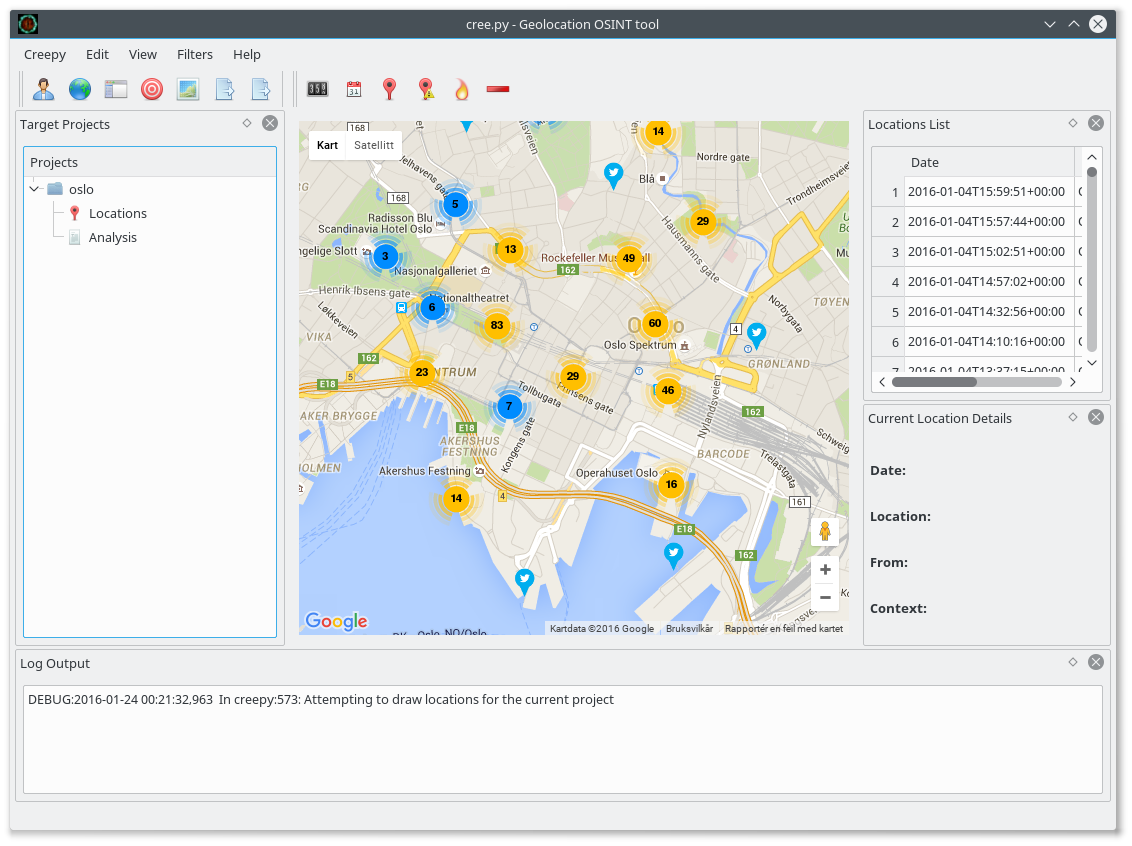
Petter Reinholdtsen: Creepy, visualise geotagged social media information - nice free software

Most people seem not to realise that every time they walk around with the computerised radio beacon known as a mobile phone their position is tracked by the phone company and often stored for a long time (like every time a SMS is received or sent). And if their computerised radio beacon is capable of running programs (often called mobile apps) downloaded from the Internet, these programs are often also capable of tracking their location (if the app requested access during installation). And when these programs send out information to central collection points, the location is often included, unless extra care is taken to not send the location. The provided information is used by several entities, for good and bad (what is good and bad, depend on your point of view). What is certain, is that the private sphere and the right to free movement is challenged and perhaps even eradicated for those announcing their location this way, when they share their whereabouts with private and public entities.

The phone company logs provide a register of locations to check out when one want to figure out what the tracked person was doing. It is unavailable for most of us, but provided to selected government officials, company staff, those illegally buying information from unfaithful servants and crackers stealing the information. But the public information can be collected and analysed, and a free software tool to do so is called Creepy or Cree.py. I discovered it when I read an article about Creepy in the Norwegian newspaper Aftenposten i November 2014, and decided to check if it was available in Debian. The python program was in Debian, but the version in Debian was completely broken and practically unmaintained. I uploaded a new version which did not work quite right, but did not have time to fix it then. This Christmas I decided to finally try to get Creepy operational in Debian. Now a fixed version is available in Debian unstable and testing, and almost all Debian specific patches are now included upstream. The Creepy program visualises geolocation information fetched from Twitter, Instagram, Flickr and Google+, and allow one to get a complete picture of every social media message posted recently in a given area, or track the movement of a given individual across all these services. Earlier it was possible to use the search API of at least some of these services without identifying oneself, but these days it is impossible. This mean that to use Creepy, you need to configure it to log in as yourself on these services, and provide information to them about your search interests. This should be taken into account when using Creepy, as it will also share information about yourself with the services. The picture above show the twitter messages sent from (or at least geotagged with a position from) the city centre of Oslo, the capital of Norway. One useful way to use Creepy is to first look at information tagged with an area of interest, and next look at all the information provided by one or more individuals who was in the area. I tested it by checking out which celebrity provide their location in twitter messages by checkout out who sent twitter messages near a Norwegian TV station, and next could track their position over time, making it possible to locate their home and work place, among other things. A similar technique have been used to locate Russian soldiers in Ukraine, and it is both a powerful tool to discover lying governments, and a useful tool to help people understand the value of the private information they provide to the public. The package is not trivial to backport to Debian Stable/Jessie, as it depend on several python modules currently missing in Jessie (at least python-instagram, python-flickrapi and python-requests-toolbelt). (I have uploaded the image to screenshots.debian.net and licensed it under the same terms as the Creepy program in Debian.)

23 January 2016

Dirk Eddelbuettel: RcppEigen 0.3.2.7.0

A new minor release of RcppEigen is now on CRAN and in Debian. It primarily upgrades to the recent 3.2.7 release of Eigen -- thanks once again to fine work by Yixuan Qiu. We also have one additonal PR by Alexey Stukalow who ensured that the fastLm() example will work fine with when the Intel MKL is used. The NEWS file entry follows.
Changes in RcppEigen version 0.3.2.7.0 (2016-01-18)
  • Updated to version 3.2.7 of Eigen
  • The fastLm example will not include the Lapack header if MKL is defined (thanks to PR #25 by Alexey Stukalow)
Courtesy of CRANberries, there is also a diffstat report for the most recent release.

This post by Dirk Eddelbuettel originated on his Thinking inside the box blog. Please report excessive re-aggregation in third-party for-profit settings.

Dirk Eddelbuettel

Dirk Eddelbuettel: RcppCCTZ 0.0.3

Bradley White from the upstream CCTZ team prepared some more changes in CCTZ itself -- so a new RcppCCTZ version got to CRAN the other day catching up with these changes. CCTZ is a C++ library for translating between absolute and civil times using the rules of a time zone. It requires only a proper C++11 compiler and the standard IANA time zone data base which standard Unix, Linux, OS X, ... computers tend to have in /usr/share/zoneinfo. RcppCCTZ connects this library to R by relying on Rcpp. Changes in this version are summarized here:
Changes in version 0.0.3 (2016-01-17)
  • Synchronized with CCTZ upstream.
We also have a diff to the previous version thanks to CRANberries. More details, issue tickets etc at the GitHub repository.

This post by Dirk Eddelbuettel originated on his Thinking inside the box blog. Please report excessive re-aggregation in third-party for-profit settings.

18 January 2016

Russ Allbery: rra-c-util 5.10

Despite the name of the package, most of the changes in this release are actually to the Perl test infrastructure. I decided to finally standardize the versions of the modules embedded in wallet, but discovered the need to add an exclusion list so that I don't have to change the version of the schema module. (That currently drives database schema upgrades.) While doing that, I rediscovered that I have two versions of the module version check that shared a ton of code, so they've now been refactored into a module (and then debugged again, since I broke various things about the Automake integration). This release also fixes use of UNIX-specific path delimiters in my standard Perl docs/synopsis.t test, which fixed some failing tests in podlators. I would have been done with this somewhat sooner, but the Travis-CI tests for rra-c-util started failing in the IPv6 server test, and it took a lot of debugging to figure out why. It turned out that the environment allows creation of IPv6 sockets but not connecting to them, and my test for whether IPv6 was working didn't account for that. Now it does, so those tests are properly skipped when IPv6 is half-configured. You can get the latest version from the rra-c-util distribution page.

12 January 2016

Gunnar Wolf: Readying up for the second "Embedded Linux" diploma course

I am happy to share here a project I was a part of during last year, that ended up being a complete success and now stands to be repeated: The diploma course on embedded Linux, taught at Facultad de Ingenier a, UNAM, where I'm teaching my regular classes as well. Back in November, we held the graduation for our first 10 students. This photo shows only seven, as the remaining three have already relocated to Guadalajara, where they were hired by Continental, a company that promoted the creation of this specialization program. After this first excercise, we went over the program and made some adequations; future generations will have a shorter and more focused program (240 instead of 288 hours, leaving out several topics that were not deemed related to the topic or were thoroughly understood by students to begin with); we intend to start the semester-long course in early February. I will soon update here with the full program and promotional material, as soon as I receive it. update (01-19): You can download the promotional information, or go to an (unofficial) URL with the full information. We are close to starting the program, so hurry! I am specially glad that this course is taught by people I admire and recognize, and a very interesting mix between long-time academic and stemming from my free-software-related friends: From the academic side, Facultad de Ingenier a's professors Laura Sandoval, Karen S enz and Oscar Valdez, and from the free-software side, Sandino Araico, Iv n Chavero, C sar Y ez and Gabriel Salda a (and myself on both camps, of course )
AttachmentSize
OT401_nota.jpg75.82 KB
Linux Embebido - Folleto.pdf455.32 KB

11 January 2016

Thadeu Lima de Souza Cascardo: GNU on Smartphones (part II)

Some time ago, I wrote how to get GNU on a smartphone. This is going to be a long discussion on why and how we should work on more operating systems for more devices. On Android So, why should we bother if we already have Android, some might ask? If it's just because of some binary blobs, one could just use Replicant, right? Well, one of the problems is that Android development is done in hiding, and pushed downstream when a new version is launched. There is no community behind that anyone can join. Replicant ends up either following it or staying behind. It could do a fork and have its own innovations. And I am all for it. But the lack of manpower for supporting devices and keeping up with the latest versions and security fixes already takes most of the time for the one or two developers involved. Also, Android has a huge modularity problem, that I will discuss further below. But it's hard to replace many components in the system, unless you replace them all. And that also causes the problem that applications can hardly share extra components. I would rather see Debian running on my devices and supporting good environments and frameworks for all kinds of devices, like phones, tablets, TVs, cars, etc. It's developed by a community I can join, it allows a diverse set of frameworks and environments, and it's much easier to replace single components on such a system. On Copyleft Hardware I get it. Hardware is not free or libre. Its design is. I love the concept of copyleft hardware, where one applies the copyleft principles to a hardware design. Also, there is the concept of Hardware that Respects Your Freedom, that is, one that allows you to use it with only free software. Note that RYF hardware is not necessarily copyleft hardware. In fact, most of the time, the original vendor has not helped at all, and it required reverse engineering efforts by other people to be able to run free software on those systems. My point here is that we should not prevent people from running free software on hardware that does not RYF or that is not copyleft. We should continue the efforts of reverse engineering and of pushing hardware vendors to not only ship free software for their hardware, but also release their design under free licenses. But in the meantime, we need to make free software flourish in the plethora of devices on the hands of so many people around the world. On Diversity I won't go into details on this post about two things. One topic I love is retrocomputing and how Linux supported so many devices, and how many free or quasi-free operating systems ran on so many of them in the past. I could mention ucLinux, Familiar, PDAs, Palmtops, Motorolas, etc. But I will leave it to another time and go from Openmoko and Maemo forward. The other topic is application scalability. Even Debian with so many software available does not ship all free software there is available. And it doesn't support all third-party services out there. How can we solve that? It has to do with platforms, protocols, open protocols, etc. I will not go into that today. Because I believe that either way, it's healthy for our society to have diversity. I believe we should have other operating systems available for our devices. Even if application developers will not develop for all of them. That is already the case today. There are other ways to fix that, when that needs fixing. Sometimes, it's sufficient that you can have your own operating system on your device, that you can customize it, enhance it and share it with friends. And also, that would allow for innovation. It would make possible that some other operating system would have enough market share on some other niche. Other than Android and iOS, for example. But that requires that we can support that operating system on different devices. And that is the scalability that I want to talk about. How to support more devices with less effort. Options But before I go into that, let me write more about the alternatives we have out there. And some of the history around it. Openmoko Openmoko developed a set of devices that had some free design. And it has some free operating systems running on top. The community developed a lot of their own as well. Debian could (still can) run on it. There is SHR, which uses FSO, a mobile middleware based on D-Bus. It even spawned other devices to be developed, like GTA04, a successor board, that can be shipped inside a Neo Freerunner case. Maemo, Moblin, Meego and Tizen I remember the announcement of Nokia N770. During FISL in 2005, I even criticized a lot, because it shipped with proprietary drivers. And applications. But it was the first time we heard of Maemo. It was based on Debian and GNOME. The GNOME Mobile initiative was born from that, I believe, but died later on. But with the launch of N900, and later events, like the merge of Moblin with Maemo, to create Meego, we all had an operating system that was based on community developed components, that had some community participation, and was much more like the systems we were used to. You could run gcc on N900. You could install Das U-Boot and have other operating systems running there. But Nokia has gone a different path. Intel has started Tizen with Samsung. There is so much legacy there, that could still be developed upon. I am just sad that Jolla decided to put proprietary layers on top of that, to create SailfishOS. But we still have Mer, Nemo. But it looks like Cordia is gone. At least, (http://cordiahd.org) seems to have been registered by a domain seller. Not to forget, Neo900, a project to upgrade the board, in the same vein as GTA04. FirefoxOS and Ubuntu What can I say about FirefoxOS and Ubuntu Phone? In summary, I think we need more than Web, and Canonical has a history of not being too community oriented as we'd like. I won't go too much here in what I think about the Web as a platform. But I think we need a system that has more options for platforms. I haven't participated in projects directed by Mozilla either, so I can't say much about that. Ubuntu Phone should be a system more like what we are used to. But Canonical is going to set the directions to the project, it's not a community project. Nonetheless, I think they add to the diversity, and users should be able to try them, or their free parts or versions. But there are challenges there, that I think need to be discussed. So, both of these systems are based on Android. They don't use Dalvik or the application framework. But they use what is below that, which means device drivers in userspaces, like RIL, for the modem drivers, and EGL, for graphics drivers. The reason they do that is to build on top of all the existing vendor support for Android. If a SOC and phone vendor already supports Android, there should be not much needed to do to support FirefoxOS or Ubuntu Phone. In practice, this has not benefited the users or the projects. Porting should be as simple as getting a generic FirefoxOS or Ubuntu Phone image and run it on top of your Android or CyanogenMod port. Porting usually requires doing all the same work as porting Android. Even though one should be able to take advantage of existing ports, it still requires doing a lot of integration work and building an entire image, most of the time, including the upper layers, that should be equal in all devices. This process should require at most creating a new image based on other images and loading it on the device. I will discuss more about this below. I can't forget to mention the Matchstick TV project. It is based on FirefoxOS. I think it would have much more changes to succeed if it was easier for testers to have images available for all of their gadgets capable of running some form of Android. Replicant And then we have Replicant. It has a lot of the problems Android has. Even so, it's a tremendously important project. First, it offers a free version of Android, removing all proprietary pieces. This is very good for the community. But more than that, it tries to free the devices beyond that. What the project has been done is reverse engineer some of the pieces, mostly the modem drivers. That allows other projects to build upon that work, and support those modems. Without that, there is no telephony or celullar data available on any of these devices. Not without proprietary software, that is. They also have been working on free bootloaders, which is another important step for a completely free system. Next steps There are many challenges here, but I believe we should work on a set of steps that make it more palatable and produce intermediary results that can be used by users and other projects. One of the goals should be good modularity. The ability to replace some pieces with the least trouble necessary. The update of a single framework library should be just a package install, instead of building the entire framework again. If there is ABI breakage, users should still be able to have access to binaries (and accompanying source code) and only need to update the library and its reverse dependencies. If one layer does not have these properties, at least it should be possible to update this big chunk without interfering with the other layers. One example is FirefoxOS and Ubuntu Phone. Even if there is a big image with all system userspace and middleware, the porting, install and upgrade process should allow the user to keep the applications and to leverage porting already done by similar projects. Heck, these two projects should be able to share porting efforts without any trouble. So what follows is a quick discussion on Android builds, then suggestions on how to approach some of the challenges. On Android build The big problem with Android build is its non-modularity. You need to build the world and more to get a single image in the end. Instead of packages that could be built independently, that generated modular package images, that could be bundled in a single system image. Better yet would be the ability to pick only those components that matter. Certainly, portability would be just as interesting, being able to build certain components on top a GNU system with GNU libc. At times, it seems like this is done by design, to make it difficult for "fragmentation" and competition. Basically, making it difficult to exercise the freedom to modify the software and share your modifications with others. Imagine the possibilities of being able to: There are some dangers in promoting the use of Android like this. Since it promotes proprietary drivers, relying on such layers instead of better community oriented layers means giving an advantage to the first. So, the best plan would be to replace those layers, when they are used, for things like ofono and Wayland, for example. But, in the meantime, making it easier for users to experiment with FirefoxOS, Ubuntu Phone, Matchstick TV, Replicant on other devices, without resorting to building the entire Android system, would be a very nice thing. It is possible that there are some challenges with respect to API and ABI. That these layers are too intermingled that some changes present in one port would prevent FirefoxOS to run on top of it without changes in either of the layers. I can't confirm that is the case, but can't deny the possibility. Rooting One of the challenges we have that may have trouble in scaling is rooting devices. Unfortunately, most of the devices are owned by the vendor or carrier, not the user. The user is prevented from replacing software components in the system, by removing its permissions from replacing most of the files in the filesystem, or writing to block devices, or change boot parameters or write to the storage devices. Fortunately, there are many documents, guides, howtos, and whatnots out there instructing on how to root a lot of devices. In some cases, it depends on software bugs that can be patched by the users as instructed by vendors. Certainly, favoring devices that are built to allow rooting, hacking, etc, is a good thing. But we should still help those users out there who do not have such devices, and allow them to run free software on them. Booting Then, comes booting, which is a large discussion on its own, and also related to rooting, or how to allow users to replace their software. First, we have the topic of bootloaders, which are usually not free, and embedded in the chip, not on external storage. So, there are those pieces of the bootloader which we can replace more easily and those that we are not, because they would require changing a piece of ROM, for example. Das U-Boot would be one of the preferred options for a system. It supports a lot of hardware platforms out there, a lot of storage devices and filesystems, network booting, USB and serial booting, and a lot of other things. Porting is not an easy task, but it is possible. Meanwhile, using the bootloaders that ship with the system, when possible, would allow a path where other pieces of the system would be free. One of the challenges here is building single images that could boot everywhere. The lack of a single ARM boot environment is a curse and a blessing. It makes it hard to have this single boot image, but, on the other hand, it has allowed so much of the information for such systems to be free, to be embedded in copyleft software, instead of having blobs executed by our free systems, like ACPI encourages. Device trees have pushed this portability issue from the kernel to the bootloaders. Possibily encouraging vendors to now hide and copyright this information in the form of proprietary device trees. But it has made it easier for single images. In practice, we still need to see a lot of devices out there supporting this single kernel scenario. And this mechanism only brings us the possibility of a single kernel. We still need to ship bootable images that have pieces of bootloaders that are not as portable. This has caused lots of operating systems out there to be built for a single board. Or to support just a small set of boards. I struggle with the concept. Why are we not able to mix device-specific pieces with generic pieces and get a resulting image that will boot on our choice of board? Why does every project need to do all the porting work again, repeating the efforts? Or have one entier ISO image for every supported board? Check how Geexbox does it, for an example. Fortunately, I see Debian going in a good direction. Here, one can see how it instructs the user to combine a system-dependent part with a system-independent part. Installation Which brings us to the installation challenge. We should make this easy and also customizable by the user. Every project might have its own method, and that is part of the diversity that we should allow. The great challenge here is handling rooting and booting for the user. But it's also possible to leave that as separate efforts, as it would be nice to have good installers as we have in the desktop and server environments. Linux Linux is one of the most ported kernels out there. Of course, it would be healthy to the diversity I propose that other kernels and systems out there should work on those mobile devices. NetBSD, for example, has a reputation of being very portable and ported to many platforms. And GNU runs on many of them, either together with the original systems, or as the main system on top of other kernels, as proven by the Debian GNU/kFreeBSD port, which uses GNU libc. But, though I would love to see HURD running directly on those devices, Linux and its derivatives are already running on them. Easier to tackle is to get Linux-libre running on those systems. But though this looks like one of the easier tasks at hand, it is not. If you run a derivative version from Linux, provided by the vendor, things should go smooth. But most of the time, the vendor does not provide patches upstream, and leave their fork to rot, if you are lucky, in the earlier 3.x series. And some times, there is not even source code available. There are vendors out there who do not respect the GPL and that is one of the reasons why GPL enforcement is important. I take this opportunity to call attention to the work of Software Freedom Conservancy and its current efforts to raise funds to continue their work. Running an existing binary version of Linux on your device with a free userspace is part of the strategy of replacing pieces one at a time while allowing for good diversity and reaching more users. Drivers Then we have the matter of drivers. And in this case, it's not only Linux drivers, but drivers running in userspace. Though others exist, there are two important and common cases, which are modem and graphics drivers, both of which are usually provided by Android frameworks, and that other systems try to leverage, instead of using alternatives that are more community friendly. In the case of modem drivers, Android uses its RIL. Besides not using a Radio or Modem at all, there are two strategies for free versions. One is using free versions of the drivers for RIL. That's what Replicant does, because, well, it uses the other Android subsystems after all. The other one is using a system that is developed by the community. ofono is one that, even though it's an Intel iniative, looks more community governed or open to community participation than any Android subsystem ever was. As for Graphics, Canonical even built its Mir project with the goal of being able to use Android GPU drivers. Luckily, there has been a lot of reverse engineering efforts out there for a lot of those GPUs shipped with ARM SoCs. Then, we can use Mesa, Wayland and X.org. Other option, until then, is just using a framebuffer driver, possibly one that does not need any initialization, depending on one done by the bootloader, for example. Middleware and Shells Plasma Active, that I just found out now is Plasma Mobile, looks like a great system. Built by folks behind KDE, we can expect great freedom to come from it. Unfortunately, it suffers from what we have been discussing here, which is lack of good device support, or shipping images that run on top of single devices, without leveraging the porting that has come before of other systems. Fortunately, that is just what I want to accomplish with this effort. FSO, that I mentioned before, is a good middleware, that we should try to run on top of these devices. Running GNOME or Unity shell, and use rpm or deb based systems, that's all part of the plan on diversity. You could use systemd, or System V init systems, whatever gives you the kicks. It's not an easy task, since there are so many new things on these new kinds of devices. Besides touch, there is telephony, which as I mentioned, would be a good task for ofono. As for TV sets or dongles, I would love to see OpenFlint, created by the Matchstick TV guys, flourish out there and allow me to flint stuff from my mobile phone running Debian into my TV dongle running Debian. Project So, is there a project out there you can start contributing to? Well, I pointed out a lot of them. All of them make part of this plan. Contributing to reverse engineering GPUs, or to Plasma Mobile, ofono, GNOME, Linux-libre, bootloaders, Debian, and so many other projects. My plans are to contribute in the scope of Debian and make sure it works well on top of semi-liberated devices, and make sure there is a nice user interface and good applications when using either GNOME or Plasma. Integrating ofono is a good next step, but I am running ahead of myself. Right now, I don't think there is need for an integrated effort. If you think otherwise, please let me know. If you are doing something in this direction, I would love to know. Paul Wise reminded me to point out to the Debian Mobile, where I will probably contribute any documentation and other relevant results. Thanks There are some many people to thank, but I would like to remember Ian Murdock, who created Debian, one of the projects who inspires me the most. I think the best way to handle his passing is to celebrate what he has helped create, and move forward, taking more free software to more people in an easy and modular way. I have been wanting to write something like this for a long time, so I thank Chris Webber for inspiring me on doing it.

Dirk Eddelbuettel: Rcpp 0.12.3: Keep rollin'

The third update in the 0.12.* series of Rcpp arrived on the CRAN network for GNU R earlier today, and has been pushed to Debian. It follows the 0.12.0 release from late July, the 0.12.1 release in September, and the 0.12.2 release in November making it the seventh release at the steady bi-montly release frequency. This release is somewhat more of a maintenance release addressing a number of small bugs and nuisances without adding any new features. Rcpp has become the most popular way of enhancing GNU R with C or C++ code. As of today, 553 packages on CRAN depend on Rcpp for making analytical code go faster and further. That is up by more than fourty packages from the last release in November. Once again, we have new first-time contributors. Kazuki Fukui corrected an issue he encountered when having CLion re-formatted some code for him. Joshua Pritikin corrected a constructor initialization. Of course, we also had several pull reports from regular contributors -- see below for a detailed list of changes extracted from the NEWS file.
Changes in Rcpp version 0.12.3 (2016-01-10)
  • Changes in Rcpp API:
    • Const iterators now CharacterVector now behave like regular iterators (PR #404 by Dan fixing #362).
    • Math operators between matrix and scalars type have been added (PR #406 by Qiang fixing #365).
    • A missing std::hash function interface for Rcpp::String has been addded (PR #408 by Qiang fixing #84).
  • Changes in Rcpp Attributes:
    • Avoid invalid function names when generating C++ interfaces (PR #403 by JJ fixing #402).
    • Insert additional space around & in function interface (PR #400 by Kazuki Fukui fixing #278).
  • Changes in Rcpp Modules:
    • The copy constructor now initialized the base class (PR #411 by Joshua Pritikin fixing #410)
  • Changes in Rcpp Repository:
    • Added a file Contributing.md providing some points to potential contributors (PR #414 closing issue #413)
Thanks to CRANberries, you can also look at a diff to the previous release. As always, even fuller details are on the Rcpp Changelog page and the Rcpp page which also leads to the downloads page, the browseable doxygen docs and zip files of doxygen output for the standard formats. A local directory has source and documentation too. Questions, comments etc should go to the rcpp-devel mailing list off the R-Forge page.

This post by Dirk Eddelbuettel originated on his Thinking inside the box blog. Please report excessive re-aggregation in third-party for-profit settings.

9 January 2016

Daniel Pocock: Comments about people with mental illness

A quote:
As the Buddha said 2500 years ago... we're all out of our fucking minds. (Albert Ellis)
There have been a few occasions over the last year where people suffering mental illnesses have been the subject of much discussion. In March 2015 there was the tragic loss of Germanwings flight 9525. It was discovered that the co-pilot, Andreas Lubitz, had been receiving treatment for mental illness. Under strict privacy laws, nobody at his employer, the airline, had received any information about the diagnosis or treatment. During the summer, the private mailing list for a large online community discussed the mental illness of a contributor to a project. Various people expressed opinions that appeared to be generalizations about all those with mental illness. Some people hinted the illness was a lie to avoid work while others speculated about options for treatment. Nobody involved mentioned having any medical expertise. It is ironic that on the one hand, we have the dramatic example of an aircraft crashing at the hands of somebody who is declared unfit to work but working anyway and on the other hand when somebody else couldn't do something, the diagnosis is being disputed by people who find it inconvenient or don't understand it. More recently, there has been openly public discussion about whether another developer may have had mental illness. Once again, there doesn't appear to be any evidence from people with any medical expertise or documentation whatsoever. Some of the comments appear to be in the context of a grudge or justifying some other opinion. What's worse, some comments appear to suggest that mental illness can be blamed for anything else that goes wrong in somebody's life. If somebody is shot and bleeds to death, do you say low blood pressure killed him or do you just say he was shot? Likewise, if somebody is subject to some kind of bullying and abused, does this have no interaction with mental illness? In fact, Google reveals an enormous number of papers from experts in this field suggesting that mental illness can arise or be exacerbated by bad experiences. Although it may not have been clear at that point in time, when we look back at Alan Turing's death today, suicide was not a valid verdict and persecution was a factor. Statistics tell us that 1 in 4 people experience a mental health problem in the UK each year. In the USA it is 26% of the adult population, each year. These may be long term conditions or they may be short term conditions. They may arise spontaneously or they may be arising from some kind of trauma, abuse or harassment in the home, workplace or some other context. For large online communities, these statistics imply it is inevitable that some participants will be suffering from mental illness and others will have spouses, parents or children suffering from such conditions. These people will be acutely aware of the comments being made publicly about other people in the community. Social interaction also relates to the experience of mental illness, people who are supported by their community and society are more likely to recover while those who feel they are not understood or discriminated against may feel more isolated, compounding their condition. As a developer, I wouldn't really like the idea of doctors meddling with my code, so why is it that some people in the IT and business community are so happy to meddle around in the domain of doctors, giving such strong opinions about something they have no expertise in? Despite the tragic loss of life in Germanwings 9525, observing some of these other discussions that have taken place reminds me why Germany and some other countries do have such strict privacy laws for people who seek medical treatment. (You can Follow or Tweet about this blog on Twitter)

Dirk Eddelbuettel: digest 0.6.9

A new release, now at version number 0.6.9, of the digest package is now on CRAN. I also just prepared the Debian upload. This release is very large part the work of Thierry Onkelinx who added stable sha1 support in a new function sha1(). Here, stable means that numerically equivalent numbers (in the sense of the semi-famous R FAQ entry 7.31) result in identical hashes. This is useful for hashing results from numerical analysis---where the representation may differ bitwise between, say, 32 and 64-bit platforms. We started to write a little more about this in a (at this very point still rather unfinished) little vignette. We also had a nice pull request from fellow Rcpp hacker Qiang Kou who updated the code to use XLENGTH so that large vectors can be supported. CRANberries provides the usual summary of changes to the previous version.

This post by Dirk Eddelbuettel originated on his Thinking inside the box blog. Please report excessive re-aggregation in third-party for-profit settings.

8 January 2016

Carl Chenet: My Free Activities in December 2015

I was quite busy in December 2015, especially with my new Python projects related to automatize Twitter actions. Have a look at my Github home for more information ! 1. Personal projects 2. Journal du hacker That s all folks! See you next month!

Dirk Eddelbuettel: AsioHeaders 1.11.0-1

Making it easier to use C++ in R has been a really nice and rewarding side effect of the work on Rcpp. One really good idea came from something Jay Emerson, Michael Kane and had I kicked about for way too long: shipping Boost headers for easier use by R and CRAN packages (such as their family of packages around bigmemory). The key idea here is headers: Experienced C++ authors such as library writers can organise C++ code in such a way that one can (almost always) get by without any linking. Which makes deployment so much easier in most use cases, and surely also with R which knows how to set an include path. So after years of "yes we really should", Jay deserves the credit for actually sitting down almost three years ago and creating the first version. So at the end of January 2013, we released BH version 1.51.0-0. By now the package is used fifty-four other CRAN packages --- clearly a much stronger uptake then we ever expected. I took over maintenance at some point, and we are currently in-line with the most recent Boost release 1.60.0. But some people were always lusting after (some) parts of Boost which also require linking. For some libraries (such as Boost.Date_Time in my RcppBDT package) you can set a #define to not require linking (and forego some string formatting or parsing we get from R anyway). Some others are trickier; Boost Regex is one example. I do not think you can use it without linking (but then C++11 helps and finally brings regular expression in the default library). Another library which the systems / network programmers at work would frequently rely upon is Boost.Asio, a cross-platform C++ library for network and low-level I/O programming. It was already used on CRAN by the iptools package by Bob Rudis and Oliver Keyes which shied away from building on Windoze (while 'doze and Boost do get along, but the CRAN system makes it a little more involved). A couple of days ago, I somehow learned that the Asio library actually comes in two flavours: the well-known Boost.Asio (requiring linking), and also as a header-only standalone library! Well, well, well -- so I ran that by Bob and Oliver asking if that would be useful. And the response was a resounding and pretty much immediate Hell, Yes!. So I wrapped it in a package, told Bob about it, who tested it and gave the thumbs up. And after a slightly longer-than-usual on-boarding, the package is now on CRAN. As network (and systems) programming is not entirely uncommon even at CRAN, I hope that this package may find a few more use cases. A new version of iptools should be forthcoming "shortly", including for the first time a Windows build thanks to this package. The indefatigable Martin Morgan already spotted our GitHub repo and scored the first fork. Comments and suggestions about AsioHeaders are welcome via the issue tracker at the GitHub GitHub repo.

This post by Dirk Eddelbuettel originated on his Thinking inside the box blog. Please report excessive re-aggregation in third-party for-profit settings.

7 January 2016

Thorsten Glaser: git find published; test, review, fix it please

I just published the first version of git find on gh/mirabilos/git-find for easy collaboration. The repository deliberately only contains the script and the manual page so it can easily be merged into git.git with complete history later, should they accept it. git find is MirOS licenced. It does require a recent mksh (Update: I did start it in POSIX sh first, but it eventually turned out to require arrays, and I don t know perl(1) and am not going to rewrite it in C) and some common utility extensions to deal with NUL-separated lines (sort -z, grep -z, git ls-tree -z); also, support for '\0' in tr(1) and a comm(1) that does not choke on embedded NULs in lines.

To install or uninstall it, run

	$ git clone git@github.com:mirabilos/git-find.git
	$ cd git-find
	$ sudo ln -sf $PWD/git-find /usr/lib/git-core/
	$ sudo cp git-find.1 /usr/local/share/man/man1/
	  hack  
	$ sudo rm /usr/lib/git-core/git-find \
	    /usr/local/share/man/man1/git-find.1

then you can call it as git find and look at the documentation with git help find , as is customary. The idea behind this utility is to have a tool like git grep that acts on the list of files known to git (and not e.g. ignored files) to quickly search for, say, all PNG files in the repository (but not the generated ones). git find acts on the index for the HEAD, i.e. whatever commit is currently checked-out (unlike git grep which also knows about git add ed files; fix welcome) and then offers a filter syntax similar to find(1) to follow up: parenthes s, ! for negation, -a and -o for boolean are supported, as well as -name, -regex and -wholename and their case-insensitive variants, although regex uses grep(1) without (or, if the global option -E is given, with) -E, and the pattern matches use mksh(1) s, which ignores the locale and doesn t do [[:alpha:]] character classes yet. On the plus side, the output is guaranteed to be sorted; on the minus side, it is rather wastefully using temporary files (under $TMPDIR of course, so use of tmpfs is recommended). -print0 is the only output option (-print being the default). Another mode forwards the file list to the system find; since it doesn t support DOS-style response files, this only works if the amount of files is smaller than the operating system s limit; this mode supports the full range (except -maxdepth) of the system find(1) filters, e.g. -mmin -1 and -ls, but it occurs filesystem access penalty for the entire tree and doesn t sort the output, but can do -ls or even -exec. The idea here is that it can collaboratively be improved, reviewed, fixed, etc. and then, should they agree, with the entire history, subtree-merged into git.git and shipped to the world. Part of the development was sponsored by tarent solutions GmbH, the rest and the entire manual page were done in my vacation.

Next.

Previous.