Search Results: "beh"

21 April 2015

Manuel A. Fernandez Montecelo: About the Debian GNU/Linux port for OpenRISC or1k

In my previous post I mentioned my involvement with the OpenRISC or1k port. It was the technical activity in which I spent most time during 2014 (Debian and otherwise, day job aside). I thought that it would be nice to talk a bit about the port for people who don't know about it, and give an update for those who do know and care. So this post explains a bit how it came to be, details about its development, and finally the current status. It is going to be written as a rather personal account, for that matter, since I did not get involved enough in the OpenRISC community at large to learn much about its internal workings and aspects that I was not directly involved with. There is not much information about all of this elsewhere, only bits and pieces scattered here and there, but specially not much public information at all about the development of the Debian port. There is an OpenRISC entry in the Debian wiki, but it does not contain much information yet. Hopefully, this piece will help a bit to preserve history and give an insight for future porters. First Things First I imagine that most people reading this post will be familiar with the terminology, but just in case, to create a new Debian port means to get a Debian system (GNU/Linux variant, in this case) to run in the OpenRISC or1k computer architecture. Setting to one side all differences between hardware and software, and as described in their site:
The aim of the OpenRISC project is to create free and open source computing platforms
It is therefore a good match for the purposes of Debian and Free Software world in general. The processor has not been produced in silicon, or not available for the masses in any case. People with the necessary know-how can download the hardware description (Verilog) and synthesise it in a FPGA, or otherwise use simulators. It is not some piece of hardware that people can purchase yet, and there are no plans to mass-produce it in the near future either. The two people (including me) involved in this Debian port did not have the hardware, so we created the port entirely through cross-compiling from other architectures, and then compiling inside Qemu. In a sense, we were creating a Debian port for hardware that "does not [phisically] exist". The software that we built was tested by people who had hardware available in FPGA, though, so it was at least usable. I understand that people working in the arm64 port had to work similarly in the initial phases, working in the dark without access to real hardware to compile or test. The Spark The first time that I heard about the initiative to create the port was in late February of 2014, in a post which appeared in Linux Weekly News (sent by Paul Wise) and Slashdot. The original post announcing it was actually from late January, from Christian Svensson (blueCmd):
Some people know that I've been working on porting Glibc and doing some toolchain work. My evil master plan was to make a Debian port, and today I'm a happy hacker indeed! Below is a link to a screencast of me installing Debian for OpenRISC, installing python2.7 via apt-get (which you shouldn't do in or1ksim, it takes ages! (but it works!)) and running a small Python script. http://asciinema.org/a/7362
So, now, what can a Debian Hacker do when reading this? (Even if one's Hackery Level is not that high, as it is my case). And well, How Hard Can It Be? I mean, Really? Well, in my own defence, I knew that the answer to the last two questions would be a resounding Very . But for some reason the idea grabbed me and I couldn't help but think that it would be a Really Exciting Project, and that somehow I would like to get involved. So I wrote to Christian offering my help after considering it for a few days, around mid March, and he welcomed me aboard. The Ball Was Already Rolling Christian had already been in contact with the people behind DebianBootstrap, and he had already created the repository http://openrisc.debian.net/ with many packages of the base system and beyond (read: packages name_version_or1k.deb available to download and install). Still nowadays the packages are not signed with proper keys, though, so use your judgement if you want to try them. After a few weeks, I got up to speed with the status of the project and got my system working with the necessary tools. This meant basically sbuild/schroot to compile new packages, with the base system that Christian already got working, installed in a chroot, probably with the help of debootstrap, and qemu-system-or1k to simulate the system. Only a few of the packages were different from the version in Debian, like gcc, binutils or glibc -- they had not been upstreamed yet. sbuild ran through qemu-system-or1k, so the compilation of new packages could happen "natively" (running inside Qemu) rather than cross-compiling the packages, pulling _or1k.deb packages for dependencies from the repository that he had prepared, and _all.deb packages from snapshots.debian.org. I started by trying to get the packages that I [co-]maintain in Debian compiled for this architecture, creating the corresponding _or1k.deb. For most of them, though, I needed many dependencies compiled before I could even compile my packages. The GNU autotools / autoreconf Problem Since very early, many of the packages failed to build with messages such as:
Invalid configuration 'or1k-linux-gnu': machine 'or1k' not recognized
configure: error: /bin/bash ../config.sub or1k-linux-gnu failed
This means that software packages based on GNU autotools and using configure scripts need recent versions of the files config.sub and config.guess that they ship in their root directory, to be able to detect the architecture and generate the code accordingly. This is counter-intuitive, having into account that GNU autotools were designed to help with portability. Yet, in the case of creating new Debian ports, it meant that unless upstream had very recent versions of config. guess,sub , it would prevent the package to compile straight away in the new architectures -- even if invoking gcc without ado would have worked without problems in most cases for native compilation. Of course this did not only affect or1k, and there was already the autoreconf effort underway as a way to update these files automatically when building Debian packages, pushed by people porting Debian to the new architectures added in 2013/2014 (mips64el, arm64, ppc64el), which encountered the same roadblock. This affected around a thousand source packages in unstable. A Royal Pain. Also, all of their reverse dependencies (packages that depended on those to be built) could not be compiled straight away. The bugs were not Release Critical, though (none of these architectures were officially accepted at the time), so for people not concerned with the new ports there was no big incentive to get them fixed. This problem, which conceptually is easily solvable, prevented new ports to even attempt compile vast portions of the archive straight away (cleanly, without modifications to the package or to the host system), for weeks or months. The GNU autotools / autoreconf Solution We tackled this problem mainly in two ways. First, more useful for Debian in general, was to do as other porters were doing and submit bug reports and patches to Debian packages requesting them to use autoreconf, and NMUing packages (uploading changes to the archive without the official maintainers' intervention). A few NMUs were made for packages which had bug reports with patches available for a while, that were in the critical path to get many other packages compiled, and that were orphan or had almost no maintainer activity. The people working in the other new ports, and mainly Ubuntu people which helped with some of those ports and wanted to support them, had submitted a large amount of requests since late 2013, so there was no shortage of NMUs to be made. Some porters, not being Debian Developers, could not easily get the changes applied; so I also helped a bit the porters of other architectures, specially later on before the freeze of Jessie, to get as many packages compiled in those architectures as possible. The second way was to create dpkg-buildpackage hooks that updated unconditionally config. guess,sub before attempting to build the package in the local build system. This local and temporary solution allowed us in the or1k port to get many _or1k.deb packages in the experimental repository, which in turn would allow many more packages to compile. After a few weeks, I set up many sbuilds in a multi-core machine attempting to build uninterruptedly packages that were not previously built and which had their dependencies available. Every now and then (typically several times per day in peak times) I pushed the resulting _or1k.deb files to the repository, so more packages would have the necessary dependencies ready to attempt to build. Christian was doing something similar, and by April at peak times, among the two of us, we were compiling some days more than a hundred packages -- a huge amount of packages did not need any change other than up-to-date config. guess,sub files. At some point, late April, Christian set up wanna-build in a few hosts to do this more elegantly and smartly than my method, and more effectively as well. Ugly Hacks, Bugs and Shortcomings in the Toolchain and Qemu Some packages are extremely important because many other packages need them to compile (like cmake, Qt or GTK+), and they are themselves very complex and have dependency loops. They had deeper problems than the autoreconf issue and needed some seriously dirty hacking to get them built. To try to get as many packages compiled as possible, we sometimes compiled these important packages with some functionality disabled, disabling some binary packages (e.g. Java bindings) or specially disabling documentation (using DEB_BUILD_OPTIONS=nodoc when possible, and more aggressively when needed by removing chunks of debian/rules). I tried to use the more aggressive methods in as few packages as possible, though, about a dozen in total. We also used DEB_BUILD_OPTIONS=nocheck for speeding up compilation and avoiding build failures -- many packages' tests failed due to qemu-system-or1k not supporting multi-threading, which we could do nothing about at the time, but otherwise the packages mostly passed tests fine. Due to bugs and shortcomings in Qemu and the toolchain --like the compiler lacking atomics, missing functionality in glibc, Qemu entering in endless loops, or programs segfaulting (especially gettext, used by many packages and causing the packages failing to build)--, we had to resort to some very creative ways or time-consuming dull work to edit debian/rules, or to create wrappers of the real programs avoiding or forcing certain options (like gcc -O0, since -O2 made buggy binaries too often). To avoid having a mix of cleanly compiled and hacked packages in the same repository, Christian set up a two-tiered repository system -- the clean one and the dirty one. In the dirty one we dumped all of the packages that we got built, no matter how. The packages in the clean one could use packages from the dirty one to build, but they themselves were compiled without any hackery. Of course this was not a completely airtight solution, since they could contain code injected at build time from the "dirty repository" (e.g. by static linking), and perhaps other quirks. We hoped to get rid of these problems later by rebuilding all packages against clean builds of all their dependencies. In addition, Christian also spent significant amounts of time working inside the OpenRISC community, debugging problems, testing and recompiling special versions of the toolchain that we could use to advance in our compilation of the whole archive. There were other people in the OpenRISC community implementing the necessary bits in the toolchain, but I don't know the details. Good Progress Olof Kindgren wrote the OpenRISC health report April 2014 (actually posted in May), explaining the status at the time of projects in the broad OpenRISC community, and talking about the software side, Debian port included. Sadly, I think that there have been no more "health reports" since then. There was also a new post in Slashdot entitled OpenRISC Gains Atomic Operations and Multicore Support shortly thereafter. In the side of the Debian port, from time to time new versions of packages entered unstable and we started to use those newer versions. Some of them had nice fixes, like the autoreconf updates, so they did not require local modifications. In other cases, the new versions failed to build when old ones had worked (e.g. because the newer versions added support and dependencies of new versions of gnutls, systemd or other packages not yet available for or1k), and we had to repeat or create more nasty hacks to get the packages built again. But in general, progress was very good. There were about 10k arch-dependent packages in Debian at the time, and we got about half of them compiled by the beginning of May, counting clean and dirty. And, if I recall correctly, there were around the same number of arch=all (which can be installed in any architecture, after the package is built in one of them). Counting both, it meant that systems using or1k got about 15k packages available, or 75% of the whole Debian archive (at least "main", we excluded "contrib" and "non-free"). Not bad. By the middle to end of May, we had about 6k arch-dependent packages compiled, and 4k to go. The count of packages eventually reached ~6.6k at its peak (I think that in June/July). Many had been built with hacks and not rebuilt cleanly yet, but everything was fine until the amount of packages built plateaued. Plateauing There were multiple reasons for that. One of them is that after having fixed the autoreconf issue locally in some packages, new versions were uploaded to Debian without fixing that problem (in many cases there was no bug report or patch yet, so it was understandable; in other cases the requests were ignored). The wanna-build for the clean repository set up by Christian rightly considered the package out-of-date and prepared to build the more recent version, that failed. Then, other packages entering the unstable archive and build-depending on newer versions of those could not be built ("BD-Uninstallable"), until we built the newer versions of the dependencies in the dirty repository with local hacks. Consequently, the count of cleanly built packages went back-and-forth, when not backwards. More challenging was the fact that when creating a new port, language compilers which are written in that same language need to be built for that architecture first. Sometimes it is not the compiler, but compile-time or run-time support for modules of a language are not ported yet. Obviously, as with other dependencies, large amounts of packages written in those languages are bound to remain uncompiled for a long time. As Colin Watson explained in porting Haskell's GHC to arm64 and ppc64el, untangling some of the chicken-and-egg problems of language compilers for new ports is extremely challenging. Perl and Python are pretty much a pre-requisite of the base Debian system, and Christian got them working early on. But for example in May, 247 packages depended on r-base-dev (GNU R) for building, and 736 on ghc, and we did not have these dependencies compiled. Just counting those two, 1k source packages of the remaining 4k to 5k to be compiled for the new architecture would have to wait for a long time. Then there was Java, Mono, etc... Even more worrying problems were the pending issues with the toolchain, like atomics in glibc, or make check failing for some packages in the clean repository built with wanna-build. Christian continued to work on the toolchain and liasing with the rest of the OpenRISC community, I continued to request more changes to the Debian archive through a few requests to use autoreconf, and pushing a few more NMUs. Though many requests were attended, I soon got negative replies/reactions and backed off a bit. In the meantime, the porters of other new architectures at the time were mostly submitting requests to support them and not NMUing much either. Upstreaming Things continued more or less in the same state until the end of the summer. The new ports needed as many packages built as possible before the evaluation of which official ports to accept (in early September, I think, the final decision around the time of the freeze). Porters of the other new architectures (and maintainers, and other helpful Debian Developers) were by then more active in pushing for changes, specially remaining autoreconf issues, many of which benefited or1k. As I said before, I also kept pushing NMUs now and then, specially during summer, for packages which were not of immediate benefit for our port but helped the others (e.g. ppc64el needed updates to ltmain.sh for libtool which were not necessary for or1k, in addition to config. guess,sub ). In parallel in the or1k camp, there were patches that needed changes to be sent upstream, like for example Python's NumPy, that I submitted in May to the Debian package and upstream, and was uploaded to Debian in September with a new upstream release. Similar paths were followed between May and September for packages such as jemalloc, ocaml, gstreamer0.10, libgc, mesa, X.org's cf module and cmake (patch created by Christian). In April, Christian had reached the amazing milestone of tracking and getting all of the contributors of the port of GNU binutils to assign copyright to the Free Software Foundation (FSF), all of the work was refreshed and upstreamed. In July or August, he started to gather information about the contributors of the GCC port, which had started more than a decade ago. After that, nothing much happened (from the outside) until the end of the year, when Christian sent a message about the status of upstreaming GCC to the OpenRISC community. There was only one remaining person to assign the copyright to the FSF, but it was a blocker. In addition, there was the need to find one or more maintainers to liaise with upstream, review the patches, fix the remaining failures in the test suite and keeping the port in good shape. A few months after that and from what I could gather, the status remains the same. Current Status, and The Future? In terms of the Debian port, there have not been huge visible changes since the end of the summer, and not only because of the Jessie freeze. It seems that for this effort to keep going forward and be sustainable, sorting out the issues with GCC and Glibc is essential. That means having the toolchain completely pushed upstream and in good shape, and particularly completing the copyright assignment. Debian will not accept private forks of those essential packages without a very good reason even in unofficially supported ports; and from the point of view of porters, working in the remaining not-yet-built packages with continuing problems in the toolchain is very frustrating and time-consuming. Other than that, there is already a significant amount of software available that could run in an or1k system, so I think that overall the project has achieved a significant amount of success. Granted, KDE and LibreOffice are not available yet, neither are the tools depending on Haskell or Java. But a lot of software is available (including things high in the stack, like XFCE), and in many aspects it should provide a much more functional system that the one available in Linux (or other free software) systems in the late 1990s. If the blocking issues are sorted out in the near future, the effort needed to get a very functional port, on par with the unofficial Debian ports, should not be that big. In my opinion, and looking at the big picture, not bad at all for an architecture whose hardware implementation is not easy to come by, and in which the port was created almost solely with simulators. That it has been possible to get this far with such meagre resources, it's an amazing feat of Free Software and Debian in particular. As for the future, time will tell, as usual. I will try to keep you posted if there is any significant change in the future.

20 April 2015

Russ Allbery: Review: The Girls from Alcyone

Review: The Girls from Alcyone, by Cary Caffrey
Series: Girls from Alcyone #1
Publisher: Tealy
Copyright: 2011
ISBN: 1-105-33727-8
Format: Kindle
Pages: 315
Sigrid is a very special genetic match born to not particularly special parents, deeply in debt in the slums of Earth. That's how she finds herself being purchased by a mercenary corporation at the age of nine, destined for a secret training program involving everything from physical conditioning to computer implants, designed to make her a weapon. Sigrid, her friend Suko, and the rest of their class are a special project of the leader of the Kimura corporation, one that's controversial even among the corporate board, and when the other mercenary companies unite against Kimura's plans, they become wanted contraband. This sounds like it could be a tense SF thriller, but I'll make my confession at the start of the review: I had great difficulty taking this book seriously. Initially, it had me wondering what horrible alterations and mind control Kimura was going to impose on the girls, but it very quickly turned into, well, boarding school drama, with little of the menace I was expecting. Not that bullying, or the adults who ignore it to see how the girls will handle it themselves, are light-hearted material, but it was very predictable. As was the teenage crush that grows into something deeper, the revenge on the nastiest bully that the protagonist manages to not be responsible for, and the conflict between unexpectedly competent girls and an invasion of hostile mercenaries. I'm not particularly well-read or informed about the genre, so I'm not the best person to make this comparison, but the main thing The Girls from Alcyone reminded me of was anime or manga. The mix of boarding-school interpersonal relationships, crushes and passionate love, and hypercompetent female action heroes who wear high heels and have constant narrative attention on their beauty had that feel to it. Add in the lesbian romance and the mechs (of sorts) that show up near the end of the story, and it's hard to shake the feeling that one is reading SF yuri as imagined by a North American author. The other reason why I had a hard time taking this seriously is that it's over-the-top action sequences (it's the Empire Strikes Back rescue scene!) mixed with rather superficial characterization, with one amusing twist: female characters almost always end up being on the side of the angels. Lady Kimura, when she appears, turns into exactly the sort of mentor figure that one would expect given the rest of the story (and the immediate deference she got felt like it was lifted from anime). The villains, meanwhile, are hissable and motivated by greed or control. While there's a board showdown, there's no subtle political maneuvering, just a variety of more or less effective temper tantrums. I found The Girls from Alcyon amusing, and even fun to read in places, but that was mostly from analyzing how closely it matched anime and laughing at how reliably it delivered characteristic tropes. It thoroughly embraces its action-hero story full of beautiful, deadly women, but it felt more like a novelization of a B-grade sci-fi TV show than serious drama. It's just not well-written or deep enough for me to enjoy it as a novel. None of the characters were particularly engaging, partly because they were so predictable. And the deeper we got into the politics behind the plot, the less believable I found any of it. I picked this up, along with several other SFF lesbian romances, because sometimes it's nice to read a story with SFF trappings, a positive ending, and a lack of traditional gender roles. The Girls from Alcyone does have most of those things (the gender roles are tweaked but still involve a lot of men looking at beautiful women). But unless you really love anime-style high-tech mercenary boarding-school yuri, want to read it in book form, and don't mind a lot of cliches, I can't recommend it. Followed by The Machines of Bellatrix. Rating: 3 out of 10

15 April 2015

Petter Reinholdtsen: Debian Edu interview: Shirish Agarwal

It was a surprise to me to learn that project to create a complete computer system for schools I've involved in, Debian Edu / Skolelinux, was being used in India. But apparently it is, and I managed to get an interview with one of the friends of the project there, Shirish Agarwal. Who are you, and how do you spend your days? My name is Shirish Agarwal. Based out of the educational and historical city of Pune, from the western state of Maharashtra, India. My bread comes from giving training, giving policy tips, installations on free software to mom and pop shops in different fields from Desktop publishing to retail shops as well as work with few software start-ups as well. How did you get in contact with the Skolelinux / Debian Edu project? It started innocently enough. I have been using Debian for a few years and in one local minidebconf / debutsav I was asked if there was anything for schools or education. I had worked / played with free educational softwares such as Gcompris and Stellarium for my many nieces and nephews so researched and found Debian Edu or Skolelinux as it was known then. Since then I have started using the various education meta-packages provided by the project. What do you see as the advantages of Skolelinux / Debian Edu? It's closest I have seen where a package full of educational software are packed, which are free and open (both literally and figuratively). Even if I take the simplest software which is gcompris, the number of activities therein are amazing. Another one of the softwares that I have liked for a long time is stellarium. Even pysycache is cool except for couple of issues I encountered #781841 and #781842. I prefer software installed on the system over web based solutions, as a web site can disappear any time but the software on disk has the possibility of a larger life span. Of course with both it's more a question if it has enough users who make it fun or sustainable or both for the developer per-se. What do you see as the disadvantages of Skolelinux / Debian Edu? I do see that the Debian Edu team seems to be short-handed and I think more efforts should be made to make it popular and ask and take help from people and the larger community wherever possible. I don't see any disadvantage to use Skolelinux apart from the fact that most apps. are generic which is good or bad how you see it. However, saying that I do acknowledge the fact that the canvas is pretty big and there are lot of interesting ideas that could be done but for reasons not known not done or if done I don't know about them. Let me share some of the ideas (these are more upstream based but still) I have had for a long time : 1. Classical maths question of two trains in opposing directions each running @x kmph/mph at y distance, when they will meet and how far would each travel and similar questions like these. The computer is a fantastic system where questions like these can be drawn, animated and the methodology and answers teased out in interactive manner. While sites such as the Ask Dr. Math FAQ on The Two Trains problem (as an example or point of inspiration) can be used there is lot more that can be done. I dunno if there is a free software which does something like this. The idea being a blend of objects + animation + interaction which does this. The whole interaction could be gamified with points or sounds or colourful celebration whenever the user gets even part of the question or/and methodology right. That would help reinforce good behaviour. This understanding could be used to share/showcase everything from how the first wheel came to be, to evolution to how astronomy started, psychics and everything in-between. One specific idea in the train part was having the Linux mascot on one train and the BSD or GNU mascot on the other train and they meeting somewhere in-between. Characters from blender movies could also be used. 2. Loads of crossword-puzzles with reference to subjects: We have enormous data sets in Wikipedia and Wikitionary. I don't think it should be a big job to design crossword puzzles. Using categories and sub-categories it should be doable to have Q&A single word answers from the existing data-sets. What would make it easy or hard could be the length of the word + existence of many or few vowels depending on the user's input. 3. Jigsaw puzzles - We already have a great software called palapeli with number of slicers making it pretty interesting. What needs to be done is to download large number of public domain and copyleft images, tease and use IPTC tags to categorise them into nature, history etc. and let it loose. This could turn to be really huge collection of images. One source could be taken from commons.wikimedia.org, others could be huge collection of royalty-free stock photos. Potential is immense. Apart from this, free software suffers in two directions, we lag both in development (of using new features per-se) and maintenance a lot. This is more so in educational software as these applications need to be timely and the opportunity cost of missing deadlines is immense. If we are able to solve issues of funding for development and maintenance of such software I don't see any big difficulties. I know of few start-ups in and around India who would love to develop and maintain such software if funding issues could be solved. Which free software do you use daily? That would be huge list. Some of the softwares are obviously apt, aptitude, debdelta, leafpad, the shell of course (zsh nowadays), quassel for IRC. In games I use shisen-sho while card-games are evenly between kpat and Aiselriot. In desktops it's a tie between gnome-flashback and mate. Which strategy do you believe is the right one to use to get schools to use free software? I think it should first start with using specific FOSS apps. in whatever environment they are. If it's MS-Windows or Mac so be it. Once they are habitual with the apps. and there is buy-in from the school management then it could be installed anywhere. Most of the people now understand the concept of a repository because of the various online stores so it isn't hard to convince on that front. What is harder is having enough people with technical skills and passion to service them. If you get buy-in from one or two teachers then ideas like above could also be asked to be done as a project as well. I think where we fall short more than anything is in marketing. For instance, Debian has this whole range of fonts in its archive but there isn't even a page where all those different fonts in the La Ipsum format could be tried out for newcomers. One of the issues faced constantly in installations is with updates and upgrades. People have this myth that each update and upgrade means the user interface will / has to change. I have seen this innumerable times. That perhaps is one of the reasons which browsers like Iceweasel / Firefox change user interfaces so much, not because it might be needed or be functional but because people believe that changed user interfaces are better. This, can easily be pointed with the user interfaces changed with almost every MS-Windows and Mac OS releases. The problems with Debian Edu for deployment are many. The biggest is the huge gap between what is taught in schools and what Debian Edu is aimed at. Me and my friends did teach on week-ends in a government school for around 2 years, and gathered some experience there. Some of the things we learnt/discovered there was :
  1. Most of the teachers are very territorial about their subjects and they do not want you to teach anything out of the portion/syllabus given.
  2. They want any activity on the system in accordance to whatever is in the syllabus.
  3. There are huge barriers both with the English language and at times with objects or whatever. An example, let's say in gcompris you have objects falling down and you have to name them and let's say the falling object is a hat or a fedora hat, this would not be as recognizable as say a Puneri Pagdi so there is need to inject local objects, words wherever possible. Especially for word-games there are so many hindi words which have become part of english vocabulary (for instance in parley), those could be made into a hinglish collection or something but that is something for upstream to do.

13 April 2015

Santiago Garc a Manti n: haproxy as a very very overloaded sslh

After using haproxy at work for some time I realized that it can be configured for a lot of things, for example: it knows about SNI (on ssl is the method we use to know what host the client is trying to reach so that we know what certificate to present and thus we can multiplex several virtual hosts on the same ssl IP:port) and it also knows how to make transparent proxy connections (the connections go through haproxy but the ending server will think they are arriving directly from the client, as it will see the client's IP as the source IP of the packages).With this two little features, which are available on haproxy 1.5 (Jessie's version has them all), I thought I could give it a try to substitute sslh with haproxy giving me a lot of possibilities that sslh cannot do.Having this in mind I thought I could multiplex several ssl services, not only https but also openvpn or similar, on the 443 port and also allow this services to arrive transparently to the final server. Thus what I wanted was not to mimic sslh (which can be done with haproxy) but to get the semantic I needed, which is similar to sslh but with more power and with a little different behaviour, cause I liked it that way.There is however one caveat that I don't like about this setup and it is that to achieve the transparency one has to run haproxy as root, which is not really something one likes :-( so, having transparency is great, but we'll be taking some risks here which I personally don't like, to me it isn't worth it.Anyway, here is the setup, it basically consists of a setup on haproxy but if we want transparency we'll have to add to it a routing and iptables setup, I'll describe here the whole setupHere is what you need to define on /etc/haproxy/haproxy.cfg:frontend ft_ssl bind 192.168.0.1:443 mode tcp option tcplog tcp-request inspect-delay 5s tcp-request content accept if req_ssl_hello_type 1 acl sslvpn req_ssl_sni -i vpn.example.net use_backend bk_sslvpn if sslvpn use_backend bk_web if req_ssl_sni -m found default_backend bk_ssh backend bk_sslvpn mode tcp source 0.0.0.0 usesrc clientip server srvvpn vpnserver:1194 backend bk_web mode tcp source 0.0.0.0 usesrc clientip server srvhttps webserver:443 backend bk_ssh mode tcp source 0.0.0.0 usesrc clientip server srvssh sshserver:22 An example of a transparent setup can be found here but lacks some details, for example, if you need to redirect the traffic to the local haproxy you'll want to use the xt_TPROXY, there is a better doc for that at squid's wiki. Anyway, if you are playing just with your own machine, like we typically do with sslh, you won't need the TPROXY power, as packets will come straight to your 443, so haproxy will be able to get the without any problem. The problem will come if you are using transparency (source 0.0.0.0 usesrc clientip) because then packets coming out of haproxy will be carrying the ip of the real client, and thus the answers of the backend will go to that client (but with different ports and other tcp data), so it will not work. We'll have to get those packets back to haproxy, for that what we'll do is mark the packages with iptables and then route them to the loopback interface using advanced routing. This is where all the examples will tell you to use iptables' mangle table with rules marking on PREROUTING but that won't work out if you are having all the setup (frontend and backends) in just one box, instead you'll have to write those rules to work on the OUTPUT chain of the mangle table, having something like this:*mangle :PREROUTING ACCEPT :INPUT ACCEPT :FORWARD ACCEPT :OUTPUT ACCEPT :POSTROUTING ACCEPT :DIVERT - -A OUTPUT -s public_ip -p tcp --sport 22 -o public_iface -j DIVERT -A OUTPUT -s public_ip -p tcp --sport 443 -o public_iface -j DIVERT -A OUTPUT -s public_ip -p tcp --sport 1194 -o public_iface -j DIVERT -A DIVERT -j MARK --set-mark 1 -A DIVERT -j ACCEPT COMMIT Take that just as an example, better suggestions on how to know what traffic to send to DIVERT are welcome. The point here is that if you are sending the service to some other box you can do it on PREROUTIING, but if you are sending the service to the very same box of haproxy you'll have to mark the packages on the OUTPUT chain.Once we have the packets marked we just need to route them, something like this will work out perfectly:ip rule add fwmark 1 lookup 100 ip route add local 0.0.0.0/0 dev lo table 100 And that's all for this crazy setup. Of course, if, like me, you don't like the root implication of the transparent setup, you can remove the "source 0.0.0.0 usesrc clientip" lines on the backends and forget about transparency (connections to the backend will come from your local IP), but you'll be able to run haproxy with dropped privileges and you'll just need the plain haproxy.cfg setup and not the weird iptables and advanced routing setup.Hope you like the article, btw, I'd like to point out the main difference of this setup vs sslh, it is that I'm only sending the packages to the ssl providers if the client is sending SNI info, otherwise I'm sending them to the ssh server, while sslh will send ssl clients without SNI also to the ssl provider. If your setup mimics sslh and you want to comment on it, feel free to do it.

11 April 2015

Steve Kemp: Some things get moved, some things get doubled in size.

Relocation
We're about three months away from relocating from Edinburgh to Newcastle and some of the immediate panic has worn off. We've sold our sofa, our spare sofa, etc, etc. We've bought a used dining-table, chairs, and a small sofa, etc. We need to populate the second-bedroom as an actual bedroom, do some painting, & etc, but things are slowly getting done. I've registered myself as a landlord with the city council, so that I can rent the flat out without getting into trouble, and I'm in the process of discussing the income possabilities with a couple of agencies. We're still unsure of precisely which hospital, from the many choices, in Newcastle my wife will be stationed at. That's frustrating because she could be in the city proper, or outside it. So we need to know before we can find a place to rent there. Anyway moving? It'll be annoying, but we're making progress. Plus, how hard can it be?
VLAN Expansion
I previously had a /28 assigned for my own use, now I've doubled that to a /27 which gives me the ability to create more virtual machines and run some SSL on some websites. Using SNI I've actually got the ability to run SSL almost all sites. So I configured myself as a CA and generated a bunch of certificates for myself. (Annoyingly few tutorials on running a CA mentioned SNI so it took a few attempts to get the SAN working. But once I got the hang of it it was simple enough.) So if you have my certificate authority file installed you can browse many, many of my interesting websites over SSL.
SSL
I run a number of servers behind a reverse-proxy. At the moment the back-end is lighttpd. Now that I have SSL setup the incoming requests hit the proxy, get routed to lighttpd and all is well. Mostly. However redirections break. A request for:
  • https://lumail.org/docs
Gets rewritten to:
  • http://lumail.org/docs/
That is because lighttpd generates the redirection and it only sees the HTTP connection. It seems there is mod_extforward which should allow the server to be aware of the SSL - but it doesn't do so in a useful fashion. So right now most of my sites are SSL-enabled, but sometimes they'll flip to naked and unprotected. Annoying. I don't yet have a solution..

10 April 2015

Andrew Shadura: Kallithea 0.2 released

This post is almost a carbon copy of the Kallithea 0.2 release notes. Kallithea project have just released Kallithea 0.2. Kallithea is a Python-based GPLv3 source code management software for web-based hosting of Mercurial and Git repositories. This release brings many changes since 0.1. Notably, pull requests system have been improved, making contributing changes more robust. The visual appearance has also been refined: modern font-based symbolic icons from FontAwesome and GitHub Octicons have replaced the previously used bitmap icons, and revision graphs are now drawn with HiDPI display support. Kallithea now supports Mercurial 3.3 and Dulwich 0.9.9. Several fixes in the database code boosted performance significantly. We have also updated our Javascript libraries: jQuery, CodeMirror and Mergely. Javascript and CSS code have been cleaned up, with less and less code depending on Yahoo UI library. Since 0.1 we have discovered two security issues, so all users are strongly recommended to upgrade. For more details on these issues, please see our Security Notices page For more information, see https://kallithea-scm.org/ or http://docs.kallithea-scm.org/. The summary of the changes since 0.1 release is below. Bug fixes: Features and improvements: Changes (might influence workflows): Cleanup:

9 April 2015

Daniel Pocock: Never fly Etihad again?

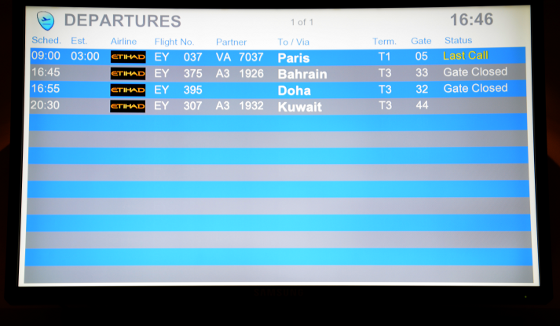
This is the first time we've flown out to Australia with Etihad and it may also be the last. We were due to fly back into Europe at CDG and head down to Lyon for the mini-DebConf this weekend. departure board, 18 hour delay for Paris Lets look at how our Etihad experience has worked out: 21:00 UTC Tuesday - waking up on Wednesday morning in Melbourne (UTC+10) 13:00 UTC Wednesday - leaving Melbourne about 11pm Wednesday night, a 12-13 hour flight to Abu Dhabi. We had heard about the air traffic control strikes in France (where we are going) and asked the airline if we should fly and they told us everything would be OK. 02:30 UTC Thursday - touchdown in Abu Dhabi, 6:30 am local time. Go to the transfer counter to ask for our boarding passes to CDG. At this stage, we were told that the connecting flight to CDG had been delayed 20 hours due to French strikes. As we are trying to reach Lyon for the mini-DebConf this weekend, we asked if we could leave Abu Dhabi on a 09:00 flight to Geneva. The Etihad staff told us to contact our travel agent (the flight was booked through Expedia) and for the next hour everybody's time was wasted making calls to Expedia who kept telling us to speak to Etihad. Whenever the Etihad customer service staff tried to speak to Expedia, the Expedia call center would hang up. Eventually, the Etihad staff told us that the deadline for putting us on the Geneva flight had passed and we would be stuck in Abu Dhabi for at least 20 hours. For flights to and from Europe, airlines have a responsibility to arrange hotels for passengers if there is a lengthy delay. If the airline is at fault, they must also pay some extra cash compensation but for a strike situation that is not applicable. Etihad has repeatedly fobbed us off. Initially we were given vouchers for Burger King or a pizza slice and told to hang around the transfer counter. By about 12:00 UTC (4pm local time, nine hours of waiting around the transfer counter) there was still no solution. One passenger was so upset that the airport security were called to speak to him and he was taken away. The airline staff kept giving excuses. Some passengers had been sent to a hotel but others left behind. I asked them again about our hotel and they kept trying to fob me off. Faced with the possibility that I would miss two nights of sleep and eight hours time difference coming into Europe, I continued asking the Etihad staff to own up to their responsibilities and they eventually offered us access to their airport lounge. We discovered some other passengers in the lounge too, including the passenger who had earlier been escorted away by security. This is unlike anything we've experienced with any other airline. At every opportunity (the check-in at Melbourne, or when the Geneva flight was boarding), the airline has failed to make arrangements that would have avoided cost and inconvenience. Assuming the flight goes ahead with a 20 hour delay, we will arrive in CDG some time Friday morning and not really sleep in a proper bed again until Friday night, about 70 hours after getting up in Melbourne on Wednesday morning. Thanks Etihad, you are a waking nightmare. The airline has been evasive about how they will deal with our onward travel from CDG to Lyon. We had booked a TGV train ticket already but it is not valid after such a long delay and it seems quite possible that trains will be busier than usual thanks to the air traffic control strike. So we don't even know if we will be loitering around a Paris airport or railway station for hours on Friday and nobody from the airline or Expedia really seems to care. Conclusion The only conclusion I can reach from this experience is that Etihad can't be trusted, certainly not for long journies such as Australia to Europe. Having flown through Singapore, Kuala Lumpur and Hong Kong, I know that air passengers have plenty of options available and there are many airlines that do go the extra mile to look after passengers especially on such long journeys. The airline missed opportunities to re-route us at every opportunity. It looks like they help some passengers (like those who did get to hotels) but leave many others high and dry just to stay within their budget.

7 April 2015

Mike Hommey: Announcing git-cinnabar 0.2.0

Git-cinnabar is a git remote helper to interact with mercurial repositories. It allows to clone, pull and push from/to mercurial remote repositories, using git. Get it on github. What s new since 0.1.1? What to expect next? If you want to follow the improvements more closely, I encourage you to switch to the next branch. I won t push anything there that hasn t been extensively tested on the above mentioned repositories. And as always, please report any issue you run into.

6 April 2015

Daniel Leidert: Correct keyboard layout (QWERTZ) with Logitech K400 attached to an Android HDMI stick

I've bought an HDMI stick with Android 4.4.2 to connect a TV to the local network (stream, DLNA) and the internet (Video portals etc.). The stick comes with no input device whatsoever. So I decided for a wireless Logitech K400r keyboard. Unfortunately the keyboard layout used by Android seems to be American (QWERTY) although the language and location settings are set to German. So I neither get Umlauts nor special signs correct nor do the media keys of the K400 work. But there is an easy way to make all this work. I've recently seen some people suggesting to install an app called External Keyboard Helper to fix things, which comes in a demo and a pro version, the latter with costs. Fortunately I didn't need any of these for the Logitech keyboard plus I got all media keys of this keyboard to work in just three steps without any cost :) Step 1First I went to the Google Play Store and installed the Logitech Keyboard Plus app by Logitech Europe S.A. (See? No external stuff and without costs. Ignore anything that's written in its description about Bluetooth.)App Logitech Keyboard Plus shown at Google Play Store Step 2Then I opened the settings section and went for Settings > Language and Input (Einstellungen > Sprache und Eingabe). Under KEYBOARD & INPUT METHOD (TASTATUR & EINGABEMETHODEN) I activated the entry called Logitech keyboard (Logitech Tastatur) as shown below.Activate the entry &quote;Logitech keyboard&quote; under Settings > Language and Input Step 3Now a click on the field above that is called Default (Standard) and (here) defaults to Deutsch - Android-Tastatur (AOSP) ...Click on the field &quote;Default&quote;... opened a popup called Choose input method and there I've chosen Logitech keyboard (Logitech Tastatur) as shown below and confirmed it.Activate the Logitech keyboard on the popup called &quote;Choose input method&quote;The default now is the Logitech keyboard:The default keyboard now is the Logitech keyboard Finally ...... it's done. The keyboard now behaves as expected and also the media/function keys do work. It is however not possible to adjust or configure anything, because this presumes a confirmed Bluetooth pairing between the keyboard and the android device and the K400 is not a Bluetooth device. It would probably be a good idea for Logitech to make this app usable for all available Logitech keyboards, even USB and Unifying(TM) ones. Update: As of now it is possible to cancel the Bluetooth pairing attempt without leaving the application. So this app in fact can be used for USB and Unifying(TM)-based Logitech keyboards.

1 April 2015

Raphaël Hertzog: My Free Software Activities in March 2015

My monthly report covers a large part of what I have been doing in the free software world. I write it for my donators (thanks to them!) but also for the wider Debian community because it can give ideas to newcomers and it s one of the best ways to find volunteers to work with me on projects that matter to me. Debian LTS This month I have been paid to work 15.25 hours on Debian LTS. In that time I did the following: That s it for the paid work. But still about LTS, I proposed two events for Debconf 15: A Debian LTS logoIn my last Freexian LTS report, I mentioned briefly that it would be nice to have a logo for the LTS project. Shortly after I got a first logo prepared by Damien Escoffier and a few more followed: they are available on a wiki page (and the logo you see above is from him!). Following a suggestion of Paul Wise, I registered the logo request on another wiki page dedicated to artwork requests. That kind of collaboration is awesome! Thanks to all the artists involved in Debian. Debian packaging Django. This month has seen no less than 3 upstream point releases packaged for Debian (1.7.5, 1.7.6 and 1.7.7) and they have been accepted by the release team into Jessie. I m pleased with this tolerance as I have argued the case for it multiple times in the past given the sane upstream release policy (bugfix only in a given released branch). Python code analysis. I discovered a few months ago a tool combining the power of multiple Python code analysis tools: it s prospector. I just filed a Request for Package for it (see #781165) and someone already volunteered to package it, yay \o/ update-rc.d and systemd. While working on a Kali version based on Jessie, I got hit by what boils down to a poor interaction between systemd and update-rc.d (see #746580) and after some exchanges with other affected users I raised the severity to serious as we really ought to do something about it before release. I also opened #781155 on openbsd-inetd as its usage of inetd.service instead of openbsd-inetd.service (which is only provided as a symlink to the former) leads to multiple small issues. Misc Debian France. The general assembly is over and the new board elected its new president: it s now official, I m no longer Debian France s president. Good luck to Nicolas Dandrimont who took on this responsibility. Salt s openssh formula. I improved salt s openssh formula to make it possible to manage the /etc/ssh/ssh_known_hosts file referencing the public SSH keys of other managed minions. Tendenci.com. I was looking for a free software solution to handle membership management of a large NPO and I discovered Tendenci. It looked very interesting feature wise and written with a language/framework that I enjoy (Python/Django). But while it s free software, there s no community at all. The company that wrote it released it under a free software license and it really looks like that they did intend to build a community but they failed at it. When I looked their development forums were web-based and mostly empty with only initial discussion of the current developers and no reply from anybody there s also no mention of an IRC channel or a mailing list. I sent them a mail to see what kind of collaboration we could expect if we opted for their software and got no reply. A pity, really. What free software membership management solution would you use when you have more than 10000 members to handle and when you want to use the underlying database to offer SSO authentication to multiple external services? Thanks See you next month for a new summary of my activities.

2 comments Liked this article? Click here. My blog is Flattr-enabled.

31 March 2015

Dirk Eddelbuettel: R / Finance 2015 Open for Registration

The annoucement below just went to the R-SIG-Finance list. More information is as usual at the R / Finance page.
Registration for R/Finance 2015 is now open! The conference will take place on May 29 and 30, at UIC in Chicago. Building on the success of the previous conferences in 2009-2014, we expect more than 250 attendees from around the world. R users from industry, academia, and government will joining 30+ presenters covering all areas of finance with R. We are very excited about the four keynote presentations given by Emanuel Derman, Louis Marascio, Alexander McNeil, and Rishi Narang.
The conference agenda (currently) includes 18 full presentations and 19 shorter "lightning talks". As in previous years, several (optional) pre-conference seminars are offered on Friday morning. There is also an (optional) conference dinner at The Terrace at Trump Hotel. Overlooking the Chicago river and skyline, it is a perfect venue to continue conversations while dining and drinking. Registration information and agenda details can be found on the conference website as they are being finalized.
Registration is also available directly at the registration page. We would to thank our 2015 sponsors for the continued support enabling us to host such an exciting conference: International Center for Futures and Derivatives at UIC Revolution Analytics
MS-Computational Finance and Risk Management at University of Washington Ketchum Trading
OneMarketData
RStudio
SYMMS On behalf of the committee and sponsors, we look forward to seeing you in Chicago! For the program committee:
Gib Bassett, Peter Carl, Dirk Eddelbuettel, Brian Peterson,
Dale Rosenthal, Jeffrey Ryan, Joshua Ulrich
See you in Chicago in May!

This post by Dirk Eddelbuettel originated on his Thinking inside the box blog. Please report excessive re-aggregation in third-party for-profit settings.

30 March 2015

Matthias Klumpp: Limba Project: Another progress report

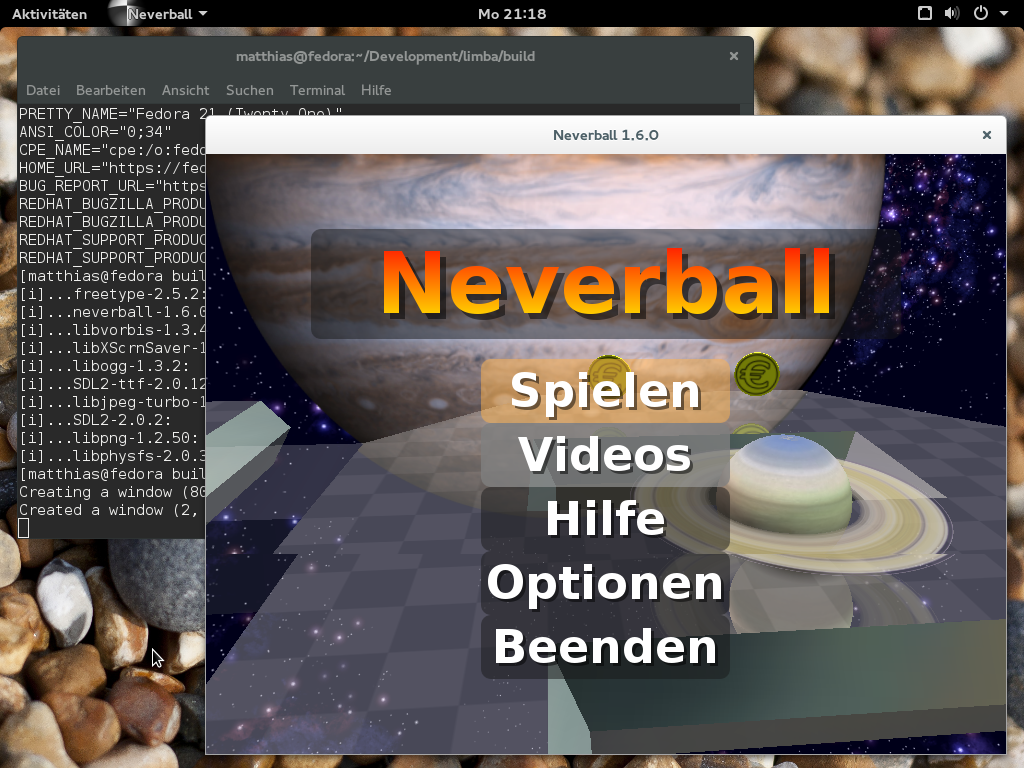
And once again, it s time for another Limba blogpost :-)limba-small Limba is a solution to install 3rd-party software on Linux, without interfering with the distribution s native package manager. It can be useful to try out different software versions, use newer software on a stable OS release or simply to obtain software which does not yet exist for your distribution. Limba works distribution-independent, so software authors only need to publish their software once for all Linux distributions. I recently released version 0.4, with which all most important features you would expect from a software manager are complete. This includes installing & removing packages, GPG-signing of packages, package repositories, package updates etc. Using Limba is still a bit rough, but most things work pretty well already. So, it s time for another progress report. Since a FAQ-like list is easier to digest. compared to a long blogpost, I go with this again. So, let s address one important general question first: How does Limba relate to the GNOME Sandboxing approach? (If you don t know about GNOMEs sandboxes, take a look at the GNOME Wiki Alexander Larsson also blogged about it recently) First of all: There is no rivalry here and no NIH syndrome involved. Limba and GNOMEs Sandboxes (XdgApp) are different concepts, which both have their place. The main difference between both projects is the handling of runtimes. A runtime is the shared libraries and other shared ressources applications use. This includes libraries like GTK+/Qt5/SDL/libpulse etc. XdgApp applications have one big runtime they can use, built with OSTree. This runtime is static and will not change, it will only receive critical security updates. A runtime in XdgApp is provided by a vendor like GNOME as a compilation of multiple single libraries. Limba, on the other hand, generates runtimes on the target system on-the-fly out of several subcomponents with dependency-relations between them. Each component can be updated independently, as long as the dependencies are satisfied. The individual components are intended to be provided by the respective upstream projects. Both projects have their individual up and downsides: While the static runtime of XdgApp projects makes testing simple, it is also harder to extend and more difficult to update. If something you need is not provided by the mega-runtime, you will have to provide it by yourself (e.g. we will have some applications ship smaller shared libraries with their binaries, as they are not part of the big runtime). Limba does not have this issue, but instead, with its dynamic runtimes, relies on upstreams behaving nice and not breaking ABIs in security updates, so existing applications continue to be working even with newer software components. Obviously, I like the Limba approach more, since it is incredibly flexible, and even allows to mimic the behaviour of GNOMEs XdgApp by using absolute dependencies on components. Do you have an example of a Limba-distributed application? Yes! I recently created a set of package for Neverball Alexander Larsson also created a XdgApp bundle for it, and due to the low amount of stuff Neverball depends on, it was a perfect test subject. One of the main things I want to achieve with Limba is to integrate it well with continuous integration systems, so you can automatically get a Limba package built for your application and have it tested with the current set of dependencies. Also, building packages should be very easy, and as failsafe as possible. You can find the current Neverball test in the Limba-Neverball repository on Github. All you need (after installing Limba and the build dependencies of all components) is to run the make_all.sh script. Later, I also want to provide helper tools to automatically build the software in a chroot environment, and to allow building against the exact version depended on in the Limba package. Creating a Limba package is trivial, it boils down to creating a simple control file describing the dependencies of the package, and to write an AppStream metadata file. If you feel adventurous, you can also add automatic build instructions as a YAML file (which uses a subset of the Travis build config schema) This is the Neverball Limba package, built on Tanglu 3, run on Fedora 21: Limba-installed Neverball Which kernel do I need to run Limba? The Limba build tools run on any Linux version, but to run applications installed with Limba, you need at least Linux 3.18 (for Limba 0.4.2). I plan to bump the minimum version requirement to Linux 4.0+ very soon, since this release contains some improvements in OverlayFS and a few other kernel features I am thinking about making use of. Linux 3.18 is included in most Linux distributions released in 2015 (and of course any rolling release distribution and Fedora have it). Building all these little Limba packages and keeping them up-to-date is annoying Yes indeed. I expect that we will see some bigger Limba packages bundling a few dependencies, but in general this is a pretty annoying property of Limba currently, since there are so few packages available you can reuse. But I plan to address this. Behind the scenes, I am working on a webservice, which will allow developers to upload Limba packages. This central ressource can then be used by other developers to obtain dependencies. We can also perform some QA on the received packages, map the available software with CVE databases to see if a component is vulnerable and publish that information, etc. All of this is currently planned, and I can t say a lot more yet. Stay tuned! (As always: If you want to help, please contact me) Are the Limba interfaces stable? Can I use it already? The Limba package format should be stable by now since Limba is still Alpha software, I will however, make breaking changes in case there is a huge flaw which makes it reasonable to break the IPK package format. I don t think that this will happen though, as the Limba packages are designed to be easily backward- and forward compatible. For the Limba repository format, I might make some more changes though (less invasive, but you might need to rebuilt the repository). tl;dr: Yes! Plase use Limba and report bugs, but keep in mind that Limba is still in an early stage of development, and we need bug reports! Will there be integration into GNOME-Software and Muon? From the GNOME-Software side, there were positive signals about that, but some technical obstancles need to be resolved first. I did not yet get in contact with the Muon crew they are just implementing AppStream, which is a prerequisite for having any support for Limba[1]. Since PackageKit dropped the support for plugins, every software manager needs to implement support for Limba.
So, thanks for reading this (again too long) blogpost :) There are some more exciting things coming soon, especially regarding AppStream on Debian/Ubuntu! [1]: And I should actually help with the AppStream support, but currently I can not allocate enough time to take that additional project as well this might change in a few weeks. Also, Muon does pretty well already!

Dimitri John Ledkov: Boiling frog, or when did we loose it with /etc ?

$ sudo find /etc -type f wc -l
2794

StatelessWhen was the last time you looked at /etc and thought - "I honestly know what every single file in here is". Or for example had a thought "Each file in here is configuration changes that I made". Or for example do you have confidence that your system will continue to function correctly if any of those files and directories are removed?

Traditionally most *NIX utilities are simple enough utilities, that do not require any configuration files what's so ever. However most have command line arguments, and environment variables to manipulate their behavior. Some of the more complex utilities have configuration files under /etc, sometimes with "layer" configuration from user's home directory (~/). Most of them are generally widely accepted. However, these do not segregate upstream / distribution / site administrator / local administrator / user configuration changes. Most update mechanisms created various ways to deal with merging and maintaining the correct state of those. For example both dpkg & RPM (%config) have elaborate strategies and policies and ways to deal with them. However, even today, still, they cause problems: prompting user for whitespace changes in config files, not preserving user changes, or failing to migrate them.

I can't find exact date, but it has now been something like 12 years since XDG Base directory specification was drafted. It came from Desktop Environment requirements, but one thing it achieves is segregation between upstream / distro / admin / user induced changes. When applications started to implement Base directory specification, I started to feel empowered. Upstream ships sensible configs in /usr, distribution integrators ship their overlay tweaks packaged in /usr, my site admin applies further requirements in /etc, and as I user I am free to improve or brake everything with configs in ~/. One of the best things from this setup - no upgrade prompts, and ease of reverting each layer of those configs (or at least auditing where the settings are coming from).

However, the uptake of XDG Base directory spec is slow / non-existing among the core components of any OS today. And at the same time /etc has grown to be a dumping ground for pretty much everything under the sun:
  • Symlink farms - E.g. /etc/rc*.d/*, /etc/systemd/system/*.wants/*, /etc/ssl/certs/*
  • Cache files - E.g. /etc/ld.so.cache
  • Empty (and mandatory) directories
  • Empty (and mandatory) "configuration" files. - E.g. whitespace & comments only
Let's be brutally honest and say that none of the above belongs in /etc. /etc must be for end-user configuration only, made by the end user alone and nobody else (or e.g. an automation tool driven by the end-user, like puppet).

Documentation of available configuration options and syntax to specify those in the config files should be shipped... in the documentation. E.g. man pages, /usr/share/doc, and so on. And not as the system-wide "example" config files. Absence of the files in /etc must not be treated as fatal, but a norm, since most users use default settings (especially for the most obscure options). Lastly compiled-in defaults should be used where possible, or e.g. layer configuration from multiple locations (e.g. /usr, /etc, ~/ where appropriate).

Above observations are not novel, and shared by most developers and users in the wider open source ecosystem. There are many projects and concepts to deal with this problem by using automation (e.g. puppet, chef), by migrating to new layouts (e.g. implementing / supporting XDG base dir spec), using "app bundles" (e.g. mobile apps, docker), or fully enumerating/abstracting everything in a generic manner (e.g. NixOS). Whilst fixing the issue at hand, these solutions do increase the dependency on files in /etc to be available. In other words we grew a de-facto user-space API we must not break, because modifications to the well known files in /etc are expected to take effect by both users and many administrator tools.

Since August last year, I have joined Open Source Technology Center at Intel, and have been working on Clear Linux* Project for Intel Architecture. One of the goals we have set out is to achieve stateless operation - that is to have empty /etc by default, reserved for user modification alone, yet continuing to support all legacy / well-known configuration paths. The premise is that all software can be patched with auto-detection, built-in defaults or support for layered configuration to achieve this. I hope that this work would interest everyone and will be widely adopted.

Whilst the effort to convert everything is still on going, I want to discuss a few examples of any core system.

ShadowThe login(1) command, whilst having built-in default for every single option exits with status 1, if it cannot stat(2) login.defs(5) file.

The passwd(1) command will write out the salted/hashed password in the passwd(5) file, rather than in shadow(5), if it cannot stat the shadow(5) file. There is similar behavior with gshadow. I found it very ironic, that upstream project "shadow" does not use shadow(5) by default.

Similarly, stock files manipulated by passwd/useradd/groupadd utilities are not created, if missing.

Some settings in login.defs(5) are not applicable, when compiled with PAM support, yet present in the default shipped login.defs(5) file.

Patches to resolve above issues are undergoing review on the upstream mailing list.
DBusIn xml based configuration, includedir' elements are mandatory to exist on disk, that is empty directory must be present, if referenced. If these directories are non-existant, the configuration fails to load and the system or session bus are not started.

Similarly, upstream have general agreement with the stateless concept and patches to move all of dbus default configurations from /etc to /usr are being reviewed for inclusion at the bug tracker. I hope this change will make into the 1.10 stable release.

GNU Lib CToday, we live in a dual-stack IPv4 and IPv6 world, where even the localhost has multiple IP addresses. As a slightly ageist time reference, the first VCS I ever used was git. Thus when I read below, I get very confused:
$ cat /etc/host.conf
# The "order" line is only used by old versions of the C library.
order hosts,bind
multi on
Why not simply do this:
--- a/resolv/res_hconf.c
+++ b/resolv/res_hconf.c
@@ -309,6 +309,8 @@ do_init (void)
if (hconf_name == NULL)
hconf_name = _PATH_HOSTCONF;

+ arg_bool (ENV_MULTI, 1, "on", HCONF_FLAG_MULTI);
+
fp = fopen (hconf_name, "rce");
if (fp)

There are still many other packages that needed fixes similar to above. Stay tuned for further stateless observations about Glibc, OpenSSH, systemd and other well known packages.

In the mean time, you can try out https://clearlinux.org/ images that implement above and more already. If you want to chat about it more, comment on G+, find myself on irc - xnox @ irc.freenode.net #clearlinux and join our mailing list to kick the conversation off, if you are interested in making the world more stateless.

ps.
I am a professional Linux Distribution developer, currently employed by Intel, however the postings on this site are my own and don't necessarily represent Intel's or any other past/present/future employer positions, strategies, or opinions.

* Other names and brands may be claimed as the property of others


29 March 2015

Zlatan Todori : Its all about fun

The percentage that women in Debian occupy as DDs is ~2%. Yes, just ~2% ladies that are DDs! So that means ~98% of DDs are gentelmen. some picture with rage meme I know there are more of ladies in Debian, so I firstly urge you, for love of Debian, to apply if you are contributing to this project, love its community and want to see Debian taking over the universe (okay, it seems that we conquered outer space so we need a help on Earth). So why is the number this low? Well maybe it's too precious to us currently inside that we want to prevent it being spoiled from outside. Also there seems to be not that much of younger DDs. Why is that important - well, young people like to do it and not to think about it. Many time they just break it, but many time they also do a breakthrough. Why is difference important and why should we embrace it? It's very important because it breaks a monopoly on view and behavior. It brings views not just from a larger number of people, but also from people from different backgrounds, and in constructive conversation it can put even more pluses on current workflow or it can counter it with good arguments. In a project of its size and worldwide geolocation of its developers, this is true for Debian more then any other projects I know. We need more women so we can balance our inner workings and have a better understanding of humanity and how is it moving, what and why does it need and where is it steering. That way we can produce a community which will improve quality of OS that we produce - because of sheer number of different people working on the same thing bringing to it its own personal touch. So, ladies and youth all over the world, unite and join in Debian because without diversity Debian can't grow beyond its current size. Also, no, Debian is not about code only, it needs painters, musicians, people that want to talk about Debian, people that share love and happiness, people that want to build better communities, UI/UX designers, makers, people who know how to repair a bike, athletes, homebrew beer producers, lawyers (just while world gets rid of laws, then we don't need you), actors, writters... Why, well because world and communities are made up from all that diversity and that's what makes it a better and not a monotone place. But I just use Debian. Well, do you feel love towards Debian and its work? Would you like to feel more as integral part of community? If the answer is big fat YES, then you should be a DD too. Every person that feels it's part of Debians philosophy about freedom and behaving in good manner should join Debian. Every person that feels touched and enhanced by Debian's work should become part of community and share its experience how Debian touched their soul, impacted their life. If you love Debian, you should be free to contribute to it in whatever manner and you should be free to express your love towards it. If you think lintian is sexy, or shebang is a good friends of yours, or you enjoy talking to MadameZou about Debian and zombies (yeah, we do have all kinds of here), or you like Krita, or you hate the look of default XFCE theme, or you can prove that you a more crazy developer then paultag - just hop into community and try to integrate in it. You will meet great folks, have a lot of conversation about wine and cheese, play some dangerous card games and even learn about things like bokononism (yeah I am looking at you dkg!). Now for the current Debian community - what the hell is packaging and non-packaging Debian Developer? Are one better then others? Do others stink? They don't know to hug? WHAT? Yes I know that inexperienced person shouldn't have a permission to access Debian packaging infrastructure, but I have the feeling that even that person knows that. Every person should have a place in Debian and acknowledge other fields. So yes, software developers need access to Debian packaging infrastructure, painters don't. I think we can agree on this. So lets abolish the stupid term and remove the difference in our community. Lets embrace the difference, because if someone writes a good poem about Debian heroism I could like it more then flashplugin-nonfree! Yep, I made that comparison on purpose so you can give a thought about it. Debian has excellent community regarding operating system that it's producing. And it's not going away, not at least anytime soon. But it will not go forward if we don't give additional push as human beings, as people who care about their fellow Debianites. And we do care, I know that, we just need to push it more public. We don't hide bugs, we for sure shouldn't hide features. It will probably bring bad seeds too, but we have mechanisms and will to counter that. If we, on average 10 bad seeds, get some crazy good hacker or crazy lovely positive person like this lady, we will be on right path. Debian is a better place, it should lead in effort to bring more people into FLOSS world and it should allow people to bring more of diversity into Debian. draw a picture where it says next year 3 dpl candidates should be only women and at least one of them not involved in packaging

28 March 2015

Matt Zimmerman: What I think about thought

Only parts of us will ever
touch o n l y parts of others
one s own truth is just that really one s own truth.
We can only share the part that is u n d e r s t o o d b y within another s knowing acceptable t o t h e o t h e r t h e r e f o r e so one
is for most part alone.
As it is meant to be in
evidently in nature at best t h o u g h perhaps it could make
our understanding seek
another s loneliness out.
unpublished poem by Marilyn Monroe, via berlin-artparasites This poem inspired me to put some ideas into words this morning, an attempt to summarize my current working theory of consciousness. Ideas travel through space and time. An idea that exists in my mind is filtered through my ability to express it somehow (words, art, body language, ), and is then interpreted by your mind and its models for understanding the world. This shifts your perspective in some way, some or all of which may be unconscious. When our minds encounter new ideas, they are accepted or rejected, reframed, and integrated with our existing mental models. This process forms a sort of living ecosystem, which maintains equilibrium within the realm of thought. Ideas are born, divide, mutate, and die in the process. Language, culture, education and so on are stable structures which form and support this ecosystem. Consciousness also has analogues of the immune system, for example strongly held beliefs and models which tend to reject certain ideas. Here again these can be unconscious or conscious. I ve seen it happen that if someone hears an idea they simply cannot integrate, they will behave as if they did not hear it at all. Some ideas can be identified as such a serious threat that ignoring them is not enough to feel safe: we feel compelled to eliminate the idea in the external world. The story of Christianity describes a scenario where an idea was so threatening to some people that they felt compelled to kill someone who expressed it. A microcosm of this ecosystem also exists within each individual mind. There are mental structures which we can directly introspect and understand, and others which we can only infer by observing our thoughts and behaviors. These structures communicate with each other, and this communication is limited by their ability to speak each other s language . A dream, for example, is the conveyance of an idea from an unconscious place to a conscious one. Sometimes we get the message, and sometimes we don t. We can learn to interpret, but we can t directly examine and confirm if we re right. As in biology, each part of this process introduces uncountable errors , but the overall system is surprisingly robust and stable. This whole system, with all its many minds interacting, can be thought of as an intelligence unto itself, a gestalt consciousness. This interpretation leads to some interesting further conclusions: Naturally, this is by no means an original idea (can such a thing exist?). It is my own take on the subject, informed both consciously and unconsciously by my own study, first-hand experience, conversations I ve had with others, and so on. It s informed by the countless thinkers who have influenced me. Its expression is limited by my ability to write about it in a way that makes sense to other people.
Maybe some of this makes sense to you, and maybe I seem insane, or maybe both. Hopefully you don t find that you have an inexplicable unconscious desire to kill me!

26 March 2015

Zlatan Todori : Random bits

Gogs I installed today Gogs and configured it with mysql (yes, yes, I know - use postgres you punk!). I will not post details of how I did it because:
  • It still has "weird" coding as pointed already by others
  • It doesn't have fork and pull request ability yet
And there was end of journey. When they code in fork/PR , I will close my eyes on other coding stuff and try it again because Gitlab is not close to my heart and installing their binary takes ~850MB of space which means a lot of ruby code that could go wrong way. It would be really awesome to have in archive something to apt install and have github-like place. It would be great if Debian infrastructure would have the possibility to have that.

Diaspora* Although I am thrilled about it finally reaching Debian archive, it still isn't ready. Not even closely. I couldn't even finish installation of it and it's not suitable for main archive as it takes files from github repo of diaspora. Maybe poking around Bitnami folks about how they did it.

The power of Free software Text Secure is was an mobile app that I thought it could take on Viber or WhatsUp. Besides all its goodies it had chance to send encrypted SMS to other TS users. Not anymore. Fortunate, there is a fork called SMSSecure which still has that ability.

Trolls So there is this Allwinner company that does crap after crap. Their latest will reach wider audience and I hope it gets resolved in a matter how they would react if some big proprietary company was stealing their code. It seems Allwinner is a pseudo for Alllooser. Whoa, that was fun!

A year old experiment So I had a bet with a friend that I will run for a year Debian Unstable mixed with some packages from experimental and do some random testings on packages of interest to them. Also I promised to update aggressively so it was to be twice a day. This was my only machine so the bet was really good as it by theory could break very often. Well on behalf of Debian community, I can say that Debian hasn't had a single big breakage. Yay! The good side: on average I had ~3000 packages installed (they were in range from 2500-3500). I had for example xmonad, e17, gnome, cinnamon, xfce, systemd from experimental, kernels from experimental, nginx, apache, a lot of heavy packages, mixed packages from pip, npm, gems etc. So that makes it even more incredible that it stayed stable. There is no bigger kudos to people working on Debian, then when some sadist tries countless of ways to break it and Debian is just keeps running. I mean, I was doing my $PAID_WORK on this machine! The bad side: there were small breakages. It's seems that polkit and systemd-side of gnome were going through a lot of changes because sometimes system would ask password for every action (logout, suspend, poweroff, connect to network etc), audio would work and would not work, would often by itself just mute sound on every play or it would take it to 100% (which would blow my head when I had earplugs), bluetooth is almost de facto not working in gnome (my bluetooth mice worked without single problem in lenny, squeeze, in wheezy it maybe had once or twice a problem, but in this year long test it's almost useless). System would also have random hangs from time to time. The test: in the beginning my radeon card was too new and it was not supported by FLOSS driver so I ended up using fglrx which caused me a lot of annoyance (no brightness control, flickering of screen) but once FLOSS driver got support I was on it, and it performed more fluid (no glitches while moving windows). So as my friends knew that I have radeon and they want to play games on their machines (I play my Steam games on FLOSS driver) they set me the task to try fglrx driver every now end then. End result - there is no stable fglrx driver for almost a year, it breaks graphical interface so I didn't even log into DE with it for at least 8 months if not more. On the good side my expeditions in flgrx where quick - install it, boot into disaster, remove it, boot into freedom. Downside seems to be that removing fglrx driver, leaves a lot of its own crap on system (I may be mistaking but it seems I am not). Debian with love Well, that's all for today. I think so. You can never be sure.

21 March 2015

Iustin Pop: Effects of a PSU upgrade

Got some unexpected results from a hardware upgrade First, GPU upgrade Old videocard My current video card was getting a bit long in the tooth. I kept delaying the upgrade, because newer Radeon cards are pretty inefficient, energy-wise, and I didn't want to upgrade my PSU as well. My old card had a TDP of 150W, and I was looking for upgrading to something in the same ballpark. While there were more current similar cards, the performance benefit was not that great - to get a real boost, I'd need to upgrade to something 200W+, if not 250W. Additionally, I was focused on AMD-only cards because of Linux open-source support, even though newer AMD cards don't support EXA anymore (plain 2D). Surprised to learn about Nvidia Maxwell While looking at what AMD cards to upgrade to, I happen to learn about the now ~1 year old Nvidia Maxwell architecture, which is - surprisingly - much more energy efficient. So efficient, that I could upgrade to a top-of-the-line card, with around 6 performance on most benchmarks compared to my current card, with only a 25W TDP increase. I couldn't believe I missed this for almost a year, just because I was focused only on AMD cards. I research some more, I try to console myself about going back to Nvidia's binary blobs until Nouveau supports GM20x card well, but in the end the results seem too good to ignore. Upgrade: in-game performance and noise For the card I bought, Nvidia says a PSU with 500W output is the minimum. That matched exactly the PSU I had, and it was a quality producer (Seasonic), so I bought the new videocard and installed it. Performance was, surprisingly, as expected: my new card is faster at maximum settings than my old card was on low settings in two or three games that I tested. So all good from this side. On Linux, moving to the non-free Nvidia driver was a walk in the part, thanks to the maintainers of all things Nvidia: thanks! Last I used an Nvidia card, many years ago, it was a bit more painful. And yes, Nvidia doesn't enable all monitors upon boot, requiring some reshuffling of the outputs for multi-monitor work. Finding that I still had an .nvidia-settings-rc in my homedir from ages ago was fun :) The downside was that the system was noisier under load; slightly noisier in some games, to much more noisier in others. This didn't match my expectations, since the specific version of the card I bought was not overclocked and had extra large fans, and with only a +25W TDP it shouldn't have been significantly noisier. Well, that's it, I said, not all marketing/reviews should be believed. One interesting thing was that I wasn't clearly able to pin-point what was generating the additional noise. PSU upgrade I was thinking anyway about doing a PSU upgrade as well, since my current PSU was even older than my videocard, and was at the limit. Dust So I bought a PSU as well, and spent about half a day installing it. Why half a day? Because the new PSU is modular, and the combination with the case I have means I could redo the cabling inside my case, significantly. In the process, I found a lot of accumulated dust which I cleaned. I also found out that parts of the CPU cooler fins were blocked by dust, so the fan was not as effective as when new. I also realised that one case fan was no longer effective in its position, since I have no HDDs that need cooling (this case is split between MB and HDD/PSU areas), so I could move it in a place that cools better the various PCIe devices. and silence! After all was said and done, the PC booted up just fine. Everything seemed correct, the new position of the fan was drawing in cold air and pushing it over the PCIe cards, so it was time to see if all the cleanup had any effect on the behaviour under load. So I start a game, the card gets slightly noisier compared to idle, and stays there. I go on playing for 10 minutes, which would have been more than enough to heat the whole system enough that it becomes noisy, but nothing, just slightly above the normal "PC is on" noise. Before all the upgrades, my old card was definitely noisier when playing I don't know if there is a single, key factor, or if it's a combination of all of: In any case, I'm happy now. I got much better performance (5-6 is nothing to laugh at) for slight increase in energy consumption at load (~+25W). If I had stopped here, it would have been good enough. But spending 3 hours cleaning and simplifying the cabling means I also got a much quieter PC. The only downside is Linux with binary drivers. Waiting now for Nouveau

20 March 2015

Zlatan Todori : My journey into Debian

Notice: There were several requests for me to more elaborate on my path to Debian and impact on life so here it is. It's going to be a bit long so anyone who isn't interested in my personal Debian journey should skip it. :) In 2007. I enrolled into Faculty of Mechanical Engineering (at first at Department of Industrial Management and later transfered to Department of Mechatronics - this was possible because first 3 semesters are same for both departments). By the end of same year I was finishing my tasks (consisting primarily of calculations, some small graphical designs and write-ups) when famous virus, called by users "RECYCLER", sent my Windows XP machine into oblivion. Not only it took control over machine and just spawned so many processes that system would crash itself, it actually deleted all from hard-disk before it killed the system entirely. I raged - my month old work, full of precise calculations and a lot of design details, was just gone. I started cursing which was always continued with weeping: "Why isn't there an OS that can whithstand all of viruses, even if it looks like old DOS!". At that time, my roommate was my cousin who had used Kubuntu in past and currently was having SUSE dual-booted on his laptop. He called me over, started talking about this thing called Linux and how it's different but de facto has no viruses. Well, show me this Linux and my thought was, it's probably so ancient and not used that it probably looks like from pre Windows 3.1 era, but when SUSE booted up it had so much more beautiful UI look (it was KDE, and compared to XP it looked like the most professional OS ever). So I was thrilled, installed openSUSE, found some rough edges (I knew immediately that my work with professional CAD systems will not be possible on Linux machines) but overall I was bought. After that he even talked to me about distros. Wait, WTF distros?! So, he showed me distrowatch.com. I was amazed. There is not only a better OS then Windows - there where dozens, hundreds of them. After some poking around I installed Debian KDE - and it felt great, working better then openSUSE but now I was as most newbies, on fire to try more distros. So I was going around with Fedora, Mandriva, CentOS, Ubuntu, Mint, PCLinuxOS and in beginning of 2008 I stumbled upon Debian docs which where talking about GNU and GNU Manifesto. To be clear, I was always as a high-school kid very much attached to idea of freedom but started loosing faith by faculty time (Internet was still not taking too much of time here, youth still spent most of the day outside). So the GNU Manifesto was really a big thing for me and Debian is a social bastion of freedom. Debian (now with GNOME2) was being installed on my machine. As all that hackerdom in Debian was around I started trying to dig up some code. I never ever read a book on coding (until this day I still didn't start and finish one) so after a few days I decided to code tetris in C++ with thought that I will finish it in two days at most (the feeling that you are powerful and very bright person) - I ended it after one month in much pain. So instead I learned about keeping Debian system going on, and exploring some new packages. I got thrilled over radiotray, slimvolley (even held a tournament in my dorm room), started helping on #debian, was very active in conversation with others about Debian and even installed it on few laptops (I became de facto technical support for users of those laptops :D ). Then came 2010 which with negative flow that came in second half of 2009, started to crush me badly. I was promised to go to Norway, getting my studies on robotics and professor lied (that same professor is still on faculty even after he was caught in big corruption scandal over buying robots - he bought 15 years old robots from UK, although he got money from Norway to buy new ones). My relationship came to hard end and had big emotional impact on me. I fell a year on faculty. My father stopped financing me and stopped talking to me. My depression came back. Alcohol took over me. I was drunk every day just not to feel anything. Then came the end of 2010, I somehow got to the information that DebConf will be in Banja Luka. WHAT?! DebConf in city where I live. I got into #debconf and in December 2010/January 2011 I became part of the famous "local local organizers". I was still getting hammered by alcohol but at least I was getting out of depression. IIRC I met Holger and Moray in May, had a great day (a drop of rakia that was too much for all of us) and by their way of behaving there was something strange. Beatiful but strange. Both were sending unique energy of liberty although I am not sure they were aware of it. Later, during DebConf I felt that energy from almost all Debian people, which I can't explain. I don't feel it today - not because it's not there, it's because I think I integrated so much into Debian community that it's now a natural feeling which people here, that are close to me are saying that they feel it when I talk about Debian. DebConf time in Banja Luka was awesome - firstly I met Phil Hands and Andrew McMillan which were a crazy team, local local team was working hard (I even threw up during the work in Banski Dvor because of all heat and probably not much of sleep due to excitement), met also crazy Mexican Gunnar (aren't all Mexicans crazy?), played Mao (never again, thank you), was hanging around smart but crazy people (love all) from which I must notice Nattie (a bastion of positive energy), Christian Perrier (which had coordinated our Serbian translation effort), Steve Langasek (which asked me to find physiotherapist for his co-worker Mathias Klose, IIRC), Zach (not at all important guy at that time), Luca Capello (who gifted me a swirl on my birthday) and so many others that this would be a post for itself just naming them. During DebConf it was also a bit of hard time - my grandfather died on 6th July and I couldn't attend the funeral so I was still having that sadness in my heart, and Darjan Prtic, a local team member that came from Vienna, committed suicide on my birthday (23 July). But DebConf as conference was great, but more importantly the Debian community felt like a family and Meike Reichle told me that it was. The night it finished, me and Vedran Novakovic cried. A lot. Even days after, I was getting up in the morning having the feeling I need something to do for DebConf. After a long time I felt alive. By the end of year, I adopted package from Clint Adams and Moray became my sponsor. In last quarter of 2011 and beginning of 2012, I (as part of LUG) held talks about Linux, had Linux installation in Computer Center for the first time ever, and installed Debian on more machines. Now fast forwarding with some details - I was also on DebConf13 in Switzerland, met some great new friends such as Tincho and Santiago (and many many more), Santiago was also my roommate in Portland on the previous DebConf. In Switzerland I had really great and awesome time. Year 2014 - I was also at DebConf14, maintain a bit more packages and have applied for DD, met some new friends among which I must put out Apollon Oikonomopoulos and Costas Drogos which friendship is already deep for such a short time and I already know that they are life-long friends. Also thanks to Steve Langasek, because without his help I wouldn't be in Portland with my family and he also gave me Arduino. :) 2015. - I am currently at my village residence, have a 5 years of working experince as developer due to Debian and still a lot to go, learn and do but my love towards Debian community is by magnitude bigger then when I thought I love it at most. I am also going through my personal evolution and people from Debian showed me to fight for what you care, so I plan to do so. I can't write all and name all the people that I met, and believe me when I say that I remember most and all of you impacted my life for which I am eternally grateful. Debian, and it's community effect literally saved my life, spring new energy into me and changed me for better. Debian social impact is far bigger then technical, and when you know that Debian is a bastion of technical excellence - you can maybe picture the greatness of Debian. Some of greatest minds are in Debian but most important isn't the sheer amount of knowledge but the enormous empathy. I just hope I can in future show to more people what Debian is and to find all lost souls as me to give them the hope, to show them that we can make world a better place and that everyone is capable to live and do what they love. P.S. I am still hoping and waiting to see Bdale writing a book about Debian's history to this day - in which I think many of us would admire the work done by project members, laugh about many situations and have fun reading a book about project that was having nothing to do but fail and yet it stands stronger then ever with roots deep into our minds.

16 March 2015

Russ Allbery: Another haul post

Wow, it's been quite a long time since I've posted something here. Everything is going well -- I'm just very, very engrossed with the new job, since I'm still in exponential ramp-up mode. It's lasting for longer than I expected, although my expectations didn't have much basis since this is the first time I've started a new job in 17 years. I'm feeling more and more capable every day, but the combination of a very heavily social learning process, a lot of new technical areas to learn, and not having taken a vacation since last June means that my weekends are spent just passively watching things and zoning. Not sure yet how long that will last, and I don't want to make any predictions, although I do have my first significant vacation coming up next month. Anyway, book reading and buying has continued, although I'm again far behind on writing reviews. With luck, I'll be writing one of those (for posting later) right after writing this post. Michelle Alexander The New Jim Crow (non-fiction)
Elizabeth Bear Karen Memory (sff)
Becky Chambers The Long Way to a Small, Angry Planet (sff)
Fred Clark The Anti-Christ Handbook (non-fiction)
Charles de Lint The Very Best of Charles de Lint (sff)
S.L. Huang A Neurological Study on the Effects... (sff)
S.L. Huang Half Life (sff)
Kameron Hurley The Mirror Empire (sff)
Sophie Lack Dissonance (sff)
Sophie Lack Imbalance (sff)
Susan R. Matthews An Exchange of Hostages (sff)
Kaoru Mori A Bride's Story #1 (graphic novel)
Donald Shoup The High Cost of Free Parking (non-fiction)
Jo Walton The Just City (sff) Pretty nice variety of different stuff from a huge variety of recommendation sources. I've already read the Chambers (and can recommend it). A review will be forthcoming.

Next.

Previous.