Search Results: "az"

14 January 2016

Elena 'valhalla' Grandi: Conservancy supporter, at last!

Conservancy supporter, at last!

Yesterday I've finally donated to become a Conservancy Supporter http://sfconservancy.org/supporter/.

The reasons to donate have already been explained many times both on Planet Debian http://planet.debian.org/ and elsewhere; a few weeks ago I wrote a post (in Italian) on the Ninux community blog https://blog.ninux.org/2015/12/03/causa-vmware-per-violazione-gpl-sponsor-ritirano-fondi-a-software-freedom-conservancy/ to spread the word about it.

So, why I haven't donated earlier?

Trying to donate via PayPal from Italy (and, it seems, from Europe in general) requires a PayPal account, which I don't have and don't want to have, so I contacted them to ask for bank transfer instructions.
The first instructions I received were too complex for my online-only bank account, so I asked my bank for help, there was an exchange of emails, further simpler instructions from their bank, a small donation to test everything and time passed.

Finally, the good news: it is possible to donate to Conservancy from Italy (and probably from elsewhere in EU) using a SEPA transfer with minimal commissions and usually available from the home banking websites, so that it doesn't require significantly more effort than using paypal.
You can contact Conservancy via e-mail mailto:accounting@sfconservancy.org to get the relevant payment data.

(Conservancy has an account in EUR which is then used to pay for expenses in EUR, so no currency conversion commission are involved.)

13 January 2016

Norbert Preining: Ian Buruma: Wages of Guilt

Since moving to Japan, I got more and more interested in history, especially the recent history of the 20th century. The book I just finished, Ian Buruma (Wiki, home page) Wages of Guilt Memories of War in Germany and Japan (Independent, NYRB), has been a revelation for me. As an Austrian living in Japan, I am experiencing the discrepancy between these two countries with respect to their treatment of war legacy practically daily, and many of my blog entries revolve around the topic of Japanese non-reconciliation.
Willy Brandt went down on his knees in the Warsaw ghetto, after a functioning democracy had been established in the Federal Republic of Germany, not before. But Japan, shielded from the evil world, has grown into an Oskar Matzerath: opportunistic, stunted, and haunted by demons, which it tries to ignore by burying them in the sand, like Oskar s drum.
Ian Buruma, Wages of Guilt, Clearing Up the Ruins
Buruma-Wages_of_Guilt The comparison of Germany and Japan with respect to their recent history as laid out in Buruma s book throws a spotlight on various aspects of the psychology of German and Japanese population, while at the same time not falling into the easy trap of explaining everything with difference in the guilt culture. A book of great depth and broad insights everyone having even the slightest interest in these topics should read.
This difference between (West) German and Japanese textbooks is not just a matter of detail; it shows a gap in perception.
Ian Buruma, Wages of Guilt, Romance of the Ruins
Only thinking about giving a halfway full account of this book is something impossible for me. The sheer amount of information, both on the German and Japanese side, is impressive. His incredible background (studies of Chinese literature and Japanese movie!) and long years as journalist, editor, etc, enriches the book with facets normally not available: In particular his knowledge of both the German and Japanese movie history, and the reflection of history in movies, were complete new aspects for me (see my recent post (in Japanese)). The book is comprised of four parts: The first with the chapters War Against the West and Romance of the Ruins; the second with the chapters Auschwitz, Hiroshima, and Nanking; the third with History on Trial, Textbook Resistance, and Memorials, Museums, and Monuments; and the last part with A Normal Country, Two Normal Towns, and Clearing Up the Ruins. Let us look at the chapters in turn: The boook somehow left me with a bleak impression of Japanese post-war times as well as Japanese future. Having read other books about the political ignorance in Japan (Norma Field s In the realm of a dying emperor, or the Chibana history), Buruma s characterization of Japanese politics is striking. He couldn t foresee the recent changes in legislation pushed through by the Abe government actually breaking the constitution, or the rewriting of history currently going on with respect to comfort women and Nanking. But reading his statement about Article Nine of the constitution and looking at the changes in political attitude, I am scared about where Japan is heading to:
The Nanking Massacre, for leftists and many liberals too, is the main symbol of Japanese militarism, supported by the imperial (and imperialist) cult. Which is why it is a keystone of postwar pacifism. Article Nine of the constitution is necessary to avoid another Nanking Massacre. The nationalist right takes the opposite view. To restore the true identity of Japan, the emperor must be reinstated as a religious head of state, and Article Nine must be revised to make Japan a legitimate military power again. For this reason, the Nanking Massacre, or any other example of extreme Japanese aggression, has to be ignored, softened, or denied.
Ian Buruma, Wages of Guilt, Nanking
While there are signs of resistance in the streets of Japan (Okinawa and the Hanako bay, the demonstrations against secrecy law and reversion of the constitution), we are still to see a change influenced by the people in a country ruled and distributed by oligarchs. I don t think there will be another Nanking Massacre in the near future, but Buruma s books shows that we are heading back to a nationalistic regime similar to pre-war times, just covered with a democratic veil to distract critics.
I close with several other quotes from the book that caught my attention: In the preface and introduction:
[ ] mainstream conservatives made a deliberate attempt to distract people s attention from war and politics by concentrating on economic growth.
The curious thing was that much of what attracted Japanese to Germany before the war Prussian authoritarianism, romantic nationalism, pseudo-scientific racialism had lingered in Japan while becoming distinctly unfashionable in Germany.
In Romance of the Ruins:
The point of all this is that Ikeda s promise of riches was the final stage of what came to be known as the reverse course, the turn away from a leftist, pacifist, neutral Japan a Japan that would never again be involved in any wars, that would resist any form of imperialism, that had, in short, turned its back for good on its bloody past. The Double Your Incomes policy was a deliberate ploy to draw public attention away from constitutional issues.
In Hiroshima:
The citizens of Hiroshima were indeed victims, primarily of their own military rulers. But when a local group of peace activists petitioned the city of Hiroshima in 1987 to incorporate the history of Japanese aggression into the Peace Memorial Museum, the request was turned down. The petition for an Aggressors Corner was prompted by junior high school students from Osaka, who had embarrassed Peace Museum officials by asking for an explanation about Japanese responsibility for the war.
The history of the war, or indeed any history, is indeed not what the Hiroshima spirit is about. This is why Auschwitz is the only comparison that is officially condoned. Anything else is too controversial, too much part of the flow of history .
In Nanking, by the governmental pseudo-historian Tanaka:
Unlike in Europe or China, writes Tanaka, you won t find one instance of planned, systematic murder in the entire history of Japan. This is because the Japanese have a different sense of values from the Chinese or the Westerners.
In History on Trial:
In 1950, Becker wrote that few things have done more to hinder true historical self-knowledge in Germany than the war crimes trials. He stuck to this belief. Becker must be taken seriously, for he is not a right-wing apologist for the Nazi past, but an eminent liberal.
There never were any Japanese war crimes trials, nor is there a Japanese Ludwigsburg. This is partly because there was no exact equivalent of the Holocaust. Even though the behavior of Japanese troops was often barbarous, and the psychological consequences of State Shinto and emperor worship were frequently as hysterical as Nazism, Japanese atrocities were part of a military campaign, not a planned genocide of a people that included the country s own citizens. And besides, those aspects of the war that were most revolting and furthest removed from actual combat, such as the medical experiments on human guinea pigs (known as logs ) carried out by Unit 731 in Manchuria, were passed over during the Tokyo trial. The knowledge compiled by the doctors of Unit 731 of freezing experiments, injection of deadly diseases, vivisections, among other things was considered so valuable by the Americans in 1945 that the doctors responsible were allowed to go free in exchange for their data.
Some Japanese have suggested that they should have conducted their own war crimes trials. The historian Hata Ikuhiko thought the Japanese leaders should have been tried according to existing Japanese laws, either in military or in civil courts. The Japanese judges, he believed, might well have been more severe than the Allied tribunal in Tokyo. And the consequences would have been healthier. If found guilty, the spirits of the defendants would not have ended up being enshrined at Yasukuni. The Tokyo trial, he said, purified the crimes of the accused and turned them into martyrs. If they had been tried in domestic courts, there is a good chance the real criminals would have been flushed out.
After it was over, the Nippon Times pointed out the flaws of the trial, but added that the Japanese people must ponder over why it is that there has been such a discrepancy between what they thought and what the rest of the world accepted almost as common knowledge. This is at the root of the tragedy which Japan brought upon herself.
Emperor Hirohito was not Hitler; Hitler was no mere Shrine. But the lethal consequences of the emperor-worshipping system of irresponsibilities did emerge during the Tokyo trial. The savagery of Japanese troops was legitimized, if not driven, by an ideology that did not include a Final Solution but was as racialist as Hider s National Socialism. The Japanese were the Asian Herrenvolk, descended from the gods.
Emperor Hirohito, the shadowy figure who changed after the war from navy uniforms to gray suits, was not personally comparable to Hitler, but his psychological role was remarkably similar.
In fact, MacArthur behaved like a traditional Japanese strongman (and was admired for doing so by many Japanese), using the imperial symbol to enhance his own power. As a result, he hurt the chances of a working Japanese democracy and seriously distorted history. For to keep the emperor in place (he could at least have been made to resign), Hirohito s past had to be freed from any blemish; the symbol had to be, so to speak, cleansed from what had been done in its name.
In Memorials, Museums, and Monuments:
If one disregards, for a moment, the differences in style between Shinto and Christianity, the Yasukuni Shrine, with its relics, its sacred ground, its bronze paeans to noble sacrifice, is not so very different from many European memorials after World War I. By and large, World War II memorials in Europe and the United States (though not the Soviet Union) no longer glorify the sacrifice of the fallen soldier. The sacrificial cult and the romantic elevation of war to a higher spiritual plane no longer seemed appropriate after Auschwitz. The Christian knight, bearing the cross of king and country, was not resurrected. But in Japan, where the war was still truly a war (not a Holocaust), and the symbolism still redolent of religious exultation, such shrines as Yasukuni still carry the torch of nineteenth-century nationalism. Hence the image of the nation owing its restoration to the sacrifice of fallen soldiers.
In A Normal Country:
The mayor received a letter from a Shinto priest in which the priest pointed out that it was un-Japanese to demand any more moral responsibility from the emperor than he had already taken. Had the emperor not demonstrated his deep sorrow every year, on the anniversary of Japan s surrender? Besides, he wrote, it was wrong to have spoken about the emperor in such a manner, even as the entire nation was deeply worried about his health. Then he came to the main point: It is a common error among Christians and people with Western inclinations, including so-called intellectuals, to fail to grasp that Western societies and Japanese society are based on fundamentally different religious concepts . . . Forgetting this premise, they attempt to place a Western structure on a Japanese foundation. I think this kind of mistake explains the demand for the emperor to bear full responsibility.
In Two Normal Towns:
The bust of the man caught my attention, but not because it was in any way unusual; such busts of prominent local figures can be seen everywhere in Japan. This one, however, was particularly grandiose. Smiling across the yard, with a look of deep satisfaction over his many achievements, was Hatazawa Kyoichi. His various functions and titles were inscribed below his bust. He had been an important provincial bureaucrat, a pillar of the sumo wrestling establishment, a member of various Olympic committees, and the recipient of some of the highest honors in Japan. The song engraved on the smooth stone was composed in praise of his rich life. There was just one small gap in Hatazawa s life story as related on his monument: the years from 1941 to 1945 were missing. Yet he had not been idle then, for he was the man in charge of labor at the Hanaoka mines.
In Clearing Up the Ruins:
But the question in American minds was understandable: could one trust a nation whose official spokesmen still refused to admit that their country had been responsible for starting a war? In these Japanese evasions there was something of the petulant child, stamping its foot, shouting that it had done nothing wrong, because everybody did it.
Japan seems at times not so much a nation of twelve-year-olds, to repeat General MacArthur s phrase, as a nation of people longing to be twelve-year-olds, or even younger, to be at that golden age when everything was secure and responsibility and conformity were not yet required.
For General MacArthur was right: in 1945, the Japanese people were political children. Until then, they had been forced into a position of complete submission to a state run by authoritarian bureaucrats and military men, and to a religious cult whose high priest was also formally chief of the armed forces and supreme monarch of the empire.
I saw Jew S ss that same year, at a screening for students of the film academy in Berlin. This showing, too, was followed by a discussion. The students, mostly from western Germany, but some from the east, were in their early twenties. They were dressed in the international uniform of jeans, anoraks, and work shirts. The professor was a man in his forties, a 68er named Karsten Witte. He began the discussion by saying that he wanted the students to concentrate on the aesthetics of the film more than the story. To describe the propaganda, he said, would simply be banal: We all know the what, so let s talk about the how. I thought of my fellow students at the film school in Tokyo more than fifteen years before. How many of them knew the what of the Japanese war in Asia.

12 January 2016

Antoine Beaupr : The Downloadable Internet

How corporations killed the web I have read with fascination what we would have called before a blog post, except it was featured on The Guardian: Iran's blogfather: Facebook, Instagram and Twitter are killing the web The "blogfather" is Hossein Derakshan or h0d3r, an author from Teheran that was jailed for almost a decade for his blogging. The article is very interesting both because it shows how fast things changed in the last few years, technology-wise, but more importantly, how content-free the web have become, where Facebook's last acquisition, Instagram, is not even censored by Iran. Those platforms have stopped being censored, not because of democratic progress but because they have become totally inoffensive (in the case of Iran) or become a tool of surveillance for the government and targeted advertisement for companies (in the case of, well, most of the world). This struck a chord, personally, at the political level: we are losing control of the internet (if we ever had it). The defeat isn't directly political: we have some institutions like ICANN and the IETF that we can still have an effect on, even if only at the technological level. The defeat is economic, and, of course, through economy comes enormous power. That defeat meant that we have first lost free and open access to the internet (yes, dialup used to be free) and then free hosting of our content (no, Google and Facebook are not free, you are the product). This marked a major change in the way content is treated online. H0d3r explains this as the shift from a link-based internet to a stream-based internet, a "deparure from a books-internet towards a television-internet". I have been warning about this "television-internet" in my talks and conversation for a while and with Netflix taking the crown off Youtube (and making you pay for it, of course), we can assuredly say that H0d3r is right and the television, far from disappearing, is finally being resurrected and taking over the internet.

The Downloadable internet and open standards But I would like to add to that: it is not merely that we had "links" before. We had, and still have, open standards. This made the internet "downloadable" (and by extension, uploadable) and decentralized. (In fact, I still remember my earlier days on the web when I would actually download images (as in "right-click" and "Save as..." images, not just have the browser download and display it on the fly). I would download images because they were big! It could take a minute or sometimes more to download images on older modems. Later, I would do the same with music: I would download WAV files before the rise of the MP3 format, of which I ended up building a significant collection (just fair use copies from friends and owned CDs, of course) and eventually video files.) The downloadable internet is what still allows me to type this article in a text editor, without internet access, while reading H0d3r's blog post on my e-reader, because I downloaded his article off an RSS feed. It is what makes it possible for anyone to download a full copy of this blog post and connected web pages as a git repository and this way get the full history of modifications on all the pages, but also be able to edit it offline and push modifications back in. Wikipedia is downloadable (there are even offline apps for your phone). Open standards like RSS feeds and HTML are downloadable. Heck, even the Internet Archive is downloadable (and I mean, all of it, not just the parts you want), surprisingly enough.

The app-based internet and proprietary software App-based websites like Google Plus and Facebook are not really downloadable. They are meant to be browsed through an app, so what you actually see through your web browser is really more an application, downloaded software than a downloaded piece of content. If you turn off Javascript, you will see that visiting Facebook actually shows no content: everything is downloaded on the fly by an application itself downloaded, on the fly, by your browser. In a way, your browser has become an operating system that runs proprietary, untrusted and unverified applications from the web. (The software is generally completely proprietary, except some frameworks that are published as free software in what looks like the lenient act of a godly king, but is actually more an economic decision of a clever corporation which outsources, for free, R&D and testing to the larger free software community. The real "secret sauce" is basically always proprietary, if only so that we don't freak out on stuff like PRISM that reports everything we do to the government.) Technology is political. This new "app design" is not a simple optimization or an cosmetic accident of a fancy engineer: by moving content through an application, Facebook, Twitter and the like can see exactly what you do on a web page, what you actually read (as opposed to what you click on) and how long. By adding a proprietary interface between you and the content online, the advertisement-surveillance complex can track every move you make online. This is a very fine-tuned surveillance system, and because of the App, you cannot escape it. You cannot share the content outside of Facebook, as you can't download it. Or at least, it's not obvious how you can. Projects like youtube-dl are doing an amazing job reverse-engineering what is becoming the proprietary Youtube streaming protocol, which is constantly changing and is not really documented. But it's a hack: it's a Sisyphus struggle which is bound to fail, and it does, all the time, until we figure out how to either turn those corporations into good netizens respecting and contributing to open standards (unlikely) or destroy those corporations (most likely). You are trapped in their walled garden. No wonder internet.org is Facebook only: for most people nowadays, the internet is the web, and the web is Facebook, Twitter and Google, or an iPad with a bunch of apps, each their own cute little walled garden, crafted just for you. If you think you like the Internet, you should really reconsider what you are watching, what you are consuming, or rather, how it is consuming you. There are alternatives. Facebook is a though nut to crack for free software activists because we lack the critical mass. But Facebook it is also an addiction for a lot of people, and spending less time on that spying machine could be a great improvement for you I am sure. For everything else, we have good free software alternatives and open standards, use them. "Big brother ain't watching you, you're watching him." - CRASS, Nineteen Eighty Bore (audio)

11 January 2016

Carl Chenet: Extend your Twitter network with Retweet

Retweet is self-hosted app coded in Python 3 allowing to retweet all the statuses from a given Twitter account to another one. Lots of filters can be used to retweet only tweets matching given criterias. Retweet 0.8 is available on the PyPI repository and is already in the official Debian unstable repository. Retweet is in production already for Le Journal Du hacker , a French FOSS community website to share and relay news and LinuxJobs.fr , a job board for the French-speaking FOSS community. logo-journal-du-hacker linuxjobs-horizontale The new features of the 0.8 allow Retweet to manage the tweets given how old they are, retweeting only if : Retweet is extensively documented, have a look at the official documentation to understand how to install it, configure it and use it. What about you? does Retweet allow you to develop your Twitter account? Let your comments in this article.

Dirk Eddelbuettel: Rcpp 0.12.3: Keep rollin'

The third update in the 0.12.* series of Rcpp arrived on the CRAN network for GNU R earlier today, and has been pushed to Debian. It follows the 0.12.0 release from late July, the 0.12.1 release in September, and the 0.12.2 release in November making it the seventh release at the steady bi-montly release frequency. This release is somewhat more of a maintenance release addressing a number of small bugs and nuisances without adding any new features. Rcpp has become the most popular way of enhancing GNU R with C or C++ code. As of today, 553 packages on CRAN depend on Rcpp for making analytical code go faster and further. That is up by more than fourty packages from the last release in November. Once again, we have new first-time contributors. Kazuki Fukui corrected an issue he encountered when having CLion re-formatted some code for him. Joshua Pritikin corrected a constructor initialization. Of course, we also had several pull reports from regular contributors -- see below for a detailed list of changes extracted from the NEWS file.
Changes in Rcpp version 0.12.3 (2016-01-10)
  • Changes in Rcpp API:
    • Const iterators now CharacterVector now behave like regular iterators (PR #404 by Dan fixing #362).
    • Math operators between matrix and scalars type have been added (PR #406 by Qiang fixing #365).
    • A missing std::hash function interface for Rcpp::String has been addded (PR #408 by Qiang fixing #84).
  • Changes in Rcpp Attributes:
    • Avoid invalid function names when generating C++ interfaces (PR #403 by JJ fixing #402).
    • Insert additional space around & in function interface (PR #400 by Kazuki Fukui fixing #278).
  • Changes in Rcpp Modules:
    • The copy constructor now initialized the base class (PR #411 by Joshua Pritikin fixing #410)
  • Changes in Rcpp Repository:
    • Added a file Contributing.md providing some points to potential contributors (PR #414 closing issue #413)
Thanks to CRANberries, you can also look at a diff to the previous release. As always, even fuller details are on the Rcpp Changelog page and the Rcpp page which also leads to the downloads page, the browseable doxygen docs and zip files of doxygen output for the standard formats. A local directory has source and documentation too. Questions, comments etc should go to the rcpp-devel mailing list off the R-Forge page.

This post by Dirk Eddelbuettel originated on his Thinking inside the box blog. Please report excessive re-aggregation in third-party for-profit settings.

10 January 2016

Carl Chenet: Feed2tweet 0.2: power of the command line sending your Feed RSS to Twitter

Feed2tweet is a self-hosted Python app to send you RSS feed to Twitter. A long descriptions about why and how to use it is available in my last post about it. Feed2tweet is in production for Le Journal du hacker, a French Hacker News-style FOSS website. logo-journal-du-hacker Feed2tweet 0.2 brings a lot of new command line options, contributed by Antoine Beaupr @theanarcat. Taking a short extract of the Feed2tweet 0.2 changelog: Lots of issues from the previous project was also fixed. Using Feed2tweet? Send us bug reports/feature requests/push requests/comments about it!

9 January 2016

Norbert Preining: Kobo firmware 3.19.5761 mega update (KSM, nickel patch, ssh, fonts)

Since 3.18.0 there have been two new firmwares for the Kobo eInk devices. For the very recently released firmware release 3.19.5761 I have updated my collection of patches and features. As with previous mega-package, I prepared updates for all three hardwares, Mark4 (Glo), Mark5 (Aura), and Mark6 (GloHD), but only the one for Mark6 is tested by myself. Kobo Logo Changes since last release: Included patches from the Metazoa firmware patches: Custom reading footer style, My 15 line spacing values, Custom left & right margins, Brightness fine control, Search in Library by default, Custom page refresh options (1,2,3, ,12), Fix three KePub fullScreenReading bugs, Always display chapter name on navigation menu. Other things that are included are as usual: koreader, pbchess, coolreader, the ssh part of kobohack, and some side-loaded fonts. For details on the respective parts please see the previous post Download Mark6 Kobo GloHD firmware: Kobo 3.19.5761 for GloHD Mega update: Kobo-3.19.5761-combined/Mark6/KoboRoot.tgz Mark5 Aura firmware: Kobo 3.19.5761 for Aura Mega update: Kobo-3.19.5761-combined/Mark5/KoboRoot.tgz Mark4 Kobo Glo, Aura HD firmware: Kobo 3.19.5761 for Glo and AuraHD Mega update: Kobo-3.19.5761-combined/Mark4/KoboRoot.tgz Enjoy.

8 January 2016

Carl Chenet: My Free Activities in December 2015

I was quite busy in December 2015, especially with my new Python projects related to automatize Twitter actions. Have a look at my Github home for more information ! 1. Personal projects 2. Journal du hacker That s all folks! See you next month!

7 January 2016

Daniel Pocock: Do you own your phone or does it own you?

Have you started thinking about new year's resolutions for 2016? Back to the gym or giving up sugary drinks? Many new year's resolutions have a health theme. Unless you have a heroin addiction, there may not be anything else in your life that is more addictive and has potentially more impact on your health and quality of life than your mobile phone. Almost every week there is some new report about the negative impact of phone use on rest or leisure time. Children are particularly at risk and evidence strongly suggests their grades at school are tanking as a consequence. Can you imagine your life changing for the better if you switched off your mobile phone or left it at home for one day per week in 2016? If you have children, can you think of anything more powerful than the example you set yourself to help them stay in control of their phones? Children have a remarkable ability to emulate the bad habits they observe in their parents. Are you in control? Turning it off is a powerful act of showing who is in charge. If you feel you can't live without it, then you are putting your life in the hands of the people who expect an immediate answer of their calls, your phone company and the Silicon Valley executives who make all those apps you can't stop using. As security expert Jacob Appelbaum puts it, cell phones are tracking devices that also happen to make phone calls. Isn't that a chilling thought to reflect on the next time you give one as Christmas gift? For your health, your children and your bank balance Not so long ago we were having lunch in a pizza restaurant in Luzern, a picturesque lakeside town at the base of the Swiss Alps. Luzern is a popular first stop for tourists from all around the world. A Korean family came along and sat at the table next to us. After ordering their food, they all immediately took out their mobile devices and sat there in complete silence, the mother and father, a girl of eight and a boy of five, oblivious to the world around them and even each other, tapping and swiping for the next ten minutes until their food arrived. We wanted to say hello to them, I joked that I should beep first, initiating communication with the sound of a text message notification. Is this how all holidays will be in future? Is it how all families will spend time together? Can you imagine your grandchildren and their children sharing a meal like this in the year 2050 or beyond? Which gadgets does Bond bring to Switzerland? On Her Majesty's Secret Service is one of the more memorable Bond movies for its spectacular setting in the Swiss Alps, the location now transformed into a mountain-top revolving restaurant visited by thousands of tourists every day with a comfortable cable car service and hiking trails with breathtaking views that never become boring. Can you imagine Bond leaving behind his gun and his skis and visiting Switzerland with a smartphone instead? Eating a pizza with one hand while using the fingertips of the other to operate an app for making drone strikes on villains, swiping through Tinder for a new girl to replace the one who died (from boredom) in his previous "adventure" and letting his gelati melt while engrossed in a downhill ski or motorcycle game in all the glory of a 5.7" 24-bit colour display? Of course its absurd. Would you want to live like that yourself? We see more and more of it in people who are supposedly in Switzerland on the trip of a lifetime. Would you tolerate it in a movie? The mobile phone industry has paid big money to have their technology appear on the silver screen but audience feedback shows people are frustrated with movies that plaster the contents of text messages across the screen every few minutes; hopefully Bond movies will continue to plaster bullets and blood across the screen instead. Time for freedom How would you live for a day or a weekend or an entire holiday without your mobile phone? There are many small frustrations you may experience but the biggest one and the indirect cause of many other problems you will experience may be the inability to tell the time. Many people today have stopped wearing a watch, relying instead upon their mobile phone to tell the time. Without either a phone or a watch, frustration is not far away. If you feel apprehension just at the thought of leaving your phone at home, the lack of a watch may be a subconcious factor behind your hesitation. Trying is better than reading Many articles and blogs give opinions about how to buy a watch, how much to spend and what you can wear it with. Don't spend a lot of time reading any of it, if you don't know where to start, simply go down to the local high street or mall and try them. Start with the most glamorous and expensive models from Swiss manufacturers, as these are what everything else is compared to and then perhaps proceed to look more widely. While Swiss brands tend to sell through the stores, vendors on Amazon and eBay now distribute a range of watches from manufacturers in Japan, China and other locations, such as Orient and Invicta, at a fraction of the price of those in the stores. You still need to try a few first to identify your preferred style and case size though. Google can also turn up many options for different budgets.

Copying or competition? Similarity of Invicta (from Amazon) and Rolex Submariner You may not know whether you want a watch that is manually wound, automatically wound or battery operated. Buying a low-cost automatic model online could be a good way to familiarize yourself before buying anything serious. Mechanical watches have a smoother and more elegant second-hand movement and will survive the next Carrington event but may come to grief around magnets - a brief encounter with a low-cost de-gausser fixes that. Is it smart to buy a smart watch? If you genuinely want to have the feeling of complete freedom and control over technology, you may want to think twice about buying a smart watch. While it may be interesting to own and experiment with it some of the time, being free from your phone means being free from other electronic technology too. If you do go for a smart watch (and there are many valid reasons for trying one some of the time), maybe make it a second (or third) watch. Smart watches are likely to be controversial for some time to come due to their impact in schools (where mobile phones are usually banned) and various privacy factors. Help those around you achieve phone freedom in 2016 There will be further blogs on this theme during 2016, each looking at the pressures people face when with or without the mobile phone. As a developer of communications technology myself, you may be surprised to see me encouraging people not to use it every waking minute. Working on this technology makes me more conscious of its impact on those around me and society in general. A powerful factor to consider when talking about any communications technology is the presence of peer pressure and the behavior of those around you. Going phone-free may involve helping them to consider taking control too. Helping them out with a new watch as a gift (be careful to seek advice on the style that they are likely to prefer or ensure the purchase can be exchanged) may be an interesting way to help them engage with the idea and every time they look at the time, they may also be reminded of your concern for their freedom.

4 January 2016

John Goerzen: Hiking a mountain with Ian Murdock

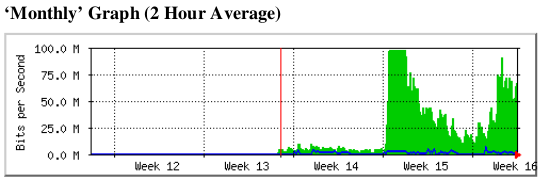
Would you like to hike a mountain? That question caught me by surprise. It was early in 2000, and I had flown to Tucson for a job interview. Ian Murdock was starting a new company, Progeny, and I was being interviewed for their first hire. Well, I thought, hiking will be fun. So we rode a bus or something to the top of the mountain and then hiked down. Our hike was full of well, everything. Ian talked about Tucson and the mountains, about his time as the Debian project leader, about his college days. I asked about the plants and such we were walking past. We talked about the plans for Progeny, my background, how I might fit in. It was part interview, part hike, part two geeks chatting. Ian had no HR telling him you can t go hiking down a mountain with a job candidate, as I m sure HR would have. And I am glad of it, because even 16 years later, that is still by far the best time I ever had at a job interview, despite the fact that it ruined the only pair of shoes I had brought along I had foolishly brought dress shoes for a, well, job interview. I guess it worked, too, because I was hired. Ian wanted to start up the company in Indianapolis, so over the next little while there was the busy work of moving myself and setting up an office. I remember those early days Ian and I went computer shopping at a local shop more than once to get the first workstations and servers for the company. Somehow he had found a deal on some office space in a high-rent office building. I still remember the puzzlement on the faces of accountants and lawyers dressed up in suits riding in the elevators with us in our shorts and sandals, or tie-die, next to them. Progeny s story was to be a complicated one. We set out to rock the world. We didn t. We didn t set out to make lasting friendships, but we often did. We set out to accomplish great things, and we did some of that, too. We experienced a full range of emotions there elation when we got hardware auto-detection working well or when our downloads looked very popular, despair when our funding didn t come through as we had hoped, being lost when our strategy had to change multiple times. And, as is the case everywhere, none of us were perfect. I still remember the excitement after we published our first release on the Internet. Our little server that could got pegged at 100Mb of outbound bandwidth (that was something for a small company in those days.) The moment must have meant something, because I still have the mrtg chart from that day on my computer, 15 years later. Progeny's Bandwidth Chart We made a good Linux distribution, an excellent Debian derivative, but commercial success did not flow from it. In the succeeding months, Ian and the company tried hard to find a strategy that would stick and make our big break. But that never happened. We had several rounds of layoffs when hoped-for funding never materialized. Ian eventually lost control of the company, and despite a few years of Itanium contract work after I left, closed for good. Looking back, Progeny was life compressed. During the good times, we had joy, sense of accomplishment, a sense of purpose at doing something well that was worth doing. I had what was my dream job back then: working on Debian as I loved to do, making the world a better place through Free Software, and getting paid to do it. And during the bad times, different people at Progeny experienced anger, cynicism, apathy, sorrow for the loss of our friends or plans, or simply a feeling to soldier on. All of the emotions, good or bad, were warranted in their own way. Bruce Byfield, one of my co-workers at Progeny, recently wrote a wonderful memoriam of Ian. He wrote, More than anything, he wanted to repeat his accomplishment with Debian, and, naturally he wondered if he could live up to his own expectations of himself. That, I think, was Ian s personal tragedy that he had succeeded early in life, and nothing else he did with his life could quite measure up to his expectations and memories. Ian was not the only one to have some guilt over Progeny. I, for years, wondered if I should have done more for the company, could have saved things by doing something more, or different. But I always came back to the conclusion I had at the time: that there was nothing I could do a terribly sad realization. In the years since, I watched Ubuntu take the mantle of easy-to-install Debian derivative. I saw them reprise some of the ideas we had, and even some of our mistakes. But by that time, Progeny was so thoroughly forgotten that I doubt they even realized they were doing it. I had long looked at our work at Progeny as a failure. Our main goal was never accomplished, our big product never sold many copies, our company eventually shuttered, our rock-the-world plan crumpled and forgotten. And by those traditional measurements, you could say it was a failure. But I have come to learn in the years since that success is a lot more that those things. Success is also about finding meaning and purpose through our work. As a programmer, success is nailing that algorithm that lets the application scale 10x more than before, or solving that difficult problem. As a manager, success is helping team members thrive, watching pieces come together on projects that no one person could ever do themselves. And as a person, success comes from learning from our experiences, and especially our mistakes. As J. Michael Straczynski wrote in a Babylon 5 episode, loosely paraphrased: Maybe this experience will be a good lesson. Too bad it was so painful, but there ain t no other kind. The thing about Progeny is this Ian built a group of people that wanted to change the world for the better. We gave it our all. And there s nothing wrong with that. Progeny did change the world. As us Progeny alumni have scattered around the country, we benefit from the lessons we learned there. And many of us were different , sort of out of place before Progeny, and there we found others that loved C compilers, bootloaders, and GPL licenses just as much as we did. We belonged, not just online but in life, and we went on to pull confidence and skill out of our experience at Progeny and use them in all sorts of ways over the years. And so did Ian. Who could have imagined the founder of Debian and Progeny would one day lead the cause of an old-guard Unix turning Open Source? I run ZFS on my Debian system today, and Ian is partly responsible for that and his time at Progeny is too. So I can remember Ian, and Progeny, as a success. And I leave you with a photo of my best memento from the time there: an original unopened boxed copy of Progeny Linux. IMG_6197_v1

3 January 2016

Carl Chenet: To be alerted if no more tweet is sent from your Twitter account: Twitterwatch

This version 0.1 of Twitterwatch is dedicated to Ian Murdock, Debian project Founder. If you use an automated system like Feed2tweet in order to feed your Twitter account from your website of any RSS feed, it is of the utmost important to know when this system is broken, because you are losing traffic because of this malfunction. At the Journal du hacker, a French-speaking FOSS website where people contribute weblinks like Hacker News or Lobste.rs, every new contribution is sent through the RSS feed to the Twitter account of the Journal du hacker. A lot of our readers only follow the news on Twitter. So if the link breaks, our readers are not fed any more :) To be alerted to this issue, I wrote a small self hosted and documented app. I m proud to introduce Twitterwatch ! It runs with Python 3.4 and the Tweepy library. You can install it from PyPI or from sources. The documentation is available on Readthedocs. You can read about how to install it, configure it and use it. It s the first release but the main features do the job already. In order to use it, you need a twitterwatch.ini file as following:
[twitter]
consumer_key=ml6jaiBnf3pkU9uIrKNIxAr3o
consumer_secret=4Cmljklzerkhfer4hlj3ljl2hfvc123rezrfsdatpokaelzerp
access_token=213416790-jgJnrJG5gz132nzerl5zerwi1ahmnwkfJFN9nr2j
access_token_secret=WjanlPgqDKlunJ4Knr11k2bnfk3jfnwkFjeriFZERj16Z
[schedule]
; duration between 2 checks in minutes
check_interval=60
[mail]
host=localhost
from=admin@myserver.org
to=foo@mylaptop.org
The most difficult part is now complete. To launch Twitterwatch, just launch the following command:
$ twitterwatch /path/to/twitterwatch.ini
Whenever no more new tweet is sent from your Twitter account during 60 minutes, you ll receive the following mail (here the user is @journalduhacker):
Title: Twitter stream of journalduhacker has stopped
Body: Twitter stream of journalduhacker has stopped since 23/12/2015 - 14:49:23
It is still pretty rough, but it does the job. New features will come whenever I need them (or if you require/open bugs/submit push requests ;) ). Write a comment to tell me what you think of it or why you use it!

Lunar: Reproducible builds: week 35 in Stretch cycle

What happened in the reproducible builds effort between December 20th to December 26th: Toolchain fixes Mattia Rizzolo rebased our experimental versions of debhelper (twice!) and dpkg on top of the latest releases. Reiner Herrmann submited a patch for mozilla-devscripts to sort the file list in generated preferences.js files. To be able to lift the restriction that packages must be built in the same path, translation support for the __FILE__ C pre-processor macro would also be required. Joerg Sonnenberger submitted a patch back in 2010 that would still be useful today. Chris Lamb started work on providing a deterministic mode for debootstrap. Packages fixed The following packages have become reproducible due to changes in their build dependencies: bouncycastle, cairo-dock-plug-ins, darktable, gshare, libgpod, pafy, ruby-redis-namespace, ruby-rouge, sparkleshare. The following packages became reproducible after getting fixed: Some uploads fixed some reproducibility issues, but not all of them: Patches submitted which have not made their way to the archive yet: reproducible.debian.net Statistics for package sets are now visible for the armhf architecture. (h01ger) The second build now has a longer timeout (18 hours) than the first build (12 hours). This should prevent wasting resources when a machine is loaded. (h01ger) Builds of Arch Linux packages are now done using a tmpfs. (h01ger) 200 GiB have been added to jenkins.debian.net (thanks to ProfitBricks!) to make room for new jobs. The current count is at 962 and growing! diffoscope development Aside from some minor bugs that have been fixed, a one-line change made huge memory (and time) savings as the output of transformation tool is now streamed line by line instead of loaded entirely in memory at once. disorderfs development Andrew Ayer released disorderfs version 0.4.2-1 on December 22th. It fixes a memory corruption error when processing command line arguments that could cause command line options to be ignored. Documentation update Many small improvements for the documentation on reproducible-builds.org sent by Georg Koppen were merged. Package reviews 666 (!) reviews have been removed, 189 added and 162 updated in the previous week. 151 new fail to build from source reports have been made by Chris West, Chris Lamb, Mattia Rizzolo, and Niko Tyni. New issues identified: unsorted_filelist_in_xul_ext_preferences, nondeterminstic_output_generated_by_moarvm. Misc. Steven Chamberlain drew our attention to one analysis of the Juniper ScreenOS Authentication Backdoor: Whilst this may have been added in source code, it was well-disguised in the disassembly and just 7 instructions long. I thought this was a good example of the current state-of-the-art, and why we'd like our binaries and eventually, installer and VM images reproducible IMHO. Joanna Rutkowska has mentioned possible ways for Qubes to become reproducible on their development mailing-list.

1 January 2016

Russ Allbery: 2015 Book Reading in Review

2015 was another very busy year, but one of stabilization, rebuilding, and recovery. I got through the ramp-up period with my new job, found a better role inside the company for my personal talents and preferences, and ended the year on a professional high note. I also moved, to a place I like much better. It was a year for taking things as they come, focusing on priorities, letting other things slip, and being realistic about how much I can do. All of that, plus quite a lot of company, a business trip, and a few other unexpected distractions, meant less reading than I would have preferred. However, I did catch up completely on review writing, which is another happy sign of stabilization. Reviews came in spotty bursts, but they did come. The only explicit reading goal I'm making for 2016 is to read more than I did in 2015. I'm still working out the best priorities and schedule for me, and finding the best work/life balance points, so a predictable reading schedule will have to wait a while longer. The below statistics are confined to the books I reviewed in 2015, but thanks to significant catch-up work, I've only read one book that I have not yet reviewed (and I finished that one on December 31st). That book will be counted in 2016. Once again, the year saw two 10 out of 10 books, and once again, my favorite book of the year was written by Ann Leckie. The conclusion of the Imperial Radch trilogy, Ancillary Mercy, is as good or better than the start. The second book of the trilogy, Ancillary Sword, was also among my 2015 reviews and got 9 out of 10. I highly recommend the entire trilogy, beginning with Ancillary Justice (my book of the year in 2014), to anyone who hasn't read it. The second 10 out of 10 was non-fiction: Randall Munroe's What If? collection, featuring some material from the web site feature that accompanies xkcd and some original material. These are longer essays exploring interesting bits of science, math, and guesswork in the context of hypothetical questions that usually become surprisingly destructive. As the review says, try a few samples from the web site and see if this is your thing. I loved it. Despite my continuing low reading totals, this was a year full of fiction stand-outs. Becky Chambers's The Long Way to a Small, Angry Planet was the surprise of the year for me: a heart-warming, delightful story of chosen family. Jo Walton's My Real Children was less of a surprise because I already knew she is an excellent writer, but it was probably the best-written book I read all year. In turns sad, thoughtful, and determined, it's slice-of-life fiction so good that it overcame my normal dislike of that subject matter. Other fiction highlights are parts of series: the first two Steerswomen books by Rosemary Kirstein (The Steerswoman and The Outskirter's Secret), which dance between fantasy and scientific discovery, and Seanan McGuire's One Salt Sea, the best of all the October Daye books I've read. In non-fiction, the other book that stands out is Jenny Lawson's Let's Pretend This Never Happened. This combination of memoir and stand-up comedy in book form is one of the funniest things I've read, and it mixes that humor with self-awareness and generous openness. It's a book about being a little crazy and a lot anxious, finding ways to cope by laughing at yourself, and inviting the rest of the world to join in. Finally, Sydney Padua's The Thrilling Adventures of Lovelace and Babbage straddles the line between fiction and non-fiction, but certainly deserves a place in the year-end round-up. Full of great art, humor, steampunk, footnotes galore, and numerous forms of geekery, it's a collection I've been waiting for since Padua's very occasional comic got its moment of Internet fame. The full analysis includes some additional personal reading statistics, probably only of interest to me.

Mehdi Dogguy: In memoriam: Ian Murdock

It is with great sadness that I learned of the passing of Ian Murdock. I have never had the chance to meet him. Several persons testify for his kindness and talent. We will always remember him. His legacy influences our lives everyday!

Looking at his latest blog posts, he seemed a bit nostalgic about Debian and still very proud of it.

Later, he wrote about how he came to find Linux and the importance of telling the story of hackers of his generation. In his memory, I'll reread Stephen Levy s Hackers for the nth time too.

When (if?) his webserver will shut down, you will still be able to read his past blog posts using the archived version of his website or a static mirror that has been set up.

RIP Ian.

30 December 2015

Bits from Debian: Debian lamenta el fallecimiento de Ian Murdock

Ian Murdock Con el coraz n compungido, Debian lamenta el fallecimiento de Ian Murdock, firme partidario del software libre y abierto, padre, hijo y el 'ian' en Debian. Ian empez el proyecto en agosto de 1993, publicando la primera versi n de Debian m s tarde en el mismo a o. Debian se convertir a as en el sistema operativo universal para el mundo, funcionando en cualquier dispositivo, desde sistemas embebidos hasta la estaci n espacial. Ian se centr en crear una distribuci n y una cultura de comunidad que hiciera lo correcto tanto en lo tico como en lo t cnico. Publicar cuando est listo y una postura firme sobre la libertad de software son las reglas de oro en el mundo del software libre y de c digo abierto. La devoci n le gui en su trabajo, tanto en Debian como en los a os posteriores, siempre trabajando hacia un futuro lo mejor posible. El sue o de Debian est vivo, la comunidad permanece incre blemente activa con miles de desarrolladores que trabajan incontables horas para ofrecer un sistema operativo seguro y confiable. La comunidad de Debian da el p same a la familia en este momento tan dif cil. Su familia nos ha pedido discreci n durante estos momentos dif ciles y deseamos respetarlo. Desde dentro de Debian y de la amplia comunidad de Linux podemos expresar nuestras muestras de condolencia a in-memoriam-ian@debian.org, donde ser n guardadas y archivadas.

Steve Kemp: I joined the internet of things.

In my old flat I had a couple of simple radio-controlled switches, which allowed me to toggle power to a pair of standing lamps - one at each side of the bed. This was very lazy, but also really handy and I've always been curious about automation.. When it comes to automation there seems to be three main flavours:

X10
The original standard, with stuff produced by many vendors and good Linux support. X10 supports two ways of sending/receiving commands - over the electrical wiring, and over RF.
Z-Wave
This is the newcomer, which despite that seems to be well-supported and extensible. It allows "measurements" to be sent/received in addition to the broadcast of events like "switch on", and "switch off".
Other systems - often lighting-centric
There are toy-things like the previously noted power-controlling things, there are also stand-alone devices from people like Philips with their philips hue system, but given how Philips recently crippled their devices to disable third-party bulbs I've no desire to use them. One company caught my eye though, Osram make a smart lightbulb and mini-hub to work with it.
So I bought one of the osram lightify systems, consisting of a magic box and a pair of lightbulbs. The box connects to your wifi, and gets an IP address. The IP address is then used by the application on your mobile phone (i.e. the magic box does the magic, not the bulbs). The phone application can be used to trigger "on", "off", "dim", "brighter", and the various colour-changing commands, as you would expect. You absolutely must use the phone-based application to do the setup, but after that the whole point was that I could automate things. I wanted to be able to setup my desktop computer to schedule events, and started hacking. I've written a simple Perl module to let me discover bulbs, and turn them off and on. No doubt it'll be on CPAN in the near future, once I can pick a suitable name for it:
$ ol --bridge=192.168.10.136 --list
hall       MAC:8418260000d9c70c RGBW:255,255,255,255 STATE:On
kitchen    MAC:8418260000cb433b RGBW:255,255,255,255 STATE:On
$ ol --bridge=192.168.10.136 --off=kitchen
$ ol --bridge=192.168.10.136 --list
hall       MAC:8418260000d9c70c RGBW:255,255,255,255 STATE:On
kitchen    MAC:8418260000cb433b RGBW:255,255,255,255 STATE:Off
The only niggle was the fiddly pairing, and the lack of any decent documentation. The code I wrote was loosely based on the python project python-lightify written by Mikael Magnusson. Also worth noting that the bridge/magic-box only exposes a single port so you can find the device on your VLAN by nmapping for port 4000:
$ nmap -v 192.168.10.0/24 -p 4000
The device doesn't seem to allow any network setup at all - it only uses DHCP. So you might want to make sure it gets assigned a stable IP. Anyway I'm going to bed. When I do so I'll turn the lights off with my mobile phone. Neat. In the future I will look at more complex automation, and I think Z-wave is the way I'll go. Right now I'm in a rented flat so replacing wall-switches, etc, is something I can't do. But the systems I've looked at seem neat, and this current setup will keep me amused for several months!

Clint Adams: Oh what a night, late December 1963

24 Dec. 63 Dear Uncle Ron and Aunt Helen, It has been quite awhile since I have written you folks. I am not too much of one for writing, and when I do write, I keep putting it off, and putting it off; and the next thing you know, the weeks turn into months and then the months into years. I haven't sent any Christmas cards, so at this time I'll offer my best wishes for the season to you. It is Christmas Eve and I am working tonight. I will also work New Year's eve and day. It really doesn't seem like Christmas here, and there isn't that much to do in the evening's; So I'm just as well off working. As I had mentioned, I had intended to send you some coins from Korea but I believe that I put them in with a package that I had sent to Mom and told her to give them to you. In any event, here are some in this box. The Korean coin with the 10 on it is 10 Won, and worth about $.0769. The large copper coin is Japanese ( 10 Yen) and about 2.8 Wait! I was wrong on the Korean coins.They are 10 Hwan which is the old money. When they Changed to Won, they made 10 Hwan equal to 1 Won. (Sounds confusing and tongue-tying, doesn't it?) So these 10 copper pieces with the 10 on them altogether are only worth 7 / The Viet Namese coins with the former president Diem picture on them are soon being taken out of circulation. ( Since he was overthrown and killed, they are going to replace the money also.) The small pieces marked 1 dong are 1 piastre; also called one Viet Namese dollar. 1 piastre is about .7 . I also recall sending some coins home in my hold baggage. I'll tell Mom to look for them and give them to you. Now that I look back on it, the year I spent in Korea wasn't bad. It was difficult at first having to work for an arrogant Jew boss, but after a few months I got out of his office and was on my own working directly for the army people ( U.S.) The country of Korea isn't too bad. As you can see on the coins they were in the year 4294 last year. It is surprising for a civilization to be that far along in years and still live under very primitive conditions. Going from Korea to Japan is like going from the dark ages into the future science fiction world. Those people are really progressing in Japan. I spent several days in Japan after I left Korea. Then I went to Honolulu for almost a month. Then I went back to Japan for Leave for 3 weeks and then down here to Viet Nam in October. They were building like crazy in Japan to get ready for the Olympics. Working 4 hours a day, 7 days a week on construction. You could drive into Tokyo early in the evening and return late in the night and find the road you had gone in on was now completely torn away. And downtown Tokyo is vey nice. Lots of modern building and just about any modern gadget you can think of. I really like their cooking also. Their Kobe Beef is excellent. In this beef, the cattle are pampered from the time they are born until they are slaughtered. They massage them, feed them beer, and let them live a lazy life. I would really like to work a year or two in Japan. The hot baths and big tubs are also great. Only it is almost impossible to stand the hot temperatures that they can. Westerners always have to add quite a lot of cold water before they can get in the tub. The Viet Namese people are much dirtier than the Japanese or Koreans. They don't have any hot baths here in Viet Nam. In fact, the majority of hotels ( built by the French) don't even have hot water in them. The Korean houses don't look like much from the outside, but inside they are spotlessly clean. The older Japanese buildings look nic efrom the outside and are also clean inside. I am here in the town of Nha Trang. It is a small town on the coast of the China Sea. I like it here. My hotel is less than a hundred yards from the beach. We are now in the winter season also, but it just got a little cooler from having winds the past few weeks. This afternoon as we came to work there were all sorts of people in swimming. Lobster is also plentiful here and I eat quite a bit of it. Most of the restaurant make a creamed corn soup with lots of chunks of crab meat in it. This is very good. Being out here in Nha Trang, we missed the coup d'etat. Things were quiet here and the only way we knew what was happening was to listen to the radio and talk to our co-workers of our radio system in Saigon. When they lifted martial law and the curfew in Saigon, it took them several days later to follow suit here. There seems to be a noticed improvement since the coup. The people in general seem much happier and there appears to be much more general activity going on. Well, I guess that's about it for now. I think I may have some Korean Won notes back in my room and I'll check and enclose them if I can find them. Say hello to Ira & family when you see them, and also to Aunt Marie if she is still there with you. 'Bye for now Your nephew PS The Viet Namese coins with 50 XU on them are piastres.

28 December 2015

Carl Chenet: Parse your rss feed and post to Twitter with feed2tweet

What s more important today for a website than relaying your new blog posts to the social networks, especially Twitter ? Lots of unmaintained or unreliable third-parties web services offer this feature. I tried and was really disappointed using them. Feed2tweet, forked from rss2twitter, now offer a self-hosted, documented, easy-to-read Python application to automatically transfer the new posts in your RSS feed to the social network Twitter. Have a look at the official documentation on Readthedocs in order to install, configure and use Feed2tweet. It is as easy as creating a Twitter app, then writing a feed2tweet.ini file with the following lines:
[twitter]
consumer_key=ml9jaiBnf3pmU9uIrKNIxAr3v
consumer_secret=8Cmljklzerkhfer4hlj3ljl2hfvc123rezrfsdctpokaelzerp
access_token=213416590-jgJnrJG5gz132nzerl5zerwi0ahmnwkfJFN9nr3j
access_token_secret=3janlPMqDKlunJ4Hnr90k2bnfk3jfnwkFjeriFZERj32Z
  • Une erreur est survenue ; le flux est probablement indisponible. Veuillez r essayer plus tard.
uri: https://www.mycoolwebsite.com/rss [hashtaglist] several_words_hashtags_list: severalwordshashtaglist.txt
Then just launch feed2tweet:
$ feed2tweet -c /path/to/feed2tweet.ini
The first version 0.1 is now available from Github. If it helps you, Github stars are appreciated :)

27 December 2015

Vincent Sanders: The only pleasure I get from moving house is stumbling across books I had forgotton I owned

I have to agree with John Burnside on that statement, after having recently moved house again rediscovering our book collection has been a salve for an otherwise exhausting undertaking. I returned to Cambridge four years ago, initially on my own and then subsequently the family moved down to be with me.

We rented a house but, with two growing teenagers, the accommodation was becoming a little crowded. Melodie and I decided the relocation was permanent and started looking for our own property, eventually finding something to our liking in Cottenham village.

Melodie took the opportunity to have the house cleaned and decorated while empty because of overlapping time with our rental property. This meant we had to be a little careful while moving in as there was still wet paint in places.

Some of our books
Moving weekend was made bearable by Steve, Jonathan and Jo lending a hand especially on the trips to Yorkshire to retrieve, amongst other things, the aforementioned book collection. We were also fortunate to have Andy and Jane doing many other important jobs around the place while the rest of us were messing about in vans.

The desk in the study
The seemingly obligatory trip to IKEA to acquire furniture was made much more fun by trying to park a luton van which was only possible because Steve and Jonathan helped me. Though it turns out IKEA ship mattresses rolled up so tight they can be moved in an estate car so taking the van was unnecessary.

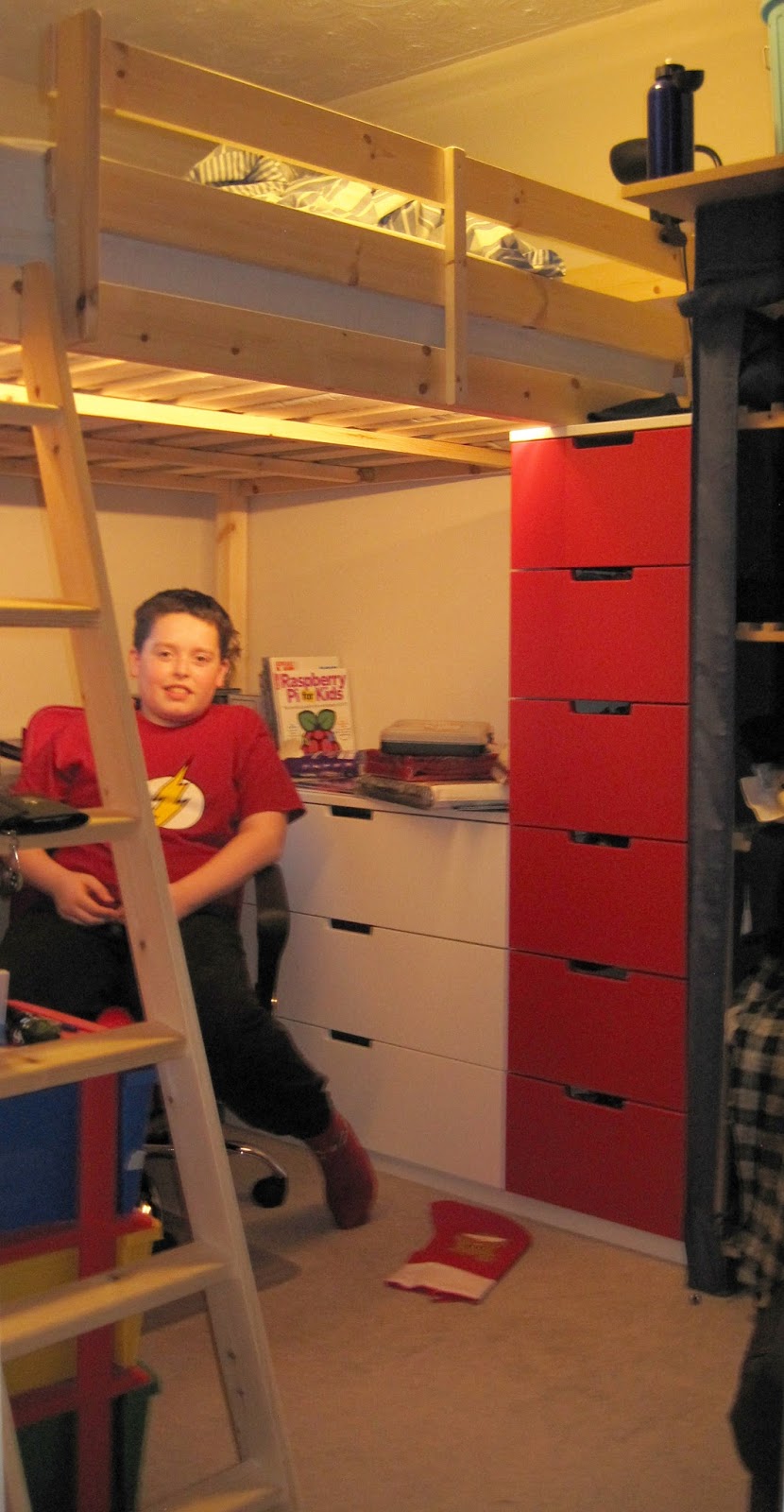
Alex under his loft bed
Having moved in it seems like every weekend is filled with a never ending "todo" list of jobs. From clearing gutters to building a desk in the study. Eight weeks on and the list seems to be slowly shrinking meaning I can even do some lower priority things like the server rack which was actually a fun project.


Joshua in his completed roomThe holidays this year afforded me some time to finish the boys bedrooms. They both got loft beds with a substantial area underneath. This allows them both to have double beds along with a desk and plenty of storage. Completing the rooms required the construction of some flat pack furniture which rather than simply do myself I supervised the boys doing it themselves.

Alexander building flat pack furniture
Teaching them by letting them get on with it was a surprisingly effective and both of them got the hang of the construction method pretty quickly. There was only a couple of errors from which they learned immediately and did not repeat (draw bottoms having a finished side and front becomes back when you are constructing upside down)

Joshua assembling flat pack furniture
The house is starting to feel like home and soon all the problems will fade from memory while the good will remain. Certainly our first holiday season has been comfortable here and I look forward to many more re-reading our books.

Lars Wirzenius: Coming back to Finland after five years

It was a shock to be back in Finland after five years. The country had gone bad. I was born in Finland, and lived here all my life, until January, 2010. I then moved abroad for five years, with my then-girlfriend, now wife. We lived in New Zealand, Scotland, and England. In October 2014 we came back, because my next job happened to be in Finland. When we came back, I found that the country had changed, or I had lost my rose-coloured glasses. The Finland I left was a place where equality and solidarity were assumed, though not universal. The country I came back to turned out to be racist, scared, and quickly abandoning everything that used to be examples of why the country is a good place to live. Some of the change has, possibly, only happened during 2015 and the refugee crisis in Europe, but the change started earlier. Examples: Now, it is clear that Finland was never the kind of idyllic utopia that I thought it was, back when I was young. The older I get, the clearer it is that I was naive. The change over five years is still quite remarkable. I can't ever go back home. Now, I am sometimes ashamed of being Finnish.
Next.

Previous.