Search Results: "will"

25 June 2008

Biella Coleman: The Cultural Significance of Free Software

When it comes to research and writing, anthropologists are notorious for being slow as molasses. It takes, on average, 9 years to finish grad school and then another 3-6 years before you write and publish your first book. Such is the sometimes frustrating pace of academia. But sometimes it is worth the wait as this new book, Two Bits, the Cultural Significance of Free Software by the anthropologist of science and technology Chris Kelty, makes clear. I am pretty intimate with the details of the book as ck was one of my dissertation committee members. I have read earlier versions and was fortunate enough to teach the final version to a small group of graduate students last spring. While there have been previous books on the subject of open source or peer-to-peer production more generally, this is the first book to delve deep, analytically and historically, into the cultural significance of free software. And the best part is that ck managed (I am not sure how but he did) to convince Duke University Press to release the whole book under a CC license. So download it to your heart’s delight and if you find it useful, do order a treeware copy (as you can’t beat that for easy and comfortable reading). For the developers out there, I would suggest starting with the introduction, which provides an initial overview of some of the main themes he develops and then I would dig into part two where the historical chapters reside and then loop back to the theoretical chapters in part one or continue to part three. Trust me, these will fascinate and surprise even those geeks with a relatively deep historical sense of this world. In fact, my very favorite academic piece on free software exists in these pages: and is the chapter on the history of the actual conflict between James Gosling and Richard Stallman that led to the creation of the GNU General Public License. Here is a small excerpt to whet your appetite:
In brief the controversy was this: in 1983 James Gosling decided to sell his version of EMACS a version written in C for UNIX called GOSMACS to a commercial software vendor called Unipress. GOSMACS, the second most famous implementation of EMACS (after Stallman s itself ), was written when Gosling was a graduate student at Carnegie Mellon University. For years, Gosling had distributed GOSMACS by himself and had run a mailing list on Usenet, on which he answered queries and discussed extensions. Gosling had explicitly asked people not to redistribute the program, but to come back to him (or send interested parties to him directly) for new versions, making GOSMACS more of a benevolent dictatorship than a commune. Gosling maintained his authority, but graciously accepted revisions and bug-fixes and extensions from users, incorporating them into new releases. Stallman s system, by contrast, allowed users to distribute their extensions themselves, as well as have them included in the official EMACS. By 1983, Gosling had decided he was unable to effectively maintain and support GOSMACS a task he considered the proper role of a corporation.
[ . . .]
Indeed, the general irony of this complicated situation was certainly not as evident as it might have been given the emotional tone of the debates: Stallman was using code from Gosling based on permission Gosling had given to Labalme, but Labalme had written code for Gosling which Gosling had commercialized without telling Labalme conceivably, but not likely, the same code. Furthermore, all of them were creating software that had been originally conceived in large part by Stallman (but based on ideas and work on TECO, an editor written twenty years before EMACS), who was now busy rewriting the very software Gosling had rewritten for UNIX. The once proud hacker ethic that Labalme mentions would thus amount not so much to an explicit belief in sharing so much as a fast-and-loose practice of making contributions and fixes without documenting them, giving oral permission to use and reuse, and losing records that may or may not have existed hardly a noble enterprise.
[. . .]
The story is a lively one, punctuated with some great e-mail “moments,” and gives you a play-by-play sense of how it is that free software become so entangled with the law and how the unwritten norms that guided sharing were violated to then become transformed, explicit, and written. The other chapter that will also fascinate those who want a deeper sense of this history is on UNIX and its role in creating the technical and collaborative conditions necessary to secure the explosion of free software years later. The story of the norms of sharing source code is, not by accident, writes Kelty, also the history of the UNIX operating system. This connection has been made by others but not shown in any historical detail as it is done in this book. For those interested in more anthropological issues, the first few chapters is where this type of more conceptual theorizing is at. Chris Kelty introduces the master trope of his book: the recursive public which is an idea that feeds into a longer academic debate, inaugurated by Jurgen Habermas, on the role of publicity, dialogue, and circulation of ideas and texts in cementing a democratic sphere. Many others, such as Charles Taylor, Michael Warner, and Nancy Fraser have since refigured and rehashed the meaning publics and public debate but there have been few ethnographies on the topic. It is here where Chris Kelty intervenes most forcefully to conceptualize publics in explicitly ethnographic terms and in an arena technology and the Internet which is often left undertheorized by cultural theorists. There is a lot more in the book (the third section examines some of the various political modulations of free software, such as Connexions and Creative Commons) but instead of saying any more, I will just leave you with his definition of a recursive public and again urge you to check out the book for yourself!
A recursive public is a public that is vitally concerned with the material and practical maintenance and modification of the technical, legal, practical, and conceptual means of its own existence as a public; it is a collective independent of other forms of constituted power and is capable of speaking to existing forms of power through the production of actually existing alternatives.

Clint Adams: Relaxation

I was misled. That much is probably true. I certainly had no idea what I was getting myself into. Enough of that though; there's narrative fading away. The part I should take responsibility for is the decision I made to stray off the map. Perhaps it was not so much a decision as a compulsion. I looked at the map. I saw the suspicious unmarked area at the edge, and concluded immediately that there was something good there, something the people wanted to keep hidden from me. I was correct, but I presumed far too much about the terrain. I thought I would make a quick exploration of the secret place, then backtrack to the more mapped area and get back with the program. Enough of that though; I've nearly forgotten the story. First I should point out that, had the map been to scale, it should have taken me an leisurely fifteen minutes to get to my first destination. It should have, assuming the land would be as flat as the map that represented it. Instead, it turned out to be something one could cover in fifteen minutes if one had, say, a jetpack and spring boots. I'm probably wrong; I'd probably injure myself in the process and take longer. Anyway, the average incline was close to 45 , and luckily was mostly uphill. Luckily. When I got to a resting place, I was able to conclude that my supply of fluids was almost certainly insufficient for me to continue. On the other hand, there was probably no way I would return if I went back for more drink. I told myself that there would likely be a beverage-selling shack out in the middle of nowhere around the next bend or so. Having solved this probability problem, I pressed on into the blazing sun. I came to a path leading down to the sea. It was unclear what was down there, but it was clear that it seemed to be a million miles down, and that that path might be the only way back. Given my current state of exhaustion and hydration, I decided to pass on this opportunity. After continuing for a while, the features at the bottom of that path became visible. A very pretty cove was down there, and almost certainly no shack o' drinks. I then came upon a fork. A wide path led downward: to what, I could not see. To its left, a narrow and rough path led straight. Knowing that a descent probably meant climbing four to eight times the altitude back somehow, and assuming the less pleasant-looking path led somewhere better, I went left. After a while, the land began to slope down, ever so slightly. Little clusters of bottles and newspapers were left on the rocks here and there. Then came a sofa under a tent. I began to wonder what hippies were traveling this path. The slope grew greater, and I passed a bench in a tent. Then I came to a giant staircase, almost straight down. It was covered in weeds and insects. Some were vegan, some wanted my flesh. As I got toward the bottom I thought about how glad I was that I had come that way from the top and not the other way around. Oh, I was very glad. At the bottom was something resembling a plastic bottle graveyard and barrels among barrels filled with water. Rubber hoses seemed to run randomly between certain barrels. A kitchen stood at the edge of some barrels. I suddenly got the feeling that I was not supposed to be here. After discovering that a couple of escape routes were actually dead ends, I proceeded to descend a small staircase to a terraced garden. Hoses lay about the rows, presumably for watering the plants. A cot under a tent lay empty, and I hurried past hoping I would not encounter the owner. Then I was at the ocean. The coast was lined with huge boulders, and a wooden bridge led me to the first one, and another wooden bridge took me to the second. Then the bridges stopped. In the distance, I could see that pretty little cove from before. I took stock. I could either return whence I came, up that horrifying staircase, or I could try to traverse the rocky coast over to the cove, then maybe do a faceplant on the beach and let the tide drown me rather than climbing back up. It seemed like a no-brainer, so I began making my way toward the cove. It got harder. Several times I became very afraid, either of falling and smashing my head against a rock or falling into the water below, or some sequential combination thereof. In the end I turned out to be more afraid of going back, at least until I got to what I judged the point of no return. I was reasonably close to where I imagined the sandy beach started, but there was a huge and impassable boulder in the way. Also, if I went further there was no way I would be able to climb back up in case I needed to retreat. I was thinking I would need to retreat, because unless there was some magical hidden toehold, I would be forced to jump into the water and swim around. I did not want to jump into the water. I wanted my phone to stay unfried in the event that I would need to use it to get rescued. I also did not want to call anyone to get rescued, especially since I didn't really know how to explain where I was. With a heavy sigh, I gave up, turned, and went back. This time I moved more quickly, though incurring more damage to my hands and feet. No humans were visible at the crazy farm/garden and makeshift reservoir, but plenty of bugs were visible on the staircase. I made the mistake of trying to lean against the railing to catch my breath. When I finally got to the bench in the tent, I understood exactly what it was for. I sat down, took a sip of my remaining water, ate an apple, and kept going up. When I got to the couch, I sat again. This time I sat and tried to figure out a plan. I still clung to the belief that once I got back to somewhere less wild I'd be able to buy a drink. I noted that I only had a little bit of water left, that I was dehydrated, that I was sunburned, that my pulse was about 180, and that there were no dogs or Russian people wandering past me. I ate a pear and drank my last few drops of water. I kept sitting until my pulse was down to around 150, then I figured I needed to keep moving. I was experiencing most of the effects of caffeine, and for free. Oddly, I passed a dog a few steps later. It was just standing by a rock, looking at me. I decided not to converse. When I had nearly reached the fork again, a couple came my way. I thought about begging them for water. I decided not to be rude. I have no idea what happened to them. I'm betting they wisely decided not to go down the steps. Resolving that the only sane option was to go back all the way to where I absolutely knew I could buy something potable, I headed in that direction. Still, I took two risks. Instead of going up the exact way I had come, or taking a well-travelled path down, I took a narrow and flat dirt path. It was actually a bit of a dilemma. I started down the latter two more than once each. Finally I saw that the down path was rather V shaped, and I concluded correctly that the straight path would bypass that angular-half-pipe-like construct. When I finally got to a point I recognized, it was smooth sailing the rest of the way down. I bought water and a snack, since I had had almost nothing to eat that day. At this point it would have been prudent to call it quits and go off and gorge myself on seafood or something, but no, I was now in the mapped area and surely it would all be roses and manna. Finishing one bottle, I bought two more. Five minutes later I bought another. I had now overcompensated, but I was playing it safe. I continued my explorations. Bicyclists kept nearly running into me, and, aside from the obvious, I viewed this as a good sign. Bicyclists, especially those that can't seem to steer straight for some reason, avoid difficult terrain. This is why they take their bikes on subways, trains, and buses. I don't like bike-riding, but if I had my druthers, I would always go downhill. No up, no flat, just down. Like downhill skiing, just down. It is a good thing I don't ride a bike. Once I got to the point where the bicycles thinned out to nonexistence, I was at an intersection. The way I wanted to go was up. The way I didn't want to go, but was a reasonable option, was only very slightly up. Additional factors complicated this decision point. [elision] This passage has been marked friends-only and you will not be able to view it without logging in. Moving hurriedly away from there, I headed upward. After a couple of turns, I ran into Catholics. First there were dead Catholics. Then there were Catholics pre-occupied with dead Catholics. Then there were Catholics waiting to die. Then there were seminarians. Then there were teens with prayer books. When I reached the next pinnacle, there were more teens with prayer books. There were benches, and there were no teens on them, for the teens were standing or sitting on the ground, quietly contemplating the Word. Unfortunately, they had decided that the benches were more suitable for holding all their bags, so there was nowhere for me to sit. I considered interrupting their reverie, but decided it wouldn't be very Christian of me to disturb them, so I just placed an ancient Drasnian curse on them and plodded down the hill toward a small beach. I really didn't need any more sun, but at least there probably wouldn't be anyone praying there. The water was tempting, but I'm always paranoid about my belongings when swimming alone, and if my phone were taken I wouldn't be able to call anybody to come rescue me at the next crisis point, sure to come. So I skirted the coastline and arrived at a much larger beach, one with facilities and services. Opting to save money but complicate things by using the public changing rooms and showers, I made a discovery. [elision] This passage has been marked friends-only and you will not be able to view it without logging in. Nonetheless, I changed into my swimming trunks, stuffed everything else but my towel, sunglasses, and a disgusting sugary drink I never should have bought into my bag, and went barefoot a few buildings down to rent a locker. The locker was ridiculously large for a single person, which is good to know should I ever want to kidnap a family and torture them at this place. The proprietor informed me that they were closing at some specific time, about an hour from then. I had no timekeeping device outside of the locker, so I had to wing it, and erring heavily on the side of caution, I had a short beach diversion. Given that large swathes of my epidermis were turning bright red, it's probably for the best. Handling the shower, locker, and changing in the other direction was slightly more complicated, but I did it and then I headed inland, figuring I should have a substantial meal for once that day. On my way to find dinner is when things got really crazy. [elision] This passage has been marked friends-only and you will not be able to view it without logging in. I wandered over to a bench to eat my newly-acquired snack, and did not exercise enough caution, because the flimsy paper bag ripped and I got sauce all over my pants and a little on my shirt. Unfortunately I had used my napkin in that earlier episode, and I'm not sure how much it would have helped anyway. Thus I continued on, looking like a slobby retard. Then I made an obviously-poor decision and ended up having a subpar dinner. What happened after that is a story for another time.

Wouter Verhelst: Iceweasel sucks.

I knew this since quite a while, actually—most of the firefox developers seem to developing for something else than what I use; but, well, using something else isn't very appealing to me. Anyway, yesterday the Iceweasel 3.0 update came on my laptop, and I couldn't help but sigh. I hadn't tried anything, hadn't read any reviews, didn't know what would happen; but given their track record, I expected only problems. I wasn't disappointed. Or, well, I was, depending on how you look at it. And that's only after a day. I fear the next few weeks. For the time being, hints on getting the above moronic stupidities gone (apart from the about:config one, which takes a single click) would be helpful. And then of course I'm not even mentioning the fact that most of my add-ons don't work with 3.0 yet—but that is to be expected with a new brouwser, of course. At least flashblock works, which is the most important one.

Russell Coker: Car vs Public Transport to Save Money

I’ve just been considering when it’s best to drive and when it’s best to take public transport to save money. My old car (1999 VW Passat) uses 12.8L/100km which at $1.65 per liter means 21.1 cents per km on fuel. A new set of tires costs $900 and assuming that they last 20,000km will cost 4.5 cents per km. A routine service every 10,000Km will cost about $300 so that’s another 3 cents per km. While it’s difficult to estimate the cost per kilometer of replacing parts that wear out, it seems reasonable to assume that over 100,000Km of driving at least $20,000 will be spent on parts and the labor required to install them, this adds another 20 cents per km. The total then would be 48.6 cents per km. The tax deduction for my car is 70 cents per km of business use, so if my estimates are correct then the tax deductions exceed the marginal costs of running a vehicle (the costs of registration, insurance, and asset depreciation however make the car significantly more expensive than that - see my previous post about the costs of owning a small car for more details [1]). So for business use the marginal cost after tax deductions are counted is probably about 14 cents per km. Now a 2 hour ride on Melbourne’s public transport costs $2.76 (if you buy a 10 trip ticket). For business use that’s probably the equivalent cost to 20Km of driving. The route I take when driving to the city center is about 8Km, that gets me to the nearest edge of the CBD (Central Business District) and doesn’t count the amount of driving needed to find a place to park. This means the absolute minimum distance I would drive when going to the CBD would be 16Km. The distance I would drive on a return trip to the furthest part of the CBD would be almost exactly 20km. So on a short visit to the central city area I might save money by using my car if it’s a business trip and I tax-deduct the distance driven. A daily ticket for the public transport is equivalent to two 2 hour tickets (if you have a 10 trip ticket then if you use it outside the two hour period it becomes a daily ticket and uses a second credit). If I could park my car for an out of pocket expense of less than $2.76 (while I can tax-deduct private parking it’s so horribly expensive that it would cost at least $5 after deductions are counted) then I could possibly save money by driving. There were some 4 hour public parking spots that cost $2. So it seems that for a basic trip to the CBD it’s more expensive to use a car than to take a tram when car expenses are tax deductible. For personal use a 5.7km journey would cost as much as a 2 hour ticket for public transport and a 11.4km journey would cost as much as a daily ticket. The fact that public transport is the economical way to travel for such short distances is quite surprising. In the past I had thought of using a tram ticket as an immediate cost while considering a short car drive as costing almost nothing (probably because the expense comes days later for petrol and years later for servicing the car). Also while there is a lot of media attention recently about petrol prices, it seems that for me at least petrol is still less than half the marginal cost of running a car. Cars are being advertised on the basis of how little fuel they use to save money, but cars that require less service might actually save more money. There are many cars that use less fuel than a VW Passat, and also many cars that are less expensive to repair. It seems that perhaps the imported turbo-Diesel cars which are becoming popular due to their fuel use may actually be more expensive than locally manufactured small cars which have cheap parts. Update: Changed “Km” to “km” as suggested by Lars Wirzenius.

Michal Čihař: Cool down the server

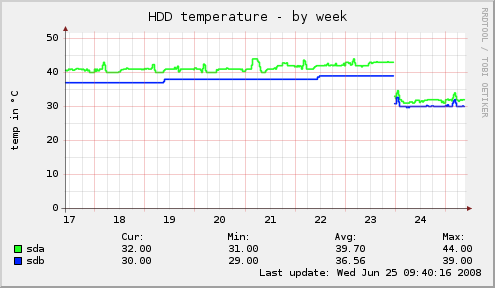
Moving of server seems to go quite well. There were some outages for users during night because of too big TTL in DNS, but after setting up redirector at old IP during morning, this should not be a problem. Now only few hosted sites were still unable to change their DNS settings, but it's not my problem :-). On the other hand, it looks that moving server to new server room will have some positive effect on it's health: Temperature of disks

Adrian von Bidder: Sometimes providers do get better...

Christian, I used to block quite aggressively (essentially blocking all IPs sending me spam for a few months) and remember seeing free.fr very, very often. Apparently this was before the block outgoing port 25 policy — I just had a grep through my log and see almost no spam coming in from free.fr. So, as I've said just recently, this is a note to all ISP: please, please, please block port 25! (ISP who don't offer unblocking will obviously lose the techie clients, but that's their own thing to decide...)

24 June 2008

William Pitcock: E-mail autoresponders suck. Please stop using them.

I find it particularly annoying, when I write a mail to a list, like say, the NANOG list, and get emails in reply like:

From: EMAIL ELIDED
To: William Pitcock <EMAIL ELIDED>
Subject: NAME ELIDED is out of the office.
Date: Tue, 24 Jun 2008 12:02:35 -0400 (11:02 CDT) I will be out of the office starting 06/23/2008 and will not return until 06/26/2008. If this matter is urgent please contact NAME ELIDED at XXX-XXX-XXXX or XXX-XXX-XXXX
This really sucks, for multiple reasons. Mostly, that: So please, for the good of all of the Internet, stop using autoresponders, because they are hideously lame. Or, at least, put something like AUTO-REPLY in your autoresponder so we can just delete the spam you insist on sending us. Thanks lazyweb.

Clint Adams: Eli and the wolves of Bristol

The West Virginian is huddled over his bong, swirling the ice cubes around his glass of cream sherry. There is a montage on the television, set to some factory-produced pop song sung by a no-talent teen who was thrust into major stardom with the help of comb filters and clever marketing. He is not watching the montage; he is thinking about Chris Wallace and nepotism. He will stand in the end.

Russell Coker: Links June 2008

Paul Graham has recently published an essay titled How To Disagree [1]. One form that he didn’t mention is to claim that a disagreement is a matter of opinion. Describing a disagreement about an issue which can be proved as a matter of opinion is a commonly used method of avoiding the need to offer any facts or analysis. Sam Varghese published an article about the Debian OpenSSL issue and quoted me [2]. The Basic AI Drives [3] is an interesting papar about what might motivate an AI and how AIs might modify themselves to better achieve their goals. It also has some insights into addiction and other vulnerabilities in human motivation. It seems that BeOS [4] is not entirely dead. The Haiku OS project aims to develop an open source OS for desktop computing based on BeOS [5]. It’s not nearly usable for end-users yet, but they have vmware snapshots that can be used for development. On my Document Blog I have described how to debug POP problems with the telnet command [6]. Some users might read this and help me fix their email problems faster. I know that most users won’t be able to read this, but the number of people who can use it will surely be a lot greater than the number of people who can read the RFCs… Singularity tales is an amusing collection of short stories [7] about the Technological Singularity [8]. A summary of the banana situation [9]. Briefly describes how “banana republics” work and the fact that a new variety of the Panama disease is spreading through banana producing countries. Given the links between despotic regimes and banana production it’s surprising that no-one is trying to spread the disease faster. Maybe Panama disease could do for South America what the Boll weevil did for the south of the US [10]. Jeff Dean gives an interesting talk about the Google server architecture [11]. One thing I wonder about is whether they have experimented with increasing the chunk size over the years. It seems that the contiguous IO performance of disks has been steadily increasing while the seek performance has stayed much the same, and the dramatic increases in the amount of RAM you can get for any given amount of money over the last few years have been amazing. So it seems that now it’s possible to read larger chunks of data in the same amount of time and more easily store such large chunks in memory.

Matthew Garrett: Power management design philosphy

One of the traditional problems with power management has been balancing power savings against reduced functionality. The two traditional approaches to this have been to have sane defaults or to let the user tweak them, with a hybrid approach being to have sane defaults and an "advanced" box that lets users set their own parameters.

Both of these options suck.

The problem with sane defaults is that power management is an area where the "sane default" genuinely does differ between users. Usage patterns will determine the appropriate spindown period for a hard drive. AHCI's ALPM will disable hotswap detection, which is fine for home users but a pain if people want to rip out a failed RAID element. ALPM also introduces a small amount of latency (on the order of a seek in the most aggressive mode), which is entirely irrelevant for almost everyone but is a pain if you're trying to offer i/o latency guarantees. PCI-E link power management adds small quantities of latency. Letting the CPU run to full speed whenever it wants to is good for power management but potentially bad for thermal management. Screensaver timeouts vary depending on whether you're watching a movie or not.

The problem with leaving everything tweakable is that you're asking users to make choices about things but not giving them the information they need to make those choices. Whether you get a power saving from hard drive spindown depends on whether the drive is idle for long enough to save the power you'll spend spinning it back up. Get it wrong and you'll be putting your drive under extra load, reducing performance and consuming more power than you were to begin with. If you limit the maximum speed of your CPU to keep it cool, you'll be wasting power and performance even when it's well below the thermal limits. Disabling ALPM because you might want to change a RAID device at some stage means you're consuming power despite generally not needing to use the additional functionality.

But while these options both suck in different ways, they share one fundamental failure. They both imply static configuration. The correct power management policy depends on the way that a machine is being used at a specific instant in time, and no matter how many power management profiles you add there's no way for a user to switch between them fast enough to obtain a decent power/performance ratio.

Adaptive power management adopts a different strategy. Rather than define a static policy (or several static policies), the hardware is monitored to determine the best power management settings. An example of this is the ondemand CPUfreq governor. Rather than attempt to provide a static configuration, the processor frequency is automatically changed to meet demand while also keeping the overall power consumption as low as possible. This patch adds a thermal component to its policy, preventing the machine from overheating. Result? No requirement to provide tunables to userspace.

Something similar is achievable with hard-drive spindown. By simply monitoring how often reads or writes actually hit disk, it's possible to automatically adjust the spindown period to obtain decent power savings while reducing the number of spinups. This approach is imperfect - in an ideal world we'd know to spin the drive up before it's needed, but that simply isn't possible. However, the user is almost certainly unable to make a better guess. It's not realistic for a user to be able to predict whether or not a given page is still in cache or has been evicted. Nothing is lost by providing a dynamic policy, and another unnecessary tunable has vanished.

The difficult part of an adaptive policy comes when roles are switched in ways that don't correspond to changse in hardware status. One of the most common cases is that of screensaver settings when the user is watching a video. It's not practical for the kernel or a system daemon to predict this case, so we have two choices:.One of these choices involves the user having to explicitly state something that's obvious - playing a video automatically implies the desire to adopt a different power management policy, and so asking the user to manually adjust that is ridiculous.

The loss of hotswap notifications when ALPM is enabled? Simply reenable it if SMART starts complaining or the RAID set becomes degraded or a filesystem is unmounted or any of the other things that will have to be done before a drive can be safely removed. Latency an issue? Let userspace tell you what its latency requirements are. When we get down to it, the only settings that we can't infer are things like idle-time-to-suspend, screensaver settings and default brightnesses. Which, curiously, are about the only things that Mac OS exposes[1].

The problem we face is that we don't currently have interfaces to let applications tell us what their requirements are. This is theoretically straightforward, but getting it right is important. Beyond latency and screensaver issues, what constraints do applications want to impose? How can we expose an interface to those constraints? This is the sort of thing we'll be looking at at the Linux Plumbers Conference, so if you have ideas about what they'd need to look like then sign up. Or, even better, submit a paper and be part of the process that gets Linux's power consumption as close to the theoretical minimum as possible.

[1] My Vista system gives me 25 options which can be set for each of AC and battery.

Uwe Hermann: DIY secure pseudo-DDNS setup using ssh

Here's a quick HOWTO for setting up your own secure pseudo-dynamic DNS (DDNS) server. It's not a "real" DDNS service, i.e. you won't be able to use standard DNS tools or protocols to talk to the server, but it covers 98% of all functionality I expect from a service such as DynDNS or similar ones: It tells me the IP address of a certain box which doesn't have a static IP address (e.g. my home-server). Requirements You'll need: Setup On the homeserver: On the publicserver: The script Finally, here's the content of the updateip script:
  #!/bin/sh
  # Update IP address.
  echo $SSH_CLIENT   cut -d " " -f 1 > /home/user/homeserverip.txt
So to summarize: the homeserver's user simply executes the updateip script on the remote publicserver, which in turn abuses the $SSH_CLIENT environment variable which contains the public IP the ssh connection was coming from (which is exactly what we're looking for). We store that IP in the homeserverip.txt file, which will always contain the latest-known IP address of the homeserver (because of the cronjob). Getting the current homeserver IP address You can now retrieve the current IP address of your homeserver easily from anywhere (i.e. from your laptop when you're in another, possibly hostile network) in order to connect to your homeserver:
  $ ssh -x user@publicserver cat /home/user/homeserverip.txt
To make this a bit more convenient you can add a shell alias (e.g. into ~/.bashrc):
  alias homeserverip='ssh -x user@publicserver cat /home/user/homeserverip.txt'
Or, to conveniently login to your homeserver as user:
  alias homeserverlogin='ssh -x user@ ssh -x user@publicserver cat /home/user/homeserverip.txt '
Conclusion, advantages This may not be the most elegant solution, and it has a number of drawbacks when compared to services such as DynDNS, but it's sufficient for me and it also has some advantages: Personally I'm currently using this mechanism for two things, more might follow: So far it works pretty nicely. Update 2008-06-24: Various fixes and simplifications. SSH key must be password-less. Don't run cronjob once per minute, that's overkill.

Matthew Garrett: Intel power saving

It's sometimes surprising where power goes in a laptop. One of the things busily consuming power is the digital link between the graphics hardware and the TFT, which is busily updating your screen 50 or 60 times a second. That's kind of unfortunate, because most of the time nothing's actually changed. Unlike CRTs, TFTs don't have the same requirement for rapid updates to maintain an image - reducing the vertical refresh rate (within reason) won't result in any reduction in image quality. What it will do is result in jerky movement and blurring, though, so doing this by default is a problem.

The obvious way to handle this would be to downclock the display when it's idle and upclock it again when it's active. Doing so gives the benefit of reduced power consumption when not much is going on (most of the time) and not impairing image quality. Programming clocks takes a noticable amount of time, and doing it while they're controlling the display results in nasty screen flicker. Thankfully, Intel hardware has two sets of clocks per output. One can be programmed at high frequency, and the other at low frequency. On pre-965 chipsets, we can then simply flick between them whenever the screen becomes idle or active - the clocks are already set up and the hardware waits for the next vblank before actually performing the switch, so there's no blurring or flicker. 965 theoretically does all of this in hardware, but I haven't actually tested that yet. In principle the patch sets it up, but...

The savings seem to be on the order of 0.5W or so, though that'll probably depend on your screen resolution. Patch against current git is here, and a precompiled version of the driver for 32-bit is here. The most likely problem is screen flicker when idle, so if anyone sees that then let me know and we'll see if it can be tuned.

Russell Coker: Solving Rubik s Cube and IO Bandwidth

Solving Rubiks Cube by treating disk as RAM: Gene Cooperman gave an interesting talk at Google about how he proved that Rubik’s Cube can be solved in 26 moves and how treating disk as RAM was essential for this. The Google talk is on Youtube [1]. I recommend that you read the ACM paper he wrote with Daniel Kunkle first before watching the talk. Incidentally due to the resolution of Youtube it would have been good if the notes had less than 10 lines per screen. Here is the main page for the Rubiks Cube project with source and math [2], note that I haven’t been interested enough to read the source but I’m including the link for reference. The main concept is that modern disks can deliver up to 100MB/s (I presume that’s from the outer tracks, I suspect that the inner tracks wouldn’t deliver that speed) for contiguous IO. Get 50 disks running at the same speed and you get 5GB/s for contiguous IO which is a typical speed for RAM. Of course that RAM speed is for a single system while getting 50 disks running at that speed will require either a well-tuned system from SGI (who apparently achieved such speeds on a single process on a single system many years ago - but I can’t find a reference) or 5+ machines from anyone else. The configuration that Gene describes apparently involves a network of machines with one disk each, he takes advantage of hardware purchased for other tasks (where the disks are mostly wasted). I believe that SGI sells Altix machines which can have enough RAM to store all that data. It is NUMA RAM, even the “slow” access to RAM on another NUMA node should be a lot faster in most cases for sequential access and when there are seeks the benefits of NUMA RAM over disk will be dramatic. Of course the cost of a large NUMA installation is also significant, while a set of 50 quad-core machines with 500G disks is affordable by some home users.

23 June 2008

Christian Perrier: On random blacklisting of mail servers

Yesterday, I again got a stupid thing like:
: host YYYYYYYYYYY.de[AA.BB.CC.DDa] said: 550
    5.7.0 ... We don't accept mail from SPAM-friendly
    providers (in reply to RCPT TO command)
That's insane. Do people really want to communicate? This was about a bug in a Debian package and the above is the address used by the maintainer in his package. Dude, when you put your name in a package, please accept that people will want to send you mail and will want to be able to do so *easily*. The original mail was sent from my home server, hosted on a fixed IP address of the French ISP provider Free. The address has reverse DNS resolution and my system never sent spam or never was used to send spam. Free has a policy to block outboind port 25 for its customers unless they explicitely request to open it...which is IMHO the best compromise to avoid thousands of zombie Windows computers to send out spam. Blocking random blocks of IP addresses because they are "used by ISP customers" or because "one should us one's ISP mail server" is nonsense. This is not the Internet I knew and this is not the Internet I want. I don't see any reason why my home server would be worse than Free mail servers. I know what spam is. I receive tons of it and I had to take measures to limit and filter it. These measures never involved such stupid blocking by IP address and silly blacklisting. I use the Internet to communicate and I want people to be able to reach me, not going through weird ways to find their route to my precious mail address. That was the random rant of the day. I know many people will maybe comment on why Filtering Is Good or why I Shouldn't Be Sending Mail Directly But Use My ISP. Feel free to do so but also think about it: aren't we using mail to freely communicate? Blocking IP addresses randomly is just the poor man's solution to spam.

Russell Coker: TED - Defining Words

I recently joined the community based around the TED conference [1]. The TED conference is expensive ($6000US) and has a long waiting list (the 2009 conference is sold out) so it seems quite unlikely that I will ever attend one. But signing up to the web site is easy and might offer some benefit. One thing that interested me was that part of the sign-up process requests that you select up to 10 words from the list above to describe yourself. Some of the words seem almost mandatory for anyone who is interested in what TED has to offer (I find it difficult to imagine someone declaring that they are not an “activist” or a “change agent” while wanting to be involved with TED in any way). The range of words also seems quite strange, there are some professions mixed with educational status, marital status, and religion. The way it is laid out would tend to encourage people to make a decision as to which aspects of their life are more important, is career, marital status, or religion more important? Given the nature of TED I’m wondering whether the intentionally did a bad job of that part of the site design to encourage people to think about these issues. It seems to me that a better way of doing this would be to provide a few suggestions and allow people to fill in text fields with their own values. Even defining marital status can require many choices and there is no limit to the number of religions and careers. If you try to make a comprehensive list then you will end up doing what British Airways did with their frequent flyer membership application page [2]. Even disregarding the choices of spelling (EG Admiral vs Admiraal and Brig Gen vs Brig General vs Brigadier General) the British Airways list is unreasonably long, and I doubt that anyone who deserves the title “Her Magesty” or “His Holyness” is going to be interested in frequent flyer points. Also I wonder which of the entries in the TED list would be most commonly accepted by the free software community. It seems that activist and technologist would be quite popular. Here is the list in text form for those who can’t get the picture above:

Activist, Agnostic, Architect, Artist, Atheist, Athlete, Blogger, Brainstormer, Buddhist, Business adviser, Business leader, Business mentor, Care taker, Change Agent, Christian, Clergy, Concerned citizen, Connector, Consultant, Designer, Doctor, Educator/Teacher, Engineer, Entrepreneur, Environmentalist, Event planner, Explorer, Filmmaker, Finance professional, Foodie, Gay, Global soul, Hindu, Idea generator, Industrialist, Inventor, Investor, Jewish, Job-seeker, Journalist, Lawyer, Life mentor, Marketer, Musician, Muslim, Parent, Performer, Philanthropist, Photographer, Policy maker, Potential employer, Producer, Project manager, Promoter, Public servant, Real Estate professional, Sales specialist, Scientist, Single, Social entrepreneur, Startup, Student, Technologist, Web guru, World traveler, and Writer/Editor.

Michal &#268;iha&#345;: Server has been moved

This night, long delayed operation has been done and server which gives you this page has been moved to another server room. It should bring a bit better conditions for server and you should not notice this except short outage in this night till all DNS caches on the way will will update their records. This is a theory and lets see what problems will appear tomorrow morning ;-).

Jonathan McDowell: BarCamp Belfast 2008

I spent Saturday at BarCamp Belfast. There were more people than I expected; I'm no good at judging exact numbers but the wiki lists 62. As it turned out not everyone ended up talking; this worked out well for me because I don't think I'm Web2.0 enough (is that a bit ironic given I'm writing this on a blog?). I don't really do user interfaces or website stuff and that seemed to be the primary focus of a lot of the attendees. Nice to know there's a fairly active crowd in
Belfast though; I discovered the existence of Belfast Open Coffee which I'll have to try and make at some point.

I went to at least the following talks::

Gerard McBreen on Digital Circle & Adobe Flex: Quite a cute demonstration of the Flex framework for Flash. I'd have been more convinced if Flash could be considered truly cross platform; Adobe can't even manage a 64 bit client yet and Gnash is far from ready.

Daniel McLaughlin on Nagios: Not really anything I didn't already know, but always interesting to see how other people are using these things to see if there's any nice tricks you've missed.

Andrew Gribbon from Exile Coffee on speciality coffee: This was really interesting. A complete tangent from IT but enjoyable and I must buy some roasted beans from him (I've been meaning to place a Roast and Post order for ages anyway).

Brian O'Neill on freelancing: Tailored towards the web market in my opinion, which is fair enough but things like aiming to never employ anyone and stay a one man operation doesn't really work if you're doing something that a customer wants supported around the clock. Or even just during the working day if you're crossing time zones. Interesting to hear that Brian had run an agency in the past but preferred working on his own these days. I kinda feel I've gone a bit the other way. :)

Linux Hardware workshop: Not really a lot of interest here; a clutch of EEEs, an N800 and a Debian box or two. However I had a chat with David Newman about his MythTV setup which convinced me I really should give it another try. After I get someone to install a bigger aerial in the hope of stabilising our Freeview reception.

Brian Cleland on Linux Trends: Talking about lots of Linux takeup by big names and general market adoption eg the recent selection of cheap subnotebooks. Main thing of interest was OpenPandora which I hadn't heard of before; OMAP3 based handheld device running Linux with a 800x480 4.3" screen. Aimed as a gaming device, but has a keyboard and bluetooth/wifi so has potential as a PDA as well. Hopefully the build quality will be better than the GP2X I saw.

Andy McMillan on coffee shop working: I've thought about this in the past myself; I worked from Cafe Java in Norwich a few times while doing Black Cat, but in general didn't find it as conducive to work as I'd hoped. He mentioned Coworking Belfast which is an idea Tristam has talked about in the past, in terms of people who work from home getting to have some form of social contact with like minded individuals, without having to go to the expense of a whole office. It'll be interesting to see if it takes off.

Darragh Doyle and Grannymar on blogging: I think everyone in the audience already had a blog of some description. I don't really consider my blog a social forum; it's not something I expect to have a long conversation on, just ask a quick question or discuss something
I've done that I think might interest people or give a general "this is what's happening at present" post. Blog commenting systems are all a bit crap to keep up anything sustained. Someone needs to write a blog<>nntp gateway that correctly cross posts comments as well. I suppose the issue with that is then everyone needs to run a news server, or all agree on
using the same one. Fine for groups of people who know each other but not if you want to read a dozen blogs from different areas in a single client that'll let you properly follow conversations. Mind you, people seem to cope with forums and I don't really understand how. Supporters of news and mailing lists seem to be dwindling. :(

Anyway, that was my first BarCamp. I wasn't quite sure what to expect, it was a bit more Web2.0 than I'd have liked (which is fair enough, but I'd have liked to have seen some talks about low level bits really) but I'd go again and will keep an eye out for the next one. And hopefully I'll see some of the people I met there at the BLUG meeting this Wednesday (Tap House in Lower Crescent from 6pm for anyone who's not on the mailing list).

Russell Coker: ISP Redundancy and Virtualisation

If you want a reliable network then you need to determine an appropriate level of redundancy. When servers were small and there was no well accepted virtual machine technology there were always many points at which redundancy could be employed. A common example is a large mail server. You might have MX servers to receive mail from the Internet, front-end servers to send mail to the Internet, database or LDAP servers (of which there is one server for accepting writes and redundant slave servers for allowing clients to read data), and some back-end storage. The back-end storage is generally going to lack redundancy to some degree (all the common options involve mail being stored in one location). So the redundancy would start with the routers which direct traffic to redundant servers (typically a pair of routers in a failover configuration - I would use OpenBSD boxes running CARP if I was given a choice in how to implement this [1], in the past I’ve used Cisco devices). The next obvious place for redundancy is for the MX servers (it seems that most ISPs have machines with names such as mx01.example.net to receive mail from the Internet). The way that MX records are used in the DNS means that there is no need for a router to direct traffic to a pair of servers, and even a pair of redundant routers is another point of failure so it’s best to avoid them where possible. A smaller ISP might have two MX machines that are used for both sending outbound mail from their users (which needs to go through a load-balancing router) as well as inbound mail. A larger ISP will have two or more machines dedicated to receiving mail and two or more machines dedicated to sending mail (when you scan for viruses on both sent and received mail it can take a lot of compute power). Now the database or LDAP servers used for storing user account data is another possible place for redundancy. While some database and LDAP servers support multi-master operation a more common configuration is to have a single master and multiple slaves which are read-only. This means that you want to have more slaves than are really required so that you can lose one without impacting the service. There are several ways of losing a server. The most obvious is a hardware failure. While server class machines will have redundant PSUs, RAID, ECC RAM, and a general high quality of hardware design and manufacture, they still have hardware problems from time to time. Then there are a variety of software related ways of losing a server, most of which stem from operator error and bugs in software. Of course the problem with the operator errors and software bugs is that they can easily take out all redundant machines. If an operator mistakenly decides that a certain command needs to be run on all machines they will often run it on all machines before realising that it causes things to go horribly wrong. A software bug will usually be triggered by the same thing on all machines (EG I’ve had bad data written to a master LDAP server cause all slaves to crash and had a mail loop between two big ISPs take out all front-end mail servers). Now if you have a mail server running on a virtual platform such that the MX servers, the mail store, and the database servers all run on the same hardware then redundancy is very unlikely to alleviate hardware problems. It’s difficult to imagine a situation where a hardware failure takes out one DomU while leaving others running. It seems to me that if you are running on a single virtual server there is no benefit in having redundancy. However there is benefit in having an infrastructure which supports redundancy. For example if you are going to install new software on one of the servers there is a possibility that the software will fail. Doing upgrades and then having to roll them back is one of the least pleasant parts of sys-admin work, not only is it difficult but it’s also unreliable (new software writes different data to shared files and you have to hope that the old version can cope with them). To implement this you need to have a Dom0 that can direct traffic to multiple redundant servers for services which only have a single server. Then when you need to upgrade (be it the application or the OS) you can configure a server on the designated secondary address, get it running, and then disable traffic to the primary server. If there are any problems you can direct traffic back to the primary server (which can be done much more quickly than downgrading software). Also if configured correctly you could have the secondary server be accessible from certain IP addresses only. So you could test the new version of the software using employees as test users while customers use the old version. One advantage a virtual machine environment for load balancing is that you can have as many virtual Ethernet devices as you desire and you can configure them using software (without changing cables in the server room). A limitation on the use of load-balancing routers is that traffic needs to go through the router in both directions. This is easy for the path from the Internet to the server room and the path from the server room to the customer network. But when going between servers in the server room it’s a problem (which is not insurmountable, merely painful and expensive). Of course there will be a cost in CPU time for all the extra routing. If instead of having a single virtual ethernet device for all redundant nodes you have a virtual ethernet device for every type of server and use the Dom0 as a router you will end up doubling the CPU requirements for networking without even considering the potential overhead of the load balancing router functionality. Finally there is a significant benefit in virtual machines for reliability of services. That is the ability to perform snapshot backups. If you have sufficient disk space and IO capacity you could have a snapshot of your server taken every day and store several old snapshots. Of course doing this effectively would require some minor changes to the configuration of machines to avoid unnecessary writes, this would include not compressing old log files and using a ram disk for /tmp and any other filesystem with transient data. When you have snapshots you can then run filesystem analysis tools on the snapshots to detect any silent corruption that may be occurring and give the potential benefit of discovering corruption before it gets severe (but I have yet to see a confirmed report of this saving anyone). Of course similar snapshot facilities are available on almost every SAN and on many NAS devices, but there are many sites that don’t have the budget to use such equipment.

Kartik Mistry: wait()


* We all know that ‘Good things come to those who waits’. But, I am not in mood for that today. - Laptop, Dealer is saying (%$#^@@#) that it will come in half hour since last one week. - Rented home, People are just playing with words and has no value of time. - Bike, I am not finding nice model :( Thankfully, Firefox3 Party Pack is just arrived as scheduled on time from UPS.com. Their package tracking system aka PTS rocks! And got new sports shoes, even I know that I am not going to use it for running.

MJ Ray: Firefox 3, day 6: security flaw and banks

I didn't spot this when I wrote my last post, but it seems there's a security alert for FF3 already - hackademix.net: Firefox 3 Untimely Security Advisory - but it also affects FF2 and probably my cautious Javascript settings are enough to stop it anyway, looking at that report. I've also been sent another update to the page on Online Banking with GNU/Linux, Firefox-based browsers or Free Software (first direct plus using ActiveX) - I wonder if any bankers will be noticeably slow to allow FF3 and will any of them cite this security flaw? I hope not - UK online banking security is hardly in a good place to throw stones. I was mildly surprised that the list was linked from Ashley Highfield's BBC blog on Testing Linux Ubuntu but I've no idea why he doubts the list's accuracy! It's as accurate as its contributors - most of whom I name - and I'm willing to put my name to it too. That's better than Wikipedia, which the BBC uses far too much IMO. Would he trust the list more if it was anonymously-edited on a public site? Anyway, I guess I should move that list to a more permanent location soon. Previous FF3 parts: Firefox 3, day 3: first impressions and 7 Reasons Why Firefox 3 Download Day Sucks

Next.

Previous.