Search Results: "ed"

5 May 2013

M nica Ram rez Arceda: Debian-Wheezy party in Barcelona

Yesterday night Debian Wheezy was released and Debian Catalan community organized a nice party to celebrate it. Thanks to all Debian contributors that have made this new release possible! The magic thing was that we organized this event through the debian-user-catalan list and everyone contributed in a different way (one made the poster, some spread the word, other brought some^Wa lot of food ) It was a DIY party and I think I can say everybody enjoyed it. Yes, I'm proud to belong to this local community. Here you have the party souce code (developed in Catalan language): Catalan Debian Wheezy party source code And here you have the binary: Be careful, if you try to build it again, the binary may be different ;)

M nica Ram rez Arceda

blog:barcelona-debian-party-wheezy.png

M nica Ram rez Arceda

blog:barcelona-debian-party-food.png

M nica Ram rez Arceda

blog:barcelona-debian-party.png

Michael Banck: 5 May 2013

Debian 7.0 "wheezy" has been released this weekend!

Quite a few new Debichem packages are now available in a stable Debian release for the first time:

Vasudev Kamath: CDBS Packaging: package relationship management

(It took me a while to come up with new CDBS packaging series post not because I stopped using CDBS just because I was procrastinating myself as busy) This is the second post in the CDBS packaging series. In this series I'm going to talk about package relationship management. The better example where this feature is useful is packages where build-depends and run-time dependencies overlap. Most of the Perl modules which have test suites have build-depend and run-time dependency intersection. So let me take example of a Perl module. First lets see control file of a Perl package which is not using CDBS and then let me explain how CDBS can help you improve the situation. I choose libxml-libxml-perl lets see part of control file which includes Build-Depends Depends Suggests Recommends.
Source: libxml-libxml-perl
Maintainer: Debian Perl Group <pkg-perl-maintainers@lists.alioth.debian.org>
Uploaders: Jonathan Yu <jawnsy@cpan.org>,
 gregor herrmann <gregoa@debian.org>,
 Chris Butler <chrisb@debian.org>
Section: perl
Priority: optional
Build-Depends: perl (>= 5.12),
 debhelper (>= 9.20120312),
 libtest-pod-perl,
 libxml2-dev,
 libxml-namespacesupport-perl,
 libxml-sax-perl,
 zlib1g-dev
Standards-Version: 3.9.4
Vcs-Browser: http://anonscm.debian.org/gitweb/?p=pkg-perl/packages/libxml-libxml-perl.git
Vcs-Git: git://anonscm.debian.org/pkg-perl/packages/libxml-libxml-perl.git
Homepage: https://metacpan.org/release/XML-LibXML/
Package: libxml-libxml-perl
Architecture: any
Depends: $ shlibs:Depends , $ misc:Depends , $ perl:Depends ,
 libxml-namespacesupport-perl,
 libxml-sax-perl
Breaks: libxml-libxml-common-perl
Replaces: libxml-libxml-common-perl
Description: Perl interface to the libxml2 library
 XML::LibXML is a Perl interface to the GNOME libxml2 library, which provides
 interfaces for parsing and manipulating XML files. This module allows Perl
 programmers to make use of the highly capable validating XML parser and the
 high performance Document Object Model (DOM) implementation. Additionally, it
 supports using the XML Path Language (XPath) to find and extract information.
So 2 packages are both in Build-Depends and Depends field
  1. libsax-xml-perl
  2. libxml-namespacesupport-perl
So in this situation there is a possibility that we miss to add one or both of these packages into Depends field, I'm not saying we will surely miss but we might after all we are all human beings. So how can we improve the situation using CDBS? Let me go through step by step on what we need to do.
  1. Create a file called control.in with same above contents but slight modification in Build-Depends and Depends section. I will display the diff below to avoid re-pasting entire file again and again.
--- debian/control      2013-04-28 23:08:11.930082600 +0530
+++ debian/control.in   2013-05-04 20:51:18.849680419 +0530
@@ -5,13 +5,7 @@
  Chris Butler <chrisb@debian.org>
 Section: perl
 Priority: optional
-Build-Depends: perl (>= 5.12),
- debhelper (>= 9.20120312),
- libtest-pod-perl,
- libxml2-dev,
- libxml-namespacesupport-perl,
- libxml-sax-perl,
- zlib1g-dev
+Build-Depends: @cdbs@
 Standards-Version: 3.9.4
 Vcs-Browser: http://anonscm.debian.org/gitweb/?p=pkg-perl/packages/libxml-libxml-perl.git
 Vcs-Git: git://anonscm.debian.org/pkg-perl/packages/libxml-libxml-perl.git
@@ -20,8 +14,7 @@
 Package: libxml-libxml-perl
 Architecture: any
 Depends: $ shlibs:Depends , $ misc:Depends , $ perl:Depends ,
- libxml-namespacesupport-perl,
- libxml-sax-perl
+ $ cdbs:Depends 
 Breaks: libxml-libxml-common-perl
 Replaces: libxml-libxml-common-perl
 Description: Perl interface to the libxml2 library
@@ -30,4 +23,3 @@
  programmers to make use of the highly capable validating XML parser and the
  high performance Document Object Model (DOM) implementation. Additionally, it
  supports using the XML Path Language (XPath) to find and extract information.
-
  1. Next we need to have something like below in the rule files
#!/usr/bin/make -f
include /usr/share/cdbs/1/rules/debhelper.mk
include /usr/share/cdbs/1/rules/utils.mk
include /usr/share/cdbs/1/rules/upstream-tarball.mk
include /usr/share/cdbs/1/class/perl-makemaker.mk
pkg = $(DEB_SOURCE_PACKAGE)
deps = libxml-libxml-perl libxml-sax-perl
deps-test = libtest-pod-perl
CDBS_BUILD_DEPENDS +=, $(deps), $(deps-test)
CDBS_BUILD_DEPENDS +=, zlib1g-dev, libxml2-dev, perl (>= 5.12)
CDBS_DEPENDS_$(pkg) = , $(deps)
So basically we moved all Build-Depends and Depends to rules file. The common ones are placed in deps variable and assigned to both Build-Depends and Depends. CDBS uses following variables for package relationship management.
  1. CDBS_BUILD_DEPENDS: This variable helps you manage Build-Depends field and all you need to do is in your control.in files Build-Depends field put place holder @cdbs@
  2. CDBS_DEPENDS: This field can be used to manage Depends field of binary package for each binary package you need to have one CDBS_DEPENDS_pkgname variable with depends assigned to it. And in your control.in append $ cdbs:Depends to Depends field.
  3. CDBS_PROVIDES, CDBS_BREAKS, CDBS_RECOMMENDS, CDBS_PREDEPENDS, CDBS_SUGGESTS, CDBS_REPLACES: all these does the job what you think it does :-).
Other than CDBS_BUILD_DEPENDS all other variables work using substvars i.e. CDBS will put the respective substitutions in pkgname.substvars file which will be used during deb creation to replace things in control file. So to make CDBS generate new control file run the below command
DEB_MAINTAINER_MODE=1 fakeroot debian/rules debian/control
Basically this command needs to be executed before starting build process if you miss your changes will not be reflected into debian/control. Additionally this feature is Maintainer Mode helper tool because Debian policy prohibits change of debian/control during normal package build. So what is the benefit of using this feature of CDBS? I've listed some of them which I felt are obvious.
  1. When there is intersection in Build-Depends and Depends this feature from CDBS is helpful. As I shown above put all intersecting dependencies in common variable and appropriately assign them wherever it is required. Thus we can avoid possible missing of some of run-time dependencies due to human error.
  2. It is also possible that newer version of package requires specific version of some package (mostly libraries) and we updated build dependencies but we might forget to do the same in Depends, by using this feature we can make sure we will not miss such minute details.
One last thing I want to point out is if you are NMUing a CDBS package
NMUs need not (but are encouraged to) make special use of these tools. In particular, the debian/control.in file can be completely ignored.
Before closing down the post, If you find some mistake in the post please let me know either through comments or through the email. Soon I will be back with new CDBS recipes till then cya.

Mehdi Dogguy: Wheezy is out!


Wheezy is finally out! Thanks to everyone who contributed to this release!

[Image from: http://devopsreactions.tumblr.com/post/49640679398/debian-wheezy-released]

Petter Reinholdtsen: Debian Wheezy is out - and Debian Edu / Skolelinux should soon follow! #newinwheezy

When I woke up this morning, I was very happy to see that the release announcement for Debian Wheezy was waiting in my mail box. This is a great Debian release, and I expect to move my machines at home over to it fairly soon. The new debian release contain heaps of new stuff, and one program in particular make me very happy to see included. The Scratch program, made famous by the Teach kids code movement, is included for the first time. Alongside similar programs like kturtle and turtleart, it allow for visual programming where syntax errors can not happen, and a friendly programming environment for learning to control the computer. Scratch will also be included in the next release of Debian Edu. And now that Wheezy is wrapped up, we can wrap up the next Debian Edu/Skolelinux release too. The first alpha release went out last week, and the next should soon follow.

Bits from Debian: Debian 7.0 Wheezy released!

Alt Keep calm and install Wheezy The new stable version of Debian, codenamed Wheezy, is finally here.
Main features of Debian 7.0 Wheezy are multiarch support, specific tools to deploy private clouds, a greatly improved installer and a complete set of multimedia codecs and front-ends which remove the need for third-party repositories.
For a complete list of new features and updated software, take a look at the official announcement. Want to give it a try?
Check out the live images! Want to install it?
Choose your favourite installation media among Blu-ray Discs, DVDs, CDs and USB sticks.
Already a happy Debian user and you only want to upgrade?
You are just an apt-get dist-upgrade away from Wheezy! Find how, reading the installation guide and the release notes. Some useful links:

4 May 2013

Jonathan McCrohan: New packages in Debian 7.0 Wheezy

Given that Debian 7.0 Wheezy will be released in a few hours, I thought it would be a good time to take part in Michael Prokop's #newinwheezy effort to publicise the new packages that have uploaded to Debian as part of Wheezy. I have introduced two new packages to Debian for this release: I've also have become (co-)maintainer of the following packages, updating them for this release: I hope you find them useful. Enjoy!

Joerg Jaspert: Wheezy release

There was Lenny, there was Squeeze, now there is Wheezy. Another major release of Debian where I had the pleasure to do the ftpmaster work for the release. Like the last times, Mark joined to help with the work. But 2 FTPMasters aren t enough for one Wheezy, or so, so Ansgar had his first run aside from point releases. With the whole load of work the release team did in the past to prepare this, combined with all the changes in dak we had since Squeeze, it turned out to be rather easy for us. Again, a few moments and not a detailed log (times in CEST): Right now (that is, 21:08 CEST) I am mostly waiting for the CD build to finish. Current schedule seems to have that in some two and a half hours, after which we can push the mirrors and our press people announce it. Except if Murphy wants to show up, but lets hope that not. Thanks go out to everyone involved in preparing this release, be it in the past by fixing bugs, uploading packages, doing whatever was needed, as well as doing the work today.

Ian Campbell: Taking over qcontrol upstream, releasing qcontrol 0.5.0

Taking over Qcontrol upstream When I took over the qcontrol package in Debian, back in October 2012, I was aware that upstream hadn't been active for quite a while (since late 2009). I figured that would be OK since the software was pretty simple and pretty much feature complete. Nevertheless since I've been maintaining the package I've had a small number of wishlist bugs (many with patches, thanks guys!) which are really upstream issues. While I could carry them as patches in the Debian package they would really be better taken care of by an upstream. With that in mind I mailed the previous upstream (and original author) Byron Bradley back in February to ask if he would mind if I took over as upstream. Unfortunately I haven't yet heard back, given how long upstream has been inactive for this isn't terribly surprising so having waited several months I have decided to just go ahead and take over upstream development. Thanks Byron for all your work on the project, I hope you don't mind me taking over. Since it is unlikely that I will be able to access the old website or Subversion repository I have converted the repository to git and uploaded it to gitorious: I don't expect I'll be doing an awful lot of proactive upstream development but at least now I have a hat I can put on when someone reports an "upstream" issue against qcontrol and somewhere which can accept upstream patches from myself and others. I'm still deciding what to do about a website etc. I may just enable the gitorious wiki or I may setup an ikiwiki software site type setup, which has the advantage of being a little more flexible and providing a neat way of dealing with bug reports without being too much overhead to setup up. In the meantime its been almost 5 years since the last release, so... New Release: qcontrol 0.5.0 This is a rollup of some changes which were made in the old upstream SVN repository but never released and some patches which had been made in the Debian packaging. What's here corresponds to the Debian 0.4.2+svn-r40-3 package. The 0.4.2 release was untagged in SVN, but corresponds to r14, new stuff since then includes: As well as the change of maintainer I think the addition of the daemon mode warrants the bump to 0.5.0. Get the new release from git or http://www.hellion.org.uk/qcontrol/releases/0.5.0/.

Raphael Geissert: A single address to get Debian Wheezy while it's hot

Already preparing to install or to upgrade to Debian Wheezy?

You can use the http.debian.net redirector to install Debian Wheezy or upgrade to it from Squeeze and make use of Debian's ever-growing 370-large mirrors network to get it.

APT one liner (to be used in your /etc/apt/sources.list file):
deb http://http.debian.net/debian wheezy main

During the installation process you can also choose to use it by manually entering http.debian.net as an HTTP mirror and /debian/ as the path.

Get it while it's hot!

Russ Allbery: Review: Democracy at Work

Review: Democracy at Work, by Richard Wolff
Publisher: Haymarket
Copyright: 2012
ISBN: 1-60846-247-1
Format: Kindle
Pages: 220
I've been reading (mostly on-line) and thinking quite a bit lately about workplace governance models, economic structure, and why the current organization of the US workplace bothers me so intensely, partly triggered by reading John Kenneth Galbraith's The Affluent Society. The economic monoculture has made that process particularly frustrating. It's rare to find a discussion, even in the context of organizational strategies that are considered radical, that avoids the standard frame of productivity and business value. Most discussion is long on tactics and short on strategy and examination of goals. Wolff's appearance on Moyers & Company was a rare breath of fresh air, enough so that I grabbed his book shortly afterwards. Wolff is a Marxian economist (meaning that he makes use of Marxist analysis of economics and capitalism while separating them from Marxist politics and Marx's advocacy of revolutionary socialism), which for me was part of the interest. Marxist thought of any branch is not common in the United States; we're regularly deprived of several sides in the international conversation on economic models. I was taught Marxist theory in elementary and high school (in retrospect, surprisingly even-handedly and well, despite the biases of my schooling), but none of the later developments of Marxist thought. I think that's a typical experience here; in the United States, Marxism culminated in Mao and Stalin, and no further development of the underlying theories is ever mentioned. Democracy at Work is subtitled A Cure for Capitalism and does indeed advocate a concrete alternative to capitalist business structures. But this is only the last third of the book (and in some ways the least useful, as I'll discuss in a moment). The first two-thirds of the book is basically a remedial education in modern, as opposed to historic, Marxian economics for US readers like myself who have never heard it before, cast in the context of the current financial crisis. This may well be old hat for Europeans, but if you've been wondering what (at least some) modern-day Marxists actually believe, or are saying to yourself "there are modern-day Marxists after the collapse of the Soviet Union?", I recommend this book to your attention. It's an excellent summary, which I read with the delightful feeling of an expanding viewpoint and the discovery of new directions from which to look at a problem. There's quite a bit in this section that's worth thinking about, including another take on the nature of the recent economic collapse and how that fits into a Marxian analysis of capitalist crises. But there was one point in Wolff's explanation that I found particularly helpful. He completely restructured my understanding of the Marxian analysis of worker exploitation and profit allocation. There are two angles of Marxist economic thought and socialist economics that get a great deal of attention, at least in the United States, in history and economics classes: the role (or lack thereof) of markets in price setting, and the ownership of the means of production. Defenders of capitalism like to focus on the former, since it's quite easy to identify the advantages of theoretical free markets in finding ideal prices and balancing supply and demand, whereas central planning of prices and production has resulted in some catastrophic and deadly failures. (Although I will note, with passing interest, that those failures predate large-scale computing, and there are now large corporations that manage budgets larger than some countries via centralized command-and-control economic practices.) Defenders of socialism are more likely to focus on the ownership of the means of production, since it's easy to show prima facie unfairness in owners of capital extracting vast profits without having to do any work themselves, only be lucky enough to start with large quantities of money. Wolff, however, argues that both of these focuses misses a core critique by Marx of the workplace structure in capitalism, and that, by ignoring that critique, supposedly Marxist countries did not create anything that was actually Marxist in implementation. The Soviet Union was just as much a capitalist country as the United States is. It was state capitalism rather than private capitalism, but the core capitalist structure was intact. Wolff arrives at this conclusion, which may be well-trodden ground in parts of the world that include active Marxist thought but which was quite startling to this American, by treating the ownership of capital as a partial distraction. He focuses on a more direct question and practical question: who determines what a worker does on a day-to-day basis and how that product is used? Who determines what profits are collected and how they are spent? In private capitalism, this is done by the owners of the capital: large shareholders, major investors, and the managerial class that they hire. In Soviet state capitalism, this is done by national politicians, bureaucrats, and the managerial class that they hire. In neither model is it done by the workers themselves. The Soviet model gives theoretical ownership of the capital to the workers, but that ownership is diffused, centralized, and politicized, redirected through the mechanisms of the state, and therefore is effectively ignored. Ownership and control is entirely captured by the political class. Both of these systems are capitalist in Wolff's view of Marx: there is a class of owners and managers, who control the terms and nature of work and who allocate the profits, and a class of workers, who have to do what they're told, are not paid full value for their labor, and don't have a say in how the profits their work generates are spent. At the most important level of day-to-day autonomy and empowerment, they are functionally identical. They are both equally hierarchical and exploitative; the only difference is in whether the system is controlled by rich individuals or by well-connected politicians. (And, as any study of modern politics quickly reveals, the distinction between those two groups in most countries is murky at best.) Wolff convincingly recasts modern economic history as a constant pendulum swing between private capitalism and state capitalism. Crises in one system push countries towards the other system; subsequent crises push the country back towards the first system. Regulation grows and shrinks, companies are nationalized and then privatized, but both systems are united in excluding the worker from any meaningful control over their work life. The first two-thirds of the book was full of insights like this for me. I didn't agree with all of it, but all of it was worthwhile and thought-provoking. But I was a bit leery of Wolff's proposed solution. My past experience with critics of capitalism is that the critique is often quite compelling, but the proposed solution is much less believable. And, sadly, that concern was warranted here as well. The core of Wolff's proposal is predictable but possibly sound: a restructuring of the workplace to be radically democratic. The business would be owned entirely and exclusively by the people who work for it, equally regardless of the job of the worker, and the workers would decide democratically or via elected repesentatives from among the workers how to allocate the profits of the business, what standards and business practices should be followed, and how the work is to be done. I was particularly interested to hear that this model (workers' self-directed enterprises) has apparently been successful in Spain in the form of the Mondragon Cooperative. Given all the tricky, small details that have to be resolved in an actual workplace, an existence proof is worth more than pounds of theory. Unfortunately, like a lot of proposed alternatives, Wolff's description of WSDEs is quite fuzzy and involves a lot of hand-waving. I was never able to build, from this book, a coherent and complete mental model of how such a workplace would function. Wolff tends to surround every specific in a halo of contingencies, possibilities, and alternative models, and is maddeningly nonspecific on such practical matters as how line management would work, how such a business would do financial planning or project approval, how competing interests in different parts of the organization would be balanced, and other practical governance matters that fill my work life. Maybe the answer to all of that is just "democracy," but I'm dubious. Democracy has a number of well-known flaws that I thought weren't adequately addressed. For example, democracies are often quite happy to further and reinforce existing prejudice (such as sexism or racism), and are prone to yielding control to the most charismatic. Democracies also have an informed voter problem, which seems like it would be particularly acute if democracy is going to make detailed business decisions. And, for larger organizations, control by pre-existing money could re-enter the equation via propaganda and campaigning around votes. Some of this gap in the book could be addressed via a more in-depth look at how Mondragon and any other real-life examples work, but that is sadly missing here. (I am interested enough now, though, that I'd read a good popular treatment of the history and methodology of Mondragon, although I don't think I'm up to working through an academic study.) The hierarchical, dictatorial management structure imposed by capitalism is so awful that WSDEs don't have a particularly high bar to meet to be fairer and more empowering than what we have today. The question, rather, is would they function sufficiently well that the business would be able to make effective decisions, and that's unclear to me from this book. This is, as Wolff spends some time discussing, particularly difficult when in direct competition with capitalist enterprises. This sort of endeavor will probably trade some degree of economic efficiency and raw marketplace power for improvements to fairness and empowerment, but that means it's going to require support from the surrounding society, which is a huge obstacle. I doubt there's a free lunch here: true fairness and equity also leading to improved economic efficiency in a capitalist context is a nice dream, but not horribly practical. Wolff also seems to suffer from something else I associate with Marxist thought: a preferential focus on a very narrowly-defined type of productive worker, apparently left over from Marx's original critique in the context of industrialization. Wolff inserts a very odd and quite awkward distinction in his WSDE model between workers who directly produce the product that's sold, and who in his model therefore produce the profits of the business, and all other workers in the business. He then gives special privileges to the former group to decide how much profit to return in worker compensation and how much to use for other purposes, thus making the supporting workers second-class citizens within this supposedly equal workplace. Speaking as someone who works in IT, and hence would be classified by Wolff into the supporting rather than directly productive category, I do not find this division at all convincing, and Wolff never provides a coherent explanation for why he introduced it. He only says that it's necessary for the governance of the business to not be exploitative, which seems to assume that there is a special economic role played by the workers who work directly on a saleable product. Maybe there is some analysis that could convince me of this, but, if so, it's not present in this book. It struck me as a recipe for continuing the exploitation of the most invisible and powerless workers in capitalism: janitors, groundskeepers, and other low-paid service jobs. I wish the whole book were as insightful and pointed as the first two-thirds, but alas I found the WSDE discussion to be somewhat muddled and utopian. "How do we get there from here" is always the hardest part of this type of discussion, and Wolff has no special skill in that department. But, despite that, I got a lot of fascinating ideas and new conceptual frameworks out of this book, and I'm tempted to read it again. I suspect some of this, similar to my discovery of promises and infinite streams in programming, is filling in of odd gaps in my personal education rather than a discovery of unusual, new ideas. But if you too have gotten your political education within the US capitalism ber alles bubble, this book may fill in similar gaps in your knowledge. If so, it's a very rewarding experience. If you're curious about a preview of Wolff's perspective without paying for the book, I recommend watching the first episode of Moyers & Company in which he appeared. Wolff is a clear and engaging speaker, and his interview provides a good feel for his discussion style and his general perspective. Rating: 8 out of 10

3 May 2013

Soeren Sonnenburg: Shogun Student Applications Statistics for Google Summer of Code 2013

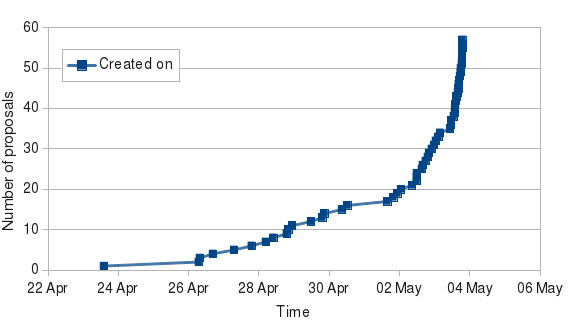
Almost a month has passed since SHOGUN has been accepted for Google Summer of Code 2013. Student application deadline was today (May 6) and shogun received 57 proposals from 52 students. This is quite some increase compared to 2012 (48 applications from 38 students). What is interesting though is that it didn't look that good in the very beginning (see the figure below): Comparing this to 2012, this curve is much more flat in the beginning but exponentially increasing towards the end. Why is that? We didn't change the way we engaged with students (even though we tried to improve the instructions and added lots of entrance tagged tasks to github issues). We still require patches to be submitted to even be considered. So it is similarly tough to get into gsoc 2013 with us as it was in the previous year. What is interesting though is that various organizations complained about a slow uptake in the beginning. And it turns out that google did limit the number of student applications from 20 (last year) to 5 (in 2013). This might explain the shape of the curve: Students are more cautious to apply but once the deadline is near the apply to the maximum of 5 to improve their chances. This goes hand-in-hand with the observation that the quality of newly submitted student applications tends to decrease towards the deadline. So did this new limit hurt? To the contrary! In the end the quality of proposals increased a lot and we were able to even way before the student application deadline start to score/rank students. We are happy to have many very strong candidates this year again. Lets hope we get enough slots to accommodate all of the excellent students and then lets start the fun :)

Wouter Verhelst: Oops, I did it again...

For (at least) the third time, I managed to register for debconf before registration was actually open. Oops. I found out that unfortunately, it's not quite certain yet that there will actually be a debcamp this year and if there is going to be a debcamp, it won't be a full week. Pity. At any rate, I'll be there the whole time, whatever the duration of debcamp. Since Vaumarcus is closer to Mechelen than Edinburgh (by about 250km), this is going to be the closest debconf for me, ever. And if I could go to Banja Luka by car, I can certainly go to Vaumarcus by car. Anyone care to join me?

Richard Hartmann: Release Critical Bug report for Week 18

Releezy Tomorrow morning at around 0900 UTC, a lot of very dedicated people will start working on the actual release of Debian 7.0 (wheezy). A huge thank you to everyone who worked on getting Debian to this point. I for one welcome our new penguin overlord! Housekeeping These will obviously be the last rc bug stats in this release cycle. I am still unsure what to do with this particular series until the next freeze and feedback would be appreciated. Possible approaches are continuing as is, putting this into its own specific feed, decreasing the frequency to once a month, or to simply stop until jessie is frozen. An ikiwiki poll may be overkill. Or not. Remaining bugs As of right now, there are two bugs open: Both relate to weird behaviour by apt when upgrading from squeeze to wheezy. These bugs will not be truly closed, but merely ignored, for wheezy's release. If you happen to encounter the message above, it's best to consult the release notes for possible workarounds. Stats The UDD bugs interface currently knows about the following release critical bugs: How do we compare to the Squeeze release cycle?
Week Squeeze Wheezy Diff
43 284 (213+71) 468 (332+136) +184 (+119/+65)
44 261 (201+60) 408 (265+143) +147 (+64/+83)
45 261 (205+56) 425 (291+134) +164 (+86/+78)
46 271 (200+71) 401 (258+143) +130 (+58/+72)
47 283 (209+74) 366 (221+145) +83 (+12/+71)
48 256 (177+79) 378 (230+148) +122 (+53/+69)
49 256 (180+76) 360 (216+155) +104 (+36/+79)
50 204 (148+56) 339 (195+144) +135 (+47/+90)
51 178 (124+54) 323 (190+133) +145 (+66/+79)
52 115 (78+37) 289 (190+99) +174 (+112/+62)
1 93 (60+33) 287 (171+116) +194 (+111/+83)
2 82 (46+36) 271 (162+109) +189 (+116/+73)
3 25 (15+10) 249 (165+84) +224 (+150/+74)
4 14 (8+6) 244 (176+68) +230 (+168/+62)
5 2 (0+2) 224 (132+92) +222 (+132/+90)
6 release! 212 (129+83) +212 (+129/+83)
7 release+1 194 (128+66) +194 (+128/+66)
8 release+2 206 (144+62) +206 (+144/+62)
9 release+3 174 (105+69) +174 (+105/+69)
10 release+4 120 (72+48) +120 (+72/+48)
11 release+5 115 (74+41) +115 (+74/+41)
12 release+6 93 (47+46) +93 (+47/+46)
13 release+7 50 (24+26) +50 (+24/+26)
14 release+8 51 (32+19) +51 (+32/+19)
15 release+9 39 (32+7) +39 (+32/+7)
16 release+10 20 (12+8) +20 (+12/+8)
17 release+11 24 (19+5) +24 (+19/+5)
18 release+12 2 (2+0) +2 (+2/+0)
Graphical overview of bug stats thanks to azhag:

Clint Adams: Tartufo i batalo

There were two competing free software projects, doing more or less the same thing. Project B was in active development 3 years before Project R showed up, and then the two competed for quite some time. While Project B seemed to operate as part of the gift economy, Project R was developed by folks who had received some monetary funding, and once their funding began to wane, they began to complain. Eventually fundraising campaigns were held. The community was happy to participate in polite fictions: Project B didn't really exist; the only people who could possibly fix the bugs in Project R were the people demanding money; there would be no conflict of interest between the gatekeepers of Project R. Gradually, all development ceased on Project B and never resumed. The leader of Project R kept jumping up and down and demanding more money, until finally he declared it insufficient. Then there were two dead codebases.

Daniel Kahn Gillmor: It's Advertising all the way down

Today i saw a billboard on the side of a bus. It was from a cable TV channel, bragging about how well-connected their viewers are (presumably on the internet, social media, blogs, etc). It shows a smiling, attractive man, with text next to him saying something like "I told 9000 people what smartphone to buy". What happened here? And almost all of these steps count as positive economic activity when we try to measure whether the US economy is healthy. I am depressed by this tremendous waste of time and effort.Tags: advertising

DebConf team: Registration is now open for DebConf13 (Posted by Didier Raboud)

Dear all,
Going to DebConf13!
Registration is now open for DebConf13, which will take place in Le Camp near Vaumarcus, Switzerland, from Sunday 11 August to Saturday 17 August 2013. The registration deadline for those who wish to make sponsorship applications is Wednesday 15 May 2013. After this date, you can still register, but you will need to pay for accommodation and food. Registration If you want to attend DebConf13, go to the Registration page and follow the procedure outlined there. Please even read the website page if you attended previous conferences, because it explains some important changes with respect to previous years. DebCamp We are planning to prepend the current DebConf week with additional DebCamp days, but we need some more time to sort out the details. We also need more money to be able to fully sponsor DebCamp for everyone or to extend it to more than a few days. If you would like this to happen, please contact us and help find additional sponsorship. We will send another announcement about DebCamp as soon as registration for DebCamp opens. Thank you
Be a sponsor for DebConf13!
DebConf13 thanks its two platinum sponsors, Google and the Matanel Foundation, as well as all other sponsors. We look forward to welcoming you to Le Camp in August! The DebConf team

Next.

Previous.