Search Results: "ed"

8 May 2013

Ben Hutchings: Warning: Debian 7.0 'wheezy' on VIA C3 and Cyrix III systems

The 'longhaul' module may cause instability or even hardware damage on some systems. Unfortunately, it is now being auto-loaded on all systems with a compatible CPU (VIA C3 or Cyrix III). See bug #707047. Before upgrading one of these systems to Debian 7.0 'wheezy', if you do not currently use the 'longhaul' module, you should blacklist it by creating e.g. /etc/modprobe.d/blacklist-longhaul.conf containing the line:
  blacklist longhaul
I would advise against attempting a fresh installation on these systems at present.

Raphael Geissert: Almost one million requests per day

In the first 48 hours after its log files were rotated last Sunday, http.debian.net handled almost 2 million requests, for an average of 11 requests per second.

In the last weeks before the release of Debian wheezy the number of requests had dropped slightly below 2 million per week.

Debian is alive.

Steve Langasek: Plymouth is not a bootsplash

Congrats to the Debian release team on the new release of Debian 7.0 (wheezy)! Leading up to the release, a meme making the rounds on Planet Debian has been to play a #newinwheezy game, calling out some of the many new packages in 7.0 that may be interesting to users. While upstart as a package is nothing new in wheezy, the jump to upstart 1.6.1 from 0.6.6 is quite a substantial change. It does bring with it a new package, mountall, which by itself isn't terribly interesting because it just provides an upstart-ish replacement for some core scripts from the initscripts package (essentially, /etc/rcS.d/*mount*). Where things get interesting (and, typically, controversial) is the way in which mountall leverages plymouth to achieve this. What is plymouth? There is a great deal of misunderstanding around plymouth, a fact I was reminded of again while working to get a modern version of upstart into wheezy. When Ubuntu first started requiring plymouth as an essential component of the boot infrastructure, there was a lot of outrage from users, particularly from Ubuntu Server users, who believed this was an attempt to force pretty splash screen graphics down their throats. Nothing could be further from the truth. Plymouth provides a splash screen, but that's not what plymouth is. What plymouth is, is a boot-time I/O multiplexer. And why, you ask, would upstart - or mountall, whose job is just to get the filesystem mounted at boot - need a boot-time I/O multiplexer? Why use plymouth? The simple answer is that, like everything else in a truly event-driven boot system, filesystem mounting is handled in parallel - with no defined order. If a filesystem is missing or fails an fsck, mountall may need to interact with the user to decide how to handle it. And if there's more than one missing or broken filesystem, and these are all being found in parallel, there needs to be a way to associate each answer from the user to the corresponding question from mountall, to avoid crossed signals... and lost data. One possible way to handle this would be for mountall to serialize the fsck's / mounts. But this is a pretty unsatisfactory answer; all other things (that is, boot reliability) being equal, admins would prefer their systems to boot as fast as possible, so that they can get back to being useful to users. So we reject the idea of solving the problem of serializing prompts by making mountall serialize all its filesystem checks. Another option would be to have mountall prompt directly on the console, doing its own serialization of the prompts (even though successful mounts / fscks continue to be run in parallel). This, too, is not desirable in the general case, both because some users actually would like to have pretty splash screens at boot time, and this would be incompatible with direct console prompting; and because mountall is not the only piece of software that need to prompt at boot time (see also: cryptsetup). Plymouth: not just a pretty face Enter plymouth, which provides the framework for serializing requests to the user while booting. It can provide a graphical boot splash, yes; ironically, even its own homepage suggests that this is its purpose. But it can also provide a text-only console interface, which is what you get automatically when booting without a splash boot argument, or even handle I/O over a serial console. Which is why, contrary to the initial intuitions of the s390 porters upon seeing this package, plymouth is available for all of Debian's Linux architectures in wheezy, s390 and s390x included, providing a consistent architecture for boot-time I/O for systems that need it - which is any machine using a modern boot system, such as upstart or systemd. Room for improvement Now, having a coherent architecture for your boot I/O is one thing; having a bug-free splash screen is another. The experience of plymouth in Ubuntu has certainly not been bug-free, with plymouth making significant demands of the kernel video layer. Recently, the binary video driver packages in Ubuntu have started to blacklist the framebuffer kernel driver entirely due to stability concerns, making plymouth splash screens a non-starter for users of these drivers and regressing the boot experience. One solution for this would be to have plymouth offload the video handling complexity to something more reliable and better tested. Plymouth does already have an X backend, but we don't use that in Ubuntu because even if we do have an X server, it normally starts much later than when we would want to display the splash screen. With Mir on the horizon for Ubuntu, however, and its clean separation between system and session compositors, it's possible that using a Mir backend - that can continue running even after the greeter has started, unlike the current situation where plymouth has to cede the console to the display manager when it starts - will become an appealing option. This, too, is not without its downsides. Needing to load plymouth when using crypted root filesystems already makes for a bloated initramfs; adding a system compositor to the initramfs won't make it any better, and introduces further questions about how to hand off between initramfs and root fs. Keeping your system compositor running from the initramfs post-boot isn't really ideal, particularly for low-memory systems; whereas killing the system compositor and restarting it will make it harder to provide a flicker-free experience. But for all that, it does have its architectural appeal, as it lets us use plymouth as long as we need to after boot. As the concept of static runlevels becomes increasingly obsolete in the face of dynamic systems, we need to design for the world where the distinction between "booting" and "booted" doesn't mean what it once did.

Antoine Beaupr : Debian Wheezy et Debian Qu bec ce samedi!

[En fran ais ci-bas] As announced by Fabian we are launching the Debian Qu bec group this saturday, with a release party at UQAM. I may not be present as I was planning to go camping this weekend, but since the weather forecast is rainy so far, I may cancel. Tel qu'annonc par Fabian, nous lan ons le groupe Debian Qu bec ce samedi, avec un "release party". Je vais *peut- tre tre absent vu que je pr voyais sortir en camping, mais vu qu'ils pr voient de la pluie pour 4 jours, je vais peut- tre m'abstenir...

7 May 2013

Evgeni Golov: Wheezy, ejabberd, Pidgin and SRV records

TL;DR: fqdn, "jabber.die-welt.net" . So, how many servers do you have, that are still running Squeeze? I count one, mostly because I did not figure out a proper upgrade path from OpenVZ to something else yet, but this is a different story. This post is about the upgrade of my communication machine, dengon.die-welt.net. It runs my private XMPP and IRC servers. I upgraded it to Wheezy, checked that my irssi and my BitlBee still could connect and left for work. There I noticed, that Pidgin could only connect to one of the two XMPP accounts I have on that server. sargentd@jabber.die-welt.net worked just fine, while evgeni@golov.de failed to connect. ejabberd was logging a failed authentication:
I(<0.1604.0>:ejabberd_c2s:802) : ( socket_state,tls, tlssock,#Port<0.5130>,#Port<0.5132> ,<0.1603.0> ) Failed authentication for evgeni@golov.de

While Pidgin was just throwing Not authorized errors. I checked the password in Pidgin (even if it did not change). I tried different (new) accounts: anything@jabber.die-welt.net worked, nothing@golov.de did not and somethingdifferent@jabber.<censored>.de worked too. So where was the difference between the three vhosts? jabber.die-welt.net and jabber.<censored>.de point directly (A/CNAME) to dengon.die-welt.net. golov.de has SRV records for XMPP pointing to jabber.die-welt.net. Let s ask Google about ejabberd pidgin srv . There are some bugs. But they are marked as fixed in Wheezy. Mhh Let s read again Okay, I have to set fqdn, "<my_srv_record_name>" . when this does not match my hostname. Edit /etc/ejabberd/ejabberd.cfg, add fqdn, "jabber.die-welt.net" . (do not forget the dot at the end) and restart the ejabberd. Pidgin can connect again. Yeah.

Steve Kemp: So progress is going well on lumail

A massive marathon has resulted in my lumail mail client working well. Functionally the application looks little different to the previous C-client, but it is a lot cleaner, neater, and nicer internally. The configuration file luamail.lua gives a good flavour of the code, and the github repository has brief instructions. Initially I decied that the navigation/index stuff was easy and the rest of the program would be hard; dealing with GPG-signatures, MIME-parts, etc. But I'm stubborn enough to keep going. If I can get as far as reading messages, with MIME handled properly, and replying then I can switch to using it immediately which will spur further development. I'm really pleased with the keybinding code, and implementing the built-in REPL-like prompt was a real revelation. Worht it for that alone. The domain name lumail.org was available. So I figured why not?

Matthew Garrett: A short introduction to TPMs

I've been working on TPMs lately. It turns out that they're moderately awful, but what's significantly more awful is basically all the existing documentation. So here's some of what I've learned, presented in the hope that it saves someone else some amount of misery.
What is a TPM?TPMs are devices that adhere to the Trusted Computing Group's Trusted Platform Module specification. They're typically microcontrollers[1] with a small amount of flash, and attached via either i2c (on embedded devices) or LPC[2] (on PCs). While designed for performing cryptographic tasks, TPMs are not cryptographic accelerators - in almost all situations, carrying out any TPM operations on the CPU instead would be massively faster[3]. So why use a TPM at all?
Keeping secrets with a TPMTPMs can encrypt and decrypt things. They're not terribly fast at doing so, but they have one significant benefit over doing it on the CPU - they can do it with keys that are tied to the TPM. All TPMs have something called a Storage Root Key (or SRK) that's generated when the TPM is initially configured. You can ask the TPM to generate a new keypair, and it'll do so, encrypt them with the SRK (or another key descended from the SRK) and hand it back to you. Other than the SRK (and another key called the Endorsement Key, which we'll get back to later), these keys aren't actually kept on the TPM - the running OS stores them on disk. If the OS wants to encrypt or decrypt something, it loads the key into the TPM and asks it to perform the desired operation. The TPM decrypts the key and then goes to work on the data. For small quantities of data, the secret can even be stored in the TPM's nvram rather than on disk.

All of this means that the keys are tied to a system, which is great for security. An attacker can't obtain the decrypted keys, even if they have a keylogger and full access to your filesystem. If I encrypt my laptop's drive and then encrypt the decryption key with the TPM, stealing my drive won't help even if you have my passphrase - any other TPM simply doesn't have the keys necessary to give you access.

That's fine for keys which are system specific, but what about keys that I might want to use on multiple systems, or keys that I want to carry on using when I need to replace my hardware? Keys can optionally be flagged as migratable, which makes it possible to export them from the TPM and import them to another TPM. This seems like it defeats most of the benefits, but there's a couple of features that improve security here. The first is that you need the TPM ownership password, which is something that's set during initial TPM setup and then not usually used afterwards. An attacker would need to obtain this somehow. The other is that you can set limits on migration when you initially import the key. In this scenario the TPM will only be willing to export the key by encrypting it with a pre-configured public key. If the private half is kept offline, an attacker is still unable to obtain a decrypted copy of the key.
So I just replace the OS with one that steals the secret, right?Say my root filesystem is encrypted with a secret that's stored on the TPM. An attacker can replace my kernel with one that grabs that secret once the TPM's released it. How can I avoid that?

TPMs have a series of Platform Configuration Registers (PCRs) that are used to record system state. These all start off programmed to zero, but applications can extend them at runtime by writing a sha1 hash into them. The new hash is concatenated to the existing PCR value and another sha1 calculated, and then this value is stored in the PCR. The firmware hashes itself and various option ROMs and adds those values to some PCRs, and then grabs the bootloader and hashes that. The bootloader then hashes its configuration and the files it reads before executing them.

This chain of trust means that you can verify that no prior system component has been modified. If an attacker modifies the bootloader then the firmware will calculate a different hash value, and there's no way for the attacker to force that back to the original value. Changing the kernel or the initrd will result in the same problem. Other than replacing the very low level firmware code that controls the root of trust, there's no way an attacker can replace any fundamental system components without changing the hash values.

TPMs support using these hash values to decide whether or not to perform a decryption operation. If an attacker replaces the initrd, the PCRs won't match and the TPM will simply refuse to hand over the secret. You can actually see this in use on Windows devices using Bitlocker - if you do anything that would change the PCR state (like booting into recovery mode), the TPM won't hand over the key and Bitlocker has to prompt for a recovery key. Choosing which PCRs to care about is something of a balancing act. Firmware configuration is typically hashed into PCR 1, so changing any firmware configuration options will change it. If PCR 1 is listed as one of the values that must match in order to release the secret, changing any firmware options will prevent the secret from being released. That's probably overkill. On the other hand, PCR 0 will normally contain the firmware hash itself. Including this means that the user will need to recover after updating their firmware, but failing to include it means that an attacker can subvert the system by replacing the firmware.
What about using TPMs for DRM?In theory you could populate TPMs with DRM keys for media playback, and seal them such that the hardware wouldn't hand them over. In practice this is probably too easily subverted or too user-hostile - changing default boot order in your firmware would result in validation failing, and permitting that would allow fairly straightforward subverted boot processes. You really need a finer grained policy management approach, and that's something that the TPM itself can't support.

This is where Remote Attestation comes in. Rather than keep any secrets on the local TPM, the TPM can assert to a remote site that the system is in a specific state. The remote site can then make a policy determination based on multiple factors and decide whether or not to hand over session decryption keys. The idea here is fairly straightforward. The remote site sends a nonce and a list of PCRs. The TPM generates a blob with the requested PCR values, sticks the nonce on, encrypts it and sends it back to the remote site. The remote site verifies that the reply was encrypted with an actual TPM key, makes sure that the nonce matches and then makes a policy determination based on the PCR state.

But hold on. How does the remote site know that the reply was encrypted with an actual TPM? When TPMs are built, they have something called an Endorsement Key (EK) flashed into them. The idea is that the only way to have a valid EK is to have a TPM, and that the TPM will never release this key to anything else. There's a couple of problems here. The first is that proving you have a valid EK to a remote site involves having a chain of trust between the EK and some globally trusted third party. Most TPMs don't have this - the only ones I know of that do are recent Infineon and STMicro parts. The second is that TPMs only have a single EK, and so any site performing remote attestation can cross-correlate you with any other site. That's a pretty significant privacy concern.

There's a theoretical solution to the privacy issue. TPMs never actually sign PCR quotes with the EK. Instead, TPMs can generate something called an Attestation Identity Key (AIK) and sign it with the EK. The OS can then provide this to a site called a PrivacyCA, which verifies that the AIK is signed by a real EK (and hence a real TPM). When a third party site requests remote attestation, the TPM signs the PCRs with the AIK and the third party site asks the PrivacyCA whether the AIK is real. You can have as many AIKs as you want, so you can provide each service with a different AIK.

As long as the PrivacyCA only keeps track of whether an AIK is valid and not which EK it was signed with, this avoids the privacy concerns - nobody would be able to tell that multiple AIKs came from the same TPM. On the other hand, it makes any PrivacyCA a pretty attractive target. Compromising one would not only allow you to fake up any remote attestation requests, it would let you violate user privacy expectations by seeing that (say) the TPM being used to attest to HolyScriptureVideos.com was also being used to attest to DegradingPornographyInvolvingAnimals.com.

Perhaps unsurprisingly (given the associated liability concerns), there's no public and trusted PrivacyCAs yet, and even if they were (a) many computers are still being sold without TPMs and (b) even those with TPMs often don't have the EK certificate that would be required to make remote attestation possible. So while remote attestation could theoretically be used to impose DRM in a way that would require you to be running a specific OS, practical concerns make it pretty difficult for anyone to deploy that at any point in the near future.
Is this just limited to early OS components?Nope. The Linux kernel has support for measuring each binary run or each module loaded and extending PCRs accordingly. This makes it possible to ensure that the running binaries haven't been modified on disk. There's not a lot of distribution infrastructure for setting this up, but in theory a distribution could deploy an entirely signed userspace and allow the user to opt into only executing correctly signed binaries. Things get more interesting when you add interpreted scripts to the mix, so there's still plenty of work to do there.
So what can I actually use a TPM for?Drive encryption is probably the best example (Bitlocker does it on Windows, and there's a LUKS-based implementation for Linux here) - while in theory you could do things like use your TPM as a factor in two-factor authentication or tie your GPG key to it, there's not a lot of existing infrastructure for handling all of that. For the majority of people, the most useful feature of the TPM is probably the random number generator. rngd has support for pulling numbers out of it and stashing them in /dev/random, and it's probably worth doing that unless you have an Ivy Bridge or other CPU with an RNG.

Things get more interesting in more niche cases. Corporations can bind VPN keys to corporate machines, making it possible to impose varying security policies. Intel use the TPM as part of their anti-theft technology on education-oriented devices like the Classmate. And in the cloud, projects like Trusted Computing Pools use remote attestation to verify that compute nodes are in a known good state before scheduling jobs on them.
Is there a threat to freedom?At the moment, probably not. The lack of any workable general purpose remote attestation makes it difficult for anyone to impose TPM-based restrictions on users, and any local code is obviously under the user's control - got a program that wants to read the PCR state before letting you do something? LD_PRELOAD something that gives it the desired response, or hack it so it ignores failure. It's just far too easy to circumvent.
Summary?TPMs are useful for some very domain-specific applications, drive encryption and random number generation. The current state of technology doesn't make them useful for practical limitations of end-user freedom.

[1] Ranging from 8-bit things that are better suited to driving washing machines, up to full ARM cores
[2] "Low Pin Count", basically ISA without the slots.
[3] Loading a key and decrypting a 5 byte payload takes 1.5 seconds on my laptop's TPM.

comment count unavailable comments

Gunnar Wolf: Talking about Debian while Debian was getting released

Last Saturday, I was invited to talk about Debian to Hackerspace DF, a group that is starting to work at a very nice place together with other collectives, in a quite centric place (Colonia Obrera). I know several of the people in the group (visited them a couple of times in the space's previous incarnation), and wish them great luck in this new hackerspace! Anyway I was invited to give an informal talk about Debian. And of course, I was there. And so was Alfredo, who recorded (most of) it. So, in case you want to see me talking about how Debian works, mostly on a social organization level (but also regarding some technical details). Of course, given the talk was completely informal (it started by me standing there, asking, "OK, any questions?"), I managed to mix up some names and stuff... But I hope that, in the end, the participants understood better what Debian means than when we started. Oh, and by the end of the talk, we were all much happier. Not only because I was about to shut up, but because during my talk, we got notice that Debian 7.0 "Wheezy" was released. Anyway If you want to see me talking for ~1hr, you can download the video or watch it on YouTube.

Jo Shields: Windows 8: Blood from a Stone

Ordinarily, I m a big believer that it is important to keep up to date with what every piece of software which competes with yours is doing, to remain educated on the latest concepts. Sometimes, there are concepts that get added which are definitely worth ripping off. We ve ripped off plenty of the better design choices from Windows or Mac OS, over the years, for use in the Free Desktop. So, what about Windows 8, the hip new OS on everyone s lips? Well, here s the thing I ve been using it on and off for a few months now for running legacy apps, and I can t for the life of me find anything worth stealing. Let s take the key change Windows 8 has apps built with a new design paradigm which definitely isn t called Metro. Metro apps don t really have windows in the traditional sense they re more modeled on full-screen apps from smartphones or tablets than on Windows 1.0 -> 7. Which is fine, really, if you re running Windows 8 on a tablet or touchscreen device. But what if you re not? What about the normal PC user? As Microsoft themselves ask:

How do you multitask with #windows8? The answer to that is, well, you sorta don t. Metro apps can exist in three states fullscreen, almost fullscreen, or vertical stripe. You re allowed to have two apps at most at the same time one mostly full screen, and one vertical stripe. So what happens if you try to *use* that? Let s take a fairly common thing I do watch a video and play Minesweeper. In this example, the video player is the current replacement for Windows Media Player, and ships by default. The Minesweeper game isn t installed by default, but is the only Minesweeper game in the Windows 8 app store which is gratis and by Microsoft Game Studios. Here s option A:

Unusable Windows 8 option 1 And for contrast, here s option B:

Unusable Windows 8 option 2 Which of these does a better job of letting me play Minesweeper and watch a video at the same time? Oh, here s option C, dumping Microsoft s own software, and using a third-party video player and third party Minesweeper implementation:

Windows 7 flavour It s magical almost as if picking my own window sizes makes the experience better. So, as you can see above, the old OS is still hiding there, in the form of a Windows 8 app called Desktop . Oh, sorry, didn t I say? Metro apps, and non-Metro apps, are segregated. You can run both (the Desktop app can also be almost-fullscreen or a vertical strip), but they get their own lists of apps when multitasking. Compare the list on the left with the list at the bottom:

Needs moar task lists And it s even more fun for apps like Internet Explorer, which can be started in both modes (and you often need both modes). Oh, and notice how the Ribbon interface from Office 2007 has invaded Explorer, filling the view with large buttons to do things you never want to do under normal circumstances. So, that s a short primer on why Windows 8 is terrible. Is there really nothing here worth stealing? Actually, yes, there is! After much research, I have discovered Windows 8 s shining jewel:

win8multitasking-004 The new Task Manager is lovely. I want it on my Linux systems. But that s it.

Hideki Yamane: meet to openSUSE folks (OBS dojo)

4th May, I went to Shimokitazawa (Tokyo) to participate to OBS dojo by openSUSE developer. OBS, Open Build Service (formerly known as openSUSE Build Service) is kind a buildd in Debian but anyone can use it with signup to its site. <a href="http://www.slideshare.net/ftake">@ftake</a> explains it with his slide.

And, osc package/command is like pbuilder, download dependency packages from Internet and build package in chroot (or lxc container, KVM, Xen). (disadvantage: osc is not usable if build.opensuse.org is not fine state e.g. overload. It's rare but it happened ;)

I want to learn something this OBS and osc.


Timo Jyrinki: Qt 5 in Debian and Ubuntu, patches upstreaming

PackagesI quite like the current status of Qt 5 in Debian and Ubuntu (the links are to the qtbase packages, there are ca. 15 other modules as well). Despite Qt 5 being bleeding edge and Ubuntu having had the need to use it before even the first stable release came out in December, the co-operation with Debian has gone well. Debian is now having the first Qt 5 uploads done to experimental and later on to unstable. My work contributed to pkg-kde git on the modules has been welcomed, and even though more work has been done there by others, there haven't been drastic changes that would cause too big transition problems on the Ubuntu side. It has of course helped to ask others what they want, like the whole usage of qtchooser. Now with Qt 5.0.2 I've been able to mostly re-sync all newer changes / fixes to my packaging from Debian to Ubuntu and vice versa.

There will remain some delta, as pkg-kde plans to ask for a complete transition to qtchooser so that all Qt using packages would declare the Qt version either by QT_SELECT environment variable (preferable) or a package dependency (qt5-default or qt4-default). As a temporary change related to that, Debian will have a debhelper modification that defaults QT_SELECT to qt4 for the duration of the transition. Meanwhile, Ubuntu already shipped the 13.04 release with Qt 5, and a shortcut was taken there instead to prevent any Qt 4 package breakage. However, after the transition period in Debian is over, that small delta can again be removed.

I will also need to continue pushing any useful packaging I do to Debian. I pushed qtimageformats and qtdoc last week, but I know I'm still behind with some "possibly interesting" git snapshot modules like qtsensors and qtpim.

PatchesMore delta exists in the form of multiple patches related to the recent Ubuntu Touch efforts. I do not think they are of immediate interest to Debian let's start packaging Qt 5 apps to Debian first. However, about all of those patches have already been upstreamed to be part of Qt 5.1 or Qt 5.2, or will be later on. Some already were for 5.0.2.

A couple of months ago Ubuntu did have some patches hanging around with no clear author information. This was a result of the heated preparation for the Ubuntu Touch launches, and the fact that patches flew (too) quickly in place into various PPA:s. I started hunting down the authors, and the situation turned out to be better than I thought. About half of the patches were already upstreamed, and work on properly upstreaming the other ones was swiftly started after my initial contact. Proper DEP3 fields do help understanding the overall situation. There are now 10 Canonical individuals in the upstream group of contributors, and in the last week's sprint it turned out more people will be joining them to upstream their future patches.

Nowadays about all the requests I get for including patches from developers are stuff that was already upstreamed, like the XEmbed support in qtbase. This is how it should be.

One big patch still being Ubuntu only is the Unity appmenu support. There was a temporary solution for 13.04 that forward-ported the Qt 4 way of doing it. This will be however removed from the first 13.10 ('saucy') upload, as it's not upstreamable (the old way of supporting Unity appmenus was deliberately dropped from Qt 5). A re-implementation via QPA plugin support is on its way, but it may be that the development version users will be without appmenu support for some duration. Another big patch is related to qtwebkit's device pixel ratio, which will need to be fixed. Apart from these two areas of work that need to be followed through, patches situation is quite nice as mentioned.
ConclusionFree software will do world domination, and I'm happy to be part of it.

6 May 2013

Junichi Uekawa: Got a new 27 inch monitor.

Got a new 27 inch monitor. Thanks to my friend. Connecting with displayPort cable was a breeze. xrandr tells me it is capable of 2560x1440, which is a lot of space compared to 1366x768 on MacBook Air.

Michal &#268;iha&#345;: phpMyAdmin in GSoC 2013

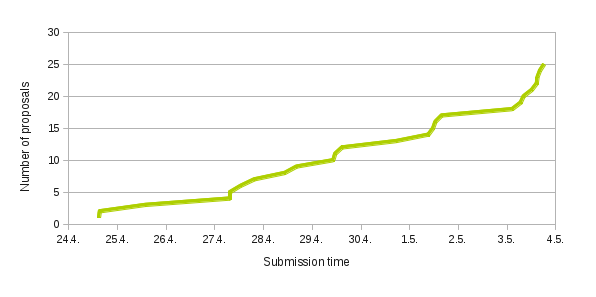
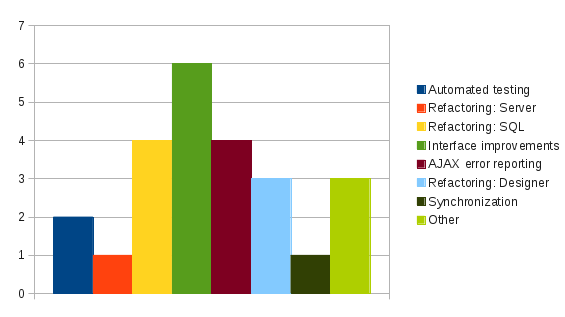
As student application period of Google Summer of Code 2013 is over, it's time to look at proposals we got for phpMyAdmin. First of all we got slightly less proposals than in past years. This is probably related to the fact that we still heavily focus on code cleanup this year and this is definitely not that interesting topic as adding new features. I think quality has also slightly improved and this time we received no bogus or spam proposals. Also as usual, people tend to leave submission for very last date (though not that much as in past years): Number of applications over time Quite unsurprisingly the most interesting topic seemed to be interface improvements, though it is quite wide. You can see how other topics were frequent in following chart: Number of applications for various types Please note that the numbers are not 100% accurate as some proposals really did not fit into above categories. Anyway we're just working on evaluation and will finalize it in upcoming days. Of course you will know the results from Google on May 27th.
Filed under: English Phpmyadmin 0 comments Flattr this!

Sylvestre Ledru: Follow up on Debian & Clang

A week after the Euro LLVM conference, I am glad to share the results I presented and discussed during the event. 1) Parallel building infrastructure using clang instead of gcc Based on the work that Alexander Pashaliyski and I did during the GSoC 2012, we are now able to automatically rebuild each package uploaded in Unstable transparently. Results are published here:
http://buildd-clang.debian.net/
This provides a quick and easy way to any Debian contributors or upstream packaged in Debian to check how the package behaves with clang.
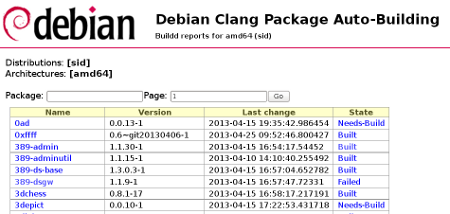
For Debian Developer and maintainer, a per maintainer view is also provided. This will list all packages maintained by a Debian packager. My page as example Here is an example of the list of package:
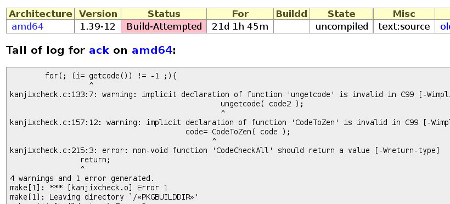
And an example of package failing:
At time of writing, most of the packages in unstable have been rebuilt (16 % are remaining). However, due to resource constraints, only amd64 packages are built. Contact me if you have resources to share for other architectures. Thanks to Paul Wise, the PTS (Debian package tracking system) proposes a link to the clang build logs (failing or not). A repository will be automatically updated with the results of these builds (once I find the time to get into buildd). 2) clang-built repository
Thanks to the Amazon Cloud, with our new DPL (Debian Project Leader), Lucas Nussbaum, we rebuilt unstable last April and published it at the following address:
deb http://clang.debian.net/repository-2013-04-07/ unstable-clang main
This allows some cool stuff like:
$ echo "deb http://clang.debian.net/repository-2013-04-07/ unstable-clang main">>/etc/apt/sources.list
$ apt-get update
$ apt-get install coreutils/unstable-clang
$ ls
$ awk
Note that this repository was only one-shoot and does not get updated. Quality of the binary produced (performance and size) can be tested thanks to this repository. Feedbacks are welcome!

Sylvestre Ledru: Follow up on Debian & Clang

A week after the Euro LLVM conference, I am glad to share the results I presented and discussed during the event. 1) Parallel building infrastructure using clang instead of gcc Based on the work that Alexander Pashaliyski and I did during the GSoC 2012, we are now able to automatically rebuild each package uploaded in Unstable transparently. Results are published here:
http://buildd-clang.debian.net/
This provides a quick and easy way to any Debian contributors or upstream packaged in Debian to check how the package behaves with clang.
For Debian Developer and maintainer, a per maintainer view is also provided. This will list all packages maintained by a Debian packager. My page as example Here is an example of the list of package:
And an example of package failing:
At time of writing, most of the packages in unstable have been rebuilt (16 % are remaining). However, due to resource constraints, only amd64 packages are built. Contact me if you have resources to share for other architectures. Thanks to Paul Wise, the PTS (Debian package tracking system) proposes a link to the clang build logs (failing or not). A repository will be automatically updated with the results of these builds (once I find the time to get into buildd). 2) clang-built repository
Thanks to the Amazon Cloud, with our new DPL (Debian Project Leader), Lucas Nussbaum, we rebuilt unstable last April and published it at the following address:
deb http://clang.debian.net/repository-2013-04-07/ unstable-clang main
This allows some cool stuff like:
$ echo "deb http://clang.debian.net/repository-2013-04-07/ unstable-clang main">>/etc/apt/sources.list
$ apt-get update
$ apt-get install coreutils/unstable-clang
$ ls
$ awk
Note that this repository was only one-shoot and does not get updated. Quality of the binary produced (performance and size) can be tested thanks to this repository. Feedbacks are welcome!

Sylvestre Ledru: Follow up on Debian & Clang

A week after the Euro LLVM conference, I am glad to share the results I presented and discussed during the event. 1) Parallel building infrastructure using clang instead of gcc Based on the work that Alexander Pashaliyski and I did during the GSoC 2012, we are now able to automatically rebuild each package uploaded in Unstable transparently. Results are published here:
http://buildd-clang.debian.net/
This provides a quick and easy way to any Debian contributors or upstream packaged in Debian to check how the package behaves with clang.
For Debian Developer and maintainer, a per maintainer view is also provided. This will list all packages maintained by a Debian packager. My page as example Here is an example of the list of package:
And an example of package failing:
At time of writing, most of the packages in unstable have been rebuilt (16 % are remaining). However, due to resource constraints, only amd64 packages are built. Contact me if you have resources to share for other architectures. Thanks to Paul Wise, the PTS (Debian package tracking system) proposes a link to the clang build logs (failing or not). A repository will be automatically updated with the results of these builds (once I find the time to get into buildd). 2) clang-built repository
Thanks to the Amazon Cloud, with our new DPL (Debian Project Leader), Lucas Nussbaum, we rebuilt unstable last April and published it at the following address:
deb http://clang.debian.net/repository-2013-04-07/ unstable-clang main
This allows some cool stuff like:
$ echo "deb http://clang.debian.net/repository-2013-04-07/ unstable-clang main">>/etc/apt/sources.list
$ apt-get update
$ apt-get install coreutils/unstable-clang
$ ls
$ awk
Note that this repository was only one-shoot and does not get updated. Quality of the binary produced (performance and size) can be tested thanks to this repository. Feedbacks are welcome!

Martin Michlmayr: Upgrading to Debian 7.0 (wheezy) on ARM

Debian 7.0 (wheezy) has been released. Here are some notes if you're running Debian on an ARM-based NAS device or plug computer and are planning to upgrade. First of all, if you're running Debian on a plug computer, such as the SheevaPlug, make sure that you have u-boot version 2011.12-3 (or higher). If you're using an older version, the Linux kernel in wheezy will not boot! You can read my u-boot upgrade instructions on how to check the version of u-boot and upgrade it. Second, check your /etc/kernel-img.conf file. If it still contains the following line, please remove this line.
postinst_hook = flash-kernel
This postinst_hook directive was needed in the past but flash-kernel is called automatically nowadays whenever you install a new kernel. Now you're almost ready to start with your upgrade. Before you start, make sure to read the release notes for Debian 7.0 on ARM. This document contains a lot of information on performing a successful upgrade. During the kernel upgrade, you'll get the following message about the boot loader configuration:
The boot loader configuration for this system was not recognized. These
settings in the configuration may need to be updated:
 * The root device ID passed as a kernel parameter;
 * The boot device ID used to install and update the boot loader.
On ARM-based NAS devices and plug computers, you can simply ignore this warning. We put the root device into the ramdisk so it will be updated automatically. There are no other issues I'm aware of, so good luck with your upgrade and have fun with Debian wheezy!

Christian Perrier: Wheezy is out: my main box upgraded the same day

As you may have noticed, Debian 7.0 wheezy was released yesterday. And, well, for the first time ever, I upgraded my main server (kheops....running Debian since buzz is out) to the finest and latest release the same day it was released. I didn't run into many problems, just a few glitches (some of them might still get some of our users angry, though). Most noticeably, I couldn't easily update two key packages on this serveer (where I receive all my incoming mail) : roundcube and dovecot. Roundcube indeed lost support for SQLite backend and that was probably the reason for which I falled into the "Could not perform immediat econfiguration" trap for it. The workarounds mentioned in the release notes did not work and the only solution was to remove the Roundcobe packages then re-add them later on. Not a big deal, as Roundcube is only used by my son (who will attend Debconf again, by the way) for the few mail he still receives on kheops. Dovecot was more tricky and my mail server temporarily stopped working for my lapto pto grab mail from it. OK, admitedly, I should have read NEWS.Debian that was explaining all problems one might have, particularly problems related to SSL certificates and the use of the "mail" group. But, indeed, that should have deserved a note in the release notes. After all, we're talking there about an obscure php5-suhosin package, right? :-) Finally, it took me less than 3 hours to upgrade everything with no service interruption for users on my local network, except a 30-minute stop of the IMAP server. I still have to reboot to get the new kernel in operation and voil . Let's now go on our way to jessie!

Olly Betts: Debian GSoC Applications for 2013

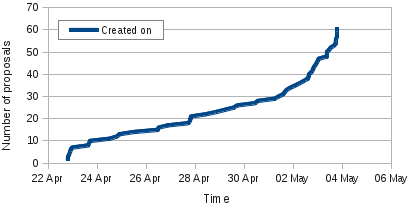
I've produced a graph of the 61 student applications which Debian received for GSoC this year: Graph of student applications to Debian in GSoC 2013 Ana blogged a similar graph last year if you want to compare. It looks like the total is down a little (though I'm not sure if the figure of 81 from the text, or ~68 read from the graph is correct for last year) - this is likely at least partly due to the number of proposals each student can send having been reduced from 20 last year to 5 this year, which should have reduced the number of low quality proposals. The timeline this year is later, which may have also had an effect. If you're an admin or a mentor, you can produce a similar graph for your own org(s) - just download this OpenDocument spreadsheet and follow the instructions inside.

5 May 2013

Timo Jyrinki: Whee!! zy

Congrats and thanks to everyone,
Debian 7.0 Wheezy releasedUpdating my trusty orion5x box as we speak. No better way to spend a (jetlagged) Sunday.

Next.

Previous.