Search Results: "ed"

12 May 2013

Matthias Klumpp: PackageKit, AppStream and Listaller A status report

I was asked by some people to write a status report about the whole PK/AS/LI stuff sorry guys that it took so much time to write it ;-) . PackageKit (PackageKit is an abstraction layer for package-management systems, allowing applications to access the package-manager using simple DBus calls)Package (with list) PackageKit is an incredibly successful project. With the 0.8.x series, it received many performance improvements, and has now the same speed on my computer than the distribution s native tools. PackageKit is used in almost all major Linux distributions, except for Ubuntu[1]. But even Ubuntu has written some compatibility layer, so most calls to PackageKit will work. The only major distro where PackageKit is currently not available, seems to be Gentoo (and I am not sure about the shape of the Gentoo PackageKit backend too). Debian Wheezy includes PackageKit by default, and in Jessy we are going to replace some distribution-specific tools with PackageKit frontends (mostly the old and unmaintained update-notifier and Software-Updater no worries, we are not going for a Synaptic replacement ;-) (currently this won t be possible with PK anyway)) Unfortunately, some PackageKit backends are still not adjusted for the 0.8.x API and are only running on 0.7.x. This is bad, since 0.8.x is a huge step forward for PackageKit. But the situation is slowly improving, with the latest OpenSUSE release, the Zypper backend is now available on 0.8.x too. Being able to run a PackageKit from the 0.8.x series is a requirement for both AppStream and Listaller. AppStream (AppStream is a cross-distro effort for building Software-Center-like Software Center Logoapplications. It contains stuff like a screenshot-service, ratings&reviews etc. The most important component is a Xapian database, storing information about all available applications in the distribution s repositories. The Xapian DB is distro-agnostik, but distributors need to provide data to fill it. AppStream offers an application-centric way to look at a package database) The AppStream side doesn t look incredibly great, but the situation is improving. As far as I know, OpenSUSE is shipping AppStream XML to generate the database. Ubuntu ships the desktop-files, and I am working on AppStream support in Debian s Archive Kit. On the Fedora side, negotiations with the infrastructure-team are still going on. I haven t heard anything from Mageia and other AppStream participants yet. Unfortunately, at least for OpenSUSE, the AppStream efforts seem to be stalled, due to people having moved to different tasks. But efforts to add the remaining missing things exist. On the software side, Apper (KDE PackageKit frontend) has full support for AppStream. Apper just needs to be compiled with some extra flags to make it use the AppStream database. On the GNOME-side, GNOME-Software is being developed. The tool will make use of the AppStream database, on distributions where it is available. Also, a Software-Center for Elementary and other GTK+-based desktops is being developed, which is based on AppStream (already quite usable!). Using the Ubuntu Software Center on not-Ubuntu-based distributions ist still not much fun, but with the AppStream database available and a working PackageKit 0.8.x with a backend which supports parallel transactions, it is possible to use it. On the infrastructure side: I recently landed some patches in AppStream-Core, which will improve the search function a lot. AppStream-Core contains all tools necessary to generate the AppStream database. It also contains libappstream, a GObject-based library which can be used to access the AppStream database. Also, we discuss dropping PackageKit s internal desktop-file-cache in favour of using the AppStream database. If we do that, we will also add software descriptions to the AppStream db, to improve search results and to speed up search for applications. Because we have to deprecate API for that, I expect this change to happen with PackageKit 0.9.x. As soon as the Freedesktop-Wiki is alive again and my account is re-enabled, I will create compatibility-list, showing which distribution implements what of the PK/AS/LI stuff, especially focusing on components needed for AppStream. Only a few distributions package AppStream-Core so far. Although it is beta-software, creating packages for it and shipping the required data to generate the AppStream database would be a very huge step forward. Listaller (Listaller is a cross-distro 3rd-party software installer, which integrates into Listaller-LogoPackageKit and AppStream. It allows installing 3rd-party applications, which are not part of the distributor s repositories, using standard tools used also for native-package handling. Everything which uses PackageKit can make use of Listaller packages too. Listaller also allows sandboxing of new applications, and uses an AppDir-like approach for installing software.) Listaller is currently undergoing it s last transition before a release with stable API and specifications can be made. Dependency solving will be improved a lot during the current release-cycle, making it less powerful, but working on all distributions instead. (Fedora always had an advantage in dependency-solving, due to RPM providing more package metadata for Listaller to use) This change was delayed due to discussing a possible use of ZeroInstall-feeds to provide missing dependencies with the ZeroInstall team. We did not come to a conclusion about extending the XML, so Listaller will contain an own format to define a dependency, which can reference a ZeroInstall feed. That should be a good solution for everyone. All these changes will result in IPK1.2, a new version of the IPK spec with small changes in the pkoptions file syntax and huge changes in dependency-handling. The new code is slowly stabilizing in a separate branch, and will soon be merged into master. The next Listaller release will be the last one of the 0.5.x series, we will start 0.6.x then. KDE currently has support for Listaller through Apper, which is enabled on a few distributions. In GNOME, optional Listaller support is being developed and will be available in one of the upcoming releases. Currently, to my knowledge, only a few distributions package Listaller. This should improve, so it is easier for application developers to deploy IPK packages. The upcoming changes in KDE and GNOME to build stable developer platforms will help Listaller a lot in finding matching dependencies, and for stuff which only depends on one software frameworks, installations should be a matter of seconds. As you can see, lots of things are happening, and there is improvement in all components related to installing and presenting software on Linux machines. However, all these projects have a severe lack of manpower, especially AppStream and Listaller have the lowest number of developers working on the tools (at time, only two active developers). This is the main reason for the slow development. But I am confident that we will have something shipped in the next distribution releases. At least AppStream should be ready then. [1]: I don t blame Ubuntu for that during the time they wrote an own solution, PackageKit did not have all the required features. (This situation has changed now, fortunately.) NOTE: I might extend this post with feedback from the different distributions, as soon as I get it.


11 May 2013

Steve Kemp: The rain in Scotland mainly makes me code

Lumail <http://lumail.org> received two patches today, one to build on Debian Unstable, and one to build on OpenBSD. The documentation of the lua primitives is almost 100% complete, and the repository has now got a public list of issues which I'm slowly working on. Even though I can't reply to messages I'm cheerfully running it on my mail box as a mail-viewer. Faster than mutt. Oddly enough. Or maybe I'm just biased.

Petter Reinholdtsen: Debian, the Linux distribution of choice for LEGO designers?

In January, I announced a new IRC channel #debian-lego, for those of us in the Debian and Linux community interested in LEGO, the marvellous construction system from Denmark. We also created a wiki page to have a place to take notes and write down our plans and hopes. And several people showed up to help. I was very happy to see the effect of my call. Since the small start, we have a debtags tag hardware::hobby:lego tag for LEGO related packages, and now count 10 packages related to LEGO and Mindstorms:
brickosalternative OS for LEGO Mindstorms RCX. Supports development in C/C++
leocadvirtual brick CAD software
libnxtutility library for talking to the LEGO Mindstorms NX
lnpddaemon for LNP communication with BrickOS
nbccompiler for LEGO Mindstorms NXT bricks
nqcNot Quite C compiler for LEGO Mindstorms RCX
python-nxtpython driver/interface/wrapper for the Lego Mindstorms NXT robot
python-nxt-filersimple GUI to manage files on a LEGO Mindstorms NXT
scratcheasy to use programming environment for ages 8 and up
t2nsimple command-line tool for Lego NXT
Some of these are available in Wheezy, and all but one are currently available in Jessie/testing. leocad is so far only available in experimental. If you care about LEGO in Debian, please join us on IRC and help adding the rest of the great free software tools available on Linux for LEGO designers.

Russell Coker: Geographic Sorting Lessons to Learn from Ingress

I ve recently been spending a bit of my spare time playing Ingress (see the Wikipedia page if you haven t heard of it). A quick summary is that Ingress is an Android phone game that involves geo-location of portals that you aim to control and most operations on a portal can only be performed when you are within 40 meters so you do a lot of travelling to get to portals at various locations. One reasonably common operation that can be performed remotely is recharging a portal by using it s key, after playing for a while you end up with a collection of keys which can be difficult to manage. Until recently the set of portal keys was ordered alphabetically. This isn t particularly useful given the fact that portal names are made up by random people who photograph things that they consider to be landmarks. If people tried to use a consistent geographic naming system (which was short enough to fit in large print on a phone display) then it would be really difficult to make it usable. But as joke names are accepted there s just no benefit in having a sort by name. A recent update to the Ingress client (the program which runs on the Android phone and is used for all game operations) changed the sort order to be by distance. This makes it really easy to see the portals which are near you (which is really useful) but also means that the order changes whenever you move which isn t such a good idea for use on a mobile phone. It s quite common for Ingress players to recharge portals while on public transport. But with the new Ingress client the list order will change as you move so anyone who does recharging on a train will find the order of the list changing during the process and it s really difficult to find items in a list which is in a different order each time you look at it. This problem of ordering by location has a much greater scope than Ingress. One example is collections of GPS tagged photographs, it wouldn t make any sense to mix the pictures of two different sets of holiday pictures because they were both taken in countries that are the same distance from my current location (as the current Ingress algorithm would do). It seems to me that the best way of sorting geo-tagged items (Ingress portals, photos, etc) is to base it on the distance from a fixed point which the user can select. It could default to the user s current location but in that case the order of the list should remain unchanged at least until the user returns to the main menu and I think it would be ideal for the order to remain unchanged until the user requests it. I think that most Ingress players would agree with me that fixing annoying mis-features of the Ingress client such as this one would be better for the game than adding new features. While most computer games have some degree of make-work (in almost every case a computer could do things better than a person) I don t think that finding things in a changing list should be part of the make-work. Also it would be nice if Google released some code for doing this properly to reduce the incidence of other developers implementing the same mistakes as the Ingress developers in this regard.

Joachim Breitner: How to play Rock-Paper-Scissors online?

There was an interesting question by Fool recently on the StackExchange site for Boardgames: How do you play a game like Rock-Paper-Scissors with friends online? Or any other game where players have to simultaneously submit their moves (e.g. Diplomacy, or Rock-Paper-Scissors-Lizzard-Spock), which, as I just learned, are simultaneous action selection games. While there are websites dedicated to playing specific games, such as webdiplomacy.net, we could not find a generic one that you can use if you, for example, invent your own variants of a game.

So I created one: At you-say-first.nomeata.de you can enter rooms and share the URL with your friends. On the one hand, you have a regular chat room there. But there is also the possibility to enter moves (whatever a move may be to you) and only when all players have done that and marked the move as final, it is shown to everyone. If you want to try it out: There is an integrated, not very fancy Rock-Paper-Scissors-playing bot. Just enter a room, join and say I want to play!
Note that this site can be used for more than just for games. Have you ever observed that persons would often want other to express their preference (e.g. where to dine) first to not reveal their own preference, so that they can (or pretend to) change their mind if they would contradict? In such situations simultaneous action selection can be a fairer method. A technical note: I created this web app using meteor (a JavaScript framework building on node.js and MongoDB that allows for reactive programming), and it is also hosted on meteor.com. I chose Meteor after someone mentioned Firebase to me, which looked very slick, but was not Free Software, so I looked for alternatives. I did not do any cross-browser-testing, and the UI design could be improved, so if you want to help out (or just complain), please use the GitHub code repository and issue tracker.

Bastian Venthur: Wee! Wheezy is out (better late than never)

Last week we released Wheezy, roughly two years after our last release Squeeze. I d like to thank all the contributors in- and outside of Debian for your fine work! Every single contribution no matter how big or small summed up to the wonderful release we finished last week. Without you this release would not have been possible. Keep up the good work guys and make Jessie rock even harder! PS: It is very nice to see once again fresh packages rolling into unstable and spending some time fixing broken dependencies :)

James Morrison: Google IO predictions

I don't work at Google, so I can play to Google IO prediction game. Here are my Android predictions:
  1. New android version -- 99%
  2. New Nexus 7 -- 90%
  3. Upgraded storage on the Nexus 4 -- 70%
  4. T-mobile LTE for Nexus 4 -- 40%
  5. AT&T LTE for Nexus 4 -- 30%
  6. Verizon Nexus 4 -- 15%
So I think that means there is a (0.99 * 0.9 * 0.7 * 0.4 * 0.3 * 0.15) a 1% chance of all of these things happening.

10 May 2013

Richard Hartmann: Release Critical Bug report for Week 19

Still not sure what to do with this whole thing, but preserving the sharp increase in RC bug count for posterity can't hurt either way. Not sure if it's sad that so many issues may have been overlooked, if this means that Debian is very much alive, either. The UDD bugs interface currently knows about the following release critical bugs: How do we compare to the Squeeze release cycle?
Week Squeeze Wheezy Diff
43 284 (213+71) 468 (332+136) +184 (+119/+65)
44 261 (201+60) 408 (265+143) +147 (+64/+83)
45 261 (205+56) 425 (291+134) +164 (+86/+78)
46 271 (200+71) 401 (258+143) +130 (+58/+72)
47 283 (209+74) 366 (221+145) +83 (+12/+71)
48 256 (177+79) 378 (230+148) +122 (+53/+69)
49 256 (180+76) 360 (216+155) +104 (+36/+79)
50 204 (148+56) 339 (195+144) +135 (+47/+90)
51 178 (124+54) 323 (190+133) +145 (+66/+79)
52 115 (78+37) 289 (190+99) +174 (+112/+62)
1 93 (60+33) 287 (171+116) +194 (+111/+83)
2 82 (46+36) 271 (162+109) +189 (+116/+73)
3 25 (15+10) 249 (165+84) +224 (+150/+74)
4 14 (8+6) 244 (176+68) +230 (+168/+62)
5 2 (0+2) 224 (132+92) +222 (+132/+90)
6 release! 212 (129+83) +212 (+129/+83)
7 release+1 194 (128+66) +194 (+128/+66)
8 release+2 206 (144+62) +206 (+144/+62)
9 release+3 174 (105+69) +174 (+105/+69)
10 release+4 120 (72+48) +120 (+72/+48)
11 release+5 115 (74+41) +115 (+74/+41)
12 release+6 93 (47+46) +93 (+47/+46)
13 release+7 50 (24+26) +50 (+24/+26)
14 release+8 51 (32+19) +51 (+32/+19)
15 release+9 39 (32+7) +39 (+32/+7)
16 release+10 20 (12+8) +20 (+12/+8)
17 release+11 24 (19+5) +24 (+19/+5)
18 release+12 2 (2+0) +2 (+2/+0)
Graphical overview of bug stats thanks to azhag:

Andreas Barth: Cleaning up wanna-build

After adding the new triggers to auto-build wheezy-backports and jessie yesterday, today I cleaned up the remaining bits in wanna-build from lenny:
wanna-build=> delete from packages where distribution ~ 'lenny' ;
DELETE 8250
wanna-build=> delete from distribution_architectures where distribution ~ 'lenny';
DELETE 63
wanna-build=> delete from locks where distribution ~ 'lenny';
DELETE 63
wanna-build=> delete from pkg_history where distribution ~ 'lenny';
DELETE 16504
wanna-build=> delete from distributions where distribution ~ 'lenny';
DELETE 6
wanna-build=> delete from architectures where architecture in ('alpha', 'arm', 'hppa');
DELETE 3

Julien Danjou: Rant about Github pull-request workflow implementation

One of my recent innocent tweet about Gerrit vs Github triggered much more reponses and debate that I expected it to. I realize that it might be worth explaining a bit what I meant, in a text longer than 140 characters. <script async="async" charset="utf-8" src="http://platform.twitter.com/widgets.js"></script> The problems with Github pull-requests I always looked at Github from a distant eye, mainly because I always disliked their pull-request handling, and saw no value in the social hype it brings. Why? One click away isn't one click effort The pull-request system looks like an incredible easy way to contribute to any project hosted on Github. You're a click away to send your contribution to any software. But the problem is that any worthy contribution isn't an effort of a single click. Doing any proper and useful contribution to a software is never done right the first time. There's a dance you will have to play. A slowly rhythmed back and forth between you and the software maintainer or team. You'll have to dance it until your contribution is correct and can be merged. But as a software maintainer, not everybody is going to follow you on this choregraphy, and you'll end up with pull-request you'll never get finished unless you wrap things up yourself. So the gain in pull-requests here, isn't really bigger than a good bug report in most cases. This is where the social argument of Github isn't anymore. As soon as you're talking about projects bigger than a color theme for your favorite text editor, this feature is overrated. Contribution rework If you're lucky enough, your contributor will play along and follow you on this pull-request review process. You'll make suggestions, he will listen and will modify his pull-request to follow your advice. At this point, there's two technics he can use to please you. Technic #1: the Topping Github's pull-requests invite you to send an entire branch, eclipsing the fact that it is composed of several commits. The problem is that a lot of one-click-away contributors do not masterize Git and/or do not make efforts to build a logical patchset, and nothing warns them that their branch history is wrong. So they tend to change stuff around, commit, make a mistake, commit, fix this mistake, commit, etc. This kind of branch is composed of the whole brain's construction process of your contributor, and is a real pain to review. To the point I quite often give up. <figure> <figcaption> A typical case: 3 commits to build a 4 lines long file. </figcaption> </figure> Without Github, the old method that all software used, and that many software still use (e.g. Linux), is to send a patch set over e-mail (or any other medium like Gerrit). This method has one positive effect, that it forces the contributor to acknowledge the list of commits he is going to publish. So, if the contributor he has fixup commits in his history, they are going to be seen as first class citizen. And nobody is going to want to see that, neither your contributor, nor the software maintainers. Therefore, such a system tend to push contributors to write atomic, logical and self-contained patchset that can be more easily reviewed. Technic #2: the History Rewriter This is actually the good way to build a working and logical patchset using Git. Rewriting history and amending problematic patches using the famous git rebase --interactive trick. The problem is that if your contributor does this and then repush the branch composing your pull-request to Github, you will both lose the previous review done, each time. There's no history on the different versions of the branch that has been pushed. In the old alternative system like e-mail, no information is lost when reworked patches are resent, obviously. This is far better because it eases the following of the iterative discussions that the patch triggered. Of course, it would be possible for Github to enhance this and fix it, but currently it doesn't handle this use case correctly.. <figure> <figcaption> Exercise for the doubtful readers: good luck finding all revisions of my patch in the pull-request #157 of Hy.</figcaption> </figure> A quick look at OpenStack workflow It's not a secret for anyone that I've been contributing to OpenStack as a daily routine for the last 18 months. The more I contribute, the more I like the contribution workflow and process. It's already well and longly described on the wiki, so I'll summarize here my view and what I like about it. Gerrit To send a contribution to any OpenStack project, you need to pass via Gerrit. This is way simpler than doing a pull-request on Github actually, all you have to do is do your commit(s), and type git review. That's it. Your patch will be pushed to Gerrit and available for review. Gerrit allows other developers to review your patch, add comments anywhere on it, and score your patch up or down. You can build any rule you want for the score needed for a patch to be merged; OpenStack requires one positive scoring from two core developers before the patch is merged. Until a patch is validated, it can be reworked and amended locally using Git, and then resent using git review again. That simple. The historic and the different version of the patches are available, with the whole comments. Gerrit doesn't lose any historic information on your workflow. Finally, you'll notice that this is actually the same kind of workflow projects use when they work by patch sent over e-mail. Gerrit just build a single place to regroup and keep track of patchsets, which is really handy. It's also much easier for people to actually send patch using a command line tool than their MUA or git send-email. Gate testing Testing is mandatory for any patch sent to OpenStack. Unit tests and functionnals test are run for each version of each patch of the patchset sent. And until your patch passes all tests, it will be impossible to merge it. Yes, this implies that all patches in a patchset must be working commits and can be merged on their own, without the entire patchset going in! With such a restricution, it's impossible to have "fixup commits" merged in your project and pollute the history and the testability of the project. Once your patch is validated by core developers, the system checks that there is not any merge conflicts. If there's not, tests are re-run, since the branch you are pushing to might have changed, and if everything's fine, the patch is merged. This is an uncredible force for the quality of the project. This implies that no broken patchset can ever sneak in, and that the project pass always all tests. Conclusion: accessibility vs code review In the end, I think that one of the key of any development process, which is code review, is not well covered by Github pull-request system. It is, along with history integrity, damaged by the goal of making contributions easier. Choosing between these features is probably a trade-off that each project should do carefully, considering what are its core goals and the quality of code it want to reach. I tend to find that OpenStack found one of the best trade-off available using Gerrit and plugging testing automation via Jenkins on it, and I would probably recommend it for any project taking seriously code reviews and testing.

Michael Prokop: How to get grub-reboot working

So while testing Proxmox VE 3.0 RC1 I had the need to reboot the system into a kernel version different than the one being the default in the bootloader GRUB. lilo -R worked fine in the past, but with GRUB it s not as trivial on the first sight to get its equivalent. I remembered to have had problems with grub-reboot in the past already, or to quote a friend of mine: has grub-reboot worked ever? Well yes, grub-reboot works but only once you re aware of the fact that you need to manually edit /etc/default/grub. :( It s actually documented at wiki.debian.org/GrubReboot, but not in the man page/info document of grub-reboot itself (great idea to provide a separate wiki page for this issue but not consider editing the official documentation instead, not). So here you go:
# grep GRUB_DEFAULT /etc/default/grub 
GRUB_DEFAULT=0
# sed -i 's/^GRUB_DEFAULT.*/GRUB_DEFAULT=saved/' /etc/default/grub
# grep GRUB_DEFAULT /etc/default/grub 
GRUB_DEFAULT=saved
# update-grub
[...]
# grep '^menuentry' /boot/grub/grub.cfg
menuentry 'Debian GNU/Linux, with Linux 3.2.0-4-amd64' --class debian --class gnu-linux --class gnu --class os  
menuentry 'Debian GNU/Linux, with Linux 3.2.0-4-amd64 (recovery mode)' --class debian --class gnu-linux --class gnu --class os  
menuentry 'Debian GNU/Linux, with Linux 2.6.32-20-pve' --class debian --class gnu-linux --class gnu --class os  
menuentry 'Debian GNU/Linux, with Linux 2.6.32-20-pve (recovery mode)' --class debian --class gnu-linux --class gnu --class os  
menuentry 'Debian GNU/Linux, with Linux 2.6.32-5-amd64' --class debian --class gnu-linux --class gnu --class os  
menuentry 'Debian GNU/Linux, with Linux 2.6.32-5-amd64 (recovery mode)' --class debian --class gnu-linux --class gnu --class os  
# grub-reboot 2  # to boot the third entry, the command writes to /boot/grub/grubenv
# reboot
FTR: Filed as #707695.

9 May 2013

Benjamin Mako Hill: The Remixing Dilemma: The Trade-off Between Generativity and Originality

This post was written with Andr s Monroy-Hern ndez. It is a summary of a paper just published in American Behavioral Scientist. You can also read the full paper: The remixing dilemma: The trade-off between generativity and originality. It is part of a series of papers I have written with Monroy-Hern ndez using data from Scratch. You can find the others on my academic website.
Remixing the reworking and recombination of existing creative artifacts represents a widespread, important, and controversial form of social creativity online. Proponents of remix culture often speak of remixing in terms of rich ecosystems where creative works are novel and highly generative. However, examples like this can be difficult to find. Although there is a steady stream of media being shared freely on the web, only a tiny fraction of these projects are remixed even once. On top of this, many remixes are not very different from the works they are built upon. Why is some content more attractive to remixers? Why are some projects remixed in deeper and more transformative ways?
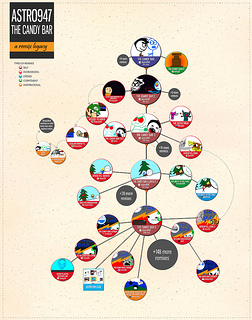
Remix Diagram
We try to shed light on both of these questions using data from Scratch a large online remixing community. Although we find support for several popular theories, we also present evidence in support of a persistent trade-off that has broad practical and theoretical implications. In what we call the remixing dilemma, we suggest that characteristics of projects that are associated with higher rates of remixing are also associated with simpler and less transformative types of derivatives.

Our study is focused on two interrelated research questions. First, we ask why some projects shared in remixing communities are more or less generative than others. Generativity a term we borrow from Jonathan Zittrain describes creative works that are likely to inspire follow-on work. Several scholars have offered suggestions for why some creative works might be more generative than others. We focus on three central theories:
  1. Projects that are moderately complicated are more generative. The free and open source software motto release early and release often suggests that simple projects will offer more obvious opportunities for contribution than more polished projects. That said, projects that are extremely simple (e.g., completely blank slates) may also uninspiring to would-be contributors.
  2. Projects by prominent creators are more generative. The reasoning for this claim comes from the suggestion that remixing can act as a form of cultural conversation and that the work of popular creators can act like a common medium or language.
  3. Projects that are remixes themselves are more generative. The reasoning for this final claim comes from the idea that remixing thrives through the accumulation of contributions from groups of people building on each other s work.
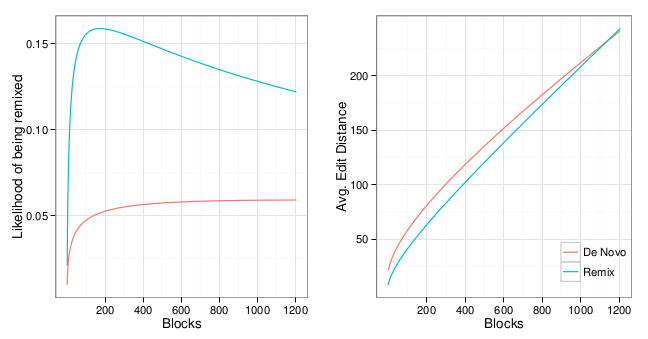
Our second question focuses on the originality of remixes and asks when more or less transformative remixing occurs. For example, highly generative projects may be less exciting if the projects produced based on them are all near-identical copies of antecedent projects. For a series of reasons including the fact that increased generativity might come by attracting less interested, skilled, or motivated individuals we suggest that each of the factors associated with generativity will also be associated with less original forms of remixing. We call this trade-off the remixing dilemma. We answer both of our research questions using a detailed dataset from Scratch, where young people build, share, and collaborate on interactive animations and video games. The community was built to support users of the Scratch programming environment, a desktop application with functionality similar to Flash created by the Lifelong Kindergarten Group at the MIT Media Lab. Scratch is designed to allow users to build projects by integrating images, music, sound, and other media with programming code. Scratch is used by more than a million users, most of them under 18 years old. To test our three theories about generativity, we measure whether or not, as well as how many times, Scratch projects were remixed in a dataset that includes every shared project. Although Scratch is designed as a remixing community, only around one tenth of all Scratch projects are ever remixed. Because more popular projects are remixed more frequently simply because of exposure, we control for the number of times each project is viewed. Our analysis shows at least some support for all three theories of generativity described above. (1) Projects with moderate amounts of code are remixed more often than either very simple or very complex projects. (2) Projects by more prominent creators are more generative. (3) Remixes are more likely to attract remixers than de novo projects. To test our theory that there is a trade-off between generativity and originality, we build a dataset that includes every Scratch remix and its antecedent. For each pair, we construct a measure of originality by comparing the remix to its antecedent and computing an edit distance (a concept we borrow from software engineering) to determine how much the projects differ. We find strong evidence of a trade-off: (1) Projects of moderate complexity are remixed more lightly than more complicated projects. (2) Projects by more prominent creators tend to be remixed in less transformative ways. (3) Cumulative remixing tends to be associated with shallower and less transformative derivatives. That said, our support for (1) is qualified in that we do not find evidence of the increased originality for the simplest projects as our theory predicted.
Two plots of estimated values for prototypical projects. Panel 1 (left) display predicted probabilities of being remixed. Panel 2 (right) display predicted edit distances. Both panels show predicted values for both remixes and de novo projects from 0 to 1,204 blocks (99th percentile).

Two plots of estimated values for prototypical projects. Panel 1 (left) displays predicted probabilities of being remixed. Panel 2 (right) displays predicted edit distances. Both panels show predicted values for both remixes and de novo projects from 0 to 1,204 blocks (99th percentile).

We feel that our results raise difficult but important challenges, especially for the designers of social media systems. For example, many social media sites track and display user prominence with leaderboards or lists of aggregate views. This technique may lead to increased generativity by emphasizing and highlighting creator prominence. That said, it may also lead to a decrease in originality of the remixes elicited. Our results regarding the relationship of complexity to generativity and originality of remixes suggest that supporting increased complexity, at least for most projects, may have fewer drawbacks. As supporters and advocates of remixing, we feel that although highly generative works that lead to highly original derivatives may be rare and difficult for system designers to support, understanding remixing dynamics and encouraging these rare projects remain a worthwhile and important goal. Benjamin Mako Hill, Massachusetts Institute of Technology
Andr s Monroy-Hern ndez, Microsoft Research
For more, see our full paper, The remixing dilemma: The trade-off between generativity and originality. Published in American Behavioral Scientist. 57-5, Pp. 643 663. (Official Link, Pay-Walled ).

Gunnar Wolf: Still more e-voting related rants

Some weeks ago, I contacted Rosa Mart nez, a tech journalist with some questions regarding what I regarded as a trick interview with an e-voting salesman. Well, not only she offered me to publish an answer to that interview, but she also offered me to write another article on a second site she also works with. So, I accepted. Being quite time-deprived, although I managed to send her the first answer quickly, by April 22, I only sent the second article yesterday night. Anyway, the links. The texts are published in Spanish:

Niels Thykier: Wheezy was brought to you by

During the Wheezy freeze, the Debian release team deployed 3254 hints[1]. This number may include some duplicates (i.e. where two members of the team hinted the same package), it certainly does not include a lot of rejected requests <insert more disclaimers here>. The top hinter was *drum roll* Adam, who did 1799 hints(That is 55% of all hints during the freeze). For comparison, the second and third runner ups added together did 1023 hints (or 31.4%). Put in a different way, on average Julien Cristau and I would both add about 1.5 hints each day and Adam would on his own add 5.6 hints a day. Of course, this is not intended to diminish the work other the rest of the team. Reviewing and unblocking packages is not all there is to a release. Particularly, a great thanks to Cyril Brulebois for his hard work on the Debian Installer (without which Debian Wheezy could not be released at all). Enjoy! [1] Determined by:
  egrep -c 'done 201(3 2-?(07 08 09 10 11 12)) $HINT_FILE
It does not count hints, but the little header we add above our hints. One header can apply to multiple hints (which is good, because udeb unblocks are usually paired with a regular unblock and we don t want to count them as two separate hints).

Bernhard R. Link: gnutls and valgrind

Memo to myself (as I tend to forget it): If you develop gnutls using applications, recompile gnutls with --disable-hardware-acceleration to be able to test them without getting flooded with false-positives.

Hideki Yamane: 48GB mem machine for $600

DELL Power Edge T320 is sold for $250 and 8GB memory is $50, then 250 + 50 *6 = $550-600, 48GB memory. wow.

Paul Tagliamonte: Hylang updates

We ve got all sorts of spiffy changes lined up and another major release! We ve got Hy version 0.9.7 released. The website is updated with the latest cut of the hylang, and y all should check it out.
Sadly, we ve not attracted any women interested in hacking on hy, so I d like to re-iterate that I m quite disappointed to see that, and encourage female hackers to check out the source and see what they can do with it. As always, the source is over at https://github.com/hylang/hy - star it, hack it, fork it, use it!

8 May 2013

Lior Kaplan: Debian in space

One more step at being the universal operating system: getting Debian to space:
Specifically, the International Space Station astronauts will be using computers running Debian 6.

Filed under: Debian GNU/Linux

Ingo Juergensmann: Is GSOC a whitewashing project?

"The same procedure as last year, Ms. Sophie?" - "The same procedure as every year, James!" - at least when summer is coming, every year Google starts its "Google Summer of Code" (GSoC). This contest is a yearly event since 2005. Wikipedia states:
The Google Summer of Code (GSoC) is an annual program, first held from May to August 2005,[1] in which Google awards stipends (of 5,000 USD, as of 2013)[2] to hundreds of students who successfully complete a requested free and open-source software coding project during the summer. The program is open to students aged 18 or over the closely related Google Code-In is intended for students under the age of 18. [...] The program invites students who meet their eligibility criteria to post applications that detail the software-coding project they wish to perform. These applications are then evaluated by the corresponding mentoring organization. Every participating organization must provide mentors for each of the project ideas received, if the organization is of the opinion that the project would benefit from them. The mentors then rank the applications and decide among themselves which proposals to accept. Google then decides how many projects each organization gets, and asks the organizations to mark at most that many projects accordingly.
Sounds nice, eh? Submit a nice project, do some cool coding and get 5000.- US-$ for having some sort of fun! While writing Open Source software (FLOSS/Libre Software), often there's no money it. It's an honory task, just for the benefit of creating a better world. A little bit, at least. Doing some coding on FLOSS and getting paid is great, eh? But think twice! Maybe Google is not that friendly company it always states that it is? In the first place Google is a company and wants to earn money. And it has a mantra: "Don't be evil!" But the companys main purpose is to earn money and it will do anything to achieve this. Think of GSoC as a cheap marketing project for Google. A contest for whitewashing Googles image. They can say: "hey, look! We are supporting the FLOSS community! We are not evil!" And you can look at GSoC as a cheap recruitment program for Google. Overall it appears that Google has a bigger benefit from GSoC than the participants as a single or than FLOSS community as a whole. There is a danger that the community gets pocketed by Google instead of enforcing the FLOSS standards and being as independant as possible. Sure, you need to pay bills, get something to eat and so on, but do you really want to help Google to whitewash its image as a monopolistic company? Or would it be worth to try out some sort of crowd funding when you have a great idea for a program you want to write?
Kategorie:

Joey Hess: faster dh

With wheezy released, the floodgates are opened on a lot of debhelper changes that have been piling up. Most of these should be pretty minor, but I released one yesterday that will affect all users of dh. Hopefully in a good way. I made dh smarter about selecting which debhelper commands it runs. It can tell when a package does not use the stuff done by a particular command, and skips running the command entirely. So the debian/rules binary of a package using dh will now often look like this:
dh binary
   dh_testroot
   dh_prep
   dh_auto_install
   dh_installdocs
   dh_installchangelogs
   dh_perl
   dh_link
   dh_compress
   dh_fixperms
   dh_installdeb
   dh_gencontrol
   dh_md5sums
   dh_builddeb
Which is pretty close to the optimal hand-crafted debian/rules file (and just about as fast, too). But with the benefit that if you later add, say, cron job files, dh_installcron will automatically start being run too. Hopefully this will not result in any behavior changes, other than packages building faster and with less noise. If there is a bug it'll probably be something missing in the specification of when a command needs to be run. Beyond speed, I hope that this will help to lower the bar to adding new commands to debhelper, and to the default dh sequences. Before, every such new command slowed things down and was annoying. Now more special-purpose commands won't get in the way of packages that don't need them.
The way this works is that debhelper commands can include a "PROMISE" directive. An example from dh_installexamples
# PROMISE: DH NOOP WITHOUT examples
Mostly this specifies the files in debian/ that are used by the command, and whose presence triggers the command to run. There is also a syntax to specify items that can be present in the package build directory to trigger the command to run. (Unfortunatly, dh_perl can't use this. There's no good way to specify when dh_perl needs to run, short of doing nearly as much work as dh_perl would do when run. Oh well.) Note that third-party dh_ commands can include these directives too, if that makes sense.
I'm happy how this turned out, but I could be happier about the implementation. The PROMISE directives need to be maintained along with the code of the command. If another config file is added, they obviously must be updated. Other changes to a command can invalidate the PROMISE directive, and cause unexpected bugs. What would be ideal is to not repeat the inputs of the command in these directives, but instead write the command such that its inputs can be automatically extracted. I played around with some code like this:
$behavior = main_behavior("docs tmp(usr/share/doc/)", sub  
       my $package=shift;
       my $docs=shift;
       my $docdir=shift;
       install($docs, $docdir);
 );
$behavior->($package);
But refactoring all debhelper commands to be written in this style would be a big job. And I was not happy enough with the flexability and expressiveness of this to continue with it. I can however, dream about what this would look like if debhelper were written in Haskell. Then I would have a Debhelper a monad, within which each command executes.
main = runDebhelperIO installDocs
installDocs :: Monad a => Debhelper a
installDocs = do
    docs <- configFile "docs"
    docdir <- tmpDir "usr/share/doc"
    lift $ install docs docdir
To run the command, runDebhelperIO would loop over all the packages and run the action, in the Debhelper IO monad. But, this also allows making an examineDebhelper that takes an action like installDocs, and runs it in a Debhelper Writer monad. That would accumulate a list of all the inputs used by the action, and return it, without performing any side effecting IO actions. It's been 15 years since I last changed the language debhelper was written in. I did that for less gains than this, really. (The issue back then was that shell getopt sucked.) IIRC it was not very hard, and only took a few days. Still, I don't really anticipate reimplementing debhelper in Haskell any time soon. For one thing, individual Haskell binaries are quite large, statically linking all Haskell libraries they use, and so the installed size of debhelper would go up quite a bit. I hope that forthcoming changes will move things toward dynamically linked haskell libraries, and make it more appealing for projects that involve a lot of small commands. So, just a thought experiment for now..

Next.

Previous.