Search Results: "ed"

17 May 2013

Rob Bradford: GNOME in Moblin: Myzone

Howdy, i m sure most people are aware of the recent release of Moblin 2.0; a user experience for netbooks. I m going to write a few blog posts about how the Moblin user experience is built on the awesome technologies in the GNOME platform. So first up, let s look at the Myzone, we re starting here since this is the first thing I really worked on in the Moblin UX and i ve been able to see it through from early ideas to the 2.0 and 2.1 releases. So, deep breath, the idea behind the Myzone is to provide a springboard to things that matter to you most: your recent files and web pages you ve visited, your upcoming events and things you need to do, things that are happening on social web services and your favourite applications. Now then, that s the theory, how does it work:

Rob Bradford: GNOME in Moblin: People panel

Previously i d talked about how we use GNOME technologies in the Moblin Myzone. Now i m going to talk about another component that i m responsible for, the People Panel. An important aspect of the Moblin user experience is about communicating with others and this panel provides quick access to do this. The core of the content is provided by an abstraction, simplification and aggregation library called Anerley. This provides a feed of items (an addressbook of people) that aggregates across the system addressbook, powered by EDS, and your IM roster, powered by Telepathy. You have small set of actions you can do on these people such as start an IM conversation / email / edit them with Contacts. The core of our IM experience is supplied by the awesome Empathy. We ve been working with the upstream maintainers to accomodate some of the needs of Moblin into the upstream source. This included the improvements to the accounts dialog and wizard that landed for GNOME 2.28. One of the biggest problems with the IM experience in Moblin 2.0 was that it was easy to miss when somebody was talking to you. If you were looking away when the notification popped up, whoops, it s gone. With our switch to Mission Control 5 I was able to integrate a Telepathy Observer into Anerley and the People Panel. An Observer will be informed of channels that are requested on the system. This allows us to show ongoing conversations in the panel and by exploiting channel requests and window presentation allow the user to switch between ongoing conversations. This wouldn t have been possible without the assistance of the nice folks in #telepathy and at Collabora: Sjoerd, Will, Jonny and countless others.

Hideki Yamane: add epub support to developers reference

I've added epub support to Debian developers reference 3.4.10 (see /usr/share/doc/developers-reference*/*.epub), so you can read it with your favorite ebook reader like kindle, sony reader or something that NetBSD folks uses for porting ;-)

Petter Reinholdtsen: How to transform a Debian based system to a Debian Edu installation

Debian Edu / Skolelinux is an operating system based on Debian intended for use in schools. It contain a turn-key solution for the computer network provided to pupils in the primary schools. It provide both the central server, network boot servers and desktop environments with heaps of educational software. The project was founded almost 12 years ago, 2001-07-02. If you want to support the project, which is in need for cash to fund developer gatherings and other project related activity, please donate some money. A topic that come up again and again on the Debian Edu mailing lists and elsewhere, is the question on how to transform a Debian or Ubuntu installation into a Debian Edu installation. It isn't very hard, and last week I wrote a script to replicate the steps done by the Debian Edu installer. The script, debian-edu-bless in the debian-edu-config package, will go through these six steps and transform an existing Debian Wheezy or Ubuntu (untested) installation into a Debian Edu Workstation:
  1. Add skolelinux related APT sources.
  2. Create /etc/debian-edu/config with the wanted configuration.
  3. Install debian-edu-install to load preseeding values and pull in our configuration.
  4. Preseed debconf database with profile setup in /etc/debian-edu/config, and run tasksel to install packages according to the profile specified in the config above, overriding some of the Debian automation machinery.
  5. Run debian-edu-cfengine-D installation to configure everything that could not be done using preseeding.
  6. Ask for a reboot to enable all the configuration changes.
There are some steps in the Debian Edu installation that can not be replicated like this. Disk partitioning and LVM setup, for example. So this script just assume there is enough disk space to install all the needed packages. The script was created to help a Debian Edu student working on setting up Raspberry Pi as a Debian Edu client, and using it he can take the existing Raspbian installation and transform it into a fully functioning Debian Edu Workstation (or Roaming Workstation, or whatever :). The default setting in the script is to create a KDE Workstation. If a LXDE based Roaming workstation is wanted instead, modify the PROFILE and DESKTOP values at the top to look like this instead:
PROFILE="Roaming-Workstation"
DESKTOP="lxde"
The script could even become useful to set up Debian Edu servers in the cloud, by starting with a virtual Debian installation at some virtual hosting service and setting up all the services on first boot.

Daniel Pocock: Zermatt, Matterhorn and Gornergrat

The DebConf13 registration deadline for developers requesting sponsorship has been extended up to Sunday, so for those still undecided or anybody else thinking about a visit to .ch, I'm sharing some more pictures today. The Matterhorn is one of the iconic symbols of Switzerland's natural beauty and appears on many postcards. The car-free town of Zermatt is at the bottom and is the final stop on the Matterhorn Gotthard Bahn railway, so it is really easy to get there with one or two trains every hour of the day. One of the most exciting places to view the Matterhorn is from the nearby observatory at Gornergrat, which is 3,089m above sea level. It is great for a single day trip of hiking and there is a convenient train station there too. The scenic train to Zermatt is included in any of the Swiss rail passes, but the train up to Gornergrat is a private railway and a special ticket must be purchased. Discounts are sometimes offered at rail stations in Swiss cities or online or it is possible to hike up and down.

Russell Coker: Voltage Inside a Car

I previously wrote a post with some calculations about the power supplied to laptops from a car battery [1]. A comment on the post suggested that I might have made a mistake in testing the Voltage because leaving the door open (and thus the internal lights on) will cause a Voltage drop. So I ve done some more tests:
Test Voltage
battery terminals 12.69
front power socket with doors closed 12.64
front power socket with doors open OR ignition switch on 12.37
cigarette lighter socket with ignition switch on 12.32
front power socket with doors closed and headlights on 11.96
front power socket with engine running 14.38
front power socket with engine running and headlights on 14.29
In my previous tests I recorded 12.85V inside my car (from the front power socket which although having the same connector as a cigarette lighter isn t designed for lighting cigarettes) and 13.02V from the battery terminals a 0.17V difference. In my tests today I was unable to reproduce that but I think that my biggest mistake was to take the reading too quickly. Today I noticed that it took up to a minute for the Voltage to stabilise after opening a door (the Voltage dips after any current draw and takes time to recover) so a quick reading isn t going to be accurate. My car is a Kia Carnival which has two sockets in the front for power and for actually lighting cigarettes. The one for lighting cigarettes has a slightly lower Voltage and only works when the ignition is turned on. The car also has a power socket in the boot (the trunk for US readers) which delivers the same Voltage as the power socket in the front. Also one thing to note is that today is a reasonably cold day (16.5C outside right now) and my car hasn t been driven since last night so the battery would be quite cold (maybe 12C or less). My previous measurements were taken in summer so the battery would have been a lot warmer and therefore working more effectively. Conclusion The Voltage drop from turning on the internal lights surprised me, I had expected that a car battery which is designed to supply high current wouldn t be affected by such things. Certainly not to give a 2% Voltage drop! The Voltage difference from reading inside the car and at the battery terminals might be partly due to the apparent lead coating on the terminals, I pushed the probes of my multimeter beneath the surface of the metal and got a really good connection. The 14% Voltage increase when the engine was running was also a surprise. It seems to me that if you are running a power hungry device (such as a laptop) it would be a good idea to disconnect it when the engine is turned off. A 14% higher voltage will give a 14% lower current if the PSU is efficient and therefore less problems with heat in the wiring and less risk of blowing a fuse. Also it s a good idea to be more methodical about performing tests than I was before my last post. There are lots of other tests I could run (such as testing after the engine has been running for a while) but at the moment I don t have enough interest in this topic to do more tests. Please leave a comment if there s something interesting that you think I missed.

Russell Coker: Effective Conference Calls

I ve been part of many conference calls for work and found them seriously lacking. Firstly there s a lack of control over the call, so when someone does something stupid like putting an unmuted phone handset near a noise source there s no way to discover who did it and disconnect them. Another problem is that of noise on the line when some people don t mute their phones, which is related to the lack of control as it s impossible to determine who isn t muting their phone. Possibly the biggest problem is how to determine who gets to speak next. When group discussions take place in person non-verbal methods are used to determine who gets to speak next. With a regular phone call (two people) something like the CSMACD algorithm for network packets works well. But when there are 8+ people involved it becomes time consuming to resolve issues of who speaks next even when there are no debates. This is more difficult for multinational calls which can have a signal round trip time of 700ms or more. I think that we need a VOIP based conference call system for smart phones to manage this. I think that an ideal system would be based on the push to talk concept with software control that only allows one phone to transmit at a time. If someone else is speaking and you want to say something then you would push a button to indicate your desire but your microphone wouldn t go live while the other person was speaking. The person speaking would be notified of your request and one of the following things would happen: Did I miss any obvious ways for the system to react to a talk request? Is there any free software to do something like this? A quick search of the Google Play store didn t find anything that seems to match.

16 May 2013

Michael Vogt: git fast-import apt

Due to popular demand I moved debian apt and python-apt from bzr to git today. Moving was pretty painless:
$ git init
$ bzr fast-export --export-marks=marks.bzr -b debian/sid /path/to/debian-sid   git fast-import --export-marks=marks.git
And then a fast-import for the debian-wheezy and debian-experimental branches too. Then a
$ git gc --aggressive
(thanks to Guillem Jover for pointing this out) and that was it. The branches are available at:

Scott Kitterman: New ipaddress module in python3.3

Back in 2010 I packaged Google s ipaddr module because I needed a light weight IP address manipulation library that supported both IPv4 and IPv6 and (at the time) python-subnettree was IPv4 only. Well, ipaddr is all grown up now and included in python3.3 as the ipaddress manipulation module in the standard library. You can find details, as well as some description of the differences, in PEP 3144. I just converted one package that I m upstream for to use either ipaddr (for python2.6/2.7/3.2) or ipaddress instead of some custom code. It turned out to be pretty easy to make it work with either. Other than the name, the only difference I ran into was the removal of the common, generic IPAddress and IPNetwork functions that are replaced by ip_address and ip_network.
-import ipaddr
+try:
+ import ipaddress
+except ImportError:
+ import ipaddr as ipaddress

- address = ipaddr.IPAddress(ip)
- if isinstance(address, ipaddr.IPv4Address):
+ try:
+ address = ipaddress.ip_address(ip)
+ except AttributeError:
+ address = ipaddress.IPAddress(ip)
+ if isinstance(address, ipaddress.IPv4Address):
Currently, python3-ipaddr has no reverse-dependencies in the archive (python-ipaddr does). Once python3.2 is dropped from Jessie, I think I ll drop the python3-ipaddr binary on the assumption people newly coding for python3.3 should use ipaddress. The python-ipaddr module will stick around for use with python2.7.

DebConf team: DebConf13 registration extended and DebConf12 Final Report (Posted by Didier Raboud)

Dear all,
Going to DebConf13!
DebConf13 sponsorship application date extended As communicated through the debconf-announce@lists.debconf.org mailing list, the deadline to apply for DebConf13 sponsorship has been extended to the end of this week, May 19th. If you intend to attend DebConf13 in August and would like to apply for sponsored registration, now is the time to register in Penta! After this deadline you will no longer be able to apply for sponsored food, accomodation or travel. Please refer to the announcement and to the registration documentation for details. Please contact us on the debconf-discuss mailing list if you have any questions. DebConf12 final report The DebConf team is also happy to announce the release of the DebConf12 Final Report. It s a 39-page document which gives the reader an idea about the conference as a whole. It includes descriptions of talks, DebCamp and Debian Day activities, personal impressions, attendee and budgeting numbers, the work of various teams, social events and so on. If you attended Debconf12, the report may refresh some of your memories and bring you closer to the organization team work. If not, it will certainly encourage you to be part of future Debian events. We thank the Universidad Centroamericana, the Government of Nicaragua, Google and all other DebConf12 sponsors for their support that made the event possible. The DebConf team

Vincent Sanders: True art selects and paraphrases, but seldom gives a verbatim translation

In my professional life I am sometimes required to provide technical support to one of our salesmen. I find this an interesting change in pace though sometimes challenging.

Occasionally I fail to clearly convey the solution we are trying to sell because of my tendency to focus on detail the customer probably does not need to understand but I think is the interesting part of the problem.

Conversely sometimes the sales people gloss over important technology choices which have a deeper impact on the overall solution. I was recently in such a situation where as part of a larger project the subject of internationalisation (you can see why it gets abbreviated to i18n) was raised.

I had little direct personal experience with handling this within a project workflow so could not give any guidance but the salesman recommended the Transifex service as he had seen it used before, indicated integration was simple and we moved onto the next topic.

Unfortunately previous experience tells me that sometime in the near future someone is going to ask me hard technical questions about i18n and possibly how to integrate Transifex into their workflow (or at least give a good estimate on the work required).
LearningBeing an engineer I have few coping strategies available for situations when I do not know how something works. The approach I best know how to employ is to give myself a practical crash course and write up what I learned...so I did.

I proceeded to do all the usual things you do when approaching something unfamiliar (wikipedia, google, colleagues etc.) and got a basic understanding of internationalisation and localisation and how they fit together.

This enabled me to understand that the Transifex workflow proposed only covered the translation part of the problem and that, as Aldrich observed in my title quote, there is an awful lot more to translation than I suspected.
PlatformsMy research indicated that there are numerous translation platforms available for both open source and commercial projects and Transifex is one of many solutions.

Although the specific platform used was Transifex most of these observations apply to all these other platforms. The main lesson though is that all platforms are special snowflakes and once a project invests effort and time into one platform it will result in the dreaded lock in. The effort to move to another platform afterwards is at least as great as the initial implementation.

It became apparent to me that all of these services, regardless of their type, boil down to a very simple data structure. They appear to be a trivial table of Key:Language:Value wrapped in a selection of tools to perform format conversions and interfaces to manipulate the data.

There may be facilities to attach additional metadata to the table such as groupings for specific sets of keys (often referred to as resources) or translator hints to provide context but the fundamental operation is common.

The pseudo workflow is:
The first three steps are almost always performed together by the uploading of a resource file containing an initial set of translations in the "default" language and due to the world being the way it is this is almost always english (some services are so poorly tested with other defaults they fail if this is not the case!)

The platforms I looked at generally follow this pattern with a greater or lesser degree of freedom in what the keys are, how the groupings into resources are made and the languages that can be used. The most common issue with these platforms (especially open source ones) is that the input convertors will only accept a very limited number of formats and often restricted to just GNU gettext PO files. This means that to use those platforms a project would have to be able to convert any internal resources into gettext translatable format.

The prevalence of the PO format pushes assumptions into almost every platform I examined, mainly that a resource is for a single language translation and that the Key (msgid in gettext terms) is the untranslated default language string in the C locale.

The Transifex service does at least allow for the Key values to be arbitrary although the resources are separated by language.

Even assuming a project uses gettext PO files and UTF-8 character encoding (and please can we kill every other character encoding and move the whole world to UTF-8) the tools to integrate the import/export into the project must be written.

A project must decide some pretty important policies, including:
These are project policy decisions and, as I discovered, just as difficult to answer as the technical challenges.

Armed with my basic understanding it was time to move on and see how the transifex platform could be integrated into a real project workflow.
ImplementingProof of conceptMy first exercise was to take a trivial command line tool, use xgettext to generate a PO file and add the relevant libintl calls to produce gettext internationalised tool.

A transifex project was created and the english po file uploaded as the initial resource. A french language was added and the online editor used to provide translations for some strings. The PO resource file for french was exported and the tool executed with LANGUAGE=fr and the french translation seen.

This proved the trivial workflow was straightforward to implement. It also provided insight into the need to automate the process as the manual website operation would soon become exceptionally tedious and error prone.
Something more usefulTo get a better understanding of a real world workflow I needed a project that:
I selected the NetSurf web browser as it best fit this list.

Internally NetSurf keeps all the translated messages in a simple associative array this is serialised to an equally straightforward file named FatMessages. The file is UTF-8 encoded with keys separated from values by a colon. The Key is constrained to be ASCII characters with no colons and is structured as language.toolkit.identifier and is unique on identifier part alone.

This file is processed at build time into a simple identifier:value dictionary for each language and toolkit.

Transifex can import several resource formats similar to this, after experimenting with YAML and Android Resource format I immediately discovered a problem, the services import and export routines were somewhat buggy.

These routines coped ok with simple use cases but having more complex characters such as angle brackets and quotation marks in the translated strings would completely defeat the escaping mechanisms employed by both these formats (through entity escaping in android resource format XML is problematic anyway)

Finally the Java property file format was used (with UTF-8 encoding) which while having bugs in the import and export escaping these could at least be worked around. The existing tool that was used to process the FatMessages file was rewritten to cope with generating different output formats and a second tool to merge the java property format resources.

To create these two tools I enlisted the assistance of my colleague Vivek Dasmohapatra as his Perl language skills exceeded my own. He eventually managed to overcome the format translation issues and produce correct input and output.
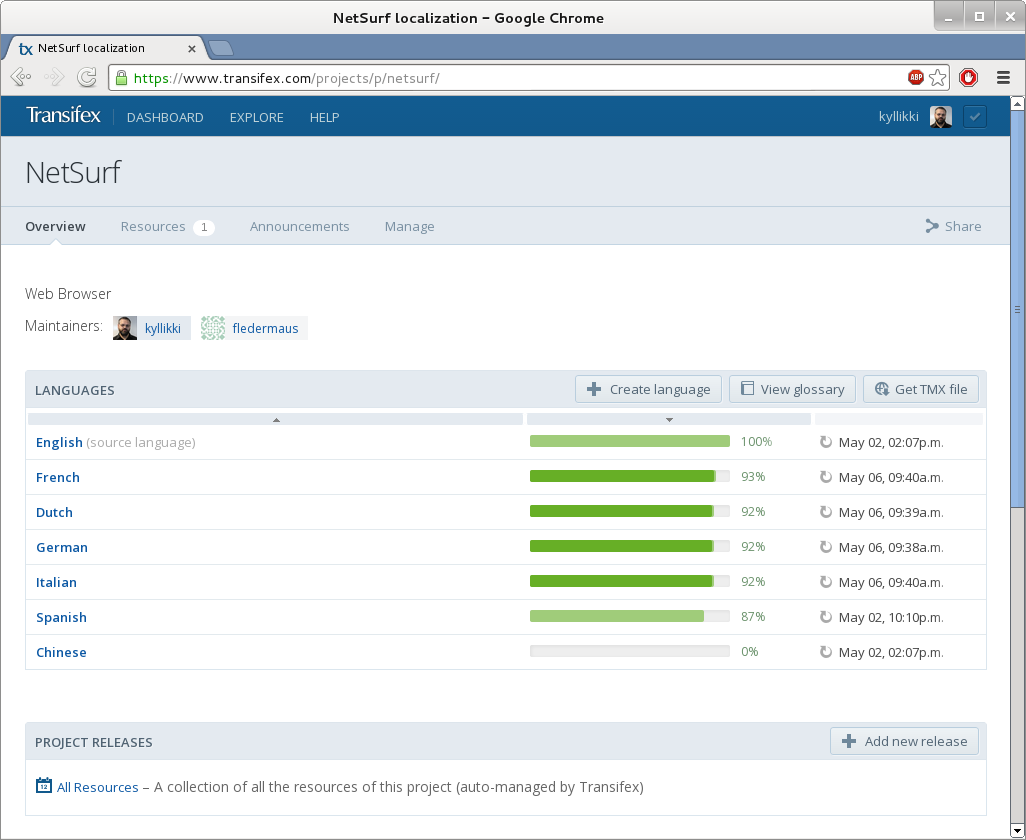
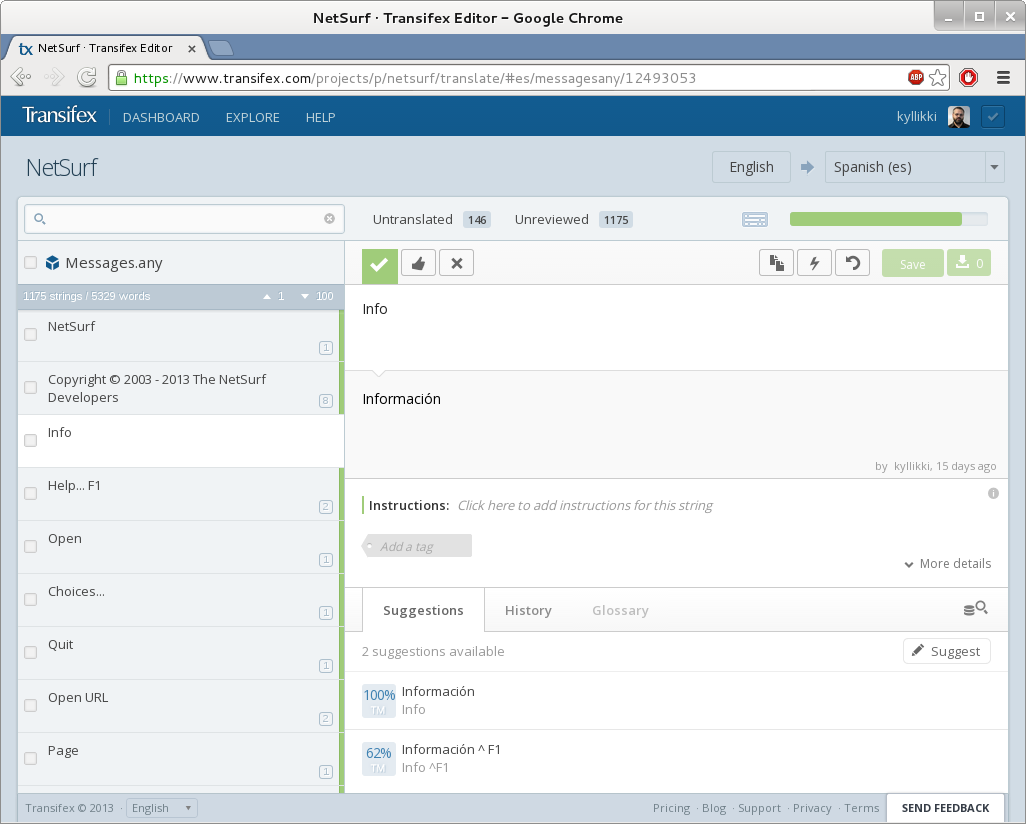
I used the Transifex platforms free open source product, created a new project and configured it for free machine translation from the Microsoft service, all of which is pretty clearly documented by Transifex.

Once this was done the messages file was split up tinto resources for the supported languages and uploaded to the transifex system.

I manually marked all the uploaded translations as "verified" and then added a few machine translations to a couple of languages. I also created spanish as a new language and machine translated most of the keys.

The resources for each language were then downloaded and merged and the resulting FatMessages file checked for differences and verified only the changes I expected appeared.

I quickly determined that manually downloading the language resources every time was not going to work with any form of automation, so I wrote a perl script to retrieve the resources automatically (might be useful for other projects too).

Once these tools were written and integrated into the build system I could finally make an evaluation as to how successful this exercise had been.
ConclusionsThe main things I learned from this investigation were:

Overall I think the final observation has to be that integrating translation services is not a straightforward operation and each project has unique challenges and requirements which reduce the existing platforms to compromise solutions.

Wouter Verhelst: Single-stepping init systems

The Linux init systems are a bit in flux at the moment. That is, they're in flux in Debian; outside Debian, most other distributions have stepped away from sysvinit and towards something else (systemd, openrc, or upstart). I've not been a proponent of any switch, though I understand the reasoning, and it probably makes sense for us to switch at some point. But yesterday, the fact that this customer's system was running sysvinit and not systemd or upstart saved me quite a bit. There's a server. It has one quadcore processor. For reasons that I won't go into here, the customer wants an extra quadcore processor to be added to the system. After having done so, I power on the system... only to see it power itself off at some point during boot. I did notice some kernel messages fly by just moments before the system would power itself off, but it was impossible for me to read them. So what did I do? That last bit is, obviously, a bit of an ugly workaround; the better way to fix this issue would have been to debug what the actual issue was, and implement a proper fix. However, I didn't have time for that (the fact that there was need for a second quadcore chip explains how much this system is in use), and the workaround was acceptable for the customer. It is not the first time that this ability to single-step the init system has saved me. The fact that sysvinit is so simplistic is what makes this possible, and I consider that one of its most important features. Recently, I came into contact with a distribution that uses systemd as its init system (in casu, Arch Linux). I had made a mistake in configuration; I had installed and enabled a graphical login system, but had no xterm or similar available, and had done something else wrong through which I couldn't get a regular shell on the console anymore, either. To fix this, I tried doing something like the above (running with init=/bin/bash and single-stepping the init system), but found that doing so with systemd is nigh impossible. In the end, I knew what exactly the problem was and could disable automatically starting the login manager through removing a symlink, but it brought home the issue that debugging a similar issue when running systemd rather than sysvinit might be a lot harder to do. We'll see what the future brings.

Daniel Pocock: Debian to rescue Skype users?

Last year at DebConf12 and the Paris mini-DebConf I mentioned some of the sophisticated techniques that the likes of Microsoft and Facebook are using to monitor their customers. So when Skype was busted spying on the content of chat messages, it was no surprise for many people in the Debian community. People are already rushing to find alternatives like XMPP and Jitsi. Debian 7 has been released just in time, with powerful features like TURN support that finally allow users to make free calls and chats with seamless NAT traversal. Sadly, Debian's built-in VoIP/RTC client, Empathy, only uses Google's TURN servers and not native Debian servers, but hopefully a solution will come soon, but it is easy enough to install Jitsi instead and configure it to use any of the free TURN server software on Debian. It should be emphasized that Skype does not just spy on URLs in chat - it has simply been possible to detect this form of spying by detecting when the URL is accessed. Microsoft has taken out various patents for secretive monitoring of Internet phone calls and the analysis of speech patterns to detect both the content and emotions during a conversation. This allows them to get a very thorough analysis of the state of mind of every user at almost every moment and fine-tune the type of advertising and branding that is delivered to that person through conventional means and also through biased news' reporting and other means.

Daniel Pocock: Debian to rescue Skype users?

Last year at DebConf12 and the Paris mini-DebConf I mentioned some of the sophisticated techniques that the likes of Microsoft and Facebook are using to monitor their customers. So when Skype was busted spying on the content of chat messages, it was no surprise for many people in the Debian community. People are already rushing to find alternatives like XMPP and Jitsi. Debian 7 has been released just in time, with powerful features like TURN support that finally allow users to make free calls and chats with seamless NAT traversal. Sadly, Debian's built-in VoIP/RTC client, Empathy, only uses Google's TURN servers and not native Debian servers, but hopefully a solution will come soon, but it is easy enough to install Jitsi instead and configure it to use any of the free TURN server software on Debian. It should be emphasized that Skype does not just spy on URLs in chat - it has simply been possible to detect this form of spying by detecting when the URL is accessed. Microsoft has taken out various patents for secretive monitoring of Internet phone calls and the analysis of speech patterns to detect both the content and emotions during a conversation. This allows them to get a very thorough analysis of the state of mind of every user at almost every moment and fine-tune the type of advertising and branding that is delivered to that person through conventional means and also through biased news' reporting and other means.

Russ Allbery: Review: Asimov's, July 2011

Review: Asimov's Science Fiction, July 2011
Editor: Sheila Williams
Issue: Volume 35, No. 7
ISSN: 1065-2698
Pages: 112
Williams's editorial is a mildly interesting piece about story titles. Silverberg's column is a more interesting (and rather convincing) rebuttal of the joke that fiction authors are "professional liars," combined with an examination of a fake and fantastic 14th travelogue that (at least in Silverberg's telling) was widely believed at the time. The precis of Silverberg's argument is that lying requires an intent to deceive, which is a property of deceptive memoir writers but not of fiction authors. Di Filippo's review column, as usual, is devoted almost entirely to esoterica, although I was moderately interested to hear of Stableford's continued work on translating early French SF. None of it seems compelling enough to go buy, but good translations of early works seem like a good thing to have in the world. "Day 29" by Chris Beckett: The conceit of this novelette is an interstellar travel system akin to a transporter that allows near-instantaneous travel between worlds. The drawback is that all memories from somewhere between 40 and 29 days before transit up until transit are wiped. The progatonist is a data analyst who is about to travel, and therefore by agency rule is required to stop doing work on day 40 before transmission since he can't be held legally liable for anything he has no recollection of doing. (I would like to say that I find this implausible, since one could always keep records, but it's exactly the sort of ass-covering regulation that a human resources department would come up with.) The premise is quite interesting: what do you do during that period that you're going to forget? Beckett wisely mixes Stephen's current waiting period on the colony world with his diary of his original waiting period on Earth the first time he went through the transmission process, and the latter adds greatly to the reader's appreciation of the weirdness of the forgotten interval. Unfortunately, this is a story more about psychological exploration than about plot, and Stephen just isn't very interesting. The telepathic but possibly nonsentient aliens add weirdness but not much else, and the ending of the story provided little sense of closure or conclusion for me. A good idea, but not the execution I wanted. (5) "Pug" by Theodora Goss: Since I grew up with a pug, I have a soft spot for a story featuring one; sadly, though, this story has insufficient pug in it. This is a quiet fantasy (Asimov's calls it SF, presumably on the basis of parallel worlds and a hypothesized scientific explanation, but it reads like fantasy to me) featuring Victorian girls, including one with a bad heart. They discover a hidden door to other versions of their world and do some minor exploration. There's little or nothing in the way of plot; the story is more of an attempt to capture a mood. It's mildly diverting, but I wish it had gone somewhere more substantial. (5) "Dunyon" by Kristine Kathryn Rusch: A Rusch story is often the highlight of an issue, and this is no exception. The protagonist is the owner of a bar in a space station that's become a combination of a refugee camp and a slum. War and chaos have created desperate people, most of whom are attempting to find some way to resources and get out of the bottom of society. The story is about a rumor: a mythical system named Dunyon that's safe and far away. And it's about how people react to that rumor. There's nothing particularly surprising about the direction the story goes (it's fairly short), but Rusch is always a good storyteller. (7) "The Music of the Sphere" by Norman Spinrad: I've had mixed feelings about Spinrad's fiction (and some of his essays), but I liked this story, despite its implausibility. It's set in the near future, featuring an expert in cetaceans and dolphin perception and a composer obsessed with both loud music and classical musical style. Just from that description, you can probably predict much of the story, but I thought it had some neat ideas about dolphins, whales, and alternate perception and aesthetics. (Note: neat, not necessarily biologically plausible.) Enjoyable. (6) "Bring on the Rain" by Josh Roseman: In a change of pace from the rest of the issue, this is a post-apocalyptic story of caravans of wheeled ships traversing a scorched and ruined landscape in search of weather systems and rain. The feel is of an inverted Waterworld, but with more emphasis on military tactics and cooperating fleets. The transposition of fleet maneuvers to huge ground vehicles adds some extra fun. The plot has little to do with the background and is a fairly stock military adventure scenario, but it's reasonably well-told. The story feels like an excerpt from a larger military-SF-inspired adventure, but the length keeps the quantity of tactics and maneuvering below the threshold where I would get bored. (6) "Twelvers" by Leah Cypess: This is a sharp and occasionally mean story of adolescent cruelty and alienation. Darla is a "twelver," a child who was carried an extra three months in the womb using newly-invented medical technology because of a belief in the advantages this would bring in later life. Unfortunately for all those who used this technique, what it also brought was a preternatural calm and an unusual reaction to emotions. Darla finds it almost impossible to get upset at anything, and that, of course, prompts the cruelty and abuse of other children. Most of the story is a description of that abuse, leading up to Darla stumbling into a nasty solution to her immediate problem. It's all very believable (well, apart from the motivating biology), but I didn't enjoy reading about it, and I'm certainly not convinced that the ending will lead to anything good. (5) "The Messenger" by Bruce McAllister: This is a very short time travel story, where time travel is used to try to unwind old family pain. This world follows the unalterable history model: no changes to the past are possible, and anything you do in the past has already happened. The mechanics are mostly avoided. Instead, McAllister concentrates on his mother, his father, and their complex relationship. I would have needed a bit more background on the characters to care enough about them for the story to be fully effective, but while the heartstring-pulling is kind of obvious, it's still a solid story. (6) "The Copenhagen Interpretation" by Paul Cornell: This is the most ingenious of the stories in this issue. It's set in a future world that extends what seemed to me to be pre-World-War-I great power politics, although there may be a hint of the Cold War. Great nations have reached a careful balance of power, and spies and secret services work to sustain that balance. The progatonist is one of those agents, making use of advanced technology like space folds in the service of a cause that he doesn't entirely believe in. Cornell mixes in mental conditioning, artificial people, space travel, and even aliens (maybe) in a taut thriller plot that, for me, gained a great deal from the unexplained strangeness of its background. If you like diving into the deep end and following a fast-moving plot against a background of strangeness, this is the sort of SF you'll enjoy. (7) Rating: 6 out of 10

15 May 2013

Russ Allbery: WebAuth 4.5.3

Good news: we finally tracked down the intermittant redirect looping bug so that I could fix it! Bad news: it was also a security vulnerability. Thankfully, it was fairly specific: you had to be using FastCGI for the login page and you also had to be using the $REMUSER_REDIRECT option. But in those situations, WebAuth versions from 4.4.1 through 4.5.2 could potentially leak authentication state from one user to another. The full scenario is somewhat tedious to explain, but the short version is that, in 4.4.1, I switched over to using a single persistent CGI::Application object instead of re-creating it for each request. This takes better advantage of FastCGI. However, CGI::Application doesn't reset header properties between requests, and while we mostly did that internally, there was one specific case around REMOTE_USER redirects where we didn't. For more details, including a patch for those who don't want to upgrade, see the security advisory. WebAuth 4.5.3 has been released with only this fix relative to 4.5.2. You can get the latest release from the official WebAuth distribution site or from my WebAuth distribution pages.

Lisandro Damián Nicanor Pérez Meyer: Qt 4.8.4 in experimental.

Since a few days we have Qt 4.8.4 (4:4.8.4+dfsg-3) in some archs of the experimental Debian archive. This release allows Qt4 to coexist with Qt5 while avoiding FTBFSs of current Qt4 packages in the archive.

So if you maintain a Qt4 app and want to check how it works with 4.8.4, you should be ready to go.

Benjamin Mako Hill: Sounds Like a Map

Colored visualization of the puzzle. I love maps something that became clear to me when I was looking at the tag cloud of my bookmarks a few years back. One of my favorite blogs (now a book) is Frank Jabobs Strange Maps. So it s no coincidence that a number of my favorite MIT Mystery Hunt puzzles are map based. Trying to connect the two worlds, I sent Jacobs a write-up of the hunt and of a particularly strange sound-based map puzzle called White Noise that I worked with Don Armstrong to solve in the 2006 hunt. While I wasn t paying attention, Jacobs did a very nice writeup of my writeup of the puzzle for Strange Maps!

Craig Small: itools is back

My last post I said that I had to remove my internet query tools due to some bugs that were a concern. Some of the code was hard to maintain and probably had holes and I had noticed that it looped at times. I m happy to say that I have restored some of those tools now, still located at http://enc.com.au/itools This code is completely re-written in Python using the TurboGears toolkit which means it is a lot cleaner in how it works and how it looks. Some of the lookup tables use a database rather than an array for ease of updating and querying. The downside is the backends will take time. It currently only does nslookup queries and whois only works for IPv4 addresses. The domain name queries will be a while off as these are the most complicated to handle. To give you an idea, all IPv4 and IPv6 address information comes from 5 sources with two formats while domain names come from over 200 sources with about 40 formats. This means the information from Regional Internet Registries will be done first.

Bastian Venthur: How to get the most precise time, comparable between processes in Python?

Let s consider the following scenario: I have two Python processes receiving the same events and I have to measure the delay between when process A received the event and when process B received it, as precisely as possible (i.e. less than 1ms). Using Python 2.7 and a Unix system you can use the time.time method which provides the time in seconds since Epoch and has a typical resolution of a fraction of a ms on Unix. You can use it on different processes and still compare the results, since both processes receive the time since Epoch, a defined and fixed time in the past. On Windows time.time also provides the time since Epoch, but the resolution is in the range of 10ms, which is not suitable for my application. There is also time.clock which is super precise on Windows, and much less precise on Unix. The mayor drawback is that it returns the time since the process started or since the first call of time.clock within that processes. This means you cannot compare the results of time.clock between two processes as they are not calibrated to a common t-zero. I had high hopes for Python 3.3 where the time module was revamped and I was reading about time.monotonic and time.perf_counter. Especially time.perf_counter looked like it would suit my needs as the documentation said it provides the highest available resolution for the system and was system-wide , in contrast to for example the new time.process_time which was process_wide . Unfortunately it turned out that time.perf_counter acts similar to time.clock on Python 2.7 as it provides you with the time since the process started or the first time the method was called within the process. The results of time.monotonic are comparable between processes, but again not precise enough on Windows. Here is a small script which demonstrates how the times provided by time.clock and time.perf_counter are not comparable between processes. It starts two processes and lets both of them print out the output of the timer to stdout. In the output the times should be monotonically increasing. Since I let process 2 sleep for one second before calling the timer method for the first time, the output of this process is usually one second smaller when using time.clock or time.perf_counter.
#!/usr/bin/env python
from multiprocessing import Process
import time
timers = ['clock', 'time', 'monotonic', 'perf_counter']
def proc(timer):
    timer = getattr(time, timer)
    time.sleep(1)
    for i in range(3):
        print('P2  time '.format(time=timer()))
        time.sleep(1)
if __name__ == '__main__':
    for t in timers:
        print("Using  timer ".format(timer=t))
        p = Process(target=proc, args=(t,))
        timer = getattr(time, t)
        p.start()
        for i in range(3):
            print('P1  time '.format(time=timer()))
            time.sleep(1)
        p.join()
The result when running on Windows with Python 3.3:
$ python timertest.py
Using clock
P1 6.146032526480321e-06
P1 0.9926582847820045
P2 2.9612702173041547e-05
P1 1.9941743992602412
P2 1.0008579302676737
P2 2.0022709590185346
Using time
P1 1368614235.509732
P1 1368614236.511172
P2 1368614236.601301
P1 1368614237.512612
P2 1368614237.602741
P2 1368614238.604181
Using monotonic
P1 484.636
P1 485.63800000000003
P2 485.738
P1 486.639
P2 486.73900000000003
P2 487.741
Using perf_counter
P1 12.390910576623565
P1 13.39050745276285
P2 7.542858100680394e-06
P1 14.39190763071843
P2 1.0014012954160376
P2 2.0041399116368144
So as far as I see it, there is no way of getting comparable times between two processes on Windows with more precision than 10ms. Is that correct or am I missing something?

Next.

Previous.