Search Results: "sto"

10 August 2023

Sandro Tosi: Mastodon hook for dput-ng

If you use dput-ng, you may be familiar with the Twitter hook that tweets a message when uploading a package.A similar hook is now available for Mastodon too; if interested, give it a try and comment on the MR

Freexian Collaborators: Debian Contributions: PTS tracker, DebConf23 Bursary, and more! (by Utkarsh Gupta)

Contributing to Debian is part of Freexian s mission. This article covers the latest achievements of Freexian and their collaborators. All of this is made possible by organizations subscribing to our Long Term Support contracts and consulting services.

tracker.debian.org work by Rapha l Hertzog Rapha l spent some time during his vacation to update distro-tracker to be fully compatible with Django 3.2 so that the codebase and the whole testsuite can run on Debian 12. There s one exception though with the functional test suite that still needs further work to cope with the latest version of Selenium. By dropping support of Django 2.2, Rapha l could also start to work toward support of Django 4.2 since Django helpfully emits deprecation warnings of things that will break in future versions. All the warnings have been fixed but the codebase still fails its testsuite in Django 4.2 because we have to get rid of the python3-django-jsonfield dependency (that is rightfully dead upstream since Django has native support nowadays). All the JSONField have been converted to use Django s native field, but the migration system still requires that dependency at this point. This will require either some fresh reboot of the migration history, or some other trickery to erase the jsonfield dependency from the history of migrations. If you have experience with that, don t hesitate to share it (mail at hertzog@debian.org, or reach out to buxy on IRC). At this point, tracker.debian.org runs with Django 3.2 on Debian 11 since Debian System Administrators are not yet ready to upgrade debian.org hosts to Debian 12.

DebConf 23 bursary work by Utkarsh Gupta Utkarsh led the bursary team this year. The bursary team got a ton of requests this time. Rolling out the results in 4 batches, the bursary team catered over 165 bursary requests - which is superb! The team managed to address all the requests and answered a bit over 120 emails in the process. With that, the bursaries are officially closed for DebConf 2023. The team also intends to roll out some of the statistics closer to DebConf.

Miscellaneous contributions
  • Stefano implemented meson support in pybuild, the tool for building Python packages in Debian against multiple Python versions.
  • Santiago did some work on Salsa CI to enhance the ARM support on the autopkgtest job and make Josch s branch work. MR to come soon.
  • Helmut sent patches for 6 cross build failures.
  • Stefano has been preparing for DebConf 23: Working on the website, and assisting the local teams.
  • Stefano attended the DebConf Video team sprint in Paris, mostly looking at new hardware and software options for video capture and live-mixing. Full sprint report.

9 August 2023

Antoine Beaupr : OpenPGP key transition

This is a short announcement to say that I have changed my main OpenPGP key. A signed statement is available with the cryptographic details but, in short, the reason is that I stopped using my old YubiKey NEO that I have worn on my keyring since 2015. I now have a YubiKey 5 which supports ED25519 which features much shorter keys and faster decryption. It allowed me to move all my secret subkeys on the key (including encryption keys) while retaining reasonable performance. I have written extensive documentation on how to do that OpenPGP key rotation and also YubiKey OpenPGP operations.

Warning on storing encryption keys on a YubiKey People wishing to move their private encryption keys to such a security token should be very careful as there are special precautions to take for disaster recovery. I am toying with the idea of writing an article specifically about disaster recovery for secrets and backups, dealing specifically with cases of death or disabilities.

Autocrypt changes One nice change is the impact on Autocrypt headers, which are considerably shorter. Before, the header didn't even fit on a single line in an email, it overflowed to five lines:
Autocrypt: addr=anarcat@torproject.org; prefer-encrypt=nopreference;
 keydata=xsFNBEogKJ4BEADHRk8dXcT3VmnEZQQdiAaNw8pmnoRG2QkoAvv42q9Ua+DRVe/yAEUd03EOXbMJl++YKWpVuzSFr7IlZ+/lJHOCqDeSsBD6LKBSx/7uH2EOIDizGwfZNF3u7X+gVBMy2V7rTClDJM1eT9QuLMfMakpZkIe2PpGE4g5zbGZixn9er+wEmzk2mt20RImMeLK3jyd6vPb1/Ph9+bTEuEXi6/WDxJ6+b5peWydKOdY1tSbkWZgdi+Bup72DLUGZATE3+Ju5+rFXtb/1/po5dZirhaSRZjZA6sQhyFM/ZhIj92mUM8JJrhkeAC0iJejn4SW8ps2NoPm0kAfVu6apgVACaNmFb4nBAb2k1KWru+UMQnV+VxDVdxhpV628Tn9+8oDg6c+dO3RCCmw+nUUPjeGU0k19S6fNIbNPRlElS31QGL4H0IazZqnE+kw6ojn4Q44h8u7iOfpeanVumtp0lJs6dE2nRw0EdAlt535iQbxHIOy2x5m9IdJ6q1wWFFQDskG+ybN2Qy7SZMQtjjOqM+CmdeAnQGVwxowSDPbHfFpYeCEb+Wzya337Jy9yJwkfa+V7e7Lkv9/OysEsV4hJrOh8YXu9a4qBWZvZHnIO7zRbz7cqVBKmdrL2iGqpEUv/x5onjNQwpjSVX5S+ZRBZTzah0w186IpXVxsU8dSk0yeQskblrwARAQABzSlBbnRvaW5lIEJlYXVwcsOpIDxhbmFyY2F0QHRvcnByb2plY3Qub3JnPsLBlAQTAQgAPgIbAwULCQgHAwUVCgkICwUWAgMBAAIeAQIXgBYhBI3JAc5kFGwEitUPu3khUlJ7dZIeBQJihnFIBQkacFLiAAoJEHkhUlJ7dZIeXNAP/RsX+27l9K5uGspEaMH6jabAFTQVWD8Ch1om9YvrBgfYtq2k/m4WlkMh9IpT89Ahmlf0eq+V1Vph4wwXBS5McK0dzoFuHXJa1WHThNMaexgHhqJOs
 S60bWyLH4QnGxNaOoQvuAXiCYV4amKl7hSuDVZEn/9etDgm/UhGn2KS3yg0XFsqI7V/3RopHiDT+k7+zpAKd3st2V74w6ht+EFp2Gj0sNTBoCdbmIkRhiLyH9S4B+0Z5dUCUEopGIKKOSbQwyD5jILXEi7VTZhN0CrwIcCuqNo7OXI6e8gJd8McymqK4JrVoCipJbLzyOLxZMxGz8Ki0b9O844/DTzwcYcg9I1qogCsGmZfgVze2XtGxY+9zwSpeCLeef6QOPQ0uxsEYSfVgS+onCesSRCgwAPmppPiva+UlGuIMun87gPpQpV2fqFg/V8zBxRvs6YTGcfcQjfMoBHmZTGb+jk1//QAgnXMO7fGG38YH7iQSSzkmodrH2s27ZKgUTHVxpBL85ptftuRqbR7MzIKXZsKdA88kjIKKXwMmez9L1VbJkM4k+1Kzc5KdVydwi+ujpNegF6ZU8KDNFiN9TbDOlRxK5R+AjwdS8ZOIa4nci77KbNF9OZuO3l/FZwiKp8IFJ1nK7uiKUjmCukL0od/6X2rJtAzJmO5Co93ZVrd5r48oqUvjklzzsBNBFmeC3oBCADEV28RKzbv3dEbOocOsJQWr1R0EHUcbS270CrQZfb9VCZWkFlQ/1ypqFFQSjmmUGbNX2CG5mivVsW6Vgm7gg8HEnVCqzL02BPY4OmylskYMFI5Bra2wRNNQBgjg39L9XU4866q3BQzJp3r0fLRVH8gHM54Jf0FVmTyHotR/Xiw5YavNy2qaQXesqqUv8HBIha0rFblbuYI/cFwOtJ47gu0QmgrU0ytDjlnmDNx4rfsNylwTIHS0Oc7Pezp7MzLmZxnTM9b5VMprAXnQr4rewXCOUKBSto+j4rD5/77DzXw96bbueNruaupb2Iy2OHXNGkB0vKFD3xHsXE2x75NBovtABEBAAHCwqwEGAEIACAWIQSNyQHOZBRsBIrVD7t5IVJSe3WSHgUCWZ4LegIbAgFACRB5IV
 JSe3WSHsB0IAQZAQgAHRYhBHsWQgTQlnI7AZY1qz6h3d2yYdl7BQJZngt6AAoJED6h3d2yYdl7CowH/Rp7GHEoPZTSUK8Ss7crwRmuAIDGBbSPkZbGmm4bOTaNs/gealc2tsVYpoMx7aYgqUW+t+84XciKHT+bjRv8uBnHescKZgDaomDuDKc2JVyx6samGFYuYPcGFReRcdmH0FOoPCn7bMW5mTPztV/wIA80LZD9kPKIXanfUyI3HLP0BPwZG4WTpKzJaalR1BNwu2oF6kEK0ymH3LfDiJ5Sr6emI2jrm4gH+/19ux/x+ST4tvm2PmH3BSQOPzgiqDiFd7RZoAIhmwr3FW4epsK9LtSxsi9gZ2vATBKO1oKtb6olW/keQT6uQCjqPSGojwzGRT2thEANH+5t6Vh0oDPZhrKUXRAAxHMBNHEaoo/M0sjZo+5OF3Ig1rMnI6XbKskLv6hu13cCymW0w/5E4XuYnyQ1cNC3pLvqDQbDx5mAPfBVHuqxJdRLQ3yDM/D2QIsxnkzQwi0FsJuni4vuJzWK/NHHDCvxMCh0YmSgbptUtgW8/niatd2Y6MbfRGxUHoctKtzqzivC8hKMTFrj4AbZhg/e9QVCsh5zSXtpWP0qFDJsxRMx0/432n9d4XUiy4U672r9Q09SsynB3QN6nTaCTWCIxGxjIb+8kJrRqTGwy/PElHX6kF0vQUWZNf2ITV1sd6LK/s/7sH+x4rzgUEHrsKr/qPvY3rUY/dQLd+owXesY83ANOu6oMWhSJnPMksbNa4tIKKbjmw3CFIOfoYHOWf3FtnydHNXoXfj4nBX8oSnkfhLILTJgf6JDFXfw6mTsv/jMzIfDs7PO1LK2oMK0+prSvSoM8bP9dmVEGIurzsTGjhTOBcb0zgyCmYVD3S48vZlTgHszAes1zwaCyt3/tOwrzU5JsRJVns+B/TUYaR/u3oIDMDygvE5ObWxXaFVnCC59r+zl0FazZ0ouyk2AYIR
 zHf+n1n98HCngRO4FRel2yzGDYO2rLPkXRm+NHCRvUA/i4zGkJs2AV0hsKK9/x8uMkBjHAdAheXhY+CsizGzsKjjfwvgqf84LwAzSDdZqLVE2yGTOwU0ESiArJwEQAJhtnC6pScWjzvvQ6rCTGAai6hrRiN6VLVVFLIMaMnlUp92EtgVSNpw6kANtRTpKXUB5fIPZVUrVdfEN06t96/6LE42tgifDAFyFTZY5FdHHri1GG/Cr39MpW2VqCDCtTTPVWHTUlU1ZG631BJ+9NB+ce58TmLr6wBTQrT+W367eRFBC54EsLNb7zQAspCn9pw1xf1XNHOGnrAQ4r9BXhOW5B8CzRd4nLRQwVgtw/c5M/bjemAOoq2WkwN+0mfJe4TSfHwFUozXuN274X+0Gr10fhp8xEDYuQM0qu6W3aDXMBBwIu0jTNudEELsTzhKUbqpsBc9WjwNMCZoCuSw/RTpFBV35mXbqQoQgbcU7uWZslLl9Wvv/C6rjXgd+GeX8SGBjTqq1ZkTv5UXLHTNQzPnbkNEExzqToi/QdSjFMIACnakeOSxc0ckfnsd9pfGv1PUyPyiwrHiqWFzBijzGIZEHxhNGFxAkXwTJR7Pd40a7RDxwbO6p/TSIIum41JtteehLHwTRDdQNMoyfLxuNLEtNYS0uR2jYI1EPQfCNWXCdT2ZK/l6GVP6jyB/olHBIOr+oVXqJh+48ki8cATPczhq3fUr7UivmguGwD67/4omZ4PCKtz1hNndnyYFS9QldEGo+AsB3AoUpVIA0XfQVkxD9IZr+Zu6aJ6nWq4M2bsoxABEBAAHCwXYEGAEIACACGwwWIQSNyQHOZBRsBIrVD7t5IVJSe3WSHgUCWPerZAAKCRB5IVJSe3WSHkIgEACTpxdn/FKrwH0/LDpZDTKWEWm4416l13RjhSt9CUhZ/Gm2GNfXcVTfoF/jKXXgjHcV1DHjfLUPmPVwMdqlf5ACOiFqIUM2ag/OEARh356w
 YG7YEobMjX0CThKe6AV2118XNzRBw/S2IO1LWnL5qaGYPZONUa9Pj0OaErdKIk/V1wge8Zoav2fQPautBcRLW5VA33PH1ggoqKQ4ES1hc9HC6SYKzTCGixu97mu/vjOa8DYgM+33TosLyNy+bCzw62zJkMf89X0tTSdaJSj5Op0SrRvfgjbC2YpJOnXxHr9qaXFbBZQhLjemZi6zRzUNeJ6A3Nzs+gIc4H7s/bYBtcd4ugPEhDeCGffdS3TppH9PnvRXfoa5zj5bsKFgjqjWolCyAmEvd15tXz5yNXtvrpgDhjF5ozPiNp/1EeWX4DxbH2i17drVu4fXwauFZ6lcsAcJxnvCA28RlQlmEQu/gFOx1axVXf6GIuXnQSjQN6qJbByUYrdc/cFCxPO2/lGuUxnufN9Tvb51Qh54laPgGLrlD2huQeSD9Sxa0MNUjNY0qLqaReT99Ygb2LPYGSLoFVx9iZz6sZNt07LqCx9qNgsJwsdmwYsNpMuFbc7nkWjtlEqzsXZHTvYN654p43S+hcAhmmOzQZcew6h71fAJLciiqsPBnCEdgCGFAWhZZdPkMA==
After the change, the entire key fits on a single line, neat!
Autocrypt: addr=anarcat@torproject.org; prefer-encrypt=nopreference;
 keydata=xjMEZHZPzhYJKwYBBAHaRw8BAQdAWdVzOFRW6FYVpeVaDo3sC4aJ2kUW4ukdEZ36UJLAHd7NKUFudG9pbmUgQmVhdXByw6kgPGFuYXJjYXRAdG9ycHJvamVjdC5vcmc+wpUEExYIAD4WIQS7ts1MmNdOE1inUqYCKTpvpOU0cwUCZHZgvwIbAwUJAeEzgAULCQgHAwUVCgkICwUWAgMBAAIeAQIXgAAKCRACKTpvpOU0c47SAPdEqfeHtFDx9UPhElZf7nSM69KyvPWXMocu9Kcu/sw1AQD5QkPzK5oxierims6/KUkIKDHdt8UcNp234V+UdD/ZB844BGR2UM4SCisGAQQBl1UBBQEBB0CYZha2IMY54WFXMG4S9/Smef54Pgon99LJ/hJ885p0ZAMBCAfCdwQYFggAIBYhBLu2zUyY104TWKdSpgIpOm+k5TRzBQJkdlDOAhsMAAoJEAIpOm+k5TRzBg0A+IbcsZhLx6FRIqBJCdfYMo7qovEo+vX0HZsUPRlq4HkBAIctCzmH3WyfOD/aUTeOF3tY+tIGUxxjQLGsNQZeGrQI
Note that I have implemented my own kind of ridiculous Autocrypt support for the Notmuch Emacs email client I use, see this elisp code. To import keys, I pipe the message into this script which is basically just:
sq autocrypt decode   gpg --import
... thanks to Sequoia best-of-class Autocrypt support.

Note on OpenPGP usage While some have claimed OpenPGP's death, I believe those are overstated. Maybe it's just me, but I still use OpenPGP for my password management, to authenticate users and messages, and it's the interface to my YubiKey for authenticating with SSH servers. I understand people feel that OpenPGP is possibly insecure, counter-intuitive and full of problems, but I think most of those problems should instead be attributed to its current flagship implementation, GnuPG. I have tried to work with GnuPG for years, and it keeps surprising me with evilness and oddities. I have high hopes that the Sequoia project can bring some sanity into this space, and I also hope that RFC4880bis can eventually get somewhere so we have a more solid specification with more robust crypto. It's kind of a shame that this has dragged on for so long, but Update: there's a separate draft called openpgp-crypto-refresh that might actually be adopted as the "OpenPGP RFC" soon! And it doesn't keep real work from happening in Sequoia and other implementations. Thunderbird rewrote their OpenPGP implementation with RNP (which was, granted, a bumpy road because it lost compatibility with GnuPG) and Sequoia now has a certificate store with trust management (but still no secret storage), preliminary OpenPGP card support and even a basic GnuPG compatibility layer. I'm also curious to try out the OpenPGP CA capabilities. So maybe it's just because I'm becoming an old fart that doesn't want to change tools, but so far I haven't seen a good incentive in switching away from OpenPGP, and haven't found a good set of tools that completely replace it. Maybe OpenSSH's keys and CA can eventually replace it, but I suspect they will end up rebuilding most of OpenPGP anyway, just more slowly. If they do, let's hope they avoid the mistakes our community has done in the past at least...

Kentaro Hayashi: How to setup DMARC policy for subdomain on debian.net

For setting up subdomain on debian.net, we usually use LDAP Gateway. [1] db.debian.org [1] https://db.debian.org/doc-mail.html With changing dnsZoneEntry, we can set up each subdomain of debian.net. For example, you can customize SPF TXT record for example.debian.net.
example IN TXT v=spf1 a:example.debian.net ~all
But when you setup DMARC policy for dnsZoneEntry, it may cause the trouble. LDAP Gateway returns the following error:
Command is not understood. Halted - no changes committed
This is caused by unsupported v=DMARC1 record by changes@db.debian.org. Even though LDAP Gateway doesn't support v=DMARC1 record, there is a workaround for it. (e.g example.debian.net) TXT record of _dmarc.example.example.org is something like this:
v=DMARC1; p=quarantine; fo=s; aspf=s; rua=dmarc-reports@example.debian.net; ruf=dmarc-reports@example.debian.net
dmarc.example IN CNAME dmarc.example.example.org.
It means that _dmarc.example.debian.net is provided by _dmarc.example.example.org 's txt record. Now you can ready to verify it.

6 August 2023

Sam Hartman: AI Tools

I wrote about how I m exploring the role of AI in human connection and intimacy. The first part of that journey has been all about learning the software and tools for approaching large language models. The biggest thing I wish I had known going in was not to focus on the traditional cloud providers. I was struggling until I found runpod.io. I kind of assumed that if you were willing to pay for it and had the money, you could go to Amazon on or google or whatever and get the compute resources you needed. Not so much. Google completely rejected my request to have the maximum number of GPUs I could run raised above a limit of 0. Go talk to your sales representative. And of course no sales representative was willing to waste their time on me. But I did eventually find some of the smaller AI-specific clouds. I intentionally wanted to run software myself. Everyone has various fine-tuning and training APIs as well as APIs for inference. I thought I d gain a much better understanding if I wrote my own code. That definitely ended up being true. I started by understanding PyTorch and the role of optimizers, gradient descent and what a model is. Then I focused on Transformers and that ecosystem, including Accelerate, tokenizers, generation and training. I m really impressed with the Hugging Face ecosystem. A lot of academic software is very purpose built and is hard to reuse and customize. But the hub strikes an amazing balance between providing abstractions for common interfaces like consuming a model or datasets without getting in the way of hacking on models or evolving the models. I had a great time, and after a number of false starts, succeeded in customizing Llama2 to explore some of the questions on my mind. I ll talk about what I accomplished and learned in the next post.

comment count unavailable comments

5 August 2023

Bits from Debian: Debian Project Bits Volume 1, Issue 1


Debian Project Bits Volume 1, Issue 1 August 05, 2023 Welcome to the inaugural issue of Debian Project Bits! Those remembering the Debian Weekly News (DwN) will recognize some of the sections here which served as our inspiration. Debian Project Bits posts will allow for a faster turnaround of some project news on a monthly basis. The Debian Micronews service will continue to share shorter news items, the Debian Project News remains as our official newsletter which may move to a biannual archive format. News Debian Day The Debian Project was officially founded by Ian Murdock on August 16, 1993. Since then we have celebrated our Anniversary of that date each year with events around the world. We would love it if you could join our revels this very special year as we have the honor of turning 30! Attend or organize a local Debian Day celebration. You're invited to plan your own event: from Bug Squashing parties to Key Signing parties, Meet-Ups, or any type of social event whether large or small. And be sure to check our Debian reimbursement How To if you need such resources. You can share your days, events, thoughts, or notes with us and the rest of the community with the #debianday tag that will be used across most social media platforms. See you then! Events: Upcoming and Reports Upcoming Debian 30 anos The Debian Brasil Community is organizing the event Debian 30 anos to celebrate the 30th anniversary of the Debian Project. From August 14 to 18, between 7pm and 22pm (UTC-3) contributors will talk online in Portuguese and we will live stream on Debian Brasil YouTube channel. DebConf23: Debian Developers Camp and Conference The 2023 Debian Developers Camp (DebCamp) and Conference (DebConf23) will be hosted this year in Infopark, Kochi, India. DebCamp is slated to run from September 3 through 9, immediately followed by the larger DebConf, September 10 through 17. If you are planning on attending the conference this year, now is the time to ensure your travel documentation, visa information, bursary submissions, papers and relevant equipment are prepared. For more information contact: debconf@debconf. MiniDebConf Cambridge 2023 There will be a MiniDebConf held in Cambridge, UK, hosted by ARM for 4 days in November: 2 days for a mini-DebCamp (Thu 23 - Fri 24), with space for dedicated development / sprint / team meetings, then two days for a more regular MiniDebConf (Sat 25 - Sun 26) with space for more general talks, up to 80 people. Reports During the last months, the Debian Community has organized some Bug Squashing Parties:
Tilburg, Netherlands. October 2022. St-Cergue, Switzerland. January 2023 Montreal, Canada. February 2023 In January, Debian India hosted the MiniDebConf Tamil Nadu in Viluppuram, Tamil Nadu, India (Sat 28 - Sun 26). The following month, the MiniDebConf Portugal 2023 was held in Lisbon (12 - 16 February 2023). These events, seen as a stunning success by some of their attendees, demonstrate the vitality of our community.
Debian Brasil Community at Campus Party Brazil 2023 Another edition of Campus Party Brazil took place in the city of S o Paulo between July 25th and 30th. And one more time the Debian Brazil Community was present. During the days in the available space, we carry out some activities such as: For more info and a few photos, check out the organizers' report. MiniDebConf Bras lia 2023 From May 25 to 27, Bras lia hosted the MiniDebConf Bras lia 2023. This gathering was composed of various activities such as talks, workshops, sprints, BSPs (Bug Squashing Party), key signings, social events, and hacking, aimed to bring the community together and celebrate the world's largest Free Software project: Debian. For more information please see the full report written by the organizers. Debian Reunion Hamburg 2023 This year the annual Debian Reunion Hamburg was held from Tuesday 23 to 30 May starting with four days of hacking followed by two days of talks, and then two more days of hacking. As usual, people - more than forty-five attendees from Germany, Czechia, France, Slovakia, and Switzerland - were happy to meet in person, to hack and chat together, and much more. If you missed the live streams, the video recordings are available. Translation workshops from the pt_BR team The Brazilian translation team, debian-l10n-portuguese, had their first workshop of 2023 in February with great results. The workshop was aimed at beginners, working in DDTP/DDTSS. For more information please see the full report written by the organizers. And on June 13 another workshop took place to translate The Debian Administrator's Handbook). The main goal was to show beginners how to collaborate in the translation of this important material, which has existed since 2004. The manual's translations are hosted on Weblate. Releases Stable Release Debian 12 bookworm was released on June 10, 2023. This new version becomes the stable release of Debian and moves the prior Debian 11 bullseye release to oldstable status. The Debian community celebrated the release with 23 Release Parties all around the world. Bookworm's first point release 12.1 address miscellaneous bug fixes affecting 88 packages, documentation, and installer updates was made available on July 22, 2023. RISC-V support riscv64 has recently been added to the official Debian architectures for support of 64-bit little-endian RISC-V hardware running the Linux kernel. We expect to have full riscv64 support in Debian 13 trixie. Updates on bootstrap, build daemon, porterbox, and development progress were recently shared by the team in a Bits from the Debian riscv64 porters post. non-free-firmware The Debian 12 bookworm archive now includes non-free-firmware; please be sure to update your apt sources.list if your systems requires such components for operation. If your previous sources.list included non-free for this purpose it may safely be removed. apt sources.list The Debian archive holds several components: Example of the sources.list file
deb http://deb.debian.org/debian bookworm main
deb-src http://deb.debian.org/debian bookworm main
deb http://deb.debian.org/debian-security/ bookworm-security main
deb-src http://deb.debian.org/debian-security/ bookworm-security main
deb http://deb.debian.org/debian bookworm-updates main
deb-src http://deb.debian.org/debian bookworm-updates main
Example using the components:
deb http://deb.debian.org/debian bookworm main non-free-firmware
deb-src http://deb.debian.org/debian bookworm main non-free-firmware
deb http://deb.debian.org/debian-security/ bookworm-security main non-free-firmware
deb-src http://deb.debian.org/debian-security/ bookworm-security main non-free-firmware
deb http://deb.debian.org/debian bookworm-updates main non-free-firmware
deb-src http://deb.debian.org/debian bookworm-updates main non-free-firmware
For more information and guidelines on proper configuration of the apt source.list file please see the Configuring Apt Sources - Wiki page. Inside Debian New Debian Members Please welcome the following newest Debian Project Members: To find out more about our newest members or any Debian Developer, look for them on the Debian People list. Security Debian's Security Team releases current advisories on a daily basis. Some recently released advisories concern these packages: trafficserver Several vulnerabilities were discovered in Apache Traffic Server, a reverse and forward proxy server, which could result in information disclosure or denial of service. asterisk A flaw was found in Asterisk, an Open Source Private Branch Exchange. A buffer overflow vulnerability affects users that use PJSIP DNS resolver. This vulnerability is related to CVE-2022-24793. The difference is that this issue is in parsing the query record parse_query(), while the issue in CVE-2022-24793 is in parse_rr(). A workaround is to disable DNS resolution in PJSIP config (by setting nameserver_count to zero) or use an external resolver implementation instead. flask It was discovered that in some conditions the Flask web framework may disclose a session cookie. chromium Multiple security issues were discovered in Chromium, which could result in the execution of arbitrary code, denial of service or information disclosure. Other Popular packages gpgv - GNU privacy guard signature verification tool. 99,053 installations. gpgv is actually a stripped-down version of gpg which is only able to check signatures. It is somewhat smaller than the fully-blown gpg and uses a different (and simpler) way to check that the public keys used to make the signature are valid. There are no configuration files and only a few options are implemented. dmsetup - Linux Kernel Device Mapper userspace library. 77,769 installations. The Linux Kernel Device Mapper is the LVM (Linux Logical Volume Management) Team's implementation of a minimalistic kernel-space driver that handles volume management, while keeping knowledge of the underlying device layout in user-space. This makes it useful for not only LVM, but software raid, and other drivers that create "virtual" block devices. sensible-utils - Utilities for sensible alternative selection. 96,001 daily users. This package provides a number of small utilities which are used by programs to sensibly select and spawn an appropriate browser, editor, or pager. The specific utilities included are: sensible-browser sensible-editor sensible-pager. popularity-contest - The popularity-contest package. 90,758 daily users. The popularity-contest package sets up a cron job that will periodically anonymously submit to the Debian developers statistics about the most used Debian packages on the system. This information helps Debian make decisions such as which packages should go on the first CD. It also lets Debian improve future versions of the distribution so that the most popular packages are the ones which are installed automatically for new users. New and noteworthy packages in unstable Toolkit for scalable simulation of distributed applications SimGrid is a toolkit that provides core functionalities for the simulation of distributed applications in heterogeneous distributed environments. SimGrid can be used as a Grid simulator, a P2P simulator, a Cloud simulator, a MPI simulator, or a mix of all of them. The typical use-cases of SimGrid include heuristic evaluation, application prototyping, and real application development and tuning. This package contains the dynamic libraries and runtime. LDraw mklist program 3D CAD programs and rendering programs using the LDraw parts library of LEGO parts rely on a file called parts.lst containing a list of all available parts. The program ldraw-mklist is used to generate this list from a directory of LDraw parts. Open Lighting Architecture - RDM Responder Tests The DMX512 standard for Digital MultipleX is used for digital communication networks commonly used to control stage lighting and effects. The Remote Device Management protocol is an extension to DMX512, allowing bi-directional communication between RDM-compliant devices without disturbing other devices on the same connection. The Open Lighting Architecture (OLA) provides a plugin framework for distributing DMX512 control signals. The ola-rdm-tests package provides an automated way to check protocol compliance in RDM devices. parsec-service Parsec is an abstraction layer that can be used to interact with hardware-backed security facilities such as the Hardware Security Module (HSM), the Trusted Platform Module (TPM), as well as firmware-backed and isolated software services. The core component of Parsec is the security service, provided by this package. The service is a background process that runs on the host platform and provides connectivity with the secure facilities of that host, exposing a platform-neutral API that can be consumed into different programming languages using a client library. For a client library implemented in Rust see the package librust-parsec-interface-dev. Simple network calculator and lookup tool Process and lookup network addresses from the command line or CSV with ripalc. Output has a variety of customisable formats. High performance, open source CPU/GPU miner and RandomX benchmark XMRig is a high performance, open source, cross platform RandomX, KawPow, CryptoNight, and GhostRider unified CPU/GPU miner and RandomX benchmark. Ping, but with a graph - Rust source code This package contains the source for the Rust gping crate, packaged by debcargo for use with cargo and dh-cargo. Once upon a time in Debian: 2014-07-31 The Technical committee choose libjpeg-turbo as the default JPEG decoder. 2010-08-01 DebConf10 starts New York City, USA 2007-08-05 Debian Maintainers approved by vote 2009-08-05 Jeff Chimene files bug #540000 against live-initramfs. Calls for help The Publicity team calls for volunteers and help! Your Publicity team is asking for help from you our readers, developers, and interested parties to contribute to the Debian news effort. We implore you to submit items that may be of interest to our community and also ask for your assistance with translations of the news into (your!) other languages along with the needed second or third set of eyes to assist in editing our work before publishing. If you can share a small amount of your time to aid our team which strives to keep all of us informed, we need you. Please reach out to us via IRC on #debian-publicity on OFTC.net, or our public mailing list, or via email at press@debian.org for sensitive or private inquiries.

4 August 2023

John Goerzen: Try the Last Internet Kermit Server

$ grep kermit /etc/services
kermit          1649/tcp
What is this mysterious protocol? Who uses it and what is its story? This story is a winding one, beginning in 1981. Kermit is, to the best of my knowledge, the oldest actively-maintained software package with an original developer still participating. It is also a scripting language, an Internet server, a (scriptable!) SSH client, and a file transfer protocol. And my first use of it was talking to my HP-48GX calculator over a 9600bps serial link. Yes, that calculator had a Kermit server built in. But let s back up and talk about serial ports and Modems.

Serial Ports and Modems In my piece The PC & Internet Revolution in Rural America, I recently talked about getting a modem what an excitement it was to get one! I realize that many people today have never used a serial line or a modem, so let s briefly discuss. Before Ethernet and Wifi took off in a big way, in the 1990s-2000s, two computers would talk to each other over a serial line and a modem. By modern standards, these were slow; 300bps was a common early speed. They also (at least in the beginning) had no kind of error checking. Characters could be dropped or changed. Sometimes even those speeds were faster than the receiving device could handle. Some serial links were 7-bit, and wouldn t even pass all 7-bit characters; for instance, sending a Ctrl-S could lock up a remote until you sent Ctrl-Q. And computers back in the 1970s and 1980s weren t as uniform as they are now. They used different character sets, different line endings, and even had different notions of what a file is. Today s notion of a file as whatever set of binary bytes an application wants it to be was by no means universal; some systems treated a file as a set of fixed-length records, for instance. So there were a lot of challenges in reliably moving files between systems. Kermit was introduced to reliably move files between systems using serial lines, automatically working around the varieties of serial lines, detecting errors and retransmitting, managing transmit speeds, and adapting between architectures as appropriate. Quite a task! And perhaps this explains why it was supported on a calculator with a primitive CPU by today s standards. Serial communication, by the way, is still commonplace, though now it isn t prominent in everyone s home PC setup. It s used a lot in industrial equipment, avionics, embedded systems, and so forth. The key point about serial lines is that they aren t inherently multiplexed or packetized. Whereas an Ethernet network is designed to let many dozens of applications use it at once, a serial line typically runs only one (unless it is something like PPP, which is designed to do multiplexing over the serial line). So it become useful to be able to both log in to a machine and transfer files with it. That is, incidentally, still useful today.

Kermit and XModem/ZModem I wondered: why did we end up with two diverging sets of protocols, created at about the same time? The Kermit website has the answer: essentially, BBSs could assume 8-bit clean connections, so XModem and ZModem had much less complexity to worry about. Kermit, on the other hand, was highly flexible. Although ZModem came out a few years before Kermit had its performance optimizations, by about 1993 Kermit was on par or faster than ZModem.

Beyond serial ports As LANs and the Internet came to be popular, people started to use telnet (and later ssh) to connect to remote systems, rather than serial lines and modems. FTP was an early way to transfer files across the Internet, but it had its challenges. Kermit added telnet support, as well as later support for ssh (as a wrapper around the ssh command you already know). Now you could easily log in to a machine and exchange files with it without missing a beat. And so it was that the Internet Kermit Service Daemon (IKSD) came into existence. It allows a person to set up a Kermit server, which can authenticate against local accounts or present anonymous access akin to FTP. And so I established the quux.org Kermit Server, which runs the Unix IKSD (part of the Debian ckermit package).

Trying Out the quux.org Kermit Server There are more instructions on the quux.org Kermit Server page! You can connect to it using either telnet or the kermit program. I won t duplicate all of the information here, but here s what it looks like to connect:
$ kermit
C-Kermit 10.0 Beta.08, 15 Dec 2022, for Linux+SSL (64-bit)
 Copyright (C) 1985, 2022,
  Trustees of Columbia University in the City of New York.
  Open Source 3-clause BSD license since 2011.
Type ? or HELP for help.
(/tmp/t/) C-Kermit>iksd /user:anonymous kermit.quux.org
 DNS Lookup...  Trying 135.148.101.37...  Reverse DNS Lookup... (OK)
Connecting to host glockenspiel.complete.org:1649
 Escape character: Ctrl-\ (ASCII 28, FS): enabled
Type the escape character followed by C to get back,
or followed by ? to see other options.
----------------------------------------------------

 >>> Welcome to the Internet Kermit Service at kermit.quux.org <<<

To log in, use 'anonymous' as the username, and any non-empty password

Internet Kermit Service ready at Fri Aug  4 22:32:17 2023
C-Kermit 10.0 Beta.08, 15 Dec 2022
kermit

Enter e-mail address as Password: [redacted]

Anonymous login.

You are now connected to the quux kermit server.

Try commands like HELP, cd gopher, dir, and the like.  Use INTRO
for a nice introduction.

(~/) IKSD>
You can even recursively download the entire Kermit mirror: over 1GB of files!

Conclusions So, have fun. Enjoy this experience from the 1980s. And note that Kermit also makes a better ssh client than ssh in a lot of ways; see ideas on my Kermit page. This page also has a permanent home on my website, where it may be periodically updated.

Shirish Agarwal: License Raj 2.0, 2023

About a week back Jio launched a laptop called JioBook that will be manufactured in China
The most interesting thing is that the whole thing will be produced in Hunan, China. Then 3 days later India mandates a licensing requirement for Apple, Dell and other laptop/tablet manufacturers. And all of these in the guise of Make in India . It is similar how India has exempted Adani and the Tatas from buying as much solar cells as are needed and then sell the same in India. Reliance will be basically monopolizing the laptop business. And if people think that projects like Raspberry Pi, Arduino etc. will be exempted they have another think coming.

History of License Raj After India became free, in the 1980s the Congress wanted to open its markets to the world just like China did. But at that time, the BJP, though small via Jan Sangh made the argument that we are not ready for the world. The indian businessman needs a bit more time. And hence a compromise was made. The compromise was simple. Indian Industry and people who wanted to get anything from the west, needed a license. This was very much in line how the Russian economy was evolving. All the three nations, India, China and Russia were on similar paths. China broke away where it opened up limited markets for competition and gave state support to its firms. Russia and Japan on the other hand, kept their markets relatively closed. The same thing happened in India, what happened in Russia and elsewhere. The businessman got what he wanted, he just corrupted the system. Reliance, the conglomerate today abused the same system as much as it could. Its defence was to be seen as the small guy. I wouldn t go into that as that itself would be a big story in itself. Whatever was sold in India was sold with huge commissions and just like Russia scarcity became the order of the day. Monopolies flourished and competition was nowhere. These remained till 1991 when Prime Minister Mr. Manmohan Singh was forced to liberalize and open up the markets. Even at that time, the RSS through its Swadeshi Jagran Manch was sharing the end of the world prophecies for the Indian businessman.

2014 Current Regime In 2010, in U.K. the Conservative party came in power under the leadership of David Cameron who was influenced by the policies of Margaret Thatcher who arguably ditched manufacturing in the UK. David Cameron and his party did the same 2010 onwards but for public services under the name austerity. India has been doing the same. The inequality has gone up while people s purchasing power has gone drastically down. CMIE figures are much more drastic and education is a joke.
Add to that since 2016 funding for scientists have gone to the dogs and now they are even playing with doctor s careers. I do not have to remind people that a woman scientist took almost a quarter century to find a drug delivery system that others said was impossible. And she did it using public finance. Science is hard. I have already shared in a previous blog post how it took the Chinese 20 years to reach where they are and somehow we think we will be able to both China and Japan. Of the 160 odd countries that are on planet earth, only a handful of countries have both the means and the knowledge to use and expand on that. While I was not part of Taiwan Debconf, later I came to know that even Taiwan in many ways is similar to Japan in the sense that a majority of its population is stuck in low-paid jobs (apart from those employed in TSMC) which is similar to Keiretsu or Chabeol from either Japan or South Korea. In all these cases, only a small percentage of the economy is going forward while the rest is stagnating or even going backwards. Similar is the case in India as well  Unlike the Americans who chose the path to have more competition, we have chosen the path to have more monopolies. So even though, I very much liked Louis es project sooner or later finding the devices itself would be hard. While the recent notification is for laptops, what stops them from doing the same with mobiles or even desktop systems. As it is, both smartphones as well as desktop systems has been contracting since last year as food inflation has gone up. Add to that availability of products has been made scarce (whether by design or not, unknown.) The end result, the latest processor launched overseas becomes the new thing here 3-4 years later. And that was before this notification. This will only decrease competition and make Ambanis rich at cost of everyone else. So much for east of doing business . Also the backlash has been pretty much been tepid. So what I shared will probably happen again sooner or later. The only interesting thing is that it s based on Android, probably in part due to the issues people seeing in both Windows 10, 11 and whatnot. Till later. Update :- The print tried a decluttering but instead cluttered the topic. While what he shared all was true, and certainly it is a step backwards but he didn t need to show how most Indians had to go to RBI for the same. I remember my Mamaji doing the same and sharing afterwards that all he had was $100 for a day which while being a big sum was paltry if you were staying in a hotel and were there for company business. He survived on bananas and whatver cheap veg. he could find then. This is almost 35-40 odd years ago. As shared the Govt. has been doing missteps for quite sometime now. The print does try to take a balanced take so it doesn t run counter of the Government but even it knows that this is a bad take. The whole thing about security is just laughable, did they wake up after 9 years. And now in its own wisdom it apparently has shifted the ban instead from now to 3 months afterwards. Of course, most people on the right just applauding without understanding the complexities and implications of the same. Vendors like Samsung and Apple who have made assembly operations would do a double-think and shift to Taiwan, Vietnam, Mexico anywhere. Global money follows global trends. And such missteps do not help
Implications in A.I. products One of the things that has not been thought about how companies that are making A.I. products in India or even MNC s will suffer. Most of them right now are in stealth mode but are made for Intel or AMD or ARM depending upon how it works for them. There is nothing to tell if the companies made their plea and was it heard or unheard. If the Government doesn t revert it then sooner or later they would either have to go abroad or cash out/sell to somebody else. Some people on the right also know this but for whatever reason have chosen to remain silent. Till later

Shirish Agarwal: Birth Control, Consent, Rape & Violence.

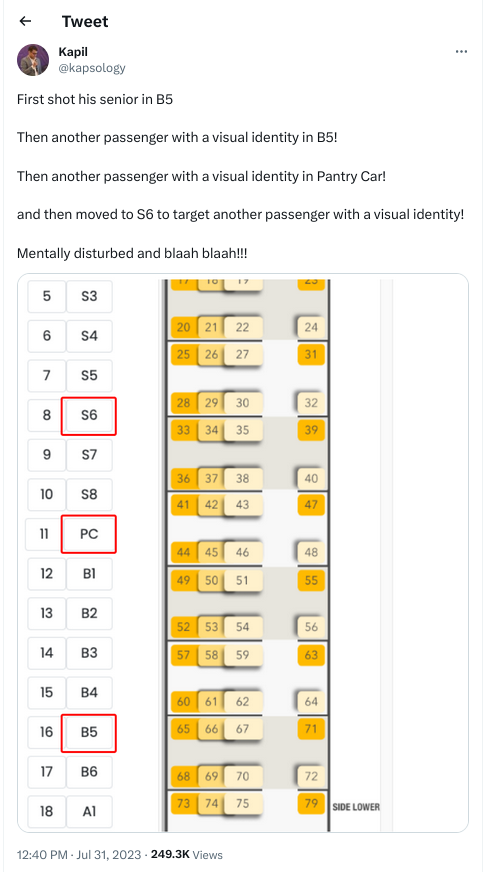
Consent, Violence, Sexual Abuse This again would be somewhat of a mature post. So children, please refrain from reading. When I hear the above words, my first thought goes to Aamir Khan s Season 1 Episode 2 in Satyamev Jayate. This was the first time that the topic of child sexual abuse was bought in the forefront in the hall rather than a topic to be discussed in the corner. Unfortunately, that episode is still in Hindi and no English subtitles available even today shows a lack of sensitivity in Indian s part to still come to terms with Child abuse that happens in India. The numbers that they had shared at that time were shocking. More than 50 per cent children experience sexual abuse and mostly from friends or relatives. That means 1 in every 2 children. And this was in 2012. But the problem of child sexual abuse didn t start then, it started in the 1960 s, 70 s. In the 1960 s, 1970s we didn t have much of cinema and TV and whatever there was pretty limited. There were few B movie producers, but most of them came into their own in the 1980s. So what influenced Indians in those days were softcore magazines that either had a mature aunt or a teen and they would tease and sooner or later the man would sort of overpower them and fulfill his needs. Even mainstream Indian cinema used similar tropes. One of the most memorable songs of that era Wada Karo Nahi Chodoge Tum Meera Saath from Aa Gale Lag jaa. A bit of context for the song. This is where Shashi Kapoor sees, he tries to ask her to date him, she says no. He tries to put an act where he shows he can t skate or rather pretends. And kinda takes a promise from her that she will date him if he is able to skate. And viola, the next moment he is not just skating, but dancing and singing as well. And the whole he touches her and you can see that is uncomfortable and yet after a while he woos her. Now this is problematic today because we are seeing it from today s lens. It might also have problematic with the feminists of that time, but they probably would have been called overly sensitive or something like that. And this is what went in Universal cinema. But this is just tip of the surface. There were and are multiple poems and even art in those times that flirted and even sort of engaged with sexual molestation, rape both in poems as well as literature, both in Hindi and various regional literature. Similar to stuff that Keats and some other poets (problematic stuff) they wrote and where both men and women were in two minds, whether to take all the other good literature out or kinda make the difference between the art and artist. Now, while Aamir spoke about consent it wasn t in any official capacity or even a legal capacity. The interesting thing was that there was an Act that kinda put some safeguards but had been doing rounds for almost a decade. Because the extremists on both sides, Hindus and Muslims were not in favor of that Act, it was still doing rounds. Aamir s episode on 6th May 2012 and the discussions in mainstream media following that forced the Indian legislature to make POSCO as a law on 22nd May 2012. Almost 6 months to 2 weeks, Nirbhaya happened and changes to the law happened in another 6 months. Both voyeurism and stalking were made jailable offenses and consent became part of lingua franca in the Supreme Court. Couple of weeks back, I had shared in the Manipur case the part about fingering . In the same Act, another change that was done that insertion of any part including foreign objects in any of the openings would be classed as rape . So in that Manipur case, at least those 2-3 people who have been identified as clear perpetrators according to the law of land would be rapists and should have the highest punishment. Unfortunately, the system is rigged against women as Vrinda Grover had shared just couple of weeks back. How a 6 month fast track case (to be completed within 6 months) becomes a 10 year old case tells you the efficacy of the system. The reality is far more worse than is shared or known. Just a few months ago, GOI shared some data on Sexual Harassment in 2018-19. And this is after constant pressurizing by Activists that GOI doesn t like. In fact, in 2021, Unicef had shared data about how India was one of the five countries where child brides are still prevalent. India denied but didn t produce any alternative data. The firing of Mr. James over NHFS data sets doesn t give it any brownie points to the present Government. What has happened in the last few years is that the Government for reasons of its own had been scrubbing and censoring a lot of data. I won t go far, just 2 day old story which I had shared just couple of days back. Roughly a 25 year old RPF constable kills his superior and kills 3 Muslims after going to various coaches and then the Government uses the defence of temporary insanity.
Even the mental instability defence has twists and turns
Incidentally, Press Trust of India is s private organization and not the public broadcaster of the old. And incidentally, just a few days back, it came to light that they hadn t paid Income tax for last 2-3 years. Because of issues in reward money, the public came to know otherwise they wouldn t have known. Coming back to the topic itself, there was a video where you could hear and see the accused stating after killing the three Muslims that if you want to remain in India, then you have to vote for only Modi or Yogi, otherwise this will happen. That video was scrubbed both from Twitter as well as YouTube. All centralized platforms at the very least, whether it is Google (Youtube) or Twitter or Meta uses its own media ID. Meta s being most problematic but that probably being a discussion for another day. The same censorship tools are applied rigorously and lot of incidents are buried. Cases of girls being thrown in lakes just after lakes or low numbers of conviction in case of gang rapes are more often than not disappears.
The above article shared just a few days ago that how low the conviction rates of gang rapes are in Gujarat tells you the story. You might get the story today, but wait for a few weeks and you will find that the story has disappeared. What most people do not know or understand is that the web is increasingly a public repository of idea, imaginations and trust and authoritarian regimes like Government of India is increasingly using both official as well as unofficial methods to suppress the same. To see that in the last 9 odd years, GOI has made the highest number of takedown requests and been either number one or number two tells all. My question is where we do from here ??? If even the Minister and her Ministry can do only whataboutery rather than answer the questions, then how we are supposed to come up solutions. And even if a solution exists, without the state and Center agreeing and co-operating with civil society, any solution will be far off the desired result. I am sorry that I at least have no answers

Reproducible Builds: Reproducible Builds in July 2023

Welcome to the July 2023 report from the Reproducible Builds project. In our reports, we try to outline the most important things that we have been up to over the past month. As ever, if you are interested in contributing to the project, please visit the Contribute page on our website.
Marcel Fourn et al. presented at the IEEE Symposium on Security and Privacy in San Francisco, CA on The Importance and Challenges of Reproducible Builds for Software Supply Chain Security. As summarised in last month s report, the abstract of their paper begins:
The 2020 Solarwinds attack was a tipping point that caused a heightened awareness about the security of the software supply chain and in particular the large amount of trust placed in build systems. Reproducible Builds (R-Bs) provide a strong foundation to build defenses for arbitrary attacks against build systems by ensuring that given the same source code, build environment, and build instructions, bitwise-identical artifacts are created. (PDF)

Chris Lamb published an interview with Simon Butler, associate senior lecturer in the School of Informatics at the University of Sk vde, on the business adoption of Reproducible Builds. (This is actually the seventh instalment in a series featuring the projects, companies and individuals who support our project. We started this series by featuring the Civil Infrastructure Platform project, and followed this up with a post about the Ford Foundation as well as recent ones about ARDC, the Google Open Source Security Team (GOSST), Bootstrappable Builds, the F-Droid project and David A. Wheeler.) Vagrant Cascadian presented Breaking the Chains of Trusting Trust at FOSSY 2023.
Rahul Bajaj has been working with Roland Clobus on merging an overview of environment variations to our website:
I have identified 16 root causes for unreproducible builds in my empirical study, which I have linked to the corresponding documentation. The initial MR right now contains information about 10 root causes. For each root cause, I have provided a definition, a notable instance, and a workaround. However, I have only found workarounds for 5 out of the 10 root causes listed in this merge request. In the upcoming commits, I plan to add an additional 6 root causes. I kindly request you review the text for any necessary refinements, modifications, or corrections. Additionally, I would appreciate the help with documentation for the solutions/workarounds for the remaining root causes: Archive Metadata, Build ID, File System Ordering, File Permissions, and Snippet Encoding. Your input on the identified root causes for unreproducible builds would be greatly appreciated. [ ]

Just a reminder that our upcoming Reproducible Builds Summit is set to take place from October 31st November 2nd 2023 in Hamburg, Germany. Our summits are a unique gathering that brings together attendees from diverse projects, united by a shared vision of advancing the Reproducible Builds effort. During this enriching event, participants will have the opportunity to engage in discussions, establish connections and exchange ideas to drive progress in this vital field. If you re interested in joining us this year, please make sure to read the event page which has more details about the event and location.
There was more progress towards making the Go programming language ecosystem reproducible this month, including: In addition, kpcyrd posted to our mailing list to report that:
while packaging govulncheck for Arch Linux I noticed a checksum mismatch for a tar file I downloaded from go.googlesource.com. I used diffoscope to compare the .tar file I downloaded with the .tar file the build server downloaded, and noticed the timestamps are different.

In Debian, 20 reviews of Debian packages were added, 25 were updated and 25 were removed this month adding to our knowledge about identified issues. A number of issue types were updated, including marking ffile_prefix_map_passed_to_clang being fixed since Debian bullseye [ ] and adding a Debian bug tracker reference for the nondeterminism_added_by_pyqt5_pyrcc5 issue [ ]. In addition, Roland Clobus posted another detailed update of the status of reproducible Debian ISO images on our mailing list. In particular, Roland helpfully summarised that live images are looking good, and the number of (passing) automated tests is growing .
Bernhard M. Wiedemann published another monthly report about reproducibility within openSUSE.
F-Droid added 20 new reproducible apps in July, making 165 apps in total that are published with Reproducible Builds and using the upstream developer s signature. [ ]
The Sphinx documentation tool recently accepted a change to improve deterministic reproducibility of documentation. It s internal util.inspect.object_description attempts to sort collections, but this can fail. The change handles the failure case by using string-based object descriptions as a fallback deterministic sort ordering, as well as adding recursive object-description calls for list and tuple datatypes. As a result, documentation generated by Sphinx will be more likely to be automatically reproducible. Lastly in news, kpcyrd posted to our mailing list announcing a new repro-env tool:
My initial interest in reproducible builds was how do I distribute pre-compiled binaries on GitHub without people raising security concerns about them . I ve cycled back to this original problem about 5 years later and built a tool that is meant to address this. [ ]

Upstream patches The Reproducible Builds project detects, dissects and attempts to fix as many currently-unreproducible packages as possible. We endeavour to send all of our patches upstream where appropriate. This month, we wrote a large number of such patches, including:
In diffoscope development this month, versions 244, 245 and 246 were uploaded to Debian unstable by Chris Lamb, who also made the following changes:
  • Don t include the file size in image metadata. It is, at best, distracting, and it is already in the directory metadata. [ ]
  • Add compatibility with libarchive-5. [ ]
  • Mark that the test_dex::test_javap_14_differences test requires the procyon tool. [ ]
  • Initial work on DOS/MBR extraction. [ ]
  • Move to using assert_diff in the .ico and .jpeg tests. [ ]
  • Temporarily mark some Android-related as XFAIL due to Debian bugs #1040941 & #1040916. [ ]
  • Fix the test skipped reason generation in the case of a version outside of the required range. [ ]
  • Update copyright years. [ ][ ]
  • Fix try.diffoscope.org. [ ]
In addition, Gianfranco Costamagna added support for LLVM version 16. [ ]

Testing framework The Reproducible Builds project operates a comprehensive testing framework (available at tests.reproducible-builds.org) in order to check packages and other artifacts for reproducibility. In July, a number of changes were made by Holger Levsen:
  • General changes:
    • Upgrade Jenkins host to Debian bookworm now that Debian 12.1 is out. [ ][ ][ ][ ]
    • djm: improve UX when rebooting a node fails. [ ]
    • djm: reduce wait time between rebooting nodes. [ ]
  • Debian-related changes:
    • Various refactoring of the Debian scheduler. [ ][ ][ ]
    • Make Debian live builds more robust with respect to salsa.debian.org returning HTTP 502 errors. [ ][ ]
    • Use the legacy SCP protocol instead of the SFTP protocol when transfering Debian live builds. [ ][ ]
    • Speed up a number of database queries thanks, Myon! [ ][ ][ ][ ][ ]
    • Split create_meta_pkg_sets job into two (for Debian unstable and Debian testing) to half the job runtime to approximately 90 minutes. [ ][ ]
    • Split scheduler job into four separate jobs, one for each tested architecture. [ ][ ]
    • Treat more PostgreSQL errors as serious (for some jobs). [ ]
    • Re-enable automatic database documentation now that postgresql_autodoc is back in Debian bookworm. [ ]
    • Remove various hardcoding of Debian release names. [ ]
    • Drop some i386 special casing. [ ]
  • Other distributions:
    • Speed up Alpine SQL queries. [ ]
    • Adjust CSS layout for Arch Linux pages to match 3 and not 4 repos being tested. [ ]
    • Drop the community Arch Linux repo as it has now been merged into the extra repo. [ ]
    • Speed up a number of Arch-related database queries. [ ]
    • Try harder to properly cleanup after building OpenWrt packages. [ ]
    • Drop all kfreebsd-related tests now that it s officially dead. [ ]
  • System health:
    • Always ignore some well-known harmless orphan processes. [ ][ ][ ]
    • Detect another case of job failure due to Jenkins shutdown. [ ]
    • Show all non co-installable package sets on the status page. [ ]
    • Warn that some specific reboot nodes are currently false-positives. [ ]
  • Node health checks:
    • Run system and node health checks for Jenkins less frequently. [ ]
    • Try to restart any failed dpkg-db-backup [ ] and munin-node services [ ].
In addition, Vagrant Cascadian updated the paths in our automated to tests to use the same paths used by the official Debian build servers. [ ]

If you are interested in contributing to the Reproducible Builds project, please visit our Contribute page on our website. However, you can get in touch with us via:

Louis-Philippe V ronneau: pymonitair: Air Quality Monitoring Display with MicroPython

I've never been a fan of IoT devices for obvious reasons: not only do they tend to be excellent at being expensive vendor locked-in machines, but far too often, they also end up turning into e-waste after a short amount of time. Manufacturers can go out of business or simply decide to shut down the cloud servers for older models, and then you're stuck with a brick. Well, this all changes today, as I've built my first IoT device and I love it. Introducing pymonitair. What pymonitair is a MicroPython project that aims to display weather data from a home weather station (like the ones sold by AirGradient) on a small display. The source code was written for the Raspberry Pi Pico W, the Waveshare Pico OLED 1.3 display and the RevolvAir Revo 1 weather station, but can be adapted to other displays and stations easily, as I tried to keep the code as modular as possible. The general MicroPython code itself isn't specific to the Raspberry Pi Pico and shouldn't need to be modified for other boards. pymonitair features: Here's a demo of me scrolling through the different pages and (somewhat failing) to turn the screen on and off: Why? If you follow my blog, you'll know that my last entry was about building a set of tools to collect and graph data from a weather station my neighbor set up. Why on Earth would I need a separate device to show this data, when the website I've built works perfectly fine and is accessible on any computer or smartphone? Mostly alerts. When the air quality here dropped following forest fires, I found out keeping track of if I had to close my windows and bunker down was quite a hassle. Air quality would degrade during the day and I would only notice it hours later. With the pymonitair, I'll have a little screen flashing angrily at me whenever this happens. A simpler solution would probably have been to forgo hardware altogether and code some icinga2 alert to ping me over Signal whenever the air quality got bad. Hacking on pymonitair was mostly a way to learn to use MicroPython and familiarize myself with this type of embedded hardware device. I'll surely blog about this later this year, but I plan to use a very similar stack to mod my apartment's HVAC unit to stop pulling air from outside when an air quality sensor detects cigarette smoke (or bad air quality in general). Things I've learnt This project was super fun and taught me many things:

  1. PM1, PM2.5, PM10, Temperature, Humidity and Pressure
  2. Part of the screen will flash repeatedly
  3. I did look for other solutions to transfer files to the board, but none of them were actually maintained. I nearly finished packaging ampy before realising it was officially unmaintained and its main alternative, rshell, has had its last release in December 2021. When I caught myself seriously considering writing a script to transfer files over the serial link, I gave up and decided thonny was not that bad after all.

2 August 2023

Shirish Agarwal: Kaalkoot

Kaalkoot This post would be mature and would talk about death and other things. So if there are young kids or whatever kindly refrain from reading it. Just saw this series in 2 days. In a way the series encompasses all that which is wrong in India and partly the World perhaps. IMDB describes it as A police officer must deal with society s and his mother s pressure to marry, as well as frequent bullying and pressure from his superiors. But that hardly does justice to either the story or the script or the various ebbs and flows it takes. A very bit part of the series of the series is about patriarchy and the various forms it takes. It tells how we would use women and then throw them, many a times by willing relatives who want to save face . And it s so many ways and so many times that people do not even pay attention. I will not share the story as it needs to be experienced as well as the many paths the story takes as well as many paths it could have taken. What is remarkable about this series is that everyone is grey apart from the women who are victims in all of these. Even our hero, the protagonist uses it to take advantage of a woman. There are multiple stories and timelines that are just touched upon. For e.g. curing the gay and boasting he has cured many guys and now have their married with families. How many families suffered god only knows, both sexes dissatisfied  At the end of the series while a slightly progressive end is shown, in reality you are left wondering whether the decision taken by the protagonist and the woman having just no agency. The hero knowing he is superior to her because of her perceived weakness. A deep-rooted malaise that is difficult to break out of. His father too and the relationship the hero longs for to have with his father who is no more. He does share some of his feelings with his mum, which touches the cord of probably every child whose mother father left them early and all those things they wanted to talk or would have chatted out if they knew this would be the last conversation they will ever have with them. Couldn t even say sorry for all the wrongs and the pain we have given them. There are just too many layers in the webseries that I would need to see it a few times to be aware of. I could sense the undercurrents but sometimes you need to see such series or movies multiple times to understand them or it could simply be the case of me being just too thick. There are also poems and poems as we know may have multiple meanings and is or can be more contextual to the person reading it rather than the creator. At the end, while it does show a positive end, in reality I feel there is no redemption for us. I am talking about men. We are too proud, too haughty and too insecure. And if things don t go the way we want, it s the women who pay the price  I am not going to talk about any news either about Manipur or anywhere else because hate crimes have become normal. An RPF personnel plans, and goes from coach to coach to find Muslims and shoot them and then say only the tallest leaders in RW should be voted for. A mob then burns down Muslim s homes and businesses, all par for the course. The mentally unstable moniker taken right from the American far-right notebook.
The Americans have taken it much further than anyone else using open carry and stand your ground, laws to make blacks afraid and going further. I don t really wanna go down that route as it s a whole another pandora s box and what little I have read tells me it starts from the very beginning when the European settlers invaded America and took indigenous people s lands and giving it the moniker of Wild West . Just too much to deal with.

Mental Health But these spate of bad news, of murders, rapes and whatnot does take a toll on the mental health of people. Take this tweet as instance
I think the above tweet is an expression that is felt by many Indians, whatsoever their religion might be. Most of them unable to express it as many have responsibilities in which they are the only caretakers or the only earner in the family. So even though, we have huge inflation especially in foods and whatnot the daily struggle to put food on the table extinguishes everything else. And for those who may want to go through for whatever reasons, there is nothing like MAID in India. There was a good debate that I saw few months ago about it, and I think both the for and against miss a very crucial point. People have their own idea or imagination of what dignity in living as well as dignity of dying. I was seeing some videos of NHS doctors (UK) where many doctors couldn t do anything as their patients died as they couldn t pay bills for heating. Many of the patients wanted the doctors to end their suffering. The case against it is that people should reach out and have community services. While that is a great theory, practically it is difficult. Whether it is in dense populated area like Pune (population around 10 odd million) or the whole country of Japan which is heavily being depopulated, in both the extreme scenarios the access to mental health is and would be low. And even if there is someway that the Government, the community, business community etc. come altogether and solve it, it just shifts the problem. All the shit, our fears, our uncertainties, our doubts we unload on the medical health professional but where do they go to get rid of it. It s a vicious circular problem. I did read somewhere that mental health professionals are four times prone to suicide than other doctors. And all emergency care professionals like firefighters and whatnot are again 4 times more likely to commit suicide than the general population. How much those stats are true, have no clue as again most of such kinds of data is not collected by NCRB (National Crime Records Bureau) in India. In fact, NCRB often describes such deaths as accidental deaths as otherwise the person would be termed as loser or something else. Even in and after death, people are worried about labels. But that I guess is what s it all about. I do not know but do guess most of the 160 odd countries would have similar issues and most of them keep quiet about it. Till later

1 August 2023

Jonathan Dowland: Interzone's new home

IZ #294, the latest issue IZ #294, the latest issue
The long running British1 SF Magazine Interzone has a new home and new editor, Gareth Jelley, starting with issue 294. It's also got a swanky new format ("JB6"): a perfect-bound, paperback novel size, perfect for fitting into an oversize coat or jeans pocket for reading on the train. I started reading Interzone in around 2003, having picked up an issue (#176) from Feb 2002 that was languishing on the shelves in Forbidden Planet. Once I discovered it I wondered why it had taken me so long. That issue introduced me to Greg Egan. I bought a number of back issues on eBay, to grab issues with stories by people including Terry Pratchett, Iain Banks, Alastair Reynolds, and others.
IZ #194: The first by TTA press IZ #194: The first by TTA press
A short while later in early 2004, after 22 years, Interzone's owner and editorship changed from David Pringle to Andy Cox and TTA Press. I can remember the initial transition was very jarring: the cover emphasised expanding into coverage of Manga, Graphic Novels and Video Games (which ultimately didn't happen) but after a short period of experimentation it quickly settled down into a similarly fantastic read. I particularly liked the move to a smaller, perfect-bound form-factor in 2012. I had to double-check this but I'd been reading IZ throughout the TTA era and it lasted 18 years! Throughout that time I have discovered countless fantastic authors that I would otherwise never have experienced. Some (but by no means all) are Dominic Green, Daniel Kaysen, Chris Beckett, C cile Cristofari, Aliya Whiteley, Tim Major, Fran oise Harvey, Will McIntosh. Cox has now retired (after 100 issues and a tenure almost as long as Pringle) and handed the reins to Gareth Jelley/MYY Press, who have published their first issue, #294. Jelley is clearly putting a huge amount of effort into revitalizing the magazine. There's a new homepage at interzone.press but also companion internet presences: a plethora of digital content at interzone.digital, Interzone Socials (a novel idea), a Discord server, a podcast, and no doubt more. Having said that, the economics of small magazines have been perilous for a long time, and that hasn't changed, so I think the future of IZ (in physical format at least) is in peril. If you enjoy short fiction, fresh ideas, SF/F/Fantastika; why not try a subscription to Interzone, whilst you still can!

  1. Interzone has always been "British", in some sense, but never exclusively so. I recall fondly a long-term project under Pringle to publish a lot of Serbian writer Zoran ivkovi , for example, and the very first story I read was by Australian Greg Egan. Under Jelley, the magazine is being printed in Poland and priced in Euros. I expect it to continue to attract and publish writers from all over the place.

Reproducible Builds: Supporter spotlight: Simon Butler on business adoption of Reproducible Builds

The Reproducible Builds project relies on several projects, supporters and sponsors for financial support, but they are also valued as ambassadors who spread the word about our project and the work that we do. This is the seventh instalment in a series featuring the projects, companies and individuals who support the Reproducible Builds project. We started this series by featuring the Civil Infrastructure Platform project, and followed this up with a post about the Ford Foundation as well as recent ones about ARDC, the Google Open Source Security Team (GOSST), Bootstrappable Builds, the F-Droid project and David A. Wheeler. Today, however, we will be talking with Simon Butler, an associate senior lecturer in the School of Informatics at the University of Sk vde, where he undertakes research in software engineering that focuses on IoT and open source software, and contributes to the teaching of computer science to undergraduates.

Chris: For those who have not heard of it before, can you tell us more about the School of Informatics at Sk vde University? Simon: Certainly, but I may be a little long-winded. Sk vde is a city in the area between the two large lakes in southern Sweden. The city is a busy place. Sk vde is home to the regional hospital, some of Volvo s manufacturing facilities, two regiments of the Swedish defence force, a lot of businesses in the Swedish computer games industry, other tech companies and more. The University of Sk vde is relatively small. Sweden s large land area and low population density mean that regional centres such as Sk vde are important and local universities support businesses by training new staff and supporting innovation. The School of Informatics has two divisions. One focuses on teaching and researching computer games. The other division encompasses a wider range of teaching and research, including computer science, web development, computer security, network administration, data science and so on.
Chris: You recently had a open-access paper published in Software Quality Journal. Could you tell us a little bit more about it and perhaps briefly summarise its key findings? Simon: The paper is one output of a collaborative research project with six Swedish businesses that use open source software. There are two parts to the paper. The first consists of an analysis of what the group of businesses in the project know about Reproducible Builds (R-Bs), their experiences with R-Bs and their perception of the value of R-Bs to the businesses. The second part is an interview study with business practitioners and others with experience and expertise in R-Bs. We set out to try to understand the extent to which software-intensive businesses were aware of R-Bs, the technical and business reasons they were or were not using R-Bs and to document the business and technical use cases for R-Bs. The key findings were that businesses are aware of R-Bs, and some are using R-Bs as part of their day-to-day development process. Some of the uses for R-Bs we found were not previously documented. We also found that businesses understood the value R-Bs have as part of engineering and software quality processes. They are also aware of the costs of implementing R-Bs and that R-Bs are an intangible value proposition - in other words, businesses can add value through process improvement by using R-Bs. But, that, currently at least, R-Bs are not a selling point for software or products.
Chris: You performed a large number of interviews in order to prepare your paper. What was the most surprising response to you? Simon: Most surprising is a good question. Everybody I spoke to brought something new to my understanding of R-Bs, and many responses surprised me. The interviewees that surprised me most were I01 and I02 (interviews were anonymised and interviewees were assigned numeric identities). I02 described the sceptical perspective that there is a viable, pragmatic alternative to R-Bs - verifiable builds - which I was aware of before undertaking the research. The company had developed a sufficiently robust system for their needs and worked well. With a large archive of software used in production, they couldn t justify the cost of retrofitting a different solution that might only offer small advantages over the existing system. Doesn t really sound too surprising, but the interview was one of the first I did on this topic, and I was very focused on the value of, and need for, trust in a system that motivated the R-B. The solution used by the company requires trust, but they seem to have established sufficient trust for their needs by securing their build systems to the extent that they are more or less tamper-proof. The other big surprise for me was I01 s use of R-Bs to support the verification of system configuration in a system with multiple embedded components at boot time. It s such an obvious application of R-Bs, and exactly the kind of response I hoped to get from interviewees. However, it is another instance of a solution where trust is only one factor. In the first instance, the developer is using R-Bs to establish trust in the toolchain. There is also the second application that the developer can use a set of R-Bs to establish that deployed system consists of compatible components. While this might not sound too significant, there appear to be some important potential applications. One that came to mind immediately is a problem with firmware updates on nodes in IoT systems where the node needs to update quickly with limited downtime and without failure. The node also needs to be able to roll back any update proposed by a server if there are conflicts with the current configuration or if any tests on the node fail. Perhaps the chances of failure could be reduced, if a node can instead negotiate with a server to determine a safe path to migrate from its current configuration to a working configuration with the upgraded components the central system requires? Another potential application appears to be in the configuration management of AI systems, where decisions need to be explainable. A means of specifying validated configurations of training data, models and deployed systems might, perhaps, be leveraged to prevent invalid or broken configurations from being deployed in production.
Chris: One of your findings was that reproducible builds were perceived to be good engineering practice . To what extent do you believe cultural forces affect the adoption or rejection of a given technology or practice? Simon: To a large extent. People s decisions are informed by cultural norms, and business decisions are made by people acting collectively. Of course, decision-making, including assessments of risk and usefulness, is mediated by individual positions on the continuum from conformity to non-conformity, as well as individual and in-group norms. Whether a business will consider a given technology for adoption will depend on cultural forces. The decision to adopt may well be made on the grounds of cost and benefits.
Chris: Another conclusion implied by your research is that businesses are often dealing with software deployment lifespans (eg. 20+ years) that differ from widely from those of the typical hobbyist programmer. To what degree do you think this temporal mismatch is a problem for both groups? Simon: This is a fascinating question. Long-term software maintenance is a requirement in some industries because of the working lifespans of the products and legal requirements to maintain the products for a fixed period. For some other industries, it is less of a problem. Consequently, I would tend to divide developers into those who have been exposed to long-term maintenance problems and those who have not. Although, more professional than hobbyist developers will have been exposed to the problem. Nonetheless, there are areas, such as music software, where there are also long-term maintenance challenges for data formats and software.
Chris: Based on your research, what would you say are the biggest blockers for the adoption of reproducible builds within business ? And, based on this, would you have any advice or recommendations for the broader reproducible builds ecosystem? Simon: From the research, the main blocker appears to be cost. Not an absolute cost, but there is an overhead to introducing R-Bs. Businesses (and thus business managers) need to understand the business case for R-Bs. Making decision-makers in businesses aware of R-Bs and that they are valuable will take time. Advocacy at multiple levels appears to be the way forward and this is being done. I would recommend being persistent while being patient and to keep talking about reproducible builds. The work done in Linux distributions raises awareness of R-Bs amongst developers. Guix, NixOS and Software Heritage are all providing practical solutions and getting attention - I ve been seeing progressively more mentions of all three during the last couple of years. Increased awareness amongst developers should lead to more interest within companies. There is also research money being assigned to supply chain security and R-B s. The CHAINS project at KTH in Stockholm is one example of a strategic research project. There may be others that I m not aware of. The policy-level advocacy is slowly getting results in some countries, and where CISA leads, others may follow.
Chris: Was there a particular reason you alighted on the question of the adoption of reproducible builds in business? Do you think there s any truth behind the shopworn stereotype of hacker types neglecting the resources that business might be able to offer? Simon: Much of the motivation for the research came from the contrast between the visibility of R-Bs in open source projects and the relative invisibility of R-Bs in industry. Where companies are known to be using R-Bs (e.g. Google, etc.) there is no fuss, no hype. They were not selling R-Bs as a solution; instead the documentation is very matter-of-fact that R-Bs are part of a customer-facing process in their cloud solutions. An obvious question for me was that if some people use R-B s in software development, why doesn t everybody? There are limits to the tooling for some programming languages that mean R-Bs are difficult or impossible. But where creating an R-B is practical, why are they not used more widely? So, to your second question. There is another factor, which seems to be more about a lack of communication rather than neglecting opportunities. Businesses may not always be willing to discuss their development processes and innovations. Though I do think the increasing number of conferences (big and small) for software practitioners is helping to facilitate more communication and greater exchange of ideas.
Chris: Has your personal view of reproducible builds changed since before you embarked on writing this paper? Simon: Absolutely! In the early stages of the research, I was interested in questions of trust and how R-Bs were applied to resolve build and supply chain security problems. As the research developed, however, I started to see there were benefits to the use of R-Bs that were less obvious and that, in some cases, an R-B can have more than a single application.
Chris: Finally, do you have any plans to do future research touching on reproducible builds? Simon: Yes, definitely. There are a set of problems that interest me. One already mentioned is the use of reproducible builds with AI systems. Interpretable or explainable AI (XAI) is a necessity, and I think that R-Bs can be used to support traceability in the configuration and testing of both deployed systems and systems used during model training and evaluation. I would also like to return to a problem discussed briefly in the article, which is to develop a deeper understanding of the elements involved in the application of R-Bs that can be used to support reasoning about existing and potential applications of R-Bs. For example, R-Bs can be used to establish trust for different groups of individuals at different times, say, between remote developers prior to the release of software and by users after release. One question is whether when an R-B is used might be a significant factor. Another group of questions concerns the ways in which trust (of some sort) propagates among users of an R-B. There is an example in the paper of a company that rebuilds Debian reproducibly for security reasons and is then able to collaborate on software projects where software is built reproducibly with other companies that use public distributions of Debian.
Chris: Many thanks for this interview, Simon. If someone wanted to get in touch or learn more about you and your colleagues at the School of Informatics, where might they go? Thank you for the opportunity. It has been a pleasure to reflect a little more widely on the research! Personally, you can find out about my work on my official homepage and on my personal site. The software systems research group (SSRG) has a website, and the University of Sk vde s English language pages are also available. Chris: Many thanks for this interview, Simon!


For more information about the Reproducible Builds project, please see our website at reproducible-builds.org. If you are interested in ensuring the ongoing security of the software that underpins our civilisation and wish to sponsor the Reproducible Builds project, please reach out to the project by emailing contact@reproducible-builds.org.

Louis-Philippe V ronneau: Weather Station Data Visualisations Using R and Python

A few weeks ago, my friend and neighbor J r me (aka lavamind) installed a weather station on his balcony and started collecting data from it. It has been quite useful to measure the degrading air quality during the recent forest fires plaguing northern Canada, but sadly, the hardware itself isn't great. Whereas some projects like airgradient offer open hardware devices running free software, the station we got is from RevolvAir, some kind of local air monitoring project that aims to be a one-stop solution for exterior air monitoring. Not only is their device pretty expensive1, but it also reboots frequently by itself. Even worse, their online data map requires an account to view the data and the interface is bad, unintuitive and only stores data up to a month. Having a good background in data visualisation and statistics thanks to my master's degree in economics, I decided I could do better. Two days later, I had built a series of tools to collect, analyse and graph the JSON time series data provided by the device. The result is a very simple website that works without any JavaScript, leveraging static graphs built using R. Modern web libraries and projects offer an incredible wealth of tools to graph and visualise data, but as for most of my web projects, I wanted something static and simple. The source code for the project can be found here, and although it is somewhat specific to the data structure provided by the RevolvAir device, it could easily be adapted to other devices, as they tend to have very similar JSON dumps.

  1. around 300 CAD, whereas a similar station from airgradient costs around 90 CAD. Thankfully, this station was a gift from a local group mobilising against an industrial project near our housing cooperative and we didn't have to pay for it ourselves.

31 July 2023

Paul Wise: FLOSS Activities July 2023

Focus This month I didn't have any particular focus. I just worked on issues in my info bubble.

Changes

Issues

Debugging

Review

Administration
  • Debian IRC: rescue empty Debian IRC channel
  • Debian wiki: unblock IP addresses, approve accounts

Communication
  • Respond to queries from Debian users and contributors on the mailing lists and IRC

Sponsors The libpst, nmap, sptag, pytest-rerunfailures work was sponsored. All other work was done on a volunteer basis.

30 July 2023

Russell Coker: My Predictions for the Ukraine War

There are a lot of people talking about the Russian invasion of Ukraine and a lot of moving goalposts in such discussions. I think that everyone who wants to advocate for it should publish what they expect to happen and what specific things they consider as victory conditions. When Russia first invaded I thought they would win in a matter of weeks. I underestimated the determination of the Ukrainian people and the corruption and the incompetence and corruption of the Russian military. The first time I thought that Ukraine could win was when I read an analysis of the tires on Russian military vehicles breaking because of the cheapest available tires being bought and then not stored correctly to avoid damage, which led to the long stalled convoy. A successful military campaign requires many more difficult tasks than buying good tires and maintaining them correctly. An army that is too corrupt to buy the bare minimum of usable equipment and too incompetent to adapt to failures is not going to do well. The Ukrainians have done very well with the equipment available, one example is their use of off the shelf drones for dropping grenades into armoured vehicles and for targeting artillery. While the Russians have responded by buying Iranian military drones because they lack the industrial capacity to make their own ones. From the time when the Russians first got bogged down the Ukrainians have been mostly retaking their territory slowly and steadily. The Russians started the invasion with a significant advantage in aircraft, armoured vehicles, artillery, and ammunition. This advantage has been significantly decreased due to losses of vehicles and artillery, high rates of ammunition use, and Ukrainian capture of Russian equipment. The Ukrainians are getting new vehicles, aircraft, artillery, and ammunition from western countries while sanctions are preventing Russians from importing or manufacturing much. Currently one important factor for Russia is the ability of their airforce to attack Ukrainian positions while out of range of Ukrainian air defence systems. The MANPAD systems are good for close support but not good for long range. A problem that the Russians will have in the long term is running out of spare parts and being unable to properly maintain aircraft. This will result in loss of aircraft due to accidents and the inability to repair aircraft that has even minor damage. Here are my specific predictions:
  1. I predict that by the end of 2023 Russia will have a much smaller number of military aircraft through maintenance problems even if Ukraine doesn t get long-range SAM systems.
  2. I predict that by mid 2024 Ukraine will have air superiority. They will destroy many Russian SAM systems and be able to bomb Russian targets with little risk.
  3. I predict that Russia won t impose any significant new conscription programs on their population. Such programs are extremely unpopular and Russia doesn t have the industrial capacity to equip a larger army as they can t properly equip their current army.
  4. Currently Ukraine is making slow but steady progress in retaking their territory in the East. I predict that before the end of 2023 they will have cut all supply lines to Crimea from the mainland by having artillery that can accurately cover all the distance to the coast of the Sea of Azov. I also predict that the bridge over the Kerch strait will be mostly unusable from now on (on average less than 1/3 the bridge capacity usable). As fast as the Russians can repair it the Ukrainians will bomb it again. At most they will have half of the road lanes available to cars and will be unable to transport any significant amount of military equipment.
  5. Due to Russians lacking supplies I predict that Ukraine will recapture at least half the Crimean land area by the end of 2023.
  6. The regions of Luhansk and Donetsk will be the most difficult to capture as they have been held the longest. I predict that the war will not end until Ukraine controls everything within their 2013 borders including Luhansk and Donetsk. The final victory may happen due to the Russian military collapsing or due to a new Russian government ordering a withdrawal.
  7. I predict that Russia will make significant efforts to help Trump get elected in 2024. But even if they succeed it will be too late for him to help them much or change the outcome.
  8. I predict that Ukraine will win this war before the end of 2025. Even if some of my other predictions turn out to be incorrect I predict that by the end of 2025 the military forces of Russia and Ukraine will not be fighting and that it will be because Ukraine has given the Russian military a proper spanking. If something like the Troubles in Ireland happens (which is a real possibility) that doesn t count as a war.
  9. I predict that Ukraine will not deploy any significant attack inside Russian territory. They will launch small scale attacks on specific military targets but do nothing that the Russian population might consider to be full scale war.
  10. I predict that Putin will not lead Russia 2 months after Ukraine recaptures all their territory. He may not live for long after Ukraine wins, or the Russian withdrawal might happen because Putin dies of apparently natural causes.
  11. After the war I predict that Ukraine will control all their territory from 2013 and there will be a demilitarised zone or no-fly zone in Russian territory.
  12. I predict that after the war some parts of the Russian Federation will break free. There are many different groups who would like to be free of Russia and Ukraine destroying most of the Russian military will make things easy for them. A Russian civil war is a possibility.
  13. I predict that the US will give minimal support to Russia after the war as a strategic plan to block China. I predict that the quality and efficacy of such support will be comparable to the US actions in the Middle East.
I welcome comments disagreeing with this. But please make specific predictions that can be tested and sign your name to them. If you don t think that a certain event will happen when I predict it then provide a date when you think it will happen or a date by which the opposite will have happened. Also please show enough confidence to make multiple predictions. I ve made 12 specific predictions, if you think I m doing badly then make at least 3 specific competing predictions. If you think that Russia will win then define what a win means in terms of territory occupied when fighting between armies ends and when that will happen. Also if you think that Russia will win then please make a prediction about whether there will be a Ukrainian equivalent of the IRA and if so what they will do.

Russell Coker: Links July 2023

Phys.org has an interesting article about finding evidence for nanohertz gravity waves [1]. 1nano-Herz is a wavelength of 31.7 light years! Wired has an interesting story about OpenAI saying that no further advances will be made with larger training models [2]. Bruce Schneier and Nathan Sanders wrote an insightful article about the need for government run GPT type systems [3]. He focuses on the US, but having other countries/groups of countries do it would be good too. We could have a Chinese one, an EU one, etc. I don t think it would necessarily make sense for a small country like Australia to have one but it would make a lot more sense than having nuclear submarines (which are much more expensive). The Roadmap project is a guide for learning new technologies [4]. The content seems quite good. Bigthink has an informative and darkly amusing article Horror stories of cryonics: The gruesome fates of futurists hoping for immortality [5]. From this month in Australia psilocybin (active ingredient in Magic Mushrooms) can be prescribed for depression and MDMA (known as Ecstacy on the streets) can be prescribed for PTSD [6]. That s great news! Slate has an interesting article about the Operation Underground Railroad organisation that purports to help sex trafficed chilren [7]. This is noteworthy now with the controverst over the recent movie about that. Apparently they didn t provide much help for kids after they had been rescued and at least some of the kids were trafficed specifically to fulfill the demand that they created by offering to pay for it. Vigilantes aren t as effective as law enforcement. The ACCC is going to prevent Apple and Google from forcing app developers to give them a share of in-app purchases in Australia [8]. We need this in every country! This site has links to open source versions of proprietary games [9]. Vice has an interesting article about the Hungarian neuroscientist Viktor T th who taught rats to play Doom 2 [10]. The next logical step is to have mini tanks that they can use in real battlefields. Like the Mason s Rats episode of Love Death and Robots on Netflix. Brian Krebs wrote a mind boggling pair of blog posts about the Ashley Adison hack [11]. A Jewish disgruntled ex-employee sending anti-semitic harassment to the Jewish CEO and maybe cooperating with anti-semitic organisations to harass him is one of the people involved, but he killed himself (due to mental health problems) before the hack took place. Long Now has an insightful blog post about digital avatars being used after the death of the people they are based on [12]. Tavis Ormandy s description of the zenbleed bug is interesting [13]. The technique for finding the bug is interesting as well as the information on how the internals of the CPUs in question work. I don t think this means AMD is bad, trying to deliver increasing performance while limited by the laws of physics is difficult and mistakes are sometimes made. Let s hope the microcode updates are well distributed. The Hacktivist documentary about Andrew Bunnie Huang is really good [14]. Bunnie s lecture about supply chain attacks is worth watching [15]. Most descriptions of this issue don t give nearly as much information. However bad you thought this problem was, after you watch this lecture you will realise it s worse than that!

29 July 2023

Shirish Agarwal: Manipur, Data Leakage, Aadhar, and IRCv3

Manipur Lot of news from Manipur. Seems the killings haven t stopped. In fact, there was a huge public rally in support of the rapists and murderers as reported by Imphal Free Press. The Ruling Govt. both at the Center and the State being BJP continuing to remain mum. Both the Internet shutdowns have been criticized and seems no effect on the Government. Their own MLA was attacked but they have chosen to also be silent about that. The opposition demanded that the PM come in both the houses and speak but he has chosen to remain silent. In that quite a few bills were passed without any discussions. If it was not for the viral videos nobody would have come to know of anything  . Internet shutdowns impact women disproportionately as more videos of assaults show  Of course, as shared before that gentleman has been arrested under Section 66A as I shared in the earlier blog post. In any case, in the last few years, this Government has chosen to pass most of its bills without any discussions. Some of the bills I will share below. The attitude of this Govt. can be seen through this cartoon
The above picture shows the disqualified M.P. Rahul Gandhi because he had asked what is the relationship between Adani and Modi. The other is the Mr. Modi, the Prime Minister who refuses to enter and address the Parliament. Prem Panicker shares how we chillingly have come to this stage when even after rapes we are silent

Data Leakage According to most BJP followers this is not a bug but a feature of this Government. Sucheta Dalal of Moneylife shared how the data leakage has been happening at the highest levels in the Government. The leakage is happening at the ministerial level because unless the minister or his subordinate passes a certain startup others cannot come to know. As shared in the article, while the official approval may take 3-4 days, within hours other entities start congratulating. That means they know that the person/s have been approved.While reading this story, the first thought that immediately crossed my mind was data theft and how easily that would have been done. There was a time when people would be shocked by articles such as above and demand action but sadly even if people know and want to do something they feel powerless to do anything

PAN Linking and Aadhar Last month GOI made PAN Linking to Aadhar a thing. This goes against the judgement given by the honored Supreme Court in September 2018. Around the same time, Moneylife had reported on the issue on how the info. on Aadhar cards is available and that has its consequences. But to date nothing has happened except GOI shrugging. In the last month, 13 crore+ users of PAN including me affected by it  I had tried to actually delink the two but none of the banks co-operated in the same  Aadhar has actually number of downsides, most people know about the AEPS fraud that has been committed time and time again. I have shared in previous blog posts the issue with biometric data as well as master biometric data that can and is being used for fraud. GOI either ignorant or doesn t give a fig as to what happens to you, citizen of India. I could go on and on but it would result in nothing constructive so will stop now

IRCv3 I had been enthused when I heard about IRCV3. While it was founded in 2016, it sorta came on in its own in around 2020. I did try matrix or rather riot-web and went through number of names while finally setting on element. While I do have the latest build 1.11.36 element just hasn t been workable for me. It is too outsized, and occupies much more real estate than other IM s (Instant Messengers and I cannot correct size it like I do say for qbittorrent or any other app. I had filed couple of bugs on it but because it apparently only affects me, nothing happened afterwards  But that is not the whole story at all. Because of Debconf happening in India, and that too Kochi, I decided to try out other tools to see how IRC is doing. While the Debian wiki page shares a lot about IRC clients and is also helpful in sharing stats by popcounter ( popularity-contest, thanks to whoever did that), it did help me in trying two of the most popular clients. Pidgin and Hexchat, both of which have shared higher numbers. This might be simply due to the fact that both get downloaded when you install the desktop version or they might be popular in themselves, have no idea one way or the other. But still I wanted to see what sort of experience I could expect from both of them in 2023. One of the other things I noticed is that Pidgin is not a participating organization in ircv3 while hexchat is. Before venturing in, I also decided to take a look at oftc.net. Came to know that for sometime now, oftc has started using web verify. I didn t see much of a difference between hcaptcha and gcaptcha other than that the fact that they looked more like oil paintings rather than anything else. While I could easily figure the odd man out or odd men out to be more accurate, I wonder how a person with low or no vision would pass that ??? Also much of our world is pretty much contextual based, figuring who the odd one is or are could be tricky. I do not have answers to the above other than to say more work needs to be done by oftc in that area. I did get a link that I verified. But am getting ahead of the story. Another thing I understood that for some reason oftc is also not particpating in ircv3, have no clue why not :(I

Account Registration in Pidgin and Hexchat This is the biggest pain point in both. I failed to register via either Pidgin or Hexchat. I couldn t find a way in either client to register my handle. I have had on/off relationships with IRC over the years, the biggest issue being IIRC is that if you stop using your handle for a month or two others can use it. IIRC, every couple of months or so, irc/oftc releases the dormant ones. Matrix/Vector has done quite a lot in that regard but that s a different thing altogether so for the moment will keep that aside. So, how to register for the network. This is where webchat.oftc.net comes in. You get a quaint 1970 s IRC window (probably emulated) where you call Nickserv to help you. As can be seen it one of the half a dozen bots that helps IRC. So the first thing you need to do is /msg nickserv help what you are doing is asking nickserv what services they have and Nickserv shares the numbers of services it offers. After looking into, you are looking for register /msg nickerv register Both the commands tell you what you need to do as can be seen by this
Let s say you are XYZ and your e-mail address is xyz@xyz.com This is just a throwaway id I am taking for the purpose of showing how the process is done. For this, also assume your passowrd is 1234xyz;0x something like this. I have shared about APG (Advanced Password Generator) before so you could use that to generate all sorts of passwords for yourself. So next would be /msg nickserv register 1234xyz;0x xyz@xyz.com Now the thing to remember is you need to be sure that the email is valid and in your control as it would generate a link with hcaptcha. Interestingly, their accessibility signup fails or errors out. I just entered my email and it errors out. Anyway back to it. Even after completing the puzzle, even with the valid username and password neither pidgin or hexchat would let me in. Neither of the clients were helpful in figuring out what was going wrong. At this stage, I decided to see the specs of ircv3 if they would help out in anyway and came across this. One would have thought that this is one of the more urgent things that need to be fixed, but for reasons unknown it s still in draft mode. Maybe they (the participants) are not in consensus, no idea. Unfortunately, it seems that the participants of IRCv3 have chosen a sort of closed working model as the channel is restricted. The only notes of any consequence are being shared by Ilmari Lauhakangas from Finland. Apparently, Mr/Ms/they Ilmari is also a libreoffice hacker. It is possible that their is or has been lot of drama before or something and that s why things are the way they are. In either way, doesn t tell me when this will be fixed, if ever. For people who are on mobiles and whatnot, without element, it would be 10x times harder. Update :- Saw this discussion on github. Don t see a way out  It seems I would be unable to unable to be part of Debconf Kochi 2023. Best of luck to all the participants and please share as much as possible of what happens during the event.

27 July 2023

Louis-Philippe V ronneau: My new friend Ted

About 6 months ago, I decided to purchase a bike trailer. I don't drive and although I also have a shopping caddy, it often can't handle a week's groceries. The trailer, attached to my bike, hauling two storage crates Since the goal for the trailer was to haul encumbering and heavy loads, I decided to splurge and got a Surly Ted. The 32" x 24" flat bed is very versatile and the trailer is rated for up to 300 lbs (~135 kg). At around 30 lbs (~13.5 kg), the trailer itself is light enough for me to climb up the stairs to my apartment with it. Having seldom driven a bike trailer before, I was at first worried about its handling and if it would jerk me around (as some children's chariots tend to). I'm happy to report the two pronged hitch Surly designed works very well and lets you do 180 turns effortlessly. The trailer on my balcony, ready to be hoisted So far, I've used the trailer to go grocery shopping, buy bulk food and haul dirt and mulch. To make things easier, I've purchased two 45L storing crates from Home Depot and added two planks of wood on each side of the trailer to stabilise things when I strap the crates down to the bed. Since my partner and I are subscribed to an organic farmer's box during the summer and get baskets from Lufa during the winter, picking up our groceries at the pick-up point is as easy as dumping our order in the storing crates and strapping them back to the trailer. The pulleys on the roof of my balcony Although my housing cooperative has a (small) indoor bicycle parking space, my partner uses our spot during the summer, which means I have to store the trailer on my balcony. To make things more manageable and free up some space, I set up a system of pulleys to hoist the trailer up the air when it's not in use. I did go through a few iterations, but I'm pretty happy with the current 8 pulleys block and tackle mechanism I rigged. The trailer hoisted to the roof of the balcony All and all, this trailer wasn't cheap, but I regret nothing. Knowing Surley's reputation, it will last me many years and not having to drive a car to get around always ends up being the cheaper solution.

Next.

Previous.