Search Results: "sten"

16 November 2015

Norbert Preining: Movies: Monuments Men and Interstellar

Over the rainy weekend we watched two movies: Monuments Men (in Japanese it is called Michelangelo Project!) and Interstellar. Both blockbuster movies from the usual American companies, they are light-years away when it comes to quality. The Monuments Men are boring, without a story, without depth, historically inaccurate, a complete failure. Interstellar, although a long movie, keeps you frozen in the seat while being as scientific as possible and starts your brain working heavily. monuments-men-interstellar My personal verdict: 3 rotten eggs (because Rotten Tomatoes are not stinky enough) for the Monuments Men, and 4 stars for Interstellar. Story First for the plot of the two movies: The Monuments Men is loosely based on a true story about rescuing pieces of art at the end of the second world war, before the Nazis destroy them or the Russian take them away. A group of art experts is sent into Europe and manages to find several hiding places of art taken by the Nazis. Interstellar is set in near future where the conditions on the earth are deteriorating to a degree that human life seems to be soon impossible. Some years before the movie plays a group of astronauts were sent through a wormhole into a different galaxy to search for new inhabitable planets. Now it is time to check out these planets, and try to establish colonies there. Cooper, a retired NASA officer and pilot, now working as farmer, and his daughter are guided by some mysterious way to a secret NASA facility. Cooper is drafted for being a pilot on the reconnaissance mission, and leaves earth and our galaxy through the same wormhole. (Not telling more!) Monuments Men Looking at the cast of Monuments Men (George Clooney, Matt Damon, Bill Murray, John Goodman, Jean Dujardin, Bob Balaban, Hugh Bonneville, and Cate Blanchett) one would expect a great movie but from the very first to the very last scene, it is a slowly meandering shallow flow of sticked together scenes without much coherence. Tension is generated only through unrelated events (stepping onto a landmine, patting a horse), but never developed properly. Dialogs are shallow and boring with one exception: When Frank Stokes (George Clooney) meets the one German and inquires general about the art, predicting his future being hanged. Historically, the movie is as inaccurate as it can be despite Clooney stating that 80 percent of the story is still completely true and accurate, and almost all of the scenes happened . That contrasts starkly with the verdict of Nigel Pollard (Swansea University): There s a kernel of history there, but The Monuments Men plays fast and loose with it in ways that are probably necessary to make the story work as a film, but the viewer ends up with a fairly confused notion of what the organisation was, and what it achieved. The movie leaves a bitter aftertaste, hailing of American heroism paired with the usual stereotypes (French amour, German retarded, Russian ignorance, etc). Together with the half baked dialogues it feels like a permanent coitus interruptus. Interstellar Interstellar cannot serve with a similar cast, but still a few known people (Matthew McConaughey, Anne Hathaway, and Michael Caine!). But I believe this is actually a sign of quality. Well balancing scientific accuracy and the requirements for blockbusters, the movie successfully spans the bridge between complicated science, in particular general gravity, and entertainment. While not going so far to call the move edutainment (like both the old and new Cosmos), it is surprising how much of hard science is packed into this movie. This is mostly thanks to the theoretical physicist Kip Thorne acting as scientific consultant for the movie, but also due to the director Christopher Nolan being serious about it and studying relativity at Caltech. Of course, scientific accuracy has limits nobody knows what happens if one crosses the event horizon of a black hole, and even the existence of wormholes is purely theoretical by now. Still, throughout the movie it follows the two requirements laid out by Kip Thorne: First, that nothing would violate established physical laws. Second, that all the wild speculations would spring from science and not from the fertile mind of a screenwriter. I think the biggest compliment was that, despite the length, despite a long day out (see next blog), despite the rather unfamiliar topic, my wife, who is normally not interested in space movies and that kind, didn t fall asleep throughout the movie, and I had to stop several times to explain details of the theory of gravity and astronomy. So in some sense it was perfect edutainment!

14 November 2015

Juliana Louback: PaperTrail - Powered by IBM Watson

On the final semester of my MSc program at Columbia SEAS, I was lucky enough to be able to attend a seminar course taught by Alfio Gliozzo entitled Q&A with IBM Watson. A significant part of the course is dedicated to learning how to leverage the services and resources available on the Watson Developer Cloud. This post describes the course project my team developed, the PaperTrail application.

Project Proposal Create an application to assist in the development of future academic papers. Based on a paper s initial proposal, Paper Trail predicts publications to be used as references or acknowledgement of prior art and provides a trend analysis of major topics and methods. The objective is to speed the discovery of relevant papers early in the research process, and allow for early assessment of the depth of prior research concerning the initial proposal.

Meet the Team Wesley Bruning, Software Engineer, MSc. in Computer Science Xavier Gonzalez, Industrial Engineer, MSc. in Data Science Juliana Louback, Software Engineer, MSc. in Computer Science Aaron Zakem, Patent Attorney, MSc. in Computer Science

Prior Art A significant amount of attention has been given to this topic over the past few decades. The table below shows the work the team deemed most relevant due to recency, accuracy and similarity of functionality. priorArt The variation in accuracy displayed is a result of experimentation with different dataset sizes and algorithm variations. More information and details can be found in the prior art report. The main differential of PaperTrail is providing a form of access to the citation prediciton and trend analysis algorithm. With the exception of the project by McNee et al., these algorithmns aren t currently available for general use. The application on researchindex.net is open to use but its objective is to rank publications and authors for given topics.

Algorithm Citation Prediction: PaperTrail builds on the work done by Wolski s team in Fall 2014. This algorithmn builds a reference graph used to define research communities, with an associated vector of topic scores generated by an LDA model. The papers in each research community are then ranked by importance within the community with a custom ranking algorithm. When a target document is given to algorithm as input, the LDA model is used to generate a vector of topics that are present in the document. The communities with the most similar topic vectors are selected and the publications within these communities with highest rank and greatest similarity to the input document are recommended as references. A more detailed description can be found here. Trend Analysis: Initially, the idea was to use the AlchemyData News API to obtain statistics pertaining to the amount of publications on a given topic over time. However, with the exception of buzz-words (i.e. big data ), many more specialized topics appeared very infrequently in news articles, if at all. This isn t entirely surprising given the target audience of PaperTrail. As a work around, we use the Alchemy Language API to extract keywords from the abstracts in the dataset, in addition to relevance scores. The PaperTrail database could then be queried for entry counts for a given year and keyword to provide an indication of publication trends in academia. Note that the Alchemy Language API extracts multiple-word keywords as well as single words.

Data To maintain consistency with Wolski s project, we are using the DBLP data as made available on aminer.org. The DBLP-Citation-network V5 dataset contains 1,572,277 entries; we are limited to the use of entries that contain both abstracts and citations, bringing the dataset size down to 265,865 entries.

Architecture A high-level visualization of the project architecture is displayed below. Before launching PaperTrail, it s necessary to train Wolski s algorithm offline. Currently any documentation with regard to the performance of said algorithm is unavailable; the PaperTrail project will include an evaluation phase and report the findings made. The PaperTrail app and database will be hosted on the Bluemix Platform. ptArchitecture

Status Report Phases completed:
  • Project design
  • Prior art research
  • Data cleansing
  • Development and deployment of an alpha version of the PaperTrail app
Phases under development:
  • Algorithm training and evaluation
  • Keyword extraction
  • MapReduce of publication frequency by year and topic
  • Data visualization component

13 November 2015

Raphaël Hertzog: Freexian s report about Debian Long Term Support, October 2015

A Debian LTS logoLike each month, here comes a report about the work of paid contributors to Debian LTS. Individual reports In September, 85.50 work hours have been dispatched among 8 paid contributors. Their reports are available: Evolution of the situation November crossed a new record with 114.5 hours funded. This is mainly thanks to our first Platinum sponsor: TOSHIBA (through Toshiba Software Development Vietnam). They don t know yet if they can sponsor us in the long term (they hope so), but it s still a nice news as we jumped from 50% to 65% of the objective of the equivalent of a full-time position with a single new sponsor. Currently no change is expected for next month as we don t have any other new sponsor in the process of joining us. We still need more support to be able to support all the packages we could not afford to support during the squeeze cycle. We are currently discussing which package we can or cannot support on the LTS list, see the thread Unsupported packages for Wheezy LTS for the current situation. In terms of security updates waiting to be handled, the situation is close to last month: the dla-needed.txt file lists 21 packages awaiting an update (6 more than last month), the list of open vulnerabilities in Squeeze shows about 23 affected packages in total (exactly like last month). Thanks to our sponsors The new sponsors are in bold.

No comment Liked this article? Click here. My blog is Flattr-enabled.

11 November 2015

Bits from Debian: New Debian Developers and Maintainers (September and October 2015)

The following contributors got their Debian Developer accounts in the last two months: The following contributors were added as Debian Maintainers in the last two months: Congratulations!

10 November 2015

Norbert Preining: Music check: Google versus Apple Is that all? You can do better, Google!

Ok, I have been an iPhone user since I moved to Japan and got my first smart-phone ever. First a 3s, then a 4s, then a 5s that I dropped into the toilet, so I switched the SIM back into the 4s to have a working phone. Furthermore, I am a heavy music listener and used iTunes Radio for 3 months. Since I am planning to change phones to an Android phone (being fed up with Apple s super-closed environment), I tried out Google Music Plus for about 3 months, too. Here is my verict Google Music is a big pain, far from iTunes in comfort and user friendliness. music-check-google-vs-apple My move to Android is not very much in danger. General description of the service In principle, iTunes Radio and Google Music Subscription do the same things: There are slight differences, that often create confusion, especially with Apple s services: If you are only signed in, you can listen to music stations and can skip some music (limited), but you cannot listen to arbitrary songs from the whole Apple Music library. Then there is another service from Apple, called iTunes Match, that only allows you to upload your music library to the cloud, but other than that again only listening to normal radio stations. Google Music is much simpler, there are only two options: By default it is free to have your music (up to 25000 songs) in the cloud, but if you want to listen to radio stations or any other music in the Google music store, you need a subscription. Prizes and features overview:
Apple Google
No subscription iTunes Match iTunes Radio No subscription With subscription
Prize 0 25$/year 10$/month 0 10$/month
(early access 8$)
Cloud space 0 100000 25000
Extra service Radio stations Radio stations Radio/all music Nothing Radio/all music
Music on the go the application Let us first consider the applications provided to listen to music on your smart phone: Apple Music can of course only be used on Apple devices, and uses the built-in Music application. Start up time is about a few seconds after a cold boot (all on my 4s), and music streaming starts with hardly any delay. Responsiveness is good, and the user interface is clear and easy. Google s application is available on iOS and Android. I have tested the latest version on iOS, but it is a pain in the butt: Managing your library Here iTunes is the way to go, bit of a pain when using Linux, but there are other reasons I have a Windows installation in parallel, so I don t mind to boot now and then into Windows. iTunes gives you very powerful tools to change all kind of data. Google gives you a few options: Use your iTunes library in this case all your playlists and ratings (but see later) are also uploaded. I am not sure what happens if I retag a song in iTunes, or change anything else in there. I guess the song will not be re-uploaded, but who knows for sure. Furthermore, you can edit your library via the web interface, but this is rather poor. Searching your library Over times your library grows and there are hundreds if not thousands of artists. So you want to search them. The natural way would be to scroll to the first letter of the artist you are searching, and then look it up. Well, that works perfectly in both Apple s and Google s application unless you are having artists written in some strange script like Japanese or Korean. iTunes allows you to set a field called something like Artist name for sorting , which allows me to put for example or into the artist field, and into the sort field Tomokawa Kazuki and Kim Doo Soo . This way I find the artists in the correct place. Google on the other hand uses simple Unicode order sorting how could you do that? This is simply plain wrong, and everyone should know that by now. Japanese people will never be able to find anything in their list. And in contrast to Goole Contacts Google Music does not support phonetic name fields (similar to the order sort artist) for artists. What I had to do now is to rename all the artists to include first the phonetic name, followed by the proper name, like in Tomokawa Kazuki ( ) . Something I strongly detest! Radio stations I might have a slightly peculiar music taste, but the radio stations mixed by Google are simply a pain. The reason is easy to explain: I live in Japan, and so what Google does is mixing about 80% of J-Pop into the radio, all those happy yodeling girlies I really dislike (see my Anti J-Pop campaign for alternatives yes, they do exist also in Japan!). iTunes radio is here more relaxed it seems. I appreciate Google s trial to cater to local (dis)taste, but besides voting down each and every song I hear I don t see any other option. And honestly, I cannot go through all this voting down without dying from pain inflicted by J-Pop. Other than this, the two radio stations are probably more or less the same but as I said, due to the local colorit it is hard to compare. Rating Ohhh, what a dire point. So there you have you well curated iTunes library with 5-star ratings. I used the ratings in a way that those songs I like get 1 star, those I even like more get 2 stars, and my absolute favorites got 5 stars. I didn t do any negative ratings. iTunes/iOS Music app allows you to easily adjust rating, and they are synced between devices. All as you would expect. Now for Google they did have a 5-star rating system at some time, but:
Thank you for your feedback. We ve decided to remove the 5-star Rating lab. This decision wasn t made lightly, but Thumbs Up/Down is integral for the future vision for Play Music and will be a central design point for our future releases. Please note that we ll continue to store your ratings that you ve set via the star lab or via iTunes, and we ll translate them to thumbs up/down (1-2 stars = thumbs down, 4-5 stars = thumbs up).
Here we go with the move to a new design they threw away the 5-star system, without any reason but integral for future vision rubbish sales speak. Besides being a very very poor rating system to have only an up and down (good-bad-don t care), the translation from my rating system to the thumbs up-down is just plain wrong. <rant>
Why on earth is the current movement to reduce functionality and rob users of control? Gnome 3 is the prime example of how we stupiditize users by taken any freedom from them in the name of simple design. Google now does the same. I am so sick of getting patronized this way, so Gnome3 was completely banished from my computer and replaced by Cinnamon, which uses the same (good) underlying technique, but takes users seriously!
</rant> Overall verdict As much as I would like to see Google Music a valid alternative to iTunes, by now it makes the impression of a quickly hacked together rotten piece of code that tries to get a share of the market without providing equivalent service. Google is using its market presence and convenience to convert people, not features and quality. I can only hope that this changes in the future. That still leaves me with the question move to Android or remain with iOS

8 November 2015

Andrew Cater: Edit methods - ARM Cambridge - 1500

MiniDebconf postings are being typed on my lap on a laptop real time.

I can't remember the consistent format of how I titled them last time :)

Thanks to all for coffee carrying, to Planet Debian for getting the postings up so quickly, to front desk, organisers, facilitators.

Next up - Network Performance Tuning: Lessons from the Coal Face by Christopher J Walker

[And yes, elgriff, I'm breaking all your good advice I heard less than an hour ago]

7 November 2015

Stig Sandbeck Mathisen: Let's Encrypt with Hitch and Varnish

Let's Encrypt is now in beta. Here's how to use the automated CA with Hitch TLS proxy, and Varnish HTTP accelerator as a backend for Hitch.
Let's Encrypt Let's Encrypt is a free, automated and open Certificate Authority (CA), run for the public's benefit.
Varnish Varnish is a HTTP accelerator. I use it as a web server, and it serves content from various backends. Varnish is used on a lot of high-traffic web servers, and supports simple and complex web site configurations.
Hitch Hitch is a TLS proxy, by Varnish Software. It terminates TLS connections, and forwards them to a backend, unencrypted. The TLS proxy is simple to configure, and handles many thousands of requests per second on commodity hardware. Hitch was originally called stud and was written by Jamie Turner at Bump.com.
Varnish plugin for Let's Encrypt Let's Encrypt Varnish Plugin is needed for the Let's Encrypt client to authenticate against their service, for getting the certificates. You can skip this if you have the option of temporarily disabling your web service, when registering and renewing your certificates.
Hitch TLS proxy Hitch must be configured to listen on the https port (TCP/443), with a list of strong ciphers. To get Forward Secrecy, we need ciphers with EECDH or EDH. To use these, we need to generate a set of DH Parameters. In /etc/hitch/hitch.conf:
      
# Listening
frontend = "[*]:443"
ciphers  = "EECDH+AESGCM:EDH+AESGCM:AES256+EECDH:AES256+EDH"
      
    
Varnish as backend for Hitch Hitch will forward traffic to Varnish on localhost:6082, using the PROXY protocol. Here's a snippet for /etc/hitch/hitch.conf to do this:
      
# Send traffic to the varnish backend
backend        = "[::1]:6086"
write-proxy-v2 = on
      
    
For varnish, I've added a separate port for the "PROXY" protocol, by adding an extra "-a" argument for port 6086. The -a :80 handles the existing http traffic, while the -a '[::1]:6086,PROXY' adds a listener on localhost, which will be used by hitch.
      
/usr/sbin/varnishd -j unix,user=vcache -a :80 -a '[::1]:6086,PROXY' ...
      
    
Let's Encrypt install letsencrypt First, install the letsencrypt client. The beta program sends you a mail with instructions. When it is generally available, I suspect it'll be something like:
      
apt install letsencrypt
      
    
install varnish plugin Then, get the let's encrypt varnish plugin. The plugin will extend the letsencrypt software to be able to rewrite the VCL and reload Varnish to satisfy the authentication challenge of the Let's Encrypt server.
      
cd /usr/local/src
git clone http://git.sesse.net/letsencrypt-varnish-plugin
. ~/.local/share/letsencrypt/bin/activate
pip install -e /usr/local/src/letsencrypt-varnish-plugin
      
    
get certificate Get certificates. Let's Encrypt is still in beta, so I had to add a few more command line arguments than the documentation specifies:
      
~/.local/share/letsencrypt/bin/letsencrypt --agree-dev-preview \
    --server https://acme-v01.api.letsencrypt.org/directory \
    -a letsencrypt-varnish-plugin:varnish -d example.org certonly
      
    
Adding certificates to Hitch Hitch requires one PEM file per domain we serve. Each .pem file contains the private key, the signed certificate and any required intermediates. Create a file with DH parameters:
      
openssl dhparam -out /etc/hitch/dhparam.pem 2048
      
    
This file may take a long while to generate. Combine the key, the signed certificate, and the dhparam file to something hitch can use:
      
cat \
    /etc/letsencrypt/live/example.org/privkey.pem \
    /etc/letsencrypt/live/example.org/fullchain.pem \
    /etc/hitch/dhparam.pem \
    > /etc/hitch/example.org.pem
chmod 0600 /etc/hitch/example.org.pem
      
    
and configure hitch to use the file, by adding it to /etc/hitch/hitch.conf:
      
# List of PEM files, each with key, certificates and dhparams
pem-file = "/etc/hitch/example.org.pem"
pem-file = "/etc/hitch/www.example.org.pem"
pem-file = "/etc/hitch/example.com.pem"
pem-file = "/etc/hitch/www.example.com.pem"


Wouter Verhelst: Minidebconf Cambridge

My main reason for being here was to join the Debconf video team sprint. But hey, since I'm here anyway, why not join all of it, right? Right. Apart from the video team stuff that I've been involved in, I've been spending the last few days improving NBD: There're a few more things that I'd like to see fixed, but after that I'll probably release 3.12 (upstream and in Debian) sometime later this week. With that, I'll be ready to start tackling Debian bug #796633, to provide proper systemd support in nbd-client.

3 November 2015

Norbert Preining: Two videos that make you happy

Sometimes one feels down and troubled, and instead of a helping hand, watching videos that cheer you up can get you a long way. Two of my favorite videos are one of the crazy Korean drummer Kwon Soon Keun (search on youtube), and the election campaign video of Iceland s Best party, founded by the musician and comedian J n Gnarr, which won the election of the Reykjav k City Council in 2010. Both pieces always make me laugh out loud, even after having seen them many times. Kwon Soon Keun
Besti flokkurinn
Let me know what you are watching/listening when you need a cheer-up!

Daniel Pocock: How much of Linux will be illegal in the UK?

This week I've been in the UK again, giving a talk about Lumicall and JSCommunicator in Manchester last night and a talk about Free Real-Time Communications at the mini-DebConf in Cambridge on the weekend of 7-8 November. An interesting backdrop to these activities has been a national debate about Internet privacy. The UK Government and police are demanding laws to mandate back doors in all communications products and services. It leaves me wondering about a range of issues:
  • Will overzealous UK police, reknowned for singling out and bullying people who don't conform with their idea of normality, start taking a more sinister attitude to people using software like Linux? For example, if airport security asks to inspect a laptop and doesn't see the familiar Windows or Mac OS desktop, will the owner of the laptop be delayed or told to leave it behind? Some people may feel this is extreme, but workers in these roles are known for taking initiative in their own special way, such as the infamous baby pat-down. If the owner of a Linux laptop is a Muslim, like the Texas schoolboy recently arrested because his clock looks suspicious to the untrained eye of a policeman, the chances of a rough encounter with authority probably rise even further.
  • Will developers still be able to use technologies like PGP and ZRTP in the UK? Will PGP key-signing parties become illegal or have to be held 20 miles offshore on a boat like the legendary pirate radio stations of the sixties?
  • Will Linux distributions such as Debian and Fedora have to avoid distributing packages such as Enigmail?
  • Will updates to Android and iOS on smartphones seek to automatically disable or remove apps like Lumicall?
  • Even if a user chooses a secure app like Lumicall for communication, will the vendor of the operating system be required to provide alternative ways to monitor the user, for example, by intercepting audio before it is encrypted by the app?
  • Without strong encryption algorithms, digital signatures will no longer be possible either and it will be impossible for software vendors to securely distribute new versions of their software.
  • Why should the police be the only workers to have their job done for them by Internet snooping? Why shouldn't spouses have a right to all their partner's communications to periodically verify they are not cheating and putting themselves at risk of diseases? Why shouldn't employers be able to check on employee's private communications and home computers to help prevent leaks of customer data? Why shouldn't the NHS be able to go through people's garbage to monitor what they eat given the WHO warning that bacon is more likely to kill you than a terrorist?
  • While the authorities moan about the internet being a "safe" place for terrorists and paedophiles, what is their real motivation for trying to bring in these new laws, even when their best technical advisors must surely be telling them about the risks and negative consequences for compatibility of UK systems in a global Internet? If the terrorist scare story is not so credible, is it more likely they are seeking to snoop on people who may not be paying taxes or to maintain the upper hand over rival political parties like the Greens and the UKIP in a time of prolonged and increasingly punitive austerity?
  • Australia already introduced similar laws a few weeks ago, despite widespread criticism from around the world. With cricket and rugby now over, is the UK just looking to go one up on Australia in the game of snooping?
Island mentality in the Internet age Politics aside, what would this mean from a technical perspective? The overwhelming consensus among experts is that secure technology that people use and expect in many other parts of the world, including the US, simply won't be compatible with the products and services that UK residents will be permitted to use. Bigger companies like Google and Apple may be able to offer differentiated versions of their services for the UK but smaller companies or companies who have built their reputation on technical excellence simply won't be able or willing to offer crippled versions of their products with backdoors for the UK. The UK's island geography will become a metaphor for its relationship with the global marketplace. The first thing to take note of is that encryption and authentication are closely related. Public-key cryptography, for example, simply swaps the public key and private key when being used to authenticate instead of encrypt. An effective and wide-reaching legal ban on encryption would also potentially prohibit the algorithms used for authentication. Many methods of distributing software, including packages distributed through Linux distributions or apps distributed through the Google Play store are authenticated with such algorithms. This is often referred to as a digital signature. Digital signatures help ensure that software is not corrupted, tampered with by hackers or infected by viruses when it is transmitted and stored in the public Internet. To correctly implement these mechanisms for installing software safely, every device running an operating system such as Debian, Ubuntu, Fedora or Android needs to include some software modules implementing the algorithms. In Linux, for example, I'm referring to packages like GnuPG, OpenSSL and GnuTLS. Without these components, it would be hard or even impossible for developers in the UK to contribute or publish new versions of their software. Users of the software would not be able to securely receive vital updates to their systems. An opportunity for free software? Some people say that any publicity can be good publicity. Now the Government has put the ball into play, people promoting secure solutions based on free software have an opportunity to participate in the debate too. While laws may or may not change, principles don't. It is a perfect time to remind users that many of the principles of software freedom were written down many years ago, before the opportunity for mass surveillance came into existence. These principles remain relevant to this day. The experts who developed these principles back then are also far more likely to offer insights and trustworthy solutions for the road ahead. If you'd like to discuss these issues or ask questions, please join the Free-RTC mailing list.

2 November 2015

Sven Hoexter: Ubuntu 14.04 php-apcu backport arrived

In case you're one of those troubled by the sorry state of the apcu release in Ubuntu 14.04 you can now switch to the official backport. Micah Gersten was kind enough to invest some time and got it uploaded.

1 November 2015

Thorsten Alteholz: My Debian Activities in October 2015

FTP assistant This month I marked 492 packages for accept and rejected 50 of them. I had to send only 11 emails to maintainers. Up to now I accepted about 6000 packages, my first one was pexpect_3.0-1 on 20131211.
date package
1 20131211 pexpect_3.0-1
1111 20140506 dochelp_0.1
2121 20140825 cl-parse-number_1.3-1
2222 20140903 node-websocket-driver_0.3.5-1
3333 20150303 libparse-keyword-perl_0.08-1
4242 20150625 python-monotonic_0.2-1
4444 20150708 libmusicbrainz5_5.1.0+git20150707-1
5555 20150928 golang-github-yosssi-ace_0.0.4+git20150515.41.78e48a2-3
So, when do you expect accepted package number 6666, 7777, 8888 and 9999? Squeeze LTS This was my sixteenth month that I did some work for the Squeeze LTS initiative, started by Raphael Hertzog at Freexian. This month I only got a workload of 13.25h. Altogether I uploaded those DLAs: While preparing the libxml2 upload, I mixed up things for the i386 build and so [DLA 334-2] had to follow shortly after [DLA 334-1].
I also prepared a new upload of PHP5 with nine CVEs fixed. I put the i386 and amd64 versions at people.d.o and invite everybody to test them and give positive or negative feedback. The real upload to the archive will happen next week. This month I also had another term of doing frontdesk work and looked for CVEs that are important for Squeeze LTS or could be ignored. Other stuff This month I only polished some packages and uploaded: I also manually closed #711329 and #352421. After adopting package chktex I inherited #352421, which was one of my oldest bugs. It was about emacs longlines-mode support and I could close it without actually fixing something. The longlines-mode vanished from emacs. So, sorry for that

31 October 2015

Joey Hess: a tiling region manager for the console

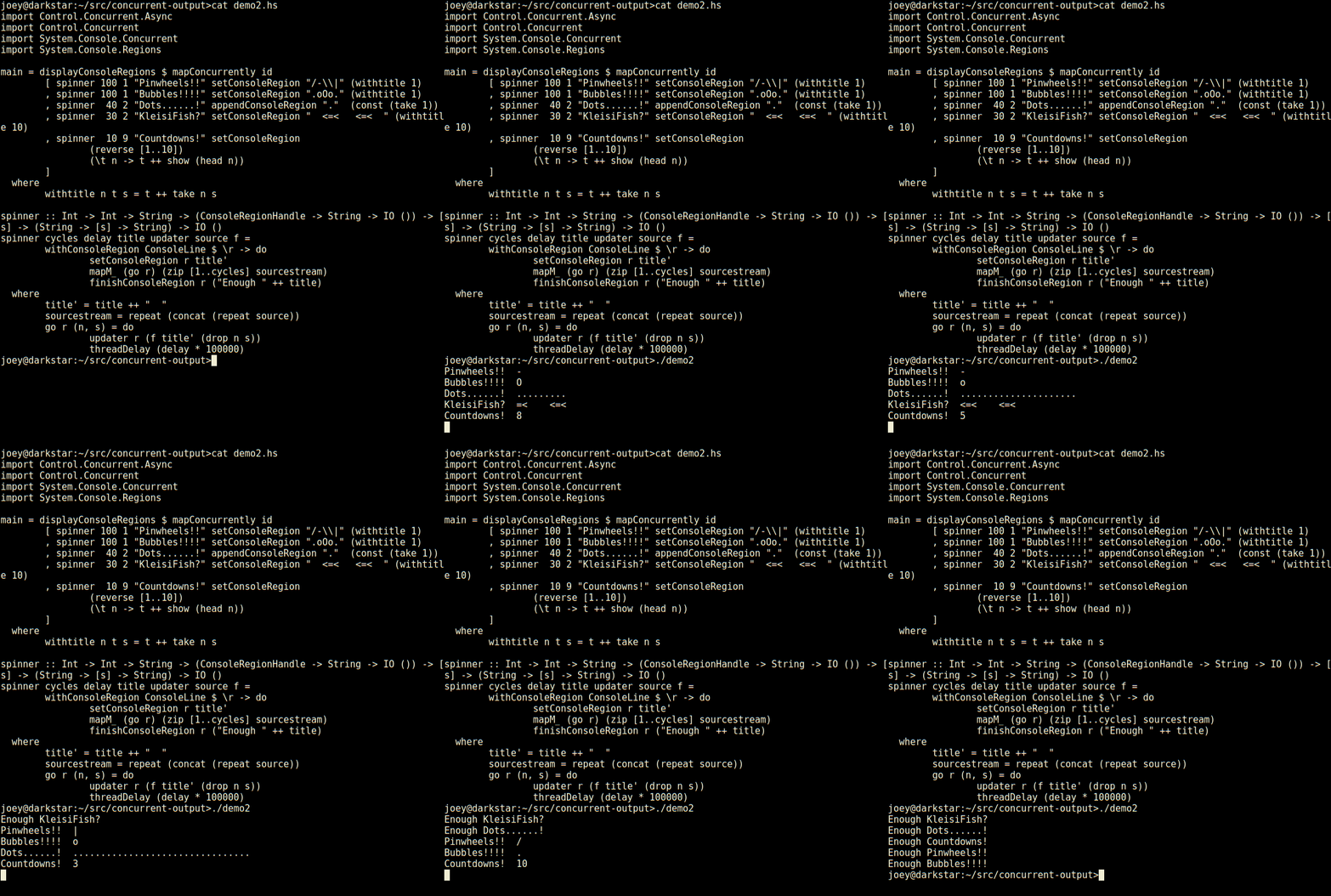
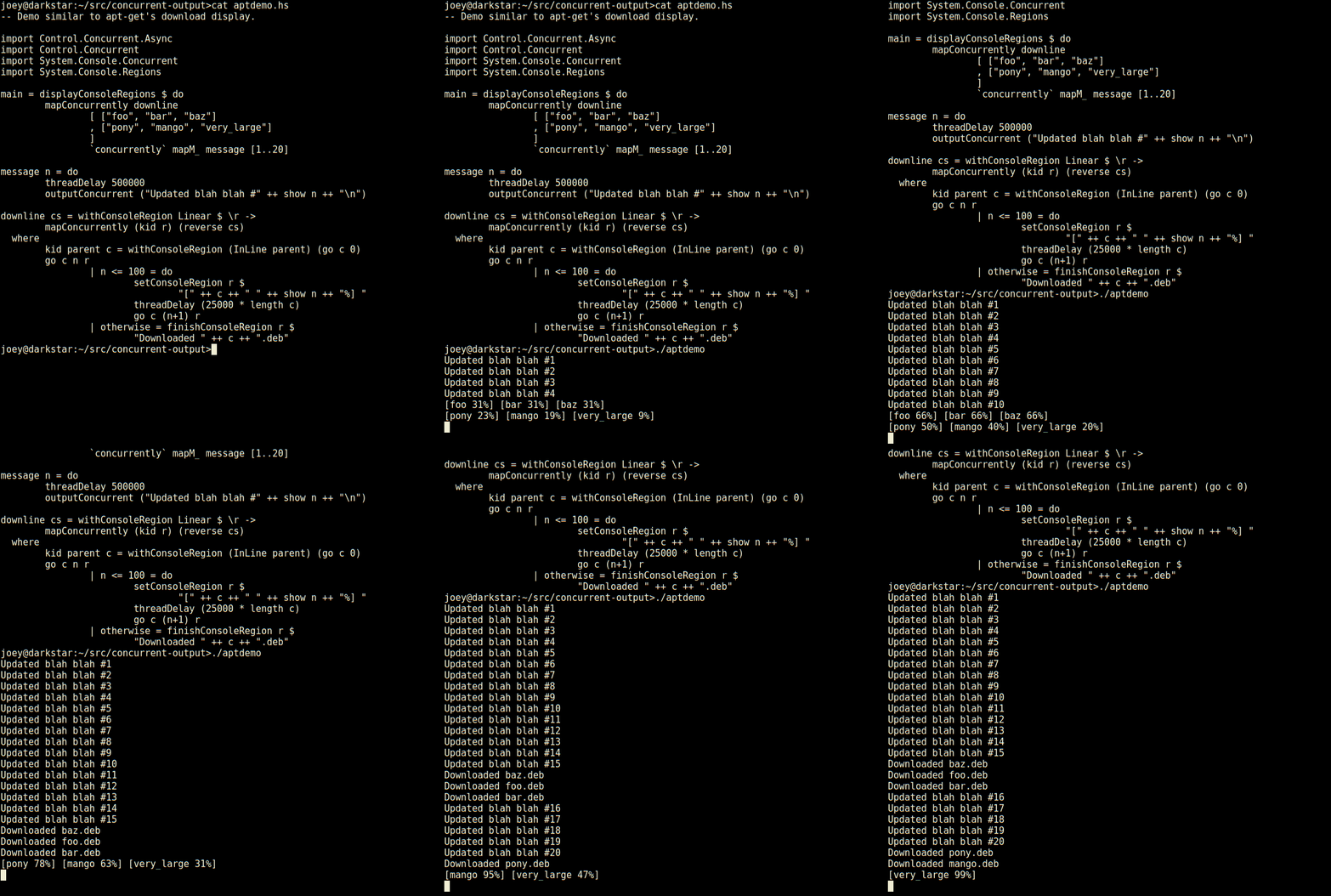
Building on top of concurrent-output, and some related work Joachim Breitner did earlier, I now have a kind of equivilant to a tiling window manager, except it's managing regions of the console for different parts of a single program. Here's a really silly demo, in an animated gif: demo2.gif Not bad for 23 lines of code, is that? Seems much less tedious to do things this way than using ncurses. Even with its panels, ncurses requires you to think about layout of various things on the screen, and many low-level details. This, by contrast, is compositional, just add another region and a thread to update it, and away it goes. So, here's an apt-like download progress display, in 30 lines of code. aptdemo.gif Not only does it have regions which are individual lines of the screen, but those can have sub-regions within them as seen here (and so on). And, log-type messages automatically scroll up above the regions. External programs run by createProcessConcurrent will automatically get their output/errors displayed there, too. What I'm working on now is support for multiline regions, which automatically grow/shrink to fit what's placed in them. The hard part, which I'm putting the finishing touches on, is to accurately work out how large a region is before displaying it, in order to lay it out. Requires parsing ANSI codes amoung other things. STM rules There's so much concurrency, with complicated interrelated data being updated by different threads, that I couldn't have possibly built this without Software Transactional Memory. Rather than a nightmare of locks behind locks behind locks, the result is so well behaved that I'm confident that anyone who needs more control over the region layout, or wants to do funky things can dive into to the STM interface and update the data structures, and nothing will ever deadlock or be inconsistent, and as soon as an update completes, it'll display on-screen. An example of how powerful and beuatiful STM is, here's how the main display thread determines when it needs to refresh the display:
data DisplayChange
        = BufferChange [(StdHandle, OutputBuffer)]
          RegionChange RegionSnapshot
          TerminalResize (Maybe Width)
          EndSignal ()
    ...
                change <- atomically $
                        (RegionChange <$> regionWaiter origsnapshot)
                                 orElse 
                        (RegionChange <$> regionListWaiter origsnapshot)
                                 orElse 
                        (BufferChange <$> outputBufferWaiterSTM waitCompleteLines)
                                 orElse 
                        (TerminalResize <$> waitwidthchange)
                                 orElse 
                        (EndSignal <$> waitTSem endsignal)
                case change of
                        RegionChange snapshot -> do
                ...
                        BufferChange buffers -> do
                ...
                        TerminalResize width -> do
                ...
So, it composes all these STM actions that can wait on various kinds of changes, to get one big action, that waits for all of the above, and builds up a nice sum type to represent what's changed. Another example is that the whole support for sub-regions only involved adding 30 lines of code, all of it using STM, and it worked 100% the first time.
Available in concurrent-output 1.1.0.

29 October 2015

Mart n Ferrari: Tales from the SRE trenches: SREs are not firefighters

This is the third part in a series of articles about SRE, based on the talk I gave in the Romanian Association for Better Software. If you haven't already, you might want to read part 1 and part 2 first. In this post, I talk about some strategies to avoid drowning SRE people in operational work.

SREs are not firefighters As I said before, it is very important that there is trust and respect between Dev and Ops. If Ops is seen as just an army of firefighters that will gladly put away fires at any time of the night, there are less incentives to make good software. Conversely, if Dev is shielded from the realities of the production environment, Ops will tend to think of them as delusional and untrustworthy.

Common staffing pool for SRE and SWE The first tool to combat this at Google -and possibly a difficult one to implement in small organisations- is to have single headcount budgets for Dev and Ops. That means that the more SREs you need to support your service, the less developers you have to write it. Combined with this, Google offers the possibility to SREs to move freely between teams, or even to transfer out to SWE. Because of this, a service that is painful to support will see the most senior SREs leaving and will only be able to afford less experienced hires. All this is a strong incentive to write good quality software, to work closely and to listen to the Ops people.

Share 5% of operational work with the SWE team On the other hand, it is necessary that developers see first hand how the service works in production, understand the problems, and share the pain of things failing. To this end, SWEs are expected to take on a small fraction of the operational work from SRE: handling tickets, being on-call, performing deployments, or managing capacity. This results in better communication among the teams and a common understanding of priorities.

Cap operational load at 50% One very uncommon rule from SRE at Google, is that SREs are not supposed to spend more than half of their time on "operational work". SREs are supposed to be spending their time on automation, monitoring, forecasting growth... Not on repeatedly fixing manually issues that stem from bad systems.

Excess operational work overflows to SWE If an SRE team is found to be spending too much time on operational work, that extra load is automatically reassigned to the development team, so SRE can keep doing their non-operational duties. On extreme cases, a service might be deemed too unstable to maintain, and SRE support is completely removed: it means the development team now has to carry pagers and do all the operational work themselves. It is a nuclear option, but the threat of it happening is a strong incentive to keep things sane.
The next post will be less about how to avoid unwanted work and more about the things that SRE actually do, and how these make things better. Comment

Daniel Pocock: Lumicall rapid provisioning, Opus support and other enhancements

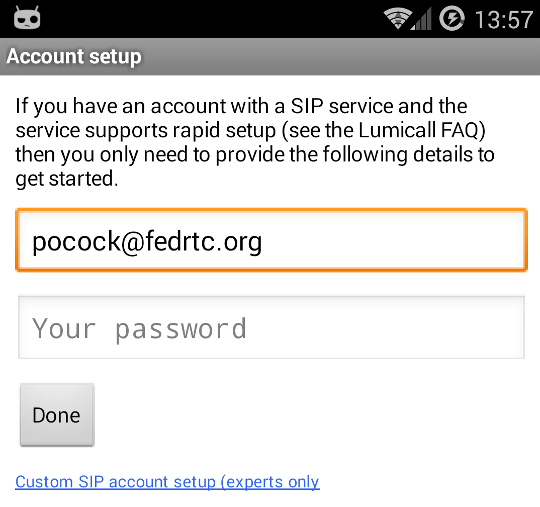
Thanks to feedback from many people at DebConf15, Lumicall has had a range of improvements over the last couple of months and it is now easier to use and more reliable than ever. Rapid provisioning for Debian.org, FedRTC.org and other SIP accounts 1. Setup your SIP password in the Debian LDAP or the FedRTC account setup (using Fedora OpenID) or any other SIP service that supports rapid provisioning (see the FAQ). 2. Install the Lumicall app from F-Droid, Google Play or by direct download. 3. When the app starts the first time, you can verify your phone number (so other users can call you using the number they know) or just click the "Manual account setup" link underneath the verification button. If you do verify your number, the "Add account" link is also available in the menu from the main screen. Test calls If a friend installs Lumicall too and you dial their number, the Lumicall popup should appear and give you the option to make the call over SIP. You can also make test calls using this link for a recorded announcement. Many other improvements
  • Support for the OPUS codec, which brings us one step closer to direct WebRTC interoperability
  • Fixing a bug in ice4j that caused NAT traversal to fail intermittently
  • Tweaks to make it more tolerant of IPv6 networks
  • The rapid account setup form (described above) for existing SIP accounts
  • Conversion to the Gradle build system (for Android Studio)
  • Breaking out embedded library code from the Lumicall repository into standalone projects so they can be maintained independently
  • Use of the compatibility library to display the ActionBar, consistent with the current design guidelines, while still maintaining compatibility with older devices
  • Use of Spongy Castle instead of Bouncy Castle crypto library for more consistent behavior across different Android devices
Share your experiences with Lumicall All feedback is welcome. If you can come in person to the workshop in Manchester (2 November) or the mini-DebConf in Cambridge (I'll be there Saturday, 7 November) then we can look at any problems in person and access logs with the Android tools if necessary. Discussion is also welcome on the Lumicall users mailing list or the Free RTC mailing list.

27 October 2015

Mart n Ferrari: Tales from the SRE trenches: Dev vs Ops

This is the second part in a series of articles about SRE, based on the talk I gave in the Romanian Association for Better Software. On the first part, I introduced briefly what is SRE. Today, I present some concrete ways in which SRE tried to make things better, by stopping the war between developers and SysAdmins.

Dev vs Ops: the eternal battle So, it starts at looking at the problem: how to increase the reliability of the service? It turns out that some of the biggest sources of outages are new launches: a new feature that seemed innocuous somehow managed to bring the whole site down. Devs want to launch, and Ops want to have a quiet weekend, and this is were the struggle begins. When launches are problematic, bureaucracy is put in place to minimise the risks: launch reviews, checklists, long-lived canaries. This is followed by development teams finding ways of side-stepping those hurdles. Nobody is happy. One of the key aspects of SRE is to avoid this conflict completely, by changing the incentives, so these pressures between development and operations disappear. At Google, they achieve this with a few different strategies:

Have an SLA for your service Before any service can be supported by SRE, it has to be determined what is the level of availability that it must achieve to make the users and the company happy: this is called the Service Level Agreement (SLA). The SLA will define how availability is measured (for example, percentage of queries handled successfully in less than 50ms during the last quarter), and what is the minimum acceptable value for it (the Service Level Objective, or SLO). Note that this is a product decision, not a technical one. This number is very important for an SRE team and its relationship with the developers. It is not taken lightly, and it should be measured and enforced rigorously (more on that later). Only a few things on earth really require 100% availability (pacemakers, for example), and achieving really high availability is very costly. Most of us are dealing with more mundane affairs, and in the case of websites, there are many other things that fail pretty often: network glitches, OS freezes, browsers being slow, etc. So an SLO of 100% is almost never a good idea, and in most cases it is impossible to reach. In places like Google an SLO of "five nines" (99.999%) is not uncommon, and this means that the service can't fail completely for more than 5 minutes across a whole year!

Measure and report performance against SLA/SLO Once you have a defined SLA and SLO, it is very important that these are monitored accurately and reported constantly. If you wait for the end of the quarter to produce a hand-made report, the SLA is useless, as you only know you broke it when it is too late. You need automated and accurate monitoring of your service level, and this means that the SLA has to be concrete and actionable. Fuzzy requirements that can't be measured are just a waste of time. This is a very important tool for SRE, as it allows to see the progression of the service over time, detect capacity issues before they become outages, and at the same time show how much downtime can be taken without breaking the SLA. Which brings us to one core aspect of SRE:

Use error budgets and gate launches on them If SLO is the minimum rate of availability, then the result of calculating 1 - SLO is what fraction of the time a service can fail without failing out of the SLA. This is called an error budget, and you get to use it the way you want it. If the service is flaky (e.g. it fails consistently 1 of every 10000 requests), most of that budget is just wasted and you won't have any margin for launching riskier changes. On the other hand, a stable service that does not eat the budget away gives you the chance to bet part of it on releasing more often, and getting your new features quicker to the user. The moment the error budget is spent, no more launches are allowed until the average goes back out of the red. Once everyone can see how the service is performing against this agreed contract, many of the traditional sources of conflict between development and operations just disappear. If the service is working as intended, then SRE does not need to interfere on new feature launches: SRE trusts the developers' judgement. Instead of stopping a launch because it seems risky or under-tested, there are hard numbers that take the decisions for you. Traditionally, Devs get frustrated when they want to release, but Ops won't accept it. Ops thinks there will be problems, but it is difficult to back this feeling with hard data. This fuels resentment and distrust, and management is never pleased. Using error budgets based on already established SLAs means there is nobody to get upset at: SRE does not need to play bad cop, and SWE is free to innovate as much as they want, as long as things don't break. At the same time, this provides a strong incentive for developers to avoid risking their budget in poorly-prepared launches, to perform staged deployments, and to make sure the error budget is not wasted by recurrent issues.
That's all for today. The next article will continue delving into how traditional tensions between Devs and Ops are played in the SRE world. Comment

Marco d'Itri: Per-process netfilter rules

This article documents how the traffic of specific Linux processes can be subjected to a custom firewall or routing configuration, thanks to the magic of cgroups. We will use the Network classifier cgroup, which allows tagging the packets sent by specific processes. To create the cgroup which will be used to identify the processes I added something like this to /etc/rc.local:
mkdir /sys/fs/cgroup/net_cls/unlocator
/bin/echo 42 > /sys/fs/cgroup/net_cls/unlocator/net_cls.classid
chown md: /sys/fs/cgroup/net_cls/unlocator/tasks
The tasks file, which controls the membership of processes in a cgroup, is made writeable by my user: this way I can add new processes without becoming root. 42 is the arbitrary class identifier that the kernel will associate with the packets generated by the member processes. A command like systemd-cgls /sys/fs/cgroup/net_cls/ can be used to explore which processes are in which cgroup. I use a simple shell wrapper to start a shell or a new program as members of this cgroup:
#!/bin/sh -e
CGROUP_NAME=unlocator
if [ ! -d /sys/fs/cgroup/net_cls/$CGROUP_NAME/ ]; then
  echo "The $CGROUP_NAME net_cls cgroup does not exist!" >&2
  exit 1
fi
/bin/echo $$ > /sys/fs/cgroup/net_cls/$CGROUP_NAME/tasks
if [ $# = 0 ]; then
  exec $ SHELL:-/bin/sh 
fi
exec "$@"
My first goal is to use a special name server for the DNS queries of some processes, thanks to a second dnsmasq process which acts as a caching forwarder. /etc/dnsmasq2.conf:
port=5354
listen-address=127.0.0.1
bind-interfaces
no-dhcp-interface=*
no-hosts
no-resolv
server=185.37.37.37
server=185.37.37.185
/etc/systemd/system/dnsmasq2.service:
[Unit]
Description=dnsmasq - Second instance
Requires=network.target
[Service]
ExecStartPre=/usr/sbin/dnsmasq --test
ExecStart=/usr/sbin/dnsmasq --keep-in-foreground --conf-file=/etc/dnsmasq2.conf
ExecReload=/bin/kill -HUP $MAINPID
PIDFile=/run/dnsmasq/dnsmasq.pid
[Install]
WantedBy=multi-user.target
Do not forget to enable the new service:
systemctl enable dnsmasq2
systemctl start dnsmasq2
Since the cgroup match extension is not yet available in a released version of iptables, you will first need to build and install it manually:
git clone git://git.netfilter.org/iptables.git
cd iptables
./autogen.sh
./configure
make -k
sudo cp extensions/libxt_cgroup.so /lib/xtables/
sudo chmod -x /lib/xtables/libxt_cgroup.so
The netfilter configuration required is very simple: all DNS traffic from the marked processes is redirected to the port of the local dnsmasq2:
iptables -t nat -A OUTPUT -m cgroup --cgroup 42 -p udp --dport 53 -j REDIRECT --to-ports 5354
iptables -t nat -A OUTPUT -m cgroup --cgroup 42 -p tcp --dport 53 -j REDIRECT --to-ports 5354
For related reasons, I also need to disable IPv6 for these processes:
ip6tables -A OUTPUT -m cgroup --cgroup 42 -j REJECT
I use a different cgroup to force some programs to use my office VPN by first setting a netfilter packet mark on their traffic:
iptables -t mangle -A OUTPUT -m cgroup --cgroup 43 -j MARK --set-mark 43
The packet mark is then used to policy-route this traffic using a dedicate VRF, i.e. routing table 43:
ip rule add fwmark 43 table 43
This VPN VRF just contains a default route for the VPN interface:
ip route add default dev tun0 table 43
Depending on your local configuration it may be a good idea to also add to the VPN VRF the routes of your local interfaces:
ip route show scope link proto kernel \
    xargs -I ROUTE ip route add ROUTE table 43
Since the source address selection happens before the traffic is diverted to the VPN, we also need to source-NAT to the VPN address the marked packets:
iptables -t nat -A POSTROUTING -m mark --mark 43 --out-interface tun0 -j MASQUERADE

26 October 2015

Steve Kemp: It begins - a new mail client, with lua scripting

Once upon a time I wrote a mail-client, which worked in the console directly via Maildir manipulation. My mail client was written in C++, and used Lua for scripting unlike clients such as mutt, alpine, and similar alternatives which don't have complete scripting support. I've pondered several times whether to restart this project, but I think it is the right thing to do. The original lumail client has a rich API, but it is very ad-hoc and random. Functions were added where they seemed like a good idea, but with no real planning, and although there are grouped functions that operate similarly there isn't a lot of consistency. The implementation is clean in places, elegant in others, and horrid in yet more parts. This time round everything is an object, accessible to Lua, with Lua, and for Lua. This time round all the drawing-magic is will be written in Lua. So to display a list of Maildirs I create a bunch of objects, one for each Maildir, and then the Lua function Maildir.to_string is called. That function looks like this:
--
-- This method returns the text which is displayed when a maildir is
-- to be show in maildir-mode.
--
function Maildir.to_string(self)
   local total  = self:total_messages()
   local unread = self:unread_messages()
   local path   = self:path()
   local output = string.format( "[%05d / %05d] - %s", unread, total, path );
   if ( unread > 0 ) then
      output = "$[RED]" .. output
   end
   if ( string.find( output, "Automated." ) ) then
      output = strip_colour( output )
      output = "$[YELLOW]" .. output
   end
   return output
end
The end result is something that looks like this:
[00001 / 00010 ] - Amazon.de
[00000 / 00023 ] - Automated.root
The formatting can thus be adjusted clearly, easily, and without hacking the core of the client. Providing I implement the apporpriate methods to the Maildir object. It's still work in progress. You can view maildirs, view indexes, and view messages. You cannot reply, forward, or scroll properly. That said the hard part is done now, and I'm reasonably happy with it. The sample configuration file is a bit verbose, but a good demonstration regardless. See the code, if you wish, online here:

Simon Josefsson: Combining Dnsmasq and Unbound

For my home office network I have been using Dnsmasq for some time. Dnsmasq provides me with DNS, DHCP, DHCPv6, and IPv6 Router Advertisement. I run dnsmasq on a Debian Jessie server, but it works similar with OpenWRT if you want to use a smaller device. My entire /etc/dnsmasq.d/local configuration used to look like this:
dhcp-authoritative
interface=eth1
read-ethers
dhcp-range=192.168.1.100,192.168.1.150,12h
dhcp-range=2001:9b0:104:42::100,2001:9b0:104:42::1500
dhcp-option=option6:dns-server,[::]
enable-ra
Here dhcp-authoritative enable DHCP. interface=eth1 says to listen on eth1 only, which is my internal (IPv4 NAT) network. I try to keep track of the MAC address of all my devices in a /etc/ethers file, so I use read-ethers to have dnsmasq give stable IP addresses for them. The dhcp-range is used to enable DHCP and DHCPv6 on my internal network. The dhcp-option=option6:dns-server,[::] statement is needed to inform the DHCP clients of the DNS resolver s IPv6 address, otherwise they would only get the IPv4 DNS server address. The enable-ra parameter enables IPv6 router advertisement on the internal network, thereby removing the need to run radvd too useful since I prefer to use copyleft software. Recently I had a desire to use DNSSEC, and enabled it in Dnsmasq using the following statements:
dnssec
trust-anchor=.,19036,8,2,49AAC11D7B6F6446702E54A1607371607A1A41855200FD2CE1CDDE32F24E8FB5
dnssec-check-unsigned
The dnssec keyword enable DNSSEC validation in dnsmasq, using the indicated trust-anchor (get the root-anchors from IANA). The dnssec-check-unsigned deserves some more discussion. The dnsmasq manpage describes it as follows:
As a default, dnsmasq does not check that unsigned DNS replies are legitimate: they are assumed to be valid and passed on (without the authentic data bit set, of course). This does not protect against an attacker forging unsigned replies for signed DNS zones, but it is fast. If this flag is set, dnsmasq will check the zones of unsigned replies, to ensure that unsigned replies are allowed in those zones. The cost of this is more upstream queries and slower performance.
For example, this means that dnsmasq s DNSSEC functionality is not secure against active man-in-the-middle attacks between dnsmasq and the DNS server it is using. Even if example.org used DNSSEC properly, an attacker could fake that it was unsigned to dnsmasq, and I would get potentially incorrect values in return. We all know that the Internet is not a secure place, and your threat model should include active attackers. I believe this mode should be the default in dnsmasq, and users should have to configure dnsmasq to not be in that mode if they really want to (with the obvious security warning). Running with this enabled for a couple of days resulted in frustration about not being able to reach a couple of domains. The behaviour was that my clients would hang indefinitely or get a SERVFAIL, both resulting in lack of service. You can enable query logging in dnsmasq with log-queries and enabling this I noticed three distinct form of error patterns:
jow13gw dnsmasq 460 - -  forwarded www.fritidsresor.se to 213.80.101.3
jow13gw dnsmasq 460 - -  validation result is BOGUS
jow13gw dnsmasq 547 - -  reply cloudflare-dnssec.net is BOGUS DNSKEY
jow13gw dnsmasq 547 - -  validation result is BOGUS
jow13gw dnsmasq 547 - -  reply linux.conf.au is BOGUS DS
jow13gw dnsmasq 547 - -  validation result is BOGUS
The first only happened intermittently, the second did not cause any noticeable problem, and the final one was reproducible. To be fair, I only found the last example after starting to search for problem reports (see post confirming bug). At this point, I had a confirmed bug in dnsmasq that affect my use-case. I want to use official packages from Debian on this machine, so installing newer versions manually is not an option. So I started to look into alternatives for DNS resolving, and quickly found Unbound. Installing it was easy:
apt-get install unbound
unbound-control-setup 
I created a local configuration file in /etc/unbound/unbound.conf.d/local.conf as follows:
server:
	interface: 127.0.0.1
	interface: ::1
	interface: 192.168.1.2
	interface: 2001:9b0:104:42::2
	access-control: 127.0.0.1 allow
	access-control: ::1 allow
	access-control: 192.168.1.2/24 allow
	access-control: 2001:9b0:104:42::2/64 allow
	outgoing-interface: 155.4.17.2
	outgoing-interface: 2001:9b0:1:1a04::2
#	log-queries: yes
#	verbosity: 2
The interface keyword determine which IP addresses to listen on, here I used the loopback interface and the local address of the physical network interface for my internal network. The access-control allows recursive DNS resolving from those networks. And outgoing-interface specify my external Internet-connected interface. log-queries and/or verbosity are useful for debugging. To make things work, dnsmasq has to stop providing DNS services. This can be achieved with the port=0 keyword, however that will also disable informing DHCP clients about the DNS server to use. So this has to be added in manually. I ended up adding the two following lines to /etc/dnsmasq.d/local:
port=0
dhcp-option=option:dns-server,192.168.1.2
Restarting unbound and dnsmasq now leads to working (and secure) internal DNSSEC-aware name resolution over both IPv4 and IPv6. I can verify that resolution works, and that Unbound verify signatures and reject bad domains properly with dig as below, or use online DNSSEC resolver test page although I m not sure how confident you can be in the result from that page.
$ host linux.conf.au
linux.conf.au has address 192.55.98.190
linux.conf.au mail is handled by 1 linux.org.au.
$ host sigfail.verteiltesysteme.net
;; connection timed out; no servers could be reached
$ 
I use Munin to monitor my services, and I was happy to find a nice Unbound Munin plugin. I installed the file in /usr/share/munin/plugins/ and created a Munin plugin configuration file /etc/munin/plugin-conf.d/unbound as follows:
[unbound*]
user root
env.statefile /var/lib/munin-node/plugin-state/root/unbound.state
env.unbound_conf /etc/unbound/unbound.conf
env.unbound_control /usr/sbin/unbound-control
env.spoof_warn 1000
env.spoof_crit 100000
I run munin-node-configure --shell sh to enable it. To work unbound has to be configured as well, so I create a /etc/unbound/unbound.conf.d/munin.conf as follows.
server:
	extended-statistics: yes
	statistics-cumulative: no
	statistics-interval: 0
remote-control:
	control-enable: yes
The graphs may be viewed at my munin instance.

25 October 2015

Johannes Schauer: unshare without superuser privileges

TLDR: With the help of Helmut Grohne I finally figured out most of the bits necessary to unshare everything without becoming root (though one might say that this is still cheated because the suid root tools newuidmap and newgidmap are used). I wrote a Perl script which documents how this is done in practice. This script is nearly equivalent to using the existing commands lxc-usernsexec [opts] -- unshare [opts] -- COMMAND except that these two together cannot be used to mount a new proc. Apart from this problem, this Perl script might also be useful by itself because it is architecture independent and easily inspectable for the curious mind without resorting to sources.debian.net (it is heavily documented at nearly 2 lines of comments per line of code on average). It can be retrieved here at https://gitlab.mister-muffin.de/josch/user-unshare/blob/master/user-unshare Long story: Nearly two years after my last last rant about everything needing superuser privileges in Linux, I'm still interested in techniques that let me do more things without becoming root. Helmut Grohne had told me for a while about unshare(), or user namespaces as the right way to have things like chroot without root. There are also reports of LXC containers working without root privileges but they are hard to come by. A couple of days ago I had some time again, so Helmut helped me to get through the major blockers that were so far stopping me from using unshare in a meaningful way without executing everything with sudo. My main motivation at that point was to let dpkg-buildpackage when executed by sbuild be run with an unshared network namespace and thus without network access (except for the loopback interface) because like pbuilder I wanted sbuild to enforce the rule not to access any remote resources during the build. After several evenings of investigating and doctoring at the Perl script I mentioned initially, I came to the conclusion that the only place that can unshare the network namespace without disrupting anything is schroot itself. This is because unsharing inside the chroot will fail because dpkg-buildpackage is run with non-root privileges and thus the user namespace has to be unshared. But this then will destroy all ownership information. But even if that wasn't the case, the chroot itself is unlikely to have (and also should not) tools like ip or newuidmap and newgidmap installed. Unsharing the schroot call itself also will not work. Again we first need to unshare the user namespace and then schroot will complain about wrong ownership of its configuration file /etc/schroot/schroot.conf. Luckily, when contacting Roger Leigh about this wishlist feature in bug#802849 I was told that this was already implemented in its git master \o/. So this particular problem seems to be taken care of and once the next schroot release happens, sbuild will make use of it and have unshare --net capabilities just like pbuilder already had since last year. With the sbuild case taken care of, the rest of this post will introduce the Perl script I wrote. The name user-unshare is really arbitrary. I just needed some identifier for the git repository and a filename. The most important discovery I made was, that Debian disables unprivileged user namespaces by default with the patch add-sysctl-to-disallow-unprivileged-CLONE_NEWUSER-by-default.patch to the Linux kernel. To enable it, one has to first either do
echo 1   sudo tee /proc/sys/kernel/unprivileged_userns_clone > /dev/null
or
sudo sysctl -w kernel.unprivileged_userns_clone=1
The tool tries to be like unshare(1) but with the power of lxc-usernsexec(1) to map more than one id into the new user namespace by using the programs newgidmap and newuidmap. Or in other words: This tool tries to be like lxc-usernsexec(1) but with the power of unshare(1) to unshare more than just the user and mount namespaces. It is nearly equal to calling:
lxc-usernsexec [opts] -- unshare [opts] -- COMMAND
Its main reason of existence are: I hoped that systemd-nspawn could do what I wanted but it seems that its requirement for being run as root will not change any time soon Another tool in Debian that offers to do chroot without superuser privileges is linux-user-chroot but that one cheats by being suid root. Had I found lxc-usernsexec earlier I would've probably not written this. But after I found it I happily used it to get an even better understanding of the matter and further improve the comments in my code. I started writing my own tool in Perl because that's the language sbuild was written in and as mentioned initially, I intended to use this script with sbuild. Now that the sbuild problem is taken care of, this is not so important anymore but I like if I can read the code of simple programs I run directly from /usr/bin without having to retrieve the source code first or use sources.debian.net. The only thing I wasn't able to figure out is how to properly mount proc into my new mount namespace. I found a workaround that works by first mounting a new proc to /proc and then bind-mounting /proc to whatever new location for proc is requested. I didn't figure out how to do this without mounting to /proc first partly also because this doesn't work at all when using lxc-usernsexec and unshare together. In this respect, this perl script is a bit more powerful than those two tools together. I suppose that the reason is that unshare wasn't written with having being called without superuser privileges in mind. If you have an idea what could be wrong, the code has a big FIXME about this issue. Finally, here a demonstration of what my script can do. Because of the /proc bug, lxc-usernsexec and unshare together are not able to do this but it might also be that I'm just not using these tools in the right way. The following will give you an interactive shell in an environment created from one of my sbuild chroot tarballs:
$ mkdir -p /tmp/buildroot/proc
$ ./user-unshare --mount-proc=/tmp/buildroot/proc --ipc --pid --net \
    --uts --mount --fork -- sh -c 'ip link set lo up && ip addr && \
    hostname hoothoot-chroot && \
    tar -C /tmp/buildroot -xf /srv/chroot/unstable-amd64.tar.gz; \
    /usr/sbin/chroot /tmp/buildroot /sbin/runuser -s /bin/bash - josch && \
    umount /tmp/buildroot/proc && rm -rf /tmp/buildroot'
(unstable-amd64-sbuild)josch@hoothoot-chroot:/$ whoami
josch
(unstable-amd64-sbuild)josch@hoothoot-chroot:/$ hostname
hoothoot-chroot
(unstable-amd64-sbuild)josch@hoothoot-chroot:/$ ls -lha /proc   head
total 0
dr-xr-xr-x 218 nobody nogroup    0 Oct 25 19:06 .
drwxr-xr-x  22 root   root     440 Oct  1 08:42 ..
dr-xr-xr-x   9 root   root       0 Oct 25 19:06 1
dr-xr-xr-x   9 josch  josch      0 Oct 25 19:06 15
dr-xr-xr-x   9 josch  josch      0 Oct 25 19:06 16
dr-xr-xr-x   9 root   root       0 Oct 25 19:06 7
dr-xr-xr-x   9 josch  josch      0 Oct 25 19:06 8
dr-xr-xr-x   4 nobody nogroup    0 Oct 25 19:06 acpi
dr-xr-xr-x   6 nobody nogroup    0 Oct 25 19:06 asound
Of course instead of running this long command we can also instead write a small shell script and execute that instead. The following does the same things as the long command above but adds some comments for further explanation:
#!/bin/sh

set -exu

# I'm using /tmp because I have it mounted as a tmpfs
rootdir="/tmp/buildroot"

# bring the loopback interface up
ip link set lo up

# show that the loopback interface is really up
ip addr

# make use of the UTS namespace being unshared
hostname hoothoot-chroot

# extract the chroot tarball. This must be done inside the user namespace for
# the file permissions to be correct.
#
# tar will fail to call mknod and to change the permissions of /proc but we are
# ignoring that
tar -C "$rootdir" -xf /srv/chroot/unstable-amd64.tar.gz true

# run chroot and inside, immediately drop permissions to the user "josch" and
# start an interactive shell
/usr/sbin/chroot "$rootdir" /sbin/runuser -s /bin/bash - josch

# unmount /proc and remove the temporary directory
umount "$rootdir/proc"
rm -rf "$rootdir"
and then:
$ mkdir -p /tmp/buildroot/proc
$ ./user-unshare --mount-proc=/tmp/buildroot/proc --ipc --pid --net --uts --mount --fork -- ./chroot.sh
As mentioned in the beginning, the tool is nearly equivalent to calling lxc-usernsexec [opts] -- unshare [opts] -- COMMAND but because of the problem with mounting proc (mentioned earlier), lxc-usernsexec and unshare cannot be used with above example. If one tries anyways one will only get:
$ lxc-usernsexec -m b:0:1000:1 -m b:1:558752:1 -- unshare --mount-proc=/tmp/buildroot/proc --ipc --pid --net --uts --mount --fork -- ./chroot.sh
unshare: mount /tmp/buildroot/proc failed: Invalid argument
I'd be interested in finding out why that is and how to fix it.

Next.

Previous.