Search Results: "ron"

11 December 2022

Vincent Bernat: Akvorado: a flow collector, enricher, and visualizer

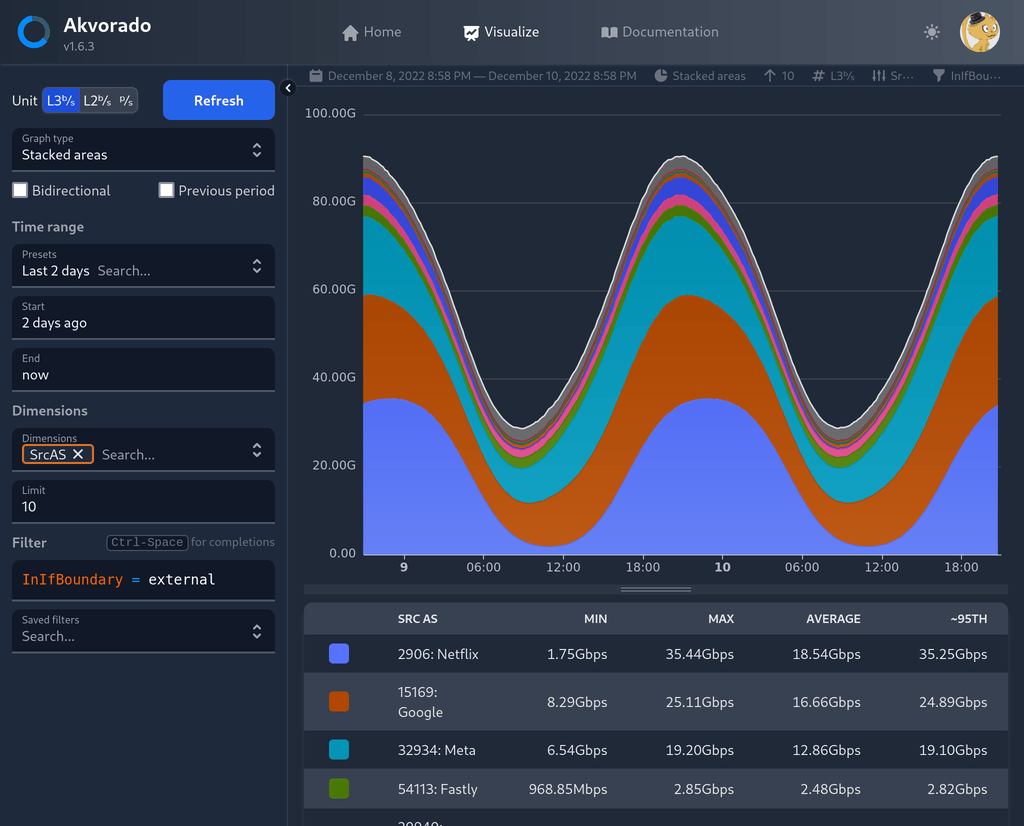
Earlier this year, we released Akvorado, a flow collector, enricher, and visualizer. It receives network flows from your routers using either NetFlow v9, IPFIX, or sFlow. Several pieces of information are added, like GeoIP and interface names. The flows are exported to Apache Kafka, a distributed queue, then stored inside ClickHouse, a column-oriented database. A web frontend is provided to run queries. A live version is available for you to play.
Akvorado web interface displays the result of a simple query using stacked areas
Akvorado s web frontend
Several alternatives exist: Akvorado differentiates itself from these solutions because: The proposed deployment solution relies on Docker Compose to set up Akvorado, Zookeeper, Kafka, and ClickHouse. I hope it should be enough for anyone to get started quickly. Akvorado is performant enough to handle 100 000 flows per second with 64 GB of RAM and 24 vCPU. With 2 TB of disk, you should expect to keep data for a few years. I spent some time writing a fairly complete documentation. It seems redundant to repeat its content in this blog post. There is also a section about its internal design if you are interested in how it is built. I also did a FRnOG presentation earlier this year, and a ClickHouse meetup presentation, which focuses more on how ClickHouse is used. I plan to write more detailed articles on specific aspects of Akvorado. Stay tuned!

  1. While the collector could write directly to the database, the queue buffers flows if the database is unavailable. It also enables you to process flows with another piece of software (like an anti-DDoS system).

Russ Allbery: Review: The Fifth Elephant

Review: The Fifth Elephant, by Terry Pratchett
Series: Discworld #24
Publisher: Harper
Copyright: 2000
Printing: May 2014
ISBN: 0-06-228013-9
Format: Mass market
Pages: 455
The Fifth Elephant is the 24th Discworld and fifth Watch novel, and largely assumes you know who the main characters are. This is not a good place to start. The dwarves are electing a new king. The resulting political conflict is spilling over into the streets of Ankh-Morpork, but that's not the primary problem. First, the replica Scone of Stone, a dwarven artifact used to crown the Low King of the Dwarves, is stolen from the Dwarf Bread Museum. Then, Vimes is dispatched to berwald, ostensibly to negotiate increased fat exports with the new dwarven king. And then Angua disappears, apparently headed towards her childhood home in berwald, which immediately prompts Carrot to resign and head after her. The City Watch is left in the hands of now-promoted Captain Colon. We see lots of Lady Sybil for the first time since Guards! Guards!, and there's a substantial secondary plot with Angua and Carrot and a tertiary plot with Colon making a complete mess of things back home, but this is mostly a Vimes novel. As usual, Vetinari is pushing him outside of his comfort zone, but he's not seriously expecting Vimes to act like an ambassador. He's expecting Vimes to act like a policeman, even though he's way outside his jurisdiction. This time, that means untangling a messy three-sided political situation involving the dwarves, the werewolves, and the vampires. There is some Igor dialogue in this book, but thankfully Pratchett toned it down a lot and it never started to bother me. I do enjoy Pratchett throwing Vimes and his suspicious morality at political problems and watching him go at them sideways. Vimes's definition of crimes is just broad enough to get him fully invested in a problem, but too narrow to give him much patience with the diplomatic maneuvering. It makes him an unpredictable diplomat in a clash of cultures way that's fun to read about. Cheery and Detritus are great traveling companions for this, since both of them also unsettle the dwarves in wildly different ways. I also have to admit that Pratchett is doing more interesting things with the Angua and Carrot relationship than I had feared. In previous books, I was getting tired of their lack of communication and wasn't buying the justifications for it, but I think I finally understand why the communication barriers are there. It's not that Angua refuses to talk to Carrot (although there's still a bit of that going on). It's that Carrot's attitude towards the world is very strange, and gets stranger the closer you are to him. Carrot has always been the character who is too earnest and straightforward and good for Ankh-Morpork and yet somehow makes it work, but Pratchett is doing something even more interesting with the concept of nobility. A sufficiently overwhelming level of heroic ethics becomes almost alien, so contrary to how people normally think that it can make conversations baffling. It's not that Carrot is perfect (sometimes he does very dumb things), it's that his natural behavior follows a set of ethics that humans like to pretend they follow but actually don't and never would entirely. His character should be a boring cliche or an over-the-top parody, and yet he isn't at all. But Carrot's part is mostly a side plot. Even more than Jingo, The Fifth Elephant is establishing Vimes as a force to be reckoned with, even if you take him outside his familiar city. He is in so many ways the opposite of Vetinari, and yet he's a tool that Vetinari is extremely good at using. Colon of course is a total disaster as the head of the Watch, and that's mostly because Colon should never be more than a sergeant, but it's also because even when he's taking the same action as Vimes, he's not doing it for the same reasons or with the same stubborn core of basic morality and loyalty that's under Vimes's suspicious conservatism. The characterization in the Watch novels doesn't seem that subtle or deep at first, but it accumulates over the course of the series in a way that I think is more effective than any of the other story strands. Vetinari, Vimes, and Carrot all represent "right," or at least order, in overlapping stories of right versus wrong, but they do so in radically different ways and with radically different goals. Each time one of them seems ascendant, each time one of their approaches seems more clearly correct, Pratchett throws them at a problem where a different approach is required. It's a great reading experience. This was one of the better Discworld novels even though I found the villains to be a bit tedious and stupid. Recommended. Followed by The Truth in publication order. The next Watch novel is Night Watch. Rating: 8 out of 10

10 December 2022

Simon Josefsson: Trisquel 11 on NV41PZ: First impressions

My NovaCustom NV41PZ laptop arrived a couple of days ago, and today I had some time to install it. You may want to read about my purchasing decision process first. I expected a rough ride to get it to work, given the number of people claiming that modern laptops can t run fully free operating systems. I first tried the Trisquel 10 live DVD and it booted fine including network, but the mouse trackpad did not work. Before investigating it, I noticed a forum thread about Trisquel 11 beta3 images, and being based on Ubuntu 22.04 LTS and has Linux-libre 5.15 it seemed better to start with more modern software. After installing through the live DVD successfully, I realized I didn t like MATE but wanted to keep using GNOME. I reverted back to installing a minimal environment through the netinst image, and manually installed GNOME (apt-get install gnome) since I prefer that over MATE, together with a bunch of other packages. I ve been running it for a couple of hours now, and here is a brief summary of the hardware components that works.
CPUAlder Lake Intel i7-1260P
Memory2x32GB Kingston DDR4 SODIMM 3200MHz
StorageSamsung 980 Pro 2TB NVME
BIOSDasharo Coreboot
GraphicsIntel Xe
Screen (internal)14 1920 1080
Screen (HDMI)Connected to Dell 27 2560 1440
Screen (USB-C)Connected to Dell 27 2560 1440 via Wavlink port extender
WebcamBuiltin 1MP Camera
MicrophoneIntel Alder Lake
KeyboardISO layout, all function keys working
MouseTrackpad, tap clicking and gestures
Ethernet RJ45Realtek RTL8111/8168/8411 with r8169 driver
Memory cardO2 Micro comes up as /dev/mmcblk0
Docking stationWavlink 4xUSB, 2xHDMI, DP, RJ45,
ConnectivityUSB-A, USB-C
AudioIntel Alder Lake
Hardware components and status
So what s not working? Unfortunately, NovaCustom does not offer any WiFi or Bluetooth module that is compatible with Trisquel, so the AX211 (1675x) Wifi/Bluetooth card in it is just dead weight. I imagine it would be possible to get the card to work if non-free firmware is loaded. I don t need Bluetooth right now, and use the Technoetic N-150 USB WiFi dongle when I m not connected to wired network. Compared against my X201, the following factors have improved. I m still unhappy about the following properties with both the NV41PZ and the X201. Hopefully my next laptop will have improved on this further. I hope to be able to resolve the WiFi part by replacing the WiFi module, there appears to be options available but I have not tested them on this laptop yet. Does anyone know of a combined WiFi and Bluetooth M.2 module that would work on Trisquel? While I haven t put the laptop to heavy testing yet, everything that I would expect a laptop to be able to do seems to work fine. Including writing this blog post!

Timo Jyrinki: Running Cockpit inside ALP

(quoted from my other blog at since a new OS might be interesting for many and this is published in separate planets)
ALP - The Adaptable Linux Platform is a new operating system from SUSE to run containerized and virtualized workloads. It is in early prototype phase, but the development is done completely openly so it s easy to jump in to try it.For this trying out, I used the latest encrypted build as of the writing, 22.1 from ALP images. I imported it in virt-manager as a Generic Linux 2022 image, using UEFI instead of BIOS, added a TPM device (which I m interested in otherwise) and referring to an Ignition JSON file in the XML config in virt-manager.The Ignition part is pretty much fully thanks to Paolo Stivanin who studied the secrets of it before me. But here it goes - and this is required for password login in Cockpit to work in addition to SSH key based login to the VM from host - first, create config.ign file:
 
"ignition": "version": "3.3.0" ,
"passwd":
"users": [

"name": "root",
"passwordHash": "YOURHASH",
"sshAuthorizedKeys": [
"ssh-... YOURKEY"
]

]
,
"systemd":
"units": [
"name": "sshd.service",
"enabled": true
]
,
"storage":
"files": [

"overwrite": true,
"path": "/etc/ssh/sshd_config.d/20-enable-passwords.conf",
"contents":
"source": "data:,PasswordAuthentication%20yes%0APermitRootLogin%20yes%0A"
,
"mode": 420

]


where password SHA512 hash can be obtained using openssl passwd -6 and the ssh key is your public ssh key.That file is put to eg /tmp and referred in the virt-manager s XML like follows:
  <sysinfo type="fwcfg">
<entry name="opt/com.coreos/config" file="/tmp/config.ign"/>
</sysinfo>
Now we can boot up the VM and ssh in - or you could log in directly too but it s easier to copy-paste commands when using ssh.Inside the VM, we can follow the ALP documentation to install and start Cockpit:
podman container runlabel install registry.opensuse.org/suse/alp/workloads/tumbleweed_containerfiles/suse/alp/workloads/cockpit-ws:latest
podman container runlabel --name cockpit-ws run registry.opensuse.org/suse/alp/workloads/tumbleweed_containerfiles/suse/alp/workloads/cockpit-ws:latest
systemctl enable --now cockpit.service
Check your host s IP address with ip -a, and open IP:9090 in your host s browser:Cockpit login screenLogin with root / your password and you shall get the front page:Cockpit front page and many other pages where you can manage your ALP deployment via browser:Cockpit podman pageAll in all, ALP is in early phases but I m really happy there s up-to-date documentation provided and people can start experimenting it whenever they want. The images from the linked directory should be fairly good, and test automation with openQA has been started upon as well.You can try out the other example workloads that are available just as well.

Simon Josefsson: How to complicate buying a laptop

I m about to migrate to a new laptop, having done a brief pre-purchase review of options on Fosstodon and reaching a decision to buy the NovaCustom NV41. Given the rapid launch and decline of Mastodon instances, I thought I d better summarize my process and conclusion on my self-hosted blog until the fediverse self-hosting situation improves. Since 2010 my main portable computing device has been the Lenovo X201 that replaced the Dell Precision M65 that I bought in 2006. I have been incredibly happy with the X201, even to the point that in 2015 when I wanted to find a replacement, I couldn t settle on a decision and eventually realized I couldn t articulate what was wrong with the X201 and decided to just buy another X201 second-hand for my second office. There is still no deal-breaker with the X201, and I m doing most of my computing on it including writing this post. However, today I can better articulate what is lacking with the X201 that I desire, and the state of the available options on the market has improved since my last attempt in 2015. Briefly, my desired properties are: My workload for the machine is Emacs, Firefox, Nextcloud client, GNOME, Evolution (mail & calendar), LibreOffice Calc/Writer, compiling software and some podman/qemu for testing. I have used Debian as the main operating system for the entire life of this laptop, but have experimented with PureOS recently. My current X201 is useful enough for this, although support for 4K displays and a faster machine wouldn t hurt. Based on my experience in 2015 that led me to make no decision, I changed perspective. This is a judgement call and I will not be able to fulfil all criteria. I will have to decide on a balance and the final choice will include elements that I really dislike, but still it will hopefully be better than nothing. The conflict for me mainly center around these parts: A simple choice for me would be to buy one of the FSF RYF certified laptops. Right now that list only contains the 10+ year old Lenovo series, and I actually already have a X200 with libreboot that I bought earlier for comparison. The reason the X200 didn t work out as a replacement for me was the lack of a mouse trackpad, concerns about non-free EC firmware, Intel ME uncertainty (is it really neutralized?) and non-free CPU microcode (what are the bugs that it fixes?), but primarily that for some reason that I can t fully articulate it feels weird to use a laptop manufactured by Lenovo but modified by third parties to be useful. I believe in market forces to pressure manufacturers into Doing The Right Thing, and feel that there is no incentive for Lenovo to use libreboot in the future when this market niche is already fulfilled by re-sellers modifying Lenovo laptops. So I d be happier buying a laptop from someone who is natively supportive of they way I m computing. I m sure this aspect could be discussed a lot more, and maybe I ll come back to do that, and could even reconsider my thinking (the right-to-repair argument is compelling). I will definitely continue to monitor the list of RYF-certified laptops to see if future entries are more suitable options for me. Eventually I decided to buy the NovaCustom NV41 laptop, and it arrived quickly and I m in the process of setting it up. I hope to write a separate blog about it next.

Matthew Garrett: On-device WebAuthn and what makes it hard to do well

WebAuthn improves login security a lot by making it significantly harder for a user's credentials to be misused - a WebAuthn token will only respond to a challenge if it's issued by the site a secret was issued to, and in general will only do so if the user provides proof of physical presence[1]. But giving people tokens is tedious and also I have a new laptop which only has USB-C but does have a working fingerprint reader and I hate the aesthetics of the Yubikey 5C Nano, so I've been thinking about what WebAuthn looks like done without extra hardware.

Let's talk about the broad set of problems first. For this to work you want to be able to generate a key in hardware (so it can't just be copied elsewhere if the machine is compromised), prove to a remote site that it's generated in hardware (so the remote site isn't confused about what security assertions you're making), and tie use of that key to the user being physically present (which may range from "I touched this object" to "I presented biometric evidence of identity"). What's important here is that a compromised OS shouldn't be able to just fake a response. For that to be possible, the chain between proof of physical presence to the secret needs to be outside the control of the OS.

For a physical security token like a Yubikey, this is pretty easy. The communication protocol involves the OS passing a challenge and the source of the challenge to the token. The token then waits for a physical touch, verifies that the source of the challenge corresponds to the secret it's being asked to respond to the challenge with, and provides a response. At the point where keys are being enrolled, the token can generate a signed attestation that it generated the key, and a remote site can then conclude that this key is legitimately sequestered away from the OS. This all takes place outside the control of the OS, meeting all the goals described above.

How about Macs? The easiest approach here is to make use of the secure enclave and TouchID. The secure enclave is a separate piece of hardware built into either a support chip (for x86-based Macs) or directly on the SoC (for ARM-based Macs). It's capable of generating keys and also capable of producing attestations that said key was generated on an Apple secure enclave ("Apple Anonymous Attestation", which has the interesting property of attesting that it was generated on Apple hardware, but not which Apple hardware, avoiding a lot of privacy concerns). These keys can have an associated policy that says they're only usable if the user provides a legitimate touch on the fingerprint sensor, which means it can not only assert physical presence of a user, it can assert physical presence of an authorised user. Communication between the fingerprint sensor and the secure enclave is a private channel that the OS can't meaningfully interfere with, which means even a compromised OS can't fake physical presence responses (eg, the OS can't record a legitimate fingerprint press and then send that to the secure enclave again in order to mimic the user being present - the secure enclave requires that each response from the fingerprint sensor be unique). This achieves our goals.

The PC space is more complicated. In the Mac case, communication between the biometric sensors (be that TouchID or FaceID) occurs in a controlled communication channel where all the hardware involved knows how to talk to the other hardware. In the PC case, the typical location where we'd store secrets is in the TPM, but TPMs conform to a standardised spec that has no understanding of this sort of communication, and biometric components on PCs have no way to communicate with the TPM other than via the OS. We can generate keys in the TPM, and the TPM can attest to those keys being TPM-generated, which means an attacker can't exfiltrate those secrets and mimic the user's token on another machine. But in the absence of any explicit binding between the TPM and the physical presence indicator, the association needs to be up to code running on the CPU. If that's in the OS, an attacker who compromises the OS can simply ask the TPM to respond to an challenge it wants, skipping the biometric validation entirely.

Windows solves this problem in an interesting way. The Windows Hello Enhanced Signin doesn't add new hardware, but relies on the use of virtualisation. The agent that handles WebAuthn responses isn't running in the OS, it's running in another VM that's entirely isolated from the OS. Hardware that supports this model has a mechanism for proving its identity to the local code (eg, fingerprint readers that support this can sign their responses with a key that has a certificate that chains back to Microsoft). Additionally, the secrets that are associated with the TPM can be held in this VM rather than in the OS, meaning that the OS can't use them directly. This means we have a flow where a browser asks for a WebAuthn response, that's passed to the VM, the VM asks the biometric device for proof of user presence (including some sort of random value to prevent the OS just replaying that), receives it, and then asks the TPM to generate a response to the challenge. Compromising the OS doesn't give you the ability to forge the responses between the biometric device and the VM, and doesn't give you access to the secrets in the TPM, so again we meet all our goals.

On Linux (and other free OSes), things are less good. Projects like tpm-fido generate keys on the TPM, but there's no secure channel between that code and whatever's providing proof of physical presence. An attacker who compromises the OS may not be able to copy the keys to their own system, but while they're on the compromised system they can respond to as many challenges as they like. That's not the same security assertion we have in the other cases.

Overall, Apple's approach is the simplest - having binding between the various hardware components involved means you can just ignore the OS entirely. Windows doesn't have the luxury of having as much control over what the hardware landscape looks like, so has to rely on virtualisation to provide a security barrier against a compromised OS. And in Linux land, we're fucked. Who do I have to pay to write a lightweight hypervisor that runs on commodity hardware and provides an environment where we can run this sort of code?


[1] As I discussed recently there are scenarios where these assertions are less strong, but even so

comment count unavailable comments

Russ Allbery: Review: Trust

Review: Trust, by Mary Sisson
Series: Trang #2
Publisher: Mary Sisson
Copyright: 2012
Printing: December 2013
ASIN: B0087KQDQ0
Format: Kindle
Pages: 375
Trust is a direct sequel to Trang and should not be read out of order. Both the primary and secondary plot deal with the consequences of the ending of Trang and thus spoil it heavily. After a dodgy and unethical debriefing under mental probe (which took far too long to become relevant to the story) Philippe Trang is back at work as the human diplomat to a space station full of aliens in intergalactic space. At first, interspecies relations have not changed much, but soon Philippe will be drawn farther into the consequences of Trang's dramatic conclusion than he would have expected. And there are other complications: a new group of Special Forces soldiers, an extremely grumpy alien who disapproves of his species' current culture, and the continuing incomprehensible behavior of the Magic Man. I was hoping this series would be a hidden gem of diplomatic SF, a subgenre that I want to exist. Unfortunately, this entry takes a strong turn towards more conventional territory: a Star Trek plot. One of the merits of the first novel is that Trang, and the humans in general, didn't have much power. Humans were meeting aliens as equals or inferiors, and both sides were attempting to understand. Although the humans became central to the plot (probably unavoidable when they're the protagonists), it was somewhat by accident. I was hoping Sisson would lean into that setup, stress the equal footing, and focus on the complex diplomacy. Instead, Trust puts Trang in a position of considerable authority over one of the alien races. Like most Star Trek plots, this book is primarily about mapping strange alien behavior onto human morality to solve the problem of the week. As an entry in that genre, it's... okay. I still like Trang as a character, Sisson does an adequate job showing how weird aliens can be (although mostly by jumbling together extremes of human behavior instead of finding something truly alien), and the opinions of the aliens continue to matter. But I feel like this series is sliding towards making the humans central to everything, and I was not enthused by a plot that requires Trang sort out complex political problems for an entire alien race he knows next to nothing about. This book also adds more viewpoints, giving us several chapters from the perspective of one of Trang's escort soldiers and one from one of the aliens. I liked the alien perspective; it was probably the best chapter of the book. Seeing the human characters from an external perspective was amusing, and I liked how both the humans and the aliens surprised and confused each other. That said, it also felt like a bit of a cheat to tell the reader about the cultural forces at play that Trang was missing. I already thought Trang was being exceptionally dim about the alien gifts he was given, pocketing them without attempting to understand them and then never studying them later. Being shown more things he should have tried to figure out didn't help. You're a diplomat in an extended first contact situation: please have some basic curiosity about what's going on and talk it over with the people around you, rather than treating aliens like children. The soldier perspective adds a secondary plot that was okay but a bit silly, and I'm not sure why Sisson needed to introduce a second perspective to tell it. I think the same secondary plot would have been more interesting if she'd stuck with Trang's perspective and forced him to reconstruct what had been happening when he wasn't paying attention. As is, the plot relied too much on people being stupid and not talking to each other. There was nothing seriously wrong with this book, but it's also not fulfilling the potential of the first book of the series. It felt like okay self-published science fiction; that's not nothing, but there are a lot of books like that, and I wanted diplomatic science fiction that goes somewhere different. I may give the third book a chance, but I'm feeling less enthused now. Followed by Tribulations. Rating: 6 out of 10

John Goerzen: Music Playing: Both Whole-House and Mobile

It s been nearly 8 years since I last made choices about music playing. At the time, I picked Logitech Media Server (LMS, aka Slimserver and Squeezebox server) for whole-house audio and Ampache with the DSub Android app. It s time to revisit that approach. Here are the things I m looking for: The current setup Here are the current components: LMS makes an excellent whole-house audio system. I can pull up the webpage (or use an Android app like Squeezer) to browse my music library, queue things up to play, and so forth. I can also create playlists, which it saves as m3u files. This whole setup is boringly reliable. It just works, year in, year out. The main problem with this is that LMS has no real streaming/offline mobile support. It is also a rather dated system, with a painful UI for playlist management, and in general doesn t feel very modern. (It s written largely in Perl also!) So, I paired with it is Ampache. As a streaming player, Ampache is fantastic; I can access it from a web browser, and it will transcode my FLAC files to the quality I ve set in my user prefs. The DSub app for Android is fantastic and remembers my last-play locations and such. The problem is that Ampache doesn t write its playlists back to m3u format, so I can t use them with LMS. I have to therefore maintain all the playlists in LMS, and it has a smallish limit on the number of tracks per playlist. Ampache also doesn t auto-update from LMS playlists, so I have to delete and recreate the playlists catalog periodically to get updates into Ampache. Not fun. The new experiment I m trying out a new system based on these components: This looks a lot more complicated than what I had before, but in reality it only has one additional layer. Since Snapcast is a general audio syncing tool, and Jellyfin doesn t itself output audio, Mopidy and its extensions is the glue . There s a lot to like about this setup. There is one single canonical source for music and playlists. Jellyfin can do a lot more besides music, and its mobile app gives me video access also. The setup, in general, works pretty well. There are a few minor glitches, but nothing huge. For instance, Jellyfin fails to clear the play queue on the mopidy side. But there is one problem, though: when playing a playlist, it is played out of order. Jellyfin itself has the same issue internally, so I m unsure where the bug lies. Rejected option: Jellyfin with jellycli This could be a nice option; instead of mopidy with a plugin, just run jellycli in headless mode as a more native client. It also has the playlist ordering bug, and in addition, fails to play a couple of my albums which Mopidy-Jellyfin handles fine. But, if those bugs were addressed, it has a ton of promise as a simpler glue between Jellyfin and Snapcast than Mopidy. Rejected option: Mopidy-Subidy Plugin with Ampache Mopidy has a Subsonic plugin, and Ampache implements the Subsonic API. This would theoretically let me use a Mopidy client to play things on the whole-house system, coming from the same Ampache system. Although I did get this connected with some trial and error (legacy auth on, API version 1.13.0), it was extremely slow. Loading the list of playlists took minutes, the list of albums and artists many seconds. It didn t cache any answers either, so it was unusably slow. Rejected option: Ampache localplay with mpd Ampache has a feature called localplay which allows it to control a mpd server. I tested this out with mpd and snapcast. It works, but is highly limited. Basically, it causes Ampache to send a playlist a literal list of URLs to the mpd server. Unfortunately, seeking within a track is impossible from within the Ampache interface. I will note that once a person is using mpd, snapcast makes a much easier whole-house solution than the streaming option I was trying to get working 8 years ago.

9 December 2022

Matthew Garrett: End-to-end encrypted messages need more than libsignal

(Disclaimer: I'm not a cryptographer, and I do not claim to be an expert in Signal. I've had this read over by a couple of people who are so with luck there's no egregious errors, but any mistakes here are mine)

There are indications that Twitter is working on end-to-end encrypted DMs, likely building on work that was done back in 2018. This made use of libsignal, the reference implementation of the protocol used by the Signal encrypted messaging app. There seems to be a fairly widespread perception that, since libsignal is widely deployed (it's also the basis for WhatsApp's e2e encryption) and open source and has been worked on by a whole bunch of cryptography experts, choosing to use libsignal means that 90% of the work has already been done. And in some ways this is true - the security of the protocol is probably just fine. But there's rather more to producing a secure and usable client than just sprinkling on some libsignal.

(Aside: To be clear, I have no reason to believe that the people who were working on this feature in 2018 were unaware of this. This thread kind of implies that the practical problems are why it didn't ship at the time. Given the reduction in Twitter's engineering headcount, and given the new leadership's espousal of political and social perspectives that don't line up terribly well with the bulk of the cryptography community, I have doubts that any implementation deployed in the near future will get all of these details right)

I was musing about this last night and someone pointed out some prior art. Bridgefy is a messaging app that uses Bluetooth as its transport layer, allowing messaging even in the absence of data services. The initial implementation involved a bunch of custom cryptography, enabling a range of attacks ranging from denial of service to extracting plaintext from encrypted messages. In response to criticism Bridgefy replaced their custom cryptographic protocol with libsignal, but that didn't fix everything. One issue is the potential for MITMing - keys are shared on first communication, but the client provided no mechanism to verify those keys, so a hostile actor could pretend to be a user, receive messages intended for that user, and then reencrypt them with the user's actual key. This isn't a weakness in libsignal, in the same way that the ability to add a custom certificate authority to a browser's trust store isn't a weakness in TLS. In Signal the app key distribution is all handled via Signal's servers, so if you're just using libsignal you need to implement the equivalent yourself.

The other issue was more subtle. libsignal has no awareness at all of the Bluetooth transport layer. Deciding where to send a message is up to the client, and these routing messages were spoofable. Any phone in the mesh could say "Send messages for Bob here", and other phones would do so. This should have been a denial of service at worst, since the messages for Bob would still be encrypted with Bob's key, so the attacker would be able to prevent Bob from receiving the messages but wouldn't be able to decrypt them. However, the code to decide where to send the message and the code to decide which key to encrypt the message with were separate, and the routing decision was made before the encryption key decision. An attacker could send a message saying "Route messages for Bob to me", and then another saying "Actually lol no I'm Mallory". If a message was sent between those two messages, the message intended for Bob would be delivered to Mallory's phone and encrypted with Mallory's key.

Again, this isn't a libsignal issue. libsignal encrypted the message using the key bundle it was told to encrypt it with, but the client code gave it a key bundle corresponding to the wrong user. A race condition in the client logic allowed messages intended for one person to be delivered to and readable by another.

This isn't the only case where client code has used libsignal poorly. The Bond Touch is a Bluetooth-connected bracelet that you wear. Tapping it or drawing gestures sends a signal to your phone, which culminates in a message being sent to someone else's phone which sends a signal to their bracelet, which then vibrates and glows in order to indicate a specific sentiment. The idea is that you can send brief indications of your feelings to someone you care about by simply tapping on your wrist, and they can know what you're thinking without having to interrupt whatever they're doing at the time. It's kind of sweet in a way that I'm not, but it also advertised "Private Spaces", a supposedly secure way to send chat messages and pictures, and that seemed more interesting. I grabbed the app and disassembled it, and found it was using libsignal. So I bought one and played with it, including dumping the traffic from the app. One important thing to realise is that libsignal is just the protocol library - it doesn't implement a server, and so you still need some way to get information between clients. And one of the bits of information you have to get between clients is the public key material.

Back when I played with this earlier this year, key distribution was implemented by uploading the public key to a database. The other end would download the public key, and everything works out fine. And this doesn't sound like a problem, given that the entire point of a public key is to be, well, public. Except that there was no access control on this database, and the filenames were simply phone numbers, so you could overwrite anyone's public key with one of your choosing. This didn't let you cause messages intended for them to be delivered to you, so exploiting this for anything other than a DoS would require another vulnerability somewhere, but there are contrived situations where this would potentially allow the privacy expectations to be broken.

Another issue with this app was its handling of one-time prekeys. When you send someone new a message via Signal, it's encrypted with a key derived from not only the recipient's identity key, but also from what's referred to as a "one-time prekey". Users generate a bunch of keypairs and upload the public half to the server. When you want to send a message to someone, you ask the server for one of their one-time prekeys and use that. Decrypting this message requires using the private half of the one-time prekey, and the recipient deletes it afterwards. This means that an attacker who intercepts a bunch of encrypted messages over the network and then later somehow obtains the long-term keys still won't be able to decrypt the messages, since they depended on keys that no longer exist. Since these one-time prekeys are only supposed to be used once (it's in the name!) there's a risk that they can all be consumed before they're replenished. The spec regarding pre-keys says that servers should consider rate-limiting this, but the protocol also supports falling back to just not using one-time prekeys if they're exhausted (you lose the forward secrecy benefits, but it's still end-to-end encrypted). This implementation not only implemented no rate-limiting, making it easy to exhaust the one-time prekeys, it then also failed to fall back to running without them. Another easy way to force DoS.

(And, remember, a successful DoS on an encrypted communications channel potentially results in the users falling back to an unencrypted communications channel instead. DoS may not break the encrypted protocol, but it may be sufficient to obtain plaintext anyway)

And finally, there's ClearSignal. I looked at this earlier this year - it's avoided many of these pitfalls by literally just being a modified version of the official Signal client and using the existing Signal servers (it's even interoperable with Actual Signal), but it's then got a bunch of other weirdness. The Signal database (I /think/ including the keys, but I haven't completely verified that) gets backed up to an AWS S3 bucket, identified using something derived from a key using KERI, and I've seen no external review of that whatsoever. So, who knows. It also has crash reporting enabled, and it's unclear how much internal state it sends on crashes, and it's also based on an extremely old version of Signal with the "You need to upgrade Signal" functionality disabled.

Three clients all using libsignal in one form or another, and three clients that do things wrong in ways that potentially have a privacy impact. Again, none of these issues are down to issues with libsignal, they're all in the code that surrounds it. And remember that Twitter probably has to worry about other issues as well! If I lose my phone I'm probably not going to worry too much about whether the messages sent through my weird bracelet app being gone forever, but losing all my Twitter DMs would be a significant change in behaviour from the status quo. But that's not an easy thing to do when you're not supposed to have access to any keys! Group chats? That's another significant problem to deal with. And making the messages readable through the web UI as well as on mobile means dealing with another set of key distribution issues. Get any of this wrong in one way and the user experience doesn't line up with expectations, get it wrong in another way and the worst case involves some of your users in countries with poor human rights records being executed.

Simply building something on top of libsignal doesn't mean it's secure. If you want meaningful functionality you need to build a lot of infrastructure around libsignal, and doing that well involves not just competent development and UX design, but also a strong understanding of security and cryptography. Given Twitter's lost most of their engineering and is led by someone who's alienated all the cryptographers I know, I wouldn't be optimistic.

comment count unavailable comments

8 December 2022

John Goerzen: Building an Asynchronous, Internet-Optional Instant Messaging System

I loaded up this title with buzzwords. The basic idea is that IM systems shouldn t have to only use the Internet. Why not let them be carried across LoRa radios, USB sticks, local Wifi networks, and yes, the Internet? I ll first discuss how, and then why.

How do set it up I ve talked about most of the pieces here already: So, putting this together:
  • All Delta Chat needs is access to a SMTP and IMAP server. This server could easily reside on localhost.
  • Existing email servers support transport of email using non-IP transports, including batch transports that can easily store it in files.
  • These batches can be easily carried by NNCP, Syncthing, Filespooler, etc. Or, if the connectivity is good enough, via traditional networking using Yggdrasil.
    • Side note: Both NNCP and email servers support various routing arrangements, and can easily use intermediary routing nodes. Syncthing can also mesh. NNCP supports asynchronous multicast, letting your messages opportunistically find the best way to their destination.

OK, so why would you do it? You might be thinking, doesn t asynchronous mean slow? Well, not necessarily. Asynchronous means reliability is more important than speed ; that is, slow (even to the point of weeks) is acceptable, but not required. NNCP and Syncthing, for instance, can easily deliver within a couple of seconds. But let s step back a bit. Let s say you re hiking in the wilderness in an area with no connectivity. You get back to your group at a campsite at the end of the day, and have taken some photos of the forest and sent them to some friends. Some of those friends are at the campsite; when you get within signal range, they get your messages right away. Some of those friends are in another country. So one person from your group drives into town and sits at a coffee shop for a few minutes, connected to their wifi. All the messages from everyone in the group go out, all the messages from outside the group come in. Then they go back to camp and the devices exchange messages. Pretty slick, eh?
Note: this article also has a more permanent home on my website, where it may be periodically updated.

Reproducible Builds: Reproducible Builds in November 2022

Welcome to yet another report from the Reproducible Builds project, this time for November 2022. In all of these reports (which we have been publishing regularly since May 2015) we attempt to outline the most important things that we have been up to over the past month. As always, if you interested in contributing to the project, please visit our Contribute page on our website.

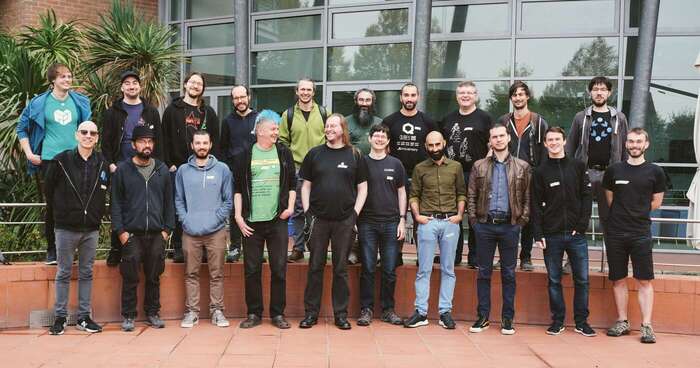
Reproducible Builds Summit 2022 Following-up from last month s report about our recent summit in Venice, Italy, a comprehensive report from the meeting has not been finalised yet watch this space! As a very small preview, however, we can link to several issues that were filed about the website during the summit (#38, #39, #40, #41, #42, #43, etc.) and collectively learned about Software Bill of Materials (SBOM) s and how .buildinfo files can be seen/used as SBOMs. And, no less importantly, the Reproducible Builds t-shirt design has been updated

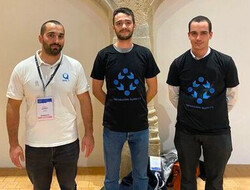
Reproducible Builds at European Cyber Week 2022 During the European Cyber Week 2022, a Capture The Flag (CTF) cybersecurity challenge was created by Fr d ric Pierret on the subject of Reproducible Builds. The challenge consisted in a pedagogical sense based on how to make a software release reproducible. To progress through the challenge issues that affect the reproducibility of build (such as build path, timestamps, file ordering, etc.) were to be fixed in steps in order to get the final flag in order to win the challenge. At the end of the competition, five people succeeded in solving the challenge, all of whom were awarded with a shirt. Fr d ric Pierret intends to create similar challenge in the form of a how to in the Reproducible Builds documentation, but two of the 2022 winners are shown here:

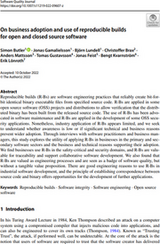
On business adoption and use of reproducible builds Simon Butler announced on the rb-general mailing list that the Software Quality Journal published an article called On business adoption and use of reproducible builds for open and closed source software. This article is an interview-based study which focuses on the adoption and uses of Reproducible Builds in industry, with a focus on investigating the reasons why organisations might not have adopted them:
[ ] industry application of R-Bs appears limited, and we seek to understand whether awareness is low or if significant technical and business reasons prevent wider adoption.
This is achieved through interviews with software practitioners and business managers, and touches on both the business and technical reasons supporting the adoption (or not) of Reproducible Builds. The article also begins with an excellent explanation and literature review, and even introduces a new helpful analogy for reproducible builds:
[Users are] able to perform a bitwise comparison of the two binaries to verify that they are identical and that the distributed binary is indeed built from the source code in the way the provider claims. Applied in this manner, R-Bs function as a canary, a mechanism that indicates when something might be wrong, and offer an improvement in security over running unverified binaries on computer systems.
The full paper is available to download on an open access basis. Elsewhere in academia, Beatriz Michelson Reichert and Rafael R. Obelheiro have published a paper proposing a systematic threat model for a generic software development pipeline identifying possible mitigations for each threat (PDF). Under the Tampering rubric of their paper, various attacks against Continuous Integration (CI) processes:
An attacker may insert a backdoor into a CI or build tool and thus introduce vulnerabilities into the software (resulting in an improper build). To avoid this threat, it is the developer s responsibility to take due care when making use of third-party build tools. Tampered compilers can be mitigated using diversity, as in the diverse double compiling (DDC) technique. Reproducible builds, a recent research topic, can also provide mitigation for this problem. (PDF)

Misc news
On our mailing list this month:

Debian & other Linux distributions Over 50 reviews of Debian packages were added this month, another 48 were updated and almost 30 were removed, all of which adds to our knowledge about identified issues. Two new issue types were added as well. [ ][ ]. Vagrant Cascadian announced on our mailing list another online sprint to help clear the huge backlog of reproducible builds patches submitted by performing NMUs (Non-Maintainer Uploads). The first such sprint took place on September 22nd, but others were held on October 6th and October 20th. There were two additional sprints that occurred in November, however, which resulted in the following progress: Lastly, Roland Clobus posted his latest update of the status of reproducible Debian ISO images on our mailing list. This reports that all major desktops build reproducibly with bullseye, bookworm and sid as well as that no custom patches needed to applied to Debian unstable for this result to occur. During November, however, Roland proposed some modifications to live-setup and the rebuild script has been adjusted to fix the failing Jenkins tests for Debian bullseye [ ][ ].
In other news, Miro Hron ok proposed a change to clamp build modification times to the value of SOURCE_DATE_EPOCH. This was initially suggested and discussed on a devel@ mailing list post but was later written up on the Fedora Wiki as well as being officially proposed to Fedora Engineering Steering Committee (FESCo).

Upstream patches The Reproducible Builds project detects, dissects and attempts to fix as many currently-unreproducible packages as possible. We endeavour to send all of our patches upstream where appropriate. This month, we wrote a large number of such patches, including:

diffoscope diffoscope is our in-depth and content-aware diff utility. Not only can it locate and diagnose reproducibility issues, it can provide human-readable diffs from many kinds of binary formats. This month, Chris Lamb prepared and uploaded versions 226 and 227 to Debian:
  • Support both python3-progressbar and python3-progressbar2, two modules providing the progressbar Python module. [ ]
  • Don t run Python decompiling tests on Python bytecode that file(1) cannot detect yet and Python 3.11 cannot unmarshal. (#1024335)
  • Don t attempt to attach text-only differences notice if there are no differences to begin with. (#1024171)
  • Make sure we recommend apksigcopier. [ ]
  • Tidy generation of os_list. [ ]
  • Make the code clearer around generating the Debian substvars . [ ]
  • Use our assert_diff helper in test_lzip.py. [ ]
  • Drop other copyright notices from lzip.py and test_lzip.py. [ ]
In addition to this, Christopher Baines added lzip support [ ], and FC Stegerman added an optimisation whereby we don t run apktool if no differences are detected before the signing block [ ].
A significant number of changes were made to the Reproducible Builds website and documentation this month, including Chris Lamb ensuring the openEuler logo is correctly visible with a white background [ ], FC Stegerman de-duplicated by email address to avoid listing some contributors twice [ ], Herv Boutemy added Apache Maven to the list of affiliated projects [ ] and boyska updated our Contribute page to remark that the Reproducible Builds presence on salsa.debian.org is not just the Git repository but is also for creating issues [ ][ ]. In addition to all this, however, Holger Levsen made the following changes:
  • Add a number of existing publications [ ][ ] and update metadata for some existing publications as well [ ].
  • Hide draft posts on the website homepage. [ ]
  • Add the Warpforge build tool as a participating project of the summit. [ ]
  • Clarify in the footer that we welcome patches to the website repository. [ ]

Testing framework The Reproducible Builds project operates a comprehensive testing framework at tests.reproducible-builds.org in order to check packages and other artifacts for reproducibility. In October, the following changes were made by Holger Levsen:
  • Improve the generation of meta package sets (used in grouping packages for reporting/statistical purposes) to treat Debian bookworm as equivalent to Debian unstable in this specific case [ ] and to parse the list of packages used in the Debian cloud images [ ][ ][ ].
  • Temporarily allow Frederic to ssh(1) into our snapshot server as the jenkins user. [ ]
  • Keep some reproducible jobs Jenkins logs much longer [ ] (later reverted).
  • Improve the node health checks to detect failures to update the Debian cloud image package set [ ][ ] and to improve prioritisation of some kernel warnings [ ].
  • Always echo any IRC output to Jenkins output as well. [ ]
  • Deal gracefully with problems related to processing the cloud image package set. [ ]
Finally, Roland Clobus continued his work on testing Live Debian images, including adding support for specifying the origin of the Debian installer [ ] and to warn when the image has unmet dependencies in the package list (e.g. due to a transition) [ ].
If you are interested in contributing to the Reproducible Builds project, please visit our Contribute page on our website. You can get in touch with us via:

Shirish Agarwal: Wayland, Hearing aids, Multiverse & Identity

Wayland First up, I read Antoine Beaupr s Wayland to Sway migration with interest. While he said it s done and dusted or something similar, the post shows there s still quite a ways to go. I wouldn t say it s done or whatever till it s integrated so well that a person installs it and doesn t really need to fiddle with config files as an average user. For specific use-cases you may need to, but that should be outside of a normal user (layperson) experience. I have been using mate for a long long time and truth be told been very happy with it. The only thing I found about Wayland on mate is this discussion or rather this entry. The roadmap on Ubuntu Mate is also quite iffy. The Mate Wayland entry on Debian wiki also perhaps need an updation but dunno much as the latest update it shares is 2019 and it s 2022. One thing to note, at least according to Antoine, things should be better as and when it gets integrated even on legacy hardware. I would be interested to know how it would work on old desktops and laptops rather than new or is there some barrier? I, for one would have liked to see or know about why lightdm didn t work on Wayland and if there s support. From what little I know lightdm is much lighter than gdm3 and doesn t require much memory and from what little I have experienced works very well with mate. I have been using it since 2015/16 although the Debian changelog tells me that it has been present since 2011. I was hoping to see if there was a Wayland specific mailing list, something like debian-wayland but apparently there s not :(. Using mate desktop wayland (tried few other variations on the keywords) but search fails to find any meaningful answer :(. FWIW and I don t know the reason why but Archwiki never fails to amaze me. Interestingly, it just says No for mate. I probably would contact upstream in the coming days to know what their plans are and hopefully they will document what their plans are on integrating Wayland in both short-term and long-term with an update, or if there is something more recent they have documented elsewhere, get that update on the Debian wiki so people know. The other interesting thread I read was Russel Coker s Thinkpad X1 Carbon Gen5 entry. I would be in the market in a few months to find/buy a Thinkpad but probably of AMD rather than Intel because part of recent past history with Intel as well as AMD having a bit of an edge over Intel as far as graphics is concerned. I wonder why Russel was looking into Intel and not AMD. Would be interested to know why Intel and not AMD? Any specific reason ???

Hearing Aids I finally bought hearing aids about a couple of weeks back and have been practicing using them. I was able to have quite a few conversations although music is still I m not able to listen clearly but it is still a far cry from before and for the better. I am able to have conversations with people and also reply and they do not have to make that extra effort that they needed to. Make things easier for everybody. The one I bought is at the starting range although the hearing aids go all the way to 8 lakhs for a pair (INR 800,000), the more expensive ones having WiFi, Bluetooth and more channels, it all depends on how much can one afford. And AFAIK there is not a single Indian manufacturer who is known in this business.

One thing I did notice is while the hearing aids are remarkably sturdy if they fall down as they are small, yet you have to be careful of both dust and water . That does makes life a bit difficult as my house and city both gets sand quite a bit everyday. I don t think they made any India-specific changes, if they had, would probably make things better. I haven t yet looked at it, but it may be possible to hack it remotely. There may or may not be security issues involved, probably would try once I ve bit more time am bit more comfortable to try and see what I can find out. If I had bought it before, maybe I would have applied for the Debian event happening in Kerala, if nothing else, would have been to document what happened there in detail.  I probably would have to get a new motherboard for my desktop probably in a year or two as quite a few motherboards also have WiFi (WiFi 6 ?) think on the southbridge. I at least would have a look in new year and know more as to what s been happening. For last at least 2-3 years there has been a rumor which has been confirmed time and again that the Tata Group has been in talks with multiple vendors to set chip fabrication and testing business but to date they haven t been able to find one. They do keep on giving press conferences about the same but that s all they do :(. Just shared the latest one above.

The Long War Terry Pratchett, Stephen Braxter Long Earth Terry Pratchett, Stephen Braxter ISBN13: 9780062067777 Last month there was also a seconds books sale where I was lucky enough to get my hands on the Long War. But before I share about the book itself, I had a discussion with another of my friends and had to re-share part of that conversation. While the gentleman was adamant that non-fiction books are great, my point as always is both are equal. As I shared perhaps on this blog itself, perhaps multiple times, that I had seen a YT video in which a professor shared multiple textbooks of physics and shared how they are wrong and have been wrong and kept them in a specific corner. He took the latest book which he honestly said doesn t have any mistakes as far as he know and yet still kept in that same corner denoting that it is highly possible that future understanding will make the knowledge or understanding we know different. An example of physics in the nano world and how that is different and basically turns our understanding than what we know. Now as far as the book is concerned, remember Michael Crichton s Timeline. Now that book was originally written in the 1960 s while this one was written by both the honorable gentleman in 2013. So almost 50+ years difference between the two books, and that even shows how they think about things. In this book, you no longer need a big machine, but have something called a stepper machine which is say similar to a cellphone, that size and that frame, thickness etc. In this one, the idea of multiverse is also there but done a tad differently. In this, we do not have other humans or copy humans but have multiple earths that may have same or different geography as how evolution happened. None of the multiverse earths have humans but have different species depending on the evolution that happened there. There are something called as trolls but they have a much different meaning and way about them about how most fantasy authors portray trolls. While they are big in this as well, they are as gentle as bears or rabbits. So the whole thing is about real estate and how humans have spread out on multiple earths and the politics therein. Interestingly, the story was trashed or given negative reviews on Goodreads. The sad part is/was that it was written and published in 2013 when perhaps the possibility of war or anything like that was very remote especially in the States, but now we are now in 2022 and just had an insurrection happen and whole lot of Americans are radicalized, whether you see the left or the right depending on your ideology. An American did share few weeks ago how some shares are looking at Proportional Representation and that should make both parties come more towards the center and be a bit more transparent. What was interesting to me is the fact that states have much more rights to do elections and electioneering the way they want rather than a set model which everyone has common which is what happens in India. This also does poke holes into the whole Donald Trump stolen democracy drama but that s a different story altogether. One of the more interesting things I came to know about is that there are 4 books in the long series and this was the second book in itself. I do not want to dwell on the characters themselves as frankly speaking I haven t read all the four books and it would be gross injustice on my part to talk about the characters themselves. Did I enjoy reading the book, for sure. What was interesting and very true of human nature is that even if we have the ability or had the ability to have whole worlds to ourselves, we are bound to mess it up. And in that aspect, I don t think he is too far off the mark. If I had a whole world, wouldn t I try to exploit it to the best or worse of my ability. One of the more interesting topics in the book is the barter system they have thought of that is called as favors. If you are in multiple worlds, then having a currency, even fiat money is of no use and they have to find ways and means to trade with one another. The book also touches a bit on slavery but only just and doesn t really explore it as much as it could have.

Identity Now this has many meanings to it. Couple of weeks ago, saw a transgender meet. For the uninitiated or rather people like me, basically it is about people who are born in one gender but do not identify with it but the other and they express it first through their clothes and expression and the end of the journey perhaps is with having the organs but this may or may not be feasible, as such surgery is expensive and also not available everywhere. After section 377 was repealed few years ago, we do have a third gender on forms as well as have something called a Transgender Act but how much the needle has moved in society is still a question. They were doing a roadshow near my house hence I was able to talk with them with my new hearing aids and while there was lot of traffic was able to understand some of their issues. For e.g. they find it difficult to get houses on rent, but then it is similar for bachelor guys or girls also. One could argue to what degree it is, and that perhaps maybe. Also, there is a myth that they are somehow promiscuous but that I believe is neither here or there. Osho said an average person thinks about the opposite sex every few seconds or a minute. I am sure even Freud would have similar ideas. So, if you look in that way everybody is promiscuous as far as thought is concerned. The other part being opportunity but that again is function of so many other things. Some people are able to attract a lot of people, others might not. And then whether they chose to act on that opportunity or not is another thing altogether. Another word that is or was used is called gender fluid, but that too is iffy as gender fluid may or may not mean transgender. Also, while watching some nature documentary few days/weeks back had come to know that trees have something like 18 odd genders. That just blows me out of the mind and does re-question this whole idea of sexuality and identity to only two which seems somewhat regressive at least to me. If we think humans are part of nature, then we need to be open up perhaps a bit more. But identity as I shared above has more than one meaning. For e.g. citizenship, that one is born in India is even messier to know, understand and define. I had come across this article about couple of months back. Now think about this. Now, there have been studies and surveys about citizenship and it says something like 60% birth registrations are done in metro cities. Now Metro cities are 10 as defined by Indian state. But there are roughly an odd 4k cities in India and probably twice the number of villages and those are conservative numbers as we still don t record things meticulously, maybe due to the Indian oral tradition or just being lazy or both, one part is also that if you document people and villages and towns, then you are also obligated to give them some things as a state and that perhaps is not what the Indian state wants. A small village in India could be anywhere from few hundreds of people to a few thousand. And all the new interventions whether it is PAN, Aadhar has just made holes rather than making things better. They are not inclusive but exclusive. And none of this takes into account Indian character and the way things are done in India. In most households, excluding the celebs (they are in a world of pain altogether when it comes to baby names but then it s big business but that s an entire different saga altogether, so not going to touch that.) I would use or say my individual case as that is and seems to be something which is regular even today. I was given a nickname when I was 3 years old and given a name when I was 5-6 when I was put in school. I also came to know in school few kids who didn t like their names and couple of them cajoled and actually changed their names while they were kids, most of us just stayed with what we got. I do remember sharing about nakushi or something similar a name given to few girls in Maharashtra by their parents and the state intervened and changed their names. But that too is another story in itself. What I find most problematic is that the state seems to be blind, and this seems to be by design rather than a mistake. Couple of years back, Assam did something called NRC (National Register of Citizens) and by the Govt s own account it was a failure of massive proportions. And they still want to bring in CAA, screwing up Assam more. And this is the same Govt. went shown how incorrect it was, blamed it all on the High Court and it s the same Govt. that shopped around for judges to put somebody called Mr. Saibaba (an invalid 90 year adivasi) against whom the Govt. hasn t even a single proof as of date. Apparently, they went to 6 judges who couldn t give what the decision the Govt. wanted. All this info. is in public domain. So the current party ruling, i.e. BJP just wants to make more divisions rather than taking people along as they don t have answers either on economy, inflation or issues that people are facing. One bright light has been Rahul Gandhi who has been doing a padhyatra (walking) from Kanyakumari to Kashmir and has had tremendous success although mainstream media has showed almost nothing what he is doing or why he is doing that. Not only he had people following him, there are and were many who took his example and using the same values of inclusiveness are walking where they can. And this is not to do with just a political party but more with a political thought of inclusiveness, that we are one irrespective of what I believe, eat, wear etc. And that gentleman has been giving press conferences while our dear P.M. even after 8 years doesn t have the guts to do a single press conference. Before closing, I do want to take another aspect, Rahul Gandhi s mother is an Italian or was from Italy before she married. But for BJP she is still Italian. Rishi Sunak, who has become the UK Prime Minister they think of him as Indian and yet he has sworn using the Queen s name. And the same goes for Canada Kumar (Akshay Kumar) and many others. How the right is able to blind and deaf to what it thinks is beyond me. All these people have taken an oath in the name of the Queen and they have to be loyal to her or rather now King Charles III. The disconnect continues.

Jonathan Dowland: Portland, Oregon and Beatdown Records, Newcastle

Powell's frontage Powell's frontage
I'm over on the west coast of the States attending 15th IEEE/ACM International Conference on Utility and Cloud Computing (UCC2022) in Vancouver, WA. Vancouver is a city on the southern extent of Washington, on the north side of the Columbia River from the (better known) Portland, Oregon. (Perhaps more about Vancouver in another post.) In between conference sessions I've made a couple of trips out to Portland to see bits and pieces. My friends with experience here all raved about Powell's City of Books, and with good reason. I managed to escape without a mortal wound to my finances, but only just.
Music Millennium. Keep Portland Weird! Music Millennium. Keep Portland Weird!
Likewise Music Millennium, emblazoned with the unofficial city slogan "Keep Portland Weird!" was a worthwhile pilgrimage. I was saved only by knowing that I had to carry home whatever I bought on the plane. Visiting MM made me realise something about my favourite record store at home, Beatdown Records: It is a truly world-class record store. I have bought from (and sold at) many times over the years, but the last time I had a realisation that it was somewhere a bit special was in between two of the UK's Covid lockdowns. My father and I both qualified for early access to the first two rounds of COVID-19 vaccinations on offer in the UK the Astra Zeneca and The Centre for Life (across the road from Beatdown Records) was the nearest place to go and get them. By the time of our second shot, shops had started to open up again and things had loosened up a bit. We had time to kill around the appointment so I took my Dad to Beatdown. The shop has a reasonably-sized front room with a selection of CDs and records, but the real gold is in the back. Dad hadn't realised there was a back. He's a pretty quiet person so when I took him to the back and he loudly exclaimed " Wow", it was quite satisfying.

Russell Coker: Thinkpad X1 Carbon Gen5

Gen1 Since February 2018 I have been using a Thinkpad X1 Carbon Gen1 [1] as my main laptop. Generally I ve been very happy with it, it s small and light, has good performance for web browsing etc, and with my transition to doing all compiles etc on servers it works well. When I wrote my original review I was unhappy with the keyboard, but I got used to that and found it to be reasonably good. The things that I have found as limits on it are the display resolution as 1600*900 isn t that great by modern standards (most phones are a lot higher resolution), the size (slightly too large for the pocket of my Scott e Vest [2] jacket), and the lack of USB-C. Modern laptops can charge via USB-C/Thunderbolt while also doing USB and DisplayPort video over the same cable. USB-C monitors which support charging a laptop over the same cable as used for video input are becoming common (last time I checked the Dell web site for many models of monitor there was a USB-C one that cost about $100 more). I work at a company with lots of USB-C monitors and docks so being able to use my personal laptop with the same displays when on breaks is really handy. A final problem with the Gen1 is that it has a proprietary and unusual connector for the SSD which means that a replacement SSD costs about what I paid for the entire laptop. Ever since the SSD gave a BTRFS checksum error I ve been thinking of replacing it. Choosing a Replacement The Gen5 is the first Thinkpad X1 Carbon to have USB-C. For work I had used a Gen6 which was quite nice [3]. But it didn t seem to offer much over the Gen5. So I started looking for cheap Thinkpad X1 Carbons of Gen5+. A Cheap? Gen5 In July I saw an ebay advert for a Gen5 with FullHD display for $370 or nearest offer, with the downside being that the BIOS password had been lost. I offered $330 and the seller accepted, in retrospect that was unusually cheap and should have been a clue that I needed to do further investigation. It turned out that resetting the BIOS password is unusually difficult as it s in the TPM so the system would only boot Windows. When I learned that I should have sold the laptop to someone who wanted to run Windows and bought another. Instead I followed some instructions on the Internet about entering a wrong password multiple times to get to a password recovery screen, instead the machine locked up entirely and became unusable for windows (so don t do that). Then I looked for ways of fixing the motherboard. The cheapest was $75.25 for a replacement BIOS flash chip that had a BIOS that didn t check the validity of passwords. The aim was to solder that on, set a new password (with any random text being accepted as the old password), then solder the old one back on for normal functionality. It turned out that I m not good at fine soldering, after I had hacked at it a friend diagnosed the chip and motherboard to probably both be damaged (he couldn t get it going). The end solution was that my friend found a replacement motherboard for $170 from China. This gave a total cost of $575.25 for the laptop which is more than the usual price of a Gen6 and more than I expected to pay. In the past when advocating buying second hand or refurbished laptops people would say what happens if you get one that doesn t work properly , the answer to that question is that I paid a lot less than the new cost of $2700+ for a Thinkpad X1 Carbon and got a computer that does everything I need. One of the advantages of getting a cheap laptop is that I won t be so unhappy if I happen to drop it. A Cheap Gen6 After the failed experiment with a replacement BIOS on the Gen5 I was considering selling it for scrap. So I bought a Gen6 from Australian Computer Traders via Amazon for $390 in August. The advert clearly stated that it was for a laptop with USB-C and Thunderbolt (Gen5+ features) but they shipped me a Gen4 that didn t even have USB-C. They eventually refunded me but I will try to avoid buying from them again. Finally Working The laptop I now have has a i5-6300U CPU that rates 3242 on cpubenchmark.net. My Gen1 thinkpad has a i7-3667U CPU that rates 2378 on cpubenchmark.net, note that the cpubenchmark.net people have rescaled their benchmark since my review of the Gen1 in 2018. So according to the benchmarks my latest laptop is about 36% faster for CPU operations. Not much of a difference when comparing systems manufactured in 2012 and 2017! According to the benchmarks a medium to high end recent CPU will be more than 10* faster than the one in my Gen5 laptop, but such a CPU would cost more than my laptop cost. The storage is a 256G NVMe device that can do sustained reads at 900MB/s, that s not even twice as fast as the SSD in my Gen1 laptop although NVMe is designed to perform better for small IO. It has 2*USB-C ports both of which can be used for charging, which is a significant benefit over the Gen6 I had for work in 2018 which only had one. I don t know why Lenovo made Gen6 machines that were lesser than Gen5 in such an important way. It can power my Desklab portable 4K monitor [4] but won t send a DisplayPort signal over the same USB-C cable. I don t know if this is a USB-C cable issue or some problem with the laptop recognising displays. It works nicely with Dell USB-C monitors and docks that power the laptop over the same cable as used for DisplayPort. Also the HDMI port works with 4K monitors, so at worst I could connect my Desklab monitor via a USB-C cable for power and HDMI for data. The inability to change the battery without disassembly is still a problem, but hopefully USB-C connected batteries capable of charging such a laptop will become affordable in the near future and I have had some practice at disassembling this laptop. It still has the Ethernet dongle annoyance, and of course the seller didn t include that. But USB ethernet devices are quite good and I have a few of them. In conclusion it s worth the $575.25 I paid for it and would have been even better value for money if I had been a bit smarter when buying. It meets the initial criteria of USB-C power and display and of fitting in my jacket pocket as well as being slightly better than my old laptop in every other way.

Louis-Philippe V ronneau: Debian Python Team 2022 Sprint Report

This is the report for the Debian Python Team remote sprint that took place on December 2-3-4 2022. Many thanks to those who participated, namely: Here is a list of issues we worked on: pybuild autodep8 feature About a year ago, Antonio Terceiro contributed code to pybuild to make it possible to automatically run the upstream test suite as autopkgtests. This feature has now been merged and uploaded to unstable. Although you can find out more about it in the pybuild-autopkgtest manpage, an email providing more details should be sent to the debian-python mailing list relatively soon. Fixing packages that run tests via python3 setup.py test Last August, Stefano Rivera poked the team about the deprecation of the python3 setup.py test command to run tests in pybuild. Although this feature has been deprecated upstream for 6 years now, many packages in the archive still use it to run the upstream test suite during build. Around 29 of the 67 packages that are team-maintained by the Debian Python Team were fixed during the sprint. Ideally, all of them would be before the feature is removed from pybuild. if a package you maintain still runs this command, please consider fixing it! Fixing packages that use nose nose, provided by the python3-nose package, is an obsolete testing framework for Python and has been unmaintained since 2015. During the sprint, people worked on fixing some of the many bugs filled against packages still running tests via nose, but there are still around 240 packages affected by this issue in the archive. Again, if a package you maintain still runs this command, please consider fixing it! Removal of the remaining Python2 packages With the upload of dh-python 5.20221202, Stefano Rivera officially removed support for dh_python2 and dh_pypy, thus closing the "Python2 removal in sid/bullseye" bug. It seems some work still needs to be done for complete Python2 removal from Sid, but I expect this will be done in time for the Bookworm release. Working on Lintian tags for the Team During the sprint, I managed to work on some Lintian issues that we had targeted, namely: I also worked on a few other Lintian tags, but they were unrelated to the Debian Python Team itself. I'm also happy to report many of the tags I wrote for the team in the past few months were merged by the awesome Russ Allbery and should land in unstable as soon as a new release is made. I'm particularly looking forward the new "uses-python-distutils" tag that should help us flag packages that still use the deprecated distutils library. Patching distro-tracker (tracker.debian.org) to show pending team MRs It's often hard to have a good overview of pending merge requests when working with team-maintained packages, as by default, Salsa doesn't notify anyone when a MR is opened. Although our workflow typically does not involve creating merge requests, some people still do and they end up sitting there, unnoticed. During the sprint, Kurt Kremitzki worked on solving this issue by having distro-tracker show the pending MRs on our team's tracker page. Sadly, it seems little progress was made, as the removal of python3-django-jsonfield from the archive and breaking changes in python3-selenium has broken the test suite. Migrate packages building with the flit plugin to the generic pyproject one pybuild has been supporting building with PEP-517 style pyproject.toml files via a generic plugin (pybuild-plugin-pyproject) for a while now. As this plugin supersedes the old flit plugin, we've been thinking of deprecating it in time for the Bookworm release. To make this possible, most of the packages in the archive that still used this plugin were migrated to the generic one and I opened bugs on the last handful of packages that were not team-maintained. Other work Many other things were done during the sprint, such as: Thanks Thanks again to everyone who joined the sprint, and three big cheers for all the folks who donate to Debian and made it possible for us to have a food budget for the event.

7 December 2022

Thorsten Alteholz: My Debian Activities in November 2022

FTP master This month I accepted 292 and rejected 43 packages. The overall number of packages that got accepted was 295. Debian LTS This was my hundred-first month that I did some work for the Debian LTS initiative, started by Raphael Hertzog at Freexian. This month my all in all workload has been 14h. During that time I uploaded: I also started to work on ring, but this seems to be a pile of work. Not least because at the moment the package does not migrate to testing. Further I started to investigate what packages are really affected by CVE-2018-17942. It looks like some upstreams and their corresponding maintainers did not care about that CVE in the embedded gnulib. Last but not least I did some days of frontdesk duties. Debian ELTS This month was the fifty second ELTS month. During my allocated time I uploaded: Last but not least I did some days of frontdesk duties. Debian Mobcom This month I uploaded improved packages of: Other stuff This month I uploaded improved packages of:

Matthew Garrett: Making an Orbic Speed RC400L autoboot when USB power is attached

As I mentioned a couple of weeks ago, I've been trying to hack an Orbic Speed RC400L mobile hotspot so it'll automatically boot when power is attached. When plugged in it would flash a "Welcome" screen and then switch to a display showing the battery charging - it wouldn't show up on USB, and didn't turn on any networking. So, my initial assumption was that the bootloader was making a policy decision not to boot Linux. After getting root (as described in the previous post), I was able to cat /proc/mtd and see that partition 7 was titled "aboot". Aboot is a commonly used Android bootloader, based on Little Kernel - LK provides the hardware interface, aboot is simply an app that runs on top of it. I was able to find the source code for Quectel's aboot, which is intended to run on the same SoC that's in this hotspot, so it was relatively easy to line up a bunch of the Ghidra decompilation with actual source (top tip: find interesting strings in your decompilation and paste them into github search, and see whether you get a repo back).

Unfortunately looking through this showed various cases where bootloader policy decisions were made, but all of them seemed to result in Linux booting. Patching them and flashing the patched loader back to the hotspot didn't change the behaviour. So now I was confused: it seemed like Linux was loading, but there wasn't an obvious point in the boot scripts where it then decided not to do stuff. No boot logs were retained between boots, which made things even more annoying. But then I realised that, well, I have root - I can just do my own logging. I hacked in an additional init script to dump dmesg to /var, powered it down, and then plugged in a USB cable. It booted to the charging screen. I hit the power button and it booted fully, appearing on USB. I adb shelled in, checked the logs, and saw that it had booted twice. So, we were definitely entering Linux before showing the charging screen. But what was the difference?

Diffing the dmesg showed that there was a major distinction on the kernel command line. The kernel command line is data populated by the bootloader and then passed to the kernel - it's how you provide arguments that alter kernel behaviour without having to recompile it, but it's also exposed to userland by the running kernel so it also serves as a way for the bootloader to pass information to the running userland. The boot that resulted in the charging screen had a androidboot.poweronreason=USB argument, the one that booted fully had androidboot.poweronreason=PWRKEY. Searching the filesystem for androidboot.poweronreason showed that the script that configures USB did not enable USB if poweronreason was USB, and the same string also showed up in a bunch of other applications. The bootloader was always booting Linux, but it was telling Linux why it had booted, and if that reason was "USB" then Linux was choosing not to enable USB and not starting the networking stack.

One approach would be to modify every application that parsed this data and make it work even if the power on reason was "USB". That would have been tedious. It seemed easier to modify the bootloader. Looking for that string in Ghidra showed that it was reading a register from the power management controller and then interpreting that to determine the reason it had booted. In effect, it was doing something like:
boot_reason = read_pmic_boot_reason();
switch(boot_reason)  
case 0x10:
  bootparam = strdup("androidboot.poweronreason=PWRKEY");
  break;
case 0x20:
  bootparam = strdup("androidboot.poweronreason=USB");
  break;
default:
  bootparam = strdup("androidboot.poweronreason=Hard_Reset");
 
Changing the 0x20 to 0xff meant that the USB case would never be detected, and it would fall through to the default. All the userland code was happy to accept "Hard_Reset" as a legitimate reason to boot, and now plugging in USB results in the modem booting to a functional state. Woo.

If you want to do this yourself, dump the aboot partition from your device, and search for the hex sequence "03 02 00 0a 20"". Change the final 0x20 to 0xff, copy it back to the device, and write it to mtdblock7. If it doesn't work, feel free to curse me, but I'm almost certainly going to be no use to you whatsoever. Also, please, do not just attempt to mechanically apply this to other hotspots. It's not going to end well.

comment count unavailable comments

30 November 2022

Russell Coker: Links November 2022

Here s the US Senate Statement of Frances Haugen who used to work for Facebook countering misinformation and espionage [1]. She believes that Facebook is capable of dealing with the online radicalisation and promotion of bad things on it s platform but is unwilling to do so for financial reasons. We need strong regulation of Facebook and it probably needs to be broken up. Interesting article from The Atlantic about filtered cigarettes being more unhealthy than unfiltered [2]. Every time I think I know how evil tobacco companies are I get surprised by some new evidence. Cory Doctorow wrote an insightful article about resistance to rubber hose cryptanalysis [3]. Cory Doctorow wrote an interesting article When Automation Becomes Enforcement with a new way of thinking about Snapchat etc [4]. Cory Doctorow wrote an insightful and informative article Big Tech Isn t Stealing News Publishers Content, It s Stealing Their Money [5] which should be read by politicians from all countries that are trying to restrict quoting news on the Internet. Interesting articl;e on Santiago Genoves who could be considered as a pioneer of reality TV for deliberately creating disputes between a group of young men and women on a raft in the Atlantic for 3 months [6]. Matthew Garrett wrote an interesting review of the Freedom Phone, seems that it s not good for privacy and linked to some companies doing weird stuff [7]. Definitely worth reading. Cory Doctorow wrote an interesting and amusing article about backdoors for machine learning [8] Petter Reinholdtsen wrote an informative post on how to make a bootable USB stick image from an ISO file [9]. Apparently Lenovo provides ISO images to update laptops that don t have DVD drives. :( Barry Gander wrote an interesting article about the fall of Rome and the decline of the US [10]. It s a great concern that the US might fail in the same way as Rome. Ethan Siegel wrote an interesting article about Iapetus, a moon of Saturn that is one of the strangest objects in the solar system [11]. Cory Doctorow s article Revenge of the Chickenized Reverse-Centaurs has some good insights into the horrible things that companies like Amazon are doing to their employees and how we can correct that [12]. Charles Stross wrote an insightful blog post about Billionaires [13]. They can t do much for themselves with the extra money beyond about $10m or $100m (EG Steve Jobs was unable to extend his own life much when he had cancer) and their money is trivial when compared to the global economy. They are however effective parasites capable of performing great damage to the country that hosts them. Cory Doctorow has an interesting article about how John Deere is being evil again [14]. This time with potentially catastrophic results.

Utkarsh Gupta: FOSS Activites in November 2022

Here s my (thirty-eighth) monthly but brief update about the activities I ve done in the F/L/OSS world.

Debian
This was my 47th month of actively contributing to Debian. I became a DM in late March 2019 and a DD on Christmas 19! \o/ There s a bunch of things I do, both, technical and non-technical. Here are the things I did this month:

Debian Uploads

Other $things:
  • Sponsoring stuff for non-DDs.
  • Mentoring for newcomers.
  • Moderation of -project mailing list.

Ubuntu
This was my 22nd month of actively contributing to Ubuntu. Now that I joined Canonical to work on Ubuntu full-time, there s a bunch of things I do! \o/ I mostly worked on different things, I guess. I was too lazy to maintain a list of things I worked on so there s no concrete list atm. Maybe I ll get back to this section later or will start to list stuff from the fall, as I was doing before. :D

Debian (E)LTS
Debian Long Term Support (LTS) is a project to extend the lifetime of all Debian stable releases to (at least) 5 years. Debian LTS is not handled by the Debian security team, but by a separate group of volunteers and companies interested in making it a success. And Debian Extended LTS (ELTS) is its sister project, extending support to the stretch and jessie release (+2 years after LTS support). This was my thirty-eighth month as a Debian LTS and twenty-nine month as a Debian ELTS paid contributor.
I worked for 41.00 hours for LTS and 30.25 hours for ELTS.

LTS CVE Fixes and Announcements:

ELTS CVE Fixes and Announcements:
  • Issued ELA 731-1, fixing CVE-2022-39377, for sysstat.
    For Debian 9 stretch, these problems have been fixed in version 11.4.3-2+deb9u1.
    For Debian 8 jessie, these problems have been fixed in version 11.0.1-1+deb8u1.
  • Issued ELA 749-1, fixing CVE-2022-41325, for vlc.
    For Debian 9 stretch, these problems have been fixed in version 3.0.17.4-0+deb9u2.
  • Issued ELA 750-1 for a new upstream version update of clamav.
    For Debian 9 stretch, the package has been updated to version 0.103.7+dfsg-0+deb9u1. For Debian 8 jessie, the package has been updated to version 0.103.7+dfsg-0+deb8u1.
  • Started to look at other set of packages.

Other (E)LTS Work:
  • Front desk duty from 21-11 until 27-11 for both, LTS and ELTS.
  • Triaged jqueryui, open-vm-tools, systemd, ffmpeg, lava, pngcheck, snapd, vlc, g810-led, libpgjava, dropbear, python3.5, python3.4, clamav, systat, postgresql-11, and mariadb-10.1.
  • Marked CVE-2009-1143/open-vm-tools as postponed for buster, stretch and jessie.
  • Marked CVE-2022-45873/systemd as not-affected in stretch and jessie.
  • Marked CVE-2022-396 4,5 /ffmpeg as postponed for buster and stretch.
  • Marked CVE-2022-45061/python3. 4,5 as postponed for stretch and jessie.
  • Marked CVE-2022-31160/jqueryui as not-affected for jessie instead.
  • Noted CVE-2022-45061/python3.4 to be marked as postponed; only things to fix is the armhf FTBFS.
  • Auto EOL d linux, libpgjava, nvidia-graphics-drivers, maradns, chromium, and glance for ELTS.
  • Helped and assisted new contributors joining Freexian (LTS/ELTS/internally).
  • Answered questions (& discussions) on IRC (#debian-lts and #debian-elts) and Matrix.
  • Participated and helped fellow members with their queries via private mail and chat.
  • General and other discussions on LTS private and public mailing list.
  • Attended the monthly meeting held on IRC on November 24th.

Until next time.
:wq for today.

Russ Allbery: Review: The Fed Unbound

Review: The Fed Unbound, by Lev Menand
Publisher: Columbia Global Reports
Copyright: 2022
ISBN: 1-7359137-1-5
Format: Kindle
Pages: 156
The Fed Unbound is a short non-fiction exploration of US Federal Reserve actions to reducing systemic risk caused by shadow banking. Its particular focus is the role of the Fed from the 2008 financial crisis to the present, including the COVID shock, but it includes a history of what Menand calls the "American Monetary Settlement," the political compromise that gave rise to the Federal Reserve. In Menand's view, a central cause of instability in the US financial system (and, given the influence of the dollar system, the world financial system as well) is shadow banking: institutions that act as banks without being insured like banks or subject to bank regulations. A bank, in this definition, is an organization that takes deposits. I'm simplifying somewhat, but what distinguishes a deposit from a security or an investment is that deposits can be withdrawn at any time, or at least on very short notice. When you want to spend the money in your checking account, you don't have to wait for a three-month maturity period or pay an early withdrawal penalty. You simply withdraw the money, with immediate effect. This property is what makes deposits "money," rather than something that you can (but possibly cannot) sell for money, such as stocks or bonds. Most people are familiar with the basic story of how banks work. Essentially no bank simply takes people's money and puts it in a vault until the person wants it again. If that were the case, you would need to pay the bank to store your money. Instead, a bank takes in deposits and then lends some portion of that money out to others. Those loans, for things like cars or houses or credit card spending, come due over time, with interest. The interest rate the bank charges on the loans is much higher than the rate it has to pay on its deposits, and it pockets the difference. The problem with this model, of course, is that the bank doesn't have your money, so if all the depositors go to the bank at the same time and ask for their money, the bank won't be able to repay them and will collapse. (See, for example, the movie It's a Wonderful Life, or Mary Poppins, or any number of other movies or books.) Retail banks are therefore subject to stringent regulations designed to promote public trust and to ensure that traditional banking is a boring (if still lucrative) business. Banks are also normally insured, which in the US means that if they do experience a run, federal regulators will step in, shut down the bank in an orderly fashion, and ensure every depositor gets their money back (at least up to the insurance limit). Alas, if you thought people would settle for boring work that makes a comfortable profit, you don't know the financial industry. Highly-regulated insured deposits are less lucrative than acting like a bank without all of those restrictions and rules and deposit insurance payments. As Menand relates in his brief history of US banking, financial institutions constantly invent new forms of deposits with similar properties but without all the pesky rules: eurodollars (which have nothing to do with the European currency), commercial paper, repo, and many others. These forms of deposits are primarily used by large institutions like corporations. The details vary, but they tend to be prone to the same fundamental instability as bank deposits: if there's a run on the market, there may not be enough liquidity for everyone to withdraw their money at once. Unlike bank deposits, though, there is no insurance, no federal regulator to step in and make depositors whole, and much less regulation to ensure that runs are unlikely. Instead, there's the Federal Reserve, which has increasingly become the bulwark against liquidity crises among shadow banks. This happened in 2008 during the financial crisis (which Menand argues can be seen as a shadow bank run sparked by losses on mortgage securities), and again at a larger scale in 2020 during the initial COVID crisis. Menand is clear that these interventions from the Federal Reserve were necessary. The alternative would have been an uncontrolled collapse of large sections of the financial system, with unknown consequences. But the Fed was not intended to perform those types of interventions. It has no regulatory authority to reform the underlying financial systems to make them safer, remove executives who failed to maintain sufficient liquidity for a crisis, or (as is standard for all traditional US banks) prohibit combining banking and more speculative investment on the same balance sheet. What the Federal Reserve can do, and did, is function as a buyer of last resort, bailing out shadow banks by purchasing assets with newly-created money. This works, in the sense that it averts the immediate crisis, but it creates other distortions. Most importantly, constant Fed intervention doesn't create an incentive to avoid situations that require that intervention; if anything, it encourages more dangerous risk-taking. The above, plus an all-too-brief history of the politics of US banking, is the meat of this book. It's a useful summary, as far as it goes, and I learned a few new things. But I think The Fed Unbound is confused about its audience. This type of high-level summary and capsule history seems most useful for people without an economics background and who haven't been following macroeconomics closely. But Menand doesn't write for that audience. He assumes definitions of words like "deposits" and "money" that are going to be confusing or even incomprehensible to the lay reader. For example, Menand describes ordinary retail banks as creating money, even saying that a bank loans money by simply incrementing the numbers in a customer's deposit account. This is correct in the technical economic definition of money (fractional reserve banking effectively creates new money), but it's going to sound to someone not well-versed in the terminology as if retail banks can create new dollars out of the ether. That power is, of course, reserved for the Federal Reserve, and indeed is largely the point of its existence. Much of this book relies on a very specific definition of money and money supply that will only be familiar to those with economics training. Similarly, the history of the Federal Reserve is interesting but slight, and at no point does Menand explain clearly how the record-keeping between it and retail banks works, or what the Fed's "balance sheet" means in practice. I realize this book isn't trying to give a detailed description or history of the Federal Reserve system, but the most obvious audience is likely to flounder at the level of detail Menand provides. Perhaps, therefore, this book is aimed at an audience already familiar with macroeconomics? But, if so, I'm not sure it says anything new. I follow macroeconomic policy moderately closely and found most of Menand's observations obvious and not very novel. There were tidbits here and there that I hadn't understood, but my time would probably have been better invested in another book. Menand proposes some reforms, but they mostly consist of "Congress should do its job and not create situations where the Federal Reserve has to act without the right infrastructure and political oversight," and, well, yes. It's hard to disagree with that, and it's also hard to see how it will ever happen. It's far too convenient to outsource such problems to central banking, where they are hidden behind financial mechanics that are incomprehensible to the average voter. This is an important topic, but I don't think this is the book to read about it. If you want a clearer and easier-to-understand role of the Federal Reserve in shadow banking crises, read Crashed instead. If you want to learn more about how retail bank regulation works, and hear a strong case for why the same principles should be applied to shadow banks, see Sheila Bair's Bull by the Horns. I'm still looking for a great history and explainer of the Federal Reserve system as a whole, but that is not this book. Rating: 5 out of 10

Next.

Previous.