Search Results: "mt"

25 January 2012

Pietro Abate: new thinkpad x220

This summer my beloved thinkpad x301 died in a cloud of smoke. It was exactly 3 years and 20 days old while my warranty was valid only for 3 years. Now, don't tell me this is a coincidence. Anyway. After about 5 months, I finally managed to convince my employer to get me a new thinkpad, the x220. My specs includes a 128G SSD , 4G of RAM, 2.4Gz processor, camera and fingerprint reader. It's a pity that the x300 series is not in production anymore. They were light, with a solid battery and a large screen. The X1 just don't cut it. Even though it can be consider the successor of the x300, its battery life is just not enough for my needs. On the other hand, the x220 is a very nice machine : the screen is a bit smaller then the X300, but it is light, with a very powerful processor, good battery and it feels very solid. In my opinion lenovo should have packed the new hw of the x220 in the chassis of the x300, maybe with small compromise on the battery life (I got the big battery and I can squeeze almost 7 hs with a single charge) but clearly this was not a good business choice... Installing debian on this laptop is not immediate because none of the official debian installers are shipped with a recent kernel (as in 3.x series). Since with the official debian installer I cannot have neither the driver for the Ethernet card or the driver for the wirelles card, I opted to use a custom installer built by kmuto (http://kmuto.jp/debian/d-i/ ) . Using this installer the ethernet card is recognized immediately and it's easy to proceed with the installation as usual. Another option would have been to add the binary blog for the wireless chip, but apparently the deb installer supports only WEP auth, while all my access point are WPA. I didn't spend too much time on the wireless setup, so it might well be that is indeed possible to install using a WPA access point. Last time I installed a laptop, I used the automatic partition option to have lvm on top of a lucks encrypted partition, only to discover later that the default dimensions of the partitions were a bit too small for me. For example, by default the boot partition is only 256Mb. This is plenty if you want to have only one kernel image installed at each given time, but if you want more then one kernel, memtest and for example a grml rescue iso, it's easy to run out of space. So I proceed to manually partition the disc creating a boot partition of 512M, and using the rest as a luks encrypted device with lvm on top and 3 logical volumes : sys (15G), swap (4G) and home (the rest). For my daily use having 15G on my laptop for /usr, /var, etc should more the enough... Next step was to install the system. Since in recent times I got extremely pissed off with gnome 3, I've decided to dump it completely and go back to awesome. But since awesome all by itself is a bit sad, I paired it up with xfce. Everything works, except the automount, and I'm still trying to figure out how to make it work. Apparently is a consolkit problem... I'll write another post about the xfce4 + awsome setup soon... Today I've also started playing with the finger print reader. It seems working, but I haven't managed yet to use it in conjunction with pam for authentication ... more to come. And... On last closing remark : during the last 5 months I've used a dell latitude e6410 ... Gosh. I feel I'm on anther planet. The keyboard of a thinkpad give you pleasure, not pain, from 2 to 4G of RAM is a big jump and from a conventional HD to a SSD ... well... it seems I'm flyinggggg :) I've the impression my productivity just went up 50% !!! If you work with your laptop everyday get a good laptop. It is well worth the investment ...

Jon Dowland: Music for Our Future

cover
In 2010, a collaboration between the SyFy channel, Create Digital Music, XLR8R and Pitchfork created "Music for our Future": a compilation album of free music inspired by the TV show "Caprica". XLR8R hosted it but their page for the release has subsequently disappeared. A few people here and there on the 'net have been asking for a copy, so here it is on archive.org: http://www.archive.org/details/MusicForOurFuture. Some background info, photos etc. via CDM.

22 January 2012

Kees Cook: fixing vulnerabilities with systemtap

Recently the upstream Linux kernel released a fix for a serious security vulnerability (CVE-2012-0056) without coordinating with Linux distributions, leaving a window of vulnerability open for end users. Luckily: Still, it s a cross-architecture local root escalation on most common installations. Don t stop reading just because you don t have a local user base attackers can use this to elevate privileges from your user, or from the web server s user, etc. Since there is now a nearly-complete walk-through, the urgency for fixing this is higher. While you re waiting for your distribution s kernel update, you can use systemtap to change your kernel s running behavior. RedHat suggested this, and here s how to do it in Debian and Ubuntu: In this case, the systemtap script is changing the argument containing the size of the write to zero bytes ($count = 0), which effectively closes this vulnerability. UPDATE: here s a systemtap script from Soren that doesn t require the full debug symbols. Sneaky, put can be rather slow since it hooks all writes in the system. :)

2012, Kees Cook. This work is licensed under a Creative Commons Attribution-ShareAlike 3.0 License.
Creative Commons License

Jon Dowland: The Crying Tree

Somebody bought The Crying Tree by Naseem Rakha for Sarah as a present and she asked me to read it so we could talk about it, so I did. It's a novel about a family tragedy, Southern-state U.S.A. and the death penalty. A little boy is shot dead, a man is arrested for the crime and faces the death penalty. The book chronicles what happens to the family and to the killer during the 19 years or so that passes before the execution takes place. The book could be accused of having an anti-capital punishment agenda, but I have no problem with that. At least until about half-way through the book, the plot and happenings follow the synopsis with little in the way of surprise, but then there's a twist. I felt that the twist diminished the message of the book. Without trying to spoil what happens, I felt that you didn't need the core details of the story to be varied or expanded upon or U-turned to push that agenda. In my opinion, it's perfectly possible for someone to construct a story about a killer who faces death, who was unambiguously guilty of the crime they are charged with, and still leave the reader feeling remorse for the killer, and questioning the justice meted out. In fact I thought Rakha was doing a fine job of just that. However, a twist (or twists) occur, and the facts are called into question, and so you ask even further questions about the practise of killing criminals, in my view redundantly. It's a good book and worth a read, regardless of what your position is on the issue. It does a great job of describing the unbearable pain of losing a child, but also of the power of forgiveness for the victims.

Jon Dowland: bugs

[pic]
Bugs I've hit in GNOME 3, in the last 5 minutes: I didn't set out to bug-hunt this morning, I'm actually trying to get some work done. Whilst this is a particularly bad case of stacked-bugs, it's unfortunately, pretty representative of what it's like to try and use a Linux desktop at the moment. Every day I go through a similar experience. I've just had to give up and log out and back in again. The shell path bug above has re-surfaced in a new session. Great. I'm waiting on a delayed laptop at work. I'm very tempted to cancel the order and just use a Mac Air instead (we have one spare). It seems I'm walking the inevitable path of F/OSS desktop frustration and the end for many people seems to be the Mac perhaps I should spare myself the pain of the journey. In the mean time, It's bye-bye to GNOME and off to Xfce for me.

21 January 2012

Steve Kemp: So mega-upload is gone

So the site http://megaupload.com/ has been taken offline, amidst allegations of knowingly conducting in piracy. There are probably a lot of legitimate users who have lost access to their uploaded files, even if they were offsite backups you can imagine a user owning a website which now has a million dead-links. This reminds me of a conversation I overheard on Jon Dowlands blog - the summary is that he'd written a (useful) tool to extract attachments from Maildir folders and was wondering how to store and access those attachments. The upshot seemed to be magical URLs of the form:
  • https://file.example.com/sha1/509c2fe2eba509e93987c3024a74d74583c274bd
The comments covered an alternative which was hash:///sha1/xxxxxxxxxxxxxxxx, which then becomes close to the magnet:// schema. I've not yet thought things through, but I can't help thinking that with the redundency already present in the internet we should be looking at non-server-specific links. Yes there are times right now when you might want to address a specific file on a specific server - but otherwise? Wouldn't it be nice if you could just access a file from "anywhere" which happened to have the right contents? Already my nonporn-but-definitely-adult-site makes its images available as /img/$md5sum.jpg - and similarly the storage at the back-end of my random image upload site uses SHA1 hashes to store the actual files. To make this more complete what we need is something that crawls the internet to find files by hash; then add support in browsers. Obviously this must be async and could introduce timing issues, but fundamentally it seems like a reasonable approach to the problem of a single host going offline. (Consider what happens if imgur.com disappears. All those links would die, yet 99% of the images would still be available somewhere.) I'm tempted to suggest microformat format but I need to consider the matter. Right now I'm going to immediately update my current image hosts to use, at the very least:
 <a href="/foo" rel="sha1:xxxxx md5sum:xxxx">
  <img src="foo.jpg" alt="img name">
 </a>
The unfortunate thing is you cannot have a 'rel="xx"' attribute for an image. So you either have to encode it in the parent link, or add it to the alt attribute which is suboptimal. ObQuote: "Now, they tell me I paid my debt to society." - Oceans Eleven (2001)

19 January 2012

Obey Arthur Liu: Going to London - Cambridge

I'll be in Great Britain next week. I'll come to the Debian Party 2008 in Cambridge on Saturday 23rd August and will be back to London to visit 'till Wednesday 27th August. I'm staying by myself in a nice little hotel in Bloomsbury.

It will be very interesting to meet Debian people and probably do some pitching for my Aptitude GTK project which is making nice progress.


I've never been to London before. In fact, I've been once when very young and all that I can remember is that the hot dogs seemed nice :). I'm currently reading the Lonely Planet book about London and filling my program. Hi, London!

13 January 2012

Jon Dowland: vi

As seen on reddit: an old Bill Joy quote often banded about as part of the (largely synthetic) vi-vs.-emacs holy war starts as follows:
vi was written for a world that doesn't exist anymore
The context of that quote is:
I was trying to make it usable over a 300 baud modem. That's also the reason you have all these funny commands. It just barely worked to use a screen editor over a modem. It was just barely fast enough. 9600 baud is faster than you can read. 1200 baud is way slower. So the editor was optimized so that you could edit and feel productive when it was painting slower than you could think.
(source: the register). Furthermore:
unless you decide to get a satellite phone and use it to connect to the Net at 2400 baud, in which case you'll realize that the Net is not usable at 2400 baud.
You don't need anything as esoteric as a satellite phone: a cellular mobile phone will suffice. I've no idea what the effective/equivalent baud rate of GPRS is (or EDGE), but I have a new-found appreciation for vi's design goals having tried to run an SSH session over such a connection.

11 January 2012

Jon Dowland: The Silent Land

I've just finished reading Graham Joyce's haunting The Silent Land: an atmospheric and moving love story set in an Alpine ski resort. Husband and Wife Jake and Zoe head out to the slopes early one morning and are caught in an avalanche. They survive, narrowly, but upon returning to the resort, everything has changed Anyone who has read any quantity of SF or fantasy will probably make an early guess at what's going on, and you'd most likely get it wrong. Even if you know where you're going, the journey is often the point, rather than the destination, and this journey is pretty gripping. I do most of my reading on the train to and from work. I often listen to music when I'm reading and I try to choose things which aren't going to distract my attention from the book too much. Film soundtracks are good; so is classical; so is a lot of Eno's work. For this book I mostly listened to the score from the latest film version of The Girl with the Dragon Tattoo, by Trent Reznor and Atticus Ross. Clocking in at only seven minutes shy of three hours, this is a haunting score that evokes a cold, isolated Swedish winter, and thematically matched the book perfectly. The score is a little less accessible than their previous work, but is rewarding on repeat listen. You can get a free 6-track sampler at the website linked above.

Jon Dowland: My new record player unit

[pic]
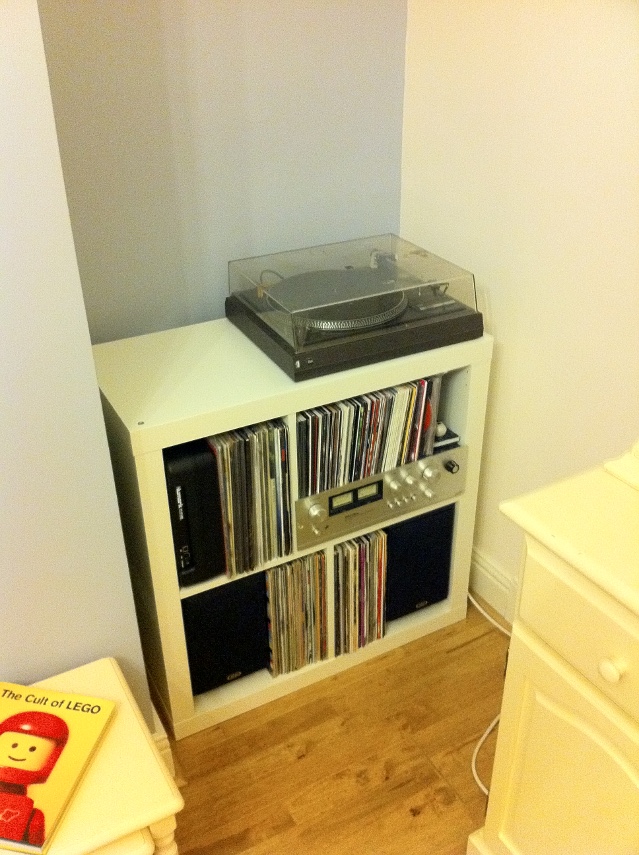
A mildly hacked Ikea "Expedit" shelving unit is a surprisingly snug home for my Hi-fi and my vinyl collection (even the 7" records). [

Jon Dowland: whiley.gif

Jon Dowland: Robert Smith in for John Peel

On 21st October 2004, Robert Smith of the Cure sat in for John Peel whilst he was on holiday and presented his show. This was part of a sequence of people covering for Peel. Off the top of my head Siouxie of the Banshees sat in on another night, but I forget who else. Anyway, sadly, John died a few days later on the 25th. Before John's death, in response to his pre-recorded show being butchered by the BBC, Smith posted an angry message on the Cure's website, which included the tracklisting as he had originally prepared. After John's death was announced, Smith deleted the post from his site, no doubt out of respect for Peel and to avoid any mis-interpretation. I recorded the show onto minidisc when it was broadcast and discovered a lot of music that I loved and hadn't heard of before. I've just stumbled across a copy of Smith's post, including the tracklist, so for historical interest's sake, here it is (with only light typographical editing). If anyone cares enough, I could have a look for that minidisc

9 January 2012

Steve McIntyre: Armhf buildds and status in Debian

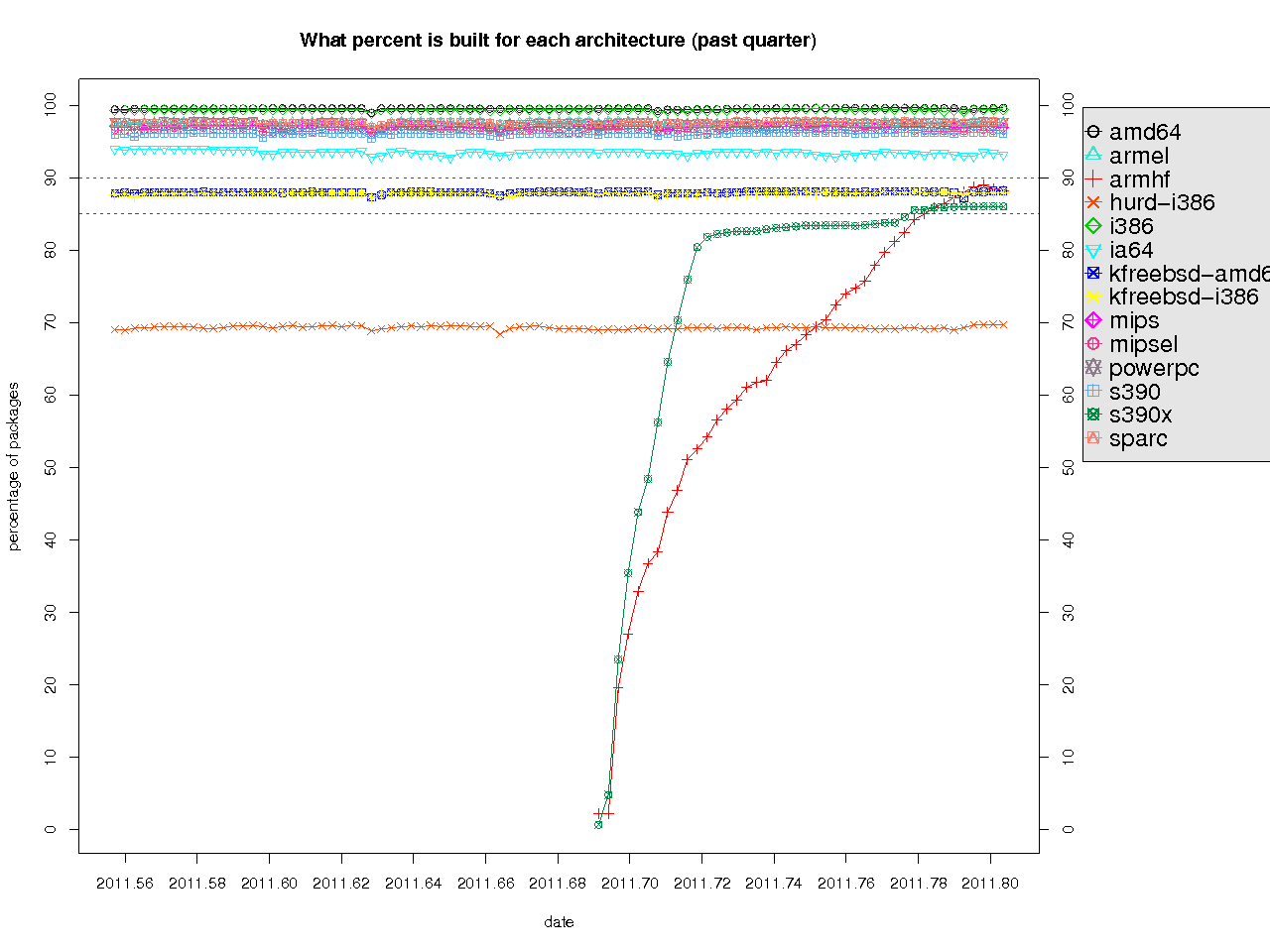
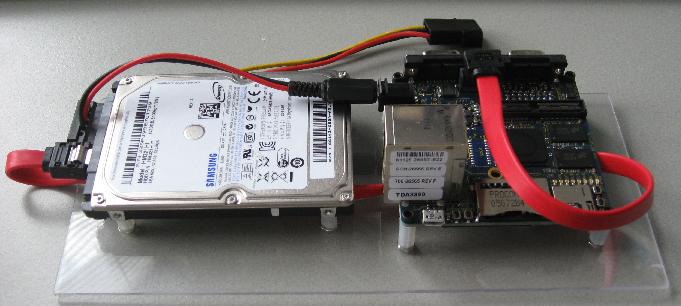
Current status Back in September, I wrote about the machines that I set up to help bootstrap the new armhf port in Debian. Basing on Konstantinos' huge efforts in bringing up the new "architecture" in debian-ports, we started importing armhf into the main Debian archive on the 24th of November. Since then, those builders have been churning away night and day to build the huge collection of software that makes up the Debian archive. The current state can be seen on the armhf buildd status page, and there's a nice graph showing how quickly we've managed to run from 0 to over 90% of the archive here. (Click on the image for a larger version, or visit https://buildd.debian.org/stats/ for other versions. We overtook hurd-i386 quickly and are now ahead of the kfreebsd-* architectures. armhf bootstrap graph We've recently brought 3 more similar build machines online (hildegard, howells and hummel), again sponsored by the nice folks at Linaro but now hosted at the York NeuroImaging Centre at the University of York. This gives us both more build horsepower to keep up with building more different bits of Debian (experimental, updates etc.) and more redundancy in case of problems. We now have the vast majority of the archive built, and now a number of us are concentrating on fixing the remaining issues: language bootstraps and bugs. Also, on the 7th of January we were just added into testing, the next step on our path for inclusion as a Debian release architecture. Setting up the machines A lot of people have been asking me about the physical setup I showed in my last blog about these machines, so here's more details for those who are interested. Mount the 6 boards into the mini-rack, connect up the Molex power connectors to each board, attach ethernet cables and turn it all on! Each board comes with a micro-SD card containing uboot and an Ubuntu installation. I've configured uboot to boot off the hard drive directly, but leaving configuration available to use the Ubuntu on the micro-SD as a simple rescue system should the need arise. The Quickstart boards are not ideal physically for two reasons: the lack of SATA power, plus you need to push a power button on each board to boot it - they don't boot automatically the moment power is applied. However, they're quite inexpensive little machines and have done a great job of building the Debian archive so far! The ideal machines for us would also include more RAM at this point. CPU on these is adequate, but the larger C++ packages (yay webkit!) use a huge amount of memory at link time. Linking in swap is not the best thing, performance-wise... :-( UPDATE 2012-01-12: Ian tells me that the newer Quickstart-R boards apparently have a different power controller; these now boot up straight away without needing you to push a button. That sounds useful.

7 January 2012

Jon Dowland: Flow My Tears, the Policeman Said

The Philip K. Dick Collection The Philip K. Dick Collection
I've just finished reading "Flow My Tears, the Policeman Said" by Philip K Dick, one of 13 novels collected in the Library of America's wonderful "The Philip K. Dick Collection" boxed set. This story has never jumped out at me as one to read with any particular urgency, despite the title being a reference to a composition by my namesake. I was reminded about it whilst listening to one of BBC Radio 4's "Great Lives" broadcasts, where Michael Sheen read a passage from the book. As an aside, the "Great Lives" series is a really interesting listen: I particularly enjoyed their episode on Ludwig Wittgenstein. You can get the whole series in podcast form. Back to the book. It features Dick's trademark theme of fractured realities, perhaps more so than in many of his more well-known works such as Ubik or A Scanner Darkly. It also has much better characterisation than I expect from his writing. His female characters remain as always sinister, threatening, mischevious, but they are at least fleshed out. There is a lot more of an exploration of the human condition than usual. Dick wrote that the novel begun as an attempt to explore different varieties of love. I enjoyed the mystery of the weird goings-on whilst they were mysterious, but I felt mildly let down when the explanation was eventually proffered.

6 January 2012

Mirco Bauer: Smuxi 0.8.9 "One Giant Leap" Release

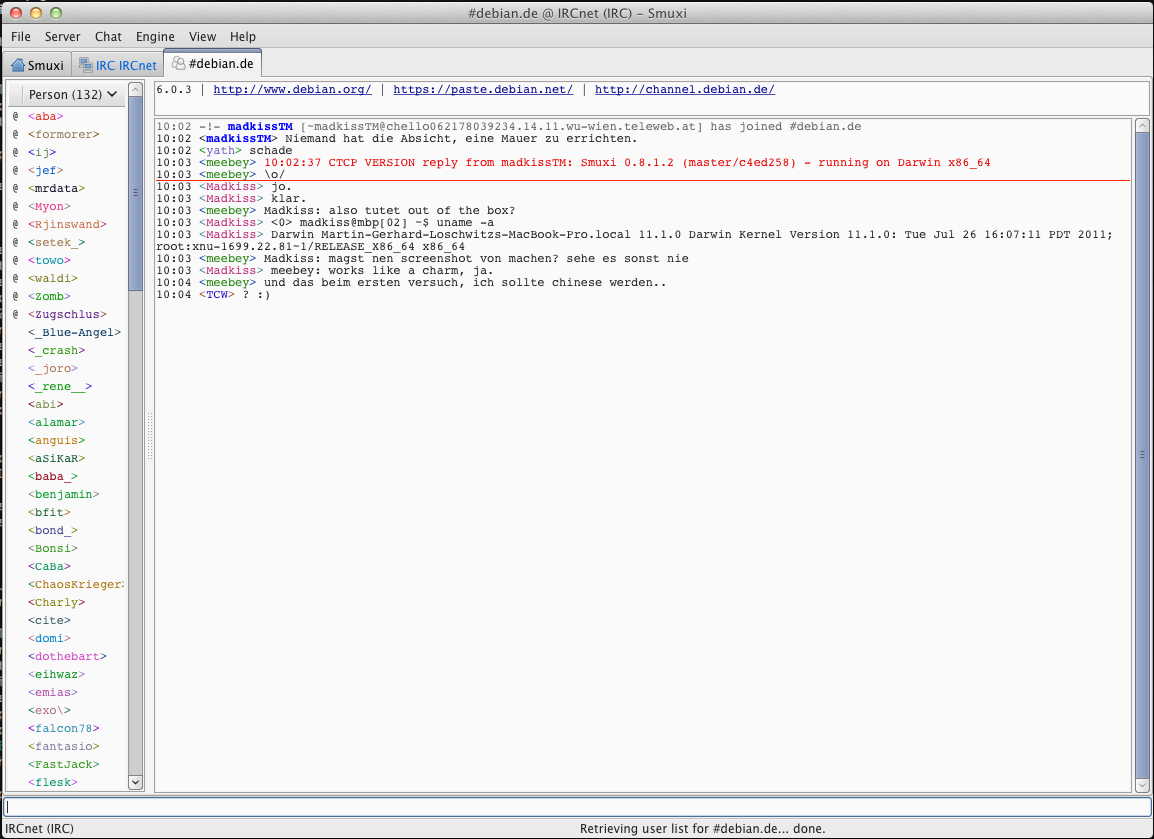
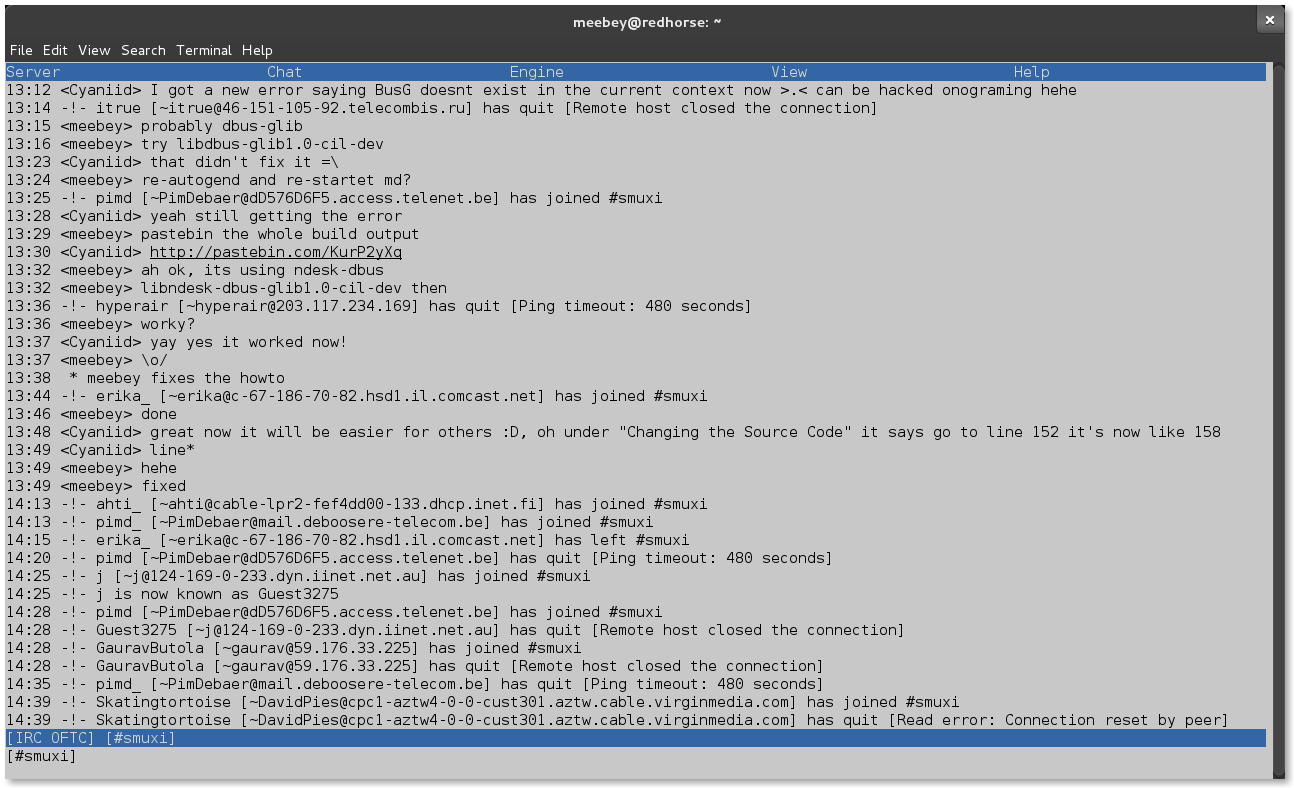
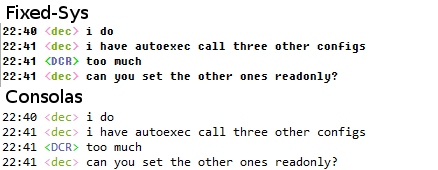
Just in time for 2012 I am very pleased to announce Smuxi 0.8.9 codenamed "One Giant Leap". During the development 56 bug reports and 33 feature requests in 593 commits were worked on making this release a major milestone of the Smuxi project. At the Chaos Communication Congress (28C3) in Berlin I was doing the final development sprint to get 0.8.9 done, which was a very intensive and refreshing experience. Here are the highlights of this release: Development Builds / Rolling Releases After the 0.8 release it became clear that a continious and short development -> test cycle is important to keep the project going quickly. At some point I have received requests if the project is dead while it was more active than ever. The lack of new releases (for about 15 months) lead to this wrong impression. Thus Smuxi can be obtained from development builds now. This includes daily builds for Debian (Squeeze, Wheezy, Sid), Ubuntu (Lucid, Maverick, Natty, Oneiric, Precise) and Windows. Thanks goes to Hannes Tismer for providing the Windows autobuilder and to Canonical for the PPA autobuilder. We invite everyone to use these daily builds to keep track of the latest development of Smuxi. Issues and regressions are fixed in a very short period (usually the same day). Thanks to our users who ran development builds and reported issues which led to many bug fixes prior to this release. On the other hand one of my New Year's resolutions are to "release early, release often" So there should be no nerd left behind... Screenshot of Smuxi 0.8.9 on Mac OS X Mac OS X support With the help of Steven McGrath (Steve[cug]) who created the initial Mac OS X installer for Smuxi we now have official support for Mac OS X. The download page contains the instructions how to obtain and install Smuxi on Mac OS X. This makes the 4th platform where Smuxi can be used on besides Windows, Linux and *BSD. For now Smuxi 0.8.9 doesn't feel as native as it could as it relies on the GTK+ port. We are looking into enhancing the experience though, just stay tuned. Chat History on Disk (Beta) The most exciting feature in this release I think are the "persistent message buffers". With this feature I could solve one of the biggest drawbacks IRC ever had: IRC does not retain any messages you have sent or received. All messages are only relayed to all users. The issue is that if you close your IRC client or even just leave a channel, all your received messages are gone. One workaround in most clients was to create text log files which then contains the chat history, but it is annoying and not user-friendly to open some text file somewhere from your disk to read the history outside of your IRC client. Now with Smuxi 0.8.9 you no longer have this issue, all chat history gets automatically written and read to a message database when you start Smuxi, join channels or open queries! As this feature is not fully stable yet it is not enabled by default. If you want to try it go to: File -> Preferences -> Interface and change "Persistency Type" from "Volatile" to "Persistent", hit OK and restart Smuxi. Now all messages are saved into the database and will automatically be shown. Click here for a screencast of this feature Jabber / XMPP Support (Beta) You probably have friends not on IRC and Twitter, say on Jabber, gTalk or Facebook? This is where the new XMPP engine of Smuxi comes into play. You can send and receive messages to/from them now! The implementation is far from complete, though. It has no buddy list for example and needs only to be treated as a technical preview of what will be coming in future Smuxi releases. Click here for a screencast of this feature Screenshot of Smuxi's Text Interface Text Interface (Alpha) This is the first release that contains a text frontend based on the STFL library. STFL is a library that uses ncurses to draw text based user interface using a markup language (like Glade for GTK+). This frontend is in early alpha state and lacks a lot of interface features and likes to crash. It is still included to attract potential developers who want to enhance this frontend. The frontend can be enabled by passing --enable-frontend-stfl to the configure script and then by executing smuxi-frontend-stfl. NetworkManager Support Everyone with a laptop knows how annoying it can be to suspend and resume when network based applications suddenly go crazy because they have lost the connection and either spew errors or take forever to get back in shape. Smuxi will now detect the network state right away with the help of the new Network Manager support. It automatically reconnects when needed right away for you. Next Generation Internet Support You can now connect to IRC servers using the IPv6 protocol Enhanced Find Group Chat Support Users had real issues to find out how to search for channels, thus Bianca Mix added a neat feature. The /list command will now simply open the Find Group Chat dialog for you. This way everyone used to IRC will find it in no time. Searching for channels on freenode wasn't working correctly, this is now fixed. Smuxi also supports the SAFELIST feature of the IRC protocol now which allows to retrieve a full channel list and do client side search which makes consecutive searches much faster. Enhanced Windows Experience For a long time you could not use Smuxi with the latest GTK# version of 2.12.10 on Windows. The issue was that Smuxi relied on SVG support which 2.12.10 no longer had. Smuxi is no longer using SVG instead it uses pre-scaled PNG images thus it works just fine with GTK# 2.12.10 on Windows now. At the same time the issue that the maximized state of the main window was left when restoring from task bar is fixed with GTK# 2.12.10. Screenshot of Fixed-Sys vs Consolas font Smuxi used by default the FixedSys font on Windows to give it the typical IRC look most people are used to. Since Windows Vista there is a better console-like font available called Consolas. Smuxi will now use the Consolas font instead on Windows Vista or later. Another important enhancement is that Smuxi no longer has issues with multiple GTK+ installs on the same computer, which was getting more common with more popular ported GTK+ applications such as GIMP or Pidgin. SSL for IRC fixed IRC with SSL was only working with the default port of 6697. Thanks to Jo Shields now any port can be used with SSL. Crash Related Issues Desktop notifications could crash Smuxi in case of errors related to the notification system or an absent notification daemon. There was a chance that the crash dialog simply disappeared which made reporting bugs more difficult no longer happens. Rapid use of ctrl+w, /window close (Jimmie Elvenmark) and opening the Find Group Chat dialog on the Smuxi tab do no longer crash. Also number-only network names, /network switch freenode and GTK+ install without SVG support no longer lead into a crash. Enhanced Notice Handling Notices will no longer open query tabs for you instead it will show them on tabs you share with the person who sent it with the server tab as fallback. This also avoids ChanServ, NickServ and spammy IRCop tabs. Twitter fixes Twitter made some changes to their API which broke the Twitter support of Smuxi 0.8. This was taken care of and also a few other issues were solved allowing Smuxi 0.8.9 to work smoothly with Twitter again. Extended Keybindings Smuxi allows now to use the ctrl+tab / ctrl+shift+tab and ctrl+n / ctrl+p keys to switch tabs. The keybindings still work even with a hidden menu bar now. Smuxi Server specific highlights More interactive and much faster synchronization When connecting to a smuxi-server you had to wait till Smuxi finished the synchronization before you could use the interface. Also you could not tell how far the synchronization was and just had to wait till it was completed. With Smuxi 0.8.9 the connect just takes a few seconds and all chats are synchronized in the background with a progress bar so you can use the interface from the first moment on and know how far it is. The speed how much it takes to synchronize all chats also reduced drastictly by 400%! Click here for a screencast of this feature More background communication When using a smuxi-server the interface sometimes had load times like when opening the preferences or when using the nickname completion (Andrew Kannan). These operations are done in the background and no longer blocks the interface. Also when the communication is lost to the smuxi-server the frontend will now automatically reconnect to it in the background. Low Bandwidth Mode When it comes to mobile internet connectivity such as UMTS/HSDPA, Edge and GRPS it can be a real pain to connect to the smuxi-server as it has to transfer all the messages over that. If you just want to ask someone you know then you don't need any old messages to do that. With the "Low Bandwidth Mode" you can now connect to the smuxi-server without loading old messages which makes the connect very quick. You find this option in the engine connect dialog. Stable Protocol Initially I didn't plan to make the protocol of Smuxi stable before the 0.9 release, but as it turned out the 0.8 protocol was good enough to still use it and for that reason Smuxi 0.8.9 is still compatible with 0.8. The 0.8 protocol will see no breakages, instead the next protocol will be on-top or opt-in of the current one. This means future Smuxi versions stay compatible with it. Shutdown Command You can now shutdown the smuxi-server if you like using the /shutdown command. It it safe to use the command, it will do a clean shutdown sequence for you. For example it makes sure all messages are written to disk in the case of enabled persistent message buffers. If you have your smuxi-server daemon monitored (e.g. with runit) it can also automatically be restarted and upgraded this way. Built-in SSH Keyfile Support It is no longer needed to fiddle with the .ssh/config file or pagent to get SSH key authorization working. You can now simply tell Smuxi which SSH keyfile you want to use to connect to your smuxi-server. Updated Translations
  • Catalan (Siegfried-Angel Gevatter Pujals)
  • Danish (Joe Hansen)
  • Finnish (Kalle Kaitala)
  • French (Cl ment Bourgeois)
  • German (Bianca Mix)
  • Italian (Vincenzo Campanella)
  • Portuguese (Americo Monteiro)
  • Spanish (Castilian) (Ricardo A. Hermosilla Carrillo)
New Translations
  • Chinese Simp (Dean Lee)
  • Slovak (Tom Vadina)
  • Swedish (Jimmie Elvenmark)
  • partially Russian (Aleksandr P)
  • partially Turkish (Umut Albayrak)
  • partially Urdu (makki)
Contributors Contributors to this release are the following people:
  • Mirco Bauer (497 commits)
  • Tuukka Hastrup (10 commits)
  • Bianca Mix (10 commits, translations)
  • Cl ment Bourgeois (8 commits, translations)
  • Andrius Bentkus (5 commits)
  • Carlos Mart n Nieto (3 commits)
  • Jimmie Elvenmark (3 commits, translations)
  • Hannes Tismer (1 commit)
  • Jonathan Pryor (1 commit)
  • Jo Shields (1 commit)
  • Siegfried-Angel Gevatter Pujals (translations)
  • Dean Lee (translations)
  • Aleksandr P (translations)
  • Americo Monteiro (translations)
  • Andrew Kannan (translations)
  • Joe Hansen (translations)
  • Kalle Kaitala (translations)
  • makki (translations)
  • Ricardo A. Hermosilla Carrillo (translations)
  • Tom Vadina (translations)
  • Umut Albayrak (translations)
  • Vincenzo Campanella (translations)
Thank you very much for your contributions to Smuxi! After reading this whole pile of text, head over here and grab this smexy stuff!
Posted Sun Jan 1 22:58:29 2012

Timo Jyrinki: I have a new GPG key


-----BEGIN PGP SIGNED MESSAGE-----
Hash: SHA1,SHA512

Hello,

I'm transitioning from my 2003 GPG key to a new one.

The old key will continue to be valid for some time, but I eventually
plan to revoke it, so please use the new one from now on. I would also
like this new key to be re-integrated into the web of trust. This message
is signed by both keys to certify the transition.

The old key was:

pub 1024D/FC7F6D0F 2003-07-10
Key fingerprint = E6A8 8BA0 D28A 3629 30A9 899F 82D7 DF6D FC7F 6D0F

The new key is:

pub 4096R/90BDD207 2012-01-06
Key fingerprint = 6B85 4D46 E843 3CD7 CDC0 3630 E0F7 59F7 90BD D207

To fetch my new key from a public key server, you can simply do:

gpg --keyserver pgp.mit.edu --recv-key 90BDD207

If you already know my old key, you can now verify that the new key is
signed by the old one:

gpg --check-sigs 90BDD207

If you don't already know my old key, or you just want to be double
extra paranoid, you can check the fingerprint against the one above:

gpg --fingerprint 90BDD207

If you are satisfied that you've got the right key, and the UIDs match
what you expect, I'd appreciate it if you would sign my key:

gpg --sign-key 90BDD207

Lastly, if you could send me these signatures, i would appreciate it.
You can either send me an e-mail with the new signatures by attaching
the following file:

gpg --armor --export 90BDD207 > timojyrinki.asc

Or you can just upload the signatures to a public keyserver directly:

gpg --keyserver pgp.mit.edu --send-key 90BDD207

Please let me know if there is any trouble, and sorry for the inconvenience.

(this post has been modified from the example at
http://www.debian-administration.org/users/dkg/weblog/48)

-----BEGIN PGP SIGNATURE-----
Version: GnuPG v1.4.11 (GNU/Linux)

iEYEARECAAYFAk8GuZoACgkQgtffbfx/bQ9nqACglWyHnDTFQfdKmz8OCd3oL6iR
hcEAmgKJ7RZsgwxwkRGPhygy5y1Ztb+3iQIcBAEBCgAGBQJPBrmaAAoJEOD3WfeQ
vdIHdVQQAMT1yvIogzbtK6sUnWqwbrXI9pDEFk7AzJTb80R+wzxsw7gu9gcBDk8G
BL2O26GKUqKWA3ytuApSl42FJam/Lusi9npT3XNkmHs6FaBMNuLYrqEXmCwXwWr/
OrLyeeLiF4yxgbNWbv+600BqAWqFlo6NeTgQKsJWtCjR3RVMxX3R8nzjDnKJuF+z
c6+2JKBWyx/HVUKcJpJrFDDR36HRFvVJomTuma2JCQ/RAl9vzAguqNYOi1QkuuQv
EF1gXH7gLifukGuwquP1DHP6SWWkj77jtRWr5ewC0xymbrArzAwKbvMQl3VpKBHh
MmpJjYP3ECyL14AKi/TY2Lidi0Sf6yqFMcPcreoih01N0OU0NXmD4IrHMT24/ssb
okDUe1o3YImjGq1jTACvlzC8s54EfLsqDgSP98SGVpuoDqPJUwVk4nuHj8q0vDSs
qZox26gVwB2FAOUi1BFiZbIzM5rsyYfCGyWUGiAwBFf54lYRAeCDCt8iAOOL1Ov/
TumIGYdLoXnDuOJq1VjXLGx2OFDrpyU8SPGoa3zNEVz39tgxQ48ASJEqcqt7HvBy
IW+TTsMLdJ1Ait9aCM3mzzr1iwP8TrL0qUsdRLOE6AKdAqocIfqXY8OeDKhbUiOJ
CXWk5q3xheK3sDWUXX7J63bAAUH4jFnpQEOVMJKBUNMKsWa0iXDS
=mklN
-----END PGP SIGNATURE-----

5 January 2012

Russell Coker: DRBD Benchmarking

I ve got some performance problems with a mail server that s using DRBD so I ve done some benchmark tests to try and improve things. I used Postal for testing delivery to an LMTP server [1]. The version of Postal I released a few days ago had a bug that made LMTP not work, I ll release a new version to fix that next time I work on Postal or when someone sends me a request for LMTP support (so far no-one has asked for LMTP support so I presume that most users don t mind that it s not yet working). The local spool on my test server is managed by Dovecot, the Dovecot delivery agent stores the mail and the Dovecot POP and IMAP servers provide user access. For delivery I m using the LMTP server I wrote which has been almost ready for GPL release for a couple of years. All I need to write is a command-line parser to support delivery options for different local delivery agents. Currently my LMTP server is hard-coded to run /usr/lib/dovecot/deliver and has it s parameters hard-coded too. As an aside if someone would like to contribute some GPL C/C++ code to convert a string like /usr/lib/dovecot/deliver -e -f %from% -d %to% -n into something that will populate an argv array for execvp() then that would be really appreciated. Authentication is to a MySQL server running on a fast P4 system. The MySQL server was never at any fraction of it s CPU or disk IO capacity so using a different authentication system probably wouldn t have given different results. I used MySQL because it s what I m using in production. Apart from my LMTP server and the new version of Postal all software involved in the testing is from Debian/Squeeze. The Tests All tests were done on a 20G IDE disk. I started testing with a Pentium-4 1.5GHz system with 768M of RAM but then moved to a Pentium-4 2.8GHz system with 1G of RAM when I found CPU time to be a bottleneck with barrier=0. All test results are for the average number of messages delivered per minute for a 19 minute test run where the first minute s results are discarded. The delivery process used 12 threads to deliver mail.
P4-1.5 p4-2.8
Default Ext4 1468 1663
Ext4 max_batch_time=30000 1385 1656
Ext4 barrier=0 1997 2875
Ext4 on DRBD no secondary 1810 2409
When doing the above tests the 1.5GHz system was using 100% CPU time when the filesystem was mounted with barrier=0, about half of that was for system (although I didn t make notes at the time). So the testing on the 1.5GHz system showed that increasing the Ext4 max_batch_time number doesn t give a benefit for a single disk, that mounting with barrier=0 gives a significant performance benefit, and that using DRBD in disconnected mode gives a good performance benefit through forcing barrier=0. As an aside I wonder why they didn t support barriers on DRBD given all the other features that they have for preserving data integrity. The tests with the 2.8GHz system demonstrate the performance benefits of having adequate CPU power, as an aside I hope that Ext4 is optimised for multi-core CPUs because if a 20G IDE disk needs a 2.8GHz P4 then modern RAID arrays probably require more CPU power than a single core can provide. It s also interesting to note that a degraded DRBD device (where the secondary has never been enabled) only gives 84% of the performance of /dev/sda4 when mounted with barrier=0.
p4-2.8
Default Ext4 1663
Ext4 max_batch_time=30000 1656
Ext4 min_batch_time=15000,max_batch_time=30000 1626
Ext4 max_batch_time=0 1625
Ext4 barrier=0 2875
Ext4 on DRBD no secondary 2409
Ext4 on DRBD connected C 1575
Ext4 on DRBD connected B 1428
Ext4 on DRBD connected A 1284
Of all the options for batch times that I tried it seemed that every change decreased the performance slightly but as the greatest decrease in performance was only slightly more than 2% it doesn t matter much. One thing that really surprised me was the test results from different replication protocols. The DRBD replication protocols are documented here [2]. Protocol C is fully synchronous a write request doesn t complete until the remote node has it on disk. Protocol B is memory synchronous, the write is complete when it s on a local disk and in RAM on the other node. Protocol A is fully asynchronous, a write is complete when it s on a local disk. I had expected protocol A to give the best performance as it has lower latency for critical write operations and for protocol C to be the worst. My theory is that DRBD has a performance bug for the protocols that the developers don t recommend. One other thing I can t explain is that according to iostat the data partition on the secondary DRBD node had almost 1% more sectors written than the primary and the number of writes was more than 1% greater on the secondary. I had hoped that with protocol A the writes would be combined on the secondary node to give a lower disk IO load. I filed Debian bug report #654206 about the kernel not exposing the correct value for max_batch_time. The fact that no-one else has reported that bug (which is in kernels from at least 2.6.32 to 3.1.0) is an indication that not many people have found it useful. Conclusions When using DRBD use protocol C as it gives better integrity and better performance. Significant CPU power is apparently required for modern filesystems. The fact that a Maxtor 20G 7200rpm IDE disk [3] can t be driven at full speed by a 1.5GHz P4 was a surprise to me. DRBD significantly reduces performance when compared to a plain disk mounted with barrier=0 (for a fair comparison). The best that DRBD could do in my tests was 55% of native performance when connected and 84% of native performance when disconnected. When comparing a cluster of cheap machines running DRBD on RAID-1 arrays to a single system running RAID-6 with redundant PSUs etc the performance loss from DRBD is a serious problem that can push the economic benefit back towards the single system. Next I will benchmark DRBD on RAID-1 and test the performance hit of using bitmaps with Linux software RAID-1. If anyone knows how to make a HTML table look good then please let me know. It seems that the new blog theme that I m using prevents borders. Update: I mentioned my Debian bug report about the mount option and the fact that it s all on Debian/Squeeze. Related posts:
  1. I need an LMTP server I am working on a system where a front-end mail...
  2. Some Notes on DRBD DRBD is a system for replicating a block device across...
  3. paper about ZCAV This paper by Rodney Van Meter about ZCAV (Zoned Constant...

4 January 2012

Jon Dowland: Ready Player One

I recently completed "Ready Player One", Ernest Cline's debut novel. It's a Sci-Fi fan-service novel that explores a dystopian future (yes, another one) where the majority of the populace hide inside a VR environment to escape their "real" lives. The sole-genius who authored the VR software hid a series of easter eggs inside, in the form of challenges relating to pop-culture and video game trivia circa the 80s. He constructs his will such that whoever first completes the challenges inherits the mega-bucks company who control the VR simulation. Mike Hoye has an excellent summary:
Ready Player One is a nerdculture bender of a book, about as hard to hate while you re in the middle of it as it is to love in hindsight; it s young adult literature for people who were born in the late seventies and haven t really grown up yet. Of which I am apparently one, it has become clear, but you re still left with the sense that you re reading a Cory Doctorow book whose discerning virtue is that the lead isn t a thinly-veiled Cory Doctorow. Which is a huge, huge improvement, make no mistake, but it s stills relentless, pandering fanservice.
(Whilst you are over on Mike's website you should really read this excellent piece on libraries and publishers.) Despite the points above, I enjoyed the book. My biggest complaint was that the ending was quite abrupt. Quite often when I read a story which is essentially about a journey, I am disappointed if the story ends when the journey does. I hope I am not spoiling too much here by revealing that someone eventually solves the riddles and inherits essentially the earth. But what do they do with it? What impact do they make on the miserable world, described only briefly in sparse passages dotted around the bulk of the text detailing the VR one? During the book, the characters opine on what to do with the fortune, but we never see that come to fruition. Perhaps in a sequel.

3 January 2012

Jon Dowland: instagr/am/bient

Via Boing Boing, I stumbled across an excellent audio/visual project called instagr/am/bient: 25 ambient pieces of music inspired by 25 photos on the instagram photo service. The original upload featured a high-resolution PDF of the pictures, with MP3 audio and low-quality embedded copies of each picture as each track's artwork. I was a little disappointed about this, as I thought the tracks would be best appreciated next to the higher-quality picture that inspired them. So, I fixed it: Instagr/am/bient (HD images) This was possible thanks the liberal licensing of the original, but also two excellent pieces of software: pdfimages (from the poppler-utils package) and eyeD3, which made it not just possible but trivial. See also the 9.5M accompanying PDF. I do like what people are creating with instagram; I also like the "tumble-blog" approach to sharing similar images. I occasionally rotate the indexpics on my site; perhaps I should do so more often, and publish the new ones on my blog, too.

29 December 2011

Jon Dowland: backup

Backups are something I don't do well. I hope to write a more thorough article about them at some point. For now, here are some tips. Like most home users, I don't have access to a tape drive or jukebox for backups. I'm therefore looking for a solution that backs up to a local block device. I haven't ruled out a solution that backs up to DVD-Rs, but I haven't found a suitable one. I first tried rsnapshot, which uses hard link trees to represent increments. I found that this resulted in enormous filesystem metadata, sufficient to cause the machine I was running it on (an embedded ARM system) to slow to a crawl. I'd recommend to avoid anything using this technique. I more recently have been using rdiff-backup. This has appeared to work quite well for a number of years. However, it does not gracefully handle the backup volume being full, spewing python backtraces. This is compounded with some confusing use of temporary directies and not honouring $TMPDIR. This has been known about for years (1, 2). I've just independently discovered these problems for the second time. Aside from that, because it does not de-duplicate files, it is sensitive to large files being moved around in the source being backed up. It also cannot do a dry-run estimate of the disk space required for the next increment. So: time to move on. Back in 2010 I discovered bup, an intriguing backup tool that used a git-style backing store. It's interesting enough that I packaged it and use it in a few situations, but I wouldn't rely on it for my main backups, for two reasons: one, it's not tried-and-tested enough yet (but that is rapidly being resolved), two: you can't get rid of old increments, so your backup volume will always increase in size over time, and never throw away old data. So, for now: move on. Next on my list to try is Lars Wirzenius' obnam.

Next.

Previous.