Search Results: "eric"

13 May 2011

Maximilian Attems: initramfs-tools release 0.99 "scarpe rotte e pur bisogna andar"

This new release features /run usage and xz support. For the details see the release announcement of latest initramfs-tools. The upload itself fixes 18 (19) bugs in the Debian BTS and has also a cute lilo support patch hiding under "initramfs-tools: Fix handling of numeric root= arguments to be udev-friendly" coming from Ubuntu. (; Ben Hutchings revamped the bootloader linux-2.6 hooks in order that update-initramfs no longer calls any bootloader by itself. Thank you for all the contributions. The development docs got nicely refreshed too.

12 May 2011

Erich Schubert: AMD64 broken on Debian unstable - avoid libc6 2.13-3

Beware from upgrading on AMD64. Make sure to avoid version 2.1.3-3, as this will render your system unbootable and unusable. As simple as the reason is (a missing link) as severe.
Bug report with instructions on how to recover. If you are lucky you have a root shell open to restore the missing link. Otherwise, you need to reboot with parameters break=init rw, recover the link with cd root; ln -s lib lib64, sync, unmount, reboot. It's not really hard to do when you know how. But it is a lot easier to avoid upgrading to this version. My i386 mirror already has the fixed upload (but i386 is not affected anyway). So by tomorrow, it should be safe again (depening on your mirrors delay).

9 May 2011

Evgeni Golov: playing sick games (RC-bugs 2011/18)

I ve been a little sick the last days and decided to be productive instead of just drinking tea all the time.The result are some (10) squashed bugs from pkg-games, and one long standing nmu.adonthell#624998 LP#765984
FTBFS: py_adonthell_wrap.cc:27357:44: error: taking address of temporary [-fpermissive]
Patch by Peter De Wachter, I just had to sign and upload.alex4#624884
FTBFS: stat.h:106:22: error: expected identifier or ( before [' token
Include defs.h *after* particle.h, thus not redifining __unused from glibc's bits/stat.hfenix#554286 LP#770962
FTBFS with binutils-gold
Fixed since 0.92a.dfsg1-6, bug closed. Found different FTBFS though, fix uploaded as -9.freeciv#554411
FTBFS with binutils-gold
Closed after verifying that it is fixed since at least 2.2.1 as upstream wrote.kball#624978
FTBFS: src/gamemenu.cpp:224:52: error: 'mkdir' was not declared in this scope
Include sys/stat.h in 06_homedir_game.patch and 07_homedir_editor.patch.kiki-the-nano-bot#625047 LP#770970
FTBFS: ../src/../SWIG/KikiPy_wrap.cpp:13045:63: error: taking address of temporary [-fpermissive]
Patch by Peter De Wachter, I just had to sign and upload.late#624937 LP#770857
FTBFS: ball.h:113:19: error: NULL was not declared in this scope
Include stddef.h in ball.h to define NULL.libclaw#625038 #624919 LP#770805
FTBFS: avl_base.hpp:137:15: error: ptrdiff_t does not name a type
Patch by Julien Jorge, I just had to sign and upload.liquidwar#555468
FTBFS with binutils-gold
Patch by Stephen Kitt, I just had to sign and upload.lordsawar#555564
FTBFS with binutils-gold
Closed after verifying that it is fixed since at least 0.1.8xnecview#621392
FTBFS on armel: expected identifier before numeric constant
R0 is already taken as a register name on armel, rename xnecview s constant to DEFFAULTR0. (Patch basically stolen from Ubuntu)

Jonathan McDowell: A minor keyring-maint rant

This should probably be an official FAQ, but a) I wanted to rant a bit more than is probably acceptable for something "official" and b) the sort of person this information is directed at never bloody reads keyring.debian.org, which is the logical place for it. Who are keyring-maint? Currently Gunnar Wolf (good cop) and Jonathan McDowell (bad cop). Previous keyring maintainers include Igor Grobman & James Troup. I'd like to be a DM/DD. Do I send you my key? No. You go through the DebianMaintainer or NM processes. Then the DM team or DAM tell us to add your key to the appropriate keyring. I'd like to replace my DM/DD key in the Debian keyring. What should I do? Read the instructions at http://keyring.debian.org/replacing_keys.html I have a new key that isn't signed by anyone else, will you accept it? No. Did you read http://keyring.debian.org/replacing_keys.html ? I've got a single DD signature on my new key. That's enough, right? Not unless your old key has been lost and you're getting a different DD to request the replacement for you (and if they're prepared to ask for a key replacement we'll wonder why they're not prepared to sign the new key too). Did you read http://keyring.debian.org/replacing_keys.html ? I'm still really confused about how I should request a key replacement. Help? Try reading https://rt.debian.org/Ticket/Display.html?id=3141 (which just happens to be a recent decent example). Clear subject line (I'd have added a real name too, but it's still fairly clear), full fingerprint of the old and new keys, inline signed so RT doesn't mangle it. New key signed by old key and 3 other DDs. Request signed by old key. That RT link needs a login. I don't have one. Have you tried reading up on the Debian RT system? There's a generic read only login that'll get you access. That's too hard. Can't you just give me the details? Damnit. It appears the read-only login details are currently disabled due to misuse (one wonders how). Try reading http://wiki.debian.org/rt.debian.org Why are you using RT? Isn't bugs.debian.org more appropriate? We need the ability to for people to contact us is in a private fashion, for example if they need to us to remove a key because it's been lost or compromised. We could only use RT for that purpose and use bugs.d.o for things that can be public, but this way all the information is in one place and we get to make the call about when it becomes a publicly viewable ticket. What's with jetring? Should I send you a jetring changeset? jetring is a tool written by Joey Hess that used to be used to manage the Debian Maintainers keyring. keyring-maint borrowed a number of good ideas from jetring but don't use it at all. We ignore jetring changesets. So you just want key fingerprints, not attached keys? Yes. Of course you have to make sure your key is actually on a public keyserver so we can get it. the.earth.li is a good choice (because Jonathan runs it and thus pays more attention to it), but subkeys.pgp.net or pool.sks-keyservers.net are also commonly used. My key has expired and I want to update the key expiry date. I should email RT asking for this to be done, right? No, you should send the updated key via HKP to keyring.debian.org. You can do this with "gpg --keyserver keyring.debian.org --send-key <keyid>" Obviously replace <keyid> with your own key ID. I tried to send an entirely new key via HKP to keyring.debian.org, but I can't see it there. What gives? keyring.debian.org only accepts updates to keys it already knows about. That means you can send updated expiry dates, new uids and new signatures to your existing key, but not an entirely new key. I sent my updated key via HKP to keyring.debian.org and can see it's updated there, but the Debian archive processing tools (eg dak) don't seem to recognize the update. Why not? The updates sent via HKP are folded back into the HKP server automatically every 15 minutes or so. They are folded into the live Debian keyrings on a manual basis, at least once a month. This means if your key has an expiry date then you probably want to update your key at least a month before it expires. Where can I find these live Debian keyrings? They're what's available via rsync from keyring.debian.org::keyrings/keyrings/ This is canonical location for the current Debian Developers and Debian Maintainers keyrings. What about the debian-keyring package? This is a convenience package of the keyrings. It's usually the most out of date. We update it sporadically and try to ensure that the version shipped with a stable Debian release is current at the point of release. It is not used by any of the official Debian infrastructure. Why don't you automatically update my key in the live keyring when I send an update via HKP? We think that automatic updates of keys that allow uploads to Debian are a bad thing and that invoking a human eye at some step of the process is a useful sanity check. Paranoid much? Never enough. How are updates to the keyring tracked? We use bzr to maintain the keyring, with a separate file per key that can then be easily combined into the various keyrings. You can see the repository at: http://bzr.debian.org/scm/loggerhead/keyring/debian-keyring/changes Note that this is only updated when a keyring is pushed to live; the working tree may contain details of compromised keys and thus isn't public. What's with the whole replacement of 1024 bit keys? 2 things. Firstly 1024 bit keys tend to use SHA1 as a hash algorithm, which has been shown to be weaker than expected. While we're not aware of active exploits against this updating all of the keys Debian uses is not a trivial process and it's wiser to get it done /before/ there's a known issue. Secondly computing power has moved on and we feel that upgrading to larger key sizes is prudent. Elliptic curve cryptography (ECC) keys look like the future. Can I use one for Debian? No, not at present. When there are tools that are part of a Debian stable release that support them we'll look into it, after discussion with the major users of the keyring (DSA, ftpmaster, the secretary).

5 May 2011

Russell Coker: Osama bin Laden

After almost 10 years the Americans finally found Osama bin Laden, unfortunately they were unable to take him alive. The Reid Report has a good summary of what happened [1]. Sam Varghese wrote an interesting analysis of the political aspects of this event in Pakistan [2], and he s a lot less positive about it than most people. Later he wrote about the inconsistencies in the reports, it seems that bin Laden was executed while unarmed [3]. When dealing with someone who is no stranger to suicide attacks and who has stated an intention to never be taken alive it s not unreasonable to shoot quickly, it s just a pity that they couldn t have been honest from the start. Dr. Pamela Gerloff wrote an insightful article for Psychology Today titled Why We Should Stop Celebrating Osama Bin Laden s Death [4]. She asks the rhetorical questions What kind of nation and what kind of species do we want to be? Do we want to become a species that honors life? Do we want to become a species that embodies peace? and suggests that we should mourn the series of tragedies that led up to this situation and to feel compassion for anyone who, because of their role in the military or government, American or otherwise, has had to play any role in killing another . Daniel R. Hawes wrote an insightful article for Psychology Today that s quite different from Dr. Gerloff s article [5]. He is quite glad that bin Laden is dead. But he considers how the people who have lost friends and relatives on 9-11 might feel about this and says that the shouts and celebratory chants that rang around America today seemed to me to carry a certain element of irreverence for those affected most deeply by the September 11 attacks and the entire military operations that followed . To represent the people who are partying now there is a post by Jenny Lind Schmitt that is totally unworthy of a site such as Psychology Today [6]. Jenny told her small children about al Quaeda: They hate you because you are American. Their god is destruction, and they would kill you, a little child, if they had the chance, just because you are American. She also describes al Quaeda as lunatics . Describing all your enemies as lunatics is quite common in general conversation, but it s not suitable for a web site that discusses psychology (where some respect for people with mental health issues is expected). Teaching children to be bigoted against Islam is a bad thing too. It seems to me that a factor in the violence that comes from the middle-east is a result of women just like her telling their children similar things but with country names and religions switched. Finally some capacity for empathy is required for someone to have any insight into psychology, someone who can t understand such things can t be competent to discuss psychology. In stark contrast to Jenny (who bears an irrational hatred in spite of apparently not having any close connection to the events in question) there is a TED talk by Phyllis Rodriguez (who s son was killed in the 9-11 attacks) and Aicha el-Wafi (who s son is in jail for being a member of al Quaeda and was accused of being part of the 9-11 plot) [7]. The two women became friends after 9-11 and work together in the cause of peace. From reading some interviews that Google turned up Aicha seems like a very intelligent woman, I think that the TED talk with her section translated from French to English didn t seem to show this. Perhaps people who speak French and English would get more from the TED talk than I did. Also perhaps if she gave a talk to a French audience and it was subtitled then the result would be better. Now of course the less intelligent people on the right-wing are trying to spin this to say that Bush deserves credit for getting bin Laden. The Reid Report has a good analysis of the history of the hunt for bin Laden and it doesn t make Bush look good [8]. Also the Reid Report has an interesting analysis of the operation to get bin Laden and the possibility for peace now that he s gone [9]. LA Times has an article about the use of the name Geronimo as a code-word for bin Laden [10]. But compared to the use of words such as crusade and paladin by the US armed forces this hardly rates a mention.

Erich Schubert: Upcoming publications in data mining

Upcoming 2011 publications of my research:
Just presented at the SDM11 last weekend:
H.-P. Kriegel, P. Kr ger, E. Schubert, A. Zimek
Interpreting and Unifying Outlier Scores
In Proceedings of the 11th SIAM International Conference on Data Mining (SDM), Mesa, AZ, 2011.
To be presented and published end of August:
T. Bernecker, M. E. Houle, H.-P. Kriegel, P. Kr ger, M. Renz, E. Schubert, A. Zimek
Quality of Similarity Rankings in Time Series
In Proceedings of the 12th International Symposium on Spatial and Temporal Databases (SSTD), Minneapolis, MN, 2011.
E. Achtert, A. Hettab, H.-P. Kriegel, E. Schubert, A. Zimek
Spatial Outlier Detection: Data, Algorithms, Visualizations
In Proceedings of the 12th International Symposium on Spatial and Temporal Databases (SSTD), Minneapolis, MN, 2011.
The latter will also accompany the release of version 0.4 of our data mining research software ELKI.

3 May 2011

Craig Small: IPv6 and address translation

We re in that in-between place where there is plenty of IPv4 out there, but sometimes you either need or want to get to IPv6 addresses. With the IPv4 address allocations out of ARIN now empty there is going to be an increased need of NAT either between the address families or within it. This is a quick overview of the different sorts of systems that do this address translations. 6tunnel The best way to describe this is port forwarding across the address families. You can have a IPv4 port on your local device that when you connect to it forwards the connection via IPv6 to a remote device, perhaps on a different port. You can also do it the other way, so connecting to a local IPv6 port will connect to a remote IPv4 port. Of course remote could be another port on the same computer. Squid You could replace squid with any other sort of proxy server that can work as a reverse proxy and understands IPv6. From the deployments I ve heard of, this arrangement where the IPv4 only webservers are front-ended with a dual stack IPv4/IPv6 squid (or other) reverse proxy server or set of servers. It is a real simple way of getting your webserver onto IPv6, if you cannot do it in the webserver itself. The usual advantages and disadvantages of using a reverse proxy apply here. The better long-term solution is to have the servers just run IPv6 natively, but this is a reasonable stop-gap. That s a brief overview of the various packages out there that can help with address translation to either get your servers understanding IPv6 or a client to get to an IPv6 server. Ideally these are only temporary measures but as some methods people use to write programs (the latest I ve seen has weird hard-coded 4 byte offset tree-table with 256 long list inside good luck fixing that!) they may be temporary for some time. Tayga This program implements NAT64 which is a 1:1 address translation. It can work both ways so IPv6 clients can connect to IPv4 servers and vice-versa. You would normally use this for your own hosts, rather than for connecting to the internet as you need to specify prefixes. It works like the old style static nat ranges in IPv4 where 1.1.1.10-100 would map to 2.2.2.10-100 tnat64 Now this package is a little back-to-front to the others in that it takes an existing IPv4 only application and makes it able to connect, at least at the socket level, to a IPv6 server. It works by preloading a library which overloads the socket functions like socket() and connect() so it can attempt to find IPv6 servers. totd This is a small DNS proxy which can be used to translate IPv4 A records to IPv6 AAAA records. You often use it with translation technologies like Tayga.
totd This is a small DNS proxy which can be used to translate IPv4 A records to IPv6 AAAA records. You often use it with translation technologies like Tayga.

30 April 2011

Russell Coker: Autism Awareness and the Free Software Community

It s Autism Awareness Month April is Autism Awareness month, there are lots of articles about Autism, most of them are at best misleading if not wrong. The most common error seems to be describing non-verbal Autistic children and then claiming that Autistic people comprise about 1% of the population. The number of non-verbal Autistic children is a lot less than 1% of the population, and at least 1/3 of the people on the Autism Spectrum have good verbal skills and often talk more than average. To be precise, they are describing the symptoms of people who would be diagnosed with Severity 3 according to the American Psychiatric Association s Diagnostic and Statistical Manual (the DSM) as applying to all people who are on the Autism Spectrum even though of the currently diagnosed people probably about 1/3 might be classified as Severity 2 and 1/3 as Severity 1. It seems that severity 1 Autism is going to be the replacement for Asperger Syndrome in the new DSM-5. The problem with misleading information in regard to what comprises Autism is that parents really don t want to have a child who s abnormal and search for evidence to make their wishes come true. At the extreme there are parents who can convince themselves that a 4yo non-verbal child isn t on the Autism Spectrum. When people are given the impression that Autism is only about non-verbal children then they will probably think that a 6yo who can give a half-hour lecture on a topic of interest (regardless of whether the audience is interested) isn t on the Autism Spectrum. There is also a similar issue with undiagnosed adults, I would have probably got assessed at least a decade earlier if I had learned more about Autism instead of believing some of the stories. In a quick Google search for Autism Awareness Month I haven t found any clear and accurate information on what Autism is or what should be done about it, so it seems to me that the awareness project has largely been a failure. The Autism page on Wikipedia [1] and the page for Asperger Syndrome [2] are good places to start reading. By merely pointing to those two Wikipedia pages I ve made this post a lot more useful than every article I ve seen in the mainstream media. To find some useful and insightful posts about Autism awareness you have to add some search terms such as neurodiversity, which turns up posts such as a post by Leah Jane about Autism Acceptance [3]. It seems that the Autism Awareness articles that are most useful at informing people will only be found by people who are already aware of some of the issues. Most People Who Read this are Geeks The majority of the readers for my blog come from aggregators that cater to fairly geeky people. Geek culture is largely Aspie culture. So I think that most people who read my blog have a good general knowledge of what people who might be diagnosed with Asperger Syndrome or High Functioning Autism are like they just think that such people are merely a bit more geeky than is typical for the Free Software community. So it s not as if all Autistic people are hidden away somewhere because they can t live independently. Many of us work in the computer industry and in academia. Probably the majority of people who have a university degree related to science or engineering have had a professor who was on the Autism Spectrum, probably most people who have any significant experience in the computer industry have had colleagues who are on the Spectrum. After having become used to the geek culture I initially found it difficult to believe that I could be on the Autism Spectrum because I knew heaps of people in the Free Software community who are at least as geeky as me but apparently weren t on the Autism Spectrum. I now think that the majority of people who are as geeky as me would get diagnosed with Asperger Syndrome (or High Functioning Autism under DSM-5) if they were assessed. Adult Diagnosis If you are wondering whether you might be on the Autism Spectrum then it s worth reading the pages linked from the DSM 5 draft process have the full diagnostic criteria (both for DSM-4 and DSM-5) [4]. Also Glenn Rowe has a web page with tests designed by Professor Simon Baron-Cohen [5] and Leif Ekblad has a project to do long-term analysis of changes to personality test scores which starts with a quick Aspie quiz [6] (and also has lots of links to other relevant sites). If you think that you might be on the Autism Spectrum (which means Asperger Syndrome in the case of most people who read my blog) then I recommend that you get assessed if possible. As assessment by a psychologist isn t cheap there is the option of self-diagnosis in which case Chaotic Idealism s post about self-diagnosis is worth reading [7].

29 April 2011

Petter Reinholdtsen: Initial notes on adding Open311 server API on FixMyStreet

The last few days I have spent some time trying to add support for the Open311 API in the Norwegian FixMyStreet service. Earlier I believed Open311 would be a useful API to use to submit reports to the municipalities, but when I noticed that the New Zealand version of FixMyStreet had implemented Open311 on the server side, it occurred to me that this was a nice way to allow the public, press and municipalities to do data mining directly in the FixMyStreet service. Thus I went to work implementing the Open311 specification for FixMyStreet. The implementation is not yet ready, but I am starting to get a draft limping along. In the process, I have discovered a few issues with the Open311 specification. One obvious missing feature is the lack of natural language handling in the specification. The specification seem to assume all reports will be written in English, and do not provide a way for the receiving end to specify which languages are understood there. To be able to use the same client and submit to several Open311 receivers, it would be useful to know which language to use when writing reports. I believe the specification should be extended to allow the receivers of problem reports to specify which language they accept, and the submitter to specify which language the report is written in. Language of a text can also be automatically guessed using statistical methods, but for multi-lingual persons like myself, it is useful to know which language to use when writing a problem report. I suspect some lang=nb,nn kind of attribute would solve it. A key part of the Open311 API is the list of services provided, which is similar to the categories used by FixMyStreet. One issue I run into is the need to specify both name and unique identifier for each category. The specification do not state that the identifier should be numeric, but all example implementations have used numbers here. In FixMyStreet, there is no number associated with each category. As the specification do not forbid it, I will use the name as the unique identifier for now and see how open311 clients handle it. The report format in open311 and the report format in FixMyStreet differ in a key part. FixMyStreet have a title and a description, while Open311 only have a description and lack the title. I'm not quite sure how to best handle this yet. When asking for a FixMyStreet report in Open311 format, I just merge title an description into the open311 description, but this is not going to work if the open311 API should be used for submitting new reports to FixMyStreet. The search feature in Open311 is missing a way to ask for problems near a geographic location. I believe this is important if one is to use Open311 as the query language for mobile units. The specification should be extended to handle this, probably using some new lat=, lon= and range= options. The final challenge I see is that the FixMyStreet code handle several administrations in one interface, while the Open311 API seem to assume only one administration. For FixMyStreet, this mean a report can be sent to several administrations, and the categories available depend on the location of the problem. Not quite sure how to best handle this. I've noticed SeeClickFix added latitude and longitude options to the services request, but it do not solve the problem of what to return when no location is specified. Will have to investigate this a bit more. My distaste for web forums have kept me from bringing these issues up with the open311 developer group. I really wish they had a email list available via Gmane to use for discussions instead of only a forum. Oh, well. That will probably resolve itself, one way or another. I've also tried visiting the IRC channel #open311 on FreeNode, but no-one seem to reply to my questions there. This make me wonder if I just fail to understand how the open311 community work. It sure do not work like the free software project communities I am used to.

28 April 2011

Erich Schubert: SIAM SDM11 - Unified Outlier Scores

I'm currently in Phoenix, AZ at the 2011 SIAM International Conference on Data Mining.
My contribution is titled "Interpreting and Unifying Outlier Scores", a method that allows the combination, interpretation, visualization etc. of existing outlier algorithms. The method brings back a bit more statistics into a data mining area that has drifted away from the statistical roots.
We apply the method to a couple of outlier detection algorithms and combine them using a naive ensemble approach, that still outperforms existing outlier ensembles.

Daniel Kahn Gillmor: USAA Deposit@Home: bad engineering and terrible UX

I use USAA for some of my finances. They specialize in remote banking (i've never been in a physical branch). Sadly, they can still be pretty clueless about how to use the web properly. My latest frustration with them was trying to use their Deposit@Home service, where you scan your checks and upload them. No problem, right? I've got a scanner and a web browser and i know how to use them both. Ha ha. Upon first connecting, i'm rejected, and i find the absurd System Requirements -- only Windows and Mac, and only certain versions of certain browsers. You also need Sun's Java plugin, apparently. Deliberately na ve, i call their helpdesk and ask them if they could just give me a link to let me upload my scanned checks. They tell me that they want 200dpi images, and then give an absurd runaround that includes references to the Gramm-Leach-Bliley Act as the reason they need to limit the system to Windows or Mac, and that security is the reason they need to control the scanner directly (apparently your browser can control your local scanner on Windows? yikes). But they let slip that Mac users don't have the scanner controlled directly, and can just upload images (apparently the federal law doesn't cover them or something). Preposterous silliness. The Workaround Of course, it turns out you can get it working on Debian GNU/Linux, mainly by telling them what they want to hear ("yes sir, i'm running Mac OS"), but you'll also have to run Sun's Java (non-free software) to do it, since their Java uploader fails with nasty errors when using icedtea6-plugin. I set up a dedicated system user for this goofiness, since i'm going to be running apparently untrustworthy applets on top of non-free software. I run a separate instance of iceweasel as that user; all configuration described is for that user's homedir. If you do this yourself, You'll need to decide if you want the same level of isolation for yourself. So i have the choice of installing sun-java6-plugin from non-free and having the plugin installed for all web browsers, or just doing a per-user install of java for my dedicated user (and avoiding the plugin for my normal user). I opted for the latter. As the dedicated user, I fetched the self-extracting variant from java.com, unpacked it, and added it to the iceweasel plugins:
chmod a+x ~/Download/jre-6u25-linux-i586.bin
mkdir -p ~/lib ~/.mozilla/plugins
cd ~/lib
~/Download/jre-6u25-linux-i586.bin
ln -s ~/lib/jre*/lib/*/libnpjp2.so ~/.mozilla/plugins/
Then i closed iceweasel and restarted it. In the relaunched iceweasel sesson, I told Iceweasel 4 to pretend that it was actually Firefox 3.6 on a Mac. I did this by going to about:config (checking the box that says i know what i'm doing), right-clicking, and choosing "new >> string". The new variable name is general.useragent.override and i found that setting it to the following (insane, false) value worked for me:
Mozilla/5.0 (Macintosh; U; PPC Mac OS X Mach-O; en-US; rv:1.9.2.3) Gecko/20060426 Firefox/3.5.18
Note that this configuration might make hotmail think that you are a mobile device. :P If you try to use this browser profile for anything other than visiting USAA, you might want to remove this setting, or install xul-ext-useragentswitcher to be able to set it more easily than using about:config. Once these changes were made, I was able to log into USAA, use the Deposit@Home service to upload my 200dpi grayscale scans. I guess they think i'm a Mac user now. The Followup After completing the upload, I wrote them this review (i doubt they'll post it):
The Deposit@Home service has great potential. Unfortunately, it currently appears to be overengineered and unnecessarily restrictive. The service requires two scans (front and back) of the deposited check, at 200dpi, in grayscale or black-and-white, in jpeg format, reasonably-cropped. The simplest way to do this would be to show some examples of good scans and bad scans, and provide two file upload forms. Once the user uploaded their images, the web site could run its own verification, and display them back for the user to confirm, optionally using a simple javascript-based image-cropper if any image seems wrong-sized. This would work fine with any reasonable browser on any OS. Instead, Deposit@Home requires the user to present a User-Agent header claiming to be from specific versions of Mac or Windows, running certain (older) versions of certain browsers, and requires the use of Sun's Java plugin. Entirely unnecessary system requirements to do a simple task. Disappointing. :(
Acknowledgements I found good background for this approach on the ubuntu forums. The Takeaway I continue to be frustrated and annoyed by organizations that haven't yet embraced the benefits of the open web. Clearly, USAA has spent a lot of money engineering what they think is a certain experience for their users. However, they didn't design with standard web browsers in mind, so they appear to have boxed themselves into a corner where they think they have to test and approve of the entire software stack running on the end-user's machine. This is not only foolish -- it's impossible. When you're designing a web-based application, just design it for the web. Keep it simple. If you want to offer some snazzy java-hooked-into-your-scanner insanity, i will only have a mild objection: it seems like a waste of time and engineering effort. My objection is much stronger if your snazzy/incompatible absurdity is the only way to use your service. A simple, web-based, browser-agnostic interface should be available to all your clients. Even more aggravating is the claim that they don't think they should engineer for everyone. I was told during the runaround that they would only support Linux if 4% of their users were using Linux (which they don't think is the case at the moment -- if you are a USAA customer, and you use something other than Mac and Windows, please tell them so). I tried to tell them that I wasn't asking for Linux support; i was asking for everyone support. If you just use generic engineering in the first place, there's no extra expense for special-casing other users. But they couldn't understand. And now, since i'll need to lie to them in my User Agent string every time i want to deposit a check online, those visits won't even show up in their logs to be counted. "Our web site deliberately disables itself for $foo users; we haven't written it for them; but that's OK, we don't have any $foo users anyway" is a nasty self-fulfilling prophecy. Why would you do that?

27 April 2011

Kees Cook: non-executable kernel memory progress

The Linux kernel attempts to protect portions of its memory from unexpected modification (through potential future exploits) by setting areas read-only where the compiler has allowed it (CONFIG_DEBUG_RODATA). This, combined with marking function pointer tables const , reduces the number of easily writable kernel memory targets for attackers. However, modules (which are almost the bulk of kernel code) were not handled, and remained read-write, regardless of compiler markings. In 2.6.38, thanks to the efforts of many people (especially Siarhei Liakh and Matthieu Castet), CONFIG_DEBUG_SET_MODULE_RONX was created (and CONFIG_DEBUG_RODATA expanded). To visualize the effects, I patched Arjan van de Ven s arch/x86/mm/dump_pagetables.c to be a loadable module so I could look at /sys/kernel/debug/kernel_page_tables without needing to rebuild my kernel with CONFIG_X86_PTDUMP. Comparing Lucid (2.6.32), Maverick (2.6.35), and Natty (2.6.38), it s clear to see the effects of the RO/NX improvements, especially in the Modules section which has no NX markings at all before 2.6.38:
lucid-amd64# awk '/Modules/,/End Modules/' /sys/kernel/debug/kernel_page_tables   grep NX   wc -l
0
maverick-amd64# awk '/Modules/,/End Modules/' /sys/kernel/debug/kernel_page_tables   grep NX   wc -l
0
natty-amd64# awk '/Modules/,/End Modules/' /sys/kernel/debug/kernel_page_tables   grep NX   wc -l
76
2.6.38 s memory region is much more granular, since each module has been chopped up for the various segment permissions:
lucid-amd64# awk '/Modules/,/End Modules/' /sys/kernel/debug/kernel_page_tables   wc -l
53
maverick-amd64# awk '/Modules/,/End Modules/' /sys/kernel/debug/kernel_page_tables   wc -l
67
natty-amd64# awk '/Modules/,/End Modules/' /sys/kernel/debug/kernel_page_tables   wc -l
155
For example, here s the large sunrpc module. RW is read-write, ro is read-only, x is executable, and NX is non-executable:
maverick-amd64# awk '/^'$(awk '/^sunrpc/  print $NF ' /proc/modules)'/','!/GLB/' /sys/kernel/debug/kernel_page_tables
0xffffffffa005d000-0xffffffffa0096000         228K     RW             GLB x  pte
0xffffffffa0096000-0xffffffffa0098000           8K                           pte
natty-amd64# awk '/^'$(awk '/^sunrpc/  print $NF ' /proc/modules)'/','!/GLB/' /sys/kernel/debug/kernel_page_tables
0xffffffffa005d000-0xffffffffa007a000         116K     ro             GLB x  pte
0xffffffffa007a000-0xffffffffa0083000          36K     ro             GLB NX pte
0xffffffffa0083000-0xffffffffa0097000          80K     RW             GLB NX pte
0xffffffffa0097000-0xffffffffa0099000           8K                           pte
The latter looks a whole lot more like a proper ELF (text segment is read-only and executable, rodata segment is read-only and non-executable, and data segment is read-write and non-executable). Just another reason to make sure you re using your CPU s NX bit (via 64bit or 32bit-PAE kernels)! (And no, PAE is not slower in any meaningful way.)

26 April 2011

Julien Danjou: Why not Lua

Since my latest announcement of the Lua workshop, I received a couple of emails asking why I discourage the use of Lua. Actually, I already wrote out many of the things I dislike about Lua. I won't come back on this technical issues here, but since Lua 5.2 is not yet released (it's still at alpha stage), they are still relevant nowadays. Stack based API is harder

The ease of integration of Lua into a C program is one of the point of Lua. They claim it's very easy to integrate Lua into your C application, because it does not use pointer, nor reference counting, nor anything that requires a minimum amount of skills to be used. It uses a virtual stack based approach. You push or pop things on a stack, and refers to them using a relative or absolute index. In order to people who never wrote Lua code to understand, here's a quick example on how this work. The L pointer is a Lua environment.

/* Create a table on the stack: index 1 */
lua_newtable(L);
/* Push a string on the stack: index 2 */
lua_pushstring(L, "hello");
/* Push a number on the stack: index 3 */
lua_pushnumber(L, 123);
/* Set newtable["hello"] = 123 */
lua_settable(L, -3);
You first push a table (in Lua, a table is almost equivalent to what you'd call a hash table in other language), then push the key, the value, and do the assignment operation. In the settable, we use -3 as index, meaning the "3rd item on the stack counting from top". We could also have written lua_settable(L, 1), since the table is also the first item on the stack from the bottom. So far, so good. Problems arise when you do more complicated stuff. My previous example is what you would typically find in a tutorial, but of course, real life is different, and usually more complex. If you cut the things in different parts, it can start to be more complicated. Let's take a look at the following:
/* Create a table on the stack: index 1 */
lua_newtable(L);
/* Push a string on the stack: index 2 */
lua_pushstring(L, "hello");
/* Push a number on the stack: index 3 */
lua_pushnumbe(L, mycomputingfunction());
/* Set newtable["hello"] = 123 */
lua_settable(L, -3);
Here, we do exactly the same thing, but we do not push 123 directly: we compute it. And here's the trick: if your computing function is also using the Lua stack, things can become very messy. As long as your computing function use the stack cleanly by pushing and poping all its item, and returning the stack in the same state it was before, you're safe. The problem is that in a complex program, you also write bugs. You do not chose to, but you do. And sometimes, you forget to pop one of the item you fetched from a table. Imagine that mycomputingfunction is:
int
mycomputingfunctiong(void)
 
  /* Just push the table we want to fetch
     the number from on the stack */
  pushatableonstack(L);
  lua_pushstring(L, "mykey");
  lua_gettable(L, -2);
  return lua_tonumber(L, -1);
 
This function works perfectly. It pushes a table, then a key ("mykey"), then fetches mytable["mykey"] and pops the key (lua_gettable does push value/pop key itself), and then returns the numeric value of the last item (the fetched one) of the stack. However, this function has a bug: it does not pop the table! This does not prevent the function to work. It does not raise a segmentation fault. It does not show any problem under gdb. It does not show any leak under Valgrind. It does now show any problem under any standard C debugging tool. But when you'll start using it, your program will start to do weird things, and you'll have to spend a huge amount of time debugging it manually, dumping the stack content at each step of your program to watch out what's wrong. Another bad thing, that can happen, is some code poping accidentally an item from the stack, or worst, from an empty stack. This does not raise any error on the Lua side, but will break your program in very unfunny way. Even if I've been very meticulous writing awesome, but we hit that problem regularly. The easiest workaround is to use lua_settop(L, 0) to reset the stack to 0 element. Doing this regularly (like after each program event or treatment) can remove left-over items and avoid the never ending stack grow you may experience if your left-over items continue to pile up. Did I tell you I dislike work-around? You could also use lua_call(), which would avoid such an error, but this would require a huge amount of indirection, and would make write more (useless) code. This kind of problem does not exists with pointer based API. If you screw things up, the problem will cause a segmentation fault or leak memory, or cause things you can (easily) debug with standard tools like gdb or Valgrind. No reference counting is a pain in the ass

Userdata objects are variable Lua size objects embedding a C struct you define. It's the equivalent of an object in object oriented language. Lua does not provide any reference counting for the userdata objects. That means you can push this objects on the stack, use them, but they cannot directly reference each others. If you have a "car" userdata and a "wheel" one, the car cannot hold directly a reference to the wheel. This is not possible because userdata are allocated and garbage collected by Lua, and there's no way to increase the reference counting yourself. So the common hack is to store the wheel into a table as a value, and store the table index as an integer into the car data structure. This obviously makes memory leaks tracking harder, add huge level of reference indirection in usage (still more code), and does not make the whole process less error prone (at least in my opinion). No paradigm makes you lose time

Lua is proud to come with no paradigm and to provide metatables. I already showed 3 years ago that it has big flaws. To me, this ain't no good. Lua is not functional, nor it is object oriented. Most people, including me, want one of this paradigm, or any else. Plain old imperative is not enough. So you'll start to build more, or to use something like LOOP, which implements an object model. You'll implement your paradigm. I say life is too short to (re)write a paradigm. In awesome we wanted to have an object oriented approach (this is kind of typical in such a graphical application context), so we tried to build one. To me, this started to be a show stopper when I realized that I've ended writing Python object model into Lua while developing awesome (which aims to be a window manager, not a language). This is one of the reason I stopped hacking on Lua things. I liked Python object model and wanted to have it in Lua, and spending time rewriting Python is just not worth it. I probably should have chose Python, not Lua. YMMV. Embedding may not be a good choice

This is not Lua related, but I want to mention it. Googling for "embedding vs extending" will probably tell you more about why you should double check that you really need to embed Lua rather than to extend it. Being small is not an excuse

One common argument to choose Lua is that it has a small footprint. Yeah, that's true, but that's useless. Bummer! When I program, I don't have any resource usage pressure. People who have such pressure are either paranoids or playing in the world of embedded computers. This is also a no more existing conception since quad core processors equiped phones are coming into the market. I'm rather confident that what we used to call embedded devices are just dead and are now plain computers. But as usual, YMMV. So start to forget about it, run in your underpants and yelling "yay we killed that shit!", and then use real computers stuff. :-) Even if benchmarks show how Lua is damn fast, remember what a benchmark proves: that you can do useless things very fast. Too few extension modules

This is not directly Lua's fault, but there's too few extension modules for Lua. The community is quite small compared to other big languages' ones. So think twice

before you choose Lua (or any other language). My recommendations these days would be not to embed, but to extend. If you really have no choice and need to embed a language into your application, GNU Guile is probably worth considering, because it's a Scheme and therefore a functional language :-), and because it can provides also different languages. Including Lua. Flattr this

24 April 2011

John Goerzen: Adventure: 1 dad, 2 boys, and lots of trains

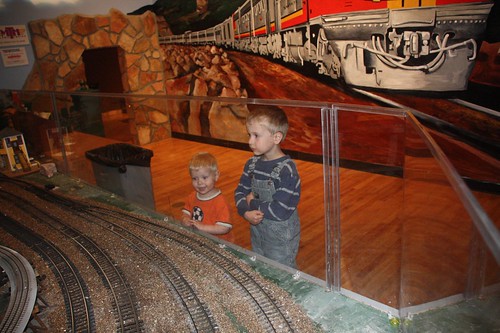
Terah and I recently decided that each of us could use a day off of not having to do work or supervise boys. Yesterday I had the day off work so that was mine. I took my Kindle, along with its Gutenberg copy of War and Peace, which yes, I m reading for fun. I slept in a bit, then got breakfast and sat down at Botanica, the Wichita Gardens with the Kindle for awhile. That was a nice way to spend the morning. Today was Terah s day off. Initially I thought of taking the boys to The Cosmosphere, one of the world s premier space museums, or to the Kansas Aviation Museum. But then I realized that the Midland Railway, a historic excursion line in Baldwin City, KS, was having their first train trip of the year. And it s the Easter special: you take the train a few miles out of town, get off, the kids do an Easter egg hunt, then also get to get their picture taken with the Easter bunny. Kid paradise, right? What could be better? So this is how my alarm came to be set for 5:15 on a Saturday morning. Oliver woke up early, but I had to get Jacob up. He was groggy, trying to cover his face and ears, and annoyed at me for trying to wake him up. Until I said, Jacob, it s time to get ready for the car trip to the train ride. Can you go get dressed for the day? Silence. Then about 5 seconds later, he jumped up, said, OK dad, I will do it, and he did. We drove our 2.5 hours. I had set out a non-dirty breakfast in the car for them the night before, so they munched while we drove. Then had to wait in a huge line for our tickets. An hour later we had them got the last 3 tickets for the first departure of the day, 10AM and ran to get on the train before it left. Jacob and Oliver both got very quiet. Sometimes Jacob especially does that when he s very excited about things. He doesn t always look it right then, but I knew I d be hearing about it later. He had his face almost pressed to the window the whole way. IMG_5685.JPG Oh, and yes, he dressed himself and I didn t check to make sure he had the correct shirt, or that it wasn t on inside-out, until it was too late. Oops. We rode in an ex-CP car built in 1936. One of the cars on the train was built in the 1890s quite some neat equipment. Anyhow, next came the hunt. There were two large lawns covered in eggs, separated by age group. Jacob and Oliver were in the younger group, but still only got a few eggs (there were lots of other parents, uhm, helping their kids by picking up eggs the kids were too slow to get and putting them in baskets ) But they were thrilled with the experience so that s what counts. They moved the locomotive to the other end of the train for the trip back using an adjacent track. Lots of the kids watched them couple it back on. Jacob and Oliver were particularly interested nothing could have distracted them from watching that train though they didn t particularly like the noise of the horn. IMG_5655.JPG On the way back, someone in an Easter bunny suit was on the train for pictures. I took the boys there. They usually refuse to sit on laps of Santa and such, so I didn t figure much success. They actually agreed to do it. And despite their expressions in this photo, Jacob later told me over and over how much fun it was to be with the Easter bunny. IMG_5671.JPG After we got back, we headed for the car. Jacob insisted on carrying his own Easter bag, and predictably wound up carrying it upside down for awhile. So his bag had some grass in it from picking the candy back up. Oliver discovered some rocks by a ditch and had fun throwing them in to make a splash, so we paused for that for awhile. By this point it was about noon. So at this point, what does a dad who has managed to keep two active boys in line for an hour, help them with an egg hunt and giant rabbit, and keep them from falling into the ditch they re throwing rocks into, do? Say that it s time to eat lunch and then head for home so we can be there in time for supper? Or go for MORE ADVENTURE? I said, Jacob, how would you like to eat lunch inside a big train station in Kansas City? Pause for a couple of seconds to think. YEAH! I have never had lunch in a train station before! Let s go! Shall we go NOW? So I gave them the leftover breakfast to eat during the hour drive on towards the beautiful Kansas City Union Station. It s one of the few grand American train stations that survives intact, and is just stunning. Jacob and Oliver both fell asleep on the way there. We parked, walked inside, and Jacob just froze. Dad WOW! That ceiling is SO HIGH! I can t even reach it! He then raised his hand as high as it would go and said, See dad, it is so high I can t touch it! (Most ceilings are, but this one is indeed much, much taller than most.) We ate lunch in the second level of a restaurant right in the Grand Hall, which Jacob really enjoyed. Here s Jacob, annoyed that I pulled out the camera again: IMG_5693.JPG Then we went exploring for an hour. Jacob talked about his adventure . We went up the elevators and checked out the balconies. Then we found the Model Railroad Experience. And oh my. The boys were visibly the most excited they had been all day. Oliver just froze at the spot he walked through the door, not caring to move and see the rest of the exhibit because he was so fascinated by what he already saw. There was a huge layout in the middle of the room, and smaller ones in adjacent rooms. We finally made our way there, and Oliver just ran round and round one of them, following a train, excitedly yelling There it is! There it is! There it is! Here s a photo from the big layout: IMG_5706.JPG Jacob cried when it was time to go, but I had promised them some dessert before we left, so after a bite of ice cream we were on our way. On the way home, every 15 minutes or so, Jacob would make a remark like this: Dad, the train ride was SO fun! or Dad, I really liked Kansas City Union Station! and so forth, naming every highlight of the day for him several times over: the Easter bunny, the egg hunt, train ride, and everything about Union Station. On the way home, we stopped at our favorite restaurant in Emporia: BobbyD s Merchant St. BBQ. This is always a hit for everyone in the family. A down-home place that has excellent food, is not far off our path, and never seems to have a wait. Yum.

23 April 2011

Dirk Eddelbuettel: Another nice Rcpp example

While preparing my slides for the Rcpp workshop this Thursday, I had wondered about more nice examples motivating Rcpp. So I posed a quick question on the rcpp-devel list. And I received a few friendly answers. My favourite, so far, was a suggestion by Lance Bachmeier who sent me a short script which used both R and C++ (via Rcpp) to simulate a first-order vector autoregressive process (and he ensured me that it worked well enough on his graduate students). It is indeed a great example as it involves (simple) matrix multiplication in an iterative fashion. Which makes it a great example not only for Rcpp but also for our RcppArmadillo package (which wraps Conrad Sanderson's wonderful Armadillo C++ templated library for linear algebra and more). And at the same time, we can also add another look at the new and shiny R compiler I also blogged about recently. So Lance and I iterated over this a little more over email, and I now added this as a new (and initial) example file in the RcppArmadillo SVN repo. (As an aside: The newest version 0.2.19 of RcppArmadillo has been sitting in incoming at CRAN since earlier in the week while the archive maintainer takes a well-deserved vacation. It should hit the public archive within a few days, and is otherwise available too from my site.) So let's walk through the example:
R> ## parameter and error terms used throughout
R> a <- matrix(c(0.5,0.1,0.1,0.5),nrow=2)
R> e <- matrix(rnorm(10000),ncol=2)
R> ## Let's start with the R version
R> rSim <- function(coeff, errors)  
+   simdata <- matrix(0, nrow(errors), ncol(errors))
+   for (row in 2:nrow(errors))  
+     simdata[row,] = coeff %*% simdata[(row-1),] + errors[row,]
+    
+   return(simdata)
+  
R> rData <- rSim(a, e)                     # generated by R
This starts with a simple enough loop. After skipping the first row, each iteration multiplies the previous row with the parameters and adds error terms. We can then turn to the R compiler:
R> ## Now let's load the R compiler (requires R 2.13 or later)
R> suppressMessages(require(compiler))
R> compRsim <- cmpfun(rSim)
R> compRData <- compRsim(a,e)              # generated by R 'compiled'
R> stopifnot(all.equal(rData, compRData))  # checking results
Nice and easy: We load the compiler package, create a compiled function and use it. We check the results and surely enough find them to be identical. With that, time to turn to C++ using Armadillo via RcppArmadillo:
R> ## Now load 'inline' to compile C++ code on the fly
R> suppressMessages(require(inline))
R> code <- '
+   arma::mat coeff = Rcpp::as<arma::mat>(a);
+   arma::mat errors = Rcpp::as<arma::mat>(e);
+   int m = errors.n_rows; int n = errors.n_cols;
+   arma::mat simdata(m,n);
+   simdata.row(0) = arma::zeros<arma::mat>(1,n);
+   for (int row=1; row<m; row++)  
+     simdata.row(row) = simdata.row(row-1)*trans(coeff)+errors.row(row);
+    
+   return Rcpp::wrap(simdata);
+ '
R> ## create the compiled function
R> rcppSim <- cxxfunction(signature(a="numeric",e="numeric"),
+                        code,plugin="RcppArmadillo")
R> rcppData <- rcppSim(a,e)                # generated by C++ code
R> stopifnot(all.equal(rData, rcppData))   # checking results
Here we load the inline package to compile, link and load C++ snippets. We define a short C++ function in the code variable, declare a signature taking a and e as before and ask cxxfunction() to deploy the plugin for RcppArmadillo so that it and Rcpp are found during build. With that, we have a compiled function to generate data, and we once again check the result. The C++ code is pretty straightforward as well. We can instatiate Armadillo matrices directly from the R objects we pass down; we then run a similar loop building the result row by row. Now, with all the build-up, here is the final timing comparison, using the rbenchmark package:
R> ## now load the rbenchmark package and compare all three
R> suppressMessages(library(rbenchmark))
R> res <- benchmark(rcppSim(a,e),
+                  rSim(a,e),
+                  compRsim(a,e),
+                  columns=c("test", "replications", "elapsed",
+                            "relative", "user.self", "sys.self"),
+                  order="relative")
R> print(res)
            test replications elapsed relative user.self sys.self
1  rcppSim(a, e)          100   0.038   1.0000      0.04        0
3 compRsim(a, e)          100   2.011  52.9211      2.01        0
2     rSim(a, e)          100   4.148 109.1579      4.14        0
So in a real-world example involving looping and some algebra (which is of course already done by BLAS and LAPACK libraries), the new R compiler improves by more than a factor of two, cutting time from 4.14 seconds down to about 2 seconds. Yet, this still leaves the C++ solution, clocking in at a mere 38 milliseconds, ahead by a factor of over fifty relative to the new R compiler And compared to just R itself, the simple solution involving Rcpp and RcppArmadillo is almost 110 times faster. As I mentioned, I quite like this example ;-).

Russell Coker: Links April 2011

Sebastian Thrun gave an interesting TED talk about the Google driverless car project and explains how his main aim is to avoid all the needless road deaths that are due to human error [1]. Finally a good use for the Google street-view type data! AnnMarie Thomas gave an interesting short TED talk about using play-dough to make circuits [2]. There are two recipies for play-dough, the one made with salt conducts well and the one made with sugar conducts poorly. That allows making wires with salty dough and insulators with the sugar dough. John Robb has published an interesting article about a Chinese fake revolutionary group that is triggering a backlash from Chinese security forces [3]. Even if this isn t accurate it seems like a good way to make people hate their local security forces and thus demand political change. Chris Rock made an interesting observation, we aren t making progress on racial issues, white people are getting less crazy [4]. Red Hill has an interesting article about 486 motherboards with fake cache chips that were sold in the 90 s [5]. One thing I disagree with is that they blame the customers for seeking low prices. When a white-box PC cost $2000 (which is $3000 in today s money) it made sense to try and get the cheapest option possible. Now that major department stores sell name-brand laptops for $400 it really makes sense to buy name-brand quality rather than white-box rubbish. IHollaBack.org is an interesting project to combat street harassment of women [6]. Psychology Today has an interesting article by Joe Navarro (former FBI counter-intelligence agent and author) about the serious implications of attempting to detect lies [7]. His main point is that most people over-estimate their ability to detect lies and because the legal system believes such claims from law enforcement officers many innocent people get found guilty and criminals get away free! Cory Doctorow wrote an informative article about the ways of persuading people to pay for content that can be obtained for free [8]. The main message seems to be that the big media companies are doing things the wrong way in everything that they do. The news satire site CBS Breaking News has an interesting about page explaining their mission [9]. They stopped their automated disaster generator after the Japanese Tsunami, while I can understand them wanting to keep some good taste and be sympathetic to the plight of the Japanese people it seems that they have forgotten that there is always a disaster somewhere. The typical bus plunge is just as bad as the Tsunami to the people on the bus and their relatives! Psychology Today has an interesting blog post by Satoshi Kanazawa explaining how criminals don t specialise, the psychological factors that make someone likely to commit one crime will make them likely to commit others, this makes it logical to collect DNA samples from all criminals [10]. Psychology Today has an interesting blog post by Dave Niose about a landmark US legal case in 1948 where Vashti McCollum had to escalate to the Supreme Court to allow her children to receive secular education [11]. We need something like this in Australia now as the religious extremists are going too far in indoctrinating children. Sam Richards gave a TED talk titled A Radical Experiment in Empathy which aims to teach Americans how to understand the way that people in the middle-east feel [12]. The comments suggest that his talk wasn t successful. Of course the fact that empathy doesn t have a clear definition in the English language doesn t help, and the fact that most people don t seem to interpret it in any way that corresponds to any dictionary and that most people seem unable to define what they mean by it makes things worse. At the moment I can t think of any examples of successfully teaching empathy to unwilling people. The people who want to learn will do so eventually, you can have some good success in helping them to learn faster. Kathryn Schulz gave an interesting TED talk about Being Wrong [13]. One interesting point that she makes concerns the way that people assume that people who disagree are ignorant, stupid, or evil instead of just having a different set of data or a different understanding of the same data. Of course it is possible for someone to be ignorant/stupid/evil AND have a different understanding. Marcin Jakubowski gave an inspiring TED talk about his project to develop free blueprints that allow anyone to create all machines needed to sustain civilisation with minimal cost [14]. His Open Source Ecology project has a blog and a wiki with blueprints and files for CAD/CAM [15]. Dave Meslin gave an insightful TED talk about apathy in the political process [16]. Among other things he compares council notices that supposedly request citizen input with adverts for running shoes which encourage people to buy them. One thing he didn t mention is the difference that technology can make, a short council advert with a QR code is probably a lot more useful than the current dense text-based adverts for today s audience.

22 April 2011

Steve McIntyre: Bias in the news

Apologies for yet more politics; normal-ish service will be resumed shortly, I hope. I've just put the following into the "BBC News website feedback" form, but I doubt it will have any impact. Quoting it here for the record... The BBC news website appears to be showing a systemic bias over the AV referendum. For the last few weeks, there has been regular coverage of the referendum and it seems that there has been the usual blind adherence to "balance" - every story about AV has included some of the (incorrect, unscientific, even hate-filled) propaganda from the "no to AV" campaign without critique or analysis. It's difficult to see any justification for this except deliberate editorial bias, but I don't imagine that there's much that can be done about that. However, right now on the BBC News front page at http://www.bbc.co.uk/news/ I can see that there is a link "Referendum views" that points to yet another opinion piece from a "No" campaigner (Frederick Forsyth). I only see a single view here, not the plural "views" suggested. I don't see any positive view for AV promoted from the front page at all, nor any link from this puff piece to the other articles that have been written in the recent past. Looking further, I can see that there *has*, in fact, been a positive piece on the News Front Page today (from Billy Bragg) but there are no visible links to it any more. Both articles were posted/updated at the same time this morning (22nd April, 08:34 BST) yet now only the negative one remains. Very shoddy, and not at all what I would expect from the BBC.

21 April 2011

Alastair McKinstry: How much wind energy can we use?

So how much wind energy can we realistically use? A paper (Earth System Dynamics, DOI: 10.5194/esd-2-1-2011) by Miller,Gans and Kleidon (MGK10) has generated a lot of controversy courtesy of a New Scientist review (See Climate Progress for a good rebuttal). They argue that the effective limit we can safely extract without (bad) climatic consequences is around 18--68 TW (we currently use 0.2 TW of wind power). This paper is a follow-on to Kleidons work on the thermodynamics of the climate, where he points out that the free energy is the important measure of what energy can be generated by renewables. The free energy of the atmosphere is on the scale of hundreds of TW, he argues, much less than the heat energy of ~10^5 TW that comes from the sun. He argues that not enough attention is paid to the free energy budget, and argues that from MEP theory that free energy flows through different geophysical processes are more important than people currently think: such energy and momentum flows then lead to faster depletion of gradients than people currently use in their models. Frequently we use "diffusive-like" approximations to stuff we can't explicitly handle,such as convection and eddies below the resolution of our computer models. That the free energy budget, and small-scale processes need more detailed study (such as the transfer of momentum and energy from wind to water), I agree. But paradoxically, MGK10's estimates based on diffusive processes are what gets it into trouble. The critiques (e.g. Jacobsen and Archer) seem to concentrate on the estimates for diffusive and other energy losses (eg. wake fields) and climatic consequences are very loose, and out by factors of 50-100. They also ignore the fact that using wind as a substitute for more destructive energy sources produces a net gain, climate-wise. Based on these numbers, the real limits on wind power are more limited by where we can realistically place turbines, and the use and availability of rare earth metals in turbine magnets (MW sized turbines use over a ton of neodynium each in magnets!) One of the focuses of research at ICHEC and Met Eireann is wind for wind power: this becomes increasingly important for Ireland as we have more energy production by wind. I've been recently involved in a European project Weather Intelligence for Renewable Energies on investigating weather and climate forecasting needs of wind energy. In our weather models, we are getting to finer and finer resolutions (down to 2-5 km operationally, but working on 1 km in research), but as yet do not take account of wind energy changes. Modelling the wake turbulence, etc. and other effects of turbines is a 'fluid dynamics' problem done by the wind turbine manufacturers, mostly, in order to lay out turbines in a farm efficiently; this is done on the timescale of metres and seconds, while on the other end of the spectrum work is done in climate research on the changes in potential winds to see if wind energy will change in a few decades. But little is done on 'weather' scales of kilometres, minutes and hours: it turns out there are wind patterns that we don't predict in our models (vortices, etc.; especially for offshore turbines) that affect wind energy production, but would be very useful for wind farm and electrical grid operators to know about. So we should think about adapting our weather models for these. Either way, it looks like more detailed work on the interactions between atmospheric dynamics and wind farms would be a good thing. Incidentally, whatever about the alarmist nature of the article, kudos to New Scientist for their linking to papers: they quoted the names of the journals (Earth System Dynamics,Philosophical Transactions of the Royal Society), but where the article was not yet published (or behind a paywall), linked to the Arxiv.org version. More could do this. Tags , , , , ,

17 April 2011

Russell Coker: More about the Xperia X10

I ve now had a Sony Ericsson Xperia X10 for almost two months (here is a link for my first review) [1]. This is a phone that people seem to really dislike because the battery life is poor and Sony doesn t allow replacing the kernel. I m happy with mine, happy enough that after buying one for my wife and trying it out I bought one for myself. I knew about it s problems in advance and wanted a relatively cheap phone with a large high resolution screen, and the Xperia X10 was the best match for my criteria.ChargingThere has been a recent trend towards using USB for charging devices. Sony provides a tiny wall-wart PSU which has a USB socket and a short (1m) USB cable that can be used to charge the phone from it s PSU or from a PC. The size is really convenient, as the phone has a short battery life I ll probably want to take the PSU to more places than I would for other phones I ve owned.The short USB cable saves weight and tangle when travelling, but can be inconvenient. I m currently working on the phone while it s plugged into my laptop, that works well and I can make calls while it s connected. If the phone was connected to a USB port on a tower computer that was on the ground then the cable could be too short to make a call, if it was charging on a power point near the floor then I wouldn t even be able to use the computer functionality let alone make calls without kneeling. My Viewty has a 175cm charging cable which alleviates these problems. I ve got a 50cm USB extension cable that I use for charging my phone while I m in bed that is just long enough to allow me to check my email without getting out of bed!The socket for connecting the USB cable is protected by a plastic lid that is connected by a strip of rubber. For a socket that will be used at least twice a day this isn t a good mechanical design. The plastic slide on the LG U990 Viewty seems like a much better design.As an aside it s a pity that they aren t designing cars with USB charging sockets built in. Some new cars have a socket for one USB flash drive to be attached to the radio, but really they need at least one USB charging port per seat. It would also be nice if they made power points with USB charging sockets built in, I d buy a few of those if they made them.Preserving the BatteryI ve been running Juice Defender to reduce the battery use, at the moment it is claiming to have extended battery life by 69%. That combined with turning off things that aren t needed (such as WiFi) has made the phone reasonably usable. I can survive more than 12 hours during which I use the phone a lot without charging it.XperiaX10.net has an interesting review of replacement batteries [5]. I m not going to buy them because the largest battery requires a replacement back case which prevents using an external case to prevent damage and the smaller one doesn t provide enough of a benefit and the design of the phone makes it difficult to change batteries so carrying a spare battery isn t a good option.Cursor Control KeysThe HP/Compaq iPaQs that I own from ~10 years ago have a single button that can be moved up/down/left/right to act as a cursor, it can also be pressed inwards to act as an ENTER key (or whatever the application might want for a fifth function). Having some sort of hardware cursor control is really handy, I often end up deleting several characters when I want to replace one because getting the cursor onto the desired character is too difficult.Adding more hardware keys would require making the phone bigger, but that would be fine by me. As described in my previous post about phone cameras I d like to have a phone that s thicker to have a better camera with a greater focal distance for a larger lens [2].Core Phone FunctionalityI really miss having separate green and red buttons for making/answering calls and for rejecting/ending calls.A really common operation is to call back the last person who called. To do this on my LG U990 Viewty I press the green button twice on my home screen which took less than a second. On the Xperia this involves selecting the phone icon from the home screen, then the call log icon, then the call that is desired, then the Call user line. That is four presses in different parts of the screen compared to pressing the same hardware button twice. I m investigating dialer applets right now, the Dialler One applet has a good interface for calling people who have called or been called recently but it still requires two presses on different parts of the screen. With my old Viewty I could call back the last person by feel without even looking at the phone!In the last 6 years the standard functionality of phones has been to include multiple profiles for noises. My Viewty has profiles named Normal , Silent , Vibrate only , Outdoor , Headset (automatically selected when a headset is connected), and three customised ones. The Xperia has only one setting, and that is three icon presses away from the home screen. It does allow changing the volume by hardware switches on the side which includes going to vibrate-only and silent mode. While this is useful, it s not the best way that two precious hardware keys could be used. It also doesn t allow control over all the different notifications, I d like to be able to activate a noise profile and have every application respond to it in an appropriate manner. This is a deficiency in Android 2.1 not in the phone itself.In many ways this phone has the worst phone functionality of any mobile phone I ve ever owned, I think that this is more the fault of the Android designers than Sony Ericsson.Android UpdatesSony had previously claimed that they wouldn t support Android later than 2.1. Now Sony has announced that they will support Gingerbread Android 2.3 [3]. So one of the major complaints about the Xperia will soon be addressed.TetheringThe build of Android that the Xperia runs at the moment doesn t support Wifi tethering. I m currently using with Easy Tether for USB tethering [4]. It s not free software and requires it s own code to run as root on your Linux system that is being tethered (which is easily locked down with SE Linux), but it basically works. The down-side with Easy Tether is that it proxies all the connections so you can t run traceroute etc and in the free version you can t use UDP.K9 MailK9 Mail fixes some of the problems in the default Android email program that I described in my previous post. It allows selection of SSL with a default port of 993 for IMAPs. It uses mail.example.com as the mail server address for an email address of user@example.com (so I ll add a mail CNAME to the domains I run). When I connected initially it told me that the SSL key was not signed by a CA and asked if I wanted to save it or reject it this is the correct and desired functionality. It also correctly parses URLs from the email (or at least has fixed the bug that I discovered in the default email app).One problem I ve found with K9 is that it seems to timeout on large folders. This is probably partly the fault of Virgin Mobile being slow for IP access, but I wonder whether K9 doesn t pipeline IMAP commands as Virgin can do bulk transfer at reasonable speeds (80KB/s) and it mainly fails on latency (900ms being typical). The result is that a folder with more than 500 messages that need to be copied to the phone will never get synchronised. When I started reading mail on my phone I had to move mail from some of the bigger folders into other folders to avoid timeouts. As an aside the amount of time I ve saved by reading email on the go has already paid for the phone.MediascapeThe Sony Mediascape software is used for categorising photos. One function of this is to assign names to photos, the names come from the contact list so if you photograph someone who you can t phone then you need to add a contact list entry for them. This also means that you couldn t conveniently add names to non-humans, I guess I could have added a contact list entry Mr Crash Dump for photos of system crash logs. But a bigger problem is that it decides what is a picture of a person, a picture of someone who is not centered in the photo or a profile picture can be regarded as not a photo of a person and therefore not subject to being associated with a contact list. Finally when selecting a name for a picture it displays the entire contacts list in a small font instead of displaying favorites, I have the phone numbers of many clients in my contacts list who I will never photograph Mediascape just isn t much good. If I feel the need to do something serious in this regard I ll search the app store for something free that s better.ProtectionFor $15 each I bought one grey and one clear Gel Case from J2K. This case covers the sides and back of the phone with a firm rubber layer that will hopefully allow it to bounce rather than break. It also extends slightly higher than the screen which should stop the screen being scratched if the phone is left face-down on a hard surface on the vibrate setting.One problem with the Gel Case is that by it s design it has to cover the buttons on the sides, due to a design or manufacturing problem the clear case that my wife uses can press slightly on the shutter button which disables the three main buttons on the front. So when the menu or back button stops working she has to slightly move the Gel Case out from the side. I m thinking of just cutting out a section of the Gel Case there, that will make it difficult to press the shutter button, but you can use the touch screen to take photos and there doesn t seem to be any other use for the shutter button so this shouldn t be a problem. The clear and grey cases have different designs, the grey one has a hole over the raised Sony logo which makes it fit a little better as well as not having the shutter problem, so it seems to be a later design I don t know whether all clear cases have the same problem but I recommend that someone who only has one Xperia X10 get the grey case just in case.Web BrowsingI m experimenting with using my own web proxy to compress the data sent to the phone. Unfortunately the Android settings for a web proxy only apply to the main web browser, not to all the other applications that use web services. Also the built-in web browser requires pressing the settings hardware button followed by at least two touch-screen presses to change between windows or close a window and it doesn t seem to support making the short-press action be to open a link in a new window. So I will have to find another web browser to use.Bandwidth UseThe 3G Watchdog applet is really good for tracking the data transfer and optionally cutting off 3G access before the quota is exceeded. Unfortunately Virgin has already sent me a bill with $234 in extra charges for bandwidth use because I used 1.6G instead of my 1.5G quota. A Virgin representative had told me over the phone that the billing period would be based on the end of the month, so while every calendar month has had less than 1.5G used because I used more than average in the end of March and the start of April that counts as excess data in the 14th March to 13th April period.I m going to appeal this to the Telecommunications Industry Ombudsman, I don t think that it s reasonable that I should be billed almost 7* the normal bill for exceeding the quota by 7.4% based on following the instructions of a Virgin employee. While I could have read the previous bill that they sent me to discover the end of billing period dates, I don t think that I should be expected to distrust everything that a Virgin employee says. If they billed me an extra $20 then I d just pay it, but $234 is unreasonable.ConclusionSince using the phone I ve found significant benefits in web browsing and reading email with the major limitation being the small screen (relative to a Netbook or Laptop). So if I was to buy another phone I would probably consider a Dell Streak which seems to be the largest Android phone on the market at the moment.Given the amount of use that I ve got I would be happy to spend more money and therefore consider a more expensive phone. But I don t regret the decision to save money by getting an Xperia X10.Finally when a telco tries to stick me with a $234 excess charge it really detracts from the value of having a phone contract. If I end up having to pay that then it s half the value of a smart-phone lost in one telco scam. This is enough to make a contract with Virgin a bad option, after this contract expires I may use VOIP and a pre-paid SIM from Telstra NextG if their network is still the best. Another possibility is to just use a small tablet and skip having a mobile phone, email and Jabber plus SMS from the people who lack net access will probably do.

12 April 2011

Dirk Eddelbuettel: The new R compiler package in R 2.13.0: Some first experiments

R 2.13.0 will be released tomorrow. It contains a new package by R Core member Luke Tierney: compiler. What a simple and straightforward name, and something that Luke has been working on for several years. The NEWS file says
    o Package compiler is now provided as a standard package.  See
      ?compiler::compile for information on how to use the compiler.
      This package implements a byte code compiler for R: by default
      the compiler is not used in this release.  See the 'R
      Installation and Administration Manual' for how to compile the
      base and recommended packages.
so the compiler is not yet used for R's own base and recommended packages. While working on my slides for the upcoming Rcpp workshop preceding R/Finance 2011, I thought of a nice test example to illustrate the compiler. Last summer and fall, Radford Neal had sent a very nice, long and detailed list of possible patches for R performance improvements to the development list. Some patches were integrated and some more discussion ensued. One strand was on the difference in parsing between normal parens and curly braces. In isolation, these seem too large, but (as I recall) this is due some things 'deep down' in the parser. However, some folks really harped on this topic. And it just doesn't die as a post from last week demonstrated once more. Last year, Christian Robert had whittled it down to a set of functions, and I made a somewhat sarcastic post argueing that I'd rather use Rcpp to get 80-fold speed increase than spend my time argueing over ten percent changes in code that could be made faster so easily. So let us now examine what the compiler package can do for us. The starting point is the same as last year: five variants of computing 1/(1+x) for a scalar x inside an explicit for loop. Real code would never do it this way as vectorisation comes to the rescue. But for (Christian's) argument's sake, it is useful to highlight differences in the parser. We once again use the nice rbenchmark package to run, time and summarise alternatives:
> ## cf http://dirk.eddelbuettel.com/blog/2010/09/07#straight_curly_or_compiled
> f <- function(n, x=1) for (i in 1:n) x=1/(1+x)
> g <- function(n, x=1) for (i in 1:n) x=(1/(1+x))
> h <- function(n, x=1) for (i in 1:n) x=(1+x)^(-1)
> j <- function(n, x=1) for (i in 1:n) x= 1/ 1+x 
> k <- function(n, x=1) for (i in 1:n) x=1/ 1+x 
> ## now load some tools
> library(rbenchmark)
> ## now run the benchmark
> N <- 1e6
> benchmark(f(N,1), g(N,1), h(N,1), j(N,1), k(N,1),
+           columns=c("test", "replications",
+           "elapsed", "relative"),
+           order="relative", replications=10)
     test replications elapsed relative
5 k(N, 1)           10   9.764  1.00000
1 f(N, 1)           10   9.998  1.02397
4 j(N, 1)           10  11.019  1.12853
2 g(N, 1)           10  11.822  1.21077
3 h(N, 1)           10  14.560  1.49119
This replicates Christian's result. We find that function k() is the fastest using curlies, and that explicit exponentiation in function h() is the slowest with a relative penalty of 49%, or an absolute difference of almost five seconds between the 9.7 for the winner and 14.6 for the worst variant. On the other hand, function f(), the normal way of writing things, does pretty well. So what happens when we throw the compiler into the mix? Let's first create compiled variants using the new cmpfun() function and then try again:
> ## R 2.13.0 brings this toy
> library(compiler)
> lf <- cmpfun(f)
> lg <- cmpfun(g)
> lh <- cmpfun(h)
> lj <- cmpfun(j)
> lk <- cmpfun(k)
> # now run the benchmark
> N <- 1e6
> benchmark(f(N,1), g(N,1), h(N,1), j(N,1), k(N,1),
+           lf(N,1), lg(N,1), lh(N,1), lj(N,1), lk(N,1),
+           columns=c("test", "replications",
+           "elapsed", "relative"),
+           order="relative", replications=10)
       test replications elapsed relative
9  lj(N, 1)           10   2.971  1.00000
10 lk(N, 1)           10   2.980  1.00303
6  lf(N, 1)           10   2.998  1.00909
7  lg(N, 1)           10   3.007  1.01212
8  lh(N, 1)           10   4.024  1.35443
1   f(N, 1)           10   9.479  3.19051
5   k(N, 1)           10   9.526  3.20633
4   j(N, 1)           10  10.775  3.62673
2   g(N, 1)           10  11.299  3.80310
3   h(N, 1)           10  14.049  4.72871
Now things have gotten interesting and substantially faster, for very little cost. Usage is straightforward: take your function and compile it, and reap more than a threefold speed gain. Not bad at all. Also of note, the difference between the different expressions essentially vanishes. The explicit exponentiation is still the loser, but there may be an additional explicit function call involved. So we do see the new compiler as a potentially very useful addition. I am sure more folks will jump on this and run more tests to find clearer corner cases. To finish, we have to of course once more go back to Rcpp for some <emph>real</emph> gains, and some comparison between compiled and byte code compiled code.
> ## now with Rcpp and C++
> library(inline)
> ## and define our version in C++
> src <- 'int n = as<int>(ns);
+         double x = as<double>(xs);
+         for (int i=0; i<n; i++) x=1/(1+x);
+         return wrap(x); '
> l <- cxxfunction(signature(ns="integer",
+                            xs="numeric"),
+                  body=src, plugin="Rcpp")
> ## now run the benchmark again
> benchmark(f(N,1), g(N,1), h(N,1), j(N,1), k(N,1),
+           l(N,1),
+           lf(N,1), lg(N,1), lh(N,1), lj(N,1), lk(N,1),
+           columns=c("test", "replications",
+           "elapsed", "relative"),
+           order="relative", replications=10)
       test replications elapsed relative
6   l(N, 1)           10   0.120   1.0000
11 lk(N, 1)           10   2.961  24.6750
7  lf(N, 1)           10   3.128  26.0667
8  lg(N, 1)           10   3.140  26.1667
10 lj(N, 1)           10   3.161  26.3417
9  lh(N, 1)           10   4.212  35.1000
5   k(N, 1)           10   9.500  79.1667
1   f(N, 1)           10   9.621  80.1750
4   j(N, 1)           10  10.868  90.5667
2   g(N, 1)           10  11.409  95.0750
3   h(N, 1)           10  14.077 117.3083
Rcpp still shoots the lights out by a factor of 80 (or even almost 120 to the worst manual implementation) relative to interpreted code. Relative to the compiled byte code, the speed difference is about 25-fold. Now, these are of course entirely unrealistic code examples that are in no way, shape or form representative of real R work. Effective speed gains will be smaller for both the (pretty exciting new) compiler package and also for our C++ integration package Rcpp. Before I close, two more public service announcements. First, if you use Ubuntu see this post by Michael on r-sig-debian announcing his implementation of a suggestion of mine: we now have R alpha/beta/rc builds via his Launchpad PPA. Last Friday, I had the current R-rc snapshot of R 2.13.0 on my Ubuntu box only about six hours after I (as Debian maintainer for R) uploaded the underlying new R-rc package build to Debian unstable. This will be nice for testing of upcoming releases. Second, as I mentioned, the Rcpp workshop on April 28 preceding R/Finance 2011 on April 29 and 30 still has a few slots available, as has the conference itself.

Next.

Previous.