Search Results: "edd"

24 March 2016

Bits from Debian: DebConf16: Call for Proposals

The DebConf Content team is pleased to announce the Call for Proposals for the DebConf16 conference, to be held in Cape Town, South Africa from 2 through 9 July 2016. Submitting an Event In order to submit an event, go to "Submit a talk" on your profile page in the DebConf16 website and describe your proposal. Please note, events are not limited to traditional presentations or informal sessions (BoFs). We welcome submissions of tutorials, performances, art installations, debates, or any other format of event that you think would be beneficial to the Debian community. Please include a short title, suitable for a compact schedule, and an engaging description of the event. You should use the field "Notes" to provide us information such as additional speakers, scheduling restrictions, or any special requirements we should consider for your event. Regular sessions may either be 20 or 45 minutes long (including time for questions), other kinds of sessions (like workshops) could have different durations. Please choose the most suitable duration for your event and explain any special requests. Timeline The first batch of accepted proposals will be announced in April. If you depend on having your proposal accepted in order to attend the conference, please submit it as soon as possible so that it can be considered during this first evaluation period. All proposals must be submitted before Sunday 1 May 2016 to be evaluated for the official schedule. Topics and Tracks Though we invite proposals on any Debian or FLOSS related subject, we have some broad topics on which we encourage people to submit proposals, including: Video Coverage Providing video of sessions amplifies DebConf achievements and is one of the conference goals. Unless speakers opt-out, official events will be streamed live over the Internet to promote remote participation. Recordings will be published later under the DebConf license, as well as presentation slides and papers whenever available. Contact and Thanks to Sponsors DebConf would not be possible without the generous support of all our sponsors, especially our platinum sponsor HPE. DebConf16 is still accepting sponsors; if you are interested, please get in touch! You are welcome to contact the Content Team with any concerns about your event, or with any ideas or questions about DebConf events in general. You can reach us at content@debconf.org. Registration Reminder Registration for DebConf is open. Please log into the DebConf16 website and register from your profile page. To request bursaries (sponsorship) for food, accommodation, or travel, you must be registered by Sunday, 10 April 2016. After this date, registrations will still be accepted in any of the basic, professional, and corporate categories. However, accommodation on the campus will no longer be guaranteed, and requests for sponsorship will no longer be accepted. Even if you are not certain you will be able to attend, we recommend registering now. You can always cancel your registration, before the deadline. We do suggest that attendees begin making travel arrangements as soon as possible, of course. We hope to see you all in Cape Town!

21 March 2016

Lunar: Reproducible builds: week 47 in Stretch cycle

What happened in the reproducible builds effort between March 13th and March 19th 2016:

Toolchain fixes
  • Petter Reinholdtsen uploaded naturaldocs/1.51-1.1 which makes the output reproducible. Original patch by Chris Lamb.
  • Damyan Ivanov uploaded libpdf-api2-perl/2.025-2 which will make internal font ID reproducible.
  • Christian Hofstaedtler uploaded ruby2.3/2.3.0-5 which sets gzip embedded mtime field to fixed value for rdoc-generated compressed javascript data.

Packages fixed The following packages have become reproducible due to changes in their build dependencies: diction, doublecmd, ruby-hiredis, vdr-plugin-epgsearch. The following packages became reproducible after getting fixed: Some uploads fixed some reproducibility issues, but not all of them: Patches submitted which have not made their way to the archive yet:
  • #818128 on nethack by Reiner Herrmann: implement support for SOURCE_DATE_EPOCH, set LC_ALL to C, and ensure deterministic build order when running parallel builds.
  • #818111 on debian-keyring by Satyam Zode: fix the order of files in md5sums.
  • #818067 on ncurses by Niels Thykier: strip trailing whitespaces introduced when using dash as system shell.
  • #818230 on aircrack-ng by Reiner Herrmann: build assembly code as a separate .o file.
  • #818419 on mutt by Daniel Shahaf: use C locale when listing files to be put in README.Patches.
  • #818430 on ruby-coveralls by Dhole: ensure UTC is used as the timezone when generating the documentation.
  • #818686 on littlewizard by Reiner Herrmann: use the C locale in the script for iterating over the files.
  • #818704 on strigi by Reiner Herrmann: sort keys when traversing hashes in makecode.pl.

Package reviews 44 reviews have been removed, 40 added and 5 updated in the previous week. Chris Lamb has reported 16 FTBFS.

17 March 2016

Dirk Eddelbuettel: RcppArmadillo 0.6.600.4.0

armadillo image Conrad announced a new Armadillo release 6.600.4 yesterday. This followed some work we had done for thorough pre-release checking with reverse dependencies tests for the over 200 CRAN packages using it and resulted in one more squashed bug. This releasehas been folded into RcppArmadillo 0.6.600.4.0 which arrived on CRAN and Debian earlier today. Armadillo is a powerful and expressive C++ template library for linear algebra aiming towards a good balance between speed and ease of use with a syntax deliberately close to a Matlab. Changes in this release are as follows:
Changes in RcppArmadillo version 0.6.600.4.0 (2016-03-15)
  • Upgraded to Armadillo 6.600.4 (Catabolic Amalgamator)
    • expanded sum(), mean(), min(), max() to handle cubes
    • expanded Cube class to handle arbitrarily sized empty cubes (eg. 0x5x2)
    • added shift() for circular shifts of elements
    • added sqrtmat() for finding the square root of a matrix
    • fix for gmm_diag when using Mahalanobis distance
  • The configure script now reflects the full LAPACK fallback offered by R 3.3.0 or later (PR #81)
Courtesy of CRANberries, there is also a diffstat report for this release. As always, more detailed information is on the RcppArmadillo page. Questions, comments etc should go to the rcpp-devel mailing list off the R-Forge page.

This post by Dirk Eddelbuettel originated on his Thinking inside the box blog. Please report excessive re-aggregation in third-party for-profit settings.

16 March 2016

Dirk Eddelbuettel: Rblpapi 0.3.3

A new release of Rblpapi is now on CRAN. It provides a direct interface between R and the Bloomberg Terminal via the C++ API provided by Bloomberg Labs (but note that a valid Bloomberg license and installation is required). This marks the fourth release since the package first appeared on CRAN last year. Thanks to multiple contributors, it packs a number of changes (including two new functions bsrch() and fieldInfo()), numerous internal as well as build improvements, additional documentation and last but not least use of unit testing (provided a Bloomberg connection is available, ie not at CRAN or on Travis CI). See the NEWS.Rd extract for more details:
Changes in Rblpapi version 0.3.3 (2016-03-14)
  • configure adds a missing method="libcurl" options (PR #109 by Martin Bel).
  • New function bsrch() adds basic search functionality (PR #111 by Morgan Williams fixing ticket #82).
  • The licensing status of the Rblpapi source package was clarified (PR #119).
  • The bds() help page now shows an example using an overrides argument (PR #121).
  • A new function fieldInfo was added, and field information is used in bdh and bdp (PRs #122, #123, #125, and #127).
  • The bdp function now checks the order (PR #126).
  • Unit testing was added (PRs #129 and #131).
  • Data retrieval is now smarter about the types returned from Bloomberg (PR #132 and #133; and #141 and #142).
  • The bdh and bds functions now support an option verbose (PRs #138).
Courtesy of CRANberries, there is also a diffstat report for the this release. As always, more detailed information is on the Rblpapi page. Questions, comments etc should go to the issue tickets system at the GitHub repo.

This post by Dirk Eddelbuettel originated on his Thinking inside the box blog. Please report excessive re-aggregation in third-party for-profit settings.

15 March 2016

Michal Čihař: Weekly phpMyAdmin contributions 2016-W10

Last week was quite equally split between refactoring and bug fixing. As we're getting closer to 4.6.0 release more people give feedback on it and some corner case issues are being discovered. However the biggest challenge was strange bug that was reported long time ago - it affected only Italian translation on Windows server. After lot of debugging, I've realized that trying to encode Cardinalit </td> to json (using json_encode) causes this problem. Obviously there have to be more conditions met as this string only doesn't cause it, however removing it or placing x between and < fixes the problem. In the end I've workarounded it in our code and hopefully I will get to create proper bugreport for php so that it can be fixed upstream as well. The refactoring was mostly focused on encoding conversion part which is now all embedded in the Encoding class. It was quite simplified and should also speed up pages a bit as it does the initialization only when needed not on every phpMyAdmin's page. Handled issues:

Filed under: English phpMyAdmin 0 comments

Dirk Eddelbuettel: x13binary 0.1.2

A new version of x13binary is now on CRAN. It updates the underlying X-13ARIMA-SEATS binary to build 1.1.26 which was released recently by the US Census Bureau. Our x13binary package takes the pain out of installing this, and provides it to the seasonal package upon which other packages such as gunsales or ggseas build their functionality. Things just work: Depend on x13binary and on all relevant OSs supported by R, you should have an X-13ARIMA-SEATS binary installed which will be called seamlessly by the higher-level packages. See this announcement blog post describing the initial 0.1.0 release; we had since followed up with a 0.1.1 release tightening up behaviour on two edge case OSs. Courtesy of CRANberries, there is also a diffstat report for the most recent release as well as the preceding bugfix release.

This post by Dirk Eddelbuettel originated on his Thinking inside the box blog. Please report excessive re-aggregation in third-party for-profit settings.

11 March 2016

Matthew Garrett: I stayed in a hotel with Android lightswitches and it was just as bad as you'd imagine

I'm in London for Kubecon right now, and the hotel I'm staying at has decided that light switches are unfashionable and replaced them with a series of Android tablets.
A tablet displaying the text UK_bathroom isn't responding. Do you want to close it?
One was embedded in the wall, but the two next to the bed had convenient looking ethernet cables plugged into the wall. So.

I managed to borrow a couple of USB ethernet adapters, set up a transparent bridge (brctl addbr br0; brctl addif br0 enp0s20f0u1; brctl addif br0 enp0s20f0u2; ifconfig br0 up) and then stuck my laptop between the tablet and the wall. tcpdump -i br0 showed traffic, and wireshark revealed that it was Modbus over TCP. Modbus is a pretty trivial protocol, and notably has no authentication whatsoever. tcpdump showed that traffic was being sent to 172.16.207.14, and pymodbus let me start controlling my lights, turning the TV on and off and even making my curtains open and close. What fun!

And then I noticed something. My room number is 714. The IP address I was communicating with was 172.16.207.14. They wouldn't, would they?

I mean yes obviously they would.

It's basically as bad as it could be - once I'd figured out the gateway, I could access the control systems on every floor and query other rooms to figure out whether the lights were on or not, which strongly implies that I could control them as well. Jesus Molina talked about doing this kind of thing a couple of years ago, so it's not some kind of one-off - instead, hotels are happily deploying systems with no meaningful security, and the outcome of sending a constant stream of "Set room lights to full" and "Open curtain" commands at 3AM seems fairly predictable.

We're doomed.

(edited: this previously claimed I could only access systems on my own floor, but it turns out that each floor is a separate broadcast domain and I just needed to set a gateway to access the others)

(further edit: I'm deliberately not naming the hotel. They were receptive to my feedback and promised to do something about the issue.)

comment count unavailable comments

Dirk Eddelbuettel: Rcpp now used by 600 CRAN packages

600 Rcpp packages Earlier this morning, Rcpp reached another milestone: 600 packages on CRAN now depend on it (as measured by Depends, Imports and LinkingTo declarations). The graph is on the left depicts the growth of Rcpp usage over time. Rcpp cleared 300 packages in November 2014. It passed 400 packages in June of last year (when I only tweeted about it) and then 500 packages in late October. The chart now extends to the very beginning as I manually compiled some more data from the CRANberries checked with crandb. Then next part uses manually saved entries, and the final and largest part of the data set was generated semi-automatically via a short script appending updates to a small file-based backend. A list of user package is kept on this page. Also displayed in the graph is the relative proportion of CRAN packages using Rcpp. The four per-cent hurdle was cleared just before useR! 2014 where I showed a similar graph (as two distinct graphs) in my invited talk. We passed five percent in December of 2014, six percent last July, seven percent just before Christmas and now stands at 7.31 percent, or a little less than one in thirteen R packages. 600 user packages is truly humbling, a staggering number and a big responsibility. We continue to try our best try to keep Rcpp as performant and reliable as it has been so that the next set of packages can rely on it---just like these 600 do. So with that a very big Thank You! to all users and contributors of Rcpp for help, suggestions, bug reports, documentation or, of course, code.

This post by Dirk Eddelbuettel originated on his Thinking inside the box blog. Please report excessive re-aggregation in third-party for-profit settings.

10 March 2016

Antoine Beaupr : Trying out Keybase

I was privileged enough to get access to the alpha preview of Keybase.io. Last year, the project raised 11M$ in venture capital and they seem to be attacking the hard problems, so it is a serious project, worth considering for any cryptography hacker like me. This was obviously discussed elsewhere previously but since Keybase has evolved a bit since then, I figured it would be worth adding my grain of salt.

The elite alpha problem My first problem with Keybase was of course that I wasn't in the elite club of invited people. Somehow, I finally got in but the problem remains for the everyone else. In my case, it was the Keybase filesystem announcement that brought my attention back to the project, although I have yet to test that itself - yet another invite-only problem (need to email chris@keybase.io to get access, I guess). Still, 10GB of storage might be interesting for some people, but considering the number of hurdles or "friction", as they say, that needs to be jumped over to get access, I am not sure how much traction this will get for now. The project has been in alpha for a while now (more than a year) with no announced public beta just yet, which is way slower than similarly challenging projects with less capital. Let's encrypt, as a comparison, was publicly announced in 2014 and by the end of 2015, the public beta was opened.

Private key leakage My second major concern is that Keybase does worrisome things to private key material. If you tell it to import your regular GPG keys, it will copy them into the keybase keyring, which is already a problem: now you have two places where you store sensitive secrets. But worse, Keybase offers you to upload your private key material on the server, without clearly and explicitely exposing the potential risks that means to the user. The key, presumably, is encrypted (at least that is what I can parse from the Keybase privacy policy). Yet this is still a concern: a determined attacker (e.g. the government or another malicious entity) could force Keybase to give up the encrypted private key material and install sniffers that would reveal the passphrase that would allow decryption and impersonation of the related identity. That is a huge deal. This is what caused Hushmail's demise in 2007: they had similar promises about how they had a "secure" email (in this case) service based on OpenPGP, but since they key was stored on the server, they only had to serve a malicious applet to victims and were able to give cleartext data to the US government (12 CDs!) under a Mutual Legal Assistance Treaty with Canada. In Keybase, When I generate a new key, it asks me if I want to upload the key to their servers, and "Yes" is chosen as a default, so it is clearly a policy that is encouraged. This is presumably to enable browser-based crypto, yet this could be done by storing keys within the browser, not on the server. The mere possibility that the client can meddle with secret key material in such a way is a problem. Even if uploading secret keys to the server is optional, the fact that it is a possibility widens the attack surface on the client significantly. GPG has been working on isolating private key operations to a different process (gpg-agent) or smart cards, SSH has privilege seperation. The idea of uploading secret key material online is so beyond current practices that it should bring the project to a full stop already. My private key material is pretty sensitive. I am a Debian developer: if someone gets access to that key, they can upload arbitrary code for thousands of packages, affecting thousands if not millions of users. That is a huge deal, and I am not ready to give that power to an arbitrary third party that I know little about.

Privacy policy issues Furthermore, the Keybase privacy policy explicitely states that "Logs of this information may persist for an indefinite period", which include, and I quote:
  • Your computer s IP address
  • Your preferences and settings (time zone, language, privacy preferences, application preferences, etc.)
  • The URL of the site that referred you to the Service
  • The buttons and controls you clicked on (if any) within the Service
  • How long you used the Service and which parts and features you used
  • Session times and lengths
For a company working to improve user's privacy, this is a pretty bad policy. It exposes Keybase users to undue surveillance, on a lot of private information that is not necessary to operate the service. I haven't actually read the remaining of the policy, as I was already scared as hell and figure I would just log off for now and try not to add any extra personal information in that already growing pile. Let's mention, while I'm here, that the keybase commandline client has this odd way of working that it forks a daemon in the background all the time, even to run just keybase status. One has to wonder if this thing is included in the surveillance data above, which would make the keybase client an amazing surveillance device in itself. To stop all this, you need:
keybase logout
keybase ctl stop
Not quite obvious...

Usability issues Which brings me to a series of usability issues I have found while working with Keybase. Having worked on usability myself in the Monkeysphere project, I understand how hard those problems can be. But right now, the fact is that keybase is only a commandline client, with some web-based sugar sprinkled on top. I recognize the huge efforts that have been done to make the user experience (UX) as easy as possible through the commandline, but this is definitely not "grand public" material yet. Even as a OpenPGP hacker, Keybase can get confusing. Since it has its own separate keyring from GPG, things that used to be obvious before are suddenly new things to learn. For example, I originally generated a key for anarcat@debian.org in keybase, thinking it would be a separate thing from my current GPG identity. Well, that ended up creating a new key in my GPG keyring, duplicating my existing identity, with no way for me to tell this was a Keybase copy. This could have ended up on the keyservers and confuse anyone looking for my PGP key.

Revoking keys So I revoked that key, which, in itself, is not such an obvious process either. I first had to "drop" the key:
keybase pgp drop '010143572d4e438f457a7447c9758804cc7be44c1ee2b7915c3904567d0a3fb5cf590a'
To find that magic number, I had to go on the website and click through the PGP key to end up on the revoke link which told me which magic string to put. The web UI was telling me I could use keybase status to get that information, but I couldn't find that in the output here:
$ keybase status
Username:      anarcat
Logged in:     no
Device:
    name:      angela
    ID:        070f6a13f2a66afbb463f49dadfd4518
    status:    active
Keybase keys:  unlocked
Session:       anarcat [salt only]
KBFS:
    status:    not running
    version:
    log:       /home/anarcat/.cache/keybase/keybase.kbfs.log
Service:
    status:    running
    version:   1.0.14-1
    log:       /home/anarcat/.cache/keybase/keybase.service.log
Platform Information:
    OS:        linux
    Runtime:   go1.5.3
    Arch:      amd64
Client:
    version:   1.0.14-1
Desktop app:
    status:    not running
    version:
    log:       /home/anarcat/.cache/keybase/Keybase.app.log
Config path:   /home/anarcat/.config/keybase/config.json
Default user:  anarcat
Other users:
command-line client:
    keybase status [pid: 14562, version: 1.0.14-1]
So keybase drop "deletes" the key from the keybase client (and presumably the server). One problem here is that we have three different verbs to mean the same thing: in some places, the website says "deleted" (in the web graph), the commandline client uses "drop" and everyone else using PGP in the world uses "revoke". So what is it? Also note that just dropping that key is not enough to eradicate that key: you still need to generate and import a revocation certificate on GPG's side as well, for that key. This makes sense, because you may have imported that key and you may not want to destroy it when you remove it from keybase, but there could be a little better guessing and UX here as well.

Password usage Then another problem is that, when you signup on the commandline, it asks you to choose a passphrase. It's not clear at all from the UI what that passphrase is for. Is it to protect the private key material? To login the website? Both? It turns out it is actually to login to the website and the Keybase API. It could also be the key to the private key material, but I haven't quite figured that out yet. Similarly, the "paper devices" are a little confusing to me as well. The registration process is fairly insistent that I need to write a series of secret words down on a piece of paper and put it my wallet. This is based on the idea that you can use that key to recover your account and setup new devices. However, it is not made clear at all how those credentials should be protected or used. What if I lose my wallet? What do I do then? Is it okay if i write it on the back of my laptop instead? I know it sounds like stupid questions to crypto geek, but it's definitely stuff people will do, and education, at all levels, is necessary here.

The existing web of trust Finally, I found it surprisingly counter-intuitive to sign keys with keybase. I was assuming the whole point of the thing was to expand the web of trust, but it seems their mission lies somewhere else: there is no facility to sign keys directly in keybase. You sign statements on various social sites (Github, Twitter, Reddit...) but doing traditional key exchanges seems to be off limits. My obvious use case was to sign my existing key material with my newly generated anarcat@keybase.io key, so that keybase would become another way of verifying my identity. Well, this is not possible with keybase directly - you still have to go through the regular:
gpg --sign-key DEADBEEF
Which is really unfortunate, because some craaaazy people like me insist on doing in person, actually secure key exchanges sometimes, and the tools to do this right now (mainly gpg, caff and monkeysign) really need a lot of love and help. Keybase could have helped a lot in pushing those initiatives forward and bring new ways of doing secure key exchanges, instead of only lowering the standards on cryptographic identity.

Usual proprietary startup rant I can't help but finish by noticing that the whole basic problem with Keybase is more fundamental than a few usability issues, which can all be fixed fairly easily. Keybase.IO is a web-based service that is entirely proprietary. The client is freely downloadable and free software - but the server side is not. This makes us rely on a central point of failure and the goodwill of those operators to not only keep the service running (for free?) indefinitely, but to protect us against all attackers, state-run or otherwise. This is definitely against basic free software principles and the open architecture of the internet federation, well embodied in the Franklin street statement. Online services should be decentralized and open like the OpenPGP keyservers have always been, period.

Conclusion I am curious to see where Keybase brings us, as a community. So far, I am concerned about centralization and devaluation of the web of trust as cryptographic system. I do not believe that trusting multiple corporate social networking sites bring much benefit to our security, although it does improve usability significantly and is certainly better than TOFU, so that part of the project is definitely interesting, especially since it allows leveraging classical internet protocols like DNS and HTTPS. Key exchange is a critical problem that still hasn't properly been resolved in the cryptographic community. Most efforts at building communication tools (say like Signal or Telegram) mostly ignore the problem and expect people to read up strings of numbers or rely on synchronous communications (see the Axolotl rachet for Signal's take on it). Keybase's attempts at fixing this are great, but needs much more work to actually resolve the PKI issues in a significant way. More fundamentally, the practice of storing keys on the servers should just stop: it is a definite no go for me, and a classic crypto mistake that has bitten way too many people. In my mind, it discredits the whole project. The point of OpenPGP is end to end encryption across devices: storing the keys on a server breaks that apart, and doesn't improve much on the existing HTTPS security systems already in place on the web. It is especially a problem given the new waves of attacks on cryptography from western governments, from the UK to California... Until those issues are resolved, I can't get myself to recommend Keybase to anyone just yet.

Post-scriptum Note to Keybase developers: I have considered filing issues regarding the above, but unfortunately, I was unable to filter through the gigantic github issues list for duplicates, and didn't have time to file detailed reports for everything. I apologize for bypassing those usual conventions. If you want to try out Keybase to make your own opinion, I do have 4 invites I can give away, but I will do so only if you need to test specific issues. Otherwise, I note that there is a Request For Package for the Debian package to become official, that Debian developers (or Keybase developers!) may be interested in completing.

8 March 2016

Dirk Eddelbuettel: gtrendsR 1.3.3

A very nice new update to the gtrendsR package by Philippe and myself is now avilable via CRAN. I had only blogged about the initial 1.3.0 release, and we have added a whole slew of new features and fixes. Philippe rewrote a lot of the parsing to make it more robust to different encodings, and to add other features. So in no particular order, we can now sub-group by regions more finely, withstand various misfeatures in returned data sets, generally do better on connections, and more --- and also allow for intra-day, daily and weekly queries! That last part is pretty fun. Here is the code I ran last Saturday to look at the query for Donald Drumpf, a name brought to us via a beautiful John Oliver episode worth watching which ran about nine days ago. So last Saturday, when we were still within the seven day window, I ran
library(gtrendsR)
dp <- gtrends("Donald Drumpf", res="7d")
plot(dp) + ggplot2::ggtitle("The Drumpf") + ggplot2::theme(legend.position="none")
which resulted in the following chart Donald Drump query which highlights another nice feature: the ggplot2 object created by the plotting function is returned, so we can locally modify and tune it. Here we set a title and suppress the default legend. As I had not blogged about the interim bug-fix releases 1.3.1 and 1.3.2, here is the set of NEWS entries for the last three releases:

gtrendsR 1.3.3
  • A ggplot2 object can now be returned for further customization. plot(gtrends("NHL")) + ggtitle("NHL trend") + theme(legend.position="none")
  • Support for hourly and daily data (#67). For example, it is now possible to have hourly data for the last seven days with gtrends("nhl", geo = "CA", res = "7d"). Use ?gtrends for more information about the time resolution supported by the package.
  • Support for categorties (#46). Ex.: gtrends("NHL", geo = "US", cat = "0-20") will search only in the sport category.
  • Some countries (ex: Hong Kong) were missing from the list (#69).
  • Various typos and documentation work.

gtrendsR 1.3.2
  • Added support for sub-countries (#25). Ex.: gtrends("NHL", geo = "CA-QC") will return trends data for Qu bec province in Canada. The list of supported sub-countries can be obtained via data(countries).
  • Data parsing should work for any data returned by Google Trends (i.e. countries independent).
  • Better support for queries using keywords in different languages (#50, #57). Ex.: gtrends(" ", geo = "TW")
  • Now able to specify up to five countries (#53) via gtrends("NHL", geo = c("CA", "US"))
  • Fixing issue #51 allowing UK-based queries via geo = "GB"

gtrendsR 1.3.1
  • Fixing issue #34 where connection verification was not done properly.
  • Now able to use more latin character in query. For example: gtrends("montr al").
  • Can now deal with data returned other than in English language.

Courtesy of CRANberries, there is also a diffstat report for the this release. As always, more detailed information is on the gtrendsR repo where questions, comments etc should go via the issue tickets system.

This post by Dirk Eddelbuettel originated on his Thinking inside the box blog. Please report excessive re-aggregation in third-party for-profit settings.

Edited 2016-03-08: Corrected code snipped and one grammar instance

7 March 2016

Dirk Eddelbuettel: Rblpapi 'Release Candidate' 0.3.2.5

We have a made numerous changes to Rblpapi since the previous release 0.3.2 in early December. You can see the commits, or look at the ChangeLog or NEWS.Rd to get an indea of the changes. We have new functions, improved internals, bug fixes and more. In order to facilitate more widespread testing, I have just placed source and (Windows) binaries in the ghrr drat repo from which you can install the new version simply via
drat:::add("ghrr")          # if you have drat installed
install.packages("Rblpapi") # uses the drat version b/c higher version number than release
Alternatively you can also do
drat:::add("ghrr")          # if you have drat installed
update.packages()           # refresh all packages against all repos
We would appreciate wider testing, and feedback / bug reports / ... via the issue tracker. PRs with unit test suggestions would also be most welcome -- we now use RUnit and run the tests if a file ~/.R/rblpapiOptions.R exists which sets the options() values for automatic connection (see help(blpConnect)) as well as the blpUnitTests=TRUE option. This is needed to 'opt-in' as standard test setups at [Travis])(https://travis-ci.org/) or CRAN will not have access to a Bloomberg terminal.

This post by Dirk Eddelbuettel originated on his Thinking inside the box blog. Please report excessive re-aggregation in third-party for-profit settings.

5 March 2016

Dirk Eddelbuettel: gunsales 0.1.1

A minor update to our recently released gunsales package is now on the CRAN network. The changes are completely internal and deal with automagic discovery of the X-13ARIMA-SEATS program via our associated x13binary package. More precisely, we let Solaris and the Windows old-release builds fail more gracefully. Others, ie current Windows builds, OS X and Linux, are entirely unaffected in their functionality. For simplicity, all examples now have an \dontrun wrapper, and the vignette makes its code conditional on the platform it is running on. Courtesy of CRANberries, there is also a diffstat report for the most recent release.

This post by Dirk Eddelbuettel originated on his Thinking inside the box blog. Please report excessive re-aggregation in third-party for-profit settings.

Mart n Ferrari: Serendipity

So I was reading G+, and saw there a post by Bernd Zeimetz about some "marble machine". Which turns out to be a very cool device that is programmed to play a single tune, and it is just mesmerising to watch: So, naturally, I click through to see if there is more music made with this machine. It turns out the machine has been on the making for a while, and the first complete song (the one embedded above) was released only a few days ago. It is obviously porn for nerds, and Wired had already posted an article about it. So instead I found a band called like the machine: Wintergatan, which sounds pretty great. It took me a while to realise the guy who built the machine is one of the members of the band. They even have a page collecting all the videos about the machine. After a while, and noticing the suggestions from Youtube, I realise that two of the members of Wintergatan were previously in Detektivbyr n, which is another band I love, and about which I wrote a post on this very blog, 7.5 years ago!1. So the sad news is that Detektivbyran disbanded, the good news is that this guy keeps making great music, now with insane machines. I only discovered Detektivbyran in the first place thanks to an article the -now sadly defunct- Coilhouse Magazine. I find this 8-year long loop that closes unexpectedly during a late-night idle browsing session pretty amusing.

  1. I keep telling my friends that I was a hipster before it was cool to do so...
Comment

2 March 2016

Dirk Eddelbuettel: RcppEigen 0.3.2.8.1

A good week after the update to Eigen 3.2.8 in our RcppEigen package 0.3.2.8.0, we have another (local) update with RcppEigen 0.3.2.8.1 which should fix another UBSAN issue. This new version in now on CRAN and in Debian. Big thanks once again to Yixuan Qiu for liasing with Eigen upstream, reporting the bug and preparing a PR with the fix. The NEWS file entry follows.
Changes in RcppEigen version 0.3.2.8.1 (2016-02-29)
  • Applied another upstream UBSAN fix (PR #30 by Yixuan)
Courtesy of CRANberries, there is also a diffstat report for the most recent release.

This post by Dirk Eddelbuettel originated on his Thinking inside the box blog. Please report excessive re-aggregation in third-party for-profit settings.

1 March 2016

Michal &#268;iha&#345;: Weekly phpMyAdmin contributions 2016-W08

As you could see tonight, last week was again full of security work. Mostly again XSS issues, but nothing really easily exploitable. On the refactoring side, the most time was spent on bringing php-gettext to better shape. In the it ended up as being separate library which can be used by others as well - motranslator. Another major task was to identify some easier tasks for prospective GSoC students and help them with implementing the changes. This worked quite well, but we will most likely loose those students as we were not selected this year to participate. List of handled issues:

Filed under: English phpMyAdmin 0 comments

29 February 2016

Chris Lamb: Free software activities in February 2016

Here is my monthly update covering a large part of what I have been doing in the free software world (previously):
Debian
  • Updated travis.debian.net a hosted script to easily test and build Debian packages on the Travis CI continuous integration platform to support:
    • Automatic bumping of the version number in debian/changelog based on TRAVIS_BUILD_NUMBER. (#14)
    • Security repositories. Thanks to Stefan Jenkner for the initial pull request. These are additionally now enabled by default. (#15)
    • The backports repositories. (#13)
  • Applied #812830 and #812830 from James Clark to the Debian Archive Kit to improve the interface of various webpages it generates.
  • Updated the SSL certificate for try.diffoscope.org, a hosted version of the diffoscope in-depth and content-aware diff utility. Thanks to Bytemark for sponsoring the hardware.
  • Worked on my slides for Reproducible Builds - fulfilling the original promise of free software, to be presented at FOSSASIA '16.
My work in the Reproducible Builds project was also covered in more depth in Lunar's weekly reports (#40, #41, #42, #43)
LTS

This month I have been paid to work 18 hours on Debian Long Term Support (LTS). In that time I did the following:
  • "Frontdesk" duty for the week of 22nd 28th, triaging CVEs, etc.
  • Proofread announcements, etc. for the upcoming migration to wheezy-lts.
  • Issued DLA 417-1 for xdelta3 to fix a buffer overflow that allowed arbitrary code execution from input files.
  • Issued DLA 420-1 for libmatroska, correcting a heap information leak.
  • Issued DLA 428-1 for websvn fixing a cross-site scripting vulnerability.
  • Issued DLA 429-1 for pixman fixing a buffer overflow issue.
  • Issued DLA 430-1 & DLA 431-1 for libfcgi and libfcgi-perl respectfully, fixing a remote denial-of-service (DoS) vulnerability.

Uploads
  • redis (2:3.0.7-2) Correcting my SOURCE_DATE_EPOCH reproducibility patch as the conditional was accidentally inverted. Thanks to Reiner Herrmann (deki).
  • disque (1.0~rc1-5) Making the parallel SOURCE_DATE_EPOCH patch change and additionally tidying the packaging after introducing procps as a build-dependency.


RC bugs


I also filed 137 FTBFS bugs against aac-tactics, angular.js, astyle, bcftools, blacs-mpi, bogofilter, boxes, caldav-tester, ccdproc, ckeditor, coq-float, cqrlog, dasher, django-recurrence, dspdfviewer, eclipse-egit, ess, etcd, felix-latin, fio, flexml, funny-manpages, gap-atlasrep, garmin-plugin, gitlab, gnome-mines, graphicsmagick, haskell-nettle, healpy, hg-git, hunspell, hwloc, ijs, ipset, janest-core-extended, jpathwatch, kcompletion, kcompletion, keyrings.alt, kodi-pvr-hts, kodi-pvr-vdr-vnsi, libcommons-compress-java, libgnome2-wnck-perl, libkate, liblrdf, libm4ri, libnet-server-mail-perl, libsis-jhdf5-java, libspectre, libteam, libwnck, libwnckmm, libxkbcommon, lombok, lombok-patcher, mako, maven-dependency-analyzer, mopidy-mpris, mricron, multcomp, netty-3.9, numexpr, ocaml-textutils, openimageio, openttd-openmsx, osmcoastline, osmium-tool, php-guzzle, php-net-smartirc, plexus-component-metadata, polari, profitbricks-client, pyentropy, pynn, pyorbital, pypuppetdb, python-aioeventlet, python-certifi, python-hglib, python-kdcproxy, python-matplotlib-venn, python-mne, python-mpop, python-multipletau, python-pbh5tools, python-positional, python-pydot-ng, python-pysam, python-snuggs, python-tasklib, r-cran-arm, r-cran-httpuv, r-cran-tm, rjava, ros-geometry-experimental, ros-image-common, ros-pluginlib, ros-ros-comm, rows, rr, ruby-albino, ruby-awesome-print, ruby-default-value-for, ruby-fast-gettext, ruby-github-linguist, ruby-gruff, ruby-hipchat, ruby-omniauth-crowd, ruby-packetfu, ruby-termios, ruby-thinking-sphinx, ruby-tinder, ruby-versionomy, ruby-zentest, sbsigntool, scikit-learn, scolasync, sdl-image1.2, signon-ui, sisu-guice, sofa-framework, spykeutils, ssreflect, sunpy, tomcat-maven-plugin, topmenu-gtk, trocla, trocla, tzdata, verbiste, wcsaxes, whitedune, wikidiff2, wmaker, xmlbeans, xserver-xorg-input-aiptek & zeroc-icee-java.

FTP Team

As a Debian FTP assistant I ACCEPTed 107 packages: androguard, android-platform-dalvik, android-platform-development, android-platform-frameworks-base, android-platform-frameworks-native, android-platform-libnativehelper, android-platform-system-core, android-platform-system-extras, android-platform-tools-base, android-sdk-meta, apktool, armci-mpi, assertj-core, bart, bind9, caja, caldav-tester, clamav, class.js, diamond, diffoscope, django-webpack-loader, djangocms-admin-style, dnsvi, esptool, fuel-astute, gcc-6-cross, gcc-6-cross-ports, gdal, giella-core, gnupg, golang-github-go-ini-ini, golang-github-tarm-serial, gplaycli, gradle-jflex-plugin, haskell-mountpoints, haskell-simple, hurd, iceweasel, insubstantial, intellij-annotations, jetty9, juce, keyrings.alt, leptonlib, libclamunrar, libdate-pregnancy-perl, libgpg-error, libhtml5parser-java, libica, libvoikko, linux, llvm-toolchain-3.8, lombok-patcher, mate-dock-applet, mate-polkit, mono-reference-assemblies, mxt-app, node-abab, node-array-equal, node-array-flatten, node-array-unique, node-bufferjs, node-cors, node-deep-extend, node-original, node-setimmediate, node-simplesmtp, node-uglify-save-license, node-unpipe, oar, openjdk-8, openjdk-9, pg8000, phantomjs, php-defaults, php-random-compat, php-symfony-polyfill, pnetcdf, postgresql-debversion, pulseaudio-dlna, pyconfigure, pyomo, pysatellites, python-fuelclient, python-m3u8, python-pbh5tools, python-qtpy, python-shellescape, python-tunigo, pyutilib, qhull, r-cran-rjsonio, r-cran-tm, reapr, ruby-fog-dynect, scummvm-tools, symfony, talloc, tesseract, twextpy, unattended-upgrades, uwsgi, vim-command-t, win-iconv, xkcdpass & xserver-xorg-video-ast. I additionally REJECTed 4 packages.

Dirk Eddelbuettel: New CRAN package gunsales

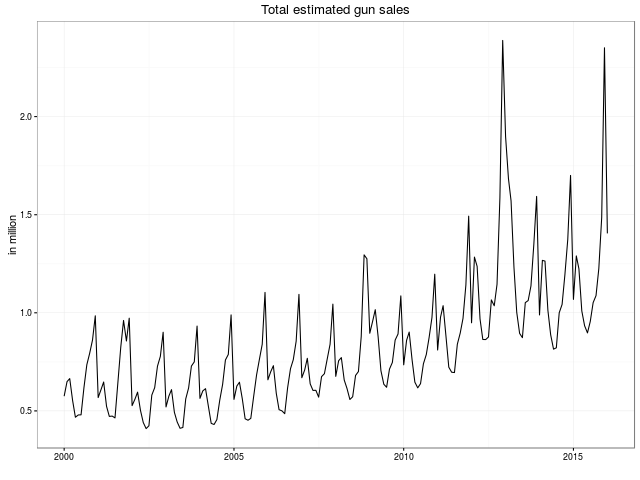
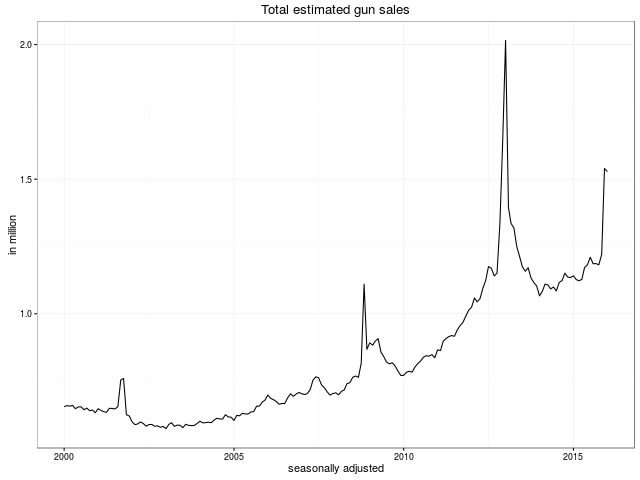
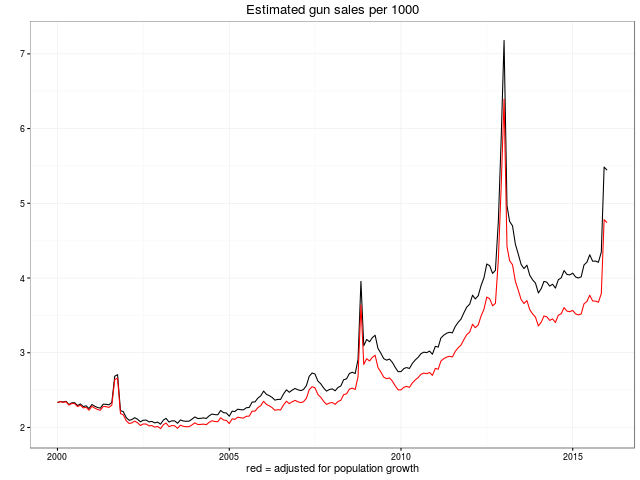
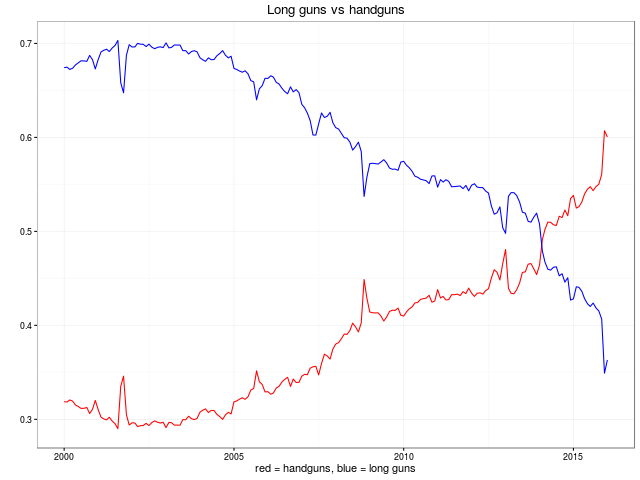
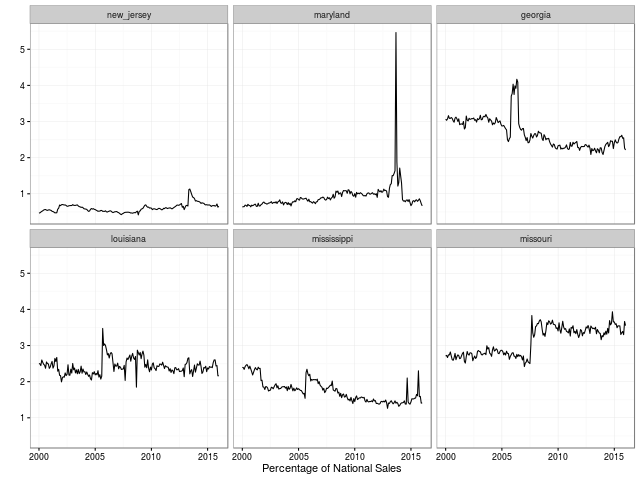
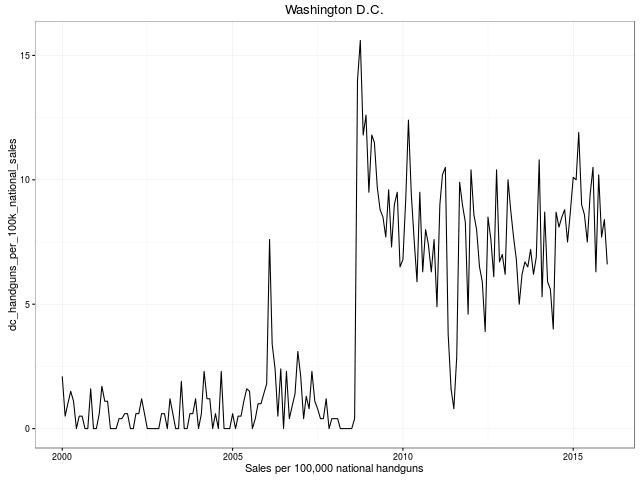
This is based on joint work with Gregor Aisch and Josh Keller of the New York Times. A new package gunsales is now on the CRAN network for R. It is based the NYTimes/gunsales repository underlying the excellent New York Times visualizations, first published first in December 2015 and updated with more recent data since. The analysis takes public government data on gun sales from the National Instant Criminal Background Check System (NICS). The original data is scraped from the pdf, included in the package, and analysed in a cross-section and time-series manner. The standard US Census tool X-13ARIMA-SEATS is used to deseasonalize the timeseries at the national or state level. (Note that Buzzfeed also published data and (Python) code in another GitHub repo.) As an aside, it was the use of X-13ARIMA-SEATS here -- and its somewhat awkward and manual installation also seen in the initial versions of the code in the NYTimes/gunsales repo -- which lead to the recent work by Christoph Sax and myself. We now provide a new package x13binary on CRAN so that Christoph's excellent seasonal package can simply depend upon it and have a working binary provided and installed ready to use; see the recent blog post for more. The net result is that a package like this new gunsales project can simply depend upon seasonal and also be assurred that x13binary "just works". As Martha would say, "A Good Thing". Back to the gunsales project. Following the initial publication of the repository with the data and R code in a simple script, I felt compelled to reorganize it as a package. Packages for R, as we teach our students, colleagues, or anybody else who wants to listen are really the best way to bundle code, data, documentation (i.e. vignettes) and tests. All that exists now in the gunsales package. The package now has one main function, analysis(), which returns a single dataframe object. This dataframe object can then be fed to two plotting functions. The first, plot_gunsales(), will then recreate all the (base R) plots from the original code base. The second, ggplot_gunsales(), does the same but via ggplot2. This should give anybody the ability to look at the data, study the transformations done, form and maybe test new hypotheses and visualize in manner comparable to the original publication. As an amuse gueule, here are the key plots also shown in the main README.md at GitHub: Total Estimated Gun Sales Total Estimated Gun Sales, Seasonally Adjusted Total Estimated Gun Sales, Population-Growth Adjusted Handguns vs Longguns Six States DC We look forward to more remixes and analysis of this data. The plan of the GitHub repository is to keep the data set updated as new data points are published.

This post by Dirk Eddelbuettel originated on his Thinking inside the box blog. Please report excessive re-aggregation in third-party for-profit settings.

24 February 2016

Dirk Eddelbuettel: RcppEigen 0.3.2.8.0

Another minor release of RcppEigen is on CRAN and getting into Debian. The main focus is an upgrade to the recent 3.2.7 release of Eigen which should address another UBSAN issue. And once again Yixuan Qiu did all the heavy lifting. The NEWS file entry follows.
Changes in RcppEigen version 0.3.2.8.0 (2016-02-23)
  • Updated to version 3.2.8 of Eigen (PR #29 by Yixuan)
Courtesy of CRANberries, there is also a diffstat report for the most recent release.

This post by Dirk Eddelbuettel originated on his Thinking inside the box blog. Please report excessive re-aggregation in third-party for-profit settings.

23 February 2016

Michal &#268;iha&#345;: Weekly phpMyAdmin contributions 2016-W07

As the flow of incoming bugs for upcoming 4.6.0 has slowed down a bit it was more time for code cleanups and related tasks. But it's also time where potential Google Summer of Code students come to our organization and want to get involved. On the cleanup side the biggest was change to remove embedded PHP libraries which are available on Packagist from our Git and use Composer to manage the dependencies. This change will happen in 4.7.0, so it's still some time ahead, but it's already in our master branch. There still some third party libraries which we use and can not be installed using Composer, so we keep these for now. Besides the usual bug fixing stuff, I've noticed that we lack issues which can be easily understood and fixed by potential Google Summer of Code. We require them to get involved before the program starts, so that we can see they are capable of useful contributions and also to see how they behave if asked for patch improvements. To fix this deficit we're prepared few small cleanup or refactoring tasks, where the students can show their skills. All handled issues:

Filed under: English phpMyAdmin 2 comments

20 February 2016

Mark Brown: Expedient ABIs

The biggest change we ve seen in the Linux kernel for ARM over the past few years has been the transition to providing descriptions of the hardware in systems via device tree. This splits out the description of the devices in the system that can t be automatically enumerated from the kernel into a separate binary instead of being part of the kernel binary. Currently for most systems that are actively used upstream the device tree source code is kept in the kernel but the goal is to allow people to use device trees that are distributed separately to the kernel, especially device trees that are shipped as part of the board firmware. This is something that other platforms have done for a long time, PowerPC Macs and Sun SPARC systems use device tree as the mechanism for describing the hardware to the operating system. One consequence of this desire to allow the kernel and device tree to be shipped separately is that the device tree becomes an ABI. This is a really big change for people working in the embedded and consumer electronics areas where ARM has been most widely deployed, it means that any descriptions of the hardware need to be something that can stand the test of time. Anything we release is something we have to expect to carry code for indefinitely. When everything was done as part of the kernel binary we could easily do something that doesn t quite represent the hardware with the intention of replacing it later, now it is much harder to do that. An example of this is the SAW in Qualcomm SoCs. This is a block in the SoC which provides control of some regulators used for the CPU cores in the PMIC in very low power states and also allows the CPU to control the regulator with fast memory mapped registers rather than the slower buses used to control the PMIC. Unfortunately it doesn t fully replace direct access to the PMIC, it supports a subset of the control we need for the PMIC but not all of it. We could represent the SAW as an independent regulator but from a system integration point of view it is functioning as an extra control interface for the external PMIC and if we want to use the extra functionality that is only available via direct access to the PMIC we need to consider that and represent the SAW as an extension of it. If we don t need that extra PMIC functionality at the current time this means we need to do some extra work to make sure we describe the PMIC before we can use the SAW even if we have no intention to use anything other than the SAW. Now, few if any people are actually using the device tree as an ABI at present so those working on enabling platforms often forget about the requirement and find it an obstacle to getting things done they have pressure to get things done, they don t have quite the same pressure to make sure that attention is paid to device tree compatibility so it can easily get forgotten. Over time this may change, especially if people start to take advantage of the device tree as an ABI that become more and more important, but for now if we want to enable that in the future it s something we have to actively think about and work on, accepting that this means we won t always be able to do the most expedient thing.

Next.

Previous.