Search Results: "ean"

15 June 2022

Edward Betts: Find link needs a rewrite, the visual editor broke it

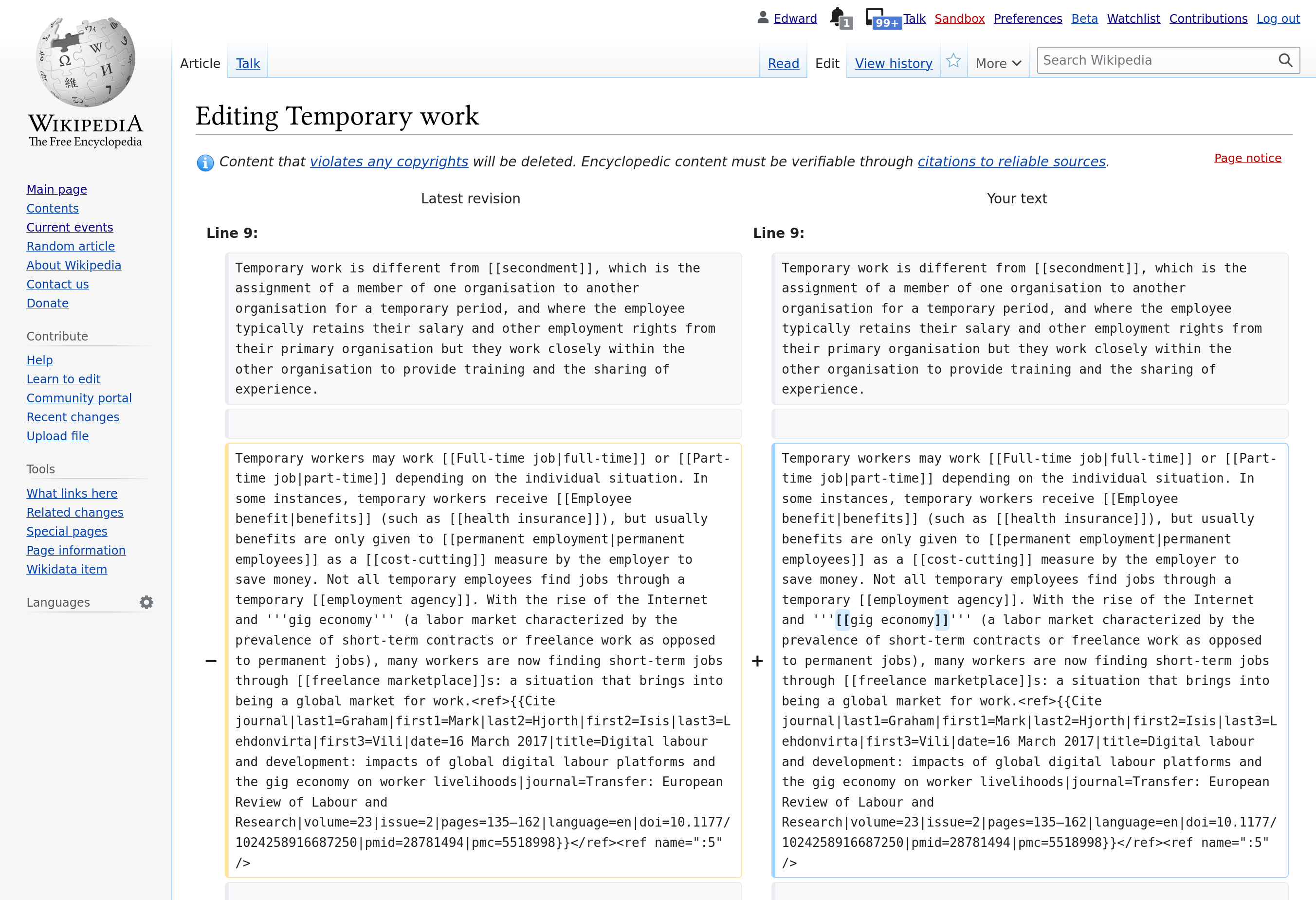
Find link is a tool that I wrote for adding links between articles in Wikipedia. Given an article title, find link will find other articles that include the entered article title but no link to the article. There is the option to edit the found articles and add the missing link. For example, you might want to find missing links to the gig economy article.
I originally wrote the tool in 2008 when the MediaWiki software didn't have a rich-text editor. Wikipedia articles were edited by writing wiki markup in MediaWiki syntax. Since then MediaWiki has evolved and now has rich-text editing via the visual editor. Users don't need to know how to write wiki markup to modify an article. Within MediaWiki there is a user preference to disable the visual editor and stick with editing via the original wiki markup. Find link edits articles by taking the article text, adding the missing link, and sending the user to the changes view of the modified article on Wikipedia, if they're happy with the change they hit save. This only works with the original editor, it doesn't work with the visual editor.
English Wikipedia has had the visual editor enabled by default since 2016. For somebody to use find link they need to disable the visual editor in their Wikipedia preferences first. Fixing this bug means quite a significant change to how the tool works. My plan is to rewrite find link to save edits directly without needing to send the user to Wikipedia article edit change view page to make the edits. Users will authenticate with their Wikipedia account via OAuth and give permission for find link to edit articles on their behalf. Some of my other tools use OAuth for editing OpenStreetMap and Wikidata, so I'm confident about using it to edit Wikipedia. The source code for find link is on GitHub. I'll post updates here as I make progress on the rewrite.

12 June 2022

Iustin Pop: Somewhat committing to a new sport

Quite a few years ago - 4, to be precise, so in 2018 - I did a couple of SUP trainings, organised by a colleague. That was enjoyable, but not really matching with me (asymmetric paddling, ugh!), so I also did learn some kayaking, which I really love, but that s way higher overhead - no sea around in Switzerland, and lakes are generally too small. So I basically postponed any more water sports , until sometime in the future when I ll finally decide what I want to do (and in what setup). I did a couple of one-off SUP rides in various places (2019, 2021), but I really was out of practice, so it wasn t really enjoyable. But with family, SUP offers a much easier way to carry a passenger (than a kayak), so slowly I started thinking more about doing it more seriously. So last week, after much deliberation, bought an inflatable board, paddle and various other accessories, and on Saturday went to try it out, on excellent weather (completely flat) and hot but not overly so. The board choosing in itself was something I like to do (research options), so for a bit I was concerned whether I m more interested in the gear, or the actual paddling itself To my surprise, it went way better than I feared - last time I tried it, paddled 30 minutes on my knees (knee-paddling?!), since I didn t dare stand up. But this time, I launched and then did stand up, and while very shaky, I didn t fall in. Neither by myself, nor with an extra passenger And hour later, and my initial shakiness went away, with the trainings slowly coming back to mind. Another half hour, and - for completely flat water - I felt quite confident. The view was awesome, the weather nice, the water cold enough to be refreshing and the only question on my mind was - why didn t I do this 2, 3 years ago? Well, Corona aside. I forgot how much I love just being on the water. It definitely pays off the cost of going somewhere, unpacking the stuff, pumping up the board (that s a bit of a sport in itself ), because the blue-green-light-blue colour palette is just how things should be:
Small lake, but beautiful view Small lake, but beautiful view
Well, approximately blue. This being a small lake, it s more blue-green than proper blue. That s next level, since bigger lakes mean waves, and more traffic. Of course, this could also turn up like many other things I tried (a device in a corner that s not used anymore), but at least for yesterday, I was a happy paddler!

11 June 2022

Louis-Philippe V ronneau: Updating a rooted Pixel 3a

A short while after getting a Pixel 3a, I decided to root it, mostly to have more control over the charging procedure. In order to preserve battery life, I like my phone to stop charging at around 75% of full battery capacity and to shut down automatically at around 12%. Some Android ROMs have extra settings to manage this, but LineageOS unfortunately does not. Android already comes with a fairly complex mechanism to handle the charge cycle, but it is mostly controlled by the kernel and cannot be easily configured by end-users. acc is a higher-level "systemless" interface for the Android kernel battery management, but one needs root to do anything interesting with it. Once rooted, you can use the AccA app instead of playing on the command line to fine tune your battery settings. Sadly, having a rooted phone also means I need to re-root it each time there is an OS update (typically each week). Somehow, I keep forgetting the exact procedure to do this! Hopefully, I will be able to use this post as a reference in the future :) Note that these instructions might not apply to your exact phone model, proceed with caution! Extract the boot.img file This procedure mostly comes from the LineageOS documentation on extracting proprietary blobs from the payload.
  1. Download the latest LineageOS image for your phone.
  2. unzip the image to get the payload.bin file inside it.
  3. Clone the LineageOS scripts git repository: $ git clone https://github.com/LineageOS/scripts
  4. extract the boot image (requires python3-protobuf): $ mkdir extracted-payload $ python3 scripts/update-payload-extractor/extract.py payload.bin --output_dir extracted-payload
You should now have a boot.img file. Patch the boot image file using Magisk
  1. Upload the boot.img file you previously extracted to your device.
  2. Open Magisk and patch the boot.img file.
  3. Download the patched file back on your computer.
Flash the patched boot image
  1. Enable ADB debug mode on your phone.
  2. Reboot into fastboot mode. $ adb reboot fastboot
  3. Flash the patched boot image file: $ fastboot flash boot magisk_patched-foo.img
  4. Disable ADB debug mode on your phone.
Troubleshooting In an ideal world, you would do this entire process each time you upgrade to a new LineageOS version. Sadly, this creates friction and makes updating much more troublesome. To simplify things, you can try to flash an old patched boot.img file after upgrading, instead of generating it each time. In my experience, it usually works. When it does not, the device behaves weirdly after a reboot and things that require proprietary blobs (like WiFi) will stop working. If that happens:
  1. Download the latest LineageOS version for your phone.
  2. Reboot into recovery (Power + Volume Down).
  3. Click on "Apply Updates"
  4. Sideload the ROM: $ adb sideload lineageos-foo.zip

3 June 2022

Raphaël Hertzog: Freexian s report about Debian Long Term Support, April 2022

A Debian LTS logo
Like each month, have a look at the work funded by Freexian s Debian LTS offering. Debian project funding Two projects are currently in the pipeline: Gradle enterprise and Tryton update. Progress is quite slow on the Gradle one, there are technical difficulties. The tryton one was stalled because the developer had not enough time but seems to progress smoothly in the last weeks. In April, we put aside 2635 EUR to fund Debian projects. We re looking forward to receive more projects from various Debian teams! Learn more about the rationale behind this initiative in this article. Debian LTS contributors In April, 11 contributors have been paid to work on Debian LTS, their reports are available: Evolution of the situation In April we released 30 DLAs and we were glad to welcome a new customer with Alter Way. The security tracker currently lists 72 packages with a known CVE and the dla-needed.txt file has 71 packages needing an update. It is worth pointing out that we are getting close to the end of the LTS period for Debian 9. After June 30th, no new security updates will be made available on security.debian.org. But Freexian and its team of paid Debian contributors will continue to maintain Debian 9 going forward for the customers of the Extended LTS offer. If you have Debian 9 servers to keep secure, it s time to subscribe! You might not have noticed, but Freexian formalized a mission statement where we explain that our purpose is to help improve Debian. For this, we want to fund work time for the Debian developers that recently joined Freexian as collaborators. The Extended LTS and the PHP LTS offers are built following a model that will help us to achieve this if we manage to have enough customers for those offers. So consider subscribing: you help your organization but you also help Debian! Thanks to our sponsors Sponsors that joined recently are in bold.

1 June 2022

Russ Allbery: Review: The Seeress of Kell

Review: The Seeress of Kell, by David Eddings
Series: The Malloreon #5
Publisher: Del Rey
Copyright: May 1991
Printing: May 1992
ISBN: 0-345-37759-1
Format: Mass market
Pages: 374
The Seeress of Kell is the conclusion of the five-book Malloreon series and a direct sequel to Sorceress of Darshiva. You do not want to begin the series here (or, to be honest, at all). We have finally finished the relaxed tour of Mallorea, the second continent of Eddings's remarkably small two-continent world. The heroes have gathered all of their required companions and are headed for Kell, where the seeress Cyradis awaits. From there, they and the new Child of Dark must find their way to the Place Which Is No More for the final confrontation. By "find," I mean please remain seated with your hands, arms, feet, and legs inside the vehicle. The protagonists have about as much to do with the conclusion of this series as the passengers of a roller coaster have control over its steering. I am laughing at my younger self, who quite enjoyed this series (although as I recall found it a bit repetitive) and compared it favorably to the earlier Belgariad series. My memory kept telling me that the conclusion of the series was lots of fun. Reader, it was not. It was hilariously bad. Both of Eddings's first two series, but particularly this one, take place in a fantasy world full of true prophecy. The conceit of the Malloreon in particular (this is a minor spoiler for the early books, but not one that I think interferes with enjoyment) is that there are two competing prophecies that agree on most events but are in conflict over a critical outcome. True prophecy creates an agency problem: why have protagonists if everything they do is fixed in prophecy? The normal way to avoid that is to make the prophecy sufficiently confusing and the mechanism by which it comes true sufficiently subtle that everyone has to act as if there is no prophecy, thus reducing the role of the prophecy to foreshadowing and a game the author plays with the reader. What makes the Malloreon interesting (and I mean this sincerely) is that Eddings instead leans into the idea of a prophecy as an active agent leading the protagonists around by the nose. As a meta-story commentary on fantasy stories, this can be quite entertaining, and it helps that the prophecy appears as a likable character of sorts in the book. The trap that Eddings had mostly avoided before now is that this structure can make the choices of the protagonists entirely pointless. In The Seeress of Kell, he dives head-first into the trap and then pulls it shut behind him. The worst part is Ce'Nedra, who once again spends an entire book either carping at Garion in ways that are supposed to be endearing (but aren't) or being actively useless. The low point is when she is manipulated into betraying the heroes, costing them a significant advantage. We're then told that, rather than being a horrific disaster, this is her important and vital role in the story, and indeed the whole reason why she was in the story at all. The heroes were too far ahead of the villains and were in danger of causing the prophecy to fail. At that point, one might reasonably ask why one is bothering reading a novel instead of a summary of the invented history that Eddings is going to tell whether his characters cooperate or not. The whole middle section of the book is like this: nothing any of the characters do matters because everything is explicitly destined. That includes an extended series of interludes following the other main characters from the Belgariad, who are racing to catch up with the main party but who will turn out to have no role of significance whatsoever. I wouldn't mind this as much if the prophecy were more active in the story, given that it's the actual protagonist. But it mostly disappears. Instead, the characters blunder around doing whatever seems like a good idea at the time, while Cyradis acts like a bizarre sort of referee with a Calvinball rule set and every random action turns out to be the fulfillment of prophecy in the most ham-handed possible way. Zandramas, meanwhile, is trying to break the prophecy, which would have been a moderately interesting story hook if anyone (Eddings included) thought she were potentially capable of doing so. Since no one truly believes there's any peril, this turns into a series of pointless battles the reader has no reason to care about. All of this sets up what has been advertised since the start of the series as a decision between good and evil. Now, at the least minute, Eddings (through various character mouthpieces) tries to claim that the decision is not actually between good and evil, but is somehow beyond morality. No one believes this, including the narrator and the reader, making all of the philosophizing a tedious exercise in page-turning. To pull off a contention like that, the author has to lay some sort of foundation to allow the reader to see the supposed villain in multiple lights. Eddings does none of that, instead emphasizing how evil she is at every opportunity. On top of that, this supposed free choice on which the entire universe rests and for which all of history was pointed depends on someone with astonishing conflicts of interest. While the book is going on about how carefully the prophecy is ensuring that everyone is in the right place at the right time so that no side has an advantage, one side is accruing an absurdly powerful advantage. And the characters don't even seem to realize it! The less said about the climax, the better. Unsurprisingly, it was completely predictable. Also, while I am complaining, I could never get past how this entire series starts off with and revolves around an incredibly traumatic and ongoing event that has no impact whatsoever on the person to whom the trauma happens. Other people are intermittently upset or sad, but not only is that person not harmed, they act, at the end of this book, as if the entire series had never happened. There is one bright spot in this book, and ironically it's the one plot element that Eddings didn't make blatantly obvious in advance and therefore I don't want to spoil it. All I'll say is that one of the companions the heroes pick up along the way turns out to be my favorite character of the series, plays a significant role in the interpersonal dynamics between the heroes, and steals every scene that she's in by being more sensible than any of the other characters in the story. Her story, and backstory, is emotional and moving and is the best part of this book. Otherwise, not only is the plot a mess and the story structure a failure, but this is also Eddings at his most sexist and socially conservative. There is an extended epilogue after the plot resolution that serves primarily as a showcase of stereotypes: baffled men having their habits and preferences rewritten by their wives, cast-iron gender roles inside marriage, cringeworthy jokes, and of course loads and loads of children because that obviously should be everyone's happily ever after. All of this happens to the characters rather than being planned or actively desired, continuing the theme of prophecy and lack of agency, although of course they're all happy about it (shown mostly via grumbling). One could write an entire academic paper on the tension between this series and the concept of consent. There were bits of the Malloreon that I enjoyed, but they were generally in spite of the plot rather than because of it. I do like several of Eddings's characters, and in places I liked the lack of urgency and the sense of safety. But I think endings still have to deliver some twist or punch or, at the very least, some clear need for the protagonists to take an action other than stand in the right room at the right time. Eddings probably tried to supply that (I can make a few guesses about where), but it failed miserably for me, making this the worst book of the series. Unless like me you're revisiting this out of curiosity for your teenage reading habits (and even then, consider not), avoid. Rating: 3 out of 10

31 May 2022

Paul Wise: FLOSS Activities May 2022

Focus This month I didn't have any particular focus. I just worked on issues in my info bubble.

Changes

Issues

Review
  • Spam: reported 1 Debian bug reports and 41 Debian mailing list posts
  • Patches: reviewed gt patches
  • Debian packages: sponsored psi-notify
  • Debian wiki: RecentChanges for the month
  • Debian BTS usertags: changes for the month
  • Debian screenshots:
    • approved cppcheck-gui eta flpsed fluxbox p7zip-full pampi pyqso xboard
    • rejected p7zip (help output), openshot (photo of a physical library), clamav-daemon (movie cartoon character), aptitude (screenshot of random launchpad project), laditools (screenshot of tracker.d.o for src:hello), weboob-qt/chromium-browser/supercollider-vim ((NSFW) selfies), node-split (screenshot of screenshots site), libc6 (Chinese characters alongside a photo of man and bottle)

Administration
  • Debian servers: investigate etckeeper cron mail
  • Debian wiki: investigate account existence, approve accounts

Communication
  • Respond to queries from Debian users and contributors on the mailing lists and IRC

Sponsors The gensim and libpst work was sponsored. All other work was done on a volunteer basis.

Russ Allbery: Review: Maskerade

Review: Maskerade, by Terry Pratchett
Series: Discworld #18
Publisher: Harper
Copyright: 1995
Printing: February 2014
ISBN: 0-06-227552-6
Format: Mass market
Pages: 360
Maskerade is the 18th book of the Discworld series, but you probably could start here. You'd miss the introduction of Granny Weatherwax and Nanny Ogg, which might be a bit confusing, but I suspect you could pick it up as you went if you wanted. This is a sequel of sorts to Lords and Ladies, but not in a very immediate sense. Granny is getting distracted and less interested in day-to-day witching in Lancre. This is not good; Granny is incredibly powerful, and bored and distracted witches can go to dark places. Nanny is concerned. Granny needs something to do, and their coven needs a third. It's not been the same since they lost their maiden member. Nanny's solution to this problem is two-pronged. First, they'd had their eye on a local girl named Agnes, who had magic but who wasn't interested in being a witch. Perhaps it was time to recruit her anyway, even though she'd left Lancre for Ankh-Morpork. And second, Granny needs something to light a fire under her, something that will get her outraged and ready to engage with the world. Something like a cookbook of aphrodisiac recipes attributed to the Witch of Lancre. Agnes, meanwhile, is auditioning for the opera. She's a sensible person, cursed her whole life by having a wonderful personality, but a part of her deep inside wants to be called Perdita X. Dream and have a dramatic life. Having a wonderful personality can be very frustrating, but no one in Lancre took either that desire or her name seriously. Perhaps the opera is somewhere where she can find the life she's looking for, along with another opportunity to try on the Perdita name. One thing she can do is sing; that's where all of her magic went. The Ankh-Morpork opera is indeed dramatic. It's also losing an astounding amount of money for its new owner, who foolishly thought owning an opera would be a good retirement project after running a cheese business. And it's haunted by a ghost, a very tangible ghost who has started killing people. I think this is my favorite Discworld novel to date (although with a caveat about the ending that I'll get to in a moment). It's certainly the one that had me laughing out loud the most. Agnes (including her Perdita personality aspect) shot to the top of my list of favorite Discworld characters, in part because I found her sensible personality so utterly relatable. She is fascinated by drama, she wants to be in the middle of it and let her inner Perdita goth character revel in it, and yet she cannot help being practical and unflappable even when surrounded by people who use far too many exclamation points. It's one thing to want drama in the abstract; it's quite another to be heedlessly dramatic in the moment, when there's an obviously reasonable thing to do instead. Pratchett writes this wonderfully. The other half of the story follows Granny and Nanny, who are unstoppable forces of nature and a wonderful team. They have the sort of long-standing, unshakable adult friendship between very unlike people that's full of banter and minor irritations layered on top of a deep mutual understanding and respect. Once they decide to start investigating this supposed opera ghost, they divvy up the investigative work with hardly a word exchanged. Planning isn't necessary; they both know each other's strengths. We've gotten a lot of Granny's skills in previous books. Maskerade gives Nanny a chance to show off her skills, and it's a delight. She effortlessly becomes the sort of friendly grandmother who blends in so well that no one questions why she's there, and thus manages to be in the middle of every important event. Granny watches and thinks and theorizes; Nanny simply gets into the middle of everything and talks to everyone until people tell her what she wants to know. There's no real doubt that the two of them are going to get to the bottom of anything they want to get to the bottom of, but watching how they get there is a delight. I love how Pratchett handles that sort of magical power from a world-building perspective. Ankh-Morpork is the Big City, the center of political power in most of the Discworld books, and Granny and Nanny are from the boondocks. By convention, that means they should either be awed or confused by the city, or gain power in the city by transforming it in some way to match their area of power. This isn't how Pratchett writes witches at all. Their magic is in understanding people, and the people in Ankh-Morpork are just as much people as the people in Lancre. The differences of the city may warrant an occasional grumpy aside, but the witches are fully as capable of navigating the city as they are their home town. Maskerade is, of course, a parody of opera and musicals, with Phantom of the Opera playing the central role in much the same way that Macbeth did in Wyrd Sisters. Agnes ends up doing the singing for a beautiful, thin actress named Christine, who can't sing at all despite being an opera star, uses a truly astonishing excess of exclamation points, and strategically faints at the first sign of danger. (And, despite all of this, is still likable in that way that it's impossible to be really upset at a puppy.) She is the special chosen focus of the ghost, whose murderous taunting is a direct parody of the Phantom. That was a sufficiently obvious reference that even I picked up on it, despite being familiar with Phantom of the Opera only via the soundtrack. Apart from that, though, the references were lost on me, since I'm neither a musical nor an opera fan. That didn't hurt my enjoyment of the book in the slightest; in fact, I suspect it's part of why it's in my top tier of Discworld books. One of my complaints about Discworld to date is that Pratchett often overdoes the parody to the extent that it gets in the way of his own (excellent) characters and story. Maybe it's better to read Discworld novels where one doesn't recognize the material being parodied and thus doesn't keep getting distracted by references. It's probably worth mentioning that Agnes is a large woman and there are several jokes about her weight in Maskerade. I think they're the good sort of jokes, about how absurd human bodies can be, not the mean sort? Pratchett never implies her weight is any sort of moral failing or something she should change; quite the contrary, Nanny considers it a sign of solid Lancre genes. But there is some fat discrimination in the opera itself, since one of the things Pratchett is commenting on is the switch from full-bodied female opera singers to thin actresses matching an idealized beauty standard. Christine is the latter, but she can't sing, and the solution is for Agnes to sing for her from behind, something that was also done in real opera. I'm not a good judge of how well this plot line was handled; be aware, going in, if this may bother you. What did bother me was the ending, and more generally the degree to which Granny and Nanny felt comfortable making decisions about Agnes's life without consulting her or appearing to care what she thought of their conclusions. Pratchett seemed to be on their side, emphasizing how well they know people. But Agnes left Lancre and avoided the witches for a reason, and that reason is not honored in much the same way that Lancre refused to honor her desire to go by Perdita. This doesn't seem to be malicious, and Agnes herself is a little uncertain about her choice of identity, but it still rubbed me the wrong way. I felt like Agnes got steamrolled by both the other characters and by Pratchett, and it's the one thing about this book that I didn't like. Hopefully future Discworld books about these characters revisit Agnes's agency. Overall, though, this was great, and a huge improvement over Interesting Times. I'm excited for the next witches book. Followed in publication order by Feet of Clay, and later by Carpe Jugulum in the thematic sense. Rating: 8 out of 10

30 May 2022

Daniel Lange: Work-around for randomly dropping WiFi connections on ChromeOS

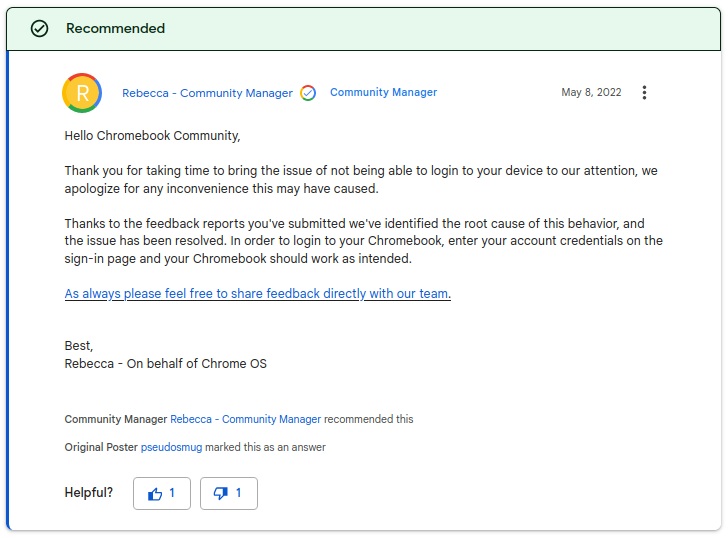
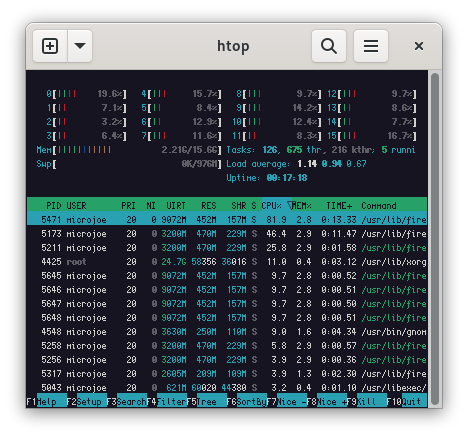
The company got me a Chromebook for times when I want to ignore email and not get dragged into code reviews but still be available on IRC and chat. Nifty devices at great price points. I really like them. Chromebook logo These things are meant to be very consumer-style end-user devices. You log in with your Google account and everything works. Until it doesn't. Just setting it up caused the first issue: I was always thrown back to a black screen and then another login-screen despite having successfully logged in initially to create the "owner" user of the Chromebook. No error message, not useful UI feedback. Just logging in again and again and again. The issue is ... not having a GMail account associated with my Google account. Duh! So add a GMail.com address as the primary to your Google account and the initial setup completes. Of course you cannot delete that GMail.com association again because the owner user is linked to the email and not the account. Well, you can delete it but then you cannot configure "owner" items of your Chromebook any more. Great job, Google. Not. Identity management 101 fail. Kudos to Anurag Chawake for blogging about the issue. The Google support forum thead claims this is solved now. But it didn't work for me, so this may be needing to trickle down through ChromeOS releases or be deployed on more Google infra. Or whatever. We can't tell from outside the Googleplex as - of course - "Rebecca" sheds no light on what the identified "root cause" was: Google Forum answer Once I was able to login to the new Chromebook all worked fine until I started to use ssh sessions. These always hung for 30 seconds to 10 minutes and then resumed with lots of packets lost in between and the last minute or so coming in from buffering in a burst. This was easy to see in ping as well. The connection essentially dropped dead while the WiFi icon was continuing to show full signal strength. The logs did not show anything useful. These are really hard to access on ChromeOS (JSON format and no useful UI on the Chromebook itself, Google provides a viewer on Google Apps Toolbox but that requires uploading the logs). Better than no logs at all but not really nice. The ChromeOS bug tracker and its Google corporate counterpart are also not useful at this time. For reference:
Google ... Device users randomly disconnect from Wi-Fi network
Chromium ... Device users randomly disconnect from Wi-Fi network
Google ... Constant connect and disconnect from WiFi source post-update
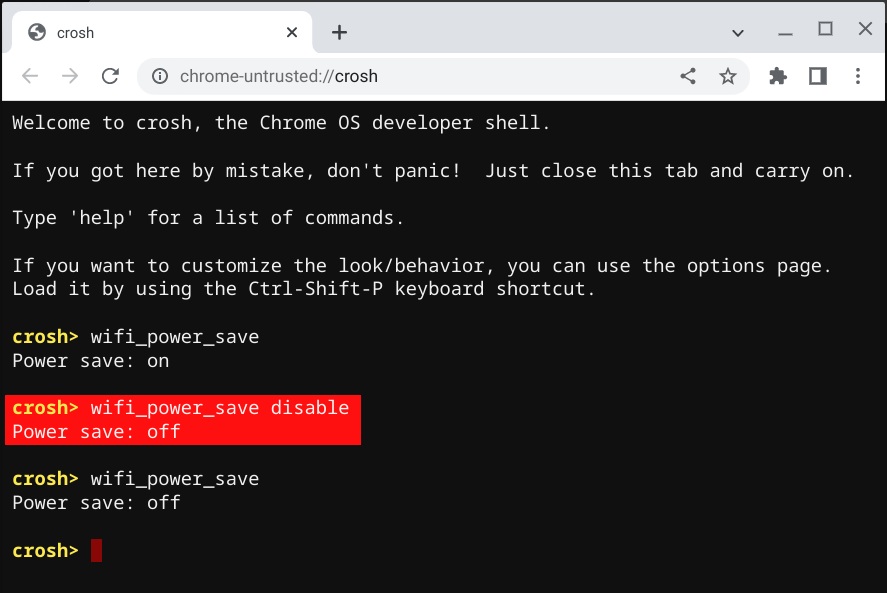
Chromium ... Constant connect and disconnect from WiFi source post-update Playing around with the device on the network showed that it reduced sending power beyond being able to reach the access point any more. This is why disconnecting and re-connecting the WiFi fixes the issue for a few minutes, typically. Still, there is a better way: In crosh (the ChromeOS shell available when pressing Alt+Ctrl+T) type:
wifi_power_save disable
Crosh session screenshot This unfortunately only lasts until the next reboot but it does persist over suspend cycles (aka closing the lid).

29 May 2022

Russ Allbery: Review: Kleptopia

Review: Kleptopia, by Tom Burgis
Publisher: Harper
Copyright: 2020
Printing: September 2021
ISBN: 0-06-323613-3
Format: Kindle
Pages: 340
Kleptopia is a nonfiction chronicle of international financial corruption and money laundering told via a focus on the former Soviet republic of Kazakhstan. The primary characters are a British banker named Nigel Wilkins (at the start of the story, the head of compliance in the London office of the Swiss bank BSI), a group of businessmen from Kyrgyzstan and Uzbekistan called the Trio, and a Kazakh oligarch and later political dissident named Mukhtar Ablyazov, although the story spreads beyond them. It is partly a detailed example of what money laundering looks like in practice: where the money comes from, who has it, what they want to do with it, who they hire to move it, and what countries welcome it. But it is more broadly about the use of politics for financial plunder, and what stories we tell about the results. The title of this book feels a bit like clickbait, and I was worried it would be mostly opinion and policy discussion. It is the exact opposite. Tom Burgis is an investigations correspondent at the Financial Times, and this is a detailed piece of investigative journalism (backed by a hundred pages of notes and detailed attributions). Burgis has a clear viewpoint and expresses it when it seems relevant, but the vast majority of this book is the sort of specific account of people, dates, times, and events that one would expect from a full-length investigative magazine piece, except maintained at book length. Even aside from the subject matter, I love that writing like this exists. It's often best in magazines, newspapers, and on-line articles for timeliness, since book publishing is slow, but some subjects require the length of a book. Burgis is the sort of reporter who travels the world to meet with sources in person, and who, before publication, presents his conclusions to everyone mentioned for their rebuttals (many of which are summarized or quoted in detail in the notes so that the reader can draw their own credibility conclusions). Whether or not one agrees with his specific conclusions or emphasis, we need more of this sort of journalism in the world. I knew essentially nothing about Kazakhstan or its politics before reading this book. I also had not appreciated the degree to which exploitation of natural resources is the original source of the money for international money laundering. In both Kazakhstan and Africa (a secondary setting for this book), people get rich largely because of things dug or pumped out of the ground. That money, predictably, does not go to the people doing the hard work of digging and pumping, who work in appalling conditions and are put down with violence if they try to force change. (In one chapter, Burgis tells the harrowing and nightmarish story of Roza Tuletayeva, a striker at the oil field in Zhanaozen.) It's gathered up by the already rich and politically connected, who gained control of former state facilities during the post-Soviet collapse and then maintained their power with violence and corruption. And once they have money, they try to convert it into holdings in European banks, London real estate, and western corporations. The primary thing I will remember from this book is the degree to which oligarchs rely on being able to move between two systems. They make their money in unstable or authoritarian countries with high degrees of political corruption and violence, and are adept at navigating that world (although sometimes it turns on them; more on that in a moment). But they don't want to leave their money in that world. Someone else could betray them, undermine them, or gain the ear of the local dictator. They rely instead on western countries with strong property rights, stable financial institutions, and vast legal systems devoted to protecting the wealth of people who are already rich. In essence, they play both rule sets against each other: make money through techniques that would be illegal in London, and then move their money to London so that the British government and legal system will protect it against others who are trying to do the same. What they get out of this is obvious. What London gets out of it is another theme of this book: it's a way for a lot of people to share the wealth without doing any of the crimes. Money laundering is a very lossy activity. Lots of money falls out of the cart along the way, where it is happily scooped up by bankers, lawyers, accountants, public relations consultants, and the rest of the vast machinery of theoretically legitimate business. Everyone wins, except the people the money is being stolen from in the first place. (And the planet; Burgis doesn't talk much about the environment, but I found the image of one-way extraction of irreplaceable natural resources haunting and disturbing.) Donald Trump does make an appearance here, although not as significant of one as I was expecting given the prominent appearance of Trump crony Felix Sater. Trump is part of the machinery that allows oligarch money to become legally-protected business investment, but it's also clear from Burgis's telling that he is (at least among the money flows Burgis is focused on) a second-tier player with delusions of grandeur. He's more notable for his political acumen and ability to craft media stories than his money-laundering skills. The story-telling is a third theme of this book. The electorate of the societies into which oligarchs try to move their money aren't fond of crime, mob activity, political corruption, or authoritarian exploitation of workers. If public opinion turns sufficiently strongly against specific oligarchs, the normally friendly mechanisms of law and business regulation may have to take action. The primary defense of laundered money is hiding its origins sufficiently that it's too hard to investigate or explain to a jury, but there are limits to how completely the money can hide given that oligarchs still want to spend it. They need to tell a story about how they are modernizing businessmen, aghast at the lingering poor conditions of their home countries but working earnestly to slowly improve them. And they need to defend those stories against people who might try to draw a clearer link between them and criminal activity. The competing stories between dissident oligarch Mukhtar Ablyazov and the Kazakh government led by Nursultan Nazarbayev are a centerpiece of this book. Ablyazov is in some sense a hero of the story, someone who attempted to expose the corruption of Nazerbayev's government and was jailed by Nazerbayev for corruption in retaliation. But Burgis makes clear the tricky fact that Ablyazov likely is guilty of at least some (and possibly a lot) of the money laundering of which he was accused. It's a great illustration of the perils of simple good or bad labels when trying to understand this world from the outside. All of these men are playing similar games, and all of them are trying to tell stories where they are heroes and their opponents are corrupt thieves. And yet, there is not a moral equivalency. Ablyazov is not a good person, but what Nazerbayev attempted to do to his family is appalling, far worse than anything Ablyazov did, and the stories about Ablyazov that have prevailed to date in British courts are not an attempt to reach the truth. The major complaint that I have about Kleptopia is that this is a highly complex story with a large number of characters, but Burgis doesn't tell it in chronological order. He jumps forward and backward in time to introduce new angles of the story, and I'm not sure that was the right structural choice. Maybe a more linear story would have been even more confusing, but I got lost in the chronology at several points. Be prepared to put in some work as a reader in keeping the timeline straight. I also have to warn that this is not in any way a hopeful book. Burgis introduces Nigel Wilkins and his quixotic quest to expose the money laundering activities of European banks early in the book. In a novel that would set up a happy ending in which Wilkins brings down the edifice, or at least substantial portions of it. We do not live in a novel, sadly. Kleptopia is not purely depressing, but by and large the bad guys win. This is not a history of corruption that we've exposed and overcome. It's a chronicle of a problem that is getting worse, and that the US and British governments are failing to address. Burgis's publishers successfully defended a libel suit in British courts brought by the Eurasian Natural Resources Corporation, the primary corporate entity of the Trio who are the primary villains of this book. I obviously haven't done my own independent research, but after reading this book, including the thorough notes, this looks to me like the type of libel suit that should serve as an advertisement for its target. I can't say I enjoyed reading this, particularly at the end when the arc becomes clear. Understanding how little governments and institutions care about stopping money laundering is not a pleasant experience. But it's an important book, well and vividly told (except for the chronology), and grounded in solid investigative journalism. Recommended; I'm glad I read it. Rating: 7 out of 10

26 May 2022

Sergio Talens-Oliag: New Blog Config

As promised, on this post I m going to explain how I ve configured this blog using hugo, asciidoctor and the papermod theme, how I publish it using nginx, how I ve integrated the remark42 comment system and how I ve automated its publication using gitea and json2file-go. It is a long post, but I hope that at least parts of it can be interesting for some, feel free to ignore it if that is not your case

Hugo Configuration

Theme settingsThe site is using the PaperMod theme and as I m using asciidoctor to publish my content I ve adjusted the settings to improve how things are shown with it. The current config.yml file is the one shown below (probably some of the settings are not required nor being used right now, but I m including the current file, so this post will have always the latest version of it):
config.yml
baseURL: https://blogops.mixinet.net/
title: Mixinet BlogOps
paginate: 5
theme: PaperMod
destination: public/
enableInlineShortcodes: true
enableRobotsTXT: true
buildDrafts: false
buildFuture: false
buildExpired: false
enableEmoji: true
pygmentsUseClasses: true
minify:
  disableXML: true
  minifyOutput: true
languages:
  en:
    languageName: "English"
    description: "Mixinet BlogOps - https://blogops.mixinet.net/"
    author: "Sergio Talens-Oliag"
    weight: 1
    title: Mixinet BlogOps
    homeInfoParams:
      Title: "Sergio Talens-Oliag Technical Blog"
      Content: >
        ![Mixinet BlogOps](/images/mixinet-blogops.png)
    taxonomies:
      category: categories
      tag: tags
      series: series
    menu:
      main:
        - name: Archive
          url: archives
          weight: 5
        - name: Categories
          url: categories/
          weight: 10
        - name: Tags
          url: tags/
          weight: 10
        - name: Search
          url: search/
          weight: 15
outputs:
  home:
    - HTML
    - RSS
    - JSON
params:
  env: production
  defaultTheme: light
  disableThemeToggle: false
  ShowShareButtons: true
  ShowReadingTime: true
  disableSpecial1stPost: true
  disableHLJS: true
  displayFullLangName: true
  ShowPostNavLinks: true
  ShowBreadCrumbs: true
  ShowCodeCopyButtons: true
  ShowRssButtonInSectionTermList: true
  ShowFullTextinRSS: true
  ShowToc: true
  TocOpen: false
  comments: true
  remark42SiteID: "blogops"
  remark42Url: "/remark42"
  profileMode:
    enabled: false
    title: Sergio Talens-Oliag Technical Blog
    imageUrl: "/images/mixinet-blogops.png"
    imageTitle: Mixinet BlogOps
    buttons:
      - name: Archives
        url: archives
      - name: Categories
        url: categories
      - name: Tags
        url: tags
  socialIcons:
    - name: CV
      url: "https://www.uv.es/~sto/cv/"
    - name: Debian
      url: "https://people.debian.org/~sto/"
    - name: GitHub
      url: "https://github.com/sto/"
    - name: GitLab
      url: "https://gitlab.com/stalens/"
    - name: Linkedin
      url: "https://www.linkedin.com/in/sergio-talens-oliag/"
    - name: RSS
      url: "index.xml"
  assets:
    disableHLJS: true
    favicon: "/favicon.ico"
    favicon16x16:  "/favicon-16x16.png"
    favicon32x32:  "/favicon-32x32.png"
    apple_touch_icon:  "/apple-touch-icon.png"
    safari_pinned_tab:  "/safari-pinned-tab.svg"
  fuseOpts:
    isCaseSensitive: false
    shouldSort: true
    location: 0
    distance: 1000
    threshold: 0.4
    minMatchCharLength: 0
    keys: ["title", "permalink", "summary", "content"]
markup:
  asciidocExt:
    attributes:  
    backend: html5s
    extensions: ['asciidoctor-html5s','asciidoctor-diagram']
    failureLevel: fatal
    noHeaderOrFooter: true
    preserveTOC: false
    safeMode: unsafe
    sectionNumbers: false
    trace: false
    verbose: false
    workingFolderCurrent: true
privacy:
  vimeo:
    disabled: false
    simple: true
  twitter:
    disabled: false
    enableDNT: true
    simple: true
  instagram:
    disabled: false
    simple: true
  youtube:
    disabled: false
    privacyEnhanced: true
services:
  instagram:
    disableInlineCSS: true
  twitter:
    disableInlineCSS: true
security:
  exec:
    allow:
      - '^asciidoctor$'
      - '^dart-sass-embedded$'
      - '^go$'
      - '^npx$'
      - '^postcss$'
Some notes about the settings:
  • disableHLJS and assets.disableHLJS are set to true; we plan to use rouge on adoc and the inclusion of the hljs assets adds styles that collide with the ones used by rouge.
  • ShowToc is set to true and the TocOpen setting is set to false to make the ToC appear collapsed initially. My plan was to use the asciidoctor ToC, but after trying I believe that the theme one looks nice and I don t need to adjust styles, although it has some issues with the html5s processor (the admonition titles use <h6> and they are shown on the ToC, which is weird), to fix it I ve copied the layouts/partial/toc.html to my site repository and replaced the range of headings to end at 5 instead of 6 (in fact 5 still seems a lot, but as I don t think I ll use that heading level on the posts it doesn t really matter).
  • params.profileMode values are adjusted, but for now I ve left it disabled setting params.profileMode.enabled to false and I ve set the homeInfoParams to show more or less the same content with the latest posts under it (I ve added some styles to my custom.css style sheet to center the text and image of the first post to match the look and feel of the profile).
  • On the asciidocExt section I ve adjusted the backend to use html5s, I ve added the asciidoctor-html5s and asciidoctor-diagram extensions to asciidoctor and adjusted the workingFolderCurrent to true to make asciidoctor-diagram work right (haven t tested it yet).

Theme customisationsTo write in asciidoctor using the html5s processor I ve added some files to the assets/css/extended directory:
  1. As said before, I ve added the file assets/css/extended/custom.css to make the homeInfoParams look like the profile page and I ve also changed a little bit some theme styles to make things look better with the html5s output:
    custom.css
    /* Fix first entry alignment to make it look like the profile */
    .first-entry   text-align: center;  
    .first-entry img   display: inline;  
    /**
     * Remove margin for .post-content code and reduce padding to make it look
     * better with the asciidoctor html5s output.
     **/
    .post-content code   margin: auto 0; padding: 4px;  
  2. I ve also added the file assets/css/extended/adoc.css with some styles taken from the asciidoctor-default.css, see this blog post about the original file; mine is the same after formatting it with css-beautify and editing it to use variables for the colors to support light and dark themes:
    adoc.css
    /* AsciiDoctor*/
    table  
        border-collapse: collapse;
        border-spacing: 0
     
    .admonitionblock>table  
        border-collapse: separate;
        border: 0;
        background: none;
        width: 100%
     
    .admonitionblock>table td.icon  
        text-align: center;
        width: 80px
     
    .admonitionblock>table td.icon img  
        max-width: none
     
    .admonitionblock>table td.icon .title  
        font-weight: bold;
        font-family: "Open Sans", "DejaVu Sans", sans-serif;
        text-transform: uppercase
     
    .admonitionblock>table td.content  
        padding-left: 1.125em;
        padding-right: 1.25em;
        border-left: 1px solid #ddddd8;
        color: var(--primary)
     
    .admonitionblock>table td.content>:last-child>:last-child  
        margin-bottom: 0
     
    .admonitionblock td.icon [class^="fa icon-"]  
        font-size: 2.5em;
        text-shadow: 1px 1px 2px var(--secondary);
        cursor: default
     
    .admonitionblock td.icon .icon-note::before  
        content: "\f05a";
        color: var(--icon-note-color)
     
    .admonitionblock td.icon .icon-tip::before  
        content: "\f0eb";
        color: var(--icon-tip-color)
     
    .admonitionblock td.icon .icon-warning::before  
        content: "\f071";
        color: var(--icon-warning-color)
     
    .admonitionblock td.icon .icon-caution::before  
        content: "\f06d";
        color: var(--icon-caution-color)
     
    .admonitionblock td.icon .icon-important::before  
        content: "\f06a";
        color: var(--icon-important-color)
     
    .conum[data-value]  
        display: inline-block;
        color: #fff !important;
        background-color: rgba(100, 100, 0, .8);
        -webkit-border-radius: 100px;
        border-radius: 100px;
        text-align: center;
        font-size: .75em;
        width: 1.67em;
        height: 1.67em;
        line-height: 1.67em;
        font-family: "Open Sans", "DejaVu Sans", sans-serif;
        font-style: normal;
        font-weight: bold
     
    .conum[data-value] *  
        color: #fff !important
     
    .conum[data-value]+b  
        display: none
     
    .conum[data-value]::after  
        content: attr(data-value)
     
    pre .conum[data-value]  
        position: relative;
        top: -.125em
     
    b.conum *  
        color: inherit !important
     
    .conum:not([data-value]):empty  
        display: none
     
  3. The previous file uses variables from a partial copy of the theme-vars.css file that changes the highlighted code background color and adds the color definitions used by the admonitions:
    theme-vars.css
    :root  
        /* Solarized base2 */
        /* --hljs-bg: rgb(238, 232, 213); */
        /* Solarized base3 */
        /* --hljs-bg: rgb(253, 246, 227); */
        /* Solarized base02 */
        --hljs-bg: rgb(7, 54, 66);
        /* Solarized base03 */
        /* --hljs-bg: rgb(0, 43, 54); */
        /* Default asciidoctor theme colors */
        --icon-note-color: #19407c;
        --icon-tip-color: var(--primary);
        --icon-warning-color: #bf6900;
        --icon-caution-color: #bf3400;
        --icon-important-color: #bf0000
     
    .dark  
        --hljs-bg: rgb(7, 54, 66);
        /* Asciidoctor theme colors with tint for dark background */
        --icon-note-color: #3e7bd7;
        --icon-tip-color: var(--primary);
        --icon-warning-color: #ff8d03;
        --icon-caution-color: #ff7847;
        --icon-important-color: #ff3030
     
  4. The previous styles use font-awesome, so I ve downloaded its resources for version 4.7.0 (the one used by asciidoctor) storing the font-awesome.css into on the assets/css/extended dir (that way it is merged with the rest of .css files) and copying the fonts to the static/assets/fonts/ dir (will be served directly):
    FA_BASE_URL="https://cdnjs.cloudflare.com/ajax/libs/font-awesome/4.7.0"
    curl "$FA_BASE_URL/css/font-awesome.css" \
      > assets/css/extended/font-awesome.css
    for f in FontAwesome.otf fontawesome-webfont.eot \
      fontawesome-webfont.svg fontawesome-webfont.ttf \
      fontawesome-webfont.woff fontawesome-webfont.woff2; do
        curl "$FA_BASE_URL/fonts/$f" > "static/assets/fonts/$f"
    done
  5. As already said the default highlighter is disabled (it provided a css compatible with rouge) so we need a css to do the highlight styling; as rouge provides a way to export them, I ve created the assets/css/extended/rouge.css file with the thankful_eyes theme:
    rougify style thankful_eyes > assets/css/extended/rouge.css
  6. To support the use of the html5s backend with admonitions I ve added a variation of the example found on this blog post to assets/js/adoc-admonitions.js:
    adoc-admonitions.js
    // replace the default admonitions block with a table that uses a format
    // similar to the standard asciidoctor ... as we are using fa-icons here there
    // is no need to add the icons: font entry on the document.
    window.addEventListener('load', function ()  
      const admonitions = document.getElementsByClassName('admonition-block')
      for (let i = admonitions.length - 1; i >= 0; i--)  
        const elm = admonitions[i]
        const type = elm.classList[1]
        const title = elm.getElementsByClassName('block-title')[0];
    	const label = title.getElementsByClassName('title-label')[0]
    		.innerHTML.slice(0, -1);
        elm.removeChild(elm.getElementsByClassName('block-title')[0]);
        const text = elm.innerHTML
        const parent = elm.parentNode
        const tempDiv = document.createElement('div')
        tempDiv.innerHTML =  <div class="admonitionblock $ type ">
        <table>
          <tbody>
            <tr>
              <td class="icon">
                <i class="fa icon-$ type " title="$ label "></i>
              </td>
              <td class="content">
                $ text 
              </td>
            </tr>
          </tbody>
        </table>
      </div> 
        const input = tempDiv.childNodes[0]
        parent.replaceChild(input, elm)
       
     )
    and enabled its minified use on the layouts/partials/extend_footer.html file adding the following lines to it:
     - $admonitions := slice (resources.Get "js/adoc-admonitions.js")
        resources.Concat "assets/js/adoc-admonitions.js"   minify   fingerprint  
    <script defer crossorigin="anonymous" src="  $admonitions.RelPermalink  "
      integrity="  $admonitions.Data.Integrity  "></script>

Remark42 configurationTo integrate Remark42 with the PaperMod theme I ve created the file layouts/partials/comments.html with the following content based on the remark42 documentation, including extra code to sync the dark/light setting with the one set on the site:
comments.html
<div id="remark42"></div>
<script>
  var remark_config =  
    host:   .Site.Params.remark42Url  ,
    site_id:   .Site.Params.remark42SiteID  ,
    url:   .Permalink  ,
    locale:   .Site.Language.Lang  
   ;
  (function(c)  
    /* Adjust the theme using the local-storage pref-theme if set */
    if (localStorage.getItem("pref-theme") === "dark")  
      remark_config.theme = "dark";
      else if (localStorage.getItem("pref-theme") === "light")  
      remark_config.theme = "light";
     
    /* Add remark42 widget */
    for(var i = 0; i < c.length; i++) 
      var d = document, s = d.createElement('script');
      s.src = remark_config.host + '/web/' + c[i] +'.js';
      s.defer = true;
      (d.head   d.body).appendChild(s);
     
   )(remark_config.components   ['embed']);
</script>
In development I use it with anonymous comments enabled, but to avoid SPAM the production site uses social logins (for now I ve only enabled Github & Google, if someone requests additional services I ll check them, but those were the easy ones for me initially). To support theme switching with remark42 I ve also added the following inside the layouts/partials/extend_footer.html file:
 - if (not site.Params.disableThemeToggle)  
<script>
/* Function to change theme when the toggle button is pressed */
document.getElementById("theme-toggle").addEventListener("click", () =>  
  if (typeof window.REMARK42 != "undefined")  
    if (document.body.className.includes('dark'))  
      window.REMARK42.changeTheme('light');
      else  
      window.REMARK42.changeTheme('dark');
     
   
 );
</script>
 - end  
With this code if the theme-toggle button is pressed we change the remark42 theme before the PaperMod one (that s needed here only, on page loads the remark42 theme is synced with the main one using the code from the layouts/partials/comments.html shown earlier).

Development setupTo preview the site on my laptop I m using docker-compose with the following configuration:
docker-compose.yaml
version: "2"
services:
  hugo:
    build:
      context: ./docker/hugo-adoc
      dockerfile: ./Dockerfile
    image: sto/hugo-adoc
    container_name: hugo-adoc-blogops
    restart: always
    volumes:
      - .:/documents
    command: server --bind 0.0.0.0 -D -F
    user: $ APP_UID :$ APP_GID 
  nginx:
    image: nginx:latest
    container_name: nginx-blogops
    restart: always
    volumes:
      - ./nginx/default.conf:/etc/nginx/conf.d/default.conf
    ports:
      -  1313:1313
  remark42:
    build:
      context: ./docker/remark42
      dockerfile: ./Dockerfile
    image: sto/remark42
    container_name: remark42-blogops
    restart: always
    env_file:
      - ./.env
      - ./remark42/env.dev
    volumes:
      - ./remark42/var.dev:/srv/var
To run it properly we have to create the .env file with the current user ID and GID on the variables APP_UID and APP_GID (if we don t do it the files can end up being owned by a user that is not the same as the one running the services):
$ echo "APP_UID=$(id -u)\nAPP_GID=$(id -g)" > .env
The Dockerfile used to generate the sto/hugo-adoc is:
Dockerfile
FROM asciidoctor/docker-asciidoctor:latest
RUN gem install --no-document asciidoctor-html5s &&\
 apk update && apk add --no-cache curl libc6-compat &&\
 repo_path="gohugoio/hugo" &&\
 api_url="https://api.github.com/repos/$repo_path/releases/latest" &&\
 download_url="$(\
  curl -sL "$api_url"  \
  sed -n "s/^.*download_url\": \"\\(.*.extended.*Linux-64bit.tar.gz\)\"/\1/p"\
 )" &&\
 curl -sL "$download_url" -o /tmp/hugo.tgz &&\
 tar xf /tmp/hugo.tgz hugo &&\
 install hugo /usr/bin/ &&\
 rm -f hugo /tmp/hugo.tgz &&\
 /usr/bin/hugo version &&\
 apk del curl && rm -rf /var/cache/apk/*
# Expose port for live server
EXPOSE 1313
ENTRYPOINT ["/usr/bin/hugo"]
CMD [""]
If you review it you will see that I m using the docker-asciidoctor image as the base; the idea is that this image has all I need to work with asciidoctor and to use hugo I only need to download the binary from their latest release at github (as we are using an image based on alpine we also need to install the libc6-compat package, but once that is done things are working fine for me so far). The image does not launch the server by default because I don t want it to; in fact I use the same docker-compose.yml file to publish the site in production simply calling the container without the arguments passed on the docker-compose.yml file (see later). When running the containers with docker-compose up (or docker compose up if you have the docker-compose-plugin package installed) we also launch a nginx container and the remark42 service so we can test everything together. The Dockerfile for the remark42 image is the original one with an updated version of the init.sh script:
Dockerfile
FROM umputun/remark42:latest
COPY init.sh /init.sh
The updated init.sh is similar to the original, but allows us to use an APP_GID variable and updates the /etc/group file of the container so the files get the right user and group (with the original script the group is always 1001):
init.sh
#!/sbin/dinit /bin/sh
uid="$(id -u)"
if [ "$ uid " -eq "0" ]; then
  echo "init container"
  # set container's time zone
  cp "/usr/share/zoneinfo/$ TIME_ZONE " /etc/localtime
  echo "$ TIME_ZONE " >/etc/timezone
  echo "set timezone $ TIME_ZONE  ($(date))"
  # set UID & GID for the app
  if [ "$ APP_UID " ]   [ "$ APP_GID " ]; then
    [ "$ APP_UID " ]   APP_UID="1001"
    [ "$ APP_GID " ]   APP_GID="$ APP_UID "
    echo "set custom APP_UID=$ APP_UID  & APP_GID=$ APP_GID "
    sed -i "s/^app:x:1001:1001:/app:x:$ APP_UID :$ APP_GID :/" /etc/passwd
    sed -i "s/^app:x:1001:/app:x:$ APP_GID :/" /etc/group
  else
    echo "custom APP_UID and/or APP_GID not defined, using 1001:1001"
  fi
  chown -R app:app /srv /home/app
fi
echo "prepare environment"
# replace  % REMARK_URL %  by content of REMARK_URL variable
find /srv -regex '.*\.\(html\ js\ mjs\)$' -print \
  -exec sed -i "s % REMARK_URL % $ REMARK_URL  g"   \;
if [ -n "$ SITE_ID " ]; then
  #replace "site_id: 'remark'" by SITE_ID
  sed -i "s 'remark' '$ SITE_ID ' g" /srv/web/*.html
fi
echo "execute \"$*\""
if [ "$ uid " -eq "0" ]; then
  exec su-exec app "$@"
else
  exec "$@"
fi
The environment file used with remark42 for development is quite minimal:
env.dev
TIME_ZONE=Europe/Madrid
REMARK_URL=http://localhost:1313/remark42
SITE=blogops
SECRET=123456
ADMIN_SHARED_ID=sto
AUTH_ANON=true
EMOJI=true
And the nginx/default.conf file used to publish the service locally is simple too:
default.conf
server   
 listen 1313;
 server_name localhost;
 location /  
    proxy_pass http://hugo:1313;
    proxy_set_header Host $http_host;
    proxy_set_header X-Real-IP $remote_addr;
    proxy_set_header X-Forwarded-For $proxy_add_x_forwarded_for;
    proxy_set_header X-Forwarded-Proto $scheme;
    proxy_set_header Upgrade $http_upgrade;
    proxy_set_header Connection "upgrade";
  
 location /remark42/  
    rewrite /remark42/(.*) /$1 break;
    proxy_pass http://remark42:8080/;
    proxy_set_header Host $http_host;
    proxy_set_header X-Real-IP $remote_addr;
    proxy_set_header X-Forwarded-For $proxy_add_x_forwarded_for;
    proxy_set_header X-Forwarded-Proto $scheme;


Production setupThe VM where I m publishing the blog runs Debian GNU/Linux and uses binaries from local packages and applications packaged inside containers. To run the containers I m using docker-ce (I could have used podman instead, but I already had it installed on the machine, so I stayed with it). The binaries used on this project are included on the following packages from the main Debian repository:
  • git to clone & pull the repository,
  • jq to parse json files from shell scripts,
  • json2file-go to save the webhook messages to files,
  • inotify-tools to detect when new files are stored by json2file-go and launch scripts to process them,
  • nginx to publish the site using HTTPS and work as proxy for json2file-go and remark42 (I run it using a container),
  • task-spool to queue the scripts that update the deployment.
And I m using docker and docker compose from the debian packages on the docker repository:
  • docker-ce to run the containers,
  • docker-compose-plugin to run docker compose (it is a plugin, so no - in the name).

Repository checkoutTo manage the git repository I ve created a deploy key, added it to gitea and cloned the project on the /srv/blogops PATH (that route is owned by a regular user that has permissions to run docker, as I said before).

Compiling the site with hugoTo compile the site we are using the docker-compose.yml file seen before, to be able to run it first we build the container images and once we have them we launch hugo using docker compose run:
$ cd /srv/blogops
$ git pull
$ docker compose build
$ if [ -d "./public" ]; then rm -rf ./public; fi
$ docker compose run hugo --
The compilation leaves the static HTML on /srv/blogops/public (we remove the directory first because hugo does not clean the destination folder as jekyll does). The deploy script re-generates the site as described and moves the public directory to its final place for publishing.

Running remark42 with dockerOn the /srv/blogops/remark42 folder I have the following docker-compose.yml:
docker-compose.yml
version: "2"
services:
  remark42:
    build:
      context: ../docker/remark42
      dockerfile: ./Dockerfile
    image: sto/remark42
    env_file:
      - ../.env
      - ./env.prod
    container_name: remark42
    restart: always
    volumes:
      - ./var.prod:/srv/var
    ports:
      - 127.0.0.1:8042:8080
The ../.env file is loaded to get the APP_UID and APP_GID variables that are used by my version of the init.sh script to adjust file permissions and the env.prod file contains the rest of the settings for remark42, including the social network tokens (see the remark42 documentation for the available parameters, I don t include my configuration here because some of them are secrets).

Nginx configurationThe nginx configuration for the blogops.mixinet.net site is as simple as:
server  
  listen 443 ssl http2;
  server_name blogops.mixinet.net;
  ssl_certificate /etc/letsencrypt/live/blogops.mixinet.net/fullchain.pem;
  ssl_certificate_key /etc/letsencrypt/live/blogops.mixinet.net/privkey.pem;
  include /etc/letsencrypt/options-ssl-nginx.conf;
  ssl_dhparam /etc/letsencrypt/ssl-dhparams.pem;
  access_log /var/log/nginx/blogops.mixinet.net-443.access.log;
  error_log  /var/log/nginx/blogops.mixinet.net-443.error.log;
  root /srv/blogops/nginx/public_html;
  location /  
    try_files $uri $uri/ =404;
   
  include /srv/blogops/nginx/remark42.conf;
 
server  
  listen 80 ;
  listen [::]:80 ;
  server_name blogops.mixinet.net;
  access_log /var/log/nginx/blogops.mixinet.net-80.access.log;
  error_log  /var/log/nginx/blogops.mixinet.net-80.error.log;
  if ($host = blogops.mixinet.net)  
    return 301 https://$host$request_uri;
   
  return 404;
 
On this configuration the certificates are managed by certbot and the server root directory is on /srv/blogops/nginx/public_html and not on /srv/blogops/public; the reason for that is that I want to be able to compile without affecting the running site, the deployment script generates the site on /srv/blogops/public and if all works well we rename folders to do the switch, making the change feel almost atomic.

json2file-go configurationAs I have a working WireGuard VPN between the machine running gitea at my home and the VM where the blog is served, I m going to configure the json2file-go to listen for connections on a high port using a self signed certificate and listening on IP addresses only reachable through the VPN. To do it we create a systemd socket to run json2file-go and adjust its configuration to listen on a private IP (we use the FreeBind option on its definition to be able to launch the service even when the IP is not available, that is, when the VPN is down). The following script can be used to set up the json2file-go configuration:
setup-json2file.sh
#!/bin/sh
set -e
# ---------
# VARIABLES
# ---------
BASE_DIR="/srv/blogops/webhook"
J2F_DIR="$BASE_DIR/json2file"
TLS_DIR="$BASE_DIR/tls"
J2F_SERVICE_NAME="json2file-go"
J2F_SERVICE_DIR="/etc/systemd/system/json2file-go.service.d"
J2F_SERVICE_OVERRIDE="$J2F_SERVICE_DIR/override.conf"
J2F_SOCKET_DIR="/etc/systemd/system/json2file-go.socket.d"
J2F_SOCKET_OVERRIDE="$J2F_SOCKET_DIR/override.conf"
J2F_BASEDIR_FILE="/etc/json2file-go/basedir"
J2F_DIRLIST_FILE="/etc/json2file-go/dirlist"
J2F_CRT_FILE="/etc/json2file-go/certfile"
J2F_KEY_FILE="/etc/json2file-go/keyfile"
J2F_CRT_PATH="$TLS_DIR/crt.pem"
J2F_KEY_PATH="$TLS_DIR/key.pem"
# ----
# MAIN
# ----
# Install packages used with json2file for the blogops site
sudo apt update
sudo apt install -y json2file-go uuid
if [ -z "$(type mkcert)" ]; then
  sudo apt install -y mkcert
fi
sudo apt clean
# Configuration file values
J2F_USER="$(id -u)"
J2F_GROUP="$(id -g)"
J2F_DIRLIST="blogops:$(uuid)"
J2F_LISTEN_STREAM="172.31.31.1:4443"
# Configure json2file
[ -d "$J2F_DIR" ]   mkdir "$J2F_DIR"
sudo sh -c "echo '$J2F_DIR' >'$J2F_BASEDIR_FILE'"
[ -d "$TLS_DIR" ]   mkdir "$TLS_DIR"
if [ ! -f "$J2F_CRT_PATH" ]   [ ! -f "$J2F_KEY_PATH" ]; then
  mkcert -cert-file "$J2F_CRT_PATH" -key-file "$J2F_KEY_PATH" "$(hostname -f)"
fi
sudo sh -c "echo '$J2F_CRT_PATH' >'$J2F_CRT_FILE'"
sudo sh -c "echo '$J2F_KEY_PATH' >'$J2F_KEY_FILE'"
sudo sh -c "cat >'$J2F_DIRLIST_FILE'" <<EOF
$(echo "$J2F_DIRLIST"   tr ';' '\n')
EOF
# Service override
[ -d "$J2F_SERVICE_DIR" ]   sudo mkdir "$J2F_SERVICE_DIR"
sudo sh -c "cat >'$J2F_SERVICE_OVERRIDE'" <<EOF
[Service]
User=$J2F_USER
Group=$J2F_GROUP
EOF
# Socket override
[ -d "$J2F_SOCKET_DIR" ]   sudo mkdir "$J2F_SOCKET_DIR"
sudo sh -c "cat >'$J2F_SOCKET_OVERRIDE'" <<EOF
[Socket]
# Set FreeBind to listen on missing addresses (the VPN can be down sometimes)
FreeBind=true
# Set ListenStream to nothing to clear its value and add the new value later
ListenStream=
ListenStream=$J2F_LISTEN_STREAM
EOF
# Restart and enable service
sudo systemctl daemon-reload
sudo systemctl stop "$J2F_SERVICE_NAME"
sudo systemctl start "$J2F_SERVICE_NAME"
sudo systemctl enable "$J2F_SERVICE_NAME"
# ----
# vim: ts=2:sw=2:et:ai:sts=2
Warning: The script uses mkcert to create the temporary certificates, to install the package on bullseye the backports repository must be available.

Gitea configurationTo make gitea use our json2file-go server we go to the project and enter into the hooks/gitea/new page, once there we create a new webhook of type gitea and set the target URL to https://172.31.31.1:4443/blogops and on the secret field we put the token generated with uuid by the setup script:
sed -n -e 's/blogops://p' /etc/json2file-go/dirlist
The rest of the settings can be left as they are:
  • Trigger on: Push events
  • Branch filter: *
Warning: We are using an internal IP and a self signed certificate, that means that we have to review that the webhook section of the app.ini of our gitea server allows us to call the IP and skips the TLS verification (you can see the available options on the gitea documentation). The [webhook] section of my server looks like this:
[webhook]
ALLOWED_HOST_LIST=private
SKIP_TLS_VERIFY=true
Once we have the webhook configured we can try it and if it works our json2file server will store the file on the /srv/blogops/webhook/json2file/blogops/ folder.

The json2file spooler scriptWith the previous configuration our system is ready to receive webhook calls from gitea and store the messages on files, but we have to do something to process those files once they are saved in our machine. An option could be to use a cronjob to look for new files, but we can do better on Linux using inotify we will use the inotifywait command from inotify-tools to watch the json2file output directory and execute a script each time a new file is moved inside it or closed after writing (IN_CLOSE_WRITE and IN_MOVED_TO events). To avoid concurrency problems we are going to use task-spooler to launch the scripts that process the webhooks using a queue of length 1, so they are executed one by one in a FIFO queue. The spooler script is this:
blogops-spooler.sh
#!/bin/sh
set -e
# ---------
# VARIABLES
# ---------
BASE_DIR="/srv/blogops/webhook"
BIN_DIR="$BASE_DIR/bin"
TSP_DIR="$BASE_DIR/tsp"
WEBHOOK_COMMAND="$BIN_DIR/blogops-webhook.sh"
# ---------
# FUNCTIONS
# ---------
queue_job()  
  echo "Queuing job to process file '$1'"
  TMPDIR="$TSP_DIR" TS_SLOTS="1" TS_MAXFINISHED="10" \
    tsp -n "$WEBHOOK_COMMAND" "$1"
 
# ----
# MAIN
# ----
INPUT_DIR="$1"
if [ ! -d "$INPUT_DIR" ]; then
  echo "Input directory '$INPUT_DIR' does not exist, aborting!"
  exit 1
fi
[ -d "$TSP_DIR" ]   mkdir "$TSP_DIR"
echo "Processing existing files under '$INPUT_DIR'"
find "$INPUT_DIR" -type f   sort   while read -r _filename; do
  queue_job "$_filename"
done
# Use inotifywatch to process new files
echo "Watching for new files under '$INPUT_DIR'"
inotifywait -q -m -e close_write,moved_to --format "%w%f" -r "$INPUT_DIR"  
  while read -r _filename; do
    queue_job "$_filename"
  done
# ----
# vim: ts=2:sw=2:et:ai:sts=2
To run it as a daemon we install it as a systemd service using the following script:
setup-spooler.sh
#!/bin/sh
set -e
# ---------
# VARIABLES
# ---------
BASE_DIR="/srv/blogops/webhook"
BIN_DIR="$BASE_DIR/bin"
J2F_DIR="$BASE_DIR/json2file"
SPOOLER_COMMAND="$BIN_DIR/blogops-spooler.sh '$J2F_DIR'"
SPOOLER_SERVICE_NAME="blogops-j2f-spooler"
SPOOLER_SERVICE_FILE="/etc/systemd/system/$SPOOLER_SERVICE_NAME.service"
# Configuration file values
J2F_USER="$(id -u)"
J2F_GROUP="$(id -g)"
# ----
# MAIN
# ----
# Install packages used with the webhook processor
sudo apt update
sudo apt install -y inotify-tools jq task-spooler
sudo apt clean
# Configure process service
sudo sh -c "cat > $SPOOLER_SERVICE_FILE" <<EOF
[Install]
WantedBy=multi-user.target
[Unit]
Description=json2file processor for $J2F_USER
After=docker.service
[Service]
Type=simple
User=$J2F_USER
Group=$J2F_GROUP
ExecStart=$SPOOLER_COMMAND
EOF
# Restart and enable service
sudo systemctl daemon-reload
sudo systemctl stop "$SPOOLER_SERVICE_NAME"   true
sudo systemctl start "$SPOOLER_SERVICE_NAME"
sudo systemctl enable "$SPOOLER_SERVICE_NAME"
# ----
# vim: ts=2:sw=2:et:ai:sts=2

The gitea webhook processorFinally, the script that processes the JSON files does the following:
  1. First, it checks if the repository and branch are right,
  2. Then, it fetches and checks out the commit referenced on the JSON file,
  3. Once the files are updated, compiles the site using hugo with docker compose,
  4. If the compilation succeeds the script renames directories to swap the old version of the site by the new one.
If there is a failure the script aborts but before doing it or if the swap succeeded the system sends an email to the configured address and/or the user that pushed updates to the repository with a log of what happened. The current script is this one:
blogops-webhook.sh
#!/bin/sh
set -e
# ---------
# VARIABLES
# ---------
# Values
REPO_REF="refs/heads/main"
REPO_CLONE_URL="https://gitea.mixinet.net/mixinet/blogops.git"
MAIL_PREFIX="[BLOGOPS-WEBHOOK] "
# Address that gets all messages, leave it empty if not wanted
MAIL_TO_ADDR="blogops@mixinet.net"
# If the following variable is set to 'true' the pusher gets mail on failures
MAIL_ERRFILE="false"
# If the following variable is set to 'true' the pusher gets mail on success
MAIL_LOGFILE="false"
# gitea's conf/app.ini value of NO_REPLY_ADDRESS, it is used for email domains
# when the KeepEmailPrivate option is enabled for a user
NO_REPLY_ADDRESS="noreply.example.org"
# Directories
BASE_DIR="/srv/blogops"
PUBLIC_DIR="$BASE_DIR/public"
NGINX_BASE_DIR="$BASE_DIR/nginx"
PUBLIC_HTML_DIR="$NGINX_BASE_DIR/public_html"
WEBHOOK_BASE_DIR="$BASE_DIR/webhook"
WEBHOOK_SPOOL_DIR="$WEBHOOK_BASE_DIR/spool"
WEBHOOK_ACCEPTED="$WEBHOOK_SPOOL_DIR/accepted"
WEBHOOK_DEPLOYED="$WEBHOOK_SPOOL_DIR/deployed"
WEBHOOK_REJECTED="$WEBHOOK_SPOOL_DIR/rejected"
WEBHOOK_TROUBLED="$WEBHOOK_SPOOL_DIR/troubled"
WEBHOOK_LOG_DIR="$WEBHOOK_SPOOL_DIR/log"
# Files
TODAY="$(date +%Y%m%d)"
OUTPUT_BASENAME="$(date +%Y%m%d-%H%M%S.%N)"
WEBHOOK_LOGFILE_PATH="$WEBHOOK_LOG_DIR/$OUTPUT_BASENAME.log"
WEBHOOK_ACCEPTED_JSON="$WEBHOOK_ACCEPTED/$OUTPUT_BASENAME.json"
WEBHOOK_ACCEPTED_LOGF="$WEBHOOK_ACCEPTED/$OUTPUT_BASENAME.log"
WEBHOOK_REJECTED_TODAY="$WEBHOOK_REJECTED/$TODAY"
WEBHOOK_REJECTED_JSON="$WEBHOOK_REJECTED_TODAY/$OUTPUT_BASENAME.json"
WEBHOOK_REJECTED_LOGF="$WEBHOOK_REJECTED_TODAY/$OUTPUT_BASENAME.log"
WEBHOOK_DEPLOYED_TODAY="$WEBHOOK_DEPLOYED/$TODAY"
WEBHOOK_DEPLOYED_JSON="$WEBHOOK_DEPLOYED_TODAY/$OUTPUT_BASENAME.json"
WEBHOOK_DEPLOYED_LOGF="$WEBHOOK_DEPLOYED_TODAY/$OUTPUT_BASENAME.log"
WEBHOOK_TROUBLED_TODAY="$WEBHOOK_TROUBLED/$TODAY"
WEBHOOK_TROUBLED_JSON="$WEBHOOK_TROUBLED_TODAY/$OUTPUT_BASENAME.json"
WEBHOOK_TROUBLED_LOGF="$WEBHOOK_TROUBLED_TODAY/$OUTPUT_BASENAME.log"
# Query to get variables from a gitea webhook json
ENV_VARS_QUERY="$(
  printf "%s" \
    '(.             @sh "gt_ref=\(.ref);"),' \
    '(.             @sh "gt_after=\(.after);"),' \
    '(.repository   @sh "gt_repo_clone_url=\(.clone_url);"),' \
    '(.repository   @sh "gt_repo_name=\(.name);"),' \
    '(.pusher       @sh "gt_pusher_full_name=\(.full_name);"),' \
    '(.pusher       @sh "gt_pusher_email=\(.email);")'
)"
# ---------
# Functions
# ---------
webhook_log()  
  echo "$(date -R) $*" >>"$WEBHOOK_LOGFILE_PATH"
 
webhook_check_directories()  
  for _d in "$WEBHOOK_SPOOL_DIR" "$WEBHOOK_ACCEPTED" "$WEBHOOK_DEPLOYED" \
    "$WEBHOOK_REJECTED" "$WEBHOOK_TROUBLED" "$WEBHOOK_LOG_DIR"; do
    [ -d "$_d" ]   mkdir "$_d"
  done
 
webhook_clean_directories()  
  # Try to remove empty dirs
  for _d in "$WEBHOOK_ACCEPTED" "$WEBHOOK_DEPLOYED" "$WEBHOOK_REJECTED" \
    "$WEBHOOK_TROUBLED" "$WEBHOOK_LOG_DIR" "$WEBHOOK_SPOOL_DIR"; do
    if [ -d "$_d" ]; then
      rmdir "$_d" 2>/dev/null   true
    fi
  done
 
webhook_accept()  
  webhook_log "Accepted: $*"
  mv "$WEBHOOK_JSON_INPUT_FILE" "$WEBHOOK_ACCEPTED_JSON"
  mv "$WEBHOOK_LOGFILE_PATH" "$WEBHOOK_ACCEPTED_LOGF"
  WEBHOOK_LOGFILE_PATH="$WEBHOOK_ACCEPTED_LOGF"
 
webhook_reject()  
  [ -d "$WEBHOOK_REJECTED_TODAY" ]   mkdir "$WEBHOOK_REJECTED_TODAY"
  webhook_log "Rejected: $*"
  if [ -f "$WEBHOOK_JSON_INPUT_FILE" ]; then
    mv "$WEBHOOK_JSON_INPUT_FILE" "$WEBHOOK_REJECTED_JSON"
  fi
  mv "$WEBHOOK_LOGFILE_PATH" "$WEBHOOK_REJECTED_LOGF"
  exit 0
 
webhook_deployed()  
  [ -d "$WEBHOOK_DEPLOYED_TODAY" ]   mkdir "$WEBHOOK_DEPLOYED_TODAY"
  webhook_log "Deployed: $*"
  mv "$WEBHOOK_ACCEPTED_JSON" "$WEBHOOK_DEPLOYED_JSON"
  mv "$WEBHOOK_ACCEPTED_LOGF" "$WEBHOOK_DEPLOYED_LOGF"
  WEBHOOK_LOGFILE_PATH="$WEBHOOK_DEPLOYED_LOGF"
 
webhook_troubled()  
  [ -d "$WEBHOOK_TROUBLED_TODAY" ]   mkdir "$WEBHOOK_TROUBLED_TODAY"
  webhook_log "Troubled: $*"
  mv "$WEBHOOK_ACCEPTED_JSON" "$WEBHOOK_TROUBLED_JSON"
  mv "$WEBHOOK_ACCEPTED_LOGF" "$WEBHOOK_TROUBLED_LOGF"
  WEBHOOK_LOGFILE_PATH="$WEBHOOK_TROUBLED_LOGF"
 
print_mailto()  
  _addr="$1"
  _user_email=""
  # Add the pusher email address unless it is from the domain NO_REPLY_ADDRESS,
  # which should match the value of that variable on the gitea 'app.ini' (it
  # is the domain used for emails when the user hides it).
  # shellcheck disable=SC2154
  if [ -n "$ gt_pusher_email##*@"$ NO_REPLY_ADDRESS " " ] &&
    [ -z "$ gt_pusher_email##*@* " ]; then
    _user_email="\"$gt_pusher_full_name <$gt_pusher_email>\""
  fi
  if [ "$_addr" ] && [ "$_user_email" ]; then
    echo "$_addr,$_user_email"
  elif [ "$_user_email" ]; then
    echo "$_user_email"
  elif [ "$_addr" ]; then
    echo "$_addr"
  fi
 
mail_success()  
  to_addr="$MAIL_TO_ADDR"
  if [ "$MAIL_LOGFILE" = "true" ]; then
    to_addr="$(print_mailto "$to_addr")"
  fi
  if [ "$to_addr" ]; then
    # shellcheck disable=SC2154
    subject="OK - $gt_repo_name updated to commit '$gt_after'"
    mail -s "$ MAIL_PREFIX $ subject " "$to_addr" \
      <"$WEBHOOK_LOGFILE_PATH"
  fi
 
mail_failure()  
  to_addr="$MAIL_TO_ADDR"
  if [ "$MAIL_ERRFILE" = true ]; then
    to_addr="$(print_mailto "$to_addr")"
  fi
  if [ "$to_addr" ]; then
    # shellcheck disable=SC2154
    subject="KO - $gt_repo_name update FAILED for commit '$gt_after'"
    mail -s "$ MAIL_PREFIX $ subject " "$to_addr" \
      <"$WEBHOOK_LOGFILE_PATH"
  fi
 
# ----
# MAIN
# ----
# Check directories
webhook_check_directories
# Go to the base directory
cd "$BASE_DIR"
# Check if the file exists
WEBHOOK_JSON_INPUT_FILE="$1"
if [ ! -f "$WEBHOOK_JSON_INPUT_FILE" ]; then
  webhook_reject "Input arg '$1' is not a file, aborting"
fi
# Parse the file
webhook_log "Processing file '$WEBHOOK_JSON_INPUT_FILE'"
eval "$(jq -r "$ENV_VARS_QUERY" "$WEBHOOK_JSON_INPUT_FILE")"
# Check that the repository clone url is right
# shellcheck disable=SC2154
if [ "$gt_repo_clone_url" != "$REPO_CLONE_URL" ]; then
  webhook_reject "Wrong repository: '$gt_clone_url'"
fi
# Check that the branch is the right one
# shellcheck disable=SC2154
if [ "$gt_ref" != "$REPO_REF" ]; then
  webhook_reject "Wrong repository ref: '$gt_ref'"
fi
# Accept the file
# shellcheck disable=SC2154
webhook_accept "Processing '$gt_repo_name'"
# Update the checkout
ret="0"
git fetch >>"$WEBHOOK_LOGFILE_PATH" 2>&1   ret="$?"
if [ "$ret" -ne "0" ]; then
  webhook_troubled "Repository fetch failed"
  mail_failure
fi
# shellcheck disable=SC2154
git checkout "$gt_after" >>"$WEBHOOK_LOGFILE_PATH" 2>&1   ret="$?"
if [ "$ret" -ne "0" ]; then
  webhook_troubled "Repository checkout failed"
  mail_failure
fi
# Remove the build dir if present
if [ -d "$PUBLIC_DIR" ]; then
  rm -rf "$PUBLIC_DIR"
fi
# Build site
docker compose run hugo -- >>"$WEBHOOK_LOGFILE_PATH" 2>&1   ret="$?"
# go back to the main branch
git switch main && git pull
# Fail if public dir was missing
if [ "$ret" -ne "0" ]   [ ! -d "$PUBLIC_DIR" ]; then
  webhook_troubled "Site build failed"
  mail_failure
fi
# Remove old public_html copies
webhook_log 'Removing old site versions, if present'
find $NGINX_BASE_DIR -mindepth 1 -maxdepth 1 -name 'public_html-*' -type d \
  -exec rm -rf   \; >>"$WEBHOOK_LOGFILE_PATH" 2>&1   ret="$?"
if [ "$ret" -ne "0" ]; then
  webhook_troubled "Removal of old site versions failed"
  mail_failure
fi
# Switch site directory
TS="$(date +%Y%m%d-%H%M%S)"
if [ -d "$PUBLIC_HTML_DIR" ]; then
  webhook_log "Moving '$PUBLIC_HTML_DIR' to '$PUBLIC_HTML_DIR-$TS'"
  mv "$PUBLIC_HTML_DIR" "$PUBLIC_HTML_DIR-$TS" >>"$WEBHOOK_LOGFILE_PATH" 2>&1  
    ret="$?"
fi
if [ "$ret" -eq "0" ]; then
  webhook_log "Moving '$PUBLIC_DIR' to '$PUBLIC_HTML_DIR'"
  mv "$PUBLIC_DIR" "$PUBLIC_HTML_DIR" >>"$WEBHOOK_LOGFILE_PATH" 2>&1  
    ret="$?"
fi
if [ "$ret" -ne "0" ]; then
  webhook_troubled "Site switch failed"
  mail_failure
else
  webhook_deployed "Site deployed successfully"
  mail_success
fi
# ----
# vim: ts=2:sw=2:et:ai:sts=2

25 May 2022

Dirk Eddelbuettel: RcppAPT 0.0.9: Minor Update

A new version of the RcppAPT package with the R interface to the C++ library behind the awesome apt, apt-get, apt-cache, commands and their cache powering Debian, Ubuntu and the like arrived on CRAN earlier today. RcppAPT allows you to query the (Debian or Ubuntu) package dependency graph at will, with build-dependencies (if you have deb-src entries), reverse dependencies, and all other goodies. See the vignette and examples for illustrations. This release updates the code to the Apt 2.5.0 release this makes. It makes a cleaner distinction between public and private components of the API. We adjusted one access point to a pattern we already used, and while at it, simplified some of the transition from the pre-Apt 2.0.0 interface. No new features. The NEWS entries follow.

Changes in version 0.0.9 (2022-05-25)
  • Simplified and standardized to only use public API
  • No longer tests and accomodates pre-Apt 2.0 API

Courtesy of my CRANberries, there is also a diffstat report for this release. A bit more information about the package is available here as well as at the GitHub repo. If you like this or other open-source work I do, you can now sponsor me at GitHub.

This post by Dirk Eddelbuettel originated on his Thinking inside the box blog. Please report excessive re-aggregation in third-party for-profit settings.

20 May 2022

Wouter Verhelst: Faster tar

I have a new laptop. The new one is a Dell Latitude 5521, whereas the old one was a Dell Latitude 5590. As both the old and the new laptops are owned by the people who pay my paycheck, I'm supposed to copy all my data off the old laptop and then return it to the IT department. A simple way of doing this (and what I'd usually use) is to just rsync the home directory (and other relevant locations) to the new machine. However, for various reasons I didn't want to do that this time around; for one, my home directory on the old laptop is a bit of a mess, and a new laptop is an ideal moment in time to clean that up. If I were to just rsync over the new home directory, then, well. So instead, I'm creating a tar ball. The first attempt was quite slow:
tar cvpzf wouter@new-laptop:old-laptop.tar.gz /home /var /etc
The problem here is that the default compression algorithm, gzip, is quite slow, especially if you use the default non-parallel implementation. So we tried something else:
tar cvpf wouter@new-laptop:old-laptop.tar.gz -Ipigz /home /var /etc
Better, but not quite great yet. The old laptop now has bursts of maxing out CPU, but it doesn't even come close to maxing out the gigabit network cable between the two. Tar can compress to the LZ4 algorithm. That algorithm doesn't compress very well, but it's the best algorithm if "speed" is the most important consideration. So I could do that:
tar cvpf wouter@new-laptop:old-laptop.tar.gz -Ilz4 /home /var /etc
The trouble with that, however, is that the tarball will then be quite big. So why not use the CPU power of the new laptop?
tar cvpf - /home /var /etc   ssh new-laptop "pigz > old-laptop.tar.gz"
Yeah, that's much faster. Except, now the network speed becomes the limiting factor. We can do better.
tar cvpf - -Ilz4 /home /var /etc   ssh new-laptop "lz4 -d   pigz > old-laptop.tar.gz"
This uses about 70% of the link speed, just over one core on the old laptop, and 60% of CPU time on the new laptop. After also adding a bit of --exclude="*cache*", to avoid files we don't care about, things go quite quickly now: somewhere between 200 and 250G (uncompressed) was transferred into a 74G file, in 20 minutes. My first attempt hadn't even done 10G after an hour!

19 May 2022

Ulrike Uhlig: How do kids conceive the internet? - part 2

I promised a follow up to my post about interviews about how children conceptualize the internet. Here it is. (Maybe not the last one!)

The internet, it s that thing that acts up all the time, right? As said in my first post, I abandoned the idea to interview children younger than 9 years because it seems they are not necessarily aware that they are using the internet. But it turns out that some do have heard about the internet. My friend Anna, who has 9 younger siblings, tried to win some of her brothers and sisters for an interview with me. At the dinner table, this turned into a discussion and she sent me an incredibly funny video where two of her brothers and sisters, aged 5 and 6, discuss with her about the internet. I won t share the video for privacy reasons besides, the kids speak in the wondrous dialect of Vorarlberg, a region in western Austria, close to the border with Liechtenstein. Here s a transcription of the dinner table discussion:
  • Anna: what is the internet?
  • both children: (shouting as if it was a game of who gets it first) photo! mobile! device! camera!
  • Anna: But one can have a camera without the internet
  • M.: Internet is the mobile phone charger! Mobile phone full!
  • J.: Internet is internet is
  • M.: I know! Internet is where you can charge something, the mobile phone and
  • Anna: You mean electricity?
  • M.: Yeah, that is the internet, electricity!
  • Anna: (laughs), Yes, the internet works a bit similarly, true.
  • J.: It s the electricity of the house!
  • Anna: The electricity of the house
(everyone is talking at the same time now.)
  • Anna: And what s WiFi?
  • M.: WiFi it s the TV!
  • Anna (laughs)
  • M.: WiFi is there so it doesn t act up!
  • Anna (laughs harder)
  • J. (repeats what M. just said): WiFi is there so it doesn t act up!
  • Anna: So that what doesn t act up?
  • M.: (moves her finger wildly drawing a small circle in the air) So that it doesn t spin!
  • Anna: Ah?
  • M.: When one wants to watch something on Youtube, well then that the thing doesn t spin like that!
  • Anna: Ahhh! so when you use Youtube, you need the internet, right?
  • J.: Yes, so that one can watch things.
I really like how the kids associate the internet with a thing that works all the time, except for when it doesn t work. Then they notice: The internet is acting up! Probably, when that happens, parents or older siblings say: the internet is acting up or let me check why the internet acts up again and maybe they get up from the sofa, switch a home router on and off again, which creates this association with electricity. (Just for the sake of clarity for fellow multilingualist readers, the kids used the German word spinnen , which I translated to acting up . In French that would be d conner .)

WiFi for everyone! I interviewed another of Anna s siblings, a 10 year old boy. He told me that he does not really use the internet by himself yet, and does not own any internet capable device. He watches when older family members look up stuff on Google, or put on a video on Youtube, Netflix, or Amazon he knew all these brand names though. In the living room, there s Alexa, he told me, and he uses the internet by asking Alexa to play music.
Then I say: Alexa, play this song!
Interestingly, he knew that, in order to listen to a CD, the internet was not needed. When asked how a drawing would look like that explains the internet, he drew a scheme of the living room at home, with the TV, Alexa, and some kind of WiFi dongle, maybe a repeater. (Unfortunately I did not manage to get his drawing.) If he could ask a wise and friendly dragon one thing about the internet that he always wanted to know, he would ask How much internet can one have and what are all the things one can do with the internet? If he could change the internet for the better for everyone, he would build a gigantic building which would provide the entire world with WiFi.

Cut out the stupid stuff from the internet His slightly older sister does own a laptop and a smartphone. She uses the internet to watch movies, or series, to talk with her friends, or to listen to music. When asked how she would explain the internet to an alien, she said that
one can do a lot of things on the internet, but on the internet there can be stupid things, but also good things, one can learn stuff on the internet, for example how to do crochet.
Most importantly, she noticed that
one needs the internet nowadays.
A child's drawing. On the left, a smartphone with WhatsApp, saying 'calls with WhatsApp'. In the middle a TV saying 'watching movies'. On the right, a laptop with lots of open windowns. Her drawing shows how she uses the internet: calls using WhatsApp, watching movies online, and a laptop with open windows on the screen. She would ask the dragon that can explain one thing she always wanted to know about the internet:
What is the internet? How does it work at all? How does it function?
What she would change has to do with her earlier remark about stupid things:
I would make it so that there are less stupid things. It would be good to use the internet for better things, but not for useless things, that one doesn t actually need.
When I asked her what she meant by stupid things , she replied:
Useless videos where one talks about nonsense. And one can also google stupid things, for example how long will i be alive? and stuff like that.

Patterns From the interviews I made until now, there seems to be a cut between then age where kids don t own a device and use the internet to watch movies, series or listen to music and the age where they start owning a device and then they start talking to their friends, and create accounts on social media. This seems to happen roughly at ages 9-10. I m still surprised at the amount of ideas that kids have, when asked what they would change on the internet if they could. I m sure there s more if one goes looking for it.

Thanks Thanks to my friends who made all these interviews possible either by allowing me to meet their children, or their younger siblings: Anna, Christa, Aline, Cindy, and Martina.

Agathe Porte: Status update, May 2022

Boing, time for another status update.
Debian work I have finally found how to make my fonts-creep2 package work on my Debian machines. The solution was to not use the TTF file that contains the Bitmap glyphs, but instead generate an OTB file, which is an OpenType format for Bitmap fonts. Creep2 font used in htop command This means that I can close the fonts-creep ITP bug altogether and rely on this fonts-creep2 package instead. Hopefully it will be reviewed and uploaded soon by a certified Debian Developer. This font is too small for daily usage, but imagine the quantity of data you could display on an auxiliary screen with poor resolution (and poor pixel density eventually). Here is a meme I created for the occasion: Hide the pain Harold meme. First: Package software and its gazillion dependencies. Second: Popcon says I'm the only user. Checks out.
Rust work I have obsoleted my most popular Rust crate, gladis. Screenshot of the Gladis Github README Indeed, the GTK folks have managed to develop a similar solution named CompositeTemplate, that is available in both gtk3-macros and gtk4-macros crates. I did not investigate from how long this has been available before I created this crate. Hopefully it did not exist before I developed it. I have learnt a lot about Rust crates development with this crate, and managed to put in place a semi-automated release flow that I will surely use in other future crates. See ya.

18 May 2022

Gunnar Wolf: I do have a full face

I have been a bearded subject since I was 18, back in 1994. Yes, during 1999-2000, I shaved for my military service, and I briefly tried the goatee look in 2008 Few people nowadays can imagine my face without a forest of hair. But sometimes, life happens. And, unlike my good friend Bdale, I didn t get Linus to do the honors But, all in all, here I am: Turns out, I have been suffering from quite bad skin infections for a couple of years already. Last Friday, I checked in to the hospital, with an ugly, swollen face (I won t put you through that), and the hospital staff decided it was in my best interests to trim my beard. And then some more. And then shave me. I sat in the hospital for four days, getting soaked (medical term) with antibiotics and otherstuff, got my recipes for the next few days, and well, I really hope that s the end of the infections. We shall see! So, this is the result of the loving and caring work of three different nurses. Yes, not clean-shaven (I should not trim it further, as shaving blades are a risk of reinfection). Anyway I guess the bits of hair you see over the place will not take too long to become a beard again, even get somewhat respectable. But I thought some of you would like to see the real me PS- Thanks to all who have reached out with good wishes. All is fine!

Reproducible Builds: Supporter spotlight: Jan Nieuwenhuizen on Bootstrappable Builds, GNU Mes and GNU Guix

The Reproducible Builds project relies on several projects, supporters and sponsors for financial support, but they are also valued as ambassadors who spread the word about our project and the work that we do. This is the fourth instalment in a series featuring the projects, companies and individuals who support the Reproducible Builds project. We started this series by featuring the Civil Infrastructure Platform project and followed this up with a post about the Ford Foundation as well as a recent ones about ARDC and the Google Open Source Security Team (GOSST). Today, however, we will be talking with Jan Nieuwenhuizen about Bootstrappable Builds, GNU Mes and GNU Guix.
Chris Lamb: Hi Jan, thanks for taking the time to talk with us today. First, could you briefly tell me about yourself? Jan: Thanks for the chat; it s been a while! Well, I ve always been trying to find something new and interesting that is just asking to be created but is mostly being overlooked. That s how I came to work on GNU Guix and create GNU Mes to address the bootstrapping problem that we have in free software. It s also why I have been working on releasing Dezyne, a programming language and set of tools to specify and formally verify concurrent software systems as free software. Briefly summarised, compilers are often written in the language they are compiling. This creates a chicken-and-egg problem which leads users and distributors to rely on opaque, pre-built binaries of those compilers that they use to build newer versions of the compiler. To gain trust in our computing platforms, we need to be able to tell how each part was produced from source, and opaque binaries are a threat to user security and user freedom since they are not auditable. The goal of bootstrappability (and the bootstrappable.org project in particular) is to minimise the amount of these bootstrap binaries. Anyway, after studying Physics at Eindhoven University of Technology (TU/e), I worked for digicash.com, a startup trying to create a digital and anonymous payment system sadly, however, a traditional account-based system won. Separate to this, as there was no software (either free or proprietary) to automatically create beautiful music notation, together with Han-Wen Nienhuys, I created GNU LilyPond. Ten years ago, I took the initiative to co-found a democratic school in Eindhoven based on the principles of sociocracy. And last Christmas I finally went vegan, after being mostly vegetarian for about 20 years!
Chris: For those who have not heard of it before, what is GNU Guix? What are the key differences between Guix and other Linux distributions? Jan: GNU Guix is both a package manager and a full-fledged GNU/Linux distribution. In both forms, it provides state-of-the-art package management features such as transactional upgrades and package roll-backs, hermetical-sealed build environments, unprivileged package management as well as per-user profiles. One obvious difference is that Guix forgoes the usual Filesystem Hierarchy Standard (ie. /usr, /lib, etc.), but there are other significant differences too, such as Guix being scriptable using Guile/Scheme, as well as Guix s dedication and focus on free software.

Chris: How does GNU Guix relate to GNU Mes? Or, rather, what problem is Mes attempting to solve? Jan: GNU Mes was created to address the security concerns that arise from bootstrapping an operating system such as Guix. Even if this process entirely involves free software (i.e. the source code is, at least, available), this commonly uses large and unauditable binary blobs. Mes is a Scheme interpreter written in a simple subset of C and a C compiler written in Scheme, and it comes with a small, bootstrappable C library. Twice, the Mes bootstrap has halved the size of opaque binaries that were needed to bootstrap GNU Guix. These reductions were achieved by first replacing GNU Binutils, GNU GCC and the GNU C Library with Mes, and then replacing Unix utilities such as awk, bash, coreutils, grep sed, etc., by Gash and Gash-Utils. The final goal of Mes is to help create a full-source bootstrap for any interested UNIX-like operating system.
Chris: What is the current status of Mes? Jan: Mes supports all that is needed from R5RS and GNU Guile to run MesCC with Nyacc, the C parser written for Guile, for 32-bit x86 and ARM. The next step for Mes would be more compatible with Guile, e.g., have guile-module support and support running Gash and Gash Utils. In working to create a full-source bootstrap, I have disregarded the kernel and Guix build system for now, but otherwise, all packages should be built from source, and obviously, no binary blobs should go in. We still need a Guile binary to execute some scripts, and it will take at least another one to two years to remove that binary. I m using the 80/20 approach, cutting corners initially to get something working and useful early. Another metric would be how many architectures we have. We are quite a way with ARM, tinycc now works, but there are still problems with GCC and Glibc. RISC-V is coming, too, which could be another metric. Someone has looked into picking up NixOS this summer. How many distros do anything about reproducibility or bootstrappability? The bootstrappability community is so small that we don t need metrics, sadly. The number of bytes of binary seed is a nice metric, but running the whole thing on a full-fledged Linux system is tough to put into a metric. Also, it is worth noting that I m developing on a modern Intel machine (ie. a platform with a management engine), that s another key component that doesn t have metrics.

Chris: From your perspective as a Mes/Guix user and developer, what does reproducibility mean to you? Are there any related projects? Jan: From my perspective, I m more into the problem of bootstrapping, and reproducibility is a prerequisite for bootstrappability. Reproducibility clearly takes a lot of effort to achieve, however. It s relatively easy to install some Linux distribution and be happy, but if you look at communities that really care about security, they are investing in reproducibility and other ways of improving the security of their supply chain. Projects I believe are complementary to Guix and Mes include NixOS, Debian and on the hardware side the RISC-V platform shares many of our core principles and goals.
Chris: Well, what are these principles and goals? Jan: Reproducibility and bootstrappability often feel like the next step in the frontier of free software. If you have all the sources and you can t reproduce a binary, that just doesn t feel right anymore. We should start to desire (and demand) transparent, elegant and auditable software stacks. To a certain extent, that s always been a low-level intent since the beginning of free software, but something clearly got lost along the way. On the other hand, if you look at the NPM or Rust ecosystems, we see a world where people directly install binaries. As they are not as supportive of copyleft as the rest of the free software community, you can see that movement and people in our area are doing more as a response to that so that what we have continues to remain free, and to prevent us from falling asleep and waking up in a couple of years and see, for example, Rust in the Linux kernel and (more importantly) we require big binary blobs to use our systems. It s an excellent time to advance right now, so we should get a foothold in and ensure we don t lose any more.
Chris: What would be your ultimate reproducibility goal? And what would the key steps or milestones be to reach that? Jan: The ultimate goal would be to have a system built with open hardware, with all software on it fully bootstrapped from its source. This bootstrap path should be easy to replicate and straightforward to inspect and audit. All fully reproducible, of course! In essence, we would have solved the supply chain security problem. Our biggest challenge is ignorance. There is much unawareness about the importance of what we are doing. As it is rather technical and doesn t really affect everyday computer use, that is not surprising. This unawareness can be a great force driving us in the opposite direction. Think of Rust being allowed in the Linux kernel, or Python being required to build a recent GNU C library (glibc). Also, the fact that companies like Google/Apple still want to play us vs them , not willing to to support GPL software. Not ready yet to truly support user freedom. Take the infamous log4j bug everyone is using open source these days, but nobody wants to take responsibility and help develop or nurture the community. Not ecosystem , as that s how it s being approached right now: live and let live/die: see what happens without taking any responsibility. We are growing and we are strong and we can do a lot but if we have to work against those powers, it can become problematic. So, let s spread our great message and get more people involved!

Chris: What has been your biggest win? Jan: From a technical point of view, the full-source bootstrap has have been our biggest win. A talk by Carl Dong at the 2019 Breaking Bitcoin conference stated that connecting Jeremiah Orian s Stage0 project to Mes would be the holy grail of bootstrapping, and we recently managed to achieve just that: in other words, starting from hex0, 357-byte binary, we can now build the entire Guix system. This past year we have not made significant visible progress, however, as our funding was unfortunately not there. The Stage0 project has advanced in RISC-V. A month ago, though, I secured NLnet funding for another year, and thanks to NLnet, Ekaitz Zarraga and Timothy Sample will work on GNU Mes and the Guix bootstrap as well. Separate to this, the bootstrappable community has grown a lot from two people it was six years ago: there are now currently over 100 people in the #bootstrappable IRC channel, for example. The enlarged community is possibly an even more important win going forward.
Chris: How realistic is a 100% bootstrappable toolchain? And from someone who has been working in this area for a while, is solving Trusting Trust) actually feasible in reality? Jan: Two answers: Yes and no, it really depends on your definition. One great thing is that the whole Stage0 project can also run on the Knight virtual machine, a hardware platform that was designed, I think, in the 1970s. I believe we can and must do better than we are doing today, and that there s a lot of value in it. The core issue is not the trust; we can probably all trust each other. On the other hand, we don t want to trust each other or even ourselves. I am not, personally, going to inspect my RISC-V laptop, and other people create the hardware and do probably not want to inspect the software. The answer comes back to being conscientious and doing what is right. Inserting GCC as a binary blob is not right. I think we can do better, and that s what I d like to do. The security angle is interesting, but I don t like the paranoid part of that; I like the beauty of what we are creating together and stepwise improving on that.

Chris: Thanks for taking the time to talk to us today. If someone wanted to get in touch or learn more about GNU Guix or Mes, where might someone go? Jan: Sure! First, check out: I m also on Twitter (@janneke_gnu) and on octodon.social (@janneke@octodon.social).
Chris: Thanks for taking the time to talk to us today. Jan: No problem. :)


For more information about the Reproducible Builds project, please see our website at reproducible-builds.org. If you are interested in ensuring the ongoing security of the software that underpins our civilisation and wish to sponsor the Reproducible Builds project, please reach out to the project by emailing contact@reproducible-builds.org.
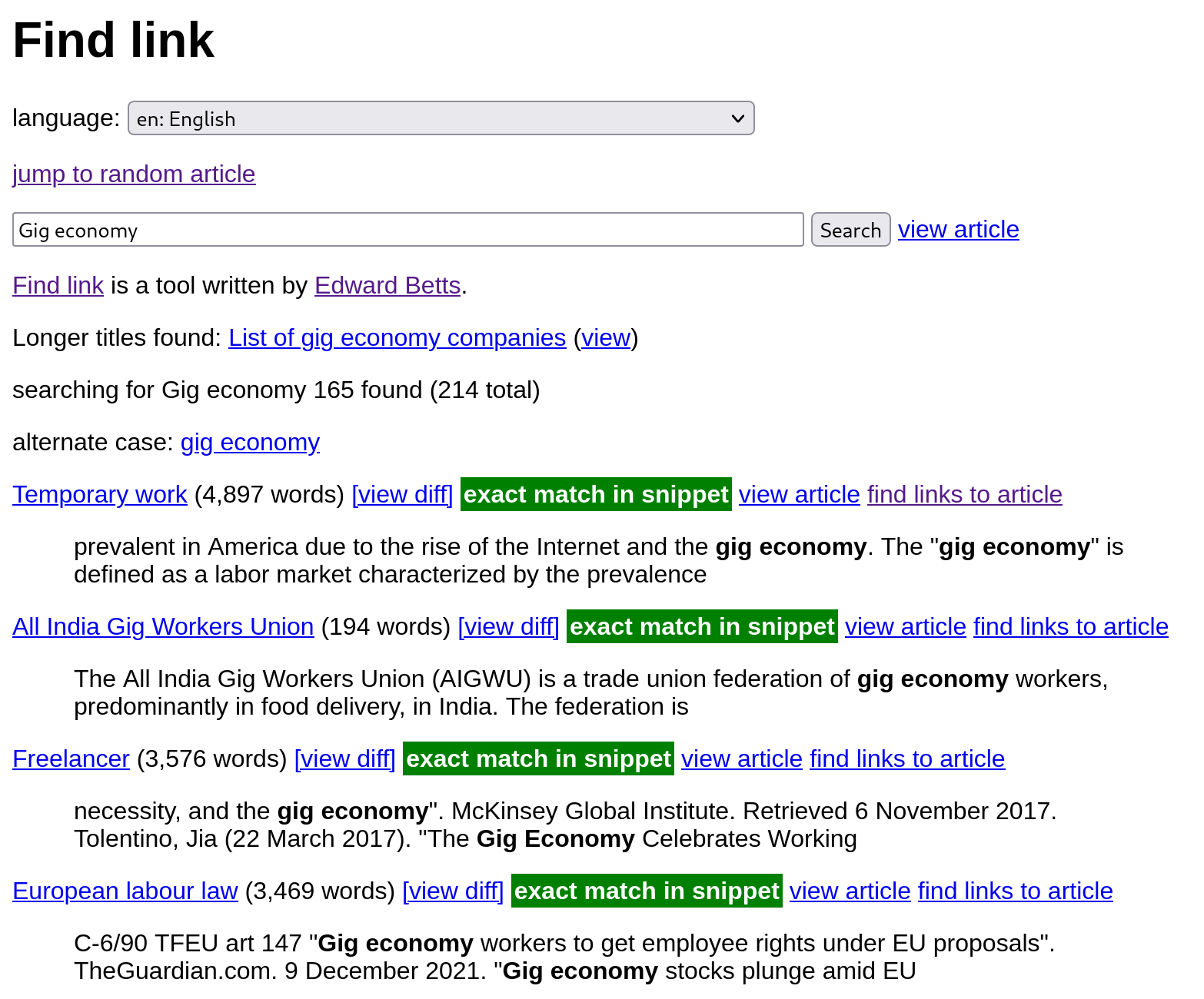
Louis-Philippe V ronneau: Clojure Team 2022 Sprint Report

This is the report for the Debian Clojure Team remote sprint that took place on May 13-14th. Looking at my previous blog entries, this was my first Debian sprint since July 2020! Crazy how fast time flies... Many thanks to those who participated, namely: Sadly, Utkarsh Gupta although having planned on participating ended up not being able to and worked on DebConf Bursary paperwork instead. rlb Rob mostly worked on creating a dh-clojure tool to help make packaging Clojure libraries easier. At the moment, most of the packaging is done manually, by invoking build tools by hand. Having a tool to automate many of the steps required to build Clojure packages would go a long way in making them more uniform. His work (although still very much a WIP) can be found here: https://salsa.debian.org/rlb/dh-clojure/ ehashman Elana: lavamind It was J r me's first time working on Clojure packages, and things went great! During the sprint, he: allentiak Leandro joined us on Saturday, since he couldn't get off work on Friday. He mostly continued working on replacing our in-house scripts for /usr/bin/clojure by upstream's, a task he had already started during GSoC 2021. Sadly, none of us were familiar with Debian's mechanism for alternatives. If you (yes you, dear reader) are familiar with it, I'm sure he would warmly welcome feedback on his development branch. pollo As for me, I: Overall, it was quite a productive sprint! Thanks to Debian for sponsoring our food during the sprint. It was nice to be able to concentrate on fixing things instead of making food :) Here's a bonus picture of the nice sushi platter I ended up getting for dinner on Saturday night: Picture of a sushi platter

13 May 2022

Antoine Beaupr : NVMe/SSD disk failure

Yesterday, my workstation (curie) was hung when I came in the office. After a "skinny elephant", the box rebooted, but it couldn't find the primary disk (in the BIOS). Instead, it booted on the secondary HDD drive, still running an old Fedora 27 install which somehow survived to this day, possibly because ?BTRFS is incomprehensible. Somehow, I blindly accepted the Fedora prompt asking me to upgrade to Fedora 28, not realizing that:
  1. Fedora is now at release 36, not 28
  2. major upgrades take about an hour...
  3. ... and happen at boot time, blocking the entire machine (I'll remember this next time I laugh at Windows and Mac OS users stuck on updates on boot)
  4. you can't skip more than one major upgrade
Which means that upgrading to latest would take over 4 hours. Thankfully, it's mostly automated and seems to work pretty well (which is not exactly the case for Debian). It still seems like a lot of wasted time -- it would probably be better to just reinstall the machine at this point -- and not what I had planned to do that morning at all. In any case, after waiting all that time, the machine booted (in Fedora) again, and now it could detect the SSD disk. The BIOS could find the disk too, so after I reinstalled grub (from Fedora) and fixed the boot order, it rebooted, but secureboot failed, so I turned that off (!?), and I was back in Debian. I did an emergency backup with ddrescue, from the running system which probably doesn't really work as a backup (because the filesystem is likely to be corrupt) but it was fast enough (20 minutes) and gave me some peace of mind. My offsites backup have been down for a while and since I treat my workstations as "cattle" (not "pets"), I don't have a solid recovery scenario for those situations other than "just reinstall and run Puppet", which takes a while. Now I'm wondering what the next step is: probably replace the disk anyways (the new one is bigger: 1TB instead of 500GB), or keep the new one as a hot backup somehow. Too bad I don't have a snapshotting filesystem on there... (Technically, I have LVM, but LVM snapshots are heavy and slow, and can't atomically cover the entire machine.) It's kind of scary how this thing failed: totally dropped off the bus, just not in the BIOS at all. I prefer the way spinning rust fails: clickety sounds, tons of warnings beforehand, partial recovery possible. With this new flashy junk, you just lose everything all at once. Not fun.

Antoine Beaupr : BTRFS notes

I'm not a fan of BTRFS. This page serves as a reminder of why, but also a cheat sheet to figure out basic tasks in a BTRFS environment because those are not obvious to me, even after repeatedly having to deal with them. Content warning: there might be mentions of ZFS.

Stability concerns I'm worried about BTRFS stability, which has been historically ... changing. RAID-5 and RAID-6 are still marked unstable, for example. It's kind of a lucky guess whether your current kernel will behave properly with your planned workload. For example, in Linux 4.9, RAID-1 and RAID-10 were marked as "mostly OK" with a note that says:
Needs to be able to create two copies always. Can get stuck in irreversible read-only mode if only one copy can be made.
Even as of now, RAID-1 and RAID-10 has this note:
The simple redundancy RAID levels utilize different mirrors in a way that does not achieve the maximum performance. The logic can be improved so the reads will spread over the mirrors evenly or based on device congestion.
Granted, that's not a stability concern anymore, just performance. A reviewer of a draft of this article actually claimed that BTRFS only reads from one of the drives, which hopefully is inaccurate, but goes to show how confusing all this is. There are other warnings in the Debian wiki that are quite scary. Even the legendary Arch wiki has a warning on top of their BTRFS page, still. Even if those issues are now fixed, it can be hard to tell when they were fixed. There is a changelog by feature but it explicitly warns that it doesn't know "which kernel version it is considered mature enough for production use", so it's also useless for this. It would have been much better if BTRFS was released into the world only when those bugs were being completely fixed. Or that, at least, features were announced when they were stable, not just "we merged to mainline, good luck". Even now, we get mixed messages even in the official BTRFS documentation which says "The Btrfs code base is stable" (main page) while at the same time clearly stating unstable parts in the status page (currently RAID56). There are much harsher BTRFS critics than me out there so I will stop here, but let's just say that I feel a little uncomfortable trusting server data with full RAID arrays to BTRFS. But surely, for a workstation, things should just work smoothly... Right? Well, let's see the snags I hit.

My BTRFS test setup Before I go any further, I should probably clarify how I am testing BTRFS in the first place. The reason I tried BTRFS is that I was ... let's just say "strongly encouraged" by the LWN editors to install Fedora for the terminal emulators series. That, in turn, meant the setup was done with BTRFS, because that was somewhat the default in Fedora 27 (or did I want to experiment? I don't remember, it's been too long already). So Fedora was setup on my 1TB HDD and, with encryption, the partition table looks like this:
NAME                   MAJ:MIN RM   SIZE RO TYPE  MOUNTPOINT
sda                      8:0    0 931,5G  0 disk  
 sda1                   8:1    0   200M  0 part  /boot/efi
 sda2                   8:2    0     1G  0 part  /boot
 sda3                   8:3    0   7,8G  0 part  
   fedora_swap        253:5    0   7.8G  0 crypt [SWAP]
 sda4                   8:4    0 922,5G  0 part  
   fedora_crypt       253:4    0 922,5G  0 crypt /
(This might not entirely be accurate: I rebuilt this from the Debian side of things.) This is pretty straightforward, except for the swap partition: normally, I just treat swap like any other logical volume and create it in a logical volume. This is now just speculation, but I bet it was setup this way because "swap" support was only added in BTRFS 5.0. I fully expect BTRFS experts to yell at me now because this is an old setup and BTRFS is so much better now, but that's exactly the point here. That setup is not that old (2018? old? really?), and migrating to a new partition scheme isn't exactly practical right now. But let's move on to more practical considerations.

No builtin encryption BTRFS aims at replacing the entire mdadm, LVM, and ext4 stack with a single entity, and adding new features like deduplication, checksums and so on. Yet there is one feature it is critically missing: encryption. See, my typical stack is actually mdadm, LUKS, and then LVM and ext4. This is convenient because I have only a single volume to decrypt. If I were to use BTRFS on servers, I'd need to have one LUKS volume per-disk. For a simple RAID-1 array, that's not too bad: one extra key. But for large RAID-10 arrays, this gets really unwieldy. The obvious BTRFS alternative, ZFS, supports encryption out of the box and mixes it above the disks so you only have one passphrase to enter. The main downside of ZFS encryption is that it happens above the "pool" level so you can typically see filesystem names (and possibly snapshots, depending on how it is built), which is not the case with a more traditional stack.

Subvolumes, filesystems, and devices I find BTRFS's architecture to be utterly confusing. In the traditional LVM stack (which is itself kind of confusing if you're new to that stuff), you have those layers:
  • disks: let's say /dev/nvme0n1 and nvme1n1
  • RAID arrays with mdadm: let's say the above disks are joined in a RAID-1 array in /dev/md1
  • volume groups or VG with LVM: the above RAID device (technically a "physical volume" or PV) is assigned into a VG, let's call it vg_tbbuild05 (multiple PVs can be added to a single VG which is why there is that abstraction)
  • LVM logical volumes: out of that volume group actually "virtual partitions" or "logical volumes" are created, that is where your filesystem lives
  • filesystem, typically with ext4: that's your normal filesystem, which treats the logical volume as just another block device
A typical server setup would look like this:
NAME                      MAJ:MIN RM   SIZE RO TYPE  MOUNTPOINT
nvme0n1                   259:0    0   1.7T  0 disk  
 nvme0n1p1               259:1    0     8M  0 part  
 nvme0n1p2               259:2    0   512M  0 part  
   md0                     9:0    0   511M  0 raid1 /boot
 nvme0n1p3               259:3    0   1.7T  0 part  
   md1                     9:1    0   1.7T  0 raid1 
     crypt_dev_md1       253:0    0   1.7T  0 crypt 
       vg_tbbuild05-root 253:1    0    30G  0 lvm   /
       vg_tbbuild05-swap 253:2    0 125.7G  0 lvm   [SWAP]
       vg_tbbuild05-srv  253:3    0   1.5T  0 lvm   /srv
 nvme0n1p4               259:4    0     1M  0 part
I stripped the other nvme1n1 disk because it's basically the same. Now, if we look at my BTRFS-enabled workstation, which doesn't even have RAID, we have the following:
  • disk: /dev/sda with, again, /dev/sda4 being where BTRFS lives
  • filesystem: fedora_crypt, which is, confusingly, kind of like a volume group. it's where everything lives. i think.
  • subvolumes: home, root, /, etc. those are actually the things that get mounted. you'd think you'd mount a filesystem, but no, you mount a subvolume. that is backwards.
It looks something like this to lsblk:
NAME                   MAJ:MIN RM   SIZE RO TYPE  MOUNTPOINT
sda                      8:0    0 931,5G  0 disk  
 sda1                   8:1    0   200M  0 part  /boot/efi
 sda2                   8:2    0     1G  0 part  /boot
 sda3                   8:3    0   7,8G  0 part  [SWAP]
 sda4                   8:4    0 922,5G  0 part  
   fedora_crypt       253:4    0 922,5G  0 crypt /srv
Notice how we don't see all the BTRFS volumes here? Maybe it's because I'm mounting this from the Debian side, but lsblk definitely gets confused here. I frankly don't quite understand what's going on, even after repeatedly looking around the rather dismal documentation. But that's what I gather from the following commands:
root@curie:/home/anarcat# btrfs filesystem show
Label: 'fedora'  uuid: 5abb9def-c725-44ef-a45e-d72657803f37
    Total devices 1 FS bytes used 883.29GiB
    devid    1 size 922.47GiB used 916.47GiB path /dev/mapper/fedora_crypt
root@curie:/home/anarcat# btrfs subvolume list /srv
ID 257 gen 108092 top level 5 path home
ID 258 gen 108094 top level 5 path root
ID 263 gen 108020 top level 258 path root/var/lib/machines
I only got to that point through trial and error. Notice how I use an existing mountpoint to list the related subvolumes. If I try to use the filesystem path, the one that's listed in filesystem show, I fail:
root@curie:/home/anarcat# btrfs subvolume list /dev/mapper/fedora_crypt 
ERROR: not a btrfs filesystem: /dev/mapper/fedora_crypt
ERROR: can't access '/dev/mapper/fedora_crypt'
Maybe I just need to use the label? Nope:
root@curie:/home/anarcat# btrfs subvolume list fedora
ERROR: cannot access 'fedora': No such file or directory
ERROR: can't access 'fedora'
This is really confusing. I don't even know if I understand this right, and I've been staring at this all afternoon. Hopefully, the lazyweb will correct me eventually. (As an aside, why are they called "subvolumes"? If something is a "sub" of "something else", that "something else" must exist right? But no, BTRFS doesn't have "volumes", it only has "subvolumes". Go figure. Presumably the filesystem still holds "files" though, at least empirically it doesn't seem like it lost anything so far. In any case, at least I can refer to this section in the future, the next time I fumble around the btrfs commandline, as I surely will. I will possibly even update this section as I get better at it, or based on my reader's judicious feedback.

Mounting BTRFS subvolumes So how did I even get to that point? I have this in my /etc/fstab, on the Debian side of things:
UUID=5abb9def-c725-44ef-a45e-d72657803f37   /srv    btrfs  defaults 0   2
This thankfully ignores all the subvolume nonsense because it relies on the UUID. mount tells me that's actually the "root" (? /?) subvolume:
root@curie:/home/anarcat# mount   grep /srv
/dev/mapper/fedora_crypt on /srv type btrfs (rw,relatime,space_cache,subvolid=5,subvol=/)
Let's see if I can mount the other volumes I have on there. Remember that subvolume list showed I had home, root, and var/lib/machines. Let's try root:
mount -o subvol=root /dev/mapper/fedora_crypt /mnt
Interestingly, root is not the same as /, it's a different subvolume! It seems to be the Fedora root (/, really) filesystem. No idea what is happening here. I also have a home subvolume, let's mount it too, for good measure:
mount -o subvol=home /dev/mapper/fedora_crypt /mnt/home
Note that lsblk doesn't notice those two new mountpoints, and that's normal: it only lists block devices and subvolumes (rather inconveniently, I'd say) do not show up as devices:
root@curie:/home/anarcat# lsblk 
NAME                   MAJ:MIN RM   SIZE RO TYPE  MOUNTPOINT
sda                      8:0    0 931,5G  0 disk  
 sda1                   8:1    0   200M  0 part  
 sda2                   8:2    0     1G  0 part  
 sda3                   8:3    0   7,8G  0 part  
 sda4                   8:4    0 922,5G  0 part  
   fedora_crypt       253:4    0 922,5G  0 crypt /srv
This is really, really confusing. Maybe I did something wrong in the setup. Maybe it's because I'm mounting it from outside Fedora. Either way, it just doesn't feel right.

No disk usage per volume If you want to see what's taking up space in one of those subvolumes, tough luck:
root@curie:/home/anarcat# df -h  /srv /mnt /mnt/home
Filesystem                Size  Used Avail Use% Mounted on
/dev/mapper/fedora_crypt  923G  886G   31G  97% /srv
/dev/mapper/fedora_crypt  923G  886G   31G  97% /mnt
/dev/mapper/fedora_crypt  923G  886G   31G  97% /mnt/home
(Notice, in passing, that it looks like the same filesystem is mounted in different places. In that sense, you'd expect /srv and /mnt (and /mnt/home?!) to be exactly the same, but no: they are entirely different directory structures, which I will not call "filesystems" here because everyone's head will explode in sparks of confusion.) Yes, disk space is shared (that's the Size and Avail columns, makes sense). But nope, no cookie for you: they all have the same Used columns, so you need to actually walk the entire filesystem to figure out what each disk takes. (For future reference, that's basically:
root@curie:/home/anarcat# time du -schx /mnt/home /mnt /srv
124M    /mnt/home
7.5G    /mnt
875G    /srv
883G    total
real    2m49.080s
user    0m3.664s
sys 0m19.013s
And yes, that was painfully slow.) ZFS actually has some oddities in that regard, but at least it tells me how much disk each volume (and snapshot) takes:
root@tubman:~# time df -t zfs -h
Filesystem         Size  Used Avail Use% Mounted on
rpool/ROOT/debian  3.5T  1.4G  3.5T   1% /
rpool/var/tmp      3.5T  384K  3.5T   1% /var/tmp
rpool/var/spool    3.5T  256K  3.5T   1% /var/spool
rpool/var/log      3.5T  2.0G  3.5T   1% /var/log
rpool/home/root    3.5T  2.2G  3.5T   1% /root
rpool/home         3.5T  256K  3.5T   1% /home
rpool/srv          3.5T   80G  3.5T   3% /srv
rpool/var/cache    3.5T  114M  3.5T   1% /var/cache
bpool/BOOT/debian  571M   90M  481M  16% /boot
real    0m0.003s
user    0m0.002s
sys 0m0.000s
That's 56360 times faster, by the way. But yes, that's not fair: those in the know will know there's a different command to do what df does with BTRFS filesystems, the btrfs filesystem usage command:
root@curie:/home/anarcat# time btrfs filesystem usage /srv
Overall:
    Device size:         922.47GiB
    Device allocated:        916.47GiB
    Device unallocated:        6.00GiB
    Device missing:          0.00B
    Used:            884.97GiB
    Free (estimated):         30.84GiB  (min: 27.84GiB)
    Free (statfs, df):        30.84GiB
    Data ratio:               1.00
    Metadata ratio:           2.00
    Global reserve:      512.00MiB  (used: 0.00B)
    Multiple profiles:              no
Data,single: Size:906.45GiB, Used:881.61GiB (97.26%)
   /dev/mapper/fedora_crypt  906.45GiB
Metadata,DUP: Size:5.00GiB, Used:1.68GiB (33.58%)
   /dev/mapper/fedora_crypt   10.00GiB
System,DUP: Size:8.00MiB, Used:128.00KiB (1.56%)
   /dev/mapper/fedora_crypt   16.00MiB
Unallocated:
   /dev/mapper/fedora_crypt    6.00GiB
real    0m0,004s
user    0m0,000s
sys 0m0,004s
Almost as fast as ZFS's df! Good job. But wait. That doesn't actually tell me usage per subvolume. Notice it's filesystem usage, not subvolume usage, which unhelpfully refuses to exist. That command only shows that one "filesystem" internal statistics that are pretty opaque.. You can also appreciate that it's wasting 6GB of "unallocated" disk space there: I probably did something Very Wrong and should be punished by Hacker News. I also wonder why it has 1.68GB of "metadata" used... At this point, I just really want to throw that thing out of the window and restart from scratch. I don't really feel like learning the BTRFS internals, as they seem oblique and completely bizarre to me. It feels a little like the state of PHP now: it's actually pretty solid, but built upon so many layers of cruft that I still feel it corrupts my brain every time I have to deal with it (needle or haystack first? anyone?)...

Conclusion I find BTRFS utterly confusing and I'm worried about its reliability. I think a lot of work is needed on usability and coherence before I even consider running this anywhere else than a lab, and that's really too bad, because there are really nice features in BTRFS that would greatly help my workflow. (I want to use filesystem snapshots as high-performance, high frequency backups.) So now I'm experimenting with OpenZFS. It's so much simpler, just works, and it's rock solid. After this 8 minute read, I had a good understanding of how ZFS worked. Here's the 30 seconds overview:
  • vdev: a RAID array
  • vpool: a volume group of vdevs
  • datasets: normal filesystems (or block device, if you want to use another filesystem on top of ZFS)
There's also other special volumes like caches and logs that you can (really easily, compared to LVM caching) use to tweak your setup. You might also want to look at recordsize or ashift to tweak the filesystem to fit better your workload (or deal with drives lying about their sector size, I'm looking at you Samsung), but that's it. Running ZFS on Linux currently involves building kernel modules from scratch on every host, which I think is pretty bad. But I was able to setup a ZFS-only server using this excellent documentation without too much problem. I'm hoping some day the copyright issues are resolved and we can at least ship binary packages, but the politics (e.g. convincing Debian that is the right thing to do) and the logistics (e.g. DKMS auto-builders? is that even a thing? how about signed DKMS packages? fun-fun-fun!) seem really impractical. Who knows, maybe hell will freeze over (again) and Oracle will fix the CDDL. I personally think that we should just completely ignore this problem (which wasn't even supposed to be a problem) and ship binary packages directly, but I'm a pragmatic and do not always fit well with the free software fundamentalists. All of this to say that, short term, we don't have a reliable, advanced filesystem/logical disk manager in Linux. And that's really too bad.

Arturo Borrero Gonz lez: Toolforge GridEngine Debian 10 Buster migration

Toolforge logo, a circle with an anvil in the middle This post was originally published in the Wikimedia Tech blog, authored by Arturo Borrero Gonzalez. In accordance with our operating system upgrade policy, we should migrate our servers to Debian Buster. As discussed in the previous post, one of the most important and successful services provided by the Wikimedia Cloud Services team at the Wikimedia Foundation is Toolforge. Toolforge is a platform that allows users and developers to run and use a variety of applications with the ultimate goal of helping the Wikimedia mission from the technical side. As you may know already, all Wikimedia Foundation servers are powered by Debian, and this includes Toolforge and Cloud VPS. The Debian Project mostly follows a two year cadence for releases, and Toolforge has been using Debian Stretch for some years now, which nowadays is considered old-old-stable . In accordance with our operating system upgrade policy, we should migrate our servers to Debian Buster. Toolforge s two different backend engines, Kubernetes and Grid Engine, are impacted by this upgrade policy. Grid Engine is notably tied to the underlying Debian release, and the execution environment offered to tools running in the grid is limited to what the Debian archive contains for a given release. This is unlike in Kubernetes, where tool developers can leverage container images and decouple the runtime environment selection from the base operating system. Since the Toolforge grid original conception, we have been doing the same operation over and over again: We ve done this type of migration several times before. The last few ones were Ubuntu Precise to Ubuntu Trusty and Ubuntu Trusty to Debian Stretch. But this time around we had some special angles to consider.
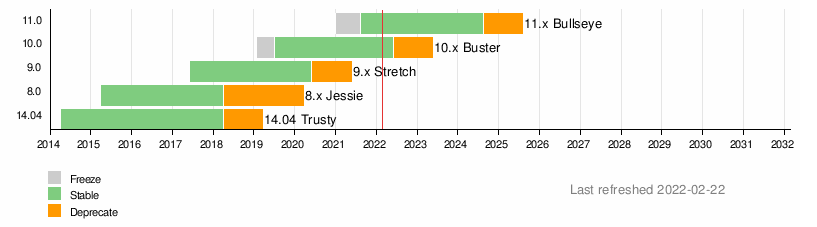
So, you are upgrading the Debian release
  • You are migrating to Debian 11 Bullseye, no?
  • No, we re migrating to Debian 10 Buster
  • Wait, but Debian 11 Bullseye exists!
  • Yes, we know! Let me explain
We re migrating the grid from Debian 9 Stretch to Debian 10 Buster, but perhaps we should be migrating from Debian 9 Stretch to Debian 11 Bullseye directly. This is a legitimate concern, and we discussed it in September 2021. A timeline showing Debian versions since 2014 Back then, our reasoning was that skipping to Debian 11 Bullseye would be more difficult for our users, especially because greater jump in version numbers for the underlying runtimes. Additionally, all the migration work started before Debian 11 Bullseye was released. Our original intention was for the migration to be completed before the release. For a couple of reasons the project was delayed, and when it was time to restart the project we decided to continue with the original idea. We had some work done to get Debian 10 Buster working correctly with the grid, and supporting Debian 11 Bullseye would require an additional effort. We didn t even check if Grid Engine could be installed in the latest Debian release. For the grid, in general, the engineering effort to do a N+1 upgrade is lower than doing a N+2 upgrade. If we had tried a N+2 upgrade directly, things would have been much slower and difficult for us, and for our users. In that sense, our conclusion was to not skip Debian 10 Buster.

We no longer want to run Grid Engine In a previous blog post we shared information about our desired future for Grid Engine in Toolforge. Our intention is to discontinue our usage of this technology.

No grid? What about my tools? Toolforge logo, a circle with an anvil in the middle Traditionally there have been two main workflows or use cases that were supported in the grid, but not in our Kubernetes backend:
  • Running jobs, long-running bots and other scheduled tasks.
  • Mixing runtime environments (for example, a nodejs app that runs some python code).
The good news is that work to handle the continuity of such use cases has already started. This takes the form of two main efforts:
  • The Toolforge buildpacks project to support arbitrary runtime environments.
  • The Toolforge Jobs Framework to support jobs, scheduled tasks, etc.
In particular, the Toolforge Jobs Framework has been available for a while in an open beta phase. We did some initial design and implementation, then deployed it in Toolforge for some users to try it and report bugs, report missing features, etc. These are complex, and feature-rich projects, and they deserve a dedicated blog post. More information on each will be shared in the future. For now, it is worth noting that both initiatives have some degree of development already. The conclusion Knowing all the moving parts, we were faced with a few hard questions when deciding how to approach the Debian 9 Stretch deprecation:
  • Should we not upgrade the grid, and focus on Kubernetes instead? Let Debian 9 Stretch be the last supported version on the grid?
  • What is the impact of these decisions on the technical community? What is best for our users?
The choices we made are already known in the community. A couple of weeks ago we announced the Debian 9 Stretch Grid Engine deprecation. In parallel to this migration, we decided to promote the new Toolforge Jobs Framework, even if it s still in beta phase. This new option should help users to future-proof their tool, and reduce maintenance effort. An early migration to Kubernetes now will avoid any more future grid problems. We truly hope that Debian 10 Buster is the last version we have for the grid, but as they say, hope is not a good strategy when it comes to engineering. What we will do is to work really hard in bringing Toolforge to the service level we want, and that means to keep developing and enabling more Kubernetes-based functionalities. Stay tuned for more upcoming blog posts with additional information about Toolforge. This post was originally published in the Wikimedia Tech blog, authored by Arturo Borrero Gonzalez.

Next.

Previous.