Search Results: "don"

25 August 2023

Ian Jackson: I cycled to all the villages in alphabetical order

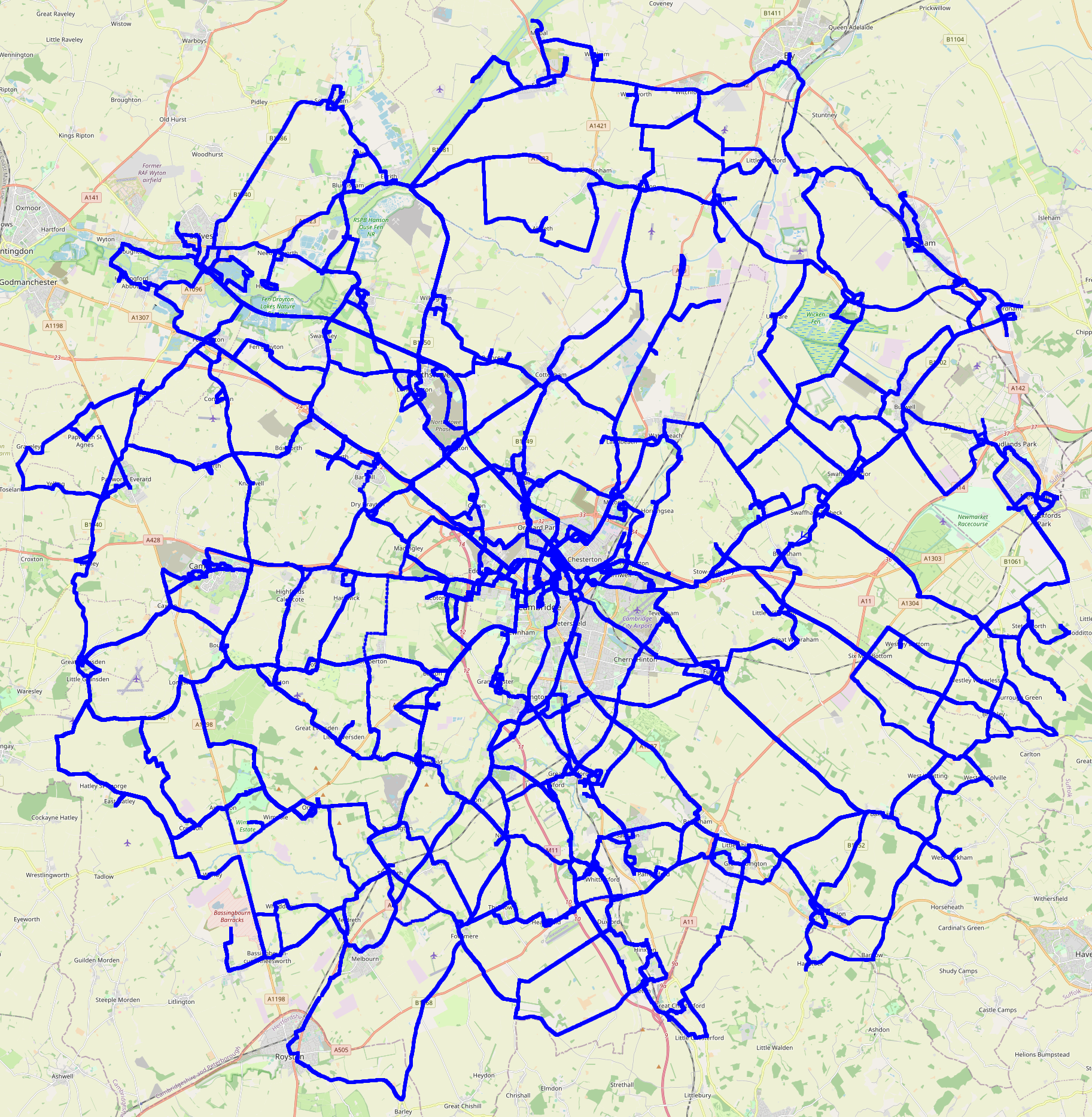
This last weekend I completed a bike rides project I started during the first Covid lockdown in 2020: I ve cycled to every settlement (and radio observatory) within 20km of my house, in alphabetical order. Stir crazy In early 2020, during the first lockdown, I was going a bit stir crazy. Clare said you re going very strange, you have to go out and get some exercise . After a bit of discussion, we came up with this plan: I d visit all the local villages, in alphabetical order. Choosing the radius I decided that I would pick a round number of kilometers, as the crow flies, from my house. 20km seemed about right. 25km would have included Ely, which would have been nice, but it would have added a great many places, all of them quite distant. Software I wrote a short Rust program to process OSM data into a list of places to visit, and their distances and bearings. You can download a tarball of the alphabetical villages scanner. (I haven t published the git history because it has my house s GPS coordinates in it, and because I committed the output files from which that location can be derived.) The Rides I set off on my first ride, to Aldreth, on Sunday the 31st of May 2020. The final ride collected Yelling, on Saturday the 19th of August 2023. I did quite a few rides in June and July 2020 - more than one a week. (I d read the lockdown rules, and although some of the government messaging said you should stay near your house, that wasn t in the legislation. Of course I didn t go into any buildings or anything.) I m not much of a morning person, so I often set off after lunch. For the longer rides I would usually pack a picnic. Almost all of the rides I did just by myself. There were a handful where I had friends along: Dry Drayton, which I collected with Clare, at night. I held my bike up so the light shone at the village sign, so we could take a photo of it. Madingley, Melbourn and Meldreth, which was quite an expedition with my friend Ben. We went out as far as Royston and nearby Barley (both outside my radius and not on my list) mostly just so that my project would have visited Hertfordshire. The Hemingfords, where I had my friend Matthew along, and we had a very nice pub lunch. Girton and Wilburton, where I visited friends. Indeed, I stopped off in Wilburton on one or two other occasions. And, of course, Yelling, for which there were four of us, again with a nice lunch (in Eltisley). I had relatively little mechanical trouble. My worst ride for this was Exning: I got three punctures that day. Luckily the last one was close to home. I often would stop to take lots of photos en-route. My mum in particular appreciated all the pretty pictures. Rules I decided on these rules: I would cycle to each destination, in order, and it would count as collected if I rode both there and back. I allowed collecting multiple villages in the same outing, provided I did them in the right order. (And obviously I was allowed to pass through places out of order, without counting them.) I tried to get a picture of the village sign, where there was one. Failing that, I got a picture of something in the village with the village s name on it. I think the only one I didn t manage this for was Westley Bottom; I had to make do with the word Westley on some railway level crossing equipment. In Barway I had to make do with a planning application, stuck to a pole. I tried not to enter and leave a village by the same road, if possible. Edge cases I had to make some decisions: I decided that I would consider the project complete if I visited everywhere whose centre was within my radius. But the centre of a settlement is rather hard to define. I needed a hard criterion for my OpenStreetMap data mining: a place counted if there was any node, way or relation, with the relevant place tag, any part of which was within my ambit. That included some places that probably oughtn t to have counted, but, fine. I also decided that I wouldn t visit suburbs of Cambridge, separately from Cambridge itself. I don t consider them separate settlements, at least, not if they re conurbated with Cambridge. So that excluded Trumpington, for example. But I decided that Girton and Fen Ditton were (just) separable. Although the place where I consider Girton and Cambridge to nearly touch, is administratively well inside Girton, I chose to look at land use (on the ground, and in OSM data), rather than administrative boundaries. But I did visit both Histon and Impington, and all each of the Shelfords and Stapleford, as separate entries in my list. Mostly because otherwise I d have to decide whether to skip (say) Impington, or Histon. Whereas skipping suburbs of Cambridge in favour of Cambridge itself was an easy decision, and it also got rid of a bunch of what would have been quite short, boring, urban expeditions. I sorted all the Greats and Littles under G and L, rather than (say) Shelford, Great , which seemed like it would be cheating because then I would be able to do Shelford, Great and Shelford, Little in one go. Northstowe turned from mostly a building site into something that was arguably a settlement, during my project. It wasn t included in the output of my original data mining. Of course it s conurbated with Oakington - but happily, Northstowe inserts right before Oakington in the alphabetical list, so I decided to add it, visiting both the old and new in the same day. There are a bunch of other minor edge cases. Some villages have an outlying hamlet. Mostly I included these. There are some individual farms, which I generally didn t count. Some stats I visited 150 villages plus the Lords Bridge radio observatory. The project took 3 years and 3 months to complete. There were 96 rides, totalling about 4900km. So my mean distance was around 51km. The median distance per ride was a little higher, at around 52 km, and the median duration (including stoppages) was about 2h40. The total duration, if you add them all up, including stoppages, was about 275h, giving a mean speed including photo stops, lunches and all, of 18kph. The longest ride was 89.8km, collecting Scotland Farm, Shepreth, and Six Mile Bottom, so riding across the Cam valley. The shortest ride was 7.9km, collecting Cambridge (obviously); and I think that s the only one I did on my Brompton. The rest were all on my trusty Thorn Audax. My fastest ride (ranking by distance divided by time spent in motion) was to collect Haddenham, where I covered 46.3km in 1h39, giving an average speed in motion of 28.0kph. The most I collected in one day was 5 places: West Wickham, West Wratting, Westley Bottom, Westley Waterless, and Weston Colville. That was the day of the Wests. (There s only one East: East Hatley.) Map Here is a pretty picture of all of my tracklogs:
Edited 2023-08-25 01:32 BST to correct a slip.


comment count unavailable comments

24 August 2023

Lukas M rdian: Netplan v0.107 is now available

I m happy to announce that Netplan version 0.107 is now available on GitHub and is soon to be deployed into a Linux installation near you! Six months and more than 200 commits after the previous version (including a .1 stable release), this release is brought to you by 8 free software contributors from around the globe.

Highlights Highlights of this release include the new configuration types for veth and dummy interfaces:
network:
  version: 2
  virtual-ethernets:
    veth0:
      peer: veth1
    veth1:
      peer: veth0
  dummy-devices:
    dm0:
      addresses:
        - 192.168.0.123/24
      ...
Furthermore, we implemented CFFI based Python bindings on top of libnetplan s API, that can easily be consumed by 3rd party applications (see full cffi-bindings.py example):
from netplan import Parser, State, NetDefinition
from netplan import NetplanException, NetplanParserException

parser = Parser()
# Parse the full, existing YAML config hierarchy
parser.load_yaml_hierarchy(rootdir='/')
# Validate the final parser state
state = State()
try:
    # validation of current state + new settings
    state.import_parser_results(parser)
except NetplanParserException as e:
    print('Error in', e.filename, 'Row/Col', e.line, e.column, '->', e.message)
except NetplanException as e:
    print('Error:', e.message)
# Walk through ethernet NetdefIDs in the state and print their backend
# renderer, to demonstrate working with NetDefinitionIterator &
# NetDefinition
for netdef in state.ethernets.values():
    print('Netdef', netdef.id, 'is managed by:', netdef.backend)
    print('Is it configured to use DHCP?', netdef.dhcp4 or netdef.dhcp6)

Changelog:

Bug fixes:

23 August 2023

Jo Shields: Retirement

Apparently it s nearly four years since I last posted to my blog. Which is, to a degree, the point here. My time, and priorities, have changed over the years. And this lead me to the decision that my available time and priorities in 2023 aren t compatible with being a Debian or Ubuntu developer, and realistically, haven t been for years. As of earlier this month, I quit as a Debian Developer and Ubuntu MOTU. I think a lot of my blogging energy got absorbed by social media over the last decade, but with the collapse of Twitter and Reddit due to mismanagement, I m trying to allocate more time for blog-based things instead. I may write up some of the things I ve achieved at work (.NET 8 is now snapped for release Soon ). I might even blog about work-adjacent controversial topics, like my changed feelings about the entire concept of distribution packages. But there s time for that later. Maybe. I ll keep tagging vaguely FOSS related topics with the Debian and Ubuntu tags, which cause them to be aggregated in the Planet Debian/Ubuntu feeds (RSS, remember that from the before times?!) until an admin on those sites gets annoyed at the off-topic posting of an emeritus dev and deletes them. But that s where we are. Rather than ignore my distro obligations, I ve admitted that I just don t have the energy any more. Let someone less perpetually exhausted than me take over. And if they don t, maybe that s OK too.

22 August 2023

Scarlett Gately Moore: KDE: A Day in the Life the KDE Snapcrafter Part 2

KDE MascotKDE Mascot
Much to my dismay, I figured out that my blog has been disabled on the Ubuntu planet since May. If you are curious about what I have been up to, please go to the handy links -> and read up! This post is a continuation of last weeks https://www.scarlettgatelymoore.dev/kde-a-day-in-the-life-of-the-kde-snapcrafter/ IMPORTANT: I am still looking for a super awesome team lead for a super amazing project involving KDE and Snaps. Time is running out and well the KDE world will be a better a better place if this project goes through! I would like to clarify, this is a paid position! A current KDE developer would be ideal as it is a small team so your time will be split managing and coding alike. If you or anyone you know might be interested please contact me ASAP! Snaps: I am wrapping up the 23.04.3 KDE applications release! Head on over to https://snapcraft.io/search?q=KDE and enjoy! We are now up to 180 snaps! PIM snaps will be slowly rolling in as they go through manual reviews for D-Bus. Snapcraft: minor fix in qmake plugin found by ruff. Launchpad: I almost have approval for per application repository snapcraft files, but I have to prove it will work to our benefit and not cause loads of polling etc. So I have been testing various methods of achieving such a task, and so far I have come up with launchpads ability to watch and download release tarballs into a project. I will then need to script getting the tarball and pushing it to a bzr branch from which I can create a proper snap recipe. Unfortunately, my proper snap recipe fails! Hopefully a very helpful cjwatson will chime in, or if anyone wants to take a gander please chime in here: https://bugs.launchpad.net/launchpad/+bug/2031307 As reality sets in that my project may not happen if I don t find anyone, I need help surviving until I find work or funding to continue my snap work ( still much to do! ) If you or anyone else you know enjoys our snaps please consider a donation, anything helps! Please share! Thank you for your consideration!

20 August 2023

Russell Coker: GPT Systems and Relationships

Sam Hartman wrote an interesting blog post about his work as a sex and intimacy educator and how GPT systems could impact that [1]. I ve read some positive reviews of Replika a commercial system that is somewhat promoted as a counsellor [2], so I decided to try it out. In my brief trial it seemed to be using all the methods that Android pay to play games are known for. Having multiple types of in-game currency, pay to buy new clothes etc for your friend, etc. Basically it seems pretty horrible. I didn t pay for it and the erotic and romantic features all require payment so I didn t test that. When thinking about this logically, having a system designed to deal with people when they are vulnerable (either being in a romantic relationship or getting counselling) that uses manipulative techniques to get money from them can t have a good result. So a free software system seems the best option. When I first learned of virtual girlfriends I never thought I would feel compelled to advocate for a free software virtual dating program, but that s where the world has got to. Virtual girlfriends have been around for years now. Several years ago I watched a documentary about their use in Japan. It seemed a bit strange when a group of men who had virtual girlfriends had a dinner party with their tablets and phones propped up so their girlfriends could join in as they all appeared to be dating the same girl. The documentary didn t go in to enough detail to cover whether the girlfriend app could learn or be customised enough that they would seem to have different personalities. Virtual boyfriends have also been around for a while apparently without most people noticing. I just Googled it and found a review of a virtual boyfriend app published in 2016! One thing that will probably concern people is the possibility for virtual dating systems to be used for inappropriate things. That is a reasonable thing to be concerned about but I don t think it s possible to prevent technology that has already been released from doing such things. As a general rule technology can always be used for good and bad things so we need to just make it easy to do good things and let the legal system develop ways of dealing with the bad things.

18 August 2023

Scarlett Gately Moore: KDE: A day in the life of the KDE snapcrafter!

KDE MascotKDE Mascot
As mentioned last week, I am still looking for a super awesome team lead for a super amazing project involving KDE and Snaps. Time is running out and well the KDE world will be a better a better place if this project goes through! I would like to clarify, this is a paid position! A current KDE developer would be ideal as it is a small team so your time will be split managing and coding alike. If you or anyone you know might be interested please contact me ASAP! On to snappy things I have achieved this week: Most 23.04.3 is done, I am just testing them now. New applications: kmymoney ( Thanks Carlos! ), kde-dev-utils, and kxstitch ( Thanks Jeremy! ) With that said, I have seen on the internets candidate channel apps being promoted. Please use this channel with utmost care as they are being tested and could quite possibly be very broken! Still working on some QML issues with kirigami platform not found. I have begun the launchpad build issues journey and have been kindly pointed to using snap recipes on launchpad so we aren t doing public uploads which creates temporary recipes to build and cannot be bumped priority wise. So I have sent the request into the kde-devel arena to revisit having per repository snapcraft files ( rejected in the past ) as they do with flatpak files. So far I am getting positive feedback and hopefully this will go through. Once it does I can move forward with fully automating application new releases. Hooray! This week I jumped into the xdg-desktop-portals rabbithole while working on https://bugs.kde.org/show_bug.cgi?id=473003 for neochat. After fixing it with adding plug password-manager-service I am told that auto-connect on that one is discouraged and the libsecret should work out of the box with portals. I found and joined just in time a snapcrafter google meet and we had a long conversation spitballing and testing our portal support. At least in Neon it appears to be broken. I now have some things to do and test to see that we get this functional. Most of our online apps are affected. For now though snap connect neochat:password-manager-service :password-manager-service does work. Auto-connect was rejected as it exposes to much. Understandable. I have started a new thread on the KDE forums for users to ask any questions, or let me know of any issues you may have related to snaps here: https://discuss.kde.org/t/all-things-snaps-questions-concerns-praise/4033 come join the conversation! In the snapcraft arena I have fixed my PR for the much needed qmake plugin! This should be merged and rolled out in the very near future! I would like to continue my hard work on snap things regardless of the project going through. Unfortunately, to do so, I must ask for donations as life isn t free. I am working on self sufficiency but even that costs money to get started! KDE snaps are used by 1.7 million active devices! I do ask that if you use KDE snaps and find my work useful, or know someone that does, to please consider donating to keep my momentum going. There is still much work to be done with Qt6 rolling out. I would like to work on the KDE Plasma snap and KDE PIM suite of apps ( I have started on this ). Even if you can t help, please share! Thank you for your consideration! I have a new donation form for anyone that doesn t like gofundme here:
Gofund me:

16 August 2023

Sam Hartman: A First Exercise with AI Training

Taking a hands-on low-level approach to learning AI has been incredibly rewarding. I wanted to create an achievable task that would motivate me to learn the tools and get practical experience training and using large language models. Just at the point when I was starting to spin up GPU instances, Llama2 was released to the public. So I elected to start with that model. As I mentioned, I m interested in exploring how sex-positive AI can help human connection in positive ways. For that reason, I suspected that Llama2 might not produce good results without training: some of Meta s safety goals run counter to what I m trying to explore. I suspected that there might be more attention paid to safety in the chat variants of Llama2 rather than the text generation variants, and working against that might be challenging for a first project, so I started with Llama-2-13b as a base. Preparing a Dataset I elected to generate a fine tuning dataset using fiction. Long term, that might not be a good fit. But I ve always wanted to understand how an LLM s tone is adjusted how you get an LLM to speak in a different voice. So much of fine tuning focuses on examples where a given prompt produces a particular result. I wanted to understand how to bring in data that wasn t structured as prompts. The Huggingface course actually gives an example of how to adjust a model set up for masked language modeling trained on wikitext to be better at predicting the vocabulary of movie reviews. There though, doing sample breaks in the dataset at movie review boundaries makes sense. There s another example of training an LLM from scratch based on a corpus of python code. Between these two examples, I figured out what I needed. It was relatively simple in retrospect: tokenize the whole mess, and treat everything as output. That is, compute loss on all the tokens. Long term, using fiction as a way to adjust how the model responds is likely to be the wrong starting point. However, it maximized focus on aspects of training I did not understand and allowed me to satisfy my curiosity. Rangling the Model I decided to actually try and add additional training to the model directly rather than building an adapter and fine tuning a small number of parameters. Partially this was because I had enough on my mind without understanding how LoRA adapters work. Partially, I wanted to gain an appreciation for the infrastructure complexity of AI training. I have enough of a cloud background that I ought to be able to work on distributed training. (As it turned out, using BitsAndBytes 8-bit optimizer, I was just able to fit my task onto a single GPU). I wasn t even sure that I could make a measurable difference in Llama-2-13b running 890,000 training tokens through a couple of training epochs. As it turned out I had nothing to fear on that front. Getting everything to work was more tricky than I expected. I didn t have an appreciation for exactly how memory intensive training was. The Transformers documentation points out that with typical parameters for mixed-precision training, it takes 18 bytes per model parameter. Using bfloat16 training and an 8-bit optimizer was enough to get things to fit. Of course then I got to play with convergence. My initial optimizer parameters caused the model to diverge, and before I knew it, my model had turned to NAN, and would only output newlines. Oops. But looking back over the logs, watching what happened to the loss, and looking at the math in the optimizer to understand how I ended up getting something that rounded to a divide by zero gave me a much better intuition for what was going on. The results. This time around I didn t do anything in the way of quantitative analysis of what I achieved. Empirically I definitely changed the tone of the model. The base Llama-2 model tends to steer away from sexual situations. It s relatively easy to get it to talk about affection and sometimes attraction. Unsurprisingly, given the design constraints, it takes a bit to get it to wonder into sexual situations. But if you hit it hard enough with your prompt, it will go there, and the results are depressing. At least for prompts I used, it tended to view sex fairly negatively. It tended to be less coherent than with other prompts. One inference managed to pop out in the middle of some text that wasn t hanging together well, Chapter 7 - Rape. With my training, I did manage to achieve my goal of getting the model to use more positive language and emotional signaling when talking about sexual situations. More importantly, I gained a practical understanding of many ways training can go wrong. A lot of articles I ve been reading about training make more sense. I have better intuition for why you might want to do training a certain way, or why mechanisms for countering some problem will be important. Future Activities:

comment count unavailable comments

Simon Josefsson: Enforcing wrap-and-sort -satb

For Debian package maintainers, the wrap-and-sort tool is one of those nice tools that I use once in a while, and every time have to re-read the documentation to conclude that I want to use the --wrap-always --short-indent --trailing-comma --sort-binary-package options (or -satb for short). Every time, I also wish that I could automate this and have it always be invoked to keep my debian/ directory tidy, so I don t have to do this manually once every blue moon. I haven t found a way to achieve this automation in a non-obtrusive way that interacts well with my git-based packaging workflow. Ideally I would like for something like the lintian-hook during gbp buildpackage to check for this ideas? Meanwhile, I have come up with a way to make sure I don t forget to run wrap-and-sort for long, and that others who work on the same package won t either: create an autopkgtest which is invoked during the Salsa CI/CD pipeline using the following as debian/tests/wrap-and-sort:
#!/bin/sh
set -eu
TMPDIR=$(mktemp -d)
trap "rm -rf $TMPDIR" 0 INT QUIT ABRT PIPE TERM
cp -a debian $TMPDIR
cd $TMPDIR
wrap-and-sort -satb
diff -ur $OLDPWD/debian debian
Add the following to debian/tests/control to invoke it which is intentionally not indented properly so that the self-test will fail so you will learn how it behaves.
Tests: wrap-and-sort
Depends: devscripts, python3-debian
Restrictions: superficial
Now I will get build failures in the pipeline once I upload the package into Salsa, which I usually do before uploading into Debian. I will get a diff output, and it won t be happy until I push a commit with the output of running wrap-and-sort with the parameters I settled with. While autopkgtest is intended to test the installed package, the tooling around autopkgtest is powerful and easily allows this mild abuse of its purpose for a pleasant QA improvement. Thoughts? Happy hacking!

Wouter Verhelst: Perl test suites in GitLab

I've been maintaining a number of Perl software packages recently. There's SReview, my video review and transcoding system of which I split off Media::Convert a while back; and as of about a year ago, I've also added PtLink, an RSS aggregator (with future plans for more than just that). All these come with extensive test suites which can help me ensure that things continue to work properly when I play with things; and all of these are hosted on salsa.debian.org, Debian's gitlab instance. Since we're there anyway, I configured GitLab CI/CD to run a full test suite of all the software, so that I can't forget, and also so that I know sooner rather than later when things start breaking. GitLab has extensive support for various test-related reports, and while it took a while to be able to enable all of them, I'm happy to report that today, my perl test suites generate all three possible reports. They are: Additionally, I also store the native perl Devel::Cover report as job artifacts, as they show some information that GitLab does not. It's important to recognize that not all data is useful. For instance, the JUnit report allows for a test name and for details of the test. However, the module that generates the JUnit report from TAP test suites does not make a distinction here; both the test name and the test details are reported as the same. Additionally, the time a test took is measured as the time between the end of the previous test and the end of the current one; there is no "start" marker in the TAP protocol. That being said, it's still useful to see all the available information in GitLab. And it's not even all that hard to do:
test:
  stage: test
  image: perl:latest
  coverage: '/^Total.* (\d+.\d+)$/'
  before_script:
    - cpanm ExtUtils::Depends Devel::Cover TAP::Harness::JUnit Devel::Cover::Report::Cobertura
    - cpanm --notest --installdeps .
    - perl Makefile.PL
  script:
    - cover -delete
    - HARNESS_PERL_SWITCHES='-MDevel::Cover' prove -v -l -s --harness TAP::Harness::JUnit
    - cover
    - cover -report cobertura
  artifacts:
    paths:
    - cover_db
    reports:
      junit: junit_output.xml
      coverage_report:
        path: cover_db/cobertura.xml
        coverage_format: cobertura
Let's expand on that a bit. The first three lines should be clear for anyone who's used GitLab CI/CD in the past. We create a job called test; we start it in the test stage, and we run it in the perl:latest docker image. Nothing spectacular here. The coverage line contains a regular expression. This is applied by GitLab to the output of the job; if it matches, then the first bracket match is extracted, and whatever that contains is assumed to contain the code coverage percentage for the code; it will be reported as such in the GitLab UI for the job that was ran, and graphs may be drawn to show how the coverage changes over time. Additionally, merge requests will show the delta in the code coverage, which may help deciding whether to accept a merge request. This regular expression will match on a line of that the cover program will generate on standard output. The before_script section installs various perl modules we'll need later on. First, we intall ExtUtils::Depends. My code uses ExtUtils::MakeMaker, which ExtUtils::Depends depends on (no pun intended); obviously, if your perl code doesn't use that, then you don't need to install it. The next three modules -- Devel::Cover, TAP::Harness::JUnit and Devel::Cover::Report::Cobertura are necessary for the reports, and you should include them if you want to copy what I'm doing. Next, we install declared dependencies, which is probably a good idea for you as well, and then we run perl Makefile.PL, which will generate the Makefile. If you don't use ExtUtils::MakeMaker, update that part to do what your build system uses. That should be fairly straightforward. You'll notice that we don't actually use the Makefile. This is because we only want to run the test suite, which in our case (since these are PurePerl modules) doesn't require us to build the software first. One might consider that this makes the call of perl Makefile.PL useless, but I think it's a useful test regardless; if that fails, then obviously we did something wrong and shouldn't even try to go further. The actual tests are run inside a script snippet, as is usual for GitLab. However we do a bit more than you would normally expect; this is required for the reports that we want to generate. Let's unpack what we do there:
cover -delete
This deletes any coverage database that might exist (e.g., due to caching or some such). We don't actually expect any coverage database, but it doesn't hurt.
HARNESS_PERL_SWITCHES='-MDevel::Cover'
This tells the TAP harness that we want it to load the Devel::Cover addon, which can generate code coverage statistics. It stores that in the cover_db directory, and allows you to generate all kinds of reports on the code coverage later (but we don't do that here, yet).
prove -v -l -s
Runs the actual test suite, with verbose output, shuffling (aka, randomizing) the test suite, and adding the lib directory to perl's include path. This works for us, again, because we don't actually need to compile anything; if you do, then -b (for blib) may be required. ExtUtils::MakeMaker creates a test target in its Makefile, and usually this is how you invoke the test suite. However, it's not the only way to do so, and indeed if you want to generate a JUnit XML report then you can't do that. Instead, in that case, you need to use the prove, so that you can tell it to load the TAP::Harness::JUnit module by way of the --harness option, which will then generate the JUnit XML report. By default, the JUnit XML report is generated in a file junit_output.xml. It's possible to customize the filename for this report, but GitLab doesn't care and neither do I, so I don't. Uploading the JUnit XML format tells GitLab which tests were run and Finally, we invoke the cover script twice to generate two coverage reports; once we generate the default report (which generates HTML files with detailed information on all the code that was triggered in your test suite), and once with the -report cobertura parameter, which generates the cobertura XML format. Once we've generated all our reports, we then need to upload them to GitLab in the right way. The native perl report, which is in the cover_db directory, is uploaded as a regular job artifact, which we can then look at through a web browser, and the two XML reports are uploaded in the correct way for their respective formats. All in all, I find that doing this makes it easier to understand how my code is tested, and why things go wrong when they do.

15 August 2023

Dirk Eddelbuettel: #41: Using r2u in Codespaces

Welcome to the 41th post in the $R^4 series. This post draws on joint experiments first started by Grant building on the lovely work done by Eitsupi as part of our Rocker Project. In short, r2u is an ideal match for Codespaces, a Microsoft/GitHub service to run code locally but in the cloud via browser or Visual Studio Code. This posts co-serves as the README.md in the .devcontainer directory as well as a vignette for r2u. So let us get into it. Starting from the r2u repository, the .devcontainer directory provides a small self-containted file devcontainer.json to launch an executable environment R using r2u. It is based on the example in Grant McDermott s codespaces-r2u repo and reuses its documentation. It is driven by the Rocker Project s Devcontainer Features repo creating a fully functioning R environment for cloud use in a few minutes. And thanks to r2u you can add easily to this environment by installing new R packages in a fast and failsafe way.

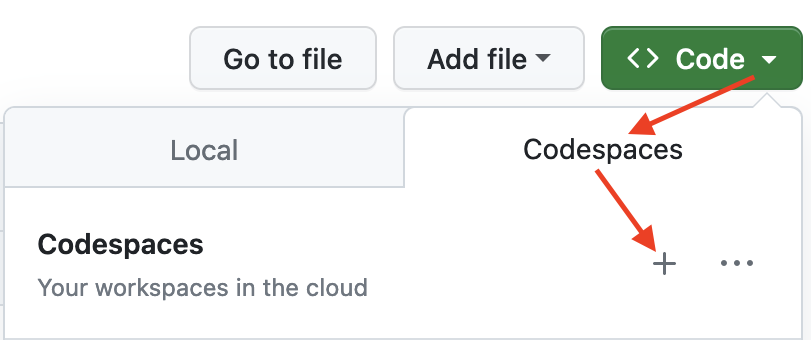
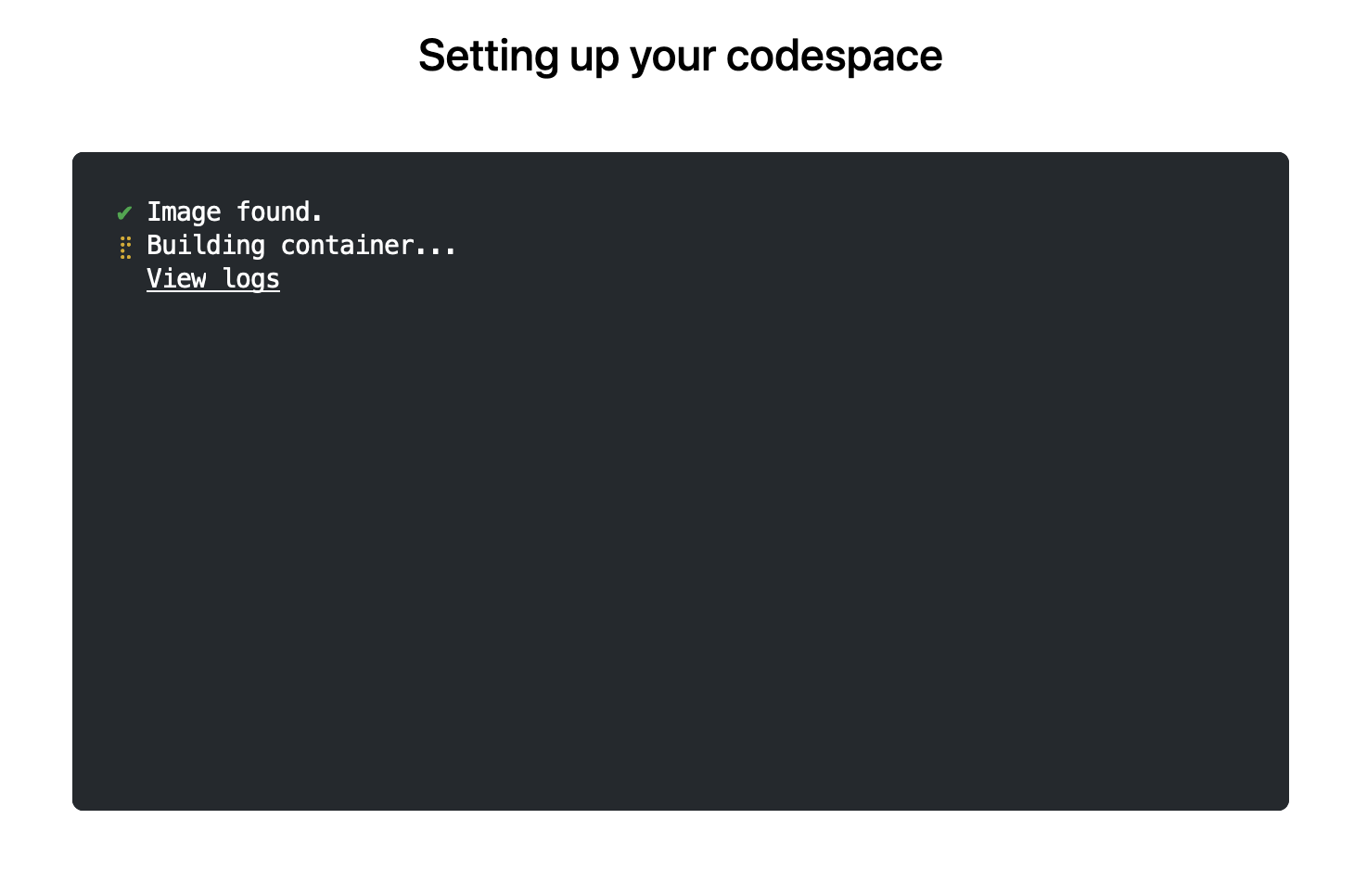
Try it out To get started, simply click on the green Code button at the top right. Then select the Codespaces tab and click the + symbol to start a new Codespace. The first time you do this, it will open up a new browser tab where your Codespace is being instantiated. This first-time instantiation will take a few minutes (feel free to click View logs to see how things are progressing) so please be patient. Once built, your Codespace will deploy almost immediately when you use it again in the future. After the VS Code editor opens up in your browser, feel free to open up the examples/sfExample.R file. It demonstrates how r2u enables us install packages and their system-dependencies with ease, here installing packages sf (including all its geospatial dependencies) and ggplot2 (including all its dependencies). You can run the code easily in the browser environment: Highlight or hover over line(s) and execute them by hitting Cmd+Return (Mac) / Ctrl+Return (Linux / Windows). (Both example screenshots reflect the initial codespaces-r2u repo as well as personal scratchspace one which we started with, both of course work here too.) Do not forget to close your Codespace once you have finished using it. Click the Codespaces tab at the very bottom left of your code editor / browser and select Close Current Codespace in the resulting pop-up box. You can restart it at any time, for example by going to https://github.com/codespaces and clicking on your instance.
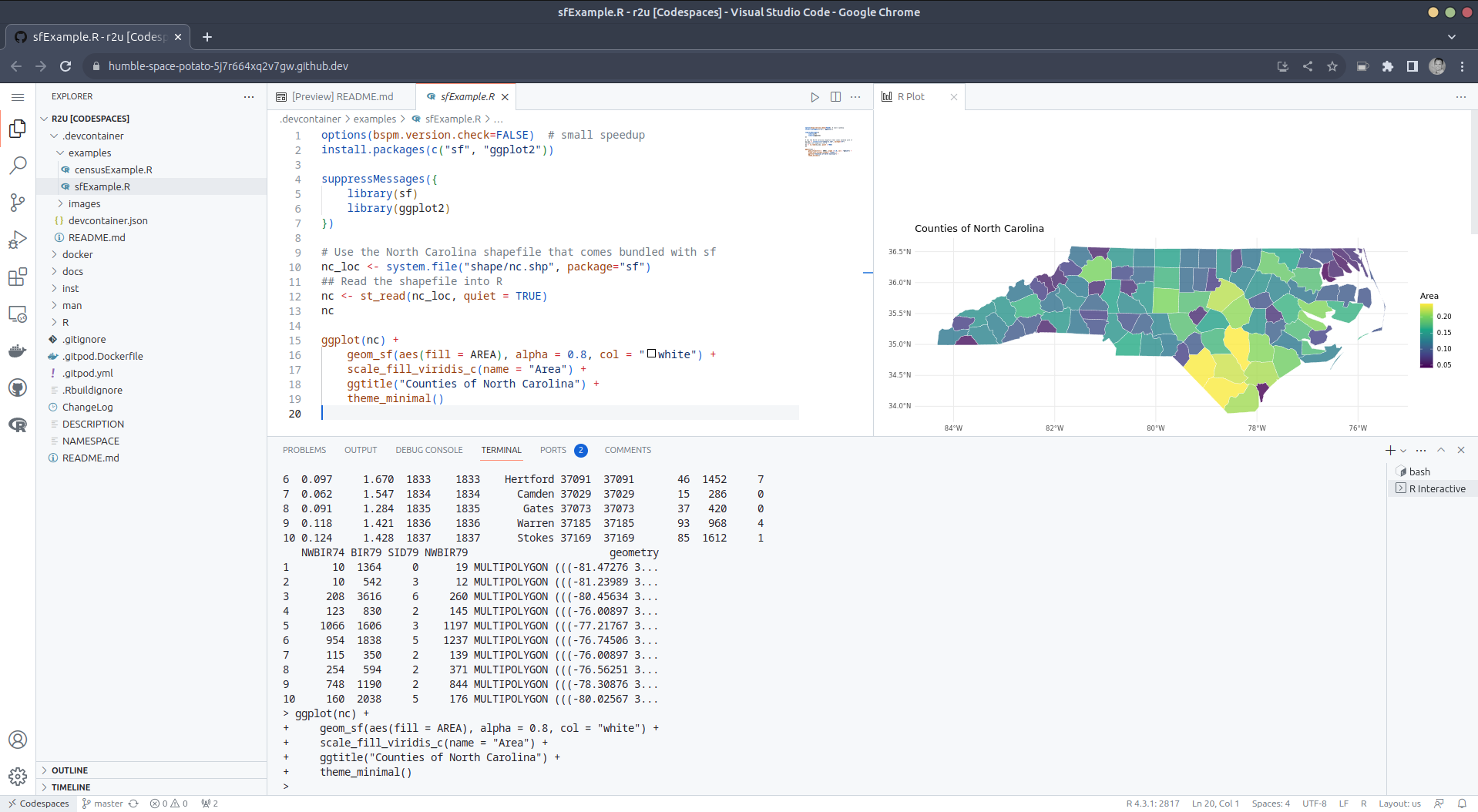
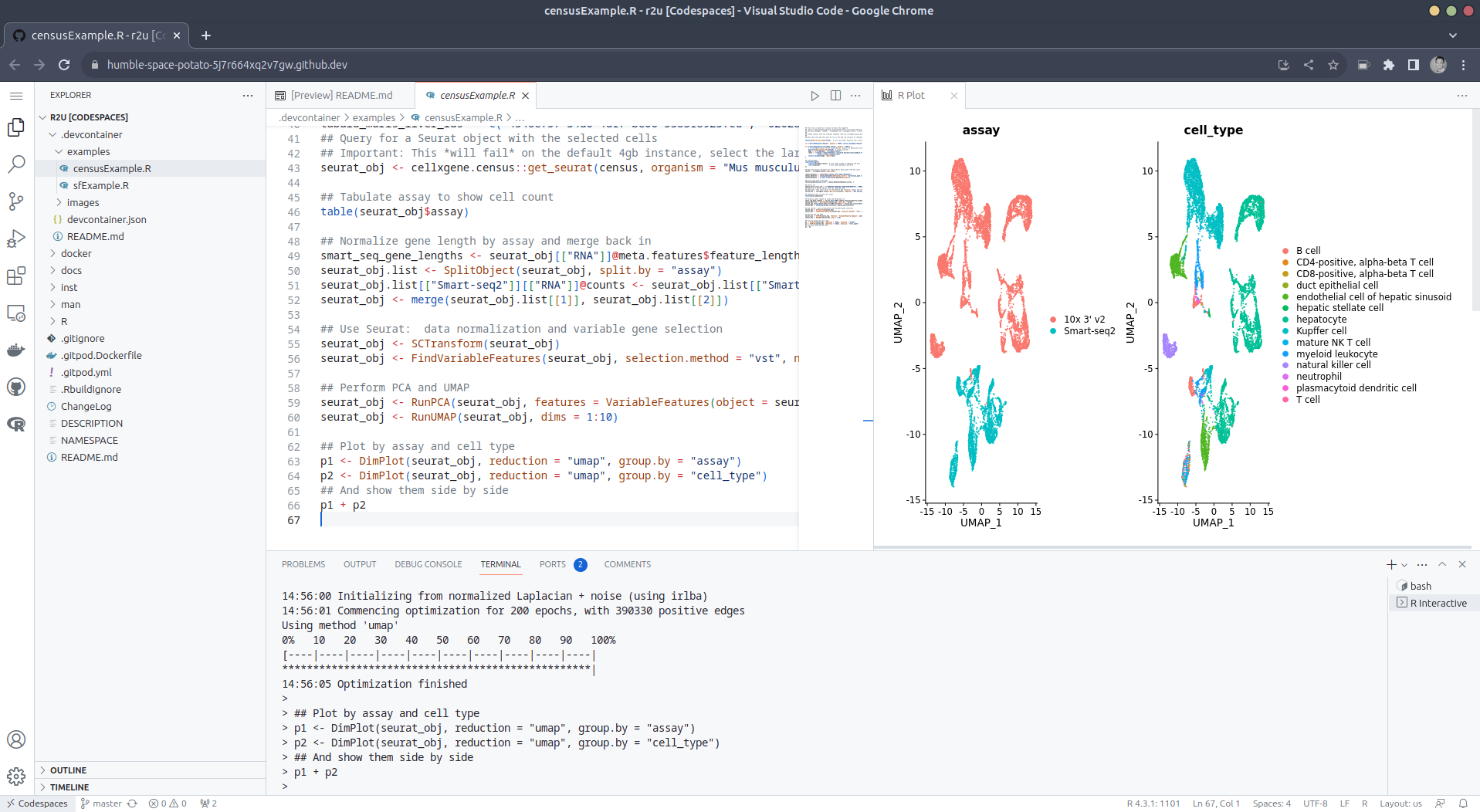
Extend r2u with r-universe r2u offers fast, easy, reliable access to all of CRAN via binaries for Ubuntu focal and jammy. When using the latter (as is the default), it can be combined with r-universe and its Ubuntu jammy binaries. We demontrates this in a second example file examples/censusExample.R which install both the cellxgene-census and tiledbsoma R packages as binaries from r-universe (along with about 100 dependencies), downloads single-cell data from Census and uses Seurat to create PCA and UMAP decomposition plots. Note that in order run this you have to change the Codespaces default instance from small (4gb ram) to large (16gb ram).

Local DevContainer build Codespaces are DevContainers running in the cloud (where DevContainers are themselves just Docker images running with some VS Code sugar on top). This gives you the very powerful ability to edit locally but run remotely in the hosted codespace. To test this setup locally, simply clone the repo and open it up in VS Code. You will need to have Docker installed and running on your system (see here). You will also need the Remote Development extension (you will probably be prompted to install it automatically if you do not have it yet). Select Reopen in Container when prompted. Otherwise, click the >< tab at the very bottom left of your VS Code editor and select this option. To shut down the container, simply click the same button and choose Reopen Folder Locally . You can always search for these commands via the command palette too (Cmd+Shift+p / Ctrl+Shift+p).

Use in Your Repo To add this ability of launching Codespaces in the browser (or editor) to a repo of yours, create a directory .devcontainers in your selected repo, and add the file .devcontainers/devcontainer.json. You can customize it by enabling other feature, or use the postCreateCommand field to install packages (while taking full advantage of r2u).

Acknowledgments There are a few key plumbing pieces that make everything work here. Thanks to:

Colophon More information about r2u is at its site, and we answered some question in issues, and at stackoverflow. More questions are always welcome! If you like this or other open-source work I do, you can now sponsor me at GitHub.

This post by Dirk Eddelbuettel originated on his Thinking inside the box blog. Please report excessive re-aggregation in third-party for-profit settings.

Originally posted 2023-08-13, minimally edited 2023-08-15 which changed the timestamo and URL.

14 August 2023

Jonathan McDowell: listadmin3: An imperfect replacement for listadmin on Mailman 3

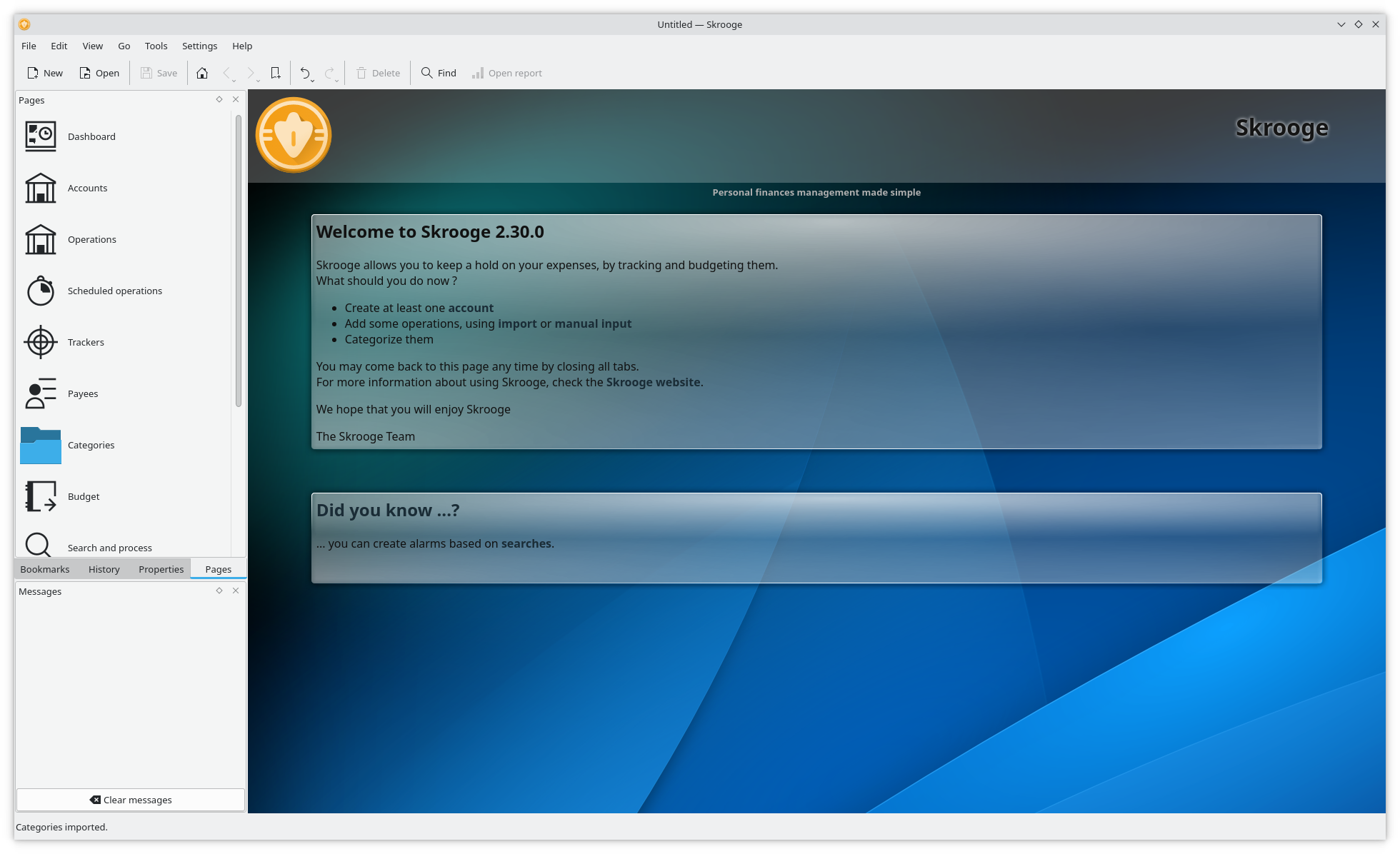
One of the annoyances I had when I upgraded from Buster to Bullseye (yes, I m talking about an upgrade I did at the end of 2021) is that I ended up moving from Mailman 2 to Mailman 3. Which is fine, I guess, but it meant I could no longer use listadmin to deal with messages held for moderation. At the time I looked around, couldn t find anything, shrugged, and became incredibly bad at performing my list moderation duties. Last week I finally accepted what I should have done at least a year ago and wrote some hopefully not too bad Python to web scrape the Mailman 3 admin interface. It then presents a list of subscribers and held messages that might need approved or discarded. It s heavily inspired by listadmin, but not a faithful copy (partly because it s been so long since I used it that I m no longer familiar with its interface). Despite that I ve called it listadmin3. It currently meets the bar of extremely useful to me so I ve tagged v0.1. You can get it on Github. I d be interested in knowing if it actually works for / is useful to anyone else (I suspect it won t be happy with interfaces configured to not be in English, but that should be solvable). Comment here or reply to my Fediverse announcement. Example usage, cribbed directly from the README:
$ listadmin3
fetching data for partypeople@example.org ... 200 messages
(1/200) 5303: omgitsspam@example.org / March 31, 2023, 6:39 a.m.:
  The message is not from a list member: TOP PICK
(a)ccept, (d)iscard, (b)ody, (h)eaders, (s)kip, (q)uit? q
Moving on...
fetching data for admins@example.org ... 1 subscription requests
(1/1) "The New Admin" <newadmin@example.org>
(a)ccept, (d)iscard, (r)eject, (s)kip, (q)uit? a
1 messages
(1/1) 6560: anastyspamer@example.org / Aug. 13, 2023, 3:15 p.m.:
  The message is not from a list member: Buy my stuff!
(a)ccept, (d)iscard, (b)ody, (h)eaders, (s)kip, (q)uit? d
0 to accept, 1 to discard, proceed? (y/n) y
fetching data for announce@example.org ... nothing in queue
$
There s Debian packaging in the repository (dpkg-buildpackage -uc -us -b will spit you out a .deb) but I m holding off on filing an ITP + actually uploading until I know if it s useful enough for others before doing so. You only really need the listadmin3 file and to ensure you have Python3 + MechanicalSoup installed. (Yes, I still run mailing lists. Hell, I still run a Usenet server.)

11 August 2023

Scarlett Gately Moore: KDE: Post Akademy Snap Wrap Up and Future

Skrooge snapKDE Skrooge snap
It has been a very busy couple of weeks in the KDE snap world! Here is a rundown of what has been done:
An update to the Very exciting news coming soon : While everything went well, it is not (yet!) happening. I do not have the management experience the stakeholders are looking for to run the project. I understand completely! I have the passion and project experience, just not management in this type of project. So with that said, are you a KDE/C++ developer with a management background and have a history of bringing projects to the finishline? Are you interested in an exciting new project with new technologies? Talk to me! I can be reached via sgmoore on the various chat channels, sgmoore at kde dot org, or connect via linkedin and message: https://www.linkedin.com/in/scarlettgatelymoore If you know anyone that might be interested, please point them here! As this project gets further delayed, it leaves me without an income still. If you or someone you know has any short term contract work let me know. Pesky bills and life expenses don t pay themselves  If you can spare some change ( anything helps ) please consider a donation. https://gofund.me/5d0691bc A big thank you to the community for making my work possible thus far!

10 August 2023

Sandro Tosi: Mastodon hook for dput-ng

If you use dput-ng, you may be familiar with the Twitter hook that tweets a message when uploading a package.A similar hook is now available for Mastodon too; if interested, give it a try and comment on the MR

Petter Reinholdtsen: Invidious add-on for Kodi 20

I still enjoy Kodi and LibreELEC as my multimedia center at home. Sadly two of the services I really would like to use from within Kodi are not easily available. The most wanted add-on would be one making The Internet Archive available, and it has not been working for many years. The second most wanted add-on is one using the Invidious privacy enhanced Youtube frontent. A plugin for this has been partly working, but not been kept up to date in the Kodi add-on repository, and its upstream seem to have given it up in April this year, when the git repository was closed. A few days ago I got tired of this sad state of affairs and decided to have a go at improving the Invidious add-on. As Google has already attacked the Invidious concept, so it need all the support if can get. My small contribution here is to improve the service status on Kodi. I added support to the Invidious add-on for automatically picking a working Invidious instance, instead of requiring the user to specify the URL to a specific instance after installation. I also had a look at the set of patches floating around in the various forks on github, and decided to clean up at least some of the features I liked and integrate them into my new release branch. Now the plugin can handle channel and short video items in search results. Earlier it could only handle single video instances in the search response. I also brushed up the set of metadata displayed a bit, but hope I can figure out how to get more relevant metadata displayed. Because I only use Kodi 20 myself, I only test on version 20 and am only motivated to ensure version 20 is working. Because of API changes between version 19 and 20, I suspect it will fail with earlier Kodi versions. I already asked to have the add-on added to the official Kodi 20 repository, and is waiting to heard back from the repo maintainers. As usual, if you use Bitcoin and want to show your support of my activities, please send Bitcoin donations to my address 15oWEoG9dUPovwmUL9KWAnYRtNJEkP1u1b.

Freexian Collaborators: Debian Contributions: PTS tracker, DebConf23 Bursary, and more! (by Utkarsh Gupta)

Contributing to Debian is part of Freexian s mission. This article covers the latest achievements of Freexian and their collaborators. All of this is made possible by organizations subscribing to our Long Term Support contracts and consulting services.

tracker.debian.org work by Rapha l Hertzog Rapha l spent some time during his vacation to update distro-tracker to be fully compatible with Django 3.2 so that the codebase and the whole testsuite can run on Debian 12. There s one exception though with the functional test suite that still needs further work to cope with the latest version of Selenium. By dropping support of Django 2.2, Rapha l could also start to work toward support of Django 4.2 since Django helpfully emits deprecation warnings of things that will break in future versions. All the warnings have been fixed but the codebase still fails its testsuite in Django 4.2 because we have to get rid of the python3-django-jsonfield dependency (that is rightfully dead upstream since Django has native support nowadays). All the JSONField have been converted to use Django s native field, but the migration system still requires that dependency at this point. This will require either some fresh reboot of the migration history, or some other trickery to erase the jsonfield dependency from the history of migrations. If you have experience with that, don t hesitate to share it (mail at hertzog@debian.org, or reach out to buxy on IRC). At this point, tracker.debian.org runs with Django 3.2 on Debian 11 since Debian System Administrators are not yet ready to upgrade debian.org hosts to Debian 12.

DebConf 23 bursary work by Utkarsh Gupta Utkarsh led the bursary team this year. The bursary team got a ton of requests this time. Rolling out the results in 4 batches, the bursary team catered over 165 bursary requests - which is superb! The team managed to address all the requests and answered a bit over 120 emails in the process. With that, the bursaries are officially closed for DebConf 2023. The team also intends to roll out some of the statistics closer to DebConf.

Miscellaneous contributions
  • Stefano implemented meson support in pybuild, the tool for building Python packages in Debian against multiple Python versions.
  • Santiago did some work on Salsa CI to enhance the ARM support on the autopkgtest job and make Josch s branch work. MR to come soon.
  • Helmut sent patches for 6 cross build failures.
  • Stefano has been preparing for DebConf 23: Working on the website, and assisting the local teams.
  • Stefano attended the DebConf Video team sprint in Paris, mostly looking at new hardware and software options for video capture and live-mixing. Full sprint report.

9 August 2023

Antoine Beaupr : OpenPGP key transition

This is a short announcement to say that I have changed my main OpenPGP key. A signed statement is available with the cryptographic details but, in short, the reason is that I stopped using my old YubiKey NEO that I have worn on my keyring since 2015. I now have a YubiKey 5 which supports ED25519 which features much shorter keys and faster decryption. It allowed me to move all my secret subkeys on the key (including encryption keys) while retaining reasonable performance. I have written extensive documentation on how to do that OpenPGP key rotation and also YubiKey OpenPGP operations.

Warning on storing encryption keys on a YubiKey People wishing to move their private encryption keys to such a security token should be very careful as there are special precautions to take for disaster recovery. I am toying with the idea of writing an article specifically about disaster recovery for secrets and backups, dealing specifically with cases of death or disabilities.

Autocrypt changes One nice change is the impact on Autocrypt headers, which are considerably shorter. Before, the header didn't even fit on a single line in an email, it overflowed to five lines:
Autocrypt: addr=anarcat@torproject.org; prefer-encrypt=nopreference;
 keydata=xsFNBEogKJ4BEADHRk8dXcT3VmnEZQQdiAaNw8pmnoRG2QkoAvv42q9Ua+DRVe/yAEUd03EOXbMJl++YKWpVuzSFr7IlZ+/lJHOCqDeSsBD6LKBSx/7uH2EOIDizGwfZNF3u7X+gVBMy2V7rTClDJM1eT9QuLMfMakpZkIe2PpGE4g5zbGZixn9er+wEmzk2mt20RImMeLK3jyd6vPb1/Ph9+bTEuEXi6/WDxJ6+b5peWydKOdY1tSbkWZgdi+Bup72DLUGZATE3+Ju5+rFXtb/1/po5dZirhaSRZjZA6sQhyFM/ZhIj92mUM8JJrhkeAC0iJejn4SW8ps2NoPm0kAfVu6apgVACaNmFb4nBAb2k1KWru+UMQnV+VxDVdxhpV628Tn9+8oDg6c+dO3RCCmw+nUUPjeGU0k19S6fNIbNPRlElS31QGL4H0IazZqnE+kw6ojn4Q44h8u7iOfpeanVumtp0lJs6dE2nRw0EdAlt535iQbxHIOy2x5m9IdJ6q1wWFFQDskG+ybN2Qy7SZMQtjjOqM+CmdeAnQGVwxowSDPbHfFpYeCEb+Wzya337Jy9yJwkfa+V7e7Lkv9/OysEsV4hJrOh8YXu9a4qBWZvZHnIO7zRbz7cqVBKmdrL2iGqpEUv/x5onjNQwpjSVX5S+ZRBZTzah0w186IpXVxsU8dSk0yeQskblrwARAQABzSlBbnRvaW5lIEJlYXVwcsOpIDxhbmFyY2F0QHRvcnByb2plY3Qub3JnPsLBlAQTAQgAPgIbAwULCQgHAwUVCgkICwUWAgMBAAIeAQIXgBYhBI3JAc5kFGwEitUPu3khUlJ7dZIeBQJihnFIBQkacFLiAAoJEHkhUlJ7dZIeXNAP/RsX+27l9K5uGspEaMH6jabAFTQVWD8Ch1om9YvrBgfYtq2k/m4WlkMh9IpT89Ahmlf0eq+V1Vph4wwXBS5McK0dzoFuHXJa1WHThNMaexgHhqJOs
 S60bWyLH4QnGxNaOoQvuAXiCYV4amKl7hSuDVZEn/9etDgm/UhGn2KS3yg0XFsqI7V/3RopHiDT+k7+zpAKd3st2V74w6ht+EFp2Gj0sNTBoCdbmIkRhiLyH9S4B+0Z5dUCUEopGIKKOSbQwyD5jILXEi7VTZhN0CrwIcCuqNo7OXI6e8gJd8McymqK4JrVoCipJbLzyOLxZMxGz8Ki0b9O844/DTzwcYcg9I1qogCsGmZfgVze2XtGxY+9zwSpeCLeef6QOPQ0uxsEYSfVgS+onCesSRCgwAPmppPiva+UlGuIMun87gPpQpV2fqFg/V8zBxRvs6YTGcfcQjfMoBHmZTGb+jk1//QAgnXMO7fGG38YH7iQSSzkmodrH2s27ZKgUTHVxpBL85ptftuRqbR7MzIKXZsKdA88kjIKKXwMmez9L1VbJkM4k+1Kzc5KdVydwi+ujpNegF6ZU8KDNFiN9TbDOlRxK5R+AjwdS8ZOIa4nci77KbNF9OZuO3l/FZwiKp8IFJ1nK7uiKUjmCukL0od/6X2rJtAzJmO5Co93ZVrd5r48oqUvjklzzsBNBFmeC3oBCADEV28RKzbv3dEbOocOsJQWr1R0EHUcbS270CrQZfb9VCZWkFlQ/1ypqFFQSjmmUGbNX2CG5mivVsW6Vgm7gg8HEnVCqzL02BPY4OmylskYMFI5Bra2wRNNQBgjg39L9XU4866q3BQzJp3r0fLRVH8gHM54Jf0FVmTyHotR/Xiw5YavNy2qaQXesqqUv8HBIha0rFblbuYI/cFwOtJ47gu0QmgrU0ytDjlnmDNx4rfsNylwTIHS0Oc7Pezp7MzLmZxnTM9b5VMprAXnQr4rewXCOUKBSto+j4rD5/77DzXw96bbueNruaupb2Iy2OHXNGkB0vKFD3xHsXE2x75NBovtABEBAAHCwqwEGAEIACAWIQSNyQHOZBRsBIrVD7t5IVJSe3WSHgUCWZ4LegIbAgFACRB5IV
 JSe3WSHsB0IAQZAQgAHRYhBHsWQgTQlnI7AZY1qz6h3d2yYdl7BQJZngt6AAoJED6h3d2yYdl7CowH/Rp7GHEoPZTSUK8Ss7crwRmuAIDGBbSPkZbGmm4bOTaNs/gealc2tsVYpoMx7aYgqUW+t+84XciKHT+bjRv8uBnHescKZgDaomDuDKc2JVyx6samGFYuYPcGFReRcdmH0FOoPCn7bMW5mTPztV/wIA80LZD9kPKIXanfUyI3HLP0BPwZG4WTpKzJaalR1BNwu2oF6kEK0ymH3LfDiJ5Sr6emI2jrm4gH+/19ux/x+ST4tvm2PmH3BSQOPzgiqDiFd7RZoAIhmwr3FW4epsK9LtSxsi9gZ2vATBKO1oKtb6olW/keQT6uQCjqPSGojwzGRT2thEANH+5t6Vh0oDPZhrKUXRAAxHMBNHEaoo/M0sjZo+5OF3Ig1rMnI6XbKskLv6hu13cCymW0w/5E4XuYnyQ1cNC3pLvqDQbDx5mAPfBVHuqxJdRLQ3yDM/D2QIsxnkzQwi0FsJuni4vuJzWK/NHHDCvxMCh0YmSgbptUtgW8/niatd2Y6MbfRGxUHoctKtzqzivC8hKMTFrj4AbZhg/e9QVCsh5zSXtpWP0qFDJsxRMx0/432n9d4XUiy4U672r9Q09SsynB3QN6nTaCTWCIxGxjIb+8kJrRqTGwy/PElHX6kF0vQUWZNf2ITV1sd6LK/s/7sH+x4rzgUEHrsKr/qPvY3rUY/dQLd+owXesY83ANOu6oMWhSJnPMksbNa4tIKKbjmw3CFIOfoYHOWf3FtnydHNXoXfj4nBX8oSnkfhLILTJgf6JDFXfw6mTsv/jMzIfDs7PO1LK2oMK0+prSvSoM8bP9dmVEGIurzsTGjhTOBcb0zgyCmYVD3S48vZlTgHszAes1zwaCyt3/tOwrzU5JsRJVns+B/TUYaR/u3oIDMDygvE5ObWxXaFVnCC59r+zl0FazZ0ouyk2AYIR
 zHf+n1n98HCngRO4FRel2yzGDYO2rLPkXRm+NHCRvUA/i4zGkJs2AV0hsKK9/x8uMkBjHAdAheXhY+CsizGzsKjjfwvgqf84LwAzSDdZqLVE2yGTOwU0ESiArJwEQAJhtnC6pScWjzvvQ6rCTGAai6hrRiN6VLVVFLIMaMnlUp92EtgVSNpw6kANtRTpKXUB5fIPZVUrVdfEN06t96/6LE42tgifDAFyFTZY5FdHHri1GG/Cr39MpW2VqCDCtTTPVWHTUlU1ZG631BJ+9NB+ce58TmLr6wBTQrT+W367eRFBC54EsLNb7zQAspCn9pw1xf1XNHOGnrAQ4r9BXhOW5B8CzRd4nLRQwVgtw/c5M/bjemAOoq2WkwN+0mfJe4TSfHwFUozXuN274X+0Gr10fhp8xEDYuQM0qu6W3aDXMBBwIu0jTNudEELsTzhKUbqpsBc9WjwNMCZoCuSw/RTpFBV35mXbqQoQgbcU7uWZslLl9Wvv/C6rjXgd+GeX8SGBjTqq1ZkTv5UXLHTNQzPnbkNEExzqToi/QdSjFMIACnakeOSxc0ckfnsd9pfGv1PUyPyiwrHiqWFzBijzGIZEHxhNGFxAkXwTJR7Pd40a7RDxwbO6p/TSIIum41JtteehLHwTRDdQNMoyfLxuNLEtNYS0uR2jYI1EPQfCNWXCdT2ZK/l6GVP6jyB/olHBIOr+oVXqJh+48ki8cATPczhq3fUr7UivmguGwD67/4omZ4PCKtz1hNndnyYFS9QldEGo+AsB3AoUpVIA0XfQVkxD9IZr+Zu6aJ6nWq4M2bsoxABEBAAHCwXYEGAEIACACGwwWIQSNyQHOZBRsBIrVD7t5IVJSe3WSHgUCWPerZAAKCRB5IVJSe3WSHkIgEACTpxdn/FKrwH0/LDpZDTKWEWm4416l13RjhSt9CUhZ/Gm2GNfXcVTfoF/jKXXgjHcV1DHjfLUPmPVwMdqlf5ACOiFqIUM2ag/OEARh356w
 YG7YEobMjX0CThKe6AV2118XNzRBw/S2IO1LWnL5qaGYPZONUa9Pj0OaErdKIk/V1wge8Zoav2fQPautBcRLW5VA33PH1ggoqKQ4ES1hc9HC6SYKzTCGixu97mu/vjOa8DYgM+33TosLyNy+bCzw62zJkMf89X0tTSdaJSj5Op0SrRvfgjbC2YpJOnXxHr9qaXFbBZQhLjemZi6zRzUNeJ6A3Nzs+gIc4H7s/bYBtcd4ugPEhDeCGffdS3TppH9PnvRXfoa5zj5bsKFgjqjWolCyAmEvd15tXz5yNXtvrpgDhjF5ozPiNp/1EeWX4DxbH2i17drVu4fXwauFZ6lcsAcJxnvCA28RlQlmEQu/gFOx1axVXf6GIuXnQSjQN6qJbByUYrdc/cFCxPO2/lGuUxnufN9Tvb51Qh54laPgGLrlD2huQeSD9Sxa0MNUjNY0qLqaReT99Ygb2LPYGSLoFVx9iZz6sZNt07LqCx9qNgsJwsdmwYsNpMuFbc7nkWjtlEqzsXZHTvYN654p43S+hcAhmmOzQZcew6h71fAJLciiqsPBnCEdgCGFAWhZZdPkMA==
After the change, the entire key fits on a single line, neat!
Autocrypt: addr=anarcat@torproject.org; prefer-encrypt=nopreference;
 keydata=xjMEZHZPzhYJKwYBBAHaRw8BAQdAWdVzOFRW6FYVpeVaDo3sC4aJ2kUW4ukdEZ36UJLAHd7NKUFudG9pbmUgQmVhdXByw6kgPGFuYXJjYXRAdG9ycHJvamVjdC5vcmc+wpUEExYIAD4WIQS7ts1MmNdOE1inUqYCKTpvpOU0cwUCZHZgvwIbAwUJAeEzgAULCQgHAwUVCgkICwUWAgMBAAIeAQIXgAAKCRACKTpvpOU0c47SAPdEqfeHtFDx9UPhElZf7nSM69KyvPWXMocu9Kcu/sw1AQD5QkPzK5oxierims6/KUkIKDHdt8UcNp234V+UdD/ZB844BGR2UM4SCisGAQQBl1UBBQEBB0CYZha2IMY54WFXMG4S9/Smef54Pgon99LJ/hJ885p0ZAMBCAfCdwQYFggAIBYhBLu2zUyY104TWKdSpgIpOm+k5TRzBQJkdlDOAhsMAAoJEAIpOm+k5TRzBg0A+IbcsZhLx6FRIqBJCdfYMo7qovEo+vX0HZsUPRlq4HkBAIctCzmH3WyfOD/aUTeOF3tY+tIGUxxjQLGsNQZeGrQI
Note that I have implemented my own kind of ridiculous Autocrypt support for the Notmuch Emacs email client I use, see this elisp code. To import keys, I pipe the message into this script which is basically just:
sq autocrypt decode   gpg --import
... thanks to Sequoia best-of-class Autocrypt support.

Note on OpenPGP usage While some have claimed OpenPGP's death, I believe those are overstated. Maybe it's just me, but I still use OpenPGP for my password management, to authenticate users and messages, and it's the interface to my YubiKey for authenticating with SSH servers. I understand people feel that OpenPGP is possibly insecure, counter-intuitive and full of problems, but I think most of those problems should instead be attributed to its current flagship implementation, GnuPG. I have tried to work with GnuPG for years, and it keeps surprising me with evilness and oddities. I have high hopes that the Sequoia project can bring some sanity into this space, and I also hope that RFC4880bis can eventually get somewhere so we have a more solid specification with more robust crypto. It's kind of a shame that this has dragged on for so long, but Update: there's a separate draft called openpgp-crypto-refresh that might actually be adopted as the "OpenPGP RFC" soon! And it doesn't keep real work from happening in Sequoia and other implementations. Thunderbird rewrote their OpenPGP implementation with RNP (which was, granted, a bumpy road because it lost compatibility with GnuPG) and Sequoia now has a certificate store with trust management (but still no secret storage), preliminary OpenPGP card support and even a basic GnuPG compatibility layer. I'm also curious to try out the OpenPGP CA capabilities. So maybe it's just because I'm becoming an old fart that doesn't want to change tools, but so far I haven't seen a good incentive in switching away from OpenPGP, and haven't found a good set of tools that completely replace it. Maybe OpenSSH's keys and CA can eventually replace it, but I suspect they will end up rebuilding most of OpenPGP anyway, just more slowly. If they do, let's hope they avoid the mistakes our community has done in the past at least...

8 August 2023

Matthew Garrett: Updating Fedora the unsupported way

I dug out a computer running Fedora 28, which was released 2018-04-01 - over 5 years ago. Backing up the data and re-installing seemed tedious, but the current version of Fedora is 38, and while Fedora supports updates from N to N+2 that was still going to be 5 separate upgrades. That seemed tedious, so I figured I'd just try to do an update from 28 directly to 38. This is, obviously, extremely unsupported, but what could possibly go wrong?

Running sudo dnf system-upgrade download --releasever=38 didn't successfully resolve dependencies, but sudo dnf system-upgrade download --releasever=38 --allowerasing passed and dnf started downloading 6GB of packages. And then promptly failed, since I didn't have any of the relevant signing keys. So I downloaded the fedora-gpg-keys package from F38 by hand and tried to install it, and got a signature hdr data: BAD, no. of bytes(88084) out of range error. It turns out that rpm doesn't handle cases where the signature header is larger than a few K, and RPMs from modern versions of Fedora. The obvious fix would be to install a newer version of rpm, but that wouldn't be easy without upgrading the rest of the system as well - or, alternatively, downloading a bunch of build depends and building it. Given that I'm already doing all of this in the worst way possible, let's do something different.

The relevant code in the hdrblobRead function of rpm's lib/header.c is:

int32_t il_max = HEADER_TAGS_MAX;
int32_t dl_max = HEADER_DATA_MAX;

if (regionTag == RPMTAG_HEADERSIGNATURES)
il_max = 32;
dl_max = 8192;


which indicates that if the header in question is RPMTAG_HEADERSIGNATURES, it sets more restrictive limits on the size (no, I don't know why). So I installed rpm-libs-debuginfo, ran gdb against librpm.so.8, loaded the symbol file, and then did disassemble hdrblobRead. The relevant chunk ends up being:

0x000000000001bc81 <+81>: cmp $0x3e,%ebx
0x000000000001bc84 <+84>: mov $0xfffffff,%ecx
0x000000000001bc89 <+89>: mov $0x2000,%eax
0x000000000001bc8e <+94>: mov %r12,%rdi
0x000000000001bc91 <+97>: cmovne %ecx,%eax

which is basically "If ebx is not 0x3e, set eax to 0xffffffff - otherwise, set it to 0x2000". RPMTAG_HEADERSIGNATURES is 62, which is 0x3e, so I just opened librpm.so.8 in hexedit, went to byte 0x1bc81, and replaced 0x3e with 0xfe (an arbitrary invalid value). This has the effect of skipping the if (regionTag == RPMTAG_HEADERSIGNATURES) code and so using the default limits even if the header section in question is the signatures. And with that one byte modification, rpm from F28 would suddenly install the fedora-gpg-keys package from F38. Success!

But short-lived. dnf now believed packages had valid signatures, but sadly there were still issues. A bunch of packages in F38 had files that conflicted with packages in F28. These were largely Python 3 packages that conflicted with Python 2 packages from F28 - jumping this many releases meant that a bunch of explicit replaces and the like no longer existed. The easiest way to solve this was simply to uninstall python 2 before upgrading, and avoiding the entire transition. Another issue was that some data files had moved from libxcrypt-common to libxcrypt, and removing libxcrypt-common would remove libxcrypt and a bunch of important things that depended on it (like, for instance, systemd). So I built a fake empty package that provided libxcrypt-common and removed the actual package. Surely everything would work now?

Ha no. The final obstacle was that several packages depended on rpmlib(CaretInVersions), and building another fake package that provided that didn't work. I shouted into the void and Bill Nottingham answered - rpmlib dependencies are synthesised by rpm itself, indicating that it has the ability to handle extensions that specific packages are making use of. This made things harder, since the list is hard-coded in the binary. But since I'm already committing crimes against humanity with a hex editor, why not go further? Back to editing librpm.so.8 and finding the list of rpmlib() dependencies it provides. There were a bunch, but I couldn't really extend the list. What I could do is overwrite existing entries. I tried this a few times but (unsurprisingly) broke other things since packages depended on the feature I'd overwritten. Finally, I rewrote rpmlib(ExplicitPackageProvide) to rpmlib(CaretInVersions) (adding an extra '\0' at the end of it to deal with it being shorter than the original string) and apparently nothing I wanted to install depended on rpmlib(ExplicitPackageProvide) because dnf finished its transaction checks and prompted me to reboot to perform the update. So, I did.

And about an hour later, it rebooted and gave me a whole bunch of errors due to the fact that dbus never got started. A bit of digging revealed that I had no /etc/systemd/system/dbus.service, a symlink that was presumably introduced at some point between F28 and F38 but which didn't get automatically added in my case because well who knows. That was literally the only thing I needed to fix up after the upgrade, and on the next reboot I was presented with a gdm prompt and had a fully functional F38 machine.

You should not do this. I should not do this. This was a terrible idea. Any situation where you're binary patching your package manager to get it to let you do something is obviously a bad situation. And with hindsight performing 5 independent upgrades might have been faster. But that would have just involved me typing the same thing 5 times, while this way I learned something. And what I learned is "Terrible ideas sometimes work and so you should definitely act upon them rather than doing the sensible thing", so like I said, you should not do this in case you learn the same lesson.

comment count unavailable comments

7 August 2023

Dirk Eddelbuettel: RQuantLib 0.4.19 on CRAN: More Maintenance

A new release 0.4.19 of RQuantLib arrived at CRAN earlier today, and has already been uploaded to Debian too. QuantLib is a rather comprehensice free/open-source library for quantitative finance. RQuantLib connects it to the R environment and language, and has been part of CRAN for more than twenty years (!!) This release of RQuantLib brings a small update to three unit tests as very recent 1.31 release QuantLib brought a subtle change to some fixed income payment schedules and dates. On a sadder note, as CRAN now checks the ratio of user time over elapsed time , excessive threading was inferred for five examples. As we seemingly cannot limit std::thread here, I opted to park these examples behind a \dontrun . Not ideal. Lastly, a few version checks in configure were updated.

Changes in RQuantLib version 0.4.19 (2023-08-07)
  • Three calendaring / schedule tests were adjusted for slightly changed values under QuantLib 1.31
  • Several checks in the configure script have been updated to reflect current versions of packages.
  • Five examples no longer run because, even while extremely short, use of (too many default) threads was seen.

Courtesy of my CRANberries, there is also a diffstat report for the this release 0.4.19. As always, more detailed information is on the RQuantLib page. Questions, comments etc should go to the rquantlib-devel mailing list. Issue tickets can be filed at the GitHub repo. If you like this or other open-source work I do, you can now sponsor me at GitHub.

This post by Dirk Eddelbuettel originated on his Thinking inside the box blog. Please report excessive re-aggregation in third-party for-profit settings.

Thorsten Alteholz: My Debian Activities in July 2023

FTP master This month I accepted 408 and rejected 40 packages. The overall number of packages that got accepted was 412. Debian LTS This was my hundred-ninth month that I did some work for the Debian LTS initiative, started by Raphael Hertzog at Freexian. This month my all in all workload has been 14h. During that time I uploaded: I also continued my work on ring and did some work on security-master. Last but not least I did some days of frontdesk duties and took part in the LTS meeting. Debian ELTS This month was the sixtieth ELTS month. Finally I found the problem with the openssl package. When starting to work on the package, it built fine without my patches. After applying some patches, the built suddenly failed, so I thought I did something wrong with the patches. At some point I found out that it weren t my patches but a certificate, that was used for testing, expired. It was valid for 10 years and just when I worked on the package it expired. Now I just have to find out how to replace it Last but not least I did some days on frontdesk duties. Debian Astro This month I uploaded new upstream version of packages, did a source upload for the transition or uploaded it to fix one or the other issue: Other stuff This month I did uploads of new packages:

4 August 2023

Shirish Agarwal: Birth Control, Consent, Rape & Violence.

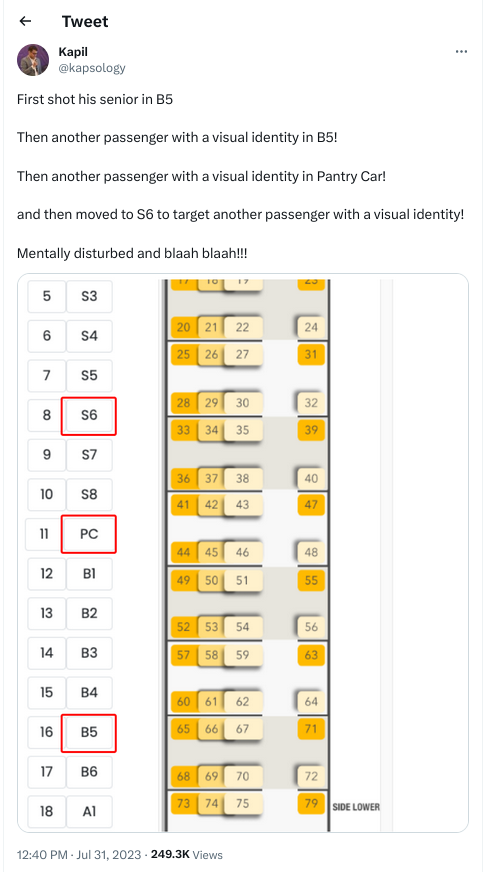
Consent, Violence, Sexual Abuse This again would be somewhat of a mature post. So children, please refrain from reading. When I hear the above words, my first thought goes to Aamir Khan s Season 1 Episode 2 in Satyamev Jayate. This was the first time that the topic of child sexual abuse was bought in the forefront in the hall rather than a topic to be discussed in the corner. Unfortunately, that episode is still in Hindi and no English subtitles available even today shows a lack of sensitivity in Indian s part to still come to terms with Child abuse that happens in India. The numbers that they had shared at that time were shocking. More than 50 per cent children experience sexual abuse and mostly from friends or relatives. That means 1 in every 2 children. And this was in 2012. But the problem of child sexual abuse didn t start then, it started in the 1960 s, 70 s. In the 1960 s, 1970s we didn t have much of cinema and TV and whatever there was pretty limited. There were few B movie producers, but most of them came into their own in the 1980s. So what influenced Indians in those days were softcore magazines that either had a mature aunt or a teen and they would tease and sooner or later the man would sort of overpower them and fulfill his needs. Even mainstream Indian cinema used similar tropes. One of the most memorable songs of that era Wada Karo Nahi Chodoge Tum Meera Saath from Aa Gale Lag jaa. A bit of context for the song. This is where Shashi Kapoor sees, he tries to ask her to date him, she says no. He tries to put an act where he shows he can t skate or rather pretends. And kinda takes a promise from her that she will date him if he is able to skate. And viola, the next moment he is not just skating, but dancing and singing as well. And the whole he touches her and you can see that is uncomfortable and yet after a while he woos her. Now this is problematic today because we are seeing it from today s lens. It might also have problematic with the feminists of that time, but they probably would have been called overly sensitive or something like that. And this is what went in Universal cinema. But this is just tip of the surface. There were and are multiple poems and even art in those times that flirted and even sort of engaged with sexual molestation, rape both in poems as well as literature, both in Hindi and various regional literature. Similar to stuff that Keats and some other poets (problematic stuff) they wrote and where both men and women were in two minds, whether to take all the other good literature out or kinda make the difference between the art and artist. Now, while Aamir spoke about consent it wasn t in any official capacity or even a legal capacity. The interesting thing was that there was an Act that kinda put some safeguards but had been doing rounds for almost a decade. Because the extremists on both sides, Hindus and Muslims were not in favor of that Act, it was still doing rounds. Aamir s episode on 6th May 2012 and the discussions in mainstream media following that forced the Indian legislature to make POSCO as a law on 22nd May 2012. Almost 6 months to 2 weeks, Nirbhaya happened and changes to the law happened in another 6 months. Both voyeurism and stalking were made jailable offenses and consent became part of lingua franca in the Supreme Court. Couple of weeks back, I had shared in the Manipur case the part about fingering . In the same Act, another change that was done that insertion of any part including foreign objects in any of the openings would be classed as rape . So in that Manipur case, at least those 2-3 people who have been identified as clear perpetrators according to the law of land would be rapists and should have the highest punishment. Unfortunately, the system is rigged against women as Vrinda Grover had shared just couple of weeks back. How a 6 month fast track case (to be completed within 6 months) becomes a 10 year old case tells you the efficacy of the system. The reality is far more worse than is shared or known. Just a few months ago, GOI shared some data on Sexual Harassment in 2018-19. And this is after constant pressurizing by Activists that GOI doesn t like. In fact, in 2021, Unicef had shared data about how India was one of the five countries where child brides are still prevalent. India denied but didn t produce any alternative data. The firing of Mr. James over NHFS data sets doesn t give it any brownie points to the present Government. What has happened in the last few years is that the Government for reasons of its own had been scrubbing and censoring a lot of data. I won t go far, just 2 day old story which I had shared just couple of days back. Roughly a 25 year old RPF constable kills his superior and kills 3 Muslims after going to various coaches and then the Government uses the defence of temporary insanity.
Even the mental instability defence has twists and turns
Incidentally, Press Trust of India is s private organization and not the public broadcaster of the old. And incidentally, just a few days back, it came to light that they hadn t paid Income tax for last 2-3 years. Because of issues in reward money, the public came to know otherwise they wouldn t have known. Coming back to the topic itself, there was a video where you could hear and see the accused stating after killing the three Muslims that if you want to remain in India, then you have to vote for only Modi or Yogi, otherwise this will happen. That video was scrubbed both from Twitter as well as YouTube. All centralized platforms at the very least, whether it is Google (Youtube) or Twitter or Meta uses its own media ID. Meta s being most problematic but that probably being a discussion for another day. The same censorship tools are applied rigorously and lot of incidents are buried. Cases of girls being thrown in lakes just after lakes or low numbers of conviction in case of gang rapes are more often than not disappears.
The above article shared just a few days ago that how low the conviction rates of gang rapes are in Gujarat tells you the story. You might get the story today, but wait for a few weeks and you will find that the story has disappeared. What most people do not know or understand is that the web is increasingly a public repository of idea, imaginations and trust and authoritarian regimes like Government of India is increasingly using both official as well as unofficial methods to suppress the same. To see that in the last 9 odd years, GOI has made the highest number of takedown requests and been either number one or number two tells all. My question is where we do from here ??? If even the Minister and her Ministry can do only whataboutery rather than answer the questions, then how we are supposed to come up solutions. And even if a solution exists, without the state and Center agreeing and co-operating with civil society, any solution will be far off the desired result. I am sorry that I at least have no answers

Next.

Previous.