Search Results: "az"

3 March 2016

Ben Hutchings: Last week 'flu by

Last Monday, I began a new project at Codethink - working on kernel support for the next generation of an interactive system fitted in some high-performance cars. I travelled up to Manchester the night before, and on Monday I met Codethink's team (most of whom I was familiar with). My first chore was to set up VPN access to the development resources (source control, wiki, etc.). I sandboxed the proprietary VPN client in a VM with a systemd unit to run it at boot, so I can control it by starting and stopping that VM. I then set to work on unpacking and exploring the SoC vendor's evaluation module (EVM), starting by looking at serial output - of which there was none. Nothing on the LCD panel or network port either. A frustrating day. On Tuesday, the architect from our immediate customer, already a friend of mine, joined us in Manchester. As for the EVM, without any obvious change in cabling it was now reliably spitting out the expected u-boot and kernel boot messages, unfortunately ending with errors from the touchscreen driver intermingled with messages from various graphics drivers. I looked at the u-boot environment to see how the kernel parameters were controlled and started tweaking them with the aim of working around the errors. None of this worked. I looked for more documentation on the EVM, but found none beyond the quick start guide. Had I been given the wrong kernel or device tree? They matched the available downloads though the device tree looked very different from the upstream version. I started trying to edit the vendor's device tree to remove the troublesome devices before realising that the decompiled tree was full of absolute cross-references that would be invalid after recompiling. So, a second day of frustration. In the evening I started to feel a cold coming on. I slept poorly, and just dragged myself out of bed in time for 11:00 checkout. In the office, I remembered that u-boot had commands for manipulating device trees in memory. I tried stepping through the boot script and then removing device tree nodes for the touchscreen and graphics hardware before booting the kernel. Success! I got a login prompt where of course username:root, password:[empty] worked. (It doesn't run sshd, but does run telnetd.) Then it was time for a team lunch at the excellent Samsi, though I hesitated to go as I was feeling quite poorly. Shortly after lunch I found myself falling asleep at my desk in the middle of reading documentation. I had to take a nap on the sofa. I got a little more work done that day, but I got progressively feebler. The train journey home was thankfully uneventful. I arrived home at midnight and soon went to sleep. I spent most of Thursday in a high fever, dreaming of abstract entities and their relationships that I struggled to name, but in retrospect might correspond to various kinds of software component. It was incredibly tedious. I had no appetite and little ability to process the real world. Nattie tended to me as she could. I called my mum to cancel her visit planned for the next day. On Friday my fever started to recede and I drank some soup. I was able to look after myself to some extent, though I sorely missed Nattie when she went out. I spent most of the day watching comedy and music docs on the BBC iPlayer, something far too passive for me to do normally. On Saturday morning I felt well enough to tackle the meze platter that Nattie brought back from her previous evening's outing. It tasted pretty damn good. I felt better hour by hour, and in the evening we both went out to a group dinner in a pub. Hot food smelled and tasted even more amazing! I was able to start catching up on email and some real work, preparing kernel stable updates. I even migrated DNS service for decadent.org.uk late that night, driven by anger at the incompetence of my previous provider that had prevented my mails reaching bugs.debian.org. Despite the awfulness of Thursday and the symptoms I still have (tickly throat and runny nose), this bout of the 'flu has been a positive experience for me, but I'll explain why that is in a subsequent entry.

1 March 2016

Vincent Sanders: Hope is tomorrow's veneer over today's disappointment.

Recently I have been very hopeful about the 96boards Hikey SBC and as Evan Esar predicted I have therefore been very disappointed. I was given a Hikey after a Linaro connect event some time ago by another developer who could not get the system working usefully and this is the tale of what followed.
The Standard Design
This board design was presented as Linaro creating a standard for the 64bit Single Board Computer (SBC) market. So I had expected that a project with such lofty goals would have considered many factors and provided at least as good a solution as the existing 32bit boards.

The lamentable hubris of creating a completely new form factor unfortunately sets a pattern for the whole enterprise. Given the aim towards "makers" I would have accepted that the system would not be a ATX PC size motherboard, but mini/micro/nano and pico ITX have been available for several years.

If opting for a smaller "credit card" form factor why not use one of the common ones that have already been defined by systems such as the Raspberry Pi B+? Instead now every 96Board requires special cases and different expansion boards.

Not content with defining their own form factor the design also uses a 8-18V supply, this is the only SBC I own that is not fed from a 5V supply. I understand that a system might require more current than a micro USB connector can provide, but for example the Banana Pi manages with a DC barrel jack readily capable of delivering 25W which would seem more than enough

The new form factor forced the I/O connectors to be placed differently to other SBC, given the opportunity to concentrate all connectors on one edge (like ATX designs) and avoid the issues where two or three sides are used. The 96board design instead puts connectors on two edges removing any possible benefit this might have given.

The actual I/O connectors specified are rather strange. There is a mandate for HDMI removing the possibility of future display technology changes. The odd USB arrangement of two single sockets instead of a stacked seems to be an attempt to keep height down but the expansion headers and CPU heatsink mean this is largely moot.

The biggest issue though is mandating WIFI but not Ethernet (even as an option), everything else in the design I could logically understand but this makes no sense. It means the design is not useful for many applications without adding USB devices.

Expansion is presented as a 2mm pitch DIL socket for "low speed" signals and a high density connector for "high speed" signals. The positioning and arrangement of these connectors proffered an opportunity to improve upon previous SBC designs which was not taken. The use of 2mm pitch and low voltage signals instead of the more traditional 2.54mm pitch 3.3v signals means that most maker type applications will need adapting from the popular Raspberry Pi and Arduino style designs.

In summary the design appears to have been a Linaro project to favour one of their members which took a Hisilicon Android phone reference design and put it onto a board with no actual thought beyond getting it done. Then afterwards attempted to turn that into a specification, this has simply not worked as an approach.

My personal opinion is that this specification is fatally flawed and, is a direct cause of, the bizarre situation where the "consumer" specification exists alongside the "enterprise" edition which itself has an option of microATX form factor anyhow!
The ImplementationIf we ignore the specification appearing to be nothing more than a codification of the original HiKey design we can look at the HiKey as an implementation.

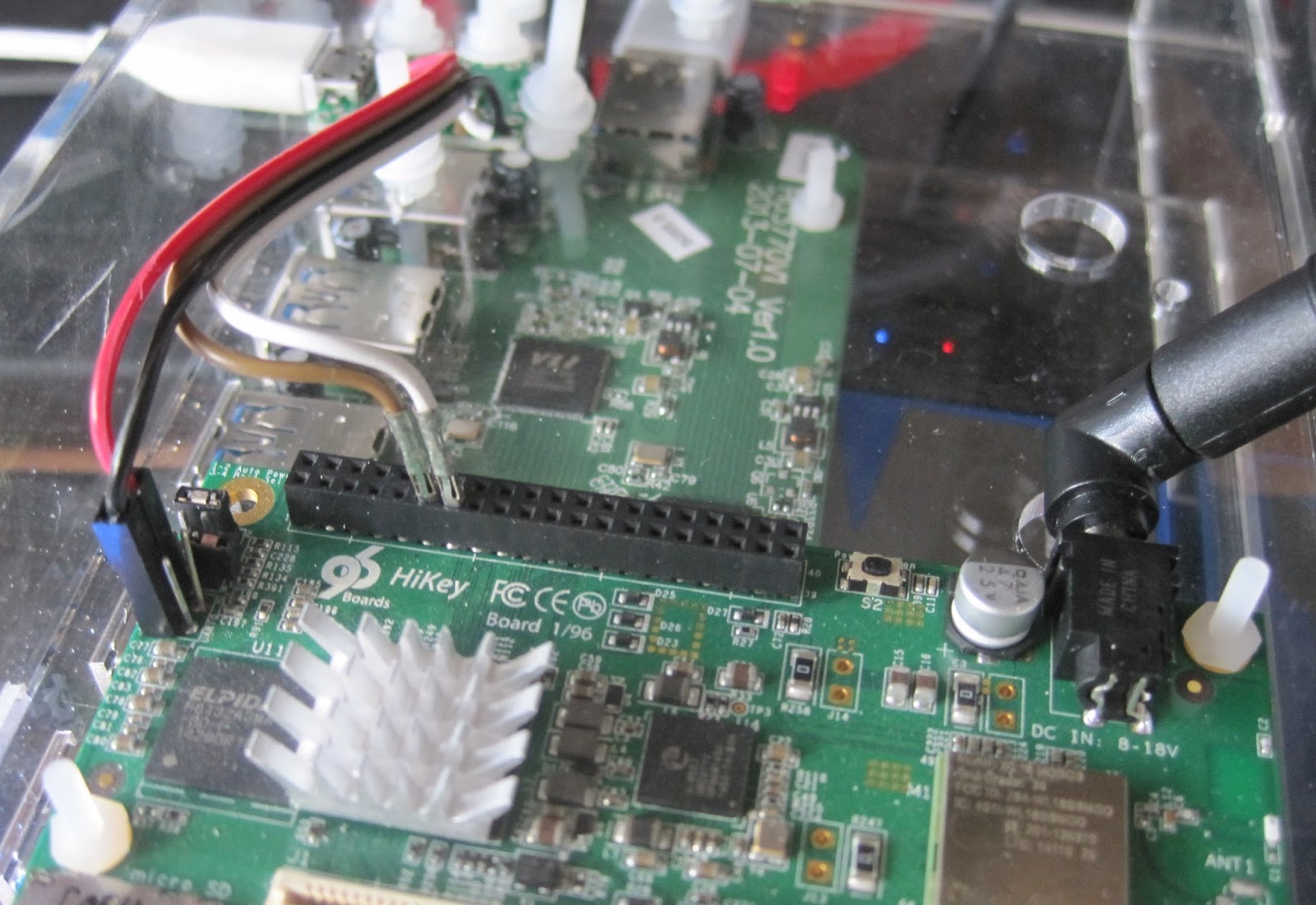
Initially the board required modifying to add headers to attach a USB to 1.8V LVTTL serial adaptor on the UART0 serial port. Once Andy Simpkins had made this change for me I was able to work through the instructions and attempt to install a bootloader and OS image.

The initial software was essentially HiSilicon vendor code using the Android fastboot system to configure booting. There was no source and the Ubuntu OS images were an obvious afterthought to the Android images. Just getting these images installed required a great deal of effort, repetition and debugging. It was such a dreadful experience this signalled the commencement one of the repeated hiatuses throughout this project, the allure of 64 bit ARM computing has its limits even for me.

When I returned to the project I attempted to use the system from the on-board eMMC but the pre-built binary only kernel and OS image were very limited. Building a replacement kernel , or even modules for the existing one proved fruitless and the system was dreadfully unstable.

I wanted to use the system as a builder for some Open Source projects but the system instability ruled this out. I considered attempting to use virtualisation which would also give better system isolation for builder systems. By using KVM running a modern host kernel and OS as a guest this would also avoid issues with the host systems limitations. At which point I discovered the system had no virtualisation enabled apparently because the bootloader lacked support.

In addition to these software issues there were hardware problems, despite forcing the use of USB for all additional connectivity the USB implementation was dreadful. For a start all USB peripherals have to run at the same speed! One cannot mix full (12Mbit) and high speed (480Mbit) devices which makes adding a USB Ethernet and SATA device challenging when you cannot use a keyboard.

And because I needed more challenges only one of the USB root hubs was functional. In effect this made the console serial port critical as it was the only reliable way to reconfigure the system without a keyboard or network link (and WIFI was not reliable either)
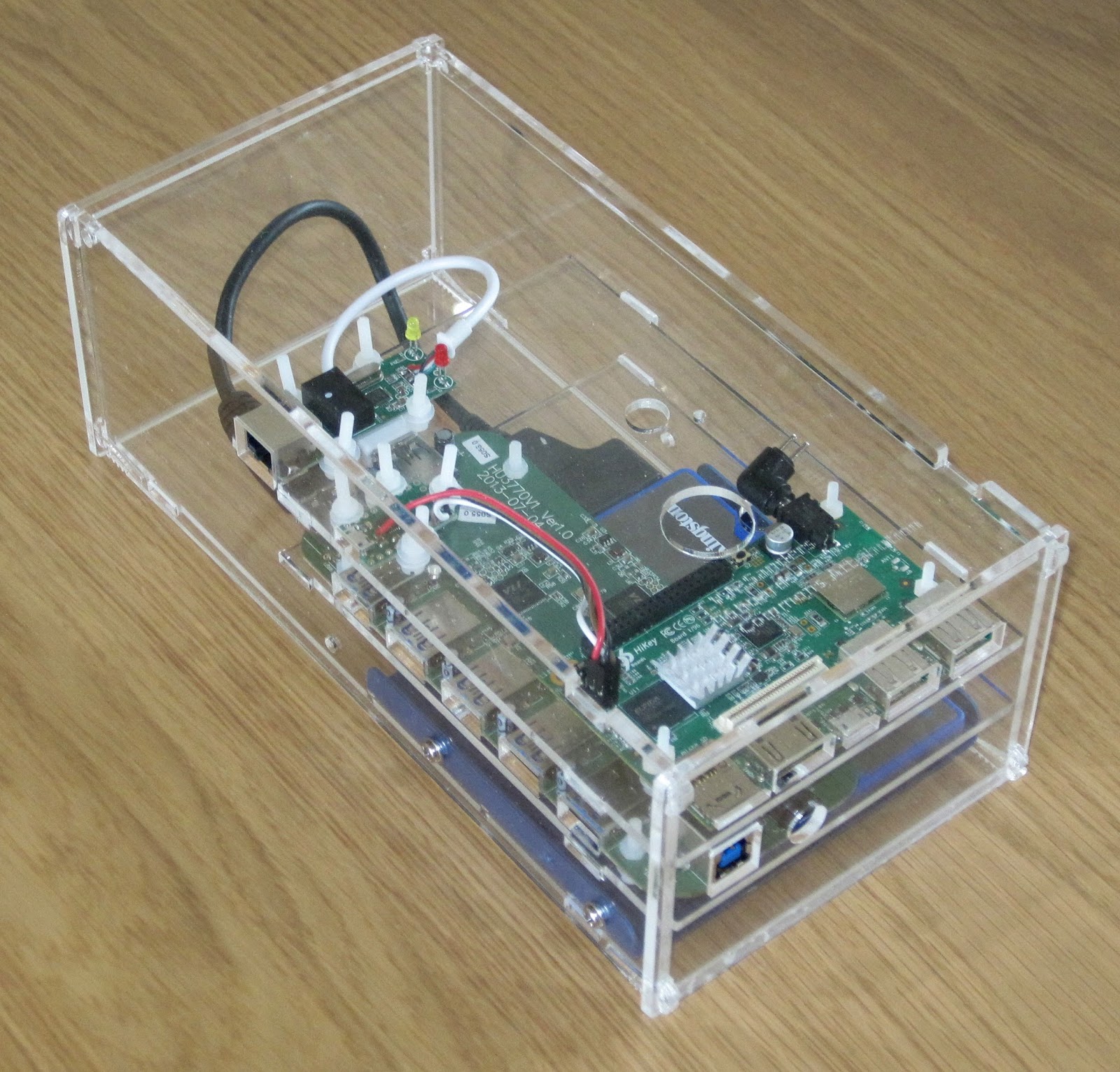
After another long pause in proceedings I decided that I should house all the components together and that perhaps being out on my bench might be the cause of some instability. I purchased a powered Amazon basics USB 2 hub, an Ethernet adaptor and a USB 2 SATA interface in the hope of accessing some larger mass storage.

The USB hub power supply was 12V DC which matched the Hikey requirements so I worked out I could use a single 4A capable supply and run a 3.5inch SATA hard drive too. I designed a laser cut enclosure and mounted all the components. As it turned out I only had a 2.5inch hard drive handy so the enclosure is a little over size. If I were redoing this design I would attempt to make it fit in 1U of height and be mountable in a 19inch rack instead it is an 83mm high (under 2U) box.

A new software release had also become available which purported to use an UEFI bootloader after struggling to install this version unsuccessfully, made somewhat more problematic by the undocumented change from UART0 (unpopulated header) to UART3 on the low speed 2mm pitch header. The system seemed to start the kernel which panicked and hung either booting from eMMC or SD card. Once again the project went on hold after spending tens of hours trying to make progress.
Third time's a charmAs the year rolled to a close I once again was persuaded to look at the hikey, I followed the much improved instructions and installed the shiny new November software release which appears to have been made for the re-release of the Hikey through LeMaker. This time I obtained a Debian "jessie" system that booted from the eMMC.

Having a booted system meant I could finally try and use it. I had decided to try and use the system to host virtual machines used as builders within the NetSurf CI system.

The basic OS uses a mixture of normal Debian packages with some replacements from Linaro repositories. I would have prefered to see more use of Debain packages even if they were from the backports repositories but on the positive side it is good to see the use of Debian instead of Ubuntu.

The kernel is a heavily patched 3.18 built in a predominantly monolithic (without modules) manner with the usual exceptions such as the mali and wifi drivers (both of which appear to be binary blobs). The use of a non-mainline capable SoC means the standard generic distribution kernels cannot be used and unless Linaro choose to distribute a kernel with the feature built in it is necessary to compile your own from sources.

The default install has a linaro user which I renamed to my user and ensured all the ssh keys and passwords on the system were changed. This is an important step when using this pre-supplied images as often a booted system is identical to every other copy.

To access mass storage my only option was via USB, indeed to add any additional expansion that is the only choice. The first issue here is that the USB host support is compiled in so when the host ports are initialised it is not possible to select a speed other than 12MBit. The speed is changed to 480Mbit by using a user space application found in the users home directory (why this is not a tool provided by a package and held in sbin I do not know).

When the usb_speed tool is run there is a chance that the previously enumerated devices will be rescanned and what was /dev/sda has become /dev/sdb if this happens there is a high probability that the system must be rebooted to prevent random crashes due to the "zombie" device.

Because the speed change operation is unreliable it cannot be reliably placed in the boot sequence so this must be executed by hand on each boot to get access to the mass storage.

NetSurf project already uses a x86_64 virtual host system which runs an LLVM physical volume from which we allocate logical volumes for each VM. I initially hoped to do this with the hikey but as soon as I tried to use the logical volume with a VM the system locked up with nothing shown on console. I did not really try very hard to discover why and instead simply used files on disc for virtual drives which seemed to work.

To provide reliable network access I used a USB attached Ethernet device, this like the mass storage suffered from unreliable enumeration and for similar reasons could not be automated requiring manually using the serial console to start the system.

Once the system was started I needed to install the guest VM. I had hoped I might be able to install locally from Debian install media as I do for x86 using the libvirt tools. After a great deal of trial and error I finally was forced to abandon this approach when I discovered the Linaro kernel is lacking iso9660 support so installing from standard media was not possible.

Instead I used the instructions provided by Leif Lindholm to create a virtual machine image on my PC and copied the result across. These instructions are great except I used version 2.5 of Qemu instead of 2.2 which had no negative effect. I also installed the Debian backports for Jessie to get an up to date 4.3 kernel.

After copying the image to the Hikey I started it by hand from the command line as a four core virtual machine and was successfully able to log in. The guest would operate for up to a day before stopping with output such as

$
Message from syslogd@ciworker13 at Jan 29 07:45:28 ...
kernel:[68903.702501] BUG: soft lockup - CPU#0 stuck for 27s! [mv:24089]

Message from syslogd@ciworker13 at Jan 29 07:45:28 ...

kernel:[68976.958028] BUG: soft lockup - CPU#2 stuck for 74s! [swapper/2:0]

Message from syslogd@ciworker13 at Jan 29 07:47:39 ...
kernel:[69103.199724] BUG: soft lockup - CPU#3 stuck for 99s! [swapper/3:0]

Message from syslogd@ciworker13 at Jan 29 07:53:21 ...
kernel:[69140.321145] BUG: soft lockup - CPU#3 stuck for 30s! [rs:main Q:Reg:505]

Message from syslogd@ciworker13 at Jan 29 07:53:21 ...
kernel:[69192.880804] BUG: soft lockup - CPU#0 stuck for 21s! [jbd2/vda3-8:107]

Message from syslogd@ciworker13 at Jan 29 07:53:21 ...
kernel:[69444.805235] BUG: soft lockup - CPU#3 stuck for 22s! [swapper/3:0]

Message from syslogd@ciworker13 at Jan 29 07:55:21 ...
kernel:[69570.177600] BUG: soft lockup - CPU#1 stuck for 112s! [systemd:1]

Timeout, server 192.168.7.211 not responding.

After this output the host system would not respond and had to be power cycled never mind the guest!

Once I changed to single core operation the system would run for some time until the host suffered from the dreaded kernel OOM killer. I was at a loss as to why the oom killer was running as the VM was only allocated half the physical memory (512MB) allowing the host what I presumed to be an adequate amount.

By adding a 512MB swapfile the system was able to push the few hundred kilobytes it wanted to swap and the system was now stable! The swapfile of course has to be started by hand as the external storage is unreliable and unavailable at boot.

I converted the qemu command line to a libvirt config using the virsh tool
virsh domxml-from-native qemu-argv cmdln.args
The converted configuration required manual editing to get a working system but now I have a libvirt based VM guest I can control along with all my other VM using the virt-manager tool.

This system is now stable and has been in production use for a month at time of writing. The one guest VM is a single core 512MB aarch64 system which takes over 1100 seconds (19 minutes) to do what a Banana Pi 2 dual core 1GB memory 32bit native ARM system manages in 300 seconds.

It seems the single core limited memory system with USB SATA attached storage is very, very slow.

I briefly attempted to run the CI system job natively within the host system but within minutes it crashed hard and required a power cycle to retrieve, it had also broken the UEFI boot. I must thank Leif for walking me through recovering the system otherwise I would have needed to start over.
ConclusionsI must stress these conclusions and observations are my own and do not represent anyone else.

My main conclusions are:

This project has taken almost a year to get to the final state and has been one of the least enjoyable within that time. The only reason I have a running system at the end of it is sheer bloody mindedness because after spending hundreds of hours of my free time I was not prepared to see it all go to waste.

To be fair, the road I travelled is now much smoother and if the application is suited to having a mobile phone without a screen then the Hikey probably works as a solution. For me, however, the Hikey product with the current hardware and software limitations is not something I would recommend in preference to other options.

Erich Schubert: Stop abusing lambda expressions - this is not functional programming

I know, all the Scala fanboys are going to hate me now. But:
Stop overusing lambda expressions.
Most of the time when you are using lambdas, you are not even doing functional programming, because you often are violating one key rule of functional programming: no side effects.
For example:
collection.forEach(System.out::println);
is of course very cute to use, and is (wow) 10 characters shorter than:
for (Object o : collection) System.out.println(o);
but this is not functional programming because it has side effects.
What you are doing are anonymous methods/objects, using a shorthand notion. It's sometimes convenient, it is usually short, and unfortunately often unreadable, once you start cramming complex problems into this framework.
It does not offer efficiency improvements, unless you have the propery of side-effect freeness (and a language compiler that can exploit this, or parallelism that can then call the function concurrently in arbitrary order and still yield the same result).
Here is an examples of how to not use lambdas:
DZone Java 8 Factorial (with boilerplate such as the Pair class omitted):
Stream<Pair> allFactorials = Stream.iterate(
  new Pair(BigInteger.ONE, BigInteger.ONE),
  x -> new Pair(
    x.num.add(BigInteger.ONE),
    x.value.multiply(x.num.add(BigInteger.ONE))));
return allFactorials.filter(
  (x) -> x.num.equals(num)).findAny().get().value;
When you are fresh out of the functional programming class, this may seem like a good idea to you... (and in contrast to the examples mentioned above, this is really a functional program).
But such code is a pain to read, and will not scale well either. Rewriting this to classic Java yields:
BigInteger cur = BigInteger.ONE, acc = BigInteger.ONE;
while(cur.compareTo(num) <= 0)  
  cur = cur.add(BigInteger.ONE); // Unfortunately, BigInteger is immutable!
  acc = acc.multiply(cur);
 
return acc;
Sorry, but the traditional loop is much more readable. It will still not perform very well (because of BigInteger not being designed for efficiency - it does not even make sense to allow BigInteger for num - the factorial of 2**63-1, the maximum of a Java long, needs 1020 bytes to store, i.e. about 500 exabyte.
For some, I did some benchmarking. One hundred random values num (of course the same for all methods) from the range 1 to 1000.
I also included this even more traditional version:
BigInteger acc = BigInteger.ONE;
for(long i = 2; i <=x; i++)  
  acc = acc.multiply(BigInteger.valueOf(i));
 
return acc;
Here are the results (Microbenchmark, using JMH, 10 warum iterations, 20 measurement iterations of 1 second each):
functional    1000     100  avgt   20  9748276,035   222981,283  ns/op
biginteger    1000     100  avgt   20  7920254,491   247454,534  ns/op
traditional   1000     100  avgt   20  6360620,309   135236,735  ns/op
As you can see, this "functional" approach above is about 50% slower than the classic for-loop. This will be mostly due to the Pair and additional BigInteger objects created and garbage collected.
Apart from being substantially faster, the iterative approach is also much simpler to follow. (To some extend it is faster because it is also easier for the compiler!)
There was a recent blog post by Robert Br utigam that discussed exception throwing in Java lambdas and the pitfalls associated with this. The discussed approach involves abusing generics for throwing unknown checked exceptions in the lambdas, ouch.

Don't get me wrong. There are cases where the use of lambdas is perfectly reasonable. There are also cases where it adheres to the "functional programming" principle. For example, a stream.filter(x -> x.name.equals("John Doe")) can be a readable shorthand when selecting or preprocessing data. If it is really functional (side-effect free), then it can safely be run in parallel and give you some speedup.
Also, Java lambdas were carefully designed, and the hotspot VM tries hard to optimize them. That is why Java lambdas are not closures - that would be much less performant. Also, the stack traces of Java lambdas remain somewhat readable (although still much worse than those of traditional code). This blog post by Takipi showcases how bad the stacktraces become (in the Java example, the stream function is more to blame than the actual lambda - nevertheless, the actual lambda application shows up as the cryptic LmbdaMain$$Lambda$1/821270929.apply(Unknown Source) without line number information). Java 8 added new bytecodes to be able to optimize Lambdas better - earlier JVM-based languages may not yet make good use of this.
But you really should use lambdas only for one-liners. If it is a more complex method, you should give it a name to encourage reuse and improve debugging.
Beware of the cost of .boxed() streams!
And do not overuse lambdas. Most often, non-Lambda code is just as compact, and much more readable. Similar to foreach-loops, you do lose some flexibility compared to the "raw" APIs such as Iterators:
for(Iterator<Something>> it = collection.iterator(); it.hasNext(); )  
  Something s = it.next();
  if (someTest(s)) continue; // Skip
  if (otherTest(s)) it.remove(); // Remove
  if (thirdTest(s)) process(s); // Call-out to a complex function
  if (fourthTest(s)) break; // Stop early
 
In many cases, this code is preferrable to the lambda hacks we see pop up everywhere these days. Above code is efficient, and readable.
If you can solve it with a for loop, use a for loop!
Code quality is not measured by how much functionality you can do without typing a semicolon or a newline!
On the contrary: the key ingredient to writing high-performance code is the memory layout (usually) - something you need to do low-level.
Instead of going crazy about Lambdas, I'm more looking forward to real value types (similar to a struct in C, reference-free objects) maybe in Java 9 (Project Valhalla), as they will allow reducing the memory impact for many scenarios considerably. I'd prefer a mutable design, however - I understand why this is proposed, but the uses cases I have in mind become much less elegant when having to overwrite instead of modify all the time.

29 February 2016

Antonio Terceiro: Debian Ruby Sprint 2016 - day 1

This year s Debian Ruby team sprint started today here at Curitiba. Everyone arrived fine, and we started working at the meeting room we have booked for the week at Curitiba campus of the Federal Technical University of Paran . The room is at the Department of Business and Community Relations , what makes a lot of sense! :-) The day started with a quick setup, with a simple 8-port switch, and a couple of power strips. It tooks us a few minutes to figure what was blocked or not on the corporate network, and almost everyone who needs connections that are usually blocked in such environments already had their VPN setups so we were able to get started right after that. We are taking notes live on mozilla s piblic etherpad site Today we accomplished quite a lot:
  • analyzed the pending issues for the ruby2.3 transition issues, categorizing the missing packages into needs a binNMU now , needs a binNMU after switching the default to ruby2.3 , and broken .
  • ruby-defaults uploaded to experimental switching to ruby2.3 as default, and dropping support for ruby2.2
  • ruby-gsl fixed to build against GSL 2.x (was blocking ruby2.3 transition)
  • #816253: ruby-fast-gettext: fix FTBFS issue and import a new upstream
  • ruby-aws: several issues fixed
  • ruby-binding-of-caller: fixed rubygems-integration
  • fixed ruby-kakasi-ffi (again)
  • made ruby-blockenspiel arch:any again
  • ruby-fast-gettext 1.0.0-1 (fix ftbfs 816253)
  • ruby-aws-sdk: new upstream, debcheck fix and several bumps
  • ruby-fcgi dropped transitional packages + refreshed packaging with -w
  • ruby-sshkit 1.8.0
  • ruby-beautify: new upstream and few minor fixes
  • asciidoctor (new version sponsored)
  • capistrano 3.4.0 (ftbfs #795724, #802734)
  • #816254: ruby-packetfu: FTBFS: expected NameError with uninitialized constant PacketFu::FakePacket , got #
  • updated rake to 10.5.0; making it not include -I/usr/lib/ruby/vendor_ruby when running tests
  • triaged an closed open bugs on ruby-httpclient that do not apply anymore.
  • updated ruby-httpclient to get rid of warnings in apt-listbugs under Ruby 2.3
  • ruby-packetfu (fix ftbfs #816254) by @kanashiro
  • investigated extension/rdepends build failing with ruby2.3-only
  • applied upstream patch to ruby to fix extension ftbfs when extension uses c++
  • ruby-albino 1.3.3-4 (#813644)
  • basic user-level testing using ruby2.3 as default:
    • chef WORKS mostly; it seems ohai segfaults some times
    • rails autopkgtest FIXED Could not find gem binding_of_caller (>= 0.7.2) , which is required by gem web-console (~> 2.0) , in any of the sources.
    • vagrant WORKS
    • redmine autopkgtest WORKS
    • apt-listbugs FIXED warnings (e.g. try apt-listbugs list $pkg ); caused by ruby-httpclient
    • nanoc WORKS
  • capistrano 3.4.0-1 (#795724, #802734) by @sbadia + @terceiro

Daniel Silverstone: Kicad hacking - Intra-sheet links and ERC

This is a bit of an odd posting since it's about something I've done but is also here to help me explain why I did it and thus perhaps encourage some discussion around the topic within the Kicad community...
Recently (as you will know if you follow this blog anywhere it is syndicated) I have started playing with Kicad for the development of some hardware projects I've had a desire for. In addition, some of you may be aware that I used to work for a hardware/software consultancy called Simtec, and there I got to play for a while with an EDA tool called Mentor Designview. Mentor was an expensive, slow, clunky, old-school EDA tool, but I grew to understand and like the workflow. I spent time looking at gEDA and Eagle when I wanted to get back into hardware hacking for my own ends; but neither did I really click with. On the other hand, a mere 10 minutes with Kicad and I knew I had found the tool I wanted to work with long-term. I designed the beer'o'meter project (a flow meter for the pub we are somehow intimately involved with) and then started on my first personal surface-mount project -- SamDAC which is a DAC designed to work with our HiFi in our study at home. As I worked on the SamDAC project, I realised that I was missing a very particular thing from Mentor, something which I had low-level been annoyed by while looking at other EDA tools -- Kicad lacks a mechanism to mark a wire as being linked to somewhere else on the same sheet. Almost all of the EDA tools I've looked at seem to lack this nicety, and honestly I miss it greatly, so I figured it was time to see if I could successfully hack on Kicad. Kicad is written in C++, and it has been mumble mumble years since I last did any C++, either for personal hacking or professionally, so it took a little while for that part of my brain to kick back in enough for me to grok the codebase. Kicad is not a small project, taking around ten minutes to build on my not-inconsiderable computer. And while it beavered away building, I spent time looking around the source code, particularly the schematic editor eeschema. To skip ahead a bit, after a couple of days of hacking around, I had a proof-of-concept for the intra-sheet links which I had been missing from my days with Mentor, and some ERC (electrical rules checking) to go alongside that to help produce schematics without unwanted "sharp corners". In total, I added:
  • an "intra-sheet link" schematic element, including: Intra-sheet linking tool
    • the schematic element itself
    • loading and saving of the element (which required a bump in schematic file format versioning)
    • UI for adding intra-sheet links to your schematic
    • netlist build support to ensure that the links found their way into the internal netlist content.
  • an ERC tickybox "Strict wiring checks" and behind that I hid: Strict wiring checks
    • checks for wires with dangling ends (dangles are bad)
    • junctions which have no point in being present (pointless junctions are confusing to readers)
    • checks that intra-sheet links exist in groups of two or more on any given net, since individual links are pointless.
I forked the Kicad mirror on Github and pushed my own branch with this work to my Kicad fork. All of this is meant to allow schematic capture engineers to more clearly state their intentions regarding what they are drawing. The intra-sheet link could be thought of like a no-connect element, except instead of saying "this explicitly goes nowhere" we're saying "this explicitly goes somewhere else on this sheet, you can go look for it". Obviously, people who dislike (or simply don't want to use) such intra-sheet link elements can just disable that ERC tickybox and not be bothered by them in the least (well except for the toolbar button and menu item I suppose). Whether this work gets accepted into Kicad, or festers and dies on the vine, it was good fun developing it and I'd like to illustrate how it could help you, and why I wrote it in the first place:

A contrived story
Note, while this story is meant to be taken seriously, it is somewhat contrived, the examples are likely electrical madness, but please just think about the purpose of the checks etc.
To help to illustrate the feature and why it exists, I'd like to tell you a somewhat contrived story about Fred. Fred is a schematic capture engineer and his main job is to review schematics generated by his colleagues. Fred and his colleagues work with Kicad (hurrah) but of late they've been having a few issues with being able to cleanly review schematics. Fred's colleagues are not the neatest of engineers. In particular they tend to be quite lazy when it comes to running busses, which are not (for example) address and data busses, around their designs and they tend to simply have wires which end in mid-space and pick up somewhere else on the sheet. All this is perfectly reasonable of course, and Kicad handles it with aplomb. Sadly it seems quite error prone for Fred's workplace. As an example, Fred's colleague Ben has been designing the power supply for a particular board. As with most power supplies, plenty of capacitors are needed to stabilise the regulators and smooth the output. In the example below, the intent is that all of the capacitors are on the FOO net. Contrived problem example 1 Sadly there's a missing junction and/or slightly misplaced label in the upper section which means that C2 and C3 simply don't join to the FOO net. This could easily be missed, but the ERC can't spot it at all since there's more than one thing on each net, so the pins of the capacitors are connected to something. Fred is very sad that this kind of problem can sometimes escape notice by the schematic designer Ben, Fred himself, and the layout engineer, resulting in boards which simply do not work. Fred takes it upon himself to request that the strict wiring checks ERC is made mandatory for all designs, and that the design engineers be required to use intra-sheet link symbols when they have signals which wander off to other parts of the sheet like FOO does in the example. Without any further schematic changes, strict wiring checks enabled gives the following points of ERC concern for Ben to think about: Contrived problem example 2 As you can see, the ERC is pointing at the wire ends and the warnings are simply that the wires are dangling and that this is not acceptable. This warning is very like the pin-not-connected warnings which can be silenced with an explicit no-connect schematic element. Ben, being a well behaved and gentle soul, obeys the design edicts from Fred and seeks out the intra-sheet link symbols, clearing off the ERC markers and then adding intra-sheet links to his design: Contrived problem example 3 This silences the dangling end ERC check, which is good, however it results in another ERC warning: Contrived problem example 4 This time, the warning for Ben to deal with is that the intra-sheet links are pointless. Each exists without a companion to link to because of the net name hiccough in the top section. It takes Ben a moment to realise that the mistake which has been made is that a junction is missing in the top section. He adds the junction and bingo the ERC is clean once more: Contrived problem example 5 Now, this might not seem like much gain for so much effort, but Ben can now be more confident that the FOO net is properly linked across his design and Fred can know, when he looks at the top part of the design, that Ben intended for the FOO net to go somewhere else on the sheet and he can look for it.

Why do this at all? Okay, dropping out of our story now, let's discuss why these ERC checks are worthwhile and why the intra-sheet link schematic element is needed.
Note: This bit is here to remind me of why I did the work, and to hopefully explain a little more about why I think it's worth adding to Kicad...
Designers are (one assumes) human beings. As humans we (and I count myself here too) are prone to mistakes. Sadly mistakes are often subtle and could easily be thought of as deliberate if the right thought processes are not followed carefully when reviewing. Anyone who has ever done code review, proofread a document, or performed any such activity, will be quite familiar with the problems which can be introduced by a syntactically and semantically valid construct which simply turns out to be wrong in the greater context. When drawing designs, I often end up with bits of wire sticking out of schematic sections which are not yet complete. Sadly if I sleep between design sessions, I often lose track of whether such a dangling wire is meant to be attached to more stuff, or is simply left because the net is picked up elsewhere on the sheet. With intra-sheet link elements available, if I had intended the latter, I'd have just dropped such an element on the end of the wire before I stopped for the day. Also, when drawing designs, I sometimes forget to label a wire, especially if it has just passed through a filter or current-limiting resistor or similar. As such, even with intra-sheet link elements to show me when I mean for a net to go bimbling off across the sheet, I can sometimes end up with unnamed nets whose capacitors end up not used for anything useful. This is where the ERC comes in. By having the ERC complain if a wire dangles -- the design engineer won't forget to add links (or check more explicitly if the wire is meant to be attached to something else). By having junctions which don't actually link anything warned about, the engineer can't just slap a junction blob down on the end of a wire to silence that warning, since that doesn't mean anything to a reviewer later down the line. By having the ERC warn if a net has exactly one intra-sheet link attached to it, missing net names and errors such as that shown in my contrived example above can be spotted and corrected. Ultimately this entire piece of work is about ensuring that the intent of the design engineer is captured clearly in the schematic. If the design engineer meant to leave that wire dangling because it's joining to another bit of wire elsewhere on the sheet, they can put the intra-sheet links in to show this. The associated ERC checks are there purely to ensure that the validation of this intent is not bypassed accidentally, or deliberately, in order to make the use of this more worthwhile and to increase the usefulness of the ERC on designs where signals jump around on sheets where wiring them up directly would just create a mess.

25 February 2016

Matthew Garrett: I bought some awful light bulbs so you don't have to

I maintain an application for bridging various non-Hue lighting systems to something that looks enough like a Hue that an Amazon Echo will still control them. One thing I hadn't really worked on was colour support, so I picked up some cheap bulbs and a bridge. The kit is badged as an iSuper iRainbow001, and it's terrible.

Things seemed promising enough at first, although the bulbs were alarmingly heavy (there's a significant chunk of heatsink built into them, which seems to get a lot warmer than I'd expect from something that claims a 7W power consumption). The app was a bit clunky, but eh - I wasn't planning on using it for long. I pressed the button on the bridge, launched the app and could control the bulbs. The first thing I noticed was that they had a separate "white" and "colour" mode. White mode was pretty bright, but colour mode massively less so - presumably the white LEDs are entirely independent of the RGB ones, and much higher intensity. Still, potentially useful as mood lighting.

Anyway. Next step was to start playing with the protocol, which meant finding the device on my network. I checked anything that had picked up a DHCP lease recently and nmapped them. The OS detection reported Linux, which wasn't hugely surprising - there was no GPL notice or source code included with the box, but I'm way past the point of shock at that. It also reported that there was a telnet daemon running. I connected and got a login prompt. And then I typed admin as the username and admin as the password and got a root prompt. So, there's that. The copy of Busybox included even came with tftp, so it was easy to get copies of tcpdump and strace on there to see what was up.

So. Next step. Protocol sniffing. I wanted to know how discovery worked, so reset the device to factory and watched what happens. The app on my phone sent out a discovery packet on UDP port 18602 which looked like this:

INLAN:CLIP:23.21.212.48:CLPT:22345:MAC:02:00:00:00:00:00

The CLIP and CLPT fields refer to the cloud server that allows for management when you're not on the local network. The mac field contains an utterly fake address. If you send out a discovery packet and your mac hasn't been registered with the device, you get a denial back. If your mac has been (and by "mac" here I mean "utterly fake mac that's the same for all devices"), you get back a response including the device serial number and IP address. And if you just leave out the mac field entirely, you get back a response no matter whether your address is registered or not. So, that's a start. Once you've registered one copy of the app with the device, anything can communicate with it by just using the same fake mac in the discovery packets.

Onwards. The command format turns out to be simple. They start ##, are followed by two ascii digits encoding a command, four ascii digits containing a bulb id, two ascii digits containing the number of following bytes and then the command data (in ascii). An example is:

##05010002ff

which decodes as command 5 (set white intensity) on bulb 1 with two bytes of data following, each of which is an f. This translates as "Set bulb 1 to full white intensity". I worked out the rest pretty quickly - command 03 sets the RGB colour of the bulb, 0A asks the bridge to search for new bulbs, 0B tells you which bulbs are available and their capabilities and 0E gives you the MAC addresses of the bulbs( ). 0C crashes the server process, and 06 spews a bunch of garbage back at you and potentially crashes the bulb in a hilarious way that involves it flickering at about 15Hz. It turns out that 06 is actually the "Rename bulb" command, and if you send it less data than it's expecting something goes hilariously wrong in string parsing and everything is awful.

Ok. Easy enough, but not hugely exciting. What about the remote protocol? This turns out to involve sending a login packet and then a wrapped command packet. The login has some length data, a header of "MQIsdp", a long bunch of ascii-encoded hex, a username and a password.

The username is w13733 and the password is gbigbi01. These are hardcoded in the app. The ascii-encoded hex can be replaced with 0s and the login succeeds anyway.

Ok. What about the wrapping on the command? The login never indicated which device we wanted to talk to, so presumably there's some sort of protection going on here oh wait. The command packet is a length, the serial number of the bridge and then a normal command packet. As long as you know the serial number of the device (which it tells you in response to a discovery packet, even if you're unauthenticated), you can use the cloud service to send arbitrary commands to the device (including the one that crashes the service). One of which involves the device then doing some kind of string parsing that doesn't appear to work that well. What could possibly go wrong?

Ok, so that seemed to be the entirety of the network protocol. Anything else to do? Some poking around on the bridge revealed (a) that it had an active wireless device and (b) a running DHCP server. They wouldn't, would they?

Yes. Yes, they would.

The devices all have a hardcoded SSID of "iRainbow", although they don't broadcast it. There's no security - anybody can associate. It'll then hand out an IP address. It's running telnetd on that interface as well. You can bounce through there to the owner's internal network.

So, in summary: it's a device that infringes my copyright, gives you root access in response to trivial credentials, has access control that depends entirely on nobody ever looking at the packets, is sufficiently poorly implemented that you can crash both it and the bulbs, has a cloud access protocol that has no security whatsoever and also acts as an easy mechanism for people to circumvent your network security. This may be the single worst device I've ever bought.

I called the manufacturer and they insisted that the device was designed in 2012, was no longer manufactured or supported, that they had no source code to give me and there would be no security fixes. The vendor wants me to pay for shipping back to them and reserves the right to deduct the cost of the original "free" shipping from the refund. Everything is awful, which is why I just ordered four more random bulbs to play with over the weekend.

comment count unavailable comments

23 February 2016

Ritesh Raj Sarraf: Unbricking my Linksys

In trying to improve the WiFi service in my house, I recently dug out my old Linksys WRT54G Router. It is a 802.11 bg router, which can do 54 MBPS. Currently, I use a TPLink based router, with a DD-WRT community firmware, which claims is 802.11 bgn and can do 300 MBPS. The overall wifi signal isn't adequate, so I thought of using the old router as a repeater. The default Linksys VXWorks firmware does not have the bridging capabilities, so it was time to flashback, again, the dd-wrt image onto it (The last time I did, I eventually had to revert back to the stock firmware because my ISP claimed that the router was giving too many packet drops). Being an old device, and me being lazy, I did not pay much attention to the exact steps; and ended up bricking my router, wherein it wouldn't give me the Management Console to flash a new firmware; nor would it give me the old VXWorks firmware interface. All it gave was a White Screen of Death and an active IP connection. Turns out I'm not the only one bricking routers, so some good soul documented the process on unbricking the router. I was in a slightly more better position than the author, cause I did have the network available. My initial hope was to just push the firmware image over tftp, and that it would work. But that didn't happen. So, I was forced to follow the steps in the article, i.e. to use the Windows Tool mentioned in it (Infact that is what triggered me to write the article). Not having Windows available, my choice was to try it out over Crossover/Wine. It got the job done; so Thank You. BTW, does anyone know what goodie does the Windows Tool do that plain tftp did not ? The Windows Tool too pushed the image over tftp, so it must be doing something within the tftp spec to trigger the firmware upload and flash. That done, getting the Repeater Bridge wasn't that painful. If you build a Repeater Bridge setup, just follow dd-wrt instructions. The only extra I'd add is that You should keep your Virtual AP's credentials the same as that of your Primary Router's AP's. I'm not sure why that is needed but that ate my good 2-3 hrs.

Categories:

Keywords:

Like:

21 February 2016

Lunar: Reproducible builds: week 43 in Stretch cycle

What happened in the reproducible builds effort between February 14th and February 20th 2016:

Toolchain fixes Yaroslav Halchenko uploaded cython/0.23.4+git4-g7eed8d8-1 which makes its output deterministic. Original patch by Chris Lamb. Didier Raboud uploaded pyppd/1.0.2-3 to experimental which now serialize PPD deterministically. Lunar submitted two patches for lcms to add a way for clients to set the creation date/time in profile headers and initialize all bytes when writing named colors.

Packages fixed The following packages have become reproducible due to changes in their build dependencies: dbconfig-common, dctrl-tools, dvdwizard, ekg2, expeyes, galternatives, gpodder, icewm, latex-mk, libiio, lives, navit, po4a, tasksel, tilda, vdr-plugin-infosatepg, xaos. The following packages became reproducible after getting fixed: Some uploads fixed some reproducibility issues, but not all of them: Unknown status:
  • tomcat7/7.0.68-1 by Emmanuel Bourg (test suite fails in test environment).
Patches submitted which have not made their way to the archive yet:
  • #814840 on tor by Petter Reinholdtsen: use the UTC timezone when calling asciidoc.
  • #815082 on arachne-pnr by Dhole: use the C locale to format the changelog date.
  • #815192 on manpages-de by Reiner Herrmann: tell grep to always treat the input as text so that it works with non-UTF-8 locales.
  • #815193 on razorqt by Reiner Herrmann: tell grep to always treat the input as text so that it works with non-UTF-8 locales.
  • #815250 on jacal by Reiner Herrmann: use the C locale to format the build date.
  • #815252 on colord by Lunar: remove extra timestamps when generating CMF and spectra and implement support for SOURCE_DATE_EPOCH.

reproducible.debian.net Two new package sets have been added: freedombox and freedombox_build-depends. (h01ger)

diffoscope development diffoscope version 49 was released on February 17th. It continues to improve handling of debug symbols for ELF files. Their content will now be compared separately to make them more readable. The search for matching debug packages is more efficient by looking only for .deb files in the same parent directory. Alongside more bug fixes, support for ICC profiles has been added, and libarchive is now also used to read metadata for ar archives.

strip-nondeterminism development Reiner Herrmann added support to normalize Gettext .mo files.

Package reviews 170 reviews have been removed, 172 added and 54 updated in the previous week. 34 new FTBFS bugs have been opened by Chris Lamb, h01ger and Reiner Herrmann. New issues added this week: lxqt_translate_desktop_binary_file_matched_under_certain_locales, timestamps_in_manpages_generated_by_autogen. Improvements to the prebuilder script: avoid ccache, skip disorderfs hook if device nodes cannot be created, compatibility with grsec trusted path execution (Reiner Herrmann), code cleanup (Esa Peuha).

Misc. Steven Chamberlain highlighted reproducibility problems due to differences in how Linux and FreeBSD handle permissions for symlinks. Some possible ways forward have been discussed on the reproducible-builds mailing list. Bernhard M. Wiedemann reported on some reproducibility tests made on OpenSuse mentioning the growing support for SOURCE_DATE_EPOCH. If you are eligible for Outreachy or Google Summer of Code, consider spending the summer working on reproducible builds!

17 February 2016

Riku Voipio: Ancient Linux swag

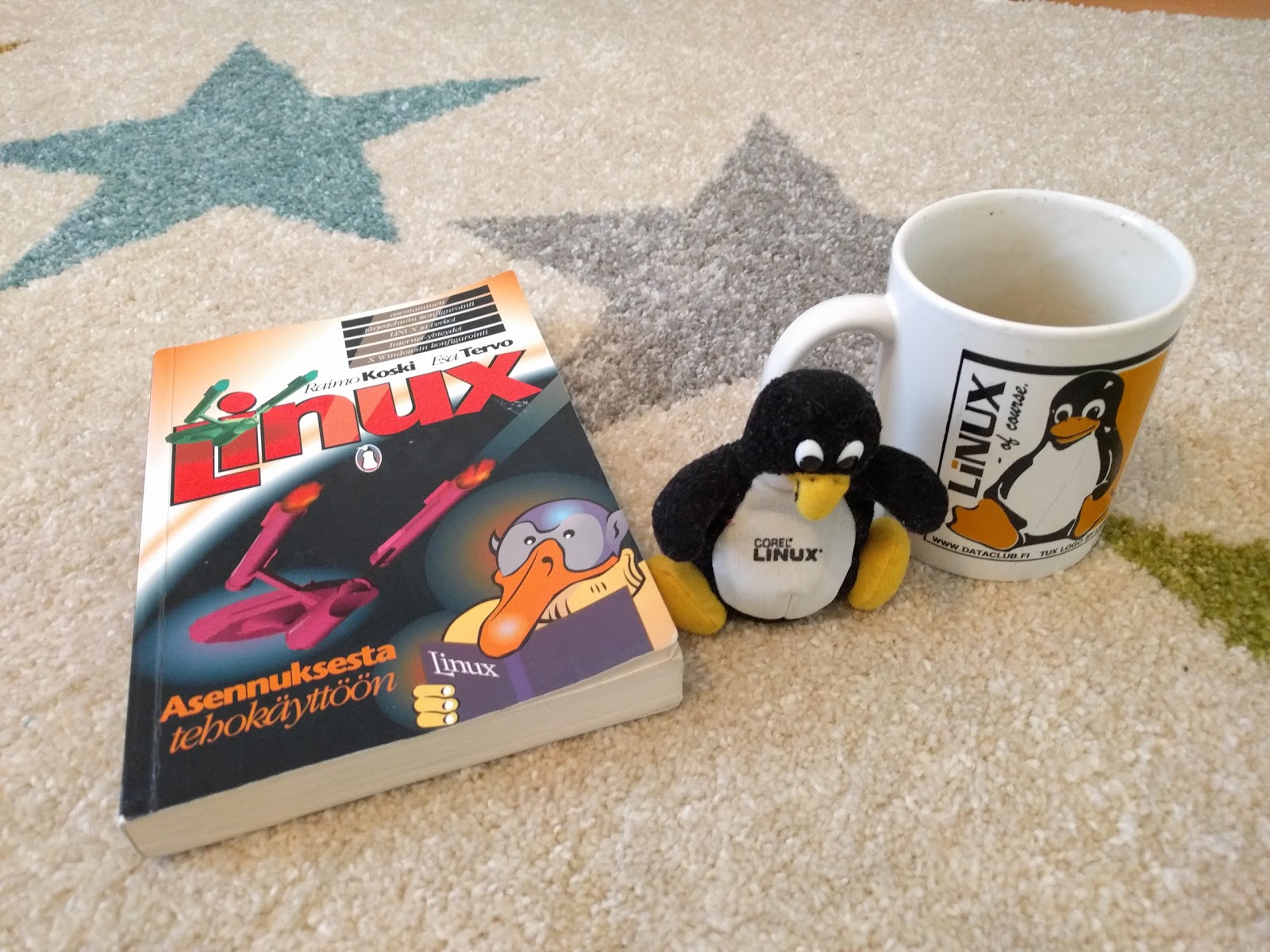
Since I've now been using Linux for 20 years, I've dug up some artifacts from the early journey.
  1. First the book, from late 1995. This from before Tux, so the penguin in the cover is just a co-incidence. The book came with a slackware 3.0 CD, which was my entrance to Linux. Today, almost all of the book is outdated - slackware and lilo install? printing with lpr? mtools and dosemu? ftp, telnet with SLIP dialup? Manually configuring XFree86 and fvwm? How I miss those times!* The only parts of the book are still valid are: shell and vi guides. I didn't read latter, and instead imported my favorite editor from dos FTE.
  2. Fast forward some years, into my first programming job. Ready to advertise the Linux revolution, I bought the mug on right. Nobody else would have a Tux mug, so nobody would accidentally take my mug from the office dishwasher. That only worked for my first work place (a huge and nationally hated IT consultant house). The next workplace, a mobile gaming startup (in 2001, I was there before it was trendy!) - and there was already plenty of Linux mugs when I joined...
  3. While today it may be hard to imagine, those days using Microsoft office tools was mandatory. That leads to the third memorabilia in the picture. Wordperfect for Linux existed for a brief while, and in the box (can you imagine, software came in physical boxes?) came a Tux plush.
* Wait no, I don't miss those times at all

Antoine Beaupr : My free software activities, february 2016

Debian Long Term Support (LTS) This is my third month working on Debian LTS, started by Raphael Hertzog at Freexian. This month was my first month working on the frontdesk duty and did a good bunch of triage. I also performed one upload and reviewed a few security issues.

Frontdesk duties I spent some time trying to get familiar with the frontdesk duty. I still need to document a bit of what I learned, which did involve asking around for parts of the process. The following issues were triaged:
  • roundcube in squeeze was happily not vulnerable to CVE-2015-8794 and CVE-2015-8793, as the code affected was not present. roundcube is also not shipped with jessie but the backport is vulnerable
  • the php-openid vulnerability was actually just a code sample, a bug report comment clarified all of CVE-2016-2049
  • ffmpeg issues were closed, as it is not supported in squeeze
  • libxml2 was marked as needing work (CVE-2016-2073)
  • asterisk was triaged for all distros before i found out it is also unsupported in squeeze (CVEs coming up, AST-2016-001, AST-2016-001, AST-2016-001)
  • libebml and libmatroska were marked as unsupported, although an upload of debian-security-support will be necessary to complete that work (bug #814557 filed)

Uploads and reviews I only ended up doing one upload, of the chrony package (CVE-2016-1567), thanks to the maintainer which provided the patch. I tried my best trying to sort through the issues with tiff (CVE-2015-8668 and CVE-2015-7554), which didn't have obvious fixes available. OpenSUSE seem to have patches, but it is really hard to find them through their issue trackers, which were timing out on me. Hopefully someone else can pick that one up. I also tried and failed to reproduce the cpio issue (CVE-2016-2037), which, at the time, didn't have a patch for a fix. This ended up being solved and Santiago took up the upload. I finally spent some time trying to untangle the mess that is libraw, or more precisely, all the packages that embed dcraw code instead of linking against libraw. Now I really feel even more strongly for the Debian policy section 4.13 which states that Debian packages should not ship with copies of other packages code. It made it really hard to figure out which packages were vulnerable, especially because it was hard to figure out which versions of libraw/dcraw were actually vulnerable to the bug, but also just plain figure out which packages were copying code from libraw. I wish I had found out about secure-testing/data/embedded-code-copies earlier... Still, it was interesting to get familiar with codesearch.debian.net to try to find copies of the vulnerable code, which was not working so well. Kudos to darktable 2.0 for getting rid of their embedded copy of libraw, by the way - it made it completely not vulnerable to the issue, the versions in stretch and sid not having the code at all and older versions having non-vulnerable copies of the code.

Issues with VMs again I still had problems running a squeeze VM - not wanting to use virtualbox because of the overhead, I got lost for a bit trying to use libvirt and KVM. A bunch of issues crept up: using virt-manager would just fail on startup with an error saying interface mtu value is improper, which is a very unhelpful error message (what is a proper value??) - and, for the record, the MTU on eth0 and wlan0 is the fairly standard 1500, while lo is at 65536 bytes, nothing unusual there as far as I know. Then the next problem was actually running a VM - I still somewhat expected to be able to boot off a chroot, something I should definitely forget about it seems like (boot loader missing? not sure). I ended up calling virt-install with the live ISO image I was previously using:
virt-install --virt-type kvm --name squeeze-amd64 --memory 512 --cdrom ~/iso/Debian/cdimage.debian.org_mirror_cdimage_archive_6.0.10_live_amd64_iso_hybrid_debian_live_6.0.10_amd64_gnome_desktop.iso --disk size=4 --os-variant debiansqueeze
At least now I have an installed squeeze VM, something I didn't get to do in Virtualbox (mostly because I didn't want to wait through the install, because it was so slow). Finally, I still have trouble getting a commandline console on the VM: somehow, running virtsh console squeeze-amd64 doesn't give me a login terminal, and worse, it actually freezes the terminal that I can actually get on virt-viewer squeeze-amd64, which definitely sounds like a bug. I documented a bit more of that setup in the Debian wiki KVM page so hopefully this will be useful for others.

Other free software work I continued my work on improving timetracking with ledger in my ledger-timetracking git repository, which now got a place on the new plaintextaccounting.org website, which acts as a portal for ledger-like software projects and documentation.

Darktable 2.0 I had the pleasure of trying the new Darktable 2.0 release, which only recently entered Debian. I built a backport for jessie, which works beautifully: much faster thumbnail rendering, no dropping of history when switching views... The new features are great, but I also appreciate how they are being very conservative in their approach. Darktable is great software: I may have trouble approaching the results other are having with lightroom and snapseed, but those are proprietary software that I can't use anyways. I also suspect that I just don't have enough of a clue of what I'm doing to get the results I need in Darktable. Maybe with hand-holding, one day, I will surpass the results I get with the JPEGs from my Canon camera. Until then, I turned off RAW exports in my camera to try and control the explosion of disk use I saw since I got that camera:
41M     2004
363M    2005
937M    2006
2,2G    2007
894M    2008
800M    2009
1,8G    2010
1,4G    2011
9,8G    2012
31G     2013
26G     2014
9,8G    2015
The drop in 2015 is mostly due to me taking less pictures in the last year, for some reason...

Markdown mode hacks I ended up writing some elisp for the markdown mode. It seems I am always writing links like [text](link) which seems more natural at first, but then the formatting looks messier, as paragraph wrapping is all off because of the long URLs. So I always ended up converting those links, which was a painful series of keystrokes. So I made a macro, and while I'm a it, why not rewrite it as a lisp function. Twice. Then I was told by the markdown-mode.el developers that they had already fixed that (in the 2.1 version, not in Debian jessie) and that the C-c C-a r key binding actually recognized existing links and conveniently converted them. I documented my adventures in bug #94, but it seems I wrote this code for nothing else than re-learning Emacs lisp, which was actually quite fun.

More emacs hacking Another thing I always wasted time doing by and is "rename file and buffer". Often, you visit a file but it's named wrong. My most common case is a .txt file that i rename to .mdwn. I would then have to do:
M-x rename-file <ret> newfile
M-x rename-buffer <ret> newfile
C-x C-s <ret> newfile
Really annoying. Turns out that set-visited-file-name actually does most of the job, but doesn't actually rename the file, which is really silly. So I wrote this small function instead:
(defun rename-file-and-buffer (newfname)
  "combine rename-file and rename-buffer
set-visited-file-name does most of the job, but unfortunately
doesn't actually rename the file. rename-file does that, but
doesn't rename the buffer. rename-buffer only renames the buffer,
which is pretty pointless.
only operates on current buffer because set-visited-file-name
also does so and we don't bother doing excursions around.
"
  (interactive "GRename file and bufer: ")
  (let ((oldfname (buffer-file-name)))
    (set-visited-file-name newfname nil t)
    (rename-file oldfname newfname)
    )
  )
Not bound to any key, really trivial, but doing this without that function is really non-trivial, especially since set-visited-file-name needs special arguments to not mark the file as modified.

IRC packages updates I updated the Sopel IRC bot package to the latest release, 6.3.0. They have finally switched to Requests, but apart from that, no change was necessary. I am glad to finally see SNI support working everywhere in the bot! I also update the Charydbis IRC server package to the latest 3.5.0 stable release. This release is great news, as I was able to remove 5 of the 7 patches I was dragging along the Debian package. The previous Charybdis stable release was over 3 years old, as 3.4.2 was released in (December) 2012! I spend a good chunk of time making the package reproducible. I filed a bug upstream and eventually made a patch to make it possible to hardcode a build timestamp, which seems to have been the only detectable change in the reproducible build infrastructure. Charybdis had been FTBS for a while in sid now, and the upload should fix that as well. Unfortunately, Charybdis still doesn't build with hardening flags - but hopefully a future update of the package should fix that. It is probably because CFLAGS are not passed around properly. There's really interesting stuff going on in the IRC world. Even though IRC is one of the oldest protocols still in operation (1988, even before the Web, but after SMTP and the even more venerable FTP), it is still being actively developed, with a working group drafting multiple extensions to the IRCv3 protocol defined in RFC 1459. For example, IRCv3.3 includes a Strict Transport Security extension, which tries to ensure users use encrypted channels as much as possible, through warnings and STARTTLS support. Charybdis goes even further by proposing a reversal of the +S ("secure channel" flag) where all channels are secure by default, and you need to deliberately mark a channel as insecure with the +U flag if you actually want to allow users on an clear-text connection to join the channel. A transition mechanism is also proposed.

Miscellaneous bug reports En vrac... I fell face-first in this amazing game that is endless-sky. I made a small pull request on the documentation, a bug report and a feature request. I forwarded a bug report, originally filed against monkeysign, to the pyqrencode maintainers. I filed a usability bug against tails-installer, which just entered Debian, mostly usability issues. I discovered the fim image viewer, which re-entered Debian recently. It seemed perfect to adjust my photos-import workflow, so I added it to my script, to be able to review photos prior to importing them into Darktable and git-annex.

9 February 2016

Mark Brown: Maintaining your email

One of the difficulties of being a kernel maintainer for a busy subsystem is that you will often end up getting a lot of mail that requires reading and handling which in turn requires sending a lot of mail out in reply. Some of that requires thought and careful consideration but a lot of it is quite routine and (perhaps surprisingly) there is often more challenge in doing a good job of handling these routine messages. For a long time I used to hand write every reply I sent but the problem with doing that is that sending the same message a lot of times tends to result in the messages getting more and more brief as the message becomes routine and practised. Your words become more optimised and if you ve stopped thinking about the message before you ve finished typing it then there s a desire to finish the typing and get on to the next thing. This is I think a lot of the reputation that kernel maintainers have for being terse and unhelpful comes from messages that are very practised for someone sending them all the time aren t always going to be obvious or helpful for someone who s not so intimately familiar with what s going on. The good part of it is that everyone is getting a personalised response and it s easy to insert a comment about that specific situation when you re already replying but it s not clear that the tradeoff is a good one. What I ve started doing instead for most things is keeping a set of pre-written paragraphs for common cases that I can just insert into a mail and edit as needed. Hopefully it s working well for people, it means the replies are that bit more verbose than they might otherwise be (mainly adding an explanation of why a given thing is being asked for) but can easily be adapted as needed. The one exception is the Applied, thanks mails I used to send when I apply a patch (literally just saying that). Those are now automatically generated by the script I use to sync my local git repository with kernel.org and very much more verbose:
From: Mark Brown <broonie@kernel.org>
To: $ CCS 
Cc: $ LIST 
Subject: $ SUBJECT 
In-Reply-To: $ MSGID 
The patch
   $ TITLE 
has been applied to the $ REPO  tree at
   $ URL  $ BRANCH 
All being well this means that it will be integrated into the linux-next
tree (usually sometime in the next 24 hours) and sent to Linus during
the next merge window (or sooner if it is a bug fix), however if
problems are discovered then the patch may be dropped or reverted.
You may get further e-mails resulting from automated or manual testing
and review of the tree, please engage with people reporting problems and
send followup patches addressing any issues that are reported if needed.
(unfortunately this bit seems to be something that it s worth pointing out)
If any updates are required or you are submitting further changes they
should be sent as incremental updates against current git, existing
patches will not be replaced.
Please add any relevant lists and maintainers to the CCs when replying
to this mail.
Thanks,
Mark
(the script does try to CC relevant lists). As well as giving people more information this also means that the mails only get sent out when things actually get published to my public repositories which avoids some confusion that used to happen sometimes with people getting my replies before I d pushed, especially when I d been working with poor connectivity as often happens when travelling. On the down side it s very much an obvious form letter which some people don t like and which can make people glaze over. My hope with this is to make things easier on average for patch submitters and easier for me, feedback on the scripted e-mails appears to be good thus far and the goal with the pasted in content is that it should be less obvious that it s happening so I d expect less feedback there.

8 February 2016

Lunar: Reproducible builds: week 41 in Stretch cycle

What happened in the reproducible builds effort this week:

Toolchain fixes After remarks from Guillem Jover, Lunar updated his patch adding generation of .buildinfo files in dpkg.

Packages fixed The following packages have become reproducible due to changes in their build dependencies: dracut, ent, gdcm, guilt, lazarus, magit, matita, resource-agents, rurple-ng, shadow, shorewall-doc, udiskie. The following packages became reproducible after getting fixed:
  • disque/1.0~rc1-5 by Chris Lamb, noticed by Reiner Herrmann.
  • dlm/4.0.4-2 by Ferenc W gner.
  • drbd-utils/8.9.6-1 by Apollon Oikonomopoulos.
  • java-common/0.54 by by Emmanuel Bourg.
  • libjibx1.2-java/1.2.6-1 by Emmanuel Bourg.
  • libzstd/0.4.7-1 by Kevin Murray.
  • python-releases/1.0.0-1 by Jan Dittberner.
  • redis/2:3.0.7-2 by Chris Lamb, noticed by Reiner Herrmann.
  • tetex-brev/4.22.github.20140417-3 by Petter Reinholdtsen.
Some uploads fixed some reproducibility issues, but not all of them:
  • anarchism/14.0-4 by Holger Levsen.
  • hhvm/3.11.1+dfsg-1 by Faidon Liambotis.
  • netty/1:4.0.34-1 by Emmanuel Bourg.
Patches submitted which have not made their way to the archive yet:
  • #813309 on lapack by Reiner Herrmann: removes the test log and sorts the files packed into the static library locale-independently.
  • #813345 on elastix by akira: suggest to use the $datetime placeholder in Doxygen footer.
  • #813892 on dietlibc by Reiner Herrmann: remove gzip headers, sort md5sums file, and sort object files linked in static libraries.
  • #813912 on git by Reiner Herrmann: remove timestamps from documentation generated with asciidoc, remove gzip headers, and sort md5sums and tclIndex files.

reproducible.debian.net For the first time, we've reached more than 20,000 packages with reproducible builds for sid on amd64 with our current test framework. Vagrant Cascadian has set up another test system for armhf. Enabling four more builder jobs to be added to Jenkins. (h01ger)

Package reviews 233 reviews have been removed, 111 added and 86 updated in the previous week. 36 new FTBFS bugs were reported by Chris Lamb and Alastair McKinstry. New issue: timestamps_in_manpages_generated_by_yat2m. The description for the blacklisted_on_jenkins issue has been improved. Some packages are also now tagged with blacklisted_on_jenkins_armhf_only.

Misc. Steven Chamberlain gave an update on the status of FreeBSD and variants after the BSD devroom at FOSDEM 16. He also discussed how jails can be used for easier and faster reproducibility tests. The video for h01ger's talk in the main track of FOSDEM 16 about the reproducible ecosystem is now available.

5 February 2016

Daniel Pocock: Giving up democracy to get it back

Do services like Facebook and Twitter really help worthwhile participation in democracy, or are they the most sinister and efficient mechanism ever invented to control people while giving the illusion that they empower us? Over the last few years, groups on the left and right of the political spectrum have spoken more and more loudly about the problems in the European Union. Some advocate breaking up the EU, while behind the scenes milking it for every handout they can get. Others seek to reform it from within. Yanis Varoufakis on motorbike Most recently, former Greek finance minister Yanis Varoufakis has announced plans to found a movement (not a political party) that claims to "democratise" the EU by 2025. Ironically, one of his first steps has been to create a web site directing supporters to Facebook and Twitter. A groundbreaking effort to put citizens back in charge? Or further entangling activism in the false hope of platforms that are run for profit by their Silicon Valley overlords? A Greek tragedy indeed, in the classical sense. Varoufakis rails against authoritarian establishment figures who don't put the citizens' interests first. Ironically, big data and the cloud are a far bigger threat than Brussels. The privacy and independence of each citizen is fundamental to a healthy democracy. Companies like Facebook are obliged - by law and by contract - to service the needs of their shareholders and advertisers paying to study and influence the poor user. If "Facebook privacy" settings were actually credible, who would want to buy their shares any more? Facebook is more akin to an activism placebo: people sitting in their armchair clicking to "Like" whales or trees are having hardly any impact at all. Maintaining democracy requires a sufficient number of people to be actively involved, whether it is raising funds for worthwhile causes, scrutinizing the work of our public institutions or even writing blogs like this. Keeping them busy on Facebook and Twitter renders them impotent in the real world (but please feel free to alert your friends with a tweet) Big data is one of the areas that requires the greatest scrutiny. Many of the professionals working in the field are actually selling out their own friends and neighbours, their own families and even themselves. The general public and the policy makers who claim to represent us are oblivious or reckless about the consequences of this all-you-can-eat feeding frenzy on humanity. Pretending to be democratic is all part of the illusion. Facebook's recent announcement to deviate from their real-name policy is about as effective as using sunscreen to treat HIV. By subjecting themselves to the laws of Facebook, activists have simply given Facebook more status and power. Data means power. Those who are accumulating it from us, collecting billions of tiny details about our behavior, every hour of every day, are fortifying a position of great strength with which they can personalize messages to condition anybody, anywhere, to think the way they want us to. Does that sound like the route to democracy? I would encourage Mr Varoufakis to get up to speed with Free Software and come down to Zurich next week to hear Richard Stallman explain it the day before launching his DiEM25 project in Berlin. Will the DiEM25 movement invite participation from experts on big data and digital freedom and make these issues a core element of their promised manifesto? Is there any credible way they can achieve their goal of democracy by 2025 without addressing such issues head-on? Or put that the other way around: what will be left of democracy in 2025 if big data continues to run rampant? Will it be as distant as the gods of Greek mythology? Still not convinced? Read about Amazon secretly removing George Orwell's 1984 and Animal Farm from Kindles while people were reading them, Apple filtering the availability of apps with a pro-Life bias and Facebook using algorithms to identify homosexual users.

31 January 2016

Chris Lamb: Free software activities in January 2016

Here is my monthly update covering a large part of what I have been doing in the free software world (previously):
  • Changed Django's project/app templates to use a py-tpl suffix to workaround the 1.9 release series shipping invalid .py files that are used as templates. (#5735)
  • Pushed a number of updates to my Strava Enhancement Suite Chrome extension:
    • Added the ability to sort starred segments first. (#42)
    • Added an option to display hidden segments by default. (#34)
    • Also hide "Yearly Goals" as part of hiding upcoming data. (#41)
    • Removed more "premium" badges. (#43)
    • Fixed an issue where removing feed entries didn't correctly cleanup subsequently-empty date headers. (commit)
  • Released a work-in-progress django.contrib.staticfiles library to recursively transparently concatenate Javascript and CSS files using "Debian-style" .d directories. I had previously been doing this manually via the various release processes and bespoke views during development as the idea pre-dated the existence of the staticfiles framework. (Repo)
  • Updated travis.debian.net, a hosted script to easily test and build Debian packages on Travis CI, to support the wheezy distribution and to improve error-handling in general. (Repo)
  • Ensured that try.diffoscope.org, a hosted version of the diffoscope in-depth and content aware diff utility, periodically cleans up containers.
  • Moved my personal music library to use dh-virtualenv and to deploy to its own server via Ansible. I also updated the codebase to the latest version of Django at the same time, taking advantage of a large number of new features and recommendations.
  • Fixed a strange issue with empty IMAP messages in my tickle-me-email GTD email toolbox.
  • It was also a month of significant bug reports and feature requests being sent to my private email.

Debian
  • Had a talk proposal accepted (Reproducible Builds - fulfilling the original promise of free software) at FOSSASIA 16.
My work in the Reproducible Builds project was also covered in more depth in Lunar's weekly reports (#35, #36, #37, #38, #39)
LTS

This month I have been paid to work 18 hours on Debian Long Term Support (LTS). In that time I did the following:
  • Sevend days of "frontdesk" duties, triaging CVEs, etc.
  • Issued DLA 386-1 for cacti to patch an SQL injection vulnerability.
  • Issued DLA 388-1 for dwarfutils fixing a NULL deference issue.
  • Issued DLA 391-1 for prosody correcting the use of a weak pseudo-random number generator.
  • Issued DLA 404-1 for nginx to prevent against an invalid pointer deference.

Uploads
  • redis (2:3.0.7-1) New upstream stable release, also ensure that test processes are cleaned up and replacing an existing reproducibility patch with a SOURCE_DATE_EPOCH solution.
  • python-django (1.9.1-1) New upstream release.
  • disque (1.0~rc1-4) Make the build reproducible via SOURCE_DATE_EPOCH, ensure that test processes are cleaned up and that the nocheck flag is correctly honoured.
  • gunicorn (19.4.5-1) New upstream release.
  • redis (2:3.2~rc3-1) New upstream RC release (to experimental).


RC bugs


I also filed 100 FTBFS bugs against apache-log4j2, awscli, binutils, brian, ccbuild, coala, commons-beanutils, commons-vfs, composer, cyrus-sasl2, debiandoc-sgml-doc-pt-br, dfvfs, dillo, django-compat, dulwich, git-annex, grpc, hdf-eos5, hovercraft, ideviceinstaller, ircp-tray, isomd5sum, javamail, jhdf, jsonpickle, kivy, klog, libcloud, libcommons-jexl2-java, libdata-objectdriver-perl, libdbd-sqlite3-perl, libpam-krb5, libproc-waitstat-perl, libslf4j-java, libvmime, linuxdcpp, lsh-utils, mailutils, mdp, menulibre, mercurial, mimeo, molds, mugshot, nose, obex-data-server, obexfs, obexftp, orafce, p4vasp, pa-test, pgespresso, pgpool2, pgsql-asn1oid, php-doctrine-cache-bundle, php-net-ldap2, plv8, pngtools, postgresql-mysql-fdw, pyfftw, pylint-common, pylint-django, pylint-django, python-ase, python-axiom, python-biopython, python-dcos, python-falcon, python-instagram, python-markdown, python-pysam, python-requests-toolbelt, python-ruffus, pytsk, pyviennacl, ros-class-loader, ros-ros-comm, ros-roscpp-core, roxterm, ruby-celluloid-extras, ruby-celluloid-fsm, ruby-celluloid-supervision, ruby-eye, ruby-net-scp, ruby-net-ssh, ruby-sidekiq, ruby-sidekiq-cron, ruby-sinatra-contrib, seaview, smc, spatial4j-0.4, swift-plugin-s3, tilecache, typecatcher, ucommon, undertaker, urdfdom, ussp-push, xserver-xorg-video-intel & yt.

FTP Team

As a Debian FTP assistant I ACCEPTed 201 packages: abi-tracker, android-platform-build, android-platform-frameworks-native, android-platform-libcore, android-platform-system-core, animate.css, apitrace, argon2, autosize.js, bagel, betamax, bittorrent, bls-standalone, btfs, caja-dropbox, cegui-mk2, complexity, corebird, courier-authlib, cpopen, ctop, dh-haskell, django-python3-ldap, e2fsprogs1.41, emacs-async, epl, fast5, fastkml, flask-restful, flask-silk, gcc-6, gitlab, golang-github-kolo-xmlrpc, golang-github-kr-fs, golang-github-pkg-sftp, golang-github-prometheus-common, google-auth-library-php, h5py, haskell-aeson-compat, haskell-userid, heroes, hugo, ioprocess, iptables, ivy-debian-helper, ivyplusplus, jquery-timer.js, klaus, kpatch, lazarus, libatteanx-store-sparql-perl, libbrowserlauncher-java, libcgi-test-perl, libdata-sah-normalize-perl, libfsntfs, libjs-fuzzaldrin-plus, libjung-free-java, libmongoc, libmygpo-qt, libnet-nessus-rest-perl, liborcus, libperinci-sub-util-propertymodule-perl, libpodofo, librep, libsodium, libx11-xcb-perl, linux, linux-grsec-base, list.js, lombok, lua-mediator, luajit, maven-script-interpreter, midicsv, mimeo, miniasm, mlpack, mom, mosquitto-auth-plugin, moxie.js, msgpuck, nanopolish, neovim, netcdf, network-manager-applet, network-manager-ssh, node-esprima-fb, node-mocks-http, node-schlock, nomacs, ns3, openalpr, openimageio, openmpi, openms, orafce, pbsim, pd-iemutils, pd-nusmuk, pd-puremapping, pd-purest-json, pg-partman, pg-rage-terminator, pgfincore, pgmemcache, pgsql-asn1oid, php-defaults, php-jwt, php-mf2, php-redis, pkg-info-el, plr, pnmixer, postgresql-multicorn, postgresql-mysql-fdw, powa-archivist, previsat, pylint-flask, pyotherside, python-caldav, python-cookies, python-dcos, python-flaky, python-flickrapi, python-frozendict, python-genty, python-git, python-greenlet, python-instagram, python-ironic-inspector-client, python-manilaclient, python-neutronclient, python-openstackclient, python-openstackdocstheme, python-prometheus-client, python-pymzml, python-pysolr, python-reno, python-requests-toolbelt, python-scales, python-socketio-client, qdox2, qgis, r-cran-biasedurn, rebar.js, repmgr, rfcdiff, rhythmbox-plugin-alternative-toolbar, ripe-atlas-cousteau, ripe-atlas-sagan, ripe-atlas-tools, ros-image-common, ruby-acts-as-list, ruby-allocations, ruby-appraiser, ruby-appraiser-reek, ruby-appraiser-rubocop, ruby-babosa, ruby-combustion, ruby-did-you-mean, ruby-fixwhich, ruby-fog-xenserver, ruby-hamster, ruby-jeweler, ruby-mime-types-data, ruby-monkey-lib, ruby-net-telnet, ruby-omniauth-azure-oauth2, ruby-omniauth-cas3, ruby-puppet-forge, ruby-racc, ruby-reek, ruby-rubinius-debugger, ruby-rubysl, ruby-rubysl-test-unit, ruby-sidekiq-cron, ruby-threach, ruby-wavefile, ruby-websocket-driver, ruby-xmlhash, rustc, s-nail, scrm, select2.js, senlin, skytools3, slurm-llnl, sphinx-argparse, sptk, sunpy, swauth, swift, tdiary, three.js, tiny-initramfs, tlsh, ublock-origin, vagrant-cachier, xapian-core, xmltooling, & yp-tools. I additionally REJECTed 29 packages.

Jamie McClelland: Networking in 2016

So many options, so little time. Many years ago I handled all my network connections via /etc/network/interfaces. Then, I was in desperate need of a Internet connection and all I had was a borrowed USB cell phone modem. My friends running NetworkManager just plugged the stick in and were online. I was left with the task of figuring out how to manually configure this piece of hardware without being online. I ended up borrowing my friend's computer. Then, when I got home, I installed NetworkManager. Once I had NetworkManager installed, I decided it was easier to find, connect to and manage passwords of wireless networks using a graphical tool rather than digging through the copious output of commands run from my terminal and trying to keep track of the passwords. So long wireless. Then I had to help a colleague get on our Virtual Private Network. Wow. There's a NetworkManager GUI for that too. If I'm going to support my colleauge with this tool... I guess I should use it as well. I also managed to write a dispatcher script in /etc/NetworkManager/dispatcher.d that calls su -c "/usr/bin/smbnetfs /media/smbnetfs" -l jamie when it receives and action of "vpn-up" and umount /media/smbnetfs 2>/dev/null on "vpn-down." Now I can mount the samba share by simply connecting to the VPN via NetworkManager. My cable connections are almost always configured using DHCP. Almost everything else is in NetworkManager, why not move enp1s0f2 as well? What's left? My final piece is my bridge. I still run and manage my own KVM guests and I have a bridge to handle that traffic. I first decided to move this functionality to systemd.network because systemd can not only handle the bridge, but can also handle IP Forwarding, DHCP service, and best of all, IP Masquerading. Well, almost... not IP Masquerading after all, at least not yet. Without IP masquerading, I figured I'd go with NetworkManager. Having all networking in the same place gives me an illusion of control at best and at worst makes it easier to debug. So, I setup a crufty script in /etc/NetworkManager/dispatcher.d that configures masquerading via iptables everytime either my wireless or wired network goes up or down, which I'm not crazy about. Maybe when #787480 is fixed I'll got back to systemd. I also edited /etc/sysctl.conf to enable #net.ipv4.ip_forward=1. Then I changed it back and added my own file in /etc/sysctl.d to do the same thing. Then I deleted that file and added sysctl net.ipv4.ip_forward=1 and sysctl net.ipv4.ip_forward=0 to my crufty dispatcher script. I decided to do without DHCP - I can manually configure the few KVM instances that I run. Now /etc/network/interfaces is so lonely.

30 January 2016

B lint R czey: Progress report on hardened1-linux-amd64, a potential Debian port with PIE, ASAN, UBSAN and more

It was more that one and a half years ago when I proposed creating a new security &QA focused port for Debian and now I m happy to share the first bits of it. Last year I started the bootstrapping during the holidays and I now have the prototype in the form of cross built packages which can be installed next to amd64 packages using multiarch. The aim of creating the port is still the same, letting people mix fast (amd64) and reasonably hardened (hardened1-linux-amd64) packages on the same system. You can already try the cross-built packages in an amd64 unstable chroot, but be warned that the packages are not stable yet. In the following session I tested curl which seems to be working OK, and groff, which seems to be too buggy even for debugging:
debootstrap --arch=amd64 unstable test-hardened1
# mount /proc for ASAN
mount --bind /proc test-hardened1/proc
chroot test-hardened1/
apt-get install debian-keyring
# this is my key, I'll create one dedicated release key later
gpg --keyring /usr/share/keyrings/debian-keyring.gpg -a --export 0x21E764DF   apt-key add -
echo "deb http://hardened1-debian.s3.amazonaws.com/debian-cross-built hardened1-unstable main" >> \
/etc/apt/sources.list
apt-get update
# update apt and dpkg to versions handling the new port
apt-get upgrade
apt-get update
dpkg --add-architecture hardened1-linux-amd64
apt-get update
apt-get install curl:hardened1-linux-amd64
curl -s https://www.debian.org   tail -n2
</body>
</html>
apt-get install -t hardened1-unstable groff:hardened1-linux-amd64
groff
ASAN:SIGSEGV
=================================================================
==20642==ERROR: AddressSanitizer: SEGV on unknown address 0x000000000000 (pc 0x7f79cd84698a bp 0x619000006980 sp 0x7ffe89b3a930 T0)
ASAN:SIGSEGV
==20642==AddressSanitizer: while reporting a bug found another one. Ignoring.
The next steps are finalizing the changes to apt, dpkg, GCC, glibc and other packages, rebuilding all packages in hardened1-linux-amd64 sbuild chroots and building the rest of the archive.
Some of the patches are not submitted yet but they are available in a temporary fork of rebootstrap
I hope I ll be back soon with the recompiled and finalized packages, but until then feel free to try the cross-compiled ones! Patches fixing crashes are always welcome! :-) update 1: Some packages like dpkg-dev are not installable, I m working on them.

update 2: There is one similar project I know of which aims creating an address sanitized Gentoo variant and Hanno B ck will give a presentation about that at FOSDEM.

21 January 2016

Holger Levsen: 20160121-farewell-reproducible.debian.net

Bye bye reproducible.debian.net After an amazing 15 months I've just "pulled the plug" on reproducible.debian.net - well, not really (at all), instead now we have https://tests.reproducible-builds.org! :-) It's still a bit rough and not really yet where I want it to be (more on that soon), but hopefully it will be there, rather soon! And hopefully our patches for dpkg will soon be merged too. At least some, right now I'm slightly puzzled there are seven now, I thought we had 3 or 4 my point here is: while Debian as a whole will freeze late 2016, the core toolchain for Stretch should be ready much sooner. So pretty please

20 January 2016

Craig Sanders: lm-sensors configs for Asus Sabertooth 990FX and M5A97 R2.0

I had to replace a motherboard and CPU a few days ago (bought an Asus M5A97 R2.0), and wanted to get lm-sensors working properly on it. Got it working eventually, which was harder than it should have been because the lm-sensors site is MIA, seems to have been rm -rf -ed. For anyone else with this motherboard, the config is included below. This inspired me to fix the config for my Asus Sabertooth 990FX motherboard. Also included below. To install, copy-paste to a file under /etc/sensors.d/ and run sensors -s to make sensors evaluate all of the set statemnents.
# Asus M5A97 R2.0
# based on Asus M5A97 PRO from http://blog.felipe.lessa.nom.br/?p=93
chip "k10temp-pci-00c3"
     label temp1 "CPU Temp (rel)"
chip "it8721-*"
     label  in0 "+12V"
     label  in1 "+5V"
     label  in2 "Vcore"
     label  in2 "+3.3V"
     ignore in4
     ignore in5
     ignore in6
     ignore in7
     ignore fan3
     compute in0  @ * (515/120), @ / (515/120)
     compute in1  @ * (215/120), @ / (215/120)
     label temp1 "CPU Temp"
     label temp2 "M/B Temp"
     set temp1_min 30
     set temp1_max 70
     set temp2_min 30
     set temp2_max 60
     label fan1 "CPU Fan"
     label fan2 "Chassis Fan"
     label fan3 "Power Fan"
     ignore temp3
     set in0_min  12 * 0.95
     set in0_max  12 * 1.05
     set in1_min  5 * 0.95
     set in1_max  5 * 1.05
     set in3_min  3.3 * 0.95
     set in3_max  3.3 * 1.05
     ignore intrusion0
#Asus Sabertooth 990FX
# modified from the version at http://www.spinics.net/lists/lm-sensors/msg43352.html
chip "it8721-isa-0290"
# Temperatures
    label temp1  "CPU Temp"
    label temp2  "M/B Temp"
    label temp3  "VCORE-1"
    label temp4  "VCORE-2"
    label temp5  "Northbridge"         # I put all these here as a reference since the
    label temp6  "DRAM"                # Asus Thermal Radar tool on my Windows box displays
    label temp7  "USB3.0-1"            # all of them.
    label temp8  "USB3.0-2"            # lm-sensors ignores all but the CPU and M/B temps.
    label temp9  "PCIE-1"              # If that is really what they are.
    label temp10 "PCIE-2"
    set temp1_min 0
    set temp1_max 70
    set temp2_min 0
    set temp2_max 60
    ignore temp3
# Fans
    label fan1 "CPU Fan"
    label fan2 "Chassis Fan 1"
    label fan3 "Chassis Fan 2"
    label fan4 "Chassis Fan 3"
#    label fan5 "Chassis Fan 4"      # lm-sensor complains about this
    ignore fan2
    ignore fan3
    set fan1_min 600
    set fan2_min 600
    set fan3_min 600
# Voltages
    label in0 "+12V"
    label in1 "+5V"
    label in2 "Vcore"
    label in3 "+3.3V"
    label in5 "VDDA"
    compute  in0  @ * (50/12), @ / (50/12)
    compute  in1  @ * (205/120), @ / (205/120)
    set in0_min  12 * 0.95
    set in0_max  12 * 1.05
    set in1_min  5 * 0.95
    set in1_max  5 * 1.05
    set in2_min  0.80
    set in2_max  1.6
    set in3_min  3.20
    set in3_max  3.6
    set in5_min  2.2
    set in5_max  2.8
    ignore in4
    ignore in6
    ignore in7
    ignore intrusion0
chip "k10temp-pci-00c3"
     label temp1 "CPU Temp"
lm-sensors configs for Asus Sabertooth 990FX and M5A97 R2.0 is a post from: Errata

17 January 2016

Lunar: Reproducible builds: week 38 in Stretch cycle

What happened in the reproducible builds effort between January 10th and January 16th:

Toolchain fixes Benjamin Drung uploaded mozilla-devscripts/0.43 which sorts the file list in preferences files. Original patch by Reiner Herrmann. Lunar submitted an updated patch series to make timestamps in packages created by dpkg deterministic. To ensure that the mtimes in data.tar are reproducible, with the patches, dpkg-deb uses the --clamp-mtime option added in tar/1.28-1 when available. An updated package has been uploaded to the experimental repository. This removed the need for a modified debhelper as all required changes for reproducibility have been merged or are now covered by dpkg.

Packages fixed The following packages have become reproducible due to changes in their build dependencies: angband-doc, bible-kjv, cgoban, gnugo, pachi, wmpuzzle, wmweather, wmwork, xfaces, xnecview, xscavenger, xtrlock, virt-top. The following packages became reproducible after getting fixed: Some uploads fixed some reproducibility issues, but not all of them: Untested changes:

reproducible.debian.net Once again, Vagrant Cascadian is providing another armhf build system, allowing to run 6 more armhf builder jobs, right there. (h01ger) Stop requiring a modified debhelper and adapt to the latest dpkg experimental version by providing a predetermined identifier for the .buildinfo filename. (Mattia Rizzolo, h01ger) New X.509 certificates were set up for jenkins.debian.net and reproducible.debian.net using Let's Encrypt!. Thanks to GlobalSign for providing certificates for the last year free of charge. (h01ger)

Package reviews 131 reviews have been removed, 85 added and 32 updated in the previous week. FTBFS issues filled: 29. Thanks to Chris Lamb, Mattia Rizzolo, and Niko Tyni. New issue identified: timestamps_in_manpages_added_by_golang_cobra.

Misc. Most of the minutes from the meetings held in Athens in December 2015 are now available to the public.

14 January 2016

Tiago Bortoletto Vaz: "Des pas sur la neige..." Orchestration

Des pas sur la neige ("Footprints in the Snow") is a beautiful piano piece from Debussy which I had the chance to orchestrate in the context of my music composition program at the university. I've received a few critics and some kind words about this work, so last year I decided to publish it somewhere. Then I completely forgot. Then this week I watched Youth, from Paolo Sorrentino, who's known for chosing lovely music for his lovely movies, and Debussy was there. I've got then some motivation and after a few adjustments here and there I uploaded the final score here. I've been using MuseScore, a free (libre) software for all my music work, even for less traditional notation.

Next.

Previous.