Search Results: "agi"

31 August 2020

Chris Lamb: Free software activities in August 2020

Here is another monthly update covering what I have been doing in the free software world during August 2020 (previous month): I uploaded Lintian versions 2.86.0, 2.87.0, 2.88.0, 2.89.0, 2.90.0, 2.91.0 and 2.92.0, as well as made the following changes:

Reproducible Builds One of the original promises of open source software is that distributed peer review and transparency of process results in enhanced end-user security. However, whilst anyone may inspect the source code of free and open source software for malicious flaws, almost all software today is distributed as pre-compiled binaries. This allows nefarious third-parties to compromise systems by injecting malicious code into ostensibly secure software during the various compilation and distribution processes. The motivation behind the Reproducible Builds effort is to ensure no flaws have been introduced during this compilation process by promising identical results are always generated from a given source, thus allowing multiple third-parties to come to a consensus on whether a build was compromised. The project is proud to be a member project of the Software Freedom Conservancy. Conservancy acts as a corporate umbrella allowing projects to operate as non-profit initiatives without managing their own corporate structure. If you like the work of the Conservancy or the Reproducible Builds project, please consider becoming an official supporter. This month, I:

diffoscope I made the following changes to diffoscope, including preparing and uploading versions 155, 156, 157 and 158 to Debian:

Debian Debian LTS This month I have worked 18 hours on Debian Long Term Support (LTS) and 12 hours on its sister Extended LTS project. You can find out more about the project via the following video:


Uploads to Debian

Jonathan Carter: Free Software Activities for 2020-08

Debian packaging 2020-08-07: Sponsor package python-sabyenc (4.0.2-1) for Debian unstable (Python team request). 2020-08-07: Sponsor package gpxpy (1.4.2-1) for Debian unstable (Python team request). 2020-08-07: Sponsor package python-jellyfish (0.8.2-1) for Debian unstable (Python team request). 2020-08-08: Sponsor package django-ipwire (3.0.0-1) for Debian unstable (Python team request). 2020-08-08: Sponsor package python-mongoengine (0.20.0-1) for Debian unstable (Python team request). 2020-08-08: Review package pdfminer (20191020+dfsg-3) (Needs some more work) (Python team request). 2020-08-08: Upload package bundlewrap (4.1.0-1) to Debian unstable. 2020-08-09: Sponsor package pdfminer (20200726-1) for Debian unstable (Python team request). 2020-08-09: Sponsor package spyne (2.13.15-1) for Debian unstable (Python team request). 2020-08-09: Review package mod-wsgi (4.6.8-2) (Needs some more work) (Python team request). 2020-08-10: Sponsor package nfoview (1.28-1) for Debian unstable (Python team request). 2020-08-11: Sponsor package pymupdf (1.17.4+ds1-1) for Debian unstable (Python team request). 2020-08-11: Upload package calamares (3.2.28-1) to Debian ubstable. 2020-08-11: Upload package xabacus (8.2.9-1) to Debian unstable. 2020-08-11: Upload package bashtop (0.9.25-1~bpo10+1) to Debian buster-backports. 2020-08-11: Upload package live-tasks (11.0.3) to Debian unstable (Closes: #942834, #965999, #956525, #961728). 2020-08-12: Upload package calamares-settings-debian (10.0.20-1+deb10u4) to Debian buster (Closes: #968267, #968296). 2020-08-13: Upload package btfs (2.22-1) to Debian unstable. 2020-08-14: Upload package calamares (3.2.28.2-1) to Debian unstable. 2020-08-14: Upload package bundlewrap (4.1.1-1) to Debian unstable. 2020-08-19: Upload package gnome-shell-extension-dash-to-panel (38-2) to Debian unstable) (Closes: #968613). 2020-08-19: Sponsor package mod-wsgi (4.7.1-1) for Debian unstable (Python team request). 2020-08-19: Review package tqdm (4.48.2-1) (Needs some more work) (Python team request). 2020-08-19: Sponsor package tqdm (4.48.2-1) to unstable (Python team request). 2020-08-19: Upload package calamares (3.2.28.3-2) to unstable (Python team request).

Russ Allbery: Review: Men at Arms

Review: Men at Arms, by Terry Pratchett
Series: Discworld #15
Publisher: Harper
Copyright: 1993
Printing: November 2013
ISBN: 0-06-223740-3
Format: Mass market
Pages: 420
Men at Arms is the fifteenth Discworld novel and a direct plot sequel to Guards! Guards!. You could start here without missing too much, but starting with Guards! Guards! would make more sense. And of course there are cameos (and one major appearance) by other characters who are established in previous books. Carrot, the adopted dwarf who joined the watch in Guards! Guards!, has been promoted to corporal. He is now in charge of training new recruits, a role that is more important because of the Night Watch's new Patrician-ordered diversity initiative. The Watch must reflect the ethnic makeup of the city. That means admitting a troll, a dwarf... and a woman? Trolls and dwarfs hate each other because dwarfs mine precious things out of rock and trolls are composed of precious things embedded in rocks, so relations between the new recruits are tense. Captain Vimes is leaving the Watch, and no one is sure who would or could replace him. (The reason for this is a minor spoiler for Guards! Guards!) A magical weapon is stolen from the Assassin's Guild. And a string of murders begins, murders that Vimes is forbidden by Lord Vetinari from investigating and therefore clearly is going to investigate. This is an odd moment at which to read this book. The Night Watch are not precisely a police force, although they are moving in that direction. Their role in Ankh-Morpork is made much stranger by the guild system, in which the Thieves' Guild is responsible for theft and for dealing with people who steal outside of the quota of the guild. But Men at Arms is in part a story about ethics, about what it means to be a police officer, and about what it looks like when someone is very good at that job. Since I live in the United States, that makes it hard to avoid reading Men at Arms in the context of the current upheavals about police racism, use of force, and lack of accountability. Men at Arms can indeed be read that way; community relations, diversity in the police force, the merits of making two groups who hate each other work together, and the allure of violence are all themes Pratchett is working with in this novel. But they're from the perspective of a UK author writing in 1993 about a tiny city guard without any of the machinery of modern police, so I kept seeing a point of clear similarity and then being slightly wrong-footed by the details. It also felt odd to read a book where the cops are the heroes, much in the style of a detective show. This is in no way a problem with the book, and in a way it was helpful perspective, but it was a strange reading experience.
Cuddy had only been a guard for a few days but already he had absorbed one important and basic fact: it is almost impossible for anyone to be in a street without breaking the law.
Vimes and Carrot are both excellent police officers, but in entirely different ways. Vimes treats being a cop as a working-class job and is inclined towards glumness and depression, but is doggedly persistent and unable to leave a problem alone. His ethics are covered by a thick layer of world-weary cynicism. Carrot is his polar opposite in personality: bright, endlessly cheerful, effortlessly charismatic, and determined to get along with everyone. On first appearance, this contrast makes Vimes seem wise and Carrot seem a bit dim. That is exactly what Pratchett is playing with and undermining in Men at Arms. Beneath Vimes's cynicism, he's nearly as idealistic as Carrot, even though he arrives at his ideals through grim contrariness. Carrot, meanwhile, is nowhere near as dim as he appears to be. He's certain about how he wants to interact with others and is willing to stick with that approach no matter how bad of an idea it may appear to be, but he's more self-aware than he appears. He and Vimes are identical in the strength of their internal self-definition. Vimes shows it through the persistent, grumpy stubbornness of a man devoted to doing an often-unpleasant job, whereas Carrot verbally steamrolls people by refusing to believe they won't do the right thing.
Colon thought Carrot was simple. Carrot often struck people as simple. And he was. Where people went wrong was thinking that simple meant the same thing as stupid.
There's a lot going on in this book apart from the profiles of two very different models of cop. Alongside the mystery (which doubles as pointed commentary on the corrupting influence of violence and personal weaponry), there's a lot about dwarf/troll relations, a deeper look at the Ankh-Morpork guilds (including a horribly creepy clown guild), another look at how good Lord Vetinari is at running the city by anticipating how other people will react, a sarcastic dog named Gaspode (originally seen in Moving Pictures), and Pratchett's usual collection of memorable lines. It is also the origin of the now-rightfully-famous Vimes boots theory:
The reason that the rich were so rich, Vimes reasoned, was because they managed to spend less money. Take boots, for example. He earned thirty-eight dollars a month plus allowances. A really good pair of leather boots cost fifty dollars. But an affordable pair of boots, which were sort of OK for a season or two and then leaked like hell when the cardboard gave out, cost about ten dollars. Those were the kind of boots Vimes always bought, and wore until the soles were so thin that he could tell where he was in Ankh-Morpork on a foggy night by the feel of the cobbles. But the thing was that good boots lasted for years and years. A man who could afford fifty dollars had a pair of boots that'd still be keeping his feet dry in ten years' time, while the poor man who could only afford cheap boots would have spent a hundred dollars on boots in the same time and would still have wet feet. This was the Captain Samuel Vimes 'Boots' theory of socioeconomic unfairness.
Men at Arms regularly makes lists of the best Discworld novels, and I can see why. At this point in the series, Pratchett has hit his stride. The plots have gotten deeper and more complex without losing the funny moments, movie and book references, and glorious turns of phrase. There is also a lot of life philosophy and deep characterization when one pays close attention to the characters.
He was one of those people who would recoil from an assault on strength, but attack weakness without mercy.
My one complaint is that I found it a bit overstuffed with both characters and subplots, and as a result had a hard time following the details of the plot. I found myself wanting a timeline of the murders or a better recap from one of the characters. As always with Pratchett, the digressions are wonderful, but they do occasionally come at the cost of plot clarity. I'm not sure I recommend the present moment in the United States as the best time to read this book, although perhaps there is no better time for Carrot and Vimes to remind us what good cops look like. But regardless of when one reads it, it's an excellent book, one of the best in the Discworld series to this point. Followed, in publication order, by Soul Music. The next Watch book is Feet of Clay. Rating: 8 out of 10

30 August 2020

Bits from Debian: DebConf20 online closes

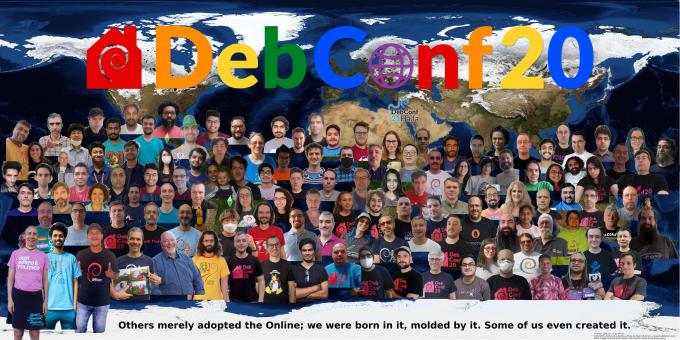
DebConf20 group photo - click to enlarge On Saturday 29 August 2020, the annual Debian Developers and Contributors Conference came to a close. DebConf20 has been held online for the first time, due to the coronavirus (COVID-19) disease pandemic. All of the sessions have been streamed, with a variety of ways of participating: via IRC messaging, online collaborative text documents, and video conferencing meeting rooms. With more than 850 attendees from 80 different countries and a total of over 100 event talks, discussion sessions, Birds of a Feather (BoF) gatherings and other activities, DebConf20 was a large success. When it became clear that DebConf20 was going to be an online-only event, the DebConf video team spent much time over the next months to adapt, improve, and in some cases write from scratch, technology that would be required to make an online DebConf possible. After lessons learned from the MiniDebConfOnline in late May, some adjustments were made, and then eventually we came up with a setup involving Jitsi, OBS, Voctomix, SReview, nginx, Etherpad, and a newly written web-based frontend for voctomix as the various elements of the stack. All components of the video infrastructure are free software, and the whole setup is configured through their public ansible repository. The DebConf20 schedule included two tracks in other languages than English: the Spanish language MiniConf, with eight talks in two days, and the Malayalam language MiniConf, with nine talks in three days. Ad-hoc activities, introduced by attendees over the course of the entire conference, have been possible too, streamed and recorded. There have also been several team gatherings to sprint on certain Debian development areas. Between talks, the video stream has been showing the usual sponsors on the loop, but also some additional clips including photos from previous DebConfs, fun facts about Debian and short shout-out videos sent by attendees to communicate with their Debian friends. For those who were not able to participate, most of the talks and sessions are already available through the Debian meetings archive website, and the remaining ones will appear in the following days. The DebConf20 website will remain active for archival purposes and will continue to offer links to the presentations and videos of talks and events. Next year, DebConf21 is planned to be held in Haifa, Israel, in August or September. DebConf is committed to a safe and welcome environment for all participants. During the conference, several teams (Front Desk, Welcome team and Community team) have been available to help so participants get their best experience in the conference, and find solutions to any issue that may arise. See the web page about the Code of Conduct in DebConf20 website for more details on this. Debian thanks the commitment of numerous sponsors to support DebConf20, particularly our Platinum Sponsors: Lenovo, Infomaniak, Google and Amazon Web Services (AWS). About Debian The Debian Project was founded in 1993 by Ian Murdock to be a truly free community project. Since then the project has grown to be one of the largest and most influential open source projects. Thousands of volunteers from all over the world work together to create and maintain Debian software. Available in 70 languages, and supporting a huge range of computer types, Debian calls itself the universal operating system. About DebConf DebConf is the Debian Project's developer conference. In addition to a full schedule of technical, social and policy talks, DebConf provides an opportunity for developers, contributors and other interested people to meet in person and work together more closely. It has taken place annually since 2000 in locations as varied as Scotland, Argentina, and Bosnia and Herzegovina. More information about DebConf is available from https://debconf.org/. About Lenovo As a global technology leader manufacturing a wide portfolio of connected products, including smartphones, tablets, PCs and workstations as well as AR/VR devices, smart home/office and data center solutions, Lenovo understands how critical open systems and platforms are to a connected world. About Infomaniak Infomaniak is Switzerland's largest web-hosting company, also offering backup and storage services, solutions for event organizers, live-streaming and video on demand services. It wholly owns its datacenters and all elements critical to the functioning of the services and products provided by the company (both software and hardware). About Google Google is one of the largest technology companies in the world, providing a wide range of Internet-related services and products such as online advertising technologies, search, cloud computing, software, and hardware. Google has been supporting Debian by sponsoring DebConf for more than ten years, and is also a Debian partner sponsoring parts of Salsa's continuous integration infrastructure within Google Cloud Platform. About Amazon Web Services (AWS) Amazon Web Services (AWS) is one of the world's most comprehensive and broadly adopted cloud platforms, offering over 175 fully featured services from data centers globally (in 77 Availability Zones within 24 geographic regions). AWS customers include the fastest-growing startups, largest enterprises and leading government agencies. Contact Information For further information, please visit the DebConf20 web page at https://debconf20.debconf.org/ or send mail to press@debian.org.

29 August 2020

Jelmer Vernooij: Debian Janitor: The Slow Trickle from Git Repositories to the Debian Archive

The Debian Janitor is an automated system that commits fixes for (minor) issues in Debian packages that can be fixed by software. It gradually started proposing merges in early December. The first set of changes sent out ran lintian-brush on sid packages maintained in Git. This post is part of a series about the progress of the Janitor. Last week s blog post documented how there are now over 30,000 lintian issues that have been fixed in git packaging repositories by the Janitor. It's important to note that any fixes from the Janitor that make it into a Git packaging repository will also need to be uploaded to the Debian archive. This currently requires that a Debian packager clones the repository and builds and uploads the package. Until a change makes it into the archive, users of Debian will unfortunately not see the benefits of improvements made by the Janitor. 82% of the 30,000 changes from the Janitor that have made it into a Git repository have not yet been uploaded, although changes do slowly trickle in as maintainers make other changes to packages and upload them along with the lintian fixes from the Janitor. This is not just true for changes from the Janitor, but for all sorts of other smaller improvements as well. However, the process of cloning and building git repositories and uploading the resulting packages to the Debian archive is fairly time-consuming and it s probably not worth the time of developers to follow up every change from the Janitor with a labour-intensive upload to the archive. It would be great if it was easier to trigger uploads from git commits. Projects like tag2upload will hopefully help, and make it more likely that changes end up in the Debian archive. The majority packages do get at least one new source version upload per release, so most changes will eventually make it into the archive.

For more information about the Janitor's lintian-fixes efforts, see the landing page.

28 August 2020

Raphaël Hertzog: Freexian s report about Debian Long Term Support, July 2020

A Debian LTS logo Like each month, albeit a bit later due to vacation, here comes a report about the work of paid contributors to Debian LTS. Individual reports In July, 249.25 work hours have been dispatched among 14 paid contributors. Their reports are available: Evolution of the situation July was our first month of Stretch LTS! Given this is our fourth LTS release we anticipated a smooth transition and it seems everything indeed went very well. Many thanks to the members of the Debian ftpmaster-, security, release- and publicity- teams who helped us make this happen!
Stretch LTS begun on July 18th 2020 after the 13th and final Stretch point release. and is currently scheduled to end on June 30th 2022. Last month, we asked you to participate in a survey and we got 1764 submissions, which is pretty awesome. Thank you very much for participating!. Right now we are still busy crunching the results, but we already shared some early analysis during the Debconf LTS bof this week. The security tracker currently lists 54 packages with a known CVE and the dla-needed.txt file has 52 packages needing an update. Thanks to our sponsors New sponsors are in bold.

No comment Liked this article? Click here. My blog is Flattr-enabled.

25 August 2020

Jonas Meurer: cryptsetup-suspend

Introducing cryptsetup-suspend Today, we're introducing cryptsetup-suspend, whose job is to protect the content of your harddrives while the system is sleeping. TL;DR:
  • You can lock your encrypted harddrives during suspend mode by installing cryptsetup-suspend
  • For cryptsetup-suspend to work properly, at least Linux kernel 5.6 is required
  • We hope that in a bright future, everything will be available out-of-the-box in Debian and it's derivatives
Before: timeline_old.svg After: timeline_new.svg

Table of contents

What does this mean and why should you care about it? If you don't use full-disk encryption, don't read any further. Instead, think about, what will happen if you lose your notebook on the train, a random person picks it up and browses through all your personal pictures, e-mails, and tax records. Then encrypt your system and come back. If you believe full-disk encryption is necessary, you might know that it only works when your machine is powered off. Once you turn on the machine and decrypt your harddrive, your encryption key stays in RAM and can potentially be extracted by malicious software or physical access. Even if these attacks are non-trivial, it's enough to worry about. If an attacker is able to extract your disk encryption keys from memory, they're able to read the content of your disk in return. Sadly, in 2020, we hardly power off our laptops anymore. The sleep mode, also known as "suspend mode", is just too convenient. Just close the lid to freeze the system state and lift it anytime later in order to continue. Well, convenience usually comes with a cost: during suspend mode, your system memory is kept powered, all your data - including your encryption keys - stays there, waiting to be extracted by a malicious person. Unfortunately, there are practical attacks to extract the data of your powered memory. Cryptsetup-suspend expands the protection of your full-disk encryption to all those times when your computer sleeps in suspend mode. Cryptsetup-suspend utilizes the suspend feature of LUKS volumes and integrates it with your Debian system. Encryption keys are evicted from memory before suspend mode and the volumes have to be re-opened after resuming - potentially prompting for the required passphrases. By now, we have a working prototype which we want to introduce today. We did quite some testing, both on virtualized and bare-metal Debian and Ubuntu systems, with and without graphical stack, so we dare to unseal and set free the project and ask you - the community - to test, review, criticize and give feedback. Here's a screencast of cryptsetup-suspend in action:

State of the implementation: where are we? If you're interested in the technical details, here's how cryptsetup-suspend works internally. It basically consists of three parts: cryptsetup-suspend.svg
  1. cryptsetup-suspend: A C program that takes a list of LUKS devices as arguments, suspends them via luksSuspend and suspends the system afterwards. Also, it tries to reserve some memory for decryption, which we'll explain below.
  2. cryptsetup-suspend-wrapper: A shell wrapper script which works the following way:
    1. Extract the initramfs into a ramfs
    2. Run (systemd) pre-suspend scripts, stop udev, freeze almost all cgroups
    3. Chroot into the ramfs and run cryptsetup-suspend
    4. Resume initramfs devices inside chroot after resume
    5. Resume non-initramfs devices outside chroot
    6. Thaw groups, start udev, run (systemd) post-suspend scripts
    7. Unmount the ramfs
  3. A systemd unit drop-in file overriding the Exec property of systemd-suspend.service so that it invokes the script cryptsetup-suspend-wrapper.
Reusing large parts of the existing cryptsetup-initramfs implementation has some positive side-effects: Out-of-the-box, we support all LUKS block device setups that have been supported by the Debian cryptsetup packages before. Freezing most processes/cgroups is necessary to prevent possible race-conditions and dead-locks after the system resumes. Processes will try to access data on the locked/suspended block devices eventually leading to buffer overflows and data loss.

Technical challenges and caveats
  • Dead-locks at suspend: In order to prevent possible dead-locks between suspending the encrypted LUKS disks and suspending the system, we have to tell the Linux kernel to not sync() before going to sleep. A corresponding patch got accepted upstream in Linux 5.6. See section What about the kernel patch? below for details.
  • Race conditions at resume: Likewise, there's a risk of race conditions between resuming the system and unlocking the encypted LUKS disks. We went with freezing as many processes as possible as a counter measurement. See last part of section State of the implementation: where are we? for details.
  • Memory management: Memory management is definitely a challenge. Unlocking disks might require a lot of memory (if key derivation function is argon2i) and the swap device most likely is locked at that time. See section All that matters to me is the memories! below for details.
  • systemd dependency: Our implementation depends on systemd. It uses a unit drop-in file for systemd-suspend.service for hooking into the system suspend process and depends on systemds cgroup management to freeze and thaw processes. If you're using a different init system, sorry, you're currently out of luck.

What about the kernel patch? The problem is simple: the Linux kernel suspend implementation enforces a final filesystem sync() before the system goes to sleep in order to prevent potential data loss. While that's sensible in most scenarios, it may result in dead-locks in our situation, since the block device that holds the filesystem is already suspended. The fssync() call will block forever as it waits for the block device to finish the sync() operation. So we need a way to conditionally disable this sync() call in the Linux kernel resume function. That's what our patch does, by introducing a run-time switch at /sys/power/sync_on_suspend, but it only got accepted into the Linux kernel recently and was first released with Linux kernel 5.6. Since release 4.3, the Linux kernel at least provides a build-time flag to disable the sync(): CONFIG_SUSPEND_SKIP_SYNC (that was called SUSPEND_SKIP_SYNC first and renamed to CONFIG_SUSPEND_SKIP_SYNC in kernel release 4.9). Enabling this flag at build-time protects you against the dead locks perfectly well. But while that works on an individual basis, it's a non-option for the distribution Linux kernel defaults. In most cases you still want the sync() to happen, except if you have user-space code that takes care of the sync() just before suspending your system - just like our cryptsetup-suspend implementation does. So in order to properly test cryptsetup-suspend, you're strongly advised to run Linux kernel 5.6 or newer. Fortunately, Linux 5.6 is available in buster-backports thanks to the Debian Kernel Team.

All that matters to me is the memories! One of the tricky parts is memory management. Since version 2, LUKS uses argon2i as default key derivation function. Argon2i is a memory-hard hash function and LUKS2 assigns the minimum of half of your systems memory or 1 GB to unlocking your device. While this is usually unproblematic during system boot - there's not much in the system memory anyway - it can become problematic when suspending. When cryptsetup tries to unlock a device and wants 1 GB of memory for this, but everything is already occupied by your browser and video player, there's only two options what to do:
  1. Kill a process to free some memory
  2. Move some of the data from memory to swap space
The first option is certainly not what you expect when suspending your system. The second option is impossible, because swap is located on your harddrive which we have locked before. Our current solution is to allocate the memory after freezing the other processes, but before locking the disks. At this time, the system can still move data to swap, but it won't be accessed anymore. We then release the memory just in time for cryptsetup to claim it again. The implementation of this is still subject to change. memories.gif

What's missing: A proper user interface As mentioned before, we consider cryptsetup-suspend usable, but it certainly still has bugs and shortcomings. The most obvious one is lack of a proper user interface. Currently, we switch over to a tty command-line interface to prompt for passphrases when unlocking the LUKS devices. It certainly would be better to replace this with a graphical user interface later, probably by using plymouth or something alike. Unfortunately, it seems rather impossible to spawn a real graphical environment for the passphrase prompt. That would imply to load the full graphical stack into the ramfs, raising the required amount of memory significantly. Lack of memory is currently our biggest concern and source of trouble. We'd definitely appreciate to learn about your ideas how to improve the user experience here.

Let's get practical: how to use TL;DR: On Debian Bullseye (Testing), all you need to do is to install the cryptsetup-suspend package from experimental. It's not necessary to upgrade the other cryptsetup packages. On Debian Buster, cryptsetup packages from backports are required.
  1. First, be sure that you're running Linux kernel 5.6 or newer. For Buster systems, it's available in buster-backports.
  2. Second, if you're on Debian Buster, install the cryptsetup 2:2.3.3-2~bpo10+1 packages from buster-backports.
  3. Third, install the cryptsetup-suspend package from experimental. Beware that cryptsetup-suspend depends on cryptsetup-initramfs (>= 2:2.3.3-1~). Either you need the cryptsetup packages from testing/unstable, or the backports from buster-backports.
  4. Now that you have the cryptsetup-suspend package installed, everything should be in place: Just send your system to sleep. It should switch to a virtual text terminal before going to sleep, ask for a passphrase to unlock your encrypted disk(s) after resume and switch back to your former working environment (most likely your graphical desktop environment) afterwards.

Security considerations Suspending LUKS devices basically means to remove the corresponding encryption keys from system memory. This protects against all sort of attacks trying to read them from there, e.g. cold-boot attacks. But, cryptsetup-suspend only protects the encryption keys of your LUKS devices. Most likely there's more sensitive data in system memory, like all kinds of private keys (e.g. OpenPGP, OpenSSH) or documents with sensitive content. We hope that the community will help improve this situation by providing useful pre-/post-suspend scripts. A positive example is KeepassXC, which is able to lock itself when going to suspend mode.

Feedback and Comments We'd be more than happy to learn about your thoughts on cryptsetup-suspend. For specific issues, don't hesitate to open a bugreport against cryptsetup-suspend. You can also reach us via mail - see the next section for contact addresses. Last but not least, comments below the blogpost work as well.

Authors
  • Tim (tim at systemli.org)
  • Jonas (jonas at freesources.org)

24 August 2020

Arnaud Rebillout: Send emails from your terminal with msmtp

In this tutorial, we'll configure everything needed to send emails from the terminal. We'll use msmtp, a lightweight SMTP client. For the sake of the example, we'll use a GMail account, but any other email provider can do. Your OS is expected to be Debian, as usual on this blog, although it doesn't really matter. We will also see how to store the credentials for the email account in the system keyring. And finally, we'll go the extra mile, and see how to configure various command-line utilities so that they automatically use msmtp to send emails. Even better, we'll make msmtp the default email sender, to actually avoid configuring these utilities one by one. Prerequisites Strong prerequisites (if you don't recognize yourself here, you probably landed on the wrong page): Weak prerequisites (if your setup doesn't match those points exactly, that's fine, you can still read on): GMail account setup For a GMail account, there's a bit of configuration to do. For other email providers, I have no idea, maybe you can just skip this part, or maybe you will have to go through a similar procedure. If you want an external program (msmtp in this case) to talk to the GMail servers on your behalf, and send emails, you can't just use your usual GMail password. Instead, GMail requires you to generate so-called app passwords, one for each application that needs to access your GMail account. This approach has several advantages: So app passwords are a good idea, it just requires a bit of work to set it up. Let's see what it takes. First, 2-Step Verification must be enabled on your GMail account. Visit https://myaccount.google.com/security, and if that's not the case, enable it. You'll need to authorize all of your devices (computer(s), phone(s) and so on), and it can be a bit tedious, granted. But you only have to do it once in a lifetime, and after it's done, you're left with a more secure account, so it's not that bad, right? Enabling the 2-Step Verification will unlock the feature we need: App passwords. Visit https://myaccount.google.com/apppasswords, and under "Signing in to Google", click "App passwords", and generate one. An app password is a 16 characters string, something like qwertyuiopqwerty. It's supposed to be used from only one place, ie. from ONE application that is installed on ONE device. That's why it's common to give it a name of the form application@device, so in our case it could be msmtp@laptop, but really it's free form, choose whatever name suits you, as long as it makes sense to you. So let's give a name to this app password, write it down for now, and we're done with the GMail config. Send your first email Time to get started with msmtp. First thing first, installation, trivial:
sudo apt install msmtp
Let's try to send an email. At this point, we did not create any configuration file for msmtp yet, so we have to provide every details on the command line.
# Write a dummy email
cat << EOF > message.txt
From: YOUR_LOGIN@gmail.com
To: SOMEONE_ELSE@SOMEWHERE_ELSE.com
Subject: Cafe Sua Da
Iced-coffee with condensed milk
EOF
# Send it
cat message.txt   msmtp \
    --auth=on --tls=on \
    --host smtp.gmail.com \
    --port 587 \
    --user YOUR_LOGIN \
    --read-envelope-from \
    --read-recipients
# msmtp prompts you for your password:
# this is where goes the app password!
Obviously, in this example you should replace the uppercase words with the real thing, that is, your email login, and real email addresses. Also, let me insist, you must enter the app password that was generated previously, not your real GMail password. And it should work already, this email should have been sent and received by now. So let me explain quickly what happened here. In the file message.txt, we provided From: (the email address of the person sending the email) and To: (the destination email address). Then we asked msmtp to re-use those values to set the envelope of the email with --read-envelope-from and --read-recipients. What about the other parameters? For more details, you should refer to the msmtp documentation. Write a configuration file So we could send an email, that's cool already. However the command to do that was a bit long, and we don't want to juggle with all these arguments every time we send an email. So let's write down all of that into a configuration file. msmtp supports two locations: ~/.msmtprc and ~/.config/msmtp/config, at your preference. In this tutorial we'll use ~/.msmtprc for brevity:
cat << 'EOF' > ~/.msmtprc
defaults
tls on
account gmail
auth on
host smtp.gmail.com
port 587
user YOUR_LOGIN
from YOUR_LOGIN@gmail.com
account default : gmail
EOF
And for a quick explanation: All in all it's pretty simple, and it's becoming easier to send an email:
# Write a dummy email. Note that the
# header 'From:' is no longer needed,
# it's already in '~/.msmtprc'.
cat << 'EOF' > message.txt
To: SOMEONE_ELSE@SOMEWHERE_ELSE.com
Subject: Flat White
The milky way for coffee
EOF
# Send it
cat message.txt   msmtp \
    --account default \
    --read-recipients
Actually, --account default is not needed, as it's the default anyway if you don't provide a --account argument. Furthermore --read-recipients can be shortened as -t. So we can make it real short now:
msmtp -t < message.txt
At this point, life is good! Except for one thing maybe: we still have to type the password every time we send an email. Surely it must be possible to avoid that annoyance... Store your password in the system keyring For this part, we'll make use of the libsecret tool to store the password in the system keyring via the Secret Service API. It means that your desktop environment should implement the Secret Service specification, which is the case for both GNOME and KDE. Note that GNOME provides Seahorse to have a look at your secrets, KDE has the KDE Wallet. There's also KeePassXC, which I have only heard of but never used. I guess it can be your password manager of choice if you use neither GNOME nor KDE. For those running an up-to-date Debian unstable, you should have msmtp >= 1.8.11-2, and you're all good to go. For those having an older version than that however, you will have to install the package msmtp-gnome in order to have msmtp built with libsecret support. Note that this package depends on seahorse, hence it pulls in a good part of the GNOME stack when you install it. For those not running GNOME, that's unfortunate. All of this was discussed and fixed in #962689. Alright! So let's just make sure that the libsecret tools are installed:
sudo apt install libsecret-tools
And now we can store our password in the system keyring with this command:
secret-tool store --label msmtp \
    host smtp.gmail.com \
    service smtp \
    user YOUR_LOGIN
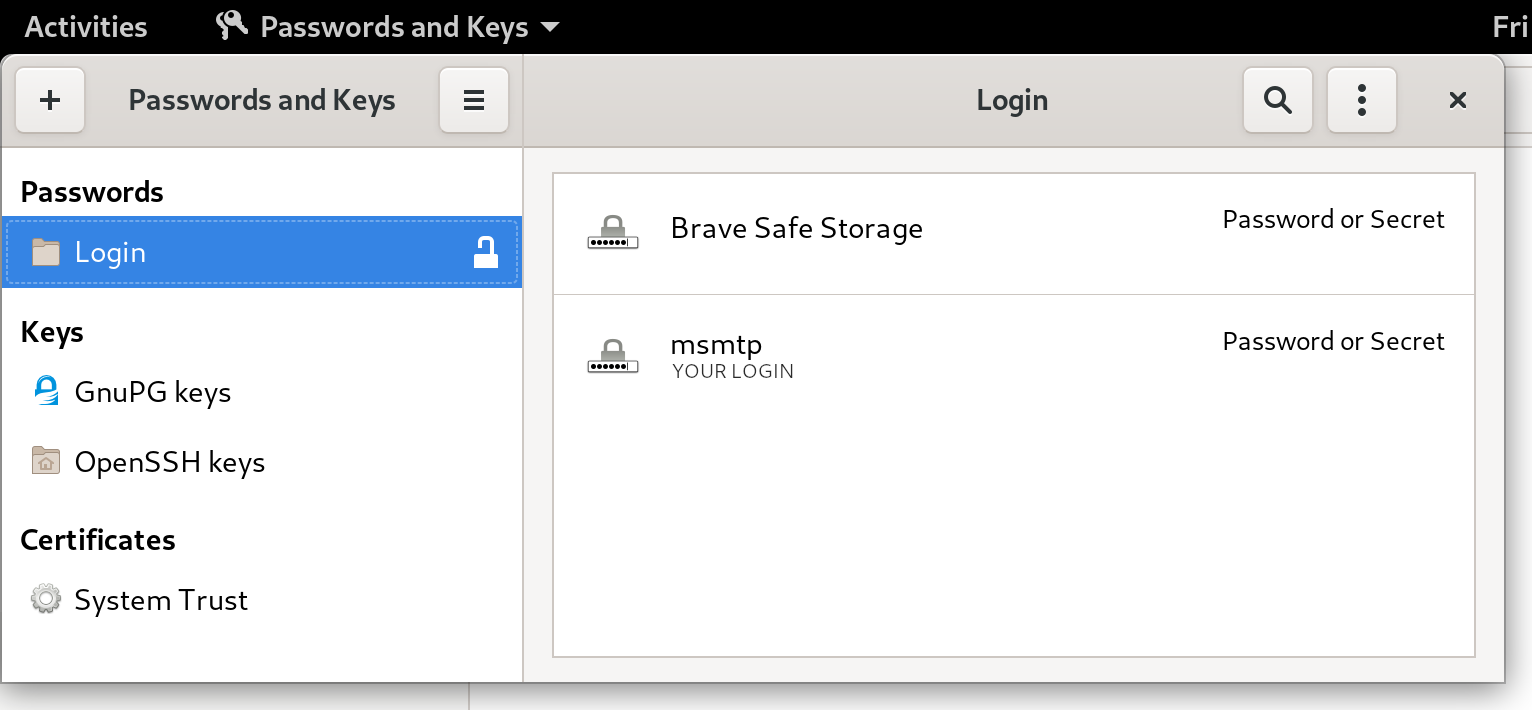
If this looks a bit too magic, and you want something more visual, you can actually fire a GUI like seahorse (for GNOME users), or kwalletmanager5 (for KDE users), and then you will see what passwords are stored in there. Here's a screenshot of Seahorse, with a msmtp password stored: seahorse with msmtp password Let's try to send an email again:
msmtp -t < message.txt
No need for a password anymore, msmtp got it from the system keyring! For more details on how msmtp handle the passwords, and to see what other methods are supported, refer to the extensive documentation. Use-cases and integration Let's go over a few use-cases, situations where you might end up sending emails from the command-line, and what configuration is required to make it work with msmtp. Git Send-Email Sending emails with git is a common workflow for some projects, like the Linux kernel. How does git send-email actually send emails? From the git-send-email manual page:
the built-in default is to search for sendmail in /usr/sbin, /usr/lib and $PATH if such program is available
It is possible to override this default though:
--smtp-server=
[...] Alternatively it can specify a full pathname of a sendmail-like program instead; the program must support the -i option.
So in order to use msmtp here, you'd add a snippet like that to your ~/.gitconfig file:
[sendemail]
    smtpserver = /usr/bin/msmtp
For a full guide, you can also refer to https://git-send-email.io. Debian developer tools Tools like bts or reportbug are also good examples of command-line tools that need to send emails. From the bts manual page:
--sendmail=SENDMAILCMD
Specify the sendmail command [...] Default is /usr/sbin/sendmail.
So if you want bts to send emails with msmtp instead of sendmail, you must use bts --sendmail='/usr/bin/msmtp -t'. Note that bts also loads settings from the file /etc/devscripts.conf and ~/.devscripts, so you could also set BTS_SENDMAIL_COMMAND='/usr/bin/msmtp -t' in one of those files. From the reportbug manual page:
--mta=MTA
Specify an alternate MTA, instead of /usr/sbin/sendmail (the default).
In order to use msmtp here, you'd write reportbug --mta=/usr/bin/msmtp. Note that reportbug reads it settings from /etc/reportbug.conf and ~/.reportbugrc, so you could as well set mta /usr/bin/msmtp in one of those files. So who is this sendmail again? By now, you probably noticed that sendmail seems to be considered the default tool for the job, the "traditional" command that has been around for ages. Rather than configuring every tool to use something else than sendmail, wouldn't it be simpler to actually replace sendmail by msmtp? Like, create a symlink that points to msmtp, something like ln -sr /usr/bin/msmtp /usr/sbin/sendmail? So that msmtp acts as a drop-in replacement for sendmail, and there's nothing else to configure? Answer is yes, kind of. Actually, the first msmtp feature that is listed on the homepage is "Sendmail compatible interface (command line options and exit codes)". Meaning that msmtp is a drop-in replacement for sendmail, that seems to be the intent. However, you should refrain from creating or modifying anything in /usr, as it's the territory of the package manager, apt. Any change in /usr might be overwritten by apt the next time you run an upgrade or install new packages. In the case of msmtp, there is actually a package named msmtp-mta that will create this symlink for you. So if you really want a definitive replacement for sendmail, there you go:
sudo apt install msmtp-mta
From this point, sendmail is now a symlink /usr/sbin/sendmail /usr/bin/msmtp, and there's no need to configure git, bts, reportbug or any other tool that would rely on sendmail. Everything should work "out of the box". Conclusion I hope that you enjoyed reading this article! If you have any comment, feel free to send me a short email, preferably from your terminal!

23 August 2020

Vincent Bernat: Zero-Touch Provisioning for Cisco IOS

The official documentation to automatically upgrade and configure on first boot a Cisco switch running on IOS, like a Cisco Catalyst 2960-X Series switch, is scarce on details. This note explains how to configure the ISC DHCP Server for this purpose.
When booting for the first time, Cisco IOS sends a DHCP request on all ports:
Dynamic Host Configuration Protocol (Discover)
    Message type: Boot Request (1)
    Hardware type: Ethernet (0x01)
    Hardware address length: 6
    Hops: 0
    Transaction ID: 0x0000117c
    Seconds elapsed: 0
    Bootp flags: 0x8000, Broadcast flag (Broadcast)
    Client IP address: 0.0.0.0
    Your (client) IP address: 0.0.0.0
    Next server IP address: 0.0.0.0
    Relay agent IP address: 0.0.0.0
    Client MAC address: Cisco_6c:12:c0 (b4:14:89:6c:12:c0)
    Client hardware address padding: 00000000000000000000
    Server host name not given
    Boot file name not given
    Magic cookie: DHCP
    Option: (53) DHCP Message Type (Discover)
    Option: (57) Maximum DHCP Message Size
    Option: (61) Client identifier
        Length: 25
        Type: 0
        Client Identifier: cisco-b414.896c.12c0-Vl1
    Option: (55) Parameter Request List
        Length: 12
        Parameter Request List Item: (1) Subnet Mask
        Parameter Request List Item: (66) TFTP Server Name
        Parameter Request List Item: (6) Domain Name Server
        Parameter Request List Item: (15) Domain Name
        Parameter Request List Item: (44) NetBIOS over TCP/IP Name Server
        Parameter Request List Item: (3) Router
        Parameter Request List Item: (67) Bootfile name
        Parameter Request List Item: (12) Host Name
        Parameter Request List Item: (33) Static Route
        Parameter Request List Item: (150) TFTP Server Address
        Parameter Request List Item: (43) Vendor-Specific Information
        Parameter Request List Item: (125) V-I Vendor-specific Information
    Option: (255) End
It requests a number of options, including the Bootfile name option 67, the TFTP server address option 150 and the Vendor-Identifying Vendor-Specific Information Option 125 or VIVSO. Option 67 provides the name of the configuration file located on the TFTP server identified by option 150. Option 125 includes the name of the file describing the Cisco IOS image to use to upgrade the switch. This file only contains the name of the tarball embedding the image.1 Configuring the ISC DHCP Server to answer with the TFTP server address and the name of the configuration file is simple enough:
filename "ob2-p2.example.com";
option tftp-server-address 172.16.15.253;
However, if you want to also provide the image for upgrade, you have to specify a hexadecimal-encoded string:2
option vivso 00:00:00:09:24:05:22:63:32:39:36:30:2d:6c:61:6e:62:61:73:65:6b:39:2d:74:61:72:2e:31:35:30:2d:32:2e:53:45:31:31:2e:74:78:74;
Having a large hexadecimal-encoded string inside a configuration file is quite unsatisfying. Instead, the ISC DHCP Server allows you to express this information in a more readable way using the option space statement:
# Create option space for Cisco and encapsulate it in VIVSO/vendor space
option space cisco code width 1 length width 1;
option cisco.auto-update-image code 5 = text;
option vendor.cisco code 9 = encapsulate cisco;
# Image description for Cisco IOS ZTP
option cisco.auto-update-image = "c2960-lanbasek9-tar.150-2.SE11.txt";
# Workaround for VIVSO option 125 not being sent
option vendor.iana code 0 = string;
option vendor.iana = 01:01:01;
Without the workaround mentioned in the last block, the ISC DHCP Server would not send back option 125. With such a configuration, it returns the following answer, including a harmless additional enterprise 0 encapsulated into option 125:
Dynamic Host Configuration Protocol (Offer)
    Message type: Boot Reply (2)
    Hardware type: Ethernet (0x01)
    Hardware address length: 6
    Hops: 0
    Transaction ID: 0x0000117c
    Seconds elapsed: 0
    Bootp flags: 0x8000, Broadcast flag (Broadcast)
    Client IP address: 0.0.0.0
    Your (client) IP address: 172.16.15.6
    Next server IP address: 0.0.0.0
    Relay agent IP address: 0.0.0.0
    Client MAC address: Cisco_6c:12:c0 (b4:14:89:6c:12:c0)
    Client hardware address padding: 00000000000000000000
    Server host name not given
    Boot file name: ob2-p2.example.com
    Magic cookie: DHCP
    Option: (53) DHCP Message Type (Offer)
    Option: (54) DHCP Server Identifier (172.16.15.252)
    Option: (51) IP Address Lease Time
    Option: (1) Subnet Mask (255.255.248.0)
    Option: (6) Domain Name Server
    Option: (3) Router
    Option: (150) TFTP Server Address
        Length: 4
        TFTP Server Address: 172.16.15.252
    Option: (125) V-I Vendor-specific Information
        Length: 49
        Enterprise: Reserved (0)
        Enterprise: ciscoSystems (9)
            Length: 36
            Option 125 Suboption: 5
                Length: 34
                Data: 63323936302d6c616e626173656b392d7461722e3135302d 
    Option: (255) End

  1. The reason of this indirection is still puzzling me. I suppose it could be because updating the image name directly in option 125 is quite a hassle.
  2. It contains the following information:
    • 0x00000009: Cisco s Enterprise Number,
    • 0x24: length of the enclosed data,
    • 0x05: Cisco s auto-update sub-option,
    • 0x22: length of the sub-option data, and
    • filename of the image description (c2960-lanbasek9-tar.150-2.SE11.txt).

22 August 2020

Jelmer Vernooij: Debian Janitor: > 60,000 Lintian Issues Automatically Fixed

The Debian Janitor is an automated system that commits fixes for (minor) issues in Debian packages that can be fixed by software. It gradually started proposing merges in early December. The first set of changes sent out ran lintian-brush on sid packages maintained in Git. This post is part of a series about the progress of the Janitor.

Scheduling Lintian Fixes To determine which packages to process, the Janitor looks at the import of lintian output across the archive that is available in UDD [1]. It will prioritize those packages with the most and more severe issues that it has fixers for. Once a package is selected, it will clone the packaging repository and run lintian-brush on it. Lintian-brush provides a framework for applying a set of fixers to a package. It will run each of a set of fixers in a pristine version of the repository, and handles most of the heavy lifting.
The Inner Workings of a Fixer Each fixer is just an executable which gets run in a clean checkout of the package, and can make changes there. Most of the fixers are written in Python or shell, but they can be in any language. The contract for fixers is pretty simple:
  • If the fixer exits with non-zero, the changes are reverted and fixer is considered to have failed
  • If it exits with zero and made changes, then it should write a summary of its changes to standard out
If a fixer is uncertain about the changes it has made, it should report so on standard output using a pseudo-header. By default, lintian-brush will discard any changes with uncertainty but if you are running it locally you can still apply them by specifying --uncertain. The summary message on standard out will be used for the commit message and (possibly) the changelog message, if the package doesn t use gbp dch.
Example Fixer Let s look at an example. The package priority extra is deprecated since Debian Policy 4.0.1 (released August 2 017) see Policy 2.5 "Priorities". Instead, most packages should use the optional priority. Lintian will warn when a package uses the deprecated extra value for the Priority - the associated tag is priority-extra-is-replaced-by-priority-optional. Lintian-brush has a fixer script that can automatically replace extra with optional . On systems that have lintian-brush installed, the source for the fixer lives in /usr/share/lintian-brush/fixers/priority-extra-is-replaced-by-priority-optional.py, but here is a copy of it for reference:
 1
 2
 3
 4
 5
 6
 7
 8
 9
10
11
12
13
#!/usr/bin/python3
from debmutate.control import ControlEditor
from lintian_brush.fixer import report_result, fixed_lintian_tag
with ControlEditor() as updater:
    for para in updater.paragraphs:
        if para.get("Priority") == "extra":
            para["Priority"] = "optional"
            fixed_lintian_tag(
                para, 'priority-extra-is-replaced-by-priority-optional')
report_result("Change priority extra to priority optional.")
This fixer is written in Python and uses the debmutate library to easily modify control files while preserving formatting or back out if it is not possible to preserve formatting. All the current fixers come with tests, e.g. for this particular fixer the tests can be found here: https://salsa.debian.org/jelmer/lintian-brush/-/tree/master/tests/priority-extra-is-replaced-by-priority-optional. For more details on writing new fixers, see the README for lintian-brush. For more details on debugging them, see the manual page.
Successes by fixer Here is a list of the fixers currently available, with the number of successful merges/pushes per fixer:
Lintian Tag Previously merged/pushed Ready but not yet merged/pushed
uses-debhelper-compat-file 4906 4161
upstream-metadata-file-is-missing 4281 3841
package-uses-old-debhelper-compat-version 4256 3617
upstream-metadata-missing-bug-tracking 2438 2995
out-of-date-standards-version 2062 2936
upstream-metadata-missing-repository 1936 2987
trailing-whitespace 1720 2295
insecure-copyright-format-uri 1791 1093
package-uses-deprecated-debhelper-compat-version 1391 1287
vcs-obsolete-in-debian-infrastructure 872 782
homepage-field-uses-insecure-uri 527 1111
vcs-field-not-canonical 850 655
debian-changelog-has-wrong-day-of-week 224 376
debian-watch-uses-insecure-uri 314 242
useless-autoreconf-build-depends 112 428
priority-extra-is-replaced-by-priority-optional 315 194
debian-rules-contains-unnecessary-get-orig-source-target 35 428
tab-in-license-text 125 320
debian-changelog-line-too-long 186 190
debian-rules-sets-dpkg-architecture-variable 69 166
debian-rules-uses-unnecessary-dh-argument 42 182
package-lacks-versioned-build-depends-on-debhelper 125 95
unversioned-copyright-format-uri 43 136
package-needs-versioned-debhelper-build-depends 127 50
binary-control-field-duplicates-source 34 134
renamed-tag 73 69
vcs-field-uses-insecure-uri 14 109
uses-deprecated-adttmp 13 91
debug-symbol-migration-possibly-complete 12 88
copyright-refers-to-symlink-license 51 48
debian-control-has-unusual-field-spacing 33 66
old-source-override-location 32 62
out-of-date-copyright-format 20 62
public-upstream-key-not-minimal 43 30
older-source-format 17 54
custom-compression-in-debian-source-options 12 57
copyright-refers-to-versionless-license-file 29 39
tab-in-licence-text 33 31
global-files-wildcard-not-first-paragraph-in-dep5-copyright 28 33
out-of-date-copyright-format-uri 9 50
field-name-typo-dep5-copyright 29 29
copyright-does-not-refer-to-common-license-file 13 42
debhelper-but-no-misc-depends 9 45
debian-watch-file-is-missing 11 41
debian-control-has-obsolete-dbg-package 8 40
possible-missing-colon-in-closes 31 13
unnecessary-testsuite-autopkgtest-field 32 9
missing-debian-source-format 7 33
debhelper-tools-from-autotools-dev-are-deprecated 9 29
vcs-field-mismatch 8 29
debian-changelog-file-contains-obsolete-user-emacs-setting 33 0
patch-file-present-but-not-mentioned-in-series 24 9
copyright-refers-to-versionless-license-file 22 9
debian-control-has-empty-field 25 6
missing-build-dependency-for-dh-addon 10 20
obsolete-field-in-dep5-copyright 15 13
xs-testsuite-field-in-debian-control 20 7
ancient-python-version-field 13 12
unnecessary-team-upload 19 5
misspelled-closes-bug 6 16
field-name-typo-in-dep5-copyright 1 20
transitional-package-not-oldlibs-optional 4 17
maintainer-script-without-set-e 9 11
dh-clean-k-is-deprecated 4 14
no-dh-sequencer 14 4
missing-vcs-browser-field 5 12
space-in-std-shortname-in-dep5-copyright 6 10
xc-package-type-in-debian-control 4 11
debian-rules-missing-recommended-target 4 10
desktop-entry-contains-encoding-key 1 13
build-depends-on-obsolete-package 4 9
license-file-listed-in-debian-copyright 1 12
missing-built-using-field-for-golang-package 9 4
unused-license-paragraph-in-dep5-copyright 4 7
missing-build-dependency-for-dh_command 6 4
comma-separated-files-in-dep5-copyright 3 6
systemd-service-file-refers-to-var-run 4 5
copyright-not-using-common-license-for-apache2 3 5
debian-tests-control-autodep8-is-obsolete 2 6
dh-quilt-addon-but-quilt-source-format 2 6
no-homepage-field 3 5
font-packge-not-multi-arch-foreign 1 6
homepage-in-binary-package 1 4
vcs-field-bitrotted 1 3
built-using-field-on-arch-all-package 2 1
copyright-should-refer-to-common-license-file-for-apache-2 1 2
debian-pyversions-is-obsolete 3 0
debian-watch-file-uses-deprecated-githubredir 1 1
executable-desktop-file 1 1
skip-systemd-native-flag-missing-pre-depends 1 1
vcs-field-uses-not-recommended-uri-format 1 1
init.d-script-needs-depends-on-lsb-base 1 0
maintainer-also-in-uploaders 1 0
public-upstream-keys-in-multiple-locations 1 0
wrong-debian-qa-group-name 1 0
Total 29656 32209

Footnotes
[1]temporarily unavailable due to Debian bug #960156 but the Janitor is relying on historical data

For more information about the Janitor's lintian-fixes efforts, see the landing page

18 August 2020

Lisandro Dami n Nicanor P rez Meyer: Stepping down as Qt 6 maintainers

After quite some time maintaining Qt in Debian both Dmitry Shachnev and I decided to not maintain Qt 6 when it's published (expected in December 2020, see https://wiki.qt.io/Qt_6.0_Release). We will do our best to keep the Qt 5 codebase up and running.

We **love** Qt, but it's a huge codebase and requires time and build power, both things that we are currently lacking, so we decided it's time for us to step down and pass the torch. And a new major version seems the right point to do that.

We will be happy to review and/or sponsor other people's work or even occasionally do uploads, but we can't promise to do it regularly.

Some things we think potential Qt 6 maintainers should be familiar with are, of course, C++ packaging (specially symbols files) and CMake, as Qt 6 will be built with it.

We also encourage prospective maintainers to remove the source's -everywhere-src suffixes and just keep the base names as source package names: qtbase6, qtdeclarative6, etc.

It has been an interesting ride all these years, we really hope you enjoyed using Qt.

Thanks for everything,

Dmitry and Lisandro.Note 20200818 12:12 ARST: I was asked if the move has anything to do with code quality or licensing. The answer is a huge no, Qt is a **great** project which we love. As stated before it's mostly about lack of free time to properly maintain it.


14 August 2020

Markus Koschany: My Free Software Activities in July 2020

Welcome to gambaru.de. Here is my monthly report (+ the first week in August) that covers what I have been doing for Debian. If you re interested in Java, Games and LTS topics, this might be interesting for you. Debian Games

Debian Java Misc Debian LTS This was my 53. month as a paid contributor and I have been paid to work 15 hours on Debian LTS, a project started by Rapha l Hertzog. In that time I did the following: ELTS Extended Long Term Support (ELTS) is a project led by Freexian to further extend the lifetime of Debian releases. It is not an official Debian project but all Debian users benefit from it without cost. The current ELTS release is Debian 8 Jessie . This was my 26. month and I have been paid to work 13,25 hours on ELTS. Thanks for reading and see you next time.

12 August 2020

Michael Stapelberg: Linux distributions: Can we do without hooks and triggers?

Hooks are an extension feature provided by all package managers that are used in larger Linux distributions. For example, Debian uses apt, which has various maintainer scripts. Fedora uses rpm, which has scriptlets. Different package managers use different names for the concept, but all of them offer package maintainers the ability to run arbitrary code during package installation and upgrades. Example hook use cases include adding daemon user accounts to your system (e.g. postgres), or generating/updating cache files. Triggers are a kind of hook which run when other packages are installed. For example, on Debian, the man(1) package comes with a trigger which regenerates the search database index whenever any package installs a manpage. When, for example, the nginx(8) package is installed, a trigger provided by the man(1) package runs. Over the past few decades, Open Source software has become more and more uniform: instead of each piece of software defining its own rules, a small number of build systems are now widely adopted. Hence, I think it makes sense to revisit whether offering extension via hooks and triggers is a net win or net loss.

Hooks preclude concurrent package installation Package managers commonly can make very little assumptions about what hooks do, what preconditions they require, and which conflicts might be caused by running multiple package s hooks concurrently. Hence, package managers cannot concurrently install packages. At least the hook/trigger part of the installation needs to happen in sequence. While it seems technically feasible to retrofit package manager hooks with concurrency primitives such as locks for mutual exclusion between different hook processes, the required overhaul of all hooks seems like such a daunting task that it might be better to just get rid of the hooks instead. Only deleting code frees you from the burden of maintenance, automated testing and debugging. In Debian, there are 8620 non-generated maintainer scripts, as reported by find shard*/src/*/debian -regex ".*\(pre\ post\)\(inst\ rm\)$" on a Debian Code Search instance.

Triggers slow down installing/updating other packages Personally, I never use the apropos(1) command, so I don t appreciate the man(1) package s trigger which updates the database used by apropos(1). The process takes a long time and, because hooks and triggers must be executed serially (see previous section), blocks my installation or update. When I tell people this, they are often surprised to learn about the existance of the apropos(1) command. I suggest adopting an opt-in model.

Unnecessary work if programs are not used between updates Hooks run when packages are installed. If a package s contents are not used between two updates, running the hook in the first update could have been skipped. Running the hook lazily when the package contents are used reduces unnecessary work. As a welcome side-effect, lazy hook evaluation automatically makes the hook work in operating system images, such as live USB thumb drives or SD card images for the Raspberry Pi. Such images must not ship the same crypto keys (e.g. OpenSSH host keys) to all machines, but instead generate a different key on each machine. Why do users keep packages installed they don t use? It s extra work to remember and clean up those packages after use. Plus, users might not realize or value that having fewer packages installed has benefits such as faster updates. I can also imagine that there are people for whom the cost of re-installing packages incentivizes them to just keep packages installed you never know when you might need the program again

Implemented in an interpreted language While working on hermetic packages (more on that in another blog post), where the contained programs are started with modified environment variables (e.g. PATH) via a wrapper bash script, I noticed that the overhead of those wrapper bash scripts quickly becomes significant. For example, when using the excellent magit interface for Git in Emacs, I encountered second-long delays when using hermetic packages compared to standard packages. Re-implementing wrappers in a compiled language provided a significant speed-up. Similarly, getting rid of an extension point which mandates using shell scripts allows us to build an efficient and fast implementation of a predefined set of primitives, where you can reason about their effects and interactions. magit needs to run git a few times for displaying the full status, so small overhead quickly adds up.

Incentivizing more upstream standardization Hooks are an escape hatch for distribution maintainers to express anything which their packaging system cannot express. Distributions should only rely on well-established interfaces such as autoconf s classic ./configure && make && make install (including commonly used flags) to build a distribution package. Integrating upstream software into a distribution should not require custom hooks. For example, instead of requiring a hook which updates a cache of schema files, the library used to interact with those files should transparently (re-)generate the cache or fall back to a slower code path. Distribution maintainers are hard to come by, so we should value their time. In particular, there is a 1:n relationship of packages to distribution package maintainers (software is typically available in multiple Linux distributions), so it makes sense to spend the work in the 1 and have the n benefit.

Can we do without them? If we want to get rid of hooks, we need another mechanism to achieve what we currently achieve with hooks. If the hook is not specific to the package, it can be moved to the package manager. The desired system state should either be derived from the package contents (e.g. required system users can be discovered from systemd service files) or declaratively specified in the package build instructions more on that in another blog post. This turns hooks (arbitrary code) into configuration, which allows the package manager to collapse and sequence the required state changes. E.g., when 5 packages are installed which each need a new system user, the package manager could update /etc/passwd just once. If the hook is specific to the package, it should be moved into the package contents. This typically means moving the functionality into the program start (or the systemd service file if we are talking about a daemon). If (while?) upstream is not convinced, you can either wrap the program or patch it. Note that this case is relatively rare: I have worked with hundreds of packages and the only package-specific functionality I came across was automatically generating host keys before starting OpenSSH s sshd(8) . There is one exception where moving the hook doesn t work: packages which modify state outside of the system, such as bootloaders or kernel images. Even that can be moved out of a package-specific hook, as Fedora demonstrates.

Conclusion Global state modifications performed as part of package installation today use hooks, an overly expressive extension mechanism. Instead, all modifications should be driven by configuration. This is feasible because there are only a few different kinds of desired state modifications. This makes it possible for package managers to optimize package installation.

Michael Stapelberg: Optional dependencies don t work

In the i3 projects, we have always tried hard to avoid optional dependencies. There are a number of reasons behind it, and as I have recently encountered some of the downsides of optional dependencies firsthand, I summarized my thoughts in this article.

What is a (compile-time) optional dependency? When building software from source, most programming languages and build systems support conditional compilation: different parts of the source code are compiled based on certain conditions. An optional dependency is conditional compilation hooked up directly to a knob (e.g. command line flag, configuration file, ), with the effect that the software can now be built without an otherwise required dependency. Let s walk through a few issues with optional dependencies.

Inconsistent experience in different environments Software is usually not built by end users, but by packagers, at least when we are talking about Open Source. Hence, end users don t see the knob for the optional dependency, they are just presented with the fait accompli: their version of the software behaves differently than other versions of the same software. Depending on the kind of software, this situation can be made obvious to the user: for example, if the optional dependency is needed to print documents, the program can produce an appropriate error message when the user tries to print a document. Sometimes, this isn t possible: when i3 introduced an optional dependency on cairo and pangocairo, the behavior itself (rendering window titles) worked in all configurations, but non-ASCII characters might break depending on whether i3 was compiled with cairo. For users, it is frustrating to only discover in conversation that a program has a feature that the user is interested in, but it s not available on their computer. For support, this situation can be hard to detect, and even harder to resolve to the user s satisfaction.

Packaging is more complicated Unfortunately, many build systems don t stop the build when optional dependencies are not present. Instead, you sometimes end up with a broken build, or, even worse: with a successful build that does not work correctly at runtime. This means that packagers need to closely examine the build output to know which dependencies to make available. In the best case, there is a summary of available and enabled options, clearly outlining what this build will contain. In the worst case, you need to infer the features from the checks that are done, or work your way through the --help output. The better alternative is to configure your build system such that it stops when any dependency was not found, and thereby have packagers acknowledge each optional dependency by explicitly disabling the option.

Untested code paths bit rot Code paths which are not used will inevitably bit rot. If you have optional dependencies, you need to test both the code path without the dependency and the code path with the dependency. It doesn t matter whether the tests are automated or manual, the test matrix must cover both paths. Interestingly enough, this principle seems to apply to all kinds of software projects (but it slows down as change slows down): one might think that important Open Source building blocks should have enough users to cover all sorts of configurations. However, consider this example: building cairo without libxrender results in all GTK application windows, menus, etc. being displayed as empty grey surfaces. Cairo does not fail to build without libxrender, but the code path clearly is broken without libxrender.

Can we do without them? I m not saying optional dependencies should never be used. In fact, for bootstrapping, disabling dependencies can save a lot of work and can sometimes allow breaking circular dependencies. For example, in an early bootstrapping stage, binutils can be compiled with --disable-nls to disable internationalization. However, optional dependencies are broken so often that I conclude they are overused. Read on and see for yourself whether you would rather commit to best practices or not introduce an optional dependency.

Best practices If you do decide to make dependencies optional, please:
  1. Set up automated testing for all code path combinations.
  2. Fail the build until packagers explicitly pass a --disable flag.
  3. Tell users their version is missing a dependency at runtime, e.g. in --version.

Michael Stapelberg: distri: 20x faster initramfs (initrd) from scratch

In case you are not yet familiar with why an initramfs (or initrd, or initial ramdisk) is typically used when starting Linux, let me quote the wikipedia definition: [ ] initrd is a scheme for loading a temporary root file system into memory, which may be used as part of the Linux startup process [ ] to make preparations before the real root file system can be mounted. Many Linux distributions do not compile all file system drivers into the kernel, but instead load them on-demand from an initramfs, which saves memory. Another common scenario, in which an initramfs is required, is full-disk encryption: the disk must be unlocked from userspace, but since userspace is encrypted, an initramfs is used.

Motivation Thus far, building a distri disk image was quite slow: This is on an AMD Ryzen 3900X 12-core processor (2019):
distri % time make cryptimage serial=1
80.29s user 13.56s system 186% cpu 50.419 total # 19s image, 31s initrd
Of these 50 seconds, dracut s initramfs generation accounts for 31 seconds (62%)! Initramfs generation time drops to 8.7 seconds once dracut no longer needs to use the single-threaded gzip(1) , but the multi-threaded replacement pigz(1) : This brings the total time to build a distri disk image down to:
distri % time make cryptimage serial=1
76.85s user 13.23s system 327% cpu 27.509 total # 19s image, 8.7s initrd
Clearly, when you use dracut on any modern computer, you should make pigz available. dracut should fail to compile unless one explicitly opts into the known-slower gzip. For more thoughts on optional dependencies, see Optional dependencies don t work . But why does it take 8.7 seconds still? Can we go faster? The answer is Yes! I recently built a distri-specific initramfs I m calling minitrd. I wrote both big parts from scratch:
  1. the initramfs generator program (distri initrd)
  2. a custom Go userland (cmd/minitrd), running as /init in the initramfs.
minitrd generates the initramfs image in 400ms, bringing the total time down to:
distri % time make cryptimage serial=1
50.09s user 8.80s system 314% cpu 18.739 total # 18s image, 400ms initrd
(The remaining time is spent in preparing the file system, then installing and configuring the distri system, i.e. preparing a disk image you can run on real hardware.) How can minitrd be 20 times faster than dracut? dracut is mainly written in shell, with a C helper program. It drives the generation process by spawning lots of external dependencies (e.g. ldd or the dracut-install helper program). I assume that the combination of using an interpreted language (shell) that spawns lots of processes and precludes a concurrent architecture is to blame for the poor performance. minitrd is written in Go, with speed as a goal. It leverages concurrency and uses no external dependencies; everything happens within a single process (but with enough threads to saturate modern hardware). Measuring early boot time using qemu, I measured the dracut-generated initramfs taking 588ms to display the full disk encryption passphrase prompt, whereas minitrd took only 195ms. The rest of this article dives deeper into how minitrd works.

What does an initramfs do? Ultimately, the job of an initramfs is to make the root file system available and continue booting the system from there. Depending on the system setup, this involves the following 5 steps:

1. Load kernel modules to access the block devices with the root file system Depending on the system, the block devices with the root file system might already be present when the initramfs runs, or some kernel modules might need to be loaded first. On my Dell XPS 9360 laptop, the NVMe system disk is already present when the initramfs starts, whereas in qemu, we need to load the virtio_pci module, followed by the virtio_scsi module. How will our userland program know which kernel modules to load? Linux kernel modules declare patterns for their supported hardware as an alias, e.g.:
initrd# grep virtio_pci lib/modules/5.4.6/modules.alias
alias pci:v00001AF4d*sv*sd*bc*sc*i* virtio_pci
Devices in sysfs have a modalias file whose content can be matched against these declarations to identify the module to load:
initrd# cat /sys/devices/pci0000:00/*/modalias
pci:v00001AF4d00001005sv00001AF4sd00000004bc00scFFi00
pci:v00001AF4d00001004sv00001AF4sd00000008bc01sc00i00
[ ]
Hence, for the initial round of module loading, it is sufficient to locate all modalias files within sysfs and load the responsible modules. Loading a kernel module can result in new devices appearing. When that happens, the kernel sends a uevent, which the uevent consumer in userspace receives via a netlink socket. Typically, this consumer is udev(7) , but in our case, it s minitrd. For each uevent messages that comes with a MODALIAS variable, minitrd will load the relevant kernel module(s). When loading a kernel module, its dependencies need to be loaded first. Dependency information is stored in the modules.dep file in a Makefile-like syntax:
initrd# grep virtio_pci lib/modules/5.4.6/modules.dep
kernel/drivers/virtio/virtio_pci.ko: kernel/drivers/virtio/virtio_ring.ko kernel/drivers/virtio/virtio.ko
To load a module, we can open its file and then call the Linux-specific finit_module(2) system call. Some modules are expected to return an error code, e.g. ENODEV or ENOENT when some hardware device is not actually present. Side note: next to the textual versions, there are also binary versions of the modules.alias and modules.dep files. Presumably, those can be queried more quickly, but for simplicitly, I have not (yet?) implemented support in minitrd.

2. Console settings: font, keyboard layout Setting a legible font is necessary for hi-dpi displays. On my Dell XPS 9360 (3200 x 1800 QHD+ display), the following works well:
initrd# setfont latarcyrheb-sun32
Setting the user s keyboard layout is necessary for entering the LUKS full-disk encryption passphrase in their preferred keyboard layout. I use the NEO layout:
initrd# loadkeys neo

3. Block device identification In the Linux kernel, block device enumeration order is not necessarily the same on each boot. Even if it was deterministic, device order could still be changed when users modify their computer s device topology (e.g. connect a new disk to a formerly unused port). Hence, it is good style to refer to disks and their partitions with stable identifiers. This also applies to boot loader configuration, and so most distributions will set a kernel parameter such as root=UUID=1fa04de7-30a9-4183-93e9-1b0061567121. Identifying the block device or partition with the specified UUID is the initramfs s job. Depending on what the device contains, the UUID comes from a different place. For example, ext4 file systems have a UUID field in their file system superblock, whereas LUKS volumes have a UUID in their LUKS header. Canonically, probing a device to extract the UUID is done by libblkid from the util-linux package, but the logic can easily be re-implemented in other languages and changes rarely. minitrd comes with its own implementation to avoid cgo or running the blkid(8) program.

4. LUKS full-disk encryption unlocking (only on encrypted systems) Unlocking a LUKS-encrypted volume is done in userspace. The kernel handles the crypto, but reading the metadata, obtaining the passphrase (or e.g. key material from a file) and setting up the device mapper table entries are done in user space.
initrd# modprobe algif_skcipher
initrd# cryptsetup luksOpen /dev/sda4 cryptroot1
After the user entered their passphrase, the root file system can be mounted:
initrd# mount /dev/dm-0 /mnt

5. Continuing the boot process (switch_root) Now that everything is set up, we need to pass execution to the init program on the root file system with a careful sequence of chdir(2) , mount(2) , chroot(2) , chdir(2) and execve(2) system calls that is explained in this busybox switch_root comment.
initrd# mount -t devtmpfs dev /mnt/dev
initrd# exec switch_root -c /dev/console /mnt /init
To conserve RAM, the files in the temporary file system to which the initramfs archive is extracted are typically deleted.

How is an initramfs generated? An initramfs image (more accurately: archive) is a compressed cpio archive. Typically, gzip compression is used, but the kernel supports a bunch of different algorithms and distributions such as Ubuntu are switching to lz4. Generators typically prepare a temporary directory and feed it to the cpio(1) program. In minitrd, we read the files into memory and generate the cpio archive using the go-cpio package. We use the pgzip package for parallel gzip compression. The following files need to go into the cpio archive:

minitrd Go userland The minitrd binary is copied into the cpio archive as /init and will be run by the kernel after extracting the archive. Like the rest of distri, minitrd is built statically without cgo, which means it can be copied as-is into the cpio archive.

Linux kernel modules Aside from the modules.alias and modules.dep metadata files, the kernel modules themselves reside in e.g. /lib/modules/5.4.6/kernel and need to be copied into the cpio archive. Copying all modules results in a 80 MiB archive, so it is common to only copy modules that are relevant to the initramfs s features. This reduces archive size to 24 MiB. The filtering relies on hard-coded patterns and module names. For example, disk encryption related modules are all kernel modules underneath kernel/crypto, plus kernel/drivers/md/dm-crypt.ko. When generating a host-only initramfs (works on precisely the computer that generated it), some initramfs generators look at the currently loaded modules and just copy those.

Console Fonts and Keymaps The kbd package s setfont(8) and loadkeys(1) programs load console fonts and keymaps from /usr/share/consolefonts and /usr/share/keymaps, respectively. Hence, these directories need to be copied into the cpio archive. Depending on whether the initramfs should be generic (work on many computers) or host-only (works on precisely the computer/settings that generated it), the entire directories are copied, or only the required font/keymap.

cryptsetup, setfont, loadkeys These programs are (currently) required because minitrd does not implement their functionality. As they are dynamically linked, not only the programs themselves need to be copied, but also the ELF dynamic linking loader (path stored in the .interp ELF section) and any ELF library dependencies. For example, cryptsetup in distri declares the ELF interpreter /ro/glibc-amd64-2.27-3/out/lib/ld-linux-x86-64.so.2 and declares dependencies on shared libraries libcryptsetup.so.12, libblkid.so.1 and others. Luckily, in distri, packages contain a lib subdirectory containing symbolic links to the resolved shared library paths (hermetic packaging), so it is sufficient to mirror the lib directory into the cpio archive, recursing into shared library dependencies of shared libraries. cryptsetup also requires the GCC runtime library libgcc_s.so.1 to be present at runtime, and will abort with an error message about not being able to call pthread_cancel(3) if it is unavailable.

time zone data To print log messages in the correct time zone, we copy /etc/localtime from the host into the cpio archive.

minitrd outside of distri? I currently have no desire to make minitrd available outside of distri. While the technical challenges (such as extending the generator to not rely on distri s hermetic packages) are surmountable, I don t want to support people s initramfs remotely. Also, I think that people s efforts should in general be spent on rallying behind dracut and making it work faster, thereby benefiting all Linux distributions that use dracut (increasingly more). With minitrd, I have demonstrated that significant speed-ups are achievable.

Conclusion It was interesting to dive into how an initramfs really works. I had been working with the concept for many years, from small tasks such as debug why the encrypted root file system is not unlocked to more complicated tasks such as set up a root file system on DRBD for a high-availability setup . But even with that sort of experience, I didn t know all the details, until I was forced to implement every little thing. As I suspected going into this exercise, dracut is much slower than it needs to be. Re-implementing its generation stage in a modern language instead of shell helps a lot. Of course, my minitrd does a bit less than dracut, but not drastically so. The overall architecture is the same. I hope my effort helps with two things:
  1. As a teaching implementation: instead of wading through the various components that make up a modern initramfs (udev, systemd, various shell scripts, ), people can learn about how an initramfs works in a single place.
  2. I hope the significant time difference motivates people to improve dracut.

Appendix: qemu development environment Before writing any Go code, I did some manual prototyping. Learning how other people prototype is often immensely useful to me, so I m sharing my notes here. First, I copied all kernel modules and a statically built busybox binary:
% mkdir -p lib/modules/5.4.6
% cp -Lr /ro/lib/modules/5.4.6/* lib/modules/5.4.6/
% cp ~/busybox-1.22.0-amd64/busybox sh
To generate an initramfs from the current directory, I used:
% find .   cpio -o -H newc   pigz > /tmp/initrd
In distri s Makefile, I append these flags to the QEMU invocation:
-kernel /tmp/kernel \
-initrd /tmp/initrd \
-append "root=/dev/mapper/cryptroot1 rdinit=/sh ro console=ttyS0,115200 rd.luks=1 rd.luks.uuid=63051f8a-54b9-4996-b94f-3cf105af2900 rd.luks.name=63051f8a-54b9-4996-b94f-3cf105af2900=cryptroot1 rd.vconsole.keymap=neo rd.vconsole.font=latarcyrheb-sun32 init=/init systemd.setenv=PATH=/bin rw vga=836"
The vga= mode parameter is required for loading font latarcyrheb-sun32. Once in the busybox shell, I manually prepared the required mount points and kernel modules:
ln -s sh mount
ln -s sh lsmod
mkdir /proc /sys /run /mnt
mount -t proc proc /proc
mount -t sysfs sys /sys
mount -t devtmpfs dev /dev
modprobe virtio_pci
modprobe virtio_scsi
As a next step, I copied cryptsetup and dependencies into the initramfs directory:
% for f in /ro/cryptsetup-amd64-2.0.4-6/lib/*; do full=$(readlink -f $f); rel=$(echo $full   sed 's,^/,,g'); mkdir -p $(dirname $rel); install $full $rel; done
% ln -s ld-2.27.so ro/glibc-amd64-2.27-3/out/lib/ld-linux-x86-64.so.2
% cp /ro/glibc-amd64-2.27-3/out/lib/ld-2.27.so ro/glibc-amd64-2.27-3/out/lib/ld-2.27.so
% cp -r /ro/cryptsetup-amd64-2.0.4-6/lib ro/cryptsetup-amd64-2.0.4-6/
% mkdir -p ro/gcc-libs-amd64-8.2.0-3/out/lib64/
% cp /ro/gcc-libs-amd64-8.2.0-3/out/lib64/libgcc_s.so.1 ro/gcc-libs-amd64-8.2.0-3/out/lib64/libgcc_s.so.1
% ln -s /ro/gcc-libs-amd64-8.2.0-3/out/lib64/libgcc_s.so.1 ro/cryptsetup-amd64-2.0.4-6/lib
% cp -r /ro/lvm2-amd64-2.03.00-6/lib ro/lvm2-amd64-2.03.00-6/
In busybox, I used the following commands to unlock the root file system:
modprobe algif_skcipher
./cryptsetup luksOpen /dev/sda4 cryptroot1
mount /dev/dm-0 /mnt

Michael Stapelberg: Hermetic packages (in distri)

In distri, packages (e.g. emacs) are hermetic. By hermetic, I mean that the dependencies a package uses (e.g. libusb) don t change, even when newer versions are installed. For example, if package libusb-amd64-1.0.22-7 is available at build time, the package will always use that same version, even after the newer libusb-amd64-1.0.23-8 will be installed into the package store. Another way of saying the same thing is: packages in distri are always co-installable. This makes the package store more robust: additions to it will not break the system. On a technical level, the package store is implemented as a directory containing distri SquashFS images and metadata files, into which packages are installed in an atomic way.

Out of scope: plugins are not hermetic by design One exception where hermeticity is not desired are plugin mechanisms: optionally loading out-of-tree code at runtime obviously is not hermetic. As an example, consider glibc s Name Service Switch (NSS) mechanism. Page 29.4.1 Adding another Service to NSS describes how glibc searches $prefix/lib for shared libraries at runtime. Debian ships about a dozen NSS libraries for a variety of purposes, and enterprise setups might add their own into the mix. systemd (as of v245) accounts for 4 NSS libraries, e.g. nss-systemd for user/group name resolution for users allocated through systemd s DynamicUser= option. Having packages be as hermetic as possible remains a worthwhile goal despite any exceptions: I will gladly use a 99% hermetic system over a 0% hermetic system any day. Side note: Xorg s driver model (which can be characterized as a plugin mechanism) does not fall under this category because of its tight API/ABI coupling! For this case, where drivers are only guaranteed to work with precisely the Xorg version for which they were compiled, distri uses per-package exchange directories.

Implementation of hermetic packages in distri On a technical level, the requirement is: all paths used by the program must always result in the same contents. This is implemented in distri via the read-only package store mounted at /ro, e.g. files underneath /ro/emacs-amd64-26.3-15 never change. To change all paths used by a program, in practice, three strategies cover most paths:

ELF interpreter and dynamic libraries Programs on Linux use the ELF file format, which contains two kinds of references: First, the ELF interpreter (PT_INTERP segment), which is used to start the program. For dynamically linked programs on 64-bit systems, this is typically ld.so(8). Many distributions use system-global paths such as /lib64/ld-linux-x86-64.so.2, but distri compiles programs with -Wl,--dynamic-linker=/ro/glibc-amd64-2.31-4/out/lib/ld-linux-x86-64.so.2 so that the full path ends up in the binary. The ELF interpreter is shown by file(1), but you can also use readelf -a $BINARY grep 'program interpreter' to display it. And secondly, the rpath, a run-time search path for dynamic libraries. Instead of storing full references to all dynamic libraries, we set the rpath so that ld.so(8) will find the correct dynamic libraries. Originally, we used to just set a long rpath, containing one entry for each dynamic library dependency. However, we have since switched to using a single lib subdirectory per package as its rpath, and placing symlinks with full path references into that lib directory, e.g. using -Wl,-rpath=/ro/grep-amd64-3.4-4/lib. This is better for performance, as ld.so uses a per-directory cache. Note that program load times are significantly influenced by how quickly you can locate the dynamic libraries. distri uses a FUSE file system to load programs from, so getting proper -ENOENT caching into place drastically sped up program load times. Instead of compiling software with the -Wl,--dynamic-linker and -Wl,-rpath flags, one can also modify these fields after the fact using patchelf(1). For closed-source programs, this is the only possibility. The rpath can be inspected by using e.g. readelf -a $BINARY grep RPATH.

Environment variable setup wrapper programs Many programs are influenced by environment variables: to start another program, said program is often found by checking each directory in the PATH environment variable. Such search paths are prevalent in scripting languages, too, to find modules. Python has PYTHONPATH, Perl has PERL5LIB, and so on. To set up these search path environment variables at run time, distri employs an indirection. Instead of e.g. teensy-loader-cli, you run a small wrapper program that calls precisely one execve system call with the desired environment variables. Initially, I used shell scripts as wrapper programs because they are easily inspectable. This turned out to be too slow, so I switched to compiled programs. I m linking them statically for fast startup, and I m linking them against musl libc for significantly smaller file sizes than glibc (per-executable overhead adds up quickly in a distribution!). Note that the wrapper programs prepend to the PATH environment variable, they don t replace it in its entirely. This is important so that users have a way to extend the PATH (and other variables) if they so choose. This doesn t hurt hermeticity because it is only relevant for programs that were not present at build time, i.e. plugin mechanisms which, by design, cannot be hermetic.

Shebang interpreter patching The Shebang of scripts contains a path, too, and hence needs to be changed. We don t do this in distri yet (the number of packaged scripts is small), but we should.

Performance requirements The performance improvements in the previous sections are not just good to have, but practically required when many processes are involved: without them, you ll encounter second-long delays in magit which spawns many git processes under the covers, or in dracut, which spawns one cp(1) process per file.

Downside: rebuild of packages required to pick up changes Linux distributions such as Debian consider it an advantage to roll out security fixes to the entire system by updating a single shared library package (e.g. openssl). The flip side of that coin is that changes to a single critical package can break the entire system. With hermetic packages, all reverse dependencies must be rebuilt when a library s changes should be picked up by the whole system. E.g., when openssl changes, curl must be rebuilt to pick up the new version of openssl. This approach trades off using more bandwidth and more disk space (temporarily) against reducing the blast radius of any individual package update.

Downside: long env variables are cumbersome to deal with This can be partially mitigated by removing empty directories at build time, which will result in shorter variables. In general, there is no getting around this. One little trick is to use tr : '\n', e.g.:
distri0# echo $PATH
/usr/bin:/bin:/usr/sbin:/sbin:/ro/openssh-amd64-8.2p1-11/out/bin
distri0# echo $PATH   tr : '\n'
/usr/bin
/bin
/usr/sbin
/sbin
/ro/openssh-amd64-8.2p1-11/out/bin

Edge cases The implementation outlined above works well in hundreds of packages, and only a small handful exhibited problems of any kind. Here are some issues I encountered:

Issue: accidental ABI breakage in plugin mechanisms NSS libraries built against glibc 2.28 and newer cannot be loaded by glibc 2.27. In all likelihood, such changes do not happen too often, but it does illustrate that glibc s published interface spec is not sufficient for forwards and backwards compatibility. In distri, we could likely use a per-package exchange directory for glibc s NSS mechanism to prevent the above problem from happening in the future.

Issue: wrapper bypass when a program re-executes itself Some programs try to arrange for themselves to be re-executed outside of their current process tree. For example, consider building a program with the meson build system:
  1. When meson first configures the build, it generates ninja files (think Makefiles) which contain command lines that run the meson --internal helper.
  2. Once meson returns, ninja is called as a separate process, so it will not have the environment which the meson wrapper sets up. ninja then runs the previously persisted meson command line. Since the command line uses the full path to meson (not to its wrapper), it bypasses the wrapper.
Luckily, not many programs try to arrange for other process trees to run them. Here is a table summarizing how affected programs might try to arrange for re-execution, whether the technique results in a wrapper bypass, and what we do about it in distri:
technique to execute itself uses wrapper mitigation
run-time: find own basename in PATH yes wrapper program
compile-time: embed expected path no; bypass! configure or patch
run-time: argv[0] or /proc/self/exe no; bypass! patch
One might think that setting argv[0] to the wrapper location seems like a way to side-step this problem. We tried doing this in distri, but had to revert and go the other way.

Misc smaller issues

Appendix: Could other distributions adopt hermetic packages? At a very high level, adopting hermetic packages will require two steps:
  1. Using fully qualified paths whose contents don t change (e.g. /ro/emacs-amd64-26.3-15) generally requires rebuilding programs, e.g. with --prefix set.
  2. Once you use fully qualified paths you need to make the packages able to exchange data. distri solves this with exchange directories, implemented in the /ro file system which is backed by a FUSE daemon.
The first step is pretty simple, whereas the second step is where I expect controversy around any suggested mechanism.

Appendix: demo (in distri) This appendix contains commands and their outputs, run on upcoming distri version supersilverhaze, but verified to work on older versions, too. Large outputs have been collapsed and can be expanded by clicking on the output. The /bin directory contains symlinks for the union of all package s bin subdirectories:
distri0# readlink -f /bin/teensy_loader_cli
/ro/teensy-loader-cli-amd64-2.1+g20180927-7/bin/teensy_loader_cli
The wrapper program in the bin subdirectory is small:
distri0# ls -lh $(readlink -f /bin/teensy_loader_cli)
-rwxr-xr-x 1 root root 46K Apr 21 21:56 /ro/teensy-loader-cli-amd64-2.1+g20180927-7/bin/teensy_loader_cli
Wrapper programs execute quickly:
distri0# strace -fvy /bin/teensy_loader_cli & head cat -n
     1  execve("/bin/teensy_loader_cli", ["/bin/teensy_loader_cli"], ["USER=root", "LOGNAME=root", "HOME=/root", "PATH=/ro/bash-amd64-5.0-4/bin:/r"..., "SHELL=/bin/zsh", "TERM=screen.xterm-256color", "XDG_SESSION_ID=c1", "XDG_RUNTIME_DIR=/run/user/0", "DBUS_SESSION_BUS_ADDRESS=unix:pa"..., "XDG_SESSION_TYPE=tty", "XDG_SESSION_CLASS=user", "SSH_CLIENT=10.0.2.2 42556 22", "SSH_CONNECTION=10.0.2.2 42556 10"..., "SSHTTY=/dev/pts/0", "SHLVL=1", "PWD=/root", "OLDPWD=/root", "=/usr/bin/strace", "LD_LIBRARY_PATH=/ro/bash-amd64-5"..., "PERL5LIB=/ro/bash-amd64-5.0-4/ou"..., "PYTHONPATH=/ro/bash-amd64-5.b0-4/"...]) = 0
     2  arch_prctl(ARCH_SET_FS, 0x40c878)       = 0
     3  set_tid_address(0x40ca9c)               = 715
     4  brk(NULL)                               = 0x15b9000
     5  brk(0x15ba000)                          = 0x15ba000
     6  brk(0x15bb000)                          = 0x15bb000
     7  brk(0x15bd000)                          = 0x15bd000
     8  brk(0x15bf000)                          = 0x15bf000
     9  brk(0x15c1000)                          = 0x15c1000
    10  execve("/ro/teensy-loader-cli-amd64-2.1+g20180927-7/out/bin/teensy_loader_cli", ["/ro/teensy-loader-cli-amd64-2.1+"...], ["USER=root", "LOGNAME=root", "HOME=/root", "PATH=/ro/bash-amd64-5.0-4/bin:/r"..., "SHELL=/bin/zsh", "TERM=screen.xterm-256color", "XDG_SESSION_ID=c1", "XDG_RUNTIME_DIR=/run/user/0", "DBUS_SESSION_BUS_ADDRESS=unix:pa"..., "XDG_SESSION_TYPE=tty", "XDG_SESSION_CLASS=user", "SSH_CLIENT=10.0.2.2 42556 22", "SSH_CONNECTION=10.0.2.2 42556 10"..., "SSHTTY=/dev/pts/0", "SHLVL=1", "PWD=/root", "OLDPWD=/root", "=/usr/bin/strace", "LD_LIBRARY_PATH=/ro/bash-amd64-5"..., "PERL5LIB=/ro/bash-amd64-5.0-4/ou"..., "PYTHONPATH=/ro/bash-amd64-5.0-4/"...]) = 0
Confirm which ELF interpreter is set for a binary using readelf(1):
distri0# readelf -a /ro/teensy-loader-cli-amd64-2.1+g20180927-7/out/bin/teensy_loader_cli grep 'program interpreter'
[Requesting program interpreter: /ro/glibc-amd64-2.31-4/out/lib/ld-linux-x86-64.so.2]
Confirm the rpath is set to the package s lib subdirectory using readelf(1):
distri0# readelf -a /ro/teensy-loader-cli-amd64-2.1+g20180927-7/out/bin/teensy_loader_cli grep RPATH
 0x000000000000000f (RPATH)              Library rpath: [/ro/teensy-loader-cli-amd64-2.1+g20180927-7/lib]
and verify the lib subdirectory has the expected symlinks and target versions:
distri0# find /ro/teensy-loader-cli-amd64-*/lib -type f -printf '%P -> %l\n'
libc.so.6 -> /ro/glibc-amd64-2.31-4/out/lib/libc-2.31.so
libpthread.so.0 -> /ro/glibc-amd64-2.31-4/out/lib/libpthread-2.31.so
librt.so.1 -> /ro/glibc-amd64-2.31-4/out/lib/librt-2.31.so
libudev.so.1 -> /ro/libudev-amd64-245-11/out/lib/libudev.so.1.6.17
libusb-0.1.so.4 -> /ro/libusb-compat-amd64-0.1.5-7/out/lib/libusb-0.1.so.4.4.4
libusb-1.0.so.0 -> /ro/libusb-amd64-1.0.23-8/out/lib/libusb-1.0.so.0.2.0
To verify the correct libraries are actually loaded, you can set the LD_DEBUG environment variable for ld.so(8):
distri0# LD_DEBUG=libs teensy_loader_cli
[ ]
       678:     find library=libc.so.6 [0]; searching
       678:      search path=/ro/teensy-loader-cli-amd64-2.1+g20180927-7/lib            (RPATH from file /ro/teensy-loader-cli-amd64-2.1+g20180927-7/out/bin/teensy_loader_cli)
       678:       trying file=/ro/teensy-loader-cli-amd64-2.1+g20180927-7/lib/libc.so.6
       678:
[ ]
NSS libraries that distri ships:
find /lib/ -name "libnss_*.so.2" -type f -printf '%P -> %l\n'
libnss_myhostname.so.2 -> ../systemd-amd64-245-11/out/lib/libnss_myhostname.so.2
libnss_mymachines.so.2 -> ../systemd-amd64-245-11/out/lib/libnss_mymachines.so.2
libnss_resolve.so.2 -> ../systemd-amd64-245-11/out/lib/libnss_resolve.so.2
libnss_systemd.so.2 -> ../systemd-amd64-245-11/out/lib/libnss_systemd.so.2
libnss_compat.so.2 -> ../glibc-amd64-2.31-4/out/lib/libnss_compat.so.2
libnss_db.so.2 -> ../glibc-amd64-2.31-4/out/lib/libnss_db.so.2
libnss_dns.so.2 -> ../glibc-amd64-2.31-4/out/lib/libnss_dns.so.2
libnss_files.so.2 -> ../glibc-amd64-2.31-4/out/lib/libnss_files.so.2
libnss_hesiod.so.2 -> ../glibc-amd64-2.31-4/out/lib/libnss_hesiod.so.2

8 August 2020

Holger Levsen: 20200808-debconf8

DebConf8 This tshirt is 12 years old and from DebConf8. DebConf8 was my 6th DebConf and took place in Mar de la Plata, Argentina. Also this is my 6th post in this series of posts about DebConfs and for the last two days for the first time I failed my plan to do one post per day. And while two days ago I still planned to catch up on this by doing more than one post in a day, I have now decided to give in to realities, which mostly translates to sudden fantastic weather in Hamburg and other summer related changes in life. So yeah, I still plan to do short posts about all the DebConfs I was lucky to attend, but there might be days without a blog post. Anyhow, Mar de la Plata. When we held DebConf in Argentina it was winter there, meaning locals and other folks would wear jackets, scarfs, probably gloves, while many Debian folks not so much. Andreas Tille freaked out and/or amazed local people by going swimming in the sea every morning. And when I told Stephen Gran that even I would find it a bit cold with just a tshirt he replied "na, the weather is fine, just like british summer", while it was 14 celcius and mildly raining. DebConf8 was the first time I've met Valessio Brito, who I had worked together since at least DebConf6. That meeting was really super nice, Valessio is such a lovely person. Back in 2008 however, there was just one problem: his spoken English was worse than his written one, and that was already hard to parse sometimes. Fast forward eleven years to Curitiba last year and boom, Valessio speaks really nice English now. And, you might wonder why I'm telling this, especially if you were exposed to my Spanish back then and also now. So my point in telling this story about Valessio is to illustrate two things: a.) one can contribute to Debian without speaking/writing much English, Valessio did lots of great artwork since DebConf6 and b.) one can learn English by doing Debian stuff. It worked for me too! During set up of the conference there was one very memorable moment, some time after the openssl maintainer, Kurt Roeckx arrived at the venue: Shortly before DebConf8 Luciano Bello, from Argentina no less, had found CVE-2008-0166 which basically compromised the security of sshd of all Debian and Ubuntu installations done in the last 4 years (IIRC two Debian releases were affected) and which was commented heavily and noticed everywhere. So poor Kurt arrived and wondered whether we would all hate him, how many toilets he would have to clean and what not... And then, someone rather quickly noticed this, approached some people and suddenly a bunch of people at DebConf were group-hugging Kurt and then we were all smiling and continuing doing set up of the conference. That moment is one of my most joyful memories of all DebConfs and partly explains why I remember little about the conference itself, everything else pales in comparison and most things pale over the years anyway. As I remember it, the conference ran very smoothly in the end, despite quite some organisational problems right before the start. But as usual, once the geeks arrive and are happily geeking, things start to run smooth, also because Debian people are kind and smart and give hands and brain were needed. And like other DebConfs, Mar de la Plata also had moments which I want to share but I will only hint about, so it's up to you to imagine the special leaves which were brought to that cheese and wine party! ;-) Update: added another xkcd link, spelled out Kurt's name after talking to him and added a link to a video of the group hug.

6 August 2020

Christian Kastner: My new favorite utility: autojump

Like any developer, I have amassed an impressive collection of directory trees both broad and deep. Navigating these trees became increasingly cumbersome, and setting CDPATH, using auto-completion, and working with the readline history search alleviated this only somewhat. Enter autojump, from the package of the same name. Whatever magic it uses is unbelievably effective. I estimate that in at least 95% of my cases, typing j <name-fragment> changes to the directory I was actually thinking of. Say I'm working on package scikit-learn. My clone of the Salsa repo is in ~/code/pkg-scikit-learn/scikit-learn. Changing to that directory is trivial, I only need to specify a name fragment:
$ j sci
/home/christian/code/pkg-scikit-learn/scikit-learn
christian@workstation:~/code/pkg-scikit-learn/scikit-learn
But what if I want to work on scikit-learn upstream, to prepare a patch, for example? That repo has been cloned to ~/code/github/scikit-learn. No problem at all, just add another name fragment:
$ j gi sci
/home/christian/code/github/scikit-learn
christian@workstation:~/code/github/scikit-learn
The magic, however, is most evident with directory trees I rarely enter. As in: I have a good idea of the directory name I wish to change to, but I don't really recall its exact name, nor where (in the tree) it is located. I used to rely on autocomplete to somehow get there which can involve hitting the [TAB] key far too many times, and falling back to find in the worst case, but now, autojump always seems gets me there on first try. I can't believe that this has been available in Debian for 10 years and I only discovered it now.

3 August 2020

Holger Levsen: 20200803-debconf5

DebConf5 This tshirt is 15 years old and from DebConf5. It still looks quite nice! :) DebConf5 was my 3rd DebConf and took place in Helsinki, or rather Espoo, in Finland. This was one of my most favorite DebConfs (though I basically loved them all) and I'm not really sure why, I guess it's because of the kind of community at the event. We stayed in some future dorms of the universtity, which were to be first used by some European athletics chamopionship and which we could use even before that, guests zero. Being in Finland there were of course saunas in the dorms, which we frequently used and greatly enjoyed. Still, one day we had to go on a trip to another sauna in the forest, because of course you cannot visit Finland and only see one sauna. Or at least, you should not. Another aspect which increased community bonding was that we had to authenticate using 802.10 (IIRC, please correct me) which was an authentication standard mostly used for wireless but which also works for wired ethernet, except that not many had used it on Linux before. Thus quite some related bugs were fixed in the first days of DebCamp... Then my powerpc ibook also decided to go bad, so I had to remove 30 screws to get the harddrive out and 30 screws back in, to not have 30 screws laying around for a week. Then I put the harddrive into a spare (x86) laptop and only used my /home partition and was very happy this worked nicely. And then, for travelling back, I had to unscrew and screw 30 times again. (I think my first attempt took 1.5h and the fourth only 45min or so ;) Back home then I bought a laptop where one could remove the harddrive using one screw. Oh, and then I was foolish during the DebConf5 preparations and said, that I could imagine setting up a team and doing video recordings, as previous DebConfs mostly didn't have recordings and the one that had, didn't have releases of them... And so we did videos. And as we were mostly inexperienced we did them the hard way: during the day we recorded on tape and then when the talks were done, we used a postprocessing tool called 'cinelerra' and edited them. And because Eric Evans was on the team and because Eric worked every night almost all night, all nights, we managed to actually release them all when DebConf5 was over. I very well remember many many (23 or 42) Debian people cleaning the dorms thoroughly (as they were brand new..) and Eric just sitting somewhere, exhausted and watching the cleaners. And everybody was happy Eric was idling there, cause we knew why. In the aftermath of DebConf5 Ben Hutchings then wrote videolink (removed from sid in 2013) which we used to create video DVDs of our recordings based on a simple html file with links to the actual videos. There were many more memorable events. The boat ride was great. A pirate flag appeared. One night people played guitar until very late (or rather early) close to the dorms, so at about 3 AM someone complained about it, not in person, but on the debian-devel mailinglist. And those drunk people playing guitar, replied immediatly on the mailinglist. And then someone from the guitar group gave a talk, at 9 AM, and the video is online... ;) (It's a very slowwwwwww talk.) If you haven't been to or close to the polar circles it's almost impossible to anticipate how life is in summer there. It get's a bit darker after midnight or rather after 1 AM and then at 3 AM it get's light again, so it's reaaaaaaally easy to miss the night once and it's absolutly not hard to miss the night for several nights in a row. And then I shared a room with 3 people who all snore quite loud... There was more. I was lucky to witness the first (or second?) cheese and whine party which at that time took place in a dorm room with, dunno 10 people and maybe 15 kinds of cheese. And, of course, I met many wonderful people there, to mention a few I'll say Jesus, I mean mooch or data, Amaya and p2. And thanks to some bad luck which turned well, I also had my first time ever Sushi in Helsinki. And and and. DebConfs are soooooooo good! :-) I'll stop here as I originally planned to only write a paragraph or two about each and there are quite some to be written! Oh, and as we all learned, there are probably no mosquitos in Helsinki, just in Espoo. And you can swim naked through a lake and catch a taxi on the other site, with no clothes and no money, no big deal. (And you might not believe it, but that wasn't me. I cannot swim that well.)

2 August 2020

Andrew Cater: Debian 10.5 media testing - 202001082250 - last few debian-live images being tested for amd64 - Calamares issue - Post 5 of several.

Last few debian-live images being tested for amd64. We have found a bug with the debian-live Gnome flavour. This specifically affects installs after booting from the live media and then installing to the machine using the Calamares installer found on the desktop. The bug was introduced as a fix for one issue that has produced further buggy behaviour as a result.

Fixes are known - we've had highvoltage come and debug them with us - but will not be put out with this release but will wait for the 10.6 release which will allow for a longer time for debugging overall.

You can still run from the live-media, you can still install with the standard Debian installers found in the menu of the live-media disk - this is _only_ a limited time issue with the Calamares installer. At this point in the release cycle, it's been judged better to release the images as they are - with known and documented issues - than to try and debug them in a hurry and risk damaging or delaying a stable point release.

Next.

Previous.