Search Results: "ads"

1 May 2024

Guido G nther: Free Software Activities April 2024

A short status update of what happened on my side last month. Maintenance and code review keep to be the top time sinks (in a positive way). If you want to support my work see donations.

Russ Allbery: Review: To Each This World

Review: To Each This World, by Julie E. Czerneda
Publisher: DAW
Copyright: November 2022
ISBN: 0-7564-1543-8
Format: Kindle
Pages: 676
To Each This World is a standalone science fiction novel. Henry m'Yama t'Nowak is the Arbiter of New Earth. This is somewhat akin to a president, but only in very specific ways. Henry's job is to deal with the Kmet. New Earth was settled by a slower-than-light colony ship from old Earth, our Earth. It is, so far as they know, the last of humanity in the universe. Origin Earth fell silent hundreds of years previous, before the colonists even landed. New Earth is now a carefully and thoughtfully managed world where humans survived, thrived, and at one point sent out six slower-than-light colony ships of its own. All were feared lost after a rushed launch due to a solar storm. As this story opens, a probe from one of those ships arrives. This is cause for rejoicing, but there are two small problems. The first is that the culture of New Earth has changed drastically since the days when they launched the Halcyon colony ships. New Earth is now part of the Duality, a new alliance with aliens painstakingly negotiated after their portal appeared in orbit. The Kmet were peaceful, eager to form an alliance and offer new technology, although they struggled with concepts such as individuality and insisted on interacting only with the Arbiter. Their technological gifts and the apparent loss of the Halcyon colony ships refocused New Earth on safety and caution. This unexpected message is a somewhat tricky political problem, a reminder of the path not taken. The other small problem is that the reaction of the Kmet to this message is... dramatic. This book has several problems, but the most serious is that it is simply too long. If you have read any other Czerneda novels, you know that she tends towards sprawling world-building, but usually there are enough twists and turns in the plot to keep the story moving while the protagonists slowly puzzle out the scientific mysteries. To Each This World is not sufficiently twisty for 676 pages. I think you could have cut half the novel without losing any major plot points. The interesting parts of this book, to me, were figuring out what's going on with the Kmet, some of the political tensions within the New Earth government, and understanding what Henry and Pilot Killian's story had to do with the apparently-unrelated but intriguing interludes following Beth Seeker in a strange place called Doublet. All that stuff is in here, but it's alongside a whole lot of Henry wrestling with lifeboat ethics in situations where he thinks he needs to lie to and manipulate people for their own good. We also get several extended tours of societies that, while vaguely interesting in a science fiction world-building way, have essentially nothing to do with the plot. We also get a whole lot of Henry's eagerly helpful AI polymorph Flip. I wanted to like this character, and I occasionally managed, but I felt like there was a constant mismatch between, in hindsight, how Czerneda meant for me to see Flip and what I thought she was signaling while I was reading. I wanted Flip to either be a fascinatingly weird companion or to be directly relevant to the plot, but instead there were hundreds of pages of unnerving creepiness mixed with obsequiousness and emotional neediness, all of which I think I read more into than Czerneda had intended. The overall experience was more exhausting than fun. The core of the plot is solid, and if you like SF novels built around world-building and scientific mysteries, there's a lot here to enjoy. I think Czerneda's Species Imperative series (starting with Survival) is a better execution of some of the same ideas, but I liked that series a lot and was willing to read another take on it. Czerneda is one of the SF writers who takes biology seriously and is willing to write very alien aliens, and that leads to a few satisfying twists. Also, Beth Seeker is a great character (I wish we'd seen more of her), and Killian, while a bit generic, is a serviceable protagonist when Czerneda needs someone to go poke things with a stick. Henry... I'm not sure what I think of Henry, and your enjoyment of this book may depend on how much you click with him. Henry is a diplomat and an extrovert. His greatest joy and talent is talking to people, navigating political situations, and negotiating. Science fiction is full of protagonists who should be this character, but they rarely are this character, probably because a lot of writers are introverts. I think Czerneda deserves real credit for making her charismatic politician sufficiently accurate that his thought processes occasionally felt alien. For me, Henry was easiest to appreciate when Killian was the viewpoint protagonist and I could look at him through someone else's eyes, but Henry's viewpoint mostly worked as well. There's a lot of competence porn enjoyment in watching him do his thing. The problem for me is that I thought several of his actions were unforgivably unethical, but no one in the book who matters seems to agree. I can see why he reached those unethical decisions, but they were profound violations of consent. He directly lies to people because he thinks telling the truth would be too risky and not get them to do what he wants them to do, and Czerneda sets up the story to imply that he might be right. This is not necessarily a bad choice in a novel, but the author has to do some work to bring me along, and Czerneda didn't do enough of that work. I kept wanting there to be some twist or sting or complication that forced Henry to come to terms with what he was doing, but it never happens. He has to pick between two moral principles that I consider rather finely balanced, if not tilted in the opposite direction that he does, and he treats one principle as inviolable and the other as mostly unimportant. The plans he makes on that basis work fine, and those on the other side of that decision are never heard from again. It left a bad taste in my mouth, particularly given how much of the book is built around Henry making tough, tricky decisions under pressure. I don't know about this book. I have a lot of mixed feelings. Parts of it I quite enjoyed. Parts of it I mostly enjoyed but wish were much less dragged out. Parts of it frustrated or bored me. It's one of those books where the more I thought about it after reading it, the more the parts I disliked annoyed me. If you like Czerneda's style of world-building and biology, and if you have more tolerance for Henry's decisions than I did, you may well like this, but read Species Imperative first. I should probably also warn that there is a lot of magical technology in this book that blatantly violates some core principles of physics. I have a high tolerance for that sort of thing, but if you don't, you're going to be grumbling. Rating: 6 out of 10

Matthew Palmer: The Mediocre Programmer's Guide to Rust

Me: Hi everyone, my name s Matt, and I m a mediocre programmer. Everyone: Hi, Matt. Facilitator: Are you an alcoholic, Matt? Me: No, not since I stopped reading Twitter. Facilitator: Then I think you re in the wrong room.
Yep, that s my little secret I m a mediocre programmer. The definition of the word hacker I most closely align with is someone who makes furniture with an axe . I write simple, straightforward code because trying to understand complexity makes my head hurt. Which is why I ve always avoided the more academic languages, like OCaml, Haskell, Clojure, and so on. I know they re good languages people far smarter than me are building amazing things with them but the time I hear the word endofunctor , I ve lost all focus (and most of my will to live). My preferred languages are the ones that come with less intellectual overhead, like C, PHP, Python, and Ruby. So it s interesting that I ve embraced Rust with significant vigour. It s by far the most complicated language that I feel at least vaguely comfortable with using in anger . Part of that is that I ve managed to assemble a set of principles that allow me to almost completely avoid arguing with Rust s dreaded borrow checker, lifetimes, and all the rest of the dark, scary corners of the language. It s also, I think, that Rust helps me to write better software, and I can feel it helping me (almost) all of the time. In the spirit of helping my fellow mediocre programmers to embrace Rust, I present the principles I ve assembled so far.

Neither a Borrower Nor a Lender Be If you know anything about Rust, you probably know about the dreaded borrow checker . It s the thing that makes sure you don t have two pieces of code trying to modify the same data at the same time, or using a value when it s no longer valid. While Rust s borrowing semantics allow excellent performance without compromising safety, for us mediocre programmers it gets very complicated, very quickly. So, the moment the compiler wants to start talking about explicit lifetimes , I shut it up by just using owned values instead. It s not that I never borrow anything; I have some situations that I know are borrow-safe for the mediocre programmer (I ll cover those later). But any time I m not sure how things will pan out, I ll go straight for an owned value. For example, if I need to store some text in a struct or enum, it s going straight into a String. I m not going to start thinking about lifetimes and &'a str; I ll leave that for smarter people. Similarly, if I need a list of things, it s a Vec<T> every time no &'b [T] in my structs, thank you very much.

Attack of the Clones Following on from the above, I ve come to not be afraid of .clone(). I scatter them around my code like seeds in a field. Life s too short to spend time trying to figure out who s borrowing what from whom, if I can just give everyone their own thing. There are warnings in the Rust book (and everywhere else) about how a clone can be expensive . While it s true that, yes, making clones of data structures consumes CPU cycles and memory, it very rarely matters. CPU cycles are (usually) plentiful and RAM (usually) relatively cheap. Mediocre programmer mental effort is expensive, and not to be spent on premature optimisation. Also, if you re coming from most any other modern language, Rust is already giving you so much more performance that you re probably ending up ahead of the game, even if you .clone() everything in sight. If, by some miracle, something I write gets so popular that the expense of all those spurious clones becomes a problem, it might make sense to pay someone much smarter than I to figure out how to make the program a zero-copy masterpiece of efficient code. Until then clone early and clone often, I say!

Derive Macros are Powerful Magicks If you start .clone()ing everywhere, pretty quickly you ll be hit with this error:

error[E0599]: no method named  clone  found for struct  Foo  in the current scope

This is because not everything can be cloned, and so if you want your thing to be cloned, you need to implement the method yourself. Well sort of. One of the things that I find absolutely outstanding about Rust is the derive macro . These allow you to put a little marker on a struct or enum, and the compiler will write a bunch of code for you! Clone is one of the available so-called derivable traits , so you add #[derive(Clone)] to your structs, and poof! you can .clone() to your heart s content. But there are other things that are commonly useful, and so I ve got a set of traits that basically all of my data structures derive:

#[derive(Clone, Debug, Default)]
struct Foo  
    // ...
 

Every time I write a struct or enum definition, that line #[derive(Clone, Debug, Default)] goes at the top. The Debug trait allows you to print a debug representation of the data structure, either with the dbg!() macro, or via the :? format in the format!() macro (and anywhere else that takes a format string). Being able to say what exactly is that? comes in handy so often, not having a Debug implementation is like programming with one arm tied behind your Aeron. Meanwhile, the Default trait lets you create an empty instance of your data structure, with all of the fields set to their own default values. This only works if all the fields themselves implement Default, but a lot of standard types do, so it s rare that you ll define a structure that can t have an auto-derived Default. Enums are easily handled too, you just mark one variant as the default:

#[derive(Clone, Debug, Default)]
enum Bar  
    Something(String),
    SomethingElse(i32),
    #[default]   // <== mischief managed
    Nothing,
 

Borrowing is OK, Sometimes While I previously said that I like and usually use owned values, there are a few situations where I know I can borrow without angering the borrow checker gods, and so I m comfortable doing it. The first is when I need to pass a value into a function that only needs to take a little look at the value to decide what to do. For example, if I want to know whether any values in a Vec<u32> are even, I could pass in a Vec, like this:

fn main()  
    let numbers = vec![0u32, 1, 2, 3, 4, 5];
    if has_evens(numbers)  
        println!("EVENS!");
     
 
fn has_evens(numbers: Vec<u32>) -> bool  
    numbers.iter().any( n  n % 2 == 0)
 

Howver, this gets ugly if I m going to use numbers later, like this:

fn main()  
    let numbers = vec![0u32, 1, 2, 3, 4, 5];
    if has_evens(numbers)  
        println!("EVENS!");
     
    // Compiler complains about "value borrowed here after move"
    println!("Sum:  ", numbers.iter().sum::<u32>());
 
fn has_evens(numbers: Vec<u32>) -> bool  
    numbers.iter().any( n  n % 2 == 0)
 

Helpfully, the compiler will suggest I use my old standby, .clone(), to fix this problem. But I know that the borrow checker won t have a problem with lending that Vec<u32> into has_evens() as a borrowed slice, &[u32], like this:

fn main()  
    let numbers = vec![0u32, 1, 2, 3, 4, 5];
    if has_evens(&numbers)  
        println!("EVENS!");
     
 
fn has_evens(numbers: &[u32]) -> bool  
    numbers.iter().any( n  n % 2 == 0)
 

The general rule I ve got is that if I can take advantage of lifetime elision (a fancy term meaning the compiler can figure it out ), I m probably OK. In less fancy terms, as long as the compiler doesn t tell me to put 'a anywhere, I m in the green. On the other hand, the moment the compiler starts using the words explicit lifetime , I nope the heck out of there and start cloning everything in sight. Another example of using lifetime elision is when I m returning the value of a field from a struct or enum. In that case, I can usually get away with returning a borrowed value, knowing that the caller will probably just be taking a peek at that value, and throwing it away before the struct itself goes out of scope. For example:

struct Foo  
    id: u32,
    desc: String,
 
impl Foo  
    fn description(&self) -> &str  
        &self.desc


Returning a reference from a function is practically always a mortal sin for mediocre programmers, but returning one from a struct method is often OK. In the rare case that the caller does want the reference I return to live for longer, they can always turn it into an owned value themselves, by calling .to_owned().

Avoid the String Tangle Rust has a couple of different types for representing strings String and &str being the ones you see most often. There are good reasons for this, however it complicates method signatures when you just want to take some sort of bunch of text , and don t care so much about the messy details. For example, let s say we have a function that wants to see if the length of the string is even. Using the logic that since we re just taking a peek at the value passed in, our function might take a string reference, &str, like this:

fn is_even_length(s: &str) -> bool  
    s.len() % 2 == 0
 

That seems to work fine, until someone wants to check a formatted string:

fn main()  
    // The compiler complains about "expected  &str , found  String "
    if is_even_length(format!("my string is  ", std::env::args().next().unwrap()))  
        println!("Even length string");


Since format! returns an owned string, String, rather than a string reference, &str, we ve got a problem. Of course, it s straightforward to turn the String from format!() into a &str (just prefix it with an &). But as mediocre programmers, we can t be expected to remember which sort of string all our functions take and add & wherever it s needed, and having to fix everything when the compiler complains is tedious. The converse can also happen: a method that wants an owned String, and we ve got a &str (say, because we re passing in a string literal, like "Hello, world!"). In this case, we need to use one of the plethora of available turn this into a String mechanisms (.to_string(), .to_owned(), String::from(), and probably a few others I ve forgotten), on the value before we pass it in, which gets ugly real fast. For these reasons, I never take a String or an &str as an argument. Instead, I use the Power of Traits to let callers pass in anything that is, or can be turned into, a string. Let us have some examples. First off, if I would normally use &str as the type, I instead use impl AsRef<str>:

fn is_even_length(s: impl AsRef<str>) -> bool  
    s.as_ref().len() % 2 == 0
 

Note that I had to throw in an extra as_ref() call in there, but now I can call this with either a String or a &str and get an answer. Now, if I want to be given a String (presumably because I plan on taking ownership of the value, say because I m creating a new instance of a struct with it), I use impl Into<String> as my type:

struct Foo  
    id: u32,
    desc: String,
 
impl Foo  
    fn new(id: u32, desc: impl Into<String>) -> Self  
        Self   id, desc: desc.into()  


We have to call .into() on our desc argument, which makes the struct building a bit uglier, but I d argue that s a small price to pay for being able to call both Foo::new(1, "this is a thing") and Foo::new(2, format!("This is a thing named name ")) without caring what sort of string is involved.

Always Have an Error Enum Rust s error handing mechanism (Results everywhere), along with the quality-of-life sugar surrounding it (like the short-circuit operator, ?), is a delightfully ergonomic approach to error handling. To make life easy for mediocre programmers, I recommend starting every project with an Error enum, that derives thiserror::Error, and using that in every method and function that returns a Result. How you structure your Error type from there is less cut-and-dried, but typically I ll create a separate enum variant for each type of error I want to have a different description. With thiserror, it s easy to then attach those descriptions:

#[derive(Clone, Debug, thiserror::Error)]
enum Error  
    #[error(" 0  caught fire")]
    Combustion(String),
    #[error(" 0  exploded")]
    Explosion(String),
 

I also implement functions to create each error variant, because that allows me to do the Into<String> trick, and can sometimes come in handy when creating errors from other places with .map_err() (more on that later). For example, the impl for the above Error would probably be:

impl Error  
    fn combustion(desc: impl Into<String>) -> Self  
        Self::Combustion(desc.into())
     
    fn explosion(desc: impl Into<String>) -> Self  
        Self::Explosion(desc.into())


It s a tedious bit of boilerplate, and you can use the thiserror-ext crate s thiserror_ext::Construct derive macro to do the hard work for you, if you like. It, too, knows all about the Into<String> trick.

Banish map_err (well, mostly) The newer mediocre programmer, who is just dipping their toe in the water of Rust, might write file handling code that looks like this:

fn read_u32_from_file(name: impl AsRef<str>) -> Result<u32, Error>  
    let mut f = File::open(name.as_ref())
        .map_err( e  Error::FileOpenError(name.as_ref().to_string(), e))?;
    let mut buf = vec![0u8; 30];
    f.read(&mut buf)
        .map_err( e  Error::ReadError(e))?;
    String::from_utf8(buf)
        .map_err( e  Error::EncodingError(e))?
        .parse::<u32>()
        .map_err( e  Error::ParseError(e))
 

This works great (or it probably does, I haven t actually tested it), but there are a lot of .map_err() calls in there. They take up over half the function, in fact. With the power of the From trait and the magic of the ? operator, we can make this a lot tidier. First off, assume we ve written boilerplate error creation functions (or used thiserror_ext::Construct to do it for us)). That allows us to simplify the file handling portion of the function a bit:

fn read_u32_from_file(name: impl AsRef<str>) -> Result<u32, Error>  
    let mut f = File::open(name.as_ref())
        // We've dropped the  .to_string()  out of here...
        .map_err( e  Error::file_open_error(name.as_ref(), e))?;
    let mut buf = vec![0u8; 30];
    f.read(&mut buf)
        // ... and the explicit parameter passing out of here
        .map_err(Error::read_error)?;
    // ...

If that latter .map_err() call looks weird, without the e and such, it s passing a function-as-closure, which just saves on a few characters typing. Just because we re mediocre, doesn t mean we re not also lazy. Next, if we implement the From trait for the other two errors, we can make the string-handling lines significantly cleaner. First, the trait impl:

impl From<std::string::FromUtf8Error> for Error  
    fn from(e: std::string::FromUtf8Error) -> Self  
        Self::EncodingError(e)
     
 
impl From<std::num::ParseIntError> for Error  
    fn from(e: std::num::ParseIntError) -> Self  
        Self::ParseError(e)


(Again, this is boilerplate that can be autogenerated, this time by adding a #[from] tag to the variants you want a From impl on, and thiserror will take care of it for you) In any event, no matter how you get the From impls, once you have them, the string-handling code becomes practically error-handling-free:

    Ok(
        String::from_utf8(buf)?
            .parse::<u32>()?
    )

The ? operator will automatically convert the error from the types returned from each method into the return error type, using From. The only tiny downside to this is that the ? at the end strips the Result, and so we ve got to wrap the returned value in Ok() to turn it back into a Result for returning. But I think that s a small price to pay for the removal of those .map_err() calls. In many cases, my coding process involves just putting a ? after every call that returns a Result, and adding a new Error variant whenever the compiler complains about not being able to convert some new error type. It s practically zero effort outstanding outcome for the mediocre programmer.

Just Because You re Mediocre, Doesn t Mean You Can t Get Better To finish off, I d like to point out that mediocrity doesn t imply shoddy work, nor does it mean that you shouldn t keep learning and improving your craft. One book that I ve recently found extremely helpful is Effective Rust, by David Drysdale. The author has very kindly put it up to read online, but buying a (paper or ebook) copy would no doubt be appreciated. The thing about this book, for me, is that it is very readable, even by us mediocre programmers. The sections are written in a way that really clicked with me. Some aspects of Rust that I d had trouble understanding for a long time such as lifetimes and the borrow checker, and particularly lifetime elision actually made sense after I d read the appropriate sections.

Finally, a Quick Beg I m currently subsisting on the kindness of strangers, so if you found something useful (or entertaining) in this post, why not buy me a refreshing beverage? It helps to know that people like what I m doing, and helps keep me from having to sell my soul to a private equity firm.

28 April 2024

Evgeni Golov: Running Ansible Molecule tests in parallel

Or "How I've halved the execution time of our tests by removing ten lines". Catchy, huh? Also not exactly true, but quite close. Enjoy! Molecule?! "Molecule project is designed to aid in the development and testing of Ansible roles." No idea about the development part (I have vim and mkdir), but it's really good for integration testing. You can write different test scenarios where you define an environment (usually a container), a playbook for the execution and a playbook for verification. (And a lot more, but that's quite unimportant for now, so go read the docs if you want more details.) If you ever used Beaker for Puppet integration testing, you'll feel right at home (once you've thrown away Ruby and DSLs and embraced YAML for everything). I'd like to point out one thing, before we continue. Have another look at the quote above. "Molecule project is designed to aid in the development and testing of Ansible roles." That's right. The project was started in 2015 and was always about roles. There is nothing wrong about that, but given the Ansible world has moved on to collections (which can contain roles), you start facing challenges. Challenges using Ansible Molecule in the Collections world The biggest challenge didn't change since the last time I looked at the topic in 2020: running tests for multiple roles in a single repository ("monorepo") is tedious. Well, guess what a collection is? Yepp, a repository with multiple roles in it. It did get a bit better though. There is pytest-ansible now, which has integration for Molecule. This allows the execution of Molecule and even provides reasonable logging with something as short as:
% pytest --molecule roles/
That's much better than the shell script I used in 2020! However, being able to execute tests is one thing. Being able to execute them fast is another one. Given Molecule was initially designed with single roles in mind, it has switches to run all scenarios of a role (--all), but it has no way to run these in parallel. That's fine if you have one or two scenarios in your role repository. But what if you have 10 in your collection? "No way?!" you say after quickly running molecule test --help, "But there is "
% molecule test --help
Usage: molecule test [OPTIONS] [ANSIBLE_ARGS]...
 
  --parallel / --no-parallel      Enable or disable parallel mode. Default is disabled.
 
Yeah, that switch exists, but it only tells Molecule to place things in separate folders, you still need to parallelize yourself with GNU parallel or pytest. And here our actual journey starts! Running Ansible Molecule tests in parallel To run Molecule via pytest in parallel, we can use pytest-xdist, which allows pytest to run the tests in multiple processes. With that, our pytest call becomes something like this:
% MOLECULE_OPTS="--parallel" pytest --numprocesses auto --molecule roles/
What does that mean? However, once we actually execute it, we see:
% MOLECULE_OPTS="--parallel" pytest --numprocesses auto --molecule roles/
 
WARNING  Driver podman does not provide a schema.
INFO     debian scenario test matrix: dependency, cleanup, destroy, syntax, create, prepare, converge, idempotence, side_effect, verify, cleanup, destroy
INFO     Performing prerun with role_name_check=0...
WARNING  Retrying execution failure 250 of: ansible-galaxy collection install -vvv --force ../..
ERROR    Command returned 250 code:
 
OSError: [Errno 39] Directory not empty: 'roles'
 
FileExistsError: [Errno 17] File exists: b'/home/user/namespace.collection/collections/ansible_collections/namespace/collection'
 
FileNotFoundError: [Errno 2] No such file or directory: b'/home/user/namespace.collection//collections/ansible_collections/namespace/collection/roles/my_role/molecule/debian/molecule.yml'
You might see other errors, other paths, etc, but they all will have one in common: they indicate that either files or directories are present, while the tool expects them not to be, or vice versa. Ah yes, that fine smell of race conditions. I'll spare you the wild-goose chase I went on when trying to find out what the heck was calling ansible-galaxy collection install here. Instead, I'll just point at the following line:
INFO     Performing prerun with role_name_check=0...
What is this "prerun" you ask? Well "To help Ansible find used modules and roles, molecule will perform a prerun set of actions. These involve installing dependencies from requirements.yml specified at the project level, installing a standalone role or a collection." Turns out, this step is not --parallel-safe (yet?). Luckily, it can easily be disabled, for all our roles in the collection:
% mkdir -p .config/molecule
% echo 'prerun: false' >> .config/molecule/config.yml
This works perfectly, as long as you don't have any dependencies. And we don't have any, right? We didn't define any in a molecule/collections.yml, our collection has none. So let's push a PR with that and see what our CI thinks.
OSError: [Errno 39] Directory not empty: 'tests'
Huh?
FileExistsError: [Errno 17] File exists: b'remote.sh' -> b'/home/runner/work/namespace.collection/namespace.collection/collections/ansible_collections/ansible/posix/tests/utils/shippable/aix.sh'
What?
ansible_compat.errors.InvalidPrerequisiteError: Found collection at '/home/runner/work/namespace.collection/namespace.collection/collections/ansible_collections/ansible/posix' but missing MANIFEST.json, cannot get info.
Okay, okay, I get the idea But why? Well, our collection might not have any dependencies, BUT MOLECULE HAS! When using Docker containers, it uses community.docker, when using Podman containers.podman, etc So we have to install those before running Molecule, and everything should be fine. We even can use Molecule to do this!
$ molecule dependency --scenario <scenario>
And with that knowledge, the patch to enable parallel Molecule execution on GitHub Actions using pytest-xdist becomes:
diff --git a/.config/molecule/config.yml b/.config/molecule/config.yml
new file mode 100644
index 0000000..32ed66d
--- /dev/null
+++ b/.config/molecule/config.yml
@@ -0,0 +1 @@
+prerun: false
diff --git a/.github/workflows/test.yml b/.github/workflows/test.yml
index 0f9da0d..df55a15 100644
--- a/.github/workflows/test.yml
+++ b/.github/workflows/test.yml
@@ -58,9 +58,13 @@ jobs:
       - name: Install Ansible
         run: pip install --upgrade https://github.com/ansible/ansible/archive/$  matrix.ansible  .tar.gz
       - name: Install dependencies
-        run: pip install molecule molecule-plugins pytest pytest-ansible
+        run: pip install molecule molecule-plugins pytest pytest-ansible pytest-xdist
+      - name: Install collection dependencies
+        run: cd roles/repository && molecule dependency -s suse
       - name: Run tests
-        run: pytest -vv --molecule roles/
+        run: pytest -vv --numprocesses auto --molecule roles/
+        env:
+          MOLECULE_OPTS: --parallel
   ansible-lint:
     runs-on: ubuntu-latest
But you promised us to delete ten lines, that's just a +7-2 patch! Oh yeah, sorry, the +10-20 (so a net -10) is the foreman-operations-collection version of the patch, that also migrates from an ugly bash script to pytest-ansible. And yes, that cuts down the execution from ~26 minutes to ~13 minutes. In the collection I originally tested this with, it's a more moderate "from 8-9 minutes to 5-6 minutes", which is still good though :)

Russell Coker: Galaxy Note 9 Droidian

Droidian Support for Note 9 Droidian only supported the version of this phone with the Exynos chipset. The GSM Arena specs page for the Note 9 shows that it s the SM-N960F part number [1]. In Australia all Note 9 phones should have the Exynos but it doesn t hurt to ask for the part number before buying. The status of the Note9 in Droidian went from fully supported to totally unsupported in the time I was working on this blog post. Such a rapid change is disappointing, it would be good if they at least kept the old data online. It would also be good if they didn t require a hash character in the URL for each phone which breaks the archive.org mirroring. Installing Droidian Firstly Power+VolumeDown will reboot in some situations where Power button on its own won t. The Note 9 hardware keys are: The Droidian install document for the Galaxy Note 9 9 now deleted is a bit confusing and unclear. Here is the install process that worked for me.
  1. The doc says to start by installing Android 10 (Q) stock firmware , but apparently a version of Android 10 that s already on the phone will do for that.
  2. Download the rescue.img file and the Droidian s image files from the Droidian page and extract the Droidian s image zip.
  3. Connect your phone to your workstation by USB, preferably USB 3 because it will take a few minutes to transfer the image at USB 2 speed. Install the Debian package adb on the workstation.
  4. To Unlock the bootloader you can apparently use a PC and the Samsung software but the unlock option in the Android settings gives the same result without proprietary software, here s how to do it:
    1. Connect the phone to Wifi. Then in settings go to Software update , then click on Download and install . Refuse to install if it offers you a new version (the unlock menu item will never appear unless you do this, so you can t unlock without Internet access).
    2. In settings go to About phone , then Software information , then tap on Build number repeatedly until Developer mode is enabled.
    3. In settings go to the new menu Developer options then turn on the OEM unlocking option, this does a factory reset of the phone.
  5. To flash the recovery.img you apparently use Odin on Windows. I used the heimdall-flash package on Debian. On your Linux workstation run the commands:
    adb reboot download
    heimdall flash --RECOVERY recovery.img
    Then press VOLUME-UP+BIXBY+POWER as soon as it reboots to get into the recovery image. If you don t do it soon enough it will do a default Android boot which will wipe the recovery.img you installed and also do a factory reset which will disable Developer mode and you will need to go back to step 4.
  6. If the above step works correctly you will have a RECOVERY menu where the main menu has options Reboot system now , Apply update , Factory reset , and Advanced in a large font. If you failed to install recovery.img then you would get a similar menu but with a tiny font which is the Samsung recovery image which won t work so reboot and try again.
  7. When at the main recovery menu select Advanced and then Enter fastboot . Note that this doesn t run a different program or do anything obviously different, just gives a menu that s OK we want it at this menu.
  8. Run ./flash_all.sh on your workstation.
  9. Then it should boot Droidian! This may take a bit of time.
First Tests Battery The battery and its charge and discharge rates are very important to me, it s what made the PinePhonePro and Librem5 unusable as daily driver phones. After running for about 100 minutes of which about 40 minutes were playing with various settings the phone was at 89% battery. The output of upower -d isn t very accurate as it reported power use ranging from 0W to 25W! But this does suggest that the phone might last for 400 minutes of real use that s not CPU intensive, such as reading email, document editing, and web browsing. I don t think that 6.5 hours of doing such things non-stop without access to a power supply or portable battery is something I m ever going to do. Samsung when advertising the phone claimed 17 hours of video playback which I don t think I m ever going to get or want. After running for 11 hours it was at 58% battery. Then after just over 21 hours of running it had 13% battery. Generally I don t trust the upower output much but the fact that it ran for over 21 hours shows that its battery life is much better than the PinePhonePro and the Librem5. During that 21 hours I ve had a ssh session open with the client set to send ssh keep-alive messages every minute. So it had to remain active. There is an option to suspend on Droidian but they recommend you don t use it. There is no need for the caffeine mode that you have on Mobian. For comparison my previous tests suggested that when doing nothing a PinePhonePro might last for 30 hours on battery while the Liberem5 might only list 10 hours [2]. This test with Droidian was done with the phone within my reach for much of that time and subject to my desire to fiddle with new technology so it wasn t just sleeping all the time. When charging from the USB port on my PC it went from 13% to 27% charge in half an hour and then after just over an hour it claimed to be at 33%. It ended up taking just over 7 hours to fully charge from empty that s not great but not too bad for a PC USB port. This is the same USB port that my Librem5 couldn t charge from. Also the discharge:charge ratio of 21:7 is better than I could get from the PinePhonePro with Caffeine mode enabled. rndis0 The rndis0 interface used for IP over USB doesn t work. Droidian bug #36 [3]. Other Hardware The phone I bought for testing is the model with 6G of RAM and 128G of storage, has a minor screen crack and significant screen burn-in. It s a good test system for $109. The screen burn-in is very obvious when running the default Android setup but when running the default Droidian GNOME setup set to the Dark theme (which is a significant power saving with an AMOLED screen) I can t see it at all. Buying a cheap phone with screen burn-in is something I recommend. The stylus doesn t work, this isn t listed on the Droidian web page. I m not sure if I tested the stylus when the phone was running Android, I think I did. D State Processes I get a kernel panic early in the startup for unknown reasons and some D state kernel threads which may or may not be related to that. Droidian bug #37 [4]. Second Phone The Phone I ordered a second Note9 on ebay, it had been advertised at $240 for a month and the seller accepted my offer of $200. With postage that s $215 for a Note9 in decent condition with 8G of RAM and 512G of storage. But Droidian dropped support for the Note9 before I got to install it. At the moment I m not sure what I ll do with this, maybe I ll keep it on Android. I also bought four phone cases for $16. I got spares because of the high price of postage relative to the case cost and the fact that they may be difficult to get in a few years. The Tests For the next phone my plan was to do more tests on Android before upgrading it to Debian. Here are the ones I can think of now, please suggest any others I should do. Droidian and Security When I tell technical people about Droidian a common reaction is great you can get a cheap powerful phone and have better security than Android . This is wrong in several ways. Firstly Android has quite decent security. Android runs most things in containers and uses SE Linux. Droidian has the Debian approach for most software (IE it all runs under the same UID without any special protections) and the developers have no plans to use SE Linux. I ve previously blogged about options for Sandboxing for Debian phone use, my blog post is NOT a solution to the problem but an analysis of the different potential ways of going about solving it [5]. The next issue is that Droidian has no way to update the kernel and the installation instructions often advise downgrading Android (running a less secure kernel) before the installation. The Android Generic Kernel Image project [6] addresses this by allowing a separation between drivers supplied by the hardware vendor and the kernel image supplied by Google. This also permits running the hardware vendor s drivers with a GKI kernel released by Google after the hardware vendor dropped security support. But this only applies to Android 11 and later, so Android 10 devices (like the Note 9 image for Droidian) miss out on this.

27 April 2024

Dirk Eddelbuettel: qlcal 0.0.11 on CRAN: Calendar Updates

The eleventh release of the qlcal package arrivied at CRAN today. qlcal delivers the calendaring parts of QuantLib. It is provided (for the R package) as a set of included files, so the package is self-contained and does not depend on an external QuantLib library (which can be demanding to build). qlcal covers over sixty country / market calendars and can compute holiday lists, its complement (i.e. business day lists) and much more. Examples are in the README at the repository, the package page, and course at the CRAN package page. This releases synchronizes qlcal with the QuantLib release 1.34 and contains more updates to 2024 calendars.

Changes in version 0.0.11 (2024-04-27)
  • Synchronized with QuantLib 1.34
  • Calendar updates for Brazil, India, Singapore, South Africa, Thailand, United States
  • Minor continuous integration update

Courtesy of my CRANberries, there is a diffstat report for this release. See the project page and package documentation for more details, and more examples. If you like this or other open-source work I do, you can sponsor me at GitHub.

This post by Dirk Eddelbuettel originated on his Thinking inside the box blog. Please report excessive re-aggregation in third-party for-profit settings.

26 April 2024

Dirk Eddelbuettel: RcppSpdlog 0.0.17 on CRAN: New Upstream

Version 0.0.17 of RcppSpdlog arrived on CRAN overnight following and has been uploaded to Debian. RcppSpdlog bundles spdlog, a wonderful header-only C++ logging library with all the bells and whistles you would want that was written by Gabi Melman, and also includes fmt by Victor Zverovich. You can learn more at the nice package documention site. This releases updates the code to the version 1.14 of spdlog which was release yesterday. The NEWS entry for this release follows.

Changes in RcppSpdlog version 0.0.17 (2024-04-25)
  • Minor continuous integration update
  • Upgraded to upstream release spdlog 1.14.0

Courtesy of my CRANberries, there is also a diffstat report. More detailed information is on the RcppSpdlog page, or the package documention site. If you like this or other open-source work I do, you can sponsor me at GitHub.

This post by Dirk Eddelbuettel originated on his Thinking inside the box blog. Please report excessive re-aggregation in third-party for-profit settings.

Robert McQueen: Update from the GNOME board

It s been around 6 months since the GNOME Foundation was joined by our new Executive Director, Holly Million, and the board and I wanted to update members on the Foundation s current status and some exciting upcoming changes.

Finances As you may be aware, the GNOME Foundation has operated at a deficit (nonprofit speak for a loss ie spending more than we ve been raising each year) for over three years, essentially running the Foundation on reserves from some substantial donations received 4-5 years ago. The Foundation has a reserves policy which specifies a minimum amount of money we have to keep in our accounts. This is so that if there is a significant interruption to our usual income, we can preserve our core operations while we work on new funding sources. We ve now hit the buffers of this reserves policy, meaning the Board can t approve any more deficit budgets to keep spending at the same level we must increase our income. One of the board s top priorities in hiring Holly was therefore her experience in communications and fundraising, and building broader and more diverse support for our mission and work. Her goals since joining as well as building her familiarity with the community and project have been to set up better financial controls and reporting, develop a strategic plan, and start fundraising. You may have noticed the Foundation being more cautious with spending this year, because Holly prepared a break-even budget for the Board to approve in October, so that we can steady the ship while we prepare and launch our new fundraising initiatives.

Strategy & Fundraising The biggest prerequisite for fundraising is a clear strategy we need to explain what we re doing and why it s important, and use that to convince people to support our plans. I m very pleased to report that Holly has been working hard on this and meeting with many stakeholders across the community, and has prepared a detailed and insightful five year strategic plan. The plan defines the areas where the Foundation will prioritise, develop and fund initiatives to support and grow the GNOME project and community. The board has approved a draft version of this plan, and over the coming weeks Holly and the Foundation team will be sharing this plan and running a consultation process to gather feedback input from GNOME foundation and community members. In parallel, Holly has been working on a fundraising plan to stabilise the Foundation, growing our revenue and ability to deliver on these plans. We will be launching a variety of fundraising activities over the coming months, including a development fund for people to directly support GNOME development, working with professional grant writers and managers to apply for government and private foundation funding opportunities, and building better communications to explain the importance of our work to corporate and individual donors.

Board Development Another observation that Holly had since joining was that we had, by general nonprofit standards, a very small board of just 7 directors. While we do have some committees which have (very much appreciated!) volunteers from outside the board, our officers are usually appointed from within the board, and many board members end up serving on multiple committees and wearing several hats. It also means the number of perspectives on the board is limited and less representative of the diverse contributors and users that make up the GNOME community. Holly has been working with the board and the governance committee to reduce how much we ask from individual board members, and improve representation from the community within the Foundation s governance. Firstly, the board has decided to increase its size from 7 to 9 members, effective from the upcoming elections this May & June, allowing more voices to be heard within the board discussions. After that, we re going to be working on opening up the board to more participants, creating non-voting officer seats to represent certain regions or interests from across the community, and take part in committees and board meetings. These new non-voting roles are likely to be appointed with some kind of application process, and we ll share details about these roles and how to be considered for them as we refine our plans over the coming year.

Elections We re really excited to develop and share these plans and increase the ways that people can get involved in shaping the Foundation s strategy and how we raise and spend money to support and grow the GNOME community. This brings me to my final point, which is that we re in the run up to the annual board elections which take place in the run up to GUADEC. Because of the expansion of the board, and four directors coming to the end of their terms, we ll be electing 6 seats this election. It s really important to Holly and the board that we use this opportunity to bring some new voices to the table, leading by example in growing and better representing our community. Allan wrote in the past about what the board does and what s expected from directors. As you can see we re working hard on reducing what we ask from each individual board member by increasing the number of directors, and bringing additional members in to committees and non-voting roles. If you re interested in seeing more diverse backgrounds and perspectives represented on the board, I would strongly encourage you consider standing for election and reach out to a board member to discuss their experience. Thanks for reading! Until next time. Best Wishes,
Rob
President, GNOME Foundation Update 2024-04-27: It was suggested in the Discourse thread that I clarify the interaction between the break-even budget and the 1M EUR committed by the STF project. This money is received in the form of a contract for services rather than a grant to the Foundation, and must be spent on the development areas agreed during the planning and application process. It s included within this year s budget (October 23 September 24) and is all expected to be spent during this fiscal year, so it doesn t have an impact on the Foundation s reserves position. The Foundation retains a small % fee to support its costs in connection with the project, including the new requirement to have our accounts externally audited at the end of the financial year. We are putting this money towards recruitment of an administrative assistant to improve financial and other operational support for the Foundation and community, including the STF project and future development initiatives. (also posted to GNOME Discourse, please head there if you have any questions or comments)

25 April 2024

Dirk Eddelbuettel: RQuantLib 0.4.22 on CRAN: Maintenance

A new minor release 0.4.22 of RQuantLib arrived at CRAN earlier today, and has been uploaded to Debian. QuantLib is a rather comprehensice free/open-source library for quantitative finance. RQuantLib connects (some parts of) it to the R environment and language, and has been part of CRAN for more than twenty years (!!) as it was one of the first packages I uploaded there. This release of RQuantLib updates to QuantLib version 1.34 which was just released yesterday, and deprecates use of an access point / type for price/yield conversion for bonds. We also made two minor earlier changes.

Changes in RQuantLib version 0.4.22 (2024-04-25)
  • Small code cleanup removing duplicate R code
  • Small improvements to C++ compilation flags
  • Robustify internal version comparison to accommodate RC releases
  • Adjustments to two C++ files for QuantLib 1.34

Courtesy of my CRANberries, there is also a diffstat report for the this release. As always, more detailed information is on the RQuantLib page. Questions, comments etc should go to the rquantlib-devel mailing list. Issue tickets can be filed at the GitHub repo. If you like this or other open-source work I do, you can now sponsor me at GitHub.

This post by Dirk Eddelbuettel originated on his Thinking inside the box blog. Please report excessive re-aggregation in third-party for-profit settings.

Petter Reinholdtsen: 45 orphaned Debian packages moved to git, 391 to go

Nine days ago, I started migrating orphaned Debian packages with no version control system listed in debian/control of the source to git. At the time there were 438 such packages. Now there are 391, according to the UDD. In reality it is slightly less, as there is a delay between uploads and UDD updates. In the nine days since, I have thus been able to work my way through ten percent of the packages. I am starting to run out of steam, and hope someone else will also help brushing some dust of these packages. Here is a recipe how to do it. I start by picking a random package by querying the UDD for a list of 10 random packages from the set of remaining packages:
PGPASSWORD="udd-mirror" psql --port=5432 --host=udd-mirror.debian.net \
  --username=udd-mirror udd -c "select source from sources \
   where release = 'sid' and (vcs_url ilike '%anonscm.debian.org%' \
   OR vcs_browser ilike '%anonscm.debian.org%' or vcs_url IS NULL \
   OR vcs_browser IS NULL) AND maintainer ilike '%packages@qa.debian.org%' \
   order by random() limit 10;"
Next, I visit http://salsa.debian.org/debian and search for the package name, to ensure no git repository already exist. If it does, I clone it and try to get it to an uploadable state, and add the Vcs-* entries in d/control to make the repository more widely known. These packages are a minority, so I will not cover that use case here. For packages without an existing git repository, I run the following script debian-snap-to-salsa to prepare a git repository with the existing packaging.
#!/bin/sh
#
# See also https://bugs.debian.org/804722#31
set -e
# Move to this Standards-Version.
SV_LATEST=4.7.0
PKG="$1"
if [ -z "$PKG" ]; then
    echo "usage: $0 "
    exit 1
fi
if [ -e "$ PKG -salsa" ]; then
    echo "error: $ PKG -salsa already exist, aborting."
    exit 1
fi
if [ -z "ALLOWFAILURE" ] ; then
    ALLOWFAILURE=false
fi
# Fetch every snapshotted source package.  Manually loop until all
# transfers succeed, as 'gbp import-dscs --debsnap' do not fail on
# download failures.
until debsnap --force -v $PKG   $ALLOWFAILURE ; do sleep 1; done
mkdir $ PKG -salsa; cd $ PKG -salsa
git init
# Specify branches to override any debian/gbp.conf file present in the
# source package.
gbp import-dscs  --debian-branch=master --upstream-branch=upstream \
    --pristine-tar ../source-$PKG/*.dsc
# Add Vcs pointing to Salsa Debian project (must be manually created
# and pushed to).
if ! grep -q ^Vcs- debian/control ; then
    awk "BEGIN   s=1   /^\$/   if (s==1)   print \"Vcs-Browser: https://salsa.debian.org/debian/$PKG\"; print \"Vcs-Git: https://salsa.debian.org/debian/$PKG.git\"  ; s=0     print  " < debian/control > debian/control.new && mv debian/control.new debian/control
    git commit -m "Updated vcs in d/control to Salsa." debian/control
fi
# Tell gbp to enforce the use of pristine-tar.
inifile +inifile debian/gbp.conf +create +section DEFAULT +key pristine-tar +value True
git add debian/gbp.conf
git commit -m "Added d/gbp.conf to enforce the use of pristine-tar." debian/gbp.conf
# Update to latest Standards-Version.
SV="$(grep ^Standards-Version: debian/control awk ' print $2 ')"
if [ $SV_LATEST != $SV ]; then
    sed -i "s/\(Standards-Version: \)\(.*\)/\1$SV_LATEST/" debian/control
    git commit -m "Updated Standards-Version from $SV to $SV_LATEST." debian/control
fi
if grep -q pkg-config debian/control; then
    sed -i s/pkg-config/pkgconf/ debian/control
    git commit -m "Replaced obsolete pkg-config build dependency with pkgconf." debian/control
fi
if grep -q libncurses5-dev debian/control; then
    sed -i s/libncurses5-dev/libncurses-dev/ debian/control
    git commit -m "Replaced obsolete libncurses5-dev build dependency with libncurses-dev." debian/control
fi
Some times the debsnap script fail to download some of the versions. In those cases I investigate, and if I decide the failing versions will not be missed, I call it using ALLOWFAILURE=true to ignore the problem and create the git repository anyway. With the git repository in place, I do a test build (gbp buildpackage) to ensure the build is actually working. If it does not I pick a different package, or if the build failure is trivial to fix, I fix it before continuing. At this stage I revisit http://salsa.debian.org/debian and create the project under this group for the package. I then follow the instructions to publish the local git repository. Here is from a recent example:
git remote add origin git@salsa.debian.org:debian/perl-byacc.git
git push --set-upstream origin master upstream pristine-tar
git push --tags
With a working build, I have a look at the build rules if I want to remove some more dust. I normally try to move to debhelper compat level 13, which involves removing debian/compat and modifying debian/control to build depend on debhelper-compat (=13). I also test with 'Rules-Requires-Root: no' in debian/control and verify in debian/rules that hardening is enabled, and include all of these if the package still build. If it fail to build with level 13, I try with 12, 11, 10 and so on until I find a level where it build, as I do not want to spend a lot of time fixing build issues. Some times, when I feel inspired, I make sure debian/copyright is converted to the machine readable format, often by starting with 'debhelper -cc' and then cleaning up the autogenerated content until it matches realities. If I feel like it, I might also clean up non-dh-based debian/rules files to use the short style dh build rules. Once I have removed all the dust I care to process for the package, I run 'gbp dch' to generate a debian/changelog entry based on the commits done so far, run 'dch -r' to switch from 'UNRELEASED' to 'unstable' and get an editor to make sure the 'QA upload' marker is in place and that all long commit descriptions are wrapped into sensible lengths, run 'debcommit --release -a' to commit and tag the new debian/changelog entry, run 'debuild -S' to build a source only package, and 'dput ../perl-byacc_2.0-10_source.changes' to do the upload. During the entire process, and many times per step, I run 'debuild' to verify the changes done still work. I also some times verify the set of built files using 'find debian' to see if I can spot any problems (like no file in usr/bin any more or empty package). I also try to fix all lintian issues reported at the end of each 'debuild' run. If I find Debian specific patches, I try to ensure their metadata is fairly up to date and some times I even try to reach out to upstream, to make the upstream project aware of the patches. Most of my emails bounce, so the success rate is low. For projects with no Homepage entry in debian/control I try to track down one, and for packages with no debian/watch file I try to create one. But at least for some of the packages I have been unable to find a functioning upstream, and must skip both of these. If I could handle ten percent in nine days, twenty people could complete the rest in less then five days. I use approximately twenty minutes per package, when I have twenty minutes spare time to spend. Perhaps you got twenty minutes to spare too? As usual, if you use Bitcoin and want to show your support of my activities, please send Bitcoin donations to my address 15oWEoG9dUPovwmUL9KWAnYRtNJEkP1u1b. Update 2024-05-04: There is an updated edition of my migration script, last updated 2024-05-04.

Jonathan McDowell: Sorting out backup internet #3: failover

With local recursive DNS and a 5G modem in place the next thing was to work on some sort of automatic failover when the primary FTTP connection failed. My wife works from home too and I sometimes travel so I wanted to make sure things didn t require me to be around to kick them into switch the link in use. First, let s talk about what I didn t do. One choice to try and ensure as seamless a failover as possible would be to get a VM somewhere out there. I d then run Wireguard tunnels over both the FTTP + 5G links to the VM, and run some sort of routing protocol (RIP, OSPF?) over the links. Set preferences such that the FTTP is preferred, NAT v4 to the VM IP, and choose somewhere that gave me a v6 range I could just use directly. This has the advantage that I m actively checking link quality to the outside work, rather than just to the next hop. It also means, if the failover detection is fast enough, that existing sessions stay up rather than needing re-established. The downsides are increased complexity, adding another point of potential failure (the VM + provider), the impact on connection quality (even with a decent endpoint it s an extra hop and latency), and finally the increased cost involved. I can cope with having to reconnect my SSH sessions in the event of a failure, and I d rather be sure I can make full use of the FTTP connection, so I didn t go this route. I chose to rely on local link failure detection to provide the signal for failover, and a set of policy routing on top of that to make things a bit more seamless. Local link failure turns out to be fairly easy. My FTTP is a PPPoE configuration, so in /etc/ppp/peers/aquiss I have:
lcp-echo-interval 1
lcp-echo-failure 5
lcp-echo-adaptive
Which gives me a failover of ~ 5s if the link goes down. I m operating the 5G modem in bridge rather than router mode, which means I get the actual IP from the 5G network via DHCP. The DHCP lease the modem hands out is under a minute, and in the event of a network failure it only hands out a 192.168.254.x IP to talk to its web interface. As the 5G modem is the last resort path I choose not to do anything special with this, but the information is at least there if I need it. To allow both interfaces to be up and the FTTP to be preferred I m simply using route metrics. For the PPP configuration that s:
defaultroute-metric 100
and for the 5G modem I have:
iface sfp.31 inet dhcp
    metric 1000
    vlan-raw-device sfp
There s a wrinkle in that pppd will not replace an existing default route, so I ve created /etc/ppp/ip-up.d/default-route to ensure it s added:
#!/bin/bash
[ "$PPP_IFACE" = "pppoe-wan" ]   exit 0
# Ensure we add a default route; pppd will not do so if we have
# a lower pref route out the 5G modem
ip route add default dev pppoe-wan metric 100   true
Additionally, in /etc/dhcp/dhclient.conf I ve disabled asking for any server details (DNS, NTP, etc) - I have internal setups for the servers I want, and don t want to be trying to select things over the 5G link by default. However, what I do want is to be able to access the 5G modem web interface and explicitly route some traffic out that link (e.g. so I can add it to my smokeping tests). For that I need some source based routing. First step, add a 5g table to /etc/iproute2/rt_tables:
16  5g
Then I ended up with the following in /etc/dhcp/dhclient-exit-hooks.d/modem-interface-route, which is more complex than I d like but seems to do what I want:
#!/bin/sh
case "$reason" in
    BOUND RENEW REBIND REBOOT)
        # Check if we've actually changed IP address
        if [ -z "$old_ip_address" ]  
           [ "$old_ip_address" != "$new_ip_address" ]  
           [ "$reason" = "BOUND" ]   [ "$reason" = "REBOOT" ]; then
            if [ ! -z "$old_ip_address" ]; then
                ip rule del from $old_ip_address lookup 5g
            fi
            ip rule add from $new_ip_address lookup 5g
            ip route add default dev sfp.31 table 5g   true
            ip route add 192.168.254.1 dev sfp.31 2>/dev/null   true
        fi
    ;;
    EXPIRE)
        if [ ! -z "$old_ip_address" ]; then
            ip rule del from $old_ip_address lookup 5g
        fi
    ;;
    *)
    ;;
esac
What does all that aim to do? We want to ensure traffic directed to the 5G WAN address goes out the 5G modem, so I can SSH into it even when the main link is up. So we add a rule directing traffic from that IP to hit the 5g routing table, and a default route in that table which uses the 5G link. There s no configuration for the FTTP connection in that table, so if the 5G link is down the traffic gets dropped, which is what we want. We also configure 192.168.254.1 to go out the link to the modem, as that s where the web interface lives. I also have a curl callout (curl --interface sfp.31 to ensure it goes out the 5G link) after the routes are configured to set dynamic DNS with Mythic Beasts, which helps with knowing where to connect back to. I seem to see IP address changes on the 5G link every couple of days at least. Additionally, I have an entry in the interfaces configuration carving out the top set of the netblock my smokeping server is in:
    up ip rule add from 192.0.2.224/27 lookup 5g
My smokeping /etc/smokeping/config.d/Probes file then looks like:
*** Probes ***
+ FPing
binary = /usr/bin/fping
++ FPingNormal
++ FPing5G
sourceaddress = 192.0.2.225
+ FPing6
binary = /usr/bin/fping
which allows me to use probe = FPing5G for targets to test them over the 5G link. That mostly covers the functionality I want for a backup link. There s one piece that isn t quite solved, however, IPv6, which can wait for another post.

Jonathan Dowland: Biosphere

I've been enjoying Biosphere as the soundtrack to my recent "concentrated work" spells. Knives by Biosphere I remember seeing their name on playlists of yester-year: axioms, bluemars1, and (still a going concern) soma.fm's drone zone.
  1. Bluemars lives on, at echoes of bluemars

Lukas M rdian: Creating a Netplan enabled system through Debian-Installer

With the work that has been done in the debian-installer/netcfg merge-proposal !9 it is possible to install a standard Debian system, using the normal Debian-Installer (d-i) mini.iso images, that will come pre-installed with Netplan and all network configuration structured in /etc/netplan/. In this write-up, I d like to run you through a list of commands for experiencing the Netplan enabled installation process first-hand. For now, we ll be using a custom ISO image, while waiting for the above-mentioned merge-proposal to be landed. Furthermore, as the Debian archive is going through major transitions builds of the unstable branch of d-i don t currently work. So I implemented a small backport, producing updated netcfg and netcfg-static for Bookworm, which can be used as localudebs/ during the d-i build. Let s start with preparing a working directory and installing the software dependencies for our virtualized Debian system:
$ mkdir d-i_bookworm && cd d-i_bookworm
$ apt install ovmf qemu-utils qemu-system-x86
Now let s download the custom mini.iso, linux kernel image and initrd.gz containing the Netplan enablement changes, as mentioned above.
$ wget https://people.ubuntu.com/~slyon/d-i/bookworm/mini.iso
$ wget https://people.ubuntu.com/~slyon/d-i/bookworm/linux
$ wget https://people.ubuntu.com/~slyon/d-i/bookworm/initrd.gz
Next we ll prepare a VM, by copying the EFI firmware files, preparing some persistent EFIVARs file, to boot from FS0:\EFI\debian\grubx64.efi, and create a virtual disk for our machine:
$ cp /usr/share/OVMF/OVMF_CODE_4M.fd .
$ cp /usr/share/OVMF/OVMF_VARS_4M.fd .
$ qemu-img create -f qcow2 ./data.qcow2 5G
Finally, let s launch the installer using a custom preseed.cfg file, that will automatically install Netplan for us in the target system. A minimal preseed file could look like this:
# Install minimal Netplan generator binary
d-i preseed/late_command string in-target apt-get -y install netplan-generator
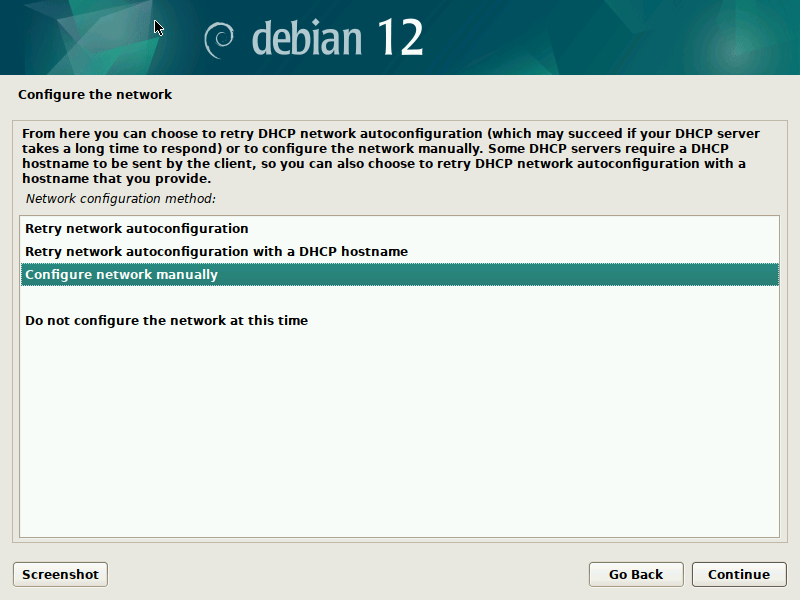
For this demo, we re installing the full netplan.io package (incl. Python CLI), as the netplan-generator package was not yet split out as an independent binary in the Bookworm cycle. You can choose the preseed file from a set of different variants to test the different configurations: We re using the custom linux kernel and initrd.gz here to be able to pass the preseed URL as a parameter to the kernel s cmdline directly. Launching this VM should bring up the normal debian-installer in its netboot/gtk form:
$ export U=https://people.ubuntu.com/~slyon/d-i/bookworm/netplan-preseed+networkd.cfg
$ qemu-system-x86_64 \
	-M q35 -enable-kvm -cpu host -smp 4 -m 2G \
	-drive if=pflash,format=raw,unit=0,file=OVMF_CODE_4M.fd,readonly=on \
	-drive if=pflash,format=raw,unit=1,file=OVMF_VARS_4M.fd,readonly=off \
	-device qemu-xhci -device usb-kbd -device usb-mouse \
	-vga none -device virtio-gpu-pci \
	-net nic,model=virtio -net user \
	-kernel ./linux -initrd ./initrd.gz -append "url=$U" \
	-hda ./data.qcow2 -cdrom ./mini.iso;
Now you can click through the normal Debian-Installer process, using mostly default settings. Optionally, you could play around with the networking settings, to see how those get translated to /etc/netplan/ in the target system.
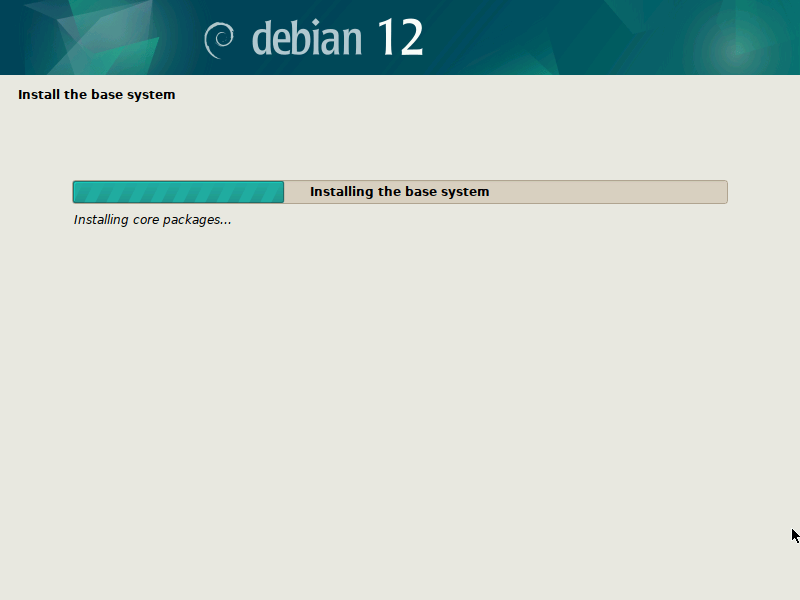
After you confirmed your partitioning changes, the base system gets installed. I suggest not to select any additional components, like desktop environments, to speed up the process.
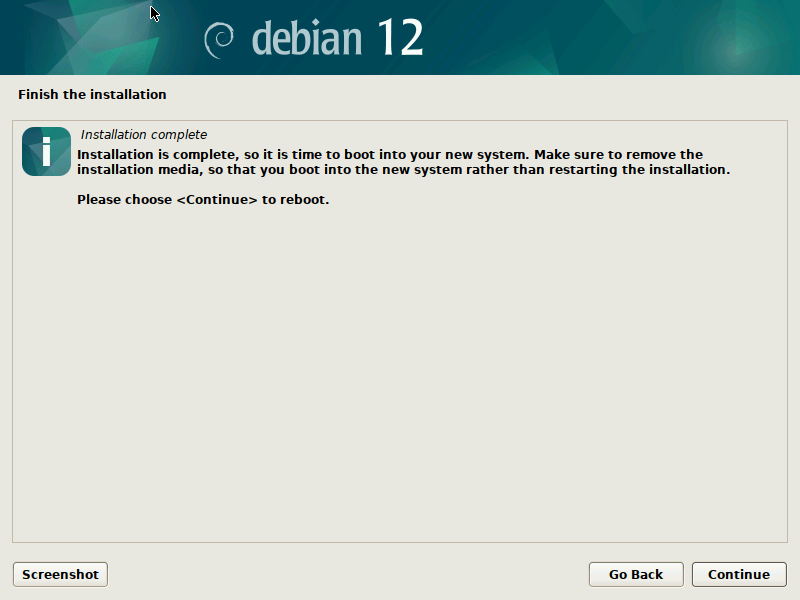
During the final step of the installation (finish-install.d/55netcfg-copy-config) d-i will detect that Netplan was installed in the target system (due to the preseed file provided) and opt to write its network configuration to /etc/netplan/ instead of /etc/network/interfaces or /etc/NetworkManager/system-connections/.
Done! After the installation finished, you can reboot into your virgin Debian Bookworm system. To do that, quit the current Qemu process, by pressing Ctrl+C and make sure to copy over the EFIVARS.fd file that was written by grub during the installation, so Qemu can find the new system. Then reboot into the new system, not using the mini.iso image any more:
$ cp ./OVMF_VARS_4M.fd ./EFIVARS.fd
$ qemu-system-x86_64 \
        -M q35 -enable-kvm -cpu host -smp 4 -m 2G \
        -drive if=pflash,format=raw,unit=0,file=OVMF_CODE_4M.fd,readonly=on \
        -drive if=pflash,format=raw,unit=1,file=EFIVARS.fd,readonly=off \
        -device qemu-xhci -device usb-kbd -device usb-mouse \
        -vga none -device virtio-gpu-pci \
        -net nic,model=virtio -net user \
        -drive file=./data.qcow2,if=none,format=qcow2,id=disk0 \
        -device virtio-blk-pci,drive=disk0,bootindex=1
        -serial mon:stdio
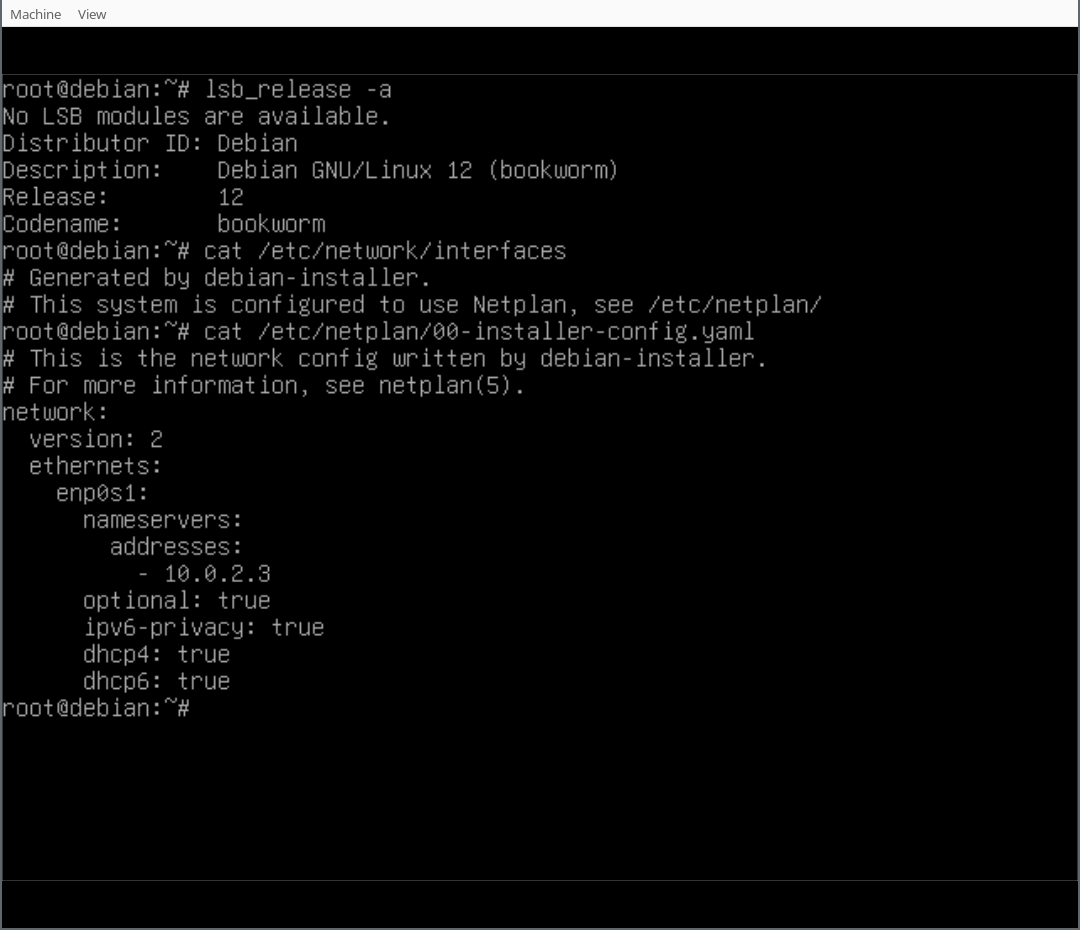
Finally, you can play around with your Netplan enabled Debian system! As you will find, /etc/network/interfaces exists but is empty, it could still be used (optionally/additionally). Netplan was configured in /etc/netplan/ according to the settings given during the d-i installation process.
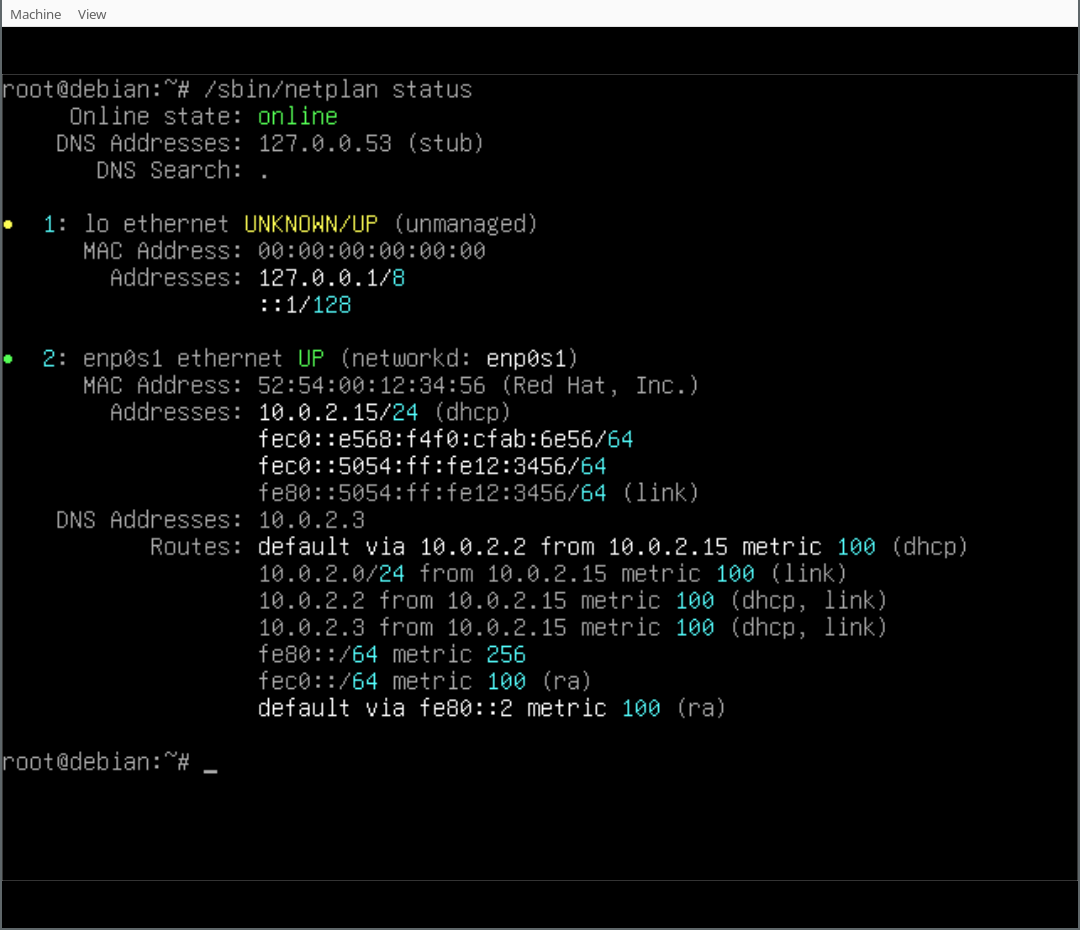
In our case, we also installed the Netplan CLI, so we can play around with some of its features, like netplan status:
Thank you for following along the Netplan enabled Debian installation process and happy hacking! If you want to learn more, join the discussion at Salsa:installer-team/netcfg and find us at GitHub:netplan.

22 April 2024

Bits from Debian: Debian Project Leader Election 2024, Andreas Tille elected.

The voting period for the Debian Project Leader election has ended. Please join us in congratulating Andreas Tille as the new Debian Project Leader. The new term for the project leader started on 2024-04-21. 369 of 1,010 Debian Developers voted using the Condorcet method. More information about the results of the voting are available on the Debian Project Leader Elections 2024 page. Many thanks all of our Developers for voting.

Vincent Fourmond: QSoas version 3.3 is out

Version 3.3 brings in new features, including reverse Laplace transforms and fits, pH fits, commands for picking points from a dataset, averaging points with the same X value, or perform singular value decomposition. In addition to these new features, many previous commands were improved, like the addition of a bandcut filter in FFT filtering, better handling of the loading of files produced by QSoas itself, and a button to interrupt the processing of scripts. There are a lot of other new features, improvements and so on, look for the full list there. About QSoas
QSoas is a powerful open source data analysis program that focuses on flexibility and powerful fitting capacities. It is released under the GNU General Public License. It is described in Fourmond, Anal. Chem., 2016, 88 (10), pp 5050 5052. Current version is 3.3. You can download for free its source code or precompiled versions for MacOS and Windows there. Alternatively, you can clone from the GitHub repository.

Russ Allbery: Review: The Stars, Like Dust

Review: The Stars, Like Dust, by Isaac Asimov
Series: Galactic Empire #2
Publisher: Fawcett Crest
Copyright: 1950, 1951
Printing: June 1972
Format: Mass market
Pages: 192
The Stars, Like Dust is usually listed as the first book in Asimov's lesser-known Galactic Empire Trilogy since it takes place before Pebble in the Sky. Pebble in the Sky was published first, though, so I count it as the second book. It is very early science fiction with a few mystery overtones. Buying books produces about 5% of the pleasure of reading them while taking much less than 5% of the time. There was a time in my life when I thoroughly enjoyed methodically working through a used book store, list in hand, tracking down cheap copies to fill in holes in series. This means that I own a lot of books that I thought at some point that I would want to read but never got around to, often because, at the time, I was feeling completionist about some series or piece of world-building. From time to time, I get the urge to try to read some of them. Sometimes this is a poor use of my time. The Galactic Empire series is from Asimov's first science fiction period, after the Foundation series but contemporaneous with their collection into novels. They're set long, long before Foundation, but after humans have inhabited numerous star systems and Earth has become something of a backwater. That process is just starting in The Stars, Like Dust: Earth is still somewhere where an upper-class son might be sent for an education, but it has been devastated by nuclear wars and is well on its way to becoming an inward-looking relic on the edge of galactic society. Biron Farrill is the son of the Lord Rancher of Widemos, a wealthy noble whose world is one of those conquered by the Tyranni. In many other SF novels, the Tyranni would be an alien race; here, it's a hierarchical and authoritarian human civilization. The book opens with Biron discovering a radiation bomb planted in his dorm room. Shortly after, he learns that his father had been arrested. One of his fellow students claims to be on Biron's side against the Tyranni and gives him false papers to travel to Rhodia, a wealthy world run by a Tyranni sycophant. Like most books of this era, The Stars, Like Dust is a short novel full of plot twists. Unlike some of its contemporaries, it's not devoid of characterization, but I might have liked it better if it were. Biron behaves like an obnoxious teenager when he's not being an arrogant ass. There is a female character who does a few plot-relevant things and at no point is sexually assaulted, so I'll give Asimov that much, but the gender stereotypes are ironclad and there is an entire subplot focused on what I can only describe as seduction via petty jealousy. The writing... well, let me quote a typical passage:
There was no way of telling when the threshold would be reached. Perhaps not for hours, and perhaps the next moment. Biron remained standing helplessly, flashlight held loosely in his damp hands. Half an hour before, the visiphone had awakened him, and he had been at peace then. Now he knew he was going to die. Biron didn't want to die, but he was penned in hopelessly, and there was no place to hide.
Needless to say, Biron doesn't die. Even if your tolerance for pulp melodrama is high, 192 small-print pages of this sort of thing is wearying. Like a lot of Asimov plots, The Stars, Like Dust has some of the shape of a mystery novel. Biron, with the aid of some newfound companions on Rhodia, learns of a secret rebellion against the Tyranni and attempts to track down its base to join them. There are false leads, disguised identities, clues that are difficult to interpret, and similar classic mystery trappings, all covered with a patina of early 1950s imaginary science. To me, it felt constructed and artificial in ways that made the strings Asimov was pulling obvious. I don't know if someone who likes mystery construction would feel differently about it. The worst part of the plot thankfully doesn't come up much. We learn early in the story that Biron was on Earth to search for a long-lost document believed to be vital to defeating the Tyranni. The nature of that document is revealed on the final page, so I won't spoil it, but if you try to think of the stupidest possible document someone could have built this plot around, I suspect you will only need one guess. (In Asimov's defense, he blamed Galaxy editor H.L. Gold for persuading him to include this plot, and disavowed it a few years later.) The Stars, Like Dust is one of the worst books I have ever read. The characters are overwrought, the politics are slapdash and build on broad stereotypes, the romantic subplot is dire and plays out mainly via Biron egregiously manipulating his petulant love interest, and the writing is annoying. Sometimes pulp fiction makes up for those common flaws through larger-than-life feats of daring, sweeping visions of future societies, and ever-escalating stakes. There is little to none of that here. Asimov instead provides tedious political maneuvering among a class of elitist bankers and land owners who consider themselves natural leaders. The only places where the power structures of this future government make sense are where Asimov blatantly steals them from either the Roman Empire or the Doge of Venice. The one thing this book has going for it the thing, apart from bloody-minded completionism, that kept me reading is that the technology is hilariously weird in that way that only 1940s and 1950s science fiction can be. The characters have access to communication via some sort of interstellar telepathy (messages coded to a specific person's "brain waves") and can travel between stars through hyperspace jumps, but each jump is manually calculated by referring to the pilot's (paper!) volumes of the Standard Galactic Ephemeris. Communication between ships (via "etheric radio") requires manually aiming a radio beam at the area in space where one thinks the other ship is. It's an unintentionally entertaining combination of technology that now looks absurdly primitive and science that is so advanced and hand-waved that it's obviously made up. I also have to give Asimov some points for using spherical coordinates. It's a small thing, but the coordinate systems in most SF novels and TV shows are obviously not fit for purpose. I spent about a month and a half of this year barely reading, and while some of that is because I finally tackled a few projects I'd been putting off for years, a lot of it was because of this book. It was only 192 pages, and I'm still curious about the glue between Asimov's Foundation and Robot series, both of which I devoured as a teenager. But every time I picked it up to finally finish it and start another book, I made it about ten pages and then couldn't take any more. Learn from my error: don't try this at home, or at least give up if the same thing starts happening to you. Followed by The Currents of Space. Rating: 2 out of 10

20 April 2024

Bastian Venthur: Help needed: creating a WSDL file to interact with debbugs

I am upstream and Debian package maintainer of python-debianbts, which is a Python library that allows for querying Debian s Bug Tracking System (BTS). python-debianbts is used by reportbug, the standard tool to report bugs in Debian, and therefore the glue between the reportbug and the BTS. debbugs, the software that powers Debian s BTS, provides a SOAP interface for querying the BTS. Unfortunately, SOAP is not a very popular protocol anymore, and I m facing the second migration to another underlying SOAP library as they continue to become unmaintained over time. Zeep, the library I m currently considering, requires a WSDL file in order to work with a SOAP service, however, debbugs does not provide one. Since I m not familiar with WSDL, I need help from someone who can create a WSDL file for debbugs, so I can migrate python-debianbts away from pysimplesoap to zeep. How did we get here? Back in the olden days, reportbug was querying the BTS by parsing its HTML output. While this worked, it tightly coupled the user-facing presentation of the BTS with critical functionality of the bug reporting tool. The setup was fragile, prone to breakage, and did not allow changing anything in the BTS frontend for fear of breaking reportbug itself. In 2007, I started to work on reportbug-ng, a user-friendly alternative to reportbug, targeted at users not comfortable using the command line. Early on, I decided to use the BTS SOAP interface instead of parsing HTML like reportbug did. 2008, I extracted the code that dealt with the BTS into a separate Python library, and after some collaboration with the reportbug maintainers, reportbug adopted python-debianbts in 2011 and has used it ever since. 2015, I was working on porting python-debianbts to Python 3. During that process, it turned out that its major dependency, SoapPy was pretty much unmaintained for years and blocking the Python3 transition. Thanks to the help of Gaetano Guerriero, who ported python-debianbts to pysimplesoap, the migration was unblocked and could proceed. In 2024, almost ten years later, pysimplesoap seems to be unmaintained as well, and I have to look again for alternatives. The most promising one right now seems to be zeep. Unfortunately, zeep requires a WSDL file for working with a SOAP service, which debbugs does not provide. How can you help? reportbug (and thus python-debianbts) is used by thousands of users and I have a certain responsibility to keep things working properly. Since I simply don t know enough about WSDL to create such a file for debbugs myself, I m looking for someone who can help me with this task. If you re familiar with SOAP, WSDL and optionally debbugs, please get in touch with me. I don t speak Pearl, so I m not really able to read debbugs code, but I do know some things about the SOAP requests and replies due to my work on python-debianbts, so I m sure we can work something out. There is a WSDL file for a debbugs version used by GNU, but I don t think it s official and it currently does not work with zeep. It may be a good starting point, though. The future of debbugs API While we can probably continue to support debbugs SOAP interface for a while, I don t think it s very sustainable in the long run. A simpler, well documented REST API that returns JSON seems more appropriate nowadays. The queries and replies that debbugs currently supports are simple enough to design a REST API with JSON around it. The benefit would be less complex libraries on the client side and probably easier maintainability on the server side as well. debbugs maintainer seemed to be in agreement with this idea back in 2018. I created an attempt to define a new API (HTML render), but somehow we got stuck and no progress has been made since then. I m still happy to help shaping such an API for debbugs, but I can t really implement anything in debbugs itself, as it is written in Perl, which I m not familiar with.

19 April 2024

Louis-Philippe V ronneau: Montreal's Debian & Stuff - March 2024

Time really flies when you are really busy you have fun! Our Montr al Debian User Group met on Sunday March 31st and I only just found the time to write our report :) This time around, 9 of us we met at EfficiOS's offices1 to chat, hang out and work on Debian and other stuff! Here is what we did: pollo: tvaz: tassia: viashimo: lavamind: justin: Pictures Here are pictures of the event. Well, one picture (thanks Tassia!) of the event itself and another one of the crisp Italian lager I drank at the bar after the event :) People at the event working around a long table A glass of beer illuminated by sunlight

  1. Maintainers, amongst other things, of the great LTTng.

18 April 2024

Jonathan McDowell: Sorting out backup internet #2: 5G modem

Having setup recursive DNS it was time to actually sort out a backup internet connection. I live in a Virgin Media area, but I still haven t forgiven them for my terrible Virgin experiences when moving here. Plus it involves a bigger contractual commitment. There are no altnets locally (though I m watching youfibre who have already rolled out in a few Belfast exchanges), so I decided to go for a 5G modem. That gives some flexibility, and is a bit easier to get up and running. I started by purchasing a ZTE MC7010. This had the advantage of being reasonably cheap off eBay, not having any wifi functionality I would just have to disable (it s going to plug it into the same router the FTTP connection terminates on), being outdoor mountable should I decide to go that way, and, finally, being powered via PoE. For now this device sits on the window sill in my study, which is at the top of the house. I printed a table stand for it which mostly does the job (though not as well with a normal, rather than flat, network cable). The router lives downstairs, so I ve extended a dedicated VLAN through the study switch, down to the core switch and out to the router. The PoE study switch can only do GigE, not 2.5Gb/s, but at present that s far from the limiting factor on the speed of the connection. The device is 3 branded, and, as it happens, I ve ended up with a 3 SIM in it. Up until recently my personal phone was with them, but they ve kicked me off Go Roam, so I ve moved. Going with 3 for the backup connection provides some slight extra measure of resiliency; we now have devices on all 4 major UK networks in the house. The SIM is a preloaded data only SIM good for a year; I don t expect to use all of the data allowance, but I didn t want to have to worry about unexpected excess charges. Performance turns out to be disappointing; I end up locking the device to 4G as the 5G signal is marginal - leaving it enabled results in constantly switching between 4G + 5G and a significant extra latency. The smokeping graph below shows a brief period where I removed the 4G lock and allowed 5G: Smokeping 4G vs 5G graph (There s a handy zte.js script to allow doing this from the device web interface.) I get about 10Mb/s sustained downloads out of it. EE/Vodafone did not lead to significantly better results, so for now I m accepting it is what it is. I tried relocating the device to another part of the house (a little tricky while still providing switch-based PoE, but I have an injector), without much improvement. Equally pinning the 4G to certain bands provided a short term improvement (I got up to 40-50Mb/s sustained), but not reliably so. speedtest.net results This is disappointing, but if it turns out to be a problem I can look at mounting it externally. I also assume as 5G is gradually rolled out further things will naturally improve, but that might be wishful thinking on my part. Rather than wait until my main link had a problem I decided to try a day working over the 5G connection. I spend a lot of my time either in browser based apps or accessing remote systems via SSH, so I m reasonably sensitive to a jittery or otherwise flaky connection. I picked a day that I did not have any meetings planned, but as it happened I ended up with an adhoc video call arranged. I m pleased to say that it all worked just fine; definitely noticeable as slower than the FTTP connection (to be expected), but all workable and even the video call was fine (at least from my end). Looking at the traffic graph shows the expected ~ 10Mb/s peak (actually a little higher, and looking at the FTTP stats for previous days not out of keeping with what we see there), and you can just about see the ~ 3Mb/s symmetric use by the video call at 2pm: 4G traffic during the work day The test run also helped iron out the fact that the content filter was still enabled on the SIM, but that was easily resolved. Up next, vaguely automatic failover.
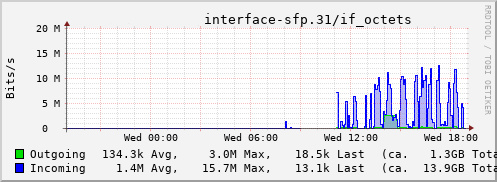

Thomas Koch: Good things come ... state folder

Posted on January 2, 2024
Just a little while ago (10 years) I proposed the addition of a state folder to the XDG basedir specification and expanded the article XDGBaseDirectorySpecification in the Debian wiki. Recently I learned, that version 0.8 (from May 2021) of the spec finally includes a state folder. Granted, I wasn t the first to have this idea (2009), nor the one who actually made it happen. Now, please go ahead and use it! Thank you.

Next.

Previous.