Search Results: "zed"

19 May 2016

Petter Reinholdtsen: I want the courts to be involved before the police can hijack a news site DNS domain (#domstolkontroll)

I just donated to the NUUG defence "fond" to fund the effort in Norway to get the seizure of the news site popcorn-time.no tested in court. I hope everyone that agree with me will do the same. Would you be worried if you knew the police in your country could hijack DNS domains of news sites covering free software system without talking to a judge first? I am. What if the free software system combined search engine lookups, bittorrent downloads and video playout and was called Popcorn Time? Would that affect your view? It still make me worried. In March 2016, the Norwegian police seized (as in forced NORID to change the IP address pointed to by it to one controlled by the police) the DNS domain popcorn-time.no, without any supervision from the courts. I did not know about the web site back then, and assumed the courts had been involved, and was very surprised when I discovered that the police had hijacked the DNS domain without asking a judge for permission first. I was even more surprised when I had a look at the web site content on the Internet Archive, and only found news coverage about Popcorn Time, not any material published without the right holders permissions. The seizure was widely covered in the Norwegian press (see for example Hegnar Online and ITavisen and NRK), at first due to the press release sent out by kokrim, but then based on protests from the law professor Olav Torvund and lawyer Jon Wessel-Aas. It even got some coverage on TorrentFreak. I wrote about the case a month ago, when the Norwegian Unix User Group (NUUG), where I am an active member, decided to ask the courts to test this seizure. The request was denied, but NUUG and its co-requestor EFN have not given up, and now they are rallying for support to get the seizure legally challenged. They accept both bank and Bitcoin transfer for those that want to support the request. If you as me believe news sites about free software should not be censored, even if the free software have both legal and illegal applications, and that DNS hijacking should be tested by the courts, I suggest you show your support by donating to NUUG.

18 May 2016

Jonathan McDowell: First steps with the ATtiny45

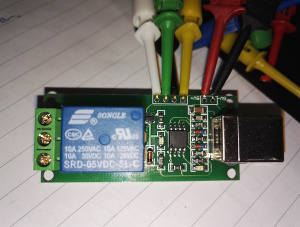
1 port USB Relay
These days the phrase embedded usually means no console (except, if you re lucky, console on a UART for debugging) and probably busybox for as much of userspace as you can get away with. You possibly have package management from OpenEmbedded or similar, though it might just be a horrible kludged together rootfs if someone hates you. Either way it s rare for it not to involve some sort of hardware and OS much more advanced than the 8 bit machines I started out programming on. That is, unless you re playing with Arduinos or other similar hardware. I m currently waiting on some ESP8266 dev boards to arrive, but even they re quite advanced, with wifi and a basic OS framework provided. A long time ago I meant to get around to playing with PICs but never managed to do so. What I realised recently was that I have a ready made USB relay board that is powered by an ATtiny45. First step was to figure out if there were suitable programming pins available, which turned out to be all brought out conveniently to the edge of the board. Next I got out my trusty Bus Pirate, installed avrdude and lo and behold:
$ avrdude -p attiny45 -c buspirate -P /dev/ttyUSB0
Attempting to initiate BusPirate binary mode...
avrdude: Paged flash write enabled.
avrdude: AVR device initialized and ready to accept instructions
Reading   ##################################################   100% 0.01s
avrdude: Device signature = 0x1e9206 (probably t45)
avrdude: safemode: Fuses OK (E:FF, H:DD, L:E1)
avrdude done.  Thank you.
Perfect. I then read the existing flash image off the device, disassembled it, worked out it was based on V-USB and then proceeded to work out that the only interesting extra bit was that the relay was hanging off pin 3 on IO port B. Which led to me knocking up what I thought should be a functionally equivalent version of the firmware, available locally or on GitHub. It s worked with my basic testing so far and has confirmed to me I understand how the board is set up, meaning I can start to think about what else I could do with it

17 May 2016

Mike Gabriel: NXv3 Rebase: Build nxagent against X.org 7.0

As already hinted in my previous blog post, here comes a short howto that explains how to test-build nxagent (v3) against a modularized X.org 7.0 source tree. WARNING: Please note that mixing NX code and X.org code partially turns the original X.org code base into GPL-2 code. We are aware of this situation and work on moving all NXv3 related GPL-2 code into the nxagent DDX code (xserver-xorg/hw/nxagent) or--if possible--dropping it completely. The result shall be a range of patches against X.org (licensable under the same license as the respective X.org files) and a GPL-2 licensed DDX (i.e. nxagent). How to build this project For the Brave and Playful
$ git clone https://git.arctica-project.org/nx-X11-rebase/build.git .
$ bash populate.sh sources.lst
$ ./buildit.sh
You can find the built tree in the _install/ sub-directory. Please note that cloning Git repositories over the https protocol can be considerably slow. If you want to speed things up, consider signing up with our GitLab server. For Developers... ... who have registered with our GitLab server.
$ git clone git@git.arctica-project.org:nx-X11-rebase/build.git .
$ bash populate.sh sources-devs.lst
$ ./buildit.sh
You will find the built tree in the _install/ sub-directory. The related git repositories are in the repos/ sub-directory. All repos modified for NX have been cloned from the Arctica Project's GitLab server via SSH. Thus, you as a developer can commit changes on those repos and push back your changes to the GitLab server. Required tools for building Debian/Ubuntu and alike In a one-liner command:
$ sudo apt-get install build-essential automake gawk git pkg-config libtool libz-dev libjpeg-dev libpng-dev
Fedora If someone tries this out in a clean Fedora chroot environment, please let us know about build dependent packages. openSUSE If someone tries this out in a clean openSUSE chroot environment, please let us know about build dependent packages. Testing the built nxagent and nxproxy The tests/ subdir contains some scripts which can be used to test the compile results. Notes on required X.org changes (NX_MODIFICATIONS) For this build workflow to work, we (i.e. mostly Ulrich Sibiller) had to work several NoMachine patches into original X.org 7.0 code. Here is a list of modified X11 components with URLs pointing to the branch containing those changes:
xkbdata                            xorg/data/xkbdata                       rebasenx  1.0.1     https://git.arctica-project.org/nx-X11-rebase/xkbdata.git
libfontenc                         xorg/lib/libfontenc                     rebasenx  1.0.1     https://git.arctica-project.org/nx-X11-rebase/libfontenc.git
libSM                              xorg/lib/libSM                          rebasenx  1.0.0     https://git.arctica-project.org/nx-X11-rebase/libSM.git
libX11                             xorg/lib/libX11                         rebasenx  1.0.0     https://git.arctica-project.org/nx-X11-rebase/libX11.git
libXau                             xorg/lib/libXau                         rebasenx  1.0.0     https://git.arctica-project.org/nx-X11-rebase/libXau.git
libXfont                           xorg/lib/libXfont                       rebasenx  1.3.1     https://git.arctica-project.org/nx-X11-rebase/libXfont.git
libXrender                         xorg/lib/libXrender                     rebasenx  0.9.0.2   https://git.arctica-project.org/nx-X11-rebase/libXrender.git
xtrans                             xorg/lib/libxtrans                      rebasenx  1.0.0     https://git.arctica-project.org/nx-X11-rebase/libxtrans.git
kbproto                            xorg/proto/kbproto                      rebasenx  1.0.2     https://git.arctica-project.org/nx-X11-rebase/kbproto.git
xproto                             xorg/proto/xproto                       rebasenx  7.0.4     https://git.arctica-project.org/nx-X11-rebase/xproto.git
xorg-server                        xorg/xserver                            rebasenx  1.0.1     https://git.arctica-project.org/nx-X11-rebase/xserver.git
mesa                               mesa/mesa                               rebasenx  6.4.1     https://git.arctica-project.org/nx-X11-rebase/mesa.git
Credits Nearly all of this has been achieved by Ulrich Sibiller. Thanks a lot for giving your time and energy to that. As the rebasing of NXv3 is currently a funded project supported by the Qindel Group, we are currently negotiating ways of monetarily appreciating Ulrich's intensive work on this. Thanks a lot, once more!!! Feedback If anyone of you feels like trying out the test build as described above, please consider signing up with the Arctica Project's GitLab server and reporting your issues there directly (against the repository nx-X11-rebase/build). Alternatively, feel free to contact us on IRC (Freenode): #arctica or subscribe to our developers' mailing list. Thank you. light+love
Mike Gabriel

15 May 2016

Bits from Debian: What does it mean that ZFS is included in Debian?

Petter Reinholdtsen recently blogged about ZFS availability in Debian. Many people have worked hard on getting ZFS support available in Debian and we would like to thank everyone involved in getting to this point and explain what ZFS in Debian means. The landing of ZFS in the Debian archive was blocked for years due to licensing problems. Finally, the inclusion of ZFS was announced slightly more than a year ago, on April 2015 by the DPL at the time, Lucas Nussbaum who wrote "We received legal advice from Software Freedom Law Center about the inclusion of libdvdcss and ZFS in Debian, which should unblock the situation in both cases and enable us to ship them in Debian soon.". In January this year, the following DPL, Neil McGovern blogged with a lot of more details about the legal situation behind this and summarized it as "TLDR: It s going in contrib, as a source only dkms module." ZFS is not available exactly in Debian, since Debian is only what's included in the "main" section archive. What people really meant here is that ZFS code is now in included in "contrib" and it's available for users using DKMS. Many people also mixed this with Ubuntu now including ZFS. However, Debian and Ubuntu are not doing the same, Ubuntu is shipping directly pre-built kernel modules, something that is considered to be a GPL violation. As the Software Freedom Conservancy wrote "while licensed under an acceptable license for Debian's Free Software Guidelines, also has a default use that can cause licensing problems for downstream Debian users".

Norbert Preining: Foreigners in Japan are evil

at least what Tokyo Shinjuku ward belives. They have put out a very nice brochure about how to behave as a foreigner in Japan: English (local copy) and Japanese (local copy). Nothing in there is really bad, but the tendency is so clear that it makes me think what on earth do you believe we are doing in this country?
foreigners Now what is so strange on that? And if you have never lived in Japan you will probably not understand. But reading through this pamphlet I felt like a criminal from the first page on. If you don t want to read through it, here a short summary: So if you count up, we have 23 pages of warnings, and 1 (as in *one*) page of practical information. Do I need to add more about how we foreigners are considered in Japan? Just a few points about details: I accept the good intention of the Shinjuku ward to bring forth a bit of warnings and guidance. But the way it was done it speaks volumes about how we foreigners are treated second class.

14 May 2016

Thadeu Lima de Souza Cascardo: Chromebook Trackpad

Three years ago, I wanted to get a new laptop. I wanted something that could run free software, preferably without blobs, with some good amount of RAM, good battery and very light, something I could carry along with a work laptop. And I didn't want to spend too much. I don't want to make this too long, so in the end, I asked in the store anything that didn't come with Windows installed, and before I was dragged into the Macbook section, I shouted "and no Apple!". That's how I got into the Chromebook section with two options before me. There was the Chromebook Pixel, too expensive for me, and the Samsung Chromebook, using ARM. Getting a laptop with an ARM processor was interesting for me, because I like playing with different stuff. I looked up if it would be possible to run something other than ChromeOS on it, got the sense that is, it would, and make a call. It does not have too much RAM, but it was cheap. I got an external HD to compensate for the lack of storage (only 16GB eMMC), and that was it. Wifi does require non-free firmware to be loaded, but booting was a nice surprise. It is not perfect, but I will see if I can get to that another day. I managed to get Fedora installed, downloading chunks of an image that I could write into the storage. After a while, I backed up home, and installed Debian using debootstrap. Recently, after an upgrade from wheezy to jessie, things stopped working. systemd would not mount the most basic partitions and would simply stop very early in the boot process. That's a story on my backlog as well, that I plan to tell soon, since I believe this connects with supporting Debian on mobile devices. After fixing some things, I decided to try libinput instead of synaptics for the Trackpad. The Chromebook uses a Cypress APA Trackpad. The driver was upstreamed in Linux 3.9. The Chrome OS ships with Linux 3.4, but had the driver in its branch. After changing to libinput, I realized clicking did not work. Neither did tapping. I moved back to synaptics, and was reminded things didn't work too well with that either. I always had to enable tapping. I have some experience with input devices. I wrote drivers, small applications reacting to some events, and some uinput userspace drivers as well. I like playing with that subsystem a lot. But I don't have too much experience with multitouch and libinput is kind of new for me too. I got my hands on the code and found out there is libinput-debug-events. It will show you how libinput translates evdev events. I clicked on the Trackpad and got nothing but some pointer movements. I tried evtest and there were some multitouch events I didn't understand too well, but it looked like there were important events there that I thought libinput should have recognized. I tried reading some of libinput code, but didn't get too far before I tried something else. But then, I had to let this exercise for another day. Today, I decided to do it again. Now, with some fresh eyes, I looked at the driver code. It showed support for left, right and middle buttons. But maybe my device doesn't support it, because I don't remember seeing it on evtest when clicking the Trackpad. I also understood better the other multitouch events, they were just saying how many fingers there were and what was the position of which one of them. In the case of a single finger, you still get an identifier. For better understanding of all this, reading Documentation/input/event-codes.txt and Documentation/input/multi-touch-protocol.txt is recommended. So, in trying to answer if libinput needs to handle my devices events properly, or handle my device specially, or if the driver requires changes, or what else I can do to have a better experience with this Trackpad, things were tending to the driver and device. Then, after running evtest, I noticed a BTN_LEFT event. OK, so the device and driver support it, what is libinput doing with that? Running evtest and libinput-debug-events at the same time, I found out the problem. libinput was handling BTN_LEFT correctly, but the driver was not reporting it all the time. By going through the driver, it looks like this is either a firmware or a hardware problem. When you get the click response, sound and everything, the drivers will not always report it. It could be pressure, eletrical contact, I can't tell for sure. But the driver does not check for anything but what the firmware has reported, so it's not the driver. A very interesting I found out is that you can read and write the firmware. I dumped it to a file, but still could not analyze what it is. There are some commands to put the driver into some bootloader state, so maybe it's possible to play with the firmware without bricking the device, though I am not sure yet. Even then, the problem might not be fixable by just changing the firmware. So, I left with the possibility of using tapping, which was not working with libinput. Grepping at the code, I found out by libinput documentation that tapping needs to be enabled. The libinput xorg driver supports that. Just set the Tapping option to true and that's it. So, now I am a happy libinput user, with some of the same issues I had before with synaptics, but something you get used to. And I have a new firmware in front of me that maybe we could tackle by some reverse engineering.

11 May 2016

Julian Andres Klode: Backing up with borg and git-annex

I recently found out that I have access to a 1 TB cloud storage drive by 1&1, so I decided to start taking off-site backups of my $HOME (well, backups at all, previously I only mirrored the latest version from my SSD to an HDD). I initially tried obnam. Obnam seems like a good tool, but is insanely slow. Unencrypted it can write about 3 MB/s, which is somewhat OK, but even then it can spend hours forgetting generations (1 generation takes probably 2 minutes, and there might be 22 of them). In encrypted mode, the speed reduces a lot, to about 500 KB/s if I recall correctly, which is just unusable. I found borg backup, a fork of attic. Borg backup achieves speeds of up to 15 MB/s which is really nice. It s also faster with scanning: I can now run my bihourly backups in about 1 min 30s (usually backs up about 30 to 80 MB mostly thanks to Chrome I suppose!). And all those speeds are with encryption turned on. Both borg and obnam use some form of chunks from which they compose files. Obnam stores each chunk in its own file, borg stores multiple chunks (even from different files) in a single pack file which is probably the main reason it is faster. So how am I backing up: My laptop has an internal SSD and an HDD. I backup every 2 hours (at 09,11,13,15,17,19,21,23,01:00 hours) using a systemd timer event, from the SSD to the HDD. The backup includes all of $HOME except for Downloads, .cache, the trash, Android SDK, and the eclipse and IntelliJ IDEA IDEs. Now the magic comes in: The backup repository on the HDD is monitored by git-annex assistant, which automatically encrypts and uploads any new files in there to my 1&1 WebDAV drive and registers them in a git repository hosted on bitbucket. All files are encrypted and checksummed using SHA256, reducing the chance of the backup being corrupted. I m not sure how the WebDAV thing will work once I want to prune things, I suspect it will then delete some pack files and repack things into new files which means it will spend more bandwidth than obnam would. I d also have to convince git-annex to actually drop anything from the WebDAV remote, but that is not really that much of a concern with 1TB storage space in the next 2 years at least I also have an external encrypted HDD which I can take backups on, it currently houses a fuller backup of $HOME that also includes Downloads, the Android SDK, and the IDEs for quicker recovery. Downloads changes a lot, and all of them can be fairly easily re-retrieved from the internet as needed, so there s not much point in painfully uploading them to a WebDAV backup site.
Filed under: Uncategorized

10 May 2016

Lars Wirzenius: Qvarn Platform announcement

In March we started a new company, to develop and support the software whose development I led at my previous job. The software is Qvarn, and it's fully free software, licensed under AGPL3+. The company is QvarnLabs (no website yet). Our plan is to earn a living from this, and our hope is to provide software that is actually useful for helping various organisations handle data securely. The first press release about Qvarn was sent out today. We're still setting up the company and getting operational, but a little publicity never hurts. (Even if it is more marketing-speak and self-promotion than I would normally put on my blog.) So this is what I do for a living now.

The development of the open source Qvarn Platform was led by QvarnLabs CEO Kaius H ggblom (left) and CTO Lars Wirzenius. Helsinki, Finland 10.05.2016 With Privacy by Design, integrated Gluu access management and comprehensive support for regulatory data compliance, Qvarn is set to become the Europe-wide platform of choice for managing workforce identities and providing associated value-added services. Construction industry federations in Sweden, Finland and the Baltic States have been using the Qvarn Platform (http://www.qvarn.org) since October 2015 to securely manage the professional digital identities of close to one million construction workers. Developed on behalf of these same federations, Qvarn is now free and open source software; making it a compelling solution for any organization that needs to manage a secure register of workers data. "There is something universal and fundamental at the core of the Qvarn platform. And that s trust," said Qvarn evangelist Kaius H ggblom. "We decided to make it free, open source and include Gluu access management because we wanted all those using Qvarn or contributing to its continued development to have the freedom to work with the platform in whatever way is best for them." Qvarn has been designed to meet the requirements of the European Union s new General Data Protection Regulation (GDPR), enabling organizations that use the platform to ensure their compliance with the new law. Qvarn has also incorporated the principles of Privacy by Design to minimize the disclosure of non-essential personal information and to give people more control over their data. "Today, Qvarn is used by the construction industry as a way to manage the data of employees, many of whom frequently move across borders. In this way the platform helps to combat the grey economy in the building sector, thereby improving quality and safety, while simultaneously protecting the professional identity data of almost a million individuals," said H ggblom. "Qvarn is so flexible and secure that we envision it becoming the preferred platform for the provision of any value-added services with an identity management component, eventually even supporting monetary transactions." Qvarn is a cloud based solution supported to run on both Amazon Web Services (AWS) and OpenStack. In partnership with Gluu, the platform delivers an out-of-the-box solution that uses open and standard protocols to provide powerful yet flexible identity and access management, including mechanisms for appropriate authentication and authorization. "Qvarn's identity management and governance capabilities perfectly compliment the Gluu Server's access management features," said Founder and CEO of Gluu, Michael Schwartz. "Free open source software (FOSS) is essential to the future of identity and access management. And the FOSS development methodology provides the transparency that is needed to foster the strong sense of community upon which a vibrant ecosystem thrives." Qvarn s development team continues to be led by recognized open source developer and platform architect Lars Wirzenius. He has been developing free and open source software for 30 years and is a renowned expert in the Linux environment, with a particular focus on the Debian distribution. Lars works at all levels of software development from writing code to designing system architecture. About the Qvarn Platform: The Qvarn Platform is free and open source software for managing workforce identities. Qvarn is integrated with the Gluu Server s access management features out of the box, using open and standard protocols to provide the platform with a single common digital identity and mechanisms for appropriate authentication and authorization. A cloud based solution, Qvarn is supported to run on both Amazon Web Services (AWS) and OpenStack. Privacy by Design is central to the architecture of Qvarn and the platform has been third party audited to a security level of HIGH. http://www.qvarn.org For more information, please contact:
Andrew Flowers
andrew.flowers@ellisnichol.com
+358 40 161 5668

Dmitry Shachnev: ReText 6.0 and PyMarkups 2.0 released

Today I have released the new major version of the ReText editor. This release would not be possible without Maurice van der Pot who was the author of the greatest features because of which the version number was bumped: Other news worth mentioning are: As usual, some bugs have been fixed (most of fixes have also been backported to 5.3.1 release), and some translations have been updated from Transifex. Please report any bugs you find to our issue tracker.

9 May 2016

Mike Gabriel: Recent progress in NXv3 development

This is to give a comprehensive overview on the recent progress made in NXv3 (aka nx-libs) development. The upstream sources of nx-libs can be found at / viewed on / cloned from Github:
https://github.com/ArcticaProject/nx-libs A great portion of the current work is sponsored by the Qindel Group [1] in Spain (QINDEL FORMACI N Y SERVICIOS, S.L.). Thanks for making this possible. Planned release date: 2nd July, 2016 We aim at releasing a completely tidied up nx-libs code tree versioned 3.6.0 on July 2nd, 2016. There is still a whole bunch of work to do for this, but I am positive that we can make this release date. Goals of our Efforts There are basically two major goals for spending a considerable amount of time, money and energy on NXv3 hacking: The efforts undertaken always have the various existing use cases in mind (esp. the framework of the coming-up Arctica Project, TheQVD and X2Go). Overview on Recent Development Progress General Code Cleanups Making this beast maintainable means first of all: identifying code redundancies, unused code passages, etc. and remove them. This is where we came from (NoMachine's NX 3.5.x, including nxcomp, nxcompext, nxcompshad, nx-X11 and nxagent): 1,757,743 lines of C/C++ code.
[mike@minobo nx-libs.35 (3.5.0.x)]$ cloc --match-f '.*\.(c cpp h)$' .
    5624 text files.
    5614 unique files.                                          
    2701 files ignored.
http://cloc.sourceforge.net v 1.60  T=18.59 s (302.0 files/s, 132847.4 lines/s)
-------------------------------------------------------------------------------
Language                     files          blank        comment           code
-------------------------------------------------------------------------------
C                             3134         231180         252893        1326393
C/C++ Header                  2274          78062         116132         349743
C++                            206          20037          13312          81607
-------------------------------------------------------------------------------
SUM:                          5614         329279         382337        1757743
-------------------------------------------------------------------------------
On the current 3.6.x branch of nx-libs (at commit 6c6b6b9), this is where we are now: 662,635 lines of C/C++ code, amount of code reduced to a third of the original code lines.
[mike@minobo nx-libs (3.6.x)]$ cloc --match-f '.*\.(c cpp h)' .
    2012 text files.
    2011 unique files.                                          
    1898 files ignored.
http://cloc.sourceforge.net v 1.60  T=5.63 s (341.5 files/s, 161351.5 lines/s)
-------------------------------------------------------------------------------
Language                     files          blank        comment           code
-------------------------------------------------------------------------------
C                             1015          74605          81625         463244
C/C++ Header                   785          26992          34354         138063
C++                            122          16984          10804          61328
-------------------------------------------------------------------------------
SUM:                          1922         118581         126783         662635
-------------------------------------------------------------------------------
The latest development branch currently has these statistics: 619,353 lines of C/C++ code, another 40,000 lines could be dropped.
[mike@minobo nx-libs (pr/libnx-xext-drop-unused-extensions)]$ cloc --match-f '.*\.(c cpp h)' .
    1932 text files.
    1931 unique files.                                          
    1898 files ignored.
http://cloc.sourceforge.net v 1.60  T=5.66 s (325.4 files/s, 150598.1 lines/s)
-------------------------------------------------------------------------------
Language                     files          blank        comment           code
-------------------------------------------------------------------------------
C                              983          69474          77186         426564
C/C++ Header                   738          25616          33048         131599
C++                            121          16984          10802          61190
-------------------------------------------------------------------------------
SUM:                          1842         112074         121036         619353
-------------------------------------------------------------------------------
Dropping various libNX_X* shared libraries (and using X.org shared client libraries instead) At first, various bundled libraries could be dropped from the nx-X11 code tree. Secondly, several of the bundled X.org libraries could be dropped, because we managed to build against those libraries as provided system-wide. Then, and this undertaking is much trickier, we could drop nearly all Xlib extension libraries that are used by nxagent with its role of being an X11 client. We could sucessfully drop these Xlib extension libraries from nx-X11, because we managed to build nxagent against the matching libraries in X.org: libNX_Xdmcp, libNX_Xfixes, libNX_XComposite, libNX_Xdamage, libNX_Xtst, libNX_Xinerama, libNX_Xfont, libNX_xkbui, and various others. All these droppings happened without a loss of functionality. However, some shared X client libraries are not easy to remove without loss of functionality, or rather not removable at all. Dropping libNX_Xrender We recently dropped libNX_Xrender [2] and now build nxagent against X.org's libXrender. However, this cost us a compression feature in NX. The libNX_Xrender code has passages that do zero padding of the unused memory portions in non-32bit-depth glyphs (the NX_RENDER_CLEANUP feature). However, we have hope for being able to reintroduce that feature again later, but current efforts [3] still fail at run-time. Dropping libNX_Xext is not possible... ...the libNX_Xext / Xserver Xext code has been cleaned up instead. Quite an amount of research and testing has been spent on removing the libNX_Xext library from the build workflow of nxagent. However, it seems that building against X.org's libXext will require us to update the Xext part of the nxagent Xserver at the same time. While taking this deep look into Xext code, we dropped various Xext extensions from the nx-X11 Xserver code. The extensions that got dropped [5] are all extensions that already have been dropped from X.org's Xserver code, as well. Further investigation, however, showed, that actually the only used client side extension code from libNX_Xext is the XShape extension. Thus, all other client side extension got dropped now in a very recent pull request [4]. Dropping libNX_X11 not easy, research summary given here For the sake of dropping the Xlib library bundled with nx-libs, we have attempted at writing a shared library called libNX_Xproxy. This library is supposed to contain a subset of the NXtrans related Xlib code that NoMachine patched into X.org's libX11 (and libxtrans). Results of this undertaking [6] so far: Over the weekend, I thought this all through once more and I am pretty sure right now, that we can actually make libNX_Xproxy work and drop all of libNX_X11 from nx-libs soon. Although we have to port (i.e. copy) various functions related to the NX transport from libNX_X11 into libNX_Xproxy, this change will allow us to drop all Xlib drawing routines and use those provided by X.org's Xlib shared library directly. Composite extension backport in nxagent to version 0.4 Mihai Moldovan looked at what it needs to make the Composite extension functional in nxagent. Unfortunately, the exact answer cannot be given, yet. As a start, Mihai backported latest Composite extension (v0.4) code from X.org's Xserver into the nxagent Xserver [7]. The currently shipped Composite extension version in nxagent is v0.2. Work on the NX Compression shared library (aka nxcomp v3) Fernando Carvajal and Salvador Fandi o from the Qindel Group [1] filed three pull requests against the nxcomp part of nx-libs recently, two of them have been code cleanups (done by Fernando), the third one is a feature enhancement regarding channels in nxcomp (provided by Salva). Protocol clean-up: drop pre-3.5 support With the release of nx-libs 3.6.x, we will drop support for nxcomp versions earlier than 3.5. Thus, if you are still on nxcomp 3.4, be prepared for upgrading at least to version 3.5.x. The code removal had been issued as pull request #111 ("Remove compatibility code for nxcomp before 3.5.0") [8]. The PR has already been reviewed and merged. Fernando filed another code cleanup PR (#119 [9]) against nx-libs that also already got merged into the 3.6.x branch. UNIX Socket Support for Channels The nxcomp library (and thus, nxproxy) provides a feature called "channels". Channels in nxcomp can be used for forwarding traffic between NX client side and the NX server side (along the graphical X11 transport that nxcomp is designed for). Until version 3.5.x, nxcomp was only able to use local TCP sockets for providing / connecting to channel endpoints. We consider local TCP sockets as insecure and aim at adding UNIX file socket support to nxcomp whereever a connection is established. Salva provided a patch against nxcomp that provides UNIX socket support to channel endpoints. The initial use case for this patch is: connect to client side pulseaudio socket file and avoid enabling the TCP listening socket in pulseaudio. The traffic then is channeled to the server side, so that pulse clients can connect to a UNIX socket file rather than to a local TCP port. The channel support patch has already been reviewed and merged into the 3.6.x branch of nx-libs. Rebasing nxagent against latest X.org Ulrich Sibiller spent a considerable amount of time and energy on providing a build chain that allows building nxagent against a modularized X.org 7.0 (rather than against the monolithic build tree of X.org 6.9, like we still do in nx-libs 3.6.x). We plan to adapt and minimize this build workflow for nx-libs 3.7.x (scheduled for summer 2017). A short howto that shows how to build nxagent with that new workflow will be posted on this blog within the next days. So stay tuned. Further work accomplished Quite a lot of code cleanup PRs have been filed by myself against nx-libs. Most of them target at removal of unnecessary code from the nx-X11 Xserver code base and the nxagent DDX: The third one (PR #120) in the list requires some detailled explanation: We discovered that nxagent ships overrides some symbols from the original Xserver code base. These overrides are induced by copies of some files from some Xserver sub-directory placed into the hw/nxagent/ DDX path. All those files' names match the pattern NX*.c. These copies of code are done in a way that the C compiler suppresses throwing its 'symbol "" redefined: first defined in ""; redefined in ""' errors. The approach taken, however, requires to have quite a few 10.000 lines of redundant code in hw/nxagent/NX*.c that also gets shipped in some Xserver sub-directory (mostly dix/ and render/). With pull request #120, we have identified all code passages in hw/nxagent/NX*.c that must be considered as NX'ish. We differentiated the NX'ish functions from functions that never got changed by NoMachine when developing nxagent. I then came up with four different approaches ([13,14,15,16]) of dropping redundant code from those hw/nxagent/NX*.c files. We (Mihai Moldovan and myself) discussed the various approaches and favoured the disable-Xserver-code-and-include-into-NX*.c variant [14] over the others for the following reasons: In the long run, the Xserver portion of the patches provided via this pull request #120 are required to be upstreamed into X.org's Xserver. The discussion around this will be started when we fully dive into rebasing nxagent's Xserver code base against latest X.org Xserver. Tasks ahead before the 3.6.x Release Various tasks we face before 3.6.x can be released. Here is a probably incomplete list: Tasks ahead after the 3.6.x Release (i.e., for 3.7.x) Here is an even rougher and probably highly incomplete list for tasks after the 3.6.x release: Credits Some people have to be named here that give their heart and love to this project. Thank you guys for supporting the development efforts around nx-libs and the Arctica Project: Thanks to Nico Arenas Alonso from and on behalf of the Qindel Group for coordinating the current funding project around nx-libs. Thanks to Ulrich Sibiller for giving a great amount of spare time to working on the nxagent-rebase-against-X.org effort. Thanks to Mihai Moldovan for doing endless code reviews and being available for contracted work via BAUR-ITCS UG [17] on NXv3, as well. Thanks to Mario Becroft for providing a patch that allows us to hook into nxagent X11 sessions with VNC and have the session fully available over VNC while the NX transport is in suspended state. Also Mario is pouring some fancy UDP ideas into the re-invention of remote desktop computing process performed in the Arctica Project. Mario has been an NX supporter for years, I am glad to have him still around after so many years (although he was close to abandoning NX usage at least once). Thanks to Fernando Carvajal from Qindel (until April 2016) for cleaning up nxcomp code. Thanks to Orion Poplawski from the Fedora Project for working on the first bundled libraries removal patches and being a resource on RPM packaging. Thanks to my friend Lee for working behind the scenes on the Arctica Core code and constantly pouring various of his ideas into my head. Thanks for regularly reminding me on benchmarking things.
Folks, thanks to all of you for all your various efforts on this huge beast of software. You are a great resource of expertise and it's a pleasure and honour working with you all.
New Faces Last but not least, I'd like to let everyone know that the Qindel Group sponsors another developer joining in on NXv3 development: Vadim Troshchinskiy (aka vatral on Github). Vadim has worked on NXv3 before and we are looking forward to having him and his skills in the team soon (probably end of May 2016). Welcome on board of the team, Vadim.
[1] http://www.qindel.com
[2] https://github.com/ArcticaProject/nx-libs/pull/93
[3] https://github.com/sunweaver/nx-libs/commit/be41bde7efc46582b442706dfb85...
[4] https://github.com/ArcticaProject/nx-libs/pull/121
[5] https://github.com/ArcticaProject/nx-libs/pull/106
[6] https://github.com/sunweaver/nx-libs/tree/wip/libnx-x11-full-removal
[7] https://github.com/sunweaver/nx-libs/tree/pr/composite-0_4
[8] https://github.com/ArcticaProject/nx-libs/pull/111
[9] https://github.com/ArcticaProject/nx-libs/pull/119
[10] https://github.com/ArcticaProject/nx-libs/pull/102
[11] https://github.com/ArcticaProject/nx-libs/pull/106
[12] https://github.com/ArcticaProject/nx-libs/pull/120
[13] https://github.com/sunweaver/nx-libs/commit/9692e6a7045b3ab5cb0daaed187e... (include NX'ish code into Xserver)
[14] https://github.com/sunweaver/nx-libs/commit/3d359bfc2b6d021c1ae9c6e19e96... (include Xserver code into NX*.c)
[15] https://github.com/sunweaver/nx-libs/commit/af72ee5624a15d21c610528e37b6... (use weak symbols and non-static symbols)
[16] https://github.com/sunweaver/nx-libs/commit/7205bb8848c49ee3e78a82fde906... (override symbols with interceptions)
[17] http://www.baur-itcs.de/20-x2go/20-x2gosupport/

Riku Voipio: Booting ubuntu 16.04 cloud images on Arm64

For testing kvm/qemu, prebaked images cloud images are nice. However, there is a few steps to get started. First we need a recent Qemu (2.5 is good enough). An efi firmware is needed, and cloud-utils, for customizing our VM.

sudo apt install -y qemu qemu-utils cloud-utils
wget https://releases.linaro.org/components/kernel/uefi-linaro/15.12/release/qemu64/QEMU_EFI.fd
wget https://cloud-images.ubuntu.com/xenial/current/xenial-server-cloudimg-arm64-uefi1.img
Cloud images are plain - there is no user setup, no default user/pw combo, so to log in to the image, we need to customize the image on first boot. The defacto tool for this is cloud-init. The simplest method for using cloud-init is passing a block media with a settings file - of course for real cloud deployment, you would use one of fancy network based initialization protocols cloud-init supports. Enter the following to a file, say cloud.txt:

#cloud-config

users:
- name: you
ssh-authorized-keys:
- ssh-rsa AAAAB3Nz....
sudo: ['ALL=(ALL) NOPASSWD:ALL']
groups: sudo
shell: /bin/bash
This minimal config will just set you a user with ssh key. A more complex setup can install packages, write files and run arbitrary commands on first boot. In professional setups, you would most likely end up using cloud-init only to start Ansible or another configuration management tool.

cloud-localds cloud.img cloud.txt
qemu-system-aarch64 -smp 2 -m 1024 -M virt -bios QEMU_EFI.fd -nographic \
-device virtio-blk-device,drive=image \
-drive if=none,id=image,file=xenial-server-cloudimg-arm64-uefi1.img \
-device virtio-blk-device,drive=cloud \
-drive if=none,id=cloud,file=cloud.img \
-netdev user,id=user0 -device virtio-net-device,netdev=user0 -redir tcp:2222::22 \
-enable-kvm -cpu host
If you are on an X86 host and want to use qemu to run an aarch64 image, replace the last line with "-cpu cortex-a57". Now, since the example uses user networking with tcp port redirect, you can ssh into the VM:

ssh -p 2222 you@localhost
Welcome to Ubuntu 16.04 LTS (GNU/Linux 4.4.0-22-generic aarch64)
....

8 May 2016

Ingo Juergensmann: Avoiding Gated Communities with Diaspora, Friendica and others

At the Chaos Communication Congress 32c3 in Hamburg last year, there was a talk by Katharina Nocun named "A New Kid on the Block - Conditions for a Successful Market Entry of Decentralized Social Networks". The short abstract is this:
The leading social networks are the powerful new gatekeepers of the digital age. Proprietary de facto standards of the dominant companies have lead to the emergence of virtual information silos that can barely communicate with one another. Has Diaspora really lost the war? Or is there still a chance to succeed?
Maybe some of you attended that talk or have already seen the recording. For those who haven't, here it is for your convenience: It's all about Social Networks and Gated Communities vs. open communities. It's like Facebook on the Gated Community side and Diaspora as an example on the other, the open side. At timecode 17:20 Katharina mentions that the Top10 of Diaspora pods have more than half a million users. But when you look more closely at the statistics from the-federation.info you can spot a different result that is most likely true for marketing statistic of Facebook as well: there is a difference between total users and current active users. Whereas indeed the total users are easily surpassing the half million users mark, it's a total different issue for the active users count of the last month: 15488 active users in total versus 546783 total users of the Top10 Diaspora sites. That's only 2.83% of active users. A quite awful turnaround rate. Many users are just quick lurkers, that came passing by, looking at Diaspora (and other alternative networks), get a quick login and a first try-out and never come back after a few days. I can confirm this from my own Friendica node at Nerdica.net where I currently have a total of 13 users: 7 users never posted any content, 1 user is already automatically set to expired because of this, and 8 users never came back after first day of registration. Therefor I cannot confirm with Katharinas conclusion that Diaspora "is not dead, it's pretty alive". All these alternative Social Networks are pretty much dead or - to put it in more friendly words - are alive in a rather small niche or small communities like data/privacy aware peoples. Am I happy about this? No, definitely not, because I am one of these data/privacy aware activits. I'm no big fan of such monolithic and centralized networks like Facebook. I'm a enthusiastic advocate of self-hosting and decentralized platforms and communication protocols, such as XMPP. So, what can be done about these kind of Gated Communities like Facebook? Are you still on Facebook, because most of your family and friends are over there and not on Diaspora/Friendica? Are you still using Skype instead of XMPP? Why are you doing this? I'm really interested in this, because I don't understand it. PS: please watch the video in full length! Katharina has some other good points as well! :)
Kategorie:

6 May 2016

Matthias Klumpp: Adventures in D programming

I recently wrote a bigger project in the D programming language, the appstream-generator (asgen). Since I rarely leave the C/C++/Python realm, and came to like many aspects of D, I thought blogging about my experience could be useful for people considering to use D. Disclaimer: I am not an expert on programming language design, and this is not universally valid criticism of D just my personal opinion from building one project with it. Why choose D in the first place? The previous AppStream generator was written in Python, which wasn t ideal for the task for multiple reasons, most notably multiprocessing and LMDB not working well together (and in general, multiprocessing being terrible to work with) and the need to reimplement some already existing C code in Python again. So, I wanted a compiled language which would work well together with the existing C code in libappstream. Using C was an option, but my least favourite one (writing this in C would have been much more cumbersome). I looked at Go and Rust and wrote some small programs performing basic operations that I needed for asgen, to get a feeling for the language. Interfacing C code with Go was relatively hard since libappstream is a GObject-based C library, I expected to be able to auto-generate Go bindings from the GIR, but there were only few outdated projects available which did that. Rust on the other hand required the most time in learning it, and since I only briefly looked into it, I still can t write Rust code without having the coding reference open. I started to implement the same examples in D just for fun, as I didn t plan to use D (I was aiming at Go back then), but the language looked interesting. The D language had the huge advantage of being very familiar to me as a C/C++ programmer, while also having a rich standard library, which included great stuff like std.concurrency.Generator, std.parallelism, etc. Translating Python code into D was incredibly easy, additionally a gir-d-generator which is actively maintained exists (I created a small fork anyway, to be able to directly link against the libappstream library, instead of dynamically loading it). What is great about D? This list is just a huge braindump of things I had on my mind at the time of writing  Interfacing with C There are multiple things which make D awesome, for example interfacing with C code and to a limited degree with C++ code is really easy. Also, working with functions from C in D feels natural. Take these C functions imported into D:
extern(C):
nothrow:
struct _mystruct  
alias mystruct_p = _mystruct*;
mystruct_p = mystruct_create ();
mystruct_load_file (mystruct_p my, const(char) *filename);
mystruct_free (mystruct_p my);
You can call them from D code in two ways:
auto test = mystruct_create ();
// treating "test" as function parameter
mystruct_load_file (test, "/tmp/example");
// treating the function as member of "test"
test.mystruct_load_file ("/tmp/example");
test.mystruct_free ();
This allows writing logically sane code, in case the C functions can really be considered member functions of the struct they are acting on. This property of the language is a general concept, so a function which takes a string as first parameter, can also be called like a member function of string. Writing D bindings to existing C code is also really simple, and can even be automatized using tools like dstep. Since D can also easily export C functions, calling D code from C is also possible. Getting rid of C++ cruft There are many things which are bad in C++, some of which are inherited from C. D kills pretty much all of the stuff I found annoying. Some cool stuff from D is now in C++ as well, which makes this point a bit less strong, but it s still valid. E.g. getting rid of the #include preprocessor dance by using symbolic import statements makes sense, and there have IMHO been huge improvements over C++ when it comes to metaprogramming. Incredibly powerful metaprogramming Getting into detail about that would take way too long, but the metaprogramming abilities of D must be mentioned. You can do pretty much anything at compiletime, for example compiling regular expressions to make them run faster at runtime, or mixing in additional code from string constants. The template system is also very well thought out, and never caused me headaches as much as C++ sometimes manages to do. Built-in unit-test support Unittesting with D is really easy: You just add one or more unittest blocks to your code, in which you write your tests. When running the tests, the D compiler will collect the unittest blocks and build a test application out of them. The unittest scope is useful, because you can keep the actual code and the tests close together, and it encourages writing tests and keep them up-to-date. Additionally, D has built-in support for contract programming, which helps to further reduce bugs by validating input/output. Safe D While D gives you the whole power of a low-level system programming language, it also allows you to write safer code and have the compiler check for that, while still being able to use unsafe functions when needed. Unfortunately, @safe is not the default for functions though. Separate operators for addition and concatenation D exclusively uses the + operator for addition, while the ~ operator is used for concatenation. This is likely a personal quirk, but I love it very much that this distinction exists. It s nice for things like addition of two vectors vs. concatenation of vectors, and makes the whole language much more precise in its meaning. Optional garbage collector D has an optional garbage collector. Developing in D without GC is currently a bit cumbersome, but these issues are being addressed. If you can live with a GC though, having it active makes programming much easier. Built-in documentation generator This is almost granted for most new languages, but still something I want to mention: Ddoc is a standard tool to generate code documentation for D code, with a defined syntax for describing function parameters, classes, etc. It will even take the contents of a unittest scope to generate automatic examples for the usage of a function, which is pretty cool. Scope blocks The scope statement allows one to execute a bit of code before the function exists, when it failed or was successful. This is incredibly useful when working with C code, where a free statement needs to be issued when the function is exited, or some arbitrary cleanup needs to be performed on error. Yes, we do have smart pointers in C++ and with some GCC/Clang extensions a similar feature in C too. But the scopes concept in D is much more powerful. See Scope Guard Statement for details. Built-in syntax for parallel programming Working with threads is so much more fun in D compared to C! I recommend taking a look at the parallelism chapter of the Programming in D book. Pure functions D allows to mark functions as purely-functional, which allows the compiler to do optimizations on them, e.g. cache their return value. See pure-functions. D is fast! D matches the speed of C++ in almost all occasions, so you won t lose performance when writing D code that is, unless you have the GC run often in a threaded environment. Very active and friendly community The D community is very active and friendly so far I only had good experience, and I basically came into the community asking some tough questions regarding distro-integration and ABI stability of D. The D community is very enthusiastic about pushing D and especially the metaprogramming features of D to its limits, and consists of very knowledgeable people. Most discussion happens at the forums/newsgroups at forum.dlang.org. What is bad about D? Half-proprietary reference compiler This is probably the biggest issue. Not because the proprietary compiler is bad per se, but because of the implications this has for the D ecosystem. For the reference D compiler, Digital Mars D (DMD), only the frontend is distributed under a free license (Boost), while the backend is proprietary. The FLOSS frontend is what the free compilers, LLVM D Compiler (LDC) and GNU D Compiler (GDC) are based on. But since DMD is the reference compiler, most features land there first, and the Phobos standard library and druntime is tuned to work with DMD first. Since major Linux distributions can t ship with DMD, and the free compilers GDC and LDC lack behind DMD in terms of language, runtime and standard-library compatibility, this creates a split world of code that compiles with LDC, GDC or DMD, but never with all D compilers due to it relying on features not yet in e.g. GDCs Phobos. Especially for Linux distributions, there is no way to say use this compiler to get the best and latest D compatibility . Additionally, if people can t simply apt install latest-d, they are less likely to try the language. This is probably mainly an issue on Linux, but since Linux is the place where web applications are usually written and people are likely to try out new languages, it s really bad that the proprietary reference compiler is hurting D adoption in that way. That being said, I want to make clear DMD is a great compiler, which is very fast and build efficient code. I only criticise the fact that it is the language reference compiler. UPDATE: To clarify the half-proprietary nature of the compiler, let me quote the D FAQ:
The front end for the dmd D compiler is open source. The back end for dmd is licensed from Symantec, and is not compatible with open-source licenses such as the GPL. Nonetheless, the complete source comes with the compiler, and all development takes place publically on github. Compilers using the DMD front end and the GCC and LLVM open source backends are also available. The runtime library is completely open source using the Boost License 1.0. The gdc and ldc D compilers are completely open sourced.
Phobos (standard library) is deprecating features too quickly This basically goes hand in hand with the compiler issue mentioned above. Each D compiler ships its own version of Phobos, which it was tested against. For GDC, which I used to compile my code due to LDC having bugs at that time, this means that it is shipping with a very outdated copy of Phobos. Due to the rapid evolution of Phobos, this meant that the documentation of Phobos and the actual code I was working with were not always in sync, leading to many frustrating experiences. Furthermore, Phobos is sometimes removing deprecated bits about a year after they have been deprecated. Together with the older-Phobos situation, you might find yourself in a place where a feature was dropped, but the cool replacement is not yet available. Or you are unable to import some 3rd-party code because it uses some deprecated-and-removed feature internally. Or you are unable to use other code, because it was developed with a D compiler shipping with a newer Phobos. This is really annoying, and probably the biggest source of unhappiness I had while working with D especially the documentation not matching the actual code is a bad experience for someone new to the language. Incomplete free compilers with varying degrees of maturity LDC and GDC have bugs, and for someone new to the language it s not clear which one to choose. Both LDC and GDC have their own issues at time, but they are rapidly getting better, and I only encountered some actual compiler bugs in LDC (GDC worked fine, but with an incredibly out-of-date Phobos). All issues are fixed meanwhile, but this was a frustrating experience. Some clear advice or explanation which of the free compilers is to prefer when you are new to D would be neat. For GDC in particular, being developed outside of the main GCC project is likely a problem, because distributors need to manually add it to their GCC packaging, instead of having it readily available. I assume this is due to the DRuntime/Phobos not being subjected to the FSF CLA, but I can t actually say anything substantial about this issue. Debian adds GDC to its GCC packaging, but e.g. Fedora does not do that. No ABI compatibility D has a defined ABI too bad that in reality, the compilers are not interoperable. A binary compiled with GDC can t call a library compiled with LDC or DMD. GDC actually doesn t even support building shared libraries yet. For distributions, this is quite terrible, because it means that there must be one default D compiler, without any exception, and that users also need to use that specific compiler to link against distribution-provided D libraries. The different runtimes per compiler complicate that problem further. The D package manager, dub, does not yet play well with distro packaging This is an issue that is important to me, since I want my software to be easily packageable by Linux distributions. The issues causing packaging to be hard are reported as dub issue #838 and issue #839, with quite positive feedback so far, so this might soon be solved. The GC is sometimes an issue The garbage collector in D is quite dated (according to their own docs) and is currently being reworked. While working with asgen, which is a program creating a large amount of interconnected data structures in a threaded environment, I realized that the GC is significantly slowing down the application when threads are used (it also seems to use UNIX signals SIGUSR1 and SIGUSR2 to stop/resume threads, which I still find odd). Also, the GC performed poorly on memory pressure, which did get asgen killed by the OOM killer on some more memory-constrained machines. Triggering a manual collection run after a large amount of these interconnected data structures wasn t needed anymore solved this problem for most systems, but it would of course have been better to not needing to give the GC any hints. The stop-the-world behavior isn t a problem for asgen, but it might be for other applications. These issues are at time being worked on, with a GSoC project laying the foundation for further GC improvements. version is a reserved word Okay, that is admittedly a very tiny nitpick, but when developing an app which works with packages and versions, it s slightly annoying. The version keyword is used for conditional compilation, and needing to abbreviate it to ver in all parts of the code sucks a little (e.g. the Package interface can t have a property version , but now has ver instead). The ecosystem is not (yet) mature In general it can be said that the D ecosystem, while existing for almost 9 years, is not yet that mature. There are various quirks you have to deal with when working with D code on Linux. It s always nothing major, usually you can easily solve these issues and go on, but it s annoying to have these papercuts. This is not something which can be resolved by D itself, this point will solve itself as more people start to use D and D support in Linux distributions gets more polished. Conclusion I like to work with D, and I consider it to be a great language the quirks it has in its toolchain are not that bad to prevent writing great things with it. At time, if I am not writing a shared library or something which uses much existing C++ code, I would prefer D for that task. If a garbage collector is a problem (e.g. for some real-time applications, or when the target architecture can t run a GC), I would not recommend to use D. Rust seems to be the much better choice then. In any case, D s flat learning curve (for C/C++ people) paired with the smart choices taken in language design, the powerful metaprogramming, the rich standard library and helpful community makes it great to try out and to develop software for scenarios where you would otherwise choose C++ or Java. Quite honestly, I think D could be a great language for tasks where you would usually choose Python, Java or C++, and I am seriously considering to replace quite some Python code with D code. For very low-level stuff, C is IMHO still the better choice. As always, choosing the right programming language is only 50% technical aspects, and 50% personal taste  UPDATE: To get some idea of D, check out the D tour on the new website tour.dlang.org.

2 May 2016

Michal Čihař: Weekly phpMyAdmin contributions 2016-W17

Last week was quite split into many smaller tasks - working on our libraries (both SQL parser and motranslator got new releases with bug fixes), fixing bugs for upcoming 4.6.1 and working on documentation. From the libraries side, probably most visible is release of motranslator 1.0, just to claim it's now stable enough. Let's see if somebody else will pick it up as well or it will stay only for our use. Most time was however spent on our documentation. We've agreed to move wiki from our server to GitHub wiki and reduce content available on the wiki. So far it's really mixture of user documentation, notes and developer documentation. The final shape should be that wiki will contain only developer documentation and all end user documentation will go to our documentation. So far I've gone through about half of user docs pages, deleted duplicated ones and moved content to our documentation. It is most visible on the user guide which now contains way more information and hopefully it will get more complete in near future. Handled issues:

Filed under: English phpMyAdmin 0 comments

Russ Allbery: Review: The Girl with the Dragon Tattoo

Review: The Girl with the Dragon Tattoo, by Stieg Larsson
Translator: Reg Keeland
Series: Millennium #1
Publisher: Vintage Crime
Copyright: 2005, 2008
Printing: June 2009
ISBN: 0-307-47347-3
Format: Mass market
Pages: 644
As The Girl with the Dragon Tattoo opens, Mikael Blomkvist is losing a criminal libel suit in Swedish court. His magazine, Millennium, published his hard-hitting piece of investigative journalism that purported to reveal sketchy arms deals and financial crimes by Hans-Erik Wennerstr m, a major Swedish businessman. But the underlying evidence didn't hold up, and Blomkvist could offer no real defense at trial. The result is a short prison stint for him (postponed several months into this book) and serious economic danger for Millennium. Lisbeth Salander is a (very) freelance investigator for Milton Security. Her specialty is research and background checks: remarkably thorough, dispassionate, and comprehensive. She's almost impossible to talk to, tending to meet nearly all questions with stony silence, but Dragan Armansky, the CEO of Milton Security, has taken her partly under his wing. She, and Milton Security, were hired by a lawyer named Dirch Frode to do a comprehensive background check on Mikael Blomkvist, which she and Dragan present near the start of the book. The reason, as the reader discovers in a few more chapters, is that Frode's employer wants to offer Blomkvist a very strange job. Over forty years ago, Harriet Vanger, scion of one of Sweden's richest industrial families, disappeared. Her uncle, Henrik Vanger, has been obsessed with her disappearance ever since, but in forty years of investigation has never been able to discover what happened to her. There are some possibilities for how her body could have been transported off the island the Vangers (mostly) lived, and live, on, but motive and suspects are still complete unknowns. Vanger wants Blomkvist to try his hand under the cover of writing a book about the Vanger family. Payment is generous, but even more compelling is Henrik Vanger's offer to give Blomkvist documented, defensible evidence against Wennerstr m at the end of the year. The Girl with the Dragon Tattoo (the original Swedish title is M n som hatar kvinnor, "Men who hate women") is the first of three mystery novels written at the very end of Stieg Larsson's life, all published posthumously. They made quite a splash when they were published: won multiple awards, sold millions of copies, and have resulted in four movies to date. I've had a copy of the book sitting around for a while and finally picked it up when in the mood for something a bit different. A major disclaimer up front: I read very little crime and mystery fiction. Every genre has its own conventions and patterns, and regular genre readers often look for different things than people new to that genre. My review is from a somewhat outside and inexperienced perspective, which may not be useful for regular genre readers. I'm also a US reader, reading the book in translation. It appears to be a very good translation, but it was also quite obvious to me that The Girl with the Dragon Tattoo was written from a slightly different set of cultural assumptions than I brought to the book. This is one of the merits of reading books from other cultures in translation. It can be eye-opening, and can carry some of the same thrill as science fiction or fantasy, to hit the parts of the book that question your assumptions. But it can also be hard to tell whether some striking aspect of a book is due to a genre convention I wasn't familiar with, a Swedish cultural assumption that I don't share, or just the personal style of the author. A few things do leap out as cultural differences. Blomkvist has to spend a few months in prison in the middle of this book, and that entire experience is completely foreign to an American understanding of what prison is like. The degradation, violence, and awfulness that are synonymous with prison for an American are almost entirely absent. He even enjoys the experience as quiet time to focus on writing a history of the Vangers (Blomkvist early on decides to take his cover story seriously, since he doubts he'll make any inroads into the mystery of Harriet's disappearance but can at least get a book out of it). It's a minor element in the book, glossed over in a few pages, but it's certainly eye-opening for how minimum security prison could be structured in a civilized country. Similarly, as an American reader, I was struck by how hard Larsson has to work to ruin Salander's life. Although much of the book is written from Blomkvist's perspective (in tight third person), Lisbeth Salander is the titular girl with the dragon tattoo and becomes more and more involved in the story as it develops. The story Larsson wanted to tell requires that she be in a very precarious position legally and socially. In the US, this would be relatively easy, particularly for someone who acts like Salander does. In Sweden, Larsson has to go to monumental efforts to find ways for Salander to credibly fall through Sweden's comprehensive social safety net, and still mostly relies on Salander's complete refusal to assist or comply with any form of authority or support. I've read a lot about differences in policies around social support between the US and Scandinavian countries, but I've rarely read something that drove the point home more clearly than the amount of work a novelist has to go to in order to mess up their protagonist's life in Sweden. The actual plot is slow-moving and as much about the psychology of the characters as it is about the mystery. The reader gets inside the thoughts of the characters occasionally, but Larsson shows far more than tells and leaves it to the reader to draw more general conclusions. Blomkvist's relationship with his long-time partner and Millennium co-founder is an excellent example: so much is left unstated that I would have expected other books to lay down in black and white, and the characters seem surprisingly comfortable with ambiguity. (Some of this may be my genre unfamiliarity; SFF tends to be straightforward to a fault, and more literary fiction is more willing to embrace ambiguous relationships.) While the mystery of Harriet's disappearance forms the backbone of the story, rather more pages are spent on Blomkvist navigating the emotional waters of the near-collapse of his career and business, his principles around investigation and journalism, and the murky waters of the Vanger's deeply dysfunctional family. Harriet's disappearance is something of a locked room mystery. The day she disappeared, a huge crash closed the only bridge from the island to the mainland, both limiting suspects and raising significant questions about why her body was never found on the island. It's also forty years into the past, so Blomkvist has to rely on Henrik Vanger's obsessive archives, old photographs, and old police reports. I found the way it unfolded to be quite satisfying: there are just enough clues to let Blomkvist credibly untangle things with some hard work and research, but they're obscure enough to make it plausible that previous investigators missed them. Through most of this novel, I wasn't sure what I thought of it. I have a personal interest in Blomkvist's journalistic focus wrongdoing by rich financiers but I had trouble warming to Blomkvist himself. He's a very passive, inward character, who spends a lot of the early book reacting to things that are happening to him. Salander is more dynamic and honestly more likable, but she's also deeply messed up, self-destructive, and does some viciously awful things in this book. And the first half of the book is very slow: lots of long conversations, lots of character introduction, and lots of Blomkvist wandering somewhat aimlessly. It's only when Larsson gets the two protagonists together that I thought the book started to click. Salander sees Blomkvist's merits more clearly than the reader can, I think. I also need to give a substantial warning: The Girl with the Dragon Tattoo is a very violent novel, and a lot of that violence is sexual. By mid-book, Blomkvist realizes that Harriet's disappearance is somehow linked with a serial killer whose trademark is horrific, sexualized symbolism drawn from Leviticus. There is a lot of rape here, including revenge rape by a protagonist. If that sort of thing is likely to bother you, you may want to steer way clear. That said, despite the slow pace, the nauseating subject matter, the occasionally very questionable ethics of protagonists, and a twist of the knife at the very end of the novel that I thought was gratuitously nasty on Larsson's part and wasn't the conclusion I wanted, I found myself enjoying this. It has a different pace and a different flavor than what I normally read, the characters are deep and complex enough to play off each other in satisfying ways, and Salander is oddly compelling to read about. Given the length, it's a substantial investment of time, but I don't regret reading it, and I'm quite tempted to read the sequel. I'm not sure this is the sort of book I can recommend (or not recommend) given my lack of familiarity with the genre, but I think US readers might get an additional layer of enjoyment out of seeing how different of a slant the Swedish setting puts on some of the stock elements of a crime novel. Followed by The Girl Who Played with Fire. Rating: 7 out of 10

1 May 2016

Russ Allbery: Review: The Oath

Review: The Oath, by Jeffrey Toobin
Publisher: Anchor
Copyright: 2012
Printing: June 2013
ISBN: 0-307-39071-3
Format: Trade paperback
Pages: 298
Jeffrey Toobin is a legal analyst for CNN and The New Yorker and plays a similar role for the intricacies of the legal system as popular science writers play for physics. I'd previously read and reviewed his The Nine, an excellent history of the Rehnquist Supreme Court. The Oath is half sequel and half extension, bringing the same analysis to the first four years of the Obama presidency and the appointments of Sonia Sotomayor and Elena Kagan. Sequels to popular history books that are not explicitly multi-volume works are a tricky publishing niche. People expect them to stand alone; I doubt it would work to tell people "read The Nine before reading this book," and regardless, Toobin did not take that approach. But the court profiled in The Oath only differs by two justices than that in The Nine. There was therefore a fair bit of repetition, since Toobin felt obligated to repeat his profiles of the five members of the court he had already deeply analyzed in the previous book. He even retold the story of Sandra Day O'Conner leaving the court despite it falling outside the focus of this book. I think these 300 pages could have been 150 pages of additional material in The Nine if Toobin had started this project later. That said, if you enjoyed The Nine (and I very much did), this is more of the same. Toobin picks up with Obama's inauguration ceremony and a fascinating bit of legal trivia over the oath of office, and then provides a detailed profile of the Roberts court and the major decisions of the first four years of Obama's presidency. His discussion of the nomination process and Obama's judicial philosophy rang very true following the death of Scalia: Obama's nomination of Merrick Garland is exactly what one would predict from Toobin's discussion. And, as with the previous book, I discovered that I had a lot of misconceptions about both Sotomayor and Kagan that Toobin cleared up. He does a great job showing the complexities of the interplay between law, politics, apparently unlikely friendships (such as Scalia and Ginsburg), and the executive and judicial branch. Worth particular mention is Toobin's discussion of the office of Solicitor General of the United States. I had no idea the role it plays in Supreme Court decisions. If I had given it any thought at all, I would have assumed it was essentially a variation on White House Counsel crossed with the Attorney General's office. But it's quite a bit more than that, as Elena Kagan's profile shows. If you, like I, raised an eyebrow at Obama's nomination of Elena Kagan to the Supreme Court from Solicitor General, wondering if that was at all similar to Bush's nomination of Harriet Miers, this section will be very informative. White House Counsel and Solicitor General are very, very different positions. However, The Oath has one major drawback that The Nine didn't: it's partisan. Now, Toobin is a liberal, with a clear preference towards the progressive side of the court. This was also true in The Nine, and I don't think that's a serious problem. Everyone writes from a particular perspective; stating it is more honest than concealing it, and it's the reader's responsibility to weigh multiple sides. But I thought Toobin was largely fair to those he disagreed with in The Nine. Even Thomas received some defense against popular misconceptions. It probably helped that much of that book focuses on conservatives who became liberals as the court shifted, people like Sandra Day O'Conner for whom Toobin has clear respect. I commented in my review of the previous book that it didn't feel quite balanced, but it felt like Toobin was trying hard to be fair. The Oath does not give that same feeling. Toobin hates the direction of the Roberts court, hates most of its 5-4 decisions, and strongly disagrees with the judicial philosophies of both Roberts and Alito. But more than that, he is clearly dubious that they even have coherent judicial philosophies. Maybe that's a legitimate critique, maybe it's not; regardless, I don't think he proves his case. The tone of much of the book is disgusted and angry rather than deliberate and relentless. Where Toobin engages with the thought process of Alito or, particularly, Roberts, the primary focus is to disagree with it rather than explain it. This happens to match my own emotional reaction, but I doubt it will be persuasive to someone who doesn't already agree with Toobin, and it hurts the quality of the history. I suspect this would have been a better book if Toobin had waited ten years before writing it (still covering the same time frame). Some distance from the subject helps provide a more complete and thoughtful history. But, of course, it likely wouldn't have sold as well. That said, one of the themes of this book is how the conservatives on the Roberts court are currently playing the role of radicals from the perspective of the judicial tradition, overturning settled case law and calling into question precedents that have been used to decide numerous cases. The liberals, in contrast, are currently mostly playing the role of conservatives: standing up for the principle of stare decisis, trying to maintain consistency with past decisions, trying to minimize disruptive change. Conservatives will argue (correctly) that this depends on one's time frame and that they're trying to overturn radical past decisions, but those radical decisions, whatever their merits, are now often more than fifty years into the past. I hadn't thought about the current Supreme Court ideological battles from that perspective and found it eye-opening. It also ties in well with Obama's judicial philosophy as Toobin presents it: preferring democracy, laws, and change from the ballot box, and with little appetite for controversial court decisions. Obama is a judicial conservative. He therefore favors the liberal wing as the court is currently constructed, but not because he has much appetite for pushing forward civil rights in the courts. This is not the book The Nine was. It's repetitive if you've read the previous book (which you should, as it's the better book of the two), and I thought Toobin's critical balance was off. But it has a lot of interesting things to say about Obama's approach to the law, how the executive branch interacts with the Supreme Court, and the philosophy and approaches of the newer justices on the court. Recommended, although not as strongly. Rating: 7 out of 10

28 April 2016

Dirk Eddelbuettel: RcppRedis 0.1.7

A new release of RcppRedis arrived on CRAN today. And just like for the previous release, Russell Pierce contributed a lot of changes via several pull requests which make for more robust operations. In addition, we have started to add support for MessagePack by relying on our recently-announced RcppMsgPack package.
Changes in version 0.1.7 (2016-04-27)
  • Added support for timeout constructor argument (PR #14 by Russell Pierce)
  • Added new commands exists, ltrim, expire and pexpire along with unit tests (PR #16 by Russell Pierce)
  • Return NULL for empty keys in serialized get for consistency with lpop and rpop (also PR #16 by Russell Pierce)
  • Minor corrections to get code and hget and hset documentation (also PR #16 by Russell Pierce)
  • Error conditions are now properly forwarded as R errors (PR #22 by Russell Pierce)
  • Results from Redis commands are now checked for NULL (PR #23 by Russell Pierce)
  • MessagePack encoding can now be used which requires MessagePackage headers of version 1.0 or later; the (optional) RcppMsgPack package can be used.
Courtesy of CRANberries, there is also a diffstat report for the most recent release. More information is on the RcppRedis page.

This post by Dirk Eddelbuettel originated on his Thinking inside the box blog. Please report excessive re-aggregation in third-party for-profit settings.

26 April 2016

Reproducible builds folks: Reproducible builds: week 52 in Stretch cycle

What happened in the Reproducible Builds effort between April 17th and April 23rd 2016: Toolchain fixes Thomas Weber uploaded lcms2/2.7-1 which will not write uninitialized memory when writing color names. Original patch by Lunar. The GCC 7 development phase has just begun, so Dhole reworked his patch to make gcc use SOURCE_DATE_EPOCH if set which prompted interesting feedback, but it has not been merged yet. Alexis Bienven e submitted a patch for sphinx to strip Python object memory addresses from the generated documentation. Packages fixed The following packages have become reproducible due to changes in their build dependencies: cobertura, commons-pool, easymock, eclipselink, excalibur-logkit, gap-radiroot, gluegen2, jabref, java3d, jcifs, jline, jmock2, josql, jtharness, libfann, libgroboutils-java, libjemmy2-java, libjgoodies-binding-java, libjgrapht0.8-java, libjtds-java, liboptions-java, libpal-java, libzeus-jscl-java, node-transformers, octave-msh, octave-secs2d, openmama, rkward. The following packages have become reproducible after being fixed: Patches submitted that have not made their way to the archive yet: tests.reproducible-builds.org diffoscope development diffoscope 52 was released with changes from Mattia Rizzolo, h01ger, Satyam Zode and Reiner Herrmann, who also did the release. Notable changes included: As usual, diffoscope 52 is available on Debian, Archlinux and PyPI, other distributions will hopefully soon update. Package reviews 28 reviews have been added, 11 have been updated and 94 have been removed in this week. 14 FTBFS bugs were reported by Chris Lamb (one being was a duplicate of a bug filed by Sebastian Ramacher an hour earlier). Misc. This week's edition was written by Lunar, Holger 'h01ger' Levsen and Chris Lamb and reviewed by a bunch of Reproducible builds folks on IRC.

Matthias Klumpp: A GNOME Software Hackfest report

Two weeks ago was the GNOME Software hackfest in London, and I ve been there! And I just now found the time to blog about it, but better do it late than never  . Arriving in London and finding the Red Hat offices After being stuck in trains for the weekend, but fortunately arriving at the airport in time, I finally made it to London with quite some delay due to the slow bus transfer from Stansted Airport. After finding the hotel, the next issue was to get food and a place which accepted my credit card, which was surprisingly hard in defence of London I must say though, that it was a Sunday, 7 p.m. and my card is somewhat special (in Canada, it managed to crash some card readers, so they needed a hard-reset). While searching for food, I also found the Red Hat offices where the hackfest was starting the next day by accident. My hotel, the office and the tower bridge were really close, which was awesome! I have been to London in 2008 the last time, and only for a day, so being that close to the city center was great. The hackfest didn t leave any time to visit the city much, but by being close to the center, one could hardly avoid the London experience  . Cool people working on great stuff towerbridge2016That s basically the summary for the hackfest  . It was awesome to meet with Richard Hughes again, since we haven t seen each other in person since 2011, but work on lots of stuff together. This was especially important, since we managed to solve quite some disagreements we had over stuff Richard even almost managed to make me give in to adding <kudos/> to the AppStream spec, something which I was pretty against supporting (it didn t make it yet, but I am no longer against the idea of having that the remaining issues are solvable). Meeting Iain Lane again (after FOSDEM) was also very nice, and also seeing other people I ve only worked with over IRC or bug reports (e.g. William, Kalev, ) was great. Also lots of new people were there, like guys from Endless, who build their low-budget computer for developing/emerging countries on top of GNOME and Linux technologies. It s pretty cool stuff they do, you should check out their website! (they also build their distribution on top of Debian, which is even more awesome, and something I didn t know before (because many Endless people I met before were associated with GNOME or Fedora, I kind of implicitly assumed the system was based on Fedora  )). The incarnation of GNOME Software used by endless looks pretty different from what the normal GNOME user sees, since it s adjusted for a different audience and input method. But it looks great, and is a good example for how versatile GS already is! And for upstream GNOME, we ve seen some pretty great mockups done by Endless too I hope those will make it into production somehow.
Ironically, a "snapstore" was close to the office ;-)

Ironically, a snapstore was close to the office ;-)

XdgApp and sandboxing of apps was also a big topic, aside from Ubuntu and Endless integration. Fortunately, Alexander Larsson was also there to answer all the sandboxing and XdgApp-questions. I used the time to follow up on a conversation with Alexander we started at FOSDEM this year, about the Limba vs. XdgApp bundling issue. While we are in-line on the sandboxing approach, the way how software is distributed is implemented differently in Limba and XdgApp, and it is bad to have too many bundling systems around (doesn t make for a good story where we can just tell developers ship as this bundling format, and it will be supported everywhere ). Talking with Alex about this was very nice, and I think there is a way out of the too-many-solutions dilemma, at least for Limba and XdgApp I will blog about that separately soon. On the Ubuntu side, a lot of bugs and issues were squashed and changes upstreamed to GNOME, and people were generally doing their best to reduce Richard s bus-factor on the project a little  . I mainly worked on AppStream issues, finishing up the last pieces of appstream-generator and running it against some sample package sets (and later that week against the whole Debian archive). I also started to implement support for showing AppStream issues in the Debian PTS (this work is not finished yet). I also managed to solve a few bugs in the old DEP-11 generator and prepare another release for Ubuntu. We also enjoyed some good Japanese food, and some incredibly great, but also suddenly very expensive Indian food (but that s a different story  ). The most important thing for me though was to get together with people actually using AppStream metadata in software centers and also more specialized places. This yielded some useful findings, e.g. that localized screenshots are not something weird, but actually a wanted feature of Endless for their curated AppStore. So localized screenshots will be part of the next AppStream spec. Also, there seems to be a general need to ship curation information for software centers somehow (which apps are featured? how are they styled? added special banners for some featured apps, app of the day features, etc.). This problem hasn t been solved, since it s highly implementation-specific, and AppStream should be distro-agnostic. But it is something we might be able to address in a generic way sooner or later (I need to talk to people at KDE and Elementary about it). In summary It was a great event! Going to conferences and hackfests always makes me feel like it moves projects leaps ahead, even if you do little coding. Sorting out issues together with people you see in person (rather than communicating with them via text messages or video chat), is IMHO always the most productive way to move forward (yeah, unless you do this every week, but I think you get my point  ). For me, being the only (and youngest ^^) developer at the hackfest who was not employed by any company in the FLOSS business, the hackfest was also motivating to continue to invest spare time into working on these projects. So, the only thing left to do is a huge shout out of THANK YOU to the Ubuntu Community Fund and therefore the Ubuntu community for sponsoring me! You rock! Also huge thanks to Canonical for organizing the sponsoring really quickly, so I didn t get into trouble with paying my flights.

Laney and attente walking on the Millennium Bridge after we walked the distance between Red Hat and Canonical's offices.

Laney and attente on the Millennium Bridge after we walked the distance between Red Hat and Canonical s offices.

To worried KDE people: No, I didn t leave the blue side I just generally work on cross-desktop stuff, and would like all desktops to work as well as possible

25 April 2016

Gunnar Wolf: Passover / Pesaj, a secular viewpoint, a different viewpoint... And slowly becoming history!

As many of you know (where "you" is "people reading this who actually know who I am), I come from a secular Jewish family. Although we have some religious (even very religious) relatives, neither my parents nor my grandparents were religious ever. Not that spirituality wasn't important to them My grandparents both went deep into understanding by and for themselves the different spiritual issues that came to their mind, and that's one of the traits I most remember about them while I was growing up. But formal, organized religion was never much welcome in the family; again, each of us had their own ways to concile our needs and fears with what we thought, read and understood. This week is the Jewish celebration of Passover, or Pesaj as we call it (for which Passover is a direct translation, as Pesaj refers to the act of the angel of death passing over the houses of the sons of Israel during the tenth plague in Egypt; in Spanish, the name would be Pascua, which rather refers to the ritual sacrifice of a lamb that was done in the days of the great temple)... Anyway, I like giving context to what I write, but it always takes me off the main topic I want to share. Back to my family. I am a third-generation member of the Hashomer Hatzair zionist socialist youth movement; my grandmother was among the early Hashomer Hatzair members in Poland in the 1920s, both my parents were active in the Mexico ken in the 1950s-1960s (in fact, they met and first interacted there), and I was a member from 1984 until 1996. It was also thanks to Hashomer that my wife and I met, and if my children get to have any kind of Jewish contact in their lifes, I hope it will be through Hashomer as well. Hashomer is a secular, nationalist movement. A youth movement with over a century of history might seem like a contradiction. Over the years, of course, it has changed many details, but as far as I know, the essence is still there, and I hope it will continue to be so for good: Helping shape integral people, with identification with Judaism as a nation and not as a religion; keeping our cultural traits, but interpreting them liberally, and aligned with a view towards the common good Socialism, no matter how the concept seems pass nowadays. Colectivism. Inclusion. Peaceful coexistence with our neighbours. Acceptance of the different. I could write pages on how I learnt about each of them during my years in Hashomer, how such concepts striked me as completely different as what the broader Jewish community I grew up in understood and related to them... But again, I am steering off the topic I want to pursue. Every year, we used to have a third Seder (that is, a third Passover ceremony) at Hashomer. A third one, because as tradition mandates two ceremonies to be held outside Israel, and a movement comprised of people aged between 7 and 21, having a seder competing with the familiar one would not be too successful, we held a celebration on a following day. But it would never be the same as the "formal" Pesaj: For the Seder, the Jewish tradition mandates following the Hagada The Seder always follows a predetermined order (literally, Seder means order), and the Hagad (which means both legend and a story that is spoken; you can find full Hagadot online if you want to see what rites are followed; I found a seemingly well done, modern, Hebrew and English version, a more traditional one, in Hebrew and Spanish, and Wikipedia has a description including its parts and rites) is, quite understandably, full with religious words, praises for God, and... Well, many things that are not in line with Hashomer's values. How could we be a secular movement and have a big celebration full with praises for God? How could we yearn for life in the kibbutz distance from the true agricultural meaning of the celebration? The members of Hashomer Hatzair repeatedly took on the task (or, as many would see it, the heresy) of adapting the Hagada to follow their worldview, updated it for the twentieth century, had it more palatable for our peculiarities. Yesterday, when we had our Seder, I saw my father still has together with the other, more traditional Hagadot we use two copies of the Hagad he used at Hashomer Hatzair's third Seder. And they are not only beautiful works showing what they, as very young activists thought and made solemn, but over time, they are becoming historic items by themselves (one when my parents were still young janijim, in 1956, and one when they were starting to have responsabilities and were non-formal teachers or path-showers, madrijim, in 1959). He also had a copy of the Hagad we used in the 1980s when I was at Hashomer; this last one was (sadly?) not done by us as members of Hashomer, but prepared by a larger group between Hashomer Hatzair and the Mexican friends of Israeli's associated left wing party, Mapam. This last one, I don't know which year it was prepared and published on, but I remember following it in our ceremony. So, I asked him to borrow me the three little books, almost leaflets, and scanned them to be put online. Of course, there is no formal licensing information in them, much less explicit authorship information, but they are meant to be shared So I took the liberty of uploading them to the Internet Archive, tagging them as CC-0 licensed. And if you are interested in them, flowing over and back between Spanish and Hebrew, with many beautiful texts adapted for them from various sources, illustrated by our own with the usual heroic, socialist-inspired style, and lovingly hand-reproduced using the adequate technology for their day... Here they are: I really enjoyed the time I took scanning and forming them, reading some passages, imagining ourselves and my parents as youngsters, remembering the beautiful work we did at such a great organization. I hope this brings this joy to others like it did to me. , . Once shomer, always shomer.
Next.

Previous.