Search Results: "spa"

4 November 2022

Louis-Philippe V ronneau: Book Review: Chokepoint Capitalism, by Rebecca Giblin and Cory Doctorow

Two weeks ago, I had the chance to go see Cory Doctorow at my local independent bookstore, in Montr al. He was there to present his latest essay, co-written with Rebecca Giblin1. Titled Chokepoint Capitalism: How Big Tech and Big Content Captured Creative Labor Markets and How We'll Win Them Back, it focuses on the impact of monopolies and monopsonies (more on this later) on creative workers. The book is divided in two main parts: A picture of the book cover Although Doctorow is known for his strong political stances, I have to say I'm quite surprised by the quality of the research Giblin and he did for this book. They both show a pretty advanced understanding of the market dynamics they look at, and even though most of the solutions they propose aren't new or groundbreaking, they manage to be convincing and clear. That is to say, you certainly don't need to be an economist to understand or enjoy this book :) As I have mentioned before, the book heavily criticises monopolies, but also monopsonies a market structure that has only one buyer (instead of one seller). I find this quite interesting, as whereas people are often familiar with the concept of monopolies, monopsonies are frequently overlooked. The classic example of a monopsony is a labor market with a single employer: there is a multitude of workers trying to sell their labor power, but in the end, working conditions are dictated by the sole employer, who gets to decide who has a job and who hasn't. Mining towns are good real-world examples of monopsonies. In the book, the authors argue most of the contemporary work produced by creative workers (especially musicians and writers) is sold to monopsonies and oligopsonies, like Amazon2 or major music labels. This creates a situation where the consumers are less directly affected by the lack of competition in the market (they often get better prices), but where creators have an increasingly hard time making ends meet. Not only this, but natural monopsonies3 are relatively rare, making the case for breaking the existing ones even stronger. Apart from the evident need to actually start applying (the quite good) antitrust laws in the USA, some of the other solutions put forward are: Overall, I found this book quite enjoying and well written. Since I am not a creative worker myself and don't experience first-hand the hardships presented in the book, it was the occasion for me to delve more deeply in this topic. Chances are I'll reuse some of the expos s in my classes too.

  1. Professor at the Melbourne Law School and Director of the Intellectual Property Research Institute of Australia, amongst other things. More on her here.
  2. Amazon owns more than 50% of the US physical book retail market and has an even higher market share for ebooks and audiobooks (via Audible). Not only this, but with the decline of the physical book market, audiobooks are an increasingly important source of revenue for authors.
  3. Natural monopolies happen when it does not make economic sense for multiple enterprises to compete in a market. Critical infrastructures, like water supply or electricity, make for good examples of natural monopolies. It simply wouldn't be efficient to have 10 separate electrical cables connecting your house to 10 separate electric grids. In my opinion, such monopolies are acceptable (and even desirable), as long as they are collectively owned, either by the State or by local entities (municipalities, non-profits, etc.).

3 November 2022

Junichi Uekawa: user namespace not enabled when running podman.

user namespace not enabled when running podman. Completely forgot about this but seems like I need to enable user namespace for podman. sudo sysctl -w kernel.unprivileged_userns_clone=1. Not quite sure when this started being required.

1 November 2022

Paul Tagliamonte: Decoding LDPC: k-Bit Brute Forcing

Before you go on: I've been warned off implementing this in practice on a few counts; namely, the space tradeoff isn't worth it, and it's unlikely to correct meaningful errors. I'm going to leave this post up, but please do take the content with a very large grain of salt!
My initial efforts to build a PHY and Data Link layer from scratch using my own code have been progressing nicely since the initial BPSK based protocol I ve documented under the PACKRAT series. As part of that, I ve been diving deep into FEC, and in particular, LDPC. I won t be able to do an overview of LDPC justice in this post with any luck that ll come in a later post to come as part of the RATPACK series, so some knowledge is assumed. As such this post is less useful for those looking to learn about LDPC, and a bit more targeted to those who enjoy talking and thinking about FEC.
Hey, heads up! - This post contains extremely unvalidated and back of the napkin quality work without any effort to prove this out generally. Hopefully this work can be of help to others, but please double check anything below if you need it for your own work!
While implementing LDPC, I ve gotten an encoder and checker working, enough to use LDPC like a checksum. The next big step is to write a Decoder, which can do error correction. The two popular approaches for the actual correction that I ve seen while reading about LDPC are Belief Propagation, and some class of linear programming that I haven t dug into yet. I m not thrilled at how expensive this all is in software, so while implementing the stack I ve been exploring every shady side ally to try and learn more about how encoders and decoders work, both in theory - and in practice.

Processing an LDPC Message Checking if a message is correct is fairly straightforward with LDPC (as with encoding, I ll note). As a quick refresher given the LDPC H (check) matrix of width N, you can check your message vector (msg) of length N by multipling H and msg, and checking if the output vector is all zero.
 // scheme contains our G (generator) and
 // H (check) matrices.
 scheme :=  G: Matrix ... , H: Matrix ... 
// msg contains our LDPC message (data and
 // check bits).
 msg := Vector ... 
// N is also the length of the encoded
 // msg vector after check bits have been
 // added.
 N := scheme.G.Width
// Now, let's generate our 'check' vector.
 ch := Multiply(scheme.H, msg)
We can now see if the message is correct or not:
 // if the ch vector is all zeros, we know
 // that the message is valid, and we don't
 // need to do anything.
 if ch.IsZero()  
// handle the case where the message
 // is fine as-is.
 return ...
 
// Expensive decode here
This is great for getting a thumbs up / thumbs down on the message being correct, but correcting errors still requires pulling the LDPC matrix values from the g (generator) matrix out, building a bipartite graph, and iteratively reprocessing the bit values, until constraints are satisfied and the message has been corrected. This got me thinking - what is the output vector when it s not all zeros? Since 1 values in the output vector indicates consistency problems in the message bits as they relate to the check bits, I wondered if this could be used to speed up my LDPC decoder. It appears to work, so this post is half an attempt to document this technique before I put it in my hot path, and half a plea for those who do like to talk about FEC to tell me what name this technique actually is.

k-Bit Brute Forcing Given that the output Vector s non-zero bit pattern is set due to the position of errors in the message vector, let s use that fact to build up a table of k-Bit errors that we can index into.
 // for clarity's sake, the Vector
 // type is being used as the lookup
 // key here, even though it may
 // need to be a hash or string in
 // some cases.
 idx := map[Vector]int 
for i := 0; i < N; i++  
// Create a vector of length N
 v := Vector 
v.FlipBit(i)
// Now, let's use the generator matrix to encode
 // the data with checksums, and then use the
 // check matrix on the message to figure out what
 // bit pattern results
 ev := Multiply(scheme.H, Multiply(v, scheme.G))
idx[ev] = i
 
This can be extended to multiple bits (hence: k-Bits), but I ve only done one here for illustration. Now that we have our idx mapping, we can now go back to the hot path on Checking the incoming message data:
 // if the ch vector is all zeros, we know
 // that the message is valid, and we don't
 // need to do anything.
 if ch.IsZero()  
// handle the case where the message
 // is fine as-is.
 return ...
 
errIdx, ok := idx[ch]
if ok  
msg.FlipBit(errIdx)
// Verify the LDPC message using
 // H again here.
 return ...
 
// Expensive decode here
Since map lookups wind up a heck of a lot faster than message-passing bit state, the hope here is this will short-circuit easy to solve errors for k-Bits, for some value of k that the system memory can tolerate.

Does this work? Frankly I have no idea. I ve written a small program and brute forced single-bit errors in all bit positions using random data to start with, and I ve not been able to find any collisions in the 1-bit error set, using the LDPC matrix from 802.3an-2006. Even if I was to find a collision for a higher-order k-Bit value, I m tempted to continue with this approach, and treat each set of bits in the Vector s bin (like a hash-table), checking the LDPC validity after each bit set in the bin. As long as the collision rate is small enough, it should be possible to correct k-Bits of error faster than the more expensive Belief Propagation approach. That being said, I m not entirely convinced collisions will be very common, but it ll take a bit more time working through the math to say that with any confidence. Have you seen this approach called something official in publications? See an obvious flaw in the system? Send me a tip, please!

Jonathan Dowland: Halloween playlist 2022

I hope you had a nice Halloween! I've collected together some songs that I've enjoyed over the last couple of years that loosely fit a theme: ambient, instrumental, experimental, industrial, dark, disconcerting, etc. I've prepared a Spotify playlist of most of them, but not all. The list is inline below as well, with many (but not all) tracks linking to Bandcamp, if I could find them there. This is a bit late, sorry. If anyone listens to something here and has any feedback I'd love to hear it. (If you are reading this on an aggregation site, it's possible the embeds won't work. If so, click through to my main site) Spotify playlist: https://open.spotify.com/playlist/3bEvEguRnf9U1RFrNbv5fk?si=9084cbf78c364ac8; The list, with Bandcamp embeds where possible: Some sources
  1. Via Stuart Maconie's Freak Zone
  2. Via Mary Anne Hobbs
  3. Via Lose yourself with
  4. Soma FM - Doomed (Halloween Special)

Paul Wise: FLOSS Activities October 2022

Focus This month I didn't have any particular focus. I just worked on issues in my info bubble.

Changes

Issues

Review

Administration
  • Debian BTS: unarchive/reopen/triage bugs for reintroduced packages nautilus-image-converter, swift-im, runit-services
  • Debian IRC: removed 2 spammers from OFTC, disable anti-spam channel modes for some channels
  • Debian servers: restart processes due to OOM
  • Debian wiki: approve accounts

Communication
  • Initiate discussion about the apt hook protocol
  • Respond to queries from Debian users and contributors on the mailing lists and IRC

Sponsors All work was done on a volunteer basis.

31 October 2022

Alastair McKinstry: An Bord Plean la conceded that the N6 Galway City Ring Road was in ...

An Bord Plean la conceded that the N6 Galway City Ring Road was in contravention with the National Climate Action plan.
In planning for how we adapt to and mitigate climate change, the UN IPCC AR6 report summarised the state of research globally and modelled nearly 3000 scenarios. The scenarios that kept us below 2 degrees of warming (our Paris agreement commitments) overwhelmingly depended on a move away from car-dependent societies and relied on car-free cities. This report was signed off by every world government. All EU and national modelling agrees. Accordingly our national Climate Action plan prepares for this global move from cars. It involves a reduction in car traffic, heavy investment in public transport and active travel (walking and cycling). This is essential as the research shows this works, and takes up to 84% less energy for transport in cities. The N6GCRR plan ignored this, and assumed an increase in car traffic of up to 49%. It in practice would have locked in car dependency when we don t expect there to be enough materials (lithium, etc for batteries) or energy to support that number of cars.
Across Europe and the world we have seen how to move from cars in cities: rail, reliable bus services with dedicated bus corridors; safe, segregated cycle lanes, public space design that enables walking, cycling by keeping distances short the 15 minute city concept of having schools, shops, transport hubs less than 15 minutes from your door. From Paris, removing 40% of cars from the city, now removing a lane from the Peripherique (its ring road), to Korea where expressways in cities have been removed to improve traffic as part of its better design. In Ireland, Dublin has seen a 49% drop in peak-time traffic over recent decades with improved public transport and cycling. But in Galway we ve ignored all this: not a kilometre of segregated cycle lane added, as there has been an over 80% drop in pupils cycling to school since the 1980s, amplifying traffic as parents commute to drop them to school, making roads more dangerous. No bus route passes over the Quincentennial bridge. Rather than fix the traffic in Galway, a ring road would induce more traffic as the existing Bothar na dTreabh / Quincintennial bridge did; the current road opened up Knocknacarra for development; a new motorway to Barna would open up Barna for more development. This is zombie planning: a roads plan from the 1990s lives on, while our County Development Plan has moved the focus to creating new satellite towns in Ardaun and Garraun instead. When all new business wants to be on the East, the new developments need to be near them; new schools are being built on the East, not the West. Rail is being double-tracked to Oranmore (and on to Athenry) to provide commuter rail to Renmore and the growing towns. This reduces the demand for cross-city commuting. Active travel and public transport development in the city has been stalled awaiting the ring road. This needs to be implemented as quickly as possible. The bus corridor from Salthill (via the schools) to Oranmore (via the businesses at Ballybrit, Parkmore) needs to be completed; this will involve a bus lane on the bridge. The N6GCRR said this was impossible without a new bridge for cars; Dublin s experience with the quays shows otherwise. If we get a fraction of the drop Dublin has seen, the traffic problem will be solved, as shown when the schools are out for holidays. The NTA and Galway councils have been stuck in thinking from 30 years ago. They assume that traffic cannot be reduced, only added; the ABP inspector agreed, despite overwhelming evidence elsewhere. We need to implement what has been shown to work elsewhere as quickly as possible; the funding is in place but the will and vision to do so has been lacking.

29 October 2022

Louis-Philippe V ronneau: Extruded Schiit Stack

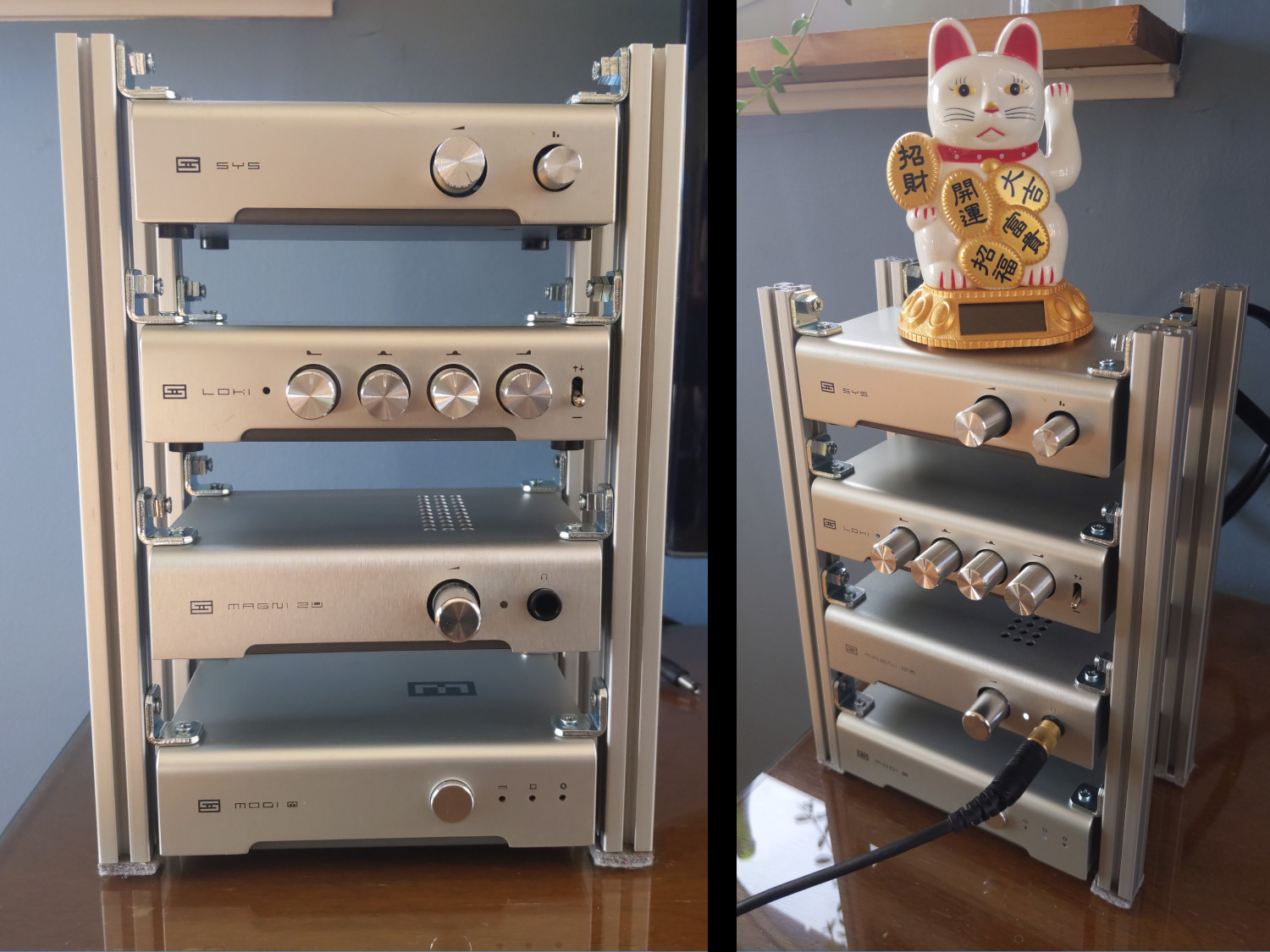
I've been a fan of the products manufactured by Schiit Audio for a while now. They are affordable (for high-end audio gear), sound great, are made in the USA1 and I think their industrial design looks great. I first started with one of their classic "Schiit Stack"2, but eventually upgraded to the Modi Multibit (I wanted the TOSLINK input), added a physical EQ (the Loki) and eventually got a Sys when I bought a Vidar speaker amp. The original Schiit Stack being 2 devices high was pretty manageable as-is. With my current 4-high stack though, things became unstable and I had to resort to finding a way to bolt them together. Mooching from a friend with a 3D printer, I printed this clever mount from Thingiverse. It worked well enough, but was somewhat imperfect for multiple reasons:
  1. The plastic tabs had a tendency of breaking in two when the screws where tight enough for the stack to feel solid.
  2. The plastic wasn't really rigid enough to support the 4 devices properly and the stack, being back-heavy from the cables, was unstable and tipped over easily.
  3. Due to the plastic tabs being fragile, it was pretty much impossible to disassemble the stack.
This last issue was what killed this solution for me. When I tried to replace my Modi 2 by the Modi Multibit, the mount pretty much crumbled away. Sadly, my friend warped a bunch of pieces on his 3D printer while trying to print ABS and I couldn't have him print me replacement parts either. After a while, I grew tired of having these four devices laying around my desk and wasting valuable space. I had tasted the 4-stack and knew how better things could be! That's when I realised the solution was to ditch 3D printing altogether, use aluminum framing extrusions and build my own stack out of metal. The 4 different Schiit devices with the hardware needed to build the extruded frame This was my first time working with aluminium frame extrusions and I had tons of fun! I specced the first version using 10mm x 10mm rails from McMaster-Carr, but discovered they do not ship to residential addresses in Canada... After looking at local options, I then decided to use 15mm x 15mm rails from Misumi. I went with this option since the rails are still small enough not to be an eyesore, but also because this system uses M3 screws, which the Schiit mini series also uses, making assembly much easier. I choose to make the assembled stack quite a bit taller than the previous one made with 3D printed plastic, as I found the headphone amp got pretty hot during the summer and I wanted to provide better airflow. If you are interested in replicating this stack, here are the parts I used, all from Misumi: I didn't order any since I had some already, but you'll also need M3 screws, namely: You can also cheap out and use only M3-10 screws (as I did), but you'll have to use the extra nuts you ordered as spacers. The assembled stack, complete with my lucky cat For the curious ones, the cabling is done this way:
                            
                                                              
          Magni (hp amp)       Vidar (sp amp)  


                              Sys (switch)   


                 Modi (DAC)        Loki (EQ)    
                                                              
                            
The Vidar is not part of the actual stack, as it's a 600W amp that weights 10kg :D. The last thing I think I want to change in this setup is the cables. The ones I have are too long for the stack. Shorter ones would reduce the wasted space in the back and make the whole thing more elegant.

  1. As in, designed, manufactured and assembled in the USA, from parts, transformers and boards made in the USA. I find this pretty impressive.
  2. A USB DAC and a headphone amp you can stack one of top of the other.

28 October 2022

Antoine Beaupr : Debating VPN options

In my home lab(s), I have a handful of machines spread around a few points of presence, with mostly residential/commercial cable/DSL uplinks, which means, generally, NAT. This makes monitoring those devices kind of impossible. While I do punch holes for SSH, using jump hosts gets old quick, so I'm considering adding a virtual private network (a "VPN", not a VPN service) so that all machines can be reachable from everywhere. I see three ways this can work:
  1. a home-made Wireguard VPN, deployed with Puppet
  2. a Wireguard VPN overlay, with Tailscale or equivalent
  3. IPv6, native or with tunnels
So which one will it be?

Wireguard Puppet modules As is (unfortunately) typical with Puppet, I found multiple different modules to talk with Wireguard.
module score downloads release stars watch forks license docs contrib issue PR notes
halyard 3.1 1,807 2022-10-14 0 0 0 MIT no requires firewall and Configvault_Write modules?
voxpupuli 5.0 4,201 2022-10-01 2 23 7 AGPLv3 good 1/9 1/4 1/61 optionnally configures ferm, uses systemd-networkd, recommends systemd module with manage_systemd to true, purges unknown keys
abaranov 4.7 17,017 2021-08-20 9 3 38 MIT okay 1/17 4/7 4/28 requires pre-generated private keys
arrnorets 3.1 16,646 2020-12-28 1 2 1 Apache-2 okay 1 0 0 requires pre-generated private keys?
The voxpupuli module seems to be the most promising. The abaranov module is more popular and has more contributors, but it has more open issues and PRs. More critically, the voxpupuli module was written after the abaranov author didn't respond to a PR from the voxpupuli author trying to add more automation (namely private key management). It looks like setting up a wireguard network would be as simple as this on node A:
wireguard::interface   'wg0':
  source_addresses => ['2003:4f8:c17:4cf::1', '149.9.255.4'],
  public_key       => $facts['wireguard_pubkeys']['nodeB'],
  endpoint         => 'nodeB.example.com:53668',
  addresses        => [ 'Address' => '192.168.123.6/30', , 'Address' => 'fe80::beef:1/64' ,],
 
This configuration come from this pull request I sent to the module to document how to use that fact. Note that the addresses used here are examples that shouldn't be reused and do not confirm to RFC5737 ("IPv4 Address Blocks Reserved for Documentation", 192.0.2.0/24 (TEST-NET-1), 198.51.100.0/24 (TEST-NET-2), and 203.0.113.0/24 (TEST-NET-3)) or RFC3849 ("IPv6 Address Prefix Reserved for Documentation", 2001:DB8::/32), but that's another story. (To avoid boostrapping problems, the resubmit-facts configuration could be used so that other nodes facts are more immediately available.) One problem with the above approach is that you explicitly need to take care of routing, network topology, and addressing. This can get complicated quickly, especially if you have lots of devices, behind NAT, in multiple locations (which is basically my life at home, unfortunately). Concretely, basic Wireguard only support one peer behind NAT. There are some workarounds for this, but they generally imply a relay server of some sort, or some custom registry, it's kind of a mess. And this is where overlay networks like Tailscale come in.

Tailscale Tailscale is basically designed to deal with this problem. It's not fully opensource, but pretty close, and they have an interesting philosophy behind that. The client is opensource, and there is an opensource version of the server side, called headscale. They have recently (late 2022) hired the main headscale developer while promising to keep supporting it, which is pretty amazing. Tailscale provides an overlay network based on Wireguard, where each peer basically has a peer-to-peer encrypted connexion, with automatic key rotation. They also ship a multitude of applications and features on top of that like file sharing, keyless SSH access, and so on. The authentication layer is based on an existing SSO provider, you don't just register with Tailscale with new account, you login with Google, Microsoft, or GitHub (which, really, is still Microsoft). The Headscale server ships with many features out of that:
  • Full "base" support of Tailscale's features
  • Configurable DNS
    • Split DNS
    • MagicDNS (each user gets a name)
  • Node registration
    • Single-Sign-On (via Open ID Connect)
    • Pre authenticated key
  • Taildrop (File Sharing)
  • Access control lists
  • Support for multiple IP ranges in the tailnet
  • Dual stack (IPv4 and IPv6)
  • Routing advertising (including exit nodes)
  • Ephemeral nodes
  • Embedded DERP server (AKA NAT-to-NAT traversal)
Neither project (client or server) is in Debian (RFP 972439 for the client, none filed yet for the server), which makes deploying this for my use case rather problematic. Their install instructions are basically a curl bash but they also provide packages for various platforms. Their Debian install instructions are surprisingly good, and check most of the third party checklist we're trying to establish. (It's missing a pin.) There's also a Puppet module for tailscale, naturally. What I find a little disturbing with Tailscale is that you not only need to trust Tailscale with authorizing your devices, you also basically delegate that trust also to the SSO provider. So, in my case, GitHub (or anyone who compromises my account there) can penetrate the VPN. A little scary. Tailscale is also kind of an "all or nothing" thing. They have MagicDNS, file transfers, all sorts of things, but those things require you to hook up your resolver with Tailscale. In fact, Tailscale kind of assumes you will use their nameservers, and have suffered great lengths to figure out how to do that. And naturally, here, it doesn't seem to work reliably; my resolv.conf somehow gets replaced and the magic resolution of the ts.net domain fails. (I wonder why we can't opt in to just publicly resolve the ts.net domain. I don't care if someone can enumerate the private IP addreses or machines in use in my VPN, at least I don't care as much as fighting with resolv.conf everywhere.) Because I mostly have access to the routers on the networks I'm on, I don't think I'll be using tailscale in the long term. But it's pretty impressive stuff: in the time it took me to even review the Puppet modules to configure Wireguard (which is what I'll probably end up doing), I was up and running with Tailscale (but with a broken DNS, naturally). (And yes, basic Wireguard won't bring me DNS either, but at least I won't have to trust Tailscale's Debian packages, and Tailscale, and Microsoft, and GitHub with this thing.)

IPv6 IPv6 is actually what is supposed to solve this. Not NAT port forwarding crap, just real IPs everywhere. The problem is: even though IPv6 adoption is still growing, it's kind of reaching a plateau at around 40% world-wide, with Canada lagging behind at 34%. It doesn't help that major ISPs in Canada (e.g. Bell Canada, Videotron) don't care at all about IPv6 (e.g. Videotron in beta since 2011). So we can't rely on those companies to do the right thing here. The typical solution here is often to use a tunnel like HE's tunnelbroker.net. It's kind of tricky to configure, but once it's done, it works. You get end-to-end connectivity as long as everyone on the network is on IPv6. And that's really where the problem lies here; the second one of your nodes can't setup such a tunnel, you're kind of stuck and that tool completely breaks down. IPv6 tunnels also don't give you the kind of security a VPN provides as well, naturally. The other downside of a tunnel is you don't really get peer-to-peer connectivity: you go through the tunnel. So you can expect higher latencies and possibly lower bandwidth as well. Also, HE.net doesn't currently charge for this service (and they've been doing this for a long time), but this could change in the future (just like Tailscale, that said). Concretely, the latency difference is rather minimal, Google:
--- ipv6.l.google.com ping statistics ---
10 packets transmitted, 10 received, 0,00% packet loss, time 136,8ms
RTT[ms]: min = 13, median = 14, p(90) = 14, max = 15
--- google.com ping statistics ---
10 packets transmitted, 10 received, 0,00% packet loss, time 136,0ms
RTT[ms]: min = 13, median = 13, p(90) = 14, max = 14
In the case of GitHub, latency is actually lower, interestingly:
--- ipv6.github.com ping statistics ---
10 packets transmitted, 10 received, 0,00% packet loss, time 134,6ms
RTT[ms]: min = 13, median = 13, p(90) = 14, max = 14
--- github.com ping statistics ---
10 packets transmitted, 10 received, 0,00% packet loss, time 293,1ms
RTT[ms]: min = 29, median = 29, p(90) = 29, max = 30
That is because HE.net peers directly with my ISP and Fastly (which is behind GitHub.com's IPv6, apparently?), so it's only 6 hops away. While over IPv4, the ping goes over New York, before landing AWS's Ashburn, Virginia datacenters, for a whopping 13 hops... I managed setup a HE.net tunnel at home, because I also need IPv6 for other reasons (namely debugging at work). My first attempt at setting this up in the office failed, but now that I found the openwrt.org guide, it worked... for a while, and I was able to produce the above, encouraging, mini benchmarks. Unfortunately, a few minutes later, IPv6 just went down again. And the problem with that is that many programs (and especially OpenSSH) do not respect the Happy Eyeballs protocol (RFC 8305), which means various mysterious "hangs" at random times on random applications. It's kind of a terrible user experience, on top of breaking the one thing it's supposed to do, of course, which is to give me transparent access to all the nodes I maintain. Even worse, it would still be a problem for other remote nodes I might setup where I might not have acess to the router to setup the tunnel. It's also not absolutely clear what happens if you setup the same tunnel in two places... Presumably, something is smart enough to distribute only a part of the /48 block selectively, but I don't really feel like going that far, considering how flaky the setup is already.

Other options If this post sounds a little biased towards IPv6 and Wireguard, it's because it is. I would like everyone to migrate to IPv6 already, and Wireguard seems like a simple and sound system. I'm aware of many other options to make VPNs. So before anyone jumps in and says "but what about...", do know that I have personnally experimented with:
  • tinc: nice, automatic meshing, used for the Montreal mesh, serious design flaws in the crypto that make it generally unsafe to use; supposedly, v1.1 (or 2.0?) will fix this, but that's been promised for over a decade by now
  • ipsec, specifically strongswan: hard to configure (especially configure correctly!), harder even to debug, otherwise really nice because transparent (e.g. no need for special subnets), used at work, but also considering a replacement there because it's a major barrier to entry to train new staff
  • OpenVPN: mostly used as a client for [VPN service][]s like Riseup VPN or Mullvad, mostly relevant for client-server configurations, not really peer-to-peer, shared secrets or TLS, kind of an hassle to maintain, see also SoftEther for an alternative implementation
All of those solutions have significant problems and I do not wish to use any of those for this project. Also note that Tailscale is only one of many projects laid over Wireguard to do that kind of thing, see this LWN review for others (basically NetbBird, Firezone, and Netmaker).

Future work Those are options that came up after writing this post, and might warrant further examination in the future.
  • Meshbird, a "distributed private networking" with little information about how it actually works other than "encrypted with strong AES-256"
  • Nebula, "A scalable overlay networking tool with a focus on performance, simplicity and security", written by Slack people to replace IPsec, docs, runs as an overlay for Slack's 50k node network, only packaged in Debian experimental, lagging behind upstream (1.4.0, from May 2021 vs upstream's 1.6.1 from September 2022), requires a central CA, Golang, I'm in "wait and see" mode for now
  • n2n: "layer two VPN", seems packaged in Debian but inactive
  • ouroboros: "peer-to-peer packet network prototype", sounds and seems complicated
  • QuickTUN is interesting because it's just a small wrapper around NaCL, and it's in Debian... but maybe too obscure for my own good
  • unetd: Wireguard-based full mesh networking from OpenWRT, not in Debian
  • vpncloud: "high performance peer-to-peer mesh VPN over UDP supporting strong encryption, NAT traversal and a simple configuration", sounds interesting, not in Debian
  • Yggdrasil: actually a pretty good match for my use case, but I didn't think of it when starting the experiments here; packaged in Debian, with the Golang version planned, Puppet module; major caveat: nodes exposed publicly inside the global mesh unless configured otherwise (firewall suggested), requires port forwards, alpha status

Conclusion Right now, I'm going to deploy Wireguard tunnels with Puppet. It seems like kind of a pain in the back, but it's something I will be able to reuse for work, possibly completely replacing strongswan. I have another Puppet module for IPsec which I was planning to publish, but now I'm thinking I should just abort that and replace everything with Wireguard, assuming we still need VPNs at work in the future. (I have a number of reasons to believe we might not need any in the near future anyways...)

Shirish Agarwal: Shantaram, The Pyramid, Japan s Hikikomori & Backpack

Shantaram I know I have been quite behind in review of books but then that s life. First up is actually not as much as a shocker but somewhat of a pleasant surprise. So, a bit of background before I share the news. If you have been living under a rock, then about 10-12 years ago a book called Shantaram was released. While the book is said to have been released in 2003/4 I got it in my hand around 2008/09 or somewhere around that. The book is like a good meal, a buffet. To share the synopsis, Lin a 20 something Australian guy gets involved with a girl, she encourages him to get into heroin, he becomes a heroin user. And drugs, especially hard drugs need constant replenishment, it is a chemical thing. So, to fund those cravings, he starts to steal, rising to rob a bank and while getting away shoots a cop who becomes dead. Now either he surrenders or is caught is unclear, but he is tortured in the jail. So one day, he escapes from prison, lands up at home of somebody who owes him a favor, gets some money, gets a fake passport and lands up in Mumbai/Bombay as it was then known. This is from where the actual story starts. And how a 6 foot something Australian guy relying on his street smartness and know how the transformation happens from Lin to Shantaram. Now what I have shared is perhaps just 5% of the synopsis, as shared the real story starts here. Now the good news, last week 4 episodes of Shantaram were screened by Apple TV. Interestingly, I have seen quite a number people turning up to buy or get this book and also sharing it on Goodreads. Now there seems to have been some differences from the book to TV. Now I m relying on 10-12 year back memory but IIRC Khaderbhai, one of the main characters who sort of takes Lin/Shantaram under his wing is an Indian. In the series, he is a western or at least looks western/Middle Eastern to me. Also, they have tried to reproduce 1980s in Mumbai/Bombay but dunno how accurate they were  My impression of that city from couple of visits at that point in time where they were still more tongas (horse-ridden carriages), an occasional two wheelers and not many three wheelers. Although, it was one of the more turbulent times as lot of agitation for worker rights were happening around that time and a lot of industrial action. Later that led to lot of closure of manufacturing in Bombay and it became more commercial. It would be interesting to know whether they shot it in actual India or just made a set somewhere in Australia, where it possibly might have been shot. The chawl of the book needs a bit of arid land and Australia has lots of it. It is also interesting as this was a project that had who s who interested in it for a long time but somehow none of them was able to bring the project to fruition, the project seems to largely have an Australian cast as well as second generations of Indians growing in Australia. To take names, Amitabh Bacchan, Johnny Depp, Russel Crowe each of them wanted to make it into a feature film. In retrospect, it is good it was not into a movie, otherwise they would have to cut a lot of material and that perhaps wouldn t have been sufficient. Making it into a web series made sure they could have it in multiple seasons if people like it. There is a lot between now and 12 episodes to even guess till where it would leave you then. So, if you have not read the book and have some holidays coming up, can recommend it. The writing IIRC is easy and just flows. There is a bit of action but much more nuance in the book while in the web series they are naturally more about action. There is also quite a bit of philosophy between him and Kaderbhai and while the series touches upon it, it doesn t do justice but then again it is being commercially made. Read the book, see the series and share your thoughts on what you think. It is possible that the series might go up or down but am sharing from where I see it, may do another at the end of the season, depending on where they leave it and my impressions. Update A slight update from the last blog post. Seems Rishi Sunak seems would be made PM of UK. With Hunt as chancellor and Rishi Sunak, Austerity 2.0 seems complete. There have been numerous articles which share how austerity gives rises to fascism and vice-versa. History gives lot of lessons about the same. In Germany, when the economy was not good, it was all blamed on the Jews for number of years. This was the reason for rise of Hitler, and while it did go up by a bit, propaganda by him and his loyalists did the rest. And we know and have read about the Holocaust. Today quite a few Germans deny it or deny parts of it but that s how misinformation spreads. Also Hitler is looked now more as an aberration rather than something to do with the German soul. I am not gonna talk more as there is still lots to share and that actually perhaps requires its own blog post to do justice for the same.

The Pyramid by Henning Mankell I had actually wanted to review this book but then the bomb called Shantaram appeared and I had to post it above. I had read two-three books before it, but most of them were about multiple beheadings and serial killers. Enough to put anybody into depression. I do not know if modern crime needs to show crime and desperation of and to such a level. Why I and most loved and continue to love Sherlock Holmes as most stories were not about gross violence but rather a homage to the art of deduction, which pretty much seems to be missing in modern crime thrillers rather than grotesque stuff. In that, like a sort of fresh air I read/am reading the Pyramid by Henning Mankell. The book is about a character made by Monsieur Henning Mankell named Kurt Wallender. I am aware of the series called Wallender but haven t yet seen it. The book starts with Wallender as a beat cop around age 20 and on his first case. He is ambitious, wants to become a detective and has a narrow escape with death. I wouldn t go much into it as it basically gives you an idea of the character and how he thinks and what he does. He is more intuitive by nature and somewhat of a loner. Probably most detectives IRL are, dunno, have no clue. At least in the literary world it makes sense, in real world think there would be much irony for sure. This is speculation on my part, who knows. Back to the book though. The book has 5 stories a sort of prequel one could say but also not entirely true. The first case starts when he is a beat cop in 1969 and he is just a beat cop. It is a kind of a prequel and a kind of an anthology as he covers from the first case to the 1990s where he is ending his career sort of. Before I start sharing about the stories in the book, I found the foreword also quite interesting. It asks questions about the interplay of the role of welfare state and the Swedish democracy. Incidentally did watch couple of videos about a sort of mixed sort of political representation that happens in Sweden. It uses what is known as proportional representation. Ironically, Sweden made a turn to the far right this election season. The book was originally in Swedish and were translated to English by Ebba Segerberg and Laurie Thompson. While all the stories are interesting, would share the last three or at least ask the questions of intrigue. Of course, to answer them you would need to read the book  So the last three stories I found the most intriguing. The first one is titled Man on the Beach. Apparently, a gentleman goes to one of the beaches, a sort of lonely beach, hails a taxi and while returning suddenly dies. The Taxi driver showing good presence of mind takes it to hospital where the gentleman is declared dead on arrival. Unlike in India, he doesn t run away but goes to the cafeteria and waits there for the cops to arrive and take his statement. Now the man is in his early 40s and looks to be fit. Upon searching his pockets he is found to relatively well-off and later it turns out he owns a couple of shops. So then here are the questions ? What was the man doing on a beach, in summer that beach is somewhat popular but other times not so much, so what was he doing there? How did he die, was it a simple heart attack or something more? If he had been drugged or something then when and how? These and more questions can be answered by reading the story Man on the Beach . 2. The death of a photographer Apparently, Kurt lives in a small town where almost all the residents have been served one way or the other by the town photographer. The man was polite and had worked for something like 40 odd years before he is killed/murdered. Apparently, he is murdered late at night. So here come the questions a. The shop doesn t even stock any cameras and his cash box has cash. Further investigation reveals it is approximate to his average takeout for the day. So if it s not for cash, then what is the motive ? b. The body was discovered by his cleaning staff who has worked for almost 20 years, 3 days a week. She has her own set of keys to come and clean the office? Did she give the keys to someone, if yes why? c. Even after investigation, there is no scandal about the man, no other woman or any vices like gambling etc. that could rack up loans. Also, nobody seems to know him and yet take him for granted till he dies. The whole thing appears to be quite strange. Again, the answers lie in the book. 3. The Pyramid Kurt is sleeping one night when the telephone rings. The scene starts with a Piper Cherokee, a single piston aircraft flying low and dropping something somewhere or getting somebody from/on the coast of Sweden. It turns and after a while crashes. Kurt is called to investigate it. Turns out, the plane was supposed to be destroyed. On crash, both the pilot and the passenger are into pieces so only dental records can prove who they are. Same day or a day or two later, two seemingly ordinary somewhat elderly women, spinsters, by all accounts, live above the shop where they sell buttons and all kinds of sewing needs of the town. They seem middle-class. Later the charred bodies of the two sisters are found :(. So here come the questions a.Did the plane drop something or pick something somebody up ? The Cherokee is a small plane so any plane field or something it could have landed up or if a place was somehow marked then could be dropped or picked up without actually landing. b. The firefighter suspects arson started at multiple places with the use of petrol? The question is why would somebody wanna do that? The sisters don t seem to be wealthy and practically everybody has bought stuff from them. They weren t popular but weren t also unpopular. c. Are the two crimes connected or unconnected? If connected, then how? d. Most important question, why the title Pyramid is given to the story. Why does the author share the name Pyramid. Does he mean the same or the original thing? He could have named it triangle. Again, answers to all the above can be found in the book. One thing I also became very aware of during reading the book that it is difficult to understand people s behavior and what they do. And this is without even any criminality involved in. Let s say for e.g. I die in some mysterious circumstances, the possibility of the police finding my actions in last days would be limited and this is when I have hearing loss. And this probably is more to do with how our minds are wired. And most people I know are much more privacy conscious/aware than I am.

Japan s Hikikomori Japan has been a curious country. It was more or less a colonizer and somewhat of a feared power till it dragged the U.S. unnecessarily in World War 2. The result of the two atom bombs and the restitution meant that Japan had to build again from the ground up. It is also in a seismically unstable place as they have frequent earthquakes although the buildings are hardened/balanced to make sure that vibrations don t tear buildings apart. Had seen years ago on Natgeo a documentary that explains all that. Apart from that, Japan was helped by the Americans and there was good kinship between them till the 1980s till it signed the Plaza Accord which enhanced asset price bubbles that eventually burst. Something from which they are smarting even today. Japan has a constitutional monarchy. A somewhat history lesson or why it exists even today can be found here. Asset price bubbles of the 1980s, more than 50 percent of the population on zero hour contracts and the rest tend to suffer from overwork. There is a term called Karoshi that explains all. An Indian pig-pen would be two, two and a half times larger than a typical Japanese home. Most Japanese live in micro-apartments called konbachiku . All of the above stresses meant that lately many young Japanese people have become Hikikomori. Bloomberg featured about the same a couple of years back. I came to know about it as many Indians are given the idea of Japan being a successful country without knowing the ills and issues it faces. Even in that most women get the wrong end of the short stick i.e. even it they manage to find jobs, it would be most back-breaking menial work. The employment statistics of Japan s internal ministry tells its own story.

If you look at the data above, it seems that the between 2002 and 2019, the share of zero hour contracts has increased while regular work has decreased. This also means that those on the bottom of the ladder can no longer afford a home. There is and was a viral video called Lost in Manboo that went viral few years ago. It is a perfect set of storms. Add to that the Fukushima nuclear incident about which I had shared a few years ago. While the workers are blamed but all design decisions are taken by the management. And as was shown in numerous movies, documentaries etc. Interestingly, and somewhat ironically, the line workers knew the correct things to do and correct decisions to take unlike the management. The shut-ins story is almost a decade or two decades old. It is similar story in South Korea but not as depressive as the in Japan. It is somewhat depressive story but needed to be shared. The stories shared in the bloomberg article makes your heart ache

Backpacks In and around 2015, I had bought a Targus backpack, very much similar to the Targus TSB194US-70 Motor 16-inch Backpack. That bag has given me a lot of comfort over the years but now has become frayed the zip sometimes work and sometimes doesn t. Unlike those days there are a bunch of companies now operating in India. There are eight different companies that I came to know about, Aircase, Harrisons Sirius, HP Oddyssey, Mokobara, Artic Hunter, Dell Pro Hybrid, Dell Roller Backpack and lastly the Decathlon Quechua Hiking backpack 32L NH Escape 500 . Now of all the above, two backpacks seem the best, the first one is Harrisons Sirius, with 45L capacity, I don t think I would need another bag at all. The runner-up is the Decathlon Quecha Hiking Backpack 32L. One of the better things in all the bags is that all have hidden pockets for easy taking in and out of passport while having being ant-theft. I do not have to stress how stressful it is to take out the passport and put it back in. Almost all the vendors have made sure that it is not a stress point anymore. The good thing about the Quecha is that they are giving 10 years warranty, the point to be asked is if that is does the warranty cover the zip. Zips are the first thing that goes out in bags.That actually has what happened to my current bag. Decathlon has a store in Wakad, Pune while I have reached out to the gentleman in charge of Harrisons India to see if they have a reseller in Pune. So hopefully, in next one week I should have a backpack that isn t spilling with things all over the place, whichever I m able to figure out.

26 October 2022

Dirk Eddelbuettel: RQuantLib 0.4.17 on CRAN: Maintenance

A new release 0.4.17 of RQuantLib arrived at CRAN earlier today, and has been uploaded to Debian as well. QuantLib is a very comprehensice free/open-source library for quantitative finance; RQuantLib connects it to the R environment and language. The release of RQuantLib comes five months after the previous maintenance, and brings a somewhat humurous upgrade from a default C++ standard of C++11 to C++14. We waited so long for C++11 to become available for R (which happened eventually when g++ 4.9 was no longer the default on Windows) and now it has become a constraint!! QuantLib 1.28, released today actually switched to C++14 as a minimum required. R also supports this as the default, but we still had C++11 hardwired so this quick maintenance release does away with that.

Changes in RQuantLib version 0.4.17 (2022-10-25)
  • Switch compilation to C++14 which is required by QuantLib 1.28 and, while standard with R 4.2.*, may be needed for R 4.1.*

Courtesy of my CRANberries, there is also a diffstat report for the this release. As always, more detailed information is on the RQuantLib page. Questions, comments etc should go to the new rquantlib-devel mailing list. Issue tickets can be filed at the GitHub repo. If you like this or other open-source work I do, you can now sponsor me at GitHub.

This post by Dirk Eddelbuettel originated on his Thinking inside the box blog. Please report excessive re-aggregation in third-party for-profit settings.

25 October 2022

Arturo Borrero Gonz lez: Netfilter Workshop 2022 summary

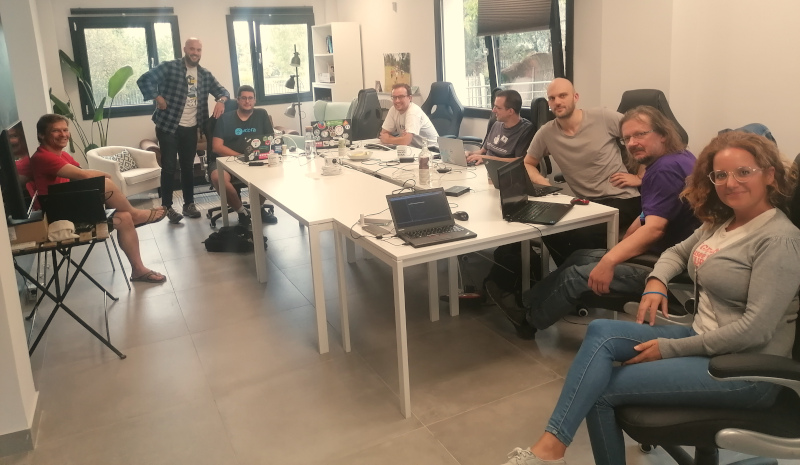
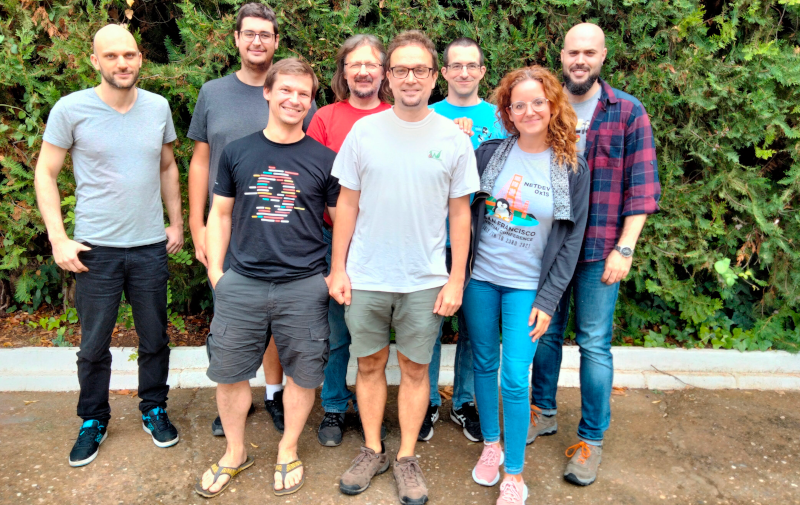
Netfilter logo This is my report from the Netfilter Workshop 2022. The event was held on 2022-10-20/2022-10-21 in Seville, and the venue was the offices of Zevenet. We started on Thursday with Pablo Neira (head of the project) giving a short welcome / opening speech. The previous iteration of this event was in virtual fashion in 2020, two years ago. In the year 2021 we were unable to meet either in person or online. This year, the number of participants was just eight people, and this allowed the setup to be a bit more informal. We had kind of an un-conference style meeting, in which whoever had something prepared just went ahead and opened a topic for debate. In the opening speech, Pablo did a quick recap on the legal problems the Netfilter project had a few years ago, a topic that was settled for good some months ago, in January 2022. There were no news in this front, which was definitely a good thing. Moving into the technical topics, the workshop proper, Pablo started to comment on the recent developments to instrument a way to perform inner matching for tunnel protocols. The current implementation supports VXLAN, IPIP, GRE and GENEVE. Using nftables you can match packet headers that are encapsulated inside these protocols. He mentioned the design and the goals, that was to have a kernel space setup that allows adding more protocols by just patching userspace. In that sense, more tunnel protocols will be supported soon, such as IP6IP, UDP, and ESP. Pablo requested our opinion on whether if nftables should generate the matching dependencies. For example, if a given tunnel is UDP-based, a dependency match should be there otherwise the rule won t work as expected. The agreement was to assist the user in the setup when possible and if not, print clear error messages. By the way, this inner thing is pure stateless packet filtering. Doing inner-conntracking is an open topic that will be worked on in the future. Pablo continued with the next topic: nftables automatic ruleset optimizations. The times of linear ruleset evaluation are over, but some people have a hard time understanding / creating rulesets that leverage maps, sets, and concatenations. This is where the ruleset optimizations kick in: it can transform a given ruleset to be more optimal by using such advanced data structures. This is purely about optimizing the ruleset, not about validating the usefulness of it, which could be another interesting project. There were a couple of problems mentioned, however. The ruleset optimizer can be slow, O(n!) in worst case. And the user needs to use nested syntax. More improvements to come in the future. Next was Stefano Brivio s turn (Red Hat engineer). He had been involved lately in a couple of migrations to nftables, in particular libvirt and KubeVirt. We were pointed to https://libvirt.org/firewall.html, and Stefano walked us through the 3 or 4 different virtual networks that libvirt can create. He evaluated some options to generate efficient rulesets in nftables to instrument such networks, and commented on a couple of ideas: having a null matcher in nftables set expression. Or perhaps having kind of subsets, something similar to a view in a SQL database. The room spent quite a bit of time debating how the nft_lookup API could be extended to support such new search operations. We also discussed if having intermediate facilities such as firewalld could provide the abstraction levels that could make developers more comfortable. Using firewalld also may have the advantage that coordination between different system components writing ruleset to nftables is handled by firewalld itself and developers are freed of the responsibility of doing it right. Next was Fernando F. Mancera (Red Hat engineer). He wanted to improve error reporting when deleting table/chain/rules with nftables. In general, there are some inconsistencies on how tables can be deleted (or flushed). And there seems to be no correct way to make a single table go away with all its content in a single command. The room agreed in that the commands destroy table and delete table should be defined consistently, with the following meanings: This topic diverted into another: how to reload/replace a ruleset but keep stateful information (such as counters). Next was Phil Sutter (Netfilter coreteam member and Red Hat engineer). He was interested in discussing options to make iptables-nft backward compatible. The use case he brought was simple: What happens if a container running iptables 1.8.7 creates a ruleset with features not supported by 1.8.6. A later container running 1.8.6 may fail to operate. Phil s first approach was to attach additional metadata into rules to assist older iptables-nft in decoding and printing the ruleset. But in general, there are no obvious or easy solutions to this problem. Some people are mixing different tooling version, and there is no way all cases can be predicted/covered. iptables-nft already refuses to work in some of the most basic failure scenarios. An other way to approach the issue could be to introduce some kind of support to print raw expressions in iptables-nft, like -m nft xyz. Which feels ugly, but may work. We also explored playing with the semantics of release version numbers. And another idea: store strings in the nft rule userdata area with the equivalent matching information for older iptables-nft. In fact, what Phil may have been looking for is not backwards but forward compatibility. Phil was undecided which path to follow, but perhaps the most common-sense approach is to fall back to a major release version bump (2.x.y) and declaring compatibility breakage with older iptables 1.x.y. That was pretty much it for the first day. We had dinner together and went to sleep for the next day. The room The second day was opened by Florian Westphal (Netfilter coreteam member and Red Hat engineer). Florian has been trying to improve nftables performance in kernels with RETPOLINE mitigations enabled. He commented that several workarounds have been collected over the years to avoid the performance penalty of such mitigations. The basic strategy is to avoid function indirect calls in the kernel. Florian also described how BPF programs work around this more effectively. And actually, Florian tried translating nf_hook_slow() to BPF. Some preliminary benchmarks results were showed, with about 2% performance improvement in MB/s and PPS. The flowtable infrastructure is specially benefited from this approach. The software flowtable infrastructure already offers a 5x performance improvement with regards the classic forwarding path, and the change being researched by Florian would be an addition on top of that. We then moved into discussing the meeting Florian had with Alexei in Zurich. My personal opinion was that Netfilter offers interesting user-facing interfaces and semantics that BPF does not. Whereas BPF may be more performant in certain scenarios. The idea of both things going hand in hand may feel natural for some people. Others also shared my view, but no particular agreement was reached in this topic. Florian will probably continue exploring options on that front. The next topic was opened by Fernando. He wanted to discuss Netfilter involvement in Google Summer of Code and Outreachy. Pablo had some personal stuff going on last year that prevented him from engaging in such projects. After all, GSoC is not fundamental or a priority for Netfilter. Also, Pablo mentioned the lack of support from others in the project for mentoring activities. There was no particular decision made here. Netfilter may be present again in such initiatives in the future, perhaps under the umbrella of other organizations. Again, Fernando proposed the next topic: nftables JSON support. Fernando shared his plan of going over all features and introduce programmatic tests from them. He also mentioned that the nftables wiki was incomplete and couldn t be used as a reference for missing tests. Phil suggested running the nftables python test-suite in JSON mode, which should complain about missing features. The py test suite should cover pretty much all statements and variations on how the nftables expression are invoked. Next, Phil commented on nftables xtables support. This is, supporting legacy xtables extensions in nftables. The most prominent problem was that some translations had some corner cases that resulted in a listed ruleset that couldn t be fed back into the kernel. Also, iptables-to-nftables translations can be sloppy, and the resulting rule won t work in some cases. In general, nft list ruleset nft -f may fail in rulesets created by iptables-nft and there is no trivial way to solve it. Phil also commented on potential iptables-tests.py speed-ups. Running the test suite may take very long time depending on the hardware. Phil will try to re-architect it, so it runs faster. Some alternatives had been explored, including collecting all rules into a single iptables-restore run, instead of hundreds of individual iptables calls. Next topic was about documentation on the nftables wiki. Phil is interested in having all nftables code-flows documented, and presented some improvements in that front. We are trying to organize all developer-oriented docs on a mediawiki portal, but the extension was not active yet. Since I worked at the Wikimedia Foundation, all the room stared at me, so at the end I kind of committed to exploring and enabling the mediawiki portal extension. Note to self: is this perhaps https://www.mediawiki.org/wiki/Portals ? Next presentation was by Pablo. He had a list of assorted topics for quick review and comment. Following this, a new topic was introduced by Stefano. He wanted to talk about nft_set_pipapo, documentation, what to do next, etc. He did a nice explanation of how the pipapo algorithm works for element inserts, lookups, and deletion. The source code is pretty well documented, by the way. He showed performance measurements of different data types being stored in the structure. After some lengthly debate on how to introduce changes without breaking usage for users, he declared some action items: writing more docs, addressing problems with non-atomic set reloads and a potential rework of nft_rbtree. After that, the next topic was kubernetes & netfilter , also by Stefano. Actually, this topic was very similar to what we already discussed regarding libvirt. Developers want to reduce packet matching effort, but also often don t leverage nftables most performant features, like sets, maps or concatenations. Some Red Hat developers are already working on replacing everything with native nftables & firewalld integrations. But some rules generators are very bad. Kubernetes (kube-proxy) is a known case. Developers simply won t learn how to code better ruleset generators. There was a good question floating around: What are people missing on first encounter with nftables? The Netfilter project doesn t have a training or marketing department or something like that. We cannot force-educate developers on how to use nftables in the right way. Perhaps we need to create a set of dedicated guidelines, or best practices, in the wiki for app developers that rely on nftables. Jozsef Kadlecsik (Netfilter coreteam) supported this idea, and suggested going beyond: such documents should be written exclusively from the nftables point of view: stop approaching the docs as a comparison to the old iptables semantics. Related to that last topic, next was Laura Garc a (Zevenet engineer, and venue host). She shared the same information as she presented in the Kubernetes network SIG in August 2020. She walked us through nftlb and kube-nftlb, a proof-of-concept replacement for kube-proxy based on nftlb that can outperform it. For whatever reason, kube-nftlb wasn t adopted by the upstream kubernetes community. She also covered latest changes to nftlb and some missing features, such as integration with nftables egress. nftlb is being extended to be a full proxy service and a more robust overall solution for service abstractions. In a nutshell, nftlb uses a templated ruleset and only adds elements to sets, which is exactly the right usage of the nftables framework. Some other projects should follow its example. The performance numbers are impressive, and from the early days it was clear that it was outperforming classical LVS-DSR by 10x. I used this opportunity to bring a topic that I wanted to discuss. I ve seen some SRE coworkers talking about katran as a replacement for traditional LVS setups. This software is a XDP/BPF based solution for load balancing. I was puzzled about what this software had to offer versus, for example, nftlb or any other nftables-based solutions. I commented on the highlighs of katran, and we discussed the nftables equivalents. nftlb is a simple daemon which does everything using a JSON-enabled REST API. It is already packaged into Debian, ready to use, whereas katran feels more like a collection of steps that you need to run in a certain order to get it working. All the hashing, caching, HA without state sharing, and backend weight selection features of katran are already present in nftlb. To work on a pure L3/ToR datacenter network setting, katran uses IPIP encapsulation. They can t just mangle the MAC address as in traditional DSR because the backend server is on a different L3 domain. It turns out nftables has a nft_tunnel expression that can do this encapsulation for complete feature parity. It is only available in the kernel, but it can be made available easily on the userspace utility too. Also, we discussed some limitations of katran, for example, inability to handle IP fragmentation, IP options, and potentially others not documented anywhere. This seems to be common with XDP/BPF programs, because handling all possible network scenarios would over-complicate the BPF programs, and at that point you are probably better off by using the normal Linux network stack and nftables. In summary, we agreed that nftlb can pretty much offer the same as katran, in a more flexible way. Group photo Finally, after many interesting debates over two days, the workshop ended. We all agreed on the need for extending it to 3 days next time, since 2 days feel too intense and too short for all the topics worth discussing. That s all on my side! I really enjoyed this Netfilter workshop round.
Russ Allbery: Review: A Spaceship Repair Girl Supposedly Named Rachel

Review: A Spaceship Repair Girl Supposedly Named Rachel, by Richard Roberts
Publisher: Mystique Press
Copyright: 2022
ISBN: 1-63789-763-4
Format: Kindle
Pages: 353
Rachel had snuck out of the house to sit on the hill, to write and draw in rare peace and quiet, when a bus fell out of the sky like a meteor and plowed into the ground in front of her. This is quickly followed by a baffling encounter with a seven-foot-tall man with a blunderbuss, two misunderstandings and a storytelling lie, and a hurried invitation to get into the bus and escape before they're both infected by math. That's how Rachel discovers that she's able to make on-the-fly repairs to bicycle-powered spaceships, and how she ends up at the Lighthouse of Ceres. The title comes from Rachel's initial hesitation to give her name, which propagates through the book to everyone she meets as certainty that Rachel isn't really her name. I enjoyed this running gag way more than I expected to. I don't read enough young adult and middle-grade books to be entirely clear on the boundaries, but this felt very middle-grade. It has a headlong plot, larger-than-life characters, excitingly imaginative scenery (such as a giant space lighthouse dwarfing the asteroid that it's attached to), a focus on friendship, and no romance. This is, to be clear, not a complaint. But it's a different feel than my normal fare, and there were a few places where I was going one direction and the book went another. The conceit of this book is that Earth is unique in the solar system in being stifled by the horrific weight of math, which infects anyone who visits and makes the routine wonders of other planets impossible. Other planets have their own styles and mythos (Saturn is full of pirates, the inhabitants of Venus are space bunnies with names like Passionfruit Nectar Ecstasy), but throughout the rest of the solar system, belief, style, and story logic reign supreme. That means Rachel's wild imagination and reflexive reliance on tall tales makes her surprisingly powerful. The first wild story she tells, to the man who crashed on earth, shapes most of the story. She had written in her sketchbook that it was the property of the Witch Queen of Eloquent Verbosity and Grandiose Ornamentation, and when challenged on it, says that she stole it to cure her partner. Much to her surprise, everyone outside of Earth takes this completely seriously. Also much to her surprise, her habit of sketching spaceships and imaginative devices makes her a natural spaceship mechanic, a skill in high demand. Some of the story is set on Ceres, a refuge for misfits with hearts of gold. That's where Rachel meets Wrench, a kobold who is by far my favorite character of the book and the one relationship that I thought had profound emotional depth. Rachel's other adventures are set off by the pirate girl Violet (she's literally purple), who is the sort of plot-provoking character that I think only works in middle-grade fiction. By normal standards, Violet's total lack of respect for other people's boundaries or consent would make her more of a villain. Here, while it often annoys Rachel, it's clear that both Rachel and the book take Violet's steamroller personality in good fun, more like the gentle coercion between neighborhood friends trying to pull each other into games. I still got rather tired of Violet, though, which caused me a few problems around the middle of the book. There's a bit of found family here (some of it quite touching), a lot of adventures, a lot of delightful spaceship repair, and even some more serious plot involving the actual Witch Queen of Charon. There is a bit of a plot arc to give some structure to the adventures, but this is not the book to read if you're looking for complex plotting or depth. I thought the story fell apart a bit at the tail end, with a conflict that felt like it was supposed to be metaphorical and then never resolved for me into something concrete. I was expecting Rachel to eventually have to do more introspection and more direct wrestling with her identity, but the resolution felt a bit superficial and unsatisfying. Reading this as an adult, I found it odd but fun. I wanted more from the ending, and I was surprised that Roberts does not do more to explain to the reader why Rachel does not regret leaving Earth and her family behind. It feels like something Rachel will have to confront eventually, but this is not the book for it. Instead we get some great friendships (some of which I agreed with wholeheartedly, and some of which I found annoying) and an imaginative, chaotic universe that Rachel takes to like a fish to water. The parts of the story focused on her surprising competence (and her delight in her own competence) were my favorites. The book this most reminds me of is Norton Juster's The Phantom Tollbooth. It is, to be clear, nowhere near as good as The Phantom Tollbooth, which is a very high bar, and it's not as focused on puns. But it has the same sense of internal logic and the same tendency to put far more weight on belief and stories than our world does, and to embrace the resulting chaos. I'm not sure this will be anyone's favorite book (although I'm also not the target age), but I enjoyed reading it. It was a great change of pace after Nona the Ninth. Recommended if you're in the mood for some space fantasy that doesn't take itself seriously. Rating: 7 out of 10

24 October 2022

Russ Allbery: Review: Nona the Ninth

Review: Nona the Ninth, by Tamsyn Muir
Series: The Locked Tomb #3
Publisher: Tordotcom
Copyright: 2022
ISBN: 1-250-85412-1
Format: Kindle
Pages: 480
Nona the Ninth is the third book of the Locked Tomb series and entirely pointless to read if you have not read the series to date. It completely spoils the previous books, assuming you would be able to figure out who these people were and why you should care about them. This is only for readers who are already invested. This series was originally supposed to be a trilogy, and this book was supposed to be Alecto the Ninth. Muir says in the acknowledgments, and has said at more length elsewhere, that Nona changed all of her plans and demanded her own book. Hence this book, postponing the end of the series and lengthening it to four books. After reading it, I understand why Muir decided to write a whole book about Nona. She's an interesting character in ways that wouldn't have come out if she was a small part of the concluding book. Unfortunately, it's also obvious that this book wasn't part of the plan. It's not entirely correct to say that Nona the Ninth is devoid of series plot, but the plot advances very little, and mostly at the end. Instead, we get Nona, who is physically a teenager who acts like someone several years younger, most of the time. She lives with her family (who I won't name to avoid spoilers for Harrow the Ninth), helps at a local school (although her level of understanding is about that of the students), and is a member of a kid's gang. She also has dreams every night about a woman with a painted face, dreams her family are very interested in. This sounds weirdly normal for this series, but Nona and her family live in a war-torn city full of fighting, refugees, and Blood of Eden operatives. The previous books of the series took place in the rarefied spaces of the Houses. Here we see a bit of the rest of the universe, although it's not obvious at first what we're looking at and who these people are. Absolutely no concession is made to the reader's fading memory, so expect to need either a re-read, help from friends with better memories, or quality time with a wiki. And, well, good luck with the latter if you've not already read this book, since the Locked Tomb Wiki has now been updated with spoilers for Nona. The other challenge, besides memory for the plot, is that this book is told from a tight third-person focus on Nona, and Nona is not a very reliable narrator. She doesn't lie, exactly, but she mostly doesn't understand what's going on, often doesn't care, and tends not to focus on what the reader is the most interested in. Nona is entirely uninterested in developing the series plot. Her focus is on her child friends (who are moderately interesting but not helpful if you're trying to figure out the rest of the story) and the other rhythms of a strange life that's normal to her. For me at least, that meant the first half of this book involved a lot of "what the heck is going on and why do I care about any of this?" I liked Harrow the Ninth a lot, despite how odd and ambiguous it was, but I was ready for revelations and plot coherence and was not thrilled by additional complexity, odd allusions, and half-revealed details. I didn't mind the layers of complexity added on by Harrow, but for me Nona was a bit too much and I started getting frustrated rather than intrigued. We do, at last, get most of the history of this universe, including the specific details of how John became God Emperor and how the Houses were founded. That happens in odd interludes with a forced and somewhat artificial writing style, but it's more straightforward and comprehensible than I feared at first. The pace of the story picks up considerably towards the end of the book, finally providing the plot momentum that I was hoping for. Unfortunately, it also gets more cryptic at the end of the book in ways that I didn't enjoy. The epilogue, which is vital to understanding the climax of the novel, took me three readings before I think I understood what happened. If you preferred the clarity of Gideon the Ninth, be warned that Nona is more like Harrow and Muir seems to be making the plot more cryptic as she goes. I am hoping this trend reverses in Alecto the Ninth. This book made me grumpy. Nona is okay as a character, but the characters in this series that I really like mostly do not appear or appear in heavily damaged and depressing forms. Muir does bring back a couple of my favorite characters, but then does something to them that's a major spoiler but that I think was intended to be a wonderful moment for them and instead left me completely cold and unhappy. There are still some great moments of humor, but overall it felt more strained. That said, I still had tons of fun discussing this book and its implications with friends who were reading it at the same time. I think that is the best way to read this series. Muir is being intentionally confusing and is inserting a blizzard of references. Some of them are pop culture jokes, but some of them are deep plot clues, and I'm not up to deciphering them all by myself. Working through them with other people is much more fun. (It also gives me an opportunity to feel smug about guessing correctly what was happening at the end of Harrow the Ninth, when I'm almost never the person who makes correct guesses about that sort of thing.) I think your opinion of this one will depend on how much you like Nona as a character, how much patience you have for the postponement of plot resolution, and how much tolerance you have for even more cryptic references. I'm still invested in this series until the end, but this was not my favorite installment. I suspect it (and the rest of the series) would benefit immensely from re-reading, but life is short and my reading backlog is long. What Muir is doing is interesting and has a lot of depth, but she's asking quite a lot of the reader. Content warning: Nona has an eating disorder, which occupied rather more of my mental space while reading this book than I was comfortable with. Followed by Alecto the Ninth, which does not have a publication date scheduled as of this writing. Rating: 7 out of 10

20 October 2022

Dirk Eddelbuettel: RcppQuantuccia 0.1.1 on CRAN: Maintenance

A minor release of RcppQuantuccia arrived on CRAN today. RcppQuantuccia started from the Quantuccia header-only subset / variant of QuantLib which it brings it to R. This project validated the idea of making the calendaring functionality of QuantLib available in a more compact and standalone project which we now do with qlcal which can be seen as a successor to this. This release merely updates a source file to proper encoding as clang++-15 would otherwise warn. The complete list changes for this release follows.

Changes in version 0.1.1 (2022-10-19)
  • Minor code reorganization splitting off calendars.cpp
  • Convert the Argentinian calendar sources files as utf-8 to appease clang++-15
  • Advertise the qlcal package as an alternative

Courtesy of CRANberries, there is also a diffstat report relative to the previous release. More information is on the RcppQuantuccia page. Issues and bugreports should go to the GitHub issue tracker. If you like this or other open-source work I do, you can now sponsor me at GitHub.

This post by Dirk Eddelbuettel originated on his Thinking inside the box blog. Please report excessive re-aggregation in third-party for-profit settings.

19 October 2022

Shirish Agarwal: Pune Rains, Uncosted Budgets, Hearing Loss Covid, Fracking

Pune Rains Lemme start with a slightly funny picture that tells as much about Pune, my city as anything else does.
Pune- Leave your attitude behind, we have our own
This and similar tags, puns and whatnot you will find if you are entering Pune from the road highway. You can also find similar similar symbols and Puns all over the city and they are partly sarcasm and ironic and partly the truth. Puneities work from the attitude that they know everything rather than nothing, including yours truly  . What is the basis of that or why is there such kind of confidence I have no clue or idea, it is what it is. Approximately 24 hrs. ago, apparently we had a cloudburst. What I came to know later is that we got 100 mm of rain. Sharing from local news site. Much more interesting was a thread made on Reddit where many people half-seriously asked where they can buy a boat. One of the reasons being even if it s October, in fact, we passed middle of October and it s still raining. Even today in the evening, it rained for quite a while. As I had shared in a few blog posts before, June where rains should have started, it didn t, it actually started late July or even August, so something has shifted. The current leadership does not believe in Anthropogenic Climate Change or human activity induced climate change even though that is a reality. I could share many links and even using the term above should give links to various studies. Most of the people who are opposed to it are either misinformed or influenced from the fossil fuel industry. Again, could share many links, but will share just one atm. I have talked to quite a few people about it but nobody has ever been able to give a convincing answer as to why GM had to crush the cars. Let s even take the argument that it was the worst manufactured car in history and there have been quite a few, have the others been crushed? If not, then the reason shared or given by most people sounds hollow. And if you look into it, they had an opportunity that they let go, and now most of them are scrambling and yet most of the legacy auto manufacturers will be out of existence if they don t get back into the game in the next 2-3 years. There have been a bunch of announcements but we are yet to see. The Chinese though have moved far ahead, although one has to remark that they have been doing that for the last decade, so they have a 10-year head start, hardly surprising then. But I need to get back to the subject, another gentleman on Reddit remarked that if you start to use boat, and others start to use boat, then the Govt. will tax it. In fact, somebody had shared the below the other day
Different types of taxes collected by GOI
Many of the taxes that I have shared above are by the Modi Govt. who came on the platform, manifesto that once they come to power they will reduce taxes for the common man, they have reduced taxes but only for the Corporates. For the common man, the taxes have only gone up, both direct tax and indirect tax. Any reference to the Tory party who have also done similar things and have also shared that it is labor who had done large expenditures even though they have been 8 years in power, I am sure for most is purely coincidental. Incidentally, that is the same tack that was taken even by the Republican party. They all like to give tax benefits to the 1% while for the rest is austerity claiming some reason, even if it has been proven to be false.
Corporate Tax Rate, Revenue Loss to Govt.
The figures mentioned above are findings of parliamentary panel so nobody can accuse of anybody having a bias. Also, I probably had shared this but still feel the need to re-share it as people still believe that 2G scam happened even though there are plenty of arguments I can share to prove how it was all a fabricated lie.
Vinod Rai Mafinama in Uttarakhand High Court.
Part 2 of the same Mafinama.
How pathetic Mr. Rai s understanding of economics is can be gauged from the fact that he was made Chairman of IDFC and subsequently had to be thrown out. That whole lie was engineered to throw UPA out and it worked. There are and have been many such coincidences happening over the last 8 years, parallel stories happening in India and UK. This was just yesterday, about a year back Air India was given back to the Tatas, There was controversy about the supposed auctions as only Indigo was the only other party allowed to be at auction but not allowed to buy but more as a spectator as they already have 60% of the Indian civil aviation market. And there was lot of cheering from the Govt. side that finally Air India has been bought home to its true owners, the Tatas. The Tatas too started cheering and sharing how they will take down all the workers, worker unions and everything will be happy glory within a year. In fact, just couple of days back they shared new plans. Btw for the takeover of Air India, they had bought loans from the Banks and they are in the category of too big to fail. As I have shared couple of times before, RBI has not shared any inspection reports of nationalized or private banks after 2013/14. While by law, RBI is supposed to do inspection reports every 3 months and share them in the Public domain. And if you ask any of their supporter, for everything they will say UPA did x or y, which only goes to show morally bankrupt the present Govt. is. Coming back to the topic, before I forget, the idea of sharing their plans is so that they can again borrow money from the banks. But that is not the only story. Just one day back, Smita Prakash, one of the biggest cheerleaders of the present Govt. (she is the boss at Asia News International (ANI)) posted how Air India had treated her sister and other 21 passengers. Basically, they had bought business tickets but the whole cabin was dirty, they complained and they were forced to sit in economy class, not just her cousin sister but the other 21 odd passengers too. Of course Ms Smita became calm as her sister was given free air tickets on Vistara and other goodies. Of course, after that she didn t post anything about the other 21 odd passengers after that. And yes, I understand she is supposed to be a reporter but as can be seen from the twitter thread, there is or was no follow up. Incidentally, she is one of many who has calling others about Revdi culture (freebies to the masses.) but guess that only applies to other people not her or her sister. Again, if there are any coincidences of similar nature in the UK or when Trump was P.M. of the U.S. they are just coincidental .

The Uncosted budget India and the UK have many parallels, it s mind boggling. Before we get into the nitty-gritties, saw something that would be of some interest to the people here.
For those who might not be able to see above, apparently there is place in UK called Tufton Street where there are quite a few organizations that are shadowy and whose finances are not known as to how they are financed. Ms. Truss and quite a few of the people in the cabinet are from the same shadowy organizations. Mr. Kwasi Kwarteng, the just-departed chancellor is and was part of the same group. Now even for me it was a new term to learn and understand what is an uncosted budget is. To make it much more easier I share the example using a common person who goes to the bank for a loan

Now M/S X wants a loan of say Rs. 1000/- for whatever reason. He/she/they go to the bank and asks give me a loan of say INR 1000/- The banks asks them to produce a statement of accounts to show what their financial position is. They produce a somewhat half-filled statement of accounts In which all liabilities are shown, but incomes are not. The bank says you already have so much liabilities, how are you gonna pay those, accounts have to be matched otherwise you are not solvent. M/s X adamantly refuses to do any changes citing that they don t need to. At this point, M/s X credit rating goes down and nobody in the market will give them a loan. At the same time, the assets they had held, their value also depreciates because it became known that they can t act responsibly. So whose to say whether or not M/s X has those number of assets and priced them accurately. But the drama doesn t end there, M/s X says this is the responsibility of actually Mr. Z ( cue The Bank of England) as they are my accountant/lawyer etc. M/s Z says as any lawyer/accountant should. This is not under my remit. If the clients either gives incomplete information or false information or whatever then it is their responsibility not mine. And in fact, the Chancellor is supposed to be the one who is given the responsibility of making the budget. The Chancellor is very similar to our Finance Minister. Because the UK has constitutional monarchy, I am guessing the terms are slightly different, otherwise the functionality seems to be the same. For two weeks, there was lot of chaos, lot of pension funds lost quite a bit in the market and in the end Mr. Kwasi Kwarteng was ousted out of the job. Incredibly, the same media and newspapers who had praised Mr. Kwarteng just few weeks back as the best Tory budget, they couldn t wait to bury him. And while I have attempted to simplify what happened, the best explanation of what has happened can be found in an article from the guardian. Speculation is rife in the UK as to who s ruling atm as the new Chancellor has reversed almost all the policies that Ms. Truss had bought and she is now more or less a figurehead. Mr. Hunt, the new chancellor doesn t have anybody behind him. Apparently, the gentleman wanted to throw his hat the ring in the Tory leadership contest that was held about a month back and he couldn t get 20 MP s to support him. Another thing that is different between UK and India is that in UK by law the PM has to answer questions put up to him or her by the opposition leaders. That is the way accountability is measured there. This is known as PMQ s or Prime Minister Questions and Answers. One can just go to YouTube or any streaming service and give Liz Truss and PMQ s and if they are interested of a certain date, give a date and they can see how she answered the questions thrown at her. Unfortunately, all she could do in both times were non-answers. In fact, the Tories seem to be using some of Labor s policies after they had bad-mouthed the same policies. Politics of right-wing both in the UK and the US seems so out of touch with the people whom they are supposed to protect and administer. An article about cyclists which is sort of half-truth, half irony shows how screwed up the policies are of the RW (right-wing). Now they are questions about the pensions triple-lock. Sadly, it is the working class who would suffer the most, most of the rich have already moved their money abroad several years ago. The Financial Times, did share a video about how things have been unfolding

Seems Ms. Truss forgot to add Financial Times in the list of anti-growth coalition she is so fond of. Also, the Tory party seems to want to create more tax havens in the UK and calling them investment zones. Of course, most of the top tax havens are situated around the UK itself. I wouldn t go more into as that would probably require its own article, although most of that information is all in public domain. Fracking I don t really want to take much time as the blog post has become long. There have been many articles written why Fracking is bad and that is why even the Tories had put in their Manifesto that they won t allow Fracking but apparently, today they are trying to reopen Fracking. And again how bad it is and can be found out by the article in Guardian.

17 October 2022

Dima Kogan: gnuplot output in an FLTK widget

Overview
I make a lot of plots, and the fragmentation of tools in this space really bugs me. People writing Python code mostly use matplotlib, R people use ggplot2. MS people use the internal Excel thing. I've seen people use gtkdatabox for GTK widgets, rrdtool for logging, qcustomplot for qt. And so on. This is really unhelpful, and it would benefit everybody if there was a single solid plotting backend with lots of bindings to different languages and tools. For my own usage, I've been fighting this quixotic battle, using gnuplot as the plotting backend for all my use cases. gnuplot is
  • very mature
  • stable
  • fast
  • powerful
  • supported on every (with reason) platform
  • supports lots and lots of output backends
There are some things it can't do, but those can be added, and I haven't felt it to be limiting in over 20 years of using it. I rarely use it directly, and usually interact with it through one of I wrote all of these, although the Perl library was taken over by others long ago. Recently I needed a plotting widget for an FLTK program written in Python. It would be great if there was a C++ class deriving from Fl_Widget that would be wrapped by pyfltk, but there isn't. But it turns out that I already had all the tools to quickly hack together something that mostly works. This is a not-ready-for-primetime hack, but it works so well, I'd like to write it up. Hopefully this will be done "properly" someday.

Approach
Alright. So here I'm trying to tie together a Python program, gnuplot output and an FLTK widget. This is a Python program, I can use gnuplotlib to talk to the gnuplot backend. In a perfect world, gnuplot would ship a backend interfacing to FLTK. But it doesn't. What it does do is to ship an x11 backend that makes plots with X11 commands, and it allows these commands to be directed to an arbitrary X11 window. So we
  1. Make an FLTK widget that simply creates an X11 window, and never actually draws into it
  2. Tell gnuplot to plot into this window

Demo
This is really simple, and works shockingly well. Here's my Fl_gnuplotlib widget:
#!/usr/bin/python3
import sys
import gnuplotlib as gp
import fltk
class Fl_Gnuplotlib_Window(fltk.Fl_Window):
    def __init__(self, x,y,w,h, **plot_options):
        super().__init__(x,y,w,h)
        self.end()
        self._plot                 = None
        self._delayed_plot_options = None
        self.init_plot(**plot_options)
    def init_plot(self, **plot_options):
        if 'terminal' in plot_options:
            raise Exception("Fl_Gnuplotlib_Window needs control of the terminal, but the user asked for a specific 'terminal'")
        if self._plot is not None:
            self._plot = None
        self._delayed_plot_options = None
        xid = fltk.fl_xid(self)
        if xid == 0:
            # I don't have an xid (yet?), so I delay the init
            self._delayed_plot_options = plot_options
            return
        # will barf if we already have a terminal
        gp.add_plot_option(plot_options,
                           terminal = f'x11 window "0x xid:x "')
        self._plot = gp.gnuplotlib(**plot_options)
    def plot(self, *args, **kwargs):
        if self._plot is None:
            if self._delayed_plot_options is None:
                raise Exception("plot has not been initialized")
            self.init_plot(**self._delayed_plot_options)
            if self._plot is None:
                raise Exception("plot has not been initialized. Delayed initialization failed")
        self._plot.plot(*args, **kwargs)
Clearly it's simply making an Fl_Window, and pointing gnuplotlib at it. And a sample application that uses this widget:
#!/usr/bin/python3
import sys
import numpy as np
import numpysane as nps
from fltk import *
from Fl_gnuplotlib import *
window = Fl_Window(800, 600, "plot")
plot   = Fl_Gnuplotlib_Window(0, 0, 800,600)
iplot = 0
plotx = np.arange(1000)
ploty = nps.cat(plotx*plotx,
                np.sin(plotx/100),
                plotx)
def timer_callback(*args):
    global iplot, plotx, ploty, plot
    plot.plot(plotx,
              ploty[iplot],
              _with = 'lines')
    iplot += 1
    if iplot == len(ploty):
        iplot = 0
    Fl.repeat_timeout(1.0, timer_callback)
window.resizable(window)
window.end()
window.show()
Fl.add_timeout(1.0, timer_callback)
Fl.run()
This is nice and simple. Exactly what a program using a widget to make a plot (while being oblivious to the details) should look like. It creates a window, places the one plotting widget into it, and cycles the plot inside it at 1Hz (cycling between a parabola, a sinusoid and a line). Clearly we could place other UI elements around it, or add more plots, or whatever. The output looks like this:
Fl_gnuplotlib_demo.gif
To run you need to apt install python3-numpysane python3-gnuplotlib python3-fltk. If running an older distro on a non-Debian-based distro, you should grab those from source.

Discussion
This works. But it's a hack. Some issues:
  • This plotting widget currently can output only. It can make whatever plot we like, but it cannot accept UI input from the container program in any way
  • More than that, when focused it completely replaces the FLTK event logic for that window. So all keyboard input is swallowed, including the keys to access FLTK menus, to exit the application, etc, etc.
  • This approach requires us to use the x11 gnuplot terminal. This works, but it's no longer the terminal preferred by the gnuplot devs, and it it's maintained as vigilantly as the others.
  • And it has bugs. For instance, asking to plot into a window that doesn't yet exist, causes it to create a new window. This breaks FLTK applications that start up and create a plot immediately. Here's a mailing list thread discussing these issues.
So this is a very functional hack, but it's still hack. And it feels like making this solid will take a lot of work. Maybe. I'll push more on this as I need it. Stay tuned!

16 October 2022

Colin Watson: Reproducible man-db databases

I ve released man-db 2.11.0 (announcement, NEWS), and uploaded it to Debian unstable. The biggest chunk of work here was fixing some extremely long-standing issues with how the database is built. Despite being in the package name, man-db s database is much less important than it used to be: most uses of man(1) haven t required it in a long time, and both hardware and software improvements mean that even some searches can be done by brute force without needing prior indexing. However, the database is still needed for the whatis(1) and apropos(1) commands. The database has a simple format - no relational structure here, it s just a simple key-value database using old-fashioned DBM-like interfaces and composing a few fields to form values - but there are a number of subtleties involved. The issues tend to amount to this: what does a manual page name mean? At first glance it might seem simple, because you have file names that look something like /usr/share/man/man1/ls.1.gz and that s obviously ls(1). Some pages are symlinks to other pages (which we track separately because it makes it easier to figure out which entries to update when the contents of the file system change), and sometimes multiple pages are even hard links to the same file. The real complications come with whatis references . Pages can list a bunch of names in their NAME section, and the historical expectation is that it should be possible to use those names as arguments to man(1) even if they don t also appear in the file system (although Debian policy has deprecated relying on this for some time). Not only does that mean that man(1) sometimes needs to consult the database, but it also means that the database is inherently more complicated, since a page might list something in its NAME section that conflicts with an actual file name in the file system, and now you need a priority system to resolve ambiguities. There are some other possible causes of ambiguity as well. The people working on reproducible builds in Debian branched out to the related challenge of reproducible installations some time ago: can you take a collection of packages, bootstrap a file system image from them, and reproduce that exact same image somewhere else? This is useful for the same sorts of reasons that reproducible builds are useful: it lets you verify that an image is built from the components it s supposed to be built from, and doesn t contain any other skulduggery by accident or design. One of the people working on this noticed that man-db s database files were an obstacle to that: in particular, the exact contents of the database seemed to depend on the order in which files were scanned when building it. The reporter proposed solving this by processing files in sorted order, but I wasn t keen on that approach: firstly because it would mean we could no longer process files in an order that makes it more efficient to read them all from disk (still valuable on rotational disks), but mostly because the differences seemed to point to other bugs. Having understood this, there then followed several late nights of very fiddly work on the details of how the database is maintained. None of this was conceptually difficult: it mainly amounted to ensuring that we maintain a consistent well-order for different entries that we might want to insert for a given database key, and that we consider the same names for insertion regardless of the order in which we encounter files. As usual, the tricky bit is making sure that we have the right data structures to support this. man-db is written in C which is not very well-supplied with built-in data structures, and originally much of the code was written in a style that tried to minimize memory allocations; this came at the cost of ownership and lifetime often being rather unclear, and it was often difficult to make changes without causing leaks or double-frees. Over the years I ve been gradually introducing better encapsulation to make things easier to follow, and I had to do another round of that here. There were also some problems with caching being done at slightly the wrong layer: we need to make use of a trace of the chain of links followed to resolve a page to its ultimate source file, but we were incorrectly caching that trace and reusing it for any link to the same file, with incorrect results in many cases. Oh, and after doing all that I found that the on-disk representation of a GDBM database is insertion-order-dependent, so I ended up having to manually reorganize the database at the end by reading it all in and writing it all back out in sorted order, which feels really weird to me coming from spending most of my time with PostgreSQL these days. Fortunately the database is small so this takes negligible time. None of this is particularly glamorous work, but it paid off:
# export SOURCE_DATE_EPOCH="$(date +%s)"
# mkdir emptydir disorder
# disorderfs --multi-user=yes --shuffle-dirents=yes --reverse-dirents=no emptydir disorder
# export TMPDIR="$(pwd)/disorder"
# mmdebstrap --variant=standard --hook-dir=/usr/share/mmdebstrap/hooks/merged-usr \
      unstable out1.tar
# mmdebstrap --variant=standard --hook-dir=/usr/share/mmdebstrap/hooks/merged-usr \
      unstable out2.tar
# cmp out1.tar out2.tar
# echo $?
0

Aigars Mahinovs: Ryzen 7000 amdgpu boot hang

So you decided to build a brand new system using all the latest and coolest tech, so you buy a Ryzen 7000 series Zen 4 CPU, like the Ryzen 7700X that I picked, with a new mother board and DDR5 memory and all that jazz. But for now, you don't yet have a fitting GPU for that system (as the new ones will only come out in November), so you are booting a Debian system using the new build-in video card of the new CPUs (Zen 4 generation has a simple AMD GPU build-in into every CPU now - great stuff for debugging and mostly-headless systems) and you get ... nothing on the screen. Hmm. You boot into the rescue mode and the kernel message stop after:
Oct 16 13:31:25 home kernel: [    4.128328] amdgpu: Ignoring ACPI CRAT on non-APU system
Oct 16 13:31:25 home kernel: [    4.128329] amdgpu: Virtual CRAT table created for CPU
Oct 16 13:31:25 home kernel: [    4.128332] amdgpu: Topology: Add CPU node
That looks bad, right? Well, if you either ssh into the machine or reboot with module_blacklist=amdgpu in the kernel command line you will find in /var/log/kern.log.1 those messages and also the following messages that will clarify the situation a bit:
Oct 16 13:31:25 home kernel: [    4.129352] amdgpu 0000:10:00.0: firmware: failed to load amdgpu/psp_13_0_5_toc.bin (-2)
Oct 16 13:31:25 home kernel: [    4.129354] firmware_class: See https://wiki.debian.org/Firmware for information about missing firmware
Oct 16 13:31:25 home kernel: [    4.129358] amdgpu 0000:10:00.0: firmware: failed to load amdgpu/psp_13_0_5_toc.bin (-2)
Oct 16 13:31:25 home kernel: [    4.129359] amdgpu 0000:10:00.0: Direct firmware load for amdgpu/psp_13_0_5_toc.bin failed with error -2
Oct 16 13:31:25 home kernel: [    4.129360] amdgpu 0000:10:00.0: amdgpu: fail to request/validate toc microcode
Oct 16 13:31:25 home kernel: [    4.129361] [drm:psp_sw_init [amdgpu]] *ERROR* Failed to load psp firmware!
Oct 16 13:31:25 home kernel: [    4.129432] [drm:amdgpu_device_init.cold [amdgpu]] *ERROR* sw_init of IP block <psp> failed -2
Oct 16 13:31:25 home kernel: [    4.129525] amdgpu 0000:10:00.0: amdgpu: amdgpu_device_ip_init failed
Oct 16 13:31:25 home kernel: [    4.129526] amdgpu 0000:10:00.0: amdgpu: Fatal error during GPU init
Oct 16 13:31:25 home kernel: [    4.129527] amdgpu 0000:10:00.0: amdgpu: amdgpu: finishing device.
Oct 16 13:31:25 home kernel: [    4.129633] amdgpu: probe of 0000:10:00.0 failed with error -2
So what you need is to get a new set of Linux Kernel Firmware blobs and upack that in /lib/firmware. The tarball from 2022-10-12 worked well for me. After that you also need to re-create the initramfs with update-initramfs -k all -c to include the new firmware. Having kernel version 5.18 or newer is also required for stable Zen 4 support. It might be that a fresh Mesa version is also of importance, but as I am running sid on this machine I can only say that Mesa 22.2.1 that is in sid works fine.

kpcyrd: updlockfiles: Manage lockfiles in PKGBUILDs for upstreams that don't ship them

I ve released a new tool to manage lockfiles for Arch Linux packages that can t use a lockfile from the official upstream release. It integrates closely with other Arch Linux tooling like updpkgsums that s already used to pin the content of build inputs in PKGBUILD. To use this, the downstream lockfile becomes an additional source input in the source= array of our PKGBUILD (this is already the case for some packages).
source=("git+https://github.com/vimeo/psalm.git#commit=$ _commit "
        "composer.lock")
You would then add a new function named updlockfiles that can generate new lockfiles and copies them into $outdir, and a prepare function to copy the lockfile in the right place:
 prepare()  
   cd $ pkgname 
   cp ../composer.lock .
 
updlockfiles()  
  cd $ pkgname 
  rm -f composer.lock
  composer update
  cp composer.lock "$ outdir /"
 
To update the package to the latest (compatible) patch level simply run:
updlockfiles
This can also be used in case upstreams lockfile has vulnerable dependencies that you want to patch downstream. For more detailed instructions see the readme.

Thanks This work is currently crowd-funded on github sponsors. I d like to thank @SantiagoTorres, @repi and @rgacogne for their support in particular.

15 October 2022

Jonathan Dowland: podman generate

I've been working with and on container technology for seven years, but I still learn new things every day. Recently I read the excellent LWN article Docker and the OCI container ecosystem and this was news to me:
Running the docker CLI under a process supervisor only results in supervising the CLI process. This has a variety of consequences for users of these tools. For example, any attempt to limit a container's memory usage by running the CLI as a systemd service will fail; the limits will only apply to the CLI and its non-existent children. In addition, attempts to terminate a client process may not result in terminating all of the processes in the container.
Huh of course! I hadn't really thought about that. I run a small number of containers on my home system via docker (since I was using it at work) and systemd, and sometimes I have weird consistency issues. This explains them. Later:
As a result, Podman plays nicely with tools like systemd; using podman run with a process supervisor works as expected, because the processes inside the container are children of podman run. The developers of Podman encourage people to use it in this way by a command to generate systemd units for Podman containers.
Given the above, it seemed like a good idea to migrate my few local containers over to Podman. This was easy. The first part is copying the images from Docker's storage to Podman's. To do this, I used the skopeo tool:
sudo skopeo copy  docker-daemon,containers-storage :octoprint/octoprint:latest
(I want to launch these as a superuser, rather than use root-less containers, to isolate the containers from each other: rootless ones are forced to share a common namespace.) Once the images were copied over, I needed to start up a container instance via Podman. For most of them, running under Docker, I had volume-mounted the important bits for persistent data. I can do the same with Podman:
# podman run -d --rm \
    --name octoprint \
    -p 8080:80 \
    -v /archive/octoprint:/octoprint \
    --device /dev/ttyACM0:/dev/ttyACM0 \
    octoprint/octoprint
Once an instance was running, I can use podman generate to create a Systemd unit file which describes creating an equivalent container:
# cd /etc/systemd/system
# podman generate systemd octoprint \
    --new \
    --name \
    --files
For some of the containers I was running, there are a few more steps required: migrating docker volumes and configuring equivalents for private docker networks. But Podman's versions of those concepts are largely identical. Running a mixture of Podman and Docker containers side-by-side also meant renumbering some private addresses for migrated hosts whilst the original network was still up.

Next.

Previous.