Search Results: "nion"

1 January 2009

Biella Coleman: 2008

When I return to PR, my blog tends to lie fallow. Between taking care of the house, outdoor distractions (like the very overgrown garden and the very enticing beach), and most especially visiting my mother, I turn away from the computer, from my analytical mind, from writing. But since we have edged into a new year, I thought I would spend a little bit of time ruminating on 2008, which was one of the most unforgettable for me. With each passing year, it seems that 12 months bleed right into the next 12 months. But within this swirl, there are a handful of years that retain their sharp edges (1992, 1996, 2005, 2005-2006 are the most memorable). 2008 now sits among those as it is the the year that a tube was placed into my mother s stomach and soon after she was taken from the hospital into a nursing home without even the chance to say goodbye to the dog who was her steadfast companion and the house, which was her home for over 20 years. Over the last 6 years while I have not written much about my mother and her Alzheimer s, I did so fairly consistently with at least 3 entries per year, that is until March 2008 when she was put in the nursing home. Soon after being admitted, I wrote one entry and since then have not had the heart to commit much to words, something of which I am ashamed of and have sworn I would write about at least once before another years passes us by. I don t have the desire to constantly write about my experiences with her but it seems to be that Alzheimer s is erased far too often from public view and I would rather not contribute to that type of very pervasive silencing either. The recipe for my silence has been made up of various ingredients. One was I was just really really busy. Last semester was frenetic so I often did not have an ounce of room/time to think, much less blog about such a difficult situation (and I spent a lot of time going back and forth to PR as well). Another is that I was trying to avoid the heartache that arises when you focus in, with some detail, care and attention, on something that is unavoidably painful. Each time I tried, I ultimately failed and told myself, I would do so later. Finally I was blogging less and less about these types of subjects so it just seemed a little out of place every time I tried to commit something to words. For me, one of the hardest things to accept???and this probably fed into my silence is that I played a part in prolonging her life when I know she wanted out (with a capital O U and T). But at the time the feeding tube was placed in her, she was walking and talking and it did not seem right to refuse her food (and I hoped that with some food, she would then start to eat on her own as she can swallow just fine) not to mention that her caretaker (a devout Catholic) and my sister would have never at the time been ready to refuse the feeding tube and I was not exactly quite ready either. Well, what we did not foresee was that 5 days in the hospital did her in and when she left, she could no longer walk, she could barely talk, and yet due to the feeding tube, she gained back the dramatic weight that she had shed over a year so that her body at least looked far more alive than it had been for years thanks to the steady stream of nutrition being slowly pumped into her body. I just know she would not want to be alive under these conditions and yet at this point, there is not much I can do legally except refuse certain classes of treatments if she gets sick (such as respirator) or wait until she becomes completely vegetative and then go through the legal hoops, that ultimately may not be successful, to remove the feeding tube. It has been so hard for so many months that as I late I have been trying to approach the whole thing with at least one dash of Zen-like detachment (by which I mean an embrace/acceptance of suffering in this world) and just spend as much time as I can with my mother, which I did a lot over the summer and I am now doing this winter. I am most probably moving back over the summer as well as my sister is not faring all that well after being with her for so many years. Even though she no longer knows my name, or who I am, I can tell she notices my presence and there are days she even seems to be happy. In fact, over the summer, she had some pretty lively days when we could manage to joke about almost nothing. Those days were rare and precious and today they don t seem to happen at all (she did seem a bit excited that it was a New Year though I could not tell if she really knew what I was saying). Over the summer, generally I would climb into her bed and we would co-nap for a couple of hours. And then the worst were the days she was hysterical and crying, and the absolutely worst was when she was crying, pleading for her parents. Those were days that did not break my heart but my soul. Thankfully those days of hysterics seem to be happen less and less and my mother just seems to sleep a lot. I sometimes like to think she is like those really old cats or dogs who seem to spend interminable hours sleeping and resting and don t seem to be suffering all that much though I can still tell she is still in a bad mood from time to time. She also has a wonderful roommate, Ana, who also pretty advanced Alzheimer s though certainly not as bad as my mom. Unlike my mother, she is happy as a clam, so much so she is always saying things like ???Isn t this a great day???? ???How wonderful the day is,??? etc. etc, which is a nice counterbalance to my mom! I sort of like that my mom s roommate is, personality wise, the polar opposite of my mother, who is not a fundamentally unhappy soul, but she was emotionally erratic one with quite a few peaks and valleys and this is still very much the case. Having Ana around (and her family) has transformed the way I have seen this illness and my mother s condition. I am certainly not thrilled that she is alive and in fact think how we end (or don t end) life is something we as a society should be ashamed of. I clearly want to see her released, freed like a bird from the cage of this world (my mother loved loved birds I think because they symbolized freedom), but spending time with Ana, who again seems quite content, made me realize how part of the Alzheimer s experience is rooted in one s personality. My mom has always been difficult and when she was sick but still quite functional, her personality made the illness difficult for her and those around her. She never really had much luck changing her karmic personality and it sure is not going to change now. But as I said she does seem to rest a lot. I just hope her last few months, possibly years, are if nothing else peaceful and tranquil.

29 December 2008

John Goerzen: A Day with Jacob

Old train! Smoke inside. That s what Jacob said today when he saw an old steam locomotive at the old Union Station in Wichita, KS. Never mind that it s been sitting there for decades he s got that concept of smoke coming out of steam engines down, and apparently realizes that for smoke to come out of them, it must start out inside them. But I don t think I ve ever heard anyone talk about a steam engine in a more cute way. Two is a fun age. Today I needed to return a power supply to Circuit City, so Jacob and I made a day of it. He came with me to town (yes, us country folk go to town ). We returned the power supply, then ate lunch at a Mexican place. Jacob would call it a chips and salsa place. Today he drank from a straw for the first time, and loved it so much that I think he got more liquid than food in him over lunch. Oh well. After that, we went to the eye cream (ice cream) store - Cold Stone Creamery. Whenever Jacob hears talk of Wichita, he comments with something like Go ichita. Eat eye cream. Go town. Jacob ate his entire kid-sized chocolate ice cream with sprinkles. He loves sprinkles. While we were eating ice cream, I asked him, After you are done, would you like to see skyscrapers or trains? NO! Eat eye cream! I don t think he quite got the after bit, so I asked him again in the car after we were done eating. His eyes lit up. SEE KYCRAPER!! So we drove to downtown Wichita and saw the skyscrapers. (Yes, I am aware that other cities have much taller buildings. It doesn t matter when you re 2.) We got out of the car and he got to touch a few of them. In fact, the only way I got him back into the car without a meltdown was by pointing out the train crossing above the road on a bridge, and the fact that he d still be able to see it from in the car. That, of course, led to us needing to see trains. I drove him up the ramp to be trackside by the old Wichita Union Station. There weren t any trains going past right then, but he did get to see the locomotives at the Great Plains Transportation Museum through the fence. We started to head home, but he really wanted to see the train again. So we stopped at the park in Newton to see the old ATSF locomotive there. By that point, it was waaaay past naptime and we narrowly averted a fit when I informed him that no, we could not go inside the adjacent grain elevators. So all told, I think Jacob had a fun day with his dad. Now, in case there is any doubt out there about what kind of child Jacob is, I should point out the things he notices in church lately. First off, when we get into the sanctuary, we sit in the back. But first thing he said lately when we walked in was TWO THERMOSTATS! Yes, he saw two thermostats at opposite ends of the room up front, pointed right at them, and was very excited. He also notices the organ speakers ( oran peaker ), big cross , ceiling fans, and now furnace vents . Yes, furnace vents. At the Christmas Eve service, there was a candlelight part. He loved it. Daddy hold fire! A few people nearby smiled. While we sang Silent Night, he really wanted to blow out the candle. When it was time, I said OK Jacob, now you can blow it out. A very excited Fffffffffffffffff followed, and several people nearby were chuckling by then. I also let Jacob put the candle in the box on our way out. He said, I put fire in box. I did it!

Patrick Schoenfeld: New year resolutions

This post remembered me about new year resolutions. Literally my opinion about such resolutions is not that good. Its something quiet useless, because people often do promise resolutions to themselves with the intension to break it. Anyways...

I setup the following resolutions for myself:
Actually the last bullet is a joke, because I do not smoke (regular) since two years. So lets rephrase it:

28 December 2008

Cyril Brulebois: All your package are belong to experimental

In experimental you can find: Some of those packages have been there for quite some time already, but experimental being what it is, a bit of advertisement is always welcome I guess.

Joey Hess: Southern borscht

I was asked for my borscht recipe. This is loosely derived from a recipe that is really weird -- it says to throw away the beets! Both that recipe and mine are probably very unauthentic. But good. 6 cups water
3 medium size beets
2 medium size potatoes, quartered
1/2 cup chopped carrots
1 stalk celery, chopped -- optional
1/2 a bell pepper, chopped (red or green) -- optional
1/3 cup butter
1/2 to 1 cup chopped onion
1/2 cup tomatoes (fresh are best, canned or tomato paste + water is ok)
1/4 cup milk
2 cups finely chopped cabbage
1 tablespoon vinegar
1 teaspoon dried dill weed
sour cream Put water in a large pot on high heat. Add beets, potatoes, carrots, celery, and bell pepper. Cover and boil until potatoes are tender. Meanwhile, melt butter in a skillet. Saute onion in butter until tender, about 5 minutes. Stir in tomatoes, reduce heat to medium low, cover, and simmer for 15 minutes. Remove half of sauce from skillet into a medium size bowl. Add cabbage to remainder of sauce in skillet and cook coverted on medium low heat, stirring occasionally for ten minutes, or until tender. Reduce heat on pot to a simmer. Remove beets from pot and set aside to cool. Remove quartered potatoes and add to bowl with sauce. Mash potatoes, adding milk, until creamy. Stir mashed potato mixture into soup in pot. Grate beets, removing skin if desired, or grating it in. Combine grated beets and cabbage into pot. Add vinegar to taste (optional but recommended with sweet beets). Add salt and pepper to taste. Stir in a teaspoon of dill. Cover and cook for at least another 5 minutes on low heat, then let it cook in its residual heat for as long as desired. Serve hot, garnished with sour cream and dill.

27 December 2008

Jaldhar Vyas: No Blobs!

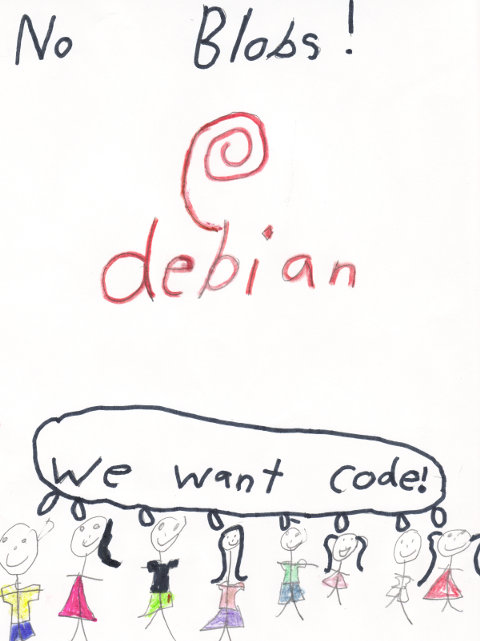
So in the end I decided to vote in the Lenny/DFSG violations GR despite lingering apathy. Option 5 won so hopefully we can get on with releasing the next stable version of Debian. For giggles, I explained all the issues to my daughter Shailaja and asked for her opinion. Her advice is that we should not worry about firmware being non-free because it could take a long time to sort out and in the mean time people would get fed up of waiting for Debian and go somewhere else. However we should make a big list of all the devices that require the binary blobs and tell everyone not to use them. To this end she has made the following sign you can copy and send to recalcitrant hardware manufacturers. no blobs
24 December 2008

MJ Ray: Representing Developers

Open and voluntary membership is a point of principle for me, so I see SPI s membership structure as a big plus. As I wrote back in August:
In my opinion, a key difference of Software in the Public Interest is that it is managed by free software developers in a more-or-less democratic fashion. Even though I ve failed in two elections, I still think it s better than the alternatives.
One of the other major free software organisations has moved in the right direction this month, with the announcement that FSFE adds Fellowship representation to General Assembly. It s not perfect - I still disagree with fellowship being conditional on payment instead of effort - but I think getting democratic representation in FSF Europe is a big step forwards for free software developers. If only FSF.org would do that too. One challenge of representation is that members have a responsibility to oversee the organisation. That s a bit difficult if the board adds reports and resolutions to the agenda at the last minute, which happened at the December 2008 meeting. Ian Jackson has asked the board to arrange that all the appropriate notifications are sent and I ask other SPI members (contributing or non-contributing - both seem to be fine for this) to second it. Finally, happy Christmas or whatever other festival you re celebrating (if any).

23 December 2008

Ondřej Čertík: Experience with git after 4 months

I switched to git from mercurial about 4 months ago. As Matt Mackall (the main author of mercurial) has pointed out, my arguments were partially just excuses for the switch, because everything could be fixed in mercurial as well (eventually). On the other hand, I really wasn't expecting to switch when I invested time and energy to learn mercurial. Also because I thought that git doesn't have such a nice documentation, has a steep learning curve and the community is hostile, because it is developed by the kernel people who are famous for sometimes being not so nice on the mailinglists (as I now found out, none of these are true). I was getting annoyed by small things one by one, after finally I said to myself enough is enough, let's just switch.

So as to the steep learning curve --- it took me a day or two to being able to do what I want, so it seems to me it's really easy to learn once you know some distributed vcs. I found out the documentation is much better than in mercurial --- in git one just types "git help command" and a full man page fires up with lot's of information and examples. In mercurial, one just gets a couple lines (compared to git) of help in the terminal, without examples. Also the first (actually second) thing I noticed is that "git log" (and other commands like "git diff") doesn't scroll out my terminal, but uses "less" automatically -- that's just great. The first thing I noticed is that git is superfast for almost every operation, especially it's noticeable with "git diff". As to the community, I only had a chance to send a few emails to the git list, so I cannot really say, but so far it's very responsive and friendly.

However, those are just little things that can (and I am sure they will) be fixed in mercurial as well. What is a big thing are branches, especially remote branches. One just fetches a remote repository and then works with it like with any other local branch, e.g. one can switch to it, or just "git log some_remote_branch" to see what is in there. One can easily compare them etc. With mercurial, I was using "hg out" and "hg in" commands to see what changes I will pull or push, but those commands require internet connection, so it really sucks and it's slow. In mercurial, I was using different directories for different branches, but that's just extremely inconvenient and also slow (creating a new branch is just a matter of adding one file, not copying the whole repository --- for example with the sympy hg repository, I often had to wait several seconds to clone a repo, while with the git repository it's just instant) and big (in terms of megabytes).

The bible of Mercurial, the hgbook says:
In most instances, isolating branches in repositories is the right approach.

But I think it's the wrong approach. The only argument for doing this that I accept is that sometimes you are not sure which branch you are in in git --- well, I use this trick (actually, just read the documentation of __git_ps1 in /etc/bash_completion.d/git), so my bash line always says which branch I am in using the red color. I never do any mistakes with this.

Anyways, I could continue like this (e.g. check out "git svn", "git rebase -i" and many other things), but you can read why git is better for example here, no need to repeat here. I am very happy now and I can only recommend to learn git.

So let me also say some things that are worse in git --- one thing that could be improved are URLs of the gitweb (hgweb urls are neat, gitweb urls use "?id=..." stuff). Another thing is that the debian package git is not git! You need to install git-core to get git (but this seems to be getting fixed).

There is also an interesting discussion happening right now in the debian-python mailinglist about switching the DPMT repositories to git. I think almost all opinions (for and against) were already stated, but if you have some opinion that wasn't yet said, please do so.

Patrick Schoenfeld: How to NOT improve relationships to your peer projects

I don't know if Aaron is an Ubuntu Developer. I hope not. And I hope that no one of the commenters is one. But this post and especially the comments to it (because the article may have some justification) is certainly not a way to improve the relationship between projects like Ubuntu and the projects its based on.

Yes, it is true, that we have a rough tone in our mailing lists and yes it is sad that every now and then topics pop up that need to be discussed till somebody is hurt and leaves (the project). I certainly hope that this can be improved over the time, but most likely this is not something which breaks the project. Who knows what its worth. We have a large community, very much different opinions and therefore conflicts. Possibly it enhances the quality of our distribution, because things that certainly would make our product worse (e.g. lowering quality standards) won't get done, because they'll get a strong opposition.

But whats the point with the innovations, Aaron? Is it the job of a distribution to serve with innovations? A distribution that serves as a base for more then 10 other distributions? A distribution that is known to care a lot about freedom and is known (and appreciated) for a high quality standard. I don't think we need to serve innovations. We served innovations back in a time where it was needed. Where things were missing. Like a good package management, like conf.d directories. Apart from this I think there were enough innovations in the past years. Possibly not that user-visible and trendy as a graphical virtualization frontend. What about xen-tools for example?
Now its all about reinventing the wheel or developing frontends. Launchpad for example is just reinventing the wheel. Savannah exists, GForge exists. Bazaar is just reinventing the wheel. Git exists. So does Mercurial.

But whats most sad about your posts and the comments is that you (and your commentors) seem to share the opinion that all Debian does is packaging software and nothing more. According to you Debian developers do not fix bugs, forward patches, file (important) wishlist bugs, encourage upstreams to remove horribly broken licensed software, improve their own software and tools (dpkg, aptitude, apt-get, the devscripts, ....), do integration work (alternatives, $EDITOR usage, ...), documentation work (writing manpages). The reality is that there are many small and greater things driven by Debian Developers that serve the whole community. Additional to the ground work that your favorite operating system is based on and without which it could not exist.
Its just not beeing doped like it is done by companies with their marketing departments that actually earn money with what they do. Take the projects you named. They all have one. They all have paid developers.

In any way such a ranting (with no real
constructiveness) will not serve the relationships between other projects and Debian.

21 December 2008

Kurt Roeckx: Debian and (non-free) firmware: where to put it?

One of the discussion that always seems to come back is what to do with firmware. It's mostly about freedom versus usability. I think the main question is where do we want to put non-free firmware in our archive. The opinion seems to range from that it should be in the non-free archive to that it should be in the main archive, with many opinions in between, and they all have good arguments. We have 3 options that are related to it in our current vote that seem to come down to: I don't see the point of that second option, and really have to wonder if there is any firmware under a license that would comply with the DFSG except that the source isn't available. The third option can make sense for some of the blobs in the kernel that are basically settings that are written to the device. You could write an editor for it, assuming there is documentation for it. But I doubt that they're all settings, and it just seems to ignore the problem. I find Theodore Ts'o' suggestion about creating a new section for firmware the best idea so far, specially if we can agree that our official CD/DVD images will have that section on it. It has the advantage that all software in our main archive can comply with the DFSG, that you don't need to add the non-free section just to be able to use hardware that requires firmware and that you can just take a CD/DVD that works.

Neil Williams: Debian Quality and Releases

Sticking with the theme that blogs are all about completely biased and probably controversial opinion and not much else, I'm glad that Thomas has made his thoughts clear. Thomas - I fully agree (but your blog doesn't support comments, so I'm putting it here).

Debian, to me, needs to about Quality over quantity (being very aggressive over orphaned packages and their reverse dependencies) and about everyone working towards the releases. Not to pick arbitrary time-based deadlines for releases but actively fixing release-critical bugs, so that the release can proceed smoothly with stable, reliable packages. Debian developers who feel unable to fix release critical bugs maybe should not be developers any more - or at least be banned from mailing lists on lists.debian.org which appear to be the only "contribution" being made.

There's no reason to continue using Gtk1.2 and no point in complaining about it because there is no prospect of anyone stepping up to maintain gtk1.2 itself. There is therefore no point in the long threads complaining about removing gtk1.2 because nobody is going to do any work to retain gtk1.2.

If you aren't prepared to do the work, you should not feel you have any rights to complain about the lack of such work being done. We're all volunteers - don't expect someone else to sift the wheat from the chaff, get rid of your own cruft. Debian needs to be an association of people who do, not the current association of people who complain, moan and generally fight amongst themselves. The answer to this negativity is a can-do attitude - it is not as if there aren't enough problems out there to fix, get out there and raise the quality. (First though, get Lenny released.)

Not everyone can do the same amount of workload but within the work that you are able to do, there must be a balance between the work you do for yourself and the work you do for the distribution. I'm not expecting people to have to match my levels of output, I am expecting people to match the proportion of time that they allocate to fixing problems outside their own limited niche. If that proportion approaches zero then maybe Debian doesn't need you any more.

There is no reason to have project members who do not contribute to either quality or releases - that doesn't just mean not fixing bugs, it means not being a part of any team or other group in Debian that provides support for general quality or the release.

If you aren't fussed about the quality of packages (in general, not just your own) and aren't willing to contribute just a small amount of your time to use your privileges to fix release-critical issues, then those privileges should be removed - you obviously don't need them. (Also, if you aren't a DD yet and you want sponsorship, these rules apply to you too. I won't sponsor people who have no feel for quality or want to help Debian make releases. I'm beginning to wish other sponsors would do the same. Quality is far more important than quantity - merely adding packages because they exist and because someone posts a request for a sponsor is insufficient. Completely insufficient, counter-productive too. See my sponsorship requirements.)

Note: this post is entirely opinionated and I don't care if you disagree. I will take a particularly brutal approach to comments that do not grasp this fact.

20 December 2008

David Paleino: Free software yes, free speech too!

Dear Julien, that proposal is not about censoring mails sent in by people. Think to it as that "karma" thing many sites have. And yes, I'm one of those in favour of such project. I'm a free software,speech guy, but just hate all the flames seen lately on -devel. We must find a way to stop that, or at least to control it. Again, it's not censorship, as I read it, all messages would go in. Citing:
I have also seen opinions that other "obvious" ways of addressing the issue,
such as moderation of the lists or a new organizational entity, which
would act as a list watchdog, is not the way to go, as it adds yet
another layer of bureacracy and raises the usual questions of choosing
the "right" people for the privileged position.
It's just an alternative way of expressing opinions about a mail. Consider it as those "+1"/"-1" mails that you can often see.

19 December 2008

Julian Andres Klode: Short review: Fedora 10 and Ubuntu 8.10


After I tried OpenSolaris 2008.11, I also tried Fedora 10 and Ubuntu 8.10, each for almost one day. Creation of bootable USB stick: For both distributions, I created a bootable USB stick because it is faster to install from USB than from CD/DVD. The creation was easy in both cases. Fedora ships a shell script and Ubuntu a graphical program for this task. Both very equally easy to use. Booting from USB: Both distributions booted perfectly from USB. But there was a big difference in boot speed: Fedora 10 booted in about the same time Ubuntu needed to find the USB stick. Installation from USB to HDD: Installation of both systems went very well, without any problems. Fedora s installer is far more powerful than Ubuntu s, e.g. it allows to use LVM or encrypted partitions. To setup LVM and encrypted volumes with Ubuntu, you need to use the text installer on Ubuntu s alternate disk (It s debian-installer). Ubuntu s graphical installer received a new partioning screen. Boot: Fedora s boot time seems to have improved a lot since the last release. Ubuntu s boot time seems to be roughly the same as in 8.04. Both distributions provide a progress bar, whereas Ubuntu s usplash looks better. But this may change once kernel-based modesetting works on Intel cards in Fedora, because Fedora s splash program needs it for graphics. Else, it only displays ASCII progress bar. Login: Fedora 10 shipped with GDM 2.24, which means that there are no themes yet. But this was no problem, as the non-themed design of GDM has improved a lot. I even like it more than any themed GDM I have seen. It reminds me a bit of OSX. Desktop: Both distributions ship with GNOME 2.24. The default themes look good, whereas Fedora s uses more GNOME-like icons, whereas Ubuntu uses Human, which is based on Tango. And that is important for me, since I normally do not change any aspect of my desktop, except for adding cpu frequency and tomboy applets to the panel. Hardware support: Both distributions provide good hardware support. Ubuntu leads here, at the cost of having non-free drivers included on the disk.For users needing windows wireless LAN drivers, Ubuntu is the right choice, as it ships ndiswrapper and the graphical frontend (ndisgtk) on the installation medium. Fedora does not include ndiswrapper, because of what it is used for (installing non-free Windows drivers). Both distributions ship firmware, and consider firmware images as free enough, as they do not run on the CPU. EXT4: Fedora 10 ships with patches for EXT4 backported from Kernel 2.6.28. It also supports the installation on ext4 partitions, but only using the DVD and if booted with the ext4 option. The Live discs do not support installation to ext4. Package management: Both distributions ship with good package managment software. YUM really improved since the early times, where it downloaded an extra metadata file for every package. Nowadays, yum and apt seem to be on a nearly equal level, but aptitude lets Ubuntu win, because it can handle problems much better (ie. it proposes ways to solve problems) than YUM. Graphical package management: Ubuntu wins here. Fedora only ships PackageKit for package managment, which, in my opinion, is not able to really compete with Synaptic and gnome-app-install. Conclusion: Both distributions are very solid. Ubuntu still has the better package managment, and a bigger selection of packages. This has only been possible due to Debian, which is the base of Ubuntu. I tried to write this blog post not as an Ubuntu member. I always liked Red Hat and Fedora, and one of my first Linux distributions was Red Hat 9. Links: Posted in General, Ubuntu

MJ Ray: Debian, Lenny GR and the Secretary

Two policy issues have been brewing in debian and I ve been mostly quiet about them because I ve been busy with TTLLP work. One is the Lenny release GR which I m still trying to make sense of. I mean: yikes! I ve been reading debian-legal and -vote for years and this ballot confuses me. I think I ll vote 5324671 but I m really not sure what that means. The other big issue is that Manoj has resigned as secretary. I think this is a good thing, if for no other reason than he s been secretary for 7 years and I feel it s not healthy for one person to hold that post too long in a thousand-strong group. I ve disagreed with Manoj about some tasks, but I didn t see any point in making this difficult job even less fun, so I stopped criticising him a while ago. Since then, my comments on the secretary s work have usually been limited to small review comments on ballots (which are then apparently ignored anyway, but at least I offer help). I m apprehensive about who will replace Manoj. In the short term, Bdale Garbee acts as secretary, but surely Bdale is busy enough already? Given his increased vote-taking activity, Neil McGovern seems a likely choice, but the work left undone after his term as SPI secretary may count against him. More generally, I think there s a problem with Debian s secretary, so anyone who would be a good secretary would probably refuse to do it as currently defined. There s an email about bundled votes and the secretary by Steve Langasek which touches on this major problem:
the secretary is the *only* line of defense against gaming of the GR process by a small group of developers who propose an uncontroversial but orthogonal amendment that will always win over the alternatives, in the process preventing the will of the project from being formally enacted
In other words, in Debian, the secretary is both secretary (usually an appointed or consensual post in most organisations, in my experience) and chairman (usually an elected post) - both doing the hard administrative leg-work and actually ruling on contentious issues, rather than just giving an opinion to the chairman. Manoj commented that he would be happy if the constitution was changed, to clarify the issue, or to explicitly add another entity to handle intepretations . Is it time to split the secretary s role?

Julian Andres Klode: Short Review: OpenSolaris 2008.11


The installation was fast and easy, comparable to the installation of Ubuntu. OpenSolaris seems to have big problems in terms of wireless LAN. I am using a WPA/WPA2 encrypted wireless LAN, and it asked to me to enter my passphrase. I entered it, and nothing happened. I was able to get wireless working via commandline, but this lead me to the problem that domain names were not resolved. I could solve this, too. But none of this was permanently, and it should work the graphical way or tell me it does not work. Maybe this whole thing happened because I have a space in the name of my Wi-Fi network. Another problem is suspend/resume, which is not yet working for most laptops; whereas recent Linux distributions support suspend/resume out-of-the-box. OpenSolaris ships non-free components, e.g. NVIDIA display drivers, or Java 6 Update 10. Hopefully, there will be an option in future to install it without this stuff. Talking about the desktop, there is GNOME 2.24 with a custom theme. In my opinion, the theme looks quite good, although I do not like the colours of the minimize,maximize,close buttons of the windows sometimes. One feature introduced with this release is Time Slider. Time slider worked very well, although for reasons I do not know, I do not really like it. The integration with nautilus is good, but I would still like to see an interface using a calender widget instead of this slider. I remember that the slider sometimes did not work as I expected, e.g. it jumped from left to right. The package management is interesting, but it is to hard to use in my opinion. Debian and derived distributions provide far better package managment in my opinion. Especially the graphical part needs a lot of work in order to compete with Debian. The overall speed was quiet good, and memory usage was 512MB. There is one problem with measuring memory consumption in gnome-system-monitor: I installed netbeans 6.5 and started it, and gnome-system-monitor showed a memory usage of around 20MB, while the program used more than 200MB (according to top). All in all, OpenSolaris gets closer to modern Linux distributions like Fedora 10 or Ubuntu 8.10, but it is not there yet. But with improvements in the area of Wi-Fi and Suspend/Resume, future releases of OpenSolaris might become a good alternative to Linux distributions, at least if you do not really care about the ideas of free software. Posted in General

Neil Williams: Opinions and blogs

Taking on from Wouter's post on metablogging, I can only say that official sounding blogs are very off-putting and I stop reading them very quickly. If a blog (or more typically the blogger) starts thinking too much of their blog, considering it an enduring reference or a permanent piece of documentation then that blogger is deluded. A typical sign of such a blog is a long list of references at the end and topics that try to stipulate how other people should blog.

To me a blog is merely the opinion of the blogger. I do use my blog for announcements but only when the subject matter isn't finalised and / or isn't ready for widespread usage outside a limited list of developers. Where things are more certain, I use mailing lists and if things are just records of what happened at a particular event, I'll use the News parts of websites. As for the time taken to write a blog entry - as short as possible - like this one. Gotta go....

18 December 2008

Wouter Verhelst: Metablogging

Ciar n O'Riodan blogs about how to blog, and his post is a good read. Most of it is solid advice, and I find there's little I disagree with; if you want to get a blog that's well-read by many people, then his advice is probably sound. So why am I posting this in my 'retorts' category? Because I feel that blogging isn't something that should be taken too seriously. A blog is an outlet, a place to get your thoughts out; it is a bit of a combination between a column and the readers' letters section in a newspaper. The writing style of a blog should reflect that; when I write a blog post, I don't care about what the truth is, I only care about my opinion. If I want to write the truth, I'll write a wikipedia article. If I want to read about the truth, I'll go and kill myself because I'm not naive enough to think something like "the truth" exists in this life. And if I want to read a magazine-style article, how about I'll go buy a magazine instead of reading a blog post? A blog post doesn't require references (beyond, perhaps, what you're replying to); a blog is a reference, one to the personal opinion of the author. If you think something is great, then as far as your blog is concerned, that something may be the best thing since sliced bread. If you think something is ugly, crap, and should be forgotten about, then on your blog it is. In more than one sense, blogs are like opinions: everybody has one. That doesn't mean I disagree with most of what Ciar n wrote; on the contrary. Points 1 through 3, and 6 through 10, will help you develop a good writing style. I couldn't agree more on point 11, that you have to push for publication yourself; and it's certainly true that being aggregated is a good way to put your thoughts in context, and to expose yourself to a larger readership. But I vehemently disagree with his point 4:
It can take time. A good article-style blog entry can take six hours to write!
Not that I think writing a blog post should take no time at all this particular one has been almost an hour in the making, now but because I feel that, simply, articles, with all their references, scientific or other background, and whatnot, simply do not belong on a blog. A bunch of articles with an RSS feed is not a blog, plain and simple. So while I do agree that it can take time, I do think you're doing fundamentally wrong if your blog post takes more than, say, an hour and a half, to be written. So, in the interest of being constructive, here are my own suggestions:
  1. Don't think too much, just write. It may sound stupid, but the most important part about blogging is actually doing it, and not wondering about how or why.
  2. Do reread if possible. While blog posts are usually read in a few minutes, they take much longer to write; it's easy to lose track of your line of thinking during that process, in which case you may end up with a completely incoherent post. That certainly is to be avoided.
  3. Ciar n's argument that if it's worth doing, it's worth blogging about certainly holds merit, but I'd go one step further: if it's worth thinking about, it's also worth blogging about. After all, a blog is mostly a braindump, so why not?
    That's not to say every thought can be turned into a coherent blog post, and I have a bunch of half-finished unpublished blog posts on my local hard disk which I may revisit at some undefined point in the future; but the principle is there.
  4. And last, but not least: don't care about what other people are doing. Your blog is your own, not someone else's; if you get an email that your content sucks, ignore it. If you get an email that you should be writing about something else instead, ignore it. You're not getting paid for your blog, are you?

Raphaël Hertzog: Release Lenny GR

This is the worst vote that has come up since I m part of Debian. And Manoj the secretary has refused to listen to the remarks of many developers about the misleading titles/summaries, about the unjustified 3:1 ratio, and worst of all, about the mixing of multiple questions in a single ballot. I have ranked misleading options ( Reaffirm social contract at least) lowest and below Further discussion and sorted all the other options according to my preference, and ranked some of them equally when the choices answer different questions (where I can not prioritize any preferred outcome). I m not yet sure if I put Further discussion first or not. There s some hope that the vote will be cancelled and redone with separate ballots but I ve lost trust in Manoj s abilities to do his job properly. I m sure he s convinced that he s doing the right thing but that doesn t help at all, on the contrary. It also means we probably should fix the constitution to make it crystal-clear how the secretary should decide whether 3:1 ratio is needed for a given resolution or not. Not really the kind of thing I enjoy within Debian, but that s the price to pay if we want to continue to work together. On this and much more I agree with Russ Alberry. Update: Manoj resigned as secretary. I want to thank him for having taken this hard decision. And I sincerely hope he doesn t resign from Debian completely as our strength is also in our diversity of opinions. Partagez cet article / Share This

17 December 2008

Steve Kemp: I am not going to sit on my ass as the events that affect me unfold to determine the course of my life

So I finally got round to vote on the Debian Lenny Firmware issue. I can't help thinking that most of the discussion so far has been a waste of time, on the grounds that developers either Either way the discussion has two, or more, sides talking past each other rather than any convergence upon a consensus. (Me? I'm in the middle. On the fence. Getting bored. Hitting "Delete thread" a lot. Who knows, maybe I could have my vote influenced, but right now I'm just not caring enough either way.) Anyway enough on that subject. Tonight I have mostly been looking around to come up with a simple way to give an "overview" of mail traffic. Something like: Individually these jobs are easy. Making it look pretty is hard. (Also I'd like to have archives of the lists in question, which are searchable.) Seems like nothing out there does everything I want. ObFilm: Ferris Bueller's Day Off.

16 December 2008

Biella Coleman: If Programming Languages Were Religions and What is Up with Ruby on Rails?

I am sure this is making the rounds but this seems like an appropriate place for this list: If Programming Languages Were Religions. My favorite description:
Lisp would be Zen Buddhism - There is no syntax, there is no centralization of dogma, there are no deities to worship. The entire universe is there at your reach - if only you are enlightened enough to grasp it. Some say that it s not a language at all; others say that it s the only language that makes sense.
Speaking of computer languages and projects and religious holy wars, in the last few weeks I have been totally intrigued by the culture being built by the Ruby on Rails guys. As a researcher of Free and Open Source Software, I, like others, actually tend to see the similarities more than the difference between these two poles (in part because I focus on practice, not on the purist ideologies or two ideologues, you know who I am taking about) but it seems to me -and I could be wrong here but I suspect I am not -that Ruby on Rails is producing a unique Open Source culture, one that really diverges from some of the core principles of Free Software, much more so than other Open Source projects like Apache. The rail guys as I have heard, are Open Source evangelists of a certain stripe, who are quite cultish (you know, it is weird if you don t use github, a Mac, TextMate). What do you think of Ruby on Rails? Are the attacks fair? Are they a bunch of douchebags, as this (very incisive) post argues? Is it where Open Source meets and marries, for better or for worse, the Web 2.0 craze? If I could clone me, this is definitely one line of research, I would love to dive into right now but since I can t, your opinions would be greatly appreciated.

Next.

Previous.
