Search Results: "nic"

18 December 2022

Freexian Collaborators: Monthly report about Debian Long Term Support, November 2022 (by Anton Gladky)

Like each month, have a look at the work funded by Freexian s Debian LTS offering.

Debian LTS contributors In November, 15 contributors have been paid to work on Debian LTS, their reports are available:
  • Abhijith PA did 0.0h (out of 14.0h assigned), thus carrying over 14.0h to the next month.
  • Anton Gladky did 6.0h (out of 15.0h assigned), thus carrying over 9.0h to the next month.
  • Ben Hutchings did 9.0h (out of 24.0h assigned), thus carrying over 15.0h to the next month.
  • Chris Lamb did 18.0h (out of 18.0h assigned).
  • Dominik George did 10.0h (out of 0h assigned and 24.0h from previous period), thus carrying over 14.0h to the next month.
  • Emilio Pozuelo Monfort did 0.0h (out of 38.0h assigned and 19.5h from previous period), thus carrying over 57.5h to the next month.
  • Enrico Zini did 0.0h (out of 0h assigned and 8.0h from previous period), thus carrying over 8.0h to the next month.
  • Helmut Grohne did 17.5h (out of 20.0h assigned).
  • Markus Koschany did 40.0h (out of 40.0h assigned).
  • Ola Lundqvist did 7.5h (out of 11.0h assigned and 5.0h from previous period), thus carrying over 8.5h to the next month.
  • Roberto C. S nchez did 20.25h (out of 0.75h assigned and 31.25h from previous period), thus carrying over 11.75h to the next month.
  • Stefano Rivera did 2.5h (out of 0h assigned and 17.0h from previous period), thus carrying over 14.5h to the next month.
  • Sylvain Beucler did 35.5h (out of 23.0h assigned and 34.5h from previous period), thus carrying over 22.0h to the next month.
  • Thorsten Alteholz did 14.0h (out of 14.0h assigned).
  • Utkarsh Gupta did 41.0h (out of 32.5h assigned and 25.0h from previous period), thus carrying over 16.5h to the next month.

Evolution of the situation In November, we released 43 DLAs, fixing 183 CVEs. We currently have 63 packages in dla-needed.txt that are waiting for updates, which is 19 fewer than the previous month. We re excited to announce that two Debian Developers Tobias Frost and Guilhem Moulin, have completed the on-boarding process and will begin contributing to LTS as of December 2022. Welcome aboard!

Thanks to our sponsors Sponsors that joined recently are in bold.

15 December 2022

Reproducible Builds: Supporter spotlight: David A. Wheeler on supply chain security

The Reproducible Builds project relies on several projects, supporters and sponsors for financial support, but they are also valued as ambassadors who spread the word about our project and the work that we do. This is the sixth instalment in a series featuring the projects, companies and individuals who support the Reproducible Builds project. We started this series by featuring the Civil Infrastructure Platform project and followed this up with a post about the Ford Foundation as well as a recent ones about ARDC, the Google Open Source Security Team (GOSST), Jan Nieuwenhuizen on Bootstrappable Builds, GNU Mes and GNU Guix and Hans-Christoph Steiner of the F-Droid project. Today, however, we will be talking with David A. Wheeler, the Director of Open Source Supply Chain Security at the Linux Foundation.
Holger Levsen: Welcome, David, thanks for taking the time to talk with us today. First, could you briefly tell me about yourself? David: Sure! I m David A. Wheeler and I work for the Linux Foundation as the Director of Open Source Supply Chain Security. That just means that my job is to help open source software projects improve their security, including its development, build, distribution, and incorporation in larger works, all the way out to its eventual use by end-users. In my copious free time I also teach at George Mason University (GMU); in particular, I teach a graduate course on how to design and implement secure software. My background is technical. I have a Bachelor s in Electronics Engineering, a Master s in Computer Science and a PhD in Information Technology. My PhD dissertation is connected to reproducible builds. My PhD dissertation was on countering the Trusting Trust attack, an attack that subverts fundamental build system tools such as compilers. The attack was discovered by Karger & Schell in the 1970s, and later demonstrated & popularized by Ken Thompson. In my dissertation on trusting trust I showed that a process called Diverse Double-Compiling (DDC) could detect trusting trust attacks. That process is a specialized kind of reproducible build specifically designed to detect trusting trust style attacks. In addition, countering the trusting trust attack primarily becomes more important only when reproducible builds become more common. Reproducible builds enable detection of build-time subversions. Most attackers wouldn t bother with a trusting trust attack if they could just directly use a build-time subversion of the software they actually want to subvert.
Holger: Thanks for taking the time to introduce yourself to us. What do you think are the biggest challenges today in computing? There are many big challenges in computing today. For example:
Holger: Do you think reproducible builds are an important part in secure computing today already? David: Yes, but first let s put things in context. Today, when attackers exploit software vulnerabilities, they re primarily exploiting unintentional vulnerabilities that were created by the software developers. There are a lot of efforts to counter this: We re just starting to get better at this, which is good. However, attackers always try to attack the easiest target. As our deployed software has started to be hardened against attack, attackers have dramatically increased their attacks on the software supply chain (Sonatype found in 2022 that there s been a 742% increase year-over-year). The software supply chain hasn t historically gotten much attention, making it the easy target. There are simple supply chain attacks with simple solutions: Unfortunately, attackers know there are other lines of attack. One of the most dangerous is subverted build systems, as demonstrated by the subversion of SolarWinds Orion system. In a subverted build system, developers can review the software source code all day and see no problem, because there is no problem there. Instead, the process to convert source code into the code people run, called the build system , is subverted by an attacker. One solution for countering subverted build systems is to make the build systems harder to attack. That s a good thing to do, but you can never be confident that it was good enough . How can you be sure it s not subverted, if there s no way to know? A stronger defense against subverted build systems is the idea of verified reproducible builds. A build is reproducible if given the same source code, build environment and build instructions, any party can recreate bit-by-bit identical copies of all specified artifacts. A build is verified if multiple different parties verify that they get the same result for that situation. When you have a verified reproducible build, either all the parties colluded (and you could always double-check it yourself), or the build process isn t subverted. There is one last turtle: What if the build system tools or machines are subverted themselves? This is not a common attack today, but it s important to know if we can address them when the time comes. The good news is that we can address this. For some situations reproducible builds can also counter such attacks. If there s a loop (that is, a compiler is used to generate itself), that s called the trusting trust attack, and that is more challenging. Thankfully, the trusting trust attack has been known about for decades and there are known solutions. The diverse double-compiling (DDC) process that I explained in my PhD dissertation, as well as the bootstrappable builds process, can both counter trusting trust attacks in the software space. So there is no reason to lose hope: there is a bottom turtle , as it were.
Holger: Thankfully, this has all slowly started to change and supply chain issues are now widely discussed, as evident by efforts like Securing the Software Supply Chain: Recommended Practices Guide for Developers which you shared on our mailing list. In there, Reproducible Builds are mentioned as recommended advanced practice, which is both pretty cool (we ve come a long way!), but to me it also sounds like this will take another decade until it s become standard normal procedure. Do you agree on that timeline? David: I don t think there will be any particular timeframe. Different projects and ecosystems will move at different speeds. I wouldn t be surprised if it took a decade or so for them to become relatively common there are good reasons for that. Today the most common kinds of attacks based on software vulnerabilities still involve unintentional vulnerabilities in operational systems. Attackers are starting to apply supply chain attacks, but the top such attacks today are typosquatting (creating packages with similar names) and dependency confusion) (convincing projects to download packages from the wrong repositories). Reproducible builds don t counter those kinds of attacks, they counter subverted builds. It s important to eventually have verified reproducible builds, but understandably other issues are currently getting prioritized first. That said, reproducible builds are important long term. Many people are working on countering unintentional vulnerabilities and the most common kinds of supply chain attacks. As these other threats are countered, attackers will increasingly target build systems. Attackers always go for the weakest link. We will eventually need verified reproducible builds in many situations, and it ll take a while to get build systems able to widely perform reproducible builds, so we need to start that work now. That s true for anything where you know you ll need it but it will take a long time to get ready you need to start now.
Holger: What are your suggestions to accelerate adoption? David: Reproducible builds need to be: I think there s a snowball effect. Once many projects packages are reproducible, it will be easier to convince other projects to make their packages reproducible. I also think there should be some prioritization. If a package is in wide use (e.g., part of minimum set of packages for a widely-used Linux distribution or framework), its reproducibility should be a special focus. If a package is vital for supporting some societally important critical infrastructure (e.g., running dams), it should also be considered important. You can then work on the ones that are less important over time.
Holger: How is the Best Practices Badge going? How many projects are participating and how many are missing? David: It s going very well. You can see some automatically-generated statistics, showing we have over 5,000 projects, adding more than 1/day on average. We have more than 900 projects that have earned at least the passing badge level.
Holger: How many of the projects participating in the Best Practices badge engaging with reproducible builds? David: As of this writing there are 168 projects that report meeting the reproducible builds criterion. That s a relatively small percentage of projects. However, note that this criterion (labelled build_reproducible) is only required for the gold badge. It s not required for the passing or silver level badge. Currently we ve been strategically focused on getting projects to at least earn a passing badge, and less on earning silver or gold badges. We would love for all projects to get earn a silver or gold badge, of course, but our theory is that projects that can t even earn a passing badge present the most risk to their users. That said, there are some projects we especially want to see implementing higher badge levels. Those include projects that are very widely used, so that vulnerabilities in them can impact many systems. Examples of such projects include the Linux kernel and curl. In addition, some projects are used within systems where it s important to society that they not have serious security vulnerabilities. Examples include projects used by chemical manufacturers, financial systems and weapons. We definitely encourage any of those kinds of projects to earn higher badge levels.
Holger: Many thanks for this interview, David, and for all of your work at the Linux Foundation and elsewhere!


For more information about the Reproducible Builds project, please see our website at reproducible-builds.org. If you are interested in ensuring the ongoing security of the software that underpins our civilisation and wish to sponsor the Reproducible Builds project, please reach out to the project by emailing contact@reproducible-builds.org.

Russell Coker: Pixel 6A

I have just bought a Pixel 6A [1] for my wife. It s one of the latest Google phones that was released almost at the same time as the Pixel 7 series, so if you want to spend a lot of money on a phone that s the latest and greatest then the Pixel 7 and Pixel 7 Pro are the options, but if you want to save some money and don t need something really high end then the Pixel 6A is a good option. The one I bought cost $550 when I bought it from Google which seemed like a good deal when it was advertised as being discounted from $750. Later I discovered that other retailers were selling it for $500 or for $550 when bundled with a Chromecast. Also one of the other retailers was a company that I could get discount gift cards for. So this is the type of item you should really shop around for. It doesn t come with a charger so you don t have the gray-market disadvantage of getting yet another charger that doesn t fit the sockets in your country. The main new feature of this phone is a fingerprint scanner built in to the screen. I don t think this is a good thing, sure it s neat technology to both display pictures and read fingerprints through the same piece of glass but there are benefits to using a different location. Huawei phones with a fingerprint reader at the rear of the phone allow the user to answer calls, drag down the notifications list, and scroll sideways via touching the fingerprint reader. So the Pixel 6A clearly gives less functionality than some Huawei phones in this regard. One major annoyance with the phone is a combination of the phone hardware and Android 13 which gives no back arrow (swipe sideways) and no button to get the task list (swipe upwards at the correct speed from the bottom of the screen). The Android 12 way of swiping up from the bottom of the screen to get buttons for back, task-list, and home-screen is much better IMHO. Hopefully they will release a software update to make this a configuration option. Generally this is a nice phone, but the lack of buttons for back and task-list is annoying. Maybe the lack of buttons is something you can get used to after using it for a while. But millions of people just taking whatever companies like Google offer isn t what I imagined when I first hoped for a large portion of the world using Linux. On PCs we have a choice between KDE, GNOME, and other UIs. It would be nice if we had similar choices on phones.

14 December 2022

Russ Allbery: Review: Contact

Review: Contact, by Carl Sagan
Publisher: Pocket Books
Copyright: 1985
Printing: October 1986
ISBN: 0-671-43422-5
Format: Mass market
Pages: 434
Contact is a standalone first-contact science fiction novel. Carl Sagan (1934 1996) was best known as a non-fiction writer, astronomer, and narrator of the PBS non-fiction program Cosmos. This is his first and only novel. Ellie Arroway is the director of Project Argus, a radio telescope array in the New Mexico desert whose primary mission is SETI: the search for extra-terrestrial intelligence by scanning the skies for unexpected radio signals. Its assignment to SETI is controversial; there are radio astronomy projects waiting, and although 25% of the telescope time is assigned to non-SETI projects, some astronomers think the SETI mission should be scrapped and Argus fully diverted to more useful research. That changes overnight when Argus picks up a signal from Vega, binary pulses representing the sequence of prime numbers. The signal of course doesn't stop when the Earth rotates, so Ellie and her team quickly notify every radio observatory they can get hold of to follow the signal as it passes out of their line of sight. Before long, nearly every country with a radio telescope is involved, and Russian help is particularly vital since they have ship-mounted equipment. The US military and intelligence establishment isn't happy about this and make a few attempts to shove the genie back into the bottle and keep any further discoveries secret, without a lot of success. (Sagan did not anticipate the end of the Cold War, and yet ironically relations with the Russians in his version of the 1990s are warmer by far than they are today. Not that this makes the military types any happier.) For better or worse, making sense of the alien signal becomes a global project. You may be familiar with this book through its 1997 movie adaptation starring Jodie Foster. What I didn't know before reading this book is that it started life as a movie treatment, co-written with Ann Druyan, in 1979. When the movie stalled, Sagan expanded it into a novel. (Given the thanks to Druyan in the author's note, it may not be far wrong to name her as a co-author.) If you've seen the movie, you will have a good idea of what will happen, but the book gives the project a more realistic international scope. Ellie has colleagues carefully selected from all over the world, including for the climactic moment of the story. The biggest problem with Contact as a novel is that Sagan is a non-fiction writer who didn't really know how to write a novel. The long, detailed descriptions of the science and the astronomical equipment fit a certain type of SF story, but the descriptions of the characters, even Ellie, are equally detailed and yet use the same style. The book starts with an account of Ellie's childhood and path into science written like a biography or a magazine profile, not like a novel in which she's the protagonist. The same is true of the other characters: we get characterization of a sort, but the tone ranges from Wikipedia article to long-form essay and never quite feels like a story. Ellie is the most interesting character in the book, partly because the way Sagan writes her is both distant but oddly compelling. Sagan (or perhaps Druyan?) tries hard to show what life is like for a woman born in the middle of the 20th century who is interested in science and I think mostly succeeds, although Ellie's reactions to sexism felt weirdly emotionless. The descriptions of her relationships are even odder and the parts where this book felt the least like a novel, but Sagan does sell some of that tone as reflective of Ellie's personality. She's a scientist, the work is the center of her life, and everything else, even when important, is secondary. It doesn't entirely make the writing style work, but it helps. Sagan does attempt to give Ellie a personal development arc related to her childhood and her relationships with her father and step-father. I thought the conclusion to that was neither believable nor anywhere near as important as Sagan thought it was, which was off-putting. Better were her ongoing arguments with evangelical Christians, one of whom is a close-minded ass and the other of which is a far more interesting character. They felt wedged into this book, and I'm dubious a realistic version of Ellie would have been the person to have those debates, but it's a subject Sagan clearly has deep personal interest in and that shows in how they're written. The other problem with Contact as a novel is that Sagan does not take science fiction seriously as a genre, instead treating it as a way to explore a thought experiment. To a science fiction reader, or at least to this science fiction reader, the interesting bits of this story involve the aliens. Those are not the bits Sagan is interested in. His attention is on how this sort of contact, and project, would affect humanity and human politics. We do get some more traditional science fiction near the end of the book, but Sagan then immediately backs away from it, minimizes that part of the story, and focuses exclusively on the emotional and philosophical implications for humans of his thought experiment. Since I found his philosophical musings about agnosticism and wonder and discovery less interesting than the actual science fiction bits, I found this somewhat annoying. The ending felt a bit more like a cheap trick than a satisfying conclusion. Interestingly, this entire novel is set in an alternate universe, for reasons entirely unexplained (at least that I noticed) in the book. It's set in the late 1990s but was written in 1985, so of course this is an alternate future, but the 1985 of this world still isn't ours. Yuri Gagarin was the first man to set foot on the moon, and the space program and the Cold War developed in subtly different ways. I'm not sure why Sagan made that choice, but it felt to me like he was separating his thought experiment farther from our world to give the ending more plausible deniability. There are, at the time of the novel, permanent orbital colonies for (mostly) rich people, because living in space turns out to greatly extend human lifespans. That gives Sagan an opportunity to wax poetic about the life-altering effects of seeing Earth from space, which in his alternate timeline rapidly sped up nuclear disarmament and made the rich more protective of the planet. This is an old bit of space boosterism that isn't as common these days, mostly because it's become abundantly clear that human psychology doesn't work this way. Sadly, rich sociopaths remain sociopaths even when you send them into space. I was a bit torn between finding Sagan's predictions charmingly hopeful and annoyingly daft. I don't think this novel is very successful as a novel. It's much longer than it needs to be and long parts of it drag. But it's still oddly readable; even knowing the rough shape of the ending in advance, I found it hard to put down once the plot properly kicks into gear about two-thirds of the way through. There's a lot in here that I'd argue with Sagan about, but he's thoughtful and makes a serious attempt to work out the political and scientific ramifications of such a discovery in detail. Despite the dry tone, he does a surprisingly good job capturing the anticipation and excitement of a very expensive and risky scientific experiment. I'm not sure I would recommend this book to anyone, but I'm also the person who found Gregory Benford's Timescape to be boring and tedious, despite its rave reviews as a science fiction novel about the practice of science. If that sort of book is more your jam, you may like Contact better than I did. Rating: 6 out of 10

13 December 2022

Matthew Garrett: Trying to remove the need to trust cloud providers

First up: what I'm covering here is probably not relevant for most people. That's ok! Different situations have different threat models, and if what I'm talking about here doesn't feel like you have to worry about it, that's great! Your life is easier as a result. But I have worked in situations where we had to care about some of the scenarios I'm going to describe here, and the technologies I'm going to talk about here solve a bunch of these problems.

So. You run a typical VM in the cloud. Who has access to that VM? Well, firstly, anyone who has the ability to log into the host machine with administrative capabilities. With enough effort, perhaps also anyone who has physical access to the host machine. But the hypervisor also has the ability to inspect what's running inside a VM, so anyone with the ability to install a backdoor into the hypervisor could theoretically target you. And who's to say the cloud platform launched the correct image in the first place? The control plane could have introduced a backdoor into your image and run that instead. Or the javascript running in the web UI that you used to configure the instance could have selected a different image without telling you. Anyone with the ability to get a (cleverly obfuscated) backdoor introduced into quite a lot of code could achieve that. Obviously you'd hope that everyone working for a cloud provider is honest, and you'd also hope that their security policies are good and that all code is well reviewed before being committed. But when you have several thousand people working on various components of a cloud platform, there's always the potential for something to slip up.

Let's imagine a large enterprise with a whole bunch of laptops used by developers. If someone has the ability to push a new package to one of those laptops, they're in a good position to obtain credentials belonging to the user of that laptop. That means anyone with that ability effectively has the ability to obtain arbitrary other privileges - they just need to target someone with the privilege they want. You can largely mitigate this by ensuring that the group of people able to do this is as small as possible, and put technical barriers in place to prevent them from pushing new packages unilaterally.

Now imagine this in the cloud scenario. Anyone able to interfere with the control plane (either directly or by getting code accepted that alters its behaviour) is in a position to obtain credentials belonging to anyone running in that cloud. That's probably a much larger set of people than have the ability to push stuff to laptops, but they have much the same level of power. You'll obviously have a whole bunch of processes and policies and oversights to make it difficult for a compromised user to do such a thing, but if you're a high enough profile target it's a plausible scenario.

How can we avoid this? The easiest way is to take the people able to interfere with the control plane out of the loop. The hypervisor knows what it booted, and if there's a mechanism for the VM to pass that information to a user in a trusted way, you'll be able to detect the control plane handing over the wrong image. This can be achieved using trusted boot. The hypervisor-provided firmware performs a "measurement" (basically a cryptographic hash of some data) of what it's booting, storing that information in a virtualised TPM. This TPM can later provide a signed copy of the measurements on demand. A remote system can look at these measurements and determine whether the system is trustworthy - if a modified image had been provided, the measurements would be different. As long as the hypervisor is trustworthy, it doesn't matter whether or not the control plane is - you can detect whether you were given the correct OS image, and you can build your trust on top of that.

(Of course, this depends on you being able to verify the key used to sign those measurements. On real hardware the TPM has a certificate that chains back to the manufacturer and uniquely identifies the TPM. On cloud platforms you typically have to retrieve the public key via the metadata channel, which means you're trusting the control plane to give you information about the hypervisor in order to verify what the control plane gave to the hypervisor. This is suboptimal, even though realistically the number of moving parts in that part of the control plane is much smaller than the number involved in provisioning the instance in the first place, so an attacker managing to compromise both is less realistic. Still, AWS doesn't even give you that, which does make it all rather more complicated)

Ok, so we can (largely) decouple our trust in the VM from having to trust the control plane. But we're still relying on the hypervisor to provide those attestations. What if the hypervisor isn't trustworthy? This sounds somewhat ridiculous (if you can't run a trusted app on top of an untrusted OS, how can you run a trusted OS on top of an untrusted hypervisor?), but AMD actually have a solution for that. SEV ("Secure Encrypted Virtualisation") is a technology where (handwavily) an encryption key is generated when a new VM is created, and the memory belonging to that VM is encrypted with that key. The hypervisor has no access to that encryption key, and any access to memory initiated by the hypervisor will only see the encrypted content. This means that nobody with the ability to tamper with the hypervisor can see what's going on inside the OS (and also means that nobody with physical access can either, so that's another threat dealt with).

But how do we know that the hypervisor set this up, and how do we know that the correct image was booted? SEV has support for a "Launch attestation", a CPU generated signed statement that it booted the current VM with SEV enabled. But it goes further than that! The attestation includes a measurement of what was booted, which means we don't need to trust the hypervisor at all - the CPU itself will tell us what image we were given. Perfect.

Except, well. There's a few problems. AWS just doesn't have any VMs that implement SEV yet (there are bare metal instances that do, but obviously you're building your own infrastructure to make that work). Google only seem to provide the launch measurement via the logging service - and they only include the parsed out data, not the original measurement. So, we still have to trust (a subset of) the control plane. Azure provides it via a separate attestation service, but again it doesn't seem to provide the raw attestation and so you're still trusting the attestation service. For the newest generation of SEV, SEV-SNP, this is less of a big deal because the guest can provide its own attestation. But Google doesn't offer SEV-SNP hardware yet, and the driver you need for this only shipped in Linux 5.19 and Azure's SEV Ubuntu images only offer up to 5.15 at the moment, so making use of that means you're putting your own image together at the moment.

And there's one other kind of major problem. A normal VM image provides a bootloader and a kernel and a filesystem. That bootloader needs to run on something. That "something" is typically hypervisor-provided "firmware" - for instance, OVMF. This probably has some level of cloud vendor patching, and they probably don't ship the source for it. You're just having to trust that the firmware is trustworthy, and we're talking about trying to avoid placing trust in the cloud provider. Azure has a private beta allowing users to upload images that include their own firmware, meaning that all the code you trust (outside the CPU itself) can be provided by the user, and once that's GA it ought to be possible to boot Azure VMs without having to trust any Microsoft-provided code.

Well, mostly. As AMD admit, SEV isn't guaranteed to be resistant to certain microarchitectural attacks. This is still much more restrictive than the status quo where the hypervisor could just read arbitrary content out of the VM whenever it wanted to, but it's still not ideal. Which, to be fair, is where we are with CPUs in general.

(Thanks to Leonard Cohnen who gave me a bunch of excellent pointers on this stuff while I was digging through it yesterday)

comment count unavailable comments

12 December 2022

Matthew Garrett: Quick update on Pluton and Linux

I've been ridiculously burned out for a while now but I'm taking the month off to recover and that's giving me an opportunity to catch up on a lot of stuff. This has included me actually writing some code to work with the Pluton in my Thinkpad Z13. I've learned some more stuff in the process, but based on everything I know I'd still say that in its current form Pluton isn't a threat to free software.

So, first up: by default on the Z13, Pluton is disabled. It's not obviously exposed to the OS at all, which also means there's no obvious mechanism for Microsoft to push out a firmware update to it via Windows Update. The Windows drivers that bind to Pluton don't load in this configuration. It's theoretically possible that there's some hidden mechanism to re-enable it at runtime, but that code doesn't seem to be in Windows at the moment. I'm reasonably confident that "Disabled" is pretty genuinely disabled.

Second, when enabled, Pluton exposes two separate devices. The first of these has an MSFT0101 identifier in ACPI, which is the ID used for a TPM 2 device. The Pluton TPM implementation doesn't work out of the box with existing TPM 2 drivers, though, because it uses a custom start method. TPM 2 devices commonly use something called a "Command Response Buffer" architecture, where a command is written into a buffer, the TPM is told to do a thing, and the response to the command ends up in another buffer. The mechanism to tell the TPM to do a thing varies, and an ACPI table exposed to the OS defines which of those various things should be used for a given TPM. Pluton systems have a mechanism that isn't defined in the existing version of the spec (1.3 rev 8 at the time of writing), so I had to spend a while staring hard at the Windows drivers to figure out how to implement it. The good news is that I now have a patch that successfully gets the existing Linux TPM driver code work correctly with the Pluton implementation.

The second device has an MSFT0200 identifier, and is entirely not a TPM. The Windows driver appears to be a relatively thin layer that simply takes commands from userland and passes them on to the chip - I haven't found any userland applications that make use of this, so it's tough to figure out what functionality is actually available. But what does seem pretty clear from the code I've looked at is that it's a component that only responds when it's asked - if the OS never sends it any commands, it's not able to do anything.

One key point from this recently published Microsoft doc is that the whole "Microsoft can update Pluton firmware" thing does just seem to be the ability for the OS to push new code to the chip at runtime. That means Microsoft can't arbitrarily push new firmware to the chip - the OS needs to be involved. This is unsurprising, but it's nice to see some stronger confirmation of that.

Anyway. tl;dr - Pluton can (now) be used as a regular TPM. Pluton also exposes some additional functionality which is not yet clear, but there's no obvious mechanism for it to compromise user privacy or restrict what users can run on a Free operating system. The Pluton firmware update mechanism appears to be OS mediated, so users who control their OS can simply choose not to opt in to that.

comment count unavailable comments

Russ Allbery: Review: The Unbroken

Review: The Unbroken, by C.L. Clark
Series: Magic of the Lost #1
Publisher: Orbit
Copyright: March 2021
ISBN: 0-316-54267-9
Format: Kindle
Pages: 490
The Unbroken is the first book of a projected fantasy trilogy. It is C.L. Clark's first novel. Lieutenant Touraine is one of the Sands, the derogatory name for the Balladairan Colonial Brigade. She, like the others of her squad, are conscript soldiers, kidnapped by the Balladairan Empire from their colonies as children and beaten into "civilized" behavior by Balladairan training. They fought in the Balladairan war against the Taargens. Now, they've been reassigned to El-Wast, capital city of Qaz l, the foremost of the southern colonies. The place where Touraine was born, from which she was taken at the age of five. Balladaire is not France and Qaz l is not Algeria, but the parallels are obvious and strongly implied by the map and the climates. Touraine and her squad are part of the forces accompanying Princess Luca, the crown princess of the Balladairan Empire, who has been sent to take charge of Qaz l and quell a rebellion. Luca's parents died in the Withering, the latest round of a recurrent plague that haunts Balladaire. She is the rightful heir, but her uncle rules as regent and is reluctant to give her the throne. Qaz l is where she is to prove herself. If she can bring the colony in line, she can prove that she's ready to rule: her birthright and her destiny. The Qaz li are uninterested in being part of Luca's grand plan of personal accomplishment. She steps off her ship into an assassination attempt, foiled by Touraine's sharp eyes and quick reactions, which brings the Sand to the princess's attention. Touraine's reward is to be assigned the execution of the captured rebels, one of whom recognizes her and names her mother before he dies. This sets up the core of the plot: Qaz li rebellion against an oppressive colonial empire, Luca's attempt to use the colony as a political stepping stone, and Touraine caught in between. One of the reasons why I am happy to see increased diversity in SFF authors is that the way we tell stories is shaped by our cultural upbringing. I was taught to tell stories about colonialism and rebellion in a specific ideological shape. It's hard to describe briefly, but the core idea is that being under the rule of someone else is unnatural as well as being an injustice. It's a deviation from the way the world should work, something unexpected that is inherently unstable. Once people unite to overthrow their oppressors, eventual success is inevitable; it's not only right or moral, it's the natural path of history. This is what you get when you try to peel the supremacy part away from white supremacy but leave the unshakable self-confidence and bedrock assumption that the universe cares what we think. We were also taught that rebellion is primarily ideological. One may be motivated by personal injustice, but the correct use of that injustice is to subsume it into concepts such as freedom and democracy. Those concepts are more "real" in some foundational sense, more central to the right functioning of the world, than individual circumstance. When the now-dominant group tells stories of long-ago revolution, there is no personal experience of oppression and survival in which to ground the story; instead, it's linked to anticipatory fear in the reader, to the idea that one's privileges could be taken away by a foreign oppressor and that the counter to this threat is ideological unity. Obviously, not every white fantasy author uses this story shape, but the tendency runs deep because we're taught it young. You can see it everywhere in fantasy, from Lord of the Rings to Tigana. The Unbroken uses a much different story shape, and I don't think it's a coincidence that the author is Black. Touraine is not sympathetic to the Qaz li. These are not her people and this is not her life. She went through hell in Balladairan schools, but she won a place, however tenuous. Her personal role model is General Cantic, the Balladairan Blood General who was also one of her instructors. Cantic is hard as nails, unforgiving, unbending, and probably a war criminal, but also the embodiment of a military ethic. She is tough but fair with the conscript soldiers. She doesn't put a stop to their harassment by the regular Balladairan troops, but neither does she let it go too far. Cantic has power, she knows how to keep it, and there is a place for Touraine in Cantic's world. And, critically, that place is not just hers: it's one she shares with her squad. Touraine's primary loyalty is not to Balladaire or to Qaz l. It's to the Sands. Her soldiers are neither one thing nor the other, and they disagree vehemently among themselves about what Qaz l and their other colonial homes should be to them, but they learned together, fought together, and died together. That theme is woven throughout The Unbroken: personal bonds, third and fourth loyalties, and practical ethics of survival that complicate and contradict simple dichotomies of oppressor and oppressed. Touraine is repeatedly offered ideological motives that the protagonist in the typical story shape would adopt. And she repeatedly rejects them for personal bonds: trying to keep her people safe, in a world that is not looking out for them. The consequence is that this book tears Touraine apart. She tries to walk a precarious path between Luca, the Qaz li, Cantic, and the Sands, and she falls off that path a lot. Each time I thought I knew where this book was going, there's another reversal, often brutal. I tend to be a happily-ever-after reader who wants the protagonist to get everything they need, so this isn't my normal fare. The amount of hell that Touraine goes through made for difficult reading, worse because much of it is due to her own mistakes or betrayals. But Clark makes those decisions believable given the impossible position Touraine is in and the lack of role models she has for making other choices. She's set up to fail, and the price of small victories is to have no one understand the decisions that she makes, or to believe her motives. Luca is the other viewpoint character of the book (and yes, this is also a love affair, which complicates both of their loyalties). She is the heroine of a more typical genre fantasy novel: the outsider princess with a physical disability and a razor-sharp mind, ambitious but fair (at least in her own mind), with a trusted bodyguard advisor who also knew her father and a sincere desire to be kinder and more even-handed in her governance of the colony. All of this is real; Luca is a protagonist, and the reader is not being set up to dislike her. But compared to Touraine's grappling with identity, loyalty, and ethics, Luca is never in any real danger, and her concerns start to feel too calculated and superficial. It's hard to be seriously invested in whether Luca proves herself or gets her throne when people are being slaughtered and abused. This, I think, is the best part of this book. Clark tells a traditional ideological fantasy of learning to be a good ruler, but she puts it alongside a much deeper and more complex story of multi-faceted oppression. She has the two protagonists fall in love with each other and challenges them to understand each other, and Luca does not come off well in this comparison. Touraine is frustrated, impulsive, physical, and sometimes has catastrophically poor judgment. Luca is analytical and calculating, and in most ways understands the political dynamics far better than Touraine. We know how this story usually goes: Luca sees Touraine's brilliance and lifts her out of the ranks into a role of importance and influence, which Touraine should reward with loyalty. But Touraine's world is more real, more grounded, and more authentic, and both Touraine and the reader know what Luca could offer is contingent and comes with a higher price than Luca understands. (Incidentally, the cover of The Unbroken, designed by Lauren Panepinto with art by Tommy Arnold, is astonishingly good at capturing both Touraine's character and the overall feeling of the book. Here's a larger version.) The writing is good but uneven. Clark loves reversals, and they did keep me reading, but I think there were too many of them. By the end of the book, the escalation of betrayals and setbacks was more exhausting than exciting, and I'd stopped trusting anything good would last. (Admittedly, this is an accurate reflection of how Touraine felt.) Touraine's inner monologue also gets a bit repetitive when she's thrashing in the jaws of an emotional trap. I think some of this is first-novel problems of over-explaining emotional states and character reasoning, but these problems combine to make the book feel a bit over-long. I'm also not in love with the ending. It's perhaps the one place in the book where I am more cynical about the politics than Clark is, although she does lay the groundwork for it. But this book is also full of places small and large where it goes a different direction than most fantasy and is better for it. I think my favorite small moment is Touraine's quiet refusal to defend herself against certain insinuations. This is such a beautiful bit of characterization; she knows she won't be believed anyway, and refuses to demean herself by trying. I'm not sure I can recommend this book unconditionally, since I think you have to be in the mood for it, but it's one of the most thoughtful and nuanced looks at colonialism and rebellion I can remember seeing in fantasy. I found it frustrating in places, but I'm also still thinking about it. If you're looking for a political fantasy with teeth, you could do a lot worse, although expect to come out the other side a bit battered and bruised. Followed by The Faithless, and I have no idea where Clark is going to go with the second book. I suppose I'll have to read and find out. Content note: In addition to a lot of violence, gore, and death, including significant character death, there's also a major plague. If you're not feeling up to reading about panic caused by contageous illness, proceed with caution. Rating: 7 out of 10

11 December 2022

Russ Allbery: Review: The Fifth Elephant

Review: The Fifth Elephant, by Terry Pratchett
Series: Discworld #24
Publisher: Harper
Copyright: 2000
Printing: May 2014
ISBN: 0-06-228013-9
Format: Mass market
Pages: 455
The Fifth Elephant is the 24th Discworld and fifth Watch novel, and largely assumes you know who the main characters are. This is not a good place to start. The dwarves are electing a new king. The resulting political conflict is spilling over into the streets of Ankh-Morpork, but that's not the primary problem. First, the replica Scone of Stone, a dwarven artifact used to crown the Low King of the Dwarves, is stolen from the Dwarf Bread Museum. Then, Vimes is dispatched to berwald, ostensibly to negotiate increased fat exports with the new dwarven king. And then Angua disappears, apparently headed towards her childhood home in berwald, which immediately prompts Carrot to resign and head after her. The City Watch is left in the hands of now-promoted Captain Colon. We see lots of Lady Sybil for the first time since Guards! Guards!, and there's a substantial secondary plot with Angua and Carrot and a tertiary plot with Colon making a complete mess of things back home, but this is mostly a Vimes novel. As usual, Vetinari is pushing him outside of his comfort zone, but he's not seriously expecting Vimes to act like an ambassador. He's expecting Vimes to act like a policeman, even though he's way outside his jurisdiction. This time, that means untangling a messy three-sided political situation involving the dwarves, the werewolves, and the vampires. There is some Igor dialogue in this book, but thankfully Pratchett toned it down a lot and it never started to bother me. I do enjoy Pratchett throwing Vimes and his suspicious morality at political problems and watching him go at them sideways. Vimes's definition of crimes is just broad enough to get him fully invested in a problem, but too narrow to give him much patience with the diplomatic maneuvering. It makes him an unpredictable diplomat in a clash of cultures way that's fun to read about. Cheery and Detritus are great traveling companions for this, since both of them also unsettle the dwarves in wildly different ways. I also have to admit that Pratchett is doing more interesting things with the Angua and Carrot relationship than I had feared. In previous books, I was getting tired of their lack of communication and wasn't buying the justifications for it, but I think I finally understand why the communication barriers are there. It's not that Angua refuses to talk to Carrot (although there's still a bit of that going on). It's that Carrot's attitude towards the world is very strange, and gets stranger the closer you are to him. Carrot has always been the character who is too earnest and straightforward and good for Ankh-Morpork and yet somehow makes it work, but Pratchett is doing something even more interesting with the concept of nobility. A sufficiently overwhelming level of heroic ethics becomes almost alien, so contrary to how people normally think that it can make conversations baffling. It's not that Carrot is perfect (sometimes he does very dumb things), it's that his natural behavior follows a set of ethics that humans like to pretend they follow but actually don't and never would entirely. His character should be a boring cliche or an over-the-top parody, and yet he isn't at all. But Carrot's part is mostly a side plot. Even more than Jingo, The Fifth Elephant is establishing Vimes as a force to be reckoned with, even if you take him outside his familiar city. He is in so many ways the opposite of Vetinari, and yet he's a tool that Vetinari is extremely good at using. Colon of course is a total disaster as the head of the Watch, and that's mostly because Colon should never be more than a sergeant, but it's also because even when he's taking the same action as Vimes, he's not doing it for the same reasons or with the same stubborn core of basic morality and loyalty that's under Vimes's suspicious conservatism. The characterization in the Watch novels doesn't seem that subtle or deep at first, but it accumulates over the course of the series in a way that I think is more effective than any of the other story strands. Vetinari, Vimes, and Carrot all represent "right," or at least order, in overlapping stories of right versus wrong, but they do so in radically different ways and with radically different goals. Each time one of them seems ascendant, each time one of their approaches seems more clearly correct, Pratchett throws them at a problem where a different approach is required. It's a great reading experience. This was one of the better Discworld novels even though I found the villains to be a bit tedious and stupid. Recommended. Followed by The Truth in publication order. The next Watch novel is Night Watch. Rating: 8 out of 10

10 December 2022

Simon Josefsson: How to complicate buying a laptop

I m about to migrate to a new laptop, having done a brief pre-purchase review of options on Fosstodon and reaching a decision to buy the NovaCustom NV41. Given the rapid launch and decline of Mastodon instances, I thought I d better summarize my process and conclusion on my self-hosted blog until the fediverse self-hosting situation improves. Since 2010 my main portable computing device has been the Lenovo X201 that replaced the Dell Precision M65 that I bought in 2006. I have been incredibly happy with the X201, even to the point that in 2015 when I wanted to find a replacement, I couldn t settle on a decision and eventually realized I couldn t articulate what was wrong with the X201 and decided to just buy another X201 second-hand for my second office. There is still no deal-breaker with the X201, and I m doing most of my computing on it including writing this post. However, today I can better articulate what is lacking with the X201 that I desire, and the state of the available options on the market has improved since my last attempt in 2015. Briefly, my desired properties are: My workload for the machine is Emacs, Firefox, Nextcloud client, GNOME, Evolution (mail & calendar), LibreOffice Calc/Writer, compiling software and some podman/qemu for testing. I have used Debian as the main operating system for the entire life of this laptop, but have experimented with PureOS recently. My current X201 is useful enough for this, although support for 4K displays and a faster machine wouldn t hurt. Based on my experience in 2015 that led me to make no decision, I changed perspective. This is a judgement call and I will not be able to fulfil all criteria. I will have to decide on a balance and the final choice will include elements that I really dislike, but still it will hopefully be better than nothing. The conflict for me mainly center around these parts: A simple choice for me would be to buy one of the FSF RYF certified laptops. Right now that list only contains the 10+ year old Lenovo series, and I actually already have a X200 with libreboot that I bought earlier for comparison. The reason the X200 didn t work out as a replacement for me was the lack of a mouse trackpad, concerns about non-free EC firmware, Intel ME uncertainty (is it really neutralized?) and non-free CPU microcode (what are the bugs that it fixes?), but primarily that for some reason that I can t fully articulate it feels weird to use a laptop manufactured by Lenovo but modified by third parties to be useful. I believe in market forces to pressure manufacturers into Doing The Right Thing, and feel that there is no incentive for Lenovo to use libreboot in the future when this market niche is already fulfilled by re-sellers modifying Lenovo laptops. So I d be happier buying a laptop from someone who is natively supportive of they way I m computing. I m sure this aspect could be discussed a lot more, and maybe I ll come back to do that, and could even reconsider my thinking (the right-to-repair argument is compelling). I will definitely continue to monitor the list of RYF-certified laptops to see if future entries are more suitable options for me. Eventually I decided to buy the NovaCustom NV41 laptop, and it arrived quickly and I m in the process of setting it up. I hope to write a separate blog about it next.

Matthew Garrett: On-device WebAuthn and what makes it hard to do well

WebAuthn improves login security a lot by making it significantly harder for a user's credentials to be misused - a WebAuthn token will only respond to a challenge if it's issued by the site a secret was issued to, and in general will only do so if the user provides proof of physical presence[1]. But giving people tokens is tedious and also I have a new laptop which only has USB-C but does have a working fingerprint reader and I hate the aesthetics of the Yubikey 5C Nano, so I've been thinking about what WebAuthn looks like done without extra hardware.

Let's talk about the broad set of problems first. For this to work you want to be able to generate a key in hardware (so it can't just be copied elsewhere if the machine is compromised), prove to a remote site that it's generated in hardware (so the remote site isn't confused about what security assertions you're making), and tie use of that key to the user being physically present (which may range from "I touched this object" to "I presented biometric evidence of identity"). What's important here is that a compromised OS shouldn't be able to just fake a response. For that to be possible, the chain between proof of physical presence to the secret needs to be outside the control of the OS.

For a physical security token like a Yubikey, this is pretty easy. The communication protocol involves the OS passing a challenge and the source of the challenge to the token. The token then waits for a physical touch, verifies that the source of the challenge corresponds to the secret it's being asked to respond to the challenge with, and provides a response. At the point where keys are being enrolled, the token can generate a signed attestation that it generated the key, and a remote site can then conclude that this key is legitimately sequestered away from the OS. This all takes place outside the control of the OS, meeting all the goals described above.

How about Macs? The easiest approach here is to make use of the secure enclave and TouchID. The secure enclave is a separate piece of hardware built into either a support chip (for x86-based Macs) or directly on the SoC (for ARM-based Macs). It's capable of generating keys and also capable of producing attestations that said key was generated on an Apple secure enclave ("Apple Anonymous Attestation", which has the interesting property of attesting that it was generated on Apple hardware, but not which Apple hardware, avoiding a lot of privacy concerns). These keys can have an associated policy that says they're only usable if the user provides a legitimate touch on the fingerprint sensor, which means it can not only assert physical presence of a user, it can assert physical presence of an authorised user. Communication between the fingerprint sensor and the secure enclave is a private channel that the OS can't meaningfully interfere with, which means even a compromised OS can't fake physical presence responses (eg, the OS can't record a legitimate fingerprint press and then send that to the secure enclave again in order to mimic the user being present - the secure enclave requires that each response from the fingerprint sensor be unique). This achieves our goals.

The PC space is more complicated. In the Mac case, communication between the biometric sensors (be that TouchID or FaceID) occurs in a controlled communication channel where all the hardware involved knows how to talk to the other hardware. In the PC case, the typical location where we'd store secrets is in the TPM, but TPMs conform to a standardised spec that has no understanding of this sort of communication, and biometric components on PCs have no way to communicate with the TPM other than via the OS. We can generate keys in the TPM, and the TPM can attest to those keys being TPM-generated, which means an attacker can't exfiltrate those secrets and mimic the user's token on another machine. But in the absence of any explicit binding between the TPM and the physical presence indicator, the association needs to be up to code running on the CPU. If that's in the OS, an attacker who compromises the OS can simply ask the TPM to respond to an challenge it wants, skipping the biometric validation entirely.

Windows solves this problem in an interesting way. The Windows Hello Enhanced Signin doesn't add new hardware, but relies on the use of virtualisation. The agent that handles WebAuthn responses isn't running in the OS, it's running in another VM that's entirely isolated from the OS. Hardware that supports this model has a mechanism for proving its identity to the local code (eg, fingerprint readers that support this can sign their responses with a key that has a certificate that chains back to Microsoft). Additionally, the secrets that are associated with the TPM can be held in this VM rather than in the OS, meaning that the OS can't use them directly. This means we have a flow where a browser asks for a WebAuthn response, that's passed to the VM, the VM asks the biometric device for proof of user presence (including some sort of random value to prevent the OS just replaying that), receives it, and then asks the TPM to generate a response to the challenge. Compromising the OS doesn't give you the ability to forge the responses between the biometric device and the VM, and doesn't give you access to the secrets in the TPM, so again we meet all our goals.

On Linux (and other free OSes), things are less good. Projects like tpm-fido generate keys on the TPM, but there's no secure channel between that code and whatever's providing proof of physical presence. An attacker who compromises the OS may not be able to copy the keys to their own system, but while they're on the compromised system they can respond to as many challenges as they like. That's not the same security assertion we have in the other cases.

Overall, Apple's approach is the simplest - having binding between the various hardware components involved means you can just ignore the OS entirely. Windows doesn't have the luxury of having as much control over what the hardware landscape looks like, so has to rely on virtualisation to provide a security barrier against a compromised OS. And in Linux land, we're fucked. Who do I have to pay to write a lightweight hypervisor that runs on commodity hardware and provides an environment where we can run this sort of code?


[1] As I discussed recently there are scenarios where these assertions are less strong, but even so

comment count unavailable comments

John Goerzen: Music Playing: Both Whole-House and Mobile

It s been nearly 8 years since I last made choices about music playing. At the time, I picked Logitech Media Server (LMS, aka Slimserver and Squeezebox server) for whole-house audio and Ampache with the DSub Android app. It s time to revisit that approach. Here are the things I m looking for: The current setup Here are the current components: LMS makes an excellent whole-house audio system. I can pull up the webpage (or use an Android app like Squeezer) to browse my music library, queue things up to play, and so forth. I can also create playlists, which it saves as m3u files. This whole setup is boringly reliable. It just works, year in, year out. The main problem with this is that LMS has no real streaming/offline mobile support. It is also a rather dated system, with a painful UI for playlist management, and in general doesn t feel very modern. (It s written largely in Perl also!) So, I paired with it is Ampache. As a streaming player, Ampache is fantastic; I can access it from a web browser, and it will transcode my FLAC files to the quality I ve set in my user prefs. The DSub app for Android is fantastic and remembers my last-play locations and such. The problem is that Ampache doesn t write its playlists back to m3u format, so I can t use them with LMS. I have to therefore maintain all the playlists in LMS, and it has a smallish limit on the number of tracks per playlist. Ampache also doesn t auto-update from LMS playlists, so I have to delete and recreate the playlists catalog periodically to get updates into Ampache. Not fun. The new experiment I m trying out a new system based on these components: This looks a lot more complicated than what I had before, but in reality it only has one additional layer. Since Snapcast is a general audio syncing tool, and Jellyfin doesn t itself output audio, Mopidy and its extensions is the glue . There s a lot to like about this setup. There is one single canonical source for music and playlists. Jellyfin can do a lot more besides music, and its mobile app gives me video access also. The setup, in general, works pretty well. There are a few minor glitches, but nothing huge. For instance, Jellyfin fails to clear the play queue on the mopidy side. But there is one problem, though: when playing a playlist, it is played out of order. Jellyfin itself has the same issue internally, so I m unsure where the bug lies. Rejected option: Jellyfin with jellycli This could be a nice option; instead of mopidy with a plugin, just run jellycli in headless mode as a more native client. It also has the playlist ordering bug, and in addition, fails to play a couple of my albums which Mopidy-Jellyfin handles fine. But, if those bugs were addressed, it has a ton of promise as a simpler glue between Jellyfin and Snapcast than Mopidy. Rejected option: Mopidy-Subidy Plugin with Ampache Mopidy has a Subsonic plugin, and Ampache implements the Subsonic API. This would theoretically let me use a Mopidy client to play things on the whole-house system, coming from the same Ampache system. Although I did get this connected with some trial and error (legacy auth on, API version 1.13.0), it was extremely slow. Loading the list of playlists took minutes, the list of albums and artists many seconds. It didn t cache any answers either, so it was unusably slow. Rejected option: Ampache localplay with mpd Ampache has a feature called localplay which allows it to control a mpd server. I tested this out with mpd and snapcast. It works, but is highly limited. Basically, it causes Ampache to send a playlist a literal list of URLs to the mpd server. Unfortunately, seeking within a track is impossible from within the Ampache interface. I will note that once a person is using mpd, snapcast makes a much easier whole-house solution than the streaming option I was trying to get working 8 years ago.

9 December 2022

Matthew Garrett: End-to-end encrypted messages need more than libsignal

(Disclaimer: I'm not a cryptographer, and I do not claim to be an expert in Signal. I've had this read over by a couple of people who are so with luck there's no egregious errors, but any mistakes here are mine)

There are indications that Twitter is working on end-to-end encrypted DMs, likely building on work that was done back in 2018. This made use of libsignal, the reference implementation of the protocol used by the Signal encrypted messaging app. There seems to be a fairly widespread perception that, since libsignal is widely deployed (it's also the basis for WhatsApp's e2e encryption) and open source and has been worked on by a whole bunch of cryptography experts, choosing to use libsignal means that 90% of the work has already been done. And in some ways this is true - the security of the protocol is probably just fine. But there's rather more to producing a secure and usable client than just sprinkling on some libsignal.

(Aside: To be clear, I have no reason to believe that the people who were working on this feature in 2018 were unaware of this. This thread kind of implies that the practical problems are why it didn't ship at the time. Given the reduction in Twitter's engineering headcount, and given the new leadership's espousal of political and social perspectives that don't line up terribly well with the bulk of the cryptography community, I have doubts that any implementation deployed in the near future will get all of these details right)

I was musing about this last night and someone pointed out some prior art. Bridgefy is a messaging app that uses Bluetooth as its transport layer, allowing messaging even in the absence of data services. The initial implementation involved a bunch of custom cryptography, enabling a range of attacks ranging from denial of service to extracting plaintext from encrypted messages. In response to criticism Bridgefy replaced their custom cryptographic protocol with libsignal, but that didn't fix everything. One issue is the potential for MITMing - keys are shared on first communication, but the client provided no mechanism to verify those keys, so a hostile actor could pretend to be a user, receive messages intended for that user, and then reencrypt them with the user's actual key. This isn't a weakness in libsignal, in the same way that the ability to add a custom certificate authority to a browser's trust store isn't a weakness in TLS. In Signal the app key distribution is all handled via Signal's servers, so if you're just using libsignal you need to implement the equivalent yourself.

The other issue was more subtle. libsignal has no awareness at all of the Bluetooth transport layer. Deciding where to send a message is up to the client, and these routing messages were spoofable. Any phone in the mesh could say "Send messages for Bob here", and other phones would do so. This should have been a denial of service at worst, since the messages for Bob would still be encrypted with Bob's key, so the attacker would be able to prevent Bob from receiving the messages but wouldn't be able to decrypt them. However, the code to decide where to send the message and the code to decide which key to encrypt the message with were separate, and the routing decision was made before the encryption key decision. An attacker could send a message saying "Route messages for Bob to me", and then another saying "Actually lol no I'm Mallory". If a message was sent between those two messages, the message intended for Bob would be delivered to Mallory's phone and encrypted with Mallory's key.

Again, this isn't a libsignal issue. libsignal encrypted the message using the key bundle it was told to encrypt it with, but the client code gave it a key bundle corresponding to the wrong user. A race condition in the client logic allowed messages intended for one person to be delivered to and readable by another.

This isn't the only case where client code has used libsignal poorly. The Bond Touch is a Bluetooth-connected bracelet that you wear. Tapping it or drawing gestures sends a signal to your phone, which culminates in a message being sent to someone else's phone which sends a signal to their bracelet, which then vibrates and glows in order to indicate a specific sentiment. The idea is that you can send brief indications of your feelings to someone you care about by simply tapping on your wrist, and they can know what you're thinking without having to interrupt whatever they're doing at the time. It's kind of sweet in a way that I'm not, but it also advertised "Private Spaces", a supposedly secure way to send chat messages and pictures, and that seemed more interesting. I grabbed the app and disassembled it, and found it was using libsignal. So I bought one and played with it, including dumping the traffic from the app. One important thing to realise is that libsignal is just the protocol library - it doesn't implement a server, and so you still need some way to get information between clients. And one of the bits of information you have to get between clients is the public key material.

Back when I played with this earlier this year, key distribution was implemented by uploading the public key to a database. The other end would download the public key, and everything works out fine. And this doesn't sound like a problem, given that the entire point of a public key is to be, well, public. Except that there was no access control on this database, and the filenames were simply phone numbers, so you could overwrite anyone's public key with one of your choosing. This didn't let you cause messages intended for them to be delivered to you, so exploiting this for anything other than a DoS would require another vulnerability somewhere, but there are contrived situations where this would potentially allow the privacy expectations to be broken.

Another issue with this app was its handling of one-time prekeys. When you send someone new a message via Signal, it's encrypted with a key derived from not only the recipient's identity key, but also from what's referred to as a "one-time prekey". Users generate a bunch of keypairs and upload the public half to the server. When you want to send a message to someone, you ask the server for one of their one-time prekeys and use that. Decrypting this message requires using the private half of the one-time prekey, and the recipient deletes it afterwards. This means that an attacker who intercepts a bunch of encrypted messages over the network and then later somehow obtains the long-term keys still won't be able to decrypt the messages, since they depended on keys that no longer exist. Since these one-time prekeys are only supposed to be used once (it's in the name!) there's a risk that they can all be consumed before they're replenished. The spec regarding pre-keys says that servers should consider rate-limiting this, but the protocol also supports falling back to just not using one-time prekeys if they're exhausted (you lose the forward secrecy benefits, but it's still end-to-end encrypted). This implementation not only implemented no rate-limiting, making it easy to exhaust the one-time prekeys, it then also failed to fall back to running without them. Another easy way to force DoS.

(And, remember, a successful DoS on an encrypted communications channel potentially results in the users falling back to an unencrypted communications channel instead. DoS may not break the encrypted protocol, but it may be sufficient to obtain plaintext anyway)

And finally, there's ClearSignal. I looked at this earlier this year - it's avoided many of these pitfalls by literally just being a modified version of the official Signal client and using the existing Signal servers (it's even interoperable with Actual Signal), but it's then got a bunch of other weirdness. The Signal database (I /think/ including the keys, but I haven't completely verified that) gets backed up to an AWS S3 bucket, identified using something derived from a key using KERI, and I've seen no external review of that whatsoever. So, who knows. It also has crash reporting enabled, and it's unclear how much internal state it sends on crashes, and it's also based on an extremely old version of Signal with the "You need to upgrade Signal" functionality disabled.

Three clients all using libsignal in one form or another, and three clients that do things wrong in ways that potentially have a privacy impact. Again, none of these issues are down to issues with libsignal, they're all in the code that surrounds it. And remember that Twitter probably has to worry about other issues as well! If I lose my phone I'm probably not going to worry too much about whether the messages sent through my weird bracelet app being gone forever, but losing all my Twitter DMs would be a significant change in behaviour from the status quo. But that's not an easy thing to do when you're not supposed to have access to any keys! Group chats? That's another significant problem to deal with. And making the messages readable through the web UI as well as on mobile means dealing with another set of key distribution issues. Get any of this wrong in one way and the user experience doesn't line up with expectations, get it wrong in another way and the worst case involves some of your users in countries with poor human rights records being executed.

Simply building something on top of libsignal doesn't mean it's secure. If you want meaningful functionality you need to build a lot of infrastructure around libsignal, and doing that well involves not just competent development and UX design, but also a strong understanding of security and cryptography. Given Twitter's lost most of their engineering and is led by someone who's alienated all the cryptographers I know, I wouldn't be optimistic.

comment count unavailable comments

8 December 2022

John Goerzen: Building an Asynchronous, Internet-Optional Instant Messaging System

I loaded up this title with buzzwords. The basic idea is that IM systems shouldn t have to only use the Internet. Why not let them be carried across LoRa radios, USB sticks, local Wifi networks, and yes, the Internet? I ll first discuss how, and then why.

How do set it up I ve talked about most of the pieces here already: So, putting this together:
  • All Delta Chat needs is access to a SMTP and IMAP server. This server could easily reside on localhost.
  • Existing email servers support transport of email using non-IP transports, including batch transports that can easily store it in files.
  • These batches can be easily carried by NNCP, Syncthing, Filespooler, etc. Or, if the connectivity is good enough, via traditional networking using Yggdrasil.
    • Side note: Both NNCP and email servers support various routing arrangements, and can easily use intermediary routing nodes. Syncthing can also mesh. NNCP supports asynchronous multicast, letting your messages opportunistically find the best way to their destination.

OK, so why would you do it? You might be thinking, doesn t asynchronous mean slow? Well, not necessarily. Asynchronous means reliability is more important than speed ; that is, slow (even to the point of weeks) is acceptable, but not required. NNCP and Syncthing, for instance, can easily deliver within a couple of seconds. But let s step back a bit. Let s say you re hiking in the wilderness in an area with no connectivity. You get back to your group at a campsite at the end of the day, and have taken some photos of the forest and sent them to some friends. Some of those friends are at the campsite; when you get within signal range, they get your messages right away. Some of those friends are in another country. So one person from your group drives into town and sits at a coffee shop for a few minutes, connected to their wifi. All the messages from everyone in the group go out, all the messages from outside the group come in. Then they go back to camp and the devices exchange messages. Pretty slick, eh?
Note: this article also has a more permanent home on my website, where it may be periodically updated.

Reproducible Builds: Reproducible Builds in November 2022

Welcome to yet another report from the Reproducible Builds project, this time for November 2022. In all of these reports (which we have been publishing regularly since May 2015) we attempt to outline the most important things that we have been up to over the past month. As always, if you interested in contributing to the project, please visit our Contribute page on our website.

Reproducible Builds Summit 2022 Following-up from last month s report about our recent summit in Venice, Italy, a comprehensive report from the meeting has not been finalised yet watch this space! As a very small preview, however, we can link to several issues that were filed about the website during the summit (#38, #39, #40, #41, #42, #43, etc.) and collectively learned about Software Bill of Materials (SBOM) s and how .buildinfo files can be seen/used as SBOMs. And, no less importantly, the Reproducible Builds t-shirt design has been updated

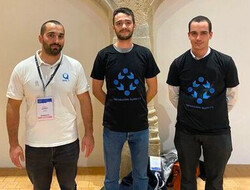
Reproducible Builds at European Cyber Week 2022 During the European Cyber Week 2022, a Capture The Flag (CTF) cybersecurity challenge was created by Fr d ric Pierret on the subject of Reproducible Builds. The challenge consisted in a pedagogical sense based on how to make a software release reproducible. To progress through the challenge issues that affect the reproducibility of build (such as build path, timestamps, file ordering, etc.) were to be fixed in steps in order to get the final flag in order to win the challenge. At the end of the competition, five people succeeded in solving the challenge, all of whom were awarded with a shirt. Fr d ric Pierret intends to create similar challenge in the form of a how to in the Reproducible Builds documentation, but two of the 2022 winners are shown here:

On business adoption and use of reproducible builds Simon Butler announced on the rb-general mailing list that the Software Quality Journal published an article called On business adoption and use of reproducible builds for open and closed source software. This article is an interview-based study which focuses on the adoption and uses of Reproducible Builds in industry, with a focus on investigating the reasons why organisations might not have adopted them:
[ ] industry application of R-Bs appears limited, and we seek to understand whether awareness is low or if significant technical and business reasons prevent wider adoption.
This is achieved through interviews with software practitioners and business managers, and touches on both the business and technical reasons supporting the adoption (or not) of Reproducible Builds. The article also begins with an excellent explanation and literature review, and even introduces a new helpful analogy for reproducible builds:
[Users are] able to perform a bitwise comparison of the two binaries to verify that they are identical and that the distributed binary is indeed built from the source code in the way the provider claims. Applied in this manner, R-Bs function as a canary, a mechanism that indicates when something might be wrong, and offer an improvement in security over running unverified binaries on computer systems.
The full paper is available to download on an open access basis. Elsewhere in academia, Beatriz Michelson Reichert and Rafael R. Obelheiro have published a paper proposing a systematic threat model for a generic software development pipeline identifying possible mitigations for each threat (PDF). Under the Tampering rubric of their paper, various attacks against Continuous Integration (CI) processes:
An attacker may insert a backdoor into a CI or build tool and thus introduce vulnerabilities into the software (resulting in an improper build). To avoid this threat, it is the developer s responsibility to take due care when making use of third-party build tools. Tampered compilers can be mitigated using diversity, as in the diverse double compiling (DDC) technique. Reproducible builds, a recent research topic, can also provide mitigation for this problem. (PDF)

Misc news
On our mailing list this month:

Debian & other Linux distributions Over 50 reviews of Debian packages were added this month, another 48 were updated and almost 30 were removed, all of which adds to our knowledge about identified issues. Two new issue types were added as well. [ ][ ]. Vagrant Cascadian announced on our mailing list another online sprint to help clear the huge backlog of reproducible builds patches submitted by performing NMUs (Non-Maintainer Uploads). The first such sprint took place on September 22nd, but others were held on October 6th and October 20th. There were two additional sprints that occurred in November, however, which resulted in the following progress: Lastly, Roland Clobus posted his latest update of the status of reproducible Debian ISO images on our mailing list. This reports that all major desktops build reproducibly with bullseye, bookworm and sid as well as that no custom patches needed to applied to Debian unstable for this result to occur. During November, however, Roland proposed some modifications to live-setup and the rebuild script has been adjusted to fix the failing Jenkins tests for Debian bullseye [ ][ ].
In other news, Miro Hron ok proposed a change to clamp build modification times to the value of SOURCE_DATE_EPOCH. This was initially suggested and discussed on a devel@ mailing list post but was later written up on the Fedora Wiki as well as being officially proposed to Fedora Engineering Steering Committee (FESCo).

Upstream patches The Reproducible Builds project detects, dissects and attempts to fix as many currently-unreproducible packages as possible. We endeavour to send all of our patches upstream where appropriate. This month, we wrote a large number of such patches, including:

diffoscope diffoscope is our in-depth and content-aware diff utility. Not only can it locate and diagnose reproducibility issues, it can provide human-readable diffs from many kinds of binary formats. This month, Chris Lamb prepared and uploaded versions 226 and 227 to Debian:
  • Support both python3-progressbar and python3-progressbar2, two modules providing the progressbar Python module. [ ]
  • Don t run Python decompiling tests on Python bytecode that file(1) cannot detect yet and Python 3.11 cannot unmarshal. (#1024335)
  • Don t attempt to attach text-only differences notice if there are no differences to begin with. (#1024171)
  • Make sure we recommend apksigcopier. [ ]
  • Tidy generation of os_list. [ ]
  • Make the code clearer around generating the Debian substvars . [ ]
  • Use our assert_diff helper in test_lzip.py. [ ]
  • Drop other copyright notices from lzip.py and test_lzip.py. [ ]
In addition to this, Christopher Baines added lzip support [ ], and FC Stegerman added an optimisation whereby we don t run apktool if no differences are detected before the signing block [ ].
A significant number of changes were made to the Reproducible Builds website and documentation this month, including Chris Lamb ensuring the openEuler logo is correctly visible with a white background [ ], FC Stegerman de-duplicated by email address to avoid listing some contributors twice [ ], Herv Boutemy added Apache Maven to the list of affiliated projects [ ] and boyska updated our Contribute page to remark that the Reproducible Builds presence on salsa.debian.org is not just the Git repository but is also for creating issues [ ][ ]. In addition to all this, however, Holger Levsen made the following changes:
  • Add a number of existing publications [ ][ ] and update metadata for some existing publications as well [ ].
  • Hide draft posts on the website homepage. [ ]
  • Add the Warpforge build tool as a participating project of the summit. [ ]
  • Clarify in the footer that we welcome patches to the website repository. [ ]

Testing framework The Reproducible Builds project operates a comprehensive testing framework at tests.reproducible-builds.org in order to check packages and other artifacts for reproducibility. In October, the following changes were made by Holger Levsen:
  • Improve the generation of meta package sets (used in grouping packages for reporting/statistical purposes) to treat Debian bookworm as equivalent to Debian unstable in this specific case [ ] and to parse the list of packages used in the Debian cloud images [ ][ ][ ].
  • Temporarily allow Frederic to ssh(1) into our snapshot server as the jenkins user. [ ]
  • Keep some reproducible jobs Jenkins logs much longer [ ] (later reverted).
  • Improve the node health checks to detect failures to update the Debian cloud image package set [ ][ ] and to improve prioritisation of some kernel warnings [ ].
  • Always echo any IRC output to Jenkins output as well. [ ]
  • Deal gracefully with problems related to processing the cloud image package set. [ ]
Finally, Roland Clobus continued his work on testing Live Debian images, including adding support for specifying the origin of the Debian installer [ ] and to warn when the image has unmet dependencies in the package list (e.g. due to a transition) [ ].
If you are interested in contributing to the Reproducible Builds project, please visit our Contribute page on our website. You can get in touch with us via:

Shirish Agarwal: Wayland, Hearing aids, Multiverse & Identity

Wayland First up, I read Antoine Beaupr s Wayland to Sway migration with interest. While he said it s done and dusted or something similar, the post shows there s still quite a ways to go. I wouldn t say it s done or whatever till it s integrated so well that a person installs it and doesn t really need to fiddle with config files as an average user. For specific use-cases you may need to, but that should be outside of a normal user (layperson) experience. I have been using mate for a long long time and truth be told been very happy with it. The only thing I found about Wayland on mate is this discussion or rather this entry. The roadmap on Ubuntu Mate is also quite iffy. The Mate Wayland entry on Debian wiki also perhaps need an updation but dunno much as the latest update it shares is 2019 and it s 2022. One thing to note, at least according to Antoine, things should be better as and when it gets integrated even on legacy hardware. I would be interested to know how it would work on old desktops and laptops rather than new or is there some barrier? I, for one would have liked to see or know about why lightdm didn t work on Wayland and if there s support. From what little I know lightdm is much lighter than gdm3 and doesn t require much memory and from what little I have experienced works very well with mate. I have been using it since 2015/16 although the Debian changelog tells me that it has been present since 2011. I was hoping to see if there was a Wayland specific mailing list, something like debian-wayland but apparently there s not :(. Using mate desktop wayland (tried few other variations on the keywords) but search fails to find any meaningful answer :(. FWIW and I don t know the reason why but Archwiki never fails to amaze me. Interestingly, it just says No for mate. I probably would contact upstream in the coming days to know what their plans are and hopefully they will document what their plans are on integrating Wayland in both short-term and long-term with an update, or if there is something more recent they have documented elsewhere, get that update on the Debian wiki so people know. The other interesting thread I read was Russel Coker s Thinkpad X1 Carbon Gen5 entry. I would be in the market in a few months to find/buy a Thinkpad but probably of AMD rather than Intel because part of recent past history with Intel as well as AMD having a bit of an edge over Intel as far as graphics is concerned. I wonder why Russel was looking into Intel and not AMD. Would be interested to know why Intel and not AMD? Any specific reason ???

Hearing Aids I finally bought hearing aids about a couple of weeks back and have been practicing using them. I was able to have quite a few conversations although music is still I m not able to listen clearly but it is still a far cry from before and for the better. I am able to have conversations with people and also reply and they do not have to make that extra effort that they needed to. Make things easier for everybody. The one I bought is at the starting range although the hearing aids go all the way to 8 lakhs for a pair (INR 800,000), the more expensive ones having WiFi, Bluetooth and more channels, it all depends on how much can one afford. And AFAIK there is not a single Indian manufacturer who is known in this business.

One thing I did notice is while the hearing aids are remarkably sturdy if they fall down as they are small, yet you have to be careful of both dust and water . That does makes life a bit difficult as my house and city both gets sand quite a bit everyday. I don t think they made any India-specific changes, if they had, would probably make things better. I haven t yet looked at it, but it may be possible to hack it remotely. There may or may not be security issues involved, probably would try once I ve bit more time am bit more comfortable to try and see what I can find out. If I had bought it before, maybe I would have applied for the Debian event happening in Kerala, if nothing else, would have been to document what happened there in detail.  I probably would have to get a new motherboard for my desktop probably in a year or two as quite a few motherboards also have WiFi (WiFi 6 ?) think on the southbridge. I at least would have a look in new year and know more as to what s been happening. For last at least 2-3 years there has been a rumor which has been confirmed time and again that the Tata Group has been in talks with multiple vendors to set chip fabrication and testing business but to date they haven t been able to find one. They do keep on giving press conferences about the same but that s all they do :(. Just shared the latest one above.

The Long War Terry Pratchett, Stephen Braxter Long Earth Terry Pratchett, Stephen Braxter ISBN13: 9780062067777 Last month there was also a seconds books sale where I was lucky enough to get my hands on the Long War. But before I share about the book itself, I had a discussion with another of my friends and had to re-share part of that conversation. While the gentleman was adamant that non-fiction books are great, my point as always is both are equal. As I shared perhaps on this blog itself, perhaps multiple times, that I had seen a YT video in which a professor shared multiple textbooks of physics and shared how they are wrong and have been wrong and kept them in a specific corner. He took the latest book which he honestly said doesn t have any mistakes as far as he know and yet still kept in that same corner denoting that it is highly possible that future understanding will make the knowledge or understanding we know different. An example of physics in the nano world and how that is different and basically turns our understanding than what we know. Now as far as the book is concerned, remember Michael Crichton s Timeline. Now that book was originally written in the 1960 s while this one was written by both the honorable gentleman in 2013. So almost 50+ years difference between the two books, and that even shows how they think about things. In this book, you no longer need a big machine, but have something called a stepper machine which is say similar to a cellphone, that size and that frame, thickness etc. In this one, the idea of multiverse is also there but done a tad differently. In this, we do not have other humans or copy humans but have multiple earths that may have same or different geography as how evolution happened. None of the multiverse earths have humans but have different species depending on the evolution that happened there. There are something called as trolls but they have a much different meaning and way about them about how most fantasy authors portray trolls. While they are big in this as well, they are as gentle as bears or rabbits. So the whole thing is about real estate and how humans have spread out on multiple earths and the politics therein. Interestingly, the story was trashed or given negative reviews on Goodreads. The sad part is/was that it was written and published in 2013 when perhaps the possibility of war or anything like that was very remote especially in the States, but now we are now in 2022 and just had an insurrection happen and whole lot of Americans are radicalized, whether you see the left or the right depending on your ideology. An American did share few weeks ago how some shares are looking at Proportional Representation and that should make both parties come more towards the center and be a bit more transparent. What was interesting to me is the fact that states have much more rights to do elections and electioneering the way they want rather than a set model which everyone has common which is what happens in India. This also does poke holes into the whole Donald Trump stolen democracy drama but that s a different story altogether. One of the more interesting things I came to know about is that there are 4 books in the long series and this was the second book in itself. I do not want to dwell on the characters themselves as frankly speaking I haven t read all the four books and it would be gross injustice on my part to talk about the characters themselves. Did I enjoy reading the book, for sure. What was interesting and very true of human nature is that even if we have the ability or had the ability to have whole worlds to ourselves, we are bound to mess it up. And in that aspect, I don t think he is too far off the mark. If I had a whole world, wouldn t I try to exploit it to the best or worse of my ability. One of the more interesting topics in the book is the barter system they have thought of that is called as favors. If you are in multiple worlds, then having a currency, even fiat money is of no use and they have to find ways and means to trade with one another. The book also touches a bit on slavery but only just and doesn t really explore it as much as it could have.

Identity Now this has many meanings to it. Couple of weeks ago, saw a transgender meet. For the uninitiated or rather people like me, basically it is about people who are born in one gender but do not identify with it but the other and they express it first through their clothes and expression and the end of the journey perhaps is with having the organs but this may or may not be feasible, as such surgery is expensive and also not available everywhere. After section 377 was repealed few years ago, we do have a third gender on forms as well as have something called a Transgender Act but how much the needle has moved in society is still a question. They were doing a roadshow near my house hence I was able to talk with them with my new hearing aids and while there was lot of traffic was able to understand some of their issues. For e.g. they find it difficult to get houses on rent, but then it is similar for bachelor guys or girls also. One could argue to what degree it is, and that perhaps maybe. Also, there is a myth that they are somehow promiscuous but that I believe is neither here or there. Osho said an average person thinks about the opposite sex every few seconds or a minute. I am sure even Freud would have similar ideas. So, if you look in that way everybody is promiscuous as far as thought is concerned. The other part being opportunity but that again is function of so many other things. Some people are able to attract a lot of people, others might not. And then whether they chose to act on that opportunity or not is another thing altogether. Another word that is or was used is called gender fluid, but that too is iffy as gender fluid may or may not mean transgender. Also, while watching some nature documentary few days/weeks back had come to know that trees have something like 18 odd genders. That just blows me out of the mind and does re-question this whole idea of sexuality and identity to only two which seems somewhat regressive at least to me. If we think humans are part of nature, then we need to be open up perhaps a bit more. But identity as I shared above has more than one meaning. For e.g. citizenship, that one is born in India is even messier to know, understand and define. I had come across this article about couple of months back. Now think about this. Now, there have been studies and surveys about citizenship and it says something like 60% birth registrations are done in metro cities. Now Metro cities are 10 as defined by Indian state. But there are roughly an odd 4k cities in India and probably twice the number of villages and those are conservative numbers as we still don t record things meticulously, maybe due to the Indian oral tradition or just being lazy or both, one part is also that if you document people and villages and towns, then you are also obligated to give them some things as a state and that perhaps is not what the Indian state wants. A small village in India could be anywhere from few hundreds of people to a few thousand. And all the new interventions whether it is PAN, Aadhar has just made holes rather than making things better. They are not inclusive but exclusive. And none of this takes into account Indian character and the way things are done in India. In most households, excluding the celebs (they are in a world of pain altogether when it comes to baby names but then it s big business but that s an entire different saga altogether, so not going to touch that.) I would use or say my individual case as that is and seems to be something which is regular even today. I was given a nickname when I was 3 years old and given a name when I was 5-6 when I was put in school. I also came to know in school few kids who didn t like their names and couple of them cajoled and actually changed their names while they were kids, most of us just stayed with what we got. I do remember sharing about nakushi or something similar a name given to few girls in Maharashtra by their parents and the state intervened and changed their names. But that too is another story in itself. What I find most problematic is that the state seems to be blind, and this seems to be by design rather than a mistake. Couple of years back, Assam did something called NRC (National Register of Citizens) and by the Govt s own account it was a failure of massive proportions. And they still want to bring in CAA, screwing up Assam more. And this is the same Govt. went shown how incorrect it was, blamed it all on the High Court and it s the same Govt. that shopped around for judges to put somebody called Mr. Saibaba (an invalid 90 year adivasi) against whom the Govt. hasn t even a single proof as of date. Apparently, they went to 6 judges who couldn t give what the decision the Govt. wanted. All this info. is in public domain. So the current party ruling, i.e. BJP just wants to make more divisions rather than taking people along as they don t have answers either on economy, inflation or issues that people are facing. One bright light has been Rahul Gandhi who has been doing a padhyatra (walking) from Kanyakumari to Kashmir and has had tremendous success although mainstream media has showed almost nothing what he is doing or why he is doing that. Not only he had people following him, there are and were many who took his example and using the same values of inclusiveness are walking where they can. And this is not to do with just a political party but more with a political thought of inclusiveness, that we are one irrespective of what I believe, eat, wear etc. And that gentleman has been giving press conferences while our dear P.M. even after 8 years doesn t have the guts to do a single press conference. Before closing, I do want to take another aspect, Rahul Gandhi s mother is an Italian or was from Italy before she married. But for BJP she is still Italian. Rishi Sunak, who has become the UK Prime Minister they think of him as Indian and yet he has sworn using the Queen s name. And the same goes for Canada Kumar (Akshay Kumar) and many others. How the right is able to blind and deaf to what it thinks is beyond me. All these people have taken an oath in the name of the Queen and they have to be loyal to her or rather now King Charles III. The disconnect continues.

Russell Coker: Thinkpad X1 Carbon Gen5

Gen1 Since February 2018 I have been using a Thinkpad X1 Carbon Gen1 [1] as my main laptop. Generally I ve been very happy with it, it s small and light, has good performance for web browsing etc, and with my transition to doing all compiles etc on servers it works well. When I wrote my original review I was unhappy with the keyboard, but I got used to that and found it to be reasonably good. The things that I have found as limits on it are the display resolution as 1600*900 isn t that great by modern standards (most phones are a lot higher resolution), the size (slightly too large for the pocket of my Scott e Vest [2] jacket), and the lack of USB-C. Modern laptops can charge via USB-C/Thunderbolt while also doing USB and DisplayPort video over the same cable. USB-C monitors which support charging a laptop over the same cable as used for video input are becoming common (last time I checked the Dell web site for many models of monitor there was a USB-C one that cost about $100 more). I work at a company with lots of USB-C monitors and docks so being able to use my personal laptop with the same displays when on breaks is really handy. A final problem with the Gen1 is that it has a proprietary and unusual connector for the SSD which means that a replacement SSD costs about what I paid for the entire laptop. Ever since the SSD gave a BTRFS checksum error I ve been thinking of replacing it. Choosing a Replacement The Gen5 is the first Thinkpad X1 Carbon to have USB-C. For work I had used a Gen6 which was quite nice [3]. But it didn t seem to offer much over the Gen5. So I started looking for cheap Thinkpad X1 Carbons of Gen5+. A Cheap? Gen5 In July I saw an ebay advert for a Gen5 with FullHD display for $370 or nearest offer, with the downside being that the BIOS password had been lost. I offered $330 and the seller accepted, in retrospect that was unusually cheap and should have been a clue that I needed to do further investigation. It turned out that resetting the BIOS password is unusually difficult as it s in the TPM so the system would only boot Windows. When I learned that I should have sold the laptop to someone who wanted to run Windows and bought another. Instead I followed some instructions on the Internet about entering a wrong password multiple times to get to a password recovery screen, instead the machine locked up entirely and became unusable for windows (so don t do that). Then I looked for ways of fixing the motherboard. The cheapest was $75.25 for a replacement BIOS flash chip that had a BIOS that didn t check the validity of passwords. The aim was to solder that on, set a new password (with any random text being accepted as the old password), then solder the old one back on for normal functionality. It turned out that I m not good at fine soldering, after I had hacked at it a friend diagnosed the chip and motherboard to probably both be damaged (he couldn t get it going). The end solution was that my friend found a replacement motherboard for $170 from China. This gave a total cost of $575.25 for the laptop which is more than the usual price of a Gen6 and more than I expected to pay. In the past when advocating buying second hand or refurbished laptops people would say what happens if you get one that doesn t work properly , the answer to that question is that I paid a lot less than the new cost of $2700+ for a Thinkpad X1 Carbon and got a computer that does everything I need. One of the advantages of getting a cheap laptop is that I won t be so unhappy if I happen to drop it. A Cheap Gen6 After the failed experiment with a replacement BIOS on the Gen5 I was considering selling it for scrap. So I bought a Gen6 from Australian Computer Traders via Amazon for $390 in August. The advert clearly stated that it was for a laptop with USB-C and Thunderbolt (Gen5+ features) but they shipped me a Gen4 that didn t even have USB-C. They eventually refunded me but I will try to avoid buying from them again. Finally Working The laptop I now have has a i5-6300U CPU that rates 3242 on cpubenchmark.net. My Gen1 thinkpad has a i7-3667U CPU that rates 2378 on cpubenchmark.net, note that the cpubenchmark.net people have rescaled their benchmark since my review of the Gen1 in 2018. So according to the benchmarks my latest laptop is about 36% faster for CPU operations. Not much of a difference when comparing systems manufactured in 2012 and 2017! According to the benchmarks a medium to high end recent CPU will be more than 10* faster than the one in my Gen5 laptop, but such a CPU would cost more than my laptop cost. The storage is a 256G NVMe device that can do sustained reads at 900MB/s, that s not even twice as fast as the SSD in my Gen1 laptop although NVMe is designed to perform better for small IO. It has 2*USB-C ports both of which can be used for charging, which is a significant benefit over the Gen6 I had for work in 2018 which only had one. I don t know why Lenovo made Gen6 machines that were lesser than Gen5 in such an important way. It can power my Desklab portable 4K monitor [4] but won t send a DisplayPort signal over the same USB-C cable. I don t know if this is a USB-C cable issue or some problem with the laptop recognising displays. It works nicely with Dell USB-C monitors and docks that power the laptop over the same cable as used for DisplayPort. Also the HDMI port works with 4K monitors, so at worst I could connect my Desklab monitor via a USB-C cable for power and HDMI for data. The inability to change the battery without disassembly is still a problem, but hopefully USB-C connected batteries capable of charging such a laptop will become affordable in the near future and I have had some practice at disassembling this laptop. It still has the Ethernet dongle annoyance, and of course the seller didn t include that. But USB ethernet devices are quite good and I have a few of them. In conclusion it s worth the $575.25 I paid for it and would have been even better value for money if I had been a bit smarter when buying. It meets the initial criteria of USB-C power and display and of fitting in my jacket pocket as well as being slightly better than my old laptop in every other way.

7 December 2022

Matthew Garrett: Making an Orbic Speed RC400L autoboot when USB power is attached

As I mentioned a couple of weeks ago, I've been trying to hack an Orbic Speed RC400L mobile hotspot so it'll automatically boot when power is attached. When plugged in it would flash a "Welcome" screen and then switch to a display showing the battery charging - it wouldn't show up on USB, and didn't turn on any networking. So, my initial assumption was that the bootloader was making a policy decision not to boot Linux. After getting root (as described in the previous post), I was able to cat /proc/mtd and see that partition 7 was titled "aboot". Aboot is a commonly used Android bootloader, based on Little Kernel - LK provides the hardware interface, aboot is simply an app that runs on top of it. I was able to find the source code for Quectel's aboot, which is intended to run on the same SoC that's in this hotspot, so it was relatively easy to line up a bunch of the Ghidra decompilation with actual source (top tip: find interesting strings in your decompilation and paste them into github search, and see whether you get a repo back).

Unfortunately looking through this showed various cases where bootloader policy decisions were made, but all of them seemed to result in Linux booting. Patching them and flashing the patched loader back to the hotspot didn't change the behaviour. So now I was confused: it seemed like Linux was loading, but there wasn't an obvious point in the boot scripts where it then decided not to do stuff. No boot logs were retained between boots, which made things even more annoying. But then I realised that, well, I have root - I can just do my own logging. I hacked in an additional init script to dump dmesg to /var, powered it down, and then plugged in a USB cable. It booted to the charging screen. I hit the power button and it booted fully, appearing on USB. I adb shelled in, checked the logs, and saw that it had booted twice. So, we were definitely entering Linux before showing the charging screen. But what was the difference?

Diffing the dmesg showed that there was a major distinction on the kernel command line. The kernel command line is data populated by the bootloader and then passed to the kernel - it's how you provide arguments that alter kernel behaviour without having to recompile it, but it's also exposed to userland by the running kernel so it also serves as a way for the bootloader to pass information to the running userland. The boot that resulted in the charging screen had a androidboot.poweronreason=USB argument, the one that booted fully had androidboot.poweronreason=PWRKEY. Searching the filesystem for androidboot.poweronreason showed that the script that configures USB did not enable USB if poweronreason was USB, and the same string also showed up in a bunch of other applications. The bootloader was always booting Linux, but it was telling Linux why it had booted, and if that reason was "USB" then Linux was choosing not to enable USB and not starting the networking stack.

One approach would be to modify every application that parsed this data and make it work even if the power on reason was "USB". That would have been tedious. It seemed easier to modify the bootloader. Looking for that string in Ghidra showed that it was reading a register from the power management controller and then interpreting that to determine the reason it had booted. In effect, it was doing something like:
boot_reason = read_pmic_boot_reason();
switch(boot_reason)  
case 0x10:
  bootparam = strdup("androidboot.poweronreason=PWRKEY");
  break;
case 0x20:
  bootparam = strdup("androidboot.poweronreason=USB");
  break;
default:
  bootparam = strdup("androidboot.poweronreason=Hard_Reset");
 
Changing the 0x20 to 0xff meant that the USB case would never be detected, and it would fall through to the default. All the userland code was happy to accept "Hard_Reset" as a legitimate reason to boot, and now plugging in USB results in the modem booting to a functional state. Woo.

If you want to do this yourself, dump the aboot partition from your device, and search for the hex sequence "03 02 00 0a 20"". Change the final 0x20 to 0xff, copy it back to the device, and write it to mtdblock7. If it doesn't work, feel free to curse me, but I'm almost certainly going to be no use to you whatsoever. Also, please, do not just attempt to mechanically apply this to other hotspots. It's not going to end well.

comment count unavailable comments

3 December 2022

Vincent Bernat: Broken commit diff on Cisco IOS XR

TL;DR Never trust show commit changes diff on Cisco IOS XR.

Cisco IOS XR is the operating system running for the Cisco ASR, NCS, and 8000 routers. Compared to Cisco IOS, it features a candidate configuration and a running configuration. In configuration mode, you can modify the first one and issue the commit command to apply it to the running configuration.1 This is a common concept for many NOS. Before committing the candidate configuration to the running configuration, you may want to check the changes that have accumulated until now. That s where the show commit changes diff command2 comes up. Its goal is to show the difference between the running configuration (show running-configuration) and the candidate configuration (show configuration merge). How hard can it be? Let s put an interface down on IOS XR 7.6.2 (released in August 2022):
RP/0/RP0/CPU0:router(config)#int Hu0/1/0/1 shut
RP/0/RP0/CPU0:router(config)#show commit changes diff
Wed Nov 23 11:08:30.275 CET
Building configuration...
!! IOS XR Configuration 7.6.2
+  interface HundredGigE0/1/0/1
+   shutdown
   !
end
The + sign before interface HundredGigE0/1/0/1 makes it look like you did create a new interface. Maybe there was a typo? No, the diff is just broken. If you look at the candidate configuration, everything is like you expect:
RP/0/RP0/CPU0:router(config)#show configuration merge int Hu0/1/0/1
Wed Nov 23 11:08:43.360 CET
interface HundredGigE0/1/0/1
 description PNI: (some description)
 bundle id 4000 mode active
 lldp
  receive disable
  transmit disable
 !
 shutdown
 load-interval 30
Here is a more problematic example on IOS XR 7.2.2 (released in January 2021). We want to unconfigure three interfaces:
RP/0/RP0/CPU0:router(config)#no int GigabitEthernet 0/0/0/5
RP/0/RP0/CPU0:router(config)#int TenGigE 0/0/0/5 shut
RP/0/RP0/CPU0:router(config)#no int TenGigE 0/0/0/28
RP/0/RP0/CPU0:router(config)#int TenGigE 0/0/0/28 shut
RP/0/RP0/CPU0:router(config)#no int TenGigE 0/0/0/29
RP/0/RP0/CPU0:router(config)#int TenGigE 0/0/0/29 shut
RP/0/RP0/CPU0:router(config)#show commit changes diff
Mon Nov  7 15:07:22.990 CET
Building configuration...
!! IOS XR Configuration 7.2.2
-  interface GigabitEthernet0/0/0/5
-   shutdown
   !
+  interface TenGigE0/0/0/5
+   shutdown
   !
   interface TenGigE0/0/0/28
-   description Trunk (some description)
-   bundle id 2 mode active
   !
end
The two first commands are correctly represented by the first two chunks of the diff: we remove GigabitEthernet0/0/0/5 and create TenGigE0/0/0/5. The two next commands are also correctly represented by the last chunk of the diff. TenGigE0/0/0/28 was already shut down, so it is expected that only description and bundle id are removed. However, the diff command forgets about the modifications for TenGigE0/0/0/29. The diff should include a chunk similar to the last one.
RP/0/RP0/CPU0:router(config)#show run int TenGigE 0/0/0/29
Mon Nov  7 15:07:43.571 CET
interface TenGigE0/0/0/29
 description Trunk to other router
 bundle id 2 mode active
 shutdown
!
RP/0/RP0/CPU0:router(config)#show configuration merge int TenGigE 0/0/0/29
Mon Nov  7 15:07:53.584 CET
interface TenGigE0/0/0/29
 shutdown
!
How can the diff be correct for TenGigE0/0/0/28 but incorrect for TenGigE0/0/0/29 while they have the same configuration? How can you trust the diff command if it forgets part of the configuration? Do you remember the last time you ran an Ansible playbook and discovered the whole router ospf block disappeared without a warning? If you use automation tools, you should check how the diff is assembled. Automation tools should build it from the result of show running-config and show configuration merge. This is what NAPALM does. This is not what cisco.iosxr collection for Ansible does. The problem is not limited to the interface directives. You can get similar issues for other parts of the configuration. For example, here is what we get when removing inactive BGP neighbors on IOS XR 7.2.2:
RP/0/RP0/CPU0:router(config)#router bgp 65400
RP/0/RP0/CPU0:router(config-bgp)#vrf public
RP/0/RP0/CPU0:router(config-bgp-vrf)#no neighbor 217.29.66.1
RP/0/RP0/CPU0:router(config-bgp-vrf)#no neighbor 217.29.66.75
RP/0/RP0/CPU0:router(config-bgp-vrf)#no neighbor 217.29.66.110
RP/0/RP0/CPU0:router(config-bgp-vrf)#no neighbor 217.29.66.112
RP/0/RP0/CPU0:router(config-bgp-vrf)#no neighbor 217.29.66.158
RP/0/RP0/CPU0:router(config-bgp-vrf)#show commit changes diff
Tue Aug  2 13:58:02.536 CEST
Building configuration...
!! IOS XR Configuration 7.2.2
   router bgp 65400
    vrf public
-    neighbor 217.29.66.1
-     remote-as 16004
-     use neighbor-group MIX_IPV4_PUBLIC
-     description MIX: MIX-IT
     !
-    neighbor 217.29.66.75
-     remote-as 49367
-     use neighbor-group MIX_IPV4_PUBLIC
     !
-    neighbor 217.29.67.10
-     remote-as 19679
     !
-    neighbor 217.29.67.15
-    neighbor 217.29.66.112
-     remote-as 8075
-     use neighbor-group MIX_IPV4_PUBLIC
-     description MIX: Microsoft
-     address-family ipv4 unicast
-      maximum-prefix 1500 95 restart 5
      !
     !
-    neighbor 217.29.66.158
-     remote-as 24482
-     use neighbor-group MIX_IPV4_PUBLIC
-     description MIX: SG.GS
-     address-family ipv4 unicast
     !
     !
    !
   !
end
The only correct chunk is for neighbor 217.29.66.112. All the others are missing some of the removed lines. 217.29.67.15 is even missing all of them. How bad is the code providing such a diff? I could go all day with examples such as these. Cisco TAC is happy to open a case in DDTS, their bug tracker, to fix specific occurrences of this bug.3 However, I fail to understand why the XR team is not just providing the diff between show run and show configuration merge. The output would always be correct!

  1. IOS XR has several limitations. The most inconvenient one is the inability to change the AS number in the router bgp directive. Such a limitation is a great pain for both operations and automation.
  2. This command could have been just show commit, as show commit changes diff is the only valid command you can execute from this point. Starting from IOS XR 7.5.1, show commit changes diff precise is also a valid command. However, I have failed to find any documentation about it and it seems to provide the same output as show commit changes diff. That s how clunky IOS XR can be.
  3. See CSCwa26251 as an example of a fix for something I reported earlier this year. You need a valid Cisco support contract to be able to see its content.

2 December 2022

Junichi Uekawa: Already December.

Already December. Things changed a lot. Six months ago I was at home most of the time. I hope I can keep on going out for a while.
Paul Wise: FLOSS Activities November 2022

Focus This month I didn't have any particular focus. I just worked on issues in my info bubble.

Changes

Issues

Review

Administration
  • Debian IRC: setup topic/entrymsg to redirect OFTC #debian-jp to the Debian Japan IRC server, cleaned up #debianppc ChanServ metadata
  • Debian wiki: unblock IP addresses, approve domains, approve accounts

Communication

Sponsors The libemail-outlook-message-perl, purple-discord, sptag, celery work was sponsored. All other work was done on a volunteer basis.

Next.

Previous.