Search Results: "ina"

25 February 2024

Jacob Adams: AAC and Debian

Currently, in a default installation of Debian with the GNOME desktop, Bluetooth headphones that require the AAC codec1 cannot be used. As the Debian wiki outlines, using the AAC codec over Bluetooth, while technically supported by PipeWire, is explicitly disabled in Debian at this time. This is because the fdk-aac library needed to enable this support is currently in the non-free component of the repository, meaning that PipeWire, which is in the main component, cannot depend on it.

How to Fix it Yourself If what you, like me, need is simply for Bluetooth Audio to work with AAC in Debian s default desktop environment2, then you ll need to rebuild the pipewire package to include the AAC codec. While the current version in Debian main has been built with AAC deliberately disabled, it is trivial to enable if you can install a version of the fdk-aac library. I preface this with the usual caveats when it comes to patent and licensing controversies. I am not a lawyer, building this package and/or using it could get you into legal trouble. These instructions have only been tested on an up-to-date copy of Debian 12.
  1. Install pipewire s build dependencies
    sudo apt install build-essential devscripts
    sudo apt build-dep pipewire
    
  2. Install libfdk-aac-dev
    sudo apt install libfdk-aac-dev
    
    If the above doesn t work you ll likely need to enable non-free and try again
    sudo sed -i 's/main/main non-free/g' /etc/apt/sources.list
    sudo apt update
    
    Alternatively, if you wish to ensure you are maximally license-compliant and patent un-infringing3, you can instead build fdk-aac-free which includes only those components of AAC that are known to be patent-free3. This is what should eventually end up in Debian to resolve this problem (see below).
    sudo apt install git-buildpackage
    mkdir fdk-aac-source
    cd fdk-aac-source
    git clone https://salsa.debian.org/multimedia-team/fdk-aac
    cd fdk-aac
    gbp buildpackage
    sudo dpkg -i ../libfdk-aac2_*deb ../libfdk-aac-dev_*deb
    
  3. Get the pipewire source code
    mkdir pipewire-source
    cd pipewire-source
    apt source pipewire
    
    This will create a bunch of files within the pipewire-source directory, but you ll only need the pipewire-<version> folder, this contains all the files you ll need to build the package, with all the debian-specific patches already applied. Note that you don t want to run the apt source command as root, as it will then create files that your regular user cannot edit.
  4. Fix the dependencies and build options To fix up the build scripts to use the fdk-aac library, you need to save the following as pipewire-source/aac.patch
    --- debian/control.orig
    +++ debian/control
    @@ -40,8 +40,8 @@
                 modemmanager-dev,
                 pkg-config,
                 python3-docutils,
    -               systemd [linux-any]
    -Build-Conflicts: libfdk-aac-dev
    +               systemd [linux-any],
    +               libfdk-aac-dev
     Standards-Version: 4.6.2
     Vcs-Browser: https://salsa.debian.org/utopia-team/pipewire
     Vcs-Git: https://salsa.debian.org/utopia-team/pipewire.git
    --- debian/rules.orig
    +++ debian/rules
    @@ -37,7 +37,7 @@
     		-Dauto_features=enabled \
     		-Davahi=enabled \
     		-Dbluez5-backend-native-mm=enabled \
    -		-Dbluez5-codec-aac=disabled \
    +		-Dbluez5-codec-aac=enabled \
     		-Dbluez5-codec-aptx=enabled \
     		-Dbluez5-codec-lc3=enabled \
     		-Dbluez5-codec-lc3plus=disabled \
    
    Then you ll need to run patch from within the pipewire-<version> folder created by apt source:
    patch -p0 < ../aac.patch
    
  5. Build pipewire
    cd pipewire-*
    debuild
    
    Note that you will likely see an error from debsign at the end of this process, this is harmless, you simply don t have a GPG key set up to sign your newly-built package4. Packages don t need to be signed to be installed, and debsign uses a somewhat non-standard signing process that dpkg does not check anyway.
  1. Install libspa-0.2-bluetooth
    sudo dpkg -i libspa-0.2-bluetooth_*.deb
    
  2. Restart PipeWire and/or Reboot
    sudo reboot
    
    Theoretically there s a set of services to restart here that would get pipewire to pick up the new library, probably just pipewire itself. But it s just as easy to restart and ensure everything is using the correct library.

Why This is a slightly unusual situation, as the fdk-aac library is licensed under what even the GNU project acknowledges is a free software license. However, this license explicitly informs the user that they need to acquire a patent license to use this software5:
3. NO PATENT LICENSE NO EXPRESS OR IMPLIED LICENSES TO ANY PATENT CLAIMS, including without limitation the patents of Fraunhofer, ARE GRANTED BY THIS SOFTWARE LICENSE. Fraunhofer provides no warranty of patent non-infringement with respect to this software. You may use this FDK AAC Codec software or modifications thereto only for purposes that are authorized by appropriate patent licenses.
To quote the GNU project:
Because of this, and because the license author is a known patent aggressor, we encourage you to be careful about using or redistributing software under this license: you should first consider whether the licensor might aim to lure you into patent infringement.
AAC is covered by a number of patents, which expire at some point in the 2030s6. As such the current version of the library is potentially legally dubious to ship with any other software, as it could be considered patent-infringing3.

Fedora s solution Since 2017, Fedora has included a modified version of the library as fdk-aac-free, see the announcement and the bugzilla bug requesting review. This version of the library includes only the AAC LC profile, which is believed to be entirely patent-free3. Based on this, there is an open bug report in Debian requesting that the fdk-aac package be moved to the main component and that the pipwire package be updated to build against it.

The Debian NEW queue To resolve these bugs, a version of fdk-aac-free has been uploaded to Debian by Jeremy Bicha. However, to make it into Debian proper, it must first pass through the ftpmaster s NEW queue. The current version of fdk-aac-free has been in the NEW queue since July 2023. Based on conversations in some of the bugs above, it s been there since at least 20227. I hope this helps anyone stuck with AAC to get their hardware working for them while we wait for the package to eventually make it through the NEW queue. Discuss on Hacker News
  1. Such as, for example, any Apple AirPods, which only support AAC AFAICT.
  2. Which, as of Debian 12 is GNOME 3 under Wayland with PipeWire.
  3. I m not a lawyer, I don t know what kinds of infringement might or might not be possible here, do your own research, etc. 2 3 4
  4. And if you DO have a key setup with debsign you almost certainly don t need these instructions.
  5. This was originally phrased as explicitly does not grant any patent rights. It was pointed out on Hacker News that this is not exactly what it says, as it also includes a specific note that you ll need to acquire your own patent license. I ve now quoted the relevant section of the license for clarity.
  6. Wikipedia claims the base patents expire in 2031, with the extensions expiring in 2038, but its source for these claims is some guy s spreadsheet in a forum. The same discussion also brings up Wikipedia s claim and casts some doubt on it, so I m not entirely sure what s correct here, but I didn t feel like doing a patent deep-dive today. If someone can provide a clear answer that would be much appreciated.
  7. According to Jeremy B cha: https://bugs.debian.org/cgi-bin/bugreport.cgi?bug=1021370#17

24 February 2024

Niels Thykier: Language Server for Debian: Spellchecking

This is my third update on writing a language server for Debian packaging files, which aims at providing a better developer experience for Debian packagers. Lets go over what have done since the last report.
Semantic token support I have added support for what the Language Server Protocol (LSP) call semantic tokens. These are used to provide the editor insights into tokens of interest for users. Allegedly, this is what editors would use for syntax highlighting as well. Unfortunately, eglot (emacs) does not support semantic tokens, so I was not able to test this. There is a 3-year old PR for supporting with the last update being ~3 month basically saying "Please sign the Copyright Assignment". I pinged the GitHub issue in the hopes it will get unstuck. For good measure, I also checked if I could try it via neovim. Before installing, I read the neovim docs, which helpfully listed the features supported. Sadly, I did not spot semantic tokens among those and parked from there. That was a bit of a bummer, but I left the feature in for now. If you have an LSP capable editor that supports semantic tokens, let me know how it works for you! :)
Spellchecking Finally, I implemented something Otto was missing! :) This stared with Paul Wise reminding me that there were Python binding for the hunspell spellchecker. This enabled me to get started with a quick prototype that spellchecked the Description fields in debian/control. I also added spellchecking of comments while I was add it. The spellchecker runs with the standard en_US dictionary from hunspell-en-us, which does not have a lot of technical terms in it. Much less any of the Debian specific slang. I spend considerable time providing a "built-in" wordlist for technical and Debian specific slang to overcome this. I also made a "wordlist" for known Debian people that the spellchecker did not recognise. Said wordlist is fairly short as a proof of concept, and I fully expect it to be community maintained if the language server becomes a success. My second problem was performance. As I had suspected that spellchecking was not the fastest thing in the world. Therefore, I added a very small language server for the debian/changelog, which only supports spellchecking the textual part. Even for a small changelog of a 1000 lines, the spellchecking takes about 5 seconds, which confirmed my suspicion. With every change you do, the existing diagnostics hangs around for 5 seconds before being updated. Notably, in emacs, it seems that diagnostics gets translated into an absolute character offset, so all diagnostics after the change gets misplaced for every character you type. Now, there is little I could do to speed up hunspell. But I can, as always, cheat. The way diagnostics work in the LSP is that the server listens to a set of notifications like "document opened" or "document changed". In a response to that, the LSP can start its diagnostics scanning of the document and eventually publish all the diagnostics to the editor. The spec is quite clear that the server owns the diagnostics and the diagnostics are sent as a "notification" (that is, fire-and-forgot). Accordingly, there is nothing that prevents the server from publishing diagnostics multiple times for a single trigger. The only requirement is that the server publishes the accumulated diagnostics in every publish (that is, no delta updating). Leveraging this, I had the language server for debian/changelog scan the document and publish once for approximately every 25 typos (diagnostics) spotted. This means you quickly get your first result and that clears the obsolete diagnostics. Thereafter, you get frequent updates to the remainder of the document if you do not perform any further changes. That is, up to a predefined max of typos, so we do not overload the client for longer changelogs. If you do any changes, it resets and starts over. The only bit missing was dealing with concurrency. By default, a pygls language server is single threaded. It is not great if the language server hangs for 5 seconds everytime you type anything. Fortunately, pygls has builtin support for asyncio and threaded handlers. For now, I did an async handler that await after each line and setup some manual detection to stop an obsolete diagnostics run. This means the server will fairly quickly abandon an obsolete run. Also, as a side-effect of working on the spellchecking, I fixed multiple typos in the changelog of debputy. :)
Follow up on the "What next?" from my previous update In my previous update, I mentioned I had to finish up my python-debian changes to support getting the location of a token in a deb822 file. That was done, the MR is now filed, and is pending review. Hopefully, it will be merged and uploaded soon. :) I also submitted my proposal for a different way of handling relationship substvars to debian-devel. So far, it seems to have received only positive feedback. I hope it stays that way and we will have this feature soon. Guillem proposed to move some of this into dpkg, which might delay my plans a bit. However, it might be for the better in the long run, so I will wait a bit to see what happens on that front. :) As noted above, I managed to add debian/changelog as a support format for the language server. Even if it only does spellchecking and trimming of trailing newlines on save, it technically is a new format and therefore cross that item off my list. :D Unfortunately, I did not manage to write a linter variant that does not involve using an LSP-capable editor. So that is still pending. Instead, I submitted an MR against elpa-dpkg-dev-el to have it recognize all the fields that the debian/control LSP knows about at this time to offset the lack of semantic token support in eglot.
From here... My sprinting on this topic will soon come to an end, so I have to a bit more careful now with what tasks I open! I think I will narrow my focus to providing a batch linting interface. Ideally, with an auto-fix for some of the more mechanical issues, where this is little doubt about the answer. Additionally, I think the spellchecking will need a bit more maturing. My current code still trips on naming patterns that are "clearly" verbatim or code references like things written in CamelCase or SCREAMING_SNAKE_CASE. That gets annoying really quickly. It also trips on a lot of commands like dpkg-gencontrol, but that is harder to fix since it could have been a real word. I think those will have to be fixed people using quotes around the commands. Maybe the most popular ones will end up in the wordlist. Beyond that, I will play it by ear if I have any time left. :)

23 February 2024

Gunnar Wolf: 10 things software developers should learn about learning

This post is a review for Computing Reviews for 10 things software developers should learn about learning , a article published in Communications of the ACM
As software developers, we understand the detailed workings of the different components of our computer systems. And probably due to how computers were presented since their appearance as digital brains in the 1940s we sometimes believe we can transpose that knowledge to how our biological brains work, be it as learners or as problem solvers. This article aims at making the reader understand several mechanisms related to how learning and problem solving actually work in our brains. It focuses on helping expert developers convey knowledge to new learners, as well as learners who need to get up to speed and start coding. The article s narrative revolves around software developers, but much of what it presents can be applied to different problem domains. The article takes this mission through ten points, with roughly the same space given to each of them, starting with wrong assumptions many people have about the similarities between computers and our brains. The first section, Human Memory Is Not Made of Bits, explains the brain processes of remembering as a way of strengthening the force of a memory ( reconsolidation ) and the role of activation in related network pathways. The second section, Human Memory Is Composed of One Limited and One Unlimited System, goes on to explain the organization of memories in the brain between long-term memory (functionally limitless, permanent storage) and working memory (storing little amounts of information used for solving a problem at hand). However, the focus soon shifts to how experience in knowledge leads to different ways of using the same concepts, the importance of going from abstract to concrete knowledge applications and back, and the role of skills repetition over time. Toward the end of the article, the focus shifts from the mechanical act of learning to expertise. Section 6, The Internet Has Not Made Learning Obsolete, emphasizes that problem solving is not just putting together the pieces of a puzzle; searching online for solutions to a problem does not activate the neural pathways that would get fired up otherwise. The final sections tackle the differences that expertise brings to play when teaching or training a newcomer: the same tools that help the beginner s productivity as training wheels will often hamper the expert user s as their knowledge has become automated. The article is written with a very informal and easy-to-read tone and vocabulary, and brings forward several issues that might seem like commonsense but do ring bells when it comes to my own experiences both as a software developer and as a teacher. The article closes by suggesting several books that further expand on the issues it brings forward. While I could not identify a single focus or thesis with which to characterize this article, the several points it makes will likely help readers better understand (and bring forward to consciousness) mental processes often taken for granted, and consider often-overlooked aspects when transmitting knowledge to newcomers.

21 February 2024

Niels Thykier: Expanding on the Language Server (LSP) support for debian/control

I have spent some more time on improving my language server for debian/control. Today, I managed to provide the following features:
  • The X- style prefixes for field names are now understood and handled. This means the language server now considers XC-Package-Type the same as Package-Type.

  • More diagnostics:

    • Fields without values now trigger an error marker
    • Duplicated fields now trigger an error marker
    • Fields used in the wrong paragraph now trigger an error marker
    • Typos in field names or values now trigger a warning marker. For field names, X- style prefixes are stripped before typo detection is done.
    • The value of the Section field is now validated against a dataset of known sections and trigger a warning marker if not known.
  • The "on-save trim end of line whitespace" now works. I had a logic bug in the server side code that made it submit "no change" edits to the editor.

  • The language server now provides "hover" documentation for field names. There is a small screenshot of this below. Sadly, emacs does not support markdown or, if it does, it does not announce the support for markdown. For now, all the documentation is always in markdown format and the language server will tag it as either markdown or plaintext depending on the announced support.

  • The language server now provides quick fixes for some of the more trivial problems such as deprecated fields or typos of fields and values.

  • Added more known fields including the XS-Autobuild field for non-free packages along with a link to the relevant devref section in its hover doc.

This covers basically all my known omissions from last update except spellchecking of the Description field. An image of emacs showing documentation for the Provides field from the language server.
Spellchecking Personally, I feel spellchecking would be a very welcome addition to the current feature set. However, reviewing my options, it seems that most of the spellchecking python libraries out there are not packaged for Debian, or at least not other the name I assumed they would be. The alternative is to pipe the spellchecking to another program like aspell list. I did not test this fully, but aspell list does seem to do some input buffering that I cannot easily default (at least not in the shell). Though, either way, the logic for this will not be trivial and aspell list does not seem to include the corrections either. So best case, you would get typo markers but no suggestions for what you should have typed. Not ideal. Additionally, I am also concerned with the performance for this feature. For d/control, it will be a trivial matter in practice. However, I would be reusing this for d/changelog which is 99% free text with plenty of room for typos. For a regular linter, some slowness is acceptable as it is basically a batch tool. However, for a language server, this potentially translates into latency for your edits and that gets annoying. While it is definitely on my long term todo list, I am a bit afraid that it can easily become a time sink. Admittedly, this does annoy me, because I wanted to cross off at least one of Otto's requested features soon.
On wrap-and-sort support The other obvious request from Otto would be to automate wrap-and-sort formatting. Here, the problem is that "we" in Debian do not agree on the one true formatting of debian/control. In fact, I am fairly certain we do not even agree on whether we should all use wrap-and-sort. This implies we need a style configuration. However, if we have a style configuration per person, then you get style "ping-pong" for packages where the co-maintainers do not all have the same style configuration. Additionally, it is very likely that you are a member of multiple packaging teams or groups that all have their own unique style. Ergo, only having a personal config file is doomed to fail. The only "sane" option here that I can think of is to have or support "per package" style configuration. Something that would be committed to git, so the tooling would automatically pick up the configuration. Obviously, that is not fun for large packaging teams where you have to maintain one file per package if you want a consistent style across all packages. But it beats "style ping-pong" any day of the week. Note that I am perfectly open to having a personal configuration file as a fallback for when the "per package" configuration file is absent. The second problem is the question of which format to use and what to name this file. Since file formats and naming has never been controversial at all, this will obviously be the easy part of this problem. But the file should be parsable by both wrap-and-sort and the language server, so you get the same result regardless of which tool you use. If we do not ensure this, then we still have the style ping-pong problem as people use different tools. This also seems like time sink with no end. So, what next then...?
What next? On the language server front, I will have a look at its support for providing semantic hints to the editors that might be used for syntax highlighting. While I think most common Debian editors have built syntax highlighting already, I would like this language server to stand on its own. I would like us to be in a situation where we do not have implement yet another editor extension for Debian packaging files. At least not for editors that support the LSP spec. On a different front, I have an idea for how we go about relationship related substvars. It is not directly related to this language server, except I got triggered by the language server "missing" a diagnostic for reminding people to add the magic Depends: $ misc:Depends [, $ shlibs:Depends ] boilerplate. The magic boilerplate that you have to write even though we really should just fix this at a tooling level instead. Energy permitting, I will formulate a proposal for that and send it to debian-devel. Beyond that, I think I might start adding support for another file. I also need to wrap up my python-debian branch, so I can get the position support into the Debian soon, which would remove one papercut for using this language server. Finally, it might be interesting to see if I can extract a "batch-linter" version of the diagnostics and related quickfix features. If nothing else, the "linter" variant would enable many of you to get a "mini-Lintian" without having to do a package build first.

20 February 2024

Niels Thykier: Language Server (LSP) support for debian/control

About a month ago, Otto Kek l inen asked for editor extensions for debian related files on the debian-devel mailing list. In that thread, I concluded that what we were missing was a "Language Server" (LSP) for our packaging files. Last week, I started a prototype for such a LSP for the debian/control file as a starting point based on the pygls library. The initial prototype worked and I could do very basic diagnostics plus completion suggestion for field names.
Current features I got 4 basic features implemented, though I have only been able to test two of them in emacs.
  • Diagnostics or linting of basic issues.
  • Completion suggestions for all known field names that I could think of and values for some fields.
  • Folding ranges (untested). This feature enables the editor to "fold" multiple lines. It is often used with multi-line comments and that is the feature currently supported.
  • On save, trim trailing whitespace at the end of lines (untested). Might not be registered correctly on the server end.
Despite its very limited feature set, I feel editing debian/control in emacs is now a much more pleasant experience. Coming back to the features that Otto requested, the above covers a grand total of zero. Sorry, Otto. It is not you, it is me.
Completion suggestions For completion, all known fields are completed. Place the cursor at the start of the line or in a partially written out field name and trigger the completion in your editor. In my case, I can type R-R-R and trigger the completion and the editor will automatically replace it with Rules-Requires-Root as the only applicable match. Your milage may vary since I delegate most of the filtering to the editor, meaning the editor has the final say about whether your input matches anything. The only filtering done on the server side is that the server prunes out fields already used in the paragraph, so you are not presented with the option to repeat an already used field, which would be an error. Admittedly, not an error the language server detects at the moment, but other tools will. When completing field, if the field only has one non-default value such as Essential which can be either no (the default, but you should not use it) or yes, then the completion suggestion will complete the field along with its value. This is mostly only applicable for "yes/no" fields such as Essential and Protected. But it does also trigger for Package-Type at the moment. As for completing values, here the language server can complete the value for simple fields such as "yes/no" fields, Multi-Arch, Package-Type and Priority. I intend to add support for Section as well - maybe also Architecture.
Diagnostics On the diagnostic front, I have added multiple diagnostics:
  • An error marker for syntax errors.
  • An error marker for missing a mandatory field like Package or Architecture. This also includes Standards-Version, which is admittedly mandatory by policy rather than tooling falling part.
  • An error marker for adding Multi-Arch: same to an Architecture: all package.
  • Error marker for providing an unknown value to a field with a set of known values. As an example, writing foo in Multi-Arch would trigger this one.
  • Warning marker for using deprecated fields such as DM-Upload-Allowed, or when setting a field to its default value for fields like Essential. The latter rule only applies to selected fields and notably Multi-Arch: no does not trigger a warning.
  • Info level marker if a field like Priority duplicates the value of the Source paragraph.
Notable omission at this time:
  • No errors are raised if a field does not have a value.
  • No errors are raised if a field is duplicated inside a paragraph.
  • No errors are used if a field is used in the wrong paragraph.
  • No spellchecking of the Description field.
  • No understanding that Foo and X[CBS]-Foo are related. As an example, XC-Package-Type is completely ignored despite being the old name for Package-Type.
  • Quick fixes to solve these problems... :)
Trying it out If you want to try, it is sadly a bit more involved due to things not being uploaded or merged yet. Also, be advised that I will regularly rebase my git branches as I revise the code. The setup:
  • Build and install the deb of the main branch of pygls from https://salsa.debian.org/debian/pygls The package is in NEW and hopefully this step will soon just be a regular apt install.
  • Build and install the deb of the rts-locatable branch of my python-debian fork from https://salsa.debian.org/nthykier/python-debian There is a draft MR of it as well on the main repo.
  • Build and install the deb of the lsp-support branch of debputy from https://salsa.debian.org/debian/debputy
  • Configure your editor to run debputy lsp debian/control as the language server for debian/control. This is depends on your editor. I figured out how to do it for emacs (see below). I also found a guide for neovim at https://neovim.io/doc/user/lsp. Note that debputy can be run from any directory here. The debian/control is a reference to the file format and not a concrete file in this case.
Obviously, the setup should get easier over time. The first three bullet points should eventually get resolved by merges and upload meaning you end up with an apt install command instead of them. For the editor part, I would obviously love it if we can add snippets for editors to make the automatically pick up the language server when the relevant file is installed.
Using the debputy LSP in emacs The guide I found so far relies on eglot. The guide below assumes you have the elpa-dpkg-dev-el package installed for the debian-control-mode. Though it should be a trivially matter to replace debian-control-mode with a different mode if you use a different mode for your debian/control file. In your emacs init file (such as ~/.emacs or ~/.emacs.d/init.el), you add the follow blob.
(with-eval-after-load 'eglot
    (add-to-list 'eglot-server-programs
        '(debian-control-mode . ("debputy" "lsp" "debian/control"))))
Once you open the debian/control file in emacs, you can type M-x eglot to activate the language server. Not sure why that manual step is needed and if someone knows how to automate it such that eglot activates automatically on opening debian/control, please let me know. For testing completions, I often have to manually activate them (with C-M-i or M-x complete-symbol). Though, it is a bit unclear to me whether this is an emacs setting that I have not toggled or something I need to do on the language server side.
From here As next steps, I will probably look into fixing some of the "known missing" items under diagnostics. The quick fix would be a considerable improvement to assisting users. In the not so distant future, I will probably start to look at supporting other files such as debian/changelog or look into supporting configuration, so I can cover formatting features like wrap-and-sort. I am also very much open to how we can provide integrations for this feature into editors by default. I will probably create a separate binary package for specifically this feature that pulls all relevant dependencies that would be able to provide editor integrations as well.

Jonathan Dowland: Propaganda A Secret Wish

How can I not have done one of these for Propaganda already?
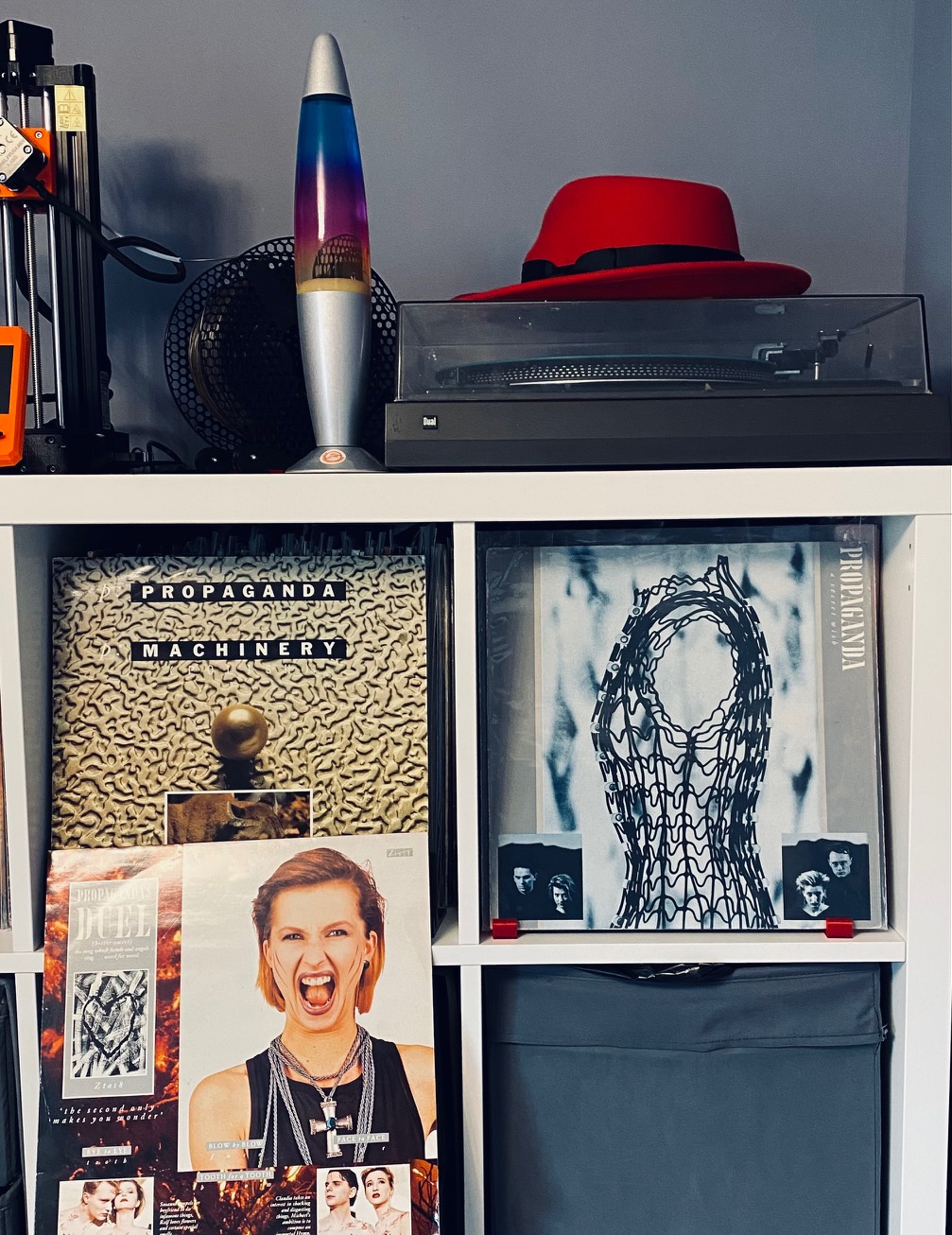
Propaganda: A Secret Wish, and 12"s of Duel and p:Machinery
Propaganda/A Secret Wish is criminally underrated. There seem to be a zillion variants of each track, which keeps completionists busy. Of the variants of Jewel/Duel/etc., I'm fond of the 03:10, almost instrumental mix of Jewel; preferring the lyrics to be exclusive to the more radio friendly Duel (04:42); I don't need them conflating (Jewel 06:21); but there are further depths I've yet to explore (Do Well cassette mix, the 20:07 The First Cut / Duel / Jewel (Cut Rough)/ Wonder / Bejewelled mega-mix...) I recently watched The Fall of the House of Usher which I think has Poe lodged in my brain, which is how this album popped back into my conciousness this morning, with the opening lines of Dream within a Dream. But are they Goth?

19 February 2024

Matthew Garrett: Debugging an odd inability to stream video

We have a cabin out in the forest, and when I say "out in the forest" I mean "in a national forest subject to regulation by the US Forest Service" which means there's an extremely thick book describing the things we're allowed to do and (somewhat longer) not allowed to do. It's also down in the bottom of a valley surrounded by tall trees (the whole "forest" bit). There used to be AT&T copper but all that infrastructure burned down in a big fire back in 2021 and AT&T no longer supply new copper links, and Starlink isn't viable because of the whole "bottom of a valley surrounded by tall trees" thing along with regulations that prohibit us from putting up a big pole with a dish on top. Thankfully there's LTE towers nearby, so I'm simply using cellular data. Unfortunately my provider rate limits connections to video streaming services in order to push them down to roughly SD resolution. The easy workaround is just to VPN back to somewhere else, which in my case is just a Wireguard link back to San Francisco.

This worked perfectly for most things, but some streaming services simply wouldn't work at all. Attempting to load the video would just spin forever. Running tcpdump at the local end of the VPN endpoint showed a connection being established, some packets being exchanged, and then nothing. The remote service appeared to just stop sending packets. Tcpdumping the remote end of the VPN showed the same thing. It wasn't until I looked at the traffic on the VPN endpoint's external interface that things began to become clear.

This probably needs some background. Most network infrastructure has a maximum allowable packet size, which is referred to as the Maximum Transmission Unit or MTU. For ethernet this defaults to 1500 bytes, and these days most links are able to handle packets of at least this size, so it's pretty typical to just assume that you'll be able to send a 1500 byte packet. But what's important to remember is that that doesn't mean you have 1500 bytes of packet payload - that 1500 bytes includes whatever protocol level headers are on there. For TCP/IP you're typically looking at spending around 40 bytes on the headers, leaving somewhere around 1460 bytes of usable payload. And if you're using a VPN, things get annoying. In this case the original packet becomes the payload of a new packet, which means it needs another set of TCP (or UDP) and IP headers, and probably also some VPN header. This still all needs to fit inside the MTU of the link the VPN packet is being sent over, so if the MTU of that is 1500, the effective MTU of the VPN interface has to be lower. For Wireguard, this works out to an effective MTU of 1420 bytes. That means simply sending a 1500 byte packet over a Wireguard (or any other VPN) link won't work - adding the additional headers gives you a total packet size of over 1500 bytes, and that won't fit into the underlying link's MTU of 1500.

And yet, things work. But how? Faced with a packet that's too big to fit into a link, there are two choices - break the packet up into multiple smaller packets ("fragmentation") or tell whoever's sending the packet to send smaller packets. Fragmentation seems like the obvious answer, so I'd encourage you to read Valerie Aurora's article on how fragmentation is more complicated than you think. tl;dr - if you can avoid fragmentation then you're going to have a better life. You can explicitly indicate that you don't want your packets to be fragmented by setting the Don't Fragment bit in your IP header, and then when your packet hits a link where your packet exceeds the link MTU it'll send back a packet telling the remote that it's too big, what the actual MTU is, and the remote will resend a smaller packet. This avoids all the hassle of handling fragments in exchange for the cost of a retransmit the first time the MTU is exceeded. It also typically works these days, which wasn't always the case - people had a nasty habit of dropping the ICMP packets telling the remote that the packet was too big, which broke everything.

What I saw when I tcpdumped on the remote VPN endpoint's external interface was that the connection was getting established, and then a 1500 byte packet would arrive (this is kind of the behaviour you'd expect for video - the connection handshaking involves a bunch of relatively small packets, and then once you start sending the video stream itself you start sending packets that are as large as possible in order to minimise overhead). This 1500 byte packet wouldn't fit down the Wireguard link, so the endpoint sent back an ICMP packet to the remote telling it to send smaller packets. The remote should then have sent a new, smaller packet - instead, about a second after sending the first 1500 byte packet, it sent that same 1500 byte packet. This is consistent with it ignoring the ICMP notification and just behaving as if the packet had been dropped.

All the services that were failing were failing in identical ways, and all were using Fastly as their CDN. I complained about this on social media and then somehow ended up in contact with the engineering team responsible for this sort of thing - I sent them a packet dump of the failure, they were able to reproduce it, and it got fixed. Hurray!

(Between me identifying the problem and it getting fixed I was able to work around it. The TCP header includes a Maximum Segment Size (MSS) field, which indicates the maximum size of the payload for this connection. iptables allows you to rewrite this, so on the VPN endpoint I simply rewrote the MSS to be small enough that the packets would fit inside the Wireguard MTU. This isn't a complete fix since it's done at the TCP level rather than the IP level - so any large UDP packets would still end up breaking)

I've no idea what the underlying issue was, and at the client end the failure was entirely opaque: the remote simply stopped sending me packets. The only reason I was able to debug this at all was because I controlled the other end of the VPN as well, and even then I wouldn't have been able to do anything about it other than being in the fortuitous situation of someone able to do something about it seeing my post. How many people go through their lives dealing with things just being broken and having no idea why, and how do we fix that?

(Edit: thanks to this comment, it sounds like the underlying issue was a kernel bug that Fastly developed a fix for - under certain configurations, the kernel fails to associate the MTU update with the egress interface and so it continues sending overly large packets)

comment count unavailable comments

Valhalla's Things: Jeans, step one

Posted on February 19, 2024
Tags: madeof:atoms, craft:sewing, FreeSoftWear
CW for body size change mentions A woman wearing a pair of tight jeans. Just like the corset, I also needed a new pair of jeans. Back when my body size changed drastically of course my jeans no longer fit. While I was waiting for my size to stabilize I kept wearing them with a somewhat tight belt, but it was ugly and somewhat uncomfortable. When I had stopped changing a lot I tried to buy new ones in the same model, and found out that I was too thin for the menswear jeans of that shop. I could have gone back to wearing women s jeans, but I didn t want to have to deal with the crappy fabric and short pockets, so I basically spent a few years wearing mostly skirts, and oversized jeans when I really needed trousers. Meanwhile, I had drafted a jeans pattern for my SO, which we had planned to make in technical fabric, but ended up being made in a cotton-wool mystery mix for winter and in linen-cotton for summer, and the technical fabric version was no longer needed (yay for natural fibres!) It was clear what the solution to my jeans problems would have been, I just had to stop getting distracted by other projects and draft a new pattern using a womanswear block instead of a menswear one. Which, in January 2024 I finally did, and I believe it took a bit less time than the previous one, even if it had all of the same fiddly pieces. I already had a cut of the same cotton-linen I had used for my SO, except in black, and used it to make the pair this post is about. The parametric pattern is of course online, as #FreeSoftWear, at the usual place. This time it was faster, since I didn t have to write step-by-step instructions, as they are exactly the same as the other pattern. Same as above, from the back, with the crotch seam pulling a bit. A faint decoration can be seen on the pockets, with the line art version of the logo seen on this blog. Making also went smoothly, and the result was fitting. Very fitting. A big too fitting, and the standard bum adjustment of the back was just enough for what apparently still qualifies as a big bum, so I adjusted the pattern to be able to add a custom amount of ease in a few places. But at least I had a pair of jeans-shaped trousers that fit! Except, at 200 g/m I can t say that fabric is the proper weight for a pair of trousers, and I may have looked around online1 for some denim, and, well, it s 2024, so my no-fabric-buy 2023 has not been broken, right? Let us just say that there may be other jeans-related posts in the near future.

  1. I had already asked years ago for denim at my local fabric shops, but they don t have the proper, sturdy, type I was looking for.

18 February 2024

Russell Coker: Release Years

In 2008 I wrote about the idea of having a scheduled release for Debian and other distributions as Mark Shuttleworth had proposed [1]. I still believe that Mark s original idea for synchronised release dates of Linux distributions (or at least synchronised feature sets) is a good one but unfortunately it didn t take off. Having been using Ubuntu a bit recently I ve found the version numbering system to be really good. Ubuntu version 16.04 was release in April 2016, it s support ended 5 years later in about April 2021, so any commonly available computers from 2020 should run it well and versions of applications released in about 2017 should run on it. If I have to support a Debian 10 (Buster) system I need to start with a web search to discover when it was released (July 2019). That suggests that applications packaged for Ubuntu 18.04 are likely to run on it. If we had the same numbering system for Debian and Ubuntu then it would be easier to compare versions. Debian 19.06 would be obviously similar to Ubuntu 18.04, or we could plan for the future and call it Debian 2019. Then it would be ideal if hardware vendors did the same thing (as car manufacturers have been doing for a long time). Which versions of Ubuntu and Debian would run well on a Dell PowerEdge R750? It takes a little searching to discover that the R750 was released in 2021, but if they called it a PowerEdge 2021R70 then it would be quite obvious that Ubuntu 2022.04 would run well on it and that Ubuntu 2020.04 probably has a kernel update with all the hardware supported. One of the benefits for the car industry in naming model years is that it drives the purchase of a new car. A 2015 car probably isn t going to impress anyone and you will know that it is missing some of the features in more recent models. It would be easier to get management to sign off on replacing old computers if they had 2015 on the front, trying to estimate hidden costs of support and lost productivity of using old computers is hard but saying it s a 2015 model and way out of date is easy. There is a history of using dates as software versions. The Reference Policy for SE Linux [2] (which is used for Debian) has releases based on date. During the Debian development process I upload policy to Debian based on the upstream Git and use the same version numbering scheme which is more convenient than the append git date to last full release system that some maintainers are forced to use. The users can get an idea of how much the Debian/Unstable policy has diverged from the last full release by looking at the dates. Also an observer might see the short difference between release dates of SE Linux policy and Debian release freeze dates as an indication that I beg the upstream maintainers to make a new release just before each Debian freeze which is expactly what I do. When I took over the Portslave [3] program I made releases based on date because there were several forks with different version numbering schemes so my options were to just choose a higher number (which is OK initially but doesn t scale if there are more forks) or use a date and have people know that the recent date is the most recent version. The fact that the latest release of Portslave is version 2010.04.19 shows that I have not been maintaining it in recent years (due to lack of hardware as well as lack of interest), so if someone wants to take over the project I would be happy to help them do so! I don t expect people at Dell and other hardware vendors to take much notice of my ideas (I have tweeted them photographic evidence of a problem with no good response). But hopefully this will start a discussion in the free software community.

17 February 2024

James Valleroy: snac2: a minimalist ActivityPub server in Debian

snac2, currently available in Debian testing and unstable, is described by its upstream as A simple, minimalistic ActivityPub instance written in portable C. It provides an ActivityPub server with a bare-bones web interface. It does not use JavaScript or require a database.
Basic forms for creating a new post, or following someone
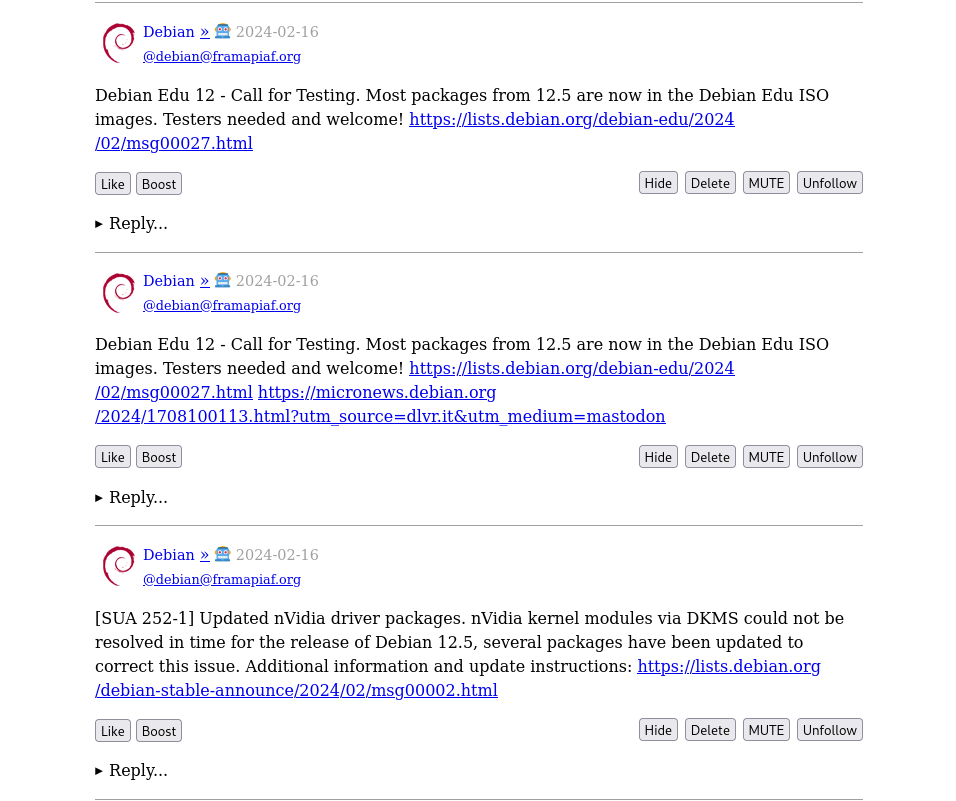
ActivityPub is the protocol for federated social networks that is implemented by Mastodon, Pleroma, and other similar server software. Federated social networks are most often used for micro-blogging , or making many small posts. You can decide to follow another user (or bot) to see their posts, even if they happen to be on a different server (as long as the server software is compatible with the ActivityPub standard).
The timeline shows posts from accounts that you follow
In addition, snac2 has preliminary support for the Mastodon Client API. This allows basic support for mobile apps that support Mastodon, but you should expect that many features are not available yet. If you are interested in running a minimalist ActivityPub server on Debian, please try out snac2, and report any bugs that you find.

13 February 2024

Matthew Palmer: Not all TLDs are Created Equal

In light of the recent cancellation of the queer.af domain registration by the Taliban, the fragile and difficult nature of country-code top-level domains (ccTLDs) has once again been comprehensively demonstrated. Since many people may not be aware of the risks, I thought I d give a solid explainer of the whole situation, and explain why you should, in general, not have anything to do with domains which are registered under ccTLDs.

Top-level What-Now? A top-level domain (TLD) is the last part of a domain name (the collection of words, separated by periods, after the https:// in your web browser s location bar). It s the com in example.com, or the af in queer.af. There are two kinds of TLDs: country-code TLDs (ccTLDs) and generic TLDs (gTLDs). Despite all being TLDs, they re very different beasts under the hood.

What s the Difference? Generic TLDs are what most organisations and individuals register their domains under: old-school technobabble like com , net , or org , historical oddities like gov , and the new-fangled world of words like tech , social , and bank . These gTLDs are all regulated under a set of rules created and administered by ICANN (the Internet Corporation for Assigned Names and Numbers ), which try to ensure that things aren t a complete wild-west, limiting things like price hikes (well, sometimes, anyway), and providing means for disputes over names1. Country-code TLDs, in contrast, are all two letters long2, and are given out to countries to do with as they please. While ICANN kinda-sorta has something to do with ccTLDs (in the sense that it makes them exist on the Internet), it has no authority to control how a ccTLD is managed. If a country decides to raise prices by 100x, or cancel all registrations that were made on the 12th of the month, there s nothing anyone can do about it. If that sounds bad, that s because it is. Also, it s not a theoretical problem the Taliban deciding to asssert its bigotry over the little corner of the Internet namespace it has taken control of is far from the first time that ccTLDs have caused grief.

Shifting Sands The queer.af cancellation is interesting because, at the time the domain was reportedly registered, 2018, Afghanistan had what one might describe as, at least, a different political climate. Since then, of course, things have changed, and the new bosses have decided to get a bit more active. Those running queer.af seem to have seen the writing on the wall, and were planning on moving to another, less fraught, domain, but hadn t completed that move when the Taliban came knocking.

The Curious Case of Brexit When the United Kingdom decided to leave the European Union, it fell foul of the EU s rules for the registration of domains under the eu ccTLD3. To register (and maintain) a domain name ending in .eu, you have to be a resident of the EU. When the UK ceased to be part of the EU, residents of the UK were no longer EU residents. Cue much unhappiness, wailing, and gnashing of teeth when this was pointed out to Britons. Some decided to give up their domains, and move to other parts of the Internet, while others managed to hold onto them by various legal sleight-of-hand (like having an EU company maintain the registration on their behalf). In any event, all very unpleasant for everyone involved.

Geopolitics on the Internet?!? After Russia invaded Ukraine in February 2022, the Ukranian Vice Prime Minister asked ICANN to suspend ccTLDs associated with Russia. While ICANN said that it wasn t going to do that, because it wouldn t do anything useful, some domain registrars (the companies you pay to register domain names) ceased to deal in Russian ccTLDs, and some websites restricted links to domains with Russian ccTLDs. Whether or not you agree with the sort of activism implied by these actions, the fact remains that even the actions of a government that aren t directly related to the Internet can have grave consequences for your domain name if it s registered under a ccTLD. I don t think any gTLD operator will be invading a neighbouring country any time soon.

Money, Money, Money, Must Be Funny When you register a domain name, you pay a registration fee to a registrar, who does administrative gubbins and causes you to be able to control the domain name in the DNS. However, you don t own that domain name4 you re only renting it. When the registration period comes to an end, you have to renew the domain name, or you ll cease to be able to control it. Given that a domain name is typically your brand or identity online, the chances are you d prefer to keep it over time, because moving to a new domain name is a massive pain, having to tell all your customers or users that now you re somewhere else, plus having to accept the risk of someone registering the domain name you used to have and capturing your traffic it s all a gigantic hassle. For gTLDs, ICANN has various rules around price increases and bait-and-switch pricing that tries to keep a lid on the worst excesses of registries. While there are any number of reasonable criticisms of the rules, and the Internet community has to stay on their toes to keep ICANN from totally succumbing to regulatory capture, at least in the gTLD space there s some degree of control over price gouging. On the other hand, ccTLDs have no effective controls over their pricing. For example, in 2008 the Seychelles increased the price of .sc domain names from US$25 to US$75. No reason, no warning, just pay up .

Who Is Even Getting That Money? A closely related concern about ccTLDs is that some of the cool ones are assigned to countries that are not great. The poster child for this is almost certainly Libya, which has the ccTLD ly . While Libya was being run by a terrorist-supporting extremist, companies thought it was a great idea to have domain names that ended in .ly. These domain registrations weren t (and aren t) cheap, and it s hard to imagine that at least some of that money wasn t going to benefit the Gaddafi regime. Similarly, the British Indian Ocean Territory, which has the io ccTLD, was created in a colonialist piece of chicanery that expelled thousands of native Chagossians from Diego Garcia. Money from the registration of .io domains doesn t go to the (former) residents of the Chagos islands, instead it gets paid to the UK government. Again, I m not trying to suggest that all gTLD operators are wonderful people, but it s not particularly likely that the direct beneficiaries of the operation of a gTLD stole an island chain and evicted the residents.

Are ccTLDs Ever Useful? The answer to that question is an unqualified maybe . I certainly don t think it s a good idea to register a domain under a ccTLD for vanity purposes: because it makes a word, is the same as a file extension you like, or because it looks cool. Those ccTLDs that clearly represent and are associated with a particular country are more likely to be OK, because there is less impetus for the registry to try a naked cash grab. Unfortunately, ccTLD registries have a disconcerting habit of changing their minds on whether they serve their geographic locality, such as when auDA decided to declare an open season in the .au namespace some years ago. Essentially, while a ccTLD may have geographic connotations now, there s not a lot of guarantee that they won t fall victim to scope creep in the future. Finally, it might be somewhat safer to register under a ccTLD if you live in the location involved. At least then you might have a better idea of whether your domain is likely to get pulled out from underneath you. Unfortunately, as the .eu example shows, living somewhere today is no guarantee you ll still be living there tomorrow, even if you don t move house. In short, I d suggest sticking to gTLDs. They re at least lower risk than ccTLDs.

+1, Helpful If you ve found this post informative, why not buy me a refreshing beverage? My typing fingers (both of them) thank you in advance for your generosity.

Footnotes
  1. don t make the mistake of thinking that I approve of ICANN or how it operates; it s an omnishambles of poor governance and incomprehensible decision-making.
  2. corresponding roughly, though not precisely (because everything has to be complicated, because humans are complicated), to the entries in the ISO standard for Codes for the representation of names of countries and their subdivisions , ISO 3166.
  3. yes, the EU is not a country; it s part of the roughly, though not precisely caveat mentioned previously.
  4. despite what domain registrars try very hard to imply, without falling foul of deceptive advertising regulations.

12 February 2024

Andrew Cater: Lessons from (and for) colleagues - and, implicitly, how NOT to get on

I have had excellent colleagues both at my day job and, especially, in Debian over the last thirty-odd years. Several have attempted to give me good advice - others have been exemplars. People retire: sadly, people die. What impression do you want to leave behind when you leave here?Belatedly, I've come to realise that obduracy, sheer bloody mindedness, force of will and obstinacy will only get you so far. The following began very much as a tongue in cheek private memo to myself a good few years ago. I showed it to a colleague who suggested at the time that I should share it to a wider audience.

SOME ADVICE YOU MAY BENEFIT FROM

Personal conduct
  • Never argue with someone you believe to be arguing idiotically - a dispassionate bystander may have difficulty telling who's who.
  • You can't make yourself seem reasonable by behaving unreasonably
  • It does not matter how correct your point of view is if you get people's backs up
  • They may all be #####, @@@@@, %%%% and ******* - saying so out loud doesn't help improve matters and may make you seem intemperate.

Working with others
  • Be the change you want to be and behave the way you want others to behave in order to achieve the desired outcome.
  • You can demolish someone's argument constructively and add weight to good points rather than tearing down their ideas and hard work and being ultra-critical and negative - no-one likes to be told "You know - you've got a REALLY ugly baby there"
  • It's easier to work with someone than to work against them and have to apologise repeatedly.
  • Even when you're outstanding and superlative, even you had to learn it all once. Be generous to help others learn: you shouldn't have to teach too many times if you teach correctly once and take time in doing so.

Getting the message across
  • Stop: think: write: review: (peer review if necessary): publish.
  • Clarity is all: just because you understand it doesn't mean anyone else will.
  • It does not matter how correct your point of view is if you put it across badly.
  • If you're giving advice: make sure it is:
  • Considered
  • Constructive
  • Correct as far as you can (and)
  • Refers to other people who may be able to help
  • Say thank you promptly if someone helps you and be prepared to give full credit where credit's due.

Work is like that
  • You may not know all the answers or even have the whole picture - consult, take advice - LISTEN TO THE ADVICE
  • Sometimes the right answer is not the immediately correct answer
  • Corollary: Sometimes the right answer for the business is not your suggested/preferred outcome
  • Corollary: Just because you can do it like that in the real world doesn't mean that you can do it that way inside the business. [This realisation is INTENSELY frustrating but you have to learn to deal with it]
  • DON'T ALWAYS DO IT YOURSELF - Attempt to fix the system, sometimes allow the corporate monster to fail - then do it yourself and fix it. It is always easier and tempting to work round the system and Just Flaming Do It but it doesn't solve problems in the longer term and may create more problems and ill-feeling than it solves.

    [Worked out for Andy Cater for himself after many years of fighting the system as a misguided missile - though he will freely admit that he doesn't always follow them as often as he should :) ]


Gunnar Wolf: Heads up! A miniDebConf is approaching in Santa Fe, Argentina

I realize it s a bit late to start publicly organizing this, but better late than never I m happy some Debian people I have directly contacted have already expressed interest. So, lets make this public! For all interested people who are reasonably close to central Argentina, or can be persuaded to come here in a month s time You are all welcome! It seems I managed to convince my good friend Mart n Bayo (some Debian people will remember him, as he was present in DebConf19 in Curitiba, Brazil) to get some facilities for us to have a nice Debian get-together in Central Argentina.

Where? We will meet at APUL Asociaci n de Personal no-docente de la Universidad Nacional del Litoral, in downtown Santa Fe, Argentina.

When? Saturday, 2024.03.09. It is quite likely we can get some spaces for continuing over Sunday if there is demand.

What are we planning? We have little time for planning but we want to have a space for Debian-related outreach (so, please think about a topic or two you d like to share with general free software-interested, not too technical, audience). Please tell me by mail (gwolf@debian.org) about any ideas you might have. We also want to have a general hacklab-style area to hang out, work a bit in our projects, and spend a good time together.

Logistics I have briefly commented about this with our dear and always mighty DPL, and Debian will support Debian-related people interested in attending; please check personally with me for specifics on how to handle this case by case. My intention is to cover costs for travel, accomodation (one or two nights) and food for whoever is interested in coming over.

More information As I don t want to direct people to keep an eye on my blog post for updates, I ll copy this information (and keep it updated!) at the Debian Wiki / DebianEvents / ar / 2024 / MiniDebConf / Santa Fe please refer to that page!

Contact

Codes of Conduct DebConf and Debian Code of Conduct apply. See the DebConf Code of Conduct and the Debian Code of Conduct.

Registration Registration is free, but needed. See the separate Registration page.

Talks Please, send your proposal to gwolf@debian.org

Freexian Collaborators: Monthly report about Debian Long Term Support, January 2024 (by Roberto C. S nchez)

Like each month, have a look at the work funded by Freexian s Debian LTS offering.
Debian LTS contributors In January, 16 contributors have been paid to work on Debian LTS, their reports are available:
  • Abhijith PA did 14.0h (out of 7.0h assigned and 7.0h from previous period).
  • Bastien Roucari s did 22.0h (out of 16.0h assigned and 6.0h from previous period).
  • Ben Hutchings did 14.5h (out of 8.0h assigned and 16.0h from previous period), thus carrying over 9.5h to the next month.
  • Chris Lamb did 18.0h (out of 18.0h assigned).
  • Daniel Leidert did 10.0h (out of 10.0h assigned).
  • Emilio Pozuelo Monfort did 10.0h (out of 14.75h assigned and 27.0h from previous period), thus carrying over 31.75h to the next month.
  • Guilhem Moulin did 9.75h (out of 25.0h assigned), thus carrying over 15.25h to the next month.
  • Holger Levsen did 3.5h (out of 12.0h assigned), thus carrying over 8.5h to the next month.
  • Markus Koschany did 40.0h (out of 40.0h assigned).
  • Roberto C. S nchez did 8.75h (out of 9.5h assigned and 2.5h from previous period), thus carrying over 3.25h to the next month.
  • Santiago Ruano Rinc n did 13.5h (out of 8.25h assigned and 7.75h from previous period), thus carrying over 2.5h to the next month.
  • Sean Whitton did 0.5h (out of 0.25h assigned and 5.75h from previous period), thus carrying over 5.5h to the next month.
  • Sylvain Beucler did 9.5h (out of 23.25h assigned and 18.5h from previous period), thus carrying over 32.25h to the next month.
  • Thorsten Alteholz did 14.0h (out of 14.0h assigned).
  • Tobias Frost did 12.0h (out of 10.25h assigned and 1.75h from previous period).
  • Utkarsh Gupta did 8.5h (out of 35.75h assigned), thus carrying over 24.75h to the next month.

Evolution of the situation In January, we have released 25 DLAs. A variety of particularly notable packages were updated during January. Among those updates were the Linux kernel (both versions 5.10 and 4.19), mariadb-10.3, openjdk-11, firefox-esr, and thunderbird. In addition to the many other LTS package updates which were released in January, LTS contributors continue their efforts to make impactful contributions both within the Debian community.

Thanks to our sponsors Sponsors that joined recently are in bold.

11 February 2024

Freexian Collaborators: Debian Contributions: Upcoming Improvements to Salsa CI, /usr-move, and more! (by Utkarsh Gupta)

Contributing to Debian is part of Freexian s mission. This article covers the latest achievements of Freexian and their collaborators. All of this is made possible by organizations subscribing to our Long Term Support contracts and consulting services.

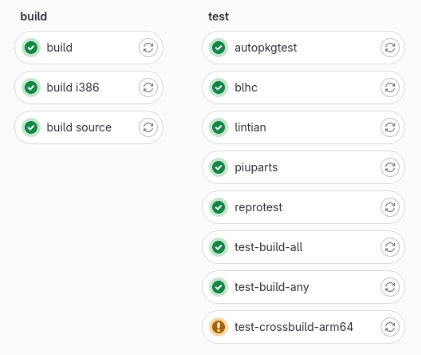
Upcoming Improvements to Salsa CI, by Santiago Ruano Rinc n Santiago started picking up the work made by Outreachy Intern, Enock Kashada (a big thanks to him!), to solve some long-standing issues in Salsa CI. Currently, the first job in a Salsa CI pipeline is the extract-source job, used to produce a debianize source tree of the project. This job was introduced to make it possible to build the projects on different architectures, on the subsequent build jobs. However, that extract-source approach is sub-optimal: not only it increases the execution time of the pipeline by some minutes, but also projects whose source tree is too large are not able to use the pipeline. The debianize source tree is passed as an artifact to the build jobs, and for those large projects, the size of their source tree exceeds the Salsa s limits. This is specific issue is documented as issue #195, and the proposed solution is to get rid of the extract-source job, relying on sbuild in the very build job (see issue #296). Switching to sbuild would also help to improve the build source job, solving issues such as #187 and #298. The current work-in-progress is very preliminary, but it has already been possible to run the build (amd64), build-i386 and build-source job using sbuild with the unshare mode. The image on the right shows a pipeline that builds grep. All the test jobs use the artifacts of the new build job. There is a lot of remaining work, mainly making the integration with ccache work. This change could break some things, it will also be important to test how the new pipeline works with complex projects. Also, thanks to Emmanuel Arias, we are proposing a Google Summer of Code 2024 project to improve Salsa CI. As part of the ongoing work in preparation for the GSoC 2024 project, Santiago has proposed a merge request to make more efficient how contributors can test their changes on the Salsa CI pipeline.

/usr-move, by Helmut Grohne In January, we sent most of the moving patches for the set of packages involved with debootstrap. Notably missing is glibc, which turns out harder than anticipated via dumat, because it has Conflicts between different architectures, which dumat does not analyze. Patches for diversion mitigations have been updated in a way to not exhibit any loss anymore. The main change here is that packages which are being diverted now support the diverting packages in transitioning their diversions. We also supported a few packages with non-trivial changes such as netplan.io. dumat has been enhanced to better support derivatives such as Ubuntu.

Miscellaneous contributions
  • Python 3.12 migration trundles on. Stefano Rivera helped port several new packages to support 3.12.
  • Stefano updated the Sphinx configuration of DebConf Video Team s documentation, which was broken by Sphinx 7.
  • Stefano published the videos from the Cambridge MiniDebConf to YouTube and PeerTube.
  • DebConf 24 planning has begun, and Stefano & Utkarsh have started work on this.
  • Utkarsh re-sponsored the upload of golang-github-prometheus-community-pgbouncer-exporter for Lena.
  • Colin Watson added Incus support to autopkgtest.
  • Colin discovered Perl::Critic and used it to tidy up some poor practices in several of his packages, including debconf.
  • Colin did some overdue debconf maintenance, mainly around tidying up error message handling in several places (1, 2, 3).
  • Colin figured out how to update the mirror size documentation in debmirror, last updated in 2010. It should now be much easier to keep it up to date regularly.
  • Colin issued a man-db buster update to clean up some irritations due to strict sandboxing.
  • Thorsten Alteholz adopted two more packages, magicfilter and ifhp, for the debian-printing team. Those packages are the last ones of the latest round of adoptions to preserve the old printing protocol within Debian. If you know of other packages that should be retained, please don t hesitate to contact Thorsten.
  • Enrico participated in /usr-merge discussions with Helmut.
  • Helmut sent patches for 16 cross build failures.
  • Helmut supported Matthias Klose (not affiliated with Freexian) with adding -for-host support to gcc-defaults.
  • Helmut uploaded dput-ng enabling dcut migrate and merging two MRs of Ben Hutchings.
  • Santiago took part in the discussions relating to the EU Cyber Resilience Act (CRA) and the Debian public statement that was published last year. He participated in a meeting with Members of the European Parliament (MEPs), Marcel Kolaja and Karen Melchior, and their teams to clarify some points about the impact of the CRA and Debian and downstream projects, and the improvements in the last version of the proposed regulation.

9 February 2024

Thorsten Alteholz: My Debian Activities in January 2024

FTP master This month I accepted 333 and rejected 31 packages. The overall number of packages that got accepted was 342.

Hooray, I already accepted package number 30000.

The statistic, where I get my numbers from, started in February 2002. Up to now 81694 packages got accepted. Given that I accepted package 20000 in October 2020, would I be able to accept half of the packages that made it through NEW? Debian LTS This was my hundred-fifteenth month that I did some work for the Debian LTS initiative, started by Raphael Hertzog at Freexian. During my allocated time I uploaded: This month I was finally able to really run the test suite of bind9. I already wanted to give up with this package, but Santiago encouraged me to proceed. So, here you are fixed-Buster-version. Jessie and Stretch have to wait a bit until the dust has settled. Last but not least I also did a few days of frontdesk duties. Debian ELTS This month was the sixty-sixth ELTS month. During my allocated time I uploaded: This month I also worked on the Jessie and Stretch updates for bind9. The uploads should happen soon. I also started to work on an update for exim4. Last but not least I did a few days of frontdesk duties. Debian Printing This month I adopted: At the moment these packages are the last adoptions to preserve the old printing protocol within Debian. If you know of other packages that should be retained, please don t hesitate to ask me. But don t wait for too long, I have fun to process RM-bugs :-). This work is generously funded by Freexian! Debian Astro This month I uploaded a new upstream version of: Debian IoT This month I uploaded new upstream versions of: Other stuff This month I uploaded new upstream version of packages, did a source upload for the transition or uploaded it to fix one or the other issue:

Abhijith PA: A new(kind of) phone

I was using a refurbished Xiaomi Redmi 6 Pro (codename: sakura . I do remember buying this phone to run LineageOS as I found this model had support. But by the time I bought it (there was a quite a gap between my research and the actual purchase) lineageOS ended the suport for this device. The maintainer might ve ended this port, I don t blame them. Its a non rewarding work. Later I found there is a DotOS custom rom available. I did a week of test run. There seems lot of bugs and it all was minor and I can live with that. Since there is no other official port for redmi 6 pro at the time, I settled on this buggy DotOS nightly build. The phone was doing fine all these(3+) years, but recently the camera started showing greyish dots on some areas to a point that I can t even properly take a photo. The outer body of the phone wasn t original, as it was a refurbished, thus the colors started to peel off and wasn t aesthetically pleasing. Then there is the Location detection issue which took a while to figure out location and battery drains fast. I recently started mapping public transportation routes, and the GPS issue was a problem for me. With all these problems combined, I decided to buy a new phone. But choosing a phone wasn t easy. There are far too many options in the market. However, one thing I was quite sure of was that I wouldn t be buying a brand new phone, but a refurbished one. It is my protest against all these phone manufacturers who have convinced the general public that a mobile phone s lifespan is only 2 years. Of course, there are a few exceptions, but the majority of players in the Indian market are not. Now I think about it, I haven t bought any brand new computing device, be it phones or laptops since 2015. All are refurbished devices except for an Orange pi. My Samsung R439 laptop which I already blogged about is still going strong. Back to picking phone. So I began by comparing LineageOS website to an online refurbished store to pick a phone that has an official lineage support then to reddit search for any reported hardware failures Google Pixel phones are well-known in the custom ROM community for ease of installation, good hardware and Android security releases. My above claims are from privacyguides.org and XDA-developers. I was convinced to go with this choice. But I have some one at home who is at the age of throwing things. So I didn t want to risk buying an expensive Pixel phone only to have it end up with a broken screen and edges. Perhaps I will consider buying a Pixel next time. After doing some more research and cross comparison I landed up on Redmi note 9. Codename: merlinx. Based on my previous experience I knew it is going to be a pain to unlock the bootloader of Xiaomi phones and I was prepared for that but this time there was an extra hoop. The phone came with ROM MIUI version 13. A small search on XDA forums and reddit told unless we downgrade to 12 or so it is difficult to unlock bootloader for this device. And performing this wasn t exactly easy as we need tools like SP Flash etc. It took some time, but I ve completed the downgrade process. From there, the rest was cakewalk as everything was perfectly documented in LineageOS wiki. And ta-da, I have a phone running lineageOS. I been using it for some time and honestly I haven t come across any bug in my way of usage. One advice I will give to you if you are going to flash a custom ROM. There are plenty of videos about unlocking bootloader, installing ROMs in Youtube. Please REFRAIN from watching and experimenting it on your phone unless you figured a way to un brick your device first.

8 February 2024

Dirk Eddelbuettel: RcppArmadillo 0.12.8.0.0 on CRAN: New Upstream, Interface Polish

armadillo image Armadillo is a powerful and expressive C++ template library for linear algebra and scientific computing. It aims towards a good balance between speed and ease of use, has a syntax deliberately close to Matlab, and is useful for algorithm development directly in C++, or quick conversion of research code into production environments. RcppArmadillo integrates this library with the R environment and language and is widely used by (currently) 1119 other packages on CRAN, downloaded 32.5 million times (per the partial logs from the cloud mirrors of CRAN), and the CSDA paper (preprint / vignette) by Conrad and myself has been cited 575 times according to Google Scholar. This release brings a new (stable) upstream (minor) release Armadillo 12.8.0 prepared by Conrad two days ago. We, as usual, prepared a release candidate which we tested against the over 1100 CRAN packages using RcppArmadillo. This found no issues, which was confirmed by CRAN once we uploaded and so it arrived as a new release today in a fully automated fashion. We also made a small change that had been prepared by GitHub issue #400: a few internal header files that were cluttering the top-level of the include directory have been moved to internal directories. The standard header is of course unaffected, and the set of full / light / lighter / lightest headers (matching we did a while back in Rcpp) also continue to work as one expects. This change was also tested in a full reverse-dependency check in January but had not been released to CRAN yet. The set of changes since the last CRAN release follows.

Changes in RcppArmadillo version 0.12.8.0.0 (2024-02-06)
  • Upgraded to Armadillo release 12.8.0 (Cortisol Injector)
    • Faster detection of symmetric expressions by pinv() and rank()
    • Expanded shift() to handle sparse matrices
    • Expanded conv_to for more flexible conversions between sparse and dense matrices
    • Added cbrt()
    • More compact representation of integers when saving matrices in CSV format
  • Five non-user facing top-level include files have been removed (#432 closing #400 and building on #395 and #396)

Courtesy of my CRANberries, there is a diffstat report relative to previous release. More detailed information is on the RcppArmadillo page. Questions, comments etc should go to the rcpp-devel mailing list off the Rcpp R-Forge page. If you like this or other open-source work I do, you can sponsor me at GitHub.

This post by Dirk Eddelbuettel originated on his Thinking inside the box blog. Please report excessive re-aggregation in third-party for-profit settings.

Sven Hoexter: Use GitHub CLI to List all Repository Secrets

Write it down before I forget about it again:
for x in $(gh api graphql --paginate -f query='query($endCursor:String)   organization(login:"myorg")  
    repositories(first: 100, after: $endCursor, isArchived:false)  
        pageInfo  
            hasNextPage
            endCursor
         
        nodes  
            name


     ' --jq '.data.organization.repositories.nodes[].name'); do
    secrets=$(gh secret list --json name --jq '.[].name' -R "myorg/$ x "   tr '\n' ',')
    if ! [ -z "$ secrets " ]; then
        echo "$ x ,$ secrets "
    fi
done
Requests a list of all not archived repositories in a GitHub org and queries repository secrets. If we find some we output the repo name and the secrets in a comma separated list. Not real CSV, but good enough for further processing. I've to admit it's kinda beautiful what you can do with the gh cli by now. Sadly it seems the secrets are not yet available via GraphQL (or I missed it in the docs), so I just use the gh cli to do the REST calls.

Reproducible Builds: Reproducible Builds at FOSDEM 2024

Core Reproducible Builds developer Holger Levsen presented at the main track at FOSDEM on Saturday 3rd February this year in Brussels, Belgium. Titled Reproducible Builds: The First Ten Years
In this talk Holger h01ger Levsen will give an overview about Reproducible Builds: How it started with a small BoF at DebConf13 (and before), then grew from being a Debian effort to something many projects work on together, until in 2021 it was mentioned in an Executive Order of the President of the United States. And of course, the talk will not end there, but rather outline where we are today and where we still need to be going, until Debian stable (and other distros!) will be 100% reproducible, verified by many. h01ger has been involved in reproducible builds since 2014 and so far has set up automated reproducibility testing for Debian, Fedora, Arch Linux, FreeBSD, NetBSD and coreboot.
More information can be found on FOSDEM s own page for the talk, including a video recording and slides.
Separate from Holger s talk, however, there were a number of other talks about reproducible builds at FOSDEM this year: and there was even an entire track on Software Bill of Materials.

Next.

Previous.