Search Results: "hug"

11 October 2010

Benjamin Mako Hill: Piracy and Free Software

This essay is a summary of my presentation at the workshop Inlaws and Outlaws, held on August 19-20, 2010 in Split, Croatia. The workshop brought together advocates of piracy with participants in the free culture and free software movements.
In Why Software Should Not Have Owners, Richard Stallman explains that, if a friend asks you for a piece of software and the license of the software bars you from sharing, you will have to choose between being a bad friend or violating the license of the software. Stallman suggests that users will have to choose between the lesser of two evils and will choose to violate the license. He emphasizes that it's unfair to ask a user to make such a choice. Over the past few years, pirate parties have grown across much of the developed world. Of course, piracy remains the primary means of distributing media across most of the rest. Advocates of access to information have gathered and organized under the "pirate" banner, representing the choice of sharing with friends over compliance with license terms. The free/libre and open source software (FLOSS) and free culture movements seem to have a confused and conflicted reaction to all this. On one hand, major proponents of several pirate parties are FLOSS and free culture stalwarts and several pirate parties have made FLOSS advocacy a component of their political platforms. Pirate Parties' clear opposition to software patents and DRM resonates with both FLOSS and free culture communities. On the other hand, FLOSS leaders, including Stallman, have warned us about "pirate" anti-copyright policies. Free culture leaders, like Lawrence Lessig, have repeatedly and vociferously denounced piracy, treated even the intimation of an association with piracy as an affront, and systematically distanced themselves and their work from piracy. Should FLOSS and free culture advocates embrace pirates as comrades in arms or condemn them? Must we choose between being either with the pirates or against them? Our communities seem to have no clearly and consistently articulated consensus. I believe that, unintuitively, if you take a strong principled position in favor of information freedom and distinguish between principles and tactics, a more nuanced "middle ground" response to piracy is possible. In light of a principled belief that users should be able to share information, we can conclude there is nothing ethically wrong with piracy. Licenses have the power of the law but they are protected by unjust "intellectual property" laws. That said, principles are not the only reason activists choose to do things. Many political stunts are bad ideas not because they are wrong, but because they won't work and have negative side effects. Tactics matter too. Even though there might not be anything ethically wrong with piracy from the perspective of free software or free culture, it might still be a bad idea. There are at least three such tactical reasons that might motivate free software and culture to not support piracy or participate in pro-piracy movements and politics. First, a systematic disrespect for copyright undermines respect for all licenses which have been of a huge tactical benefit to free software and a increasingly important factor in the success of free culture. Copyleft licenses like the GPL or CC BY-SA have power only because copyright does. As Stallman has suggested, anti-copyright actions are anti-copyleft. That needn't be an argument against attempts to limit copyright. Indeed, I think we must limit and reduce copyright. But we must tread carefully. In the current copyright climate, I believe that copyleft offers a net advantage. Why should others respect our licenses if we don't respect theirs? Looking at the long term, we must weigh the benefits of promoting the systematic violation of proprietary licenses with the benefits of adherence to free software and free culture. Second, piracy is fundamentally reactionary. Part of its resonance as a political symbol comes from the fact that the piracy represents a way that consumers of media can fight back against a set of companies which have attacked them -- with lawsuits, DRM systems, and demonization in propaganda -- for sharing in ways that most consumers think are natural and socially positive. But piracy focuses on reaction rather the fundamental importance of sharing that drives it. As a result, most pirates do not support, or are even familiar with, a principled approach to access to information. As a result, many piracy advocates who speak out against DRM on DVDs will be as happy to use NetFlix to stream DRMed movies for $5 a month as they were to download for free. The best rallying cries do not always translate into be the most robust movements. Third, through its focus on a reaction, a dialog about piracy avoids engagement with the tough questions of what we will replace the current broken copyright system with. A principled position suggests that it is our ethical prerogative to create alternative models. The free software movement has succeeded because it created such a prerogative and then, slowly over time, provided examples of workable alternatives. A principled position on free software did not require that one provide working new systems immediately, but it makes the development of creative, sustainable approaches a priority. Attacking the system without even trying to speak about alternative modes of production is unsustainable. Free software and free culture call for a revolution. Piracy only calls for a riot. Piracy, in these three senses, can be seen as tactically unwise, without necessarily being unethical. By taking a principled position, one can go build on, and go beyond, RMS's comment. On free culture and free software's terms, we can suggest that piracy is not ethically wrong, but that it is an unwise way to try to promote sharing. Without being hypocritical, we can say: "I don't think piracy is unethical. But I also do not support it."

9 October 2010

David Paleino: Simple Python and Vala XML parsers

As some of you might know, I'm an OpenStreetMaper. In the last month, during those bits of spare time I had, I wrote a set of python scripts which compute some statistics over an OSM dump. I do this by parsing the whole XML tree, and national dumps are pretty huge (italy.osm is ~4G nowadays, and is not as well-mapped as Germany!), so I needed a way to do this without creating a memory-hungry beast. With Python, I could succesfully do this:
#!/usr/bin/python
# -*- coding: utf-8 -*-
import xml.etree.cElementTree as etree
def parse(filename):
    source = open(filename)
    context = etree.iterparse(source, events=("start", "end"))
    context = iter(context)
    event, root = context.next()
    for event, elem in context:
        if event == "end":
            root.clear()
            continue
        print elem.tag
if __name__ == '__main__':
    import sys
    parse(sys.argv[1])
And here the results:
$ /usr/bin/time ./parsexml.py ~/osmstats/dumps/italy.osm.bz2.20100912.out 1>/dev/null
413.22user 6.15system 8:57.80elapsed 77%CPU (0avgtext+0avgdata 21200maxresident)k
7739552inputs+0outputs (10major+1470minor)pagefaults 0swaps
However, since some time, I wanted to learn Vala, so I tried to do this very same task with it. Here's the code:
using Xml;
class XmlParser  
    public void parse_file(string path)  
        var handler = SAXHandler();
        void* user_data = null;
        handler.startElement = start_element;
        handler.user_parse_file(user_data, path);
     
    public void start_element(string name, string[] attr)  
        stdout.printf("%s\n", name);
     
 
int main(string[] args)  
    Parser.init();
    var parser = new XmlParser();
    parser.parse_file(args[1]);
    Parser.cleanup();
    return 0;
 
You need to compile it with: valac --pkg libxml-2.0 xml.vala And here's the result:
$ /usr/bin/time ./xml ~/osmstats/dumps/italy.osm.bz2.20100912.out 1>/dev/null
122.01user 4.03system 3:14.61elapsed 64%CPU (0avgtext+0avgdata 6352maxresident)k
7738984inputs+0outputs (0major+461minor)pagefaults 0swaps
Both these codes are, however, CPU-hungry. But at least they don't swap :-) Needless to say that I'm planning to switch my scripts to Vala for 2.0.

6 October 2010

Luca Falavigna: Introducing projectb

Many people know Ultimate Debian Database already, and do use of it to create useful QA tools, or other Debian related activities. There is another database which is widely used by all of us, every day, and runs behind the scenes without being noticed. It is called projectb, the huge database of the Debian archive. projectb is the place where dak stores all the information it needs to run the archive (including but not limited to source packages, related binaries, suite definitions and associations, overrides, and so on), and it tells dak to hit you with a REJECT if you try to upload a package twice, or if you do something The Wrong Way. OK OK, it eventually allows your packages to be accepted too, sometimes it also behaves good :) projectb is hosted on ftp-master.debian.org. Most fellow Debian Developers cannot login over there because access is restricted to FTP and Release people only, but can enjoy its clone on merkel.debian.org [1]. Please note that clone is synced on a regular basis, but it could be a little bit not up-to-date with the very latest changes. Just run the following: psql -d projectb -p 5433 Now that you have access to it, you could want look at its structure to start looking at it. I just provide a couple of trivial examples of what you can do with it, your imagination is the limit [2] ;) This query displays which dpkg version known suites ship:
SELECT s.source, max(s.version) AS version, su.suite_name AS suite
FROM source s
JOIN src_associations sa ON sa.source = s.id
JOIN suite su ON su.id = sa.suite
WHERE s.source = 'dpkg'
GROUP BY s.source, su.suite_name
ORDER BY version;
This query displays changelog entries for debhelper which versions are greater than 8:
SELECT changelog
FROM changelogs
WHERE source = 'debhelper'
AND version > '8';
Working with projectb means working with real Debian archive data, so you are sure to always get solid information. You can also experience a limited (but functional) dak session on merkel. You cannot do much, data is read-only, but this is not a limit for a couple of commands. The most interesting is dak rm, where you can simulate a package removal, and discover reverse dependencies in advance, to save some work to your lovely FTP Team ;) Just run the following:
dak rm -n -R -m "Don't worry, it's a Dry Run" your_behated_package Wait a little bit, and you will be prompted with removal report. Just remember to always use -n and -R flags, though. Want even more? Join FTP Team, and you will given the chance to learn a lot more about Debian! DISCLAIMER: if you plan to write a tool, or perform an activity which relies on current projectb implementation, PLEASE TALK TO FTP TEAM FIRST. Internal structure can change a lot over times, and it is way better let FTP Team to handle exporting/parsing its data for day-by-day tasks. [1] This is probably supposed to change, as merkel is going to be decommissioned soon. [2] If you need a new feature, just talk to FTP Team.

1 October 2010

Erich Schubert: Facebook Hiatus

I today deactivated my Facebook account. It was some effort, because I had developed some Facebook applications, and their page to reassign them to a different developer was broken (actually the whole application edit page was broken).I have always been a "responsible" user, keeping good control over my data, and usually just posting stuff that I'd tell anyone anyway. Facebook has also always been some kind of "marketing" tool for me, being able to support some friends by inviting people to go to their events etc.However, there are plenty of reasons to abstain from Facebook: Facebook makes things easier, but also a lot more shallow. When someone took note and remembered your birthday, there was some effort involved that shows that they cared. With Facebook reminding people to greet, what is a birthday greeting on Facebook more than an automated message? It's about as personal as the annual christmas card by some large company. Face it: the "social" part of the "social web" is pretty shallow.As you can see above, I've been caring about these issues for some time; I post selectively, I filter much of the tracking, I don't use their games. With my Hiatus, I want to further improve, in particular

29 September 2010

Gunnar Wolf: Ruby dissonance with Debian, again

Lucas has written two long, insightful posts on the frustration about the social aspects of integrating Ruby stuff Debian The first one, on September 12 and the second one, on September 29. I cannot really blame (thoroughly) the Ruby guys for their position. After all, they have a vibrant community, and they are advancing great pieces of work. And they know who that code is meant for Fellow programmers. And yes, although it is a pain to follow their API changes (and several of the Gems I regularly use do often get refactorings and functionality enhancements which break compatibility but introduce very nice new features), they say that's solved with one of Gems' main features being the simultaneous installability of different versions. The key difference in Debian's worldview with Ruby's is they cater to Fellow programmers. Even leaving aside heaps of different positions and worldview/mindset, we have a fundamental difference: Debian cares about its users, whatever that means. So, our users should not even care what language a given application is implemented in They should only care that it works. We, as packagers, should take care of all the infrastructural stuff. And yes, that's where we find the conflicting spot: We don't want to ship many versions of a system library (that in this case would be a Gem). Specially if later versions fix known bugs in earlier versions and backports are not available or supported. Specially if upstream authors' only response to a bug in an older release will be "upgrade and rewrite whatever breaks in your application". As an example of this, I am not currently updating the gems I maintain, as Debian is on a freeze to get out the next stable release. Or if at all, I am targetting those uploads to our Experimental branch, in order not to create a huge backlog for me when the freeze is over (just a series of rebuilds targetted at unstable). And yes, I will have to be responsible for any bugs that will most likely not be supported by most of my upstreams during the next ~2 years. That's the role of a Linux distribution. And yes, as Lucas writes in the comments he got as responses to the first post This dissonance comes in no small part because the Ruby developer community is mostly made from non-linuxers. People coming from a background where (mostly propietary) applications bundle up everything they need, where static linking is more popular than dynamic libraries, where there is no coordination between parts of the system are much less likely to understand our work. And yes, the Perl community is a joy to work with in this regard. And that's the same I understand from the Python one. Because of their origins and where their main strength was grown and remains. PS - And yes, I will join the flock of people saying that... The specific person that attacked your work is a great programmer, but well known as intolerant and obnoxious. Fortunately, even if our respective cultures fail to mix so much, most of our interactions just end with a "sigh" of lack of understanding, and not with the flames you got targetted with :-/

22 September 2010

Michal Čihař: Fixing phpMyAdmin bugs in Launchpad

Once in a time when looking at my Debian Developer's Packages Overview, I just start to think there is way too much bug reports for phpMyAdmin package in Launchpad. Today the threshold was 30 :-). Managing them is usually not that hard, because vast majority of them are just duplicates of same issue. Basically all problems come with the fact that dbconfig-common really does not behave nicely when database server is not configured and user tries to configure it. I know people should just answer no to first question, whether to use dbconfig-common, but they don't and it then horribly fails. Today I finally decided to ignore all errors from dbconfig-common in our packaging scripts, so you will get an error, but the package will be installed. As it seems that this is what most Ubuntu users expect after all. This also shows huge difference between Debian and Ubuntu users - such bug has never appeared in Debian bug tracker, but has zillions of duplicates in Launchpad in various incarnations (LP#618852, LP#621569 and the most favorite LP#456674).

14 September 2010

Michal Čihař: Bugged by duplicity file matching

I always wondered why backups of my sever using duplicity are so huge, but simply looking at list of files to include seemed to be correct. However I should really spend more time by reading documentation, because now it was obvious to me that the file list is simply wrong. What a small difference in file list:
- /var/lib/vservers/
+ /var/lib
Versus the old one:
+ /var/lib
- /var/lib/vservers/

13 September 2010

Robert Collins: What do I do @ work?

I recently moved withing Canonical from being a paid developer of Bazaar to take on a larger challenge Technical Architect for Launchpad. Its been two months now, and its time to put my head up out of the coal face, have a look around and regroup. When I worked on Bazaar, every day when I started work got up I was working on a tool anyone can use, designed for collaboration upon sourcecode, for people writing software. This is a toolchain component right at the heart of the free software world. Bazaar and tools like it get used everyday to manage, distribute and collaborate on the sourcecode that makes up the components of Ubuntu, Debian, Fedora and so forth. Every time someone new starts using Bazaar for a new free or open source project, well I felt happy happy that in my small part I m helping with this revolution we re carrying out. Launchpad is pretty similar to Bazaar in some ways. Obviously they are both free software, both are written in Python, and both are sponsored by Canonical, my employer. And they both are designed to assist in collaboration and communication between free software developers albeit in rather different ways. Bazaar is a tool anyone can install locally, run as a command line, GUI, or local webserver, and share code either centrally (e.g. by pushing to Launchpad), or in a peer to peer fashion, acting as their own server. Launchpad, by contrast is a website which (usually) folk will use as a service in their browser, from the comand line FTP (for package building), ssh (for Bazaar branch pushing or pulling), or even local GUI programs using the Launchpad API service. This makes it more approachable for first time collaborators, but its less able to be used offline, and it has all the usual caveats of web sites : it needs a username and password, it s availability depends on the operators on the team I m part of. So there s a lot less room for error: if we do something wrong, the system is unavailable, and users can t just apt-get install an older release. With Launchpad our goal is to to get all the infrastructure that open source need out of the way, so that they can focus on their code, collaboration within their team and almost uniquely collaboration with other teams. As well as being open source, Launchpad is free for all open source projects to use Ubuntu is our single biggest user they use it for all bugtracking, translation and package building, and have a hugefraction of the total storage overhead in the database. Launchpad is a pretty nice system, so people use it, and as a result (on a technical basis) it is suffering from its own success: small corner cases in the code turn up every day or two, code written years ago to deal with a relatively small data set now has to deal with data sets a thousand or more times larger (one table, for instance, has over 600,000,000 rows in it. For the last two months then, I ve been working on Launchpad. As Technical Architect, I need to ensure that the things that we (users, stakeholders and developers of Launchpad) want to do are supported by the structure of the system : the platform(s) we re building on, the way we approach problems, coding standards and diagnostic tools. That sounds pretty dry and hands off, but I m finding its actually very balanced. I wrote a presentation when I started the job, which encapsulated the challenges I saw in front of the team on this purely technical front, and what I thought I needed to do. I think I was about right in my expectations: On a typical day, I ll be hands on in a problem helping get it diagnosed, talking long term structural changes with someone around how to make things more efficient / flexible / maintainable, and writing a small patch here or there to help move things along. In the two months since I took on this challenge, we ve made significant headway on the problem of performance for Launchpad : many inefficient code paths have been identified and removed, some new infrastructure has been created as is being rolled out to make individual pages faster, and we ve massively increased the diagnostic data we get when things go wrong. We ve introduced facilities for responding more rapidly to issues in the software (but they have to be rolled out across the system) and I hope, over the next 4 months we ll reach the first of my performance goals: for any webpage in Launchpad, it will complete rendering in 99% of the time. (Note that we already meet this goal if you measure the whole system, but this is biased by some pages being very frequently hit and also being very small).

12 September 2010

Alastair McKinstry: Exoclimes: the diversity of planetary scientists

I'm just back from ExoClimes 2010: Exploring the Diversity of Planetary Atmospheres. An excellent conference: the PDFs of the talks and posters are now online, and they are putting the videos of the talks up soon. But in particular the organizers deserves thanks for bringing exoplanetary scientists and observers together with climate modelers doing Earth (and Mars, Titan, Venus, ...) models.
Model complexity graph Peter Cox on model complexity
The last talk on Friday was by Peter Cox on Climate change and exoplanet sciences that was far better than expected for the "graveyard shift". One theme of the conference was the need for a 'heirarchy' of models, from simple energy-balance models to full circulation (GCM) models: using progressively more complex models to understand more bits of whats going on. Exoplanet workers mostly use simpler models, progressing now to GCMs, while Earth modellers are moving beyond GCMs to "Earth system" models including biology, etc. Peter pointed out the two styles of work: the exoplanet modelers are short of data, and risk being too speculative. We know little of what the planets are like, and concentrate on implementing physics in the models to see what they might be like. Earth modelers on the other hand are if anything swamped with data: the tendency here is to make the model fit the data, by adjusting parameters until it does so. The danger of this approach is that the model will then not work away from current present-Earth conditions. Tim Lenton pointed out some work that was done with the Met Office model, where they took the radiative transfer part of the model and tested it for other planets, and paleo-Earth conditions. The model blew up : it wasn't capable of x2 or x4 current CO2 levels. (This has since been corrected). Over dinner there were interesting discussions on the different styles within the communities. While the underlying GCMs used come from the Earth sciences, its quite common within the exoplanetary community for a researcher to work on all parts of the model: dynamics one day, radiative transfer the next. In Earth climate work people have become more specialized and someone is a 'radiative transfer' person, and won't touch other parts of the code (even if they can follow them in the huge codes we have today!). On the other hand, there is a greater tradition of model inter-comparison in Earth sciences, where we compare the model outputs to each other for some known test cases ( Held & Suarez, the CMIP5 project, etc.) Apart from some initial work by Emily Rauscher, little has been done on this in exoplanetary models; it was agreed more of this would be a good idea. Radiative transfer (the interaction of 'sunlight' with the atmosphere, where it gets absorbed, scattered and re-radiated) in particular seems to be an area that could benefit from this. In this middle ground Francois Forget showed the work on the LMDZ model and applying GCMs to terrestrial planets. They've successfully applied this model to Mars, Titan, and partially to Venus (a much tougher problem, due to its heavy clouds giving a long radiative timescale). There are problems with correctly explaining super-rotation though. This is where the atmosphere rotates faster than the planet: on Venus for example the planet rotates every 243 days, while the clouds rotate around the planet every 4 days. Sebastian Lebonnois described the possible mechanisms for Venus and Titan; Johnathan Mitchell so did some interesting work on this recently. Different regimes are involved for different rotation rates of the planet. Ralph Lorenz pointed out the lack of "real paleo-Earth" climate work at the moment. While geology has inspired a lot of work on the atmospheric composition, what with the different gas mixtures (meaning earth-model radiative transfer codes don't work) and the faster dynamics meaning super-rotation could apply (Earth's day was about 8 hours long in the Archean era), we don't have a model of the climate yet. It looks like we should treat Earth as an exoplanet. Tags , , ,

Christian Perrier: Release team...

(update: yesterday's version was using http://wiki.debian.org/Teams/ReleaseTeam as reference, while http://www.debian.org/intro/organization is the one that's up-to-date. Those watching the current traffic in debian-release can probably realize the huge *thank you* deserved by the entire release team for the work they're doing. So, how about spamming the release team members with (private!) "thank you" messages when they unblock a package of yours? And (even more difficult) also one when they don't unblock your package...but spent time reviewing it and more time to explain you why they prefer not unblocking it... In any case, thank you, Neil Maulkin, Adam adsb, Dann dannf, Felipe faw, Jurij trave11er, Luk luk, Mehdi mehdi, Pierre MadCoder, Julien jcristau (doh, French Cabal!)...and Martin zobel (who's apparently forgotten on the page). Not to forget Adam adsb and Phil phil for managing stable releases....and the Wise Release Wizards (vorlon, aba, luk, HE). Hat off, guys (only guys there, yet another place for d-w to show up).

11 September 2010

Christian Perrier: Release team...

Those watching the current traffic in debian-release can probably realize the huge *thank you* deserved by the entire release team for the work they're doing. So, how about spamming the release team members with (private!) "thank you" messages when they unblock a package of yours? And (even more difficult) also one when they don't unblock your package...but spent time reviewing it and more time to explain you why they prefer not unblocking it... In any case, thank you, Neil Maulkin, Adam adsb, Dann dannf, Felipe faw, Jurij trave11er, Luk luk, Mehdi mehdi, Pierre MadCoder, Julien jcristau (doh, French Cabal!). Not to forget Adam adsb and Phil phil for managing stable releases....and the Wise Release Wizards (vorlon, aba, HE). Hat off....

Romain Beauxis: Liquidsoap 1.0 beta1 and 0.9.3 released!

We have finally released two new versions of Liquidsoap [1]! This is a very good news for the project because the 1.0 branch contains huge and exciting improvements in particular video support, dynamic source creation/destruction and support for different clocks/time flow. 1.0 beta is also the first release that runs natively on windows, when compiled using the ocaml cross-compiler [2]. 1.0 is still some time away but the beta is now considered solid enough to be considered for production. That's also where bugfixing will happen now. 0.9.3 is a bugfix release for 0.9.2 and will be the last 0.9.x release. The release also includes a bunch of new binding releases, namely:
  • ocaml-alsa: added resume and recover function, reworked exception handling
  • ocaml-cry: removed an extra crlf sent when using icecast source protocol
  • ocaml-dtools: added support for syslog
  • ocaml-duppy: minor win32 fixes..
  • ocaml-gavl: fixed Gc issue.
  • ocaml-mad: win32-related fixes.
  • ocaml-ogg: stricter parsing of ogg streams
  • ocaml-theora: support for theora 1.1 API
The custom debian packages have been updated for 0.9.3. For the beta, you can try the SVN daily package [3] Official Debian packages should come, but through experimental while squeeze is frozen.. The release notes and changelog can be read in the announcement mail [4]. Yeah!

[1] http://savonet.sf.net/ [2] https://fedoraproject.org/wiki/Feat... [3] the automatic build needs to be fixed, the cron script does not work now for some reasons although it is perfectly fine manually.. [4] https://sourceforge.net/mailarchive...

9 September 2010

Cyril Brulebois: SD: Bugzilla gets history support

(Disclaimer: Possibly one of my longest post ever, you may want to scroll to the bottom and only look at the pictures.) So, what s new in SD since last week? Fetching everything From http://bugs.freedesktop.org/, it was possible to download all the bugs I reported there (that means 2 ), but trying to download those reported by Julien led to a crash without any trace. Dichotomy FTW, I came up with a bunch of bugs which would lead to the same result, which confirmed that the amount of bugs processed at once wasn t the issue. Playing around with strace, it appeared that exchanges with the remote server were apparently fine, so an issue on the client-side SOAP machinery got suspected. So let s enable tracing:
use SOAP::Lite +trace => 'all';
Tada! The issue was indeed local: malformed XML got received, leading to a die call issued from the XML-RPC layer. Thankfully, one can set up a fault handler, which I used to display the range of bug IDs which triggered that bug, so that people can look into it and determine what to add to the blacklist until the underlying issue s been investigated (presumably, bugzilla s at fault). Speeding things up With that blacklisting of buggy bugs, one can then try to move to other queries, dealing with more bugs. Some examples follow:
reporter=kibi@d.o
product=xorg&component=Driver/VMWare
product=xorg&component=Driver/nouveau
product=xorg&component=Server/general
product=xorg&component=Driver/intel
Moving from 2 bugs to 10-100 bugs (Julien s or VMWare s) was OK. But then moving to several hundreds of bugs (Driver/nouveau = 500+ bugs) led to noticeable performance issues. Not to mention what happened when one reaches several thousands of bugs (Driver/intel = 2500+ bugs). Indeed, even with network exchanges cached into a local file, processing data was taking up to several dozens of minutes. I knew about Perl s -d:DProf, which helps figuring out where time is spent, but was pointed to -d:NYTProf (and its accompanying tool, nytprofhtml). Some hotspots got noticed: Things got better, but not good enough. There are several Prophet (the engine under the hood) backends, so one can play with:
PROPHET_REPLICA_TYPE=sqlite   # the default for SD
PROPHET_REPLICA_TYPE=prophet
Switching to prophet was a big win, but still not good enough. Indeed, many tiny files are written, and most of the time is spent in I/O. Although I m nothing like a performance guru, I guessed that running on an average laptop, with ext3 and its default commit interval of 5 seconds might not be helping, so I gave a quick try to -o remount,commit=60, and that seemed to help. Even though there are probably other tricks to find in that area (which hopefully won t require root privileges ), there s already a patch which landed in prophet s master branch, replacing File::Spec->catfile with an optimized version: that function alone was eating 10% of runtime In the sqlite case, disabling the auto-commit feature helped reducing the I/O load, but a proper patch is still lacking for now (running into locked database issues, or into missing tables after having created them isn t fun, so I postponed debugging that). Since performance issues looked like they could be solved eventually, I switched back to implementing missing features. Handling more than comments Currently 3 types of stuff are currently fetched from the bugzilla server: (Yes, that means that attachments are totally ignored for now.) Until now, only bug comments were considered. The first comment was used to determine a pseudo-title (using its first line), the reporter, and the creation date. This approach was chosen to try and get a basic sync working quickly, so as to get: Now, the algorithm is the following: from the bug status, determine a set of properties of interest; then walk the history backwards, and update the properties incrementally until the (presumed) initial state is reached. Then create the ticket using this initial state . Adding the incremental property changes to that initial ticket makes it possible to represent the bug s life as a list of Prophet::ChangeSet objects. That s where the fun begins, since properties in the bug status may not match properties in the bug history, so one needs to establish property correspondence. Also, some properties can be multivalued for added fun. I believe that s where most of the time is going to be spent while developing a new replica type in SD: once one knows how to get a hand on needed info on the remote server, the main question is what to do with it. For now, I decided to ignore many fields to make it possible to do a big sync like Server/general, property support will be improved later on. Screenshots Instead of pasting lengthy terminal excerpt, let s use some screenshots instead (sorry, I m not sure how to present such things in an accessible way, suggestions welcome). Cloning Julien s bugs, listing all open tickets, listing all tickets, searching using a regular expression: Cloning, listing, searching Displaying bug 42 (that s the local ID): Displaying Now, let s start the embedded web server through sd server --port 1234 and point the browser there. List of RESOLVED bugs: List of RESOLVED bugs Status and comments for bug 42: Status and comments for bug 42 History for bug 42: History for bug 42 Compared to the original bugzilla page: Same bug on FreeDesktop.org Next time Some items which need work: Flattr this!

Matthew Garrett: Linux backlight control

Backlight control is one of those things that you'd think would be simple, but ha ha this is computing so of course it's an utter disaster and everything is a huge mess. There's three main classes of backlight control in the x86 world, all of which have drawbacks:
Right now, if there's an ACPI backlight interface then that's usually the only thing we'll show you. We can do that because we can identify if there's an ACPI backlight interface when we parse the ACPI tables at the start of booting, and that information can be registered before we start setting up any other backlights. The problem comes when we have no ACPI backlight interface. We don't have any idea whether there's a platform mechanism until a platform driver loads, which could be at any time. As a result, we've been reluctant to expose GPU-level backlight control because doing so would often give you two separate backlight controls and no indication as to which should be used. Userspace doesn't really have a way to make that decision either, so everyone ends up unhappy.

This is especially problematic with some machines which provide no ACPI or known platform control (or, in the case of some Samsungs, only provide platform control if you have a special Linux BIOS that Samsung won't give you) but can control the backlight via the gpu. Right now you get nothing, because giving you something would potentially break other systems and the needs of the many etc. Sorry! But this is obviously problematic in the long term, especially because multi-GPU machines tend to have multiple ACPI backlight interfaces, so I've been working on a better approach.

When a backlight device is registered, it appears under /sys/class/backlight. If it's an ACPI device it has a symlink pointing to some random ACPI device. If it's a platform device it's pointing at something like "dell-laptop" which is approximately unhelpful when it comes to figuring out what it controls. If it's a GPU-level device then it probably points at the PCI device, which is helpful except in the case where you have multiple backlight controls on a single GPU. So, by and large, you have no good way to identify which backlight control is preferable unless you keep a huge list of all possible backlights along with some scoring.

The first thing I've added to improve this is a "type" attribute. This tells you whether a given backlight is firmware-level (like ACPI), platform-level (like the various laptop drivers) or performs raw register writes (like a GPU driver). That lets userspace decide which interface is preferable. It'll typically be the ACPI interface, because that's the most likely to keep synchronisation and so avoid bizarre brightness bugs. The next thing has been to start fixing up the parent links. There's nothing we can do for the platform level devices, but the ACPI drivers could at least point at PCI devices rather than into ACPI space. That means that multi-GPU systems can now identify which interface to use based on the currently active GPU. Finally, I've started pointing the GPU-level backlight controls at the specific output rather than merely at the PCI device. This probably makes little difference for laptops as such, but once we start exposing backlight control for monitors that support ddcci it'll make things much easier as we'll know which backlight control corresponds to which monitor.

I've then written a small library that accepts information about the output and picks the "best" backlight for the device. It's obviously based on a pile of heuristics and there's a couple of bits of API that I suspect need to be nailed down yet, but it means that this code only needs to be written once. It's then simple to glue this into X drivers, which means that they can expose a "Backlight" xrandr property on each relevant display. That means that backlight control is then handled at the session level with the X server acting as the privileged agent, which simplifies a bunch of things and means we can finally let hal die entirely. Long-term this means we'll have unified backlight control for all of your displays, which is a wonderful thing.

Summary: We kind of suck right now, but there's a reasonably clear path to getting better.

8 September 2010

Wouter Verhelst: goudengids.be

... or, 'yellow pages.be'. Or something. I like it that there is an on-line version of the Belgian yellow pages. Who wants to look up a phone number in a huge book, anyway? And that's ignoring the fact that it isn't any good for the environment. I also like it that the yellow pages are now no longer distributed by default on paper. You can still get them, if you so wish, but you have to explicitly request them. Of course, searching an on-line database is also faster than flipping through pages until you find what you're looking for. What's more, you can limit your search to your location rather than whatever shops just happen to be in the version of the book that is distributed to your house. That makes it much more efficient, since rather than all thousands of computer shops in the whole province, you'll find the computer shops in your municipality. Or the ones that are in a radius around your address, if you choose that option. Rather, that would be the case. But for some unfathomable1 reason, truvo, the company behind the yellow pages, decided to make the option that gets you the names and numbers of companies that serve your region, rather than companies that actually are in your region, as the default. And since there's really n o limit to what companies can enter as the 'region' they serve, you suddenly get a name for a shop hundreds of kilometers away when all you wanted was to find the closest grocery store. D'oh. 1 Yes, yes, I can guess that money has something to do with it. But whatever, that don't matter.

Andrew McMillan: Making my laptop quiet

A few days ago I talked about how noisy my new Dell Studio 15 was but I can now report back with the beginnings of a solution to that problem, and it doesn't appear to be ACPI related. The first clue I needed was that if I switch to the proprietary fglrx drivers for the Radeon the fan quite quickly drops off to a much more reasonable level. It seems the fglrx drivers have issues, however, in particular I get big black patches on my screen. This video corruption happens especially in Firefox, but sometimes in other applications as well. They also appear to screw up my suspend/resume, which is probably even more annoying to me. The second clue that I needed was that Radeon power management support has only just made it into recent kernels. Thanks to Michael Kirkland for providing me with both of those clues :-) Looking under /sys/class/drm/ I find a whole bunch of stuff, but in particular there are /sys/class/drm/card0/device/power_method and /sys/class/drm/card0/device/power_profile. Looking through the kernel source code I can see that power_profile can be set to low, mid, high, auto and default, while power_method can be set to either dynpm or profile. Trying out all of these values, it seems I get the quietest result with the profile method and either the low or mid profile. The dynpm method is nearly as good, and I would think it should really be the default for a 'Mobility' chipset. From the detailed benchmarking that Phoronix did I wonder if it shouldn't be the default for everyone. For myself, I see some small 'tearing' artifacts occasionally when running with the low profile. These disappear when I run with the mid profile, and since that seems to have pretty much the same temperature (and noise) results I'll go with that one. Though the laptop often does still make more noise than I would prefer it to, it is no longer annoying everyone in the room. Not unexpectedly this seems to have a huge impact on power use, too. It appears that the laptop should now give me around 4.5 hours when I do everything I can think of to lower the power use, whereas before it was more like 2.5 hours. Now I guess I can get back to hacking on DAViCal...

5 September 2010

Andreas Metzler: WindowMaker is undead

I have recently switched to the wmaker-crm fork of WindowMaker. There are some new features but no huge changes. I am happily using git next branch plus these patches.

31 August 2010

Jordi Mallach: De mar a mar, hiking across the Pyrenees

Two weeks ago, Maria and I completed one of our dreams when we arrived in Cap de Creus, where the Pyrenean range sinks in the Mediterranean. To get there, we walked hundreds of kilometres during a month, crossed dozens of steep valleys and enjoyed one of the richest experiences of our lives.

We managed to complete this challenge without facing major problems or pains, and after the first five our six days, our legs seemed to have gotten used to the daily effort and it started to be easier and easier. Our morale kept growing as days passed and we advanced east. When I started walking on a cold and rainy morning in Hondarribia, after barely no rest in the night bus to Ir n, I thought for myself that it was improbable that we'd manage to get anywhere near Catalunya, that one of us would get injuried way before, or we'd just give up and go for the easy beach vacation in the Basque Country.
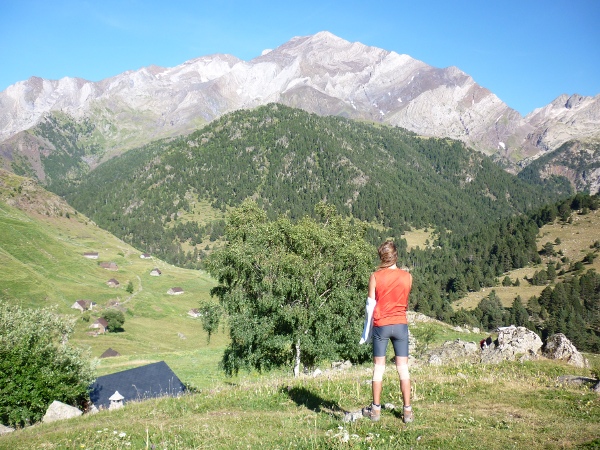

Biad s refuge, under Posets But we didn't, and after a somewhat painful start, with our boots soaking wet during the stages that crossed the enchanting Selva de Irati which ended up with me getting the biggest blister I've ever seen, we started to walk farther every day, extending the stages when we felt strong after reaching their official end. When we crossed from Nafarroa to Aragonese territory, the mental wall that I had built over the toughest stages in our quest started to fall apart. Days later, we found ourselves climbing down to Pineta, leaving Ordesa behind and enjoying a feeling that our adventure could not go better. The weather had been perfect for over a week and our legs and back were strong to go all over the way to the sea.


Ca n de A isclo, on our way to Pineta When we finally saw that huge blue stain on the horizon, the day before getting to the last mark, we got really excited. We had made it, but as we walked towards the cape, happiness slowly got mixed with melancholy. An unforgettable adventure was about to end, and we didn't want to face our return to the city and our routines. It had been many days surrounded only by awesome landscapes, and living without watches, with only sunlight and weariness marking the time to get in our sleeping bags.


At the very last red and white mark of our journey We've had plenty of time to meet great people. Starting with the Navarrian brothers we met in the early stage, which provided us with a good pace to follow while our leg muscles were still building up; or Kike and Ana, who drove from Pamplona to visit us during the first Aragonese stages (thanks for the supplies!). Tom s and Roger, young hikers from Matar , surprised us with their maturity and experience as mountaineers; we had the pleasure to join forces during four days, walking a really cool variant through the Infiernos and Collado del Letrero which avoided going through the ghost city of Panticosa. Roger and Tom s, we really hope to meet you soon! Andreu, Manel, Ghandi and Ga la visited us at the Vall de N ria and were unlucky to suffer a frightening hail and thunder storm when they left our shelter on their way back to their car. Thanks! All of you have been a very special part of our experience!

This adventure through GR 11 has been incredibly positive for us for several reasons. We've learned a lot about ourselves and strengthened our relation, and now I know how powerful drive can be; to get somewhere, no matter how far, it's really easy if you just believe you can do it and desire to get there. Maria and I are proud of what we've done, and no wonder we're looking for new challenges. An obvious one would be repeating this experience, going through the French side of the Pyrenees, but for now, the Corsican GR 20 seems the most appealing. We'll see, next summer!

30 August 2010

Richard Darst: The DebConf registration process

The DebConf registration team has the hard job of coordinating accommodation, food, and payments for hundreds of people.There are two major dates here: the sponsored registration deadline, and the reconfirmation deadline. There is also the date of opening registration, but that's usually more a matter of "how soon can we?" than "when should we?"The sponsored registration deadline (April 15 for DC10) is the deadline for requesting sponsored accommodation, food, or travel. This allows us to figure out how much we'll have to pay for attendees - attendees who register after this point should pay enough to cover their own costs.The reconfirmation deadline (June 10th for DC10) is used as a ping for attendees, particularly the sponsored ones. Attendees must reconfirm they will attend, so that we don't waste money reserving more food/rooms than we will have people using them. This deadline usually depends on the date we must give firm numbers to our accommodations.Historically, registration hasn't ever closed, anyone can come, just if you register too late you won't necessarily get any free stuff (and definitely no free food/accommodation). The deadline for food and accommodation themselves has been based on the logistics of the conference itself - DC9, when we ran out of physical rooms for accommodation, and DC10, when we had to give firm housing numbers to Columbia. Food has tended to be easier as caterers could take updates on shorter notice, usually the day before.DebConf8 began a system where attendees could pay a registration fee if they desired. This was encouraged, for example, for attendees whom could get this fee reimbursed by their company, but was not required nor encouraged of sponsored attendees. DC8-9 had two classes of fees: Professional, covering the actual costs, and Corporate, covering about double of professional and for companies or registrants whom could provide extra financial support for DebConf. DebConf10 added an extra layer of "pay per day" on top of this.It's up to the registration team to pin down attendee numbers as early as possible, as this is usually the biggest cost. DebConf provides food and accommodations to a huge number of people, but the numbers are constantly changing. It's hard to know how many people will drop out at the last minute. It's hard to know how many people will actually pay a corporate or professional fee, as opposed to mistakingly selecting it when they'd rather something else. Our registration system can't support all the little intricacies of how much an attendee will cost us, or pay us. Without knowing how many people will attend, how can we accurately get the right number of meals and right number of rooms? Sponsored people may always choose to not eat some meals with us, possibly saving us money there. How many people with travel sponsorship will actually request their full reimbursement?The registration system, Pentabarf, is used to track attendance numbers, but it isn't completely reliable. Not everyone in it will attend all days, and most people who aren't staying with us don't have accurate dates of attendance. Thus, it can only be used as estimates, not for all decisions.
The difficulties above are challenges for the registration and budgeting teams, but are not too bad - they just require thought, time, and answering many questions from attendees.Tags: debconf

27 August 2010

Richard Darst: DebConf budgeting for a single conference

My last post discussed the year-to-year budgeting of DebConf. This post discusses what makes budgeting difficult within one particular DebConf. Since every DebConf is unique in its arrangements, the particular difficulties always vary year-to-year. For example, DebConf10 was easy in that Software in the Public Interest was in the same country so that we had easy access to bank accounts, but more difficult venue payment logistics. I'll use DebConf10 as an example below.
For DebConf10, we get our venue "for free" thanks to the support of the Columbia Computer Science department. However, we had to pay for guard costs after building hours, and custodial costs. For custodial costs at least, we had to go through many layers of bureaucracy, and people kept insisting it would be more than they quoted. (It ended up being about half, since DebConf attendees were so responsible!)DebConf sponsors many attendees. This means that all their food and accommodation costs are paid by us. We have sponsored registration and reconfirmation deadlines to set a maximum of the number of people we have to sponsor, but people are continually dropping out and it's hard to know just how many people to reserve for. Sponsored people won't always eat every meal with us, and usually won't decide until the day before - so figuring out food amounts is hard, too. Furthermore, we have unsponsored people who will want food and accommodations (paying themselves) which we must somehow plan for.Different venues operate on different payment rules. This year, CU Housing was fairly strict on asking for attendee counts and room assignments two weeks in advance. Then, as time gets closer, they got more flexible, and in the end told us that they will, in fact, only charge based on number of people actually attending - a huge win for us. Similarly with CU Dining, we had to go through great lengths to make sure that we would pay only for meals we ate. At CU, food had to be paid in advance, but accommodation and other costs are paid afterwards.We have to guess how much will be spent on miscellaneous supplies once DebConf starts. We have to then decide how much to spend on extras such as the day trip or conference dinner, and how to sponsor those, if possible.Debian (and thus DebConf) has money held in trust in many currencies in different accounts. Different sponsors will pay to different currencies, depending on what is convenient for them. This means that we need to consider fluctuating currency conversion rates, and decide if and when to transfer money. In general, DebConf hasn't transfer money just to make sure the DebConf-tagged money gets spent first. Some surpluses are best left in other countries to help pay future travel sponsorship since it is expensive to move money out of the country. Some conferences may result in a net movement of money from USA to Europe (more donors in one, more expenses in the other), some the other way around.Travel sponsorship is in the form of reimbursement. These can take many months to have the documentation received from attendees and the reimbursements all sent out, and thus finalizing the budget and surplus for next year.The overall principle we've tried to stick to is plan for a balanced budget in the worst case scenario, and then be happy when it ends up better than that.
At the DebConf&Debian BOF, someone mentioned how budgeting for any (free software) conference is hard. I think that's certainly true. Some of the registration fluctuations could be made easier by being less flexible, but DebConf wants to serve our attendees even if it is a bit of extra work for us. Each DebConf will have its own ways budgeting is difficult, but things have always work out, and usually with a bigger surplus than we were expecting.Tags: debconf

Next.

Previous.