Search Results: "gio"

8 December 2006

Evan Prodromou: 17 Frimaire CCXV

One problem with keeping your journal in the French Revolutionary Calendar is that you have to keep looking up what the date is. It is nice to know that there are functions for converting Julian dates to French Revolutionary dates in PHP. Also a nice link on that page to the strange and mellow http://bottoms-dream.de/ , which isn't anywhere near as pornographic as it sounds. tags:

Blinky Redux I had Blinky Hockey again tonight -- the first time in a month that I've gone. (Blinky is the pickup hockey team my friends Meg and Patti started. It's for people who don't play hockey so good but want to learn. Like me.) Last time we had it, I flew out to California at 6AM the next day for 2 weeks, so I missed two practices in between. And then last time I had everyone over for Thanksgiving dinner, and I fell asleep putting the baby down. Doh. So it was good to go out this time around. I've been going to our local hockey rink, Ar na Mont-Royal, for free skating from 4-5PM a couple of times per week since we got home, and I think I'm getting a little steadier on the ice. I still haven't got the whole stop-on-a-dime thing or skate-forwards-backwards-forwards thing, but I'm able to get around without going face down. Which is good. Tonight we did some more sophisticated drills and had a good scrimmage at the end of practice. I didn't score but I had an awesome shot. It would have been cool if it were a score. Anyways, I think I'm going to have to keep practicing on my own. Going to the Ar na is great, but maybe I should fill our parking lot out back with water, like this R ves de Glace site suggests. That'd be cool. tags:

Calendar wishlist So, I'm always trying to learn to use my calendar application, whatever's easiest and most available. I have a Treo 650 and Evolution, and they work OK, but they don't work great. I have a lot of things that I wish calendar programs had.
  • Project management integration. This is probably the biggest one for me. I can't believe that we have two different kinds of programs for planning the exact same information: what you're going to do with your time. On top of that it's remarkable that so few of project planner programs talk to calendars (or vice versa).
  • Hierarchical TODO lists. I'd like to break up tasks into sub-tasks that depend on each other.
  • Effort estimates. I'd like to be able to make notes about how long I think a task is going to take, and when I'll get it done.
  • Repeating TODOs. Probably the most egregiously un-ergonomic thing about modern calendaring programs. Almost everything I have to do in my life I have to do on a repeating schedule. I have to take out the recycling once a week before Wednesday morning. I have to pay rent before the 1st. I understand it's a tricky problem, but that doesn't mean I don't want a program to do it.
  • Open invitations. I'd like to be able to send open event invitations to mailing lists and have people RSVP automatically (if they want). All the systems I've used require that I know the email address of each invitee ahead of time. And they rarely work across calendaring systems.
  • Skipped TODOs. Sometimes I give myself a task todo and I just don't get around to doing it. I'd like to be able to mark a task as not done, but no longer important. I don't want to forget it forever, just remember that it never got done.
  • Logging. It'd be nice if there were more and nicer interfaces to say what I did with my day after it's done. When did I finish that module? When was the last time Niko came over for dinner? It would be nice if my calendar helped me remember the past as well as plan the future.
  • Sharing by default. I want to set up calendar sharing once, have my local and remote calendar synched transparently, and never worry about it again. CalDAV seems neat, but I have got no idea how to get it working.
  • More shared calendars. I like using shared calendars; I wish more organizations published them. I'd like it if Bell Canada published a calendar that told me when to pay my phone bill, and I'd like it if MSLUG published a calendar of their meetings. I'd like it if I could mark my phone bill as paid, and RSVP for an MSLUG meeting, through my calendar interface.
  • ACLs. Different people need to see different parts of my calendar. It'd be nice to have finer-grained control than "public" and "private".
tags:

2 December 2006

Jaldhar Vyas: The Real Meaning of Nalanda

Venkatesh Hariharan recently wrote an article on Indias traditions of knowledge and how Open Source meshes with them. Now having met him at foss.in and knowing of his work, I am 100% convinced he is on the side of the angels and their is no malice in what he wrote. However, his interpretation (really not his, but the conventional wisdom amongst the Indian elite.) of Indian history and culture is so monumentally wrong it bears correction. While I admit my hackles were raised by the cultural and theological mistakes made, there are implications for Open Source advocacy in India and the world at large too. He starts by giving the example of Nalanda, supposedly "the first university in the world." but more accurately a Buddhist vihara (monastery.) Its' very name indicated sharing. I use the past tense because Nalanda doesn't exist anymore. In fact except in a few border areas influenced by Tibet or Burma, Buddhism itself is so thoroughly extinct in the land of its birth, the place where it flourished for over 1500 years, that the only reason people like Hariharan or myself only know that there ever was such a thing due to the work of 19th century Western Indologists. How could this be? One theory is that a resurgent Hinduism coopted or persecuted the Buddhists into oblivion. However this is unsatisfactory. It does not explain why Jainism (a religion as old as Buddhism and equally heretical for exactly the same reasons from the Hindu point of view) still survives to this day and it doesn't explain how it could have happened for even the most advanced genocidal regimes of the 20th century have been unable to "disappear" undesirables to the extent which Buddhism disappeared. A more plausible explanation revolves around the fact that, as I mentioned before, places like Nalanda were Viharas. This doesn't mean that they can't have university-like properties too; after all the great academic institutions of Europe also had religious foundations but the monastic nature of a vihara is salient. A monastery is not a place you go to engage the world, its a place you go to escape it. To mix metaphors a bit, the viharas were cathedrals not bazaars. While there may have been a lively intellectual life within its walls, there is no evidence that Nalanda and its denizens interacted much with the surrounding culture. An economically unproductive institution of such vast size (15,000 monks at its peak) could only survive by the patronage of kings and other rich people. When that patronage dried up as for example when the medieval Muslim invasions swept away the old royalty, Nalanda and its sisters couldn't survive. Just as when a proprietary software company dies, its "intellectual property" often dies with it, when centralized Buddhism died, Buddhist ideas died with it. (Luckily Buddhism had spread to other countries by then and developed new, less monolithic forms so it was not lost to the world altogether.) In contrast Hinduism (and for that matter Jainism) while having all due respect for monks were and are primarily lay movements. The pursuit of morality (Dharma), wealth (artha) and pleasure (kama) in this world are equally valid human goals alongside liberation from the world (moksha.) and this manifested as the much maligned institution of caste. Hariharan quotes the conventional view probably familiar to Westerners from Anthropology 101, a lock-step hierarchy of four classes (varna is the Sanskrt word) with fixed occupations, with knowledge and privilege on top and ignorance and oppression at the bottom. The thing is, this view bears no relationship whatsoever with social reality in India now or historically. There is another Sanskrit word, jati, which can be translated as caste. There are thousands of these jatis and while Indian thinkers have periodically attempted to try and shoehorn them into the varna framework, they have had little success and varna is for all practical purposes just a theory. And this is not just a fall from some putative golden age (Like the canard that once caste was flexible and merit based and only later became rigid.) but the state of affairs throughout recorded history.

A jati consists of people who share a common (or fictive) kinship, who have particular food and ritual choices, and marry endogamously. While many jatis are associated with a particular occupation, many others are not. This is what caste means to a typical Indian (it is also the social organization prevalent amongst Jains, Sikhs, Muslims and Christians even if they don't accept its theological basis.) Yes, hierarchy and concommitantly oppression, are in some cases a byproduct of casteist thinking but they are hardly its raison d'etre. A comparison can be made to the Western nuclear family system. Some people think it is superior to any other form of social organization. Most people wouldn't go that far but go along with it as "the way it is." Some of those of a liberal persuasion might want tweaks of certain aspects of it. A very small fringe think it is nothing more than a nefarious plot to spread patriarchy, subjugation and racism etc. They are mostly considered kooks by the other groups. (Unfortunately when India and caste are concerned, the kooks are ruling the roost.) The diversity of jatis like the diversity of open source creates a certain resistence to disruption that a monoculture cannot. Thus though Hinduism also suffered grievously from invasions, it was able to hold on where Indian Buddhism could not. Brahmin (sic. That's an English mispronounciation.) is also misinterpreted as one who knows Brahma (masculine noun. The Creator God.) instead of Brahman (neuter noun. The supreme spirit pervading the Universe.) though even then it would be wrong because Brahmin, Brahma, and Brahman all come from a common root word brhati (feminine noun. Sacred speech.) as any Sanskrit dictionary will attest. Hariharan cites the example of the sacred scriptures (Sic. He means the Vedas) and the notorious statement of the Manusmrti saying that an unqualified person who hears them should have molten lead poured into their ears as examples of the proprietarization of knowledge. Now the long-suffering untouchables may have been afraid of many things but having lead earplugs was not one of them. There is no historical evidence that any such action was ever attempted. You can criticize the Manusmrti for even saying such a thing but that is a far cry from using it as evidence of historical attitudes. You see, the Manusmrti is not even in the most orthodox conception Hindu Sharia and the Vedas are not "Sacred Scriptures" in the sense that the Bible or Koran are. Rather they are part of a wide range of significant literary works respected in Hinduism of which other important examples are the two Epics the Mahabharata (which includes the Bhagavadgita), and the Ramayana, and the vast compendia of geneologies, philosophy, lore and legend called the Puranas. Hariharan actually missed a good chance to make his point here because while the Vedas are indeed "proprietary" the other works I mentioned are not and have in fact permeated all over India and even beyond its borders. Many Indian languages owe their literary existence to translation of the epics or Puranas. For instance one of the earliest monuments of Hindi literature is the Ramacharitamanasa, Saint Tulsidas's translation of the Ramayana. When he wrote it in the 16th century, he did face some opposition from those who didn't think such an august work should be rendered into a "vulgar" tongue, he also received encouragement from equally orthodox people (including those who believed the Vedas should be restricted to Brahmins) Today it is by many accounts the most popular Hindu holy book in existence. So really the whole idea that the Hindu canon shows a fall from open grace to rigidly controlled private property is just bogus. To those who have slogged their way though all this verbiage wondering what it has do with Linux and Open Source, let me assure you I am getting to the point :-) It's bad enough from my point of view as a devout Hindu that my religion would be misrepresented this way but from my point of view as a supporter of Free Software ideals, it is catastrophic. Linux and Open Source in India has spread, as in most parts of the world, primararily as a hobby amongst computer enthusiasts and for a hobby it's doing ok. However if you think of it as more than that, as a tool to enhance society and empower peoples lives, that is not nearly good enough. But how can one serve a society if one apparently has no clue about that societies history and mores? The developing world is littered with failed projects that were carried out with the purest of motives but no regard to what the putative clients actually wanted. Do we want Linux and Open Source deployments to go the same way? For a couple of years now I've been trying to get Indian and NRI programmers to get involved in localization in debian-installer and elsewhere but even with the small minority that are sympathetic to Open Source (a scandal in itself.) it is like pulling teeth. To their credit, Red Hat India pays people to work on such things but volunteerism is the heart of the Open Source movement as we all know so the apathy of Indian IT professionals is deeply troubling. Hariharan is trying to increase interest by appealing to the Indians' sense of cultural pride which is a good tactic--it has been successfuly applied by many non-western or minority cultures--but he is not going to be very successful if the vision of Indian culture he is presenting is as alien as Eskimo culture to the vast majority of the people. Western Open Source advocates also run into difficulties due to being tone-deaf in their understanding of how third-world cultures actually operate. When India declined to participate in the One Laptop Per Child (OLPC) project, some commentators on places like Slashdot were perplexed. Wouldn't a poor country want an inexpensive yet efficient pc using free software instead of high-priced imports? The thing they missed is that while people in India may be poor, thanks to a more-or-less democratic polity and more-or-less open communications, their frame of reference is no longer their village. Their trends are increasingly set in Mumbai, New York, Paris, and London. The forward-thinking amongst them know that computers are the key to the future. They also know Bill Gates is the richest man in the world thanks to something called "Windows" knowing which can get you a green card and your own chance of becoming rich. So if Linux comes along, presented as a cheap alternative which is "just as good", the fake Gucci handbag of IT if you will, it is not going to impress. Thinkpads and Dells appeal to the upwardly-mobile persons vanity, a third-world hand-cranked laptop does not. (This incidently is what is behind the "Nalanda university" meme too. Monasteries are yesterday. Universities are the in thing so we have to have some in our past and not just any but by golly, the first university in the world.) When they venture from pure technology into the realm of culture, Open Source advocates need to be a lot more sophisticated, not to mention accurate, in their arguments lest they fall on deaf ears. Platitudes and sentimentality about "spiritual" versus "material" culture aren't enough. There must be concrete demonstrations of the benefits of why the Open Source approach to knowledge is better. They must be more sensitive in their presentation to avoid needlessly antagonizing people who might otherwise be natural allies. I believe the Open Source ideal is good for India and the whole world, not just in software but for society at large and I wish Venkatesh Hariharan and all the others on the frontlines of the fight for openness the best of luck. But good intentions cannot excuse sloppy thinking.

John Goerzen: Peter's Evil Overlord List

If you ever feel a bit like Darth Vader or some Bond villain, you really need to check out Peter's Evil Overlord List.

It starts out with "My Legions of Terror will have helmets with clear plexiglass visors, not face-concealing ones."

23 November 2006

Sergio Talens-Oliag: 2nd gvSIG Conference

I have not written anything on this blog for a long time and after someone told me about it I decided that I could do it today; the long delay between posts comes from the fact that I'm quite busy with my current jobs and they don't leave me free time to work on Debian or Free Software related projects in general. Today I've been on the 2nd gvSIG Conference, a two day conference related to the gvSIG project, a GPL'ed Java based GIS (Geographical Information System) promoted by Regional Council for Infrastructures and Transportation (CIT) of the Valencian Government. I know about this project since it was made public, but I never tried it because I have a very poor GIS knowledge and I always try to avoid Java based software if possible (luckily one of the main reasons for that will change soon). Some months ago I tried the tool, but I left it soon because I found its interface quite weird and had no data to play with. Today I've seen a presentation about the raster capabilities that will be included on the next version of gvSIG and I have to admit that I've been quite impressed by them. I don't think I will use the tool much, but it is good to see free software projects like this one succeed; having local GNU/Linux distributions is not bad, but IMHO projects like this one are a much better way of using public money and promote the use and development of Free Software. My only complaint about the project is that the project development is not as open as I would like it to be (there is no public revision control system, no bug-tracker, ...), probably because almost all of the work is done by local software development companies that don't like to share their work until it is finished and don't have a free software development culture... ... but hey, nobody is perfect... ;)

Edd Dumbill: Really really getting the testing religion

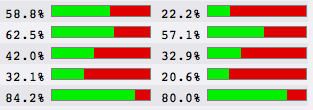
Writing tests is virtuous. It's the wholemeal bread of programming. Do it, and you'll be so much fitter. Except it tastes like cardboard and gets in the way of consuming the yummy treacle sponge of programming. But now I've got the testing religion. I view the lack of tests with the disapprobation of a reformed smoker tutting and huffing at the merest suggestion of a Marlboro Light. How did this happen and how can I be sure I won't backslide? The moment of transition was the first time that a test saved me from releasing software with a bad bug in it. The theoretical knowledge of virtue was translated into the palpitating relief of not disgracing myself in public. After that happened a few more times, I found myself desperately uncomfortable with the idea of releasing anything that didn't have decent test coverage. And so a virtuous habit is formed. It's not just driven by fear. With the right tools to hand, writing tests can be a lot of fun. You don't always need to be "in the zone". If you've got a spare half hour here and there, you can use it to increase the coverage of your tests. Getting better at testing is one of the ways I've become a much more proficient Rails developer over the last year of work on Expectnation. In case it helps anybody else, I thought I'd share some of the tools and techniques that are part of making Rails testing fun and effective. Continuous testing Whenever a checkin is made to our source repository, tests are run and the results emailed to everybody working on the project. As with the "you broke the build" disincentive, you need to be kept honest by frequent running of the tests. There are a variety of tools around to help you do continuous integration with Rails, most of which have some dependence on you using Subversion for source control. In the event, I just created my own script to do what we required. Coverage reports rcov coverage barsOne of the big mental hurdles with testing is knowing how many tests you should aim for.  You can't prove a negative: even if your tests are all passing it still doesn't tell you much about the tests you haven't written that might fail! We use rcov as part of the continuous integration process, and post the results to our project web site. The pretty red and green bars give you some idea of when you're starting to get adequate test coverage, and the line-by-line breakdown is invaluable. Tainting strings One of the easiest errors to make in Rails templates is to miss the call to h(), to escape any HTML in an output string. The only real way to catch these errors is through automation. The wonderful safe_erb plugin helps you do just that. By using Ruby's tainting mechanism for strings, it throws an exception if you render any external data unescaped. One of the beneficial side effects of safe_erb is that you then become very particular about ensuring your functional tests properly cover every action in your application.  Tests such as get 'index', which before seemed mundane and redundant, are now essential, as you want to test for tainted strings. In addition to the above techniques, there are a lot of fun shiny gadgets to help you write tests, such as ZenTest, but the three things above are the ones I've found to be of significant value. I ought to conclude with words of praise for Rails. It goes out of its way to make testing an important part of the development lifecycle, and the availability of the of unit, functional and integration test functionality makes it easy to get started. Every time I teach somebody about Rails' testing features, they end up finding it very enjoyable.
Don't forget, testing can be fun!

21 November 2006

Biella Coleman: These two services I am prepared to acknoweldge, but I do not know of any others

So I am housed in University of Alberta Department of Philosophy as my supervisor is a philosopher and there is no seperate STS department. And this “academic housing” certainly has its advantages, like for example, learning about probably one of the most audacious (and frankly amusing) statments on religion ever… by Bertrand Russell:
My own view on religion is that of Lucretius. I regard it as a diseaese born of fear and and as a source of untold misery to the human race. I cannot, however, deny that it has made some contributions to civilizaion. It helped in early days to fix the calendar, and it caused Egyptian priests to chronicle eclipses with such care that in time they became able to predict them. These two services I am prepared to acknoweldge, but I do not know of any others. Bertand Russel. “Why I am not a Christian” p. 24
I am sure he turned over in his grave when his daughter said:
“He was the most fascinating man I have ever known, the only man I ever loved, the greatest man I shall ever meet, the wittiest, the gayest, the most charming. It was a privilege to know him, and I thank God he was my father.” Katharine Tait, My Father Bertrand Russell, NY: Harcourt Brace Jovanovich, 1975, p. 202.

19 November 2006

Jose Carlos Garcia Sogo: Cities with no traffic signals

According to this article, also referred on Slashdot, an European Union project has been developed aimed to check if streets free of any traffic signal or other rules are viable. Seven cities and regions are involved, no one of them in Spain. And I hope things to stay as now. Perhaps this can work in those civilized cultures in which people try to respect others rights. But I am 100% comfident that this won't work in Spain. If people does not respect signal even if they are there and can be fined for not following them, I don't want to imagine what will people make if there are no signals and no rules. The most used motto will be: "And who the ***** are you to tell me that I can not do this?". yay!

Junichi Uekawa: Debian BOF at Kansai Open Source.

Yesterday we had a BOF at Kansai Open Source.Around 30people in the Kansai region gathered to meet.From Tokyo, Iwamatsu, Yamane, and I went there to represent Debian JP.

15 November 2006

Russell Coker: economics of a computer store (why they don't stoc...


In some mailing list discussions recently some people demonstrated a lack of knowledge of the economics of a shop. Having run a shop for a few years (an Internet Cafe) I have some practical knowledge of this. I will focus on small businesses in this article, but the same economic principles apply to large corporations too.

When running a shop the main problem you have is in managing stock. There are two ways of getting stock, one is to have wholesalers give it to you for a period in which you can try to sell it and you pay for it when it's sold, this is probably quite rare (I don't know of an example of it being done - and probably no retailer wants to talk about it in case they lose it). Often retailers consider themselves to be privileged if they are permitted to pay for hardware one month after they receive it! The more common way of getting stock is simply to buy it and hope you can sell it in a reasonable period of time (often the wholesaler will offer to buy the stock back at a 10% discount if you can't sell it).

To buy stock you need money, this can come from money that has accrued in the business account (if things are going really well) or from a mortgage taken out by the business owner if things aren't going so well. For small businesses things usually don't go so well so the money used to buy stock is borrowed at an interest rate of about 7% or 8% (I'm using numbers based on the current economic conditions in Australia, different numbers apply to different countries and different times but the same principles apply). The ideal situation is when there is money in the company bank account to cover the purchase of all stock, this means that the cost of owning stock is that you miss out on the 5.5% interest that the money will get in a term deposit.

Almost all stock has a use-by date of some form. Some items have a very short expiry (EG milk used to make hot chocolate in an Internet cafe, some have a moderate expiry date (computer systems become almost unsellable in about 18 months and lose value steadily month after month), but in the computer industry nothing has a long expiry date.

Let's assume for the sake of discussion that you want to run a small computer store that is open to passing trade (this means that you must have stock for an immediate sale). Let's assume that all items of computer hardware lose half their value over the period of 20 months at a steady rate of 2.5% of the original price per month (I think that most computer hardware loses value faster than that, but it's just an assumption to illustrate the point).

The next major issue is the profit margin on each sale. If you can make a 20% profit on a sale then an item that has lost 10% of it's value while gathering dust in your store will still be profitable. However the profit margins on computer sales are very small due to having a small number of major manufacturers (Intel, AMD, nVidia, ATI, Seagate, and WD) that have almost cartel positions in their markets and there being little to differentiate the stores apart from price. I have been told that 3% profit is typical for retail computer hardware sales by the small companies nowadays! Now if the stock will lose 2.5% of it's value per month, you pay 0.5% interest per month and you make a 3% profit then if an item remains in stock for a month then you lose money. So on average (by value) you need to have stock spending significantly less than a month in your store. Cheap items such as low-quality cases and PSUs can stay in stock for a while. More expensive items such as new CPUs and the motherboards to house them must be moved quickly.

What's the first thing that you do to reduce stock? You can keep stocks low, but there is a limit to how low you can go without losing sales. The next thing to do is to not stock items that customers won't often buy or items where there is a similar item that you can stock as a substitute. The classic example of this is hard drives, a customer will want a certain capacity for a certain price - if their preferred brand is not in stock they will almost always take a different brand if it has the same capacity at the same price. Stores often advertise prices on multiple brands of hard drive in each capacity, but often only try to keep one brand in stock.

Of course this is a problem for the more fussy buyer. If you want to buy two identical parts from the same store on different days you might discover that they don't have the stock on the second day and that they instead offer you something equivalent. Not only do retailers have issues with managing their investment in stock but wholesalers have the same problem. So if a retailer runs out of WD drives and discovers that their preferred wholesaler has also run out of WD drives then they just buy a different brand - most customers don't care anyway.

There are some companies I deal with that have a business model based on services. One of them sells hardware to customers at cost, but charges them for the time spend assembling them, transporting them, etc. The potential for a 3% profit on the hardware isn't worth persuing, they prefer to just charge for work and also save themselves the sales effort. Another company I know operates almost exclusively on the basis of ordering parts when customers request them (but still make a small profit margin on the sales), this means that the customer can be invoiced as soon as the hardware arrives. The down-side to this is that wholesalers have the same stock issues and they sometimes have excessive delays before the wholesaler can deliver the hardware.

Dell is the real winner out of this. As they operate by mail-order they don't need to have the stock immediately available, they have a few days to deliver it which gets them time to arrange the supply. They can also have a central warehouse per region which reduces the stock requirements again. A 3% profit on items that rapidly decrease in value makes it almost impossible to sustain a small business. But an organization such as Dell can sustain a successful business at that level.

Of course the down-side for the end-user is that Dell doesn't want to have too many models as that just makes it more complex for the sales channel. Also they have deals with major suppliers which presumably give them deep discounts in exchange for not selling rival products (this is why some brands of parts are conspicuously absent from Dell systems).

10 years ago there used to be a small computer store in every shopping area. Now in Australia there are a few large stores (which often only have a small section devoted to computers) and mail-order. There seems to be much less choice in computer hardware than there was, but it is much cheaper.


PS I've attached a picture of day 39 of the beard.

13 November 2006

Evan Prodromou: 21 Brumaire CCXV

Long day today (yesterday, actually, but I'm post-dating this in the interest of chronological flow). The baby's having a hard time coming off of West Coast time; she got up late and took a loooong nap till half-past three. Which was fine, because I needed the time to work on my NSLU2, which needed some attention. The NSLU2, or "Slug", is a tiny Linux computer from Linksys, about the size of a two packs of Marlboros laid side-by-side. My brother Nate gave me one last year for Christmas (thanks, nate), and I've been using it for network backups, but on our trip to SF Nate showed me that he's running all kinds of wild services off of his. So I decided to start shifting over some responsibilities to the little bugger. Which was just about time. Sometime during our trip to San Francisco, my main home server started having fan problems; it kept overheating and shutting itself down. It's going to take some time to diagnose the problem, but I figured that this was as good a time as any to move the critical services over to the Slug. The main one that needed budging was DNS. Maj's main domain, as well as my two .san-francisco.ca.us domains, run from home, because it's too hard to get the registrar to change them. The Unslung system I use for the Slug has a BIND package, which is a good thing to run, anyways. I was running MaraDNS on the big server, because I always root for the underdog, but there wasn't a MaraDNS package for the Slug. So I rewrote my zone files and things are up and running now. I don't know what else I'm going to put on there. Jabberd? Asterisk? A home wiki? Just not sure. tags:

Blah blah blah When the baby got up, we went to our local Loblaws, out towards the end of rue Rachel across from Canadian Tire. It's a pretty fantastic place to buy groceries -- it's the old CPR Angus Shops, a repair and maintenance facility for the Canadian Pacific Railway. The building is huge, with giant cranes and beams still attached to the roof. Amita and I grabbed a crapload of groceries and brought them home to Maj, who'd just had a massage at the centre around the corner and was feeling really good. She'd rented Tristram Shandy, the 2005 movie based on the 18th-century level-twisting novel. Me and Amita June made some baked potatoes, and we all watched the movie, and a good time was had. tags:
 

H****e en vrac One thing I always want to buy when I'm at the store in Quebec is the quite commonly available communion wafers. Yeah, really! big ol' 5-inches-diameter communion wafers, in the snack section next to the Doritos and the Humpty Dumpty potato chips. Quebec society has a had a precipitous secularization -- from around 90% church attendance in the 1950s to less than 10% today. But Catholicism still infuses all parts of life. For example, in Quebec, you cuss by using words from the church, including, of course, hostie ("the host"). So I can't figure out why hostie are a tasty snack treat. Is it a deliberate snub to the sacrament of communion by a secular society? Or did the practice antedate the Quiet Revolution, and did the formerly religious Quebecois eat communion wafers for fun? Or is it just a snork-snork funny thing to do, when the name of the food is actually a naughty word? I dunno. I'm fascinated, but not enough to buy a big bag of communion wafers to eat. (They're never cheese- or BBQ-flavored, by the way; they have a pristine seriousness to them.) More info solicited. tags:

Opinity One of the services mentioned in the Web 2.0 Summit infrastructure workshop was Opinity. Opinity seems to be a distributed reputation system, kind of like claimID but with a little more soft information. I think it looks pretty cool, and I'm glad to see another addition to the growing OpenID identity provider market. tags:

8 November 2006

Erinn Clark: cd /mnt/view

The week before last, I packed up my car and drove across the country and am now in California. All I have to say about that is: WESSSIIIDE! I also have a few pictures.
This cow mooed at me until I went away. I love New Mexico.
Obligatory tourist shot at the Grand Canyon. As an aside, on my way there I got stuck on a highway overnight because of a police/gunman standoff.
Some pretty blown glass flowers inside the Bellagio in Las Vegas, NV.
The meteor crater, which I wish to pave and turn into a skatepark.

6 November 2006

Antti-Juhani Kaijanaho: This is art

In front of the City Hall, there is this piece of art. A bus driver who often drives me from work commented recently that the shirts are probably dry by now. Similar comments have been seen in the regional newspaper letters to the editor.

5 November 2006

Jose Carlos Garcia Sogo: European blackout

Tonight an European power blackout happened. Some problems in the connection between Germany and France make the network unstable. What is most interesting is that this also affected some Spanish regions and Madrid areas. A Spanish windmill power plant and a gas power plant were disconnected from the network. As Joey say, automatic disconnection of users from the network worked, and it never collapsed, but I am amazed how far the problem reached. Also, some of the problems that Joey describe were due to a lowering of network's frequency, below standard 50Hz.

Christian Perrier: NepaLinux 1.1 released

(this could probably deserve a DWN entry) On Monday, 30 October 2006, Madan Puraskar Pustakalaya (the principal archive of books and periodicals in the nepali language, a non-governmental and non-profit organization based in Nepal) released the 1.1 version of Nepalinux, a entirely localized version of GNU/Linux, based on Debian (and the Morphix installer) for use by Nepali-speaking users. This work is supported by the PAN localization project just like the DzongkhaLinux project is. In the case of Nepalinux, though, the project is supported locally by a NGO rather than the local government During last year, good connections have been developed between the developers of this localized distribution and the Debian project, mostly through work on Debian Installer localization. This confirms Debian as the preferred choice of many CDD developers in the region. The success of NepaLinux can probably be seen by all Debian contributors as a success of the Debian project.

2 November 2006

Ben Hutchings: How to fix www.royalmail.com in Firefox for Linux

The front page of www.royalmail.com displays wrongly in Firefox on Linux (though apparently not Windows). Worst of all, it is impossible to focus the input fields near the top of the page by clicking on them. However, I worked out some style rules that will fix it. These have been tested in Firefox 1.5 on Debian etch and Fedora Core 5. To apply these, you need to copy/add the following text to ~/.mozilla/firefox/profile/chrome/userContent.css and then restart the browser. Perhaps someone who knows about GreaseMonkey can work out a rule for that, which would make it easier to install them.
@-moz-document url-prefix(http://www.royalmail.com)   
  div.Content-Region    position: static !important;  
  div.Content-Region div    position: static !important;  
  div.List-Container   height: auto !important;  
  div.hpBottomWide   clear: left;  
 

31 October 2006

Russell Coker: religious requirements for free software developme...


Relgions commonly require contributions to charitable causes and helping other people. Developing free software without expecting a reward seems to fit that criteria.

If my primary religious belief (atheism) turns out to be incorrect then I am certain that whatever deity might exist would want me to do Free Software development.

It seems to me that denying people the ability to contribute to Free Software development or forcing them to use proprietary software is therefore an infringement of their rights to freely practice their religion.

Prisoners should be permitted to do Free Software development. Kevin Mitnik was prevented from using computers while incarcerated and after being released (which is wrong in so many ways). It has been recently announced that pagan prisoners in the UK are being given time off prison duties for haloween. I think that allowing free software development for people who believe that it is a religious requirement deserves at least the same protection.

Also government agencies should not require the use of MS file formats or IE for communication.

PS Day 24 of the beard is depicted above.

27 October 2006

Scott James Remnant: Parallel Peer Programming

Here at Canonical Towers we have several staff who worship at the altar of Extreme Programming, and as such many of the methodologies and rituals prescribed by that religion find their way into our day-to-day working practices. A few of these came together in an interesting way a few weeks ago, and it was suggested by a cow-orker that I blog about it so he could give the URL to people. The first ritual is that of the sprint, I don’t think this is orthodox XP but rather something inspired from it that we picked up from the Python community. With all of the Canonical developers scattered across the globe mostly working from their own homes, it’s become a useful tool; particularly for the Launchpad team. The basic idea for those that haven’t heard of it is simple, and perhaps obvious; you get a selection of the team together in one place, sit them around the same table with particular goals to complete. In effect it’s highly compressed facetime and high bandwidth interaction to nail those tasks that need it, before you head off again and work at a more sedate pace. The second is directly from XP doctrine and is that peculiar observance known as pair programming, something that is often coupled with sprints. For anybody who hasn’t encountered this before, it’s something I’ve always found rather odd. You get two programmers together, both itching to code, and you take one of them’s laptop away; and you don’t just force them to fight over the keyboard either, the laptop-less soul isn’t allowed to touch it. The theory here is that it frees the deprived individual of the hassle of coding and allows them to direct the programmer in ways that may not be immediately obbious, or alternately think about the next bit of work that needs doing. Another interesting side-effect is it can be an interesting way to learn code you’ve not worked with before, if you’re the one doing the coding and you’re being guided what to do by a sage who already knows it. I have a funny story here, so I’m going to digress from the main stream for a moment to tell it. A few months ago I was working in the London office, Mark had been up all night coding and had then given me responsibility to get his changes landed onto the Launchpad mainline. I’m not that hot on quite a bit of Launchpad, and fade to utterly clueless the nearer the code gets to the web application itself; and when trying to merge the two there were conflicts which I needed Mark’s help to resolve. Now as anybody who’s met Mark knows, he’s a pretty good example of a Type-A personality, yet he suggested that we do a spot of pair programming to get the code in and I’d be the one with the laptop as it’d help me get to grips with the affected parts. This hilighted something I’ve always seen as a problem with pair programming, dealing with it when the a person with the keyboard has a totally different way of working to you. In particular, I’m an emacs user, whereas Mark is a die-hard vim user; but also right down to the working directory I would work from, how I test results, etc. When you’re the one without the laptop, this can be quite infuriating, as you know exactly how to solve a problem and the idiot with the keyboard is dithering about doing things you don’t understand just to get there. If you’re a Type-A personality, you generally snatch the laptop away at this point and do it yourself; or at least you would, if you could drive the strange editor the other person uses. I swear Mark was sulking as he gave the laptop back and let me do it. Anyway, there is some relevance to that and we’ll come to it in a moment. The third and final methodology is the concept of unit tests and more specifically test driven development. For anyone who hasn’t come across this before, I highly recommend it; I was suspicious too when Robert Collins took it upon himself to teach me the true way, but now I’m sold. Simply the idea is that if you have any code that doesn’t have another piece of code in a test suite that checks that it’s working correctly, that code is broken. More particularly unit testing involves checking just one feature or requirement at a time, and stacking them together to test all of the code paths. I’ve actually found that this improves the APIs I design, as I write the code in small blocks and functions to make them easier to test. Test driven development takes it even further, you write the unit tests first, before you write the code they’re supposed to test; usually one or two at a time. Obviously these tests will fail at first, it’s then your job to write as little code as possible to make them pass. If your code isn’t right, you add a unit test that will fail, and modify the code to make it pass. This really comes into its own when you’re fixing bugs later, once you’ve identified the bug you write a test case or two that cause the problem; these will of course fail. You can then modify the code to make them pass, and at the same time be sure you’ve not broken other functionality because of the existing test suite. I’ve also found it really useful for particularly complicated or tricky pieces of code, especially those intricate algorithms that do particularly heavy lifting. So onto the event itself, this was a sprint in our London office to indoctrinate Gustavo Niemeyer with the various projects he’d be working on. The goal for this sprint was decided to start the conversion of HCT to Bazaar-NG, and to do this Gustavo and I would pair program. Now my last experience of pair programming had been that story with Mark (see, it had some relevance) and I knew I’d be just as bad if I wasn’t allowed to have the keyboard. I was also acutely aware that if Gustavo was just sitting by and watching, he wouldn’t get much benefit from it either, so he needed to be actively involved in the coding so he could learn the things he’d be working on. I came to what I thought was a pretty neat, and obvious, solution to these problems. We set up my laptop with the code we’d be working on, and on my display were two side-by-side terminals both running screen sessions. Gustavo then set up two same-sized terminals on his, ssh’d into my laptop from both of them and joined the screen sessions. In the left-hand one he ran vi, and in the right-hand one I ran emacs. Thus we both had keyboards, and both had editors, yet could see each other working and even steal the keyboard without danger of violence. We didn’t just sit side-by-side and code on different things though, that’s not pair programming and is just ordinary programming with a bit of a voyeuristic twist. What we did was: in my terminal I started writing the test cases for the code we needed, it was Gustavo’s job to write the code that would make them pass. We actually added a third terminal in which we could run the test cases themselves; so I could run them when I’d added something that would fail, and Gustavo could run them when he thought he’d made them pass again. This turned out to be a rather fun way to work, and at one point I was almost able to try and convince myself that the code was writing itself to pass the test cases I was writing. It also got me thinking that it’d be really neat to use genetic algorithms to breed code to pass test cases.

25 October 2006

Joachim Breitner: Giving up at SOSHGIC

Some of you might have followed my volounteer work at the SOS Hermann Gmeiner International College in Tema, Ghana, where I was invited to introduce Linux at the school. Being a free software advocate, I thought this a great opportunity to spread Free Software where it can make the most difference and helps bridging the Digital Divide: In a developing country.Judging from the offer (which was very nice, it included housing, flights, freight, money), I expected the school to be very eager to learn about Linux. I was expecting that I only had to guide existing momentum. What I found instead was that there was zero interest from the people who matter in this case. I got all freedoms to implement what I want (as long as I didn t break anything), and I created some things I think are quite nice: Automatic installations that keep the installed windows intact, neat integration in the Active Directory setup, network monitoring with nagios, a transparent firewall that let s the teachers turn the internet for the class room off and on. But it felt like working for nothing, and I can t push people to use Free Software who are unwilling.So today I drew the concequences and quit with effect to the end of December. The principal, who s project it was in the first place, was sorry, but understanding of my issues, and accepted my resignation. I will be on a trip to the Volta lake and other parts of Ghana with friends from Accra for the next 10 days anywasy, so she will take the time to think and discuss how the school can make the best out of the remaining two months.I have not giving up on spreading Free Software here completely. If I find another project where I can be of more use afterwards, I will consider that. But this time I m going to be very picky where I go, and only take a shorter, better defined project. If I can t find something, then that s it and I ll go back to Germany to continue my studies.

23 October 2006

John Goerzen: We need to follow the Amish example

Just a few weeks ago, the world heard the news of the tragic school shooting at an Amish school in rural Pennsylvania. A deranged man entered the schoolhouse, bound and gagged female hostages, brought along torture equipment, and shot 10 of them. 5 died, and the remaining 5 are believed to still be hospitalized.

Back in 1990, a deranged man committed a series of murders near the University of Florida campus in Gainesville. The story mentions 5 people that were killed.

Both were tragic situations. Both men killed people that had their whole lives in front of them. Both shook an entire community.

But look at how the communities responded. The Amish responded like this:

CNN reported a grandfather of one of the murdered Amish girls said of the killer on the day of the murder: "We must not think evil of this man."

Jack Meyer, a member of the Brethren community living near the Amish in Lancaster County, explained: "I don't think there's anybody here that wants to do anything but forgive and not only reach out to those who have suffered a loss in that way but to reach out to the family of the man who committed these acts," he told CNN.

The Amish have reached out to Roberts' family. Dwight Lefever, a Roberts family spokesman said an Amish neighbor comforted the Roberts family hours after the shooting and extended forgiveness to them.

An article in a Canadian newspaper the National Post stated that the Amish have set up a charitable fund for the family of the shooter. (Wikipedia)


In addition, the Amish invited the Roberts family to attend the funerals for the Amish girls he killed.

Gainesville reacted this way:

Dianna Hoyt, Christa Hoyt's stepmother, said Rolling's execution has been eagerly awaited by the victims' families. Some will be inside the prison to witness it. . .

Sadie Darnell, who was the police department's media spokeswoman at the time and developed enduring friendships with the victims' families, said Rolling's execution still matters, even if it also provides him more of the notoriety he sought.

"Retribution . . . is important because it represents that our society is holding that person accountable," said Darnell, now a candidate for Alachua County sheriff. (CNN)


We've all heard of murders that have taken place lately. Usually they are accompanied by calls by politicians, victim's family, and sometimes even clergy to kill the perpetrator. In the days after 9/11, there were reports of anybody that looked Middle Eastern being attacked in several different places around the country.

I have never understood this great desire for revenge. How does that help anyone?

What the Amish did was right religiously and morally. They truly followed the New Testament call to love your enemies and forgive. It is not easy to follow all of Jesus' teachings, and nobody said it would be. But they are doing it, and they have already begun healing. Reports are that the Roberts family has become friends with several of the Amish in the area, and they are working to help each other out after this horrible tragedy.

Even putting religion aside for a moment, the Amish actions are quite simply the right thing to do. By spreading love instead of hate, and friendship instead of revenge, they have succeeded in making sure that no cycle of violence starts there.

In contrast, 16 years later, the families of the victims in Florida still aren't healing. They are still angry and bitter. They are still seeking revenge. They hope that their lives will get back to normal after the murderer is killed. But after 16 years of stewing about it, will they really? And what about the family of the murderer, whose lives certainly must have been a mess for the past 16 years? They will now lose a family member. Does anyone care about them, or will they now turn angry at society and possibly spread the pain more?

Imagine what would happen if so many more people around the world took the Amish perspective -- to forgive those that wronged us. How long must it be before we can forgive? How far back do we spread our hate? Do we still hate those that were involved in 9/11, or can we forgive them? Do we still hate the Germans for what their ancestors did in World War II, or can we forgive them? Do we hate politicians with whom we strongly disagree, or think are liars? Do we still hate all those that have wronged us personally -- someone that stole something from us or the sadistic boss?

Knives, electric chairs, and bombs do not buy reconciliation. They can not "win over" the hearts of others. They do not make our lives easier. Hate brings more hate, and more resentment.

Forgiveness is not easy. We all hope that we will never be involved in such a tragedies as these. But let us follow the example the Amish have shown -- forgive for all things, big or small, important or not, painful or not.

Only then will we be at peace with ourselves, and only then will we have the chance to be at peace with our neighbors.

19 October 2006

Joachim Breitner: Turnkey Linux for Internet Caf s

While thinking how to spread Free Software in Ghana more effectively I noticed some important factor: Internet caf s. On the one hand they are for most people the first contact to comuters (in contrast to Europe or US, where it's probably the family or school computer), so getting Linux on there would make a difference. On the other hand, for them a Linux system is a very viable choice: Cheap per computer (although in Ghana the argument reads legal , not cheap ), provides good software for the usual internet caf s user s needs (browsing, word processing, chatting) and is very suitable to be locked down and run safely.There are a lot of internet caf s in Ghana, at least in the Accra Region, but most of the people that run these are not he most advanced computer users, so they just go the seemingly simple road: Windows on clients and servers, and probably some software like CyberCafe, also pirated, for the accounting and the computer lockdown.My idea this evening was: Would it be possible to create something like Skolelinux, just for internet caf s? A CD that the owner of the caf just puts in what s meant to be the server and boots, answers a few questions, and a second CD for the clients where he does not have to answer any questions, and what he gets is a complete system with approximately these features:If such a distribution already exists, I d like to hear about it. If not, it might be an interesting project for the Linux Accra User Group or OpenGhana.org. If successful, this might help Free Software gaining mind share in developing countries big time. Of course I m also very interested in comments from those who read this through planet.openghana.org.

Next.

Previous.