Search Results: "ghe"

6 November 2007

Christian Perrier: No institutional pro-corp bias in French NPO (afaik)

MJ, each French NPO is free to establish its own regulation rules, which may include a differential voting system if they want to. That should of course respect the French law (for instance, no discrimination based on sex, religion or any other genetic factor) but, as far as I know, nothing prevents deciding that "personnes morales" (ie non physical people) have a higher or lower vote than others. However, this is certainly not common, but many NPO simply don't have non physical members anyway (some don't authorize non physical people to be members). For those who care, Debian France (which is a NPO, but not regulated by 1901 law, but by the special NPO law for Alsace and Lorraine, inherited from the 1810-1918 years) admits physical and "moral" members with an equal voting right. The only special case is a rule that allows Debian developers to have a veto right on any decision of the organisation. See that official regulation rules of Debian France for details (French only). PS: Debian France is currently inactive, due to a longstanding dispute with the French Tax collecting organisation (Direction des Imp ts) who initially refused to consider us as a non profit organisation...because "we sell an operating system" (doh!).

5 November 2007

Manoj Srivastava: Manoj: Filtering accuracy: Hard numbers

I have often posted on the accuracy of my mail filtering mechanisms on the mailing lists (I have not had a false positive in years, and I stash all discards/rejects locally, and do spot checks frequently; and I went through 6 months of exhaustive checks when I put this system in place). False negatives are down to about 3-4 a month (0.019%). Yes, that is right: I am claiming that my classification correctness record is 99.92 (99.98% accuracy for messages my classifiers are sure about). Incorrectly classified unsure ham is about 3-4(0.019%) a month; incorrectly classified unsure Spam is roughly the same, perhaps a little higher. Adding these to the incorrect classification, my best estimate of not confidently classified mail is 0.076%, based on the last 60 days of data (which is what gets you the 99.92%). I get unsure/retrain messages at the rate of about 20 a day (about 3.2% of non-spam email) about 2/3 rds of which are classified correctly; but either SA and crm114 disagree, or crm114 is unsure. So I have to look at about 20 messages a day to see if a ham message slipped in there; and train my filters based on these; and the process is highly automated (just uses my brain as a classifier). The mail statistics can be seen on my mail server. Oh, my filtering front end also switches between reject/discard and turns grey listing on and off based on whether or not the mail is coming from mailing lists/newsletters I have authorized; mimedefang-filter However, all these numbers are manually gathered, and I still have not gotten around to automating my setup s overall accuracy, but now I have some figures on one of the two classifies in my system. Here is the data from CRM114. I ll update the numbers below via cron. First, some context: when training CRM114 using the mailtrainer command, one can specify to leave out a certain percentage of the training set in the learn phase, and run a second pass over the mails so skipped to test the accuracy of the training. The way you do this is by specifying a regular expression to match the file names. Since my training set has message numbers, it was simple to use the least significant two digits as a regexp; but I did not like the idea of always leaving out the same messages. So I now generate two sets of numbers for every training run, and leave out messages with those two trailing digits, in effect reserving 2% of all mails for the accuracy run. An interesting thing to note is the assymetry in the accuracy: CRM114 has never identified a Spam message incorrectly. This is because the training mechanism is skewed towards letting a few spam messages slip through, rather than let a good message slip into the spam folder. I like that. So, here are the accuracy numbers for CRM114; adding in Spamassassin into the mix only improves the numbers. Also, I have always felt that a freshly learned css file is somewhat brittle in the sense that if one trains an unsure message, and then tried to TUNE (Train Until No Errors) the css file, a large number of runs through the training set are needed until the thing stabilizes. So it is as if the learning done initially was minimalistic, and adding the information for the new unsure message required all kinds of tweaking. After a while TOEing (Training on Errors) and TUNEing, this brittleness seems to get hammered out of the CSS files. I also expect to see accuracy rise as the css files get less brittle The table below starts with data from a newly minted .css file.
Accuracy number and validation regexp
Date Corpus Ham Spam Overall Validation
  Size Count Correct Accuracy Count Correct Accuracy Count Correct Accuracy Regexp
Wed Oct 31 10:22:23 UTC 2007 43319 492 482 97.967480 374 374 100.000000 866 856 98.845270 [1][6][_][_] [0][3][_][_]
Wed Oct 31 17:32:44 UTC 2007 43330 490 482 98.367350 378 378 100.000000 868 860 99.078340 [3][7][_][_] [2][3][_][_]
Thu Nov 1 03:01:35 UTC 2007 43334 491 483 98.370670 375 375 100.000000 866 858 99.076210 [2][0][_][_] [7][9][_][_]
Thu Nov 1 13:47:55 UTC 2007 43345 492 482 97.967480 376 376 100.000000 868 858 98.847930 [1][2][_][_] [0][2][_][_]
Sat Nov 3 18:27:00 UTC 2007 43390 490 480 97.959180 379 379 100.000000 869 859 98.849250 [4][1][_][_] [6][4][_][_]
Sat Nov 3 22:38:12 UTC 2007 43394 491 482 98.167010 375 375 100.000000 866 857 98.960740 [3][1][_][_] [7][8][_][_]
Sun Nov 4 05:49:45 UTC 2007 43400 490 483 98.571430 377 377 100.000000 867 860 99.192620 [4][6][_][_] [6][8][_][_]
Sun Nov 4 13:35:15 UTC 2007 43409 490 485 98.979590 377 377 100.000000 867 862 99.423300 [3][7][_][_] [7][9][_][_]
Sun Nov 4 19:22:02 UTC 2007 43421 490 486 99.183670 379 379 100.000000 869 865 99.539700 [7][2][_][_] [9][4][_][_]
Mon Nov 5 05:47:45 UTC 2007 43423 490 489 99.795920 378 378 100.000000 868 867 99.884790 [4][0][_][_] [8][3][_][_]
As you can see, the accuracy numbers are trending up, and already are nearly up to the values observed on my production system.

2 November 2007

Russell Coker: Increasing Efficiency through Less Work

I have just read an interesting article titled Why Crunch Mode Doesn’t Work [1] which documents the research on efficiency vs amount of time spent working (and by inference amount of time spent on leisure activities and sleep). It shows that a 40 hour working week was chosen by people who run factories (such as Henry Ford) not due to being nice for the workers but due to the costs of inefficient work practices and errors that damage products and equipment. Now these results can only be an indication of what works best by today’s standards. The military research is good but only military organisations get to control workers to that degree (few organisations try to control how much sleep their workers get or are even legally permitted to do so), companies can only give their employees appropriate amounts of spare time to get enough sleep and hope for the best. Much of the research dates from 80+ years ago. I suspect that modern living conditions where every house has electric lights and entertainment devices such as a TV to encourage staying awake longer during the night will change things, as would ubiquitous personal transport by car. It could be that for modern factory workers the optimum amount of work is not 40 hours a week, it could be as little as 30 or as much as 50 (at a guess). Also the type of work being done certainly changes things. The article notes that mental tasks are affected more than physical tasks by lack of sleep (in terms of the consequences of being over-tired), but no mention is made about whether the optimum working hours change. If the optimum amount of work in a factory is 40 hours per week might the optimum for a highly intellectual task such as computer programming be less, perhaps 35 or 30? The next factor is the issue of team-work. In an assembly-line it’s impossible to have one person finish work early while the rest keep working, so the limit will be based on the worker who can handle the least hours. Determining which individuals will work more slowly when they work longer hours is possible (but it would be illegal to refuse to hire such people in many jurisdictions) and determining which individuals might be more likely to cause industrial accidents may be impossible. So it seems to me that the potential for each employee to work their optimal hours is much greater in the computer industry than in most sectors. I have heard a single anecdote of an employee who determined that their best efficiency came from 5 hours work a day and arranged with their manager to work 25 hours a week, apart from that I have not heard any reports of anyone trying to tailor the working hours to the worker. Some obvious differences in capacity for working long hours without losing productivity seem related to age and general health, obligations outside work (EG looking after children or sick relatives), and enjoyment of work (the greater the amount of work time that can be regarded as “fun” the less requirement there would be for recreation time outside work). It seems likely to me that parts of the computer industry that are closely related to free software development could have longer hours worked due to the overlap between recreation and paid work. If the amount of time spent working was to vary according to the capacity of each worker then the company structures for management and pay would need to change. Probably the first step towards this would be to try to pay employees according to the amount of work that they do, one problem with this is the fact that managers are traditionally considered to be superior to workers and therefore inherently worthy of more pay. As long as the pay of engineers is restricted to less than the pay of middle-managers the range between the lowest and highest salaries among programmers is going to be a factor of at most five or six, while the productivity difference between the least and most skilled programmers will be a factor of 20 for some boring work and more than 10,000 for more challenging work (assuming that the junior programmer can even understand the task). I don’t expect that a skillful programmer will get a salary of $10,000,000 any time soon (even though it would be a bargain compared to the number of junior programmers needed to do the same work), but a salary in excess of $250,000 would be reasonable. If pay was based on the quality and quantity of work done (which as the article mentions is difficult to assess) then workers would have an incentive to do what is necessary to improve their work - and with some guidance from HR could adjust their working hours accordingly. Another factor that needs to be considered is that ideally the number of working hours would vary according to the life situation of the worker. Having a child probably decreases the work capacity for the next 8 years or so. These are just some ideas, please read the article for the background research. I’m going to bed now. ;)

29 October 2007

Wouter Verhelst: SVN merge

I'll probably get laughed at by git/mercurial/darcs/whatever fanboys for even mentioning that I use subversion, but whatever. Just so I don't forget: If, in subversion, you want to merge changes on a branch to the mainline, then the following is wrong:
svn merge http://svnserver/branches/foo/ http://svnserver/trunk/ .
Instead, you should use this:
svn merge http://svnserver/branches/foo@REV http://svnserver/branches/foo@HEAD .
With the current directory being a checkout from /trunk/, and REV being the revision where /branches/foo and /trunk started to diverge; that is, either the revision where the branch was made, or the one where they were brought back in sync with a merge in either direction. Now hopefully I don't forget this for next time.

28 October 2007

Russell Coker: Xen and Security

I have previously posted about the difference between using a chroot and using SE Linux [1]. Theo de Raadt claims that virtualisation does not provide security benefits [2] based on the idea that the Xen hypervisor may have security related bugs. From my understanding of Xen a successful exploit of a Xen system with a Dom0 that is strictly used for running the DomU’s would usually start by gaining local root on one of the DomU instances. From there it is possible to launch an attack on the Xen Dom0. One example of this is the recent Xen exploit (CVE-2007-4993) [3] where hostile data in a grub.conf in a DomU could be used to execute privileged commands in the Dom0. Another possibility would be to gain root access to a DomU and then exploit a bug in the Xen API to take over the hypervisor (I am not aware of an example of this being implemented). A final possibility is available when using QEMU code to provide virtual hardware where an attacker could exploit QEMU bugs, an example of this is CVE-2007-0998 where a local user in a guest VM could read arbitrary files in the host [4] - it’s not clear from the advisory what level of access is required to exploit it (DomU-user, DomU-root, or remote VNC access). VNC is different from other virtual hardware in that the sys-admin of the virtual machine (who might be untrusted) needs to access it. Virtual block devices etc are only accessed by the DomU and Xen manages the back-end. The best reference in regard to these issues seems to be Tavis Ormandy’s paper about hostile virtualised environments [5]. Tavis found some vulnerabilities in the QEMU hardware emulation, and as QEMU code is used for a fully virtualised Xen installation it seems likely that Xen has some vulnerabilities in this regard. I think that it is generally recommended that for best security you don’t run fully virtualised systems. The remote-console type management tools are another potential avenue of attack for virtualised servers in the case where multiple users run virtual machines on the same host (hardware). I don’t think that this is an inherent weakness of virtualisation systems. When security is most important you have one sys-admin running all virtual machines - which incidentally seems to be the case for most implementations of Xen at the moment (although for management not security reasons). In ISP hosting type environments I doubt that a remote console system based on managing Xen DomU’s is going to be inherently any less secure than a typical remote console system for managing multiple discrete computers or blades. I have just scanned the Xen hypervisor source, the file include/asm-x86/hypercall.h has 18 entries for AMD64 and 17 for i386 while include/xen/hypercall.h has 18 entries. So it seems that there are 35 or 36 entry points to call the hypervisor, compared to 296 system calls on the i386 version of Linux (which includes the sys_socketcall system call which expands to many system calls). This seems to be one clear indication that the Linux kernel is inherently more complex (and therefore likely to have a higher incidence of security flaws) than the Xen hypervisor. Theo’s main claim seems to be that Xen is written by people who aren’t OpenBSD developers and who therefore aren’t able to write secure code. While I don’t agree with his strong position I have to note the fact that OpenBSD seems to have a better security history than any other multi-user kernel for which data is available. But consider a system running Xen with Linux in Dom0 and multiple para-virtualised OpenBSD DomU’s. If the Linux Dom0 has OpenSSH as the only service being run then the risk of compromise would be from OpenSSH, IP based bugs in the Linux kernel (either through the IP address used for SSH connections or for routing/bridging to the OpenBSD instances), and from someone who has cracked root on one of the OpenBSD instances and is attacking the hypervisor directly. Given that OpenSSH comes from the OpenBSD project it seems that the above scenario would only add the additional risk of an IP based Linux kernel attack. While a root compromise of an OpenBSD instance (consider that a typical OpenBSD system will run a lot of software that doesn’t come from the OpenBSD project - much of which won’t have a great security history) would only lose that instance unless the attacker can also exploit the hypervisor (which would be a much more difficult task than merely cracking some random daemon running as root that the sys-admin is forced to install). Is the benefit of having only one instance of OpenBSD cracked due to a bad daemon enough to outweigh the risk of a Linux IP stack? I’m sure that the OpenBSD people would consider that a better option would be OpenBSD in the Dom0 and in the DomU. In which case the risk of damage from a root compromise due to one badly written daemon that didn’t come from OpenBSD is limited to a single DomU unless the attacker also compromises the hypervisor. When working as a sys-admin I have been forced by management to install some daemons as root which were great risks to the security of the system, if I had the ability to install them in separate DomU’s I would have been able to significantly improve the security of the system. Another flaw in Theo’s position is that he seems to consider running a virtual machine as the replacement of multiple machines - which would be an obvious decrease in security. However in many cases the situation is that no more or less hardware is purchased, it is just used differently. If instead of a single server running several complex applications you have a Xen server running multiple DomU’s which each have a single application then things become much simpler and more secure. Upgrades can be performed on one DomU at a time which decreases the scope of failure (which often means that you only need one business unit to sign-off on the upgrade) and upgrades can be performed on an LVM snapshot (and rolled back with ease if they don’t succeed). A major problem with computer security is when managers fear problems caused by upgrades and prohibit their staff from applying security fixes. This combined with the fact that on a multiple DomU installation one application can be compromised without immediate loss of the others (which run in different DomU’s and require further effort by the attacker for a Xen compromise) provides a significant security benefit. It would be nice for security if every application could run on separate hardware, but even with blades this is not economically viable - not even for the biggest companies. I have converted several installations from a single overloaded and badly managed server to a Xen installation with multiple DomU’s. In all cases the DomU’s were easier to upgrade (and were upgraded more often) and the different applications and users were more isolated. Finally there is the possibility of using virtualisation to monitor the integrity of the system, Bill Broadley’s presentation from the 2007 IT Security Symposium [6] provides some interesting ideas about what can be done. It seems that having a single OpenBSD DomU running under a hypervisor (maybe Xen audited by the OpenBSD people) with an OpenBSD Dom0 would offer some significant benefits over a single OpenBSD instance.

Wouter Verhelst: No, there is no cabal

I have a theory. There are two kinds of people in the world: those who see conspiracies everywhere, and those who don't. Personally, I'm part of the latter group; and it annoys me endlessly when people in the former group use conspiracy theories to explain what they don't understand—much in the same way that I don't really understand people who use religion to explain what they don't understand. An example of what I mean: Marc 'HE' Brockschmidt wrote about the stuff he'd like to change in Debian, since he feels many things go wrong. Now even though he doesn't mention the word 'Cabal' anywhere in there, it still reads as someone who sees conspiracy theories in Debian. No hard feelings, Marc, but... I could go on, but I guess you got the point. Like I said, conspiracy theories annoy the hell out of me. Marc, it isn't personal, you're just the last in a long list. Oh, and BTW: comments to this post will be moderated away.

27 October 2007

Russell Coker: A Traditional Approach to an IT Career

I have just read Career Development for Geeks [1] by Erik de Castro Lopo [2]. It makes some interesting points about a traditional approach to an IT career. The path I followed for most of my career (after I had a few years experience) was to work as a contractor and happily leave jobs without having anything else lined up. Erik suggests getting Engineers rather than managers to give references, it’s an interesting idea. Engineers can give better references about quality of work, while managers can speak on behalf of their employer (in theory). In practice a sane manager won’t give a bad review for legal reasons so the value of a reference from a manager is probably limited. Of course one problem with reviews is that I have never heard of a recruiting agent or employer actually verifying the ID of a reference. I could be listed on a friend’s CV as a senior manager in a multi-national company (which doesn’t have a major Australian presence) and give a good review and it seems unlikely that the typical recruiter would work it out. For someone with plenty of spare time and no significant assets (no risk of being sued) it could be entertaining to apply for a bunch of positions that they are not qualified for with friends using pre-paid mobile phones to give references. This could be done as a documentary on corporate hiring practices, or to simply try and get the highest paid job possible. Based on observing some former colleagues it seems that little skill is required to get a job and that when people do really badly they get paid for at least a few months. I am constantly amazed when reading reports about so-called “con artists” who commit crimes for what are often small amounts of money. Getting an income significantly greater than average without knowing anything about how to do the work is very common and is never treated as fraud (the classic example was a former colleague who wanted to write his own encryption algorithm but who didn’t even know about binary and therefore couldn’t use operations such as XOR). Erik’s main suggestion for dealing with recruiting agents is to talk about projet management issues (recruiters don’t understand technology). My way of dealing with them has been to assure them that I know it all and tell them to forward my CV to the client. Another suggestion is to learn new skills and diversify your skills. I don’t supoprt this because I believe that the majority of people who read my blog are significantly more skillful than the typical programmer. If an area of technology starts to go out of fashion then it’s the people with the least skills who suffer the most. If you are good at your work and enjoy it then it shouldn’t matter much if people around you are being laid off. Of course to rely on this you have to be working in a reasonably large field. For example if you develop software in a language which has hundreds of programmers then you may be at risk, but if there are tens of thousands of programmers using the language then you only need to be in the most skillful 10% to be assured of employment for the next decade or two. That said there are benefits to moving around, meeting new people, and working on new contracts. One thing you don’t want is to have 10 years of experience which are the same year repeated 10 times! Update: Here is a paper Erik submitted to OSDC on the same topic [3]. Mostly the advice is the same but with more detail and in a better format for reading.

22 October 2007

Enrico Zini: axi-simplequery

apt-xapian-index: performing a simple query I've recently posted an introduction of apt-xapian-index. Today I'll show how to make simple queries to apt-xapian-index. If you feel like reimplementing my examples in another language, let me know and I'll include it to the post. What I'm going to build is a replacement for apt-cache search that: This is just a beginning: in future blog posts I'll show how to enhance a search with interesting advanced features. First thing, we need to import the Xapian module, found in the package python-xapian. Documentation on the Python Xapian API can be found in /usr/share/doc/python-xapian.
import xapian
Then we open the apt-xapian-index database:
# Instantiate a xapian.Database object for read only access to the index
db = xapian.Database("/var/lib/apt-xapian-index/index")
Now we build a query from the command line arguments. We'll assume that if an argument is in the form foo::bar, then it's a Debtags tag instead of a normal keyword. For normal keywords, we also search for the stemmed version, so that we can, for example, find "editing" when the user searches for "edit".
# Stemmer function to generate stemmed search keywords
stemmer = xapian.Stem("english")
# Build the terms that will go in the query
terms = []
for word in args:
    if word.islower() and word.find("::") != -1:
        # According to /var/lib/apt-xapian-index/README, Debtags tags are
        # indexed with the 'XT' prefix.
        terms.append("XT"+word)
    else:
        # If it is not a Debtags tag, then we consider it a normal keyword.
        word = word.lower()  # The index stores keyword all in lowercase
        terms.append(word)
        # If the word has a stemmed version, add it to the query.
        # /var/lib/apt-xapian-index/README tells us that stemmed terms have a
        # 'Z' prefix.
        stem = stemmer(word)
        if stem != word:
            terms.append("Z"+stem)
Now we have the terms for the query, and we can create a query that ORs them together. One may ask, why OR and not AND? The reason is that, contrarily to apt-cache, Xapian scores results according to how well they matched. Matches that match all the terms will score higher than the others, so if we build an OR query what we really have is an AND query that gracefully degenerates to closer matches when they run out of perfect results. This allows stemmed searches to work nicely: if you look for 'editing', then the query will be 'editing OR Zedit'. Packages with the word 'editing' will match both and score higher, and packages with the word 'edited' will still match 'Zedit' and get included in the results.
# OR the terms together into a Xapian query.
#
query = xapian.Query(xapian.Query.OP_OR, terms)
We then run the query. Queries are run through a xapian.Enquire object:
# Perform the query
enquire = xapian.Enquire(db)
enquire.set_query(query)
The Enquire object returns results as an mset. An mset represents a view of the result set, and can be iterated to access the resulting documents. Here we iterate the mset and output the result of the query, looking up short descriptions with apt:
# Display the top 20 results, sorted by how well they match
matches = enquire.get_mset(0, 20)
print "%i results found." % matches.get_matches_estimated()
print "Results 1-%i:" % matches.size()
for m in matches:
    # /var/lib/apt-xapian-index/README tells us that the Xapian document data
    # is the package name.
    name = m[xapian.MSET_DOCUMENT].get_data()
    # Get the package record out of the Apt cache, so we can retrieve the short
    # description
    pkg = cache[name]
    # Print the match, together with the short description
    print "%i%% %s - %s" % (m[xapian.MSET_PERCENT], name, pkg.summary)
This is it. You can use the wsvn interface to get to the full source code. You can run the code passing keywords and Debtags tags. Try running it as:
    ./axi-query-simple.py role::program image edit
    ./axi-query-simple.py role::program game::arcade
    ./axi-query-simple.py kernel image
You can search Debtags tags using debtags tagsearch. In a later blog post, I'll show how to use apt-xapian-index to implement a better-than-you-would-ever-have-thought-possible tag search. Next in the series: adding simple result filters to the query.

20 October 2007

John Goerzen: Short-Term Thinking

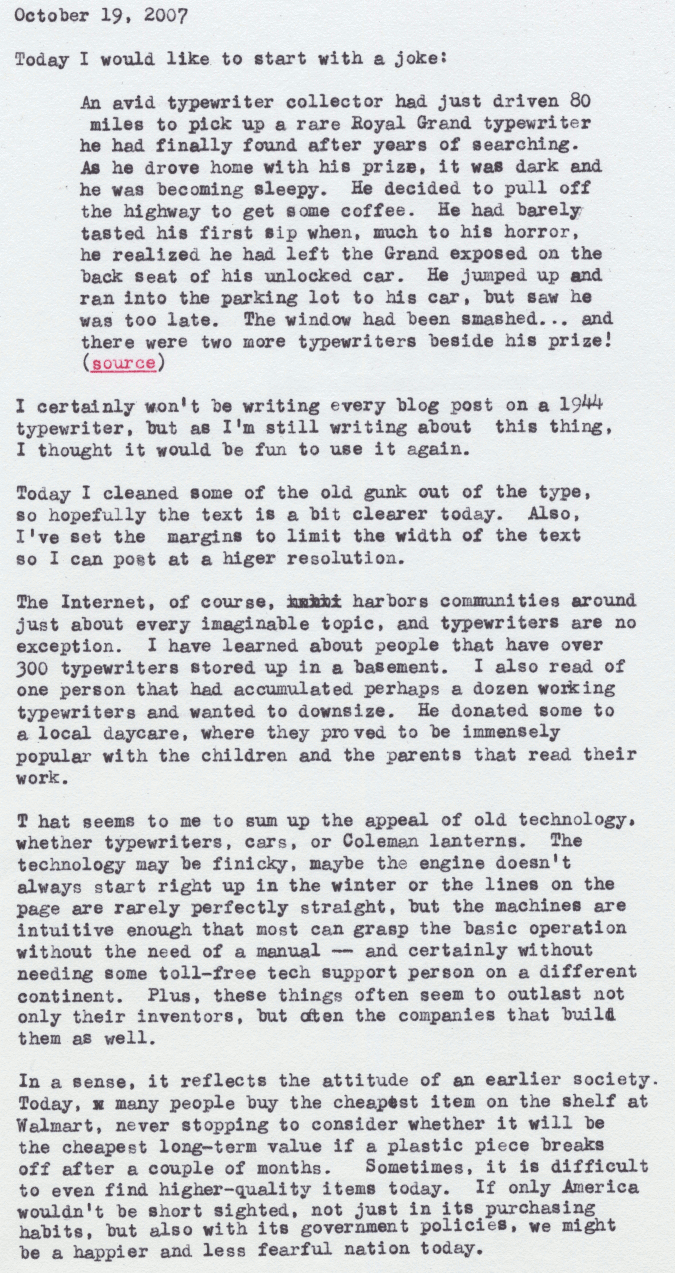
Today I would like to start with a joke:
An avid typewriter collector had just driven 80 miles to pick up a rare Royal
Grand typewriter he had finally found after years of searching.  As he drove
home with his prize, it was dark and he was becoming sleepy.  He decided
to pull off the highway to get some coffee.  He had barely tasted his first
sip when, much to his horror, he realized he had left the Grand exposed on
the back seat of his unlocked car.  He jumped up and ran into the parking
lot to his car, but saw he was too late.  The window had been smashed...
and there were two more typewriters beside his prize!
I certainly won't be writing every blog post on a 1944 typewriter, but I'm
still writing about this thing, I thought it would be fun to use it again.
Today I cleaned some of the old gunk out of the type, so hopefully the
text is a bit clearer today.  Also, I've set the margins to limit the width
of the text so I can post at a higher resolution.
The Internet, of course, harbors communities around just about every
imaginable topic, and typewriters are no exception.  I have learned about people that have over 300 typewriters stored up in a basement.  I also read of one person that had accumulated perhaps a dozen working typewriters and wanted to downsize.  He donated some to a local daycare, where they proved to be immensely popular with the children and the parents that read their work.
That seems to sum up the appeal of old technology, whether typewriters, care, or Coleman lanterns.  The technology may be finicky, maybe the engine doesn't always start right up in the winter or the lines on the page are rarely perfectly straight, but the machines are intuitive enough that most can grasp the basic operation without the need of a manual -- and certainly without needing some toll-free tech support person on a different continent.  Plus, these things often seem to outlast not only their inventors, but often the companies that build them as well.
In a sense, it reflects the attitude of an earlier society.  Today, many people buy the cheapest item on the shelf at Walmart, never stopping to consider whether it will be the cheapest long-term value if a plastic piece breaks off after a couple of months.  Sometimes, it is difficult to even find higher-quality items today.  If only America wouldn't be short sighted, not just in its purchasing habits, but also with its government policies, we might be a happier and less fearful nation today. flickr page

16 October 2007

Russell Coker: War is Bad for the Environment

I just read a nutty post claiming that Neo-Conservatism is good for the environment [1]. The first bogus claim is that Saddam had WMD and war was required because he was a despot. The fact is that the Iraqi government was always repressive, there are many factions in Iraq that don’t like each other and a repressive government is the only way to keep such groups in a united country. The current civil war in Iraq and the effective secession of Kurdistan (which currently seems to be involved in an undeclared border war with Turkey) demonstrates this. Saddam was always a despot, but he did improve the living conditions of most Iraqis - the best way to avoid a revolution is to convince the majority of the population that things will get worse if there is change. I suggest reading the Wikipedia page about Saddam Hussein [2]. The best information on Fourth Generation Warfare (4GW) seems to be on the conservative military analysis site Defense and the National Interest [7]. It covers all the issues related to invading other countries from a conservative point of view. Note that Neo-Conservatives are not Conservatives, the real Conservatives hate the Neo-Cons more than anyone else does. The amusing statement is made that “apologists claim it was one of the most advanced Arab nations” and then a link is provided to information on Saudi Arabian censorship. It’s worth reading the wikipedia page about the history of Saudi Arabia [3], among other interesting facts “the U.S. Army Corps of Engineers built the country’s television and broadcast facilities and oversaw the development of its defense industry” (does the US army share responsibility for the censorship?). It’s widely regarded that if the US military support was removed then the Saudi government would be overthrown. Referring to Saudi Arabia hardly seems like something you want to do if trying to justify occupying other middle-eastern states. An unsubstantiated claim is made that under-developed countries produce excess pollution due to inefficient technology. Unlike some people I try to get some facts before posting so I looked up the wikipedia page on CO2 emissions per capita [4]. It seems that the highest ranking first-world country is Luxembourg at #4, the next is the US at #10. The countries on the list that rank higher than the US have a combined population of about 11,000,000 while the US population is 302,000,000 - some quite mental arithmetic suggests that the US produces about 20 times more CO2 than the top 9 countries on the list combined! It doesn’t seem that having the highest technology is helping the US protect the environment, I guess that they just use it to build bigger cars. The next thing I noticed is the countries that are at the bottom of the list - they are the world’s poorest countries. It seems that countries without much money just can’t afford to burn lots of oil, while countries with lots of money can. No real surprises there. The lowest ranking on the list for a country that is unlikely to be regarded as being in abject poverty is India at position #133. The next lowest is Turkey at position #98 followed by China at #91. As a final point of reference Switzerland is at position #69 a produces just under 27% the CO2 that the US does (on a per-capita basis). According to the CIA World Fact Book Switzerland has an infant mortality rate of 4.28/1000 and a life expectancy of 80.62 [5], while the US has an infant mortality rate of 6.37/1000 and a life expectancy of 78 [6]. I believe that the infant mortality rate and the life expectancy are the two factors that are most representative of quality of life as they are the easiest factors for measuring the overall health of the population. Being healthy is one of the most important factors in quality of life. It seems to me that by all objective measures the Swiss are doing better than the people of the US, yet they produce less pollution and never invade other countries. Probably the most ridiculous statement in the post is “see rapidly dwindling resources wasted on jihad and revolution“. A revolution (locals using force to create a new government) takes little resources and most actions that a more simple-minded analysis might call “jihad” takes almost none. Sending an invasion force to the other side of the world and supporting an occupying army for years does however use significant resources, consider that the Hummvee is the least fuel-efficient vehicle on American roads in terms of work done (trucks and buses use more fuel but carry large amounts of cargo or many people), but it’s also the most fuel-efficient vehicle used by the US army in Iraq. There is the possibility that Jaldhar was attempting satire. If so then I suggest that satire be kept separate from serious web content to avoid confusion about where the satire ends. But if you want some satire about oil then I suggest consulting theonion.com. Before someone accuses me of being impolite, over a year ago the best estimate for the death toll from the occupation of Iraq was 655,000 [8]. Current extrapolations from the previous medical research suggest that the death toll has now exceeded 1,000,000. Regardless of whether the original post was intended as satire or not, I’m not laughing and I don’t feel the need to be polite to someone who makes excuses for such loss of life. Finally as a positive suggestion towards the environment (and any other issue that you may want to discuss), I suggest analysing the issues before writing about them and not blindly trusting other people. When you write a post make objective claims with references to back them up. When you read a post consider the points that are made and the references that are cited. Do the references support the claims? Are there other interpretations of the evidence? Are the reference sites reputable?

Alastair McKinstry: The Curse of Oil

Jaldhar Vyas points to the rogues gallery of oil producing states and argues that Neoconservatism is good, well at least it gets rid of the dictators such as Saddam Hussein while it grabs the oil. As he ightly points out, we are researching new alternative energy sources, and just as importantly (or even more importantly) energy conservation. But we have been doing this for decades. Sooner or later we have to realize that the "Oil Crisis" isn't due to a shortage of energy sources: its due to deliberate politics to make us dependent on oil. Peak Oil is "only" a crisis for us consumers, dependent on oil to drive our cars, heat our houses, and supply our food. For oil companies, it means (1) they are shipping oil at a greater rate than ever before, (2) at higher demand than ever before, and (3) in circumstances where pesky politics like OPEC can't interfere and try and moderate the price down (I'm not arguing OPEC or cartels are good; its just that its long-term 'maximize the benefit for the oil producing nations' strategy interferes with oil companies shorter-term profit maximization). For the Oil Companies, its a good thing. In this context we have to see our current dependence on oil as the result of deliberate policy by the oil companies. The small filip that USanian governments have done towards alternative energy, such as funding Hydrogen fuel-cell research, nuclear power, etc. are so long-term, and so small in scale, that they have to be seen as deliberately not solving the problem. Thinking that research into alternative sources is good is gpoing to save us (disclaimer: as a scientist I think research is a good thing :-)) is missing the real problem. Its politics: the oil companies have simply been better at politics than the strugging alternatives; we need to recognize this, and fight for alternatives. When oil prices reach $100/barrel, and we struggle to pay rising food and energy bills, its because other have deliberately caused the crisis. Oil has often been called a Curse because of the effects 'Oil Wealth' have caused so many countries. They are not co-incidentally dictatorships; Saddam Hussein remained in power in Iraq for so long because it benefitted the West (see the weapons supplies to Iraq in the so-called "Iran-Contra" affair, for example). Ditto Saudi Arabia, remaining 'friends' of the USA despite its ties to 911. Overthrowing Saddam Hussein was about consolidating even more power in the Gulf than America had previously, not democracy. What was planned for Iraq was democracy in name only: all real power was already neutralised, with decisions to US benefit cemented in place before the parliament met: non-negotiable contracts already signed giving US companies control. This is straight imperialism, and cannot be considered democracy or a good thing. Tags , ,

15 October 2007

Biella Coleman: On Adivising Grad Students: A grad student perspective

Joe Reagle, who happens to be a PhD student I am happily advising, wrote a response to my blog entry on the Chronicle of Higher Education article lamenting and lambasting advising graduate students. I am quoting it here in its entirety because it is a very thoughtful response:
Difficult issue. I certainly feel sympathy with the anonymous faculty member with respect to her amorous and litigious students. Also, I often wonder how I would deal with students who don’t share my sensibilities or workstyle if I were advising them under such circumstances. However, I also find much of her disappointment is related to disappointment of what her students do next, and in this I feel she may be a little unfair. She rightly recognizes that graduate school is a time of flux, no student can really guarantee what’s going to happen next. (One of my favorite religious jokes is: “How do you make God laugh?… Tell her your plans.”) If she is disappointed that a student she tried to help achieve a position at a tier 1 research institute accommodates themselves to something less than that, I’m sure at the student worked just as hard and was even more disappointed. The heart of the issue is that academia is so ridiculously competitive. It is never good enough to make a contribution or to be helpful, one always needs to be the best. It’s an exemplar for “The Winner Takes All.” I often think of this in relation to my technical work. One of the most rewarding professional relationships I had was when a more experienced programmer co-authored a Python software library with me. I don’t think he did it with any expectation that he was somehow seeding the discipline with followers, or even that I would someday be able to reciprocate in a similar manner. He was a good guy, we enjoyed our collaboration, I think he was learning by helping me, and in the end we made something useful, even if neither of us ever became Python gods. This is one of the things I like about open content communities, yes the people at the top get a fair amount of attention, but even if you spellcheck Wikipedia articles or write a Python library for canonicalising XML, that work is still appreciated.

14 October 2007

MJ Ray: Paris-Tours

Today sees the 101st Paris-Tours race, the last-but-one ProTour race. It’s showing on Eurosport (free-to-air at 19 east), France 3 (FTA at 5 west) 15:15-17:00 CET, Rai Tre (FTA 13e) 15:30-18:10 CET. If you know of other broadcasters showing the race, please leave me a comment. RAI Sport Sat (FTA 13e) repeat Paris-Tours tomorrow at 16:00 CET and show highlghts of the Giro dell’Emilia today at 13:40-14:20, and Gran Premio Beghelli 19:30-20:00.

11 October 2007

Andrew Pollock: [life] A c-section from a bloke's perspective

I've been meaning to write this for weeks. Hopefully I can still remember everything. So Sarah had a c-section the day before we were scheduled to have our c-section class. We'd both read a bit though, so it wasn't like we were going in totally uninformed and unprepared.. Firstly, Stanford Hospital's operating room area is rather mind-blowing. Sarah was transferred from Lucille Packard Children's Hospital to Stanford because they could get an operating room there sooner. The transfer was trivial, just roll the whole bed down the corridor, through the magic double doors into the operating rooms. The doors in question have a whole heap of video cameras pointing straight down, so they see everyone that gets wheeled in and out, which I found interesting. Good for records of patient movements I guess. Anyway, through those doors is a maze of corridors. There was a light-up board hanging from the ceiling in the middle of the main corridor with lights for all of the ORs. I think there were about 20. The illuminated ones were available. We went down a corridor, and past a few ORs. Outside of each one is a big stainless-steel scrub area. We got to "our" OR, and they transferred Sarah onto the operating table. Because of her heart condition, they wanted to have an arterial line in her for the duration of the procedure. This is some sort of gadget that goes into an artery and monitors your blood pressure beat by beat. The "interesting" thing with the anaesthesiologist was the New Zealand woman that we'd seen when we had an anaesthesiologist months prior, but the appointment was with a different anaesthesiologist, and this New Zealand woman was "observing". At the time, the anaesthesiologist we had the appointment with told us that she was going to be on vacation at the time of the delivery, so she wouldn't be attending. So I don't know if the Kiwi woman got promoted out of "observing" to "doing" in that period, or what, but she reintroduced herself to us in LPCH prior to moving to Stanford as being our anaesthesiologist for the delivery. Anyway, in the OR, they handed her the arterial line, in it's plastic packaging, and the first thing she asked was whether it came with anything else to put it in. At this point I figured she hadn't put one of these in before. (The answer to her question, by the way, was "no") She then proceeded to have a terrible time getting the line into Sarah's arm. Normally intravenous lines go into a vein, but this has to go into an artery. Apparently when you go poking an artery, it spasms. It then becomes very hard to get it into a moving target. She had a few goes on one arm, then gave up, and had to move over to the other arm. Sarah doesn't like needles at the best of times, and getting this honking great big thing in was no picnic. The bruising on both her wrists afterwards was phenomenal. She tends to bruise fairly spectacularly whenever they stick a needle in her. I almost stepped in and asked if it was really necessary that she have it, because they were having so much trouble getting it in, and it was clearly hurting Sarah. I think someone else ended up getting it in, not the anaesthesiologist. Not "that" one anyway. There were heaps of people in the OR. Next, came the epidural. Again, we had the inexperienced anaesthesiologist. This time she said to someone else how she was so nervous because there were "too many eyes". Not really reassuring. They gave Sarah a numbing injection first, and then proceeded to poke her in back with the epidural catheter needle thing. Sarah was flinching when they did it, and they kept yelling at her not to move. Apparently it didn't hurt, but it caused discomfort every time they tried to get it in. Eventually the associate professor of anaesthesiology stepped in and got it in. Later, they said that Sarah had a slightly curved spine or something, and that had made it a bit more complicated. I'm not begrudging the obviously inexperienced anaesthesiologist for anything. Stanford is a teaching hospital, and doctors have to get their experience somehow, but I think that when the patient is conscious, it's important to come across a little more confident. So once they got all of that sorted out, they could get her lying down on the table and get down to business. Apparently one of the side-effects of the epidural is that it can cause your body to think it's got hypothermia. Part way through the procedure, Sarah started shaking uncontrollably. I can't remember whether she complained about feeling cold or not. She also got a really itchy face. Apparently that's a side-effect of morphine. Sarah also doesn't tolerate anaesthetics very well, and started feeling nauseous part way through the procedure. Sure enough, as has happened countless times previously post-operatively, she threw up. At least we had warning and I got a kidney dish in place in time. That was about all the eventful surgical stuff. They had the usual screen up from about her neck area, so I couldn't see what they were doing. After Joshua was delivered, one of the nurses asked me if I wanted to see him, and took me around from her left shoulder where I'd been sitting to around below her right foot, to where they had him in one of those perspex portable crib things. I could see a lot of red out of the corner of my eye, and I could have seen a lot more if I'd bothered to look, but I was more interested in seeing my son at that stage. They let me bring him back around to where I'd been sitting previously, to show Sarah, but it was hard getting him up to a point where she could see him properly, and she was partially out of it by this stage. I think she dozed off for a little bit not long after that. I forget what time we got into the OR, but they started the operation in earnest at about 10:00am, and we were out of there by 10:45am if memory serves. The nurse in charge of the recovery room really didn't want me there, so I went back to LPCH with one of the nurses to spend some time with him while he was weighed and measured, and I took some photos, and held him. This was good, because I got to have a good cry on my own with him. So overall, in my "I'll never be squeezing a watermelon out of my nether regions" blokey perspective, having seen what Sarah went through, and how much discomfort that it looked like she was going through, both in the OR and afterwards, I'm not convinced c-sections are any less painful than a vaginal birth (taking the average case of both). I think you're trading some "short term" (depends on how long your labour is I guess) pain for some "long term" pain while you recover from your incision. Granted, Sarah wasn't really laid up all that badly for all that long, but it still didn't look all that pleasant. I guess really only the women who have done both delivery methods can really comment. All I know is I found it very difficult watching Sarah go through so much pain. So much so that I'm not really looking forward to that again. Maybe, hopefully, after her aorta is repaired, they'll let her delivery vaginally next time. I'm not holding much hope though. The high-risk obstetricians are fairly paranoid. There's also the possibility the baby will make the decision very easy for everyone by being breech. Sarah raised an interesting point today. Why didn't they just knock her out with a general anaesthetic? There was no need for her to be conscious for the delivery. That would have spared her the pain and suffering of getting the arterial line in, and they wouldn't have needed to bother with an epidural. One for her to ask the obstetrician at her follow-up appointment.

8 October 2007

Theodore Ts'o: Sous Vide, Revisited

In a previous post, I had recommended the 4130 NIST-Traceable Temperature Controller to control the temperature in a slow cooker. Unfortunately, that particular controller has a range that tops out at 60 degrees C / 140 degrees F, which is enough for cooking beef for long periods of time, but not enough for say, cooking duck confit, which for which a sous vide temperature of 80 degrees C is recommended. In addition, the 4130 is pretty expensive; almost $150. It’s possible to add a resistor to change the range of the 4130, but the temperature displayed by the controller is no longer correct, and you have manually create a conversion table between true temperature and the temperature as seen by the controller. I’ve recently come across a cheaper and better possibility, the Ranco ETC-111000-000 Temperature Controller which is only half the price and comes with a much larger working range (-30 to 220 degrees F). The price with the AC cord already wired in is $75; and the version which just has a 120VAC SPDT relay is only $60. A bit more about food safety. There has always been a lot of concern about bacteria growth and botulism, for good reason — and so therefore the recommendations for cooking temperature have a lot of safety margin in them — to the point now that the USDA recommends that steaks be cooked to at least 145 degrees F, which is well within what had traditionally been called “medium”, and chicken to at least 165 degrees F, which is enough to really destroy taste and texture. Sous vide cooking, especially some of the more low temperature variants, have raised a lot of concerns, to the point where a few years ago New York City (temporarily) banned it, causing a great outcry in the foodie community, since many top restaurants use sous vide techniques. First of all, any recommendation about internal temperatures and food safety that doesn’t also factor in time is massively oversimplifying the problem. Here is a table taken from “Food Safety Hazards and Controls for the Home Food Preparer”, published by the Hospitality Institute of Technology in 1994:
Temperature, F Time, 5D kill Time, 6.5D kill
130 86.42 minutes 112.34 minutes
135 27.33 minutes 35.53 minutes
140 8.64 minutes 11.23 minutes
145 2.73 minutes 3.55 minutes
150 51.85 seconds 1.12 minutes
155 16.40 seconds 21.32 seconds
160 5.19 seconds 6.74 seconds
165 1.64 seconds 2.13 seconds
This table lists the time to reduce bacteria concentrations of Salmonella and E. coli from 100,000 to 1 (5D) or 3,162,277 to 1 (6.5D). The FDA and USDA recommend cooking hamburger to 5D destruction. Since it is extremely unlikely for there to be more than 100 Salmonella organisms per gram of meat, a 5D kill will reduce Salmonella concentrations to no more than 1 organism per kilogram. So whether you cook a piece of meat to an internal temperature of 165 degrees for 1.64 seconds, or hold it at 130 degrees for 90 minutes, the effect on Salmonella and E. coli bacteria will be the same.Of course, one concern is that in many forms of cooking, particularly oven roasting and grilling, the temperature of the food as it heats up may not be even; so how do you guarantee that all parts of the food product has been brought up to the requisite 165 degrees? One way that recipe authors, fearful of liability concerns, have done so is to tell people to cook meat to much higher internal temperatures, to provide that extra safety margin at the expense of dessicated, horribly tasting turkey or chicken. But the advantage of sous vide cooking is by immersing the food in a water bath, the excellent heat conductivity of water helps guarantee that the entire body of meat will get raised to desired temperature relatively quickly. (How quickly depends on the thickness of the meat, obviously). So if you hold a roast beef that has been vacuum packed in a Foodsaver bag for five or six hours, there should be no question that all of the common bacteria has been inactivated, and that amount of time at 130 degrees F should be sufficient to inactivate 99.9 percent of all botulism toxin molecules (not there should be any in a fresh piece of meat, of course!) However, sous vide temperatures are not enough to kill bacterial spores, in particular C. botulinum, which is responsible for botulism. This requires temperatures far in excess of boiling water at sea level. For example, home canning protocols recommend holding the food product at 250 degrees F for at least 15 minutes. This is an issue in the restaurant business because very often food would be cooked sous vide, and then stored in the vacuum sealed bags for potentially weeks (yes, you could be eating an extremely expensive meal at a top-end French restaurant that had been cooked several weeks ago, and reheated just before serving; yummy, no?). If the food packages aren’t cooled quickly enough, and then allowed to warm to the danger zone, it’s possible that in the anerobic environment the C. botulinum spores could germinate and then start producing toxin. But, if you are cooking home sous vide where you are serving the food right after it has been cooked, this shouldn’t be a concern.

5 October 2007

Biella Coleman: On Traveling, Airports, and Thinking

After 6 weeks of teaching and over 2 months in my new apartment, I am making a short escape from NYC to visit my mom and sister in PR. In my Impacts of Technology class, we just finished a week on large-scale and complex technological systems, with a focus on industrial farming. We read a few sections of Micahel Pollan’s fanstastic book, The Ominvore’s Dilemma, which combines the odd qualities of being seductively alluring (thanks to his exquisite writing) and repulsive (thanks to the content, well at least the part on factory animal “farming”). I can’t recommend it enough and look forward to reading the rest, when I find the (magical) time to do so. Now that I am at the airport, I am struck at how little I know about this place, which is also a large and complex technological system and I bet revealing its technological and cultural innards would provide as fascinating (although not quite as gross) of a story as that of factory animal farming. There are many questions I would love answered: How exactly is coordination secured and what are the toughest elements to airport coordination? Where are the lines of cooperation and those of competition between airlines? What factors and values go into the design of the airport? (I know that for one thing, in American airports, there rarely seems to be enough electrical jacks; I am now sitting under the telephones, the only place with jacks in terminal 8 at JFK, and the funny thing is that there are a row of 7 unused phones and only one jack and I am sure it would be more useful to have 1 pay phone and a row of 7 jacks, instead). What sorts of airport technologies have put people out of jobs? What technologies have created new job opportunities? What sorts of social hierarchies are there in airports? Like who runs the big show? Is it a CEO? Or is something more like a university provost? What is standardized by the FAA, and what elements are more flexible, and thus different airport to airport? Is there a sense of camaraderie among airport employees, or are loyalties built primarily among employees of one airline or among the classes of workers? Given that unions are quite strong among airport employees and from the top (pilots) down (food workers), what is the political culture of airports/employees like? (I remember once overhearing a group of machinist and ground crew talking about the ugly face of globalization and NAFTA over coffee and I was dumbfounded and pretty psyched too). Are airports one of the few last remaining places in th US that provides for decent job security? Why do so many of the ground crew have such athletic, bulging calves? :-) Is it a result of the physical demands of the job? Or is it that the type of job ( outdoors with lots of heavy lifting), attract the athletic types? Do they have to pass certain physical standards as to pilots? Was there always first class seats? Or did that come about when flying became cheaper? Are employees trained to deal with irate passengers? In what ways do pilots bitch about the long waits/delays they also have to endure? What can they do when they are waiting, as we did for an hour last night, during the massive traffic jams that are especially noxious in NYC-area airports? Do pilots have any say in the way airports are run? Why do they consistently provide less chairs than are needed in lounges, even in new terminals, as the one I was in tonight? Do air traffic controllers ever meet face-to-face with pilots or do they largely have a virtual relationship? Are programmers who patch, improve, and build traffic control systems housed in the airports, or elsewhere? Airports are not only fascinating for technological and sociological reasons but I reckon there is a lot of interesting psychological work that must happen in airports. I imagine that during those long, endless waits in the lounge, on the security lines, on the tarmac, people must often take the time to reflect, on where am I going, where am I coming from, and not in the literal sense but the metaphorical one. I know that I have spent many hours in airports letting my mind wander to places and thoughts in ways that don’t happen as easily or often elsewhere. And in many instances, I don’t think that this propensity to indulge in some reflective thinking, is a matter of time, that is waiting. For me at least, it is the fact that many times when I fly, I am moving between worlds. While I have flown hundreds of times, I never have been shed of the sense of awe I feel about planes and their ability to shrink space and time so quickly. For me, it is less the act of flying itself (that feels boring, tiring, annoying, mostly because of the insane waits and delays and I never seem to get the right amount of sleep the night before) but the visceral contrast it brings. In the morning my life is of a particular tone and rhythm, currently situated in NYC and by evening, I am back at home in PR, surrounded by thick humidity and the loud sound of coquis. Once there, my as currently configured in NYC, has little direct bearing to those around me. Planes don’t just transport, they shift and convert your inner and outer world… So, if anyone (who got this far) knows of a good social history of the airport, do tell. I would love to read it.

4 October 2007

Christian Perrier: No institutional pro-corp bias in French NPO (afaik)

MJ, each French NPO is free to establish its own regulation rules, which may include a differential voting system if they want to. That should of course respect the French law (for instance, no discrimination based on sex, religion or any other genetic factor) but, as far as I know, nothing prevents deciding that "personnes morales" (ie non physical people) have a higher or lower vote than others. However, this is certainly not common, but many NPO simply don't have non physical members anyway (some don't authorize non physical people to be members). For those who care, Debian France (which is a NPO, but not regulated by 1901 law, but by the special NPO law for Alsace and Lorraine, inherited from the 1810-1918 years) admits physical and "moral" members with an equal voting right. The only special case is a rule that allows Debian developers to have a veto right on any decision of the organisation. See that official regulation rules of Debian France for details (French only). PS: Debian France is currently inactive, due to a longstanding dispute with the French Tax collecting organisation (Direction des Imp ts) who initially refused to consider us as a non profit organisation...because "we sell an operating system" (doh!).

3 October 2007

Ian Wienand: POWER5 Graffiti

On the bus yesterday I noticed a graffiti etching clearly left by someone employed by IBM. In fact the guy in the row in front had an IBM tee-shirt on, and I suspect he is the culprit, or possibly one of the OzLabs people. The photo is crap (it's hard to take a photo of a blukhead in the dark from the middle of the back seat on a crowded bus with a phone camera without arousing suspicion) but it clearly says
   I
(heart)
 POWER5
Check out my CSI style image enhancement: I (heart) POWER5 If you're ever on Sydney Buses bus number 2660 it can probably still be seen on the driver side window on the back seat. Maybe what Itanium needs isn't higher clock speeds, lower power, faster FSB, etc., but a concerted tagging effort on public transport around the world!

30 September 2007

Christian Perrier: Taking over shadow upstream

Nicolas Fran ois just announced that we (shadow package maintenance team in Debian) are taking over the maintenance of shadow upstream. Shadow is the source package that builds the passwd and login packages. login provides.....login, while passwd of provides 'passwd' but also several low-level user/group maintenance utilities (useradd, userdel, etc.....not to be confused with higher level utilities we have in Debian such as adduser). Since March 2007, Tomasz Klockzek (insert some specific Polish letter here and there), the former upstream author, nearly vanished, probably too busy with his RL and professionnal activities. Shadow is in a pretty good state, thanks to Tomasz great work and the great collaboration we had last years with him. So, it sounded quite logical topropose taking the maintenance over. Therefore, we proposed this to maintainers from Gentoo and RedHat. While none of them really want to maintain the software, they're OK to collaborate if we're taking the "lead". The shadow "team" in Debian is currently made of Nicolas, Christine Spang and me. We might need more help, particularly from people involved in PAM-related stuff and skilled in C programming and security. As of now, I don't expect us to do more than trying to merge in patches used in Debian/Gentoo/RedHat and maintain the code without adding features. The main contact point for shadow maintenance is the pkg-shadow-devel mailing list on Alioth.

29 September 2007

Maximilian Attems: happy git usage

Apparently Scott James Remnant in his article on version control systems confuses arch and git. One can only speculate that his short git usage stems from the pre 1.0 days, where you had to use higher level tools (called porcelain) to happily work on git. A funny anecdote is that Scott back in his dpkg hacking year promoted arch heavily. Ubuntu^Wbzr propaganda spreads speed gains as big bonus of the last major releases. In order to be able to do that you have to start with a terrible baseline. Testing bzr on middle sized repos is no fun at all. The bzr pain inside launchpad must be beyond imagination. Nowadays it is much easier to hack on mdadm than on lvm2. The reason is that later project uses rusty cvs. With git it is really easy to contribute back. Either you mail the patches or publish your repository. git will help you along on each way. The other very big bonus of git is the big community around git. It is a community excited around building and delivering the best version control system. The git development does regular surveys on git usages and incorporates back the wishlists. The most "funny" way to use git is to run it as cvsserver. You may believe me or not i have seen git cvsserver emulation usage in the wild.

Next.

Previous.