Search Results: "ed"

17 March 2025

James Valleroy: What s New for FreedomBox in Debian 13 trixie

FreedomBox is a Debian blend that makes it easier to run your own server. Approximately every two years, there is a new stable release of Debian. This year s release will be called Debian 13 "trixie". This post will provide an overview of changes between FreedomBox 23.6 (the version that shipped in Debian 12 "bookworm") and 25.5 (the latest release). Note: Debian 13 "trixie" is not yet released, so things may still change, be added or removed, before the official release. General Diagnostics Name Services Networks Privacy Users and Groups Deluge Ejabberd Feather Wiki GitWeb GNOME ikiwiki Kiwix Matrix Synapse MediaWiki MiniDLNA Miniflux Nextcloud OpenVPN Postfix/Dovecot Shadowsocks Server SOGo TiddlyWiki Tor Proxy Transmission Conclusion Over the past two years, FreedomBox has been increasing the number of features and applications available to its users. We have also focused on improving the reliability of the system, detecting unexpected situations, and providing means to return to a known good state. With these improvements, FreedomBox has become a good solution for people with limited time or energy to set up and start running a personal server, at home or in the cloud. Looking forward, we would like to focus on making more powerful hardware available with FreedomBox pre-installed and ready to be used. This hardware would also support larger storage devices, making it suitable as a NAS or media server. We are also very interested in exploring new features such as atomic updates, which will further enhance the reliability of the system.

Vincent Bernat: Offline PKI using 3 YubiKeys and an ARM single board computer

An offline PKI enhances security by physically isolating the certificate authority from network threats. A YubiKey is a low-cost solution to store a root certificate. You also need an air-gapped environment to operate the root CA.
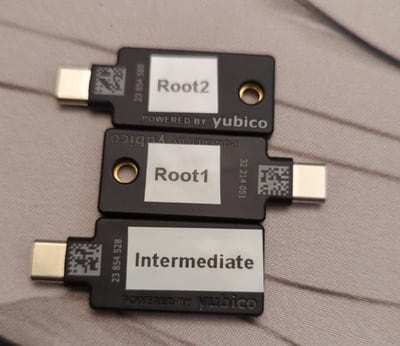
PKI relying on a set of 3 YubiKeys: 2 for the root CA and 1 for the intermediate CA.
Offline PKI backed up by 3 YubiKeys
This post describes an offline PKI system using the following components: It is possible to add more YubiKeys as a backup of the root CA if needed. This is not needed for the intermediate CA as you can generate a new one if the current one gets destroyed.

The software part offline-pki is a small Python application to manage an offline PKI. It relies on yubikey-manager to manage YubiKeys and cryptography for cryptographic operations not executed on the YubiKeys. The application has some opinionated design choices. Notably, the cryptography is hard-coded to use NIST P-384 elliptic curve. The first step is to reset all your YubiKeys:
$ offline-pki yubikey reset
This will reset the connected YubiKey. Are you sure? [y/N]: y
New PIN code:
Repeat for confirmation:
New PUK code:
Repeat for confirmation:
New management key ('.' to generate a random one):
WARNING[pki-yubikey] Using random management key: e8ffdce07a4e3bd5c0d803aa3948a9c36cfb86ed5a2d5cf533e97b088ae9e629
INFO[pki-yubikey]  0: Yubico YubiKey OTP+FIDO+CCID 00 00
INFO[pki-yubikey] SN: 23854514
INFO[yubikit.management] Device config written
INFO[yubikit.piv] PIV application data reset performed
INFO[yubikit.piv] Management key set
INFO[yubikit.piv] New PUK set
INFO[yubikit.piv] New PIN set
INFO[pki-yubikey] YubiKey reset successful!
Then, generate the root CA and create as many copies as you want:
$ offline-pki certificate root --permitted example.com
Management key for Root X:
Plug YubiKey "Root X"...
INFO[pki-yubikey]  0: Yubico YubiKey CCID 00 00
INFO[pki-yubikey] SN: 23854514
INFO[yubikit.piv] Data written to object slot 0x5fc10a
INFO[yubikit.piv] Certificate written to slot 9C (SIGNATURE), compression=True
INFO[yubikit.piv] Private key imported in slot 9C (SIGNATURE) of type ECCP384
Copy root certificate to another YubiKey? [y/N]: y
Plug YubiKey "Root X"...
INFO[pki-yubikey]  0: Yubico YubiKey CCID 00 00
INFO[pki-yubikey] SN: 23854514
INFO[yubikit.piv] Data written to object slot 0x5fc10a
INFO[yubikit.piv] Certificate written to slot 9C (SIGNATURE), compression=True
INFO[yubikit.piv] Private key imported in slot 9C (SIGNATURE) of type ECCP384
Copy root certificate to another YubiKey? [y/N]: n
You can inspect the result:
$ offline-pki yubikey info
INFO[pki-yubikey]  0: Yubico YubiKey CCID 00 00
INFO[pki-yubikey] SN: 23854514
INFO[pki-yubikey] Slot 9C (SIGNATURE):
INFO[pki-yubikey]   Private key type: ECCP384
INFO[pki-yubikey]   Public key:
INFO[pki-yubikey]     Algorithm:  secp384r1
INFO[pki-yubikey]     Issuer:     CN=Root CA
INFO[pki-yubikey]     Subject:    CN=Root CA
INFO[pki-yubikey]     Serial:     1
INFO[pki-yubikey]     Not before: 2024-07-05T18:17:19+00:00
INFO[pki-yubikey]     Not after:  2044-06-30T18:17:19+00:00
INFO[pki-yubikey]     PEM:
-----BEGIN CERTIFICATE-----
MIIBcjCB+aADAgECAgEBMAoGCCqGSM49BAMDMBIxEDAOBgNVBAMMB1Jvb3QgQ0Ew
HhcNMjQwNzA1MTgxNzE5WhcNNDQwNjMwMTgxNzE5WjASMRAwDgYDVQQDDAdSb290
IENBMHYwEAYHKoZIzj0CAQYFK4EEACIDYgAERg3Vir6cpEtB8Vgo5cAyBTkku/4w
kXvhWlYZysz7+YzTcxIInZV6mpw61o8W+XbxZV6H6+3YHsr/IeigkK04/HJPi6+i
zU5WJHeBJMqjj2No54Nsx6ep4OtNBMa/7T9foyMwITAPBgNVHRMBAf8EBTADAQH/
MA4GA1UdDwEB/wQEAwIBhjAKBggqhkjOPQQDAwNoADBlAjEAwYKy/L8leJyiZSnn
xrY8xv8wkB9HL2TEAI6fC7gNc2bsISKFwMkyAwg+mKFKN2w7AjBRCtZKg4DZ2iUo
6c0BTXC9a3/28V5aydZj6rvx0JqbF/Ln5+RQL6wFMLoPIvCIiCU=
-----END CERTIFICATE-----
Then, you can create an intermediate certificate with offline-pki yubikey intermediate and use it to sign certificates by providing a CSR to offline-pki certificate sign. Be careful and inspect the CSR before signing it, as only the subject name can be overridden. Check the documentation for more details. Get the available options using the --help flag.

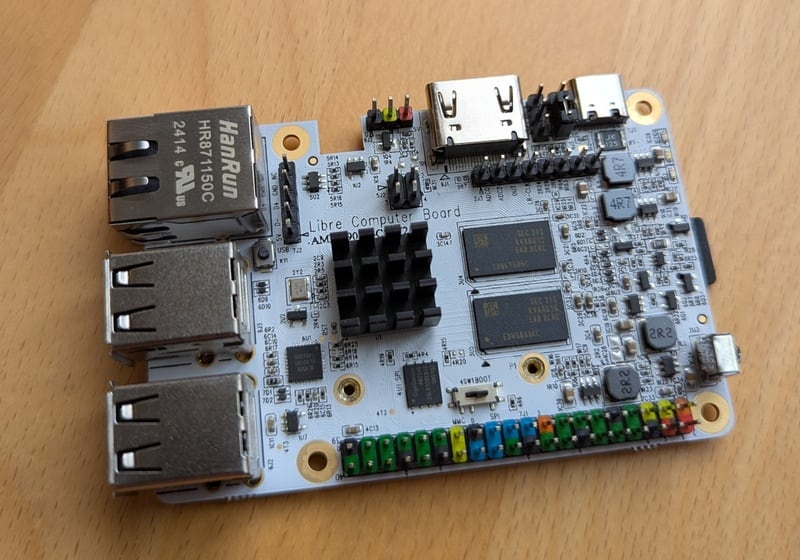
The hardware part To ensure the operations on the root and intermediate CAs are air-gapped, a cost-efficient solution is to use an ARM64 single board computer. The Libre Computer Sweet Potato SBC is a more open alternative to the well-known Raspberry Pi.1
Libre Computer Sweet Potato single board computer relying on the Amlogic S905X SOC
Libre Computer Sweet Potato SBC, powered by the AML-S905X SOC
I interact with it through an USB to TTL UART converter:
$ tio /dev/ttyUSB0
[16:40:44.546] tio v3.7
[16:40:44.546] Press ctrl-t q to quit
[16:40:44.555] Connected to /dev/ttyUSB0
GXL:BL1:9ac50e:bb16dc;FEAT:ADFC318C:0;POC:1;RCY:0;SPI:0;0.0;CHK:0;
TE: 36574
BL2 Built : 15:21:18, Aug 28 2019. gxl g1bf2b53 - luan.yuan@droid15-sz
set vcck to 1120 mv
set vddee to 1000 mv
Board ID = 4
CPU clk: 1200MHz
[ ]

The Nix glue To bring everything together, I am using Nix with a Flake providing:
  • a package for the offline-pki application, with shell completion,
  • a development shell, including an editable version of the offline-pki application,
  • a NixOS module to setup the offline PKI, resetting the system at each boot,
  • a QEMU image for testing, and
  • an SD card image to be used on the Sweet Potato or another ARM64 SBC.
# Execute the application locally
nix run github:vincentbernat/offline-pki -- --help
# Run the application inside a QEMU VM
nix run github:vincentbernat/offline-pki\#qemu
# Build a SD card for the Sweet Potato or for the Raspberry Pi
nix build --system aarch64-linux github:vincentbernat/offline-pki\#sdcard.potato
nix build --system aarch64-linux github:vincentbernat/offline-pki\#sdcard.generic
# Get a development shell with the application
nix develop github:vincentbernat/offline-pki

  1. The key for the root CA is not generated by the YubiKey. Using an air-gapped computer is all the more important. Put it in a safe with the YubiKeys when done!

16 March 2025

Russell Coker: Article Recommendations via FOSS

Google tracking everything we read is bad, particularly since Google abandoned the don t be evil plan and are presumably open to being somewhat evil. The article recommendations on Chrome on Android are useful and I d like to be able to get the same quality of recommendations without Google knowing about everything I read. Ideally without anything other than the device I use knowing what interests me. A ML system to map between sources of news that are of interest should be easy to develop and run on end user devices. The model could be published and when given inputs of articles you like give an output of sites that contain other articles you like. Then an agent on the end user system could spider the sites in question and run a local model to determine which articles to present to the user. Mapping for hate following is possible for such a system (Google doesn t do that), the user could have 2 separate model runs for regular reading and hate-following and determine how much of each content to recommend. It could also give negative weight to entries that match the hate criteria. Some sites with articles (like Medium) give an estimate of reading time. An article recommendation system should have a fixed limit of articles (both in articles and in reading time) to support the I spend half an hour reading during lunch model not doom scrolling. For getting news using only FOSS it seems that the best option at the moment is to use the Lemmy FOSS social network which is like Reddit [1] to recommend articles etc. The Lemoa client for Lemmy uses GTK [2] but it s no longer maintained. The Lemonade client for Lemmy is written in Rust [3]. It would be good if one of those was packaged for Debian, preferably one that s maintained.

15 March 2025

Bits from Debian: Debian Med Sprint in Berlin

Debian Med sprint in Berlin on 15 and 16 February The Debian Med team works on software packages that are associated with medicine, pre-clinical research, and life sciences, and makes them available for the Debian distribution. Seven Debian developers and contributors to the team gathered for their annual Sprint, in Berlin, Germany on 15 and 16 February 2025. The purpose of the meeting was to tackle bugs in Debian-Med packages, enhance the quality of the team's packages, and coordinate the efforts of team members overall. This sprint allowed participants to fix dozens of bugs, including release-critical ones. New upstream versions were uploaded, and the participants took some time to modernize some packages. Additionally, they discussed the long-term goals of the team, prepared a forthcoming invited talk for a conference, and enjoyed working together. More details on the event and individual agendas/reports can be found at https://wiki.debian.org/Sprints/2025/DebianMed.

Scarlett Gately Moore: KDE snaps fixed, Thank you for your support

KDE MascotKDE Mascot
Thank you everyone for keeping the lights on for a bit longer. KDE snaps have been restored. I also released 24.12.3! In addition, I have moved most snaps to core24. The remaining snaps need newer qt6/kf6, which is a WIP. The Bad luck girl has been hit once again with another loss, so with that, I will be reducing my hours on snaps while I consider my options for my future. I am still around, just a bit less. Thanks again everyone, if you can get me through one more ( lingering broken arm ) surgery I would be forever grateful! https://gofund.me/d5d59582

14 March 2025

Ravi Dwivedi: Libreoffice Conference 2024 in Luxembourg

Last year, I attended the annual LibreOffice Conference in Luxembourg with the help of a generous travel grant by The Document Foundation (TDF). It was a three-day event from the 10th to the 12th of October 2024, with an additional day for community meetup on the 9th. Luxembourg is a small (twice as big as Delhi) country in Western Europe. After going through an arduous visa process, I reached Luxembourg on the 8th of October. Upon arriving in Luxembourg, I took a bus to the city center, where my hotel Park Inn was located. All the public transport in Luxembourg was free of cost. It was as if I stepped in another world. There were separate tracks for cycling and a separate lane for buses, along with good pedestrian infrastructure. In addition, the streets were pretty neat and clean.
Luxembourg's Findel Airport
Separate cycling tracks in Luxembourg

My hotel was 20 km from the conference venue in Belval. However, the commute was convenient due to a free of cost train connection, which were comfortable, smooth, and scenic, covering the distance in half an hour. The hotel included a breakfast buffet, recharging us before the conference.
This is what trains look like in Luxembourg

Pre-conference, a day was reserved for the community meetup on the 9th of October. On that day, the community members introduced themselves and their contributions to the LibreOffice project. It acted as a brainstorming session. I got a lovely conference bag, which contained a T-Shirt, a pen and a few stickers. I also met my long time collaborators Mike, Sophie and Italo from the TDF, whom I had interacted only remotely till then. Likewise, I also met TDF s sysadmin Guilhem, who I interacted before regarding setting up my LibreOffice mirror.
Conference bag
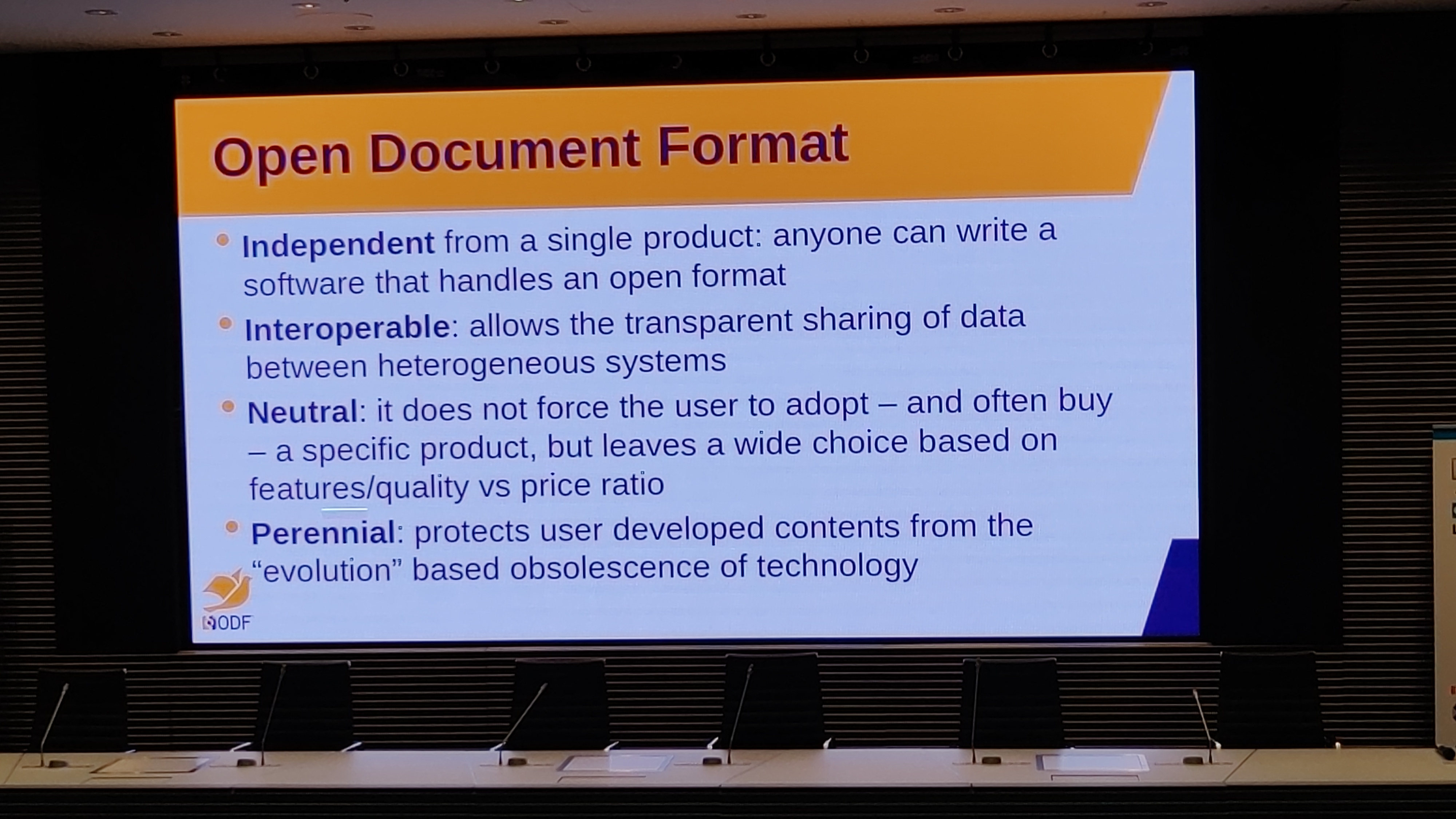
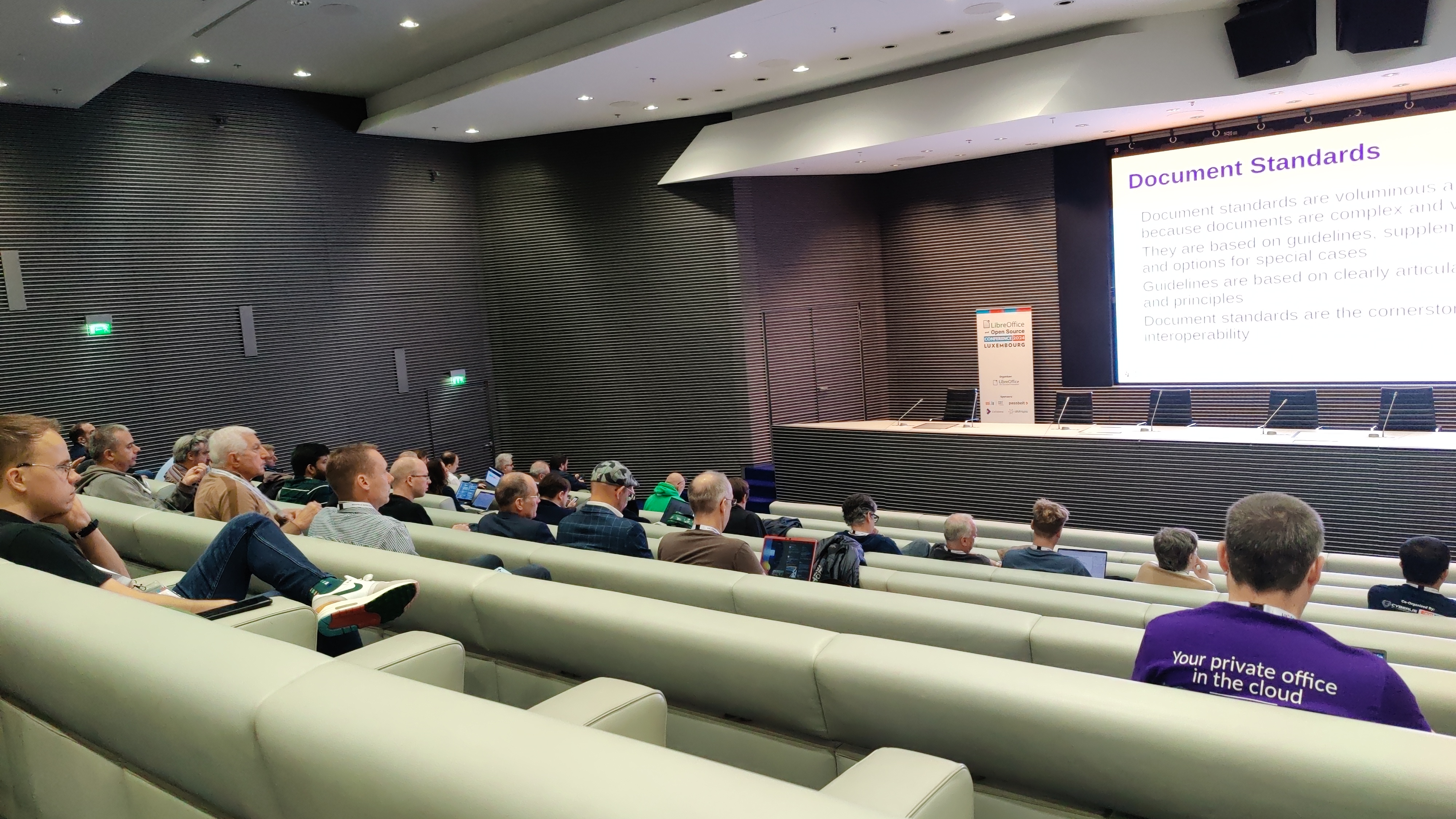
The conference started on the 10th. There were 5 attendees from India, including me, while most of the attendees were from Europe. The talks were in English. One of the talks that stood out for me was about Luxchat a chat service run by the Luxembourg government based on the Matrix protocol for the citizens of Luxembourg. I also liked Italo s talk on why document formats must be freedom-respecting. On the first night, the conference took us to a nice dinner in a restaurant. It offered one more way to socialize with other attendees and explore food at the same time.
One of the slides of Italo's talk
Picture of the hall in which talks were held

On the 11th of October, I went for a walk in the morning with Biswadeep for some sightseeing around our hotel area. As a consequence, I missed the group photo of the conference, which I wanted to be in. Anyway, we enjoyed roaming around the picturesque Luxembourg city. We also sampled a tram ride to return to our hotel.
We encountered such scenic views during our walk

Another view of Luxembourg city area
The conference ended on the 12th with a couple of talks. This conference gave me an opportunity to meet the global LibreOffice community, connect and share ideas. It also gave me a peek into the country of Luxembourg and its people, where I had good experience. English was widely known, and I had no issues getting by. Thanks to all the organizers and sponsors of the conference!

Dima Kogan: Getting precise timings out of RS-232 output

For uninteresting reasons I need very regular 58Hz pulses coming out of an RS-232 Tx line: the time between each pulse should be as close to 1/58s as possible. I produce each pulse by writing an \xFF byte to the device. The start bit is the only active-voltage bit being sent, and that produces my pulse. I wrote this obvious C program:
#include <stdio.h>
#include <stdlib.h>
#include <stdbool.h>
#include <sys/ioctl.h>
#include <unistd.h>
#include <fcntl.h>
#include <termios.h>
#include <stdint.h>
#include <sys/time.h>
static uint64_t gettimeofday_uint64()
 
    struct timeval tv;
    gettimeofday(&tv, NULL);
    return (uint64_t) tv.tv_sec * 1000000ULL + (uint64_t) tv.tv_usec;
 
int main(int argc, char* argv[])
 
    // open the serial device, and make it as raw as possible
    const char* device = "/dev/ttyS0";
    const speed_t baud = B9600;
    int fd = open(device, O_WRONLY O_NOCTTY);
    tcflush(fd, TCIOFLUSH);
    struct termios options =  .c_iflag = IGNBRK,
                              .c_cflag = CS8   CREAD   CLOCAL ;
    cfsetspeed(&options, baud);
    tcsetattr(fd, TCSANOW, &options);
    const uint64_t T_us = (uint64_t)(1e6 / 58.);
    const uint64_t t0 = gettimeofday_uint64();
    for(int i=0; ; i++)
     
        const uint64_t t_target = t0 + T_us*i;
        const uint64_t t1       = gettimeofday_uint64();
        if(t_target > t1)
            usleep(t_target - t1);
        write(fd, &((char) '\xff' ), 1);
     
    return 0;
 
This tries to make sure that each write() call happens at 58Hz. I need these pulses to be regular, so I need to also make sure that the time between each userspace write() and when the edge actually hits the line is as short as possible or, at least, stable. Potential reasons for timing errors:
  1. The usleep() doesn't wake up exactly when it should. This is subject to the Linux scheduler waking up the trigger process
  2. The write() almost certainly ends up scheduling a helper task to actually write the \xFF to the hardware. This helper task is also subject to the Linux scheduler waking it up.
  3. Whatever the hardware does. RS-232 doesn't give you any guarantees about byte-byte timings, so this could be an unfixable source of errors
The scheduler-related questions are observable without any extra hardware, so let's do that first. I run the ./trigger program, and look at diagnostics while that's running. I look at some device details:
# ls -lh /dev/ttyS0
crw-rw---- 1 root dialout 4, 64 Mar  6 18:11 /dev/ttyS0
# ls -lh /sys/dev/char/4:64/
total 0
-r--r--r-- 1 root root 4.0K Mar  6 16:51 close_delay
-r--r--r-- 1 root root 4.0K Mar  6 16:51 closing_wait
-rw-r--r-- 1 root root 4.0K Mar  6 16:51 console
-r--r--r-- 1 root root 4.0K Mar  6 16:51 custom_divisor
-r--r--r-- 1 root root 4.0K Mar  6 16:51 dev
lrwxrwxrwx 1 root root    0 Mar  6 16:51 device -> ../../../0000:00:16.3:0.0
-r--r--r-- 1 root root 4.0K Mar  6 16:51 flags
-r--r--r-- 1 root root 4.0K Mar  6 16:51 iomem_base
-r--r--r-- 1 root root 4.0K Mar  6 16:51 iomem_reg_shift
-r--r--r-- 1 root root 4.0K Mar  6 16:51 io_type
-r--r--r-- 1 root root 4.0K Mar  6 16:51 irq
-r--r--r-- 1 root root 4.0K Mar  6 16:51 line
-r--r--r-- 1 root root 4.0K Mar  6 16:51 port
drwxr-xr-x 2 root root    0 Mar  6 16:51 power
-rw-r--r-- 1 root root 4.0K Mar  6 16:51 rx_trig_bytes
lrwxrwxrwx 1 root root    0 Mar  6 16:51 subsystem -> ../../../../../../../class/tty
-r--r--r-- 1 root root 4.0K Mar  6 16:51 type
-r--r--r-- 1 root root 4.0K Mar  6 16:51 uartclk
-rw-r--r-- 1 root root 4.0K Mar  6 16:51 uevent
-r--r--r-- 1 root root 4.0K Mar  6 16:51 xmit_fifo_size
Unsurprisingly, this is a part of the tty subsystem. I don't want to spend the time to really figure out how this works, so let me look at all the tty kernel calls and also at all the kernel tasks scheduled by the trigger process, since I suspect that the actual hardware poke is happening in a helper task. I see this:
# bpftrace -e 'k:*tty* /comm=="trigger"/
                 printf("%d %d %s\n",pid,tid,probe);  
               t:sched:sched_wakeup /comm=="trigger"/
                 printf("switching to %s(%d); current backtrace:", args.comm, args.pid); print(kstack());   '
...
3397345 3397345 kprobe:tty_ioctl
3397345 3397345 kprobe:tty_check_change
3397345 3397345 kprobe:__tty_check_change
3397345 3397345 kprobe:tty_wait_until_sent
3397345 3397345 kprobe:tty_write
3397345 3397345 kprobe:file_tty_write.isra.0
3397345 3397345 kprobe:tty_ldisc_ref_wait
3397345 3397345 kprobe:n_tty_write
3397345 3397345 kprobe:tty_hung_up_p
switching to kworker/0:1(3400169); current backtrace:
        ttwu_do_activate+268
        ttwu_do_activate+268
        try_to_wake_up+605
        kick_pool+92
        __queue_work.part.0+582
        queue_work_on+101
        rpm_resume+1398
        __pm_runtime_resume+75
        __uart_start+85
        uart_write+150
        n_tty_write+1012
        file_tty_write.isra.0+373
        vfs_write+656
        ksys_write+109
        do_syscall_64+130
        entry_SYSCALL_64_after_hwframe+118
3397345 3397345 kprobe:tty_update_time
3397345 3397345 kprobe:tty_ldisc_deref
... repeated with each pulse ...
Looking at the sources I see that uart_write() calls __uart_start(), which schedules a task to call serial_port_runtime_resume() which eventually calls serial8250_tx_chars(), which calls some low-level functions to actually send the bits. I look at the time between two of those calls to quantify the scheduler latency:
pulserate=58
sudo zsh -c \
  '( echo "# dt_write_ns dt_task_latency_ns";
     bpftrace -q -e "k:vfs_write /comm==\"trigger\" && arg2==1/
                      \$t=nsecs(); if(@t0)   @dt_write = \$t-@t0;   @t0=\$t; 
                     k:serial8250_tx_chars /@dt_write/
                      \$t=nsecs(); printf(\"%d %d\\n\", @dt_write, \$t-@t0); "
   )' \
  vnl-filter                  \
    --stream -p dt_write_ms="dt_write_ns/1e6 - 1e3/$pulserate",dt_task_latency_ms=dt_task_latency_ns/1e6 \
  feedgnuplot  \
    --stream   \
    --lines    \
    --points   \
    --xlen 200 \
    --vnl      \
    --autolegend \
    --xlabel 'Pulse index' \
    --ylabel 'Latency (ms)'
Here I'm making a realtime plot showing The raw data as I tweak things lives here. Initially I see big latency spikes:
timings.scheduler.1.noise.svg
These can be fixed by adjusting the priority of the trigger task. This tells the scheduler to wake that task up first, even if something else is currently using the CPU. I do this:
sudo chrt -p 90  pidof trigger 
And I get better-looking latencies:
timings.scheduler.2.clean.svg
During some experiments (not in this dataset) I would see high helper-task timing instabilities as well. These could be fixed by prioritizing the helper task. In this kernel (6.12) the helper task is called kworker/N where N is the CPU index. I tie the trigger process to cpu 0, and priorities all the relevant helpers:
taskset -c 0 ./trigger 58
pgrep -f kworker/0   while   read pid     sudo chrt -p 90 $pid  
This fixes the helper-task latency spikes. OK, so it looks like on the software side we're good to within 0.1ms of the true period. This is in the ballpark of the precision I need; even this might be too high. It's possible to try to push the software to do better: one could look at the kernel sources a bit more, to do smarter things with priorities or to try an -rt kernel. But all this doesn't matter if the serial hardware adds unacceptable delays. Let's look. Let's look at it with a logic analyzer. I use a saleae logic analyzer with sigrok. The tool spits out the samples as it gets them, and an awk script finds the edges and reports the timings to give me a realtime plot.
samplerate=500000;
pulserate=58.;
sigrok-cli -c samplerate=$samplerate -O csv --continuous -C D1 \
  mawk -Winteractive  \
    "prev_logic==0 && \$0==1 \
       
       iedge = NR;
       if(prev_iedge)
        
         di = iedge -prev_iedge;
         dt = di/$samplerate;
         print(dt*1000);
        
       prev_iedge = iedge;
      
      
       prev_logic=\$0;
       "   feedgnuplot --stream --ylabel 'Period (ms)' --equation "1000./$pulserate title \"True $ pulserate Hz period\""
On the server I was using (physical RS-232 port, ancient 3.something kernel):
timings.hw.serial-server.svg
OK This is very discrete for some reason, and generally worse than 0.1ms. What about my laptop (physical RS-232 port, recent 6.12 kernel)?
timings.hw.serial-laptop.svg
Not discrete anymore, but not really any more precise. What about using a usb-serial converter? I expect this to be worse.
timings.hw.usbserial.svg
Yeah, looks worse. For my purposes, an accuracy of 0.1ms is marginal, and the hardware adds non-negligible errors. So I cut my losses, and use an external signal generator:
timings.hw.generator.svg
Yeah. That's better, so that's what I use.

Junichi Uekawa: Filing tax this year was really painful.

Filing tax this year was really painful. But mostly because my home network. It was ipv4 over ipv6 was not working correctly. First I swapped the Router which was trying to reinitialize the MAP-E table every time there was a dhcp client reconfiguration and overwhelming the server. Then I changed the DNS configuration not use ipv4 UDP lookup which was overwhelming the ipv4 ports. Tax return itself is a painful process. Debugging network issues is making things was just making everything more painful.

11 March 2025

Freexian Collaborators: Debian Contributions: Debian.Social administration, DebConf 25 preparations, Fixing Time-based test failure in Python requests package and more! (by Anupa Ann Joseph)

Debian Contributions: 2025-02 Contributing to Debian is part of Freexian s mission. This article covers the latest achievements of Freexian and their collaborators. All of this is made possible by organizations subscribing to our Long Term Support contracts and consulting services.

Debian.Social administration, by Stefano Rivera Over the last year, the Debian.social services outgrew the infrastructure that was supporting them. The matrix bridge in particular was hosted on a cloud instance backed by a large expensive storage volume. Debian.CH rented a new large physical server to host all these instances, earlier this year. Stefano set up Incus on the new physical machine and migrated all the old debian.social LXC Containers, libvirt VMs, and cloud instances into Incus-managed LXC containers. Stefano set up Prometheus monitoring and alerts for the new infrastructure and a Grafana dashboard. The current stack of debian.social services seem to comfortably fit on the new machine, with good room to grow.

DebConf 25, by Santiago Ruano Rinc n and Stefano Rivera DebConf 25 preparations continue. The team is currently finalizing a budget. Stefano helped to review the current budget proposals and suggest approaches for balancing it. Stefano installed a Zammad instance to organize queries from attendees, for the registration and visa teams. Santiago continued discussions with possible caterers so we can have options for the different diet requirements and that could fit into the DebConf budget. Also, in collaboration with Anupa, Santiago pushed the first draft changes to document the venue information in the DebConf 25 website and how to get to Brest.

Time-based test failure in requests, by Colin Watson Colin fixed a fun bug in the Python requests package. Santiago Vila has been running tests of what happens when Debian packages are built on a system in which time has been artificially set to somewhere around the end of the support period for the next Debian release, in order to make it easier to do things like issuing security updates for the lifetime of that release. In this case, the failure indicated an expired test certificate, and since the repository already helpfully included scripts to regenerate those certificates, it seemed natural to try regenerating them just before running tests. However, this failed for more obscure reasons and Colin spent some time investigating. This turned out to be because the test CA was missing the CA constraint and so recent versions of OpenSSL reject it; Colin sent a pull request to fix this.

Priority list for outdated packages, by Santiago Ruano Rinc n Santiago started a discussion on debian-devel about packages that have a history of security issues and that are outdated regarding new upstream releases. The goal of the mentioned effort is to have a prioritized list of packages needing some work, from a security point of view. Moreover, the aim of publicly sharing the list of packages with the Debian Developers community is to make it easier to look at the packages maintained by teams, or even other maintainers where help could be welcome. Santiago is planning to take into account the feedback provided in debian-devel and to propose a tooling that could help to regularly bring collective awareness of these packages.

Miscellaneous contributions
  • Carles worked on English to Catalan po-debconf translations: reviewed translations, created merge requests and followed up with developers for more than 30 packages using po-debconf-manager.
  • Carles helped users, fixed bugs and implemented downloading updated templates on po-debconf-manager.
  • Carles packaged a new upstream version of python-pyaarlo.
  • Carles improved reproducibility of qnetload (now reported as reproducible) and simplemonitor (followed up with upstream and pending update of Debian package).
  • Carles collaborated with debian-history package: fixed FTBFS from master branch, enabled salsa-ci and investigated reproducibility.
  • Emilio improved support for automatically marking CVEs as NOT-FOR-US in the security-tracker, closing #1073012.
  • Emilio updated xorg-server and xwayland in unstable, fixing the last round of security vulnerabilities.
  • Stefano prepared a few PyPy and cPython uploads, and started the python3.13-only transition.
  • Helmut Grohne sent patches for 24 cross build failures.
  • Helmut fixed two problems in the Debian /usr-merge analysis tool. In one instance, it would overmatch Debian bugs to issues and in another it would fail to recognize Pre-Depends as a conflict mechanism.
  • Helmut attempted making rebootstrap work for gcc-15 with limited success as very many packages FTBFS with gcc-15 due to using function declarations without arguments.
  • Helmut provided a change to the security-tracker that would pre-compute /data/json during database updates rather than on demand resulting in a reduced response time.
  • Colin uploaded OpenSSH security updates for testing/unstable, bookworm, bullseye, buster, and stretch.
  • Colin fixed upstream monitoring for 26 Python packages, and upgraded 54 packages (mostly Python-related, but also PuTTY) to new upstream versions.
  • Colin updated python-django in bookworm-backports to 4.2.18 (issuing BSA-121), and added new backports of python-django-dynamic-fixture and python-django-pgtrigger, all of which are dependencies of debusine.
  • Thorsten Alteholz finally managed to upload hplip to fix two release critical and some normal bugs. The next step in March would be to upload the latest version of hplip.
  • Faidon updated crun in unstable & trixie, resolving a long-standing request of enabling criu support and thus enabling podman with checkpoint/restore functionality (With gratitude to Salvatore Bonaccorso and Reinhard Tartler for the cooperation and collaboration).
  • Faidon uploaded a number of packages (librdkafka, libmaxminddb, python-maxminddb, lowdown, tox, tox-uv, pyproject-api, xiccd and gdnsd) bringing them up to date with new upstream releases, resolving various bugs.
  • Lucas Kanashiro uploaded some ruby packages involved in the Rails 7 transition with new upstream releases.
  • Lucas triaged a ruby3.1 bug (#1092595)) and prepared a fix for the next stable release update.
  • Lucas set up the needed wiki pages and updated the Debian Project status in the Outreachy portal, in order to send out a call for projects and mentors for the next round of Outreachy.
  • Anupa joined Santiago to prepare a list of companies to contact via LinkedIn for DebConf 25 sponsorship.
  • Anupa printed Debian stickers and sponsorship brochures, flyers for DebConf 25 to be distributed at FOSS ASIA summit 2025.
  • Anupa participated in the Debian publicity team meeting and discussed the upcoming events and tasks.
  • Rapha l packaged zim 0.76.1 and integrated an upstream patch for another regression that he reported.
  • Rapha l worked with the Debian System Administrators for tracker.debian.org to better cope with gmail s requirement for mails to be authenticated.

10 March 2025

Joachim Breitner: Extrinsic termination proofs for well-founded recursion in Lean

A few months ago I explained that one reason why this blog has become more quiet is that all my work on Lean is covered elsewhere. This post is an exception, because it is an observation that is (arguably) interesting, but does not lead anywhere, so where else to put it than my own blog Want to share your thoughts about this? Please join the discussion on the Lean community zulip!

Background When defining a function recursively in Lean that has nested recursion, e.g. a recusive call that is in the argument to a higher-order function like List.map, then extra attention used to be necessary so that Lean can see that xs.map applies its argument only elements of the list xs. The usual idiom is to write xs.attach.map instead, where List.attach attaches to the list elements a proof that they are in that list. You can read more about this my Lean blog post on recursive definitions and our new shiny reference manual, look for Example Nested Recursion in Higher-order Functions . To make this step less tedious I taught Lean to automatically rewrite xs.map to xs.attach.map (where suitable) within the construction of well-founded recursion, so that nested recursion just works (issue #5471). We already do such a rewriting to change if c then else to the dependent if h : c then else , but the attach-introduction is much more ambitious (the rewrites are not definitionally equal, there are higher-order arguments etc.) Rewriting the terms in a way that we can still prove the connection later when creating the equational lemmas is hairy at best. Also, we want the whole machinery to be extensible by the user, setting up their own higher order functions to add more facts to the context of the termination proof. I implemented it like this (PR #6744) and it ships with 4.18.0, but in the course of this work I thought about a quite different and maybe better way to do this, and well-founded recursion in general:

A simpler fix Recall that to use WellFounded.fix
WellFounded.fix : (hwf : WellFounded r) (F : (x :  )   ((y :  )   r y x   C y)   C x) (x :  ) : C x
we have to rewrite the functorial of the recursive function, which naturally has type
F : ((y :  )    C y)   ((x :  )   C x)
to the one above, where all recursive calls take the termination proof r y x. This is a fairly hairy operation, mangling the type of matcher s motives and whatnot. Things are simpler for recursive definitions using the new partial_fixpoint machinery, where we use Lean.Order.fix
Lean.Order.fix : [CCPO  ] (F :      ) (hmono : monotone F) :  
so the functorial s type is unmodified (here will be ((x : ) C x)), and everything else is in the propositional side-condition montone F. For this predicate we have a syntax-guided compositional tactic, and it s easily extensible, e.g. by
theorem monotone_mapM (f :         m  ) (xs : List  ) (hmono : monotone f) :
    monotone (fun x => xs.mapM (f x)) 
Once given, we don t care about the content of that proof. In particular proving the unfolding theorem only deals with the unmodified F that closely matches the function definition as written by the user. Much simpler!

Isabelle has it easier Isabelle also supports well-founded recursion, and has great support for nested recursion. And it s much simpler! There, all you have to do to make nested recursion work is to define a congruence lemma of the form, for List.map something like our List.map_congr_left
List.map_congr_left : (h :   a   l, f a = g a) :
    List.map f l = List.map g l
This is because in Isabelle, too, the termination proofs is a side-condition that essentially states the functorial F calls its argument f only on smaller arguments .

Can we have it easy, too? I had wished we could do the same in Lean for a while, but that form of congruence lemma just isn t strong enough for us. But maybe there is a way to do it, using an existential to give a witness that F can alternatively implemented using the more restrictive argument. The following callsOn P F predicate can express that F calls its higher-order argument only on arguments that satisfy the predicate P:
section setup
variable   : Sort u 
variable   :     Sort v 
variable   : Sort w 
def callsOn (P :     Prop) (F : (  y,   y)    ) :=
    (F': (  y, P y     y)    ),   f, F' (fun y _ => f y) = F f
variable (R :         Prop)
variable (F : (  y,   y)   (  x,   x))
local infix:50 "   " => R
def recursesVia : Prop :=   x, callsOn (    x) (fun f => F f x)
noncomputable def fix (wf : WellFounded R) (h : recursesVia R F) : (  x,   x) :=
  wf.fix (fun x => (h x).choose)
def fix_eq (wf : WellFounded R) h x :
    fix R F wf h x = F (fix R F wf h) x := by
  unfold fix
  rw [wf.fix_eq]
  apply (h x).choose_spec
This allows nice compositional lemmas to discharge callsOn predicates:
theorem callsOn_base (y :  ) (hy : P y) :
    callsOn P (fun (f :   x,   x) => f y) := by
  exists fun f => f y hy
  intros; rfl
@[simp]
theorem callsOn_const (x :  ) :
    callsOn P (fun (_ :   x,   x) => x) :=
   fun _ => x, fun _ => rfl 
theorem callsOn_app
      : Sort uu    : Sort ww 
    (F  :  (  y,   y)        ) -- can this also support dependent types?
    (F  :  (  y,   y)    )
    (h  : callsOn P F )
    (h  : callsOn P F ) :
    callsOn P (fun f => F  f (F  f)) := by
  obtain  F ', h  := h 
  obtain  F ', h  := h 
  exists (fun f => F ' f (F ' f))
  intros; simp_all
theorem callsOn_lam
      : Sort uu 
    (F :     (  y,   y)    ) -- can this also support dependent types?
    (h :   x, callsOn P (F x)) :
    callsOn P (fun f x => F x f) := by
  exists (fun f x => (h x).choose f)
  intro f
  ext x
  apply (h x).choose_spec
theorem callsOn_app2
      : Sort uu    : Sort ww 
    (g :          )
    (F  :  (  y,   y)    ) -- can this also support dependent types?
    (F  :  (  y,   y)    )
    (h  : callsOn P F )
    (h  : callsOn P F ) :
    callsOn P (fun f => g (F  f) (F  f)) := by
  apply_rules [callsOn_app, callsOn_const]
With this setup, we can have the following, possibly user-defined, lemma expressing that List.map calls its arguments only on elements of the list:
theorem callsOn_map (  : Type uu) (  : Type ww)
    (P :     Prop) (F : (  y,   y)        ) (xs : List  )
    (h :   x, x   xs   callsOn P (fun f => F f x)) :
    callsOn P (fun f => xs.map (fun x => F f x)) := by
  suffices callsOn P (fun f => xs.attach.map (fun  x, h  => F f x)) by
    simpa
  apply callsOn_app
    apply callsOn_app
      apply callsOn_const
      apply callsOn_lam
      intro  x', hx' 
      dsimp
      exact (h x' hx')
    apply callsOn_const
end setup
So here is the (manual) construction of a nested map for trees:
section examples
structure Tree (  : Type u) where
  val :  
  cs : List (Tree  )
-- essentially
-- def Tree.map (f :      ) : Tree     Tree   :=
--   fun t =>  f t.val, t.cs.map Tree.map )
noncomputable def Tree.map (f :      ) : Tree     Tree   :=
  fix (sizeOf   < sizeOf  ) (fun map t =>  f t.val, t.cs.map map )
    (InvImage.wf (sizeOf  ) WellFoundedRelation.wf) <  by
  intro  v, cs 
  dsimp only
  apply callsOn_app2
    apply callsOn_const
    apply callsOn_map
    intro t' ht'
    apply callsOn_base
    -- ht' : t'   cs -- !
    --   sizeOf t' < sizeOf   val := v, cs := cs  
    decreasing_trivial
end examples
This makes me happy! All details of the construction are now contained in a proof that can proceed by a syntax-driven tactic and that s easily and (likely robustly) extensible by the user. It also means that we can share a lot of code paths (e.g. everything related to equational theorems) between well-founded recursion and partial_fixpoint. I wonder if this construction is really as powerful as our current one, or if there are certain (likely dependently typed) functions where this doesn t fit, but the above is dependent, so it looks good. With this construction, functions defined by well-founded recursion will reduce even worse in the kernel, I assume. This may be a good thing.

The cake is a lie What unfortunately kills this idea, though, is the generation of the functional induction principles, which I believe is not (easily) possible with this construction: The functional induction principle is proved by massaging F to return a proof, but since the extra assumptions (e.g. for ite or List.map) only exist in the termination proof, they are not available in F. Oh wey, how anticlimactic.

PS: Path dependencies Curiously, if we didn t have functional induction at this point yet, then very likely I d change Lean to use this construction, and then we d either not get functional induction, or it would be implemented very differently, maybe a more syntactic approach that would re-prove termination. I guess that s called path dependence.

Thorsten Alteholz: My Debian Activities in February 2025

Debian LTS This was my hundred-twenty-eighth month that I did some work for the Debian LTS initiative, started by Raphael Hertzog at Freexian. During my allocated time I uploaded or worked on: Last but not least I did some days of FD this month and attended the monthly LTS/ELTS meeting. Debian ELTS This month was the seventy-ninth ELTS month. During my allocated time I uploaded or worked on: Last but not least I did some days of FD this month and attended the monthly LTS/ELTS meeting. Debian Printing This month I uploaded new packages or new upstream or bugfix versions of: This work is generously funded by Freexian! Debian Matomo This month I uploaded new packages or new upstream or bugfix versions of: Finally matomo was uploaded. Thanks a lot to Utkarsh Gupta and William Desportes for doing most of the work to make this happen. This work is generously funded by Freexian! Debian Astro Unfortunately I didn t found any time to upload packages.Have you ever heard of poliastro? It was a package to do calculations related to astrodynamics and orbital mechanics? It was archived by upstream end of 2023. I am now trying to revive it under the new name boinor and hope to get it back into Debian over the next months. This is almost the last month that Patrick, our Outreachy intern for the Debian Astro project, is handling his tasks. He is working on automatic updates of the indi 3rd-party driver. Debian IoT Unfortunately I didn t found any time to work on this topic. Debian Mobcom This month I uploaded new packages or new upstream or bugfix versions of: misc Unfortunately I didn t found any time to work on this topic. FTP master This month I accepted 437 and rejected 64 packages. The overall number of packages that got accepted was 445.

9 March 2025

Dirk Eddelbuettel: RcppNLoptExample 0.0.2: Minor Updates

An update to our package RcppNLoptExample arrived on CRAN earlier today marking the first update since the intial release more than four year ago. The nloptr package, created by Jelmer Ypma, has long been providing an excellent R interface to NLopt, a very comprehensive library for nonlinear optimization. In particular, Jelmer carefully exposed the API entry points such that other R packages can rely on NLopt without having to explicitly link to it (as one can rely on R providing sufficient function calling and registration to make this possible by referring back to nloptr which naturally has the linking information and resolution). This package demonstrates this in a simple-to-use Rcpp example package that can serve as a stanza. More recent NLopt versions appear to have changed behaviour a little so that an example we relied upon in simple unit test now converges to a marginally different numerical value, so we adjusted a convergence treshold. Other than that we did a number of the usual small updates to package metadata, to the README.md file, and to continuous integration. The (very short) NEWS entry follows:

Changes in version 0.0.2 (2025-03-09)
  • Updated tolerance in simple test as newer upstream nlopt change behaviour ever so slightly leading to an other spurious failure
  • Numerous small and standard updates to DESCRIPTION, README.md, badges, and continuous integration setup

Courtesy of my CRANberries, there is also a diffstat report for this release. For questions, suggestions, or issues please use the issue tracker at the GitHub repo.

This post by Dirk Eddelbuettel originated on his Thinking inside the box blog. If you like this or other open-source work I do, you can now sponsor me at GitHub.

Lisandro Dami n Nicanor P rez Meyer: Bah a Blanca floods - Mother nature says: no Nuremberg for you today

Update 20250309 13:20-03:00 - How to help A friend of mine living in the USA sent me this link to help the flood victims: Support Bah a Blanca (Argentina) Flood Victims Original blog post These are not good news. In fact, much the contrary. Compared to the real issue, the fact that I'm not able to attend Embedded World at Nuremberg is, well, a detail. Or at least that's what I'm forcing myself to believe, as I REALLY wanted to be there. But mother nature said otherwise. Plaza Dr. Alberto Martinelli - Barrio Parque Las Ca itas Park "D. Alberto Martinelli", Las Ca itas, Bah a Blanca (Google Maps) Bah a Blanca , the city I live, has received a lot on rainfall. Really, a lot. Let me introduce the number like this: the previous highest recorded measurement was 170mm (6.69 inch)... in a month. Yesterday Friday 07 we had more than 400mm (15.75 inch) in 9 hours. But those are just numbers. Some things are better seen in images. I'll start with some soft ones. Streetk sink 1 Streetk sink 2 Sink in Fournier street near Cambaceres (Google Maps) I also happen to do figure skating in the same school of the 4 times world champions (where "world" means the whole world) Roller Dreams precision skating team - Instagram, from Club El Nacional. Our skating rink got severely damaged with the hail we had like 3 weeks ago (yes, we had hail too!!!). Now it's just impossible: Roller Dreams CEN skating rink The "real" thing Let's get to the heavy, heartbreaker part. I did go to downtown Bah a Blanca, but during night, so let me share some links, most of them in Spanish, but images are images: My alma matter, Universidad Nacional del Sur, lost its main library, great part of the Physics department and a lot of labs :-( A nearby town, General Cerri, had even worst luck. In Bah a Blanca, a city of 300k+ people, has around 400 evacuated people. General Cerri, a town of 3000? people, had at least 800. Bah a Blanca, devil's land Every place has its legends. We do too. This land was called "Huecuv Map ", something like "Devil's land" by the original inhabitants of the zone, due to its harsh climate: string winters and hot summers, couple with fierce wind. But back in 1855 the Cacique (chief) Jos Mar a Bulnes Yanquetruz had a peace agreement with commander Nicanor Otamendi. But a battle ensued, which Yanquetruz won. At this point history defers depending upon who tells it. Some say Yanquetruz was assigned a military grade as Captain of the indigenous auxiliary forces and provided a military suit, some say he stole it, some say this was a setup of another chief wanting to disrupt peace. But what is known is that Yanquetruz was killed, and his wife, the "machi" (sorceress), issued a curse over the land that would last 1000 years, and the curse was on the climate. Aftermath No, we are not there yet. This has just happened. The third violent climate occurrence in 15 months. The city needs to mourn and start healing itself. Time will say.

Niels Thykier: Improving Debian packaging in Kate

The other day, I noted that the emacs integration with debputy stopped working. After debugging for a while, I realized that emacs no longer sent the didOpen notification that is expected of it, which confused debputy. At this point, I was already several hours into the debugging and I noted there was some discussions on debian-devel about emacs and byte compilation not working. So I figured I would shelve the emacs problem for now. But I needed an LSP capable editor and with my vi skills leaving much to be desired, I skipped out on vim-youcompleteme. Instead, I pulled out kate, which I had not been using for years. It had LSP support, so it would fine, right? Well, no. Turns out that debputy LSP support had some assumptions that worked for emacs but not kate. Plus once you start down the rabbit hole, you stumble on things you missed previously.
Getting started First order of business was to tell kate about debputy. Conveniently, kate has a configuration tab for adding language servers in a JSON format right next to the tab where you can see its configuration for built-in LSP (also in JSON format9. So a quick bit of copy-paste magic and that was done. Yesterday, I opened an MR against upstream to have the configuration added (https://invent.kde.org/utilities/kate/-/merge_requests/1748) and they already merged it. Today, I then filed a wishlist against kate in Debian to have the Debian maintainers cherry-pick it, so it works out of the box for Trixie (https://bugs.debian.org/1099876). So far so good.
Inlay hint woes Since July (2024), debputy has support for Inlay hints. They are basically small bits of text that the LSP server can ask the editor to inject into the text to provide hints to the reader. Typically, you see them used to provide typing hints, where the editor or the underlying LSP server has figured out the type of a variable or expression that you did not explicitly type. Another common use case is to inject the parameter name for positional arguments when calling a function, so the user do not have to count the position to figure out which value is passed as which parameter. In debputy, I have been using the Inlay hints to show inherited fields in debian/control. As an example, if you have a definition like:
Source: foo-src
Section: devel
Priority: optional
Package: foo-bin
Architecture: any
Then foo-bin inherits the Section and Priority field since it does not supply its own. Previously, debputy would that by injecting the fields themselves and their value just below the Package field as if you had typed them out directly. The editor always renders Inlay hints distinctly from regular text, so there was no risk of confusion and it made the text look like a valid debian/control file end to end. The result looked something like:
Source: foo-src
Section: devel
Priority: optional
Package: foo-bin
Section: devel
Priority: optional
Architecture: any
With the second instances of Section and Priority being rendered differently than its surrendering (usually faded or colorlessly). Unfortunately, kate did not like injecting Inlay hints with a newline in them, which was needed for this trick. Reading into the LSP specs, it says nothing about multi-line Inlay hints being a thing and I figured I would see this problem again with other editors if I left it be. I ended up changing the Inlay hints to be placed at the end of the Package field and then included surrounding () for better visuals. So now, it looks like:
Source: foo-src
Section: devel
Priority: optional
Package: foo-bin  (Section: devel)  (Priority: optional)
Architecture: any
Unfortunately, it is no longer 1:1 with the underlying syntax which I liked about the previous one. But it works in more editors and is still explicit. I also removed the Inlay hint for the Homepage field. It takes too much space and I have yet to meet someone missing it in the binary stanza. If you have any better ideas for how to render it, feel free to reach out to me.
Spurious completion and hover As I was debugging the Inlay hints, I wanted to do a quick restart of debputy after each fix. Then I would trigger a small change to the document to ensure kate would request an update from debputy to render the Inlay hints with the new code. The full outgoing payloads are sent via the logs to the client, so it was really about minimizing which LSP requests are sent to debputy. Notably, two cases would flood the log:
  • Completion requests. These are triggered by typing anything at all and since I wanted to a change, I could not avoid this. So here it was about making sure there would be nothing to complete, so the result was a small as possible.
  • Hover doc requests. These are triggered by mouse hovering over field, so this was mostly about ensuring my mouse movement did not linger over any field on the way between restarting the LSP server and scrolling the log in kate.
In my infinite wisdom, I chose to make a comment line where I would do the change. I figured it would neuter the completion requests completely and it should not matter if my cursor landed on the comment as there would be no hover docs for comments either. Unfortunately for me, debputy would ignore the fact that it was on a comment line. Instead, it would find the next field after the comment line and try to complete based on that. Normally you do not see this, because the editor correctly identifies that none of the completion suggestions start with a \#, so they are all discarded. But it was pretty annoying for the debugging, so now debputy has been told to explicitly stop these requests early on comment lines.
Hover docs for packages I added a feature in debputy where you can hover over package names in your relationship fields (such as Depends) and debputy will render a small snippet about it based on data from your local APT cache. This doc is then handed to the editor and tagged as markdown provided the editor supports markdown rendering. Both emacs and kate support markdown. However, not all markdown renderings are equal. Notably, emacs's rendering does not reformat the text into paragraphs. In a sense, emacs rendering works a bit like <pre>...</pre> except it does a bit of fancy rendering inside the <pre>...</pre>. On the other hand, kate seems to convert the markdown to HTML and then throw the result into an HTML render engine. Here it is important to remember that not all newlines are equal in markdown. A Foo<newline>Bar is treated as one "paragraph" (<p>...</p>) and the HTML render happily renders this as single line Foo Bar provided there is sufficient width to do so. A couple of extra newlines made wonders for the kate rendering, but I have a feeling this is not going to be the last time the hover docs will need some tweaking for prettification. Feel free to reach out if you spot a weirdly rendered hover doc somewhere.
Making quickfixes available in kate Quickfixes are treated as generic code actions in the LSP specs. Each code action has a "type" (kind in the LSP lingo), which enables the editor to group the actions accordingly or filter by certain types of code actions. The design in the specs leads to the following flow:
  1. The LSP server provides the editor with diagnostics (there are multiple ways to trigger this, so we will keep this part simple).
  2. The editor renders them to the user and the user chooses to interact with one of them.
  3. The interaction makes the editor asks the LSP server, which code actions are available at that location (optionally with filter to only see quickfixes).
  4. The LSP server looks at the provided range and is expected to return the relevant quickfixes here.
This flow is really annoying from a LSP server writer point of view. When you do the diagnostics (in step 1), you tend to already know what the possible quickfixes would be. The LSP spec authors realized this at some point, so there are two features the editor provides to simplify this.
  1. In the editor request for code actions, the editor is expected to provide the diagnostics that they received from the server. Side note: I cannot quite tell if this is optional or required from the spec.
  2. The editor can provide support for remembering a data member in each diagnostic. The server can then store arbitrary information in that member, which they will see again in the code actions request. Again, provided that the editor supports this optional feature.
All the quickfix logic in debputy so far has hinged on both of these two features. As life would have it, kate provides neither of them. Which meant I had to teach debputy to keep track of its diagnostics on its own. The plus side is that makes it easier to support "pull diagnostics" down the line, since it requires a similar feature. Additionally, it also means that quickfixes are now available in more editors. For consistency, debputy logic is now always used rather than relying on the editor support when present. The downside is that I had to spend hours coming up with and debugging a way to find the diagnostics that overlap with the range provided by the editor. The most difficult part was keeping the logic straight and getting the runes correct for it.
Making the quickfixes actually work With all of that, kate would show the quickfixes for diagnostics from debputy and you could use them too. However, they would always apply twice with suboptimal outcome as a result. The LSP spec has multiple ways of defining what need to be changed in response to activating a code action. In debputy, all edits are currently done via the WorkspaceEdit type. It has two ways of defining the changes. Either via changes or documentChanges with documentChanges being the preferred one if both parties support this. I originally read that as I was allowed to provide both and the editor would pick the one it preferred. However, after seeing kate blindly use both when they are present, I reviewed the spec and it does say "The edit should either provide changes or documentChanges", so I think that one is on me. None of the changes in debputy currently require documentChanges, so I went with just using changes for now despite it not being preferred. I cannot figure out the logic of whether an editor supports documentChanges. As I read the notes for this part of the spec, my understanding is that kate does not announce its support for documentChanges but it clearly uses them when present. Therefore, I decided to keep it simple for now until I have time to dig deeper.
Remaining limitations with kate There is one remaining limitation with kate that I have not yet solved. The kate program uses KSyntaxHighlighting for its language detection, which in turn is the basis for which LSP server is assigned to a given document. This engine does not seem to support as complex detection logic as I hoped from it. Concretely, it either works on matching on an extension / a basename (same field for both cases) or mime type. This combined with our habit in Debian to use extension less files like debian/control vs. debian/tests/control or debian/rules or debian/upstream/metadata makes things awkward a best. Concretely, the syntax engine cannot tell debian/control from debian/tests/control as they use the same basename. Fortunately, the syntax is close enough to work for both and debputy is set to use filename based lookups, so this case works well enough. However, for debian/rules and debian/upstream/metadata, my understanding is that if I assign these in the syntax engine as Debian files, these rules will also trigger for any file named foo.rules or bar.metadata. That seems a bit too broad for me, so I have opted out of that for now. The down side is that these files will not work out of the box with kate for now. The current LSP configuration in kate does not recognize makefiles or YAML either. Ideally, we would assign custom languages for the affected Debian files, so we do not steal the ID from other language servers. Notably, kate has a built-in language server for YAML and debputy does nothing for a generic YAML document. However, adding YAML as a supported language for debputy would cause conflict and regressions for users that are already happy with their generic YAML language server from kate. So there are certainly still work to be done. If you are good with KSyntaxHighlighting and know how to solve some of this, I hope you will help me out.
Changes unrelated to kate While I was working on debputy, I also added some other features that I want to mention.
  1. The debputy lint command will now show related context to diagnostic in its terminal report when such information is available and is from the same file as the diagnostic itself (cross file cases are rendered without related information). The related information is typically used to highlight a source of a conflict. As an example, if you use the same field twice in a stanza of debian/control, then debputy will add a diagnostic to the second occurrence. The related information for that diagnostic would provide the position of the first occurrence. This should make it easier to find the source of the conflict in the cases where debputy provides it. Let me know if you are missing it for certain diagnostics.

  2. The diagnostics analysis of debian/control will now identify and flag simple duplicated relations (complex ones like OR relations are ignored for now). Thanks to Matthias Geiger for suggesting the feature and Otto Kek l inen for reporting a false positive that is now fixed.

Closing I am glad I tested with kate to weed out most of these issues in time before the freeze. The Debian freeze will start within a week from now. Since debputy is a part of the toolchain packages it will be frozen from there except for important bug fixes.

8 March 2025

Gunnar Wolf: The author has been doctored.

Almost exactly four years after I started with this project, yesterday I presented my PhD defense. My thesis was what I ve been presenting advances of all around since 2022: A certificate-poisoning-resistant protocol for the synchronization of Web of Trust networks Lots of paperwork is still on the road for me. But at least in the immediate future, I can finally use this keyring my friend Ra l G mez 3D-printed for me:

Debian Brasil: MiniDebConf Belo Horizonte 2024 - a brief report

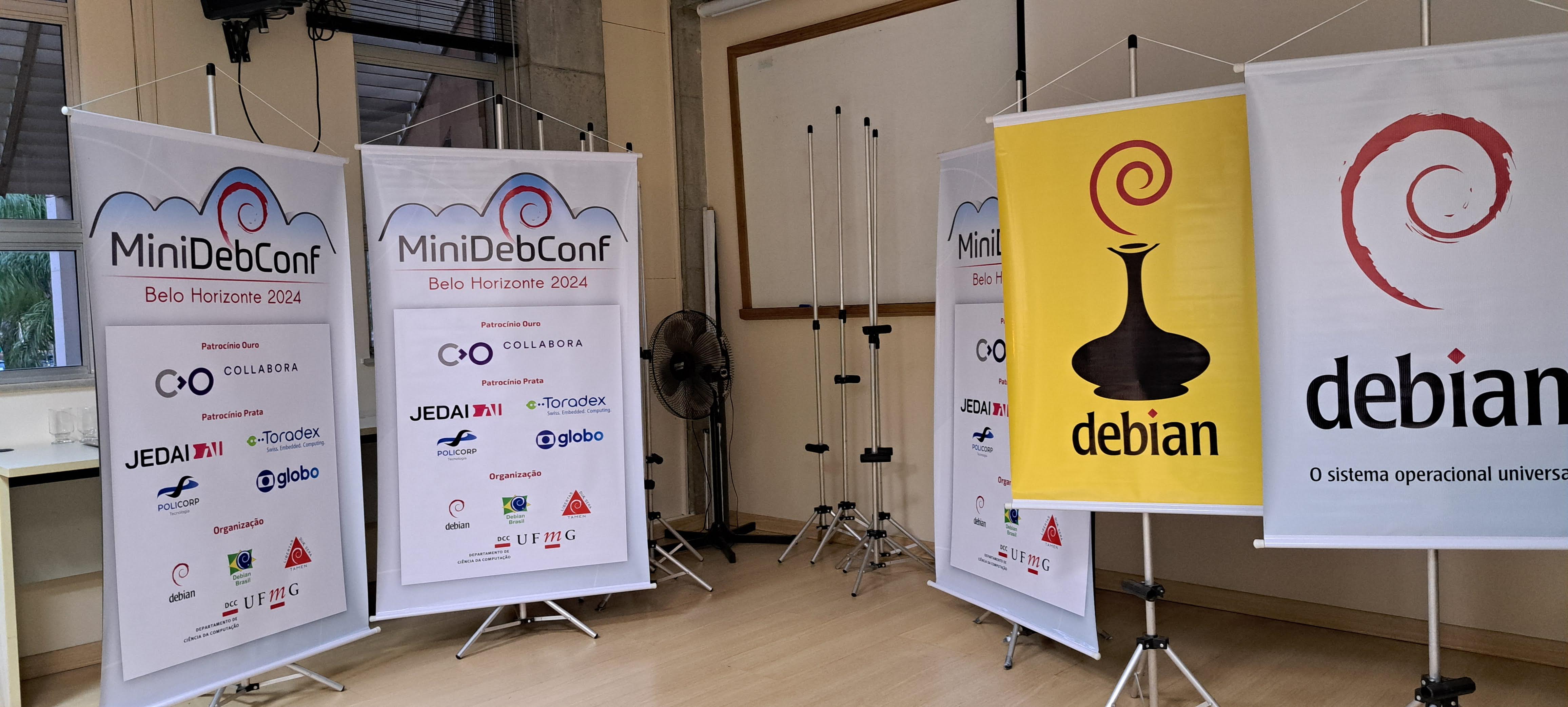
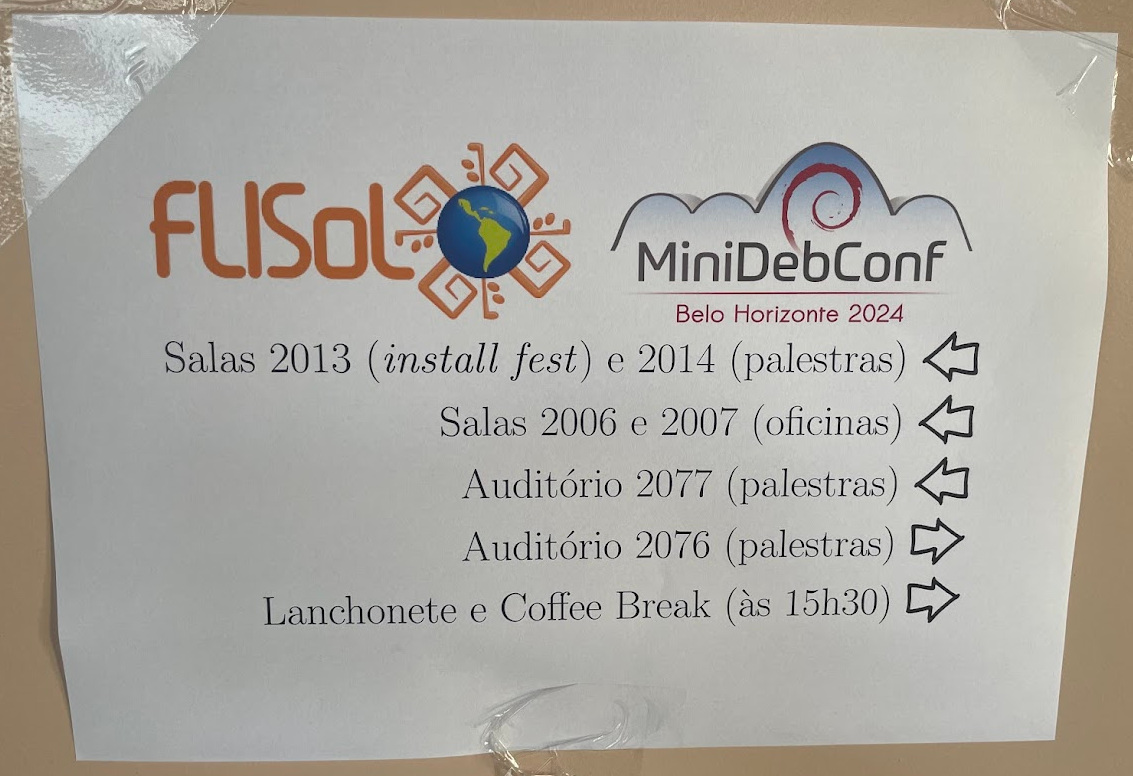
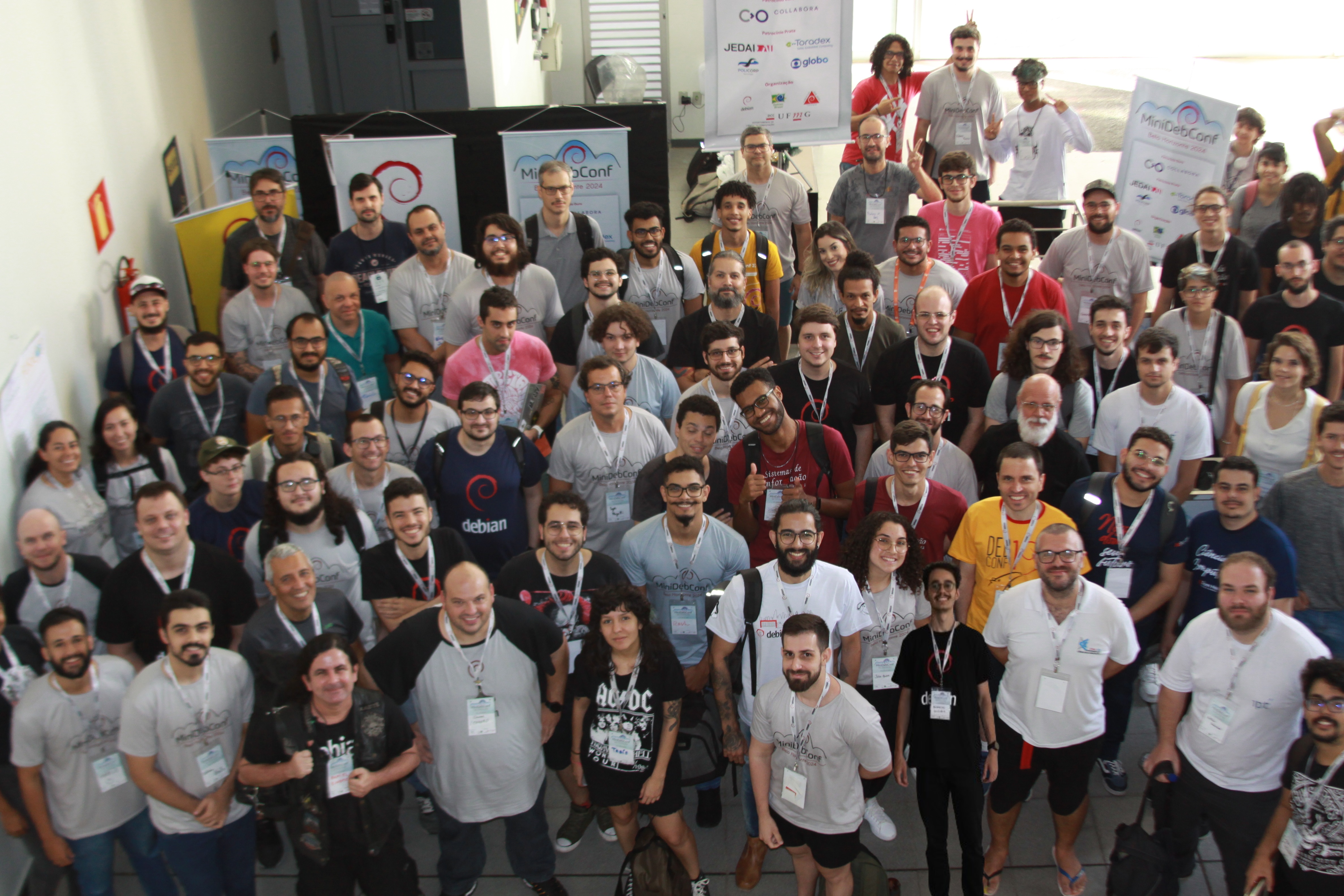
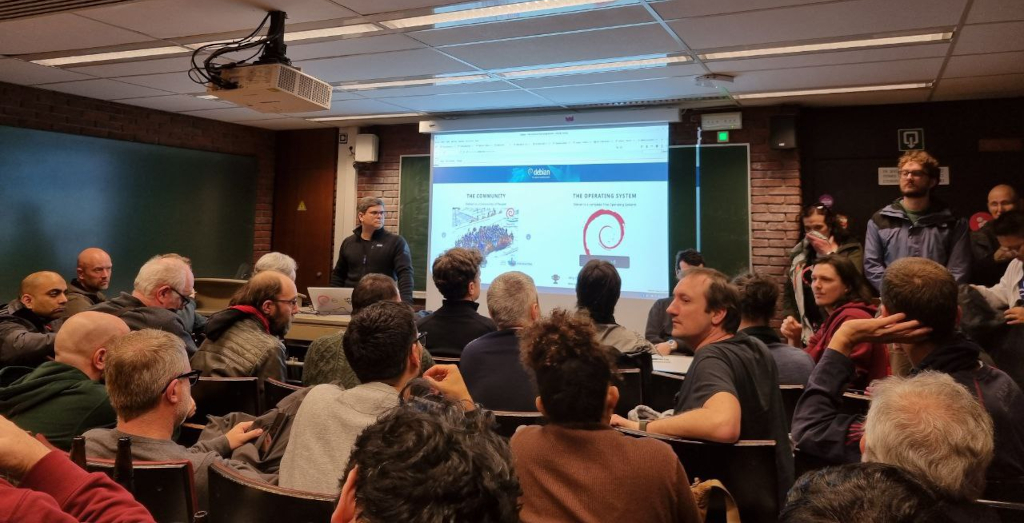
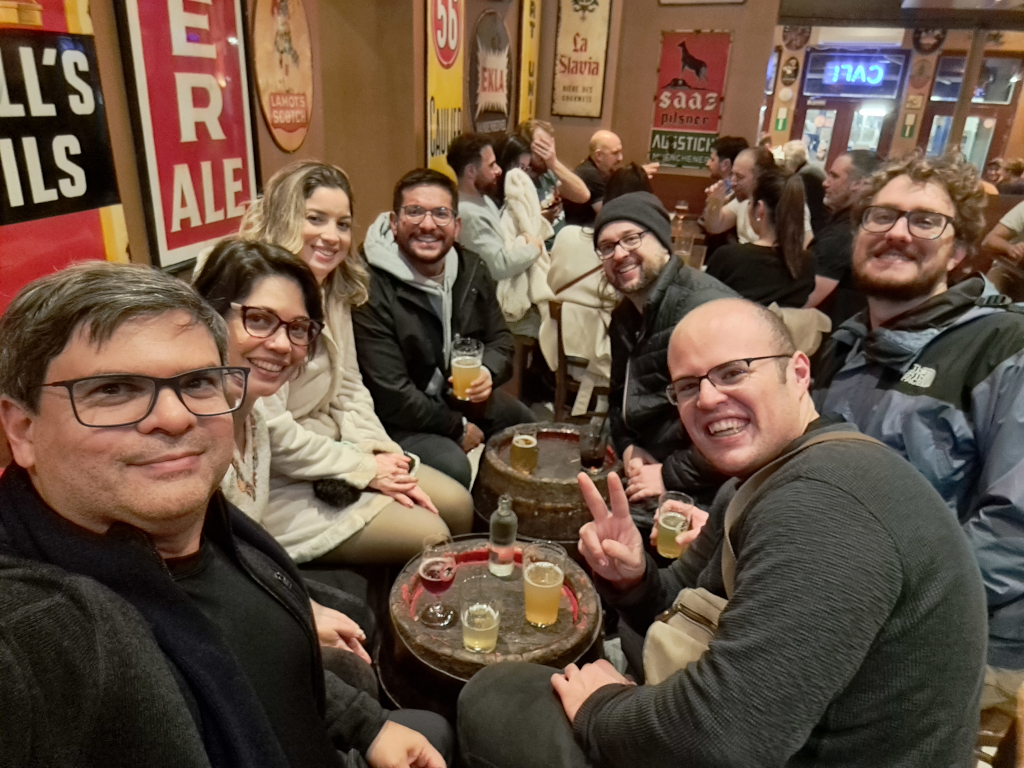
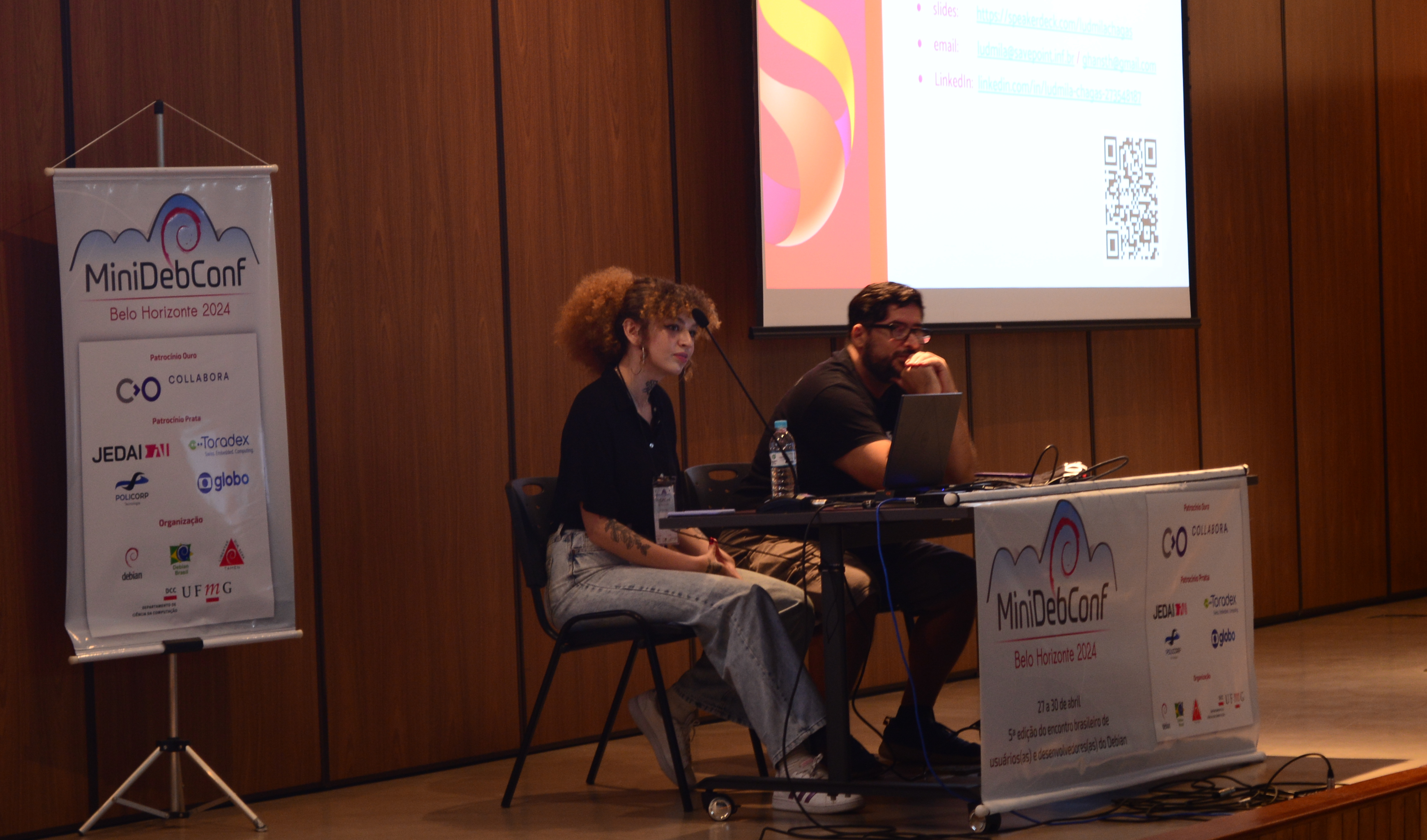
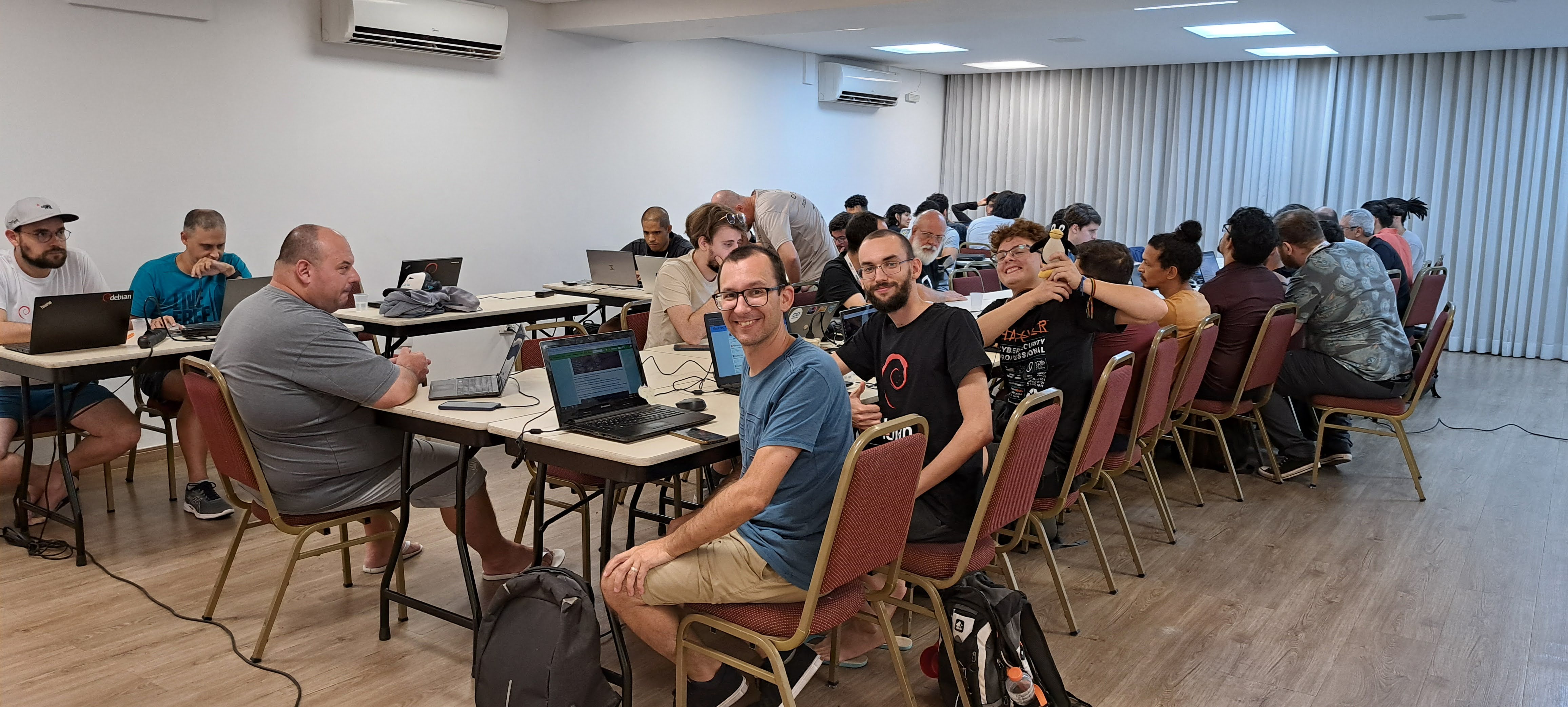
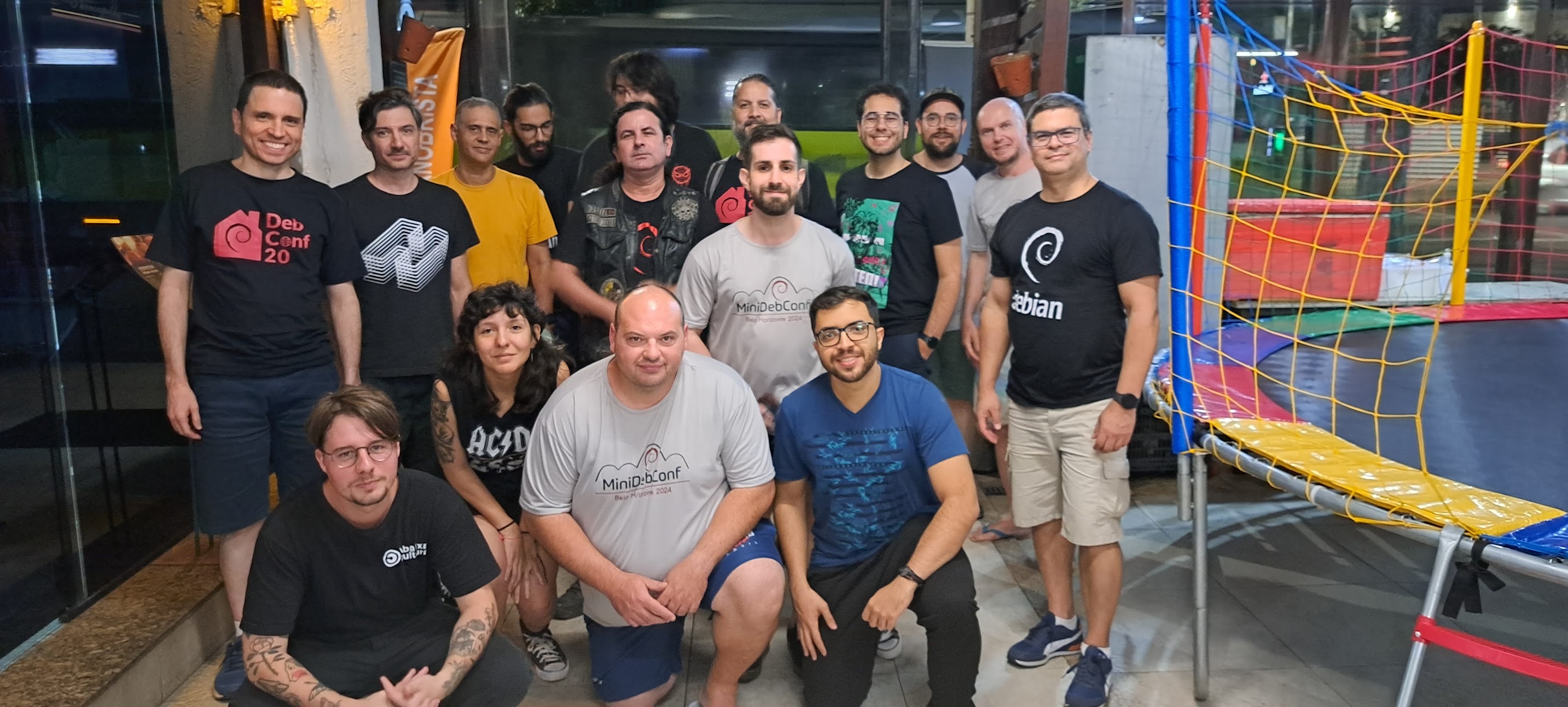
From April 27th to 30th, 2024, MiniDebConf Belo Horizonte 2024 was held at the Pampulha Campus of UFMG - Federal University of Minas Gerais, in Belo Horizonte city. MiniDebConf BH 2024 banners This was the fifth time that a MiniDebConf (as an exclusive in-person event about Debian) took place in Brazil. Previous editions were in Curitiba (2016, 2017, and 2018), and in Bras lia 2023. We had other MiniDebConfs editions held within Free Software events such as FISL and Latinoware, and other online events. See our event history. Parallel to MiniDebConf, on 27th (Saturday) FLISOL - Latin American Free Software Installation Festival took place. It's the largest event in Latin America to promote Free Software, and It has been held since 2005 simultaneously in several cities. MiniDebConf Belo Horizonte 2024 was a success (as were previous editions) thanks to the participation of everyone, regardless of their level of knowledge about Debian. We value the presence of both beginner users who are familiarizing themselves with the system and the official project developers. The spirit of welcome and collaboration was present during all the event. MiniDebConf BH 2024 flisol 2024 edition numbers During the four days of the event, several activities took place for all levels of users and collaborators of the Debian project. The official schedule was composed of: MiniDebConf BH 2024 palestra The final numbers for MiniDebConf Belo Horizonte 2024 show that we had a record number of participants. Of the 224 participants, 15 were official Brazilian contributors, 10 being DDs (Debian Developers) and 05 (Debian Maintainers), in addition to several unofficial contributors. The organization was carried out by 14 people who started working at the end of 2023, including Prof. Lo c Cerf from the Computing Department who made the event possible at UFMG, and 37 volunteers who helped during the event. As MiniDebConf was held at UFMG facilities, we had the help of more than 10 University employees. See the list with the names of people who helped in some way in organizing MiniDebConf Belo Horizonte 2024. The difference between the number of people registered and the number of attendees in the event is probably explained by the fact that there is no registration fee, so if the person decides not to go to the event, they will not suffer financial losses. The 2024 edition of MiniDebconf Belo Horizonte was truly grand and shows the result of the constant efforts made over the last few years to attract more contributors to the Debian community in Brazil. With each edition the numbers only increase, with more attendees, more activities, more rooms, and more sponsors/supporters. MiniDebConf BH 2024 grupo
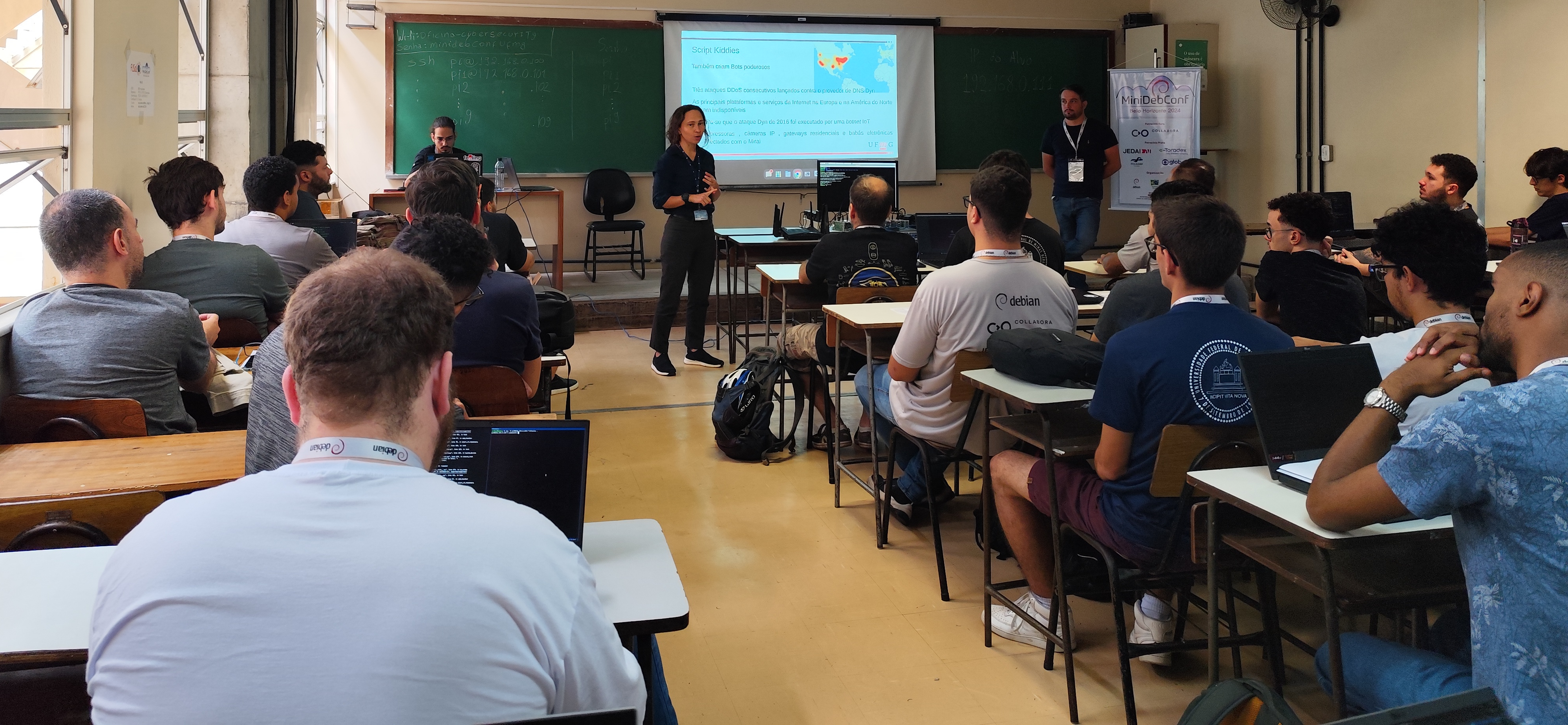
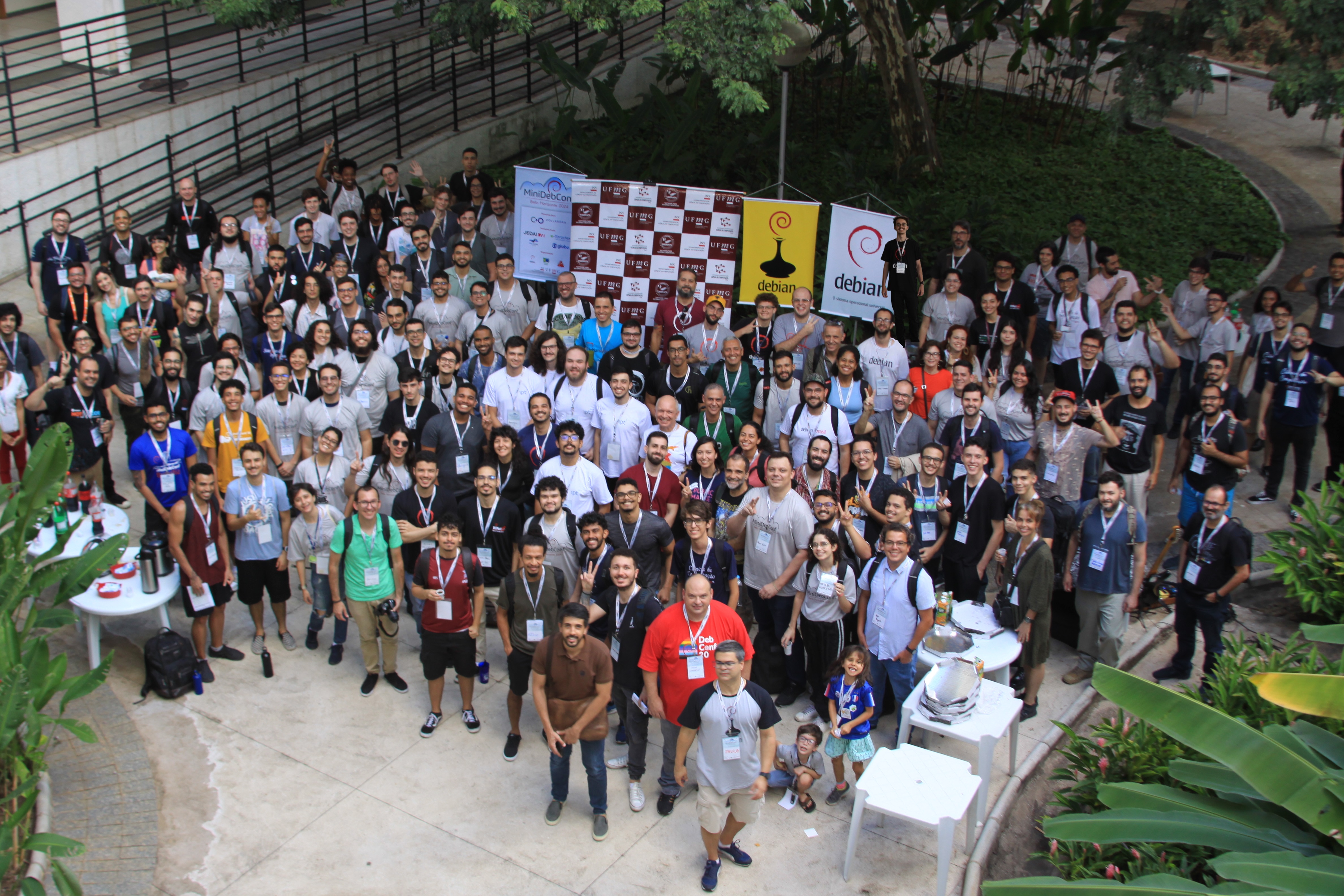
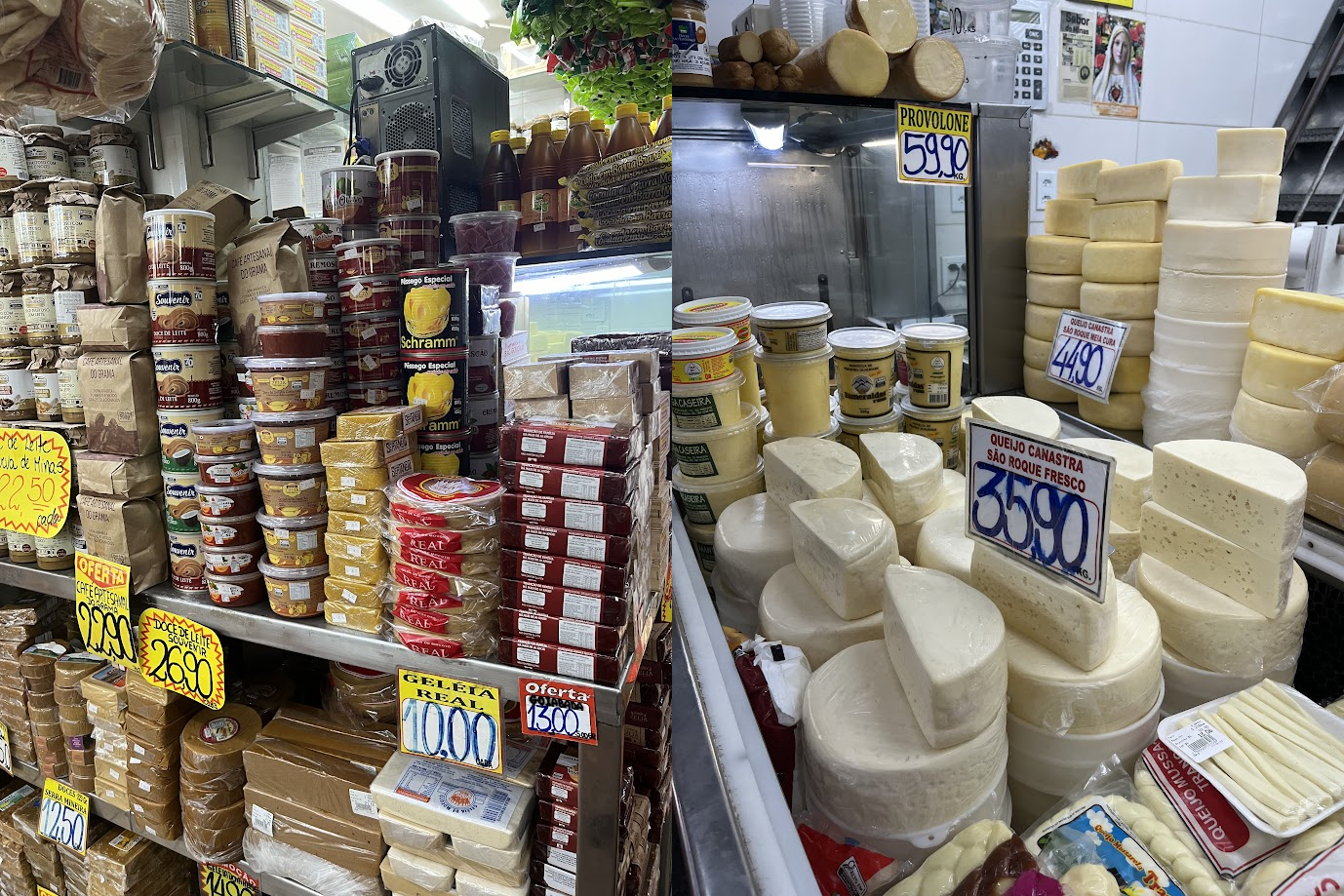
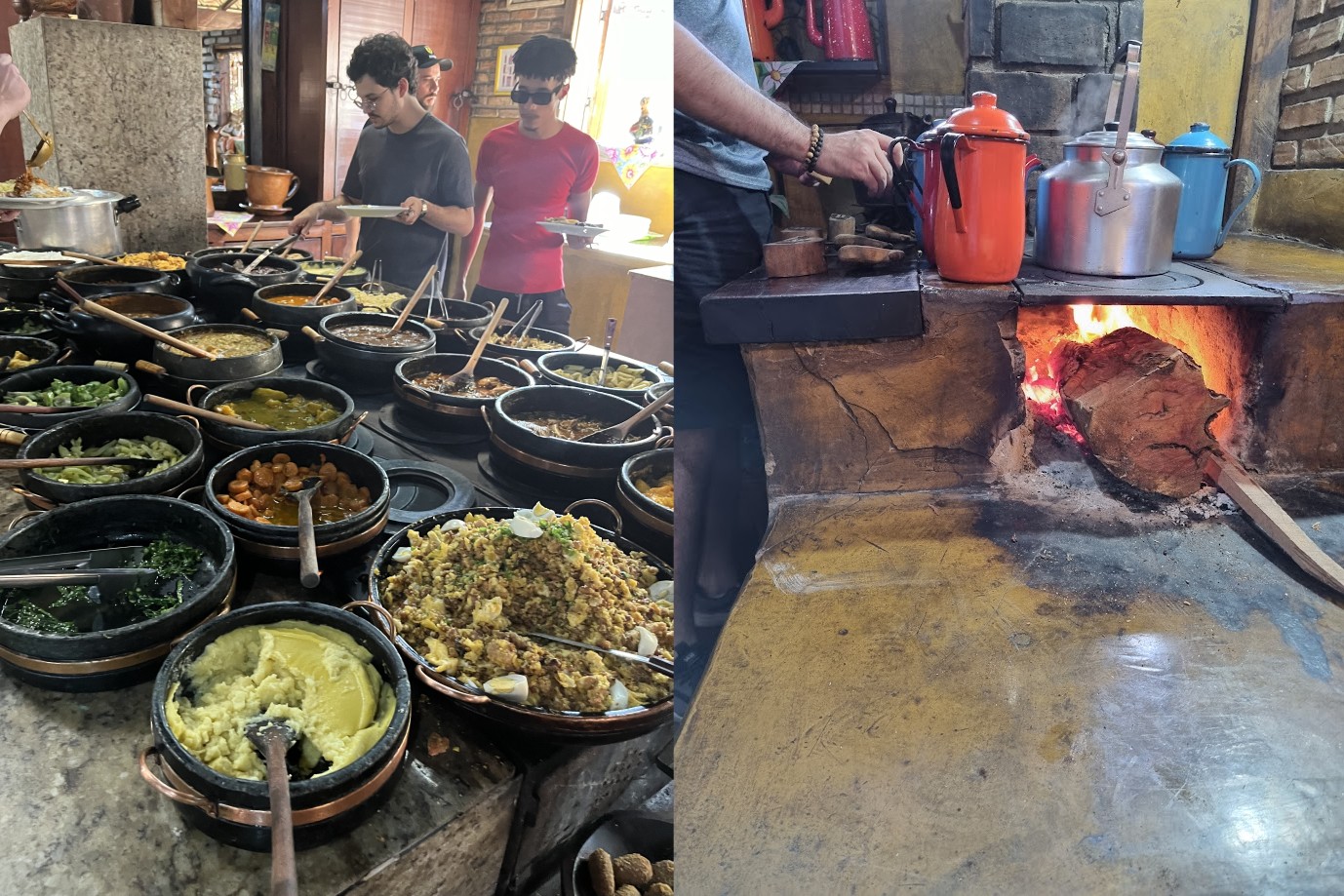
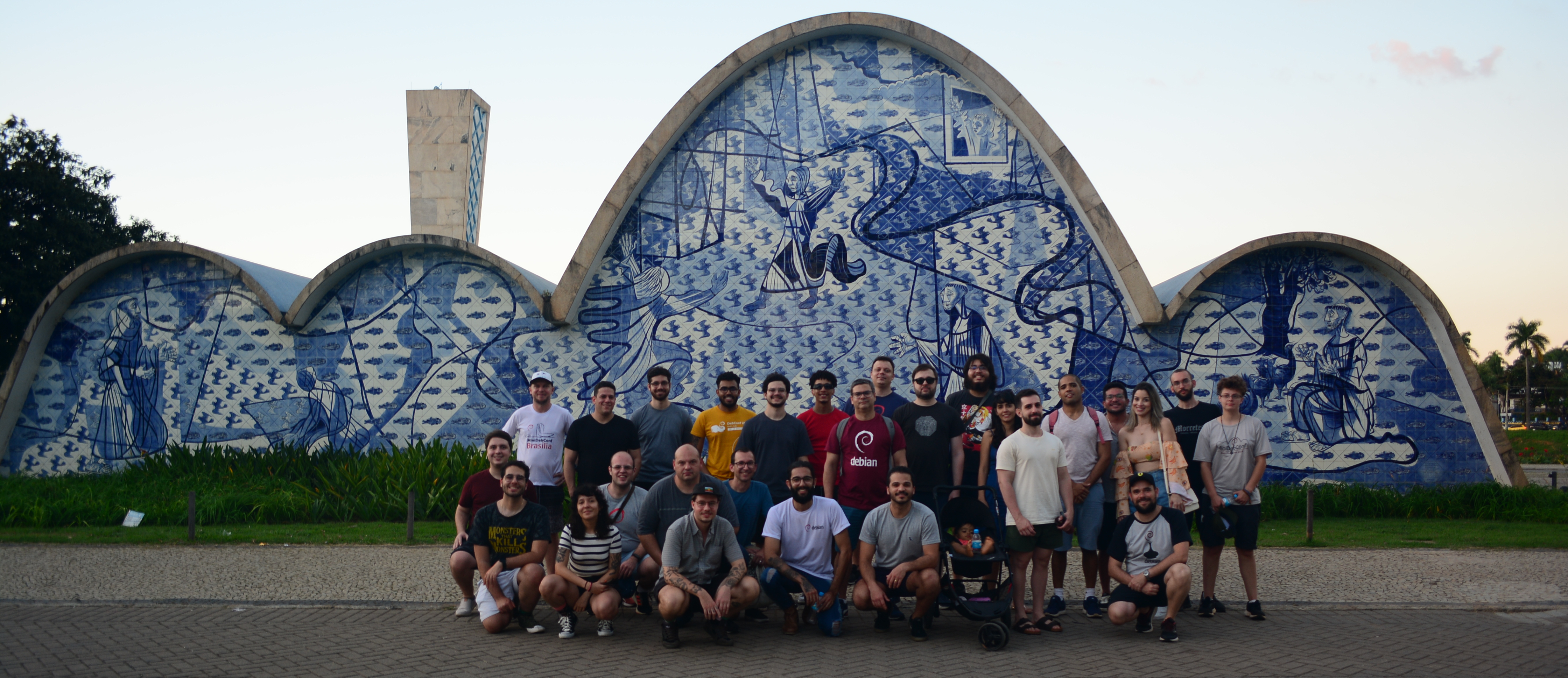
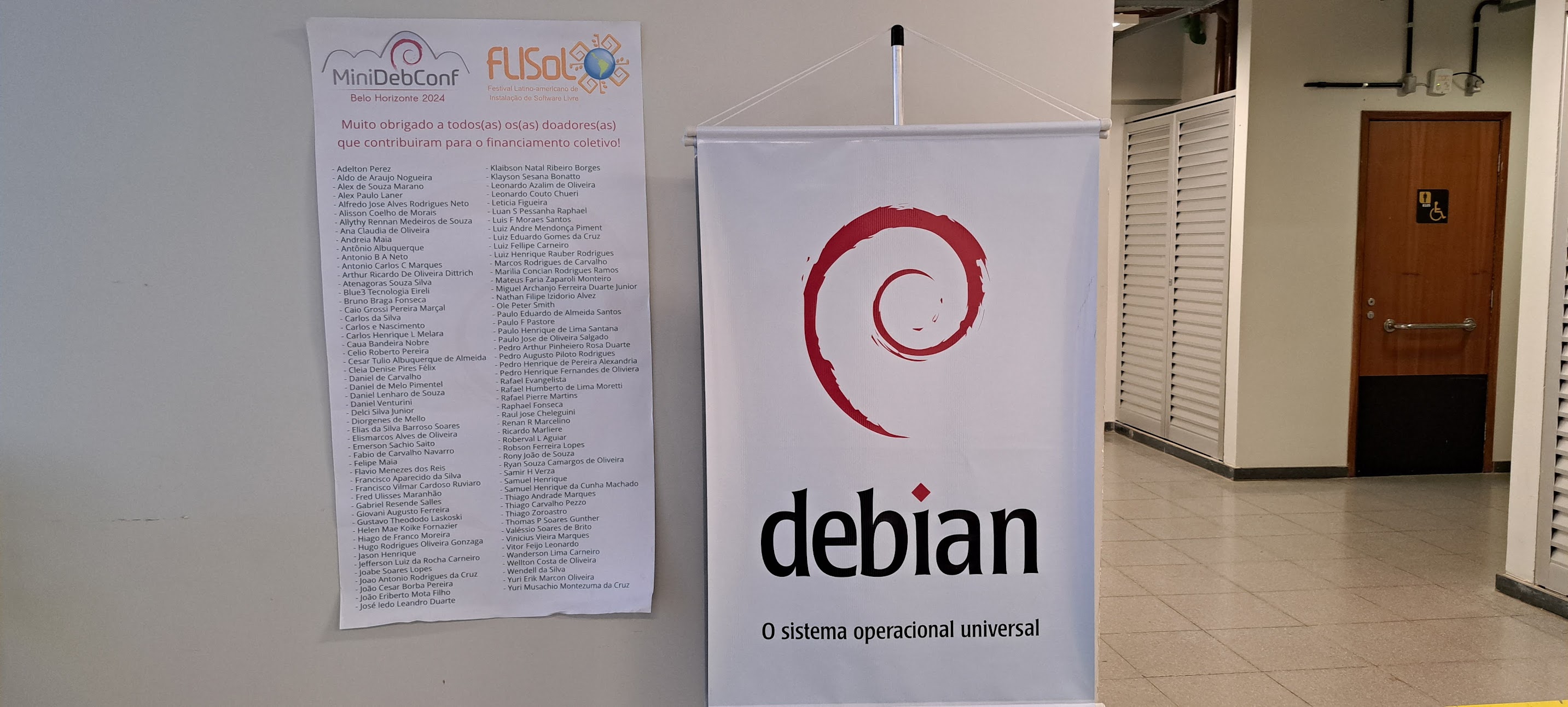
MiniDebConf BH 2024 grupo Activities The MiniDebConf schedule was intense and diverse. On the 27th, 29th and 30th (Saturday, Monday and Tuesday) we had talks, discussions, workshops and many practical activities. MiniDebConf BH 2024 palestra On the 28th (Sunday), the Day Trip took place, a day dedicated to sightseeing around the city. In the morning we left the hotel and went, on a chartered bus, to the Belo Horizonte Central Market. People took the opportunity to buy various things such as cheeses, sweets, cacha as and souvenirs, as well as tasting some local foods. MiniDebConf BH 2024 mercado After a 2-hour tour of the Market, we got back on the bus and hit the road for lunch at a typical Minas Gerais food restaurant. MiniDebConf BH 2024 palestra With everyone well fed, we returned to Belo Horizonte to visit the city's main tourist attraction: Lagoa da Pampulha and Capela S o Francisco de Assis, better known as Igrejinha da Pampulha. MiniDebConf BH 2024 palestra We went back to the hotel and the day ended in the hacker space that we set up in the events room for people to chat, packaging, and eat pizzas. MiniDebConf BH 2024 palestra Crowdfunding For the third time we ran a crowdfunding campaign and it was incredible how people contributed! The initial goal was to raise the amount equivalent to a gold tier of R$ 3,000.00. When we reached this goal, we defined a new one, equivalent to one gold tier + one silver tier (R$ 5,000.00). And again we achieved this goal. So we proposed as a final goal the value of a gold + silver + bronze tiers, which would be equivalent to R$ 6,000.00. The result was that we raised R$7,239.65 (~ USD 1,400) with the help of more than 100 people! Thank you very much to the people who contributed any amount. As a thank you, we list the names of the people who donated. MiniDebConf BH 2024 doadores Food, accommodation and/or travel grants for participants Each edition of MiniDebConf brought some innovation, or some different benefit for the attendees. In this year's edition in Belo Horizonte, as with DebConfs, we offered bursaries for food, accommodation and/or travel to help those people who would like to come to the event but who would need some kind of help. In the registration form, we included the option for the person to request a food, accommodation and/or travel bursary, but to do so, they would have to identify themselves as a contributor (official or unofficial) to Debian and write a justification for the request. Number of people benefited: The food bursary provided lunch and dinner every day. The lunches included attendees who live in Belo Horizonte and the region. Dinners were paid for attendees who also received accommodation and/or travel. The accommodation was held at the BH Jaragu Hotel. And the travels included airplane or bus tickets, or fuel (for those who came by car or motorbike). Much of the money to fund the bursaries came from the Debian Project, mainly for travels. We sent a budget request to the former Debian leader Jonathan Carter, and He promptly approved our request. In addition to this event budget, the leader also approved individual requests sent by some DDs who preferred to request directly from him. The experience of offering the bursaries was really good because it allowed several people to come from other cities. MiniDebConf BH 2024 grupo Photos and videos You can watch recordings of the talks at the links below: Thanks We would like to thank all the attendees, organizers, volunteers, sponsors and supporters who contributed to the success of MiniDebConf Belo Horizonte 2024. MiniDebConf BH 2024 grupo Sponsors Gold: Silver: Bronze: Organizers
Dirk Eddelbuettel: RcppTOML 0.2.3 on CRAN: Compiler Nag, Small Updates

A new (mostly maintenance) release 0.2.3 of RcppTOML is now on CRAN. TOMLis a file format that is most suitable for configurations, as it is meant to be edited by humans but read by computers. It emphasizes strong readability for humans while at the same time supporting strong typing as well as immediate and clear error reports. On small typos you get parse errors, rather than silently corrupted garbage. Much preferable to any and all of XML, JSON or YAML though sadly these may be too ubiquitous now. TOML is frequently being used with the projects such as the Hugo static blog compiler, or the Cargo system of Crates (aka packages ) for the Rust language. This release was tickled by another CRAN request: just like yesterday s and the RcppDate release two days ago, it responds to the esoteric whitespace in literal operator depreceation warning. We alerted upstream too. The short summary of changes follows.

Changes in version 0.2.3 (2025-03-08)
  • Correct the minimum version of Rcpp to 1.0.8 (Walter Somerville)
  • The package now uses Authors@R as mandated by CRAN
  • Updated 'whitespace in literal' issue upsetting clang++-20
  • Continuous integration updates including simpler r-ci setup

Courtesy of my CRANberries, there is also a diffstat report for this release. For questions, suggestions, or issues please use the issue tracker at the GitHub repo.

This post by Dirk Eddelbuettel originated on his Thinking inside the box blog. If you like this or other open-source work I do, you can now sponsor me at GitHub.

Vincent Bernat: Auto-expanding aliases in Zsh

To avoid needless typing, the fish shell features command abbreviations to expand some words after pressing space. We can emulate such a feature with Zsh:
# Definition of abbrev-alias for auto-expanding aliases
typeset -ga _vbe_abbrevations
abbrev-alias()  
    alias $1
    _vbe_abbrevations+=($ 1%%\=* )
 
_vbe_zle-autoexpand()  
    local -a words; words=($ (z)LBUFFER )
    if (( $  #_vbe_abbrevations[(r)$ words[-1] ]  )); then
        zle _expand_alias
    fi
    zle magic-space
 
zle -N _vbe_zle-autoexpand
bindkey -M emacs " " _vbe_zle-autoexpand
bindkey -M isearch " " magic-space
# Correct common typos
(( $+commands[git] )) && abbrev-alias gti=git
(( $+commands[grep] )) && abbrev-alias grpe=grep
(( $+commands[sudo] )) && abbrev-alias suod=sudo
(( $+commands[ssh] )) && abbrev-alias shs=ssh
# Save a few keystrokes
(( $+commands[git] )) && abbrev-alias gls="git ls-files"
(( $+commands[ip] )) &&  
  abbrev-alias ip6='ip -6'
  abbrev-alias ipb='ip -brief'
 
# Hard to remember options
(( $+commands[mtr] )) && abbrev-alias mtrr='mtr -wzbe'
Here is a demo where gls is expanded to git ls-files after pressing space:
Auto-expanding gls to git ls-files
I don t auto-expand all aliases. I keep using regular aliases when slightly modifying the behavior of a command or for well-known abbreviations:
alias df='df -h'
alias du='du -h'
alias rm='rm -i'
alias mv='mv -i'
alias ll='ls -ltrhA'

7 March 2025

Dirk Eddelbuettel: RcppSimdJson 0.1.13 on CRAN: Compiler Nag, New Upsteam

A new release 0.1.13 of the RcppSimdJson package is now on CRAN. RcppSimdJson wraps the fantastic and genuinely impressive simdjson library by Daniel Lemire and collaborators. Via very clever algorithmic engineering to obtain largely branch-free code, coupled with modern C++ and newer compiler instructions, it results in parsing gigabytes of JSON parsed per second which is quite mindboggling. The best-case performance is faster than CPU speed as use of parallel SIMD instructions and careful branch avoidance can lead to less than one cpu cycle per byte parsed; see the video of the talk by Daniel Lemire at QCon. This release was tickled by another CRAN request: just like yesterday s RcppDate release, it responds to the esoteric whitespace in literal operator depreceation warning. Turns out that upstream simdjson had this fixed a few months ago as the node bindings package ran into it. Other changes include a bit of earlier polish by Daniel, another CRAN mandated update, CI improvements, and a move of two demos to examples/ to avoid having to add half a dozen packages to Suggests: for no real usage gain in the package. The short NEWS entry for this release follows.

Changes in version 0.1.13 (2025-03-07)
  • A call to std::string::erase is now guarded (Daniel)
  • The package now uses Authors@R as mandated by CRAN (Dirk)
  • simdjson was upgraded to version 3.12.2 (Dirk)
  • Continuous integration updated to more compilers and simpler setup
  • Two demos are now in inst/examples to not inflate Suggests

Courtesy of my CRANberries, there is also a diffstat report for this release. For questions, suggestions, or issues please use the issue tracker at the GitHub repo.

This post by Dirk Eddelbuettel originated on his Thinking inside the box blog. If you like this or other open-source work I do, you can now sponsor me at GitHub.

Paulo Henrique de Lima Santana: Bits from FOSDEM 2025

This year I was at FOSDEM 2025, and it was the fifth edition in a row that I participated in person (before it was in 2019, 2020, 2023 and 2024). The event took place on February 1st and 2nd, as always at the ULB campus in Brussels. We arrived on Friday at lunchtime and went straight to the hotel to drop off our bags. This time we stayed at Ibis in the city center, very close to the hustle and bustle. The price was good and the location was really good for us to be able to go out in the city center and come back late at night. We found a Japanese restaurant near the hotel and it was definitely worth having lunch there because of the all-you-can-eat price. After taking a nap, we went out for a walk. Since January 31st is the last day of the winter sales in the city, the streets in the city center were crowded, there were lots of people in the stores, and the prices were discounted. We concluded that if we have the opportunity to go to Brussels again at this time, it would be better wait to buy clothes for cold weather there.
Fosdem 2025
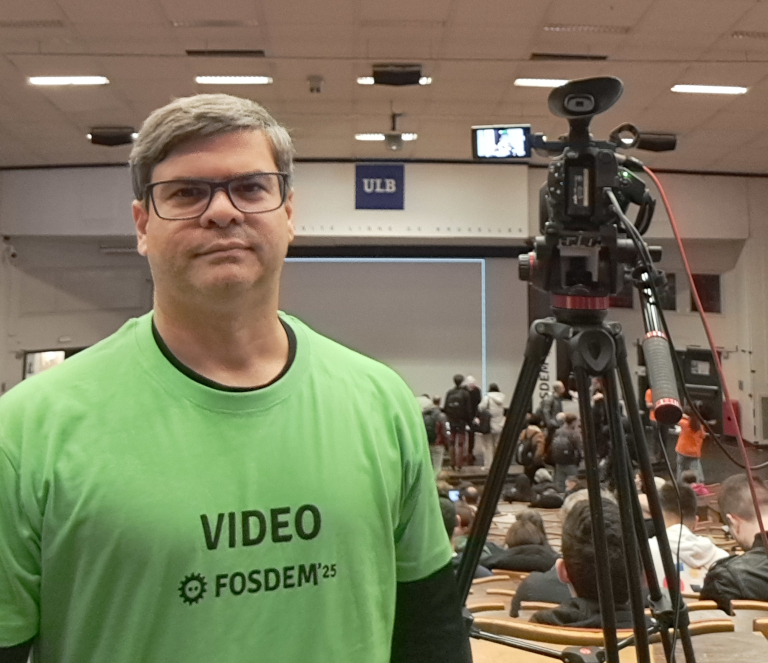
Unlike in 2023 and 2024, the FOSDEM organization did not approve my request for the Translations DevRoom,so my goal was to participate in the event and collaborate at the Debian booth. And also as I always do, I volunteered to operate the broadcast camera in the main auditorium on both days, for two hours each. The Debian booth:
Fosdem 2025
Me in the auditorium helping with the broadcast:
Fosdem 2025
2 weeks before the event, the organization put out a call for interested people to request a room for their community s BoF (Birds of a Feather), and I requested a room for Debian and it was approved :-) It was great to see that people were really interested in participating at the BoF and the room was packed! As the host of the discussions, I tried to leave the space open for anyone who wanted to talk about any subject related to Debian. We started with a talk from MiniDebConf25 organizers, that will be taking place this year in France. Then other topics followed with people talking, asking and answering questions, etc. It was worth organizing this BoF. Who knows, the idea will remain in 2026.
Fosdem 2025
Carlos (a.k.a Charles), Athos, Ma ra and Melissa talked at Fosdem, and Kanashiro was one for organizers of Distributions DevRoom
Fosdem 2025
During the two days of the event, it didn t rain or get too cold. The days were sunny (and people celebrated the weather in Brussels). But I have to admit that it would have been nice to see snow like I did in 2019. Unlike last year, this time I felt more motivated to stay at the event the whole time. Deixo meu agradecimento especial para o Andreas Tille, atual L der do Debian que aprovou o meu pedido de passagens para que eu pudesse participar dos FOSDEM 2025. Como sempre, essa ajuda foi essencial para viabilizar a minha viagem para Bruxelas. I would like to give my special thanks to Andreas Tille, the current Debian Leader, who approved my request for flight tickets so that I could join FOSDEM 2025. As always, this help was essential in making my trip to Brussels possible. And once again Jandira was with me on this adventure. On Monday we went for a walk around Brussels and we also traveled to visit Bruges again. The visit to this city is really worth it because walking through the historic streets is like going back in time. This time we even took a boat trip through the canals, which was really cool.
Fosdem 2025

Fosdem 2025

Next.

Previous.