Search Results: "cas"

20 July 2022

Enrico Zini: Deconstruction of the DAM hat

Further reading Talk notes Intro Debian Account Managers Responsibility for official membership What DAM is not Unexpected responsibilities DAM warnings DAM warnings? House rules Interpreting house rules Governance by bullying How about the Community Team? How about DAM? How about the DPL? Concentrating responsibility Empowering developers What needs to happen

17 July 2022

Russ Allbery: Review: Trang

Review: Trang, by Mary Sisson
Series: Trang #1
Publisher: Mary Sisson
Copyright: 2011
Printing: December 2013
ASIN: B004I6DAQ8
Format: Kindle
Pages: 374
In 2113, a radio mapping satellite near the Titan station disappeared. It then reappeared five days later, apparently damaged and broadcasting a signal that made computers crash. The satellite was immediately sent back to the Space Authority base in Beijing for careful examination, but the techs on the station were able to decode the transmission: a request for the contents of databases. The general manager of the station sent a probe to the same location and it too vanished, returning two days later with a picture of a portal, followed shortly by an alien probe. Five years later, Philippe Trang has been assigned as the first human diplomat to an alien space station in intergalactic space at the nexus of multiple portals. Humans will apparently be the eighth type of intelligent life to send a representative to the station. He'll have a translation system, a security detail, and the groundwork of five years of audiovisual communications with the aliens, including one that was able to learn English. But he'll be the first official diplomatic representative physically there. The current style in SF might lead you to expect a tense thriller full of nearly incomprehensible aliens, unexplained devices, and creepy mysteries. This is not that sort of book. The best comparison point I could think of is James White's Sector General novels, except with a diplomat rather than a doctor. The aliens are moderately strange (not just humans in prosthetic makeup), but are mostly earnest, well-meaning, and welcoming. Trang's security escort is more military than he expects, but that becomes a satisfying negotiation rather than an ongoing problem. There is confusion, misunderstandings, and even violence, but most of it is sorted out by earnest discussion and attempts at mutual understanding. This is, in other words, diplomat competence porn (albeit written by someone who is not a diplomat, so I wouldn't expect too much realism). Trang defuses rather than confronts, patiently sorts through the nuances of a pre-existing complex dynamic between aliens without prematurely picking sides, and has the presence of mind to realize that the special forces troops assigned to him are another culture he needs to approach with the same skills. Most of the book is low-stakes confusion, curiosity, and careful exploration, which could have been boring but wasn't. It helps that Sisson packs a lot of complexity into the station dynamics and reveals it in ways that I found enjoyably unpredictable. Some caveats: This is a self-published first novel (albeit by an experienced reporter and editor) and it shows. The book has a sort of plastic Technicolor feel that I sometimes see in self-published novels, where the details aren't quite deep enough, the writing isn't quite polished, and the dialog isn't quite as tight as I'm used to. It also meanders in a way that few commercial novels do, including slice-of-life moments and small asides that don't go anywhere. This can be either a bug or a feature depending on what you're in the mood for. I found it relaxing and stress-relieving, which is what I was looking for, but you may have a different experience. I will warn that the climax features a sudden escalation of stakes that I don't think was sufficiently signaled by the tone of the writing, and thus felt a bit unreal. Sisson also includes a couple deus ex machina twists that felt a bit predictable and easy, and I didn't find the implied recent history of one of the alien civilizations that believable. The conclusion is therefore not the strongest part of the book; if you're not enjoying the journey, it probably won't get better. But, all that said, this was fun, and I've already bought the second book in the series. It's low-stakes, gentle SF with a core of discovery and exploration rather than social dynamics, and I haven't run across much of that recently. The worst thing in the book is some dream glimpses at a horrific event in Trang's past that's never entirely on camera. It's not as pacifist as James White, but it's close. Recommended, especially if you liked Sector General. White's series is so singular that I previously would have struggled to find a suggestion for someone who wanted more exactly like that (but without the Bewitched-era sexism). Now I have an answer. Score another one for Susan Stepney, who is also how I found Julie Czerneda. Trang is also currently free for Kindle, so you can't beat the price. Followed by Trust. Rating: 8 out of 10

16 July 2022

Petter Reinholdtsen: Automatic LinuxCNC servo PID tuning?

While working on a CNC with servo motors controlled by the LinuxCNC PID controller, I recently had to learn how to tune the collection of values that control such mathematical machinery that a PID controller is. It proved to be a lot harder than I hoped, and I still have not succeeded in getting the Z PID controller to successfully defy gravity, nor X and Y to move accurately and reliably. But while climbing up this rather steep learning curve, I discovered that some motor control systems are able to tune their PID controllers. I got the impression from the documentation that LinuxCNC were not. This proved to be not true The LinuxCNC pid component is the recommended PID controller to use. It uses eight constants Pgain, Igain, Dgain, bias, FF0, FF1, FF2 and FF3 to calculate the output value based on current and wanted state, and all of these need to have a sensible value for the controller to behave properly. Note, there are even more values involved, theser are just the most important ones. In my case I need the X, Y and Z axes to follow the requested path with little error. This has proved quite a challenge for someone who have never tuned a PID controller before, but there is at least some help to be found. I discovered that included in LinuxCNC was this old PID component at_pid claiming to have auto tuning capabilities. Sadly it had been neglected since 2011, and could not be used as a plug in replacement for the default pid component. One would have to rewriting the LinuxCNC HAL setup to test at_pid. This was rather sad, when I wanted to quickly test auto tuning to see if it did a better job than me at figuring out good P, I and D values to use. I decided to have a look if the situation could be improved. This involved trying to understand the code and history of the pid and at_pid components. Apparently they had a common ancestor, as code structure, comments and variable names were quite close to each other. Sadly this was not reflected in the git history, making it hard to figure out what really happened. My guess is that the author of at_pid.c took a version of pid.c, rewrote it to follow the structure he wished pid.c to have, then added support for auto tuning and finally got it included into the LinuxCNC repository. The restructuring and lack of early history made it harder to figure out which part of the code were relevant to the auto tuning, and which part of the code needed to be updated to work the same way as the current pid.c implementation. I started by trying to isolate relevant changes in pid.c, and applying them to at_pid.c. My aim was to make sure the at_pid component could replace the pid component with a simple change in the HAL setup loadrt line, without having to "rewire" the rest of the HAL configuration. After a few hours following this approach, I had learned quite a lot about the code structure of both components, while concluding I was heading down the wrong rabbit hole, and should get back to the surface and find a different path. For the second attempt, I decided to throw away all the PID control related part of the original at_pid.c, and instead isolate and lift the auto tuning part of the code and inject it into a copy of pid.c. This ensured compatibility with the current pid component, while adding auto tuning as a run time option. To make it easier to identify the relevant parts in the future, I wrapped all the auto tuning code with '#ifdef AUTO_TUNER'. The end result behave just like the current pid component by default, as that part of the code is identical. The end result entered the LinuxCNC master branch a few days ago. To enable auto tuning, one need to set a few HAL pins in the PID component. The most important ones are tune-effort, tune-mode and tune-start. But lets take a step back, and see what the auto tuning code will do. I do not know the mathematical foundation of the at_pid algorithm, but from observation I can tell that the algorithm will, when enabled, produce a square wave pattern centered around the bias value on the output pin of the PID controller. This can be seen using the HAL Scope provided by LinuxCNC. In my case, this is translated into voltage (+-10V) sent to the motor controller, which in turn is translated into motor speed. So at_pid will ask the motor to move the axis back and forth. The number of cycles in the pattern is controlled by the tune-cycles pin, and the extremes of the wave pattern is controlled by the tune-effort pin. Of course, trying to change the direction of a physical object instantly (as in going directly from a positive voltage to the equivalent negative voltage) do not change velocity instantly, and it take some time for the object to slow down and move in the opposite direction. This result in a more smooth movement wave form, as the axis in question were vibrating back and forth. When the axis reached the target speed in the opposing direction, the auto tuner change direction again. After several of these changes, the average time delay between the 'peaks' and 'valleys' of this movement graph is then used to calculate proposed values for Pgain, Igain and Dgain, and insert them into the HAL model to use by the pid controller. The auto tuned settings are not great, but htye work a lot better than the values I had been able to cook up on my own, at least for the horizontal X and Y axis. But I had to use very small tune-effort values, as my motor controllers error out if the voltage change too quickly. I've been less lucky with the Z axis, which is moving a heavy object up and down, and seem to confuse the algorithm. The Z axis movement became a lot better when I introduced a bias value to counter the gravitational drag, but I will have to work a lot more on the Z axis PID values. Armed with this knowledge, it is time to look at how to do the tuning. Lets say the HAL configuration in question load the PID component for X, Y and Z like this:
loadrt pid names=pid.x,pid.y,pid.z
Armed with the new and improved at_pid component, the new line will look like this:
loadrt at_pid names=pid.x,pid.y,pid.z
The rest of the HAL setup can stay the same. This work because the components are referenced by name. If the component had used count=3 instead, all use of pid.# had to be changed to at_pid.#. To start tuning the X axis, move the axis to the middle of its range, to make sure it do not hit anything when it start moving back and forth. Next, set the tune-effort to a low number in the output range. I used 0.1 as my initial value. Next, assign 1 to the tune-mode value. Note, this will disable the pid controlling part and feed 0 to the output pin, which in my case initially caused a lot of drift. In my case it proved to be a good idea with X and Y to tune the motor driver to make sure 0 voltage stopped the motor rotation. On the other hand, for the Z axis this proved to be a bad idea, so it will depend on your setup. It might help to set the bias value to a output value that reduce or eliminate the axis drift. Finally, after setting tune-mode, set tune-start to 1 to activate the auto tuning. If all go well, your axis will vibrate for a few seconds and when it is done, new values for Pgain, Igain and Dgain will be active. To test them, change tune-mode back to 0. Note that this might cause the machine to suddenly jerk as it bring the axis back to its commanded position, which it might have drifted away from during tuning. To summarize with some halcmd lines:
setp pid.x.tune-effort 0.1
setp pid.x.tune-mode 1
setp pid.x.tune-start 1
# wait for the tuning to complete
setp pid.x.tune-mode 0
After doing this task quite a few times while trying to figure out how to properly tune the PID controllers on the machine in, I decided to figure out if this process could be automated, and wrote a script to do the entire tuning process from power on. The end result will ensure the machine is powered on and ready to run, home all axis if it is not already done, check that the extra tuning pins are available, move the axis to its mid point, run the auto tuning and re-enable the pid controller when it is done. It can be run several times. Check out the run-auto-pid-tuner script on github if you want to learn how it is done. My hope is that this little adventure can inspire someone who know more about motor PID controller tuning can implement even better algorithms for automatic PID tuning in LinuxCNC, making life easier for both me and all the others that want to use LinuxCNC but lack the in depth knowledge needed to tune PID controllers well. As usual, if you use Bitcoin and want to show your support of my activities, please send Bitcoin donations to my address 15oWEoG9dUPovwmUL9KWAnYRtNJEkP1u1b.

13 July 2022

Reproducible Builds: Reproducible Builds in June 2022

Welcome to the June 2022 report from the Reproducible Builds project. In these reports, we outline the most important things that we have been up to over the past month. As a quick recap, whilst anyone may inspect the source code of free software for malicious flaws, almost all software is distributed to end users as pre-compiled binaries.

Save the date! Despite several delays, we are pleased to announce dates for our in-person summit this year: November 1st 2022 November 3rd 2022
The event will happen in/around Venice (Italy), and we intend to pick a venue reachable via the train station and an international airport. However, the precise venue will depend on the number of attendees. Please see the announcement mail from Mattia Rizzolo, and do keep an eye on the mailing list for further announcements as it will hopefully include registration instructions.

News David Wheeler filed an issue against the Rust programming language to report that builds are not reproducible because full path to the source code is in the panic and debug strings . Luckily, as one of the responses mentions: the --remap-path-prefix solves this problem and has been used to great effect in build systems that rely on reproducibility (Bazel, Nix) to work at all and that there are efforts to teach cargo about it here .
The Python Security team announced that:
The ctx hosted project on PyPI was taken over via user account compromise and replaced with a malicious project which contained runtime code which collected the content of os.environ.items() when instantiating Ctx objects. The captured environment variables were sent as a base64 encoded query parameter to a Heroku application [ ]
As their announcement later goes onto state, version-pinning using hash-checking mode can prevent this attack, although this does depend on specific installations using this mode, rather than a prevention that can be applied systematically.
Developer vanitasvitae published an interesting and entertaining blog post detailing the blow-by-blow steps of debugging a reproducibility issue in PGPainless, a library which aims to make using OpenPGP in Java projects as simple as possible . Whilst their in-depth research into the internals of the .jar may have been unnecessary given that diffoscope would have identified the, it must be said that there is something to be said with occasionally delving into seemingly low-level details, as well describing any debugging process. Indeed, as vanitasvitae writes:
Yes, this would have spared me from 3h of debugging But I probably would also not have gone onto this little dive into the JAR/ZIP format, so in the end I m not mad.

Kees Cook published a short and practical blog post detailing how he uses reproducibility properties to aid work to replace one-element arrays in the Linux kernel. Kees approach is based on the principle that if a (small) proposed change is considered equivalent by the compiler, then the generated output will be identical but only if no other arbitrary or unrelated changes are introduced. Kees mentions the fantastic diffoscope tool, as well as various kernel-specific build options (eg. KBUILD_BUILD_TIMESTAMP) in order to prepare my build with the known to disrupt code layout options disabled .
Stefano Zacchiroli gave a presentation at GDR S curit Informatique based in part on a paper co-written with Chris Lamb titled Increasing the Integrity of Software Supply Chains. (Tweet)

Debian In Debian in this month, 28 reviews of Debian packages were added, 35 were updated and 27 were removed this month adding to our knowledge about identified issues. Two issue types were added: nondeterministic_checksum_generated_by_coq and nondetermistic_js_output_from_webpack. After Holger Levsen found hundreds of packages in the bookworm distribution that lack .buildinfo files, he uploaded 404 source packages to the archive (with no meaningful source changes). Currently bookworm now shows only 8 packages without .buildinfo files, and those 8 are fixed in unstable and should migrate shortly. By contrast, Debian unstable will always have packages without .buildinfo files, as this is how they come through the NEW queue. However, as these packages were not built on the official build servers (ie. they were uploaded by the maintainer) they will never migrate to Debian testing. In the future, therefore, testing should never have packages without .buildinfo files again. Roland Clobus posted yet another in-depth status report about his progress making the Debian Live images build reproducibly to our mailing list. In this update, Roland mentions that all major desktops build reproducibly with bullseye, bookworm and sid but also goes on to outline the progress made with automated testing of the generated images using openQA.

GNU Guix Vagrant Cascadian made a significant number of contributions to GNU Guix: Elsewhere in GNU Guix, Ludovic Court s published a paper in the journal The Art, Science, and Engineering of Programming called Building a Secure Software Supply Chain with GNU Guix:
This paper focuses on one research question: how can [Guix]((https://www.gnu.org/software/guix/) and similar systems allow users to securely update their software? [ ] Our main contribution is a model and tool to authenticate new Git revisions. We further show how, building on Git semantics, we build protections against downgrade attacks and related threats. We explain implementation choices. This work has been deployed in production two years ago, giving us insight on its actual use at scale every day. The Git checkout authentication at its core is applicable beyond the specific use case of Guix, and we think it could benefit to developer teams that use Git.
A full PDF of the text is available.

openSUSE In the world of openSUSE, SUSE announced at SUSECon that they are preparing to meet SLSA level 4. (SLSA (Supply chain Levels for Software Artifacts) is a new industry-led standardisation effort that aims to protect the integrity of the software supply chain.) However, at the time of writing, timestamps within RPM archives are not normalised, so bit-for-bit identical reproducible builds are not possible. Some in-toto provenance files published for SUSE s SLE-15-SP4 as one result of the SLSA level 4 effort. Old binaries are not rebuilt, so only new builds (e.g. maintenance updates) have this metadata added. Lastly, Bernhard M. Wiedemann posted his usual monthly openSUSE reproducible builds status report.

diffoscope diffoscope is our in-depth and content-aware diff utility. Not only can it locate and diagnose reproducibility issues, it can provide human-readable diffs from many kinds of binary formats. This month, Chris Lamb prepared and uploaded versions 215, 216 and 217 to Debian unstable. Chris Lamb also made the following changes:
  • New features:
    • Print profile output if we were called with --profile and we were killed via a TERM signal. This should help in situations where diffoscope is terminated due to some sort of timeout. [ ]
    • Support both PyPDF 1.x and 2.x. [ ]
  • Bug fixes:
    • Also catch IndexError exceptions (in addition to ValueError) when parsing .pyc files. (#1012258)
    • Correct the logic for supporting different versions of the argcomplete module. [ ]
  • Output improvements:
    • Don t leak the (likely-temporary) pathname when comparing PDF documents. [ ]
  • Logging improvements:
    • Update test fixtures for GNU readelf 2.38 (now in Debian unstable). [ ][ ]
    • Be more specific about the minimum required version of readelf (ie. binutils), as it appears that this patch level version change resulted in a change of output, not the minor version. [ ]
    • Use our @skip_unless_tool_is_at_least decorator (NB. at_least) over @skip_if_tool_version_is (NB. is) to fix tests under Debian stable. [ ]
    • Emit a warning if/when we are handling a UNIX TERM signal. [ ]
  • Codebase improvements:
    • Clarify in what situations the main finally block gets called with respect to TERM signal handling. [ ]
    • Clarify control flow in the diffoscope.profiling module. [ ]
    • Correctly package the scripts/ directory. [ ]
In addition, Edward Betts updated a broken link to the RSS on the diffoscope homepage and Vagrant Cascadian updated the diffoscope package in GNU Guix [ ][ ][ ].

Upstream patches The Reproducible Builds project detects, dissects and attempts to fix as many currently-unreproducible packages as possible. We endeavour to send all of our patches upstream where appropriate. This month, we wrote a large number of such patches, including:

Testing framework The Reproducible Builds project runs a significant testing framework at tests.reproducible-builds.org, to check packages and other artifacts for reproducibility. This month, the following changes were made:
  • Holger Levsen:
    • Add a package set for packages that use the R programming language [ ] as well as one for Rust [ ].
    • Improve package set matching for Python [ ] and font-related [ ] packages.
    • Install the lz4, lzop and xz-utils packages on all nodes in order to detect running kernels. [ ]
    • Improve the cleanup mechanisms when testing the reproducibility of Debian Live images. [ ][ ]
    • In the automated node health checks, deprioritise the generic kernel warning . [ ]
  • Roland Clobus (Debian Live image reproducibility):
    • Add various maintenance jobs to the Jenkins view. [ ]
    • Cleanup old workspaces after 24 hours. [ ]
    • Cleanup temporary workspace and resulting directories. [ ]
    • Implement a number of fixes and improvements around publishing files. [ ][ ][ ]
    • Don t attempt to preserve the file timestamps when copying artifacts. [ ]
And finally, node maintenance was also performed by Mattia Rizzolo [ ].

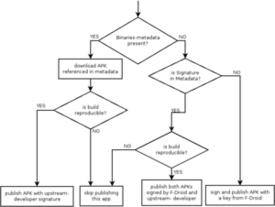
Mailing list and website On our mailing list this month: Lastly, Chris Lamb updated the main Reproducible Builds website and documentation in a number of small ways, but primarily published an interview with Hans-Christoph Steiner of the F-Droid project. Chris Lamb also added a Coffeescript example for parsing and using the SOURCE_DATE_EPOCH environment variable [ ]. In addition, Sebastian Crane very-helpfully updated the screenshot of salsa.debian.org s request access button on the How to join the Salsa group. [ ]

Contact If you are interested in contributing to the Reproducible Builds project, please visit our Contribute page on our website. However, you can get in touch with us via:

12 July 2022

Matthew Garrett: Responsible stewardship of the UEFI secure boot ecosystem

After I mentioned that Lenovo are now shipping laptops that only boot Windows by default, a few people pointed to a Lenovo document that says:

Starting in 2022 for Secured-core PCs it is a Microsoft requirement for the 3rd Party Certificate to be disabled by default.

"Secured-core" is a term used to describe machines that meet a certain set of Microsoft requirements around firmware security, and by and large it's a good thing - devices that meet these requirements are resilient against a whole bunch of potential attacks in the early boot process. But unfortunately the 2022 requirements don't seem to be publicly available, so it's difficult to know what's being asked for and why. But first, some background.

Most x86 UEFI systems that support Secure Boot trust at least two certificate authorities:

1) The Microsoft Windows Production PCA - this is used to sign the bootloader in production Windows builds. Trusting this is sufficient to boot Windows.
2) The Microsoft Corporation UEFI CA - this is used by Microsoft to sign non-Windows UEFI binaries, including built-in drivers for hardware that needs to work in the UEFI environment (such as GPUs and network cards) and bootloaders for non-Windows.

The apparent secured-core requirement for 2022 is that the second of these CAs should not be trusted by default. As a result, drivers or bootloaders signed with this certificate will not run on these systems. This means that, out of the box, these systems will not boot anything other than Windows[1].

Given the association with the secured-core requirements, this is presumably a security decision of some kind. Unfortunately, we have no real idea what this security decision is intended to protect against. The most likely scenario is concerns about the (in)security of binaries signed with the third-party signing key - there are some legitimate concerns here, but I'm going to cover why I don't think they're terribly realistic.

The first point is that, from a boot security perspective, a signed bootloader that will happily boot unsigned code kind of defeats the point. Kaspersky did it anyway. The second is that even a signed bootloader that is intended to only boot signed code may run into issues in the event of security vulnerabilities - the Boothole vulnerabilities are an example of this, covering multiple issues in GRUB that could allow for arbitrary code execution and potential loading of untrusted code.

So we know that signed bootloaders that will (either through accident or design) execute unsigned code exist. The signatures for all the known vulnerable bootloaders have been revoked, but that doesn't mean there won't be other vulnerabilities discovered in future. Configuring systems so that they don't trust the third-party CA means that those signed bootloaders won't be trusted, which means any future vulnerabilities will be irrelevant. This seems like a simple choice?

There's actually a couple of reasons why I don't think it's anywhere near that simple. The first is that whenever a signed object is booted by the firmware, the trusted certificate used to verify that object is measured into PCR 7 in the TPM. If a system previously booted with something signed with the Windows Production CA, and is now suddenly booting with something signed with the third-party UEFI CA, the values in PCR 7 will be different. TPMs support "sealing" a secret - encrypting it with a policy that the TPM will only decrypt it if certain conditions are met. Microsoft make use of this for their default Bitlocker disk encryption mechanism. The disk encryption key is encrypted by the TPM, and associated with a specific PCR 7 value. If the value of PCR 7 doesn't match, the TPM will refuse to decrypt the key, and the machine won't boot. This means that attempting to attack a Windows system that has Bitlocker enabled using a non-Windows bootloader will fail - the system will be unable to obtain the disk unlock key, which is a strong indication to the owner that they're being attacked.

The second is that this is predicated on the idea that removing the third-party bootloaders and drivers removes all the vulnerabilities. In fact, there's been rather a lot of vulnerabilities in the Windows bootloader. A broad enough vulnerability in the Windows bootloader is arguably a lot worse than a vulnerability in a third-party loader, since it won't change the PCR 7 measurements and the system will boot happily. Removing trust in the third-party CA does nothing to protect against this.

The third reason doesn't apply to all systems, but it does to many. System vendors frequently want to ship diagnostic or management utilities that run in the boot environment, but would prefer not to have to go to the trouble of getting them all signed by Microsoft. The simple solution to this is to ship their own certificate and sign all their tooling directly - the secured-core Lenovo I'm looking at currently is an example of this, with a Lenovo signing certificate. While everything signed with the third-party signing certificate goes through some degree of security review, there's no requirement for any vendor tooling to be reviewed at all. Removing the third-party CA does nothing to protect the user against the code that's most likely to contain vulnerabilities.

Obviously I may be missing something here - Microsoft may well have a strong technical justification. But they haven't shared it, and so right now we're left making guesses. And right now, I just don't see a good security argument.

But let's move on from the technical side of things and discuss the broader issue. The reason UEFI Secure Boot is present on most x86 systems is that Microsoft mandated it back in 2012. Microsoft chose to be the only trusted signing authority. Microsoft made the decision to assert that third-party code could be signed and trusted.

We've certainly learned some things since then, and a bunch of things have changed. Third-party bootloaders based on the Shim infrastructure are now reviewed via a community-managed process. We've had a productive coordinated response to the Boothole incident, which also taught us that the existing revocation strategy wasn't going to scale. In response, the community worked with Microsoft to develop a specification for making it easier to handle similar events in future. And it's also worth noting that after the initial Boothole disclosure was made to the GRUB maintainers, they proactively sought out other vulnerabilities in their codebase rather than simply patching what had been reported. The free software community has gone to great lengths to ensure third-party bootloaders are compatible with the security goals of UEFI Secure Boot.

So, to have Microsoft, the self-appointed steward of the UEFI Secure Boot ecosystem, turn round and say that a bunch of binaries that have been reviewed through processes developed in negotiation with Microsoft, implementing technologies designed to make management of revocation easier for Microsoft, and incorporating fixes for vulnerabilities discovered by the developers of those binaries who notified Microsoft of these issues despite having no obligation to do so, and which have then been signed by Microsoft are now considered by Microsoft to be insecure is, uh, kind of impolite? Especially when unreviewed vendor-signed binaries are still considered trustworthy, despite no external review being carried out at all.

If Microsoft had a set of criteria used to determine whether something is considered sufficiently trustworthy, we could determine which of these we fell short on and do something about that. From a technical perspective, Microsoft could set criteria that would allow a subset of third-party binaries that met additional review be trusted without having to trust all third-party binaries[2]. But, instead, this has been a decision made by the steward of this ecosystem without consulting major stakeholders.

If there are legitimate security concerns, let's talk about them and come up with solutions that fix them without doing a significant amount of collateral damage. Don't complain about a vendor blocking your apps and then do the same thing yourself.

[Edit to add: there seems to be some misunderstanding about where this restriction is being imposed. I bought this laptop because I'm interested in investigating the Microsoft Pluton security processor, but Pluton is not involved at all here. The restriction is being imposed by the firmware running on the main CPU, not any sort of functionality implemented on Pluton]

[1] They'll also refuse to run any drivers that are stored in flash on Thunderbolt devices, which means eGPU setups may be more complicated, as will netbooting off Thunderbolt-attached NICs
[2] Use a different leaf cert to sign the new trust tier, add the old leaf cert to dbx unless a config option is set, leave the existing intermediate in db

comment count unavailable comments

5 July 2022

Alberto Garc a: Running the Steam Deck s OS in a virtual machine using QEMU

SteamOS desktop Introduction The Steam Deck is a handheld gaming computer that runs a Linux-based operating system called SteamOS. The machine comes with SteamOS 3 (code name holo ), which is in turn based on Arch Linux. Although there is no SteamOS 3 installer for a generic PC (yet), it is very easy to install on a virtual machine using QEMU. This post explains how to do it. The goal of this VM is not to play games (you can already install Steam on your computer after all) but to use SteamOS in desktop mode. The Gamescope mode (the console-like interface you normally see when you use the machine) requires additional development to make it work with QEMU and will not work with these instructions. A SteamOS VM can be useful for debugging, development, and generally playing and tinkering with the OS without risking breaking the Steam Deck. Running the SteamOS desktop in a virtual machine only requires QEMU and the OVMF UEFI firmware and should work in any relatively recent distribution. In this post I m using QEMU directly, but you can also use virt-manager or some other tool if you prefer, we re emulating a standard x86_64 machine here. General concepts SteamOS is a single-user operating system and it uses an A/B partition scheme, which means that there are two sets of partitions and two copies of the operating system. The root filesystem is read-only and system updates happen on the partition set that is not active. This allows for safer updates, among other things. There is one single /home partition, shared by both partition sets. It contains the games, user files, and anything that the user wants to install there. Although the user can trivially become root, make the root filesystem read-write and install or change anything (the pacman package manager is available), this is not recommended because A simple way for the user to install additional software that survives OS updates and doesn t touch the root filesystem is Flatpak. It comes preinstalled with the OS and is integrated with the KDE Discover app. Preparing all necessary files The first thing that we need is the installer. For that we have to download the Steam Deck recovery image from here: https://store.steampowered.com/steamos/download/?ver=steamdeck&snr= Once the file has been downloaded, we can uncompress it and we ll get a raw disk image called steamdeck-recovery-4.img (the number may vary). Note that the recovery image is already SteamOS (just not the most up-to-date version). If you simply want to have a quick look you can play a bit with it and skip the installation step. In this case I recommend that you extend the image before using it, for example with truncate -s 64G steamdeck-recovery-4.img or, better, create a qcow2 overlay file and leave the original raw image unmodified: qemu-img create -f qcow2 -F raw -b steamdeck-recovery-4.img steamdeck-recovery-extended.qcow2 64G But here we want to perform the actual installation, so we need a destination image. Let s create one: $ qemu-img create -f qcow2 steamos.qcow2 64G Installing SteamOS Now that we have all files we can start the virtual machine:
$ qemu-system-x86_64 -enable-kvm -smp cores=4 -m 8G \
    -device usb-ehci -device usb-tablet \
    -device intel-hda -device hda-duplex \
    -device VGA,xres=1280,yres=800 \
    -drive if=pflash,format=raw,readonly=on,file=/usr/share/ovmf/OVMF.fd \
    -drive if=virtio,file=steamdeck-recovery-4.img,driver=raw \
    -device nvme,drive=drive0,serial=badbeef \
    -drive if=none,id=drive0,file=steamos.qcow2
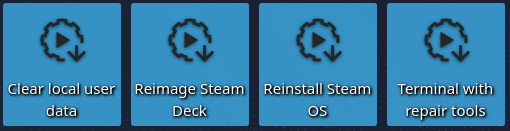
Note that we re emulating an NVMe drive for steamos.qcow2 because that s what the installer script expects. This is not strictly necessary but it makes things a bit easier. If you don t want to do that you ll have to edit ~/tools/repair_device.sh and change DISK and DISK_SUFFIX. SteamOS installer shortcuts Once the system has booted we ll see a KDE Plasma session with a few tools on the desktop. If we select Reimage Steam Deck and click Proceed on the confirmation dialog then SteamOS will be installed on the destination drive. This process should not take a long time. Now, once the operation finishes a new confirmation dialog will ask if we want to reboot the Steam Deck, but here we have to choose Cancel . We cannot use the new image yet because it would try to boot into the Gamescope session, which won t work, so we need to change the default desktop session. SteamOS comes with a helper script that allows us to enter a chroot after automatically mounting all SteamOS partitions, so let s open a Konsole and make the Plasma session the default one in both partition sets:

$ sudo steamos-chroot --disk /dev/nvme0n1 --partset A
# steamos-readonly disable
# echo '[Autologin]' > /etc/sddm.conf.d/zz-steamos-autologin.conf
# echo 'Session=plasma.desktop' >> /etc/sddm.conf.d/zz-steamos-autologin.conf
# steamos-readonly enable
# exit
$ sudo steamos-chroot --disk /dev/nvme0n1 --partset B
# steamos-readonly disable
# echo '[Autologin]' > /etc/sddm.conf.d/zz-steamos-autologin.conf
# echo 'Session=plasma.desktop' >> /etc/sddm.conf.d/zz-steamos-autologin.conf
# steamos-readonly enable
# exit
After this we can shut down the virtual machine. Our new SteamOS drive is ready to be used. We can discard the recovery image now if we want. Booting SteamOS and first steps To boot SteamOS we can use a QEMU line similar to the one used during the installation. This time we re not emulating an NVMe drive because it s no longer necessary.
$ cp /usr/share/OVMF/OVMF_VARS.fd .
$ qemu-system-x86_64 -enable-kvm -smp cores=4 -m 8G \
   -device usb-ehci -device usb-tablet \
   -device intel-hda -device hda-duplex \
   -device VGA,xres=1280,yres=800 \
   -drive if=pflash,format=raw,readonly=on,file=/usr/share/ovmf/OVMF.fd \
   -drive if=pflash,format=raw,file=OVMF_VARS.fd \
   -drive if=virtio,file=steamos.qcow2 \
   -device virtio-net-pci,netdev=net0 \
   -netdev user,id=net0,hostfwd=tcp::2222-:22
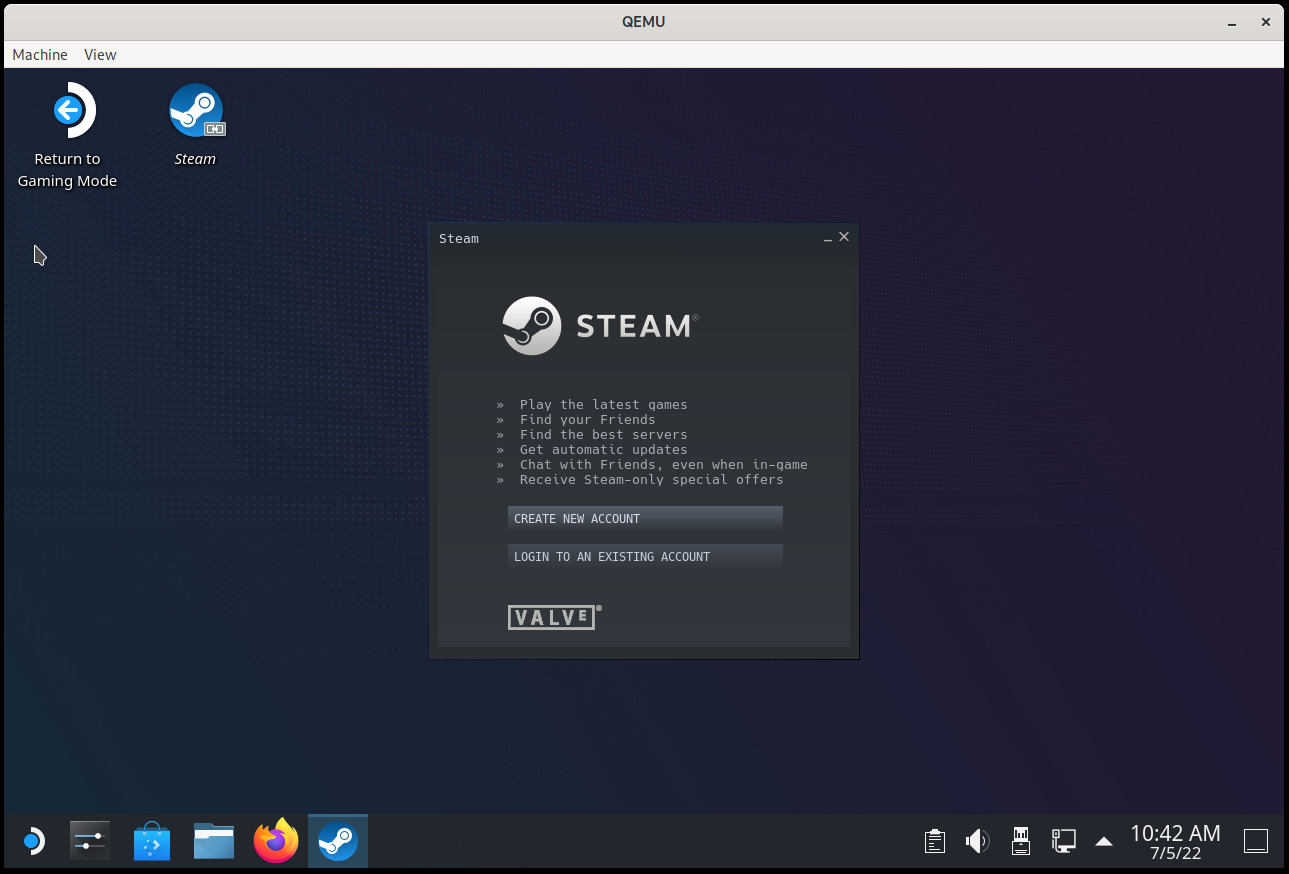
(the last two lines redirect tcp port 2222 to port 22 of the guest to be able to SSH into the VM. If you don t want to do that you can omit them) If everything went fine, you should see KDE Plasma again, this time with a desktop icon to launch Steam and another one to Return to Gaming Mode (which we should not use because it won t work). See the screenshot that opens this post. Congratulations, you re running SteamOS now. Here are some things that you probably want to do: Updating the OS to the latest version The Steam Deck recovery image doesn t install the most recent version of SteamOS, so now we should probably do a software update. Note: if the last step fails after reaching 100% with a post-install handler error then go to Connections in the system settings, rename Wired Connection 1 to something else (anything, the name doesn t matter), click Apply and run steamos-update again. This works around a bug in the update process. Recent images fix this and this workaround is not necessary with them. As we did with the recovery image, before rebooting we should ensure that the new update boots into the Plasma session, otherwise it won t work:
$ sudo steamos-chroot --partset other
# steamos-readonly disable
# echo '[Autologin]' > /etc/sddm.conf.d/zz-steamos-autologin.conf
# echo 'Session=plasma.desktop' >> /etc/sddm.conf.d/zz-steamos-autologin.conf
# steamos-readonly enable
# exit
After this we can restart the system. If everything went fine we should be running the latest SteamOS release. Enjoy! Reporting bugs SteamOS is under active development. If you find problems or want to request improvements please go to the SteamOS community tracker. Edit 06 Jul 2022: Small fixes, mention how to install the OS without using NVMe.

Russ Allbery: Review: A Mirror Mended

Review: A Mirror Mended, by Alix E. Harrow
Series: Fractured Fables #2
Publisher: Tordotcom
Copyright: 2022
ISBN: 1-250-76665-6
Format: Kindle
Pages: 129
This is a direct sequel to A Spindle Splintered and will completely spoil that story, so start there rather than here. A Mirror Mended opens with a glimpse at yet another version of the Sleeping Beauty story, this one (delightfully) a Spanish telenovela. Zinnia is world-hopping, something that's lost some of the meaning from A Spindle Splintered and become an escape from other problems. She's about ready to leave this world as well when she sees a face that is not hers in the bathroom mirror, pleading for help. Zinnia assumes this is yet another sleeping beauty, albeit an unusual one. Zinnia is wrong. Readers of A Spindle Splintered are going to groan when I tell you that Zinnia has managed to damage most of the relationships that she made in the first story, which means we get a bit of an episodic reset of unhappiness mixed with an all-new glob of guilt. Not only is this a depressing way to start a new story, it also means there are no snarky text messages and side commentary. Grumble. Harrow is isolating Zinnia to set up a strange and fraught alliance that turns into a great story, but given that Zinnia's friend network was my favorite part of the first novella, the start of this story made me grumpy. Stick with it, though, since Harrow does more than introduce another fairy tale. She also introduces a villain, one who wishes to be more complicated than her story allows and who knows rather more about the structure of the world than she should. This time, the fairy tale goes off the rails in a more directly subversive way that prods at the bones of Harrow's world-building. This may or may not be what you want, and I admit I liked the first story better. A Spindle Splintered took fairy tales just seriously enough to make a plot, but didn't poke at its premises deeply enough to destabilize them. It played off of fairy tales themselves; A Mirror Mended instead plays off of Harrow's previous story by looking directly at the invented metaphysics of parallel worlds playing out fairy tale archetypes. Some of this worked for me: Eva is a great character and the dynamic between her and Zinnia is highly entertaining. Some of it didn't: the impact on universal metaphysics of Zinnia's adventuring is a bit cliched and inadequately explained. A Mirror Mended is a character exploration with a bit more angst and ambiguity, which means it isn't as delightfully balanced and free-wheeling. I will reassure you with the minor spoiler that Zinnia does eventually pull her head out of her ass when she has to, and while there is nowhere near enough Charm in this book for my taste, there is some. In exchange for the relationship screw-ups, we get the Zinnia/Eva dynamic, which I was really enjoying by the end. One of my favorite tropes is accidental empathy, where someone who is being flippant and sarcastic stumbles into a way of truly helping someone else and is wise enough to notice it. There are several great moments of that. I like Zinnia, even this older, more conflicted, and less cavalier version. Recommended if you liked the first story, although be warned that this replaces the earlier magic with some harder relationship work and the payoff is more hinted at than fully shown. Rating: 7 out of 10

4 July 2022

Russ Allbery: Review: She Who Became the Sun

Review: She Who Became the Sun, by Shelley Parker-Chan
Series: Radiant Emperor #1
Publisher: Tor
Copyright: 2021
Printing: 2022
ISBN: 1-250-62179-8
Format: Kindle
Pages: 414
In 1345 in Zhongli village, in fourth year of a drought, lived a man with his son and his daughter, the last surviving of seven children. The son was promised by his father to the Wuhuang Monastery on his twelfth birthday if he survived. According to the fortune-teller, that son, Zhu Chongba, will be so great that he will bring a hundred generations of pride to the family name. When the girl dares ask her fate, the fortune-teller says, simply, "Nothing." Bandits come looking for food and kill their father. Zhu goes catatonic rather than bury his father, so the girl digs a grave, only to find her brother dead inside it with her father. It leaves her furious: he had a great destiny and he gave it up without a fight, choosing to become nothing. At that moment, she decides to seize his fate for her own, to become Zhu so thoroughly that Heaven itself will be fooled. Through sheer determination and force of will, she stays at the gates of Wuhuang Monastery until the monks are impressed enough with her stubbornness that they let her in under Zhu's name. That puts her on a trajectory that will lead her to the Red Turbans and the civil war over the Mandate of Heaven. She Who Became the Sun is historical fiction with some alternate history and a touch of magic. The closest comparison I can think of is Guy Gavriel Kay: a similar touch of magic that is slight enough to have questionable impact on the story, and a similar starting point of history but a story that's not constrained to follow the events of our world. Unlike Kay, Parker-Chan doesn't change the names of places and people. It's therefore not difficult to work out the history this story is based on (late Yuan dynasty), although it may not be clear at first what role Zhu will play in that history. The first part of the book focuses on Zhu, her time in the monastery, and her (mostly successful) quest to keep her gender secret. The end of that part introduces the second primary protagonist, the eunuch general Ouyang of the army of the Prince of Henan. Ouyang is Nanren, serving a Mongol prince or, more precisely, his son Esen. On the surface, Ouyang is devoted to Esen and serves capably as his general. What lies beneath that surface is far darker and more complicated. I think how well you like this book will depend on how well you get along with the characters. I thought Zhu was a delight. She spends the first half of the book proving herself to be startlingly competent and unpredictable while outwitting Heaven and pursuing her assumed destiny. A major hinge event at the center of the book could have destroyed her character, but instead makes her even stronger, more relaxed, and more comfortable with herself. Her story's exploration of gender identity only made that better for me, starting with her thinking of herself as a woman pretending to be a man and turning into something more complex and self-chosen (and, despite some sexual encounters, apparently asexual, which is something you still rarely see in fiction). I also appreciated how Parker-Chan varies Zhu's pronouns depending on the perspective of the narrator. That said, Zhu is not a good person. She is fiercely ambitious to the point of being a sociopath, and the path she sees involves a lot of ruthlessness and some cold-blooded murder. This is less of a heroic journey than a revenge saga, where the target of revenge is the entire known world and Zhu is as dangerous as she is competent. If you want your protagonist to be moral, this may not work for you. Zhu's scenes are partly told from her perspective and partly from the perspective of a woman named Ma who is a good person, and who is therefore intermittently horrified. The revenge story worked for me, and as a result I found Ma somewhat irritating. If your tendency is to agree with Ma, you may find Zhu too amoral to root for. Ouyang's parts I just hated, which is fitting because Ouyang loathes himself to a degree that is quite difficult to read. He is obsessed with being a eunuch and therefore not fully male. That internal monologue is disturbing enough that it drowned out the moderately interesting court intrigue that he's a part of. I know some people like reading highly dramatic characters who are walking emotional disaster zones. I am not one of those people; by about three quarters of the way through the book I was hoping someone would kill Ouyang already and put him out of everyone's misery. One of the things I disliked about this book is that, despite the complex gender work with Zhu, gender roles within the story have a modern gloss while still being highly constrained. All of the characters except Zhu (and the monk Xu, who has a relatively minor part but is the most likable character in the book) feel like they're being smothered in oppressive gender expectations. Ouyang has a full-fledged case of toxic masculinity to fuel his self-loathing, which Parker-Chan highlights with some weirdly disturbing uses of BDSM tropes. So, I thought this was a mixed bag, and I suspect reactions will differ. I thoroughly enjoyed Zhu's parts despite her ruthlessness and struggled through Ouyang's parts with a bad taste in my mouth. I thought the pivot Parker-Chan pulls off in the middle of the book with Zhu's self-image and destiny was beautifully done and made me like the character even more, but I wish the conflict between Ma's and Zhu's outlooks hadn't been so central. Because of that, the ending felt more tragic than triumphant, which I think was intentional but which wasn't to my taste. As with Kay's writing, I suspect there will be some questions about whether She Who Became the Sun is truly fantasy. The only obvious fantastic element is the physical manifestation of the Mandate of Heaven, and that has only a minor effect on the plot. And as with Kay, I think this book needed to be fantasy, not for the special effects, but because it needs the space to take fate literally. Unlike Kay, Parker-Chan does not use the writing style of epic fantasy, but Zhu's campaign to assume a destiny which is not her own needs to be more than a metaphor for the story to work. I enjoyed this with some caveats. For me, the Zhu portions made up for the Ouyang portions. But although it's clearly the first book of a series, I'm not sure I'll read on. I felt like Zhu's character arc reached a satisfying conclusion, and the sequel seems likely to be full of Ma's misery over ethical conflicts and more Ouyang, neither of which sound appealing. So far as I can tell, the sequel I assume is coming has not yet been announced. Rating: 7 out of 10

2 July 2022

Russ Allbery: Review: Overdue

Review: Overdue, by Amanda Oliver
Publisher: Chicago Review Press
Copyright: 2022
ISBN: 1-64160-534-0
Format: Kindle
Pages: 190
Like many lifetime readers, I adored the public library. I read my way through three different children's libraries at the rate of a grocery sack of books per week, including numerous re-readings, and then moved on to the adult section as my introduction to science fiction. But once I had a regular job, I discovered the fun of filling shelves with books without having to return them or worry about what the library had available. I've always supported my local library, but it's been decades since I spent much time in it. When I last used one heavily, the only computers were at the checkout desk and the only books were physical, normally hardcovers. Overdue: Reckoning with the Public Library therefore caught my eye when I saw a Twitter thread about it before publication. It promised to be a picture of the modern public library and its crises from the perspective of the librarian. The author's primary topic was the drafting of public libraries as de facto homeless service centers, but I hoped it would also encompass technological change, demand for new services, and the shifting meaning of what a public library is for. Overdue does... some of that. The author was a children's librarian in a Washington DC public school and then worked at a downtown branch of the Washington DC public library, and the book includes a few anecdotes from both experiences. Most of the book, though, is Oliver's personal memoir of how she got into field, why she chose to leave it, and how she is making sense of her feelings about the profession. Intermixed with that memoir is wide-ranging political commentary on topics ranging from gentrification to mental health care. This material is relevant to the current challenges libraries face, but it wandered far afield from what I was hoping to get from the book. I think of non-fiction books as coming in a few basic shapes. One is knowledge from an expert: the author has knowledge about a topic that is not widely shared, and they write a book to share it. Another is popularization: an author, possibly without prior special expertise in the topic, does research the reader could have done but doesn't have time to do and then summarizes the results in a format that's easier to understand than the original material. And a third is memoir, in which the author tells the story of their own life. This is a variation of the first type, since the author is obviously an expert in their own life, but most people's lives are not interesting. (Mine certainly isn't!) Successful memoir therefore depends on either having an unusual life or being a compelling storyteller, and ideally both. Many non-fiction books fall into multiple categories, but it's helpful for an author to have a clear idea of which of these goals they're pursuing since they result in different books. If the author is writing primarily from a position of special expertise, the book should focus on that expertise. I am interested in librarians and libraries and would like to know more about that job, so I will read with interest your personal stories about being a librarian. I am somewhat interested in your policy suggestions for how to make libraries work better, although more so if you can offer context and analysis beyond your personal experiences. I am less interested in your opinions on, say, gentrification. That's not because I doubt it is a serious problem (it is) or that it impacts libraries (it does). It's because working in a library doesn't provide any special expertise in gentrification beyond knowing that it exists, something that I can see by walking around the corner. If I want to know more, I will read books by urban planners, sociologists, and housing rights activists. This is a long-winded way of saying that I wish Overdue had about four times as many stories about libraries, preferably framed by general research and background that extended beyond the author's personal experience, or at least more specific details of the politics of the Washington DC library system. The personal memoir outside of the library stories failed to hold my interest. This is not intended as a slam on the author. Oliver seems like a thoughtful and sincere person who is struggling with how to do good in the world without burning out, which is easy for me to sympathize with. I suspect I broadly agree with her on many political positions. But I have read all of this before, and personally lived through some of the same processing, and I don't think Oliver offered new insight. The library stories were memorable enough to form the core of a good book, but the memoir structure did nothing for them and they were strangled by the unoriginal and too-general political analysis. At the risk of belaboring a negative review, there are two other things in Overdue that I've also seen in other writing and seem worth commenting on. The first is the defensive apology that the author may not have the best perspective to write the book. It's important to be clear: I am glad that the Oliver has thought about the ways her experiences as a white woman may not be representative of other people. This is great; the world is a better place when more people consider that. I'm less fond of putting that observation in the book, particularly at length. As the author, rather than writing paragraphs vaguely acknowledging that other people have different experiences, she could instead fix the problem: go talk to librarians of other ethnic and social backgrounds and put their stories in this book. The book would then represent broader experiences and not require the apology. Overdue desperately needed more library-specific content, so that would have improved the book in more than one way. Or if Oliver is ideologically opposed to speaking for other people (she makes some comments to that effect), state up-front, once, that this is a personal memoir and, as a memoir, represents only her own experience. But the author should do something with this observation other than dump its awkwardness on the reader, if for no other reason than that lengthy disclaimers about the author's limited perspective are boring. The second point is about academic jargon and stock phrasing. I work in a field that relies on precise distinctions of meaning (between identity, authentication, and authorization, for example), and therefore I rely on jargon. Its purpose is to make those types of fine distinctions. But authors who read heavily in fields with jargon tend to let that phrasing slip into popular writing where it's not necessary. The result is, to quote Orwell, "gumming together long strips of words which have already been set in order by someone else." The effect may be small in a single sentence but, when continued throughout a book, the overuse of jargon is leaden, belabored, and confusing. Any example I choose will be minor since the effect is cumulative, but one of several I noticed in Overdue is "lived experience." This is jargon from philosophy that, within the field, draws a useful distinction between one's direct experiences of living in the world, and academic or scientific experience with a field. Both types of experience are valuable in different situations, but they're not equivalent. This is a useful phrase when the distinction matters and is unclear. When the type of experience one is discussing is obvious in context (the case in at least three of the four uses in this book), the word "lived" adds nothing but verbosity. If too much of this creeps into writing, it becomes clunky and irritating to read. The best (and not coincidentally the least clunky) part of this book is Oliver's stories of the patrons and other employees of the Northwest One branch of the Washington DC library system and her experiences with them. The picture was not as vivid as I was hoping for, but I came away with some new understanding of typical interactions and day-to-day difficulties. The same was true to a lesser extent for her experiences as a school librarian. For both, I wish there had been more context and framing so that I could see how her experiences fit into a whole system, but those parts of the book were worth reading. Unfortunately, they weren't enough of those parts in the book for me to recommend Overdue. But I'm still interested in reading the book I hoped I was getting! Rating: 5 out of 10

1 July 2022

Steve Kemp: An update on my simple golang TCL interpreter

So my previous post introduced a trivial interpreter for a TCL-like language. In the past week or two I've cleaned it up, fixed a bunch of bugs, and added 100% test-coverage. I'm actually pretty happy with it now. One of the reasons for starting this toy project was to experiment with how easy it is to extend the language using itself Some things are simple, for example replacing this:
puts "3 x 4 = [expr 3 * 4]"
With this:
puts "3 x 4 = [* 3 4]"
Just means defining a function (proc) named *. Which we can do like so:
proc *  a b   
    expr $a * $b
 
(Of course we don't have lists, or variadic arguments, so this is still a bit of a toy example.) Doing more than that is hard though without support for more primitives written in the parent language than I've implemented. The obvious thing I'm missing is a native implementation of upvalue, which is TCL primitive allowing you to affect/update variables in higher-scopes. Without that you can't write things as nicely as you would like, and have to fall back to horrid hacks or be unable to do things.
# define a procedure to run a body N times
proc repeat  n body   
    set res ""
    while  > $n 0   
        decr n
        set res [$body]
     
    $res
 
# test it out
set foo 12
repeat 5   incr foo  
#  foo is now 17 (i.e. 12 + 5)
A similar story implementing the loop word, which should allow you to set the contents of a variable and run a body a number of times:
proc loop  var min max bdy   
    // result
    set res ""
    // set the variable.  Horrid.
    // We miss upvalue here.
    eval "set $var [set min]"
    // Run the test
    while  <= [set "$$var"] $max    
        set res [$bdy]
        // This is a bit horrid
        // We miss upvalue here, and not for the first time.
        eval  incr "$var" 
     
    // return the last result
    $res
 
loop cur 0 10   puts "current iteration $cur ($min->$max)"  
# output is:
# => current iteration 0 (0-10)
# => current iteration 1 (0-10)
# ...
That said I did have fun writing some simple test-cases, and implementing assert, assert_equal, etc. In conclusion I think the number of required primitives needed to implement your own control-flow, and run-time behaviour, is a bit higher than I'd like. Writing switch, repeat, while, and similar primitives inside TCL is harder than creating those same things in FORTH, for example.

29 June 2022

Russell Coker: Philips 438P1 43 4K Monitor

I have just returned a Philips 438P1 43 4K Monitor [1] and gone back to my Samsung 28 4K monitor model LU28E590DS/XY AKA UE590. The main listed differences are the size and the fact that the Samsung is TN but the Philips is IPS. Here s a comparison of TN and IPS technologies [2]. Generally I think that TN is probably best for a monitor but in theory IPS shouldn t be far behind. The Philips monitor has a screen with a shiny surface which may be good for a TV but isn t good for a monitor. Also it seemed to blur the pixels a bit which again is probably OK for a TV that is trying to emulate curved images but not good for a monitor where it s all artificial straight lines. The most important thing for me in a monitor is how well it displays text in small fonts, for that I don t really want the round parts of the letters to look genuinely round as a clear octagon or rectangle is better than a fuzzy circle. There is some controversy about the ideal size for monitors. Some people think that nothing larger than 28 is needed and some people think that a 43 is totally usable. After testing I determined that 43 is really too big, I had to move to see it all. Also for my use it s convenient to be able to turn a monitor slightly to allow someone else to get a good view and a 43 monitor is too large to move much (maybe future technology for lighter monitors will change this). Previously I had been unable to get my Samsung monitor to work at 4K resolution with 60Hz and had believed it was due to cheap video cards. I got the Philips monitor to work with HDMI so it s apparent that the Samsung monitor doesn t do 4K@60Hz on HDMI. This isn t a real problem as the Samsung monitor doesn t have built in speakers. The Philips monitor has built in speakers for HDMI sound which means one less cable to my PC and no desk space taken by speakers. I bought the Philips monitor on eBay in opened unused condition. Inside the box was a sheet with a printout stating that the monitor blanks the screen periodically, so the seller knew that it wasn t in unused condition, it was tested and failed the test. If the Philips monitor had been as minimally broken as described then I might have kept it. However it seems that certain patterns of input caused it to reboot. For example I could be watching Netflix and have it drop out, I would press the left arrow to watch that bit again and have it drop out again. On one occasion I did a test and found that a 5 second section of Netflix content caused the monitor to reboot on 6/8 times I viewed it. The workaround I discovered was to switch between maximised window and full-screen mode when it had a dropout. So I just press left-arrow and then F and I can keep watching. That s not what I expect from a $700 monitor! I considered checking for Philips firmware updates but decided against it because I didn t want to risk voiding the warranty if it didn t work correctly and I decided I just didn t like the monitor that much. Ideally for my next monitor I ll get a 4K screen of about 35 , TN, and a screen that s not shiny. At the moment there doesn t seem to be many monitors between 32 and 43 in size, so 32 may do. I am quite happy with the Samsung monitor so getting the same but slightly larger is fine. It s a pity they stopped making 5K displays.

27 June 2022

Russ Allbery: Tie::ShadowHash 2.00

This is a small Perl module that combines multiple key/value sources of data into a "shadow hash" that acts as if all of the underlying data sources have been merged. Any modifications made to the shadow hash are stored in an overlay and reflected in further accesses to the shadow hash, but the underlying data sources are read-only and are not changed. It had been 12 years since the last release of this small module, so it was overdue for some modernization and cleanup. I also removed the new() class method since shadow hashes should always be created with tie(), and documented a few more edge cases. You can get the latest version from CPAN or from the Tie::ShadowHash distribution page.

Russ Allbery: Review: Light from Uncommon Stars

Review: Light from Uncommon Stars, by Ryka Aoki
Publisher: Tor
Copyright: 2021
ISBN: 1-250-78907-9
Format: Kindle
Pages: 371
Katrina Nguyen is an young abused transgender woman. As the story opens, she's preparing to run away from home. Her escape bag is packed with meds, clothes, her papers, and her violin. The note she is leaving for her parents says that she's going to San Francisco, a plausible lie. Her actual destination is Los Angeles, specifically the San Gabriel Valley, where a man she met at a queer youth conference said he'd give her a place to sleep. Shizuka Satomi is the Queen of Hell, the legendary uncompromising violin teacher responsible for six previous superstars, at least within the limited world of classical music. She's wealthy, abrasive, demanding, and intimidating, and unbeknownst to the rest of the world she has made a literal bargain with Hell. She has to deliver seven souls, seven violin players who want something badly enough that they'll bargain with Hell to get it. Six have already been delivered in spectacular fashion, but she's running out of time to deliver the seventh before her own soul is forfeit. Tamiko Grohl, an up-and-coming violinist from her native Los Angeles, will hopefully be the seventh. Lan Tran is a refugee and matriarch of a family who runs Starrgate Donut. She and her family didn't flee another unstable or inhospitable country. They fled the collapsing Galactic Empire, securing their travel authorization by promising to set up a tourism attraction. Meanwhile, she's careful to give cops free donuts and to keep their advanced technology carefully concealed. The opening of this book is unlikely to be a surprise in general shape. Most readers would expect Katrina to end up as Satomi's student rather than Tamiko, and indeed she does, although not before Katrina has a very difficult time. Near the start of the novel, I thought "oh, this is going to be hurt/comfort without a romantic relationship," and it is. But it then goes beyond that start into a multifaceted story about complexity, resilience, and how people support each other. It is also a fantastic look at the nuance and intricacies of being or supporting a transgender person, vividly illustrated by a story full of characters the reader cares about and without the academic abstruseness that often gets in the way. The problems with gender-blindness, the limitations of honoring someone's gender without understanding how other people do not, the trickiness of privilege, gender policing as a distraction and alienation from the rest of one's life, the complications of real human bodies and dysmorphia, the importance of listening to another person rather than one's assumptions about how that person feels it's all in here, flowing naturally from the story, specific to the characters involved, and never belabored. I cannot express how well-handled this is. It was a delight to read. The other wonderful thing Aoki does is set Satomi up as the almost supernaturally competent teacher who in a sense "rescues" Katrina, and then invert the trope, showing the limits of Satomi's expertise, the places where she desperately needs human connection for herself, and her struggle to understand Katrina well enough to teach her at the level Satomi expects of herself. Teaching is not one thing to everyone; it's about listening, and Katrina is nothing like Satomi's other students. This novel is full of people thinking they finally understand each other and realizing there is still more depth that they had missed, and then talking through the gap like adults. As you can tell from any summary of this book, it's an odd genre mash-up. The fantasy part is a classic "magician sells her soul to Hell" story; there are a few twists, but it largely follows genre expectations. The science fiction part involving Lan is unfortunately weaker and feels more like a random assortment of borrowed Star Trek tropes than coherent world-building. Genre readers should not come to this story expecting a well-thought-out science fiction universe or a serious attempt to reconcile metaphysics between the fantasy and science fiction backgrounds. It's a quirky assortment of parts that don't normally go together, defy easy classification, and are often unexplained. I suspect this was intentional on Aoki's part given how deeply this book is about the experience of being transgender. Of the three primary viewpoint characters, I thought Lan's perspective was the weakest, and not just because of her somewhat generic SF background. Aoki uses her as a way to talk about the refugee experience, describing her as a woman who brings her family out of danger to build a new life. This mostly works, but Lan has vastly more power and capabilities than a refugee would normally have. Rather than the typical Asian refugee experience in the San Gabriel valley, Lan is more akin to a US multimillionaire who for some reason fled to Vietnam (relative to those around her, Lan is arguably even more wealthy than that). This is also a refugee experience, but it is an incredibly privileged one in a way that partly undermines the role that she plays in the story. Another false note bothered me more: I thought Tamiko was treated horribly in this story. She plays a quite minor role, sidelined early in the novel and appearing only briefly near the climax, and she's portrayed quite negatively, but she's clearly hurting as deeply as the protagonists of this novel. Aoki gives her a moment of redemption, but Tamiko gets nothing from it. Unlike every other injured and abused character in this story, no one is there for Tamiko and no one ever attempts to understand her. I found that profoundly sad. She's not an admirable character, but neither is Satomi at the start of the book. At least a gesture at a future for Tamiko would have been appreciated. Those two complaints aside, though, I could not put this book down. I was able to predict the broad outline of the plot, but the specifics were so good and so true to characters. Both the primary and supporting cast are unique, unpredictable, and memorable. Light from Uncommon Stars has a complex relationship with genre. It is squarely in the speculative fiction genre; the plot would not work without the fantasy and (more arguably) the science fiction elements. Music is magical in a way that goes beyond what can be attributed to metaphor and subjectivity. But it's also primarily character story deeply rooted in the specific location of the San Gabriel valley east of Los Angeles, full of vivid descriptions (particularly of food) and day-to-day life. As with the fantasy and science fiction elements, Aoki does not try to meld the genre elements into a coherent whole. She lets them sit side by side and be awkward and charming and uneven and chaotic. If you're the sort of SF reader who likes building a coherent theory of world-building rules, you may have to turn that desire off to fully enjoy this book. I thought this book was great. It's not flawless, but like its characters it's not trying to be flawless. In places it is deeply insightful and heartbreakingly emotional; in others, it's a glorious mess. It's full of cooking and food, YouTube fame, the disappointments of replicators, video game music, meet-cutes over donuts, found family, and classical music drama. I wish we'd gotten way more about the violin repair shop and a bit less warmed-over Star Trek, but I also loved it exactly the way it was. Definitely the best of the 2022 Hugo nominees that I've read so far. Content warning for child abuse, rape, self-harm, and somewhat explicit sex work. The start of the book is rather heavy and horrific, although the author advertises fairly clearly (and accurately) that things will get better. Rating: 9 out of 10

24 June 2022

Kees Cook: finding binary differences

As part of the continuing work to replace 1-element arrays in the Linux kernel, it s very handy to show that a source change has had no executable code difference. For example, if you started with this:
struct foo  
    unsigned long flags;
    u32 length;
    u32 data[1];
 ;
void foo_init(int count)
 
    struct foo *instance;
    size_t bytes = sizeof(*instance) + sizeof(u32) * (count - 1);
    ...
    instance = kmalloc(bytes, GFP_KERNEL);
    ...
 ;
And you changed only the struct definition:
-    u32 data[1];
+    u32 data[];
The bytes calculation is going to be incorrect, since it is still subtracting 1 element s worth of space from the desired count. (And let s ignore for the moment the open-coded calculation that may end up with an arithmetic over/underflow here; that can be solved separately by using the struct_size() helper or the size_mul(), size_add(), etc family of helpers.) The missed adjustment to the size calculation is relatively easy to find in this example, but sometimes it s much less obvious how structure sizes might be woven into the code. I ve been checking for issues by using the fantastic diffoscope tool. It can produce a LOT of noise if you try to compare builds without keeping in mind the issues solved by reproducible builds, with some additional notes. I prepare my build with the known to disrupt code layout options disabled, but with debug info enabled:
$ KBF="KBUILD_BUILD_TIMESTAMP=1970-01-01 KBUILD_BUILD_USER=user KBUILD_BUILD_HOST=host KBUILD_BUILD_VERSION=1"
$ OUT=gcc
$ make $KBF O=$OUT allmodconfig
$ ./scripts/config --file $OUT/.config \
        -d GCOV_KERNEL -d KCOV -d GCC_PLUGINS -d IKHEADERS -d KASAN -d UBSAN \
        -d DEBUG_INFO_NONE -e DEBUG_INFO_DWARF_TOOLCHAIN_DEFAULT
$ make $KBF O=$OUT olddefconfig
Then I build a stock target, saving the output in before . In this case, I m examining drivers/scsi/megaraid/:
$ make -jN $KBF O=$OUT drivers/scsi/megaraid/
$ mkdir -p $OUT/before
$ cp $OUT/drivers/scsi/megaraid/*.o $OUT/before/
Then I patch and build a modified target, saving the output in after :
$ vi the/source/code.c
$ make -jN $KBF O=$OUT drivers/scsi/megaraid/
$ mkdir -p $OUT/after
$ cp $OUT/drivers/scsi/megaraid/*.o $OUT/after/
And then run diffoscope:
$ diffoscope $OUT/before/ $OUT/after/
If diffoscope output reports nothing, then we re done. Usually, though, when source lines move around other stuff will shift too (e.g. WARN macros rely on line numbers, so the bug table may change contents a bit, etc), and diffoscope output will look noisy. To examine just the executable code, the command that diffoscope used is reported in the output, and we can run it directly, but with possibly shifted line numbers not reported. i.e. running objdump without --line-numbers:
$ ARGS="--disassemble --demangle --reloc --no-show-raw-insn --section=.text"
$ for i in $(cd $OUT/before && echo *.o); do
        echo $i
        diff -u <(objdump $ARGS $OUT/before/$i   sed "0,/^Disassembly/d") \
                <(objdump $ARGS $OUT/after/$i    sed "0,/^Disassembly/d")
done
If I see an unexpected difference, for example:
-    c120:      movq   $0x0,0x800(%rbx)
+    c120:      movq   $0x0,0x7f8(%rbx)
Then I'll search for the pattern with line numbers added to the objdump output:
$ vi <(objdump --line-numbers $ARGS $OUT/after/megaraid_sas_fp.o)
I'd search for "0x0,0x7f8", find the source file and line number above it, open that source file at that position, and look to see where something was being miscalculated:
$ vi drivers/scsi/megaraid/megaraid_sas_fp.c +329
Once tracked down, I'd start over at the "patch and build a modified target" step above, repeating until there were no differences. For example, in the starting example, I'd also need to make this change:
-    size_t bytes = sizeof(*instance) + sizeof(u32) * (count - 1);
+    size_t bytes = sizeof(*instance) + sizeof(u32) * count;
Though, as hinted earlier, better yet would be:
-    size_t bytes = sizeof(*instance) + sizeof(u32) * (count - 1);
+    size_t bytes = struct_size(instance, data, count);
But sometimes adding the helper usage will add binary output differences since they're performing overflow checking that might saturate at SIZE_MAX. To help with patch clarity, those changes can be done separately from fixing the array declaration.

2022, Kees Cook. This work is licensed under a Creative Commons Attribution-ShareAlike 4.0 License.
CC BY-SA 4.0

Reproducible Builds: Supporter spotlight: Hans-Christoph Steiner of the F-Droid project

The Reproducible Builds project relies on several projects, supporters and sponsors for financial support, but they are also valued as ambassadors who spread the word about our project and the work that we do. This is the fifth instalment in a series featuring the projects, companies and individuals who support the Reproducible Builds project. We started this series by featuring the Civil Infrastructure Platform project and followed this up with a post about the Ford Foundation as well as a recent ones about ARDC, the Google Open Source Security Team (GOSST) and Jan Nieuwenhuizen on Bootstrappable Builds, GNU Mes and GNU Guix. Today, however, we will be talking with Hans-Christoph Steiner from the F-Droid project.

Chris: Welcome, Hans! Could you briefly tell me about yourself? Hans: Sure. I spend most of my time trying to private communications software usable by everyone, designing interactive software with a focus on human perceptual capabilities and building networks with free software. I ve been involved in Debian since approximately 2008 and became an official Debian developer in 2011. In the little time left over from that, I sometimes compose music with computers from my home in Austria.
Chris: For those who have not heard of it before, what is the F-Droid project? Hans: F-Droid is a community-run app store that provides free software applications for Android phones. First and foremost our goal is to represent our users. In particular, we review all of the apps that we distribute, and these reviews not only check for whether something is definitely free software or not, we additionally look for ethical problems with applications as well issues that we call Anti-Features . Since the project began in 2010, F-Droid now offers almost 4,000 free-software applications. F-Droid is also a app store kit as well, providing all the tools that are needed to operate an free app store of your own. It also includes complete build and release tools for managing the process of turning app source code into published builds.
Chris: How exactly does F-Droid differ from the Google Play store? Why might someone use F-Droid over Google Play? Hans: One key difference to the Google Play Store is that F-Droid does not ship proprietary software by default. All apps shipped from f-droid.org are built from source on our own builders. This is partly because F-Droid is backed by the free software community; that is, people who have engaged in the free software community long before Android was conceived, and, in particular, share many if not all of its values. Using F-Droid will therefore feel very familiar to anyone familiar with a modern Linux distribution.
Chris: How do you describe reproducibility from the F-Droid point of view? Hans: All centralised software repositories are extremely tempting targets for exploitation by malicious third parties, and the kinds of personal or otherwise sensitive data on our phones only increase this risk. In F-Droid s case, not only could the software we distribute be theoretically replaced with nefarious copies, the build infrastructure that generates that software could be compromised as well. F-Droid having reproducible builds is extremely important as it allows us to verify that our build systems have not been compromised and distributing malware to our users. In particular, if an independent build infrastructure can produce precisely the same results from a build, then we can be reasonably sure that they haven t been compromised. Technically-minded users can also validate their builds on their own systems too, further increasing trust in our build infrastructure. (This can be performed using fdroid verify command.) Our signature & trust scheme means that F-Droid can verify that an app is 100% free software whilst still using the developer s original .APK file. More details about this may be found in our reproducibility documentation and on the page about our Verification Server.
Chris: How do you see F-Droid fitting into the rest of the modern security ecosystem? Hans: Whilst F-Droid inherits all of the social benefits of free software, F-Droid takes special care to respect your privacy as well we don t attempt to track your device in any way. In particular, you don t need an account to use the F-Droid client, and F-Droid doesn t send any device-identifying information to our servers other than its own version number. What is more, we mark all apps in our repository that track you, and users can choose to hide any apps that has been tagged with a specific Anti-Feature in the F-Droid settings. Furthermore, any personal data you decide to give us (such as your email address when registering for a forum account) goes no further than us as well, and we pledge that it will never be used for anything beyond merely maintaining your account.
Chris: What would fully reproducible mean to F-Droid? What it would look like if reproducibility was a solved problem ? Or, rather, what would be your ultimate reproducibility goals? Hans: In an ideal world, every application submitted to F-Droid would not only build reproducibly, but would come with a cryptographically-signed signature from the developer as well. Then we would only distribute an compiled application after a build had received a number of matching signatures from multiple, independent third parties. This would mean that our users were not placing their trust solely in software developers machines, and wouldn t be trusting our centralised build servers as well.
Chris: What are the biggest blockers to reaching this state? Are there any key steps or milestones to get there? Hans: Time is probably the main constraint to reaching this goal. Not only do we need system administrators on an ongoing basis but we also need to incorporate reproducibly checks into our Continuous Integration (CI) system. We are always looking for new developers to join our effort, as well as learning about how to better bring them up to speed. Separate to this, we often experience blockers with reproducibility-related bugs in the Android build tooling. Luckily, upstreams do ultimately address these issues, but in some cases this has taken three or four years to reach end-users and developers. Unfortunately, upstream is not chiefly concerned with the security aspects of reproducibility builds; they care more about how it can minimise and optimise download size and speed.
Chris: Are you tracking any statistics about reproducibility in F-Droid over time? If so, can you share them? Does F-Droid track statistics about its own usage? Hans: To underline a topic touched on above, F-Droid is dedicated to preserving the privacy of its users; we therefore do not record usage statistics. This is, of course, in contrast to other application stores. However, we are in a position to track whether packages in F-Droid are reproducible or not. As in: what proportion of APKs in F-Droid have been independently verified over time? Unfortunately, due to time constraints, we do not yet automatically publish charts for this. We do publish some raw data that is related, though, and we naturally welcome contributions of visualizations based on any and all of our data. The All our APIs page on our wiki is a good place to start for someone wanting to contribute, everything about reproducible F-Droid apps is available in JSON format, what s missing are apps or dashboards making use of the available raw data.
Chris: Many thanks for this interview, Hans, and for all of your work on F-Droid and elsewhere. If someone wanted to get in touch or learn more about the project, where might someone go? Hans: The best way to find out about F-Droid is, of course, the main F-Droid homepage, but we are also on Twitter @fdroidorg. We have many avenues to participate and to learn more! We have an About page on our website and a thriving forum. We also have part of our documentation specifically dedicated to reproducible builds.


For more information about the Reproducible Builds project, please see our website at reproducible-builds.org. If you are interested in ensuring the ongoing security of the software that underpins our civilisation and wish to sponsor the Reproducible Builds project, please reach out to the project by emailing contact@reproducible-builds.org.

20 June 2022

Petter Reinholdtsen: My free software activity of late (2022)

I guess it is time to bring some light on the various free software and open culture activities and projects I have worked on or been involved in the last year and a half. First, lets mention the book releases I managed to publish. The Cory Doctorow book "Hvordan knuse overv kningskapitalismen" argue that it is not the magic machine learning of the big technology companies that causes the surveillance capitalism to thrive, it is the lack of trust busting to enforce existing anti-monopoly laws. I also published a family of dictionaries for machinists, one sorted on the English words, one sorted on the Norwegian and the last sorted on the North S mi words. A bit on the back burner but not forgotten is the Debian Administrators Handbook, where a new edition is being worked on. I have not spent as much time as I want to help bring it to completion, but hope I will get more spare time to look at it before the end of the year. With my Debian had I have spent time on several projects, both updating existing packages, helping to bring in new packages and working with upstream projects to try to get them ready to go into Debian. The list is rather long, and I will only mention my own isenkram, openmotor, vlc bittorrent plugin, xprintidle, norwegian letter style for latex, bs1770gain, and recordmydesktop. In addition to these I have sponsored several packages into Debian, like audmes. The last year I have looked at several infrastructure projects for collecting meter data and video surveillance recordings. This include several ONVIF related tools like onvifviewer and zoneminder as well as rtl-433, wmbusmeters and rtl-wmbus. In parallel with this I have looked at fabrication related free software solutions like pycam and LinuxCNC. The latter recently gained improved translation support using po4a and weblate, which was a harder nut to crack that I had anticipated when I started. Several hours have been spent translating free software to Norwegian Bokm l on the Weblate hosted service. Do not have a complete list, but you will find my contributions in at least gnucash, minetest and po4a. I also spent quite some time on the Norwegian archiving specification Noark 5, and its companion project Nikita implementing the API specification for Noark 5. Recently I have been looking into free software tools to do company accounting here in Norway., which present an interesting mix between law, rules, regulations, format specifications and API interfaces. I guess I should also mention the Norwegian community driven government interfacing projects Mimes Br nn and Fiksgatami, which have ended up in a kind of limbo while the future of the projects is being worked out. These are just a few of the projects I have been involved it, and would like to give more visibility. I'll stop here to avoid delaying this post. As usual, if you use Bitcoin and want to show your support of my activities, please send Bitcoin donations to my address 15oWEoG9dUPovwmUL9KWAnYRtNJEkP1u1b.

Jamie McClelland: A very liberal spam assassin rule

I just sent myself a test message via Powerbase (a hosted CiviCRM project for community organizers) and it didn t arrive. Wait, nope, there it is in my junk folder with a spam score of 6!
X-Spam-Status: Yes, score=6.093 tagged_above=-999 required=5
	tests=[BAYES_00=-1.9, DKIM_SIGNED=0.1, DKIM_VALID=-0.1,
	DKIM_VALID_AU=-0.1, DKIM_VALID_EF=-0.1, DMARC_MISSING=0.1,
	HTML_MESSAGE=0.001, KAM_WEBINAR=3.5, KAM_WEBINAR2=3.5,
	NO_DNS_FOR_FROM=0.001, SPF_HELO_NONE=0.001, ST_KGM_DEALS_SUB_11=1.1,
	T_SCC_BODY_TEXT_LINE=-0.01] autolearn=no autolearn_force=no
What just happened? A careful look at the scores suggest that the KAM_WEBINAR and KAM_WEBINAR2 rules killed me. I ve never heard of them (this email came through a system I m not administering). So, I did some searching and found a page with the rules:
# SEMINARS AND WORKSHOPS SPAM
header   __KAM_WEBINAR1 From =~ /education career manage learning webinar project efolder/i
header   __KAM_WEBINAR2 Subject =~ /last chance increase productivity workplace morale payroll dept trauma.training case.study issues follow.up service.desk vip.(lunch breakfast) manage.your private.business professional.checklist customers.safer great.timesaver prep.course crash.course hunger.to.learn (keys tips).(to for).smarter/i
header   __KAM_WEBINAR3 Subject =~ /webinar strateg seminar owners.meeting webcast our.\d.new sales.video/i
body     __KAM_WEBINAR4 /executive.education contactid register now \d+.minute webinar management.position supervising.skills discover.tips register.early take.control marketing.capabilit drive.more.sales leveraging.cloud solution.provider have.a.handle plan.to.divest being.informed upcoming.webinar spearfishing.email increase.revenue industry.podcast \d+.in.depth.tips early.bird.offer pmp.certified lunch.briefing/i

meta     KAM_WEBINAR (__KAM_WEBINAR1 + __KAM_WEBINAR2 + __KAM_WEBINAR3 + __KAM_WEBINAR4 >= 3)
describe KAM_WEBINAR Spam for webinars
score    KAM_WEBINAR 3.5

meta     KAM_WEBINAR2 (__KAM_WEBINAR1 + __KAM_WEBINAR2 + __KAM_WEBINAR3 + __KAM_WEBINAR4 >= 4)
describe KAM_WEBINAR2 Spam for webinars
score    KAM_WEBINAR2 3.5
For those of you who don t care to parse those regular expressions, here s a summary: Hm. I m glad I can now fix our email, but this doesn t work so well for people with a name that includes project that like to organize webinars for which you have to register.

19 June 2022

Dirk Eddelbuettel: #38: Faster Feedback Systems

Engineers build systems. Good engineers always stress and focus efficiency of these systems. Two recent examples of engineering thinking follow. One was in a video / podcast interview with Martin Thompson (who is a noted high-performance code expert) I came across recently. The overall focus of the hour-long interview is on managing software complexity . Around minute twenty-two, the conversation turns to feedback loops and systems, and a strong preference for simple and fast systems for more immediate feedback. An important topic indeed. The second example connects to this and permeates many tweets and other writings by Erik Bernhardsson. He had an earlier 2017 post on Optimizing for iteration speed , as well as a 17 May 2022 tweet on minimizing feedback loop size, another 28 Mar 2022 tweet reply on shorter feedback loops, then a 14 Feb 2022 post on problems with slow feedback loops, as well as a 13 Jan 2022 post on a priority for tighter feedback loops, and lastly a 23 Jul 2021 post on fast feedback cycles. You get the idea: Erik really digs faster feedback loops. Nobody likes to wait: immediatecy wins each time. A few years ago, I had touched on this topic with two posts on how to make (R) package compilation (and hence installation) faster. One idea (which I still use whenever I must compile) was in post #11 on caching compilation. Another idea was in post #13: make it faster by not doing it, in this case via binary installation which skip the need for compilation (and which is what I aim for with, say, CI dependencies). Several subsequent posts can be found by scrolling down the r^4 blog section: we stressed the use of the amazing Rutter PPA c2d4u for CRAN binaries (often via Rocker containers, the (post #28) promise of RSPM, and the (post #29) awesomeness of bspm. And then in the more recent post #34 from last December we got back to a topic which ties all these things together: Dependencies. We quoted Mies van der Rohe: Less is more. Especially when it comes to dependencies as these elongate the feedback loop and thereby delay feedback. Our most recent post #37 on r2u connects these dots. Access to a complete set of CRAN binaries with full-dependency resolution accelerates use and installation. This of course also covers testing and continuous integration. Why wait minutes to recompile the same packages over and over when you can install the full Tidyverse in 18 seconds or the brms package and all it needs in 13 seconds as shown in the two gifs also on the r2u documentation site. You can even power up the example setup of the second gif via this gitpod link giving you a full Ubuntu 22.04 session in your browser to try this: so go forth and install something from CRAN with ease! The benefit of a system such our r2u CRAN binaries is clear: faster feedback loops. This holds whether you work with few or many dependencies, tiny or tidy. Faster matters, and feedback can be had sooner. And with the title of this post we now get a rallying cry to advocate for faster feedback systems: FFS .
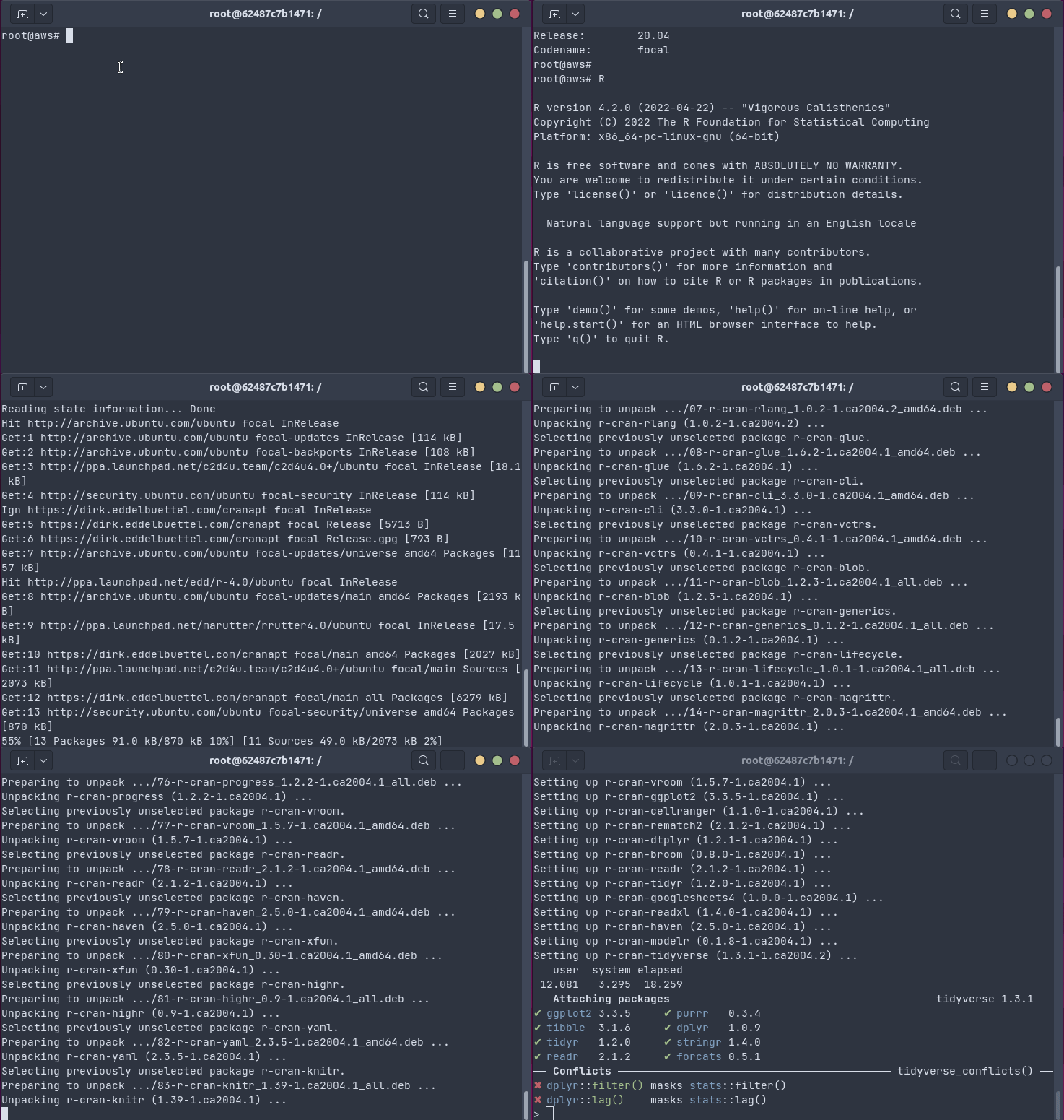
This post by Dirk Eddelbuettel originated on his Thinking inside the box blog. Please report excessive re-aggregation in third-party for-profit settings.

John Goerzen: Pipes, deadlocks, and strace annoyingly fixing them

This is a complex tale I will attempt to make simple(ish). I ve (re)learned more than I cared to about the details of pipes, signals, and certain system calls and the solution is still elusive. For some time now, I have been using NNCP to back up my files. These backups are sent to my backup system, which effectively does this to process them (each ZFS send is piped to a shell script that winds up running this):
gpg -q -d   zstdcat -T0   zfs receive -u -o readonly=on "$STORE/$DEST"
This processes tens of thousands of zfs sends per week. Recently, having written Filespooler, I switched to sending the backups using Filespooler over NNCP. Now fspl (the Filespooler executable) opens the file for each stream and then connects it to what amounts to this pipeline:
bash -c 'gpg -q -d 2>/dev/null   zstdcat -T0'   zfs receive -u -o readonly=on "$STORE/$DEST"
Actually, to be more precise, it spins up the bash part of it, reads a few bytes from it, and then connects it to the zfs receive. And this works well almost always. In something like 1/1000 of the cases, it deadlocks, and I still don t know why. But I can talk about the journey of trying to figure it out (and maybe some of you will have some ideas). Filespooler is written in Rust, and uses Rust s Command system. Effectively what happens is this:
  1. The fspl process has a File handle, which after forking but before invoking bash, it dup2 s to stdin.
  2. The connection between bash and zfs receive is a standard Unix pipe.
I cannot get the problem to duplicate when I run the entire thing under strace -f. So I am left trying to peek at it from the outside. What happens if I try to attach to each component with strace -p? So the plot thickens! Why would connecting to zstdcat and zfs receive cause them to actually change behavior? strace works by using the ptrace system call, and ptrace in a number of cases requires sending SIGSTOP to a process. In a complicated set of circumstances, a system call may return EINTR when a SIGSTOP is received, with the idea that the system call should be retried. I can t see, from either zstdcat or zfs, if this is happening, though. So I thought, how about having Filespooler manually copy data from bash to zfs receive in a read/write loop instead of having them connected directly via a pipe? That is, there would be two pipes going there: one where Filespooler reads from the bash command, and one where it writes to zfs. If nothing else, I could instrument it with debugging. And so I did, and I found that when it deadlocked, it was deadlocking on write but with no discernible pattern as to where or when. So I went back to directly connected. In analyzing straces, I found a Rust bug which I reported in which it is failing to close the read end of a pipe in the parent post-fork. However, having implemented a workaround for this, it doesn t prevent the deadlock so this is orthogonal to the issue at hand. Among the two strange things here are things returning to normal when I attach strace to zstdcat, and things crashing when I attach strace to zfs. I decided to investigate the latter. It turns out that the ZFS code that is reading from stdin during zfs receive is in the kernel module, not userland. Here is the part that is triggering the imcomplete stream error:
                int err = zfs_file_read(fp, (char *)buf + done,
                    len - done, &resid);
                if (resid == len - done)  
                        /*
                         * Note: ECKSUM or ZFS_ERR_STREAM_TRUNCATED indicates
                         * that the receive was interrupted and can
                         * potentially be resumed.
                         */
                        err = SET_ERROR(ZFS_ERR_STREAM_TRUNCATED);
                 
resid is an output parameter with the number of bytes remaining from a short read, so in this case, if the read produced zero bytes, then it sets that error. What s zfs_file_read then? It boils down to a thin wrapper around kernel_read(). This winds up calling __kernel_read(), which calls read_iter on the pipe, which is pipe_read(). That s where I don t have the knowledge to get into the weeds right now. So it seems likely to me that the problem has something to do with zfs receive. But, what, and why does it only not work in this one very specific situation, and only so rarely? And why does attaching strace to zstdcat make it all work again? I m indeed puzzled! Update 2022-06-20: See the followup post which identifies this as likely a kernel bug and explains why this particular use of Filespooler made it easier to trigger.

17 June 2022

Antoine Beaupr : Matrix notes

I have some concerns about Matrix (the protocol, not the movie that came out recently, although I do have concerns about that as well). I've been watching the project for a long time, and it seems more a promising alternative to many protocols like IRC, XMPP, and Signal. This review may sound a bit negative, because it focuses on those concerns. I am the operator of an IRC network and people keep asking me to bridge it with Matrix. I have myself considered just giving up on IRC and converting to Matrix. This space is a living document exploring my research of that problem space. The TL;DR: is that no, I'm not setting up a bridge just yet, and I'm still on IRC. This article was written over the course of the last three months, but I have been watching the Matrix project for years (my logs seem to say 2016 at least). The article is rather long. It will likely take you half an hour to read, so copy this over to your ebook reader, your tablet, or dead trees, and lean back and relax as I show you around the Matrix. Or, alternatively, just jump to a section that interest you, most likely the conclusion.

Introduction to Matrix Matrix is an "open standard for interoperable, decentralised, real-time communication over IP. It can be used to power Instant Messaging, VoIP/WebRTC signalling, Internet of Things communication - or anywhere you need a standard HTTP API for publishing and subscribing to data whilst tracking the conversation history". It's also (when compared with XMPP) "an eventually consistent global JSON database with an HTTP API and pubsub semantics - whilst XMPP can be thought of as a message passing protocol." According to their FAQ, the project started in 2014, has about 20,000 servers, and millions of users. Matrix works over HTTPS but over a special port: 8448.

Security and privacy I have some concerns about the security promises of Matrix. It's advertised as a "secure" with "E2E [end-to-end] encryption", but how does it actually work?

Data retention defaults One of my main concerns with Matrix is data retention, which is a key part of security in a threat model where (for example) an hostile state actor wants to surveil your communications and can seize your devices. On IRC, servers don't actually keep messages all that long: they pass them along to other servers and clients as fast as they can, only keep them in memory, and move on to the next message. There are no concerns about data retention on messages (and their metadata) other than the network layer. (I'm ignoring the issues with user registration, which is a separate, if valid, concern.) Obviously, an hostile server could log everything passing through it, but IRC federations are normally tightly controlled. So, if you trust your IRC operators, you should be fairly safe. Obviously, clients can (and often do, even if OTR is configured!) log all messages, but this is generally not the default. Irssi, for example, does not log by default. IRC bouncers are more likely to log to disk, of course, to be able to do what they do. Compare this to Matrix: when you send a message to a Matrix homeserver, that server first stores it in its internal SQL database. Then it will transmit that message to all clients connected to that server and room, and to all other servers that have clients connected to that room. Those remote servers, in turn, will keep a copy of that message and all its metadata in their own database, by default forever. On encrypted rooms those messages are encrypted, but not their metadata. There is a mechanism to expire entries in Synapse, but it is not enabled by default. So one should generally assume that a message sent on Matrix is never expired.

GDPR in the federation But even if that setting was enabled by default, how do you control it? This is a fundamental problem of the federation: if any user is allowed to join a room (which is the default), those user's servers will log all content and metadata from that room. That includes private, one-on-one conversations, since those are essentially rooms as well. In the context of the GDPR, this is really tricky: who is the responsible party (known as the "data controller") here? It's basically any yahoo who fires up a home server and joins a room. In a federated network, one has to wonder whether GDPR enforcement is even possible at all. But in Matrix in particular, if you want to enforce your right to be forgotten in a given room, you would have to:
  1. enumerate all the users that ever joined the room while you were there
  2. discover all their home servers
  3. start a GDPR procedure against all those servers
I recognize this is a hard problem to solve while still keeping an open ecosystem. But I believe that Matrix should have much stricter defaults towards data retention than right now. Message expiry should be enforced by default, for example. (Note that there are also redaction policies that could be used to implement part of the GDPR automatically, see the privacy policy discussion below on that.) Also keep in mind that, in the brave new peer-to-peer world that Matrix is heading towards, the boundary between server and client is likely to be fuzzier, which would make applying the GDPR even more difficult. Update: this comment links to this post (in german) which apparently studied the question and concluded that Matrix is not GDPR-compliant. In fact, maybe Synapse should be designed so that there's no configurable flag to turn off data retention. A bit like how most system loggers in UNIX (e.g. syslog) come with a log retention system that typically rotate logs after a few weeks or month. Historically, this was designed to keep hard drives from filling up, but it also has the added benefit of limiting the amount of personal information kept on disk in this modern day. (Arguably, syslog doesn't rotate logs on its own, but, say, Debian GNU/Linux, as an installed system, does have log retention policies well defined for installed packages, and those can be discussed. And "no expiry" is definitely a bug.

Matrix.org privacy policy When I first looked at Matrix, five years ago, Element.io was called Riot.im and had a rather dubious privacy policy:
We currently use cookies to support our use of Google Analytics on the Website and Service. Google Analytics collects information about how you use the Website and Service. [...] This helps us to provide you with a good experience when you browse our Website and use our Service and also allows us to improve our Website and our Service.
When I asked Matrix people about why they were using Google Analytics, they explained this was for development purposes and they were aiming for velocity at the time, not privacy (paraphrasing here). They also included a "free to snitch" clause:
If we are or believe that we are under a duty to disclose or share your personal data, we will do so in order to comply with any legal obligation, the instructions or requests of a governmental authority or regulator, including those outside of the UK.
Those are really broad terms, above and beyond what is typically expected legally. Like the current retention policies, such user tracking and ... "liberal" collaboration practices with the state set a bad precedent for other home servers. Thankfully, since the above policy was published (2017), the GDPR was "implemented" (2018) and it seems like both the Element.io privacy policy and the Matrix.org privacy policy have been somewhat improved since. Notable points of the new privacy policies:
  • 2.3.1.1: the "federation" section actually outlines that "Federated homeservers and Matrix clients which respect the Matrix protocol are expected to honour these controls and redaction/erasure requests, but other federated homeservers are outside of the span of control of Element, and we cannot guarantee how this data will be processed"
  • 2.6: users under the age of 16 should not use the matrix.org service
  • 2.10: Upcloud, Mythic Beast, Amazon, and CloudFlare possibly have access to your data (it's nice to at least mention this in the privacy policy: many providers don't even bother admitting to this kind of delegation)
  • Element 2.2.1: mentions many more third parties (Twilio, Stripe, Quaderno, LinkedIn, Twitter, Google, Outplay, PipeDrive, HubSpot, Posthog, Sentry, and Matomo (phew!) used when you are paying Matrix.org for hosting
I'm not super happy with all the trackers they have on the Element platform, but then again you don't have to use that service. Your favorite homeserver (assuming you are not on Matrix.org) probably has their own Element deployment, hopefully without all that garbage. Overall, this is all a huge improvement over the previous privacy policy, so hats off to the Matrix people for figuring out a reasonable policy in such a tricky context. I particularly like this bit:
We will forget your copy of your data upon your request. We will also forward your request to be forgotten onto federated homeservers. However - these homeservers are outside our span of control, so we cannot guarantee they will forget your data.
It's great they implemented those mechanisms and, after all, if there's an hostile party in there, nothing can prevent them from using screenshots to just exfiltrate your data away from the client side anyways, even with services typically seen as more secure, like Signal. As an aside, I also appreciate that Matrix.org has a fairly decent code of conduct, based on the TODO CoC which checks all the boxes in the geekfeminism wiki.

Metadata handling Overall, privacy protections in Matrix mostly concern message contents, not metadata. In other words, who's talking with who, when and from where is not well protected. Compared to a tool like Signal, which goes through great lengths to anonymize that data with features like private contact discovery, disappearing messages, sealed senders, and private groups, Matrix is definitely behind. (Note: there is an issue open about message lifetimes in Element since 2020, but it's not at even at the MSC stage yet.) This is a known issue (opened in 2019) in Synapse, but this is not just an implementation issue, it's a flaw in the protocol itself. Home servers keep join/leave of all rooms, which gives clear text information about who is talking to. Synapse logs may also contain privately identifiable information that home server admins might not be aware of in the first place. Those log rotation policies are separate from the server-level retention policy, which may be confusing for a novice sysadmin. Combine this with the federation: even if you trust your home server to do the right thing, the second you join a public room with third-party home servers, those ideas kind of get thrown out because those servers can do whatever they want with that information. Again, a problem that is hard to solve in any federation. To be fair, IRC doesn't have a great story here either: any client knows not only who's talking to who in a room, but also typically their client IP address. Servers can (and often do) obfuscate this, but often that obfuscation is trivial to reverse. Some servers do provide "cloaks" (sometimes automatically), but that's kind of a "slap-on" solution that actually moves the problem elsewhere: now the server knows a little more about the user. Overall, I would worry much more about a Matrix home server seizure than a IRC or Signal server seizure. Signal does get subpoenas, and they can only give out a tiny bit of information about their users: their phone number, and their registration, and last connection date. Matrix carries a lot more information in its database.

Amplification attacks on URL previews I (still!) run an Icecast server and sometimes share links to it on IRC which, obviously, also ends up on (more than one!) Matrix home servers because some people connect to IRC using Matrix. This, in turn, means that Matrix will connect to that URL to generate a link preview. I feel this outlines a security issue, especially because those sockets would be kept open seemingly forever. I tried to warn the Matrix security team but somehow, I don't think this issue was taken very seriously. Here's the disclosure timeline:
  • January 18: contacted Matrix security
  • January 19: response: already reported as a bug
  • January 20: response: can't reproduce
  • January 31: timeout added, considered solved
  • January 31: I respond that I believe the security issue is underestimated, ask for clearance to disclose
  • February 1: response: asking for two weeks delay after the next release (1.53.0) including another patch, presumably in two weeks' time
  • February 22: Matrix 1.53.0 released
  • April 14: I notice the release, ask for clearance again
  • April 14: response: referred to the public disclosure
There are a couple of problems here:
  1. the bug was publicly disclosed in September 2020, and not considered a security issue until I notified them, and even then, I had to insist
  2. no clear disclosure policy timeline was proposed or seems established in the project (there is a security disclosure policy but it doesn't include any predefined timeline)
  3. I wasn't informed of the disclosure
  4. the actual solution is a size limit (10MB, already implemented), a time limit (30 seconds, implemented in PR 11784), and a content type allow list (HTML, "media" or JSON, implemented in PR 11936), and I'm not sure it's adequate
  5. (pure vanity:) I did not make it to their Hall of fame
I'm not sure those solutions are adequate because they all seem to assume a single home server will pull that one URL for a little while then stop. But in a federated network, many (possibly thousands) home servers may be connected in a single room at once. If an attacker drops a link into such a room, all those servers would connect to that link all at once. This is an amplification attack: a small amount of traffic will generate a lot more traffic to a single target. It doesn't matter there are size or time limits: the amplification is what matters here. It should also be noted that clients that generate link previews have more amplification because they are more numerous than servers. And of course, the default Matrix client (Element) does generate link previews as well. That said, this is possibly not a problem specific to Matrix: any federated service that generates link previews may suffer from this. I'm honestly not sure what the solution is here. Maybe moderation? Maybe link previews are just evil? All I know is there was this weird bug in my Icecast server and I tried to ring the bell about it, and it feels it was swept under the rug. Somehow I feel this is bound to blow up again in the future, even with the current mitigation.

Moderation In Matrix like elsewhere, Moderation is a hard problem. There is a detailed moderation guide and much of this problem space is actively worked on in Matrix right now. A fundamental problem with moderating a federated space is that a user banned from a room can rejoin the room from another server. This is why spam is such a problem in Email, and why IRC networks have stopped federating ages ago (see the IRC history for that fascinating story).

The mjolnir bot The mjolnir moderation bot is designed to help with some of those things. It can kick and ban users, redact all of a user's message (as opposed to one by one), all of this across multiple rooms. It can also subscribe to a federated block list published by matrix.org to block known abusers (users or servers). Bans are pretty flexible and can operate at the user, room, or server level. Matrix people suggest making the bot admin of your channels, because you can't take back admin from a user once given.

The command-line tool There's also a new command line tool designed to do things like:
  • System notify users (all users/users from a list, specific user)
  • delete sessions/devices not seen for X days
  • purge the remote media cache
  • select rooms with various criteria (external/local/empty/created by/encrypted/cleartext)
  • purge history of theses rooms
  • shutdown rooms
This tool and Mjolnir are based on the admin API built into Synapse.

Rate limiting Synapse has pretty good built-in rate-limiting which blocks repeated login, registration, joining, or messaging attempts. It may also end up throttling servers on the federation based on those settings.

Fundamental federation problems Because users joining a room may come from another server, room moderators are at the mercy of the registration and moderation policies of those servers. Matrix is like IRC's +R mode ("only registered users can join") by default, except that anyone can register their own homeserver, which makes this limited. Server admins can block IP addresses and home servers, but those tools are not easily available to room admins. There is an API (m.room.server_acl in /devtools) but it is not reliable (thanks Austin Huang for the clarification). Matrix has the concept of guest accounts, but it is not used very much, and virtually no client or homeserver supports it. This contrasts with the way IRC works: by default, anyone can join an IRC network even without authentication. Some channels require registration, but in general you are free to join and look around (until you get blocked, of course). I have seen anecdotal evidence (CW: Twitter, nitter link) that "moderating bridges is hell", and I can imagine why. Moderation is already hard enough on one federation, when you bridge a room with another network, you inherit all the problems from that network but without the entire abuse control tools from the original network's API...

Room admins Matrix, in particular, has the problem that room administrators (which have the power to redact messages, ban users, and promote other users) are bound to their Matrix ID which is, in turn, bound to their home servers. This implies that a home server administrators could (1) impersonate a given user and (2) use that to hijack the room. So in practice, the home server is the trust anchor for rooms, not the user themselves. That said, if server B administrator hijack user joe on server B, they will hijack that room on that specific server. This will not (necessarily) affect users on the other servers, as servers could refuse parts of the updates or ban the compromised account (or server). It does seem like a major flaw that room credentials are bound to Matrix identifiers, as opposed to the E2E encryption credentials. In an encrypted room even with fully verified members, a compromised or hostile home server can still take over the room by impersonating an admin. That admin (or even a newly minted user) can then send events or listen on the conversations. This is even more frustrating when you consider that Matrix events are actually signed and therefore have some authentication attached to them, acting like some sort of Merkle tree (as it contains a link to previous events). That signature, however, is made from the homeserver PKI keys, not the client's E2E keys, which makes E2E feel like it has been "bolted on" later.

Availability While Matrix has a strong advantage over Signal in that it's decentralized (so anyone can run their own homeserver,), I couldn't find an easy way to run a "multi-primary" setup, or even a "redundant" setup (even if with a single primary backend), short of going full-on "replicate PostgreSQL and Redis data", which is not typically for the faint of heart.

How this works in IRC On IRC, it's quite easy to setup redundant nodes. All you need is:
  1. a new machine (with it's own public address with an open port)
  2. a shared secret (or certificate) between that machine and an existing one on the network
  3. a connect block on both servers
That's it: the node will join the network and people can connect to it as usual and share the same user/namespace as the rest of the network. The servers take care of synchronizing state: you do not need to worry about replicating a database server. (Now, experienced IRC people will know there's a catch here: IRC doesn't have authentication built in, and relies on "services" which are basically bots that authenticate users (I'm simplifying, don't nitpick). If that service goes down, the network still works, but then people can't authenticate, and they can start doing nasty things like steal people's identity if they get knocked offline. But still: basic functionality still works: you can talk in rooms and with users that are on the reachable network.)

User identities Matrix is more complicated. Each "home server" has its own identity namespace: a specific user (say @anarcat:matrix.org) is bound to that specific home server. If that server goes down, that user is completely disconnected. They could register a new account elsewhere and reconnect, but then they basically lose all their configuration: contacts, joined channels are all lost. (Also notice how the Matrix IDs don't look like a typical user address like an email in XMPP. They at least did their homework and got the allocation for the scheme.)

Rooms Users talk to each other in "rooms", even in one-to-one communications. (Rooms are also used for other things like "spaces", they're basically used for everything, think "everything is a file" kind of tool.) For rooms, home servers act more like IRC nodes in that they keep a local state of the chat room and synchronize it with other servers. Users can keep talking inside a room if the server that originally hosts the room goes down. Rooms can have a local, server-specific "alias" so that, say, #room:matrix.org is also visible as #room:example.com on the example.com home server. Both addresses refer to the same room underlying room. (Finding this in the Element settings is not obvious though, because that "alias" are actually called a "local address" there. So to create such an alias (in Element), you need to go in the room settings' "General" section, "Show more" in "Local address", then add the alias name (e.g. foo), and then that room will be available on your example.com homeserver as #foo:example.com.) So a room doesn't belong to a server, it belongs to the federation, and anyone can join the room from any serer (if the room is public, or if invited otherwise). You can create a room on server A and when a user from server B joins, the room will be replicated on server B as well. If server A fails, server B will keep relaying traffic to connected users and servers. A room is therefore not fundamentally addressed with the above alias, instead ,it has a internal Matrix ID, which basically a random string. It has a server name attached to it, but that was made just to avoid collisions. That can get a little confusing. For example, the #fractal:gnome.org room is an alias on the gnome.org server, but the room ID is !hwiGbsdSTZIwSRfybq:matrix.org. That's because the room was created on matrix.org, but the preferred branding is gnome.org now. As an aside, rooms, by default, live forever, even after the last user quits. There's an admin API to delete rooms and a tombstone event to redirect to another one, but neither have a GUI yet. The latter is part of MSC1501 ("Room version upgrades") which allows a room admin to close a room, with a message and a pointer to another room.

Spaces Discovering rooms can be tricky: there is a per-server room directory, but Matrix.org people are trying to deprecate it in favor of "Spaces". Room directories were ripe for abuse: anyone can create a room, so anyone can show up in there. It's possible to restrict who can add aliases, but anyways directories were seen as too limited. In contrast, a "Space" is basically a room that's an index of other rooms (including other spaces), so existing moderation and administration mechanism that work in rooms can (somewhat) work in spaces as well. This enables a room directory that works across federation, regardless on which server they were originally created. New users can be added to a space or room automatically in Synapse. (Existing users can be told about the space with a server notice.) This gives admins a way to pre-populate a list of rooms on a server, which is useful to build clusters of related home servers, providing some sort of redundancy, at the room -- not user -- level.

Home servers So while you can workaround a home server going down at the room level, there's no such thing at the home server level, for user identities. So if you want those identities to be stable in the long term, you need to think about high availability. One limitation is that the domain name (e.g. matrix.example.com) must never change in the future, as renaming home servers is not supported. The documentation used to say you could "run a hot spare" but that has been removed. Last I heard, it was not possible to run a high-availability setup where multiple, separate locations could replace each other automatically. You can have high performance setups where the load gets distributed among workers, but those are based on a shared database (Redis and PostgreSQL) backend. So my guess is it would be possible to create a "warm" spare server of a matrix home server with regular PostgreSQL replication, but that is not documented in the Synapse manual. This sort of setup would also not be useful to deal with networking issues or denial of service attacks, as you will not be able to spread the load over multiple network locations easily. Redis and PostgreSQL heroes are welcome to provide their multi-primary solution in the comments. In the meantime, I'll just point out this is a solution that's handled somewhat more gracefully in IRC, by having the possibility of delegating the authentication layer.

Delegations If you do not want to run a Matrix server yourself, it's possible to delegate the entire thing to another server. There's a server discovery API which uses the .well-known pattern (or SRV records, but that's "not recommended" and a bit confusing) to delegate that service to another server. Be warned that the server still needs to be explicitly configured for your domain. You can't just put:
  "m.server": "matrix.org:443"  
... on https://example.com/.well-known/matrix/server and start using @you:example.com as a Matrix ID. That's because Matrix doesn't support "virtual hosting" and you'd still be connecting to rooms and people with your matrix.org identity, not example.com as you would normally expect. This is also why you cannot rename your home server. The server discovery API is what allows servers to find each other. Clients, on the other hand, use the client-server discovery API: this is what allows a given client to find your home server when you type your Matrix ID on login.

Performance The high availability discussion brushed over the performance of Matrix itself, but let's now dig into that.

Horizontal scalability There were serious scalability issues of the main Matrix server, Synapse, in the past. So the Matrix team has been working hard to improve its design. Since Synapse 1.22 the home server can horizontally scale to multiple workers (see this blog post for details) which can make it easier to scale large servers.

Other implementations There are other promising home servers implementations from a performance standpoint (dendrite, Golang, entered beta in late 2020; conduit, Rust, beta; others), but none of those are feature-complete so there's a trade-off to be made there. Synapse is also adding a lot of feature fast, so it's an open question whether the others will ever catch up. (I have heard that Dendrite might actually surpass Synapse in features within a few years, which would put Synapse in a more "LTS" situation.)

Latency Matrix can feel slow sometimes. For example, joining the "Matrix HQ" room in Element (from matrix.debian.social) takes a few minutes and then fails. That is because the home server has to sync the entire room state when you join the room. There was promising work on this announced in the lengthy 2021 retrospective, and some of that work landed (partial sync) in the 1.53 release already. Other improvements coming include sliding sync, lazy loading over federation, and fast room joins. So that's actually something that could be fixed in the fairly short term. But in general, communication in Matrix doesn't feel as "snappy" as on IRC or even Signal. It's hard to quantify this without instrumenting a full latency test bed (for example the tools I used in the terminal emulators latency tests), but even just typing in a web browser feels slower than typing in a xterm or Emacs for me. Even in conversations, I "feel" people don't immediately respond as fast. In fact, this could be an interesting double-blind experiment to make: have people guess whether they are talking to a person on Matrix, XMPP, or IRC, for example. My theory would be that people could notice that Matrix users are slower, if only because of the TCP round-trip time each message has to take.

Transport Some courageous person actually made some tests of various messaging platforms on a congested network. His evaluation was basically:
  • Briar: uses Tor, so unusable except locally
  • Matrix: "struggled to send and receive messages", joining a room takes forever as it has to sync all history, "took 20-30 seconds for my messages to be sent and another 20 seconds for further responses"
  • XMPP: "worked in real-time, full encryption, with nearly zero lag"
So that was interesting. I suspect IRC would have also fared better, but that's just a feeling. Other improvements to the transport layer include support for websocket and the CoAP proxy work from 2019 (targeting 100bps links), but both seem stalled at the time of writing. The Matrix people have also announced the pinecone p2p overlay network which aims at solving large, internet-scale routing problems. See also this talk at FOSDEM 2022.

Usability

Onboarding and workflow The workflow for joining a room, when you use Element web, is not great:
  1. click on a link in a web browser
  2. land on (say) https://matrix.to/#/#matrix-dev:matrix.org
  3. offers "Element", yeah that's sounds great, let's click "Continue"
  4. land on https://app.element.io/#/room%2F%23matrix-dev%3Amatrix.org and then you need to register, aaargh
As you might have guessed by now, there is a specification to solve this, but web browsers need to adopt it as well, so that's far from actually being solved. At least browsers generally know about the matrix: scheme, it's just not exactly clear what they should do with it, especially when the handler is just another web page (e.g. Element web). In general, when compared with tools like Signal or WhatsApp, Matrix doesn't fare so well in terms of user discovery. I probably have some of my normal contacts that have a Matrix account as well, but there's really no way to know. It's kind of creepy when Signal tells you "this person is on Signal!" but it's also pretty cool that it works, and they actually implemented it pretty well. Registration is also less obvious: in Signal, the app confirms your phone number automatically. It's friction-less and quick. In Matrix, you need to learn about home servers, pick one, register (with a password! aargh!), and then setup encryption keys (not default), etc. It's a lot more friction. And look, I understand: giving away your phone number is a huge trade-off. I don't like it either. But it solves a real problem and makes encryption accessible to a ton more people. Matrix does have "identity servers" that can serve that purpose, but I don't feel confident sharing my phone number there. It doesn't help that the identity servers don't have private contact discovery: giving them your phone number is a more serious security compromise than with Signal. There's a catch-22 here too: because no one feels like giving away their phone numbers, no one does, and everyone assumes that stuff doesn't work anyways. Like it or not, Signal forcing people to divulge their phone number actually gives them critical mass that means actually a lot of my relatives are on Signal and I don't have to install crap like WhatsApp to talk with them.

5 minute clients evaluation Throughout all my tests I evaluated a handful of Matrix clients, mostly from Flathub because almost none of them are packaged in Debian. Right now I'm using Element, the flagship client from Matrix.org, in a web browser window, with the PopUp Window extension. This makes it look almost like a native app, and opens links in my main browser window (instead of a new tab in that separate window), which is nice. But I'm tired of buying memory to feed my web browser, so this indirection has to stop. Furthermore, I'm often getting completely logged off from Element, which means re-logging in, recovering my security keys, and reconfiguring my settings. That is extremely annoying. Coming from Irssi, Element is really "GUI-y" (pronounced "gooey"). Lots of clickety happening. To mark conversations as read, in particular, I need to click-click-click on all the tabs that have some activity. There's no "jump to latest message" or "mark all as read" functionality as far as I could tell. In Irssi the former is built-in (alt-a) and I made a custom /READ command for the latter:
/ALIAS READ script exec \$_->activity(0) for Irssi::windows
And yes, that's a Perl script in my IRC client. I am not aware of any Matrix client that does stuff like that, except maybe Weechat, if we can call it a Matrix client, or Irssi itself, now that it has a Matrix plugin (!). As for other clients, I have looked through the Matrix Client Matrix (confusing right?) to try to figure out which one to try, and, even after selecting Linux as a filter, the chart is just too wide to figure out anything. So I tried those, kind of randomly:
  • Fractal
  • Mirage
  • Nheko
  • Quaternion
Unfortunately, I lost my notes on those, I don't actually remember which one did what. I still have a session open with Mirage, so I guess that means it's the one I preferred, but I remember they were also all very GUI-y. Maybe I need to look at weechat-matrix or gomuks. At least Weechat is scriptable so I could continue playing the power-user. Right now my strategy with messaging (and that includes microblogging like Twitter or Mastodon) is that everything goes through my IRC client, so Weechat could actually fit well in there. Going with gomuks, on the other hand, would mean running it in parallel with Irssi or ... ditching IRC, which is a leap I'm not quite ready to take just yet. Oh, and basically none of those clients (except Nheko and Element) support VoIP, which is still kind of a second-class citizen in Matrix. It does not support large multimedia rooms, for example: Jitsi was used for FOSDEM instead of the native videoconferencing system.

Bots This falls a little aside the "usability" section, but I didn't know where to put this... There's a few Matrix bots out there, and you are likely going to be able to replace your existing bots with Matrix bots. It's true that IRC has a long and impressive history with lots of various bots doing various things, but given how young Matrix is, there's still a good variety:
  • maubot: generic bot with tons of usual plugins like sed, dice, karma, xkcd, echo, rss, reminder, translate, react, exec, gitlab/github webhook receivers, weather, etc
  • opsdroid: framework to implement "chat ops" in Matrix, connects with Matrix, GitHub, GitLab, Shell commands, Slack, etc
  • matrix-nio: another framework, used to build lots more bots like:
    • hemppa: generic bot with various functionality like weather, RSS feeds, calendars, cron jobs, OpenStreetmaps lookups, URL title snarfing, wolfram alpha, astronomy pic of the day, Mastodon bridge, room bridging, oh dear
    • devops: ping, curl, etc
    • podbot: play podcast episodes from AntennaPod
    • cody: Python, Ruby, Javascript REPL
    • eno: generic bot, "personal assistant"
  • mjolnir: moderation bot
  • hookshot: bridge with GitLab/GitHub
  • matrix-monitor-bot: latency monitor
One thing I haven't found an equivalent for is Debian's MeetBot. There's an archive bot but it doesn't have topics or a meeting chair, or HTML logs.

Working on Matrix As a developer, I find Matrix kind of intimidating. The specification is huge. The official specification itself looks somewhat digestable: it's only 6 APIs so that looks, at first, kind of reasonable. But whenever you start asking complicated questions about Matrix, you quickly fall into the Matrix Spec Change specification (which, yes, is a separate specification). And there are literally hundreds of MSCs flying around. It's hard to tell what's been adopted and what hasn't, and even harder to figure out if your specific client has implemented it. (One trendy answer to this problem is to "rewrite it in rust": Matrix are working on implementing a lot of those specifications in a matrix-rust-sdk that's designed to take the implementation details away from users.) Just taking the latest weekly Matrix report, you find that three new MSCs proposed, just last week! There's even a graph that shows the number of MSCs is progressing steadily, at 600+ proposals total, with the majority (300+) "new". I would guess the "merged" ones are at about 150. That's a lot of text which includes stuff like 3D worlds which, frankly, I don't think you should be working on when you have such important security and usability problems. (The internet as a whole, arguably, doesn't fare much better. RFC600 is a really obscure discussion about "INTERFACING AN ILLINOIS PLASMA TERMINAL TO THE ARPANET". Maybe that's how many MSCs will end up as well, left forgotten in the pits of history.) And that's the thing: maybe the Matrix people have a different objective than I have. They want to connect everything to everything, and make Matrix a generic transport for all sorts of applications, including virtual reality, collaborative editors, and so on. I just want secure, simple messaging. Possibly with good file transfers, and video calls. That it works with existing stuff is good, and it should be federated to remove the "Signal point of failure". So I'm a bit worried with the direction all those MSCs are taking, especially when you consider that clients other than Element are still struggling to keep up with basic features like end-to-end encryption or room discovery, never mind voice or spaces...

Conclusion Overall, Matrix is somehow in the space XMPP was a few years ago. It has a ton of features, pretty good clients, and a large community. It seems to have gained some of the momentum that XMPP has lost. It may have the most potential to replace Signal if something bad would happen to it (like, I don't know, getting banned or going nuts with cryptocurrency)... But it's really not there yet, and I don't see Matrix trying to get there either, which is a bit worrisome.

Looking back at history I'm also worried that we are repeating the errors of the past. The history of federated services is really fascinating:. IRC, FTP, HTTP, and SMTP were all created in the early days of the internet, and are all still around (except, arguably, FTP, which was removed from major browsers recently). All of them had to face serious challenges in growing their federation. IRC had numerous conflicts and forks, both at the technical level but also at the political level. The history of IRC is really something that anyone working on a federated system should study in detail, because they are bound to make the same mistakes if they are not familiar with it. The "short" version is:
  • 1988: Finnish researcher publishes first IRC source code
  • 1989: 40 servers worldwide, mostly universities
  • 1990: EFnet ("eris-free network") fork which blocks the "open relay", named Eris - followers of Eris form the A-net, which promptly dissolves itself, with only EFnet remaining
  • 1992: Undernet fork, which offered authentication ("services"), routing improvements and timestamp-based channel synchronisation
  • 1994: DALnet fork, from Undernet, again on a technical disagreement
  • 1995: Freenode founded
  • 1996: IRCnet forks from EFnet, following a flame war of historical proportion, splitting the network between Europe and the Americas
  • 1997: Quakenet founded
  • 1999: (XMPP founded)
  • 2001: 6 million users, OFTC founded
  • 2002: DALnet peaks at 136,000 users
  • 2003: IRC as a whole peaks at 10 million users, EFnet peaks at 141,000 users
  • 2004: (Facebook founded), Undernet peaks at 159,000 users
  • 2005: Quakenet peaks at 242,000 users, IRCnet peaks at 136,000 (Youtube founded)
  • 2006: (Twitter founded)
  • 2009: (WhatsApp, Pinterest founded)
  • 2010: (TextSecure AKA Signal, Instagram founded)
  • 2011: (Snapchat founded)
  • ~2013: Freenode peaks at ~100,000 users
  • 2016: IRCv3 standardisation effort started (TikTok founded)
  • 2021: Freenode self-destructs, Libera chat founded
  • 2022: Libera peaks at 50,000 users, OFTC peaks at 30,000 users
(The numbers were taken from the Wikipedia page and Netsplit.de. Note that I also include other networks launch in parenthesis for context.) Pretty dramatic, don't you think? Eventually, somehow, IRC became irrelevant for most people: few people are even aware of it now. With less than a million users active, it's smaller than Mastodon, XMPP, or Matrix at this point.1 If I were to venture a guess, I'd say that infighting, lack of a standardization body, and a somewhat annoying protocol meant the network could not grow. It's also possible that the decentralised yet centralised structure of IRC networks limited their reliability and growth. But large social media companies have also taken over the space: observe how IRC numbers peak around the time the wave of large social media companies emerge, especially Facebook (2.9B users!!) and Twitter (400M users).

Where the federated services are in history Right now, Matrix, and Mastodon (and email!) are at the "pre-EFnet" stage: anyone can join the federation. Mastodon has started working on a global block list of fascist servers which is interesting, but it's still an open federation. Right now, Matrix is totally open, but matrix.org publishes a (federated) block list of hostile servers (#matrix-org-coc-bl:matrix.org, yes, of course it's a room). Interestingly, Email is also in that stage, where there are block lists of spammers, and it's a race between those blockers and spammers. Large email providers, obviously, are getting closer to the EFnet stage: you could consider they only accept email from themselves or between themselves. It's getting increasingly hard to deliver mail to Outlook and Gmail for example, partly because of bias against small providers, but also because they are including more and more machine-learning tools to sort through email and those systems are, fundamentally, unknowable. It's not quite the same as splitting the federation the way EFnet did, but the effect is similar. HTTP has somehow managed to live in a parallel universe, as it's technically still completely federated: anyone can start a web server if they have a public IP address and anyone can connect to it. The catch, of course, is how you find the darn thing. Which is how Google became one of the most powerful corporations on earth, and how they became the gatekeepers of human knowledge online. I have only briefly mentioned XMPP here, and my XMPP fans will undoubtedly comment on that, but I think it's somewhere in the middle of all of this. It was co-opted by Facebook and Google, and both corporations have abandoned it to its fate. I remember fondly the days where I could do instant messaging with my contacts who had a Gmail account. Those days are gone, and I don't talk to anyone over Jabber anymore, unfortunately. And this is a threat that Matrix still has to face. It's also the threat Email is currently facing. On the one hand corporations like Facebook want to completely destroy it and have mostly succeeded: many people just have an email account to register on things and talk to their friends over Instagram or (lately) TikTok (which, I know, is not Facebook, but they started that fire). On the other hand, you have corporations like Microsoft and Google who are still using and providing email services because, frankly, you still do need email for stuff, just like fax is still around but they are more and more isolated in their own silo. At this point, it's only a matter of time they reach critical mass and just decide that the risk of allowing external mail coming in is not worth the cost. They'll simply flip the switch and work on an allow-list principle. Then we'll have closed the loop and email will be dead, just like IRC is "dead" now. I wonder which path Matrix will take. Could it liberate us from these vicious cycles? Update: this generated some discussions on lobste.rs.

  1. According to Wikipedia, there are currently about 500 distinct IRC networks operating, on about 1,000 servers, serving over 250,000 users. In contrast, Mastodon seems to be around 5 million users, Matrix.org claimed at FOSDEM 2021 to have about 28 million globally visible accounts, and Signal lays claim to over 40 million souls. XMPP claims to have "millions" of users on the xmpp.org homepage but the FAQ says they don't actually know. On the proprietary silo side of the fence, this page says
    • Facebook: 2.9 billion users
    • WhatsApp: 2B
    • Instagram: 1.4B
    • TikTok: 1B
    • Snapchat: 500M
    • Pinterest: 480M
    • Twitter: 397M
    Notable omission from that list: Youtube, with its mind-boggling 2.6 billion users... Those are not the kind of numbers you just "need to convince a brother or sister" to grow the network...

Next.

Previous.