Search Results: "bod"

21 June 2016

Matthew Garrett: I've bought some more awful IoT stuff

I bought some awful WiFi lightbulbs a few months ago. The short version: they introduced terrible vulnerabilities on your network, they violated the GPL and they were also just bad at being lightbulbs. Since then I've bought some other Internet of Things devices, and since people seem to have a bizarre level of fascination with figuring out just what kind of fractal of poor design choices these things frequently embody, I thought I'd oblige.

Today we're going to be talking about the KanKun SP3, a plug that's been around for a while. The idea here is pretty simple - there's lots of devices that you'd like to be able to turn on and off in a programmatic way, and rather than rewiring them the simplest thing to do is just to insert a control device in between the wall and the device andn ow you can turn your foot bath on and off from your phone. Most vendors go further and also allow you to program timers and even provide some sort of remote tunneling protocol so you can turn off your lights from the comfort of somebody else's home.

The KanKun has all of these features and a bunch more, although when I say "features" I kind of mean the opposite. I plugged mine in and followed the install instructions. As is pretty typical, this took the form of the plug bringing up its own Wifi access point, the app on the phone connecting to it and sending configuration data, and the plug then using that data to join your network. Except it didn't work. I connected to the plug's network, gave it my SSID and password and waited. Nothing happened. No useful diagnostic data. Eventually I plugged my phone into my laptop and ran adb logcat, and the Android debug logs told me that the app was trying to modify a network that it hadn't created. Apparently this isn't permitted as of Android 6, but the app was handling this denial by just trying again. I deleted the network from the system settings, restarted the app, and this time the app created the network record and could modify it. It still didn't work, but that's because it let me give it a 5GHz network and it only has a 2.4GHz radio, so one reset later and I finally had it online.

The first thing I normally do to one of these things is run nmap with the -O argument, which gives you an indication of what OS it's running. I didn't really need to in this case, because if I just telnetted to port 22 I got a dropbear ssh banner. Googling turned up the root password ("p9z34c") and I was logged into a lightly hacked (and fairly obsolete) OpenWRT environment.

It turns out that here's a whole community of people playing with these plugs, and it's common for people to install CGI scripts on them so they can turn them on and off via an API. At first this sounds somewhat confusing, because if the phone app can control the plug then there clearly is some kind of API, right? Well ha yeah ok that's a great question and oh good lord do things start getting bad quickly at this point.

I'd grabbed the apk for the app and a copy of jadx, an incredibly useful piece of code that's surprisingly good at turning compiled Android apps into something resembling Java source. I dug through that for a while before figuring out that before packets were being sent, they were being handed off to some sort of encryption code. I couldn't find that in the app, but there was a native ARM library shipped with it. Running strings on that showed functions with names matching the calls in the Java code, so that made sense. There were also references to AES, which explained why when I ran tcpdump I only saw bizarre garbage packets.

But what was surprising was that most of these packets were substantially similar. There were a load that were identical other than a 16-byte chunk in the middle. That plus the fact that every payload length was a multiple of 16 bytes strongly indicated that AES was being used in ECB mode. In ECB mode each plaintext is split up into 16-byte chunks and encrypted with the same key. The same plaintext will always result in the same encrypted output. This implied that the packets were substantially similar and that the encryption key was static.

Some more digging showed that someone had figured out the encryption key last year, and that someone else had written some tools to control the plug without needing to modify it. The protocol is basically ascii and consists mostly of the MAC address of the target device, a password and a command. This is then encrypted and sent to the device's IP address. The device then sends a challenge packet containing a random number. The app has to decrypt this, obtain the random number, create a response, encrypt that and send it before the command takes effect. This avoids the most obvious weakness around using ECB - since the same plaintext always encrypts to the same ciphertext, you could just watch encrypted packets go past and replay them to get the same effect, even if you didn't have the encryption key. Using a random number in a challenge forces you to prove that you actually have the key.

At least, it would do if the numbers were actually random. It turns out that the plug is just calling rand(). Further, it turns out that it never calls srand(). This means that the plug will always generate the same sequence of challenges after a reboot, which means you can still carry out replay attacks if you can reboot the plug. Strong work.

But there was still the question of how the remote control works, since the code on github only worked locally. tcpdumping the traffic from the server and trying to decrypt it in the same way as local packets worked fine, and showed that the only difference was that the packet started "wan" rather than "lan". The server decrypts the packet, looks at the MAC address, re-encrypts it and sends it over the tunnel to the plug that registered with that address.

That's not really a great deal of authentication. The protocol permits a password, but the app doesn't insist on it - some quick playing suggests that about 90% of these devices still use the default password. And the devices are all based on the same wifi module, so the MAC addresses are all in the same range. The process of sending status check packets to the server with every MAC address wouldn't take that long and would tell you how many of these devices are out there. If they're using the default password, that's enough to have full control over them.

There's some other failings. The github repo mentioned earlier includes a script that allows arbitrary command execution - the wifi configuration information is passed to the system() command, so leaving a semicolon in the middle of it will result in your own commands being executed. Thankfully this doesn't seem to be true of the daemon that's listening for the remote control packets, which seems to restrict its use of system() to data entirely under its control. But even if you change the default root password, anyone on your local network can get root on the plug. So that's a thing. It also downloads firmware updates over http and doesn't appear to check signatures on them, so there's the potential for MITM attacks on the plug itself. The remote control server is on AWS unless your timezone is GMT+8, in which case it's in China. Sorry, Western Australia.

It's running Linux and includes Busybox and dnsmasq, so plenty of GPLed code. I emailed the manufacturer asking for a copy and got told that they wouldn't give it to me, which is unsurprising but still disappointing.

The use of AES is still somewhat confusing, given the relatively small amount of security it provides. One thing I've wondered is whether it's not actually intended to provide security at all. The remote servers need to accept connections from anywhere and funnel decent amounts of traffic around from phones to switches. If that weren't restricted in any way, competitors would be able to use existing servers rather than setting up their own. Using AES at least provides a minor obstacle that might encourage them to set up their own server.

Overall: the hardware seems fine, the software is shoddy and the security is terrible. If you have one of these, set a strong password. There's no rate-limiting on the server, so a weak password will be broken pretty quickly. It's also infringing my copyright, so I'd recommend against it on that point alone.

comment count unavailable comments

Russ Allbery: Review: Furiously Happy

Review: Furiously Happy, by Jenny Lawson
Publisher: Flatiron
Copyright: September 2015
ISBN: 1-250-07700-1
Format: Hardcover
Pages: 329
Jenny Lawson, who blogs as The Bloggess, is best known for a combination of being extremely funny and being extremely open about her struggles with mental illness (a combination of anxiety and depression, alongside a few other problems). Her first book primarily told the story of her family, childhood, and husband. Furiously Happy is a more random and disconnected book, but insofar as it has a theme, it's about surviving depression, anxiety, and other manifestations of your brain being an asshole. I described Lawson's previous book, Let's Pretend This Never Happened, as the closest thing I've found to a stand-up comedy routine in book form. Furiously Happy is very similar, but it lacks the cohesiveness of a routine. Instead, it feels like a blog collection: a pile of essays with only some vague themes and not a lot of continuity from essay to essay. This doesn't surprise me. Second books are very different than first books, particularly second books by someone whose writing focus is not writing books, and particularly for non-fiction. I feel like Let's Pretend This Never Happened benefited from drawing on Lawson's full life experience to form the best book she could write. When that became wildly popular, everyone of course wanted a second book, including me. But when the writing is this personal, the second book is, out of necessity, partly leftovers. Lawson's recent experiences don't generate as much material as her whole life up to the point of the first book. That said, there is a bit of a theme, and the title fits it. Early in the book, Lawson describes how, after the death of a friend and a bout of depression, she decided to be furiously, vehemently happy to get back at the universe, to spite its attempts to destroy her mood. It's one of the best bits in this book. The surrounding philosophy is about embracing the moment, enjoying the hell out of everything that one can enjoy, and taking a lot of chances. A lot of the stories in this book come after the beginning of Lawson's fame and popularity. She has book tours, a vacation tour of Australia, and a community of people from her blog. That, of course, doesn't make the depression and anxiety any better; indeed, it provides a lot of material for her anxiety to work with. Lawson talks a lot about surviving, about how important that community is to her, about not believing your brain when it lies to you. This isn't as uniformly funny as her first book, and sometimes it feels a bit too much like an earnest pep talk. But there are also moments of insightful life philosophy mixed into the madcap adventures and stream-of-consciousness wild associations. Lawson also does for anxiety what Allie Brosh does for depression: make the severe form of it relatable to people who have not suffered from it. I was particularly struck by her description of flying: the people around her are getting nervous and anxious as the plane starts to take off, and she's finally able to relax because her anxiety focused on all the things she had to do in order to get onto the right plane at the right time. Once she didn't have to make any decisions or do anything other than sit in one place, her anxiety let go. I don't have any type of clinical anxiety, but I was able to identify with that moment of relief and its contrast with anxiety in a deeper way than with other descriptions. Furiously Happy is a bit more serious and earnest, and I'm not sure it worked as well. I liked Lawson's first book better; this felt more like a blog archive. But she's still funny, entertaining, and delightful, and I'm happy to support her with a book purchase. Start with either her blog or Let's Pretend This Never Happened if you're new to Lawson, but if you're already a fan, here's more of her writing. Rating: 7 out of 10

20 June 2016

Daniel Pocock: WebRTC and communications projects in GSoC 2016

This year a significant number of students are working on RTC-related projects as part of Google Summer of Code, under the umbrella of the Debian Project. You may have already encountered some of them blogging on Planet or participating in mailing lists and IRC. WebRTC plugins for popular CMS and web frameworks There are already a range of pseudo-WebRTC plugins available for CMS and blogging platforms like WordPress, unfortunately, many of them are either not releasing all their source code, locking users into their own servers or requiring the users to download potentially untrustworthy browser plugins (also without any source code) to use them. Mesut is making plugins for genuinely free WebRTC with open standards like SIP. He has recently created the WPCall plugin for WordPress, based on the highly successful DruCall plugin for WebRTC in Drupal. Keerthana has started creating a similar plugin for MediaWiki. What is great about these plugins is that they don't require any browser plugins and they work with any server-side SIP infrastructure that you choose. Whether you are routing calls into a call center or simply using them on a personal blog, they are quick and convenient to install. Hopefully they will be made available as packages, like the DruCall packages for Debian and Ubuntu, enabling even faster installation with all dependencies. Would you like to try running these plugins yourself and provide feedback to the students? Would you like to help deploy them for online communities using Drupal, WordPress or MediaWiki to power their web sites? Please come and discuss them with us in the Free-RTC mailing list. You can read more about how to run your own SIP proxy for WebRTC in the RTC Quick Start Guide. Finding all the phone numbers and ham radio callsigns in old emails Do you have phone numbers and other contact details such as ham radio callsigns in old emails? Would you like a quick way to data-mine your inbox to find them and help migrate them to your address book? Jaminy is working on Python scripts to do just that. Her project takes some inspiration from the Telify plugin for Firefox, which detects phone numbers in web pages and converts them to hyperlinks for click-to-dial. The popular libphonenumber from Google, used to format numbers on Android phones, is being used to help normalize any numbers found. If you would like to test the code against your own mailbox and address book, please make contact in the #debian-data channel on IRC. A truly peer-to-peer alternative to SIP, XMPP and WebRTC The team at Savoir Faire Linux has been busy building the Ring softphone, a truly peer-to-peer solution based on the OpenDHT distribution hash table technology. Several students (Simon, Olivier, Nicolas and Alok) are actively collaborating on this project, some of them have been fortunate enough to participate at SFL's offices in Montreal, Canada. These GSoC projects have also provided a great opportunity to raise Debian's profile in Montreal ahead of DebConf17 next year. Linux Desktop Telepathy framework and reSIProcate Another group of students, Mateus, Udit and Balram have been busy working on C++ projects involving the Telepathy framework and the reSIProcate SIP stack. Telepathy is the framework behind popular softphones such as GNOME Empathy that are installed by default on the GNU/Linux desktop. I previously wrote about starting a new SIP-based connection manager for Telepathy based on reSIProcate. Using reSIProcate means more comprehensive support for all the features of SIP, better NAT traversal, IPv6 support, NAPTR support and TLS support. The combined impact of all these features is much greater connectivity and much greater convenience. The students are extending that work, completing the buddy list functionality, improving error handling and looking at interaction with XMPP. Streamlining provisioning of SIP accounts Currently there is some manual effort for each user to take the SIP account settings from their Internet Telephony Service Provider (ITSP) and transpose these into the account settings required by their softphone. Pranav has been working to close that gap, creating a JAR that can be embedded in Java softphones such as Jitsi, Lumicall and CSipSimple to automate as much of the provisioning process as possible. ITSPs are encouraged to test this client against their services and will be able to add details specific to their service through Github pull requests. The project also hopes to provide streamlined provisioning mechanisms for privately operated SIP PBXes, such as the Asterisk and FreeSWITCH servers used in small businesses. Improving SIP support in Apache Camel and the Jitsi softphone Apache Camel's SIP component and the widely known Jitsi softphone both use the JAIN SIP library for Java. Nik has been looking at issues faced by SIP users in both projects, adding support for the MESSAGE method in camel-sip and looking at why users sometimes see multiple password prompts for SIP accounts in Jitsi. If you are trying either of these projects, you are very welcome to come and discuss them on the mailing lists, Camel users and Jitsi users. GSoC students at DebConf16 and DebConf17 and other events Many of us have been lucky to meet GSoC students attending DebConf, FOSDEM and other events in the past. From this year, Google now expects the students to complete GSoC before they become eligible for any travel assistance. Some of the students will still be at DebConf16 next month, assisted by the regular travel budget and the diversity funding initiative. Nik and Mesut were already able to travel to Vienna for the recent MiniDebConf / LinuxWochen.at As mentioned earlier, several of the students and the mentors at Savoir Faire Linux are based in Montreal, Canada, the destination for DebConf17 next year and it is great to see the momentum already building for an event that promises to be very big. Explore the world of Free Real-Time Communications (RTC) If you are interesting in knowing more about the Free RTC topic, you may find the following resources helpful: RTC mentoring team 2016 We have been very fortunate to build a large team of mentors around the RTC-themed projects for 2016. Many of them are first time GSoC mentors and/or new to the Debian community. Some have successfully completed GSoC as students in the past. Each of them brings unique experience and leadership in their domain. Helping GSoC projects in 2016 and beyond Not everybody wants to commit to being a dedicated mentor for a GSoC student. In fact, there are many ways to help without being a mentor and many benefits of doing so. Simply looking out for potential applicants for future rounds of GSoC and referring them to the debian-outreach mailing list or an existing mentor helps ensure we can identify talented students early and design projects around their capabilities and interests. Testing the projects on an ad-hoc basis, greeting the students at DebConf and reading over the student wikis to find out where they are and introduce them to other developers in their area are all possible ways to help the projects succeed and foster long term engagement. Google gives Debian a USD $500 grant for each student who completes a project successfully this year. If all 2016 students pass, that is over $10,000 to support Debian's mission.

19 June 2016

Paul Tagliamonte: Go Debian!

As some of the world knows full well by now, I've been noodling with Go for a few years, working through its pros, its cons, and thinking a lot about how humans use code to express thoughts and ideas. Go's got a lot of neat use cases, suited to particular problems, and used in the right place, you can see some clear massive wins. I've started writing Debian tooling in Go, because it's a pretty natural fit. Go's fairly tight, and overhead shouldn't be taken up by your operating system. After a while, I wound up hitting the usual blockers, and started to build up abstractions. They became pretty darn useful, so, this blog post is announcing (a still incomplete, year old and perhaps API changing) Debian package for Go. The Go importable name is pault.ag/go/debian. This contains a lot of utilities for dealing with Debian packages, and will become an edited down "toolbelt" for working with or on Debian packages. Module Overview Currently, the package contains 4 major sub packages. They're a changelog parser, a control file parser, deb file format parser, dependency parser and a version parser. Together, these are a set of powerful building blocks which can be used together to create higher order systems with reliable understandings of the world. changelog The first (and perhaps most incomplete and least tested) is a changelog file parser.. This provides the programmer with the ability to pull out the suite being targeted in the changelog, when each upload was, and the version for each. For example, let's look at how we can pull when all the uploads of Docker to sid took place:
func main()  
    resp, err := http.Get("http://metadata.ftp-master.debian.org/changelogs/main/d/docker.io/unstable_changelog")
    if err != nil  
        panic(err)
     
    allEntries, err := changelog.Parse(resp.Body)
    if err != nil  
        panic(err)
     
    for _, entry := range allEntries  
        fmt.Printf("Version %s was uploaded on %s\n", entry.Version, entry.When)
     
 
The output of which looks like:
Version 1.8.3~ds1-2 was uploaded on 2015-11-04 00:09:02 -0800 -0800
Version 1.8.3~ds1-1 was uploaded on 2015-10-29 19:40:51 -0700 -0700
Version 1.8.2~ds1-2 was uploaded on 2015-10-29 07:23:10 -0700 -0700
Version 1.8.2~ds1-1 was uploaded on 2015-10-28 14:21:00 -0700 -0700
Version 1.7.1~dfsg1-1 was uploaded on 2015-08-26 10:13:48 -0700 -0700
Version 1.6.2~dfsg1-2 was uploaded on 2015-07-01 07:45:19 -0600 -0600
Version 1.6.2~dfsg1-1 was uploaded on 2015-05-21 00:47:43 -0600 -0600
Version 1.6.1+dfsg1-2 was uploaded on 2015-05-10 13:02:54 -0400 EDT
Version 1.6.1+dfsg1-1 was uploaded on 2015-05-08 17:57:10 -0600 -0600
Version 1.6.0+dfsg1-1 was uploaded on 2015-05-05 15:10:49 -0600 -0600
Version 1.6.0+dfsg1-1~exp1 was uploaded on 2015-04-16 18:00:21 -0600 -0600
Version 1.6.0~rc7~dfsg1-1~exp1 was uploaded on 2015-04-15 19:35:46 -0600 -0600
Version 1.6.0~rc4~dfsg1-1 was uploaded on 2015-04-06 17:11:33 -0600 -0600
Version 1.5.0~dfsg1-1 was uploaded on 2015-03-10 22:58:49 -0600 -0600
Version 1.3.3~dfsg1-2 was uploaded on 2015-01-03 00:11:47 -0700 -0700
Version 1.3.3~dfsg1-1 was uploaded on 2014-12-18 21:54:12 -0700 -0700
Version 1.3.2~dfsg1-1 was uploaded on 2014-11-24 19:14:28 -0500 EST
Version 1.3.1~dfsg1-2 was uploaded on 2014-11-07 13:11:34 -0700 -0700
Version 1.3.1~dfsg1-1 was uploaded on 2014-11-03 08:26:29 -0700 -0700
Version 1.3.0~dfsg1-1 was uploaded on 2014-10-17 00:56:07 -0600 -0600
Version 1.2.0~dfsg1-2 was uploaded on 2014-10-09 00:08:11 +0000 +0000
Version 1.2.0~dfsg1-1 was uploaded on 2014-09-13 11:43:17 -0600 -0600
Version 1.0.0~dfsg1-1 was uploaded on 2014-06-13 21:04:53 -0400 EDT
Version 0.11.1~dfsg1-1 was uploaded on 2014-05-09 17:30:45 -0400 EDT
Version 0.9.1~dfsg1-2 was uploaded on 2014-04-08 23:19:08 -0400 EDT
Version 0.9.1~dfsg1-1 was uploaded on 2014-04-03 21:38:30 -0400 EDT
Version 0.9.0+dfsg1-1 was uploaded on 2014-03-11 22:24:31 -0400 EDT
Version 0.8.1+dfsg1-1 was uploaded on 2014-02-25 20:56:31 -0500 EST
Version 0.8.0+dfsg1-2 was uploaded on 2014-02-15 17:51:58 -0500 EST
Version 0.8.0+dfsg1-1 was uploaded on 2014-02-10 20:41:10 -0500 EST
Version 0.7.6+dfsg1-1 was uploaded on 2014-01-22 22:50:47 -0500 EST
Version 0.7.1+dfsg1-1 was uploaded on 2014-01-15 20:22:34 -0500 EST
Version 0.6.7+dfsg1-3 was uploaded on 2014-01-09 20:10:20 -0500 EST
Version 0.6.7+dfsg1-2 was uploaded on 2014-01-08 19:14:02 -0500 EST
Version 0.6.7+dfsg1-1 was uploaded on 2014-01-07 21:06:10 -0500 EST
control Next is one of the most complex, and one of the oldest parts of go-debian, which is the control file parser (otherwise sometimes known as deb822). This module was inspired by the way that the json module works in Go, allowing for files to be defined in code with a struct. This tends to be a bit more declarative, but also winds up putting logic into struct tags, which can be a nasty anti-pattern if used too much. The first primitive in this module is the concept of a Paragraph, a struct containing two values, the order of keys seen, and a map of string to string. All higher order functions dealing with control files will go through this type, which is a helpful interchange format to be aware of. All parsing of meaning from the Control file happens when the Paragraph is unpacked into a struct using reflection. The idea behind this strategy that you define your struct, and let the Control parser handle unpacking the data from the IO into your container, letting you maintain type safety, since you never have to read and cast, the conversion will handle this, and return an Unmarshaling error in the event of failure. Additionally, Structs that define an anonymous member of control.Paragraph will have the raw Paragraph struct of the underlying file, allowing the programmer to handle dynamic tags (such as X-Foo), or at least, letting them survive the round-trip through go. The default decoder contains an argument, the ability to verify the input control file using an OpenPGP keyring, which is exposed to the programmer through the (*Decoder).Signer() function. If the passed argument is nil, it will not check the input file signature (at all!), and if it has been passed, any signed data must be found or an error will fall out of the NewDecoder call. On the way out, the opposite happens, where the struct is introspected, turned into a control.Paragraph, and then written out to the io.Writer. Here's a quick (and VERY dirty) example showing the basics of reading and writing Debian Control files with go-debian.
package main
import (
    "fmt"
    "io"
    "net/http"
    "strings"
    "pault.ag/go/debian/control"
)
type AllowedPackage struct  
    Package     string
    Fingerprint string
 
func (a *AllowedPackage) UnmarshalControl(in string) error  
    in = strings.TrimSpace(in)
    chunks := strings.SplitN(in, " ", 2)
    if len(chunks) != 2  
        return fmt.Errorf("Syntax sucks: '%s'", in)
     
    a.Package = chunks[0]
    a.Fingerprint = chunks[1][1 : len(chunks[1])-1]
    return nil
 
type DMUA struct  
    Fingerprint     string
    Uid             string
    AllowedPackages []AllowedPackage  control:"Allow" delim:"," 
 
func main()  
    resp, err := http.Get("http://metadata.ftp-master.debian.org/dm.txt")
    if err != nil  
        panic(err)
     
    decoder, err := control.NewDecoder(resp.Body, nil)
    if err != nil  
        panic(err)
     
    for  
        dmua := DMUA 
        if err := decoder.Decode(&dmua); err != nil  
            if err == io.EOF  
                break
             
            panic(err)
         
        fmt.Printf("The DM %s is allowed to upload:\n", dmua.Uid)
        for _, allowedPackage := range dmua.AllowedPackages  
            fmt.Printf("   %s [granted by %s]\n", allowedPackage.Package, allowedPackage.Fingerprint)


Output (truncated!) looks a bit like:
...
The DM Allison Randal <allison@lohutok.net> is allowed to upload:
   parrot [granted by A4F455C3414B10563FCC9244AFA51BD6CDE573CB]
...
The DM Benjamin Barenblat <bbaren@mit.edu> is allowed to upload:
   boogie [granted by 3224C4469D7DF8F3D6F41A02BBC756DDBE595F6B]
   dafny [granted by 3224C4469D7DF8F3D6F41A02BBC756DDBE595F6B]
   transmission-remote-gtk [granted by 3224C4469D7DF8F3D6F41A02BBC756DDBE595F6B]
   urweb [granted by 3224C4469D7DF8F3D6F41A02BBC756DDBE595F6B]
...
The DM     <aelmahmoudy@sabily.org> is allowed to upload:
   covered [granted by 41352A3B4726ACC590940097F0A98A4C4CD6E3D2]
   dico [granted by 6ADD5093AC6D1072C9129000B1CCD97290267086]
   drawtiming [granted by 41352A3B4726ACC590940097F0A98A4C4CD6E3D2]
   fonts-hosny-amiri [granted by BD838A2BAAF9E3408BD9646833BE1A0A8C2ED8FF]
   ...
...
deb Next up, we've got the deb module. This contains code to handle reading Debian 2.0 .deb files. It contains a wrapper that will parse the control member, and provide the data member through the archive/tar interface. Here's an example of how to read a .deb file, access some metadata, and iterate over the tar archive, and print the filenames of each of the entries.
func main()  
    path := "/tmp/fluxbox_1.3.5-2+b1_amd64.deb"
    fd, err := os.Open(path)
    if err != nil  
        panic(err)
     
    defer fd.Close()
    debFile, err := deb.Load(fd, path)
    if err != nil  
        panic(err)
     
    version := debFile.Control.Version
    fmt.Printf(
        "Epoch: %d, Version: %s, Revision: %s\n",
        version.Epoch, version.Version, version.Revision,
    )
    for  
        hdr, err := debFile.Data.Next()
        if err == io.EOF  
            break
         
        if err != nil  
            panic(err)
         
        fmt.Printf("  -> %s\n", hdr.Name)
     
 
Boringly, the output looks like:
Epoch: 0, Version: 1.3.5, Revision: 2+b1
  -> ./
  -> ./etc/
  -> ./etc/menu-methods/
  -> ./etc/menu-methods/fluxbox
  -> ./etc/X11/
  -> ./etc/X11/fluxbox/
  -> ./etc/X11/fluxbox/window.menu
  -> ./etc/X11/fluxbox/fluxbox.menu-user
  -> ./etc/X11/fluxbox/keys
  -> ./etc/X11/fluxbox/init
  -> ./etc/X11/fluxbox/system.fluxbox-menu
  -> ./etc/X11/fluxbox/overlay
  -> ./etc/X11/fluxbox/apps
  -> ./usr/
  -> ./usr/share/
  -> ./usr/share/man/
  -> ./usr/share/man/man5/
  -> ./usr/share/man/man5/fluxbox-style.5.gz
  -> ./usr/share/man/man5/fluxbox-menu.5.gz
  -> ./usr/share/man/man5/fluxbox-apps.5.gz
  -> ./usr/share/man/man5/fluxbox-keys.5.gz
  -> ./usr/share/man/man1/
  -> ./usr/share/man/man1/startfluxbox.1.gz
...
dependency The dependency package provides an interface to parse and compute dependencies. This package is a bit odd in that, well, there's no other library that does this. The issue is that there are actually two different parsers that compute our Dependency lines, one in Perl (as part of dpkg-dev) and another in C (in dpkg). To date, this has resulted in me filing three different bugs. I also found a broken package in the archive, which actually resulted in another bug being (totally accidentally) already fixed. I hope to continue to run the archive through my parser in hopes of finding more bugs! This package is a bit complex, but it basically just returns what amounts to be an AST for our Dependency lines. I'm positive there are bugs, so file them!
func main()  
    dep, err := dependency.Parse("foo   bar, baz, foobar [amd64]   bazfoo [!sparc], fnord:armhf [gnu-linux-sparc]")
    if err != nil  
        panic(err)
     
    anySparc, err := dependency.ParseArch("sparc")
    if err != nil  
        panic(err)
     
    for _, possi := range dep.GetPossibilities(*anySparc)  
        fmt.Printf("%s (%s)\n", possi.Name, possi.Arch)
     
 
Gives the output:
foo (<nil>)
baz (<nil>)
fnord (armhf)
version Right off the bat, I'd like to thank Michael Stapelberg for letting me graft this out of dcs and into the go-debian package. This was nearly entirely his work (with a one or two line function I added later), and was amazingly helpful to have. Thank you! This module implements Debian version comparisons and parsing, allowing for sorting in lists, checking to see if it's native or not, and letting the programmer to implement smart(er!) logic based on upstream (or Debian) version numbers. This module is extremely easy to use and very straightforward, and not worth writing an example for. Final thoughts This is more of a "Yeah, OK, this has been useful enough to me at this point that I'm going to support this" rather than a "It's stable!" or even "It's alive!" post. Hopefully folks can report bugs and help iterate on this module until we have some really clean building blocks to build solid higher level systems on top of. Being able to have multiple libraries interoperate by relying on go-debian will be a massive ease. I'm in need of more documentation, and to finalize some parts of the older sub package APIs, but I'm hoping to be at a "1.0" real soon now.

Elena 'valhalla' Grandi: StickerConstructorSpec compliant swirl

StickerConstructorSpec compliant swirl

This evening I've played around a bit with the Sticker Constructor Specification https://github.com/terinjokes/StickerConstructorSpec and its https://github.com/terinjokes/StickerConstructorSpec/blob/master/assets/hexagonal-sticker_template.svg, and this is the result:

Immagine/fotohttp://social.gl-como.it/photos/valhalla/image/e8ee069635b2823e168c358d2a753f14


Now I just have to:

* find somebody in Europe who prints good stickers and doesn't require illustrator (or other proprietary software) to submit files for non-rectangular shapes
* find out which Debian team I should contact to submit the files so that they can be used by everybody interested.

But neither will happen today, nor probably tomorrow, because lazy O:-)

Edit: now that I'm awake I realized I forgot to thank @Enrico Zini Zini and MadameZou for their help in combining my two proposals in a better design.

Source svg http://social.gl-como.it/attach/3

17 June 2016

Shirish Agarwal: Medical awareness, terrorism, racism and Debconf

Hi to all the souls on planet.debian.org:) . I hope to meet many of you in Debconf16 which is being held at UCT (University of Cape Town), Rhondenbosch, South Africa and am excited to be part of it. I pushed a blog post about my journey to debconf till date. I express my sympathy and condolences to all the people who died in the cowardly shooting spree done by a madman in Orlando . I have been upset about this development but as what s done is done, it s best to just keep moving. Closer to my own reality, I was shocked to discover during my whole visa experience that nowhere there is any knowledge about vaccinations that people should have when they are traveling internationally. I was kinda rudely awakened by this mail which prompted me to take Hep A shot and also start a thread on the mailing list. The more comprehensive info. I got was at the CDC site . It seems to be a go-to site to find about what is recommended. While I will not be taking any shots now as it s nearing to the date of travel, if I had known before, it would have been a valuable resource in itself. Definitely something to be bookmarked if you are going overseas and are worried or have health concerns. On another note, About few days back, there was a discussion as recently, travel advisories have been issued about possible terror action in South Africa by various embassies due to the holy month of Ramadan.
And the recent attack just proves that it takes just one twisted personality with a perverse sense of justice or whatever s/he/ thinks as just to do what s/he did and guns and more security and not the answer.
My take on it some would describe as simplistic, there are things which you can control, there are things beyond your control. No security agency, no country can guarantee it. By being either home or away, you can t wish you will not get bitten. Got images of Final Destination invoked when I was sharing that, for as an Indian, do believe a bit on fate and karma. Also, me being single also plays a part, perhaps I would have been more cautious or have different motivations if I had a family so I do understand some of the concerns which have been raised by people in that thread. At the end of it, it really is a non-choice in my book. If you don t take part due to fear,uncertainty of a possible attack, you have already given in to fear and uncertainty and I believe this goes against the very philosophy of what Debian stands for, being bold, taking chances and having trust in your fellow men. If we haven t allowed proprietary, commercial software to win over us, how can we allow less than 0.1% radically motivated people to scare us ? And the recent attack just proves that it takes just one twisted personality with a perverse sense of justice or whatever s/he/ thinks as just to do what s/he did. More guns and more security are certainly not the answer here. A more troubling part is not terrorism but caste-ism and racism which have been also making news (not in a good way) in India. Now while I cannot claim to have any knowledge about Africans apart from 2-3 conversations which didn t go anywhere, two-three preconceived notions about them can easily be countered. As far as drugs are concerned, IF some Africans are doing drugs smuggling, it would be wrong to pin all of it onto them. India has been fighting drugs smuggling from the 70 s itself. From what we know and have learnt over the years from consuming media, India shares porous borders with almost all our neighbors. Of those, Pakistan is supposed to be the largest grower and supplier and then Nepal where young boys are used as Traffickers. The recent film Rocky Handsome and the recent upcoming controversial movie Udta Punjab are trying to explore these issues. As far as drinking in open is concerned, I have seen and been part of Punjabi parties where both men and women drink without abandon in farm parties. Russians, Germans and Israelis can also out-drink a person on their day/mood. As far as sexuality is concerned, we are the second most populous country in the world, so the less said the better:) . I believe though that underneath this racism is money, greed, phobia, language barriers and just maybe some lifestyle choices as well. I have seen North-Eastern, Chinese, Buddhist people being colored with the same brush. The more interesting case is with the Buddhist as can be seen in Himachal Pradesh, where locals feel they are deprived as Europeans come and indulge Buddhists for their monasteries and their way of life while locals don t get much money from them. This is partly true, but also due to our own short-comings in dealing with westerners. I have never seen my own countrymen going out of their way to make westerners or any tourists for that matter feel welcome in a genuine way. More often, the behavior is between hostility, jealousy and a perverted sense of hero-worship due to the color of skin. As far as being racist and bigoted are concerned, it seems we are not alone, just day before came across this news from Malaysia which is interesting in the sense that how people from different communities frame their own history and people around them, forget that is false and misleading to what we in India know to be the truth, it probably is/would be interesting for somebody who does comparative history, myth and folklore analysis. I was actually planning to talk about some of the talks I am looking forward to hearing and seeing on Debconf but guess that will have to wait for few more days. Hope to publish one more before actually flying to Debconf. Till later.
Filed under: Miscellenous Tagged: #Debconf16, #racism, #terrorism, #vaccinations

15 June 2016

Enrico Zini: On discomfort and new groups

I recenyly wrote:
When you get involved in a new community, such as Debian, find out early where, if that happens, you can find support, understanding, and help to make it stop.
Last night I asked a group of friends what do they do if they start feeling uncomfortable when they are alone in a group of people they don't know. Here are the replies: I think a lot of these point are good food for thought about barriers of entry, and about safety nets that a group has or might want to have.

Russ Allbery: Review: Matter

Review: Matter, by Iain M. Banks
Publisher: Orbit
Copyright: February 2008
ISBN: 0-316-00536-3
Format: Hardcover
Pages: 593
Sursamen is an Arithmetic, Mottled, Disputed, Multiply Inhabited, Multi-million Year Safe, and Godded Shellworld. It's a constructed world with multiple inhabitable levels, each lit by thermonuclear "suns" on tracks, each level supported above the last by giant pillars. Before the recorded history of the current Involved Species, a culture called the Veil created the shellworlds with still-obscure technology for some unknown purpose, and then disappeared. Now, they're inhabited by various transplants and watched over by a hierarchy of mentor and client species. In the case of Sursamen, both the Aultridia and the Oct claim jurisdiction (hence "Disputed"), and are forced into an uneasy truce by the Nariscene, a more sophisticated species that oversees them both. On Sursamen, on level eight to be precise, are the Sarl, a culture with an early industrial level of technology in the middle of a war of conquest to unite their level (and, they hope, the next level down). Their mentors are the Oct, who claim descendance from the mysterious Veil. The Deldeyn, the next level down, are mentored by the Aultridia, a species that evolved from a parasite on Xinthian Tensile Aranothaurs. Since a Xinthian, treated by the Sarl as a god, lives in the heart of Sursamen (hence "Godded"), tensions between the Sarl and the Aultridians run understandably high. The ruler of the Sarl had three sons and a daughter. The oldest was killed by the people he is conquering as Matter starts. The middle son is a womanizer and a fop who, as the book opens, watches a betrayal that he's entirely unprepared to deal with. The youngest is a thoughtful, bookish youth pressed into a position that he also is not well-prepared for. His daughter left the Sarl, and Sursamen itself, fifteen years previously. Now, she's a Special Circumstances agent for the Culture. Matter is the eighth Culture novel, although (like most of the series) there's little need to read the books in any particular order. The introduction to the Culture here is a bit scanty, so you'll have more background and understanding if you've read the previous novels, but it doesn't matter a great deal for the story. Sharp differences in technology levels have turned up in previous Culture novels (although the most notable example is a minor spoiler), but this is the first Culture novel I recall where those technological differences were given a structure. Usually, Culture novels have Special Circumstances meddling in, from their perspective, "inferior" cultures. But Sursamen is not in Culture space or directly the Culture's business. The Involved Species that governs Sursamen space is the Morthanveld: an aquatic species roughly on a technology level with the Culture themselves. The Nariscene are their client species; the Oct and Aultridia are, in turn, client species (well, mostly) of the Nariscene, while meddling with the Sarl and Deldeyn. That part of this book reminded me of Brin's Uplift universe. Banks's Involved Species aren't the obnoxious tyrants of Brin's universe, and mentoring doesn't involve the slavery of the Uplift universe. But some of the politics are a bit similar. And, as with Uplift, all the characters are aware, at least vaguely, of the larger shape of galactic politics. Even the Sarl, who themselves have no more than early industrial technology. When Ferbin flees the betrayal to try to get help, he ascends out of the shellworld to try to get assistance from an Involved species, or perhaps his sister (which turns out to be the same thing). Banks spends some time here, mostly through Ferbin and his servant (who is one of the better characters in this book), trying to imagine what it would be like to live in a society that just invented railroads while being aware of interstellar powers that can do practically anything. The plot, like the world on which it's set, proceeds on multiple levels. There is court intrigue within the Sarl, war on their level and the level below, and Ferbin's search for support and then justice. But the Sarl live in an artifact with some very mysterious places, including the best set piece in the book: an enormous waterfall that's gradually uncovering a lost city on the level below the Sarl, and an archaeological dig that proceeds under the Deldeyn and Sarl alike. Djan Seriy decides to return home when she learns of events in Sarl, originally for reasons of family loyalty and obligation, but she's a bit more in touch with the broader affairs of the galaxy, including the fact that the Oct are acting very strangely. There's something much greater at stake on Sursamen than tedious infighting between non-Involved cultures. As always with Banks, the set pieces and world building are amazing, the scenery is jaw-dropping, and I have some trouble warming to the characters. Dramatic flights across tower-studded landscapes seeking access to forbidden world-spanning towers largely, but don't entirely, make up for not caring about most of the characters for most of the book. This did change, though: although I never particularly warmed to Ferbin, I started to like his younger brother, and I really liked his sister and his servant by the end of the book. Unfortunately, the end of Matter is, if not awful, at least exceedingly abrupt. As is typical of Banks, we get a lot of sense of wonder but not much actual explanation, and the denouement is essentially nonexistent. (There is a coy epilogue hiding after the appendices, but it mostly annoyed me and provides only material for extrapolation about the characters.) Another SF author would have written a book about the Xinthian, the Veil, the purpose of the shellworlds, and the deep history of the galaxy. I should have known going in that Banks isn't that sort of SF author, but it was still frustrating. Still, Banks is an excellent writer and this is a meaty, complex, enjoyable story with some amazing moments of wonder and awe. If you like Culture novels in general, you will like this. If you like set-piece-heavy SF on a grand scale, such as Alastair Reynolds or Kim Stanley Robinson, you probably like this. Recommended. Rating: 8 out of 10

14 June 2016

Joey Hess: second system

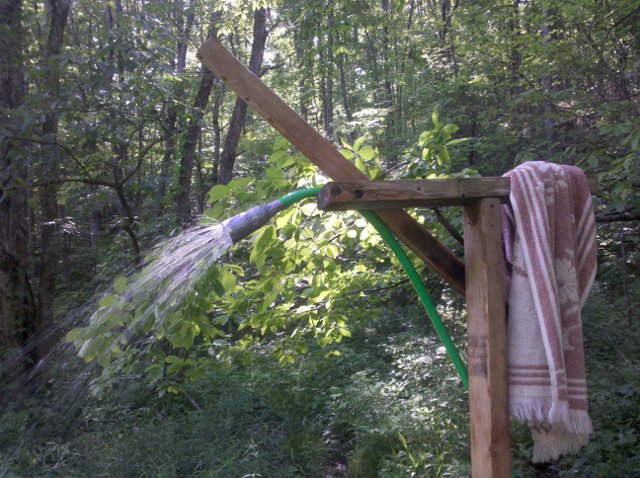
Five years ago I built this, and it's worked well, but is old and falling down now.
mark I outdoor shower
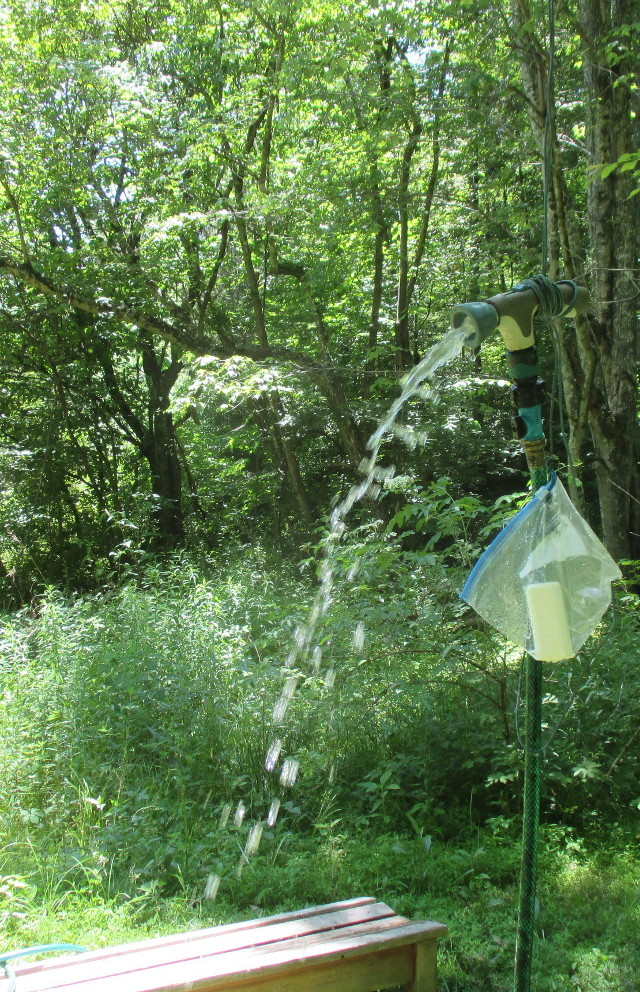
The replacement is more minimalist and like any second system tries to improve on the design of the first. No wood to rot away, fully adjustable height. It's basically a shower swing, suspended from a tree branch.
mark II outdoor shower
Probably will turn out to have its own new problems, as second systems do.

12 June 2016

Iustin Pop: Elsa Bike Trophy 2016 my first bike race!

Elsa Bike Trophy 2016 my first bike race! So today, after two months of intermittent training using Zwift and some actual outside rides, I did my first bike race. Not of 2016, not of 2000+, but like ever. Which is strange, as I learned biking very young, and I did like to bike. But as it turned out, even though I didn't like running as a child, I did participate in a number of running events over the years, but no biking ones. The event Elsa Bike Trophy is a mountain bike event cross-country, not downhill or anything crazy; it takes part in Estavayer-le-Lac, and has two courses - one 60Km with 1'791m altitude gain, and a smaller one of 30Km with 845m altitude gain. I went, of course, for the latter. 845m is more than I ever did in a single ride, so it was good enough for a first try. The web page says that this smaller course est nerveux, technique et ne laisse que peu de r pit . I choose to think that's a bit of an exaggeration, and that it will be relatively easy (as I'm not too skilled technically). The atmosphere there was like for the running races, with the exception of bike stuff being sold, and people on very noisy rollers. I'm glad for my trainer which sounds many decibels quieter The long race started at 12:00, and the shorter one at 12:20. While waiting for the start I had to concerns in mind: whether I'm able to do the whole course (endurance), and whether it will be too cold (the weather kept moving towards rain). I had a small concern about the state of the course, as it was not very nice weather recently, but a small one. And then, after one hour plus of waiting, go! Racing, with a bit of "swimming" At first thing went as expected. Starting on paved roads, moving towards the small town exit, a couple of 14% climbs, then more flat roads, then a nice and hard 18% short climb (I'll never again complain about < 10%!), then entering the woods. It became quickly apparent that the ground in the forest was in much worse state than I feared. Much worse as in a few orders of magnitude. In about 5 minutes after entering the tree cover, my reasonably clean, reasonably light bike became a muddy, heavy monster. And the pace that until then went quite OK became walking pace, as the first rider that didn't manage to keep going up because the wheel turned out of the track blocked the one behind him, which had to stop, and repeat until we were one line (or two, depending on how wide the trail was) of riders walking their bikes up. While on dry ground walking your bike up is no problem, or hiking through mud with good hiking shoes is also no problem, walking up with biking shoes is a pain. Your foot slides and you waste half of your energy "swimming" in the mud. Once the climb is over, you get on the bike, and of course the pedals and cleats are full of heavy mud, so it takes a while until you can actually clip in. Here the trail version of SPD was really useful, as I could pedal reasonably well without being clipped-in, just had to be careful and push too hard. Then maybe you exit the trail and get on paved road, but the wheels are so full of mud that you still are very slow (and accelerate very slowly), until the shed enough of the mud to become somewhat more "normal". After a bit of this "up through mud, flat and shedding mud", I came upon the first real downhill section. I would have been somewhat confident in dry ground, but I got scared and got off my bike. Better safe than sorry was the thing for now. And after this is was a repetition of the above: climb, sometimes (rarely) on the bike, most times pushing the bike, fast flat sections through muddy terrain where any mistake of controlling the bike can send the front wheel flying due to the mud being highly viscous, slow flat sections through very liquid mud where it definitely felt like swimming, or any dry sections. My biggest fear, uphill/endurance, was unfounded. The most gains I made were on the dry uphills, where I had enough stamina to overtake. On flat ground I mostly kept order (i.e. neither being overtaken nor overtaking), but on downhill sections, I lost lots of time, and was overtaken a lot. Still, it was a good run. And then, after about 20 kilometres out of the 30, I got tired enough of getting off the bike, on the bike, and also tired mentally and not being careful enough, that I stopped getting off the bike on downhills. And the feeling was awesome! It was actually much much easier to flow through the mud and rocks and roots on downhill, even when it was difficult (for me) like 40cm drops (estimated), than doing it on foot, where you slide without control and the bike can come crashing down on you. It was a liberating feel, like finally having overcome the mud. I was soo glad to have done a one-day training course with Swiss Alpine Adventure, as it really helped. Thanks Dave! Of course, people were still overtaking me, but I also overtook some people (who were on foot; he he, I wasn't the only one it seems). And being easier, I had some more energy so I was able to push a bit harder on the flats and dry uphill sections. And then the remaining distance started shrinking, and the last downhill was over, I entered through familiar roads the small town, a passer-by cries "one kilometre left", I push hard (I mean, hard as I could after all the effort), and I reach the finish. Oh, and my other concern, the rain? Yes it did rain somewhat, and I was glad for it (I keep overheating); there was a single moment I felt cold, when exiting a nice cosy forest into a field where the wind was very strong headwind, of course. Lessons learned I did learn a lot in this first event. Results So, how did I do after all? As soon as I reached the finish and recovered my items, among which the phone, I checked the datasport page: I was rank 59/68 in my category. Damn, I hoped (and thought) I would do better. Similar % in the overall ranking for this distance. That aside, it was mighty fun. So much fun I'd do it again tomorrow! I forgot the awesome atmosphere of such events, even in the back of the rankings. And then, after I reach drive home and open on my workstation the datasport page, I get very confused: the overall number of participants was different. And the I realised: not everybody finished the race when I first checked (d'oh)! Final ranking: 59 out of 84 in my category, and 247/364 in the overall 30km rankings. That makes it 70% and 67% respectively, which matches somewhat with my usual running results a few years back (but a bit worse). It is in any case better than what I thought originally, yay! Also, Strava activity for some more statistics (note that my Garmin says it was not 800+ meters of altitude ): I'd embed a Veloviewer nice 3D-map but I can't seem to get the embed option, hmm TODO: train more endurance, train more technique, train in more various conditions!

11 June 2016

Shirish Agarwal: The road to debconf 2016, tourism and arts.

A longish blog post, please bear, a second part of the blog post would be published in few days from now. My fixed visa finally arrived, yeah:) But this story doesn t start here, it starts about a year back. While I have been contributing to Debian in my free time over the years, and sometimes paid time as well, I had never thought of going overseas as the experiences I knew from friends and relatives, it isn t easy to get all the permissions and paperwork done to say the least (bureaucracy @ work). But last year, when Debconf 15 was being launched, there are/were 2-3 friends of mine who are studying, doing their Ph.D. in some computer/web stuff, living in Germany currently that they goaded me to apply. The first few times I gave some standard excuses, but when they kept on for a while, just to shut them up I applied to the debconf team applying for food, accommodation and travel sponsorship. I didn t have high hopes as there obviously are many more talented peers around me who understand FOSS and Debian at a much more fundamental, philosophical as well as technical level than me. Much to my surprise though, about a month (and around two or three weeks just before the event was about to take place) I got the bursary/sponsorships for food, accommodation as well as travel. I was unsure that the remaining time was enough to get a visa hence declined that time around. That whole episode gave me the confidence that perhaps my application would be accepted if I applied again. Using my previous years understanding, decided to give it a shot again as this would also enable me to get a feel of visa bureaucracy as well as gain a bit of novice understanding about what factors go in choosing a flight and believe me the latter part proved to be pretty confusing. While the visa business seems easy, the form at least is easy and what they ask, it can be troublesome as far as visa-processing process is concerned. It took a better part of the month to get the visa which I needed. The in-between time is and can be a bit stressful as you have committed funds for travel i.e. the airline tickets and are in a limbo as you didn t know that if the visa is cancelled for some reason, your tickets would be refunded or not. A little history is needed and hopefully is helpful for anybody who s applying for a short-stay Visa in South Africa. Exactly, A month and day back I had applied for visa. The visa I had applied for is 17 days as the flights within my budget was for those days only. The visa I got was for 10 days only which was ending in the middle of the conference. I tried many avenues to get information and was told that I needed to write a correction letter telling/sharing the information about the correct time period and dates in BOLD with a heavier weight/point which is what I did and gave to VFS office without any further payment on my part. It took a bit more time than the first time around but the consulate co-operated. While I can understand the oversight as they probably get more visas requests along with special and urgent requests so such occurrences can happen. I am and was happy that there was a recourse rather than starting from scratch which probably would have made me more anxious due to the first experience . Apparently I was lucky that I had done with Qatar Airways as later came to know that there are other airways which don t refund money even after visa rejection . This information I got to know pretty late in the game otherwise I wouldn t have been much stressed. As had committed knew had to go the whole hog and whatever barriers are there, have overcome at least as far as the visa part/process is concerned. Now after few days, will probably start to worry about the actual travel, part nervousness, part excitement, nervousness as it will be an alien land, am obese so traveling economy on 787-8 and 777-300 ER will be tricky. The 787-8 will probably be a rough ride as it s a 9 hr. journey and the seat are a mere 18 , the cattle class as shared by one of our esteemed politicians. This blame has to do with Boeing 787 rather than anybody else. Hopefully, if there is a next time, would make better choices. Anyways,have selected an aisle seat so that will be able to walk every hr. or so to get the circulation in legs going as leg room in economy is not much from my domestic air travel experiences. If I do survive the travel, then will see South Africa and try to get some free time and explore South Africa and try to figure out how are they able to get one and half time tourists while we get around half figure for a whole year even though we are bigger (area-wise) to South Africa. I did find something positive for us as well, it s not all doldrums all around. Now, I had been thinking about if I know any South African music and movies. I had explored djembe while growing up in teens but other than that, not much. The only music I have heard is Harry Belafonte . So I hope to bring some Indian movies and music with me so that people if they have not explored Bollywood as well as Indian classical music could explore some of it, of course it will be pale imitation of what Sawai Gandharva Music Festival for instance gives. I also hope to hear and get some music and movies to learn more about South Africa.
Filed under: Miscellenous Tagged: #bollywood, #Debconf Germany 2015, #Debconf South Africa 2016, #Debconf15, #Debconf16, #djembe, #South-African consulate, music, tourism, visa

10 June 2016

Jaminy Prabaharan: Weekly Report for GSoC16-week 1 and week2

After introducing ourselves to the community, we start contributing to the open and free source software. Since this is the first week, I have went through theories which would help me in coding. Before coding it is always safer to refer to theories so that we don t need to spare time in debugging. The following were my week 1-4 plans:

These two weeks I have completed my first two tasks in the list.I have committed and pushed my works in GitHub.https://github.com/Jaminy/GSoC

Successfully logged into the email account using IMAP and examined each folders.Examined inbox to extract To , From and CC of the last message received.Trying to extract all message details to put in CSV file.


8 June 2016

Daniel Pocock: Working to pass GSoC

GSoC students have officially been coding since 23 May (about 2.5 weeks) and are almost half-way to the mid-summer evaluation (20 - 27 June). Students who haven't completed some meaningful work before that deadline don't receive payment and in such a large program, there is no possibility to give students extensions or let them try and catch up later. Every project and every student are different, some are still getting to know their environment while others have already done enough to pass the mid-summer evaluation. I'd like to share a few tips to help students ensure they don't inadvertently fail the mid-summer evaluation Kill electronic distractions As a developer of real-time communications projects, many people will find it ironic or hypocritical that this is at the top of my list. Switch off the mobile phone or put it in silent mode so it doesn't even vibrate. Research has suggested that physically turning it off and putting it out of sight has significant benefits. Disabling the voicemail service can be an effective way of making sure no time is lost listening to a bunch of messages later. Some people may grumble at first but if they respect you, they'll get into the habit of emailing you and waiting for you to respond when you are not working. Get out a piece of paper and make a list of all the desktop notifications on your computer, whether they are from incoming emails, social media, automatic updates, security alerts or whatever else. Then figure out how to disable them all one-by-one. Use email to schedule fixed times for meetings with mentors. Some teams/projects also have fixed daily or weekly times for IRC chat. For a development project like GSoC, it is not necessary or productive to be constantly on call for 3 straight months. Commit every day Habits are a powerful thing. Successful students have a habit of making at least one commit every day. The "C" in GSoC is for Code and commits are a good way to prove that coding is taking place. GSoC is not a job, it is like a freelance project. There is no safety-net for students who get sick or have an accident and mentors are not bosses, each student is expected to be their own boss. Although Google has started recommending students work full time, 40 hours per week, it is unlikely any mentors have any way to validate these hours. Mentors can look for a commit log, however, and simply won't be able to pass a student if there isn't code. There may be one day per week where a student writes a blog or investigates a particularly difficult bug and puts a detailed report in the bug tracker but by the time we reach the second or third week of GSoC, most students are making at least one commit in 3 days out of every 5. Consider working away from home/family/friends Can you work without anybody interrupting you for at least five or six hours every day? Do you feel pressure to help with housework, cooking, siblings or other relatives? Even if there is no pressure to do these things, do you find yourself wandering away from the computer to deal with them anyway? Do family, friends or housemates engage in social activities, games or other things in close proximity to where you work? All these things can make a difference between passing and failing. Maybe these things were tolerable during high school or university. GSoC, however, is a stepping stone into professional life and that means making a conscious decision to shut those things out and focus. Some students have the ability to manage these distractions well, but it is not for everybody. Think about how leading sports stars or musicians find a time and space to be "in the zone" when training or rehearsing, this is where great developers need to be too. Some students find the right space in a public library or campus computer lab. Some students have been working in hacker spaces or at empty desks in local IT companies. These environments can also provide great networking opportunities. Managing another summer job concurrently with GSoC It is no secret that some GSoC students have another job as well. Sometimes the mentor is aware of it, sometimes it has not been disclosed. The fact is, some students have passed GSoC while doing a summer job or internship concurrently but some have also failed badly in both GSoC and their summer job. Choosing one or the other is the best way to succeed, get the best results and maximize the quality of learning and community interaction. For students in this situation, now it is not too late to make the decision to withdraw from GSoC or the other job. If doing a summer job concurrently with GSoC is unavoidable, the chance of success can be greatly increased by doing the GSoC work in the mornings, before starting the other job. Some students have found that they actually finish more quickly and produce better work when GSoC is constrained to a period of 4 or 5 hours each morning and their other job is only in the afternoon. On the other hand, if a student doesn't have the motivation or energy to get up and work on GSoC before the other job then this is a strong sign that it is better to withdraw from GSoC now.

7 June 2016

Matthew Garrett: Be wary of heroes

Inspiring change is difficult. Fighting the status quo typically means being able to communicate so effectively that powerful opponents can't win merely by outspending you. People need to read your work or hear you speak and leave with enough conviction that they in turn can convince others. You need charisma. You need to be smart. And you need to be able to tailor your message depending on the audience, even down to telling an individual exactly what they need to hear to take your side. Not many people have all these qualities, but those who do are powerful and you want them on your side.

But the skills that allow you to convince people that they shouldn't listen to a politician's arguments are the same skills that allow you to convince people that they shouldn't listen to someone you abused. The ability that allows you to argue that someone should change their mind about whether a given behaviour is of social benefit is the same ability that allows you to argue that someone should change their mind about whether they should sleep with you. The visibility that gives you the power to force people to take you seriously is the same visibility that makes people afraid to publicly criticise you.

We need these people, but we also need to be aware that their talents can be used to hurt as well as to help. We need to hold them to higher standards of scrutiny. We need to listen to stories about their behaviour, even if we don't want to believe them. And when there are reasons to believe those stories, we need to act on them. That means people need to feel safe in coming forward with their experiences, which means that nobody should have the power to damage them in reprisal. If you're not careful, allowing charismatic individuals to become the public face of your organisation gives them that power.

There's no reason to believe that someone is bad merely because they're charismatic, but this kind of role allows a charismatic abuser both a great deal of cover and a great deal of opportunity. Sometimes people are just too good to be true. Pretending otherwise doesn't benefit anybody but the abusers.

comment count unavailable comments

5 June 2016

Ingo Juergensmann: Request for Adoption: Buildd.Net project

I've been running Buildd.Net for quite a long time. Buildd.Net is a project that focusses on the autobuilders, not the packages. It started back then when the m68k port had a small website running on kullervo, a m68k buildd. Kullervo was too loaded to deal with the increased load of that website, so together with Stephen Marenka we moved the page from kullervo to my server under the domain m68k.bluespice.org. Over time I got many requests if that page could do the same for other archs as well, so I started to hack the code to be able to deal with different archs: Buildd.Net was born. Since then many years passed by and Buildd.Net evolved into a rather complex project, being capable to deal with different archs and different releases, such as unstable, backports, non-free, etc. Sadly the wanna-build output changed over the years as well, but I didn't have the time anymore to keep up with the changes. Buildd.Net is based on:
  • some Bash scripts
  • some Python scripts
  • a PostgreSQL database
  • gnuplot for some graphs
  • some small Perl scripts
  • ... and maybe more...
As long as I was more deeply involved with the m68k autobuilders and others, I found Buildd.Net quite informative as I could get a quick overview how all of the buildds were performing. Based on the PostgreSQL database we could easily spot if a package was stuck on one of the buildds without directly watching the buildd logs. Storing the information from the buildds about the built packages in a SQL database can give you some benefit. Originally my plan was to use that kind of information for a better autobuilder setup. In the past it happened that large packages were built by buildds with, let's say, 64 MB of RAM and smaller packages were built on the buildds with 128 MB of RAM. Eventually this led to failed builds or excessive build times. Or m68k buildds like Apple Centris boxes or so suffered from slow disk I/O, while some Amiga buildds had reasonable disk speeds (consider 160 kB/s vs. 2 MB/s). As you can see there is/was a lot room for optimization of how packages can be distributed between buildds. This could have been done by analyzing the statistics and some scripting, but was never implemented because of missing skills and time on my side. The lack of time to keep up with the changes of the official wanna-build output (like new package states) is the main reason why I want to give Buildd.Net into good hands. If you are interested in this project, please contact me! I still believe that Buildd.Net can be beneficial to the Debian project. :-)
Kategorie:

Jamie McClelland: Signal and Mobile XMPP Update

First, many thanks to Planet Debian readers for your thoughtful and constructive feedback to my Signal and Mobile Instant Messaging blogs. I learned a lot. Particularly useful was the comment directing me to Daniel Gultsch's The State of Mobile in 2016 post. I had previously listed the outstanding technical challenges as: I am now fairly convined that both problems are well-solved on Android via the Conversations app and a well-tuned XMPP server (I had no idea how easy it was to install your own Prosody modulues -- the client state indicator module is only 22 lines of lua code!) I think the current technical challenges could be better summarized as: adding iOS (iPhone) support. Both end-to-end encryption and receiving messages consistently seem to be hurdles. However, it seems that Chris Ballinger and the Chat Secure team are well on their way toward solving the push issue and facing funder skittishness on the encryption front. Nonetheless, but seem to be progressing. With the obvious technical hurdles in progress, we have the luxury of talking about the less obvious ones - particularly the ones requiring trade-offs. In particular: Signal replaces your SMS client. It looks and feels like an SMS client and automatically sends un-encrypted messages to everyone your address book that is not on signal and sends encrypted messages to those that are on signal. The significance of this feature is hard to over-state. It differentiates tools by and for technically minded people and those designed for a mass audience. When I convince people to use Conversations, in contrast, I have to teach them to: For most people who don't (yet) have their friends XMPP addresses or for people who don't have any friends who use XMPP, it means that they will install it, send me a few messages and then never use it again. The price Signal pays for this convenience is steep: Signal seems to synchronize your entire address book to their servers so they can keep a map of cell phone numbers to signal users. It's not only creepy (I get a text message everytime someone in my address book joins Signal) but it's flies in the face of expectations for a privacy-minded application. How could we take advantage of this feature, without the privacy problems? What if... The main downside (which Signal faces as well) is that you have to contend with the complexities of sending SMS messages on top of the work needed to write a well-functioning XMPP client. As I mentioned in my Signal blog, there are no shortage of MMS bugs against Signal. Nobody wants that head-ache. Additinally, we would still lose one Signal feature: with Signal, when a user joins, everyone automatically sends them encrypted messages. With this proposed app, each user would have to manually add the XMPP address and have no way of knowing when one of their friends gets an XMPP address. Any other ideas?

4 June 2016

Jaminy Prabaharan: Weekly Report for GSoC16-Community bonding period

April 23rd to May 23rd The period of introducing ourselves to the Debian community. I have updated my debian wiki page to introduce more about myself to the Debian community. https://wiki.debian.org/SummerOfCode2016/StudentApplications/Jaminy There was a webRTC session of MiniDebconf through Jitsi on 3oth April to know more about the Debian resources. During this period I have updated my PC with the Debian latest version, Jessie and got practised with the new platform.I have also learnt some basic theories on my project such as VoIP and IMAP. I was assigned by my mentor Daniel Pocock to work on telepathy reSIProcate.

System used
  • Debian GNU/Linux 8.3 (jessie)
  • Ubuntu 14.04.4 LTS (trusty)

Telepathy-Qt

First you have to configure the telepathy-qt library properly to be able to install reSIProcate. It s important to notice that you shouldn t install telepathy-qt from apt-get because in this way it wont have the telepathy-qt4-service shared library.

$ mkdir ~/telepathy-qt-stuff
$ cd ~/telepathy-qt-stuff
$ git clone https://github.com/dpocock/telepathy-qt-debian
$ cd telepathy-qt-debian
$ git checkout jessie-build-all-shared
$ cd ..

Then you should download the tar http://http.debian.net/debian/pool/main/t/telepathy-qt/telepathy-qt_0.9.6.1.orig.tar.gz in the telepathy-qt-stuff folder and continue:

$ tar xzf telepathy-qt_0.9.6.1.orig.tar.gz
$ cd telepathy-qt_0.9.6.1
$ [ -d debian ] && echo "warning: debian/ already exists!"
$ cp -r ../telepathy-qt-debian/debian .
$ dpkg-buildpackage -rfakeroot -i.* -j13 -us -uc
$ cd ..
$ ls *.deb

Now you should see a list of libtelepathy-qt* and telepathy-qt* .deb packages. You just have to install a few more packages:

$ dpkg -i libtelepathy-qt4-2_0.9.6.1-2_amd64.deb libtelepathy-qt4-dev_0.9.6.1-2_amd64.deb libtelepathy-qt4-farstream2_0.9.6.1-2_amd64.deb

After that you have the necessary packages to install reSIProcate.

$ dpkg -l   grep telepathy-qt

Should return you something like this:

ii

libtelepathy-qt4-2:amd64

0.9.6.1-2

amd64

Telepathy framework Qt 4 library

ii

libtelepathy-qt4-dev

0.9.6.1-2

amd64

Qt 4 Telepathy library (headers and static library)

ii

libtelepathy-qt4-farstream2:amd64

0.9.6.1-2

amd64

Telepathy/Farsight integration Qt 4 library

reSIProcate

After installing telepathy-qt properly you would be able to configure reSIProcate.

Make sure you have added backports to your /etc/apt/sources.list file

$ git clone https://github.com/resiprocate/resiprocate
$ cd resiprocate
$ apt-get install libpq-dev dh-autoreconf
$ apt-get build-dep resiprocate
$ apt-get install -t jessie-backports libradcli-dev
$ ./build/debian.sh
$ make

And then you are done!

3 June 2016

Eduard Sanou: No more unencrypted emails to gpg contacts

I have been using mutt for about half a year already and I m very happy with it. The previous email client I used was Thunderbird (with the Enigmail extension to handle GPG). There were two main reasons that made me switch. The first one was that I often would like to check my email while I m offline, and it seems that Thunderbird is not very good at this. Sometimes not all my email would have been downloaded (just the headers), and I also found it frustrating that after marking more than 50 emails as read while offline, they would be marked as unread again once I went back online. With mutt I m using mbsync (which apparently is faster than offlineimap) to sync my email to a local folder with a cron job. I couldn t be happier. The other issue was that I like having many filters, and it was tedious to customize filters in Thunderbird: there s no way to copy a filter and modify it, and there s a limit in the combinations of ANDs and ORs for fields. I m using procmail now, which allows me save the filter configuration in plaintext and define patterns with more flexibility. The setup for mutt took several weeks, but I never felt that I couldn t accomplish what I wanted (unlike in Thunderbird). I m using mutt with several python and bash scripts that I wrote. But the reason for this post is an issue that I believe happens in every email client (or should I say, MUA, to be more precise). I ve seen it happening to people using both Thunderbird and mutt, and I bet it has happened in other cases: sending an email to someone for which you have their GPG key unencrypted unwillingly. I ve seen this happening in email replies with several participants: after a few encrypted messages are exchanged, someone replies in the clear, quoting all the previous messages. I tried to avoid this by configuring mutt to encrypt and sign by default, forcing me to set sign only manually before sending every email that I can t send encrypted (I d like to send all my emails encrypted, but not everybody has a GPG key :( ). So what happened? I got so used to sending many unencrypted emails that I would press P S (PGP setting, Sign only) before sending emails as a reflex act. And I sent an email unencrypted to a friend for which I have his GPG key :( So I thought: It s a very rare case to want to send an unencrypted email to someone for which you have their GPG key. I think extensions like Enigmail should give you a warning when this happens, to alert you about it. In my case, I solved it with a python script that inspects the email, and, if it s unencrypted and the recipient/s is/are in your GPG keyring it warns you about it and returns an error. The script stores a temporary file with the Message-ID so that if you run it again with the same email it will properly send the email without returning an error. Now, I only needed to configure mutt to use this script as the sendmail command:
per_account:set sendmail  = "$HOME/bin/check-mail-gpg /usr/bin/msmtp -a $my_email"
And here goes the python script check-mail-gpg:
#! /usr/bin/python3
import os
import sys
import subprocess
import email.parser
from email.header import decode_header
from email.utils import parseaddr
STATUS_FILE = '/tmp/check-mail-gpg.tmp'
def dec(header):
    head = decode_header(header)
    if len(head) == 1 and head[0][1] == None:
        return head[0][0]
    else:
        return ''.join([h.decode(enc) if enc else h.decode('ascii') \
                for (h,enc) in head])
def send_mail(mail):
    print('Calling external email client to send the email...')
    #return -1 # testing mode
    p = subprocess.Popen(sys.argv[1:], stdin=subprocess.PIPE)
    p.stdin.write(mail.encode('utf-8'))
    p.stdin.close()
    return p.wait()
def main():
    mail = sys.stdin.read()
    heads = email.parser.Parser().parsestr(mail, headersonly=True)
    content = heads['Content-Type'].split(';')[0].strip()
    print('Content is:', content)
    if content == 'multipart/encrypted':
        print('Ok: encrypted mail, we can return now...')
        sys.exit(send_mail(mail))
    addrs = [parseaddr(addr) for addr in heads['To'].split(',')]
    print('Found emails:', addrs)
    gpg_cnt = 0
    for name, addr in addrs:
        print('Looking for', addr, 'in the keyring...')
        res = subprocess.call(['gpg', '--list-keys', addr],
                stdout=subprocess.DEVNULL, stderr=subprocess.DEVNULL)
        if res == 0:
            gpg_cnt += 1
    if gpg_cnt == 0:
        print('Ok: no email found in the gpg keyring, we can return now...')
        sys.exit(send_mail(mail))
    if not os.path.exists(STATUS_FILE):
        open(STATUS_FILE, 'w').close()
    msg_id = heads['Message-ID']
    msg_id_prev = ''
    with open(STATUS_FILE, 'r') as f:
        msg_id_prev = f.read()
    if msg_id.strip() == msg_id_prev.strip():
        sys.exit(send_mail(mail))
    else:
        with open(STATUS_FILE, 'w') as f:
            f.write(msg_id)
        print('Alert: trying to send an unencrypted email to', addrs,
                ', for which some gpg keys were found in the keyring!')
        print('Try again if you are sure to send this message unencrypted.')
        sys.exit(1)
if __name__ == '__main__':
    main()

Update I ve been told about the option crypt_opportunistic_encrypt in mutt, which provides a feature very similar to what I was looking for. This option will automatically enable encryption when the recipient has a GPG key in your keyring. From mutt s man page:
3.41. crypt_opportunistic_encrypt Type: boolean Default: no Setting this variable will cause Mutt to automatically enable and disable encryption, based on whether all message recipient keys can be located by mutt. When this option is enabled, mutt will determine the encryption setting each time the TO, CC, and BCC lists are edited. If $edit_headers is set, mutt will also do so each time the message is edited. While this is set, encryption settings can t be manually changed. The pgp or smime menus provide an option to disable the option for a particular message. If $crypt_autoencrypt or $crypt_replyencrypt enable encryption for a message, this option will be disabled for the message. It can be manually re-enabled in the pgp or smime menus. (Crypto only)

Gunnar Wolf: Stop it with those short PGP key IDs!

Debian is quite probably the project that most uses a OpenPGP implementation (that is, GnuPG, or gpg) for many of its internal operations, and that places most trust in it. PGP is also very widely used, of course, in many other projects and between individuals. It is regarded as a secure way to do all sorts of crypto (mainly, encrypting/decrypting private stuff, signing public stuff, certifying other people's identities). PGP's lineage traces back to Phil Zimmerman's program, first published in 1991 By far, not a newcomer PGP is secure, as it was 25 years ago. However, some uses of it might not be so. We went through several migrations related to algorithmic weaknesses (i.e. v3 keys using MD5; SHA1 is strongly discouraged, although not yet completely broken, and it should be avoided as well) or to computational complexity (as the migration away from keys smaller than 2048 bits, strongly prefering 4096 bits). But some vulnerabilities are human usage (that is, configuration-) related. Today, Enrico Zini gave us a heads-up in the #debian-keyring IRC channel, and started a thread in the debian-private mailing list; I understand the mail to a private list was partly meant to get our collective attention, and to allow for potentially security-relevant information to be shared. I won't go into details about what is, is not, should be or should not be private, but I'll post here only what's public information already. What are short and long key IDs? I'll start by quoting Enrico's mail:
there are currently at least 3 ways to refer to a gpg key: short key ID (last 8 hex digits of fingerprint), long key ID (last 16 hex digits) and full fingerprint. The short key ID used to be popular, and since 5 years it is known that it is computationally easy to generate a gnupg key with an arbitrary short key id. A mitigation to this is using "keyid-format long" in gpg.conf, and a better thing to do, especially in scripts, is to use the full fingerprint to refer to a key, or just ship the public key for verification and skip the key servers. Note that in case of keyid collision, gpg will download and import all the matching keys, and will use all the matching keys for verifying signatures.
So... What is this about? We humans are quite bad at recognizing and remembering randomly-generated strings with no inherent patterns in them. Every GPG key can be uniquely identified by its fingerprint, a 128-bit string, usually encoded as ten blocks of four hexadecimal characters (this allows for 160 bits; I guess there's space for a checksum in it). That is, my (full) key's signature is:
AB41 C1C6 8AFD 668C A045  EBF8 673A 03E4 C1DB 921F
However, it's quite hard to recognize such a long string, let alone memorize it! So, we often do what humans do: Given that strong cryptography implies a homogenous probability distribution, people compromised on using just a portion of the key the last portion. The short key ID. Mine is then the last two blocks (shown in boldface): C1DB921F. We can also use what's known as the long key ID, that's twice as long: 64 bits. However, while I can speak my short key ID on a single breath (and maybe even expect you to remember and note it down), try doing so with the long one (shown in italics above): 673A03E4C1DB921F. Nah. Too much for our little, analog brains. This short and almost-rememberable number has then 32 bits of entropy I have less than one in 4,000,000,000 chance of generating a new key with this same short key ID. Besides, key generation is a CPU-intensive operation, so it's quite unlikely we will have a collision, right? Well, wrong. Previous successful attacks on short key IDs Already five years ago, Asheesh Laroia migrated his 1024D key to a 4096R. And, as he describes in his always-entertaining fashion, he made his computer sweat until he was able to create a new key for which the short key ID collided with the old one. It might not seem like a big deal, as he did this non-maliciously, but this easily should have spelt game over for the usage of short key IDs. After all, being able to generate a collision is usually the end for cryptographic systems. Asheesh specifically mentioned in his posting how this could be abused. But we didn't listen. Short key IDs are just too convenient! Besides, they allow us to have fun, can be a means of expression! I know of at least two keys that would qualify as vanity: Obey Arthur Liu's 0x29C0FFEE (created in 2009) and Keith Packard's 0x00000011 (created in 2012). Then we got the Evil 32 project. They developed Scallion, started (AFAICT) in 2012. Scallion automates the search for a 32-bit collision using GPUs; they claim that it takes only four seconds to find a collision. So, they went through the strong set of the public PGP Web of Trust, and created a (32-bit-)colliding key for each of the existing keys. And what happened now? What happened today? We still don't really know, but it seems we found a first potentially malicious collision that is, the first "nonacademic" case. Enrico found two keys sharing the 9F6C6333 short ID, apparently belonging to the same person (as would be the case of Asheesh, mentioned above). After contacting Gustavo, though, he does not know about the second That is, it can be clearly regarded as an impersonation attempt. Besides, what gave away this attempt are the signatures it has: Both keys are signed by what appears to be the same three keys: B29B232A, F2C850CA and 789038F2. Those three keys are not (yet?) uploaded to the keyservers, though... But we can expect them to appear at any point in the future. We don't know who is behind this, or what his purpose is. We just know this looks very evil. Now, don't panic: Gustavo's key is safe. Same for his certifiers, Marga, Agust n and Maxy. It's just a 32-bit collision. So, in principle, the only parties that could be cheated to trust the attacker are humans, right? Nope. Enrico tested on the PGP pathfinder & key statistics service, a keyserver that finds trust paths between any two arbitrary keys in the strong set. Surprise: The pathfinder works on the short key IDs, even when supplied full fingerprints. So, it turns out I have three faked trust paths into our impostor. What next? There are several things this should urge us to do. And there are surely many other important recommendations. But this is a good set of points to start with. [update] I was pointed at Daniel Kahn Gillmor's 2013 blog post, OpenPGP Key IDs are not useful. Daniel argues, in short, that cutting a fingerprint in order to get a (32- or 64-bit) short key ID is the worst of all worlds, and we should rather target either always showing full fingerprints, or not showing it at all (and leaving all the crypto-checking bits to be done by the software, as comparing 160-bit strings is not natural for us humans). [update] This post was picked up by LWN.net. A very interesting discussion continues in their comments.

1 June 2016

Russell Coker: I Just Ordered a Nexus 6P

Last year I wrote a long-term review of Android phones [1]. I noted that my Galaxy Note 3 only needed to last another 4 months to be the longest I ve been happily using a phone. Last month (just over 7 months after writing that) I fell on my Note 3 and cracked the screen. The Amourdillo case is good for protecting the phone [2] so it would have been fine if I had just dropped it. But I fell with the phone in my hand, the phone landed face down and about half my body weight ended up in the middle of the phone which apparently bent it enough to crack the screen. As a result of this the GPS seems to be less reliable than it used to be so there might be some damage to the antenna too. I was quoted $149 to repair the screen, I could possibly have found a cheaper quote if I had shopped around but it was a good starting point for comparison. The Note 3 originally cost $550 including postage in 2014. A new Note 4 costs $550 + postage now from Shopping Square and a new Note 3 is on ebay with a buy it now price of $380 with free postage. It seems like bad value to pay 40% of the price of a new Note 3 or 25% the price of a Note 4 to fix my old phone (which is a little worn and has some other minor issues). So I decided to spend a bit more and have a better phone and give my old phone to one of my relatives who doesn t mind having a cracked screen. I really like the S-Pen stylus on the Samsung Galaxy Note series of phones and tablets. I also like having a hardware home button and separate screen space reserved for the settings and back buttons. The downsides to the Note series are that they are getting really expensive nowadays and the support for new OS updates (and presumably security fixes) is lacking. So when Kogan offered a good price on a Nexus 6P [3] with 64G of storage I ordered one. I m going to give the Note 3 to my father, he wants a phone with a bigger screen and a stylus and isn t worried about cracks in the screen. I previously wrote about Android device service life [4]. My main conclusion in that post was that storage space is a major factor limiting service life. I hope that 64G in the Nexus 6P will solve that problem, giving me 3 years of use and making it useful to my relatives afterwards. Currently I have 32G of storage of which about 8G is used by my music video collection and about 3G is free, so 64G should last me for a long time. Having only 3G of RAM might be a problem, but I m thinking of trying CyanogenMod again so maybe with root access I can reduce the amount of RAM use.

Next.

Previous.