Search Results: "bab"

15 July 2017

Joey Hess: Functional Reactive Propellor

I wrote this code, and it made me super happy!
data Variety = Installer   Target
    deriving (Eq)
seed :: UserInput -> Versioned Variety Host
seed userinput ver = host "foo"
    & ver (   (== Installer) --> hostname "installer"
          < > (== Target)    --> hostname (inputHostname userinput)
          )
    & osDebian Unstable X86_64
    & Apt.stdSourcesList
    & Apt.installed ["linux-image-amd64"]
    & Grub.installed PC
    & XFCE.installed
    & ver (   (== Installer) --> desktopUser defaultUser
          < > (== Target)    --> desktopUser (inputUsername userinput)
          )
    & ver (   (== Installer) --> autostartInstaller )
This is doing so much in so little space and with so little fuss! It's completely defining two different versions of a Host. One version is the Installer, which in turn installs the Target. The code above provides all the information that propellor needs to convert a copy of the Installer into the Target, which it can do very efficiently. For example, it knows that the default user account should be deleted, and a new user account created based on the user's input of their name. The germ of this idea comes from a short presentation I made about propellor in Portland several years ago. I was describing RevertableProperty, and Joachim Breitner pointed out that to use it, the user essentially has to keep track of the evolution of their Host in their head. It would be better for propellor to know what past versions looked like, so it can know when a RevertableProperty needs to be reverted. I didn't see a way to address the objection for years. I was hung up on the problem that propellor's properties can't be compared for equality, because functions can't be compared for equality (generally). And on the problem that it would be hard for propellor to pull old versions of a Host out of git. But then I ran into the situation where I needed these two closely related hosts to be defined in a single file, and it all fell into place. The basic idea is that propellor first reverts all the revertible properties for other versions. Then it ensures the property for the current version. Another use for it would be if you wanted to be able to roll back changes to a Host. For example:
foos :: Versioned Int Host
foos ver = host "foo"
    & hostname "foo.example.com"
    & ver (   (== 1) --> Apache.modEnabled "mpm_worker"
          < > (>= 2) --> Apache.modEnabled "mpm_event"
          )
    & ver ( (>= 3)   --> Apt.unattendedUpgrades )
foo :: Host
foo = foos  version  (4 :: Int)
Versioned properties can also be defined:
foobar :: Versioned Int -> RevertableProperty DebianLike DebianLike
foobar ver =
    ver (   (== 1) --> (Apt.installed "foo" <!> Apt.removed "foo")
        < > (== 2) --> (Apt.installed "bar" <!> Apt.removed "bar")
        )
Notice that I've embedded a small DSL for versioning into the propellor config file syntax. While implementing versioning took all day, that part was super easy; Haskell config files win again! API documentation for this feature PS: Not really FRP, probably. But time-varying in a FRP-like way.
Development of this was sponsored by Jake Vosloo on Patreon.

11 July 2017

Rapha&#235;l Hertzog: Freexian s report about Debian Long Term Support, June 2017

A Debian LTS logoLike each month, here comes a report about the work of paid contributors to Debian LTS. Individual reports In May, about 161 work hours have been dispatched among 11 paid contributors. Their reports are available: Evolution of the situation The number of sponsored hours increased slightly with one new bronze sponsor and another silver sponsor is in the process of joining. The security tracker currently lists 49 packages with a known CVE and the dla-needed.txt file 54. The number of open issues is close to last month. Thanks to our sponsors New sponsors are in bold.

One comment Liked this article? Click here. My blog is Flattr-enabled.

9 July 2017

Niels Thykier: Approaching the exclusive sub-minute build time club

For the first time in at least two years (and probably even longer), debhelper with the 10.6.2 upload broke the 1 minute milestone for build time (by mere 2 seconds look for Build needed 00:00:58, [ ] ). Sadly, the result it is not deterministic and the 10.6.3 upload needed 1m + 5s to complete on the buildds. This is not the result of any optimizations I have done in debhelper itself. Instead, it is the result of questionable use of developer time for the sake of meeting an arbitrary milestone. Basically, I made it possible to parallelize more of the debhelper build (10.6.1) and finally made it possible to run the tests in parallel (10.6.2). In 10.6.2, I also made the most of the tests run against all relevant compat levels. Previously, it would only run the tests against one compat level (either the current one or a hard-coded older version). Testing more than one compat turned out to be fairly simple given a proper test library (I wrote a Test::DH module for the occasion). Below is an example, which is the new test case that I wrote for Debian bug #866570.
$ cat t/dh_install/03-866570-dont-install-from-host.t
#!/usr/bin/perl
use strict;
use warnings;
use Test::More;
use File::Basename qw(dirname);
use lib dirname(dirname(__FILE__));
use Test::DH;
use File::Path qw(remove_tree make_path);
use Debian::Debhelper::Dh_Lib qw(!dirname);
plan(tests => 1);
each_compat_subtest  
  my ($compat) = @_;
  # #866570 - leading slashes must *not* pull things from the root FS.
  make_path('bin');
  create_empty_file('bin/grep-i-licious');
  ok(run_dh_tool('dh_install', '/bin/grep*'));
  ok(-e "debian/debhelper/bin/grep-i-licious", "#866570 [$ compat ]");
  ok(!-e "debian/debhelper/bin/grep", "#866570 [$ compat ]");
  remove_tree('debian/debhelper', 'debian/tmp');
 ;
I have cheated a bit on the implementation; while the test runs in a temporary directory, the directory is reused between compat levels (accordingly, there is a clean up step at the end of the test). If you want debhelper to maintain this exclusive (and somewhat arbitrary) property (deterministically), you are more than welcome to help me improve the Makefile.  I am not sure I can squeeze any more out of it with my (lack of) GNU make skills.
Filed under: Debhelper, Debian

5 July 2017

Shirish Agarwal: Debian 9 release party at Co-hive

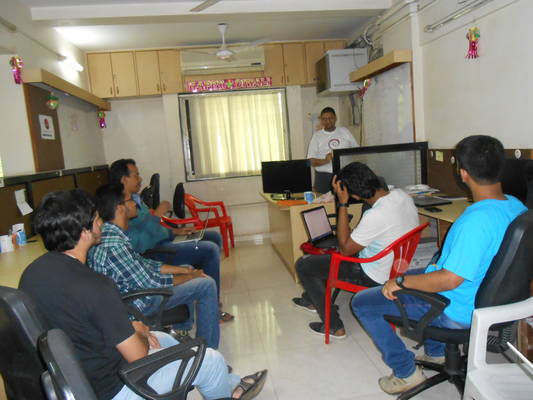
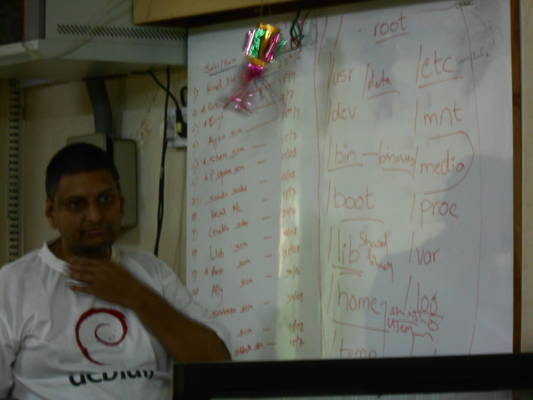
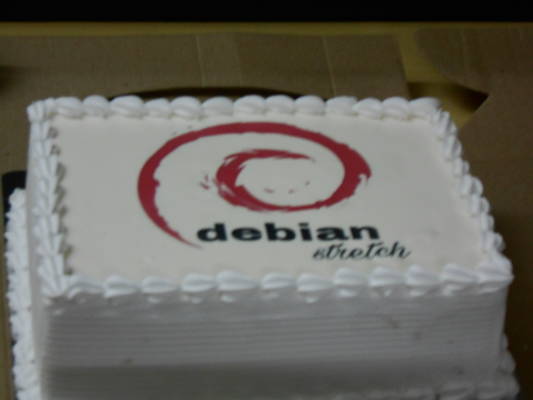
Dear all, This would be a biggish one so please have a chai/coffee or something stronger as it would take a while. I would start with attempt at some alcohol humor. While some people know that I have had a series of convulsive epileptic seizure I had shared bits about it in another post as well. Recovery is going through allopathic medicines as well as physiotherapy which I go to every alternate day. One of the exercises that I do in physiotherapy sessions is walk cross-legged on a line. While doing it today, it occurred to me that this is the same test that a Police inspector would do if they caught you drinking or are suspected of drunk driving. While some in the police force have now also have breath analyzer machines to determine alcohol content in the breath and body (and ways to deceive it are also there) the above exercise is still an integral part of examination. Now few of my friends who do drink have and had made expertise of walking on a line, while I due to this neurological disorder still have issues of walking on a line. So while I don t think of a drinking party in the near future (6 months at least), if I ever do get caught with a friend who is drunk (by association I would also be a suspect) by a policeman who doesn t have a breath analyzer machine, I could be in a lot of trouble. In addition if I tell him I have a neurological disorder I am bound to land up in a cell as he will think I m trying to make a fool of him. If you are able to picturize the situation, I m sure you will get a couple of laughs. Now coming to the release party, I was a bit apprehensive. It s been quite a while I had faced an audience and just coming out of illness didn t know how well or ill-prepared I would be for the session. I had forsaken/given up exercising two days earlier before the event as I wanted to have loose body, loose limbs all over. I also took a mild sedative (1mg) the day before just so I will have a fit night sleep and be able to focus all my energies on the big day. (I don t recommend sedatives unless the doctor prescribes) and I did have a doctor prescription so was able to have a nice sleep. I didn t do any Debian study as I hoped my somewhat long experience with both Ubuntu and Debian should help me. On the d-day, I had asked dhanesh (the organizer of the event) to accompany me from home to venue and back as I was unsure of the journey as it was around 9-10 kms. from my place and while I had been to the venue about couple of years back, I had just a mild remembrance of the place. Anyways, Dhanesh compiled with my request and together we reached the venue before the appointed 1500 hrs. As it was a Sunday I was unsure as how many people would turn up as people usually like to cozy up on a Sunday. Around 1530 hrs everybody showed up The whole group It included couple of co-organizers with most people being newbies so while I had thought of showing how to contribute via reporting bugs or putting up patches, had to set that aside and explain how things work in free software and open-source world. We didn t get into the debate of free vs open-source or free/open-source/open-core as that would have been counter-productive and probably confusing for newbies. We did however share the debian tree structure debian-tree-structure-discussion I was stumped by /var and /proc . I hadn t taken my lappy as it is expensive (a lenovo thinkpad I love very dearly) and I was unsure if I would be able to take care of it (weight wise). Dhanesh had told me that he had Debian on his lappy + zsh both of which are my favourites. While back at home I realized /var has been relegated to having apache/server logs and stuff like that, I do recall (vaguely) a thread on debian-devel about removing /var although that discussion went nowhere. One of the bugs that we hit early on is that nobody had enough space on their hdd to have Debian comfortably. It took a while to get an external hdd and push some of the content from somebody s lappy to the external drive to have space for the installation. I did share the /. /home, optional swap while Dhanesh helped by sharing about having a separate /boot partition as well which I had forgotten. I can t even begin to remember the number of times having a separate /boot partition has helped me in all of my systems. That done, we did try to install/show Debian 9 without network but were hit with #866629 so wasn t able to complete the installation. We had got the latest 9.0.1 as I had seen Steve s message about issues with the live images but even then we were hit with the above bug. As shared in the bug history, it might be a good idea to have the last couple of RC s (Release Candidate releases) as pre-release parties so people have a chance to report bugs and get them fixed. It was also nice to see Praveen raising the seriousness of the bug shared above. The next day I also filed #866971 as I had mistaken the release to be a regular release and not the live instance. I have pushed my rationale and hope the right thing happens. As installation takes a bit of time, we used the time to share about Google s Summer of Code and absence of Debian from GSoC this year. I should have directed them to an itfoss article I wrote sometime ago and also shared that Debian is also looking to having a similar apprenticeship within Debian itself. There were questions about why Debian would like to take the administrative overhead, my response was that it probably had to do with Debian wanting more control over the process. While Debian has had some great luck getting all number of seats that it asks for in GSoC, the ball is always in Google s court. Having that uncertainty off would be beneficial to Debian both in short-term as well as long-term. One interesting stat that was shared with me was that something akin to 89 students from India had been selected this year to GSoC even with the lower stipend and that is a far cry from the 10-15 students who are able to complete GSoC every year. Let s see what happens this year. One of the interesting fact/gossip I shared with them is that Google uses a modified/forked Debian internally which it probably would never release ever. There were quite a few queries about GSoC which resulted into how contributions are made and how git had become the master of all VCS (Version Control Systems). While I do have pet bugs about git (the biggest one being for places/countries having not big bandwidth git fails many a times while cloning). I *think* the bug has been reported enough times but haven t seen any improvements yet. There is a need of a solution like wget and wget -c so git just works even under the most trying circumstances (bandwidth wise) We also shared what a repo is and Dhanesh helpfully did a git shortlog to show people how commits are commented. It was from his official work so he couldn t show anything apart from the shortlog. I also shared how non-technical people can help with regard to documentation, artwork but didn t get into any concrete examples although wiki.debian.org would have been a good start. I also don t know if it s a fact or not but it seems/seemed that moinmoin (the current wiki solution used by debian) seems to have got sectional edit feature which I used sometime back. If moinmoin has got this feature then it is on par with mediawiki, although do know that mediawiki has lot more features going for it. Dhanesh did manage to install a Debian 8.0.7 (while 8.8.0 was the last release) which might have been better. The debian-installer (d-i) looks the same even though I know there are improvements with respect to UEFI and many updated components. There are and were many bugs which I wanted to share but didn t know if it was the right forum or not, for e.g. #597176 which probably needs improvements in other libraries along with the JPEG 2000 support #604859 all of which I m subscribed to. We also had a talk about code documentation and code readability, python (as almost everything in Debian is based on python) I had actually wanted to show metrics.debian.net but had seen it was down the day before and again checked to see it is down now as well, hence reported it, will hopefully come on Debian BTS some time soonish. The idea was to share that Debian does have/uses other programming languages as well and is only limited by people interested in a specific language and be willing to package and maintain packages in that specific programming language. As Dhanesh was part of Firefox OS and a Campus Ambassador we did discuss what went wrong in Firefox OS deployment and Firefox as a whole, specifically between the community and Mozilla the Corporation. In this there were lots that was lot that I wasn t able to share as had become tired otherwise would have shared that ncurses debian-installer interface although bit ugly to look at is still good as it has speech for visually differently abled people as well as people with poor sight. There is and was lots to share about Debian but was conscious that I might over-burden the audience and my stamina was also stretched. We also shared about automated builds bud didn t show either travis.debian.net or jeankins.debian.net We also had a small discussion about Artificial Intelligence, Robotics and how the outlook for people coming in Computer Science looks today. One thing I forgot to share we did do the cake-cutting together Dhanesh-Shirish cutting cake together Dhanesh is on the left while I m on the right. We did have a cute 3-4 year old boy as our guest as well bud didn t get good pictures of him. Lastly, the Debian cake itself Debian 9 cake We also talked about the kernel and subsystem maintainers and how Linus is the overlord. Look forward to comments. I am hoping Dhanesh might recollect some points that I might have missed/forgotten. Update 07/07/17 All programming languages stats. can be seen here
Filed under: Miscellenous Tagged: #alcohol humor, #co-hive, #crystal-gazing, #Debian bugs, #Debian cake, #Debian-release-party-9-pune, #live-installer, #moinmoin, #planet-debian, debian-installer, Pune

4 July 2017

Rapha&#235;l Hertzog: My Free Software Activities in June 2017

My monthly report covers a large part of what I have been doing in the free software world. I write it for my donors (thanks to them!) but also for the wider Debian community because it can give ideas to newcomers and it s one of the best ways to find volunteers to work with me on projects that matter to me. Debian LTS I was allocated 12 hours to work on security updates for Debian 7 Wheezy. During this time I did the following: Debian packaging Django. A last-minute update to Django in stretch before the release, I uploaded python-django 1:1.10.7-2 fixing two bugs (among which one was release critical) and filed the corresponding unblock request. schroot. I tried to prepare another last-minute update, this time for schroot. The goal was to fix the bash completion (#855283) and a problem encountered by the Debian sysadmins (#835104). Those issues are fixed in unstable/testing but my unblock request got turned into a post-release stretch update because the release managers wanted to give the package some more testing time in unstable. Even now, they are wondering whether they should accept the new systemd service file. live-build, live-config and live-boot. On live-build, I merged a patch to add a keyboard shortcut for the advanced option menu entry (#864386). For live-config, I uploaded version 5.20170623 to fix a broken boot sequence when you have multiple partitions (#827665). For live-boot, I uploaded version 1:20170623 to fix the path to udevadm (#852570) and avoiding a file duplication in the initrd (864385). zim. I packaged a release candidate (0.67~rc2) in Debian Experimental and started to use it. I quickly discovered two annoying regressions that I reported upstream (here and here). logidee-tools. This is a package I authored a long time ago and that I m no longer actively using. It does still work but I sometimes wonder if it still has real users. Anyway I wanted to quickly replace the broken dependency on pgf but I ended up converting the Subversion repository to Git and I also added autopkgtests. At least those tests will inform me when the package no longer works otherwise I would not notice since I m no longer using it. Bugs filed. I filed #865531 on lintian because the new check testsuite-autopkgtest-missing is giving some bad advice and probably does its check in a bad way. I also filed #865541 on sbuild because sbuild --apt-distupgrade can under some circumstances remove build-essential and break the build chroot. I filed an upstream ticket on publican to forward the request I received in #864648. Sponsorship. I sponsored a jessie update for php-tcpdf (#814030) and dolibarr 5.0.4+dfsg3-1 for unstable. I sponsored many other packages, but all in the context of the pkg-security team. pkg-security work Now that the Stretch freeze is over, the team became more active again and I have been overwhelmed with the number of packages to review and sponsor: I also updated hashcat to a new upstream release (3.6.0) and had to discuss with upstream about its weird versioning change. Looks like we will have to introduce an epoch to be able to get back in sync with upstream.  To be able to get in sync with Kali, I introduced an hashcat-meta source package (in contrib) providing hashcat-nvidia to make it easy to install hashcat for owners of NVidia hardware. Misc stuff Distro Tracker. I merged a small CSS fix from Aur lien Couderc (#858101) and added a missing constraint on the data model (found through an unexpected traceback that I received by email). I also updated the list of repositories shortly after the stretch release (#865070). Salt formulas. As part of my Kali work, I did setup a build daemon on Debian stretch host and I encountered a couple of issues with my Salt rules. I reported one against salt-formula (here) and I pushed updates for debootstrap-formula, apache-formula and schroot-formula. Thanks See you next month for a new summary of my activities.

No comment Liked this article? Click here. My blog is Flattr-enabled.

Arturo Borrero Gonz lez: Netfilter Workshop 2017: I'm new coreteam member!

nfws2017 I was invited to attend the Netfilter Workshop 2017 in Faro, Portugal this week, so I m here with all the folks enjoying some days of talks, discussions and hacking around Netfilter and general linux networking. The Coreteam of the Netfilter project, with active members Pablo Neira Ayuso (head), Jozsef Kadlecsik, Eric Leblond and Florian Westphal have invited me to join them, and the appointment has happened today. You may contact me now at my new email address: arturo@netfilter.org This is the result of my continued contribution to the Netfilter project since several years now (probably since 2012-2013). I m really happy with this, and I appreciate their recognition. I will do my best in this new position. Thanks! Regarding the workshop itself, we are having lots of interesting talks and discussions about the state of the Netfilter technology, open issues, missing features and where to go in the future. Really interesting!

John Goerzen: Time, Frozen

We re expecting a baby any time now. The last few days have had an odd quality of expectation: any time, our family will grow. It makes time seem to freeze, to stand still. We have Jacob, about to start fifth grade and middle school. But here he is, still a sweet and affectionate kid as ever. He loves to care for cats and seeks them out often. He still keeps an eye out for the stuffed butterfly he s had since he was an infant, and will sometimes carry it and a favorite blanket around the house. He will also many days prepare the Yellow House News on his computer, with headlines about his day and some comics pasted in before disappearing to play with Legos for awhile. And Oliver, who will walk up to Laura and give baby a hug many times throughout the day and sneak up to me, try to touch my arm, and say doink before running off before I can doink him back. It was Oliver that had asked for a baby sister for Christmas before he knew he d be getting one! In the past week, we ve had out the garden hose a couple of times. Both boys will enjoy sending mud down our slide, or getting out the water slide to play with, or just playing in mud. The rings of dirt in the bathtub testify to the fun that they had. One evening, I built a fire, we made brats and hot dogs, and then Laura and I sat visiting and watching their water antics for an hour after, laughter and cackles of delight filling the air, and cats resting on our laps. These moments, or countless others like Oliver s baseball games, flying the boys to a festival in Winfield, or their cuddles at bedtime, warm the heart. I remember their younger days too, with fond memories of taking them camping or building a computer with them. Sometimes a part of me wants to just keep soaking in things just as they are; being a parent means both taking pride in children s accomplishments as they grow up, and sometimes also missing the quiet little voice that can be immensely excited by a caterpillar. And yet, all four of us are so excited and eager to welcome a new life into our home. We are ready. I can t wait to hold the baby, or to lay her to sleep, to see her loving and excited older brothers. We hope for a smooth birth, for mom and baby. Here is the crib, ready, complete with a mobile with a cute bear (and even a plane). I can t wait until there is a little person here to enjoy it.

1 July 2017

Russ Allbery: Review: Make It Stick

Review: Make It Stick, by Peter C. Brown, et al.
Author: Peter C. Brown
Author: Henry L. Roediger III
Author: Mark A. McDaniel
Publisher: Belknap Press
Copyright: 2014
ISBN: 0-674-72901-3
Format: Kindle
Pages: 255
Another read for the work book club. "People generally are going about learning in the wrong ways." This is the first sentence of the preface of this book by two scientists (Roediger and McDaniel are both psychology researchers specializing in memory) and a novelist and former management consultant (Brown). The goal of Make It Stick is to apply empirical scientific research to the problem of learning, specifically retention of information for long-term use. The authors aim to convince the reader that subjective impressions of the effectiveness of study habits are highly deceptive, and that scientific evidence points strongly towards mildly counter-intuitive learning methods that don't feel like they're producing as good of results. I have such profound mixed feelings about this book. Let's start with the good. Make It Stick is a book containing actual science. The authors quote the studies, results, and scientific argument at length. There are copious footnotes and an index, as well as recommended reading. And the science is concrete and believable, as is the overlaid interpretation based on cognitive and memory research. The book's primary argument is that short-term and long-term memory are very different things, that what we're trying to achieve when we say "learning" is based heavily on long-term memory and recall of facts for an extended time after study, and that building this type of recall requires not letting our short-term memory do all the work. We tend towards study patterns that show obvious short-term improvement and that produce an increased feeling of effortless recall of the material, but those study patterns are training short-term memory and mean the knowledge slips away quickly. Choosing learning methods that instead make us struggle a little with what we're learning are significantly better. It's that struggle that leads to committing the material to long-term memory and building good recall pathways for it. On top of this convincingly-presented foundation, the authors walk through learning methods that feel worse in the moment but have better long-term effects: mixing practice of different related things (different types of solids when doing geometry problems, different pitches in batting practice) and switching types before you've mastered the one you're working on, forcing yourself to interpret and analyze material (such as writing a few paragraphs of summary in your own words) instead of re-reading it, and practicing material at spaced intervals far enough apart that you've forgotten some of the material and have to struggle to recall it. Possibly the most useful insight here (at least for me) was the role of testing in learning, not as just a way of measuring progress, but as a learning tool. Frequent, spaced, cumulative testing forces exactly the type of recall that builds long-term memory. The tests themselves help improve our retention of what we're learning. It's bad news for people like me who were delighted to leave school and not have to take a test again, but viewing tests as a more effective learning tool than re-reading and review (which they are) does cast them in a far more positive light. This is all solid stuff, and I'm very glad the research underlying this book exists and that I now know about it. But there are some significant problems with its presentation. The first is that there just isn't much here. The two long paragraphs above summarize nearly all of the useful content of this book. The authors certainly provide more elaboration, and I haven't talked about all of the study methods they mention or some of the useful examples of their application. But 80% of it is there, and the book is intentionally repetitive (because it tries to follow the authors' advice on learning theory). Make It Stick therefore becomes tedious and boring, particularly in the first four chapters. I was saying a lot of "yes, yes, you said that already" and falling asleep while trying to read it. The summaries at the end of the book are a bit better, but you will probably not need most of this book to get the core ideas. And then there's chapter five, which ends in a train wreck. Chapter five is on cognitive biases, and I see why the authors wanted to include it. The Dunning-Kruger effect is directly relevant to their topic. It undermines our ability to learn, and is yet another thing that testing helps avoid. Their discussion of Daniel Kahneman's two system theory (your fast, automatic, subconscious reactions and your slow, thoughtful, conscious processing) is somewhat less directly relevant, but it's interesting stuff, and it's at least somewhat related to the short-term and long-term memory dichotomy. But some of the stories they choose to use to illustrate this are... deeply unfortunate. Specifically, the authors decided to use US police work in multiple places as their example of choice for two-system thinking, and treat it completely uncritically. Some of you are probably already wincing because you can see where this is going. They interview a cop who, during scenario training for traffic stops, was surprised by the car trunk popping open and a man armed with a shotgun popping out of it. To this day, he still presses down on the trunk of the car as he walks up; it's become part of his checklist for every traffic stop. This would be a good example if the authors realized how badly his training has failed and deconstructed it, but they're apparently oblivious. I wanted to reach into the book and shake them. People have a limited number of things they can track and follow as part of a procedure, and some bad trainer has completely wasted part of this cop's attention in every traffic stop and thereby made him less safe! Just calculate the chances that someone would be curled up in an unlocked trunk with a shotgun and a cop would just happen to stop that car for some random reason, compared to any other threat the cop could use that same attention to watch for. This is exactly the type of scenario that's highly memorable but extremely improbable and therefore badly breaks human risk analysis. It's what Bruce Schneier calls a movie plot threat. The correct reaction to movie plot threats is to ignore them; wasting effort on mitigating them means not having that effort to spend on mitigating some other less memorable but more likely threat. This isn't the worst, though. The worst is the very next paragraph, also from police training, of showing up at a domestic call, seeing an armed person on the porch who stands up and walks away when ordered to drop their weapon, and not being sure how to react, resulting in that person (in the simulated exercise) killing the cop before they did anything. The authors actually use this as an example of how the cop was using system two and needed to train to use system one in that situation to react faster, and that this is part of the point of the training. Those of us who have been paying attention to the real world know what using system one here means: the person on the porch gets shot if they're black and doesn't get shot if they're white. The authors studiously refuse to even hint at this problem. I would have been perfectly happy if this book avoided the unconscious bias aspect of system one thinking. It's a bit far afield of the point of the book, and the authors are doubtless trying to stay apolitical. But that's why you pick some other example. You cannot just drop this kind of thing on the page and then refuse to even comment on it! It's like writing a chapter about the effect of mass transit on economic development, choosing Atlanta as one of your case studies, and then never mentioning race. Also, some editor seriously should have taken an ax to the sentence where the authors (for no justified reason) elaborate a story to describe a cop maiming a person, solely to make a cliched joke about how masculinity is defined by testicles and how people who lose body parts are less human. Thanks, book. This was bad enough that it dominated my memory of this chapter, but, reviewing the book for this review, I see it was just a few badly chosen examples at the end of the chapter and one pointless story at the start. The rest of the chapter is okay, although it largely summarizes things covered better in other books. The most useful part that's relevant to the topic of the book is probably the discussion of peer instruction. Just skip over all the police bits; you won't be missing anything. Thankfully, the rest of the book mostly avoids failing quite this hard. Chapter six does open with the authors obliviously falling for a string of textbook examples of survivorship bias (immediately after the chapter on cognitive biases!), but they shortly thereafter settle down to the accurate and satisfying work of critiquing theories of learning methods and types of intelligence. And by critiquing, I mean pointing out that they're mostly unscientific bullshit, which is fighting the good fight as far as I'm concerned. So, mixed feelings. The science seems solid, and is practical and directly applicable to my life. Make It Stick does an okay job at presenting it, but gets tedious and boring in places, particularly near the beginning. And there are a few train-wreck examples that had me yelling at the book and scribbling notes, which wasn't really the cure for boredom I was looking for. I recommend being aware of this research, and I'm glad the authors wrote this book, but I can't really recommend the book itself as a reading experience. Rating: 6 out of 10

30 June 2017

Arturo Borrero Gonz lez: About the OutlawCountry Linux malware

netfilter_predator Today I noticed the internet buzz about a new alleged Linux malware called OutlawCountry by the CIA, and leaked by Wikileaks. The malware redirects traffic from the victim to a control server in order to spy or whatever. To redirect this traffic, they use simple Netfilter NAT rules injected in the kernel. According to many sites commenting on the issue, is seems that there is something wrong with the Linux kernel Netfilter subsystem, but I read the leaked docs, and what they do is to load a custom kernel module in order to be able to load Netfilter NAT table/rules with more priority than the default ones (overriding any config the system may have). Isn t that clear? The attacker is loading a custom kernel module as root in your machine. They don t use Netfilter to break into your system. The problem is not Netfilter, the problem is your whole machine being under their control. With root control of the machine, they could simply use any mechanism, like kpatch or whatever, to replace your whole running kernel with a new one, with full access to memory, networking, file system et al. They probably use a rootkit or the like to take over the system.

Daniel Pocock: A FOSScamp by the beach

I recently wrote about the great experience many of us had visiting OSCAL in Tirana. Open Labs is doing a great job promoting free, open source software there. They are now involved in organizing another event at the end of the summer, FOSScamp in Syros, Greece. Looking beyond the promise of sun and beach, FOSScamp is also just a few weeks ahead of the Outreachy selection deadline so anybody who wants to meet potential candidates in person may find this event helpful. If anybody wants to discuss the possibilities for involvement in the event then the best place to do that may be on the Open Labs forum topic. What will tomorrow's leaders look like? While watching a talk by Joni Baboci, head of Tirana's planning department, I was pleasantly surprised to see this photo of Open Labs board members attending the town hall for the signing of an open data agreement: It's great to see people finding ways to share the principles of technological freedoms far and wide and it will be interesting to see how this relationship with their town hall grows in the future.

27 June 2017

Daniel Pocock: How did the world ever work without Facebook?

Almost every day, somebody tells me there is no way they can survive without some social media like Facebook or Twitter. Otherwise mature adults fearful that without these dubious services, they would have no human contact ever again, they would die of hunger and the sky would come crashing down too. It is particularly disturbing for me to hear this attitude from community activists and campaigners. These are people who aspire to change the world, but can you really change the system using the tools the system gives you? Revolutionaries like Gandhi and the Bolsheviks don't have a lot in common: but both of them changed the world and both of them did so by going against the system. Gandhi, of course, relied on non-violence while the Bolsheviks continued to rely on violence long after taking power. Neither of them needed social media but both are likely to be remembered far longer than any viral video clip you have seen recently. With US border guards asking visitors for their Facebook profiles and Mark Zuckerberg being a regular participant at secretive Bilderberg meetings, it should be clear that Facebook and conventional social media is not on your side, it's on theirs. Kettling has never been easier When street protests erupt in major cities such as London, the police build fences around the protesters, cutting them off from the rest of the world. They become an island in the middle of the city, like a construction site or broken down bus that everybody else goes around. The police then set about arresting one person at a time, taking their name and photograph and then slowly letting them leave in different directions. This strategy is called kettling. Facebook helps kettle activists in their arm chair. The police state can gather far more data about them, while their impact is even more muted than if they ventured out of their home. You are more likely to win the lottery than make a viral campaign Every week there is news about some social media campaign that has gone viral. Every day, marketing professionals, professional campaigners and motivated activists sit at their computer spending hours trying to replicate this phenomenon. Do the math: how many of these campaigns can really be viral success stories? Society can only absorb a small number of these campaigns at any one time. For most of the people trying to ignite such campaigns, their time and energy is wasted, much like money spent buying lottery tickets and with odds that are just as bad. It is far better to focus on the quality of your work in other ways than to waste any time on social media. If you do something that is truly extraordinary, then other people will pick it up and share it for you and that is how a viral campaign really begins. The time and effort you put into trying to force something to become viral is wasting the energy and concentration you need to make something that is worthy of really being viral. An earthquake and an escaped lion never needed to announce themselves on social media to become an instant hit. If your news isn't extraordinary enough for random people to spontaneously post, share and tweet it in the first place, how can it ever go far? The news media deliberately over-rates social media News media outlets, including TV, radio and print, gain a significant benefit crowd-sourcing live information, free of charge, from the public on social media. It is only logical that they will cheer on social media sites and give them regular attention. Have you noticed that whenever Facebook's publicity department makes an announcement, the media are quick to publish it ahead of more significant stories about social or economic issues that impact our lives? Why do you think the media puts Facebook up on a podium like this, ahead of all other industries, if the media aren't getting something out of it too? The tail doesn't wag the dog One particular example is the news media's fascination with Donald Trump's Twitter account. Some people have gone as far as suggesting that this billionaire could have simply parked his jet and spent the whole of 2016 at one of his golf courses sending tweets and he would have won the presidency anyway. Suggesting that Trump's campaign revolved entirely around Twitter is like suggesting the tail wags the dog. The reality is different: Trump has been a prominent public figure for decades, both in the business and entertainment world. During his presidential campaign, he had at least 220 major campaign rallies attended by over 1.2 million people in the real world. Without this real-world organization and history, the Twitter account would have been largely ignored like the majority of Twitter accounts. On the left of politics, the media have been just as quick to suggest that Bernie Sanders and Jeremy Corbyn have been supported by the "Facebook generation". This label is superficial and deceiving. The reality, again, is a grass roots movement that has attracted young people to attend local campaign meetings in pubs up and down the country. Getting people to get out and be active is key. Social media is incidental to their campaign, not indispensible. Real-world meetings, big or small, are immensely more powerful than a social media presence. Consider the Trump example again: if 100,000 people receive one of his tweets, how many even notice it in the non-stop stream of information we are bombarded with today? On the other hand, if 100,000 bellow out a racist slogan at one of his rallies, is there any doubt whether each and every one of those people is engaged with the campaign at that moment? If you could choose between 100 extra Twitter followers or 10 extra activists attending a meeting every month, which would you prefer? Do we need this new definition of a Friend? Facebook is redefining what it means to be a friend. Is somebody who takes pictures of you and insists on sharing them with hundreds of people, tagging your face for the benefit of biometric profiling systems, really a friend? If you want to find out what a real friend is and who your real friends really are, there is no better way to do so then blowing away your Facebook and Twitter account and waiting to see who contacts you personally about meeting up in the real world. If you look at a profile on Facebook or Twitter, one of the most prominent features is the number of friends or followers they have. Research suggests that humans can realistically cope with no more than about 150 stable relationships. Facebook, however, has turned Friending people into something like a computer game. This research is also given far more attention then it deserves though: the number of really meaningful friendships that one person can maintain is far smaller. Think about how many birthdays and spouse's names you can remember and those may be the number of real friendships you can manage well. In his book Busy, Tony Crabbe suggests between 10-20 friendships are in this category and you should spend all your time with these people rather than letting your time be spread thinly across superficial Facebook "friends". This same logic can be extrapolated to activism and marketing in its many forms: is it better for a campaigner or publicist to have fifty journalists following him on Twitter (where tweets are often lost in the blink of an eye) or three journalists who he meets for drinks from time to time? Facebook alternatives: the ultimate trap? Numerous free, open source projects have tried to offer an equivalent to Facebook and Twitter. GNU social, Diaspora and identi.ca are some of the more well known examples. Trying to persuade people to move from Facebook to one of these platforms rarely works. In most cases, Metcalfe's law suggests the size of Facebook will suck them back in like the gravity of a black hole. To help people really beat these monstrosities, the most effective strategy is to help them live without social media, whether it is proprietary or not. The best way to convince them may be to give it up yourself and let them see how much you enjoy life without it. Share your thoughts The FSFE community has recently been debating the use of propriety software and services. Please feel free to join the list and click here to reply on the thread.

Colin Watson: New address book

I ve had a kludgy mess of electronic address books for most of two decades, and have got rather fed up with it. My stack consisted of: The biggest practical problem with this was that I had the address book that was most convenient for me to add things to (Google Contacts) and the one I used when sending email, and no sensible way to merge them or move things between them. I also wasn t especially comfortable with having all my contact information in a proprietary web service. My goals for a replacement address book system were: I think I have all this now! New stack The obvious basic technology to use is CardDAV: it s fairly complex, admittedly, but lots of software supports it and one of my goals was not having to write my own thing. This meant I needed a CardDAV server, some way to sync the database to and from both Android and the system where I run mutt, and whatever query glue was necessary to get mutt to understand vCards. There are lots of different alternatives here, and if anything the problem was an embarrassment of choice. In the end I just decided to go for things that looked roughly the right shape for me and tried not to spend too much time in analysis paralysis. CardDAV server I went with Xandikos for the server, largely because I know Jelmer and have generally had pretty good experiences with their software, but also because using Git for history of the backend storage seems like something my future self will thank me for. It isn t packaged in stretch, but it s in Debian unstable, so I installed it from there. Rather than the standalone mode suggested on the web page, I decided to set it up in what felt like a more robust way using WSGI. I installed uwsgi, uwsgi-plugin-python3, and libapache2-mod-proxy-uwsgi, and created the following file in /etc/uwsgi/apps-available/xandikos.ini which I then symlinked into /etc/uwsgi/apps-enabled/xandikos.ini:
[uwsgi]
socket = 127.0.0.1:8801
uid = xandikos
gid = xandikos
umask = 022
master = true
cheaper = 2
processes = 4
plugin = python3
module = xandikos.wsgi:app
env = XANDIKOSPATH=/srv/xandikos/collections
The port number was arbitrary, as was the path. You need to create the xandikos user and group first (adduser --system --group --no-create-home --disabled-login xandikos). I created /srv/xandikos owned by xandikos:xandikos and mode 0700, and I recommend setting a umask as shown above since uwsgi s default umask is 000 (!). You should also run sudo -u xandikos xandikos -d /srv/xandikos/collections --autocreate and then Ctrl-c it after a short time (I think it would be nicer if there were a way to ask the WSGI wrapper to do this). For Apache setup, I kept it reasonably simple: I ran a2enmod proxy_uwsgi, used htpasswd to create /etc/apache2/xandikos.passwd with a username and password for myself, added a virtual host in /etc/apache2/sites-available/xandikos.conf, and enabled it with a2ensite xandikos:
<VirtualHost *:443>
        ServerName xandikos.example.org
        ServerAdmin me@example.org
        ErrorLog /var/log/apache2/xandikos-error.log
        TransferLog /var/log/apache2/xandikos-access.log
        <Location />
                ProxyPass "uwsgi://127.0.0.1:8801/"
                AuthType Basic
                AuthName "Xandikos"
                AuthBasicProvider file
                AuthUserFile "/etc/apache2/xandikos.passwd"
                Require valid-user
        </Location>
</VirtualHost>
Then service apache2 reload, set the new virtual host up with Let s Encrypt, reloaded again, and off we go. Android integration I installed DAVdroid from the Play Store: it cost a few pounds, but I was OK with that since it s GPLv3 and I m happy to help fund free software. I created two accounts, one for my existing Google Contacts database (and in fact calendaring as well, although I don t intend to switch over to self-hosting that just yet), and one for the new Xandikos instance. The Google setup was a bit fiddly because I have two-step verification turned on so I had to create an app-specific password. The Xandikos setup was straightforward: base URL, username, password, and done. Since I didn t completely trust the new setup yet, I followed what seemed like the most robust option from the DAVdroid contacts syncing documentation, and used the stock contacts app to export my Google Contacts account to a .vcf file and then import that into the appropriate DAVdroid account (which showed up automatically). This seemed straightforward and everything got pushed to Xandikos. There are some weird delays in syncing contacts that I don t entirely understand, but it all seems to get there in the end. mutt integration First off I needed to sync the contacts. (In fact I happen to run mutt on the same system where I run Xandikos at the moment, but I don t want to rely on that, and going through the CardDAV server means that I don t have to poke holes for myself using filesystem permissions.) I used vdirsyncer for this. In ~/.vdirsyncer/config:
[general]
status_path = "~/.vdirsyncer/status/"
[pair contacts]
a = "contacts_local"
b = "contacts_remote"
collections = ["from a", "from b"]
[storage contacts_local]
type = "filesystem"
path = "~/.contacts/"
fileext = ".vcf"
[storage contacts_remote]
type = "carddav"
url = "<Xandikos base URL>"
username = "<my username>"
password = "<my password>"
Running vdirsyncer discover and vdirsyncer sync then synced everything into ~/.contacts/. I added an hourly crontab entry to run vdirsyncer -v WARNING sync. Next, I needed a command-line address book tool based on this. khard looked about right and is in stretch, so I installed that. In ~/.config/khard/khard.conf (this is mostly just the example configuration, but I preferred to sort by first name since not all my contacts have neat first/last names):
[addressbooks]
[[contacts]]
path = ~/.contacts/<UUID of my contacts collection>/
[general]
debug = no
default_action = list
editor = vim
merge_editor = vimdiff
[contact table]
# display names by first or last name: first_name / last_name
display = first_name
# group by address book: yes / no
group_by_addressbook = no
# reverse table ordering: yes / no
reverse = no
# append nicknames to name column: yes / no
show_nicknames = no
# show uid table column: yes / no
show_uids = yes
# sort by first or last name: first_name / last_name
sort = first_name
[vcard]
# extend contacts with your own private objects
# these objects are stored with a leading "X-" before the object name in the vcard files
# every object label may only contain letters, digits and the - character
# example:
#   private_objects = Jabber, Skype, Twitter
private_objects = Jabber, Skype, Twitter
# preferred vcard version: 3.0 / 4.0
preferred_version = 3.0
# Look into source vcf files to speed up search queries: yes / no
search_in_source_files = no
# skip unparsable vcard files: yes / no
skip_unparsable = no
Now khard list shows all my contacts. So far so good. Apparently there are some awkward vCard compatibility issues with creating or modifying contacts from the khard end. I ve tried adding one address from ~/.mutt/aliases using khard and it seems to at least minimally work for me, but I haven t explored this very much yet. I had to install python3-vobject 0.9.4.1-1 from experimental to fix eventable/vobject#39 saving certain vCard files. Finally, mutt integration. I already had set query_command="lbdbq '%s'" in ~/.muttrc, and I wanted to keep that in place since I still wanted to use LDAP querying as well. I had to write a very small amount of code for this (perhaps I should contribute this to lbdb upstream?), in ~/.lbdb/modules/m_khard:
#! /bin/sh
m_khard_query ()  
    khard email --parsable --remove-first-line --search-in-source-files "$1"
 
My full ~/.lbdb/rc now reads as follows (you probably won t want the LDAP stuff, but I ve included it here for completeness):
MODULES_PATH="$MODULES_PATH $HOME/.lbdb/modules"
METHODS='m_muttalias m_khard m_ldap'
LDAP_NICKS='debian canonical'
Next steps I ve deleted one account from Google Contacts just to make sure that everything still works (e.g. I can still search for it when composing a new message), but I haven t yet deleted everything. I won t be adding anything new there though. I need to push everything from ~/.mutt/aliases into the new system. This is only about 30 contacts so shouldn t take too long. Overall this feels like a big improvement! It wasn t a trivial amount of setup for just me, but it means I have both better usability for myself and more independence from proprietary services, and I think I can add extra users with much less effort if I need to. Postscript A day later and I ve consolidated all my accounts from Google Contacts and ~/.mutt/aliases into the new system, with the exception of one group that I had defined as a mutt alias and need to work out what to do with. This all went smoothly. I ve filed the new lbdb module as #866178, and the python3-vobject bug as #866181.

Joey Hess: 12 to 24 volt house conversion

Upgrading my solar panels involved switching the house from 12 volts to 24 volts. No reasonably priced charge controllers can handle 1 KW of PV at 12 volts. There might not be a lot of people who need to do this; entirely 12 volt offgrid houses are not super common, and most upgrades these days probably involve rooftop microinverters and so would involve a switch from DC to AC. I did not find a lot of references online for converting a whole house's voltage from 12V to 24V. To prepare, I first checked that all the fuses and breakers were rated for > 24 volts. (Actually, > 30 volts because it will be 26 volts or so when charging.) Also, I checked for any shady wiring, and verified that all the wires I could see in the attic and wiring closet were reasonably sized (10AWG) and in good shape. Then I:
  1. Turned off every light, unplugged every plug, pulled every fuse and flipped every breaker.
  2. Rewired the battery bank from 12V to 24V.
  3. Connected the battery bank to the new charge controller.
  4. Engaged the main breaker, and waited for anything strange.
  5. Screwed in one fuse at a time.
lighting The house used all fluorescent lights, and they have ballasts rated for only 12V. While they work at 24V, they might blow out sooner or overheat. In fact one died this evening, and while it was flickering before, I suspect the 24V did it in. It makes sense to replace them with more efficient LED lights anyway. I found some 12-24V DC LED lights for regular screw-in (edison) light fixtures. Does not seem very common; Amazon only had a few models and they shipped from China. Also, I ordered a 15 foot long, 300 LED strip light, which runs on 24V DC and has an adhesive backing. Great stuff -- it can be cut to different lengths and stuck anywhere. I installed some underneath the cook stove hood and the kitchen cabinets, which didn't have lights before. Similar LED strips are used in some desktop lamps. My lamp was 12V only (barely lit at 24V), but I was able to replace its LED strip, upgrading it to 24V and three times as bright. (Christmas lights are another option; many LED christmas lights run on 24V.) appliances My Lenovo laptop's power supply that I use in the house is a vehicle DC-DC converter, and is rated for 12-24V. It seems to be running fine at 26V, did not get warm even when charging the laptop up from empty. I'm using buck converters to run various USB powered (5V) ARM boxes such as my sheevaplug. They're quarter sized, so fit anywhere, and are very efficient. My satellite internet receiver is running with a large buck converter, feeding 12V to an inverter, feeding to a 30V DC power supply. That triple conversion is inneficient, but it works for now. The ceiling fan runs on 24V, and does not seem to run much faster than on 12V. It may be rated for 12-24V. Can't seem to find any info about it. The radio is a 12V car radio. I used a LM317 to run it on 24V, to avoid the RF interference a buck converter would have produced. This is a very inneficient conversion; half of the power is wasted as heat. But since I can stream internet radio all day now via satellite, I'll not use the FM radio very often. Fridge... still running on propane for now, but I have an idea for a way to build a cold storage battery that will use excess power from the PV array, and keep a fridge at a constant 34 degrees F. Next home improvement project in the queue.

26 June 2017

Jonathan Dowland: Coming in from the cold

I've been using a Mac day-to-day since around 2014, initially as a refreshing break from the disappointment I felt with GNOME3, but since then a few coincidences have kept me on the platform. Something happened earlier in the year that made me start to think about a move back to Linux on the desktop. My next work hardware refresh is due in March next year, which gives me about nine months to "un-plumb" myself from the Mac ecosystem. From the top of my head, here's the things I'm going to have to address: I think that's probably it: not a big list! Notably, I'm not locked into iTunes, which I avoid where possible; Apple's Photo app (formerly iPhoto) which is a bit of a disaster; nor Time Machine, which is excellent, but I have a backup system for other things in place that I can use.

25 June 2017

Andreas Bombe: PDP-8/e Replicated Introduction

I am creating a replica of the DEC PDP-8/e architecture in an FPGA from schematics of the original hardware. So how did I end up with a project like this? The story begins with me wanting to have a computer with one of those front panels that have many, many lights where you can really see, in real time, what the computer is doing while it is executing code. Not because I am nostalgic for a prior experience with any of those I was born a bit too late for that and my first computer as a kid was a Commodore 64. Now, the front panel era ended around 40 years ago with the advent of microprocessors and computers of that age and older that are complete and working are hard to find and not cheap. And even if you do, there s the issue of weight, size (complete systems with peripherals fill at least a rack) and power consumption. So what to do build myself a small one with modern technology of course. While there s many computer architectures of that era to choose from, the various PDP machines by DEC are significant and well known (and documented) due to their large numbers. The most important are probably the 12 bit PDP-8, the 16 bit PDP-11 and the 36 bit PDP-10. While the PDP-11 is enticing because of the possibility to run UNIX I wanted to start with something simpler, so I chose the PDP-8.
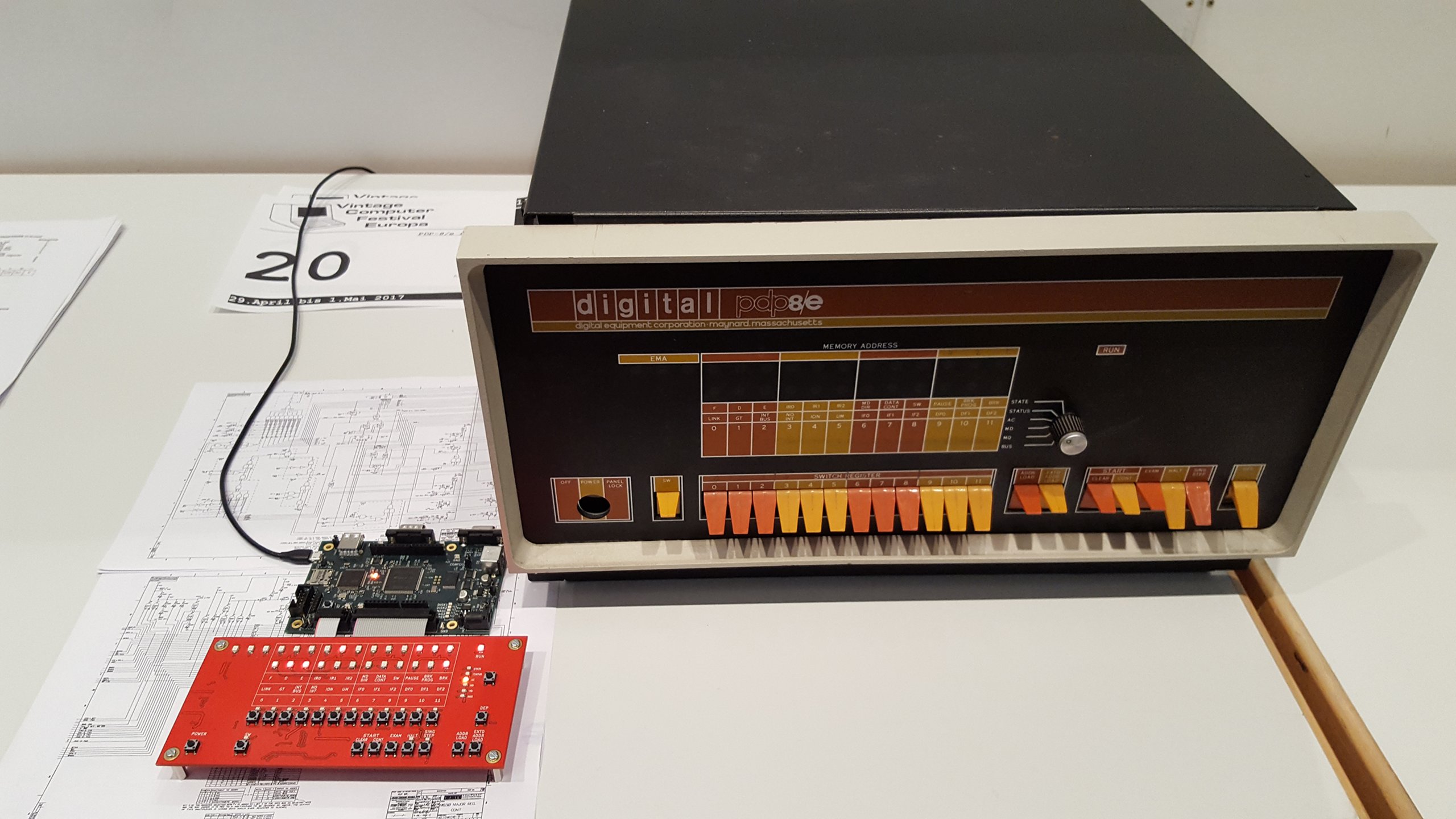
My implementation on display next to a real PDP-8/e at VCFe 18.0

The Original DEC started the PDP-8 line of computers programmed data processors designed as low cost machines in 1965. It is a quite minimalist 12 bit architecture based on the earlier PDP-5, and by minimalist I mean seriously minimal. If you are familiar with early 8 bit microprocessors like the 6502 or 8080 you will find them luxuriously equipped in comparison. The PDP-8 base architecture has a program counter (PC) and an accumulator (AC)1. That s it. There are no pointer or index registers2. There is no stack. It has addition and AND instructions but subtractions and OR operations have to be manually coded. The optional Extended Arithmetic Element adds the MQ register but that s really it for visible registers. The Wikipedia page on the PDP-8 has a good detailed description. Regarding technology, the PDP-8 series has been in production long enough to get the whole range of implementations from discrete transistor logic to microprocessors. The 8/e which I target was right in the middle, implemented in TTL logic where each IC contains multiple logic elements. This allowed the CPU itself (including timing generator) to fit on three large circuit boards plugged into a backplane. Complete systems would have at least another board for the front panel and multiple boards for the core memory, then additional boards for whatever options and peripherals were desired.

Design Choices and Comparisons I m not the only one who had the idea to build something like that, of course. Among the other modern PDP-8 implementations with a front panel, probably the most prominent project is the Spare Time Gizmos SBC6120 which is a PDP-8 single board computer built around the Harris/Intersil HD-6120 microprocessor, which implementes the PDP-8 architecture, combined with a nice front panel. Another is the PiDP-8/I, which is another nice front panel (modeled after the 8/i which has even more lights) driven by the simh simulator running under Linux on a Raspberry Pi. My goal is to get front panel lights that appear exactly like the real ones in operation. This necessitates driving the lights at full speed as they change with every instruction or even within instructions for some display selections. For example, if you run a tight loop that does nothing but increment AC while displaying that register, it would appear that all lights are lit at equal but less than full brightness. The reason is that the loop runs at such a high speed that even the most significant bit, which is blinking the slowest, is too fast to see flicker. Hence they are all effectively 50% on, just at different frequencies, and appear to be constantly light at the same brightness. This is where the other projects lack what I am looking for. The PiDP-8/I is a multiplexed display which updates at something like 30 Hz or 60 Hz, taking whatever value is current in the simulation software at the time. All the states the lights took inbetween are lost and consequently there is flickering where there shouldn t be. On the SBC6120 at least the address lines appear to update at full speed as these are the actual RAM address lines. However the used 6120 microprocessor does not have required data for the indicator display externally available. Instead, the SBC6120 runs an interrupt at 30 Hz to trap into its firmware/monitor program which then reads the current state and writes it to the front panel display, which is essentially just another peripheral. A different considerable problem with the SBC6120 is its use of the 6100 microprocessor family ICs, which are themselves long out of production and not trivial (or cheaply) to come by. Given that the way to go is to drive all lights in step with every cycle3, this can be done by a software running on a dedicated microcontroller which is how I started or by implementing a real CPU with all the needed outputs in an FPGA which is the project I am writing about. In the next post I give an overview of the hardware I built so far and some of the features that are yet to be implemented.

  1. With an associated link bit which is a little different from a carry bit in that it is treated as a thirteenth bit, i.e. it will be flipped rather than set when a carry occurs. [return]
  2. Although there are 8 specially treated memory addresses that will pre-increment when used in indirect addressing. [return]
  3. Basic cycles on the PDP-8/e are 1.4 s for memory modifying cycles and fast cycles of 1.2 s for everything else. Instructions can be one to three cycles long. [return]

Steinar H. Gunderson: Frame queue management in Nageru 1.6.1

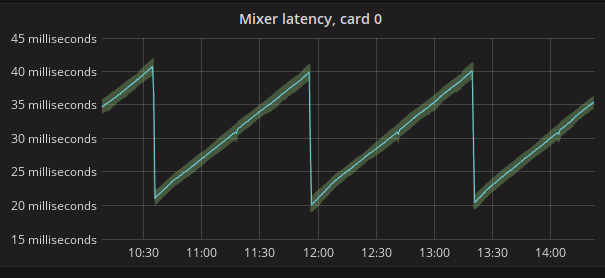
Nageru 1.6.1 is on its way, and what was intended to only be a release centered around monitoring improvements (more specifically a full set of native Prometheus] metrics) actually ended up getting a fairly substantial change to how Nageru manages its frame queues. To understand what's changing and why, it's useful to first understand the history of Nageru's queue management. Nageru 1.0.0 started out with a fairly simple scheme, but with some basics that are still relevant today: One of the input cards was deemed the master card, and whenever it delivers a frame, the master clock ticks and an output frame is produced. (There are some subtleties about dropped frames and/or the master card changing frame rates, but I'm going to ignore them, since they're not important to the discussion.) To this end, every card keeps a preallocated frame queue; when a card delivers a frame, it's put into the queue, and when the master clock ticks, it tries picking out one frame from each of the other card's queues to mix together. Note that mix here could be as simple as picking one input and throwing all the other ones away; the queueing algorithm doesn't care, it just feeds all of them to the theme and lets that run whatever GPU code it needs to match the user's preferences. The only thing that really keeps the queues bounded is that the frames in them are preallocated (in GPU memory), so if one queue gets longer than 16 frames, Nageru starts dropping it. But is 16 the right number? There are two conflicting demands here, ignoring memory usage: The 1.0.0 scheme does about as well as one could possibly hope in never dropping frames, but unfortunately, it can be pretty poor at latency. For instance, if your master card runs at 50 Hz and you have a 60 Hz card, the latter will eventually build up a delay of 16 * 16.7 ms = 266.7 ms clearly unacceptable, and rather unneeded. You could ask the user to specify a queue length, but the user probably doesn't know, and also shouldn't really have to care more knobs to twiddle are a bad thing, and even more so knobs the user is expected to twiddle. Thus, Nageru 1.2.0 introduced queue autotuning; it keeps a running estimate on how big the queue needs to be to avoid underruns, simply based on experience. If we've been dropping frames on a queue and then there's an underrun, the safe queue length is increased by one, and if the queue has been having excess frames for more than a thousand successive master clock ticks, we reduce it by one again. Whenever the queue has more than this safe number, we drop frames. This was simple, effective and largely fixed the problem. However, when adding metrics, I noticed a peculiar effect: Not all of my devices have equally good clocks. In particular, when setting up for 1080p50, my output card's internal clock (which assumes the role of the master clock when using HDMI/SDI output) seems to tick at about 49.9998 Hz, and my simple home camcorder delivers frames at about 49.9995 Hz. Over the course of an hour, this means it produces one more frame than you should have which should of course be dropped. Having an SDI setup with synchronized clocks (blackburst/tri-level) would of course fix this problem, but most people are not so lucky with their cameras, not to mention the price of PC graphics cards with SDI outputs! However, this happens very slowly, which means that for a significant amount of time, the two clocks will very nearly be in sync, and thus racing. Who ticks first is determined largely by luck in the jitter (normal is maybe 1ms, but occasionally, you'll see delayed delivery of as much as 10 ms), and this means that the 1000 frames estimate is likely to be thrown off, and the result is hundreds of dropped frames and underruns in that period. Once the clocks have diverged enough again, you're off the hook, but again, this isn't a good place to be. Thus, Nageru 1.6.1 change the algorithm around yet again, by incorporating more data to build an explicit jitter model. 1.5.0 was already timestamping each frame to be able to measure end-to-end latency precisely (now also exposed in Prometheus metrics), but from 1.6.1, they are actually used in the queueing algorithm. I ran several eight- to twelve-hour tests and simply stored all the event arrivals to a file, and then simulated a few different algorithms (including the old algorithm) to see how they fared in measures such as latency and number of drops/underruns. I won't go into the full details of the new queueing algorithm (see the commit if you're interested), but the gist is: Based on the last 5000 frames, it tries to estimate the maximum possible jitter for each input (ie., how late the frame could possibly be). Based on this as well as clock offsets, it determines whether it's really sure that there will be an input frame available on the next master tick even if it drops the queue, and then trims the queue to fit. The result is pretty satisfying; here's the end-to-end latency of my camera being sent through to the SDI output: As you can see, the latency goes up, up, up until Nageru figures it's now safe to drop a frame, and then does it in one clean drop event; no more hundreds on drops involved. There are very late frame arrivals involved in this run two extra frame drops, to be precise but the algorithm simply determines immediately that they are outliers, and drops them without letting them linger in the queue. (Immediate dropping is usually preferred to sticking around for a bit and then dropping it later, as it means you only get one disturbance event in your stream as opposed to two. Of course, you can only do it if you're reasonably sure it won't lead to more underruns later.) Nageru 1.6.1 will ship before Solskogen, as I intend to run it there :-) And there will probably be lovely premade Grafana dashboards from the Prometheus data. Although it would have been a lot nicer if Grafana were more packaging-friendly, so I could pick it up from stock Debian and run it on armhf. Hrmf. :-)

Shirish Agarwal: Dreams don t cost a penny, mumma s boy :)

This one I promise will be short  After the last two updates, I thought it was time for something positive to share. While I m doing the hard work (of physiotherapy which is gruelling), the only luxury I have nowadays is of falling on to dreams which are also rare. The dream I m going to share is totally unrealistic as my mum hates travel but I m sure many sons and daughters would identify with it. Almost all travel outside of relatives is because I dragged her onto it. In the dream, I am going to a Debconf, get bursary and the conference is being held somewhere in Europe, maybe Paris (2019 probably)  . I reach and attend the conference, present and generally have a great time sharing and learning from my peers. As we all do in these uncertain times, I too phone home every couple of days ensuring her that I m well and in best of health. The weather is mild like it was in South Africa and this time I had come packed with woollens so all was well. Just the day before the conference is to end, I call up mum and she tells about a specific hotel/hostel which I should check out. I am somewhat surprised that she knows of a specific hotel/hostel in a specific place but I accede to her request. I go there to find a small, quiet, quaint bed & breakfast place (dunno if Paris has such kind of places), something which my mum would like. Intuitively, I ask at the reception to look in the register. After seeing my passport, he too accedes to my request and shows me the logbook of all visitors registering to come in the last few days (for some reason privacy is not a concern then) . I am surprised to find my mother s name in the register and she had turned up just a day or two before. I again request the reception to be able to go to room abcd without being announced and have some sort of key (like for maintenance or laundry as an excuse) . The reception calls the manager and after looking copy of mother s passport and mine they somehow accede to the request with help located nearby just in case something goes wrong. I disguise my voice and announce as either Room service or Maintenance and we are both surprised and elated to see each other. After talking a while, I go back to the reception and register myself as her guest. The next week is a whirlwind as I come to know of hop-on, hop-off buses similar service in Paris as was in South Africa. I buy a small booklet and we go through all the museums. the vineyards or whatever it is that Paris has to offer. IIRC there is also a lock and key on a famous bridge. We also do that. She is constantly surprised at the different activities the city shows her and the mother-son bond becomes much better. I had shared the same dream with her and she laughed. In reality, she is happy and comfortable in the confines of her home. Still I hope some mother-daughter, son-father, son-mother or any combination of parent, sibling takes this entry and enrich each other by travelling together.
Filed under: Miscellenous Tagged: #dream, #mother, #planet-debian, travel

23 June 2017

Jonathan Dowland: WD drive head parking update

An update for my post on Western Digital Hard Drive head parking: disabling the head-parking completely stopped the Load_Cycle_Count S.M.A.R.T. attribute from incrementing. This is probably at the cost of power usage, but I am not able to assess the impact of that as I'm not currently monitoring the power draw of the NAS (Although that's on my TODO list).

22 June 2017

Steve McIntyre: -1, Trolling

Here's a nice comment I received by email this morning. I guess somebody was upset by my last post?
From: Tec Services <tecservices911@gmail.com>
Date: Wed, 21 Jun 2017 22:30:26 -0700
To: steve@einval.com
Subject: its time for you to retire from debian...unbelievable..your
         the quality guy and fucked up the installer!
i cant ever remember in the hostory of computing someone releasing an installer
that does not work!!
wtf!!!
you need to be retired...due to being retarded..
and that this was dedicated to ian...what a
disaster..you should be ashames..he is probably roling in his grave from shame
right now....
It's nice to be appreciated.

21 June 2017

Joey Hess: DIY professional grade solar panel installation

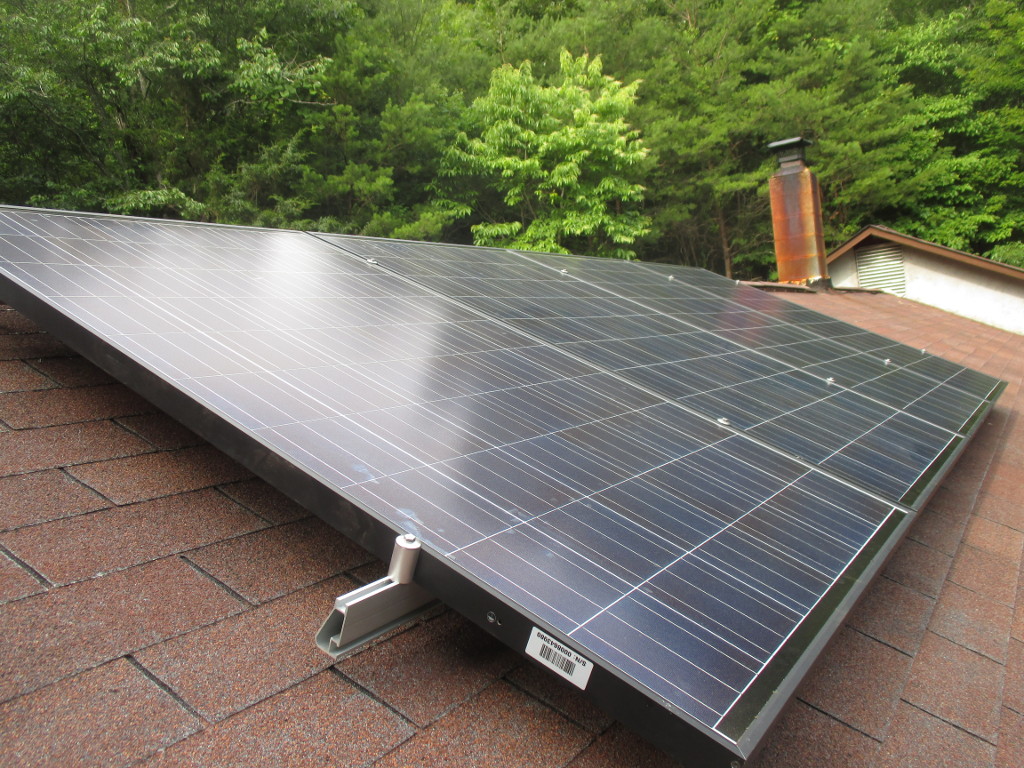
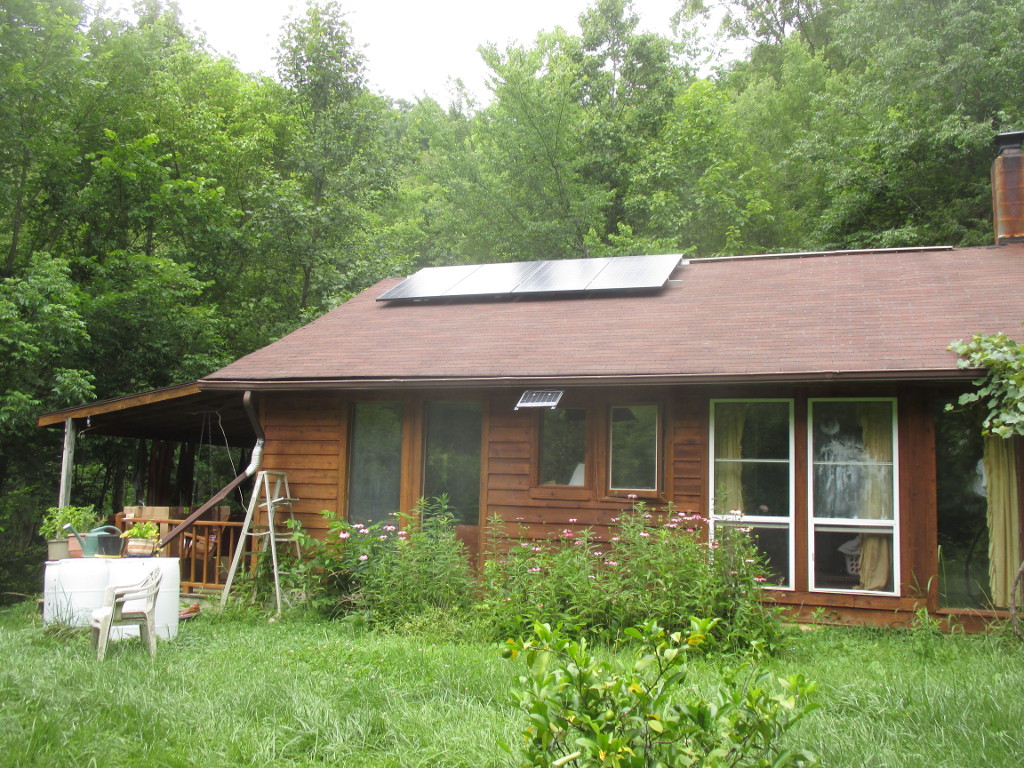
I've installed 1 kilowatt of solar panels on my roof, using professional grade eqipment. The four panels are Astronergy 260 watt panels, and they're mounted on IronRidge XR100 rails. Did it all myself, without help. house with 4 solar panels on roof I had three goals for this install:
  1. Cheap but sturdy. Total cost will be under $2500. It would probably cost at least twice as much to get a professional install, and the pros might not even want to do such a small install.
  2. Learn the roof mount system. I want to be able to add more panels, remove panels when working on the roof, and understand everything.
  3. Make every day a sunny day. With my current solar panels, I get around 10x as much power on a sunny day as a cloudy day, and I have plenty of power on sunny days. So 10x the PV capacity should be a good amount of power all the time.
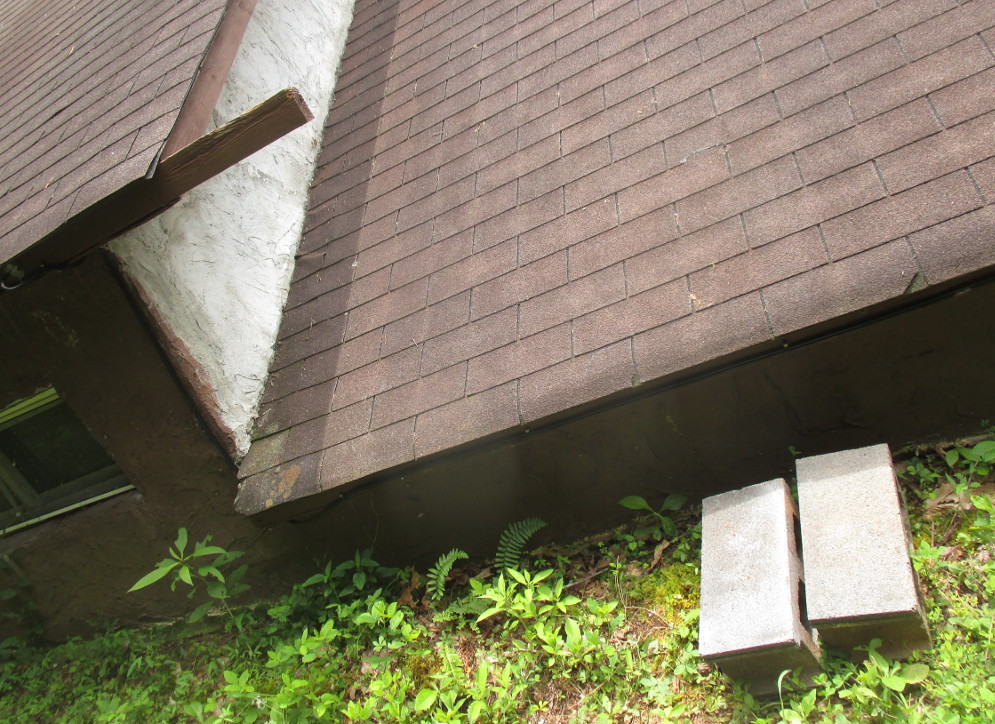
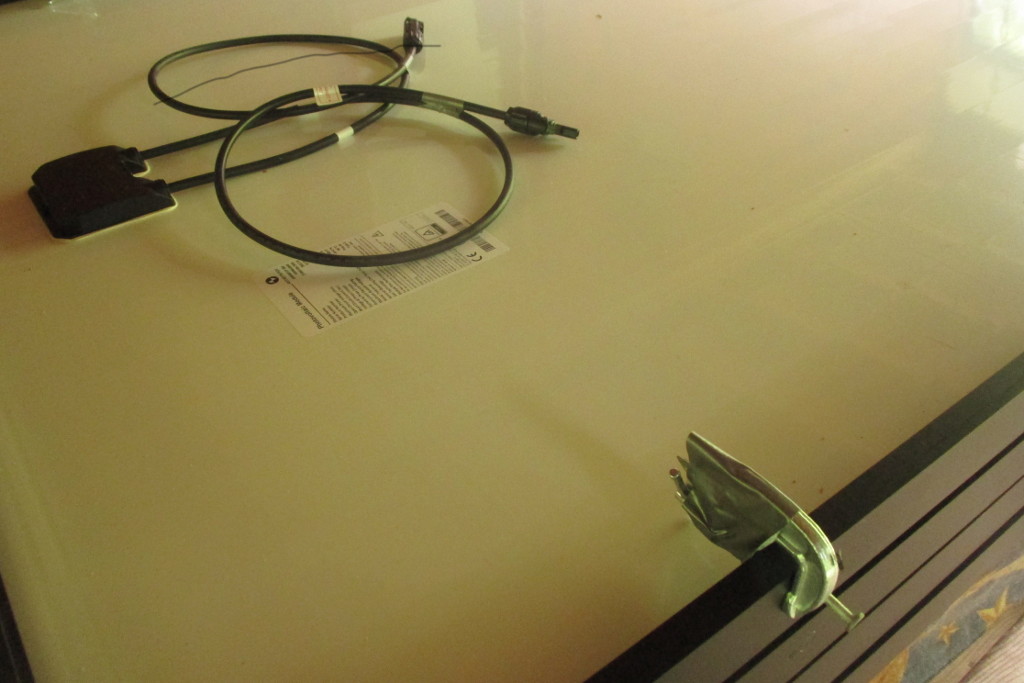
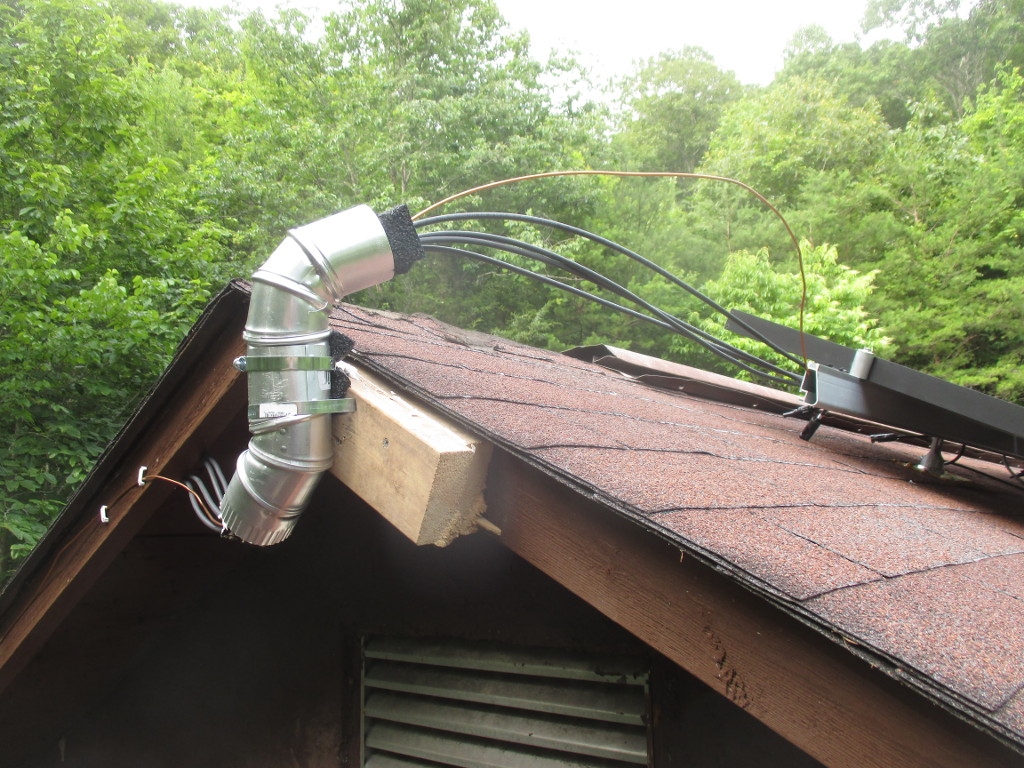
My main concerns were, would I be able to find the rafters when installing the rails, and would the 5x3 foot panels be too unweildly to get up on the roof by myself. I was able to find the rafters, without needing a stud finder, after I removed the roof's vent caps, which exposed the rafters. The shingles were on straight enough that I could follow the lines down and drilled into the rafter on the first try every time. And I got the rails on spaced well and straight, although I could have spaced the FlashFeet out better (oops). My drill ran out of juice half-way, and I had to hack it to recharge on solar power, but that's another story. Between the learning curve, a lot of careful measurement, not the greatest shoes for roofing, and waiting for recharging, it took two days to get the 8 FlashFeet installed and the rails mounted. Taking a break from that and swimming in the river, I realized I should have been wearing my water shoes on the roof all along. Super soft and nubbly, they make me feel like a gecko up there! After recovering from an (unrelated) achilles tendon strain, I got the panels installed today. Turns out they're not hard to handle on the roof by myself. Getting them up a ladder to the roof by yourself would normally be another story, but my house has a 2 foot step up from the back retaining wall to the roof, and even has a handy grip beam as you step up. roof next to the ground with a couple of cinderblock steps The last gotcha, which I luckily anticipated, is that panels will slide down off the rails before you can get them bolted down. This is where a second pair of hands would have been most useful. But, I macguyvered a solution, attaching temporary clamps before bringing a panel up, that stopped it sliding down while I was attaching it. clamp temporarily attached to side of panel I also finished the outside wiring today. Including the one hack of this install so far. Since the local hardware store didn't have a suitable conduit to bring the cables off the roof, I cobbled one together from pipe, with foam inserts to prevent chafing. some pipe with 5 wires running through it, attached to the side of the roof While I have 1 kilowatt of power on my roof now, I won't be able to use it until next week. After ordering the upgrade, I realized that my old PWM charge controller would be able to handle less than half the power, and to get even that I would have needed to mount the fuse box near the top of the roof and run down a large and expensive low-voltage high-amperage cable, around OO AWG size. Instead, I'll be upgrading to a MPPT controller, and running a single 150 volt cable to it. Then, since the MPPT controller can only handle 1 kilowatt when it's converting to 24 volts, not 12 volts, I'm gonna have to convert the entire house over from 12V DC to 24V DC, including changing all the light fixtures and rewiring the battery bank...

Next.

Previous.