Search Results: "az"

31 March 2016

Steinar H. Gunderson: Signal

Signal is a pretty amazing app; it manages to combine great security with great simplicity. (It literally takes two minutes, even for an unskilled user, to set it up.) I looked at the Wikipedia article, and the list of properties the protocol provides is impressive; I had hardly any idea you would even want all of these. But I've tried to decode what they actually mean: (There are more guarantees and features for group chat.) Again, it's really impressive. Modern cryptography at its finest. My only two concerns is that it's too bound to telephone numbers (you can't have the same account on two devices, for instance it very closely mimics the SMS/MMS/POTS model in that regard), and that it's too clumsy to verify public keys for the IM part. It can show them as hex or do a two-way QR code scan, but there's no NFC support, and there's no way to read e.g. a series of plaintext words instead of the fingerprint. (There's no web of trust, but probably that's actually for the better.) I hear WhatsApp is currently integrating the Signal protocol (or might be done already it's a bit unclear), but for now, my bet is on Signal. Install it now and frustrate NSA. And get free SMS/MMS to other Signal users (which are growing in surprising numbers) while you're at it. :-)

Chris Lamb: Free software activities in March 2016

Here is my monthly update covering a large part of what I have been doing in the free software world (previously):
Debian
  • Presented Reproducible Builds - fulfilling the original promise of free software at FOSSASIA '16.
  • Uploaded libfiu (0.94-4), adding a patch from Logan Rose to fix a FTBFS with ld --as-needed.
My work in the Reproducible Builds project was also covered in more depth in Lunar's weekly reports (#44, #45, #46, #47).
LTS

This month I have been paid to work 7 hours on Debian Long Term Support (LTS). Whilst the LTS team will take over support from the Security Team on April 26, 2016, in the meantime I did the following:
  • Archived the squeeze distribution (via the FTPteam).
  • Assisted in preparing updates for python-django.
  • Helping end-users migrate to wheezy now that squeeze LTS has reached end-of-life.


FTP Team

As a Debian FTP assistant I ACCEPTed 143 packages: acme-tiny, berkshelf-api, circlator, cloud-utils, corsix-th, cronic, diaspora-installer, dub, dumb-init, firehol, firetools, flask-bcrypt, flask-oldsessions, flycheck, ganeti, geany-plugins, git-build-recipe, git-phab, gnome-shell-extension-caffeine, gnome-shell-extension-mediaplayer, golang-github-cheggaaa-pb, golang-github-coreos-ioprogress, golang-github-cyberdelia-go-metrics-graphite, golang-github-cznic-ql, golang-github-elazarl-goproxy, golang-github-hashicorp-hil, golang-github-mitchellh-go-wordwrap, golang-github-mvdan-xurls, golang-github-paulrosania-go-charset, golang-github-xeipuuv-gojsonreference, golang-github-xeipuuv-gojsonschema, grilo-plugins, gtk3-nocsd, herisvm, identity4c, lemonldap-ng, libisal, libmath-gsl-perl, libmemcached-libmemcached-perl, libplack-middleware-logany-perl, libplack-middleware-logwarn-perl, libpng1.6, libqmi, librdf-generator-http-perl, libtime-moment-perl, libvirt-php, libxml-compile-soap-perl, libxml-compile-wsdl11-perl, linux, linux-tools, mdk-doc, mesa, mpdecimal, msi-keyboard, nauty, node-addressparser, node-ansi-regex, node-argparse, node-array-find-index, node-base62, node-co, node-component-consoler, node-crypto-cacerts, node-decamelize, node-delve, node-for-in, node-function-bind, node-generator-supported, node-invert-kv, node-json-localizer, node-normalize-git-url, node-nth-check, node-obj-util, node-read-file, node-require-dir, node-require-main-filename, node-seq, node-starttls, node-through, node-uid-number, node-uri-path, node-url-join, node-xmlhttprequest-ssl, ocrmypdf, octave-netcdf, open-infrastructure-container-tools, osmose-emulator, pdal, pep8, pg-backup-ctl, php-guzzle, printrun, pydocstyle, pysynphot, python-antlr3, python-biom-format, python-brainstorm, python-django-adminsortable, python-feather-format, python-gevent, python-lxc, python-mongoengine, python-nameparser, python-pdal, python-pefile, python-phabricator, python-pika-pool, python-pynlpl, python-qtawesome, python-requests-unixsocket, python-saharaclient, python-stringtemplate3, r-cran-adegraphics, r-cran-assertthat, r-cran-bold, r-cran-curl, r-cran-data.table, r-cran-htmltools, r-cran-httr, r-cran-lazyeval, r-cran-mcmc, r-cran-openssl, r-cran-pbdzmq, r-cran-rncl, r-cran-uuid, rawtran, reel, ruby-certificate-authority, ruby-rspec-pending-for, ruby-ruby-engine, ruby-ruby-version, scribus-ng, specutils, symfony, tandem-mass, tdb, thrift, udfclient, vala, why3, wmaker, xdg-app & xiccd.

30 March 2016

Julien Danjou: The OpenStack Schizophrenia

When I started contributing to OpenStack, almost five years ago, it was a small ecosystem. There were no foundation, a handful of projects and you could understand the code base in a few days. Fast forward 2016, and it is a totally different beast. The project grew to no less than 54 teams, each team providing one or more deliverable. For example, the Nova and Swift team each one produces one service and its client, whereas the Telemetry team produces 3 services and 3 different clients. In 5 years, OpenStack went to a few IaaS projects, to 54 different teams tackling different areas related to cloud computing. Once upon a time, OpenStack was all about starting some virtual machines on a network, backed by images and volumes. Nowadays, it's also about orchestrating your network deployment over containers, while managing your application life-cycle using a database service, everything being metered and billed for. This exponential growth has been made possible with the decision of the OpenStack Technical Committee to open the gates with the project structure reform voted at the end of 2014. This amendment suppresses the old OpenStack model of "integrated projects" (i.e. Nova, Glance, Swift ). The big tent, as it's called, allowed OpenStack to land new projects every month, growing from the 20 project teams of December 2014 to the 54 we have today multiplying the number of projects by 2.7 in a little more than a year. Amazing growth, right? And this was clearly a good change. I sat at the Technical Committee in 2013, when projects were trying to apply to be "integrated", after Ceilometer and Heat were. It was painful to see how the Technical Committee was trying to assess whether new projects should be brought in or not. But what I notice these days, is how OpenStack is still stuck between its old and new models. On one side, it accepted a lot of new teams, but on the other side, many are considered as second-class citizens. Efforts are made to continue to build an OpenStack project that does not exist anymore. For example, there is a team trying to define what's OpenStack core, named DefCore. That is looking to define which projects are, somehow, actually OpenStack. This leads to weird situations, such as having non-DefCore projects seeing their doc rejected from installation guides. Again, I reiterated my proposal to publish documentation as part of each project code to solve that dishonest situation and put everything on a level playing field Some cross-projects specs are also pushed without implication of all OpenStack projects. For example, The deprecate-cli spec which proposes to deprecate command-line interface tools proposed by each project had a lot of sense in the old OpenStack sense, where the goal was to build a unified and ubiquitous cloud platform. But when you now have tens of projects with largely different scopes, this start making less sense. Still, this spec was merged by the OpenStack Technical Committee this cycle. Keystone is the first project to proudly force users to rely on openstack-client, removing its old keystone command line tool. I find it odd to push that specs when it's pretty clear that some projects (e.g. Swift, Gnocchi ) have no intention to go down that path. Unfortunately, most specs pushed by the Technical Committee are in the realm of wishful thinking. It somehow makes sense, since only a few of the members are actively contributing to OpenStack projects, and they can't by themselves implement all of that magically. But OpenStack is no exception in the free software world and remains a do-ocracy. There is good cross-project content in OpenStack, such as the API working group. While the work done should probably not be OpenStack specific, there's a lot that teams have learned by building various HTTP REST API with different frameworks. Compiling this knowledge and offering it as a guidance to various teams is a great help. My fellow developer Chris Dent wrote a post about what he would do on the Technical Committee. In this article, he points to a lot of the shortcomings I described here, and his confusion between OpenStack being a product or being a kit is quite understandable. Indeed, the message broadcasted by OpenStack is still very confusing after the big tent openness. There's no enough user experience improvement being done. The OpenStack Technical Committee election is opened for April 2016, and from what I read so far, many candidates are proposing to now clean up the big tent, kicking out projects that do not match certain criteria anymore. This is probably a good idea, there is some inactive project laying around. But I don't think that will be enough to solve the identity crisis that OpenStack is experiencing. So this is why, once again this cycle, I will throw my hat in the ring and submit my candidacy for OpenStack Technical Committee.

29 March 2016

Vincent Fourmond: Release 0.14.1 of ctioga2

With the (relatively, sorry) recent switch to ruby2.3 as default Ruby version, I realized that my plotting program ctioga2 crashed with ruby 2.3 (due to a rather ugly lazy hack). I have just fixed this in release 0.14.1. Update as usual with:
~ gem update ctioga2
If you're not using Ruby 2.3, you probably don't need to update soon, though. Enjoy !

28 March 2016

Lars Wirzenius: Obnam user survey, 2016

In January and February of 2016 I ran an Obnam user survey. I'm not a statistician, but here is my analysis of the results. Executive summary: Obnam is slow, buggy, and the name is bad. But they'd like to buy stickers and t-shirts. Method I wrote up a long list of questions about things I felt were of interest to me. I used Google Forms to collect responses, and exported them as a CSV file, and analysed based on that. I used Google Forms, even though it is not free software, as it was the easiest service I got to work that also seemed it'd be nice for people to use. I could have run the survey using Ikiwiki, but it wouldn't have been nearly as nice. I could have found and hosted some free software for this, but that would have been much more work. Most questions had free form text responses, and this was both good and bad. It was good, because many of the responses included things I could never have expected. It was bad, because it took me a lot more time and effort to process those. I think next time I'll keep the number of free text responses down. For some of the questions, I hand-processed the responses to a more or less systematic form, in order to count things with a bit of code. For others, I did not, and show the full list of responses (I'm lazy, we don't need a survey to determine that). The responses See http://code.liw.fi/obnam/survey-2016.html for the responses, after hand-processing. For the questions for which it makes sense, a script has tabulated the various responses and calculated percentages. I haven't produced graphs, as I don't know how to do that easily. (Maybe next time I'll enlist the help of statisticians.) Conclusions

27 March 2016

Lunar: Reproducible builds: week 48 in Stretch cycle

What happened in the reproducible builds effort between March 20th and March 26th:

Toolchain fixes
  • Sebastian Ramacher uploaded breathe/4.2.0-1 which makes its output deterministic. Original patch by Chris Lamb, merged uptream.
  • Rafael Laboissiere uploaded octave/4.0.1-1 which allows packages to be built in place and avoid unreproducible builds due to temporary build directories appearing in the .oct files.
Daniel Kahn Gillmor worked on removing build path from build symbols submitting a patch adding -fdebug-prefix-map to clang to match GCC, another patch against gcc-5 to backport the removal of -fdebug-prefix-map from DW_AT_producer, and finally by proposing the addition of a normalizedebugpath to the reproducible feature set of dpkg-buildflags that would use -fdebug-prefix-map to replace the current directory with . using -fdebug-prefix-map. As succesful result of lobbying at LibrePlanet 2016, the --clamp-mtime option will be featured in the next Tar release. This option is likely to be used by dpkg-deb to implement deterministic mtimes for packaged files.

Packages fixed The following packages have become reproducible due to changes in their build dependencies: augeas, gmtkbabel, ktikz, octave-control, octave-general, octave-image, octave-ltfat, octave-miscellaneous, octave-mpi, octave-nurbs, octave-octcdf, octave-sockets, octave-strings, openlayers, python-structlog, signond. The following packages became reproducible after getting fixed: Some uploads fixed some reproducibility issues, but not all of them: Patches submitted which have not made their way to the archive yet:
  • #818742 on milkytracker by Reiner Herrmann: sorts the list of source files.
  • #818752 on tcl8.4 by Reiner Herrmann: sort source files using C locale.
  • #818753 on tk8.6 by Reiner Herrmann: sort source files using C locale.
  • #818754 on tk8.5 by Reiner Herrmann: sort source files using C locale.
  • #818755 on tk8.4 by Reiner Herrmann: sort source files using C locale.
  • #818952 on marionnet by ceridwen: dummy out build date and uname to make build reproducible.
  • #819334 on avahi by Reiner Herrmann: ship upstream changelog instead of the one generated by gettextize (although duplicate of #804141 by Santiago Vila).

tests.reproducible-builds.org i386 build nodes have been setup by converting 2 of the 4 amd64 nodes to i386. (h01ger)

Package reviews 92 reviews have been removed, 66 added and 31 updated in the previous week. New issues: timestamps_generated_by_xbean_spring, timestamps_generated_by_mangosdk_spiprocessor. Chris Lamb filed 7 FTBFS bugs.

Misc. On March 20th, Chris Lamb gave a talk at FOSSASIA 2016 in Singapore. The very same day, but a few timezones apart, h01ger did a presentation at LibrePlanet 2016 in Cambridge, Massachusetts. Seven GSoC/Outreachy applications were made by potential interns to work on various aspects of the reproducible builds effort. On top of interacting with several applicants, prospective mentors gathered to review the applications. Huge thanks to Linda Naeun Lee for the new hackergotchi visible on Planet Debian.

Chris Lamb: Generating dynamic Python tests using metaclasses

One common testing anti-pattern is a single testcase that loops over multiple yet independent inputs:
from django.test import TestCase
class MyTests(TestCase):
    def test_all(self):
        for x in (
            'foo',
            'bar',
            'baz',
            # etc.
        ):
            self.assertEqual(test(x), None)

Whilst this code style typically occurs in an honourable attempt to avoid a DRY violation, these tests:
  1. Can only report the first failure
  2. Prevent individual inputs from being tested independently
  3. Are typically slower than their neighbours, or a performance hotspot generally
  4. Do not allow for parallel computation, a feature recently added to Django 1.9

(Note that whilst foo, bar, etc. are defined statically above for simplicity, the values could be determined dynamically by, for example, iterating over the filesystem.)
If you have such tests, consider splitting them out using a metaclass like so:
class MyTestsMeta(type):
    def __new__(cls, name, bases, attrs):
        for x in (
            'foo',
            'bar',
            'baz',
        ):
            attrs['test_%s' % x] = cls.gen(x)
        return super(MyTestsMeta, cls).__new__(cls, name, bases, attrs)
    @classmethod
    def gen(cls, x):
        # Return a testcase that tests  x .
        def fn(self):
            self.assertEqual(test(x), None)
        return fn
class MyTests(TestCase):
    __metaclass__ = MyTestsMeta
This has the effect of replacing the single testcase with individual test_foo, test_bar & test_baz testcases. Each test can then be run separately:
$ ./manage.py test myproject.myapp.tests.MyTests.test_baz
Creating test database for alias 'default'...
.
----------------------------------------------------------------------
Ran 1 test in 0.039s
OK
Destroying test database for alias 'default'...
... or we can test them all in parallel:
$ ./manage.py test myproject.myapp.tests.MyTests --parallel
Creating test database for alias 'default'...
.
----------------------------------------------------------------------
Ran 3 tests in 0.065s
OK
Destroying test database for alias 'default'...


You must ensure that the tests have unique names to avoid cases masking each other. In the above example we could simply use the input string itself, but if you have no obvious candidate you could try using Python's enumerate method to generate a unique, if somewhat opaque, suffix:
for idx, x in enumerate((
    'foo',
    'bar',
    'baz',
)):
    attrs['test_%d' % idx] = cls.gen(x)

One alternative approach to a metaclass is to generate the test methods and use setattr, to bind them to the TestCase class. However, using a metaclass:
  1. Is cleaner and/or more "Pythonic"
  2. Avoids a number of subtle pitfalls with parameter binding
  3. Prevents your TestCase class from being polluted with loop variables, etc.
  4. Can be composed or abstracted into reusable testing components


Note that you can still use setUp and all the other unittest.TestCase and django.test.TestCase methods as before:
from .utils import MyBaseTestCase # custom superclass
class MyTestsMeta(type):
    # <snip>
    @classmethod
    def gen(cls, x):
        def fn(self):
            self.assertRedirects(...)
        return fn
class MyTests(MyBaseTestCase):
    __metaclass__ = MyTestsMeta
    def setUp(self):
        super(MyTests, self).setUp()
        # Code here is run before every test
    def test_other(self):
        # Test some other functionality here


UPDATE: Stu Cox asked: Do you even need the metaclass, or could you do this with __new__ straight on the TestCase? Curiously, unittest does not initialise classes in the typical way if you do not explicitly define at least one test_ method.

26 March 2016

Gunnar Wolf: Yes! I can confirm that...

I am very very (very very very!) happy to confirm that... This year, and after many years of not being able to, I will cross the Atlantic. To do this, I will take my favorite excuse: Attending DebConf! So, yes, this image I am pasting here is as far as you can imagine from official promotional material. But, having bought my plane tickets, I have to start bragging about it ;-) In case it is of use to others (at least, to people from my general geographic roundabouts), I searched for plane tickets straight from Mexico. I was accepting my lack of luck, facing an over-36-hour trip(!!) and at very high prices. Most routes were Mexico- central_europe -Arab Emirates-South Africa... Great for collecting frequent-flier miles, but terrible for anything else. Of course, requesting a more logical route (say, via Sao Paulo in Brazil) resulted in a price hike to over US$3500. Not good. I found out that Mexico-Argentina tickets for that season were quite agreeable at US$800, so I booked our family vacation to visit the relatives, and will fly from there at US$1400. So, yes, in a 48-hr timespan I will do MEX-GRU-ROS, then (by land) Rosario to Buenos Aires, then AEP-GRU-JNB-CPT. But while I am at DebConf, Regina and the kids will be at home with the grandparents and family and friends. In the end, win-win with just an extra bit of jetlag for me ;-) I *really* expect flights to be saner for USians, Europeans, and those coming from further far away. But we have grown to have many Latin Americans, and I hope we can all meet in CPT for the most intense weeks of the year! See you all in South Africa!

17 March 2016

Enrico Zini: Enhanced xkcd password generator

gpw and xkcdpass have entered testing. How about putting them together?
#!/usr/bin/python3
import subprocess
import random
import re
re_spaces = re.compile(r"\s+")
def get_words(cmd):
    out = subprocess.check_output(cmd, universal_newlines=True)
    return (x for x in re_spaces.split(out) if x)
words = set()
words.update(get_words(["xkcdpass", "-c", "10"]))
for l in range(6, 9):
    words.update(get_words(["gpw", "10", str(l)]))
for i in range(7):
    print(" ".join(random.sample(words, 5)))
Let's check the results:
#!/usr/bin/python
from __future__ import print_function
from zxcvbn import password_strength
import sys
for line in sys.stdin:
    pw = line.strip()
    info = password_strength(pw)
    print(" pw :  crack_time_display   entropy ".format(pw=pw, **info))
$ xkcdpass -n 5 -c 7   ./checkpass
moribund fasten cologne enamor by-and-by: centuries 132.586
woolen leptonic pogrom roster Serra: centuries 127.145
shorthand Piman suctional elution unholy: centuries 119.809
Blackwell mauvish covey selenium finished: centuries 112.936
asthma bloat crenulate clean-cut cytoplasm: centuries 150.181
agreeable refined racism Captain Cyrenaic: centuries 104.28
Bothnia stagnant atomist these revise: centuries 97.91
$ gpw 7   ./checkpass
ncenspri: 11.0 days 33.903
orsterma: instant 19.54
entsssel: 14.0 hours 29.788
tempispi: instant 20.058
nidgersi: 14.0 hours 29.725
oligalin: 51.0 minutes 25.824
iseartio: 10.0 minutes 23.207
$ ./metapass   ./checkpass
herups icirop overdub oldster cingsape: centuries 147.265
mujahidin usufruct rition porky prignam: centuries 153.684
cannula irenics tableaux ntshed calcific: centuries 152.196
stopgap stale orthente Amazonia sharer: centuries 113.474
edudives mmingsso eremab prignam tableaux: centuries 147.354
tingei heroism Nathaniel cannula molasses: centuries 103.007
Torres blood lewdness prignam eremab: centuries 118.475
The strength, according to zxcvbn, seems only marginally better, and it's a wonderful way to grow a vocabulary of nonexisting words that can be dropped into cheap talk conversation to confuse the innocents.

13 March 2016

Antoine Beaupr : State of Mapping on the Debian Desktop

TL;DR: Mapbox Studio classic is not as good as Tilemill, Mapbox studio is very promising, but you still need to signup for access, and kosmtik seems to be working right now. Use kosmtik and help getting it in Debian.

The requirement I have been following the development of fascinating tools from the Development seed people, now seemingly all focused on the Mapbox brand. They created what seemed to me a revolutionary desktop tool called Tilemill. Tilemill allowed you to create custom map stylesheets on your desktop to outline specific areas or patterns or "things". My interest was to create outdoor maps - OSM has pretty good biking maps, but no generic outdoor tiles out there (I need stuff for skiing, canoeing, biking)... Mapbox has Mapbox outdoors but that's a paid plan as well. Oh and there's a place to download Garmin data files especially made for outdoors as well, and that could be loaded in Qmapshack, but they don't have coverage in Canada at all. Besides, I would like to print maps, I know, crazy... So I have been looking forward to seeing Tilemill packaged in Debian given how annoying it is to maintain Node apps (period). Unfortunately, by the time Debian people figured out all the Node dependencies, the Tilemill project stopped and has been stalled since 2012. It seems the Mapbox people have now been working on other products, and in the meantime, the community, scratching their heads, just switched to other projects.

Overview of alternatives I wrote this long post to the Debian bugtrackers to try to untangle all of this, but figured this would be interesting to a wider community than the narrow group of people working on Javascript packages, so I figured I would send this on Debian planet. So Here's a summary of what happened so far, after Tilemill development stopped. Hang on to your tiles boys and girls, there's a lot going on!

Mapbox Studio classic Mapbox people have released a new product in September 2014 named Mapbox studio classic. The code is still freely available and seems to be a fork of tilemill. Mapbox classic still has releases on github, last one is from November 2015. It looks like Mapbox studio classic has some sort of Mapbox.com lock-in, and there are certainly new copyright issues, if only with the bundled fonts, but it could probably be packaged after addressing those issues. There is an ITP for Mapbox Studio classic as well.

Mapbox Studio Then there's Mapbox Studio, which is a full rewrite of Mapbox Studio classic. You need to "signup" somehow to get access, even though parts of the code are free, namely the Mapbox GL studio project. It is an interesting project because it aims to make all this stuff happen in a web browser, which means it "should" work everywhere. Unfortunately for us, it means it doesn't work anywhere without a signup form, so that's out for me at least. There is an [ITP for Mapbox-studio][] yet it is unclear to me what that one means because the source code to Mapbox-studio doesn't seem to be available, as far as i can tell (and the ITP doesn't say either). That is actually the ITP for Mapbox studio classic.

Kosmtik The Openstreetmap-carto developers have mostly switched to kosmtik instead of Mapbox. Kosmtik is another Node desktop app that seems fairly lightweight and mostly based on plugins. Ross has an ITP for kosmtik. The package is waiting on other node dependencies to be uploaded (yes, again).

The future of Tilemill And there's still this RFP for tilemill, which should probably be closed now because the project seems dead and plenty of alternatives exist. I wonder if node some dependencies that were packaged for Tilemill actually now need to be removed from Debian, because they have become useless leaf packages... I am leaving the Tilemill RFP open for someone to clean that up.

CartoCSS Oh, and finally one could mention another Mapbox project, Carto, a command line CSS tools that implements some sort of standard CSS language that all those tools end up using to talk to Mapnik, more or less. There are no RFPs for that.

Bits from Debian: Debian selected to participate in the Google Summer of Code

GSoC 2016 logo For the tenth time running, Debian has been selected as a mentoring organization for the Google Summer of Code (Debian-specific program page), an internship program open to university students aged 18 and up. Our team of amazing mentors has cooked up an exciting list of projects this year, and we would be glad to have you on board with Debian for one of those summer internships. The student application period will open on March 14 (and close on March 25), but feel free to subscribe to our mailing list and get in touch with our mentors. You can also catch us on our IRC channel #debian-soc.

Siri Reiter: The good life

It doesn't matter if I'm messy or lazy or don't reach my goals, or if I do. What matters is to feel good about what I do. I feel good when I do what's important to me. Resistance is about uncertainty. It's natural. So I try to relax about it. Take a bite and try it out anyway. Or take a break before I dive in.

11 March 2016

Steinar H. Gunderson: Agon and the Candidates tournament

The situation where Agon (the designated organizer of the Chess World Championship, and also the Candidates tournament, the prequalifier to said WC) is trying to claim exclusive rights of the broadcasting of the moves (not just the video) is turning bizarre. First of all, they have readily acknowledged they have no basis in copyright to do so; chess moves, once played, are facts and cannot be limited. They try to jump through some hoops with a New York-specific doctrine (even though the Candidates, unlike the World Championship, is played in Moscow) about hot news , but their main weapon seems to be that they simply will throw out anyone from the hall who tries to report on the moves, and then try to give them only to those that promise not to give them on. This leads to the previously unheard-of situation where you need to register and accept their terms just to get to watch the games in your browser. You have to wonder what they will be doing about the World Championship, which is broadcast unencrypted on Norwegian television (previous editions also with no geoblock). Needless to say, this wasn't practically possible to hold together. All the big sites (like Chessdom, ChessBomb and Chess24) had coverage as if nothing had happened. Move sourcing is a bit of a murky business where nobody really wants to say where they get the moves from (although it's pretty clear that for many tournaments, the tournament organizers will simply come to one or more of the big players with an URL they can poll at will, containing the games in the standard PGN format), and this was no exception ChessBomb went to the unusual move of asking their viewers to download Tor and crowdsource the moves, while Chessdom and Chess24 appeared to do no such thing. In fact, unlike Chessdom and ChessBomb, Chess24 didn't seem to say a thing about the controversy, possibly because they now found themselves on the other side of the fence from Norway Chess 2015, where they themselves had exclusive rights to the PGN in a similar controversy although it would seem from a tweet that they were perfectly okay with people just re-broadcasting from their site if they paid for a (quite expensive) premium membership, and didn't come up with any similar legal acrobatics to try to scare other sites. However, their ToS were less clear on the issue, and they didn't respond to requests for clarification at the time, so I guess all of this just continues to be on some sort of gentleman's agreement among the bigger players. (ChessBomb also provides PGNs for premium members for the tournaments they serve, but they expressly prohibit rebroadcast. They claim that for the tournaments they host, which is a small minority, they provide free PGNs for all.) Agon, predictably, sent out angry letters where they threatened to sue the sites in question, although it's not clear at all to me what exactly they would sue for. Nobody seemed to care, except one entity TWIC, which normally has live PGNs from most tournaments, announced they would not be broadcasting from the Candidats tournament. This isn't that unexpected, as TWIC (which is pretty much a one-man project anyway) mainly is about archival, where they publish weekly dumps of all top-level games played that week. This didn't affect a lot of sites, though, as TWIC's live PGNs are often not what you'd want to base a top-caliber site on (they usually lack clock information, and moves are often delayed by half a minute or so). I run a hobby chess relay/analysis site myself (mainly focusing on the games of Magnus Carlsen), though, so I've used TWIC a fair bit in the past, and if I were to cover the Candidates tournament (I don't plan to do so, given Agon's behavior, although I plan to cover the World Championship itself), I might have been hit by this. So, that was the background. The strange part started when worldchess.com, Agon's broadcasting site, promptly went down during the first round of the Candidates tournament today Agon blamed DDoS, which I'm sure is true, but it's unclear exactly how strong the DDoS was, and if they did anything at all to deal with it other than to simply wait it out. But this lead to the crazy situation where the self-declared monopolist was the only big player not broadcasting the tournament in some form. And now, in the trully bizarre move, World Chess is publishing a detailed rebuttal of Agon's arguments, explaining how it is bad for chess, not juridically sound, and also morally wrong. Yes, you read that right; Agon's broadcast site is carrying an op-ed saying Agon is wrong. You at least have to give them credit for not trying to censor their columinst when he says something they don't agree with. Oh, and if you want those PGNs? I will, at least for the time being, be pushing them out live on http://pgn.sesse.net/. I have not gone into any agreement with Agon, and they're hosted in Norway, far from any New York-specific doctrines. So feel free to relay from them, although I would of course be happy to know if you do.

10 March 2016

Lunar: Reproducible builds: week 45 in Stretch cycle

What happened in the reproducible builds effort between February 28th and March 5th:

Toolchain fixes
  • Antonio Terceiro uploaded gem2deb/0.27 that forces generated gemspecs to use the date from debian/changelog.
  • Antonio Terceiro uploaded gem2deb/0.28 that forces generated gemspecs to have their contains file lists sorted.
  • Robert Luberda uploaded ispell/3.4.00-5 which make builds of hashes reproducible.
  • C dric Boutillier uploaded ruby-ronn/0.7.3-4 which will make the output locale agnostic. Original patch by Chris Lamb.
  • Markus Koschany uploaded spring/101.0+dfsg-1. Fixed by Alexandre Detiste.
Ximin Luo resubmitted the patch adding the --clamp-mtime option to Tar on Savannah's bug tracker. Lunar rebased our experimental dpkg on top of the current master branch. Changes in the test infrastructure are required before uploading a new version to our experimental repository. Reiner Herrmann rebased our custom texlive-bin against the latest uploaded version.

Packages fixed The following 77 packages have become reproducible due to changes in their build dependencies: asciidoctor, atig, fuel-astute, jekyll, libphone-ui-shr, linkchecker, maven-plugin-testing, node-iscroll, origami-pdf, plexus-digest, pry, python-avro, python-odf, rails, ruby-actionpack-xml-parser, ruby-active-model-serializers, ruby-activerecord-session-store, ruby-api-pagination, ruby-babosa, ruby-carrierwave, ruby-classifier-reborn, ruby-compass, ruby-concurrent, ruby-configurate, ruby-crack, ruby-css-parser, ruby-cucumber-rails, ruby-delorean, ruby-encryptor, ruby-fakeweb, ruby-flexmock, ruby-fog-vsphere, ruby-gemojione, ruby-git, ruby-grack, ruby-htmlentities, ruby-jekyll-feed, ruby-json-schema, ruby-listen, ruby-markerb, ruby-mathml, ruby-mini-magick, ruby-net-telnet, ruby-omniauth-azure-oauth2, ruby-omniauth-saml, ruby-org, ruby-origin, ruby-prawn, ruby-pygments.rb, ruby-raemon, ruby-rails-deprecated-sanitizer, ruby-raindrops, ruby-rbpdf, ruby-rbvmomi, ruby-recaptcha, ruby-ref, ruby-responders, ruby-rjb, ruby-rspec-rails, ruby-rspec, ruby-rufus-scheduler, ruby-sass-rails, ruby-sass, ruby-sentry-raven, ruby-sequel-pg, ruby-sequel, ruby-settingslogic, ruby-shoulda-matchers, ruby-slack-notifier, ruby-symboltable, ruby-timers, ruby-zip, ticgit, tmuxinator, vagrant, wagon, yard. The following packages became reproducible after getting fixed: Some uploads fixed some reproducibility issues, but not all of them: Patches submitted which have not made their way to the archive yet:
  • #816209 on elog by Reiner Herrmann: use printf instead of echo which is shell-independent.
  • #816214 on python-pip by Reiner Herrmann: removes timestamp from generated Python scripts.
  • #816230 on rows by Reiner Herrmann: tell grep to always treat the input as text.
  • #816232 on eficas by Reiner Herrmann: use printf instead of echo which is shell-independent.
Florent Daigniere and bancfc reported that linux-grsec was currently built with GRKERNSEC_RANDSTRUCT which will prevent reproducible builds with the current packaging.

tests.reproducible-builds.org pbuilder has been updated to the last version to be able to support Build-Depends-Arch and Build-Conflicts-Arch. (Mattia Rizzolo, h01ger) New package sets have been added for Subgraph OS, which is based on Debian Stretch: packages and build dependencies. (h01ger) Two new armhf build nodes have been added (thanks Vagrant Cascadian) and integrated in our Jenkins setup with 8 new armhf builder jobs. (h01ger)

strip-nondeterminism development strip-nondeterminism version 0.016-1 was released on Sunday 28th. It will now normalize the POT-Creation-Date field in GNU Gettext .mo files. (Reiner Herrmann) Several improvements to the packages metadata have also been made. (h01ger, Ben Finney)

Package reviews 185 reviews have been removed, 91 added and 33 updated in the previous week. New issue: fileorder_in_gemspec_files_list. 43 FTBFS bugs were reported by Chris Lamb, Martin Michlmayr, and gregor herrmann.

Misc. After merging the patch from Dhiru Kholia adding support for SOURCE_DATE_EPOCH in rpm, Florian Festi opened a discussion on the rpm-ecosystem mailing list about reproducible builds. On March 4th, Lunar gave an overview of the general reproducible builds effort at the Internet Freedom Festival in Valencia.

Antoine Beaupr : Trying out Keybase

I was privileged enough to get access to the alpha preview of Keybase.io. Last year, the project raised 11M$ in venture capital and they seem to be attacking the hard problems, so it is a serious project, worth considering for any cryptography hacker like me. This was obviously discussed elsewhere previously but since Keybase has evolved a bit since then, I figured it would be worth adding my grain of salt.

The elite alpha problem My first problem with Keybase was of course that I wasn't in the elite club of invited people. Somehow, I finally got in but the problem remains for the everyone else. In my case, it was the Keybase filesystem announcement that brought my attention back to the project, although I have yet to test that itself - yet another invite-only problem (need to email chris@keybase.io to get access, I guess). Still, 10GB of storage might be interesting for some people, but considering the number of hurdles or "friction", as they say, that needs to be jumped over to get access, I am not sure how much traction this will get for now. The project has been in alpha for a while now (more than a year) with no announced public beta just yet, which is way slower than similarly challenging projects with less capital. Let's encrypt, as a comparison, was publicly announced in 2014 and by the end of 2015, the public beta was opened.

Private key leakage My second major concern is that Keybase does worrisome things to private key material. If you tell it to import your regular GPG keys, it will copy them into the keybase keyring, which is already a problem: now you have two places where you store sensitive secrets. But worse, Keybase offers you to upload your private key material on the server, without clearly and explicitely exposing the potential risks that means to the user. The key, presumably, is encrypted (at least that is what I can parse from the Keybase privacy policy). Yet this is still a concern: a determined attacker (e.g. the government or another malicious entity) could force Keybase to give up the encrypted private key material and install sniffers that would reveal the passphrase that would allow decryption and impersonation of the related identity. That is a huge deal. This is what caused Hushmail's demise in 2007: they had similar promises about how they had a "secure" email (in this case) service based on OpenPGP, but since they key was stored on the server, they only had to serve a malicious applet to victims and were able to give cleartext data to the US government (12 CDs!) under a Mutual Legal Assistance Treaty with Canada. In Keybase, When I generate a new key, it asks me if I want to upload the key to their servers, and "Yes" is chosen as a default, so it is clearly a policy that is encouraged. This is presumably to enable browser-based crypto, yet this could be done by storing keys within the browser, not on the server. The mere possibility that the client can meddle with secret key material in such a way is a problem. Even if uploading secret keys to the server is optional, the fact that it is a possibility widens the attack surface on the client significantly. GPG has been working on isolating private key operations to a different process (gpg-agent) or smart cards, SSH has privilege seperation. The idea of uploading secret key material online is so beyond current practices that it should bring the project to a full stop already. My private key material is pretty sensitive. I am a Debian developer: if someone gets access to that key, they can upload arbitrary code for thousands of packages, affecting thousands if not millions of users. That is a huge deal, and I am not ready to give that power to an arbitrary third party that I know little about.

Privacy policy issues Furthermore, the Keybase privacy policy explicitely states that "Logs of this information may persist for an indefinite period", which include, and I quote:
  • Your computer s IP address
  • Your preferences and settings (time zone, language, privacy preferences, application preferences, etc.)
  • The URL of the site that referred you to the Service
  • The buttons and controls you clicked on (if any) within the Service
  • How long you used the Service and which parts and features you used
  • Session times and lengths
For a company working to improve user's privacy, this is a pretty bad policy. It exposes Keybase users to undue surveillance, on a lot of private information that is not necessary to operate the service. I haven't actually read the remaining of the policy, as I was already scared as hell and figure I would just log off for now and try not to add any extra personal information in that already growing pile. Let's mention, while I'm here, that the keybase commandline client has this odd way of working that it forks a daemon in the background all the time, even to run just keybase status. One has to wonder if this thing is included in the surveillance data above, which would make the keybase client an amazing surveillance device in itself. To stop all this, you need:
keybase logout
keybase ctl stop
Not quite obvious...

Usability issues Which brings me to a series of usability issues I have found while working with Keybase. Having worked on usability myself in the Monkeysphere project, I understand how hard those problems can be. But right now, the fact is that keybase is only a commandline client, with some web-based sugar sprinkled on top. I recognize the huge efforts that have been done to make the user experience (UX) as easy as possible through the commandline, but this is definitely not "grand public" material yet. Even as a OpenPGP hacker, Keybase can get confusing. Since it has its own separate keyring from GPG, things that used to be obvious before are suddenly new things to learn. For example, I originally generated a key for anarcat@debian.org in keybase, thinking it would be a separate thing from my current GPG identity. Well, that ended up creating a new key in my GPG keyring, duplicating my existing identity, with no way for me to tell this was a Keybase copy. This could have ended up on the keyservers and confuse anyone looking for my PGP key.

Revoking keys So I revoked that key, which, in itself, is not such an obvious process either. I first had to "drop" the key:
keybase pgp drop '010143572d4e438f457a7447c9758804cc7be44c1ee2b7915c3904567d0a3fb5cf590a'
To find that magic number, I had to go on the website and click through the PGP key to end up on the revoke link which told me which magic string to put. The web UI was telling me I could use keybase status to get that information, but I couldn't find that in the output here:
$ keybase status
Username:      anarcat
Logged in:     no
Device:
    name:      angela
    ID:        070f6a13f2a66afbb463f49dadfd4518
    status:    active
Keybase keys:  unlocked
Session:       anarcat [salt only]
KBFS:
    status:    not running
    version:
    log:       /home/anarcat/.cache/keybase/keybase.kbfs.log
Service:
    status:    running
    version:   1.0.14-1
    log:       /home/anarcat/.cache/keybase/keybase.service.log
Platform Information:
    OS:        linux
    Runtime:   go1.5.3
    Arch:      amd64
Client:
    version:   1.0.14-1
Desktop app:
    status:    not running
    version:
    log:       /home/anarcat/.cache/keybase/Keybase.app.log
Config path:   /home/anarcat/.config/keybase/config.json
Default user:  anarcat
Other users:
command-line client:
    keybase status [pid: 14562, version: 1.0.14-1]
So keybase drop "deletes" the key from the keybase client (and presumably the server). One problem here is that we have three different verbs to mean the same thing: in some places, the website says "deleted" (in the web graph), the commandline client uses "drop" and everyone else using PGP in the world uses "revoke". So what is it? Also note that just dropping that key is not enough to eradicate that key: you still need to generate and import a revocation certificate on GPG's side as well, for that key. This makes sense, because you may have imported that key and you may not want to destroy it when you remove it from keybase, but there could be a little better guessing and UX here as well.

Password usage Then another problem is that, when you signup on the commandline, it asks you to choose a passphrase. It's not clear at all from the UI what that passphrase is for. Is it to protect the private key material? To login the website? Both? It turns out it is actually to login to the website and the Keybase API. It could also be the key to the private key material, but I haven't quite figured that out yet. Similarly, the "paper devices" are a little confusing to me as well. The registration process is fairly insistent that I need to write a series of secret words down on a piece of paper and put it my wallet. This is based on the idea that you can use that key to recover your account and setup new devices. However, it is not made clear at all how those credentials should be protected or used. What if I lose my wallet? What do I do then? Is it okay if i write it on the back of my laptop instead? I know it sounds like stupid questions to crypto geek, but it's definitely stuff people will do, and education, at all levels, is necessary here.

The existing web of trust Finally, I found it surprisingly counter-intuitive to sign keys with keybase. I was assuming the whole point of the thing was to expand the web of trust, but it seems their mission lies somewhere else: there is no facility to sign keys directly in keybase. You sign statements on various social sites (Github, Twitter, Reddit...) but doing traditional key exchanges seems to be off limits. My obvious use case was to sign my existing key material with my newly generated anarcat@keybase.io key, so that keybase would become another way of verifying my identity. Well, this is not possible with keybase directly - you still have to go through the regular:
gpg --sign-key DEADBEEF
Which is really unfortunate, because some craaaazy people like me insist on doing in person, actually secure key exchanges sometimes, and the tools to do this right now (mainly gpg, caff and monkeysign) really need a lot of love and help. Keybase could have helped a lot in pushing those initiatives forward and bring new ways of doing secure key exchanges, instead of only lowering the standards on cryptographic identity.

Usual proprietary startup rant I can't help but finish by noticing that the whole basic problem with Keybase is more fundamental than a few usability issues, which can all be fixed fairly easily. Keybase.IO is a web-based service that is entirely proprietary. The client is freely downloadable and free software - but the server side is not. This makes us rely on a central point of failure and the goodwill of those operators to not only keep the service running (for free?) indefinitely, but to protect us against all attackers, state-run or otherwise. This is definitely against basic free software principles and the open architecture of the internet federation, well embodied in the Franklin street statement. Online services should be decentralized and open like the OpenPGP keyservers have always been, period.

Conclusion I am curious to see where Keybase brings us, as a community. So far, I am concerned about centralization and devaluation of the web of trust as cryptographic system. I do not believe that trusting multiple corporate social networking sites bring much benefit to our security, although it does improve usability significantly and is certainly better than TOFU, so that part of the project is definitely interesting, especially since it allows leveraging classical internet protocols like DNS and HTTPS. Key exchange is a critical problem that still hasn't properly been resolved in the cryptographic community. Most efforts at building communication tools (say like Signal or Telegram) mostly ignore the problem and expect people to read up strings of numbers or rely on synchronous communications (see the Axolotl rachet for Signal's take on it). Keybase's attempts at fixing this are great, but needs much more work to actually resolve the PKI issues in a significant way. More fundamentally, the practice of storing keys on the servers should just stop: it is a definite no go for me, and a classic crypto mistake that has bitten way too many people. In my mind, it discredits the whole project. The point of OpenPGP is end to end encryption across devices: storing the keys on a server breaks that apart, and doesn't improve much on the existing HTTPS security systems already in place on the web. It is especially a problem given the new waves of attacks on cryptography from western governments, from the UK to California... Until those issues are resolved, I can't get myself to recommend Keybase to anyone just yet.

Post-scriptum Note to Keybase developers: I have considered filing issues regarding the above, but unfortunately, I was unable to filter through the gigantic github issues list for duplicates, and didn't have time to file detailed reports for everything. I apologize for bypassing those usual conventions. If you want to try out Keybase to make your own opinion, I do have 4 invites I can give away, but I will do so only if you need to test specific issues. Otherwise, I note that there is a Request For Package for the Debian package to become official, that Debian developers (or Keybase developers!) may be interested in completing.

Hideki Yamane: Microsoft uses Debian - this is 2010s

Interesting, the Register says Microsoft has released a Debian Linux switch OS. Repeat, a Debian Linux switch operating system, I don't know it's true or not but interesting at least.

Anyway, relationship between Debian and Microsoft is completely different from 10 years ago. Microsoft Azure added Debian as one of their endorsed distribution, and I worked for improving Hyper-V support on Debian, it becomes better than until 8.2 with hyperv-daemons package (thanks to folks for pushing it to stable). It's good for everyone that one of the biggest software company chose Debian for their product.


And, dear Microsoft, if you truely love OSS, then it's time to consider to show it with becoming sponsor for DebConf and talk with us in there with beer :)

swirl, swirl

8 March 2016

Tassia Camoes Araujo: Some impressions of a flourishing community bits from the MiniDebConf Curitiba @ Montreal

Last month I more-or-less accepted an invitation that got me scared at first, panicking after a while. Why do I put myself in such an uncomfortable position? Well, I think that s how we grow up ;-) I was first contacted to talk about women participation in Debian, which I kindly refused, but I said I would maybe talk about motivating new contributors, possibly with some more friends that would maybe join me at the stage. I need to confess that at that moment I had no idea (ok, a vague idea ) about what I was going to talk. So I promptly emailed some Debian friends, shared the invitation, shared some thoughts, got feedbacks, got encouragement, and we finally made it! talk_transmission For the video conference we used mconf.org which worked super well (the downside is that it requires flash, maybe you could help them get rid of it?). I had also recorded a backup video with vokoscreen, just in case Murphy would decide to go to Curitiba but everything worked well. We a single moment with connection issues, but the torrent user kindly released the bandwidth The main point I made in the talk is that Debian as a Universal Operating System is still an utopia, especially when we extend our understanding of universality to our contributors. And as an utopia, it serves to make us walk! The more we advance, the more it gets further away, so we need to keep walking. Another important point was that diversity is not an issue that touches only woman. My audience was full of Portuguese native speakers, from a third world country, a few women, many more man, a couple of DDs, some longtime contributors, some newbies, and most of them are also part of minorities in our community. I bet many of them has already felt like a weed growing surrounded by concrete at least once in their lifetimes Solidarity towards our utopia was my final message. Just for fun, and to make a recap of our conversation at the end, I made a list of 10 steps that we could all give to contribute to a more universal Debian: 1. Read our Social Contract and make sure we are all at the same page
2. Improve Debian documentation
3. Remember that diversity does not concern only women
4. Keep an eye on minority groups and show solidarity
5. Be open and alert to the needs of newbies
6. Help Debian teams to be prepared to welcome new contributors
7. Reserve part of our time to integrate new members to the community
8. Promote hands-on meetings (local and remote)
9. Promote peer-mentoring among newbie contributors
10. Do not see Debian members as special beings, we are all humans! You can check my slides or the video of the live transmission if you want to see more. In case you can not follow the audio, I d be happy to provide subtitles (but I probably won t work on that if I don t receive have any request). And if you invite me to another conference, we can have a similar chat at with your community. Note: in person is more fun ;-) Finally, I d like to thank the participants of the mini-DebConf, those that followed this session and those who were practicing how to package on the other room, Paulo Santana and all the local organization team for the invitation, Ana Guerrero and Laura Arjona for the remote support and feedback, Andreas Tille for the efforts in integrating new contributors, Christian Perrier for the developer statistics, Val ssio for being in the audience and the Debian Project for the inspiration. What we had we Brazil this weekend was a taste of a flourishing and welcoming community, I am proud and honored to be part of it!

5 March 2016

Mart n Ferrari: Serendipity

So I was reading G+, and saw there a post by Bernd Zeimetz about some "marble machine". Which turns out to be a very cool device that is programmed to play a single tune, and it is just mesmerising to watch: So, naturally, I click through to see if there is more music made with this machine. It turns out the machine has been on the making for a while, and the first complete song (the one embedded above) was released only a few days ago. It is obviously porn for nerds, and Wired had already posted an article about it. So instead I found a band called like the machine: Wintergatan, which sounds pretty great. It took me a while to realise the guy who built the machine is one of the members of the band. They even have a page collecting all the videos about the machine. After a while, and noticing the suggestions from Youtube, I realise that two of the members of Wintergatan were previously in Detektivbyr n, which is another band I love, and about which I wrote a post on this very blog, 7.5 years ago!1. So the sad news is that Detektivbyran disbanded, the good news is that this guy keeps making great music, now with insane machines. I only discovered Detektivbyran in the first place thanks to an article the -now sadly defunct- Coilhouse Magazine. I find this 8-year long loop that closes unexpectedly during a late-night idle browsing session pretty amusing.

  1. I keep telling my friends that I was a hipster before it was cool to do so...
Comment

4 March 2016

Antonio Terceiro: Debian Ruby Sprint 2016 - day 4: Steady Progress, Deferred Spring Cleaning, and Capital Sins

As the day 4 of the Debian Ruby team sprint in Curitiba unfolded, we have now fixed a total of more than 70 build failure bugs, managed to almost finish the Ruby 2.3 transition to be good to migrate into testing, and bootstrapped some documentation that will help new contributors get up to speed with Ruby packaging faster. We have also requested the removal of several packages that are either severely outdated, abandoned upstream, beyond repair, utterly wrong, or in some cases, all of the above. The full list of work items finished yesterday is: We also managed to flirt with 2 capital sins. For those who care about these things, which I don t (but I still care about you), I guess 2 out of 7 still means we are good? :-) I few people that I will not name complained that they hadn t had enough steak on the previous night, so we set out to visit a traditional all-you-can-eat Brazilian steakhouse ( churrascaria ). I made a reservation at Jardins Grill and there you have gluttony. I am pretty sure that not enough steak wasn t an issue last night. You can see how happy, despite being full to almost the point of being sick, everyone was. A disjunct set of people, who I will also not name, were very disappointed to find out that the ruby-tinder package has absolutely nothing to do with Tinder but were still very active on the later. Maybe Friday night we will have to split the group into a lust-free family party and a Tinder party.

Arturo Borrero Gonz lez: How are we training to climb Mulhacen

Alcazaba, Punta de la Cornisa and Mulhac n 3.479 m

I have been in some adventures with a group of friends for a couple of years now. We call ourselves Los Extraviaos (a quick translation to english is perhaps The Wanderers).

We like nature adventures. During summer we use to do water adventures (like rivers trekking, waterfall climbing, snorkeling, canyoning, rafting, kayaking and so on). During winter and spring, we use to do trekking, hiking and mountaineering (low altitudes, keep reading).

For this sport season, one of our main milestones is to climb the second most prominent mountain in Spain: Mulhacen, with 3.479 m over sea level, during summer (June).
From an alpinist point of view, this isn't a very big deal, since most of the mountain's snow and ice is completely melted and the altitude is not that high.
However, from our amateur mountaineering point of view we will be taking a lot of kilometres to walk and a lot of elevation gain uphill (almost 1.600 m), which is in fact a thing to take into account.
Anyway, Mulhacen is considered 'high mountaineering' and all cautions should be taken both during preparation/training and during the climbing of the mountain itself.

To train our bodies and minds we are climbing lower mountains. We have climbed 3 or 4 already, and will continue to climb more in upcoming moths until we go to Mulhacen.
Also, it's important to climb mountains in different weather conditions. We need to train how to overcome wind, snow, storm, cold, night situations. The way we learn most is facing new, challenging situations.

We started by going to the summit of 'El Aljibe', 1.094 m over sea level, with about 500 m elevation gain uphill during 13 km.
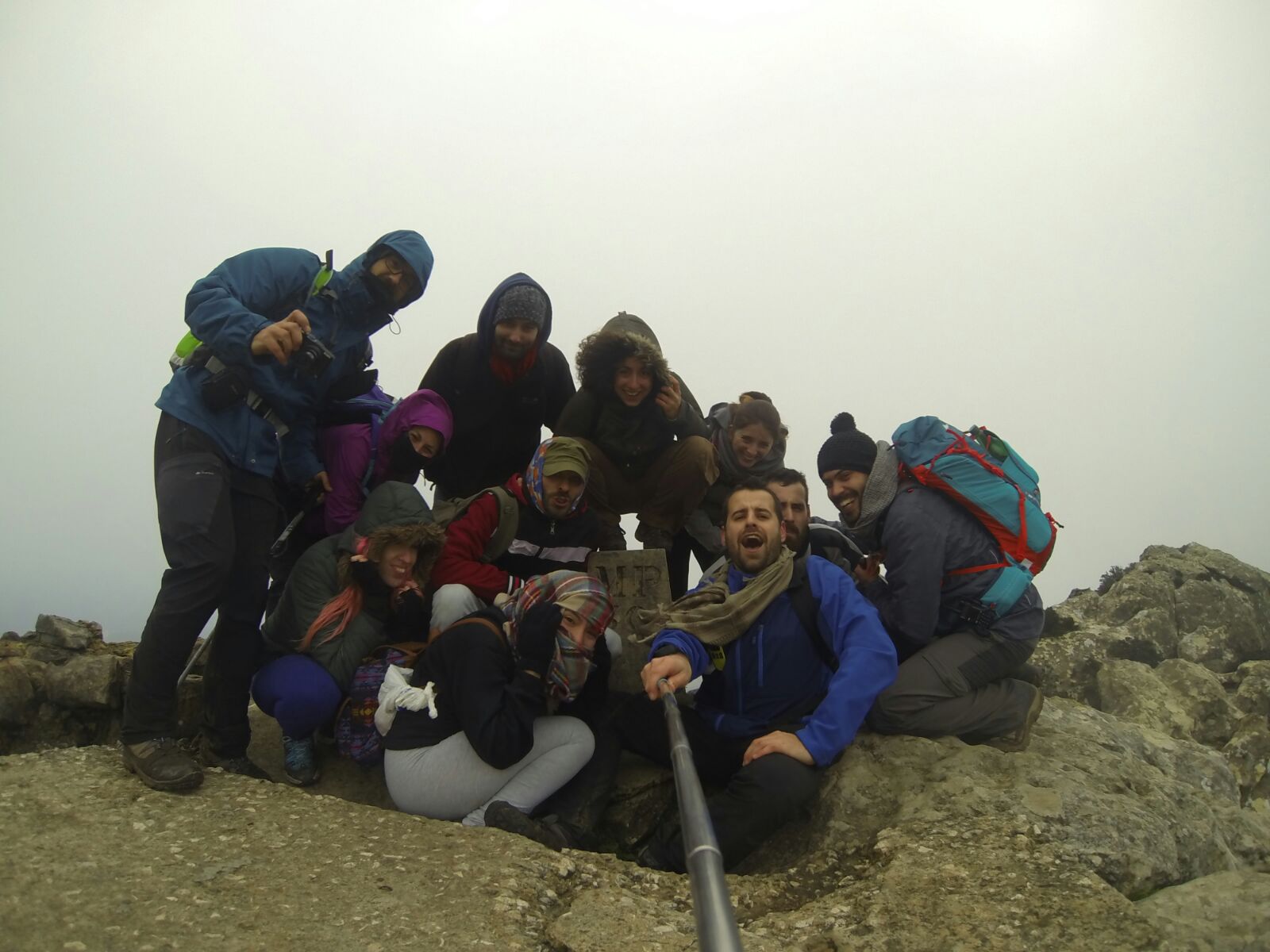
This time, the weather was very windy. A video of the summit moment:


A pic of the group:


Next was the 'Torrecilla' peak. The summit is at 1.919 m over sea level, with about 900 m elevation gain uphill during 15 km.
This time we faced a snowy trekking.
Here a music video of that day:


The Torrecilla peak is in fact challenging with snow, so we went a second time, with even more snow and wind:


This second time we faced winds of 70km/h which, due to wind-chill, resulted in a very cold day.

We also went to Sierra de Grazalema Natural Park, in a hard trekking under snowfall:


This time we walked about 15 km with about 500m elevation gain uphill, while enjoying this kind of environment:


What's next: more mountains! We plan to reach 2.069 m over sea level next week in 'La Maroma' and keep doing steep trekking in upcoming months until we go in June to Mulhacen.

It should be very funny to do some FLOSS contribution from the summit of a mountain. Do you know of someone who did that?

Next.

Previous.