Search Results: "ana"

4 August 2022

Jamie McClelland: Fine tuning Thunderbird's end-to-end encryption

I love that Thunderbird really tackled OpenPGP head on and incorporated it directly into the client. I know it s been a bit rough for some users, but I think it s a good long term investment. And to demonstrate I ll now complain about a minor issue :). I replied to an encrypted message but couldn t send the response using encryption. I got an error message indicating that End-to-end encryption requires resolving certificate issues for and it listed the recipient email address. Screen shot of error message saying: End-to-end encryption requires resolving certificate issues for I spent an enormous amount of time examining the recipient s OpenPGP key. I made sure it was not expired. I made sure it was actually in my Thunderbird key store not just in my OpenPGP keychain. I made sure I had indicated that I trust it enough to use. I re-downloaded it. I eventually gave up and didn t send the email. Then I responded to another encrypted email and it worked. What!?!? I spent more time comparing the recipients before I realized the problem was the sending address, not the recipient address. I have an OpenPGP key that lists several identities. I have a Thunderbird Account that uses the Identities feature to add several from addresses. And, it turns out that in Thunderbird, you need to indicate which OpenPGP key to use for your main account but also for each identity. When you drill down to Manage Identities for your account, you are able to indicate which OpenPGP key you want to use for each identity. Once I indicated that each identity should use my OpenPGP key, the issue was resolved. And here s my Thunderbird bug asking for an error message pointing to the sender address, not the recipient address.

Jamie McClelland: Fine tuning Thunderbird's end-to-end encryption

I love that Thunderbird really tackled OpenPGP head on and incorporated it directly into the client. I know it s been a bit rough for some users, but I think it s a good long term investment. And to demonstrate I ll now complain about a minor issue :). I replied to an encrypted message but couldn t send the response using encryption. I got an error message indicating that End-to-end encryption requires resolving certificate issues for and it listed the recipient email address. “Screen shot of error message saying: End-to-end encryption requires resolving certificate issues for [blacked out email address]” I spent an enormous amount of time examining the recipient s OpenPGP key. I made sure it was not expired. I made sure it was actually in my Thunderbird key store not just in my OpenPGP keychain. I made sure I had indicated that I trust it enough to use. I re-downloaded it. I eventually gave up and didn t send the email. Then I responded to another encrypted email and it worked. What!?!? I spent more time comparing the recipients before I realized the problem was the sending address, not the recipient address. I have an OpenPGP key that lists several identities. I have a Thunderbird Account that uses the Identities feature to add several from addresses. And, it turns out that in Thunderbird, you need to indicate which OpenPGP key to use for your main account but also for each identity. When you drill down to Manage Identities for your account, you are able to indicate which OpenPGP key you want to use for each identity. Once I indicated that each identity should use my OpenPGP key, the issue was resolved. And here s my Thunderbird bug asking for an error message pointing to the sender address, not the recipient address.

Abhijith PA: Trip to misty mountains in Munnar

Munnar is a hill station in Idukki district of Kerala, India. Home to 2nd largest tea plantation in the country. Lot of people visit here on summer and in winter as well. I live in the neighboring district of Munnar though I never made a visit. In my mind I pictured Munnar as a Tourist trap with lots of garbage lying around. I recently made a visit and it changed my perception of this place. Munnar!

Little background I never liked tea much. I am also not a coffee person either. But if I have to choose over two that will be coffee because of the strong aroma. Going to relatives house, they always offered hot tea defacto. I always find difficult say no to their friendly gesture. But I hate tea. A generation before me drinks lot of tea here at my place. You can see tea stalls in every corner and people sipping tea. I always wondered why people drink lot of tea on a hot country like India. The book I am currently trying to read has a chapter about Munnar and how it became a Tea plantation under the British rule. Well, around the same time. I watched a documentary program about the tea and Munnar.

Munnar Munnar on early evening Too much word here and there I decided to do a visit. I took a motorbike and started a journey to Munnar. Due to covid restrictions there weren t much tourists, so this was to my advantage. There are many water falls on the way to Munnar. Some are very close to road and some are far away but can be spotted. Munnar travel is just not about the destination because its never been a single spot. Enjoying the journey that the ride has to offer. I stayed at a hotel, little far away from town, though I never recommend hotels in Munnar. Try to find home stays and small establishments away from the town. There are British Era bungalows inside the plantations still maintained in good condition which can be booked per room or entire property. The lush greenery on the Mountains of tea plantation is very refreshing and feast to our eyes. The mornings and evenings of Munnar is something to watch, mountains wrapped in mist slowly uncovering with sunlight and again slipping to mist by dark evening. I planned only to visit places which are less explored by tourists. People here live a simple life. Most of them are plantation workers. The native people of Munnar are actually tribal folks but since the plantation boom many people from Tamil Nadu(neighboring state) and other parts of Kerala settled here. The houses of this plantation workers resembled Hobbit homes in Shire from Lord of the Rings as they are in the hill slides. The Kannan Devan hills, the biggest hill in area covers more than half of Munnar. Hobbit homes Two famous Tea companies from Munnar are Tata Tea and KDHP(Kanan Devan Hills Plantations Company (P) Limited) tea. KDHP is actually an employee owned Tea company ie a good share of this company is owned by the employees working there. This was interesting to me, so I bought a bag of speciality tea from KDHP store on my return. I don t drink tea on a daily basis but I will try it on special occasions.

31 July 2022

Paul Wise: FLOSS Activities July 2022

Focus This month I didn't have any particular focus. I just worked on issues in my info bubble.

Changes

Issues

Review

Administration
  • Debian BTS: unarchive/reopen/triage bugs for reintroduced packages
  • Debian servers: check full disks, ping users of excessive disk usage, restart a hung service
  • Debian wiki: approve accounts

Communication
  • Respond to queries from Debian users and contributors on the mailing lists and IRC

Sponsors The SPTAG, SIMDEverywhere, cwidget, aptitude, tldextract work was sponsored. All other work was done on a volunteer basis.

Russell Coker: Links July 2022

Darren Hayes wrote an interesting article about his battle with depression and his journey to accepting being gay [1]. Savage Garden had some great songs, Affirmation is relevant to this topic. Rorodi wrote an interesting article about the biggest crypto lending company being a Ponzi scheme [2]. One thing I find particularly noteworthy is how obviously scammy it is, even to the extent of having an ex porn star as an executive! Celsuis is now in the process of going bankrupt, 7 months after that article was published. Quora has an interesting discussion about different type casts in C++ [3]. C style casts shouldn t be used! MamaMia has an interesting article about Action Faking which means procrastination by doing tasks marginally related to the end goal [3]. This can mean include excessive study about the topic, excessive planning for the work, and work on things that aren t on the critical path first (EG thinking of a name for a project). Apple has a new Lockdown Mode to run an iPhone in a more secure configuration [4]. It would be good if more operating systems had a feature like this. Informative article about energy use of different organs [5]. The highest metabolic rates (in KCal/Kg/day) are for the heart and kidneys. The brain is 3rd on the list and as it s significantly more massive than the heart and kidneys it uses more energy, however this research was done on people who were at rest. Scientific American has an interesting article about brain energy use and exhaustion from mental effort [6]. Apparently it s doing things that aren t fun that cause exhaustion, mental effort that s fun can be refreshing.

Joachim Breitner: The Via Alpina red trail through Slovenia

This July my girlfriend and I hiked the Slovenian part of the Red Trail of the Via Alpina, from the edge of the Julian Alps to Trieste, and I d like to share some observations and tips that we might have found useful before our trip.
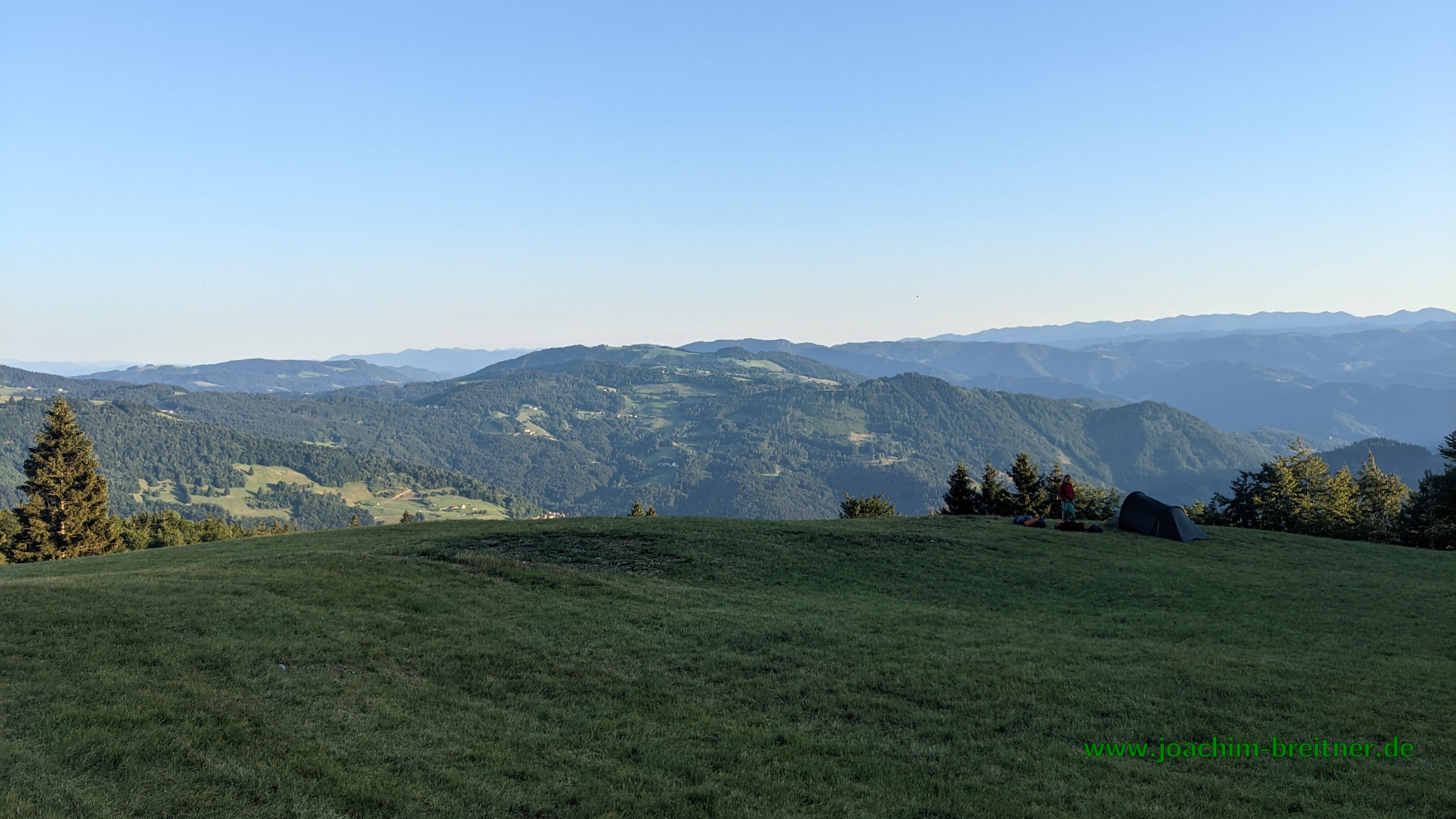
Our most favorite camp spot Our most favorite camp spot

Getting there As we traveled with complete camping gear and wanted to stay in our tent, we avoided the high alpine parts of the trail and started just where the trail came down from the Alps and entered the Karst. A great way to get there is to take the night train from Zurich or Munich towards Ljubljana, get off at Jesenice, have breakfast, take the local train to Podbrdo and you can start your tour at 9:15am. From there you can reach the trail at Pedrovo Brdo within 1 h.

Finding the way We did not use any paper maps, and instead relied on the OpenStreetMap data, which is very good, as well as the official(?) GPX tracks on Komoot, which are linked from the official route descriptions. We used OsmAnd. In general, trails are generally very well marked (red circle with white center, and frequent signs), but the signs rarely tell you which way the Via Alpina goes, so the GPS was needed. Sometimes the OpenStreetMap trail and the Komoot trail disagreed on short segments. We sometimes followed one and other times the other.

Variants We diverged from the trail in a few places:
  • We did not care too much about the horses in Lipica and at least on the map it looked like a longish boringish and sun-exposed detour, so we cut the loop and hiked from Prelo e pri Lokvi up onto the peak of the Veliko Gradi e (which unfortunately is too overgrown to provide a good view).
  • When we finally reached the top of Mali Kras and had a view across the bay of Trieste, it seemed silly to walk to down to Dolina, and instead we followed the ridge through Socerb, essentially the Alpe Adria Trail.
  • Not really a variant, but after arriving in Muggia, if one has to go to Trieste, the ferry is a probably nicer way to finish a trek than the bus.

Pitching a tent We used our tent almost every night, only in Idrija we got a room (and a shower ). It was not trivial to find good camp spots, because most of the trail is on hills with slopes, and the flat spots tend to have housed built on them, but certainly possible. Sometimes we hid in the forest, other times we found nice small and freshly mowed meadows within the forest.

Water Since this is Karst land, there is very little in terms of streams or lakes along the way, which is a pity. The Idrijca river right south of Idrija was very tempting to take a plunge. Unfortunately we passed there early in the day and we wanted to cover some ground first, so we refrained. As for drinking water, we used the taps at the bathrooms of the various touristic sites, a few (but rare) public fountains, and finally resorted to just ringing random doorbells and asking for water, which always worked.

Paths A few stages lead you through very pleasant narrow forest paths with a sight, but not all. On some days you find yourself plodding along wide graveled or even paved forest roads, though.

Landscape and sights The view from Nanos is amazing and, with this high peak jutting out over a wide plain, rather unique. It may seem odd that the trail goes up and down that mountain on the same day when it could go around, but it is certainly worth it. The Karst is mostly a cultivated landscape, with lots of forestry. It is very hilly and green, which is pretty, but some might miss some craggedness. It s not the high alps, after all, but at least they are in sight half the time. But the upside is that there are few sights along the way that are worth visiting, in particular the the Franja Partisan Hospital hidden in a very narrow gorge, the Predjama Castle and the kocjan Caves

29 July 2022

Bits from Debian: New Debian Developers and Maintainers (May and June 2022)

The following contributors got their Debian Developer accounts in the last two months: The following contributors were added as Debian Maintainers in the last two months: Congratulations!

25 July 2022

Bits from Debian: DebConf22 closes in Prizren and DebConf23 dates announced

DebConf22 group photo - click to enlarge On Sunday 24 July 2022, the annual Debian Developers and Contributors Conference came to a close. Hosting 260 attendees from 38 different countries over a combined 91 event talks, discussion sessions, Birds of a Feather (BoF) gatherings, workshops, and activities, DebConf22 was a large success. The conference was preceded by the annual DebCamp held 10 July to 16 July which focused on individual work and team sprints for in-person collaboration towards developing Debian. In particular, this year there have been sprints to advance development of Mobian/Debian on mobile, reproducible builds and Python in Debian, and a BootCamp for newcomers, to get introduced to Debian and have some hands-on experience with using it and contributing to the community. The actual Debian Developers Conference started on Sunday 17 July 2022. Together with activities such as the traditional 'Bits from the DPL' talk, the continuous key-signing party, lightning talks and the announcement of next year's DebConf (DebConf23 in Kochi, India), there were several sessions related to programming language teams such as Python, Perl and Ruby, as well as news updates on several projects and internal Debian teams, discussion sessions (BoFs) from many technical teams (Long Term Support, Android tools, Debian Derivatives, Debian Installer and Images team, Debian Science...) and local communities (Debian Brasil, Debian India, the Debian Local Teams), along with many other events of interest regarding Debian and free software. The schedule was updated each day with planned and ad-hoc activities introduced by attendees over the course of the entire conference. Several activities that couldn\'t be organized in past years due to the COVID pandemic returned to the conference\'s schedule: a job fair, open-mic and poetry night, the traditional Cheese and Wine party, the group photos and the Day Trip. For those who were not able to attend, most of the talks and sessions were recorded for live streams with videos made, available through the Debian meetings archive website. Almost all of the sessions facilitated remote participation via IRC messaging apps or online collaborative text documents. The DebConf22 website will remain active for archival purposes and will continue to offer links to the presentations and videos of talks and events. Next year, DebConf23 will be held in Kochi, India, from September 10 to September 16, 2023. As tradition follows before the next DebConf the local organizers in India will start the conference activites with DebCamp (September 03 to September 09, 2023), with particular focus on individual and team work towards improving the distribution. DebConf is committed to a safe and welcome environment for all participants. See the web page about the Code of Conduct in DebConf22 website for more details on this. Debian thanks the commitment of numerous sponsors to support DebConf22, particularly our Platinum Sponsors: Lenovo, Infomaniak, ITP Prizren and Google. About Debian The Debian Project was founded in 1993 by Ian Murdock to be a truly free community project. Since then the project has grown to be one of the largest and most influential open source projects. Thousands of volunteers from all over the world work together to create and maintain Debian software. Available in 70 languages, and supporting a huge range of computer types, Debian calls itself the universal operating system. About DebConf DebConf is the Debian Project's developer conference. In addition to a full schedule of technical, social and policy talks, DebConf provides an opportunity for developers, contributors and other interested people to meet in person and work together more closely. It has taken place annually since 2000 in locations as varied as Scotland, Argentina, and Bosnia and Herzegovina. More information about DebConf is available from https://debconf.org/. About Lenovo As a global technology leader manufacturing a wide portfolio of connected products, including smartphones, tablets, PCs and workstations as well as AR/VR devices, smart home/office and data center solutions, Lenovo understands how critical open systems and platforms are to a connected world. About Infomaniak Infomaniak is Switzerland\'s largest web-hosting company, also offering backup and storage services, solutions for event organizers, live-streaming and video on demand services. It wholly owns its datacenters and all elements critical to the functioning of the services and products provided by the company (both software and hardware). About ITP Prizren Innovation and Training Park Prizren intends to be a changing and boosting element in the area of ICT, agro-food and creatives industries, through the creation and management of a favourable environment and efficient services for SMEs, exploiting different kinds of innovations that can contribute to Kosovo to improve its level of development in industry and research, bringing benefits to the economy and society of the country as a whole. About Google Google is one of the largest technology companies in the world, providing a wide range of Internet-related services and products such as online advertising technologies, search, cloud computing, software, and hardware. Google has been supporting Debian by sponsoring DebConf for more than ten years, and is also a Debian partner sponsoring parts of Salsa's continuous integration infrastructure within Google Cloud Platform. Contact Information For further information, please visit the DebConf22 web page at https://debconf22.debconf.org/ or send mail to press@debian.org.

20 July 2022

Antoine Beaupr : Relaying mail through debian.org

Back in 2020, I wrote this article about using DKIM to sign outgoing debian.org mail. This worked well for me for a while: outgoing mail was signed with DKIM and somehow was delivered. Maybe. Who knows. But now we have a relay server which makes this kind of moot. So I have changed my configuration to use that relay instead of sending email on my own. It seems more reliable that mail seems to be coming from a real debian.org machine, so I'm hoping this will have better reputation than my current setup. In general, you should follow the DSA documentation which includes a Postfix configuration. In my case, it was basically this patch:
diff --git a/postfix/main.cf b/postfix/main.cf
index 7fe6dd9e..eabe714a 100644
--- a/postfix/main.cf
+++ b/postfix/main.cf
@@ -55,3 +55,4 @@ smtp_sasl_security_options =
 smtp_sender_dependent_authentication = yes
 sender_dependent_relayhost_maps = hash:/etc/postfix/sender_relay
 sender_dependent_default_transport_maps = hash:/etc/postfix/sender_transport
+smtp_tls_policy_maps = hash:/etc/postfix/tls_policy
diff --git a/postfix/sender_relay b/postfix/sender_relay
index b486d687..997cce19 100644
--- /dev/null
+++ b/postfix/sender_relay
@@ -0,0 +1,2 @@
+# Per-sender provider; see also /etc/postfix/sasl_passwd.
+@debian.org    [mail-submit.debian.org]:submission
diff --git a/postfix/sender_transport b/postfix/sender_transport
index ca69bc7a..c506c1fc 100644
--- /dev/null
+++ b/postfix/sender_transport
@@ -0,0 +1,1 @@
+anarcat@debian.org     smtp:
diff --git a/postfix/tls_policy b/postfix/tls_policy
new file mode 100644
index 00000000..9347921a
--- /dev/null
+++ b/postfix/tls_policy
@@ -0,0 +1,1 @@
+submission.torproject.org:submission   verify ciphers=high
This configuration differs from the one provided by DSA because I already had the following configured:
sender_dependent_relayhost_maps = hash:/etc/postfix/sender_relay
smtp_sender_dependent_authentication = yes
smtp_sasl_auth_enable = yes
smtp_sasl_password_maps = hash:/etc/postfix/sasl_passwd
smtp_sasl_tls_security_options = noanonymous
I also don't show the patch on /etc/postfix/sasl_passwd for obvious security reasons. I also had to setup a tls_policy map, because I couldn't use dane for all my remotes. You'll notice I also had to setup a sender_transport because I use a non-default default_transport as well. It also seems like you can keep the previous DKIM configuration in parallel with this one, as long as you don't double-sign outgoing mail. Since this configuration here is done on my mail client (i.e. not on the server where I am running OpenDKIM), I'm not double-signing so I left the DKIM configuration alone. But if I wanted to remove it, the magic command is:
echo "del dkimPubKey"   gpg --clearsign   mail changes@db.debian.org

Enrico Zini: Deconstruction of the DAM hat

Further reading Talk notes Intro Debian Account Managers Responsibility for official membership What DAM is not Unexpected responsibilities DAM warnings DAM warnings? House rules Interpreting house rules Governance by bullying How about the Community Team? How about DAM? How about the DPL? Concentrating responsibility Empowering developers What needs to happen

19 July 2022

Craig Small: Linux Memory Statistics

Pretty much everyone who has spent some time on a command line in Linux would have looked at the free command. This command provides some overall statistics on the memory and how it is used. Typical output looks something like this:
             total        used        free      shared  buff/cache  available
Mem:      32717924     3101156    26950016      143608     2666752  29011928
Swap:      1000444           0     1000444
Memory sits in the first row after the headers then we have the swap statistics. Most of the numbers are directly fetched from the procfs file /proc/meminfo which are scaled and presented to the user. A good example of a simple stat is total, which is just the MemTotal row located in that file. For the rest of this post, I ll make the rows from /proc/meminfo have an amber background. What is Free, and what is Used? While you could say that the free value is also merely the MemFree row, this is where Linux memory statistics start to get odd. While that value is indeed what is found for MemFree and not a calculated field, it can be misleading. Most people would assume that Free means free to use, with the implication that only this amount of memory is free to use and nothing more. That would also mean the used value is really used by something and nothing else can use it. In the early days of free and Linux statistics in general that was how it looked. Used is a calculated field (there is no MemUsed row) and was, initially, Total - Free. The problem was, Used also included Buffers and Cached values. This meant that it looked like Linux was using a lot of memory for something. If you read old messages before 2002 that are talking about excessive memory use, they quite likely are looking at the values printed by free. The thing was, under memory pressure the kernel could release Buffers and Cached for use. Not all of the storage but some of it so it wasn t all used. To counter this, free showed a row between Memory and Swap with Used having Buffers and Cached removed and Free having the same values added:
             total       used       free     shared    buffers     cached
Mem:      32717924    6063648   26654276          0     313552    2234436
-/+ buffers/cache:    3515660   29202264
Swap:      1000444          0    1000444
You might notice that this older version of free from around 2001 shows buffers and cached separately and there s no available column (we ll get to Available later.) Shared appears as zero because the old row was labelled MemShared and not Shmem which was changed in Linux 2.6 and I m running a system way past that version. It s not ideal, you can say that the amount of free memory is something above 26654276 and below 29202264 KiB but nothing more accurate. buffers and cached are almost never all-used or all-unused so the real figure is not either of those numbers but something in-between. Cached, just not for Caches That appeared to be an uneasy truce within the Linux memory statistics world for a while. By 2014 we realised that there was a problem with Cached. This field used to have the memory used for a cache for files read from storage. While this value still has that component, it was also being used for tmpfs storage and the use of tmpfs went from an interesting idea to being everywhere. Cheaper memory meant larger tmpfs partitions went from a luxury to something everyone was doing. The problem is with large files put into a tmpfs partition the Free would decrease, but so would Cached meaning the free column in the -/+ row would not change much and understate the impact of files in tmpfs. Lucky enough in Linux 2.6.32 the developers added a Shmem row which was the amount of memory used for shmem and tmpfs. Subtracting that value from Cached gave you the real cached value which we call main_cache and very briefly this is what the cached value would show in free. However, this caused further problems because not all Shem can be reclaimed and reused and probably swapped one set of problematic values for another. It did however prompt the Linux kernel community to have a look at the problem. Enter Available There was increasing awareness of the issues with working out how much memory a system has free within the kernel community. It wasn t just the output of free or the percentage values in top, but load balancer or workload placing systems would have their own view of this value. As memory management and use within the Linux kernel evolved, what was or wasn t free changed and all the userland programs were expected somehow to keep up. The kernel developers realised the best place to get an estimate of the memory not used was in the kernel and they created a new memory statistic called Available. That way if how the memory is used or set to be unreclaimable they could change it and userland programs would go along with it. procps has a fallback for this value and it s a pretty complicated setup.
  1. Find the min_free_kybtes setting in sysfs which is the minimum amount of free memory the kernel will handle
  2. Add a 25% to this value (e.g. if it was 4000 make it 5000), this is the low watermark
  3. To find available, start with MemFree and subtract the low watermark
  4. If half of both Inactive(file) and Active(file) values are greater than the low watermark, add that half value otherwise add the sum of the values minus the low watermark
  5. If half of Slab Claimable is greater than the low watermark, add that half value otherwise add Slab Claimable minus the low watermark
  6. If what you get is less than zero, make available zero
  7. Or, just look at Available in /proc/meminfo
For the free program, we added the Available value and the +/- line was removed. The main_cache value was Cached + Slab while Used was calculated as Total - Free - main_cache - Buffers. This was very close to what the Used column in the +/- line used to show. What s on the Slab? The next issue that came across was the use of slabs. At this point, main_cache was Cached + Slab, but Slab consists of reclaimable and unreclaimable components. One part of Slab can be used elsewhere if needed and the other cannot but the procps tools treated them the same. The Used calculation should not subtract SUnreclaim from the Total because it is actually being used. So in 2015 main_cache was changed to be Cached + SReclaimable. This meant that Used memory was calculated as Total - Free - Cached - SReclaimable - Buffers. Revenge of tmpfs and the return of Available The tmpfs impacting Cached was still an issue. If you added a 10MB file into a tmpfs partition, then Free would reduce by 10MB and Cached would increase by 10MB meaning Used stayed unchanged even though 10MB had gone somewhere. It was time to retire the complex calculation of Used. For procps 4.0.1 onwards, Used now means not available . We take the Total memory and subtract the Available memory. This is not a perfect setup but it is probably going to be the best one we have and testing is giving us much more sensible results. It s also easier for people to understand (take the total value you see in free, then subtract the available value). What does that mean for main_cache which is part of the buff/cache value you see? As this value is no longer in the used memory calculation, it is less important. Should it also be reverted to simply Cached without the reclaimable Slabs? The calculated fields In summary, what this means for the calculated fields in procps at least is: Almost everything else, with the exception of some bounds checking, is what you get out of /proc/meminfo which is straight from the kernel.

18 July 2022

Bits from Debian: DebConf22 welcomes its sponsors!

DebConf22 is taking place in Prizren, Kosovo, from 17th to 24th July, 2022. It is the 23rd edition of the Debian conference and organizers are working hard to create another interesting and fruitful event for attendees. We would like to warmly welcome the sponsors of DebConf22, and introduce you to them. We have four Platinum sponsors. Our first Platinum sponsor is Lenovo. As a global technology leader manufacturing a wide portfolio of connected products, including smartphones, tablets, PCs and workstations as well as AR/VR devices, smart home/office and data center solutions, Lenovo understands how critical open systems and platforms are to a connected world. Infomaniak is our second Platinum sponsor. Infomaniak is Switzerland's largest web-hosting company, also offering backup and storage services, solutions for event organizers, live-streaming and video on demand services. It wholly owns its datacenters and all elements critical to the functioning of the services and products provided by the company (both software and hardware). The ITP Prizren is our third Platinum sponsor. ITP Prizren intends to be a changing and boosting element in the area of ICT, agro-food and creatives industries, through the creation and management of a favourable environment and efficient services for SMEs, exploiting different kinds of innovations that can contribute to Kosovo to improve its level of development in industry and research, bringing benefits to the economy and society of the country as a whole. Google is our fourth Platinum sponsor. Google is one of the largest technology companies in the world, providing a wide range of Internet-related services and products such as online advertising technologies, search, cloud computing, software, and hardware. Google has been supporting Debian by sponsoring DebConf for more than ten years, and is also a Debian partner sponsoring parts of Salsa's continuous integration infrastructure within Google Cloud Platform. Our Gold sponsors are: Roche, a major international pharmaceutical provider and research company dedicated to personalized healthcare. Microsoft, enables digital transformation for the era of an intelligent cloud and an intelligent edge. Its mission is to empower every person and every organization on the planet to achieve more. Ipko Telecommunications, provides telecommunication services and it is the first and the most dominant mobile operator which offers fast-speed mobile internet 3G and 4G networks in Kosovo. Ubuntu, the Operating System delivered by Canonical. U.S. Agency for International Development, leads international development and humanitarian efforts to save lives, reduce poverty, strengthen democratic governance and help people progress beyond assistance. Our Silver sponsors are: Pexip, is the video communications platform that solves the needs of large organizations. Deepin is a Chinese commercial company focusing on the development and service of Linux-based operating systems. Hudson River Trading, a company researching and developing automated trading algorithms using advanced mathematical techniques. Amazon Web Services (AWS), is one of the world's most comprehensive and broadly adopted cloud platforms, offering over 175 fully featured services from data centers globally. The Bern University of Applied Sciences with near 7,800 students enrolled, located in the Swiss capital. credativ, a service-oriented company focusing on open-source software and also a Debian development partner. Collabora, a global consultancy delivering Open Source software solutions to the commercial world. Arm: with the world s Best SoC Design Portfolio, Arm powered solutions have been supporting innovation for more than 30 years and are deployed in over 225 billion chips to date. GitLab, an open source end-to-end software development platform with built-in version control, issue tracking, code review, CI/CD, and more. Two Sigma, rigorous inquiry, data analysis, and invention to help solve the toughest challenges across financial services. Starlabs, builds software experiences and focus on building teams that deliver creative Tech Solutions for our clients. Solaborate, has the world s most integrated and powerful virtual care delivery platform. Civil Infrastructure Platform, a collaborative project hosted by the Linux Foundation, establishing an open source base layer of industrial grade software. Matanel Foundation, operates in Israel, as its first concern is to preserve the cohesion of a society and a nation plagued by divisions. Bronze sponsors: bevuta IT, Kutia, Univention, Freexian. And finally, our Supporter level sponsors: Altus Metrum, Linux Professional Institute, Olimex, Trembelat, Makerspace IC Prizren, Cloud68.co, Gandi.net, ISG.EE, IPKO Foundation, The Deutsche Gesellschaft f r Internationale Zusammenarbeit (GIZ) GmbH. Thanks to all our sponsors for their support! Their contributions make it possible for a large number of Debian contributors from all over the globe to work together, help and learn from each other in DebConf22. DebConf22 logo

17 July 2022

Martin-Éric Racine: Trying to chainload iPXE on old Etherboot hardware

Among my collection of PC hardware, I have a few rarities whose netboot implementation predates PXE. Since I recently managed to configure dnsmasq as a potent TFTP and PXE server, I figured that I'd try chainloading iPXE via BOOTP options. This required preparing a boot image using antiquated tools: $ sudo mkelf-linux --param=autoboot --output=/srv/tftp/ipxe.nbi /srv/tftp/ipxe.lkrn The host succesufully loads the boot image, except that the iPXE blob fails to find the network card:
Any ideas?

Russ Allbery: Review: Trang

Review: Trang, by Mary Sisson
Series: Trang #1
Publisher: Mary Sisson
Copyright: 2011
Printing: December 2013
ASIN: B004I6DAQ8
Format: Kindle
Pages: 374
In 2113, a radio mapping satellite near the Titan station disappeared. It then reappeared five days later, apparently damaged and broadcasting a signal that made computers crash. The satellite was immediately sent back to the Space Authority base in Beijing for careful examination, but the techs on the station were able to decode the transmission: a request for the contents of databases. The general manager of the station sent a probe to the same location and it too vanished, returning two days later with a picture of a portal, followed shortly by an alien probe. Five years later, Philippe Trang has been assigned as the first human diplomat to an alien space station in intergalactic space at the nexus of multiple portals. Humans will apparently be the eighth type of intelligent life to send a representative to the station. He'll have a translation system, a security detail, and the groundwork of five years of audiovisual communications with the aliens, including one that was able to learn English. But he'll be the first official diplomatic representative physically there. The current style in SF might lead you to expect a tense thriller full of nearly incomprehensible aliens, unexplained devices, and creepy mysteries. This is not that sort of book. The best comparison point I could think of is James White's Sector General novels, except with a diplomat rather than a doctor. The aliens are moderately strange (not just humans in prosthetic makeup), but are mostly earnest, well-meaning, and welcoming. Trang's security escort is more military than he expects, but that becomes a satisfying negotiation rather than an ongoing problem. There is confusion, misunderstandings, and even violence, but most of it is sorted out by earnest discussion and attempts at mutual understanding. This is, in other words, diplomat competence porn (albeit written by someone who is not a diplomat, so I wouldn't expect too much realism). Trang defuses rather than confronts, patiently sorts through the nuances of a pre-existing complex dynamic between aliens without prematurely picking sides, and has the presence of mind to realize that the special forces troops assigned to him are another culture he needs to approach with the same skills. Most of the book is low-stakes confusion, curiosity, and careful exploration, which could have been boring but wasn't. It helps that Sisson packs a lot of complexity into the station dynamics and reveals it in ways that I found enjoyably unpredictable. Some caveats: This is a self-published first novel (albeit by an experienced reporter and editor) and it shows. The book has a sort of plastic Technicolor feel that I sometimes see in self-published novels, where the details aren't quite deep enough, the writing isn't quite polished, and the dialog isn't quite as tight as I'm used to. It also meanders in a way that few commercial novels do, including slice-of-life moments and small asides that don't go anywhere. This can be either a bug or a feature depending on what you're in the mood for. I found it relaxing and stress-relieving, which is what I was looking for, but you may have a different experience. I will warn that the climax features a sudden escalation of stakes that I don't think was sufficiently signaled by the tone of the writing, and thus felt a bit unreal. Sisson also includes a couple deus ex machina twists that felt a bit predictable and easy, and I didn't find the implied recent history of one of the alien civilizations that believable. The conclusion is therefore not the strongest part of the book; if you're not enjoying the journey, it probably won't get better. But, all that said, this was fun, and I've already bought the second book in the series. It's low-stakes, gentle SF with a core of discovery and exploration rather than social dynamics, and I haven't run across much of that recently. The worst thing in the book is some dream glimpses at a horrific event in Trang's past that's never entirely on camera. It's not as pacifist as James White, but it's close. Recommended, especially if you liked Sector General. White's series is so singular that I previously would have struggled to find a suggestion for someone who wanted more exactly like that (but without the Bewitched-era sexism). Now I have an answer. Score another one for Susan Stepney, who is also how I found Julie Czerneda. Trang is also currently free for Kindle, so you can't beat the price. Followed by Trust. Rating: 8 out of 10

12 July 2022

Matthew Garrett: Responsible stewardship of the UEFI secure boot ecosystem

After I mentioned that Lenovo are now shipping laptops that only boot Windows by default, a few people pointed to a Lenovo document that says:

Starting in 2022 for Secured-core PCs it is a Microsoft requirement for the 3rd Party Certificate to be disabled by default.

"Secured-core" is a term used to describe machines that meet a certain set of Microsoft requirements around firmware security, and by and large it's a good thing - devices that meet these requirements are resilient against a whole bunch of potential attacks in the early boot process. But unfortunately the 2022 requirements don't seem to be publicly available, so it's difficult to know what's being asked for and why. But first, some background.

Most x86 UEFI systems that support Secure Boot trust at least two certificate authorities:

1) The Microsoft Windows Production PCA - this is used to sign the bootloader in production Windows builds. Trusting this is sufficient to boot Windows.
2) The Microsoft Corporation UEFI CA - this is used by Microsoft to sign non-Windows UEFI binaries, including built-in drivers for hardware that needs to work in the UEFI environment (such as GPUs and network cards) and bootloaders for non-Windows.

The apparent secured-core requirement for 2022 is that the second of these CAs should not be trusted by default. As a result, drivers or bootloaders signed with this certificate will not run on these systems. This means that, out of the box, these systems will not boot anything other than Windows[1].

Given the association with the secured-core requirements, this is presumably a security decision of some kind. Unfortunately, we have no real idea what this security decision is intended to protect against. The most likely scenario is concerns about the (in)security of binaries signed with the third-party signing key - there are some legitimate concerns here, but I'm going to cover why I don't think they're terribly realistic.

The first point is that, from a boot security perspective, a signed bootloader that will happily boot unsigned code kind of defeats the point. Kaspersky did it anyway. The second is that even a signed bootloader that is intended to only boot signed code may run into issues in the event of security vulnerabilities - the Boothole vulnerabilities are an example of this, covering multiple issues in GRUB that could allow for arbitrary code execution and potential loading of untrusted code.

So we know that signed bootloaders that will (either through accident or design) execute unsigned code exist. The signatures for all the known vulnerable bootloaders have been revoked, but that doesn't mean there won't be other vulnerabilities discovered in future. Configuring systems so that they don't trust the third-party CA means that those signed bootloaders won't be trusted, which means any future vulnerabilities will be irrelevant. This seems like a simple choice?

There's actually a couple of reasons why I don't think it's anywhere near that simple. The first is that whenever a signed object is booted by the firmware, the trusted certificate used to verify that object is measured into PCR 7 in the TPM. If a system previously booted with something signed with the Windows Production CA, and is now suddenly booting with something signed with the third-party UEFI CA, the values in PCR 7 will be different. TPMs support "sealing" a secret - encrypting it with a policy that the TPM will only decrypt it if certain conditions are met. Microsoft make use of this for their default Bitlocker disk encryption mechanism. The disk encryption key is encrypted by the TPM, and associated with a specific PCR 7 value. If the value of PCR 7 doesn't match, the TPM will refuse to decrypt the key, and the machine won't boot. This means that attempting to attack a Windows system that has Bitlocker enabled using a non-Windows bootloader will fail - the system will be unable to obtain the disk unlock key, which is a strong indication to the owner that they're being attacked.

The second is that this is predicated on the idea that removing the third-party bootloaders and drivers removes all the vulnerabilities. In fact, there's been rather a lot of vulnerabilities in the Windows bootloader. A broad enough vulnerability in the Windows bootloader is arguably a lot worse than a vulnerability in a third-party loader, since it won't change the PCR 7 measurements and the system will boot happily. Removing trust in the third-party CA does nothing to protect against this.

The third reason doesn't apply to all systems, but it does to many. System vendors frequently want to ship diagnostic or management utilities that run in the boot environment, but would prefer not to have to go to the trouble of getting them all signed by Microsoft. The simple solution to this is to ship their own certificate and sign all their tooling directly - the secured-core Lenovo I'm looking at currently is an example of this, with a Lenovo signing certificate. While everything signed with the third-party signing certificate goes through some degree of security review, there's no requirement for any vendor tooling to be reviewed at all. Removing the third-party CA does nothing to protect the user against the code that's most likely to contain vulnerabilities.

Obviously I may be missing something here - Microsoft may well have a strong technical justification. But they haven't shared it, and so right now we're left making guesses. And right now, I just don't see a good security argument.

But let's move on from the technical side of things and discuss the broader issue. The reason UEFI Secure Boot is present on most x86 systems is that Microsoft mandated it back in 2012. Microsoft chose to be the only trusted signing authority. Microsoft made the decision to assert that third-party code could be signed and trusted.

We've certainly learned some things since then, and a bunch of things have changed. Third-party bootloaders based on the Shim infrastructure are now reviewed via a community-managed process. We've had a productive coordinated response to the Boothole incident, which also taught us that the existing revocation strategy wasn't going to scale. In response, the community worked with Microsoft to develop a specification for making it easier to handle similar events in future. And it's also worth noting that after the initial Boothole disclosure was made to the GRUB maintainers, they proactively sought out other vulnerabilities in their codebase rather than simply patching what had been reported. The free software community has gone to great lengths to ensure third-party bootloaders are compatible with the security goals of UEFI Secure Boot.

So, to have Microsoft, the self-appointed steward of the UEFI Secure Boot ecosystem, turn round and say that a bunch of binaries that have been reviewed through processes developed in negotiation with Microsoft, implementing technologies designed to make management of revocation easier for Microsoft, and incorporating fixes for vulnerabilities discovered by the developers of those binaries who notified Microsoft of these issues despite having no obligation to do so, and which have then been signed by Microsoft are now considered by Microsoft to be insecure is, uh, kind of impolite? Especially when unreviewed vendor-signed binaries are still considered trustworthy, despite no external review being carried out at all.

If Microsoft had a set of criteria used to determine whether something is considered sufficiently trustworthy, we could determine which of these we fell short on and do something about that. From a technical perspective, Microsoft could set criteria that would allow a subset of third-party binaries that met additional review be trusted without having to trust all third-party binaries[2]. But, instead, this has been a decision made by the steward of this ecosystem without consulting major stakeholders.

If there are legitimate security concerns, let's talk about them and come up with solutions that fix them without doing a significant amount of collateral damage. Don't complain about a vendor blocking your apps and then do the same thing yourself.

[Edit to add: there seems to be some misunderstanding about where this restriction is being imposed. I bought this laptop because I'm interested in investigating the Microsoft Pluton security processor, but Pluton is not involved at all here. The restriction is being imposed by the firmware running on the main CPU, not any sort of functionality implemented on Pluton]

[1] They'll also refuse to run any drivers that are stored in flash on Thunderbolt devices, which means eGPU setups may be more complicated, as will netbooting off Thunderbolt-attached NICs
[2] Use a different leaf cert to sign the new trust tier, add the old leaf cert to dbx unless a config option is set, leave the existing intermediate in db

comment count unavailable comments

9 July 2022

Dirk Eddelbuettel: Rcpp 1.0.9 on CRAN: Regular Updates

rcpp logo The Rcpp team is please to announce the newest release 1.0.9 of Rcpp which hit CRAN late yesterday, and has been uploaded to Debian as well. Windows and macOS builds should appear at CRAN in the next few days, as will builds in different Linux distribution and of course at r2u. The release was prepared om July 2, but it took a few days to clear a handful of spurious errors as false positives with CRAN this can when the set of reverse dependencies is so large, and the CRAN team remains busy. This release continues with the six-months cycle started with release 1.0.5 in July 2020. (This time, CRAN had asked for an interim release to silence a C++ warning; we then needed a quick follow-up to tweak tests.) As a reminder, interim dev or rc releases should generally be available in the Rcpp drat repo. These rolling release tend to work just as well, and are also fully tested against all reverse-dependencies. Rcpp has become the most popular way of enhancing R with C or C++ code. Right now, around 2559 packages on CRAN depend on Rcpp for making analytical code go faster and further, along with 252 in BioConductor. On CRAN, 13.9% of all packages depend (directly) on CRAN, and 58.5% of all compiled packages do. From the cloud mirror of CRAN (which is but a subset of all CRAN downloads), Rcpp has been downloaded 61.5 million times. This release is incremental and extends Rcpp with a number of small improvements all detailed in the NEWS file as well as below. We want to highlight the external contributions: a precious list tag is cleared on removal, and a move constructor and assignment for strings has been added (thanks to Dean Scarff), and (thanks to Bill Denney and Marco Colombo) two minor errors are corrected in the vignette documentation. A big Thank You! to everybody who contributed pull request, opened or answered issues, or questions at StackOverflow or on the mailing list. The full list of details follows.

Changes in Rcpp hotfix release version 1.0.9 (2022-07-02)
  • Changes in Rcpp API:
    • Accomodate C++98 compilation by adjusting attributes.cpp (Dirk in #1193 fixing #1192)
    • Accomodate newest compilers replacing deprecated std::unary_function and std::binary_function with std::function (Dirk in #1202 fixing #1201 and CRAN request)
    • Upon removal from precious list, the tag is set to null (I aki in #1205 fixing #1203)
    • Move constructor and assignment for strings have been added (Dean Scarff in #1219).
  • Changes in Rcpp Documentation:
    • Adjust one overflowing column (Bill Denney in #1196 fixing #1195)
    • Correct a typo in the FAQ (Marco Colombo in #1217)
  • Changes in Rcpp Deployment:
    • Accomodate four digit version numbers in unit test (Dirk)
    • Do not run complete test suite to limit test time to CRAN preference (Dirk in #1206)
    • Small updates to the CI test containers have been made
    • Some of changes also applied to an interim release 1.0.8.3 made for CRAN on 2022-03-14.

Thanks to my CRANberries, you can also look at a diff to the previous release. Questions, comments etc should go to the rcpp-devel mailing list off the R-Forge page. Bugs reports are welcome at the GitHub issue tracker as well (where one can also search among open or closed issues); questions are also welcome under rcpp tag at StackOverflow which also allows searching among the (currently) 2886 previous questions. If you like this or other open-source work I do, you can sponsor me at GitHub.

This post by Dirk Eddelbuettel originated on his Thinking inside the box blog. Please report excessive re-aggregation in third-party for-profit settings.

8 July 2022

Matthew Garrett: Lenovo shipping new laptops that only boot Windows by default

I finally managed to get hold of a Thinkpad Z13 to examine a functional implementation of Microsoft's Pluton security co-processor. Trying to boot Linux from a USB stick failed out of the box for no obvious reason, but after further examination the cause became clear - the firmware defaults to not trusting bootloaders or drivers signed with the Microsoft 3rd Party UEFI CA key. This means that given the default firmware configuration, nothing other than Windows will boot. It also means that you won't be able to boot from any third-party external peripherals that are plugged in via Thunderbolt.

There's no security benefit to this. If you want security here you're paying attention to the values measured into the TPM, and thanks to Microsoft's own specification for measurements made into PCR 7, switching from booting Windows to booting something signed with the 3rd party signing key will change the measurements and invalidate any sealed secrets. It's trivial to detect this. Distrusting the 3rd party CA by default doesn't improve security, it just makes it harder for users to boot alternative operating systems.

Lenovo, this isn't OK. The entire architecture of UEFI secure boot is that it allows for security without compromising user choice of OS. Restricting boot to Windows by default provides no security benefit but makes it harder for people to run the OS they want to. Please fix it.

comment count unavailable comments

5 July 2022

Alberto Garc a: Running the Steam Deck s OS in a virtual machine using QEMU

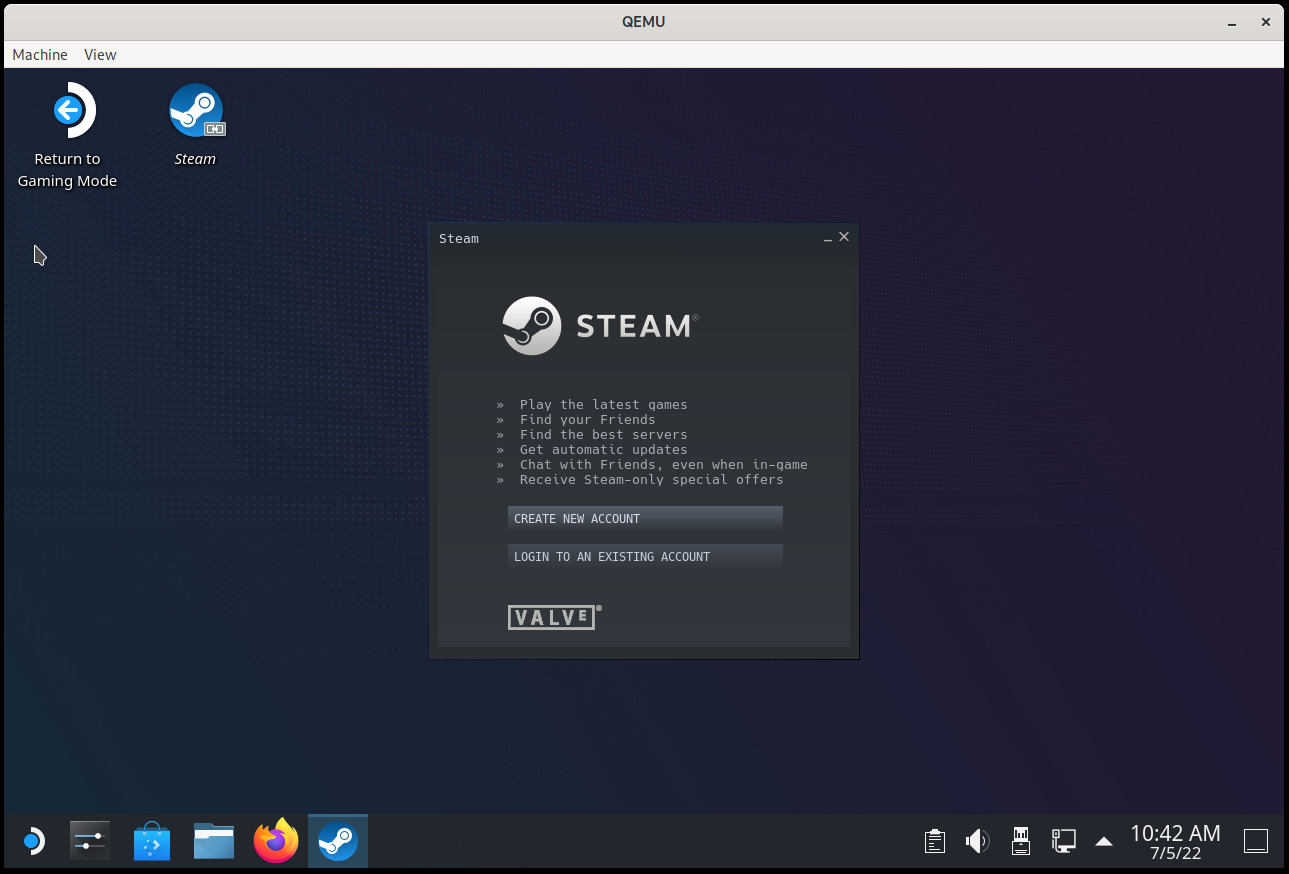
SteamOS desktop Introduction The Steam Deck is a handheld gaming computer that runs a Linux-based operating system called SteamOS. The machine comes with SteamOS 3 (code name holo ), which is in turn based on Arch Linux. Although there is no SteamOS 3 installer for a generic PC (yet), it is very easy to install on a virtual machine using QEMU. This post explains how to do it. The goal of this VM is not to play games (you can already install Steam on your computer after all) but to use SteamOS in desktop mode. The Gamescope mode (the console-like interface you normally see when you use the machine) requires additional development to make it work with QEMU and will not work with these instructions. A SteamOS VM can be useful for debugging, development, and generally playing and tinkering with the OS without risking breaking the Steam Deck. Running the SteamOS desktop in a virtual machine only requires QEMU and the OVMF UEFI firmware and should work in any relatively recent distribution. In this post I m using QEMU directly, but you can also use virt-manager or some other tool if you prefer, we re emulating a standard x86_64 machine here. General concepts SteamOS is a single-user operating system and it uses an A/B partition scheme, which means that there are two sets of partitions and two copies of the operating system. The root filesystem is read-only and system updates happen on the partition set that is not active. This allows for safer updates, among other things. There is one single /home partition, shared by both partition sets. It contains the games, user files, and anything that the user wants to install there. Although the user can trivially become root, make the root filesystem read-write and install or change anything (the pacman package manager is available), this is not recommended because A simple way for the user to install additional software that survives OS updates and doesn t touch the root filesystem is Flatpak. It comes preinstalled with the OS and is integrated with the KDE Discover app. Preparing all necessary files The first thing that we need is the installer. For that we have to download the Steam Deck recovery image from here: https://store.steampowered.com/steamos/download/?ver=steamdeck&snr= Once the file has been downloaded, we can uncompress it and we ll get a raw disk image called steamdeck-recovery-4.img (the number may vary). Note that the recovery image is already SteamOS (just not the most up-to-date version). If you simply want to have a quick look you can play a bit with it and skip the installation step. In this case I recommend that you extend the image before using it, for example with truncate -s 64G steamdeck-recovery-4.img or, better, create a qcow2 overlay file and leave the original raw image unmodified: qemu-img create -f qcow2 -F raw -b steamdeck-recovery-4.img steamdeck-recovery-extended.qcow2 64G But here we want to perform the actual installation, so we need a destination image. Let s create one: $ qemu-img create -f qcow2 steamos.qcow2 64G Installing SteamOS Now that we have all files we can start the virtual machine:
$ qemu-system-x86_64 -enable-kvm -smp cores=4 -m 8G \
    -device usb-ehci -device usb-tablet \
    -device intel-hda -device hda-duplex \
    -device VGA,xres=1280,yres=800 \
    -drive if=pflash,format=raw,readonly=on,file=/usr/share/ovmf/OVMF.fd \
    -drive if=virtio,file=steamdeck-recovery-4.img,driver=raw \
    -device nvme,drive=drive0,serial=badbeef \
    -drive if=none,id=drive0,file=steamos.qcow2
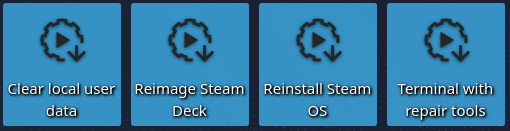
Note that we re emulating an NVMe drive for steamos.qcow2 because that s what the installer script expects. This is not strictly necessary but it makes things a bit easier. If you don t want to do that you ll have to edit ~/tools/repair_device.sh and change DISK and DISK_SUFFIX. SteamOS installer shortcuts Once the system has booted we ll see a KDE Plasma session with a few tools on the desktop. If we select Reimage Steam Deck and click Proceed on the confirmation dialog then SteamOS will be installed on the destination drive. This process should not take a long time. Now, once the operation finishes a new confirmation dialog will ask if we want to reboot the Steam Deck, but here we have to choose Cancel . We cannot use the new image yet because it would try to boot into the Gamescope session, which won t work, so we need to change the default desktop session. SteamOS comes with a helper script that allows us to enter a chroot after automatically mounting all SteamOS partitions, so let s open a Konsole and make the Plasma session the default one in both partition sets:
$ sudo steamos-chroot --disk /dev/nvme0n1 --partset A
# steamos-readonly disable
# echo '[Autologin]' > /etc/sddm.conf.d/zz-steamos-autologin.conf
# echo 'Session=plasma.desktop' >> /etc/sddm.conf.d/zz-steamos-autologin.conf
# steamos-readonly enable
# exit
$ sudo steamos-chroot --disk /dev/nvme0n1 --partset B
# steamos-readonly disable
# echo '[Autologin]' > /etc/sddm.conf.d/zz-steamos-autologin.conf
# echo 'Session=plasma.desktop' >> /etc/sddm.conf.d/zz-steamos-autologin.conf
# steamos-readonly enable
# exit
After this we can shut down the virtual machine. Our new SteamOS drive is ready to be used. We can discard the recovery image now if we want. Booting SteamOS and first steps To boot SteamOS we can use a QEMU line similar to the one used during the installation. This time we re not emulating an NVMe drive because it s no longer necessary.
$ cp /usr/share/OVMF/OVMF_VARS.fd .
$ qemu-system-x86_64 -enable-kvm -smp cores=4 -m 8G \
   -device usb-ehci -device usb-tablet \
   -device intel-hda -device hda-duplex \
   -device VGA,xres=1280,yres=800 \
   -drive if=pflash,format=raw,readonly=on,file=/usr/share/ovmf/OVMF.fd \
   -drive if=pflash,format=raw,file=OVMF_VARS.fd \
   -drive if=virtio,file=steamos.qcow2 \
   -device virtio-net-pci,netdev=net0 \
   -netdev user,id=net0,hostfwd=tcp::2222-:22
(the last two lines redirect tcp port 2222 to port 22 of the guest to be able to SSH into the VM. If you don t want to do that you can omit them) If everything went fine, you should see KDE Plasma again, this time with a desktop icon to launch Steam and another one to Return to Gaming Mode (which we should not use because it won t work). See the screenshot that opens this post. Congratulations, you re running SteamOS now. Here are some things that you probably want to do: Updating the OS to the latest version The Steam Deck recovery image doesn t install the most recent version of SteamOS, so now we should probably do a software update. Note: if the last step fails after reaching 100% with a post-install handler error then go to Connections in the system settings, rename Wired Connection 1 to something else (anything, the name doesn t matter), click Apply and run steamos-update again. This works around a bug in the update process. Recent images fix this and this workaround is not necessary with them. As we did with the recovery image, before rebooting we should ensure that the new update boots into the Plasma session, otherwise it won t work:
$ sudo steamos-chroot --partset other
# steamos-readonly disable
# echo '[Autologin]' > /etc/sddm.conf.d/zz-steamos-autologin.conf
# echo 'Session=plasma.desktop' >> /etc/sddm.conf.d/zz-steamos-autologin.conf
# steamos-readonly enable
# exit
After this we can restart the system. If everything went fine we should be running the latest SteamOS release. Enjoy! Reporting bugs SteamOS is under active development. If you find problems or want to request improvements please go to the SteamOS community tracker. Edit 06 Jul 2022: Small fixes, mention how to install the OS without using NVMe.

Russ Allbery: Review: A Mirror Mended

Review: A Mirror Mended, by Alix E. Harrow
Series: Fractured Fables #2
Publisher: Tordotcom
Copyright: 2022
ISBN: 1-250-76665-6
Format: Kindle
Pages: 129
This is a direct sequel to A Spindle Splintered and will completely spoil that story, so start there rather than here. A Mirror Mended opens with a glimpse at yet another version of the Sleeping Beauty story, this one (delightfully) a Spanish telenovela. Zinnia is world-hopping, something that's lost some of the meaning from A Spindle Splintered and become an escape from other problems. She's about ready to leave this world as well when she sees a face that is not hers in the bathroom mirror, pleading for help. Zinnia assumes this is yet another sleeping beauty, albeit an unusual one. Zinnia is wrong. Readers of A Spindle Splintered are going to groan when I tell you that Zinnia has managed to damage most of the relationships that she made in the first story, which means we get a bit of an episodic reset of unhappiness mixed with an all-new glob of guilt. Not only is this a depressing way to start a new story, it also means there are no snarky text messages and side commentary. Grumble. Harrow is isolating Zinnia to set up a strange and fraught alliance that turns into a great story, but given that Zinnia's friend network was my favorite part of the first novella, the start of this story made me grumpy. Stick with it, though, since Harrow does more than introduce another fairy tale. She also introduces a villain, one who wishes to be more complicated than her story allows and who knows rather more about the structure of the world than she should. This time, the fairy tale goes off the rails in a more directly subversive way that prods at the bones of Harrow's world-building. This may or may not be what you want, and I admit I liked the first story better. A Spindle Splintered took fairy tales just seriously enough to make a plot, but didn't poke at its premises deeply enough to destabilize them. It played off of fairy tales themselves; A Mirror Mended instead plays off of Harrow's previous story by looking directly at the invented metaphysics of parallel worlds playing out fairy tale archetypes. Some of this worked for me: Eva is a great character and the dynamic between her and Zinnia is highly entertaining. Some of it didn't: the impact on universal metaphysics of Zinnia's adventuring is a bit cliched and inadequately explained. A Mirror Mended is a character exploration with a bit more angst and ambiguity, which means it isn't as delightfully balanced and free-wheeling. I will reassure you with the minor spoiler that Zinnia does eventually pull her head out of her ass when she has to, and while there is nowhere near enough Charm in this book for my taste, there is some. In exchange for the relationship screw-ups, we get the Zinnia/Eva dynamic, which I was really enjoying by the end. One of my favorite tropes is accidental empathy, where someone who is being flippant and sarcastic stumbles into a way of truly helping someone else and is wise enough to notice it. There are several great moments of that. I like Zinnia, even this older, more conflicted, and less cavalier version. Recommended if you liked the first story, although be warned that this replaces the earlier magic with some harder relationship work and the payoff is more hinted at than fully shown. Rating: 7 out of 10

2 July 2022

Russ Allbery: Review: Overdue

Review: Overdue, by Amanda Oliver
Publisher: Chicago Review Press
Copyright: 2022
ISBN: 1-64160-534-0
Format: Kindle
Pages: 190
Like many lifetime readers, I adored the public library. I read my way through three different children's libraries at the rate of a grocery sack of books per week, including numerous re-readings, and then moved on to the adult section as my introduction to science fiction. But once I had a regular job, I discovered the fun of filling shelves with books without having to return them or worry about what the library had available. I've always supported my local library, but it's been decades since I spent much time in it. When I last used one heavily, the only computers were at the checkout desk and the only books were physical, normally hardcovers. Overdue: Reckoning with the Public Library therefore caught my eye when I saw a Twitter thread about it before publication. It promised to be a picture of the modern public library and its crises from the perspective of the librarian. The author's primary topic was the drafting of public libraries as de facto homeless service centers, but I hoped it would also encompass technological change, demand for new services, and the shifting meaning of what a public library is for. Overdue does... some of that. The author was a children's librarian in a Washington DC public school and then worked at a downtown branch of the Washington DC public library, and the book includes a few anecdotes from both experiences. Most of the book, though, is Oliver's personal memoir of how she got into field, why she chose to leave it, and how she is making sense of her feelings about the profession. Intermixed with that memoir is wide-ranging political commentary on topics ranging from gentrification to mental health care. This material is relevant to the current challenges libraries face, but it wandered far afield from what I was hoping to get from the book. I think of non-fiction books as coming in a few basic shapes. One is knowledge from an expert: the author has knowledge about a topic that is not widely shared, and they write a book to share it. Another is popularization: an author, possibly without prior special expertise in the topic, does research the reader could have done but doesn't have time to do and then summarizes the results in a format that's easier to understand than the original material. And a third is memoir, in which the author tells the story of their own life. This is a variation of the first type, since the author is obviously an expert in their own life, but most people's lives are not interesting. (Mine certainly isn't!) Successful memoir therefore depends on either having an unusual life or being a compelling storyteller, and ideally both. Many non-fiction books fall into multiple categories, but it's helpful for an author to have a clear idea of which of these goals they're pursuing since they result in different books. If the author is writing primarily from a position of special expertise, the book should focus on that expertise. I am interested in librarians and libraries and would like to know more about that job, so I will read with interest your personal stories about being a librarian. I am somewhat interested in your policy suggestions for how to make libraries work better, although more so if you can offer context and analysis beyond your personal experiences. I am less interested in your opinions on, say, gentrification. That's not because I doubt it is a serious problem (it is) or that it impacts libraries (it does). It's because working in a library doesn't provide any special expertise in gentrification beyond knowing that it exists, something that I can see by walking around the corner. If I want to know more, I will read books by urban planners, sociologists, and housing rights activists. This is a long-winded way of saying that I wish Overdue had about four times as many stories about libraries, preferably framed by general research and background that extended beyond the author's personal experience, or at least more specific details of the politics of the Washington DC library system. The personal memoir outside of the library stories failed to hold my interest. This is not intended as a slam on the author. Oliver seems like a thoughtful and sincere person who is struggling with how to do good in the world without burning out, which is easy for me to sympathize with. I suspect I broadly agree with her on many political positions. But I have read all of this before, and personally lived through some of the same processing, and I don't think Oliver offered new insight. The library stories were memorable enough to form the core of a good book, but the memoir structure did nothing for them and they were strangled by the unoriginal and too-general political analysis. At the risk of belaboring a negative review, there are two other things in Overdue that I've also seen in other writing and seem worth commenting on. The first is the defensive apology that the author may not have the best perspective to write the book. It's important to be clear: I am glad that the Oliver has thought about the ways her experiences as a white woman may not be representative of other people. This is great; the world is a better place when more people consider that. I'm less fond of putting that observation in the book, particularly at length. As the author, rather than writing paragraphs vaguely acknowledging that other people have different experiences, she could instead fix the problem: go talk to librarians of other ethnic and social backgrounds and put their stories in this book. The book would then represent broader experiences and not require the apology. Overdue desperately needed more library-specific content, so that would have improved the book in more than one way. Or if Oliver is ideologically opposed to speaking for other people (she makes some comments to that effect), state up-front, once, that this is a personal memoir and, as a memoir, represents only her own experience. But the author should do something with this observation other than dump its awkwardness on the reader, if for no other reason than that lengthy disclaimers about the author's limited perspective are boring. The second point is about academic jargon and stock phrasing. I work in a field that relies on precise distinctions of meaning (between identity, authentication, and authorization, for example), and therefore I rely on jargon. Its purpose is to make those types of fine distinctions. But authors who read heavily in fields with jargon tend to let that phrasing slip into popular writing where it's not necessary. The result is, to quote Orwell, "gumming together long strips of words which have already been set in order by someone else." The effect may be small in a single sentence but, when continued throughout a book, the overuse of jargon is leaden, belabored, and confusing. Any example I choose will be minor since the effect is cumulative, but one of several I noticed in Overdue is "lived experience." This is jargon from philosophy that, within the field, draws a useful distinction between one's direct experiences of living in the world, and academic or scientific experience with a field. Both types of experience are valuable in different situations, but they're not equivalent. This is a useful phrase when the distinction matters and is unclear. When the type of experience one is discussing is obvious in context (the case in at least three of the four uses in this book), the word "lived" adds nothing but verbosity. If too much of this creeps into writing, it becomes clunky and irritating to read. The best (and not coincidentally the least clunky) part of this book is Oliver's stories of the patrons and other employees of the Northwest One branch of the Washington DC library system and her experiences with them. The picture was not as vivid as I was hoping for, but I came away with some new understanding of typical interactions and day-to-day difficulties. The same was true to a lesser extent for her experiences as a school librarian. For both, I wish there had been more context and framing so that I could see how her experiences fit into a whole system, but those parts of the book were worth reading. Unfortunately, they weren't enough of those parts in the book for me to recommend Overdue. But I'm still interested in reading the book I hoped I was getting! Rating: 5 out of 10

Next.

Previous.