Search Results: "ed"

2 August 2013

Petter Reinholdtsen: 90 percent done with the Norwegian draft translation of Free Culture

It has been a while since my last update. Since last summer, I have worked on a Norwegian docbook version of the 2004 book Free Culture by Lawrence Lessig, to get a Norwegian text explaining the problems with the copyright law. Yesterday, I finally broken the 90% mark, when counting the number of strings to translate. Due to real life constraints, I have not had time to work on it since March, but when the summer broke out, I found time to work on it again. Still lots of work left, but the first draft is nearing completion. I created a graph to show the progress of the translation: When the first draft is done, the translated text need to be proof read, and the remaining formatting problems with images and SVG drawings need to be fixed. There are probably also some index entries missing that need to be added. This can be done by comparing the index entries listed in the SiSU version of the book, or comparing the English docbook version with the paper version. Last, the colophon page with ISBN numbers etc need to be wrapped up before the release is done. I should also figure out how to get correct Norwegian sorting of the index pages. All docbook tools I have tried so far (xmlto, docbook-xsl, dblatex) get the order of symbols and the special Norwegian letters wrong. There is still need for translators and people with docbook knowledge, to be able to get a good looking book (I still struggle with dblatex, xmlto and docbook-xsl) as well as to do the draft translation and proof reading. And I would like the figures to be redrawn as SVGs to make it easy to translate them. Any SVG master around? There are also some legal terms that are unfamiliar to me. If you want to help, please get in touch with me, and check out the project files currently available from github. If you are curious what the translated book currently look like, the updated PDF and EPUB are published on github. The HTML version is published as well, but github hand it out with MIME type text/plain, confusing browsers, so I saw no point in linking to that version.

Joey Hess: DIY crowdfunding and bitcoin

Well, my git-annex crowdfunding campaign is half way to its August 15th conclusion. So far it's raised more than five times what I hoped it would. I wish I could say I'm like some canny NASA engineer who intentionally sets low expectations for their Mars rover, but in both the previous kickstarter and this campaign I've really had no idea how far it'd go. I'm glad that I'll be working on git-annex for another year. I was particularly unsure if it'd be successful to move off Kickstarter. During the git-annex assistant Kickstarter campaign, I saw many small contributions from people who learned of it due to it being a successfully funded project, a staff pick, etc. Losing that easy network effect is a gamble. So far I've had only half the number of contributors that I got on Kickstarter. I've basically missed out entirely on the $5 level casual contributors. On the other hand, my backers have generally been more generous (and some have been exceedingly generous). And I've avoided rewards that will cost much money, so I may end up in the same ballpark funding level in the end! Incidentially, I'm really enjoying getting in touch to let people know when I make their sponsored commits. There's still time to sponsor one of your own ;) Bitcoin I also was curious to experiment with Bitcoin in this campaign. Partly because Paypal isn't available everywhere internationally, and takes really obnoxious percentages of transactions (though probably not as bad as Kickstarter taking its percentage followed by Amazon payments taking its percentage..) and partly because there seem to be interesting possibilities for supporting free software with Bitcoin. (Especially if any of the microtransactions on top of Bitcoin take off.) So far 5% of backers have used Bitcoin. It's been quite strange to actually have significant amounts of bitcoins in my wallet. Wordpress has had 94 bitcoin payments over 9 months since starting accepting them. I've had 47 payments in the two weeks my campaign has run so far. Wow! Most of the bitcoin payments have come in via Coinbase (a few people have found my direct payment address), but of those very few were using bitcoin purchased on Coinbase. Most are probably transfers of bitcoin they already had, or perhaps bitcoin purchased on other sites. The one technical issue I've had with using bitcoin is that Coinbase has not provided details about who sent most of the donations. Probably some of them are intentionally anonymous, but I suspect Coinbase's interface to claim incoming bitcoin transactions failed for some of them. (If you donated bitcoin and want to actually get a reward, please email me.) By the way, I'm converting most of the bitcoins back to USD pretty quickly. I'm not interested in speculating on currency exchange rates with money that has been donated so I can accomplish a particular task.. DIY I put up the campaign website without any means in place to handle updating it. This is because I never automate anything until I've done it at least 10 times by hand. ;) After the first trickle of donations became a flood, I quickly realized I needed at least something to handle keeping the numbers straight. What I whipped up in an hour of coding is a system where I enter incoming payments into a hledger file and a small haskell program parses that and writes out various files that are included into the website. Amusingly the percentage calculation and display code was copied from git-annex, so part of git-annex is helping run its own fundraising campaign. The campaign video is itself hosted in a public git-annex repository, come to think of it. The rest of the site is built using ikiwiki. Given that it's hosted at Branchable, this is a high level of dogfooding and DIY. There are certianly better crowdfunding platforms, but all I miss in this one is automated transaction entry. And I have total flexability, double entry accounting, and a powerful static website generator that handled being on the top of Hacker News without a sweat. Oh, and some money. What's not to like?

1 August 2013

John Goerzen: A 4-year-old s sudden interest in German monorail

Today, Oliver and Jacob heard about monorails. I showed them a wikipedia article about monorails, and it had a picture of a monorail in Germany. Oliver, age 4: I have been on that monorail! Me: Sorry, Oliver, but that monorail is in Germany. You have never been to Germany. Oliver: But I HAVE been to Germany! Me: No, you have never been to Germany. Oliver: Dad, I HAVE been to Germany. I love Germany! Jacob, taking an interest: Dad, can we go to Germany sometime? Me: Yes, we probably could sometime. Jacob: Great! Then we could ride a Deutsche Bahn train! At this point, we had a brief discussion about the fact that we can t take a train from the United States to Germany, but we can fly there and then take trains. Oliver: Dad, we should go the the airport and tell them to take us to Germany right now!

Brett Parker: Of hosting companies that are completely opaque...

So, my current place of employ (for another 3 weeks and 1 day) have a bunch of dedicated servers from a large hosting company in the UK, occasionally they break their already truly broken internal networking (yes, it defaults to blocking nearly all TCP ports between servers in their own data center, but if you want to hit those same ports from outside their network, that's absolutely fine!), I get to deal with the same thread at least once a quarter, when something in their network decides to block one of the few ports that are allowed... that port is 22, and ssh is used "rather a lot" between the approx 50 servers we have with them. Just for shits and giggles, all of their infrastructure filters ICMP making traceroute mostly totally useless. tcptraceroute ain't no better. Repeating the same question, asking for what they did when it magically all then works again, and getting a "we didn't do anything!" response is somewhat taxing, almost as taxing as watching them run commands on the servers and them not actually know what they're doing, but appear to have a vague grasp on iptables being a firewall, and that they can maybe read the rules and go, "oh, you weren't lying.". Their support is also so far lagged that it's ridiculous, other than an auto response, it took 3 hours (during office hours) to get a "oh, yeah, what you've said, that all looks good, now give us access so that we can diagnose further..." when you do give them that... it'll be between 4 and 6 hours before they bother logging in, and closer to 8 to 10 hours for them to go "oh, it works now, but I don't know why!". NYARGH. These guys make bedroom ISPs look professional to the max. The only thing they have almost going for them is that if you order a new dedicated server it is usually spun up within the hour. And here endeth the vent.

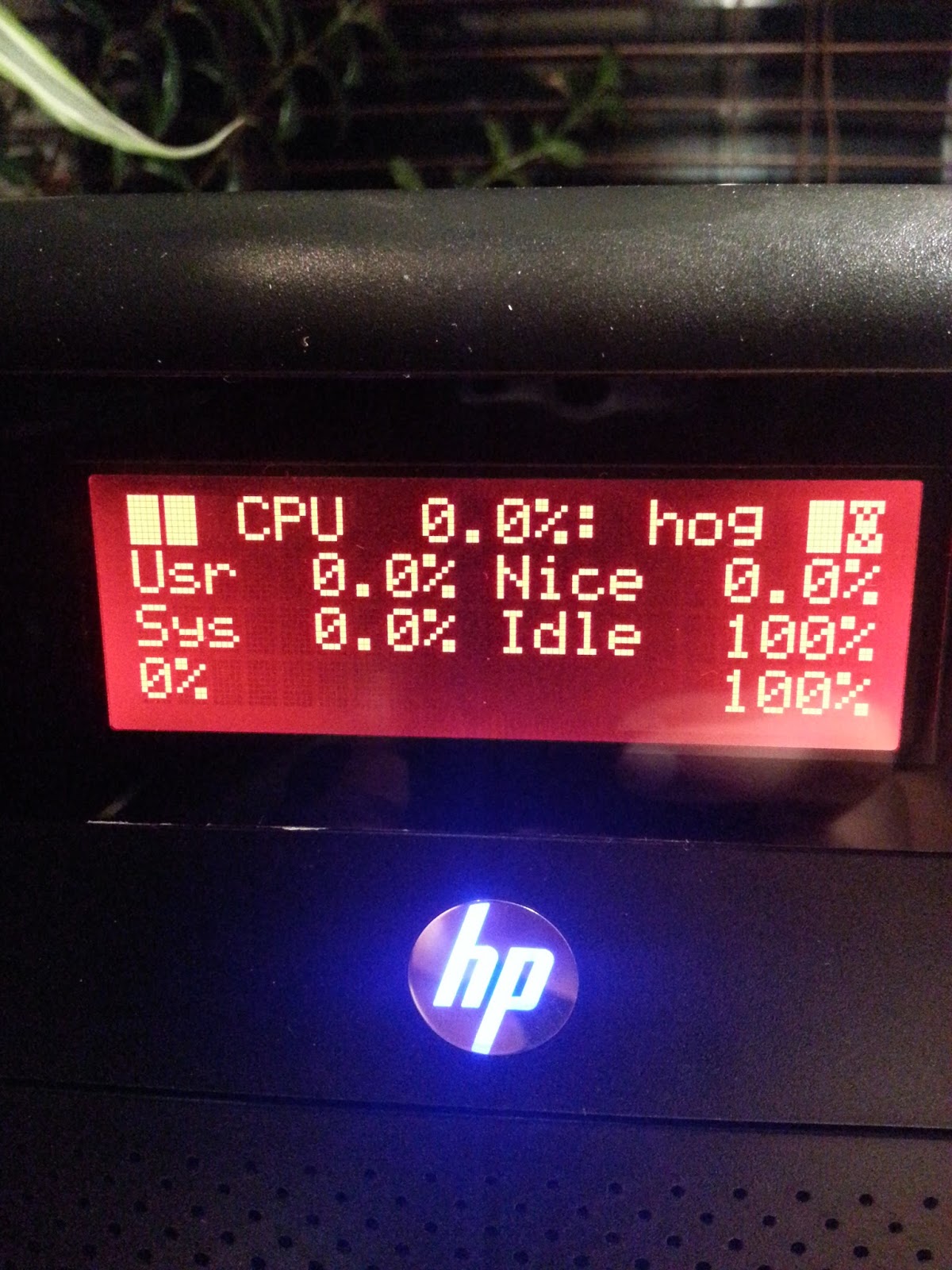
Daniel Leidert: N54L LCD-Mod with U204FR-A3 (LCDModkit) and lcdproc *pic*

N54L LCD-Mod with U204FR-A3 (LCDModkit) and lcdproc CPU screen
The picture shows my HP N54L microserver with an LCD (item no. U204FR-A3 by LCDModkit). The display is controlled via LCDd and lcdproc using the hd44780 driver. It shows the so called CPU screen here. To be continued soon ... :)

Michal Čihař: Weblate 1.6 in SUSE Studio

Finally, Weblate 1.6 is available as ready to use appliance in SUSE Studio. This took quite long as openSUSE 12.3 does not work as expected inside SUSE Studio and I was too lazy to find all necessary tweaks earlier. The same problem actually prevented from Weblate 1.5 being there at all. The biggest obstacle was MySQL setup - after enabling "Set up MySQL" in studio, you end up with MySQL database with empty mysql.users table, which obviously can not authenticate anybody. As I've found out, the only way around is manual setup. Once this was figured out, the appliance only needed minor tweaking and is now ready to use in SUSE Gallery in all formats used for virtualization.

Filed under: English Suse Weblate 0 comments Flattr this!

Julien Danjou: The definitive guide on how to use static, class or abstract methods in Python

Doing code reviews is a great way to discover things that people might struggle to comprehend. While proof-reading OpenStack patches recently, I spotted that people were not using correctly the various decorators Python provides for methods. So here's my attempt at providing me a link to send them to in my next code reviews. :-) How methods work in Python A method is a function that is stored as a class attribute. You can declare and access such a function this way:
>>> class Pizza(object):
... def __init__(self, size):
... self.size = size
... def get_size(self):
... return self.size
...
>>> Pizza.get_size
<unbound method Pizza.get_size>

What Python tells you here, is that the attribute get_size of the class Pizza is a method that is unbound. What does this mean? We'll know as soon as we'll try to call it:
>>> Pizza.get_size()
Traceback (most recent call last):
File "<stdin>", line 1, in <module>
TypeError: unbound method get_size() must be called with Pizza instance as first argument (got nothing instead)

We can't call it because it's not bound to any instance of Pizza. And a method wants an instance as its first argument (in Python 2 it must be an instance of that class; in Python 3 it could be anything). Let's try to do that then:
>>> Pizza.get_size(Pizza(42))
42

It worked! We called the method with an instance as its first argument, so everything's fine. But you will agree with me if I say this is not a very handy way to call methods; we have to refer to the class each time we want to call a method. And if we don't know what class is our object, this is not going to work for very long. So what Python does for us, is that it binds all the methods from the class Pizza to any instance of this class. This means that the attribute get_size of an instance of Pizza is a bound method: a method for which the first argument will be the instance itself.
>>> Pizza(42).get_size
<bound method Pizza.get_size of <__main__.Pizza object at 0x7f3138827910>>
>>> Pizza(42).get_size()
42

As expected, we don't have to provide any argument to get_size, since it's bound, its self argument is automatically set to our Pizza instance. Here's a even better proof of that:
>>> m = Pizza(42).get_size
>>> m()
42

Indeed, you don't even have to keep a reference to your Pizza object. Its method is bound to the object, so the method is sufficient to itself. But what if you wanted to know which object this bound method is bound to? Here's a little trick:
>>> m = Pizza(42).get_size
>>> m.__self__
<__main__.Pizza object at 0x7f3138827910>
>>> # You could guess, look at this:
...
>>> m == m.__self__.get_size
True

Obviously, we still have a reference to our object, and we can find it back if we want. In Python 3, the functions attached to a class are not considered as unbound method anymore, but as simple functions, that are bound to an object if required. So the principle stays the same, the model is just simplified.
>>> class Pizza(object):
... def __init__(self, size):
... self.size = size
... def get_size(self):
... return self.size
...
>>> Pizza.get_size
<function Pizza.get_size at 0x7f307f984dd0>

Static methods Static methods are a special case of methods. Sometimes, you'll write code that belongs to a class, but that doesn't use the object itself at all. For example:
class Pizza(object):
@staticmethod
def mix_ingredients(x, y):
return x + y

def cook(self):
return self.mix_ingredients(self.cheese, self.vegetables)

In such a case, writing mix_ingredients as a non-static method would work too, but it would provide it a self argument that would not be used. Here, the decorator @staticmethod buys us several things:
>>> Pizza().cook is Pizza().cook
False
>>> Pizza().mix_ingredients is Pizza.mix_ingredients
True
>>> Pizza().mix_ingredients is Pizza().mix_ingredients
True

Class methods Having said that, what are class methods? Class methods are methods that are not bound to an object, but to a class!
>>> class Pizza(object):
... radius = 42
... @classmethod
... def get_radius(cls):
... return cls.radius
...
>>>
>>> Pizza.get_radius
<bound method type.get_radius of <class '__main__.Pizza'>>
>>> Pizza().get_radius
<bound method type.get_radius of <class '__main__.Pizza'>>
>>> Pizza.get_radius is Pizza().get_radius
True
>>> Pizza.get_radius()
42

Whatever the way you use to access this method, it will be always bound to the class it is attached too, and its first argument will be the class itself (remember that classes are objects too). When to use this kind of methods? Well class methods are mostly useful for two types of methods:
class Pizza(object):
def __init__(self, ingredients):
self.ingredients = ingredients

@classmethod
def from_fridge(cls, fridge):
return cls(fridge.get_cheese() + fridge.get_vegetables())

class Pizza(object):
def __init__(self, radius, height):
self.radius = radius
self.height = height

@staticmethod
def compute_circumference(radius):
return math.pi * (radius ** 2)

@classmethod
def compute_volume(cls, height, radius):
return height * cls.compute_circumference(radius)

def get_volume(self):
return self.compute_volume(self.height, self.radius)

Abstract methods An abstract method is a method defined in a base class, but that may not provide any implementation. In Java, it would describe the methods of an interface. So the simplest way to write an abstract method in Python is:
class Pizza(object):
def get_radius(self):
raise NotImplementedError

Any class inheriting from Pizza should implement and override the get_radius method, otherwise an exception would be raised. This particular way of implementing abstract method has a drawback. If you write a class that inherits from Pizza and forget to implement get_radius, the error will only be raised when you'll try to use that method.
>>> Pizza()
<__main__.Pizza object at 0x7fb747353d90>
>>> Pizza().get_radius()
Traceback (most recent call last):
File "<stdin>", line 1, in <module>
File "<stdin>", line 3, in get_radius
NotImplementedError

There's a way to triggers this way earlier, when the object is being instantiated, using the abc module that's provided with Python.
import abc

class BasePizza(object):
__metaclass__ = abc.ABCMeta

@abc.abstractmethod
def get_radius(self):
"""Method that should do something."""

Using abc and its special class, as soon as you'll try to instantiate BasePizza or any class inheriting from it, you'll get a TypeError.
>>> BasePizza()
Traceback (most recent call last):
File "<stdin>", line 1, in <module>
TypeError: Can't instantiate abstract class BasePizza with abstract methods get_radius

Mixing static, class and abstract methods When building classes and inheritances, the time will come where you will have to mix all these methods decorators. So here's some tips about it. Keep in mind that declaring a class as being abstract, doesn't freeze the prototype of that method. That means that it must be implemented, but i can be implemented with any argument list.
import abc

class BasePizza(object):
__metaclass__ = abc.ABCMeta

@abc.abstractmethod
def get_ingredients(self):
"""Returns the ingredient list."""

class Calzone(BasePizza):
def get_ingredients(self, with_egg=False):
egg = Egg() if with_egg else None
return self.ingredients + egg

This is valid, since Calzone fulfil the interface requirement we defined for BasePizza objects. That means that we could also implement it as being a class or a static method, for example:
import abc

class BasePizza(object):
__metaclass__ = abc.ABCMeta

@abc.abstractmethod
def get_ingredients(self):
"""Returns the ingredient list."""

class DietPizza(BasePizza):
@staticmethod
def get_ingredients():
return None

This is also correct and fulfil the contract we have with our abstract BasePizza class. The fact that the get_ingredients method don't need to know about the object to return result is an implementation detail, not a criteria to have our contract fulfilled. Therefore, you can't force an implementation of your abstract method to be a regular, class or static method, and arguably you shouldn't. Starting with Python 3 (this won't work as you would expect in Python 2, see issue5867), it's now possible to use the @staticmethod and @classmethod decorators on top of @abstractmethod:
import abc

class BasePizza(object):
__metaclass__ = abc.ABCMeta

ingredient = ['cheese']

@classmethod
@abc.abstractmethod
def get_ingredients(cls):
"""Returns the ingredient list."""
return cls.ingredients

Don't misread this: if you think this going to force your subclasses to implement get_ingredients as a class method, you are wrong. This simply implies that your implementation of get_ingredients in the BasePizza class is a class method. An implementation in an abstract method? Yes! In Python, contrary to methods in Java interfaces, you can have code in your abstract methods and call it via super():
import abc

class BasePizza(object):
__metaclass__ = abc.ABCMeta

default_ingredients = ['cheese']

@classmethod
@abc.abstractmethod
def get_ingredients(cls):
"""Returns the ingredient list."""
return cls.default_ingredients

class DietPizza(BasePizza):
def get_ingredients(self):
return ['egg'] + super(DietPizza, self).get_ingredients()

In such a case, every pizza you will build by inheriting from BasePizza will have to override the get_ingredients method, but will be able to use the default mechanism to get the ingredient list by using super().

Matthew Garrett: Don't ship 32-bit UEFI firmware on x86

Shipping a UEFI-bootable Linux distribution is a touch awkward[1], with the main sticking point being the necessity to produce boot media with multiple El-Torito images. An El-Torito image is either an image of a floppy disk or a small hard drive, embedded into the ISO. This allows BIOS systems to look for an El Torito image, hook some interrupts and then boot without the BIOS having to care about the fact that the image is embedded in an ISO-9660 filesystem. UEFI systems will look for an El-Torito image with a special tag - if they find it they'll mount it as a FAT filesystem and look for a bootloader, and if not they'll fall back to BIOS compatibility.

So, if you want a CD that'll boot on both BIOS and UEFI systems, you need two El-Torito images - one for BIOS, one for UEFI. Unfortunately, various BIOSes deal exceptionally badly with CD images that contain more than one El-Torito image. The most common failure case is to print a menu asking you to choose an option without labelling the options, but some will just fail outright. Thankfully, this is pretty much exclusively limited to 32-bit systems.

Things get irritatingly more complicated due to a quirk of UEFI. UEFI is based on executing code in native mode. That means that 32-bit UEFI systems can't execute 64-bit code in firmware, even if the CPU is capable of it. A 64-bit OS can only boot on 32-bit UEFI if it has very ugly compatibility hacks, including having to rewrite structures and register state every time it makes a UEFI call. The only OS I'm aware of that implements this is MacOS X. Having looked into what it'd take to implement it in Linux, I decided that hammering rusty nails through my feet would be a preferable use of time. Thankfully, I went drinking instead.

So distributions have a choice. They can either produce UEFI-bootable CD images for 32-bit x86 and risk failures on actual 32-bit systems, or they can ignore UEFI entirely on 32-bit and succeed in booting on all the hardware that people actually own[2]. Unsurprisingly, they tend to choose the second option.

So, if you're building an x86 hardware platform, don't ship with 32-bit UEFI. If you're stuck with a 32-bit CPU then just ship BIOS. If you have a 64-bit CPU then ship a 64-bit UEFI. If you ship with 32-bit UEFI, no significant existing Linux distribution will support you, and you'll face an uphill battle to convince them to do so.

32-bit UEFI. Just say what on earth were you thinking, please, no, can't you find a solution that doesn't involve me getting tetanus jabs.

(If you're worried about the extra memory consumption of 64-bit OSes, just encourage 32-bit userspace on a 64-bit kernel. Or just boot via BIOS)

[1] See the number that still don't manage it despite having had several years to adapt
[2] Until recently, the only vendor to ship 32-bit UEFI firmware on volume hardware was Apple. This was fine on their 32-bit systems, but on their 64-bit systems with 32-bit UEFI booting a 64-bit version of Windows would result in boot failure. Apple rectified this by stating that 64-bit Windows wasn't supported on platforms with 32-bit UEFI, which is a neat trick if you can manage it. 32-bit Windows (and Linux) was fine because it didn't include a UEFI boot image and so didn't trigger the bug.

comment count unavailable comments

Russ Allbery: Review: And Playing the Role of Herself

Review: And Playing the Role of Herself, by K.E. Lane
Publisher: Regal Crest
Copyright: 2006
Printing: June 2010
ISBN: 1-932300-72-4
Format: Kindle
Pages: 336
Caidence Harris is an actress who has finally gotten her big shot: a starring role in the hit police drama 9th Precinct. She plays half of a police partnership; the other half is played by her best friend, the considerably more famous Liz Stokley. She's quite happy with her life and her work, and only tentatively pondering what to do about coming out (at least to herself) as a lesbian. But matters get considerably more complicated when she starts falling for Robyn Ward, a star in a parallel legal drama. And the very high-profile girlfriend of one of the best male tennis players in the world. Yes, another lesbian romance. This one has won several awards, including the highest recommendation from my friend who's been prefiltering the genre for me and pointing out only the best stories. And despite being set firmly among the rich and famous and involving TV dramas with the serial numbers filed off, he was right. This is a thoroughly enjoyable story. One of its strongest parts is how Lane develops the romance between Caidence and Robyn. There is a bit of the inevitable physical chemistry so common in romances (I still don't believe kisses work that way), and a few descriptions of physical beauty (after all, there's a built-in excuse for everyone to be TV-star beautiful). But Lane avoids putting either at the center of the relationship. Instead, this is a romance built on trust, tentative at first and then growing but rocky. That speaks to me a lot more than all the descriptions of physical chemistry. For example, we don't see Caidence and Robyn meet for the first time in the novel, as is usually the case. They've been around each other before, with Caidence acting rather tongue-tied and a bit star-struck and Robyn thinking she's rather silly. The story begins when, for whatever reason, Caidence finally manages to relax and become genuine, and then both of them become closer as they find themselves lowering barriers around each other that they normally don't lower. Lane does an excellent job using a few key facial expressions as symbols and hallmarks of that, letting the reader follow the way that trust builds through the story. The other great element of this book is Caidence's friend Liz. She could have been a stereotype of a movie star: drop-dead gorgeous, a new boyfriend each week, but not particularly intelligent. That's how she comes off at first. But as the story progresses, Lane shows more and more of their friendship, and the reader gets to see just how much Liz's first impression is a combination of an act and her unapologetic tendency to do what she wants. Underneath, she's a strong female character and an excellent, if meddling friend; by the end of the book, she was in the running for my favorite character. This is characterization of a quality that I rarely see in any genre of novel. Given that it's a romance that I enjoyed, you can correctly expect there not to be a lot of obnoxious communication breakdowns or chapters full of the main characters refusing to communicate with each other. There are, of course, a wide variety of barriers in the way of a relationship for the main characters, not the least of which being that neither of them was looking for something serious. But while they both do occasionally thoughtless or hurtful things, it's always clear just why they were thoughtless, or where their buttons were accidentally pressed, and few of the character actions are outright stupid. And, delightfully, Lane structures the story so that there are multiple, incremental payoffs. One can not only enjoy the characters getting together in the end, as they always do in this genre, but a lot of important and meaningful steps along the way. Lane does a great job putting the reader in Caidence's head, helped by first-person narration, so that one can feel just how much some moments mean to her emotionally. Add in several other fleshed-out and interesting supporting characters, some incredible architecture that was fun to imagine, and rather more in the way of plot twists and dramatic moments than I usually expect in a romance (and although the book worried me once, none of them go to the dark places that would have been less fun), and one gets a novel that kept me engrossed from start to finish. I'm tempted to read it again, and that's rare for me for a romance novel. If you're in the mood for a heart-warming story about intelligent people learning how to be together, I highly recommend this book. It's a great book to read as a stress relief when you want a story that you know will turn out "right." Rating: 9 out of 10

31 July 2013

Vincent Fourmond: Importing lots of files into git-annex

If, like me, you find git-annex very appealing, but have been moving files without it for a while, here is a little script that may help you through the transition. I've just converted my MP3 library to git-annex, but, now I must convert all my copies of the library on various computers to track one (or more) of them. The trick is to teach git-annex about the already existing files, as re-downloading a 20GB library through a 80 KB/s upload DSL line doesn't sound that funny. Here is how I did it.First, convert one repository to using git-annex. Then, switch to another computer, move away the directory containing the files to a backup directory, and git clone the first repository. Then, from the directory created, run:
~ ./import path/to/old/backup/copy

Where import is the following script:
#! /bin/bash
src="$1"
IFS=$'\n' 
for f in $(find -type l); do 
    if stat -L "$f" >/dev/null 2>/dev/null; then
        echo "File $f ok"
    else
        tg=$(readlink "$f"   sed 's/.*git/.git/' )
        dir=$(dirname "$tg")
        if [ -r "$src/$f" ]; then
            mkdir -p "$dir"
            cp -avl "$src/$f" "$tg"
        fi
    fi
done

Once this is done, you'll need to run
~ git annex fsck

Of course, there is no warranty !! It saved me lots of download time, but it could irretrievably damage your data, put your dog in danger or set fire to your house, so use with care !

Richard Hartmann: richih@debian.org

MIME-Version: 1.0
Received: by 10.194.17.9 with HTTP; Wed, 31 Jul 2013 09:21:17 -0700 (PDT)
Date: Wed, 31 Jul 2013 18:21:17 +0200
Delivered-To: richih.mailinglist@gmail.com
Message-ID: <CAD77+gQboyX1nDcJAYr-5B9Yrnmb7Uus9Yb9TzAc=C9Dnoxhcg@mail.gmail.com>
Subject: Test
From: Richard Hartmann <richih.mailinglist@gmail.com>
To: richih@debian.org
Content-Type: text/plain; charset=UTF-8
-- 
Richard

Richard Hartmann: vcsh v1.20130724

vcsh has seen a lot of activity in recent times and today's release of vcsh 1.20130724 contains a lot of useful new features. In case you haven't tried vcsh yet, or not recently, now is a very good time to do so. vcsh has been trivial to use for at least a year now, but the documentation did a very poor job of exposing that fact. Which is why there's now a 30 second howto which will get you up to speed and commiting in no time. The rest of the docs have undergone a major rewrite, as well. Feature-wise, there's If vcsh pull, vcsh push, and vcsh status sound a bit like a poor man's myrepos (formerly know as mr), that's by design. On the one hand, this enables vcsh to handle pratically all aspects of configuration management. One tool for everything On the other hand, even if you use myrepos (like I still do and will continue to do), this gives you a quick and cheap way to operate on configuration repositories, only. Especially if you're in a hurry or on a cellular connection, you may not want to pull in all changes from all remotes. If the Linux kernel or other large projects are part of your normal myrepos setup, updating them all takes time and bandwidth. Contrary to that, configuration repositories tend to be lightweight. Updating those selectively simply makes sense. Debian unstable carries the current package, Homebrew should carry it soon. Arch AUR and Fedora are getting there. And as vcsh is written in POSIX shell, it does not need to be compiled but can be run directly from a git clone without the need for installation. Did I mention that this is the perfect time to try out vcsh? ;)

B lint R czey: Meld drops support for Arch, Codeville and RCS

The latest Meld development snapshot 1.7.4 stopped supporting Arch, Codeville and RCS version control systems due to the lack of interest in maintaining it. Kai Willadsen has already called for help in May to keep support for more exotic VCS-s alive, but no one stepped up for the three dropped ones. If you would like to use Meld with Arch, Codeville or RCS in the future, it is Your time to step up and help!

Enrico Zini: Trying out new cool software

Trying out new cool software So I switched to testing, happy to have lots of new software to try. So I tried ffgtk, and reported #717662. Then I tried i7z, and reported #718418. Now I am afraid of trying another one.

Michael Stapelberg: dh-golang in unstable

Good news, everyone! dh-golang is now in Debian unstable. With this debhelper addon, packaging software written in Go is very simple. Have a look at the example/ directory in dh-golang to see how it is meant to be used. Essentially, export the DH_GOPKG variable containing the canonical upstream location of the package (e.g. github.com/stapelberg/godebiancontrol) and then use dh $@ --buildsystem=golang --with=golang. That s it! Now, given that this package is very new and only two packages use it so far (both of which are not yet in Debian, but real soon ), there are most likely bugs and missing features. This is where you come in: when packaging software written in Go, please contact me and tell me whether dh-golang worked for you and what could be improved. In case something does not work, definitely report it. Even if everything worked, I d be happy to have a look at your packaging before you upload. Also see https://wiki.debian.org/MichaelStapelberg/GoPackaging.

Christoph Berg: Version Numbers

Following an idea by Ansgar Burchardt, I've done some digging on version numbers in Debian: Most common version numbers:

projectb=> select version::text, count(*) from source group by 1 order by 2 desc;
  version     count 
------------+-------
 4:4.10.5-1     131
 1.0-1          120
 1.0.0-1         95
 1.1-1           95
 1.0.1-1         93
 1.2-1           88
 1.0-2           82
 0.2-1           80
 0.3-1           79
 0.5-1           77
 0.04-1          76
 1.1.1-1         76
 0.10-1          74
 1.4-1           72
 1.1-2           71
 0.1-1           70
 0.11-1          70
Version number with the most spellings: (considered equal by the dpkg definition, implemented in the "debversion" type)
projectb=> select version::text, count(*) from source where version = '1.02-1' group by 1 order by 2 desc;
  version     count 
------------+-------
 1.2-1           88
 1.02-1          46
 1.002-1          4
 1.000002-1       1
 001.002-1        1
 1.00002-1        1
If we look at equivalent version numbers, the first table above looks entirely different:
projectb=> select version, count(*) from source group by 1 order by 2 desc limit 30;
  version     count 
------------+-------
 0.3-1          162
 1.0-1          160
 0.05-1         156
 0.04-1         154
 0.02-1         151
 1.02-1         141
 0.006-1        133
 1.001-1        131
 4:4.10.5-1     131
 0.7-1          127
(I'm also participating in the "longest version number" contest, I've just uploaded bind9 version 1:9.8.4.dfsg.P1-6+nmu2+deb7u1~bpo60+1 to backports.)

Raphael Geissert: Ten years-old ebook reader

I own a ten years-old ebook reader.

Is it a smartphone?
It has features that make it pretty much like one, except that it can't make phone calls. So no. (However, I dare to say that making phone calls is one of the least used features of smartphones nowadays. Perhaps in the feature smartphones won't even be phones anymore, due to atrophy.)

What is it then?
It is a Sony CLI , a PEG-SJ22 to be more precise. A PDA running Palm OS 4.1 that I'm now using as an ebook reader. To my surprise, the Plucker and iSilo readers still exist and at least the latter seems somewhat alive - there is even a version for Android.

Nowadays there are ebook readers with electronic paper displays, wifi or 3G connectivity, and other features but they all come down to the same thing: an ebook reader. Truth be told, the technology is quite old. In 2004, a year after the release of the PEG-SJ22, Sony also released the LIBRI EBR-1000EP in Japan, an ebook reader with a 6" electronic paper display. A few years later is was released in the US as the Sony Reader.

Certainly, there have been advances since those devices were first released, but I have yet to see something that is really innovating. This year we are back to wrist watches, which were first released more than ten years ago - and one of them even ran linux.

Netbooks also had devices like the PEG-UX50 as their ancestor.

And if you were thinking about shoes, you've arrived late: the Puma RS already had some chips in them, and the Adidas 1 were also sported a few years ago. World, it's time to innovate.

Jan Wagner: Updated roundcube for wheezy

Roundcube is one of the well known OpenSource solutions for accessing Mails via webinterface. Unfortunately the package in wheezy is ~2 years old.
In Debian unstable the package was updated, but #714727 is blocking the migration to jessie. In the meanwhile I backported the package to wheezy. For everybody still using the sqlite (v2) backend, see here. There is no automatic migration from sqlite to sqlite3 backend.
For everybody using the package roundcube-plugins-extra, I created an updated package for roundcube 0.9 and submitted my changes to the Debian Roundcube Maintainers. If you want to give it a try, you could install the packages from my wheezy-backports repository:
# wget "http://ftp.cyconet.org/debian/sources.list.d/wheezy-backports-cyconet.list" \
    -O /etc/apt/sources.list.d/wheezy-backports-cyconet.list
# aptitude update
# aptitude -t wheezy-backports install roundcube-mysql roundcube-plugins roundcube-plugins-extra
For adding my archive key, you can just install the package "debian-cyconet-archive-keyring"

Russell Coker: Links July 2013

Wayne Mcgregor gave an interesting TED talk about the creative processes of a choreographer [1]. The dancing in this talk is really good. Melissa McEwan wrote an interesting article on whether being an ally to members of a disadvantaged group is a state or a process [2]. It seems to me that the word ally is a problem here, maybe a word like supporter would be more useful. Ken Murray wrote an insightful article How Doctors Die about the end of life choices that people with medical experience make [3]. He makes a good case for rejecting the type of treatment which has a low probability of success and a certainty of lowering the quality of life. It would be good if health insurance offered patients with terminal illness an option of $1000 per day party funds if they chose to reject the expensive and painful methods that might extend their life, that might even save enough money to allow cheaper health insurance! Rick Falkvinge wrote an interesting post about the copyright to translations of the Bible [4]. I used to think that copyright issues with religious works was only a problem with cults Joshua Foer wrote an interesting article for the New Yorker about the invention of the language Quijada which is designed for maximum precision [5]. It also has a lot of background information on constructed languages and the way that they are used.

30 July 2013

Andreas Metzler: RFH what happened to eu.org

Dear web, Do you know a human contact for the eu.org free domain name service? The mailing-list is dead (subscription is possible, but no mails are sent out) and the webpage does not provide contact points. (I already tried the role-addresses.) I would welcome hints per mail to ametzler at downhill dot eu dot org. Backstory: I would like to change where my eu.org MX record points to. As far as I can tell the web forms only support full domain delegation, while I only need to change a single eu.org hosted MX record. Thanks in advance

Next.

Previous.